Eastern's Posts
Nairaland Forum › Eastern's Profile › Eastern's Posts
 Adverts › Re: The Wonders of International Stocks by eastern(op): 10:18pm On Sep 17, 2008 Adverts › Re: The Wonders of International Stocks by eastern(op): 10:18pm On Sep 17, 2008 |
hhmm, Another massive return was made today on some global stocks, a stock making 2950%?, this could have changed someones life with an investment of just N50k. view below:
|
| Adverts › Re: The Wonders of International Stocks by eastern(op): 10:04pm On Sep 16, 2008 |
Today the % returns of some global stocks went impressively high, Imagine a stock with a percentage of 1286 for just one day, that wonderful isnt it? , but u too can benefit in such ROI. see for yourself below:
|
| Adverts › Re: The Wonders of International Stocks by eastern(op): 10:14pm On Sep 15, 2008 |
Hello every, Today some stocks did pretty well and gave us some good % return. see below:
|
| Adverts › Invitation To Succeed! by eastern(op): 1:09am On Sep 14, 2008 |
INTENSIVE AND EXECUTIVE FOREX & INTERNATIONAL STOCKS TRAINING Strictly for 30 people Venue: VILLA TUSCANA HOTELS(Banquet Hall), #1 Aguleri Street, Independence Layout Enugu, Near Govt. House Enugu. Date: 26th & 27th September and 3rd & 4th October, 2008. Time: 9am - 5pm each day Registration Fee: N35,000 only. Please Note: Registration Closes on the 24th September, 2008. Bank: Intercontinental Bank Plc A/c Number: 0093001000003428 A/c Name: Sojourn Global Services Ltd. OR Ecobank Plc A/c Number: 0370010179313301. A/c Name: [/b]Sojourn Global Services Ltd. OR Pick up your Ticket at Tuscana Hotels. [b]Contacts: Odinaka- 08033886110; Oscar- 08025524943;Ifeoma- 08068393598 Lunch will be served!!!! Materials to go home with at a discounted price: FOREX Books,Stocks Soft Copy plus stocks DVD BONUS! Free workshop on Business Leadership and Financial Management on Sunday-5th Oct.,2008 from 2pm to 5.30pm. FACILITATORS: CLIFFORD CLARKE and Team, ( PECT GLOBAL LTD) Host - SOJOURN GLOBAL SERVICES LTD |
| Art, Graphics & Video › Photo Place by eastern(op): 12:44am On Sep 14, 2008 |
hello admin, permit us to use this thread to upload any pix that is to be posted on this forum
|
| Adverts › Re: The Wonders of International Stocks by eastern(op): 11:16pm On Sep 13, 2008 |
as at of yesterday, a stock that i partook on it's share holding (PSPN) did 300% and happens to be No 2 on OTCBB microcap top % gainers list. view the list below:
|
| Adverts › Re: The Wonders of International Stocks by eastern(op): 4:48am On Sep 11, 2008 |
these global stocks below did quite well yesterday, imagine if you bought any of these stocks,what would happened to your portfolio by now!!!
|
| Adverts › Re: The Wonders of International Stocks by eastern(op): 4:30am On Sep 11, 2008 |
am gonna be using this thread to publish to us the daily percentage returns of global stocks, , watchout for it!!!!!! |
| Investment › Re: Stock Market Tips For Nigerians by eastern(m): 1:47am On Sep 10, 2008 |
hey guys what do you think of these returns on the global stocks lists below?: www.nairaland.com/attachments/96358_21_JPG0e4b6310b02bcd187c5fcc147d713003 a stock actually did 64,900% for Just one day, can you immagine that? with an investment of just N20,000 one would have made over 12million gbam!! or what do you think? |
| Adverts › Re: The Wonders of International Stocks by eastern(op): 1:37am On Sep 10, 2008 |
Hi all, I have a thread on this board titled "Learn How To Trade Global (online) Stocks", i actually use that thread as a medium to educate us on how to partake in the international stocks trading without any hassles, but a lot of us sees it as a too good to be true while some don't even think it's possible to buy stock from anywhere in the world while in Nigeria or our locality, well that's your stress, I just want us to have a look at some massive returns some microcap stocks(stocks with very small prices) does everyday. view the picture below before I continue:
|
| Adverts › The Wonders of International Stocks by eastern(op): 1:02am On Sep 10, 2008 |
If you look closely at the picture above, you could see a list of stocks that has the highest percentage gain for that day and also, you could see the highest gainer there actually did 64900% in one day (Sept. 08 2008), wow!!!, assuming you too position on that stock with just N20,000 you would have been over N12milion naira richer today. well, quite unfortunate that i couldn't purchase that stock before that massive jump. I know some of must have been saying it's impossible, well you can visit any of these research websites to find out for yourself: www.otcbb.com www.microcapmarkets.com care to learn how to fulfil your financial freedom today via global stocks? then visit this links: https://www.nairaland.com/nigeria/topic-121223.0.html or www.bizstuffs.com |
| Investment › Re: Stock Market Tips For Nigerians by eastern(m): 12:16am On Sep 04, 2008 |
@ Tufe, hahaha, If only you know who dey talk with you, you no go dey ask of hook ups, anyway If must know, the only way to come in now is by filling their offline application form and then deposit the minimum amount required to startup trading into the company's account, All pay required to startup trading are as follows: (A one time N16,000 membership fee,minimum startup capital of $250, 1% of your startup capital plus N2000, all amounts to about N48,300). Submit all payment tellers and your already filled application form to their office at No.55 Opebi Road Ikeja, Lagos or better still scan your already filled application form including all the payment tellers and send to pctsupports@gmail.com and then follow them up via phone calls and email, it takes 2 to 7 biz days for your account to be ready for trading. [move]REASONS FOR ONLINE ACCOUNT CREATION SUSPENSION[/move] The PectOnline Community decided to suspend their online account creation because they have reached the required number of clients they feel they can handle, and so they decided to allow corporate bodies to come in in form of partnership to help in handling the everly ready Nigerian crowd. But because some of the partners that has indicated interest for the deal are kind of slow on their part, The Pect Community has decided again to temporarily allow clients in but by filling the offline forms to avoid too much rush. |
| Investment › Re: Stock Market Tips For Nigerians by eastern(m): 7:56pm On Aug 31, 2008 |
@ tufe, Yes my bro they no longer accept new members for some clarified reasons but they can still take you in if you go thru the right link, if you know what i mean, trust me on this! |
| Business › Re: Learn how to trade Global (online) Stocks by eastern(op): 2:44pm On Aug 31, 2008 |
Why the confusion ztyle? have you been pondering where the world is pushing you? or are you confused on what investment vehicle you re to invest in?, what really is your problem pally?, this is a discussion board where anyone is free to express his/her self share and get their problem solved, so let's have ur expression. |
| Investment › Re: Stock Market Tips For Nigerians by eastern(m): 2:18am On Aug 31, 2008 |
Have u guys ever tot about diversifying ur portfolios on other better investment vehicles such as the international stock? cos i too don tire to dey hear too much story on this our local market that returns little in a long period of time, if we don't know, the current trend now na d global stocks trading stuff, make una wen get time do some research to see if there's a way to actually benefit from the global exchanges. i know say some of us go say: ino dey possible to buy stock listed in other countries from naija, but ino good to just conclude like that without doing a proper research. iget places where piple dey discuss heavily on global stocks for dis our country, one of dem na d Pect Investment community: www.pectonline.com/forum ,na there i see say we wen dey here still dey backward sorry to say, check it out and come back here to share ur view so that we know if we dey behind or not. , happy investing! |
| Business › Re: Learn how to trade Global (online) Stocks by eastern(op): 1:28am On Aug 31, 2008 |
CALCULATING PERCENTAGE GAIN OR LOSS IN STOCKS TRADING Trading stocks of any kind without knowing how to interpret your returns is unprofessional and so confusing so am going to let us have the formula with which to calculate it. Finding the total percentage gain or loss on a portfolio requires a few simple calculations. First, you should understand how percentage gains or losses are found on an individual security. To calculate the gain, subtract the current price or the price for which you sold the stock from the price that you initially bought it. Now that you have your gain, divide the gain by the amount of the stock. Finally, multiply your answer by 100 to get the percentage change in your investment. For example, on June 1, your portfolio is valued at $14,500. After a week of market activity, your portfolio value increases to $15,225. Your percentage return on your portfolio for the week is 5% ( ($15,225 - $14,500)/$14,500 X 100). Here is what the formula looks like: Percentage return = your selling or current price - (minus) your initial buying price / (divided) by your initial buying price again X (multiplied) by 100. If the percentage is negative, resulting from the market value being lower than the book value, you have lost on your investment. If the percentage is positive, resulting from market value being greater than book value, you have gained on your investment. I do hope this helps us. …………………, Happy trading! |
| Business › Re: Learn how to trade Global (online) Stocks by eastern(op): 1:20pm On Aug 13, 2008 |
BENEFITS FOR BEING A PECT MEMBER The PectOline Community has a variety of benefits brought together for its paid members, some important ones are listed below: Pect Partnership (A Profitable Marketing Program) Forum (Investment Resourceful Portal) Stocks Recommendation Forex Alerts and trade leads Investment Advice Personal Blog Private Portfolio Management Discounted Equity Trading Academy and lots more. 1 Like 1 Share |
| Adverts › Re: Global Stocks Trading Workshop Live In Portharcourt by eastern(op): 8:54am On Aug 10, 2008 |
Oops!!!, forgot to add contacts CONTACT Phone: 08038916150, 08064162860 E-mail: donlucky@pectonline.com www.pectonline.com |
| Business › Re: Learn how to trade Global (online) Stocks by eastern(op): 8:37am On Aug 10, 2008 |
@ D-broker, Trading global stocks through PectStocks requires just about N48,300 (forthy eight thousand three hundred niara only), The breakdown of the N48,300 goes like this: (1) Membership Fee: N16,000, PectStocks is actually built for the members of the PECT Community only, so who ever wants to trade global stocks via Pectstocks MUST be a member first by paying the membership fee. (2) Minimum startup Deposit: $250 dollar which is equivalent to N30,000 plus its 1%, making it N30,300. The 1% is the transfer charge that is required by in the intermediary banks to facilitated your transfer abroad cos all funds are transfered abroad before it could be seen in your trading account. cheers. (3) A N2000 Telex charge been charged by our local banks for transfering your money abroad. |
| Business › Re: Learn how to trade Global (online) Stocks by eastern(op): 10:48pm On Aug 08, 2008 |
CONCLUSION It is only those that understands the language of the singer can sing the corus with him, but i believe we all can sing along with me, right? I strongly believe that this tutorial will serve as an eye opener to every beginner trader and many oldbies that has the fliar to interpret what he/she sees when they research but do not have the Know-How to do so. , Happy Trading! 1 Like |
| Business › Re: Learn how to trade Global (online) Stocks by eastern(op): 8:25pm On Aug 05, 2008 |
On many tickers, colors are also used to distinguish the price at which the stock is trading. Here is the color code used by most TV stations: Green: indicates that the stock is trading higher than the most recent close. Red: indicates that the stock is trading lower than the most recent close. [b]Blue or White[/b]: means that the stock has remained at the most recent closing price. Because there are literally millions of trades done on more than 10,000 different stocks every day, it's impossible to report every single trade on the ticker tape. Most ticker tapes will select which trades to show based on factors such as volume, trading activity, price change and how widely a stock is held. |
| Business › Re: Learn how to trade Global (online) Stocks by eastern(op): 8:19pm On Aug 05, 2008 |
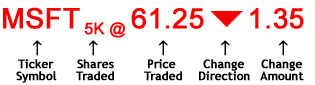
Stock Ticker If you've ever a watched financial program on CNBC or CNNfn, you've probably noticed the numbers scrolling along the bottom of the TV screen. These are known as stock tickers, a technology that has evolved substantially since it was invented in the late 1800s. https://i.investopedia.com/inv/articles/site/ticker.gif Ticker Symbol , This refers to the unique characters that are used to identify the company. Shares Traded ., This is the volume of the trade being quoted. Abbreviations are K = 1,000, M = 1,000,000 and B = 1,000,000,000 Price Traded , The price per share for the particular trade. Change Direction , Shows whether the price was higher or lower than the previous day's closing price. Change Amount , The difference in price from the previous day's close. |
| Business › Re: Learn how to trade Global (online) Stocks by eastern(op): 8:12pm On Aug 05, 2008 |
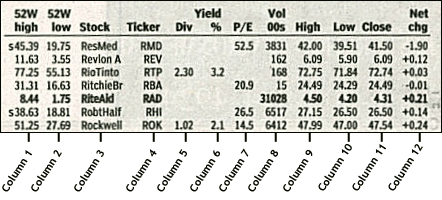
On photo No.1, Columns 1 & 2: 52-Week High and Low. These are the highest and lowest prices at which a stock has traded over the past 52 weeks (1 year). This typically does not include the previous day's trading. Column 3: Company Name and Type of Stock. This column lists the name of the company. If there are no special symbols or letters following the name, it is common stock. Different symbols imply different classes of shares. For example, "pf" means the shares are preferred stock. Column 4: Ticker Symbol. This is the unique alphabetic name which identifies the stock. If you watch financial TV, the ticker tape will quote the latest prices alongside this symbol. If you are looking for stock quotes online, you always search for a company by the ticker symbol. If you don't know a particular company's ticker symbol, you can search for it at Yahoo Finance. Column 5: Dividend Per Share. This indicates the annual dividend payment per share. If this space is blank, the company does not currently pay out dividends. Column 6: Dividend Yield. The percentage return on the dividend, dividend yield is calculated as annual dividends per share divided by price per share. Column 7: Price/Earnings Ratio (P/E ratio). This is calculated by dividing the current stock price by earnings per share from the last four quarters. (we shall later look at P/E ratio in a more comprehensive way) Column 8: Trading Volume. This figure shows the total number of shares traded for the day, listed in hundreds. To get the actual number traded, add two zeros to the end of the number listed. Column 9 & 10: Day High and Low. This indicates the price range in which the stock has traded throughout the day. In other words, these are the maximum and the minimum prices that people have paid for the stock. Column 11: Close. The close is the last trading price recorded when the market closed on the day. If the closing price is more than 5% above or below the previous day's close, the entire listing for that stock is bold-faced. Keep in mind, you are not guaranteed to get this price if you buy the stock the next day because the price is constantly changing, even after the exchange is closed for the day. The close is merely an indicator of past performance and, except in extreme circumstances, it serves as a ballpark of what you should expect to pay. Column 12: Net Change. This is the dollar value change in the stock price from the previous day's closing price. When you hear about a stock being "up for the day," it means the net change was positive. Quotes on the Internet Nowadays, it's far more convenient for most people to get stock quotes on the internet. This method is superior because most sites update throughout the day and give you more information, news, charting and research. To get quotes, simply enter the ticker symbol into the quote box of any major financial site like google finance, Yahoo Finance, CBS Marketwatch, or Quicken.com. The data qouted can also be interpreted exactly as it would if it were from the newspaper. |
| Business › Re: Learn how to trade Global (online) Stocks by eastern(op): 7:05pm On Aug 05, 2008 |
UNDERSTANDING STOCKS FINANCIAL TABLE Introduction Many new investors/traders are intimidated by the financial tables they see on the sites when they search for a stock's updates and history. It's easy to see why. These tables pack a lot of information into a small space and can be complicated unless you know what you are looking for. Learning how to read these tables will help you keep track of your portfolio's performance. This lecture will take you through six of the most popular financial tables and tickers you see in newspapers, on television and on the Internet. We will focus on how to interpret the data. Open any financial paper or quote for any stock today and you will see stock quotes that look something like the images below. In this section, we'll explain how to make sense of these tables so that you can use the information to your advantage. Let's take a look at the stock/quotes tables: No.1https://i.investopedia.com/inv/tutorials/site/tables/table.gif No.2https://i.investopedia.com/inv/tutorials/site/tables/stock_quote.gif we are gonna look at No.1 as a case of study |
| Business › Re: Learn how to trade Global (online) Stocks by eastern(op): 6:17pm On Aug 05, 2008 |
DIVIDEND 1. A distribution of a portion of a company's earnings, decided by the board of directors, to a class of its shareholders. The dividend is most often quoted in terms of the dollar amount each share receives (dividends per share). It can also be quoted in terms of a percent of the current market price, referred to as dividend yield. Also referred to as "Dividend Per Share (DPS)." 2. Mandatory distributions of income and realized capital gains made to mutual fund investors. (i) Dividends may be in the form of cash, stock or property. Most secure and stable companies offer dividends to their stockholders. Their share prices might not move much, but the dividend attempts to make up for this. High-growth companies rarely offer dividends because all of their profits are reinvested to help sustain higher-than-average growth. (ii) Mutual funds pay out interest and dividend income received from their portfolio holdings as dividends to fund shareholders. In addition, realized capital gains from the portfolio's trading activities are generally paid out (capital gains distribution) as a year-end dividend. The Importance of Dividends One of the simplest ways for companies to communicate financial well-being and shareholder value is to say "the dividend check is in the mail." Dividends, those cash distributions that many companies pay out regularly to shareholders from earnings, send a clear, powerful message about future prospects and performance. A company's willingness and ability to pay steady dividends over time--and its power to increase them--provide good clues about its fundamentals. Dividends Signal Fundamentals Before corporations were required by law to disclose financial information in the 1930s, a company's ability to pay dividends was one of the few signs of its financial health. Despite the Securities and Exchange Act of 1934 and the increased transparency it brought to the industry, dividends still remain a worthwhile yardstick of a company's prospects. Typically, mature, profitable companies pay dividends. However, companies that do not pay dividends are not necessarily without profits. If a company thinks that its own growth opportunities are better than investment opportunities available to shareholders elsewhere, the company should keep the profits and reinvest them into the business. For these reasons, few "growth" companies pay dividends. But even mature companies, while much of their profits may be distributed as dividends, still need to retain enough cash to fund business activity and handle contingencies. The progression of Microsoft through its life cycle demonstrates the relationship between dividends and growth. When Bill Gate's brainchild was a high-flying growth company, it paid no dividends, but reinvested all earnings to fuel further growth. Eventually, this 800-pound software "gorilla" reached a point where it could no longer grow at the unprecedented rate it had maintained for so long. So, instead of rewarding shareholders through capital appreciation, the company began to use dividends and share buybacks as a way of keeping investors interested. The plan was announced in July 2004, nearly 18 years after the company's IPO. The cash distribution plan put nearly $75 billion worth of value into the pockets of investors through a new $0.08 quarterly dividend, a special $3 one-time dividend, and a $30 billion share buyback program spanning four years. The Dividend Yield Many investors like to watch the dividend yield, which is calculated as the annual dividend income per share divided by the current share price. The dividend yield measures the amount of income received in proportion to the share price. If a company has a low dividend yield compared to other companies in its sector, it can mean two things: (1) the share price is high because the market reckons the company has impressive prospects and isn't overly worried about the company's dividend payments, or (2) the company is in trouble and cannot afford to pay reasonable dividends. At the same time, however, a high dividend yield can signal a sick company with a depressed share price. For more on this subject, check out the Dogs of the Dow section in the "Guide to Stock Picking." Dividend yield is of little importance for growth companies because, as we discussed above, retained earnings will be reinvested in expansion opportunities, giving shareholders profits in the form of capital gains (think Microsoft). Dividend Coverage Ratio When you evaluate a company's dividend-paying practices, ask yourself if the company can afford to pay the dividend. The ratio between a company's earnings and net dividend paid to shareholders--known as dividend coverage--remains a well-used tool for measuring whether earnings are sufficient to cover dividend obligations. The ratio is calculated as earnings per share divided by the dividend per share. When coverage is getting thin, odds are good that there will be a dividend cut, which can have a dire impact on valuation. Investors can feel safe with a coverage ratio of 2 or 3. In practice, however, the coverage ratio becomes a pressing indicator when coverage slips below about 1.5, at which point prospects start to look risky. If the ratio is under 1, the company is using its retained earnings from last year to pay this year's dividend. At the same time, if the payout gets very high, say above 5, investors should ask whether management is withholding excess earnings, not paying enough cash to shareholders. Managers who raise their dividends are telling investors that the course of business over the coming 12 months or more will be stable. For instance, when Kimberly Clark, the giant of personal care products, increased its dividend by 13% in the first quarter of 2003, the company was telling investors that the punishing price war with Proctor & Gamble was not a long-term problem. The signal was even stronger because KC said it intended to increase its dividend further over the following five years. The Dreaded Dividend Cut If a company with a history of consistently rising dividend payments suddenly cuts its payments, investors should treat this as a signal that trouble is looming. Texas Utilities, for instance, once recognized for its consistent payouts, was among the highest-yielding stocks available. Then in 2002, the company cut its quarterly dividend, and the stock price plummeted by nearly a third in a single day. While a history of steady or increasing dividends is certainly reassuring, investors need to be wary of companies that rely on borrowings to finance those payments. Again, take the utilities industry, which once attracted investors with reliable earnings and fat dividends. As some of those companies were diverting cash into expansion opportunities while trying to maintain dividend levels, they had to take on greater debt levels. Watch out for companies with debt-to-equity ratios greater than 60%. Higher debt levels often lead to pressure from Wall Street as well as debt-rating agencies. That, in turn, can hamper a company's ability to pay its dividend. Great Disciplinarian Dividends bring more discipline to management's investment decision-making. Holding onto profits might lead to excessive executive compensation, sloppy management, and unproductive use of assets. Jarad Harford, professor of finance at University of Oregon, finds that the more cash a company keeps, the more likely it will overpay for acquisitions and, in turn, damage shareholder value. In fact, companies that pay dividends tend to be more efficient in their use of capital than similar companies that do not pay dividends. Furthermore, companies that pay dividends are less likely to be cooking the books. Let's face it; managers can be awfully creative when it comes to making earnings look good. But with dividend obligations to meet twice a year, manipulation becomes that much more challenging. Finally, dividends are public promises. Breaking them is both embarrassing to management and damaging to share prices. To tarry over raising dividends, never mind suspending them, is seen as a confession of failure. A Way to Calculate Value Dividends can give investors a sense of what a company is really worth. The dividend discount model is a classic formula that explains the underlying value of a share, and it is a staple of the capital asset pricing model which, in turn, is the basis of corporate finance theory. According to the model, a share is worth the sum of all its prospective dividend payments, 'discounted back' to their net present value. As dividends are a form of cash flow to the investor, they are an important reflection of a company's value. It is important to note also that stocks with dividends are less likely to reach unsustainable values. Investors have long known that dividends put a ceiling on market declines. |
| Business › Re: Learn how to trade Global (online) Stocks by eastern(op): 6:14pm On Aug 05, 2008 |
Share Volume Share volume is a number of share or contracts traded in a security or an entire market during a given period of time. It is simply the amount of shares that trade hands from sellers to buyers as a measure of activity. If a buyer of a stock purchases 100 shares from a seller, then the volume for that period increases by 100 shares based on that transaction. Importance - Volume is an important indicator in technical analysis as it is used to measure the worth of a market move. If the markets have made strong price move either up or down, the perceived strength of that move depends on the volume for that period, Investors care because they know that when there is more share volume traded for that period; it could be a day(s) , week(s) or month, then that stock's share price will shoot up, so it's wise for you as an individual investor to use it also as an indicator to predict the direction of a stock for better trading results. Dollar volume This is the total dollar amount for shares or contracts traded in a security or an entire market during a given period of time. It is the total dollar volume trade hands from sellers to buyers as a measure of activity. If a buyer spends $1000 to acquire a stock from a seller, then the dollar volume for that period increases by $1000 based on that transaction. Importance – Dollar Volume is an important factor to be considered when measuring the prospect of a market’s growth. Compared to share volume, dollar volume has a higher indication when it comes to knowing a market’s movement strength; for example, if stock A has 100,000 share volume and $100,000 dollars volume on a given period, and stock B has 10,000 share volume and $1,000,000 dollar volume for the same given period, stock B will sure going to have higher price movement compared to that of A because the value of a stock is determined by its cash value or capitalization. Investors care because it’s a major indicator or tool for tracking a stock with a good growth prospect. |
| Business › Re: Learn how to trade Global (online) Stocks by eastern(op): 6:13pm On Aug 05, 2008 |
PARTNERSHIP A business organization in which two or more individuals manage and operate the business. Both owners are equally and personally liable for the debts from the business. Partnership doesn't always mean two people. There are many large partnerships that have thousands of partners. Patent This is an exclusive right given to a dealer, producer or a company by the government to deal, produce, without fear of any kind over a given period of time. In the United States most patents are valid for 20 years. By granting the right to produce a new product without fear of competition, patents provide incentive for companies or individuals to continue developing innovative new products or services. Why investors care A Patent award usually gives the holder a long term right for innovation; this simply means that the holder has all it takes for his company to increase in production and in value without any hassle. Consequently, the share price of such company is expected to grow higher in short while. This is what every wise investor or trader looks out for in a company, we as an investor want to invest in stock that has the potential to changing our little capital to millions of dollars in long run. Patent Reexamination A process conducted by the U.S. Patent and Trademark Office (USPTO) on a patent that already has been issued in order to verify the claims and scope of the patent. A patent reexamination is usually brought about by the original patent holder when that party feels another party has produced a product or service that infringes on its patent. Both parties are given the opportunity to state their cases in writing, and then the USPTO will render its judgment. The reexamination process originated as a cheaper and faster way to settle patent disputes rather than through litigation. Patents and other intellectual properties are an extremely valuable asset for a company - one worth protecting. In certain industries, such as technology and generic drugs, patent disputes involve very large stakes in today's marketplace, and the outcome of a patent reexamination or trial can cause big swings in the underlying stocks of the companies involved. Patent Share The percentage share of a universe of patents owned or created by one subset of that universe. This term usually applies to a comparative share between nations. Patent share has been subdivided not only across nations, but within industry groups and even in companies relative to each other. Patent share is becoming increasingly important to competitive advantage as the applicability of patents extends into information processes, computer software, chemical formulas and other intangibles. For example, the United States had a worldwide patent share of 43% as of 2003. The United States Patent & Trademark Office (USPTO) keeps track of the percentage of new patent issues that belong to every country on the globe, as well as the ratio of company-owned patents to those held by individuals. By examining industries that are growing their market shares in patent discoveries, investors can get a sense of the health and vibrancy of an industry. Industries such as technology, biotech and pharmaceuticals have seen the largest share gains in the past decade; they also show the highest annual growth rates. |
| Business › Re: Learn how to trade Global (online) Stocks by eastern(op): 6:55pm On Aug 04, 2008 |
Distinction between Mergers and Acquisitions Although they are often uttered in the same breath and used as though they were synonymous, the terms merger and acquisition mean slightly different things. When one company takes over another and clearly established itself as the new owner, the purchase is called an acquisition. From a legal point of view, the target company ceases to exist, the buyer "swallows" the business and the buyer's stock continues to be traded. In the pure sense of the term, a merger happens when two firms, often of about the same size, agree to go forward as a single new company rather than remain separately owned and operated. This kind of action is more precisely referred to as a "merger of equals." Both companies' stocks are surrendered and new company stock is issued in its place. For example, both Daimler-Benz and Chrysler ceased to exist when the two firms merged, and a new company, DaimlerChrysler, was created. In practice, however, actual mergers of equals don't happen very often. Usually, one company will buy another and, as part of the deal's terms, simply allow the acquired firm to proclaim that the action is a merger of equals, even if it's technically an acquisition. Being bought out often carries negative connotations, therefore, by describing the deal as a merger, deal makers and top managers try to make the takeover more palatable. A purchase deal will also be called a merger when both CEOs agree that joining together is in the best interest of both of their companies. But when the deal is unfriendly - that is, when the target company does not want to be purchased - it is always regarded as an acquisition. Whether a purchase is considered a merger or an acquisition really depends on whether the purchase is friendly or hostile and how it is announced. In other words, the real difference lies in how the purchase is communicated to and received by the target company's board of directors, employees and shareholders. Synergy Synergy is the magic force that allows for enhanced cost efficiencies of the new business. Synergy takes the form of revenue enhancement and cost savings. By merging, the companies hope to benefit from the following: Staff reductions - As every employee knows, mergers tend to mean job losses. Consider all the money saved from reducing the number of staff members from accounting, marketing and other departments. Job cuts will also include the former CEO, who typically leaves with a compensation package. Economies of scale - Yes, size matters. Whether it's purchasing stationery or a new corporate IT system, a bigger company placing the orders can save more on costs. Mergers also translate into improved purchasing power to buy equipment or office supplies - when placing larger orders, companies have a greater ability to negotiate prices with their suppliers. Acquiring new technology - To stay competitive, companies need to stay on top of technological developments and their business applications. By buying a smaller company with unique technologies, a large company can maintain or develop a competitive edge. Improved market reach and industry visibility - Companies buy companies to reach new markets and grow revenues and earnings. A merge may expand two companies' marketing and distribution, giving them new sales opportunities. A merger can also improve a company's standing in the investment community: bigger firms often have an easier time raising capital than smaller ones. That said, achieving synergy is easier said than done - it is not automatically realized once two companies merge. Sure, there ought to be economies of scale when two businesses are combined, but sometimes a merger does just the opposite. In many cases, one and one add up to less than two. Sadly, synergy opportunities may exist only in the minds of the corporate leaders and the deal makers. Where there is no value to be created, the CEO and investment bankers - who have much to gain from a successful M&A deal - will try to create an image of enhanced value. The market, however, eventually sees through this and penalizes the company by assigning it a discounted share price. We'll talk more about why M&A may fail in a later section of this tutorial. Varieties of Mergers From the perspective of business structures, there is a whole host of different mergers. Here are a few types, distinguished by the relationship between the two companies that are merging: Horizontal merger - Two companies that are in direct competition and share the same product lines and markets. Vertical merger - A customer and company or a supplier and company. Think of a cone supplier merging with an ice cream maker. Market-Extension merger - Two companies that sells the same products in different markets. Product-Extension merger - Two companies selling different but related products in the same market. Conglomeration - Two companies that have no common business areas. There are two types of mergers that are distinguished by how the merger is financed. Each has certain implications for the companies involved and for investors: Purchase Mergers - As the name suggests, this kind of merger occurs when one company purchases another. The purchase is made with cash or through the issue of some kind of debt instrument; the sale is taxable. Acquiring companies often prefer this type of merger because it can provide them with a tax benefit. Acquired assets can be written-up to the actual purchase price, and the difference between the book value and the purchase price of the assets can depreciate annually, reducing taxes payable by the acquiring company. We will discuss this further in part four of this tutorial. Consolidation Mergers - With this merger, a brand new company is formed and both companies are bought and combined under the new entity. The tax terms are the same as those of a purchase merger. Valuation Matters Investors in a company that are aiming to take over another one must determine whether the purchase will be beneficial to them. In order to do so, they must ask themselves how much the company being acquired is really worth. Naturally, both sides of an M&A deal will have different ideas about the worth of a target company: its seller will tend to value the company at as high of a price as possible, while the buyer will try to get the lowest price that he can. There are, however, many legitimate ways to value companies. The most common method is to look at comparable companies in an industry, but deal makers employ a variety of other methods and tools when assessing a target company. Here are just a few of them: Comparative Ratios - The following are two examples of the many comparative metrics on which acquiring companies may base their offers: Price-Earnings Ratio (P/E Ratio) - With the use of this ratio, an acquiring company makes an offer that is a multiple of the earnings of the target company. Looking at the P/E for all the stocks within the same industry group will give the acquiring company good guidance for what the target's P/E multiple should be. Enterprise-Value-to-Sales Ratio (EV/Sales) - With this ratio, the acquiring company makes an offer as a multiple of the revenues, again, while being aware of the price-to-sales ratio of other companies in the industry. Replacement Cost - In a few cases, acquisitions are based on the cost of replacing the target company. For simplicity's sake, suppose the value of a company is simply the sum of all its equipment and staffing costs. The acquiring company can literally order the target to sell at that price, or it will create a competitor for the same cost. Naturally, it takes a long time to assemble good management, acquire property and get the right equipment. This method of establishing a price certainly wouldn't make much sense in a service industry where the key assets - people and ideas - are hard to value and develop. Discounted Cash Flow (DCF) - A key valuation tool in M&A, discounted cash flow analysis determines a company's current value according to its estimated future cash flows. Forecasted free cash flows (net income + depreciation/amortization - capital expenditures - change in working capital) are discounted to a present value using the company's weighted average costs of capital (WACC). Admittedly, DCF is tricky to get right, but few tools can rival this valuation method. Synergy: The Premium for Potential Success For the most part, acquiring companies nearly always pay a substantial premium on the stock market value of the companies they buy. The justification for doing so nearly always boils down to the notion of synergy; a merger benefits shareholders when a company's post-merger share price increases by the value of potential synergy. Let's face it, it would be highly unlikely for rational owners to sell if they would benefit more by not selling. That means buyers will need to pay a premium if they hope to acquire the company, regardless of what pre-merger valuation tells them. For sellers, that premium represents their company's future prospects. For buyers, the premium represents part of the post-merger synergy they expect can be achieved. The following equation offers a good way to think about synergy and how to determine whether a deal makes sense. The equation solves for the minimum required synergy: In other words, the success of a merger is measured by whether the value of the buyer is enhanced by the action. However, the practical constraints of mergers, which we discuss in part five, often prevent the expected benefits from being fully achieved. Alas, the synergy promised by deal makers might just fall short. What to Look For It's hard for investors to know when a deal is worthwhile. The burden of proof should fall on the acquiring company. To find mergers that have a chance of success, investors should start by looking for some of these simple criteria: A reasonable purchase price - A premium of, say, 10% above the market price seems within the bounds of level-headedness. A premium of 50%, on the other hand, requires synergy of stellar proportions for the deal to make sense. Stay away from companies that participate in such contests. Cash transactions - Companies that pay in cash tend to be more careful when calculating bids and valuations come closer to target. When stock is used as the currency for acquisition, discipline can go by the wayside. Sensible appetite – An acquiring company should be targeting a company that is smaller and in businesses that the acquiring company knows intimately. Synergy is hard to create from companies in disparate business areas. Sadly, companies have a bad habit of biting off more than they can chew in mergers. Mergers are awfully hard to get right, so investors should look for acquiring companies with a healthy grasp of reality. Doing the Deal Start with an Offer When the CEO and top managers of a company decide that they want to do a merger or acquisition, they start with a tender offer. The process typically begins with the acquiring company carefully and discreetly buying up shares in the target company, or building a position. Once the acquiring company starts to purchase shares in the open market, it is restricted to buying 5% of the total outstanding shares before it must file with the SEC. In the filing, the company must formally declare how many shares it owns and whether it intends to buy the company or keep the shares purely as an investment. Working with financial advisors and investment bankers, the acquiring company will arrive at an overall price that it's willing to pay for its target in cash, shares or both. The tender offer is then frequently advertised in the business press, stating the offer price and the deadline by which the shareholders in the target company must accept (or reject) it. The Target's Response Once the tender offer has been made, the target company can do one of several things: Accept the Terms of the Offer - If the target firm's top managers and shareholders are happy with the terms of the transaction, they will go ahead with the deal. Attempt to Negotiate - The tender offer price may not be high enough for the target company's shareholders to accept, or the specific terms of the deal may not be attractive. In a merger, there may be much at stake for the management of the target - their jobs, in particular. If they're not satisfied with the terms laid out in the tender offer, the target's management may try to work out more agreeable terms that let them keep their jobs or, even better, send them off with a nice, big compensation package. Not surprisingly, highly sought-after target companies that are the object of several bidders will have greater latitude for negotiation. Furthermore, managers have more negotiating power if they can show that they are crucial to the merger's future success. Execute a Poison Pill or Some Other Hostile Takeover Defense – A poison pill scheme can be triggered by a target company when a hostile suitor acquires a predetermined percentage of company stock. To execute its defense, the target company grants all shareholders - except the acquiring company - options to buy additional stock at a dramatic discount. This dilutes the acquiring company's share and intercepts its control of the company. Find a White Knight - As an alternative, the target company's management may seek out a friendlier potential acquiring company, or white knight. If a white knight is found, it will offer an equal or higher price for the shares than the hostile bidder. Mergers and acquisitions can face scrutiny from regulatory bodies. For example, if the two biggest long-distance companies in the U.S., AT&T and Sprint, wanted to merge, the deal would require approval from the Federal Communications Commission (FCC). The FCC would probably regard a merger of the two giants as the creation of a monopoly or, at the very least, a threat to competition in the industry. Closing the Deal Finally, once the target company agrees to the tender offer and regulatory requirements are met, the merger deal will be executed by means of some transaction. In a merger in which one company buys another, the acquiring company will pay for the target company's shares with cash, stock or both. A cash-for-stock transaction is fairly straightforward: target company shareholders receive a cash payment for each share purchased. This transaction is treated as a taxable sale of the shares of the target company. If the transaction is made with stock instead of cash, then it's not taxable. There is simply an exchange of share certificates. The desire to steer clear of the tax man explains why so many M&A deals are carried out as stock-for-stock transactions. When a company is purchased with stock, new shares from the acquiring company's stock are issued directly to the target company's shareholders, or the new shares are sent to a broker who manages them for target company shareholders. The shareholders of the target company are only taxed when they sell their new shares. When the deal is closed, investors usually receive a new stock in their portfolios - the acquiring company's expanded stock. Sometimes investors will get new stock identifying a new corporate entity that is created by the M&A deal. Break Ups As mergers capture the imagination of many investors and companies, the idea of getting smaller might seem counterintuitive. But corporate break-ups, or de-mergers, can be very attractive options for companies and their shareholders. Advantages The rationale behind a spin-off, tracking stock or carve-out is that "the parts are greater than the whole." These corporate restructuring techniques, which involve the separation of a business unit or subsidiary from the parent, can help a company raise additional equity funds. A break-up can also boost a company's valuation by providing powerful incentives to the people who work in the separating unit, and help the parent's management to focus on core operations. Most importantly, shareholders get better information about the business unit because it issues separate financial statements. This is particularly useful when a company's traditional line of business differs from the separated business unit. With separate financial disclosure, investors are better equipped to gauge the value of the parent corporation. The parent company might attract more investors and, ultimately, more capital. Also, separating a subsidiary from its parent can reduce internal competition for corporate funds. For investors, that's great news: it curbs the kind of negative internal wrangling that can compromise the unity and productivity of a company. For employees of the new separate entity, there is a publicly traded stock to motivate and reward them. Stock options in the parent often provide little incentive to subsidiary managers, especially because their efforts are buried in the firm's overall performance. Disadvantages That said, de-merged firms are likely to be substantially smaller than their parents, possibly making it harder to tap credit markets and costlier finance that may be affordable only for larger companies. And the smaller size of the firm may mean it has less representation on major indexes, making it more difficult to attract interest from institutional investors. Meanwhile, there are the extra costs that the parts of the business face if separated. When a firm divides itself into smaller units, it may be losing the synergy that it had as a larger entity. For instance, the division of expenses such as marketing, administration and research and development (R&  ) into different business units may cause redundant costs without increasing overall revenues. ) into different business units may cause redundant costs without increasing overall revenues. Restructuring Methods There are several restructuring methods: doing an outright sell-off, doing an equity carve-out, spinning off a unit to existing shareholders or issuing tracking stock. Each has advantages and disadvantages for companies and investors. All of these deals are quite complex. Sell-Offs A sell-off, also known as a divestiture, is the outright sale of a company subsidiary. Normally, sell-offs are done because the subsidiary doesn't fit into the parent company's core strategy. The market may be undervaluing the combined businesses due to a lack of synergy between the parent and subsidiary. As a result, management and the board decide that the subsidiary is better off under different ownership. Besides getting rid of an unwanted subsidiary, sell-offs also raise cash, which can be used to pay off debt. In the late 1980s and early 1990s, corporate raiders would use debt to finance acquisitions. Then, after making a purchase they would sell-off its subsidiaries to raise cash to service the debt. The raiders' method certainly makes sense if the sum of the parts is greater than the whole. When it isn't, deals are unsuccessful. Equity Carve-Outs More and more companies are using equity carve-outs to boost shareholder value. A parent firm makes a subsidiary public through an initial public offering (IPO) of shares, amounting to a partial sell-off. A new publicly-listed company is created, but the parent keeps a controlling stake in the newly traded subsidiary. A carve-out is a strategic avenue a parent firm may take when one of its subsidiaries is growing faster and carrying higher valuations than other businesses owned by the parent. A carve-out generates cash because shares in the subsidiary are sold to the public, but the issue also unlocks the value of the subsidiary unit and enhances the parent's shareholder value. The new legal entity of a carve-out has a separate board, but in most carve-outs, the parent retains some control. In these cases, some portion of the parent firm's board of directors may be shared. Since the parent has a controlling stake, meaning both firms have common shareholders, the connection between the two will likely be strong. That said, sometimes companies carve-out a subsidiary not because it's doing well, but because it is a burden. Such an intention won't lead to a successful result, especially if a carved-out subsidiary is too loaded with debt, or had trouble even when it was a part of the parent and is lacking an established track record for growing revenues and profits. Carve-outs can also create unexpected friction between the parent and subsidiary. Problems can arise as managers of the carved-out company must be accountable to their public shareholders as well as the owners of the parent company. This can create divided loyalties. Spin-offs A spin-offs occurs when a subsidiary becomes an independent entity. The parent firm distributes shares of the subsidiary to its shareholders through a stock dividend. Since this transaction is a dividend distribution, no cash is generated. Thus, spin-offs are unlikely to be used when a firm needs to finance growth or deals. Like the carve-out, the subsidiary becomes a separate legal entity with a distinct management and board. Like carve-outs, spin-offs are usually about separating a healthy operation. In most cases, spin-offs unlock hidden shareholder value. For the parent company, it sharpens management focus. For the spin-off company, management doesn't have to compete for the parent's attention and capital. Once they are set free, managers can explore new opportunities. Investors, however, should beware of throw-away subsidiaries the parent created to separate legal liability or to off-load debt. Once spin-off shares are issued to parent company shareholders, some shareholders may be tempted to quickly dump these shares on the market, depressing the share valuation. Tracking Stock A tracking stock is a special type of stock issued by a publicly held company to track the value of one segment of that company. The stock allows the different segments of the company to be valued differently by investors. Let's say a slow-growth company trading at a low price-earnings ratio (P/E ratio) happens to have a fast growing business unit. The company might issue a tracking stock so the market can value the new business separately from the old one and at a significantly higher P/E rating. Why would a firm issue a tracking stock rather than spinning-off or carving-out its fast growth business for shareholders? The company retains control over the subsidiary; the two businesses can continue to enjoy synergies and share marketing, administrative support functions, a headquarters and so on. Finally, and most importantly, if the tracking stock climbs in value, the parent company can use the tracking stock it owns to make acquisitions. Still, shareholders need to remember that tracking stocks are class B, meaning they don't grant shareholders the same voting rights as those of the main stock. Each share of tracking stock may have only a half or a quarter of a vote. In rare cases, holders of tracking stock have no vote at all. Why They Can Fail It's no secret that plenty of mergers don't work. Those who advocate mergers will argue that the merger will cut costs or boost revenues by more than enough to justify the price premium. It can sound so simple: just combine computer systems, merge a few departments, use sheer size to force down the price of supplies and the merged giant should be more profitable than its parts. In theory, 1+1 = 3 sounds great, but in practice, things can go awry. Historical trends show that roughly two thirds of big mergers will disappoint on their own terms, which means they will lose value on the stock market. The motivations that drive mergers can be flawed and efficiencies from economies of scale may prove elusive. In many cases, the problems associated with trying to make merged companies work are all too concrete. Flawed Intentions For starters, a booming stock market encourages mergers, which can spell trouble. Deals done with highly rated stock as currency are easy and cheap, but the strategic thinking behind them may be easy and cheap too. Also, mergers are often attempt to imitate: somebody else has done a big merger, which prompts other top executives to follow suit. A merger may often have more to do with glory-seeking than business strategy. The executive ego, which is boosted by buying the competition, is a major force in M&A, especially when combined with the influences from the bankers, lawyers and other assorted advisers who can earn big fees from clients engaged in mergers. Most CEOs get to where they are because they want to be the biggest and the best, and many top executives get a big bonus for merger deals, no matter what happens to the share price later. On the other side of the coin, mergers can be driven by generalized fear. Globalization, the arrival of new technological developments or a fast-changing economic landscape that makes the outlook uncertain are all factors that can create a strong incentive for defensive mergers. Sometimes the management team feels they have no choice and must acquire a rival before being acquired. The idea is that only big players will survive a more competitive world. The Obstacles to Making it Work Coping with a merger can make top managers spread their time too thinly and neglect their core business, spelling doom. Too often, potential difficulties seem trivial to managers caught up in the thrill of the big deal. The chances for success are further hampered if the corporate cultures of the companies are very different. When a company is acquired, the decision is typically based on product or market synergies, but cultural differences are often ignored. It's a mistake to assume that personnel issues are easily overcome. For example, employees at a target company might be accustomed to easy access to top management, flexible work schedules or even a relaxed dress code. These aspects of a working environment may not seem significant, but if new management removes them, the result can be resentment and shrinking productivity. More insight into the failure of mergers is found in the highly acclaimed study from McKinsey, a global consultancy. The study concludes that companies often focus too intently on cutting costs following mergers, while revenues, and ultimately, profits, suffer. Merging companies can focus on integration and cost-cutting so much that they neglect day-to-day business, thereby prompting nervous customers to flee. This loss of revenue momentum is one reason so many mergers fail to create value for shareholders. But remember, not all mergers fail. Size and global reach can be advantageous, and strong managers can often squeeze greater efficiency out of badly run rivals. Nevertheless, the promises made by deal makers demand the careful scrutiny of investors. The success of mergers depends on how realistic the deal makers are and how well they can integrate two companies while maintaining day-to-day operations. Acquisitions As you can see, an acquisition may be only slightly different from a merger. In fact, it may be different in name only. Like mergers, acquisitions are actions through which companies seek economies of scale, efficiencies and enhanced market visibility. Unlike all mergers, all acquisitions involve one firm purchasing another - there is no exchange of stock or consolidation as a new company. Acquisitions are often congenial, and all parties feel satisfied with the deal. Other times, acquisitions are more hostile. In an acquisition, as in some of the merger deals we discuss above, a company can buy another company with cash, stock or a combination of the two. Another possibility, which is common in smaller deals, is for one company to acquire all the assets of another company. Company X buys all of Company Y's assets for cash, which means that Company Y will have only cash (and debt, if they had debt before). Of course, Company Y becomes merely a shell and will eventually liquidate or enter another area of business. Another type of acquisition is a reverse merger, a deal that enables a private company to get publicly-listed in a relatively short time period. A reverse merger occurs when a private company that has strong prospects and is eager to raise financing buys a publicly-listed shell company, usually one with no business and limited assets. The private company reverse merges into the public company, and together they become an entirely new public corporation with tradable shares. Regardless of their category or structure, all mergers and acquisitions have one common goal: they are all meant to create synergy that makes the value of the combined companies greater than the sum of the two parts. The success of a merger or acquisition depends on whether this synergy is achieved. mergers and acquisitions - trading strategy If you have already bought that stock, Please exit your order before the report comes out, if you have not entered yet but wants to buy, please wait till the report comes out. Reason - The reason why its important we wait till the situational report for that company comes out before embarking on action is that in most cases some companies after going through a merger or acquisition, seems to do what i call restructuring of firm such as appointing new directors, retrenching of old staffs etc. This may cause the value of a company's share to devalue or drop, resulting to a massive sell off of stocks by investors, living you the novice investor in a confused state. Hint: (a merger/ acquisition = a rise in stock price) |
| Business › Re: Learn how to trade Global (online) Stocks by eastern(op): 6:04pm On Aug 04, 2008 |
Mergers and Acquisitions Introduction Mergers and acquisitions (M&A) and corporate restructuring are a big part of the corporate finance world. Every day, Wall Street investment bankers arrange M&A transactions, which bring separate companies together to form larger ones. When they're not creating big companies from smaller ones, corporate finance deals do the reverse and break up companies through spin-offs, carve-outs or tracking stocks. Not surprisingly, these actions often make the news. Deals can be worth hundreds of millions, or even billions, of dollars. They can dictate the fortunes of the companies involved for years to come. For a CEO, leading an M&A can represent the highlight of a whole career. And it is no wonder we hear about so many of these transactions; they happen all the time. Next time you flip open the newspaper’s business section, odds are good that at least one headline will announce some kind of M&A transaction. Sure, M&A deals grab headlines, but what does this all mean to investors? To answer this question, this tutorial discusses the forces that drive companies to buy or merge with others, or to split-off or sell parts of their own businesses. Once you know the different ways in which these deals are executed, you'll have a better idea of whether you should cheer or weep when a company you own buys another company - or is bought by one. You will also be aware of the tax consequences for companies and for investors. A general term used to refer to the consolidation of companies. A merger is a combination of two companies to form a new company, while an acquisition is the purchase of one company by another in which no new company is formed. Definition The Main Idea One plus one makes three: this equation is the special alchemy of a merger or an acquisition. The key principle behind buying a company is to create shareholder value over and above that of the sum of the two companies. Two companies together are more valuable than two separate companies - at least, that's the reasoning behind M&A. This rationale is particularly alluring to companies when times are tough. Strong companies will act to buy other companies to create a more competitive, cost-efficient company. The companies will come together hoping to gain a greater market share or to achieve greater efficiency. Because of these potential benefits, target companies will often agree to be purchased when they know they cannot survive alone. |
| Business › Re: Learn how to trade Global (online) Stocks by eastern(op): 3:53am On Aug 04, 2008 |
EARNINGS Introduction You can't get far in the stock market without understanding earnings. Everybody from CEOs to research analysts is infatuated with this often-quoted number. But what exactly do earnings represent? Why do they attract so much attention? We'll answer these questions and more in this primer on earnings. What Are Earnings? A company's earnings are, quite simply, its profits. Take a company's revenue from selling something, subtract all the costs to produce that product, and, voila, you have earnings! Of course, the details of accounting get a lot more complicated, but underneath all the financial jargon what is really being measured is how much money a company makes. Part of the confusion associated with earnings is caused by its many synonyms. The terms profit, net income, bottom line, and earnings all refer to the same thing. TYPES OF EARNINGS We have several types of earnings in the world today; some important ones are listed below: Forward Earnings Normalized Earnings Operating Earnings Headline Earnings Two-Step Earnings Pro-forma Earnings Retained Earnings Foregone Earnings Gross Earnings, etc. Forward Earnings A company's forecasted, or estimated, earnings made by analysts or by the company itself. Forward earnings differ from trailing earnings (which is the figure that is quoted more often) in that they are a projection and not a fact. There are many methods used to calculate forward earnings and no single established way. Forward earnings are nothing more than a figure reflecting predictions made by analysts or by the company itself. More often than not they aren't very accurate. This is the problem: trailing earnings are known but are relatively less important since investors are more interested in the future earning potential of a company. Normalized Earnings 1. Earnings adjusted for cyclical ups and downs in the economy. 2. On the balance sheet, earnings adjusted to remove unusual or one-time influences. An example would be removing a land sale in which a large capital gain was realized. Normalized earnings help show the true earnings from operations. Operating Earnings Profits after subtracting expenses such as marketing, cost of goods sold, administration and general operating costs from revenue. Tax and interest expenses are not subtracted - operating earnings are synonymous with EBIT (earnings before interest and taxes). Analysts typically use operating earnings to judge the quality of a company's core business and forward prospects since it shows the relationship between sales, volume and costs. Headline Earnings A basis for measuring earnings per share implemented by the Institute of Investment Management and Research. This method accounts for all the profits and losses from operational, trading, and interest activities, that have been discontinued or acquired at any point during the year. Excluded from this figure are profits or losses associated with the sale or termination of discontinued operations, fixed assets or related businesses, or from any permanent devaluation or write off of their values. Headline earnings provide a stringent measurement tool. Investors can use it to compare and contrast different companies according to the standard method of accounting for net income (and EPS). Some companies report headline earnings per share in addition to required EPS figures. Two-Step Earnings A slang reference to two companies whose earnings tend to move in tandem. The earnings for the companies tend to increase in a slow-slow, quick-quick fashion. This slang term is a reference to the country-style dance called the two-step because when performing the two-step, the two individuals dancing move in tandem at a slow-slow, quick-quick pace. Pro-Forma Earnings Projected earnings based on a set of assumptions and often used to present a business plan (in Latin pro forma means "for the sake of form"  . It also refers to earnings which exclude non-recurring items. Pro-forma earnings are not derived by standard GAAP methods. . It also refers to earnings which exclude non-recurring items. Pro-forma earnings are not derived by standard GAAP methods. Items sometimes excluded in pro-forma earnings figures include write-downs, goodwill amortization, depreciation, restructuring and merger costs, interest, taxes, stock based employee pay and other expenses. The company excludes these items with the intent to present its figures more clearly to investors. However, whether or not this is accomplished is debatable. This has spawned such nicknames for pro-forma earnings as EEBS (earnings excluding bad stuff). Investors should exercise caution when using pro-forma earnings figures in their fundamental analysis. Unlike GAAP earnings, pro-forma earnings do not comply with any standardized rules or regulations. As a result, positive pro-forma earnings can become negative once GAAP requirements are applied and certain items are included in the calculations! Retained Earnings The percentage of net earnings not paid out as dividends, but retained by the company to be reinvested in its core business or to pay debt. It is recorded under shareholders' equity on the balance sheet. Calculated by adding net income to (or subtracting any net losses from) beginning retained earnings and subtracting any dividends paid to shareholders: Also known as the "retention ratio" or "retained surplus". In most cases, companies retain their earnings in order to invest them into areas where the company can create growth opportunities, such as buying new machinery or spending the money on more research and development. Should a net loss be greater than beginning retained earnings, retained earnings can become negative, creating a deficit. Foregone Earnings The difference in earnings or performance between what is actually achieved and what could have been achieved with the absence of specific fees, expenses or lost time. Forgone earnings represent the investment capital that the investor spent on investment fees. The assumption is that if the investor had been exposed to lower fees, he or she would have generated a better return. This term is often used when referring to management fees or other expenses paid to mutual funds, exchange-traded funds, or other pooled investment vehicles. Foregone earnings as they relate to investment performance can be a big drag on the long-term growth of assets. Something as seemingly innocent as a front-end load or a 1% management fee can cost thousands of dollars as the years pile up, thanks to the wonders of compound returns. To limit forgone earnings, it is important to look at the costs associated with each investment. For example, say you have $10,000 to invest and one fund charges 0.5%, while the other fund charges 2%. If you invest in the 2% fund, you will be charged $200, while the 0.5% fund only charges $50. The difference, or $150, is your forgone earnings, which could have been invested instead of being lost to fees. Gross Earnings 1. For individuals, the total income earned in a year, as calculated prior to any tax deductions or adjustments. 2. For public companies, gross earnings is an accounting convention, referring to the amount of initial profit left over from total revenues for a specified time period, once cost of goods sold have been deducted. 1. For example, consider John who earned a total of $50,000 for the recently completed fiscal year, and made $5,000 of contributions to a government-sponsored savings plan. Because his contributions reduce his taxable earnings, John is allowed to base his tax calculations off taxable earnings of $45,000, while his actual gross earnings for the year are $50,000. 2. A company's gross earnings are reported periodically on its income statement. The first line of the income statement reports a company's total sales for a given time period. When cost of goods sold (COGS) is subtracted from this number, the remaining difference is referred to as the company's gross earnings. Can Earnings Guidance Accurately Predict The Future? Earnings guidance" is a relatively new term that describes an old practice of predicting the future (in this case in regard to business expectations). But new regulations have changed how this information is given to the market. Some companies are now saying they will stop giving guidance to combat the market's focus on the short-term, but could it be because of the potential liabilities the companies face? This article will provide a perspective on this age-old tradition, discuss the good and bad points, and examine why some companies are saying "no more" to earnings guidance. Earnings Guidance Defined Earnings guidance is defined as the comments management gives about what it expects its company will do in the future. These comments are also known as "forward-looking statements" because they focus on sales or earnings expectations in light of industry and macroeconomic trends. These comments are given so that investors can use them to evaluate the company's earnings potential. An Age-Old Tradition Providing forecasts is one of the oldest professions. In previous incarnations, earnings guidance was called the "whisper number". The only difference is that whisper numbers were given to selected analysts so that they could warn their big clients. Fair disclosure laws (known as Regulation Fair Disclosure or Reg FD) made this illegal and companies now have to broadcast their expectations to the world, giving all investors access to this information at the same time. This has been a good development. The Good: More Information Is Always Better Earnings guidance serves an important role in the investment decision-making process. Under current regulations, it is the only legal way a company can communicate its expectations to the market. This perspective is important because management knows its business better than anyone else and has more information on which to base its expectations than any number of analysts. Consequently, the most efficient way to communicate management's information to the market is via guidance. In an ideal world, analysts would use this information in combination with their own research to develop earnings forecasts. The Bad: Management Can Manipulate Expectations The cynical view is that, because this is not an ideal world, managements use guidance to sway investors. In bull markets some companies have given optimistic forecasts when the market wants momentum stocks with fast-growing earnings per share (EPS). In bear markets companies have tried to lower expectations so that they can "beat the number" during earnings season. It is one of the analyst's jobs to evaluate management expectations and determine if these expectations are too optimistic or too low, which may be an attempt at setting an easier target. Unfortunately, this is something that many analysts forgot to do during the dotcom bubble. Why Some Companies Stopped Giving Guidance Claiming that guidance promotes the market's focus on the short term, some companies have said they will stop providing guidance in order to try to combat this obsession with the short term. While this may sound noble, they can't seriously think this will be effective. Eliminating guidance will not change the market's fixation on the short term because the market's incentive policies cannot be dictated. Coke could stop talking to everybody, but there would still be a score of quarterly estimates on First Call. Why? Because that is what institutional investors want. The Street will remain focused on the short term because that is how it is compensated. Everyone on Wall Street is paid annually and gets paid more if he or she outperforms in that year. This focus will not change if companies don't talk to the Street. The real reason why some companies have stopped giving guidance is probably a legal one. In this post-bubble, litigation-happy environment, eliminating guidance will avoid potential liability expenses. It will also allow management to spend more time on running the company because it won't have to answer guidance questions anymore. The Ugly: Eliminating Guidance Will Increase Volatility Eliminating guidance will result in more diverse estimates and missed numbers. Analysts often use guidance as a reference point from which to build their forecasts. Without this anchor, the range of analysts' estimates will be wider, producing larger variances from actual results. Misses of more than a penny may become commonplace. An interesting question is what will the Street do if misses become bigger and more frequent? Today, if a company misses the consensus estimate by a penny, its stock could suffer or soar, depending on whether the miss was negative or positive. Bigger misses could result in bigger swings in stock prices, producing a more volatile market. On the other hand, if the market is aware that the misses are caused by the lack of guidance, it may become more forgiving. If there is an argument for stopping guidance, it is that the Street would be more forgiving of companies that miss the consensus estimate. The Bottom Line Guidance has a role in the market because it provides information that can be used by investors to analyze the company, evaluate management and create forecasts. Companies are foolish if they think they can alter the market's short-term focus. The Street will still do what it wants, and it will stay focused on quarterly timelines. If, however, more companies opt for no guidance, the Street inadvertently may become more rational and therefore stop whipsawing stock prices for miniscule variances that are really just SWAGs (Systematic, but We're All Guessing). Earnings Per Share- (EPS) The portion of a company's profit allocated to each outstanding share of common stock. EPS serves as an indicator of a company's profitability. Calculated as: In the EPS calculation, it is more accurate to use a weighted average number of shares outstanding over the reporting term, because the number of shares outstanding can change over time. However, data sources sometimes simplify the calculation by using the number of shares outstanding at the end of the period. Diluted EPS expands on basic EPS by including the shares of convertibles or warrants outstanding in the outstanding shares number. Earnings per share is generally considered to be the single most important variable in determining a share's price. It is also a major component of the price-to-earnings valuation ratio. For example, assume that a company has a net income of $25 million. If the company pays out $1 million in preferred dividends and has 10 million shares for half of the year and 15 million shares for the other half, the EPS would be $1.92 (24/12.5). First, the $1 million is deducted from the net income to get $24 million, and then a weighted average is taken to find the number of shares outstanding (0.5 x 10M+ 0.5 x 15M = 12.5M). An important aspect of EPS that's often ignored is the capital that is required to generate the earnings (net income) in the calculation. Two companies could generate the same EPS number, but one could do so with less equity (investment) - that company would be more efficient at using its capital to generate income and, all other things being equal, would be a "better" company. Investors also need to be aware of earnings manipulation that will affect the quality of the earnings number. It is important not to rely on any one financial measure, but to use it in conjunction with statement analysis and other measures. To compare the earnings of different companies, investors and analysts often use the ratio earnings per share (EPS). To calculate EPS you take the earnings left over for shareholders and divide by the number of shares outstanding. You can think of EPS as a per-capita way of describing earnings. Because every company has a different number of shares owned by the public, comparing only companies' earnings figures does not indicate how much money each company made for each of its shares, so we need EPS to make valid comparisons. For example, take two companies: ABC Corp. and XYZ Corp. They both have earnings of $1 million but ABC Corp has 1,000,000 shares outstanding while XYZ Corp only has 100,000 shares outstanding. ABC Corp. has EPS of $1 per share ($1,000,000/1,000,000 shares) while XYZ Corp. has EPS of $10 per share ($100,000/100,000 shares). Price-Earnings Ratio - P/E Ratio A valuation ratio of a company's current share price compared to its per-share earnings. Calculated as: For example, if a company is currently trading at $43 a share and earnings over the last 12 months were $1.95 per share, the P/E ratio for the stock would be 22.05 ($43/$1.95). EPS is usually from the last four quarters (trailing P/E), but sometimes it can be taken from the estimates of earnings expected in the next four quarters (projected or forward P/E). A third variation uses the sum of the last two actual quarters and the estimates of the next two quarters. Also sometimes known as "price multiple" or "earnings multiple". In general, a high P/E suggests that investors are expecting higher earnings growth in the future compared to companies with a lower P/E. However, the P/E ratio doesn't tell us the whole story by itself. It's usually more useful to compare the P/E ratios of one company to other companies in the same industry, to the market in general or against the company's own historical P/E. It would not be useful for investors using the P/E ratio as a basis for their investment to compare the P/E of a technology company (high P/E) to a utility company (low P/E) as each industry has much different growth prospects. The P/E is sometimes referred to as the "multiple", because it shows how much investors are willing to pay per dollar of earnings. If a company were currently trading at a multiple (P/E) of 20, the interpretation is that an investor is willing to pay $20 for $1 of current earnings. It is important that investors note an important problem that arises with the P/E measure, and to avoid basing a decision on this measure alone. The denominator (earnings) is based on an accounting measure of earnings that is susceptible to forms of manipulation, making the quality of the P/E only as good as the quality of the underlying earnings number. Using The P/E Ratio Theoretically, a stock's P/E tells us how much investors are willing to pay per dollar of earnings. For this reason it's also called the "multiple" of a stock. In other words, a P/E ratio of 20 suggests that investors in the stock are willing to pay $20 for every $1 of earnings that the company generates. However, this is a far too simplistic way of viewing the P/E because it fails to take into account the company's growth prospects. Growth of Earnings Although the EPS figure in the P/E is usually based on earnings from the last four quarters, the P/E is more than a measure of a company's past performance. It also takes into account market expectations for a company's growth. Remember, stock prices reflect what investors think a company will be worth. Future growth is already accounted for in the stock price. As a result, a better way of interpreting the P/E ratio is as a reflection of the market's optimism concerning a company's growth prospects. If a company has a P/E higher than the market or industry average, this means that the market is expecting big things over the next few months or years. A company with a high P/E ratio will eventually have to live up to the high rating by substantially increasing its earnings, or the stock price will need to drop. A good example is Microsoft. Several years ago, when it was growing by leaps and bounds, and its P/E ratio was over 100. Today, Microsoft is one of the largest companies in the world, so its revenues and earnings can't maintain the same growth as before. As a result, its P/E had dropped to 43 by June 2002. This reduction in the P/E ratio is a common occurrence as high-growth startups solidify their reputations and turn into blue chips. Cheap or Expensive? The P/E ratio is a much better indicator of the value of a stock than the market price alone. For example, all things being equal, a $10 stock with a P/E of 75 is much more "expensive" than a $100 stock with a P/E of 20. That being said, there are limits to this form of analysis - you can't just compare the P/Es of two different companies to determine which is a better value. It's difficult to determine whether a particular P/E is high or low without taking into account two main factors: 1. Company growth rates - How fast has the company been growing in the past, and are these rates expected to increase, or at least continue, in the future? Something isn't right if a company has only grown at 5% in the past and still has a stratospheric P/E. If projected growth rates don't justify the P/E, then a stock might be overpriced. In this situation, all you have to do is calculate the P/E using projected EPS. 2. Industry - It is only useful to compare companies if they are in the same industry. For example, utilities typically have low multiples because they are low growth, stable industries. In contrast, the technology industry is characterized by phenomenal growth rates and constant change. Comparing a tech company to a utility is useless. You should only compare high-growth companies to others in the same industry, or to the industry average. You can find P/E ratios by industry on Yahoo! Finance or Google finance. Problems with the P/E So far we've learned that in the right circumstances, the P/E ratio can help us determine whether a company is over- or under-valued. But P/E analysis is only valid in certain circumstances and it has its pitfalls. Some factors that can undermine the usefulness of the P/E ratio include: Accounting Earnings is an accounting figure that includes non-cash items. Furthermore, the guidelines for determining earnings are governed by accounting rules (Generally Accepted Accounting Principles (GAAP)) that change over time and are different in each country. To complicate matters, EPS can be twisted, prodded and squeezed into various numbers depending on how you do the books. The result is that we often don't know whether we are comparing the same figures, or apples to oranges. Inflation In times of high inflation, inventory and depreciation costs tend to be understated because the replacement costs of goods and equipment rise with the general level of prices. Thus, P/E ratios tend to be lower during times of high inflation because the market sees earnings as artificially distorted upwards. As with all ratios, it's more valuable to look at the P/E over time in order to determine the trend. Inflation makes this difficult, as past information is less useful today. Many Interpretations A low P/E ratio does not necessarily mean that a company is undervalued. Rather, it could mean that the market believes the company is headed for trouble in the near future. Stocks that go down usually do so for a reason. It may be that a company has warned that earnings will come in lower than expected. This wouldn't be reflected in a trailing P/E ratio until earnings are actually released, during which time the company might look undervalued. It's Not A Crystal Ball What goes up , well, sometimes it stays up for an awfully long time. A common mistake among beginning investors is the short selling of stocks because they have a high P/E ratio. If you aren't familiar with short selling, it's an investing technique by which an investor can make money when a shorted security falls in value. First of all, we believe that novice investors shouldn't be shorting. Secondly, you can get into a lot of trouble by valuing stocks using only simple indicators such as the P/E ratio. Although a high P/E ratio could mean that a stock is overvalued, there is no guarantee that it will come back down anytime soon. On the flip side, even if a stock is undervalued, it could take years for the market to value it in the proper way. Security analysis requires a great deal more than understanding a few ratios. While the P/E is one part of the puzzle, it's definitely not a crystal ball. Earnings Season Earnings season is Wall Street's equivalent to school children getting sent home with their report cards. It happens four times a year as publicly-traded companies in the US. are required by law to report their financial results on a quarterly basis. Most companies follow the calendar year for reporting, but they do have the option of reporting based on their own fiscal calendars. Although it is important to remember that investors look at all financial results, you might have guessed that earnings (or EPS) is the most important number released during earnings season, attracting the most attention and media coverage. Before earnings reports come out, stock analysts issue earnings estimates - what they think earnings will come in at. These forecasts are then compiled by research firms into the "consensus earnings estimate". When a company beats this estimate it's called an earnings surprise, and the stock usually moves higher. If a company releases earnings below these estimates it is said to disappoint, and the price typically moves lower. All this makes it very confusing to try to guess how a stock will move during earnings season: it's really all about expectations. Why Do Investors Care About Earnings? The bottom line is that earnings drive stock prices. Strong earnings generally result in the stock price moving up (and vice versa). Sometimes a company with a rocketing stock price might not currently be making much money, but the rising price means that investors are hoping the company will be profitable in the future - of course, there are no guarantees that the company will fulfill the current expectations of investors. The dotcom boom and bust is a perfect example of company earnings coming in significantly short of the numbers investors imagined. When the boom started, everybody got excited about the prospects for any company involved in the Internet, and stock prices soared. But over time it became clear that the dotcoms weren't going to make nearly as much money as many had predicted. It simply wasn't possible for the market to support the high valuations without any earnings, and, as a result, the stock prices of these companies collapsed. When a company is making money it has two options. First, it can improve its products and develop new ones. Second, it can pass the money onto shareholders in the form of a dividend or a share buyback. In the first case, you trust the management to re-invest profits in hopes of making more profits. In the second case, you get your money right away. Typically, smaller companies attempt to create shareholder value by reinvesting profits while more mature companies pay out dividends. Neither method is necessarily better, but both rely on the same idea: in the long run, earnings provide a return on the investment of shareholders. Surprising Earnings Results When companies deliver their quarterly results, investors are watching - not just for improvements, but also for how these results compare to analysts' estimates. If the company surprises the market with better-than-expected earnings, the stock usually jumps. On the other hand, disappointing results can cause the stock to tumble. In this article, we'll show you how understanding surprises in earnings can help you as an investor cope with quarterly earnings seasons. Surprise! Earnings surprises occur when a company's results differ from so-called consensus estimates. How earnings results measure up to Wall Street analysts' estimates are important to the price of stocks. Keenly watched and widely disseminated, quarterly earnings announcements made by companies are key triggers for short-term stock price behavior. Stocks of companies that surprise the market with better-than-expected quarterly numbers are swiftly ratcheted-up in value. By contrast, a negative earnings surprise will usually cause the stock to be sold off by the market, especially if there are high growth expectations factored into its share price and it is expensive relative to those expectations. Even a strong set of quarterly results, if they fail to beat or exceed analysts' expectations, can send a stock tumbling. Consider Advanced Micro Devices. For the first quarter of 2006, the chip technology company saw a delivered earnings per share (EPS) profit of $0.38 - 50% higher than the first quarter in the previous year. Nonetheless, because the consensus EPS expectations for Advanced Micro Devices were pegged at the higher profit of $0.43, the stock plummeted by 9% when the earnings results were released. How Earnings Surprises Occur Earnings surprises can be seen as a measure of analyst error. While a few analysts tend to make remarkably accurate forecasts, others miss earnings by a mile. There are plenty of good reasons why analysts' estimates come in wide of the mark. These include: 1. Forecasting Is Difficult For starters, forecasting is a tricky business. Companies are subject to hard-to-predict forces, and these can have a big impact on their financial performance. With only publicly-available information to rely on, it's awfully difficult for analysts to predict precisely how many products a company will sell and the cost of doing business in the future. Expecting analysts to hit the bulls-eye with their earnings estimates may be unrealistic. 2. Herd Behavior Research shows that analysts tend to exhibit herding behavior, shifting their forecasts over time to be more in line with their peers. A study by Robert Olsen, titled "Implications Of Herding Behavior" (1996) in the Financial Analysts Journal, shows that analysts tend to prefer not to make earnings predictions that differ greatly from consensus estimates for fear that they will be proved wrong. Unfortunately, the herd is not always correct. 3. Confirmed Optimists Over-optimism increases the chance of analyst error. The trouble is, analysts' earnings forecasts generally err on the high side rather than the low side. More often than not, analysts start the year estimating too high, and then spend the period revising their estimates downward. Analysts prefer to remain positive on a stock for fear that if they get on a company's wrong side they will be cut off from management and information flows. Brokerage houses are inclined to be optimistic to encourage investor clients to buy into stocks. According to Mark Bradshaw of Harvard Business School, stock analysts are persistently optimistic in their forecasts of corporate clients that issue equity and debt. 4. Managing Expectations Companies are getting better at avoiding negative earnings surprises. Company executives can influence analysts' expectations through pro-forma earnings forecasts or "guidance" information they provide at press conferences, conferences and other meetings they arrange. The goal is to manage analysts' expectations to ensure earnings results and, at the very least, meet consensus estimates. Increasingly, companies will report bad news well ahead of earnings announcements. Management will try to get any unpleasant news out in the open so that there are no nasty surprises at report time. In fact, many companies now try to talk down expectations just enough so that there will be positive earnings surprise when results are announced. Talking down expectations is getting so prevalent; it's arguable that positive earnings are having less of an impact on share prices. Big public companies, such as General Electric, Microsoft and Wal-Mart regularly beat analysts' consensus estimates. Beating estimates by a penny or two no longer surprises the market. In a bid to manage earnings, companies have been known to reserve extra earnings in a good quarter to inflate earnings in a future bad quarter. Companies anxious to hit aggressive analyst expectations may try to inflate earnings through easing credit policies, or "stuffing" customers with more product than they need. Even worse, the need to meet or beat consensus estimates has prompted some companies to turn to illegal accounting practices. Conclusion Quarterly earnings surprises can impact share prices - certainly in the short-run. If you are interested in how a stock moves after its quarterly results, it's worth keeping track of surprises. But as an investor, you probably shouldn't put too much stock into surprises as indicators of a company's long-term investment prospects. In essence, surprises tell us about analysts' ability to predict earnings and company's ability to manage those predictions - neither of which says much about whether the company's stock is worth buying. Earnings- trading strategy The strategy to trade earnings is quite simple to those that will understand and stick to it. Now from the above "importance of earnings" it states that traders tend to buy or invest in a stock when earnings report meets or surpasses expectation for that period, and also traders or investors tend to sell off their shares (stock) when it falls bellow estimation or expectations due to the forces of demand and supply. Haven know this, we should at all time exit an already bought stock that is expecting its earnings report at least 1hour before the publishing time, also a new investor MUST wait till at least 5 to 10minutes after the report before embarking on action, this is to enable you ascertain the result of the report and also the trend or mode of that stock. Hint: (Negative report = falling of a stock price, Positive report = rising of a stock price) , to be continued! |
| Business › Re: Learn how to trade Global (online) Stocks by eastern(op): 3:46am On Aug 04, 2008 |
UNDERSTANDING STOCKS MARKET MOVERS AND THEIR IMPORTANCE FUNDAMENTALLY Trading global stocks using news is one of the best ways to actually predict a stock’s movement and also track the reasons behind that move. Professionally, it’s recommended that every wise investor must at all time know the reason why that stock he/she has bought or intend buying is having that strong up-rising or nose-diving before implementing action. Bellow are some of the major stock movers as far as fundamental trading is concern. Earnings, Mergers and Acquisitions Patent Share Volume Dollar Volume Dividend The factors above can be used to determine the general mode or trend of a stock; call it blue chip, mid stock, penny stock, nano or micro stocks. We are going to firstly look at the meaning and importance of these factors on a stock and then the strategies with which to actually trade them. |
| Business › Re: Learn how to trade Global (online) Stocks by eastern(op): 3:39am On Aug 04, 2008 |
CREATING YOUR ACCOUNT Once you are ready to get your account created for trading, you will have us walk you through the necessary forms for opening your brokerage account. It's very similar to setting up a standard bank account where you're expected to make an initial deposit of cash. Accounts are typically up and running in about 2 to 7 working days. This account will hold all your trading assets, whether cash, stocks, or bonds. The money you have deposited will be used for making purchases. When you sell, the cash from the sale goes back into your account for future purchases. |