 Business › Daily Market Update –june 18, 2012 by finintell(op): 7:13pm On Jun 18, 2012 Business › Daily Market Update –june 18, 2012 by finintell(op): 7:13pm On Jun 18, 2012 |
The Money Market
Market opened about N43.6billion down today as rates came down slightly. Secured lending rate (OBB) and overnight closed at 15.00% and 15.25% respectively, from 15.75% and 16.00% recorded on Friday.
Treasury Bills Market
The Treasure bills market saw slight upward movement in yields today, with most of the selling concentrated on the short dated bills, with yields up by about 0.25% on the average.
Current Benchmark yields are;
91days – 14.00%
182 days –14.95%
364 days –14.80%
The Bonds Market
Activity was moderate today at the Bond market, with some intraday volatility seen on the Mar 2014, May 2018, Oct 2019 and Jan 2022 bonds. The May 2018 bond shed about 15 kobo while the Oct 2019 bond traded strong, closing with about 20 kobo appreciation in price. The expectation at the next auction is for yields to come out slightly higher than current market levels, particularly on the new issue 7-year. Read More:.... http://myfinancialintelligence.com/index.php/2011-09-27-04-13-15/markets/34639-daily-market-update-june-18-2012 |
| Business › Are Speculators Really Heating Up Forex Market? by finintell(op): 11:20am On Jun 18, 2012 |
Amid perceived move by the Central Bank of Nigeria (CBN) to douse concerns over the weakening of naira against the dollar, the financial markets particularly the foreign exchange (forex) segment seems not at ease.
Till date, there seems to be a slight difference in what causes naira fall going by the apex bank’s stance and dealers’ position.
CBN believes that the pressure on the local currency is mainly due to some speculative demand arising from fears that Nigeria’s external reserves could drop, particularly with the dwindling oil prices which may reduce the apex bank’s capability to meet demand in the market.
Financial Market Dealers are of the view that the declining price of oil in the global market, growing inflationary tendencies, unattractive rate of returns in the debt markets and increased demand for imports will continue to put further pressure on the naira.
“Inflation rate may further look north due to the proposed increase in electricity tariff as well general increase in the cost of inputs,” said Financial Market Dealers Association (FMDA).
Naira that showed no sign of retreat in the last four months shed some weights as it depreciated against the United State dollar across all the market segments except CBN in the month of May. For instance in May, naira depreciated on average by 115kobo at Interbank, 105kobo at Bureau De Change (BDC) and 48kobo at the parallel market relative to April’s average rate.
The naira in the last few days has steadily declined against the dollar, both at the interbank and parallel segment of the forex market, raising concerns that it could spur illiquidity in the nation’s foreign exchange market. Read More:....... http://www.myfinancialintelligence.com/index.php/2011-09-27-04-13-15/markets/34517-are-speculators-really-heating-up-forex-market |
| Business › Daily Market Update –june 15, 2012 by finintell(op): 8:01pm On Jun 15, 2012 |
The Money Market
Market opened about N78.2billion down today as rates went up by about 0.75% following increasing FX funding. OBB and overnight closed at 15.75% and 16.00% respectively, up from 15.00% and 15.50% recorded yesterday.
There is probability that there might be intermittent liquidity intervention from Central Bank to regulate rates pending the inflow from the Federal Account Allocation Committee (FAAC) disbursement. FAAC disbursement is expected towards the end of next week.
Treasury Bills Market
The Treasure bills market traded effectively today as yields fluctuate across most maturities traded. There was a general drop in yields by an average of about 0.10% on the short end. However, yields went up slightly again on the February and March bills as there was selling of those bills.
Current Benchmark yields are;
91days – 13.90%
182 days –14.90%
364 days –14.75%
The Bonds Market
The Bond market was moderately active today. Trading was focused on the Oct 2019 bond and the Jan 2022 bond. Meanwhile, the Oct 2019 saw a bit of selling pressure, closing about 20 kobo lower, while the Jan 2022 saw some demand with about 15 kobo appreciation in prices
The expectation at the next auction is for yields to come out slightly higher than current market levels, particularly on the new issue 7-year. Read More:.... http://myfinancialintelligence.com/index.php/2011-09-27-04-13-15/markets/33910-daily-market-update-june-15-2012 |
| Business › Nigerian Deadliest Crash In Decades Dents Industry Image by finintell(op): 6:34pm On Jun 05, 2012 |
(Bloomberg) Nigeria’s deadliest airline crash in almost 40 years casts a shadow over an industry that gained a U.S. safety rating upgrade two years ago, as investigators focus on possible engine failure as the cause of the accident.
The Dana Airlines Ltd. crash on June 3 was the worst since 1973 in the West African nation and the first fatal one in Nigeria in more than four years, according to the Aviation Safety Network’s database. Since an ADC Airlines plane went down in October 2006, killing 97 people, the U.S. Federal Aviation Administration gave Nigeria a Category 1 rating in August 2010, allowing domestic carriers to fly to the U.S.
“The government has been working hard to improve aviation security, but it has faced an uphill battle and flaws persist,” Roddy Barclay, a London-based analyst at Control Risks, said in an e-mail. “Following a lull in major aviation disasters in Nigeria, the incident will provide a setback for the authorities, prompting a review of existing regulations and enforcement.”
The crash is a blow to President Goodluck Jonathan’s government, which is battling a violent campaign by the Boko Haram Islamist group, an electricity gap that is hindering industrial growth and corruption in the oil industry that is costing the nation billions of dollars in revenue annually.
National Setback Read More....... http://myfinancialintelligence.com/index.php/2011-09-27-04-13-15/transport/30450-nigerian-deadliest-crash-in-decades-dents-industry-image |
| Business › Nigerian Naira Hits 5-1/2 Month Low Vs Dollar by finintell(op): 6:00pm On Jun 05, 2012 |
LAGOS, June 5 (Reuters) - Nigeria's naira extended losses against the U.S. dollar on the interbank market on Tuesday, weakening to a 5-1/2 month low as foreign investors continued to pull out of government bonds.
The local unit traded at 162.56 naira to the dollar on Tuesday, after it touched an intra-day low of 162.75 naira. It closed 161.25 naira against the dollar the previous day.
The naira has been falling in recent weeks, despite interventions by the central bank meant to stabalise it, as dollar demand mounts from fuel importers and foreign investors selling off bonds and repatriating their returns.
"Yesterday, international banks were selling bond positions for their clients and buying dollars," one dealer told Reuters, adding that the trend had continued on Tuesday.
The central bank has directly sold dollars on the interbank market since last week, outside its bi-weekly foreign exchange auction, to calm the market, but it has so far managed to stem its decline, and it has made no interventions yet this week.
Dealers had expected central bank to intervene directly at the interbank on Monday to support the naira. Instead, the bank simply auctioned $300 million at 155.80 naira at its regular bi-weekly official window. It was not enough to lift the naira. Read More:..... http://myfinancialintelligence.com/index.php/2011-09-27-04-13-15/banking/30592-nigerian-naira-hits-5-12-month-low-vs-dollar |
| Business › The Story Of The Local Cement Investors by finintell(op): 10:56am On May 31, 2012 |
In 2008 the federal government lifted the ban on the importation of bulk cement and granted import licenses to six new firms, alongside the existing manufacturers in an effort to flood the market with cement and force the price down.
At the time Chief Charles Ugwuh, the then Minister of Commerce and Industry said that the actions would make up for the 11.5 million metric tonnes per year shortfall; Local manufacturers only brought about 6.5 million metric, while the demand was at about 18 million metric tonnes per year.
The six new licensees were: Minaj Holdings Limited, Enugu; Madewell Products, Sapele; BUA International Limited, Kano; NICA Limited, Maiduguri; Reagan Renaissance Limited, Calabar and MAAN Labadi, Lagos.
The initial companies were: Lafarge Cement WAPCO Nigeria, Ashaka Cement, Benue Cement Company, Obajana Cement, UNICEM Calabar, Cement Company of Northern Nigeria, Sokoto and DURECHEM, Ogun State.
At the time many people expected that the price of cement would crash to about N1, 000. It did not. It stayed high and many pointed accusing fingers at the high import duties and financing costs as well as the fluctuations in the government policies.
As a result of the government investment in the cement industry during the post cement armada era of the mid-70s, the industry grew from 5 to 8 plants in 1970, and local production rose from about 1.4 million metric tonnes to 2.8 million metric tonnes and in 1986, it peaked at about 3.6 million metric tonnes.
But by the year 2000, only four out of the eight cement manufacturing companies were functioning and the cumulative output was down to 2.2 million metric tonnes. The increase in local production of cement in the 1970s caused the imports to reduce to as low as 0.8 million metric tonnes.
An annual capacity of 3.5 million metric tonnes was reported in 1986 and that comes to 81.4% supply which of course had a positive effect on the price of the cement as well as employment, and the economy. Sadly, massive importation was permitted after this era and it starved the local manufacturers.
The local cement industry was reported to have crashed to a rock bottom of 1.98 million metric tonnes which made up for only 23.53% of supply. Importation of the item on the other hand rose to 8.4 million metric tonnes which is over 70% of supply.
The federal government put its right foot down once again just after the year 2000 and the country witnessed a steady rise to over 6 million metric tonnes by 2002. Between 2002 and 2008 new players were lured into the industry by the slight consistency in the policies and an additional 11.8 million metric tonnes was achieved. But after 2008 things got a little shaky again. The Federal Government had introduced an import substitution regime in 2002 with the aim of reviving the industry and weaning the country off importation. Ironically, by 2008 there was an increase in consumption which peaked at 13.04 million metric tonnes.
Nonetheless, the local production had increased to 6.40 million metric tonnes, which made up for representing 46.50% of total supply and the balance of 53.50%(6.98 million metric tonnes) was supplied via imports. The average import in price 2008 was $127.50 per tonne so that the 6.06 million metric tonnes which was locally produced would have cost the country $770 million to import. This is money that would have been paid to foreign cement suppliers.
By 2009 the projection for local production was about 10 million metric tonnes, and that amounted to over 50% of supply. At some point in 2010 reports said that the Director-General, Manufacturers Association of Nigeria (MAN), Jide Mike, told the press that MAN was not opposed to the lifting of the ban on imported cement, but the association would rather have the ‘real’ operators do the importation.
The media reports also said he made no secret of his opinion that the government should encourage importers to set up manufacturing facilities in the country by putting the right “measures” in place and his preference for a government regulation that only gave importation licenses to the importers who could show proof that they are actually building factories for local cement manufacturing in Nigeria. He supported his position by saying that after the introduction of the policies from the committee, several cement importers had built new cement plants in various locations in the country and that during the first 6 years of the policy, an increase of 11 million metric tonnes per annum was recorded. Reports say he feared that allowing unchecked importation would open the country to the influx of “substandard cement.” Read More..... http://myfinancialintelligence.com/index.php/2011-09-27-04-13-15/real-estate/26661-the-story-of-the-local-cement-investors |
| Business › Nigeria Spent Half 2012 Fuel Subsidy Budget On Arrears by finintell(op): 10:52am On May 31, 2012 |
ABUJA, May 30 (Reuters) - Nigeria has already spent half its 2012 fuel subsidy budget on arrears for last year, the finance ministry said on Wednesday, risking Africa's second-largest economy racking up further debt or running out of money to sustain huge subsidy payments.
Nigeria tried to remove gasoline import subsidies in January, but the move more than doubled the petrol price to 150 naira ($0.94) per litre, from 65 naira per litre previously, prompting more than a week of strikes and street protests.
The government backed down and partially reinstated the subsidy, bringing the price down to 97 naira per litre.
A parliamentary probe that followed uncovered a $6.8 billion fraud in the subsidy regime and said Nigeria spent 2.58 trillion naira last year on subsidy payments, more than 900 percent the budgeted amount for the year.
President Goodluck Jonathan, the state-owned oil company NNPC and the finance ministry pledged to clean up any inefficiencies, but the latest data shows spending remains out of control.
Nigeria budgeted 888 billion naira for fuel subsidies this year but it has already spent 451 billion naira on back payments for 2011, the state oil company and finance ministry said, more than double what it had expected to pay in arrears.
"This is clearly not sustainable and the ministry has a responsibility to ensure that the lapses that may have led to this unhealthy situation are not repeated," a statement from the finance ministry said on Wednesday. Read More....... http://myfinancialintelligence.com/index.php/2011-09-27-04-13-15/energy/28874-nigeria-spent-half-2012-fuel-subsidy-budget-on-arrears |
| Properties › Re: I May Have What You Are Looking For! by finintell: 9:50am On May 17, 2012 |
I need a 2 bedroom flat in Agbado Crossing area, can you get one for me? My Budget is 250k |
| Business › Finintell Magazine Preview Copy by finintell(op): 10:45am On May 11, 2012 |
|
| Car Talk › Toyota Unveils Electric SUV by finintell(op): 12:24pm On May 08, 2012 |
Toyota unveiled its new electric Rav4 crossover SUV at an event in Los Angeles Monday but said it will be available only in four California cities for the time being.
Toyota (TM) plans to sell only 2,600 of them over the next three years, the automaker said.
They will cost $49,800 each, Toyota said, but will be richly equipped with features like heated seats and an eight inch touch-sensitive computer screen. The price does not factor in a $7,500 federal tax credit for purchasing a plug-in vehicle. It also doesn't include a $2,500 state tax credit. Read More:...... http://www.myfinancialintelligence.com/index.php/2011-09-27-04-13-15/auto/22248-toyota-unveils-electric-suv |
| Properties › Web Based Real Estate Solution by finintell(op): 4:18pm On May 07, 2012 |
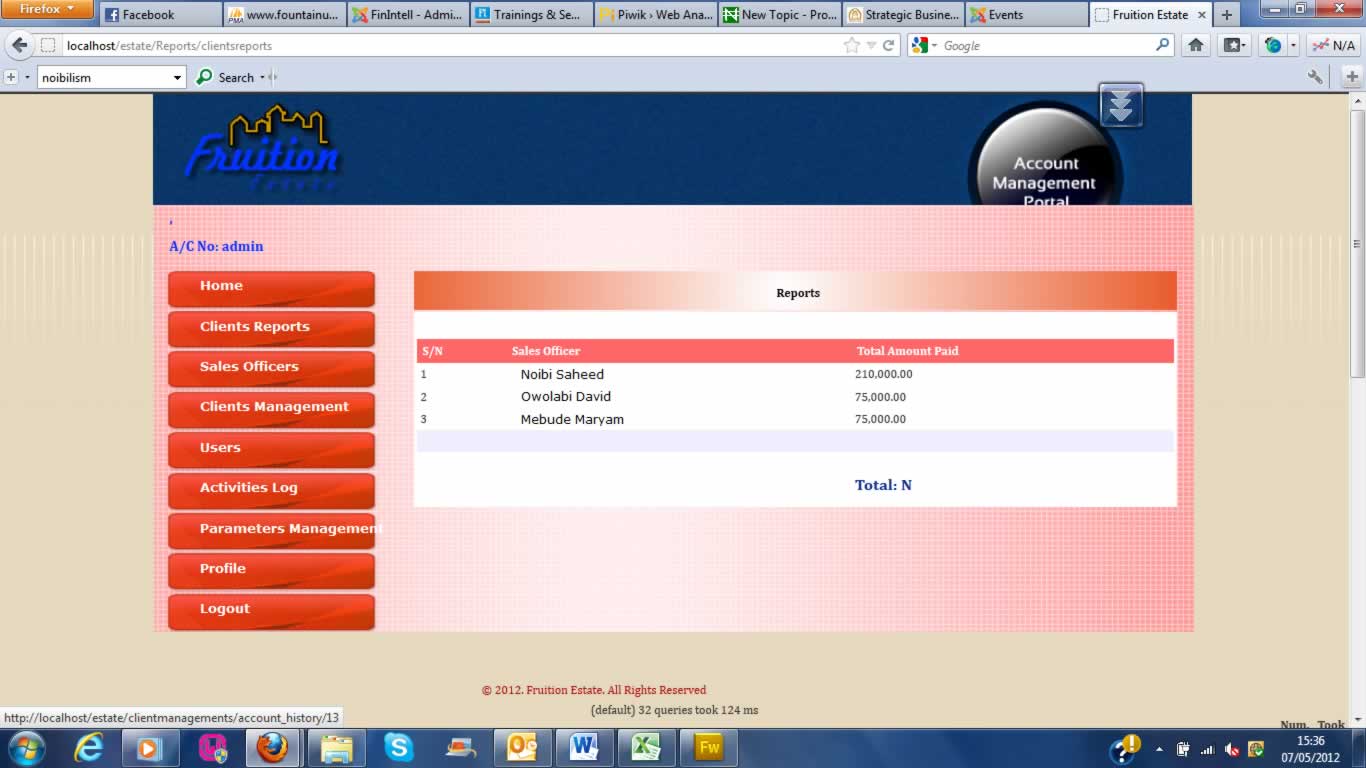
I am a web applications developer. I just developed a web based real estate solution targeted at firms who sells lands on installment basis. The application is web based (which means it can be accessed anywhere). It has the following features: 1. 3 User Roles: Administrator, Sales/Account Officers & Clients; 2. The Administrator has User management, Clients Managements, Reports, View Payment History for a client, view the audit trail, etc 3. The Sales/Account Officer can add client view clients payment history, make payment for a client, etc 4. The Client can view his/her payment history, make payments online, manage his/her profile, Gets SMS & E-Mail Alerts when their payments are approved. Dont worry about the cost..........it is very affordable. I already have a client using this application www.fruitionestate.com, You can call 08095480534 for more info. 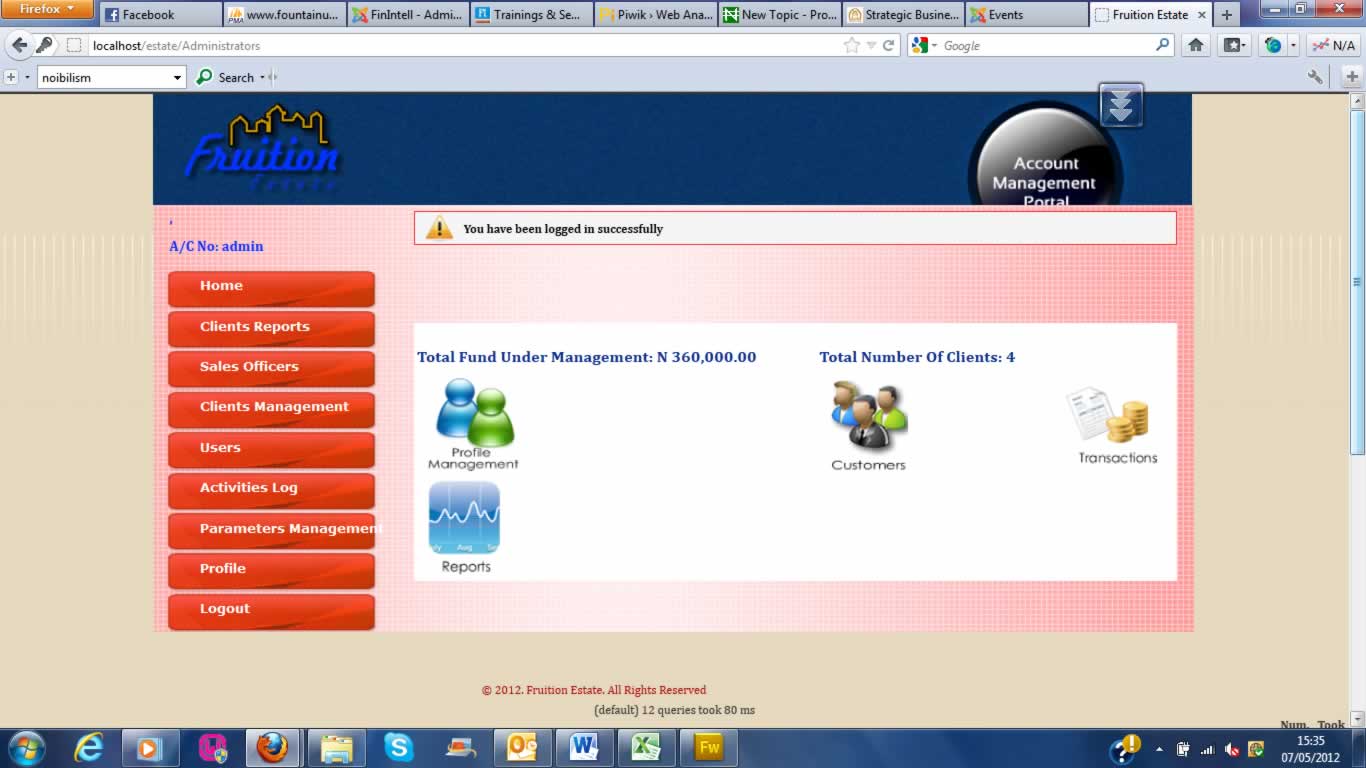
|
| Business › Tax Governance And The Wise Investor. by finintell(op): 11:34am On May 07, 2012 |
Sometime ago, I was astounded by the headlines of certain newspapers. The story was that a bank has commenced winding up proceedings against one of the largest oil marketing companies in Nigeria over unpaid loans.
These loans were related to part of the acquisition cost the current management incurred when they bought the oil retailing giant from its previous owners.
This was not amusing, but juicy bit came towards the end of the article informing us that the owner (the majority shareholder of this publicly traded oil company) lives like a sheik, owning several elite properties in highbrow area of Ikoyi, Lagos State, a fleet of exotic cars, a number of private jets, and a herd of expensive ponies. He was obviously not feeling the pains of the company which was badly haemorrhaging.
This scenario pervades the Nigerian corporate world. Read More:..... http://myfinancialintelligence.com/index.php/2011-09-27-04-13-15/taxation/188-tax-governance-and-the-wise-investor |
| Business › Adherence To Tax Governance & Your Investment Decisions by finintell(op): 11:30am On May 07, 2012 |
There is a general perception that the tax man reaps where he has not sown. There is some verity in this statement in that the tax man would wait for you to patiently cultivate your business and when it begins to yield fruits, he would demand a slice of your profits. This slice could be up to 30% if you are a corporation.
In a country such as ours, where corruption is endemic, many corporations would seek different avenues to reduce their taxes. The legal avenues for tax reduction is called tax planning which is an acceptable practice everywhere in the world whereas, the extra legal avenues would constitute tax evasion, a criminal offence. It is imperative to note that no one has been convicted for evasion yet in Nigeria even where it is proven that companies are engaged in “tax settlement” rather than paying what is due. A potent example of this is a forensic report of the NSE that was widely circulated a while back.
That report mentioned payment of 14million naira to a certain “Bamidele Nasiru” who is described as a Lagos State Internal Revenue Service (LIRS) Consultant. This amount was clearly not paid to the LIRS as taxes due to Lagos State but was paid as “settlement” to the consultant to reduce the potential liability of the NSE. Haba!! The NSE that is supposed to be the very symbol of integrity and regulatory compliance. The perpetrators are still walking the streets as free men. No wonder it is not happenstance that many companies fail to see the correlation between the value of their stock and their level of tax compliance. Read More........ http://myfinancialintelligence.com/index.php/2011-09-27-04-13-15/taxation/21937-adherence-to-tax-governance-a-your-investment-decisions |
| Adverts › Daily Market Update (market Analysis) - April 19, 2012 by finintell(op): 9:34am On Apr 20, 2012 |
The Money Market
The Money Market opened today with N91.3billion short position due to the N71 Billion cash injection from the OMO Bills maturities.
Consequently, the interbank rates dropped by 1% with overnight rate at 14.75% and Open Buy Back (OBB) rate at 14.25%.
Dealers expect the rates to inch back up as the Treasury Bill Primary auction next week will have about N71 Billon Treasury Bills on offer taking out an equal amount as that of the OMO Bills that matured today. They however hoped that the auction coincides with the Federal Account Allocation Committee’s (FAAC) disbursement.
Treasury Bills Market
Currently, yields (offer) in the secondary market are;
• o 91days - 13.90%
• 182 days – 14.55%
• 364 days – 14.40% Read More: http://myfinancialintelligence.com/index.php/2011-09-27-04-13-15/markets/17331-daily-market-update-april-19-2012 |
| Business › Daily Market Update - April 18, 2012 (Market Analysis) by finintell(op): 9:12am On Apr 18, 2012 |
Treasury Bills Market
The Treasury Bills Market witnessed very low trading activity today. Dealers said activities were mainly on the 52 day maturity with yields closing at 14.25%.
Currently, yields (offer) in the secondary market are;
• 91days - 14.00%
• 182 days – 14.60%
• 364 days – 14.75%
The Foreign Exchange Market
The naira depreciated by 5 kobo to close at N157.45 to a dollar from the N157.40 to a dollar where it closed last week. The $33 million dollars sold in the Interbank Market by Chevron today did not help in strengthening the naira as dealers confirmed dollar demand from customers.
The Central Bank of Nigeria offered and sold $150 million today in its twice weekly (Mondays and Wednesdays) Wholesale Dutch Auction System (WDAS). The naira appreciated by 10kobo at the official window to close at N157.26 to a dollar. At the auction last Wednesday, the naira closed at 157.36. Read More: http://myfinancialintelligence.com/index.php/2011-09-27-04-13-15/world/16898-daily-market-update-april-18-2012 |
| Business › Daily Market Update (market Analysis) - April 16, 2012 by finintell(op): 9:40am On Apr 17, 2012 |
Treasury Bills Market
The Treasury Bills Market witnessed very low trading activity today. Dealers said activities were mainly on the 52 day maturity with yields closing at 14.25%.
Currently, yields (offer) in the secondary market are;
• 91days - 14.00%
• 182 days – 14.60%
• 364 days – 14.75%
The naira depreciated by 5 kobo to close at N157.45 to a dollar from the N157.40 to a dollar where it closed last week. The $33 million dollars sold in the Interbank Market by Chevron today did not help in strengthening the naira as dealers confirmed dollar demand from customers.
The Central Bank of Nigeria offered and sold $150 million today in its twice weekly (Mondays and Wednesdays) Wholesale Dutch Auction System (WDAS). The naira appreciated by 10kobo at the official window to close at N157.26 to a dollar. At the auction last Wednesday, the naira closed at 157.36. Read More: http://myfinancialintelligence.com/index.php/2011-09-27-04-13-15/world/16606-daily-market-update-april-16-2012 |
| Business › Corporate Action 2012 by finintell(op): 11:38am On Apr 16, 2012 |
Company Release Date Final Div. Div. closure Date Final Pay Date Bonus Bonus Closure Date AGM Venue
VITAFOAM 3-Jan-12 N0.30 23-Jan-12 23-Feb-12 Sheraton
NESTLE 21-Feb-12 N11.05 16-Apr-12 27-Apr-12 26-Apr-12 Muson
NB 23-Feb-12 N3.00 15-Mar-12 17-May-12 16-May-12 Muson
GLAXOSMITH 27-Feb-12 N1.20 24-Apr-12 23-May-12 22-May-12 Muson
GREIF NIG 29-Feb-12 N0.30 10-Apr-12 18-Apr-12 Apapa
ZENITHBANK 9-Mar-12 N0.95 26-Mar-12 5-Apr-12 4-Mar-12 Civic center Read More: http://myfinancialintelligence.com/index.php/2011-09-27-04-13-15/world/15746-corporate-action-2012 |
| Investment › Nigerian Stock Market First Quarter (2012) Review by finintell(op): 11:32am On Apr 16, 2012 |
Since the resumption of Mr. Oscar Onyema as the new Chief Executive Officer of the Nigerian Stock Exchange (NSE) last year April, the nation’s bourse has continued to experience several reformation agenda in order to restore investors’ confidence and improve the current low market capitalisation.
The latest of such agenda was the decision of the NSE to review its Listings Rules for companies, to accommodate international standards. And in February this year, the Securities and Exchange Commission, (SEC) capital market regulator, approved the amendments proposed by the NSE to its Listing Rules as part of its new initiatives to achieve targeted goals.
Mr. Onyema, a former Senior Vice President of the American Stock Exchange, said that the NSE decided to review its listings rules because some of the stakeholders complained that the previous listings were inflexible.
He said the Exchange’s main targets for fresh listings were major companies in the Oil and Gas and the Telecommunications sectors of the economy. Mr. Onyema, who has been attending several forums both locally and internationally to further woo potential investors in the market, noted that the Exchange was in active engagements with the Bureau of Public Enterprises (BPE), which is in charge of the privatisation of the power companies, to ensure that the Share Purchase Agreements should have clauses to certify their listing on the Exchange.
He said, “Our new listing requirements have reduced the required track record for a company wanting to list from five to three years, and even below this is permissible, if the company has a core investor with a strong track record,” adding that “the BPE has been advised that an immediate listing (as soon as the sale to core investors is finalised) is now possible under our new listings requirements.”
Mr. Onyema explained further that in the oil and gas sector, the Exchange was also discussing extensively with indigenous upstream companies, adding that it was hopeful of seeing the first listing in this sector in 2012. “These groups of companies were particularly vocal in calling for a change in our listings requirements, and their feedback had been taken on board in the new listing requirements. We believe that the prospect for indigenous upstream companies to list is now higher,” he said. Read More: http://myfinancialintelligence.com/index.php/2011-09-27-04-13-15/world/16337-nigerian-stock-market-first-quarter-2012-review |
| Business › Daily Market Update (analysis) - April 13, 2012 by finintell(op): 2:52pm On Apr 14, 2012 |
The Money Market
The Money Market opened with market liquidity of N75.6 Billion in free cash position. This was due to Central Bank’s sale of OMO Bills yesterday with same-day settlement.
Consequently, Interest Rates on overnight transactions moved up to 14.25% from 14% where it closed yesterday. Dealers are of the opinion that rates will continue to move up until next week Thursday when N71 billion of Treasury Bills will mature and increase market liquidity. Some Dealers however expressed concern about the Central Bank Open Market Operation (OMO) which might deprive the market of the impact of the maturing Treasury Bills next week, should the CBN continue with its liquidity mop up.
In other related news, the chances that the Federal Account Allocation Committee will disburse this month’s budgetary allocation next week as expected are slim as it has been rumoured that Governors are ready for a showdown with the Federal Government over what they termed illegal and unwarranted deductions for fuel subsidy, from the federation account. It is said that about N304Billon had been deducted in the months of January and February, as against a budgeted amount of N148 Billon for both months.
Treasury Bills Market
The Treasury Bills Market witnessed an upward trend in yields across all maturities. Yields on the short tenured bills increased by an average of 0.15% while the long tenured bills increased slightly by an average 0.05%. Read More: http://myfinancialintelligence.com/index.php/2011-09-27-04-13-15/world/15979-daily-market-update-april-13-2012 |
| Business › Re: How To Calculate Your Income Tax In Nigeria (Ugometrics) by finintell: 12:06pm On Apr 12, 2012 |
I recently developed a Payroll Application that automatically generates payroll schedule monthly for a company based on the personal income tax act 2011.........it also sends payslips to the employees.....it has reports and so on..........if you're intersted i can deploy the same application for you. noibilism@gmail.com |
| Business › Daily Market Update - April 11, 2012 by finintell(op): 9:31pm On Apr 11, 2012 |
The Money Market
Liquidity in the Interbank Money Market further improved today to about N154 Billion in free cash position from about N103 Billion the previous day. Dealers attributed the increased market liquidity to Dealing Houses Repurchase transaction with the Central Bank of Nigeria.
Interest rates moved down slightly with overnight rates at 13.20% from yesterday’s 13.42%..
The Central Bank’s settlement platform - RTGS was restored today after yesterday’s downtime.
Treasury Bills Market
The Treasury Bills Market witnessed drop in yield across all maturities as expected due to the CBN’s Primary Auction today. The short tenured bills dropped by an average of 0.25% while the medium and long tenured bills dropped by an average 0.10% Read More: http://myfinancialintelligence.com/index.php/2011-09-27-04-13-15/world/15246-daily-market-update-april-11-2012 |
| Business › Daily Market Update - April 10, 2012 by finintell(op): 1:28pm On Apr 11, 2012 |
The Money Market
Opening today, the Money market was very liquid owing to the redemption of about N98 Billion worth of Open Market Operations (OMO) bills on Friday by the Central Bank of Nigeria (without replacement). Budgetary disbursement in the form of Excess crude Augmentation, estimated at about N70 Billon was also received. This resulted in surplus cash position of about N103 Billion, an improvement from the short position of N42.6 Billion recorded by the market opening on Thursday April 05, 2012.
Consequently, Interest rates were bearish, with about 1% drop on the overnight rate which came down from 14.54% to 13.42%
Settlement of transactions on the Central Bank’s Real Time Gross Settlement (RTGS) platform was hampered by system downtime at the CBN, which was blamed on power issues.
The Treasury Bills Market
The T-Bills market saw some apathy towards fresh position taking by dealers, as institutions were skeptical of taking positions in view of the Primary auction tomorrow. Significant activity was seen on the shortest trading bill (which will mature in about 9 days, which dropped by about 0.35% to close at 13.60%).
The consensus view of market participants is that yields at the CBN auction tomorrow will close at current market levels or slightly lower, implying decent demand levels.
Current Benchmark yields
• 91days - 13.90%
• 182 days – 14.70%
• 364 days – 14.80% Read More: http://myfinancialintelligence.com/index.php/2011-09-27-04-13-15/world/14988-daily-market-update-april-10-2012 |
| Business › Crude Oil Price Watch by finintell(op): 8:52am On Apr 06, 2012 |
With oil prices soaring ever higher, not even Saudi Arabia who stepped in last week, and
vowed to increase its production by 25% if necessary, could prevent an imminent high
and rising oil prices. This should have been good news for Nigeria; but for the import
dependent structure guiding the oil industry and the application of international base price
for determining local prices.
Such price assurances as received from Saudi Arabia portends an ability to drain a few
dollars off oil futures, the reality remains that there is nothing Saudi Arabia or anyone else
can do about rising oil prices if an escalation of crisis is pursued. In fact, crude oil is still on
track to reach $150 a barrel by mid-summer.
Oil prices started rising much earlier in 2012 than they did in 2011. The price for crude oil
broke above $100 a barrel on February 13, 2012, two weeks earlier than last year. The
key driver of higher gas prices at present is actually the world's oil markets coupled with a
heightened uncertainty about what's going on in Iran and the Middle East. President Barack
Obama said in Oklahoma recently that "The main reason the gas prices are high right now
is because people are worried about what's happening with Iran," "It doesn't have to do
with domestic oil production. It has to do with the oil markets looking and saying, you know
what, if something happens there could be trouble and so we're going to price oil higher just
in case." Read More: http://myfinancialintelligence.com/index.php/2011-09-27-04-13-15/energy/13515-crude-oil-price-watch |
| Business › Daily Market Update (analysis) - April 5, 2012 by finintell(op): 8:50am On Apr 06, 2012 |
The Money Market
The maturity of about N83 Billion of the Central Bank’s Open Market Operation (OMO) bills, without replacement by the Central Bank of Nigeria (CBN), helped assuage the liquidity pressure from the continuing NNPC withdrawals. This resulted in the Interbank market opening with a short position of about N43 Billion as against a short position of 58Bn reported yesterday.
Overnight Interest rates were down by 1% to 14.5% due to the N83 billion OMO maturities.
The Federal Account Allocation Committee is expected to meet next week, after the Easter holidays and after the meeting, budgetary inflows are expected in the market the week after.
Treasury Bills Market
The market witnessed high demand from investor particularly on the short dated bills (<90 days). This resulted in yield declining. Yields dropped by an average of 15basis point (0.15%).
The Bonds Market
The Bond market was relatively quiet today, as it has been throughout most part of the week. Focus was on the 6s4 and the 9s1, both of which appreciated with about 25 kobo on average. The topical discussion in the Bond market is still the Second Quarter (Q2) Issuance calendar that is expected to be released anytime next week by the Debt Management Office (DMO). Read More: http://myfinancialintelligence.com/index.php/2011-09-27-04-13-15/world/14030-daily-market-update-april-5-2012 |


