Properties › Man Loses Home Worth N20m Over N300,000 Debt by Islie(op): 10:51am On Jan 08, 2025 Properties › Man Loses Home Worth N20m Over N300,000 Debt by Islie(op): 10:51am On Jan 08, 2025 |
Kano State governor, Abba Kabir Yusuf, has been urged to intervene in a case of alleged injustice, where Malam Surajo Yarima’s house, valued at about N20 million, was allegedly sold by a court for a mere N2 million.
Yarima alleged in an interview with Hikima Radio/TV yesterday monitored by LEADERSHIP in Kano that the house was auctioned by a court to offset the debt of N300,000 he failed to repay to someone who sued him.
According to him, he failed to appear in the court during sittings despite several summon notices pasted on his house gate ‘because he travelled out of the state’, but the court sold his house at the sum and threw him, his wife and nine children out.
He added that he has now brought the N300,000 debt, but the creditor rejected it. The court said he had a chance to appeal against the judgement within three weeks of its verdict.
“The house was auctioned on 4th January and I brought the N300,000 on 6th January, but my creditor refused to accept it. I am now sleeping outside with my family,” he stated. https://leadership.ng/kano-man-loses-home-worth-n20m-over-n300000-debt/#google_vignette
|
| Travel › Mysterious Banana ‘Offering’ At UK Junction by Islie(op): 2:42pm On Jan 07, 2025 |
Residents of Nottinghamshire, England have been left puzzled by the mysterious appearance of plates filled with peeled bananas left by the side of a road every month for over a year.
The phenomenon occurs on the second day of each month in 2024, when a plate of bananas is found on a street corner in Beeston, across from a local church.
The mystery began over a year ago at the intersection of Abbey Road and Wensor Avenue, and its purpose remains unclear. A local resident, Clare Short, discovered the pattern and noticed the bananas were consistently placed on the second day of each month. https://punchng.com/confusion-as-mysterious-banana-offering-appear-monthly-at-uk-junction/?amp

|
| Politics › NURTW Accuses Gbajabiamila Of Sponsoring MC Oluomo's Imposition As Union Leader by Islie(op): 9:58am On Jan 07, 2025 |
NURTW Writes Tinubu, Accuses Gbajabiamila Of Sponsoring MC Oluomo's Imposition As Union LeaderThe national leadership of the National Union of Road Transport Workers (NURTW) has written to President Bola Tinubu, accusing the Chief of Staff, Femi Gbajabiamila, of sponsoring and imposing the President’s loyalist, Musiliu Akinsanya, popularly known as MC Oluomo, on the union.
The NURTW made the allegation in an open letter placed as advert and signed by its President, Alhaji Ibikunle Tajudeen Baruwa.
The open letter is titled ‘SOS: A Passionate Appeal for your Immediate Intervention; Re: War of Attrition against National Union of Road Transport Workers by Femi Gbajabiamila, Chief of Staff,’ is dated December 24, 2024.
The union called for President Tinubu’s immediate intervention in the matter, saying the controversy ravaging the union was caused by Gbajabiamila’s actions, who is allegedly sponsoring the imposition of MC Oluomo on the union.
SaharaReporters had reported how MC Oluomo emerged as the National President of National Union of Road Transport Workers (NURTW).
He secured unanimous votes from all of the delegates in the Union's Quadrennial Delegate Conference for Zone 2 Council of the Union, which was held in Osogbo, the capital of Osun State.
According to reports, MC Oluomo was nominated for the national position by the Ondo State Chairman of the Union and this was seconded by the Ekiti State Chairman.
Reacting to the result of the election, the Acting National President of the Union, Aliyu Ore, who was represented at the delegate conference maintained that MC Oluomo’s emergence as the incoming president is in line with the Union’s constitution.
But Baruwa in the letter, also endorsed by the Acting General Secretary, Comrade Sulaimon A. Musa and Treasurer, Bello Maduganari, stated, “We, the concerned National Officers and members of National Union of Road Transport Workers (NURTW), have found it necessary to bring to your attention through this medium, the benighted and awry fate of the Union.
“We wish to draw Your Excellency's attention to the challenges currently facing the National leadership of the Union, which we believe are exacerbated by certain actions attributed to the Chief of Staff, Hon. Femi Gbajabiamila."
The letter further read, “The situation leaves no hope of survival for the Union unless there is definitive intervention by your humble self.
“Your Excellency Sir, since last year, there are concerns about actions that appear to undermine the Union's constitution, allegedly aimed at influencing the leadership structure of the Union in a manner inconsistent with due process.
“We have been keeping quiet, believing that common sense will eventually prevail.
“To that effect and law-abiding citizens, we chose to handle the matter legally, but the situation keeps getting from bad to worse, hence this open letter to your exalted office for intervention.”
The letter explained that on May 24, 2023, Baruwa was duly elected for a second term in office and sworn in on August 21, 2023, in accordance and strict adherence to the provisions of the constitution of the Union.
“However, on August 28, 2023, it has been reported that a group of individuals forcefully entered the National Secretariat, resulting in the disruption of the duly elected leadership of the Union, and other National officers of the Union in the interest of peace and to avoid bloodshed, we instituted action at the National Industrial Court, Abuja against the illegal action of the former president and legitimate group in suit No. NICN/ABJ/263/2023.
“The National Industrial Court on the 11th of March 2024, the court delivered judgment in our favour.”
Not satisfied with the judgment of the National Industrial Court, “Our opponents filed an appeal at the Court of Appeal, Abuja and on November 8, 2024, the Court of Appeal ruled on the matter and affirmed the judgment of the trial court.
“Soon after the Court of Appeal judgment, the former president, Alh. Najeem Usman Yasin purportedly inaugurated Musiliu Akinsanya (MC Oluomo) as illegal president of the Union even when the said MC Oluomo did not participate in any election for the presidency of the Union as he was not a member of the Union at the time of the election as he voluntarily existed himself from the Union having publicly denounced his membership of the Union and joined the Lagos state Park Management Committee.
“Sir, we have received information suggesting that certain influential figures may be providing support to individuals acting in defiance of court orders, as contained in the judgments of the National Industrial Court as validated by the Court of Appeal.
“It is on record that there are allegations that some individuals have expressed confidence in their actions based on perceived backing from high-ranking officials, which undermines the rule of law and the judiciary's authority.
“We are prompted to bring this matter before Your Excellency because we sincerely believe that the "coup de grace" will come from you, being an advocate of democracy and the rule of law.
“Your Excellency Sir, we further employ you to use your good offices to cause a proper scrutiny of the doings of the Chief of Staff, with a view to saving a portentously vicious circle to industrial democracy, nay to political democracy, which the Federal Government has been sparing no resources to plant and enthrone as basis of the Nigeria polity.”
MC Oluomo – President Tinubu’s Loyalist
In March 2023, MC Oluomo sparked outrage when he threatened Igbo people in Lagos, warning them to stay home during the governorship election unless they planned to vote for the All Progressives Congress (APC) candidates.
He was caught on video threatening Igbo people in Lagos, warning them not to vote for candidates outside the ruling party. This incident sparked widespread concern, as it undermined Nigeria's democratic process and unity.
The video, which went viral, showed MC Oluomo addressing a gathering and issuing the threatening statement during the 2023 general election.
The Nigeria Police Force promptly denounced MC Oluomo's actions, but despite this, he has yet to face punishment for his conduct.
MC Oluomo's history of controversy is well-documented. As the former chairman of the Lagos State branch of the National Union of Road Transport Workers, he has been accused of using thugs to disrupt elections and intimidate opponents.
His influence and wealth, accumulated during his six-year tenure, have made him a formidable figure in Lagos politics.
Meanwhile, MC Oluomo has publicly described himself as being owned by Tinubu.
In October 2018, MC Oluomo, in an Instagram post, said Tinubu owned him and that whatever he (Tinubu) wanted was what he (MC Oluomo) would support.
He wrote on his Instagram page, “I am an Asiwaju Bola Ahmend Tinubu Jagaban loyalist, I wear the Jagaban jersey, I've been a loyalist since 1999, the first mecca i went is through his execellence in the year 2000, moreso, he as done alot for me, he made me who i am today our relationship has been was very cordial and strong in the area that I grew up in.
“So I'm one of his loyalist that have strong believe in him, he own the party and any where his interest belong I Musiliu Ayinde Akinsanya Mc oloumo belong. I and my people in Oshodi formerly endorse HE Akinwunmi Ambode for 2nd term because his government is still working in the shadow of the party national leader, but now the case is vice-visa i have to follow the interest of Bola Ahmend Tinubu and the party decision.” https://saharareporters.com/2025/01/06/nurtw-writes-tinubu-accuses-gbajabiamila-sponsoring-mc-oluomos-imposition-union-leader#google_vignette 
|
| Politics › Mass Layoff: Disengaged Staff Members Sue CBN, Demand N30bn Compensation by Islie(op): 6:54pm On Jan 06, 2025 |
Former staff members of the Central Bank of Nigeria (CBN) who were dismissed in a mass layoff last year, have sued the apex bank.
In a court document seen by TheCable on Monday, the workers alleged that the CBN violated internal policies, Nigerian labour laws, and their contractual rights.
The claimants, represented by Stephen Gana and 32 others, filed a class action lawsuit at the national industrial court of Nigeria (NICN), Abuja.
They said their termination process, carried out through letters, titled, ‘Reorganizational and Human Capital Restructuring’, and dated April 5, 2024, violated both the CBN human resources policies and procedures manual (HRPPM) and Section 36 of the Nigerian constitution.
The claimants said the process lacked the necessary consultation and fair hearing mandated by law.
The originating summons, filed on July 4, 2024, under the NICN Civil Procedure Rules 2017, raised several questions for the court to consider, including whether the claimants were denied their constitutional right to a fair hearing before and after their appointments were terminated.
The workers also claimed that the termination letters, issued on the basis of “restructuring,” were arbitrary, illegal, and unconstitutional.
Insisting that they continue to work for the apex bank, the claimants are seeking a court ruling that their dismissals are “void and useless”.
Additionally, they sought a restraining order to prevent the CBN from firing them without following the proper procedures, immediate reinstatement, and payment of salaries and benefits from the date of termination.
The court filing references Article 16.4.1 of the HRPPM, which mandates consultation with the joint consultative council (JCC) and adherence to fair procedures before employment actions adversely affect staff.
The claimants said the provision was flagrantly disregarded, as they were given just three days to vacate their positions and hand over official property.
They are also seeking N30 billion in general damages for psychological distress, hardship, and reputational harm caused by the dismissal; and an additional N500 million as the cost of the suit.
COURT ENCOURAGES AMICABLE RESOLUTION
In another document dated November 20, 2024, the court called for an amicable resolution of the matter.
Gana and their counsel represented the claimants while Inam Wilson alongside seven other lawyers represented the CBN (the defendant).
In the document, Obaseki Osaghae, the presiding judge of the industrial court, acknowledged the defendant’s preliminary objection, filed on November 4, 2024, challenging the suit’s admissibility.
The claimants responded with a counter-affidavit, which their counsel confirmed had been served.
In response, the judge encouraged both parties to explore a settlement under Section 20 of the National Industrial Court Act (NICA) of 2006.
“It is my view that parties should attempt an amicable resolution of this dispute,” Osaghae said.
The matter was, therefore adjourned to January 29 for the hearing of the preliminary objection or to review the progress of any settlement discussions.
BACKGROUND
In 2024, CBN terminated the appointments of about a thousand staff. The dismissal was said to have been conducted in four batches between March and May of the aforementioned year.
Some workers claimed that they received severance payments as low as N5,000, while others said their gratuities were absorbed entirely to offset outstanding loans.
Although the layoff was officially attributed to a “reorganisation” and “human capital restructuring”, the affected staff argued that the process violated the CBN Act, which mandates board approval for significant employment decisions.
On December 4 last year, the apex bank said its early exit package (EEP) was entirely voluntary and without any negative repercussions for eligible staff.
The CBN’s statement followed reports that 1,000 staff were sacked from the apex bank.
Reacting to the development, the house of representatives asked the CBN to suspend the “planned” retirement of 1,000 staff.
The lower chamber had also set up an ad hoc committee to investigate the “process and legality” of the exercise.
Speaking on the matter on January 3, Olayemi Cardoso, governor of the CBN, said the 1,000 staff who left the bank were not forced to leave.
Cardoso also said the early exit programme and the restructuring and reorganisation were to optimise the bank for enhanced efficiency. https://www.thecable.ng/mass-layoff-disengaged-staff-members-sue-cbn-demand-n30bn-compensation/
|
| Christianity Etc › Nigerian Gospel Artiste, Nathaniel Bassey Invited To Trump’s Inaugural Event by Islie(op): 9:04am On Jan 05, 2025 |
Renowned Nigerian gospel minister and pastor, Nathaniel Bassey, has been invited to minister at the U.S. Presidential Inaugural Prayer Breakfast on January 20, 2025, in Washington, D.C.
The non-political and faith-based event will be hosted by Reverend Merrie Turner ahead of President-elect Donald Trump and Vice President-elect JD Vance’s swearing-in ceremony.
The prayer breakfast, to be held at the prestigious Waldorf Astoria Presidential Ballroom, will feature a distinguished lineup of speakers, including Dr. Alveda King and Pastor Mario Bramnick.
Confirming his participation on Instagram, Bassey stated, “Let’s raise a sound in America. See you on January 20, 2025.”
Bassey, celebrated for his music and ministry, is also known for the Hallelujah Challenge, an online worship movement.
In 2024, the Mayor of Albany, New York, honored him by declaring October 6 as “Pastor Nathaniel Bassey Day.”
The event emphasizes prayer and worship as a spiritual support for the U.S. government and presidency. https://guardian.ng/news/nigerian-gospel-artiste-nathaniel-bassey-joins-trumps-inaugural-event/

|
| Politics › Landmark Moments, Historic Decisions That Shaped The Presidential Villa In 2024 by Islie(op): 8:00am On Jan 05, 2025 |
In the corridors of Aso Rock, Nigeria's seat of power, 2024 stood out as a year of bold policy shifts, controversial decisions, and diplomatic strategies and manoeuvres that tested President Bola Tinubu's leadership. JONATHAN NDA- ISAIAH writes Written by Leadership News
As President Bola Tinubu’s administration completed its first full calendar year, the Presidential Villa became the hub of key decisions poised to transform Nigeria’s economic and political landscape. Here are some of the pivotal events that shaped the seat of power.
The Subsidy Saga and Economic Turbulence
The reverberations of Tinubu’s inaugural decision to remove fuel subsidies continued to echo through 2024. What began as a bold economic reform aimed at freeing up billions for reinvestment instead catalysed a chain reaction of economic challenges. The president’s unwavering stance on the policy, despite nationwide protests and soaring inflation, set the tone for an administration willing to make unpopular decisions in pursuit of its economic agenda.Recently in his maiden presidential media chat, defended his administration’s decision to remove the fuel subsidy, describing it as a necessary reform to safeguard Nigeria’s economic future.
Tinubu expressed his resolve, stating, “I have no regrets whatever removing subsidies. It was necessary.”
The President explained that the subsidy system was unsustainable, likening it to mortgaging the future of the country for present consumption.
“We were not investing; we were just deceiving ourselves. The reform was necessary. We cannot have expenditure.
In response to mounting economic pressures, the federal government announced a new minimum wage of 70,000 naira. However, this gesture of relief was quickly undermined by the persistent rise in fuel prices, drawing criticism from labor leaders who argued that the wage increase was insufficient to offset the broader economic impact of the subsidy removal.
Cabinet Dynamics And Administrative Reforms
Perhaps no other aspect of Tinubu’s presidency drew more attention than his approach to government appointments and cabinet composition. In a move that raised eyebrows, the president maintained Nigeria’s largest-ever cabinet with 48 ministers, defending the decision as necessary for addressing the nation’s complex challenges. The October cabinet reshuffle brought significant changes, including the dismissal of six ministers, the appointment of seven new ones, and the controversial merger of key ministries.
Recently also , Tinubu defended his cabinet’s performance amid calls for reshuffling, asserting that his ministers are adding value and effectively managing their assignments.
“Nigeria is a large country. I need my cabinet; they are adding value effectively,” he said, dismissing criticism of their efficiency.
The President reiterated that job assignments in his administration are carefully structured to ensure efficiency and impact. “
You don’t give someone an assignment they cannot fulfill. Job descriptions must be efficient and effective,” he explained.
The presidential communications apparatus also underwent transformation following the departure of spokesperson Ajuri Ngelale. Rather than streamlining, the administration opted to expand the role, bringing in multiple special advisers to manage presidential communications – a decision that seemed to contradict calls for reduced government spending.
The Tax Reform Battle
The Presidential Villa became the battleground for what would become one of 2024’s most contentious political fights: comprehensive tax reform. Tinubu’s ambitious plan to overhaul Nigeria’s tax collection and administration systems met fierce resistance, particularly from northern governors and lawmakers who viewed the reforms as potentially devastating for their constituents.
The resistance culminated in an unprecedented situation where the Vice President’s economic advisory council, comprising the 36 state governors, urged withdrawal of the bills. This internal opposition highlighted the complex political dynamics at play and the challenges of implementing sweeping reforms in Nigeria’s diverse federal system.
However,the president reaffirmed his administration’s commitment to implementing comprehensive tax reforms, stating that they are essential for Nigeria’s economic transformation.
Tinubu stressed that the reforms aim to modernise the tax system, broaden the revenue base, and support the nation’s development goals.
“Tax reforms are here to stay. We cannot just continue to do what we were doing yesterday,” Tinubu declared. “We cannot retool this economy with the old broken pot.”
The President emphasised that the tax reforms are designed to be pro-poor and inclusive, targeting the expansion of the tax net rather than burdening low-income earners.
“All we ask for is to widen the net, make the cake larger so we can share a larger meal,” he explained.
Tinubu highlighted the importance of eliminating outdated colonial-era taxes, describing them as ineffective for Nigeria’s current economic realities.
He also underscored the need to address tax evasion, stating, “You cannot satisfy a larger community of tax invaders.”
The President asserted that his administration is focused on making tough but necessary decisions to stabilize the economy.
Security And Governance Challenges
While the administration maintained confidence in its security apparatus, persistent violence in various regions raised questions about the effectiveness of its approach. Tinubu’s resistance to calls for probes into security matters suggested a preference for maintaining stability within the security establishment over addressing public concerns about accountability.
We also witnessed the death of the chief of army staff , Lt General Taoreed Lagbaja and the subsequent appointment of Micheal Olukayode as the new army chief .
The year also saw a significant legal victory with the Supreme Court ruling on local government autonomy. While the administration celebrated this as a triumph for grassroots democracy, the practical implementation faced resistance from state governors, creating a new power struggle between federal and state authorities.
International Setbacks And Diplomatic Wins
The seizure of three presidential jets by a French court due to a historical dispute with a Chinese company marked a low point in Nigeria’s international standing. This embarrassing incident, stemming from a 2007 contract with Ogun State, exposed vulnerabilities in Nigeria’s handling of international obligations and raised questions about the country’s diplomatic preparedness.
However, the presidency also recorded notable diplomatic achievements. Tinubu’s re-election as ECOWAS Chair reinforced Nigeria’s regional leadership position. The country’s acceptance as a BRICS partner nation and participation in G20 meetings signaled growing international influence, though critics argued these foreign policy wins diverted attention from pressing domestic issues.
The absence of ambassadors throughout the year further complicated Nigeria’s international engagement, creating a diplomatic vacuum at a time when strong global partnerships were increasingly crucial.
Youth Engagement And Education Initiatives
In a positive development, the Presidential Villa saw the launch of the Student Loan Program, fulfilling one of Tinubu’s campaign promises. This initiative, providing interest-free loans to underprivileged students, represented a concrete step toward addressing educational access. However, rising unemployment and economic pressures continued to strain relations with Nigeria’s youth population.
Looking Ahead: The Villa’s 2025 Agenda
As 2024 drew to a close, President Tinubu expressed optimism about the coming year, emphasizing his commitment to service and cooperation with the Nigerian people. “2025 is a very promising year,” he declared, acknowledging the trust placed in his leadership while pledging continued dedication to his mandate.
Yet, the path ahead remains challenging. The Presidency enters 2025 facing pressures to demonstrate tangible progress on multiple fronts: resolving security challenges, implementing fiscal reforms, and addressing public sector inefficiencies. The administration’s ability to translate its bold policy initiatives into practical improvements in citizens’ lives will likely determine its legacy as it approaches the midpoint of its first term.
The events of 2024 at the Presidential Villa reflect a leadership willing to make difficult decisions but sometimes struggling to build consensus around its vision for reform. As Nigeria moves forward, the challenge for Aso Rock will be balancing the need for transformative change with the imperative of maintaining social stability and public support. The coming year will test whether President Tinubu’s administration can convert its controversial policy choices and diplomatic achievements into concrete benefits for the Nigerian people. https://leadership.ng/landmark-moments-historic-decisions-that-shaped-the-presidential-villa-in-2024/Nlfpmod |
| Crime › Man Arrested ‘for Stealing Goat’ For Daughter’s Naming In Ogun (pix) by Islie(op): 4:21pm On Jan 04, 2025 |
By Adam Mosadioluwa
https://tribuneonlineng.com/wp-content/uploads/2025/01/414575BA-6A4B-437A-A17E-D001D882063D.jpeg
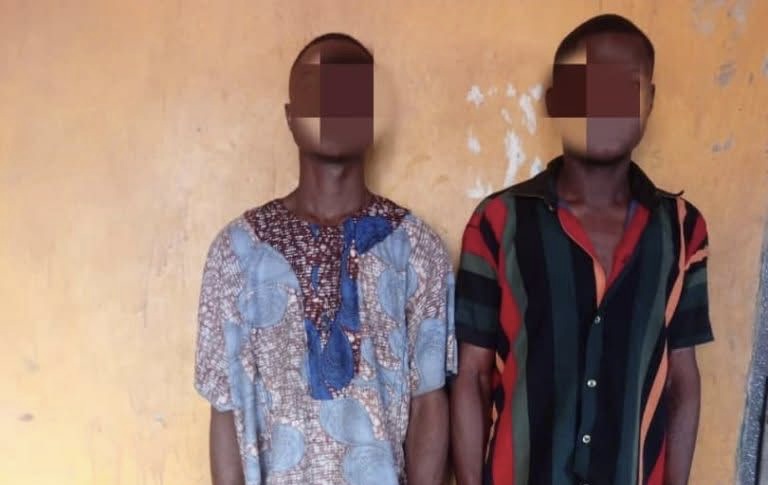
Operatives of the Odeda Division of the Ogun State Police Command have arrested Akintoye Waris for allegedly stealing and slaughtering a Savannah he-goat worth N200,000 to mark his child’s naming ceremony.
The Police Command’s spokesperson, Omolola Odutola, disclosed to Punch on Saturday that the arrest occurred on January 2, 2024, in the Odeda area of the state. Waris was apprehended alongside his accomplice, Ajayi Yusuf.
According to the police, the suspects reportedly targeted a farm in the area, ensuring that the farm owner, identified only as Mark, had taken the cattle for grazing on December 25.
However, upon Mark’s return, he discovered one of the goats was missing, prompting a community-wide search.
Odutola explained that villagers later confirmed spotting the two suspects transporting the missing goat on a motorcycle, heading toward Olodo town.
Acting on this tip-off, detectives swiftly mobilised, leading to the suspects’ arrest in the early hours of January 2, 2025.
She said, “During interrogation, the suspects confessed to the crime, explaining how they stole, transported, and later slaughtered the he-goat on December 27, 2024.”
“They disclosed that the goat was used to prepare food for the naming ceremony of Akintoye Waris’s daughter, which was held at Olodo.”
Odutola further stated that both suspects remain in custody as investigations continue at the Divisional Crime Branch.
She assured residents that the suspects would face prosecution upon the conclusion of investigations and promised to provide updates on further developments.
“The suspects are currently in custody and undergoing further investigation at the Divisional Crime Branch.” https://tribuneonlineng.com/man-arrested-for-stealing-goat-for-daughters-naming-in-ogun/amp/ |
| Politics › Falana: Why Yar’adua Cancelled Sale Of Port Harcourt Refinery To Dangote by Islie(op): 4:49am On Jan 04, 2025 |
Human rights lawyer Femi Falana has revealed the reason former President Umaru Yar’Adua did not sell the Port Harcourt refinery to a consortium led by Dangote.
Falana said the reversal was a pivotal step to address the legal and ethical breaches surrounding the transaction and to protect Nigeria’s national interest.
The senior lawyer, in a statement, explained that under the Privatisation and Commercialisation Act, the Vice President is the chairman of the National Council on Privatisation, NCP, the body responsible for overseeing the privatisation of public enterprises.
Falana, however, alleged that former President Olusegun Obasanjo bypassed this legal requirement by sidelining then-Vice President Atiku Abubakar and directly managing the privatisation of several state-owned enterprises.
“On May 17, 2007, President Obasanjo sold a 51 per cent stake in the Port Harcourt refinery to Bluestar Oil for US$561 million. In another transaction that took place on May 28, 2007, President Obasanjo sold 51 per cent shares in Kaduna Refinery to Bluestar Oil for $160 million,” Falana revealed.
The human rights activist stressed that the deals drew sharp criticism from key stakeholders, including the National Union of Petroleum and Natural Gas Workers, NUPENG, and the Petroleum and Natural Gas Senior Staff Association of Nigeria, PENGASSAN.
According to him, the unions raised concerns over due process and alleged that the country had been shortchanged.
He further explained that they also alleged that the nation had been shortchanged as the shares acquired in the Port Harcourt refinery for $516 million were worth $5 billion.
“It is on record that the cancellation of the privatisation was not challenged in any court as it was carried out contrary to the letter and spirit of the Privatisation and Commercialisation Act,” Falana stated.
He further commended the role of NUPENG and PENGASSAN in advocating for national interest and called on them to remain vigilant amid renewed calls for the privatisation of Nigeria’s refineries.
Falana’s statement emphasised the ongoing debate over privatisation in Nigeria, with advocates stressing the need for transparency and due process in managing the country’s public assets. https://dailypost.ng/2025/01/03/falana-reveals-reason-yaradua-cancelled-sale-of-port-harcourt-refinery-to-dangote/
|
| Family › How I Will Sexually Satisfy My Three New Wives – Delta Singer, Arube Otor by Islie(op): 4:25am On Jan 04, 2025 |
By Temitope Adetunji
Isoko highlife musician, Arube Otor, speaks to TEMITOPE ADETUNJI about his decision to marry three wives on the same day and his plans to balance love and responsibilities among his wives
What inspired you to marry three women on the same day?
First of all, I am Arube Otor, popularly known as Isoko Fela. I am from Uzere, Isoko South Local Government Area, Delta State, and I am a musician who plays Isoko highlife music.
What inspired me to decide to marry three women on the same day is rooted in my father’s example. When my father was alive, he married three women, and the remarkable thing was that when these women had children, you couldn’t tell which woman gave birth to which child. We lived together, ate together, and played together. This experience, growing up in such a unified family, greatly influenced my decision to marry three additional women.
If your father’s example influenced your decision, why did you decide to marry them on the same day?
The reason I decided to marry them on the same day is because of the deep love the three women share for one another. They genuinely care for each other, and I could see the unity among them. This made it easier for me to decide that I would marry them on the same day, as they support one another in every way.
How did you meet your wives?
I didn’t meet all of them at once. I met them one after the other. I was already married to my first wife, the senior wife before I decided to marry the three others. She knew about my decision, and all the women knew each other well. There’s no secret among us.
Aside from your first wife, how did you manage to balance love and understanding among the three other women, especially when you told them you would marry them on the same day?
It comes down to the decisions I make as a man. I am an entertainer, and my career permits me to have multiple relationships, which influences my life choices. Once I make a decision, I stick to it. I am very firm in my choices, and it’s hard to sway me once I’ve made up my mind. I told my first wife, ‘If you truly love me and are still married to me, you must obey my rules’. This clarity and firmness have helped me maintain balance and understanding among all of them.
Do you plan to get separate apartments for them?
No, we are all living together on the same compound. As we speak, they are all in my compound, and we share everything. I believe that living together harmoniously under one roof is key to maintaining love and unity among us.
How do you manage to maintain love and balance among your wives?
I do my best to maintain balance by treating each of them with respect and care. I am fully aware of their individual needs and emotions, and I make sure I am fair to all of them. Additionally, I trust in God’s guidance. He has been helping me to manage everything, and I believe He will continue to do so. As a man, I work with what I have. Even with the little I possess, I ensure that it is shared fairly and doesn’t become a burden.
Do you plan to marry more wives, or will you stop at four?
Yes, I still have two pending. I plan to marry two more wives to make it a total of six.
Many believe marriage is a union between two people, the husband and wife. Why do you choose to marry multiple wives?
The way my father raised us is how we live. If you meet people you want to marry, you marry them. If you meet people you don’t want to marry, you don’t. Everything is a matter of luck.
What was the sincere reaction of your first wife when you informed her about your decision?
She cooperated, and there was no negative reaction from her or any of the others. Even on the wedding day, all of us will wear the same attire. My first wife will greet the guests, welcome everyone, and coordinate, as is our cultural practice. She will wear the same head tie and dress as the others and the bride prices will be paid. Before you marry someone, you date the person to understand his or her character.
During the time I dated these women, my wife was aware of it, and she liked their characters. When I told her, I explained that some of these women already had children for me, and I didn’t want to leave my children without proper care. Two of them have already given birth, while one has not. But by God’s grace, she may have her baby before December. In total, I have nine children.
How do you plan to balance love, attention, and responsibilities among your four wives?
For the ‘bed duties,’ each wife will stay with me for three days. The sexual aspect will be rotational; if the first one spends three days with me, the next one will stay with me for the following three days, continuing until the fourth wife has had her turn. The wife staying with me during those three days will also prepare my food. That’s how we live our lives.
What do your wives do for a living?
In Isoko, everyone tends to become a farmer due to the economic situation in the country. My first wife is a hairdresser; the second one is a caterer. The third and fourth are traders.
How old are you?
I was born on March 13, 1971.
How does your family feel about your decision to marry three additional wives at once?
Every man has his preferences. For example, if you decide to buy a car, some family members may advise against it, saying it will bring you trouble later. So, there’s no need to involve family in every decision. Your decision is ultimately your own. Those who support it can join in the celebration, and those who don’t support it can choose to stay away.
Have your grown-up children expressed any concerns about your decision?
No. All of them have already bought the same clothes to wear on that day. If they were angry about it, they wouldn’t be spending their money on the preparations.
You mentioned that your father was a polygamist, and his love for his wives and children inspired your decision. Are you financially prepared to cater for four wives simultaneously?
Yes, I am. With the help of God, all things are possible.
How do you intend to handle potential conflicts or jealousy among your wives?
If I see anything like that, I will address it immediately. I’ll caution them and tell them to stop whatever they’re doing because such actions won’t bring any good. Women may quarrel from time to time, but we must live our lives by managing such situations calmly and with understanding.
When is the wedding?
The wedding will take place on January 19, 2025, at London Base, Uzere Kingdom, Isoko South Local Government Area, Delta State.
Some people view your decision as unconventional or controversial. How do you respond to criticism?
God rules my life, not human beings. If someone is uncomfortable with the way I choose to live, they can simply leave me alone. No one can control how I live my life.
What message do you think your decision to marry multiple wives sends to society about relationships and marriage?
My advice is this: Don’t do something just because someone else did it. Follow your heart. If your heart can handle it, go ahead. If not, don’t. If you want to marry another wife and your current wife agrees, go ahead with it. But if she doesn’t agree and you cannot endure the situation, then it’s best to leave it. There’s a saying, ‘Every malam with his kettle’, meaning everyone is free to live their life the way they deem fit. Live your life according to what works for you, and don’t let anyone control you.
What have been the responses from your closest friends? Were they discouraging, approving, or neutral?
We are human beings. Even with close friends, you can’t always predict how they will react. In our community, if you want to marry two wives or more, you can do so. You have to live within your means.
I even sang a song once that goes, ‘If you want to buy a motorbike, don’t tell your friend. If you want to marry, don’t tell your friend. Just do it. If it works out, you’ll be happy. If it doesn’t, you move on.’ Do what feels right from the heart without seeking too much advice. All my friends are okay with what’s happening.
Have you faced any backlash or criticism from religious or community leaders regarding your choice?
No, I have not faced any backlash or criticism at all.
What do you love most about each of your brides-to-be and your first wife?
Each woman has her unique strengths that set her apart. Some excel in intimacy or lovemaking, others excel in maintaining a home, and some are exceptional cooks. All of these qualities were what attracted me to them individually.
If you could marry only one of these four women, who would she be and why?
That’s a difficult question to answer. I can’t respond to that.
Do you believe you are prepared for the emotional and physical demands of a polygamous marriage?
Yes, I believe I am prepared.
Where are your wives from?
My first wife is from Uzere, and the remaining three are from Isoko North.
What advice do you have for the younger generation looking to get married?
For the younger generation, especially women, if your husband wishes to marry another woman, don’t try to prevent him. A woman’s character is paramount; it’s what makes a man stay. If a woman has a bad character, it could drive a man away.
As a man, if your wife possesses everything you need, there’s no need to look outside the relationship, especially if you’re not from a polygamous home. There’s no need to embrace that lifestyle.
The way I live my life is not the same as the way others live theirs. Everyone has their path. My advice is this; whatever you start, ensure you can finish. If you know you cannot finish something once you begin, don’t start it https://punchng.com/how-ill-sexually-satisfy-my-three-new-wives-delta-singer/?ampPrevious thread https://www.nairaland.com/8305723/delta-man-set-marry-3
|
| Politics › Buhari Neither Wanted Tinubu Nor Osinbajo As Successor – Ojudu by Islie(op): 10:49am On Jan 03, 2025 |
A former Special Adviser to the President on Political Matters, Babafemi Ojudu, has claimed that former President Muhammadu Buhari never supported the presidential ambition of his then Vice President, Yemi Osinbajo.
Ojudu also said Buhari did not back the current President, Bola Tinubu, despite their friendship and political alliance, but that Tinubu “outmaneuvered him in several ways.”
He spoke during his appearance on Edmund Obilo’s State Affairs podcast on Monday.
Ojudu, who served in the office of former Vice President Yemi Osinbajo, also said his former principal could have performed significantly better than the current president, Bola Ahmed Tinubu.
Recall that during the APC primary prior to the 2023 elections, Bola Tinubu secured 1,271 votes to clinch the party’s presidential ticket, while former governor of Rivers State, Rotimi Amaechi garnered 316 votes. Former Vice President Yemi Osinbajo got 235 votes, finishing third, while Senate President Ahmed Lawan got 152 votes.
Ojudu said, “I knew Osinbajo was going to lose the primary, I saw it coming. Because of the system we operated and still operating, I kept saying at our meeting that all of the efforts we are making like traveling around, convincing people, and addressing delegates is only 40 percent.
“60 percent of it lies in Buhari’s hands unless and until Buhari mobilises people around him, the governors, his aides, we are going nowhere.
“I used to refer to Buhari as one-man majority and he never mobilised his team towards Osinbajo and I think Tinubu outsmarted him in so many different ways.”
Speaking further, he likened the failure to elect Professor Yemi Osinbajo during the last presidential election to missing a second chance at the leadership of Chief Obafemi Awolowo.
“Osinbajo would have been good for this country. For me, it is like losing Awolowo for a second time because he was at Awolowo’s level in terms of capacity, ability, dedication and commitment. https://dailytrust.com/buhari-neither-wanted-tinubu-nor-osinbajo-as-successor-ojudu/

|
| Crime › One Dead, Groom Hospitalised As Bride Poisons Jigawa Wedding Guests by Islie(op): 10:24am On Jan 03, 2025 |
A wedding in Jigawa State has turned tragic after a bride allegedly poisoned food served at the reception.
The incident is said to have left the groom critically ill and one of the wedding guests dead.
The incident occurred in the Jahun Local Government Area of the state.
Eyewitnesses suggested to PUNCH Online that the bride’s actions may have been driven by a personal vendetta.
Speaking to PUNCH Online on Friday, the state Police Public Relations Officer, Shi’isu Adam, confirmed the incident and said an investigation was underway.
“We received a report that the bride had tainted the food served at the wedding reception, leaving the groom critically ill.
“Police have arrested two suspects in connection with the alleged food poisoning incident that occurred during a wedding ceremony in the state,” Adam said.
He revealed that the two suspects are the bride and another female, adding that they are in custody and being interrogated by the Criminal Investigation Department of the command.
The police spokesperson added, “We will do everything in our power to ensure that justice is served.”
According to the police spokesman, all the wedding attendants who consumed the poisoned food have been discharged from the hospital, except for the one person who was confirmed dead.
“The command is currently investigating the circumstances surrounding the incident, and we will provide more details as soon as possible.
“For now, we can confirm that the incident occurred, and we are working tirelessly to unravel the facts. We urge the public to remain calm and assured that justice will be served,” he concluded.
The identities of the deceased, the groom, and other victims have not been disclosed by the authorities. https://punchng.com/one-dead-groom-hospitalised-as-bride-allegedly-poisons-jigawa-wedding-guests/?amp
|
| Politics › Tinubu Squandered 2024; Sadly, He’s Set To Waste 2025 Too! By Olu Fasan by Islie(op): 12:34pm On Jan 02, 2025 |
At the beginning of every year, analysts look back at the past 12 months – reflecting on what worked and what didn’t – and look forward to the next 12 months – prognosticating on what might and might not be. In that tradition, this column began last year with an article titled “2024: How Nigerians must assess Tinubu’s performance” (Vanguard, January 4, 2024). The piece looked back at 2023 and projected into 2024. Similarly, this intervention reflects on 2024 and takes the long view of 2025.
In setting the criteria for assessing Tinubu’s performance in 2024, I appealed, first, to religion and quoted Proverbs 29:2. “When the righteous [good leaders] are in authority, the people rejoice; but when the wicked [bad leaders] rule, the people groan.” Then, I invoked the Jeffersonian credo that “the care of human life and happiness is the only legitimate object of good government”. This newspaper’s motto, “towards a better life for the people”, also aptly captures the primary purpose of every government. Thus, I posited that Tinubu’s performance in 2024 should be judged by the extent to which there were tangible improvements in the lives of ordinary Nigerians, and whether or not the people rejoiced or groaned.
So, what happened? Well, I gave my overall verdict in last week’s column when I said that Tinubu’s promise of renewed hope in his “2024 Renewed Hope Budget” turned out to be an illusion. In 2024, Nigeria’s ruling elite lived in outrageous opulence, using public funds to buy presidential yachts and fleets of SUVs and renovating their official residences with billions of naira, among many extravagances, while poverty reached dizzying heights, with over 64 per cent of Nigerians going to bed hungry, and an epidemic of kidnapping gripped Nigeria. In a country where there is no audit of budget implementation and performance, a mandatory practice in genuine and accountable democracies, several billions, if not trillions, of naira from last year’s N28.77 trillion budget would certainly have been embezzled and misappropriated without trace. Of course, Nigeria is a kleptocracy, as John Campbell and Matthew Page rightly stated in their book, Nigeria: What Everyone Needs to Know.
'My songs will make you buy bedsheets'- Ironha, who took hawking when fire razed his Yaba shop0:00 / 1:00
But my focus here is not the 2024 budget; rather, it is Tinubu’s governing philosophy, which led to his failure in 2024 and looks likely to make 2025 another wasted year. Everyone knows, by now, that Tinubu is a very arrogant and self-regarding ‘leader’, who believes he is a genius and can do whatever he wishes. Part of the reason for Tinubu’s self-confidence is that he has absolutely captured and pocketed the National Assembly and turned it into a supine and pliant legislature, thereby enthroning effective one-party rule.
Indeed, recently, Godswill Akpabio, Senate President, admitted that Tinubu has “muscled” the National Assembly. Akpabio said: “He [Tinubu] conferred on us Grand Commander of the Order of the Niger, GCON; whether he loved it or not he did it. He muscled the two Chambers together.” He said Tinubu did so to co-opt the National Assembly, knowing that the parliament “can turn a woman into a man and a man into a woman.” Of course, in Nigerian politics, everyone has a price, and Tinubu’s brand of politics is to pay the price, whatever it is, to get what he wants.
But at whose expense? If the National Assembly is so much in cahoots with Tinubu and rubberstamps everything that he presents to it, who then will hold him and his government up to scrutiny? Is an unaccountable government good for democracy? How come the parliament that “can turn a woman into a man and a man into a woman” can’t ensure that the Nigerian state works for the Nigerian people and engenders a better life for them? Aided by the National Assembly, Tinubu squandered 2024 shadowboxing on issues like national anthem, state police, local government autonomy and new tax bills without proper consultations and a coherent restructuring vision and without prioritising the needs of ordinary Nigerians. Of course, Tinubu and the National Assembly will trumpet the new monthly minimum wage of N70,000. But consider this: a senator, Sumaila Kawu, said in August that his monthly take-home pay was N21m, and lamented it wasn’t enough! Yet, Tinubu and the National Assembly brag about an inflation-decimated monthly minimum wage of N70,000. Simply put, they worked for themselves, not ordinary Nigerians, in 2024!
Which leads to Tinubu’s other governing philosophy: expansionary fiscal policy. Tinubu believes in large-scale government spending. He calls its “stimulus”. But the stimulus is not a rising tide that lifts all boats; rather, it unjustly enriches public officeholders, politically-connected government contractors and other political entrepreneurs who fleece the Nigerian people. Truth is, Nigeria is not only a kleptocracy, but also a plutocracy, a government of the super-rich and the well-connected. According to Enhancing Financial Innovation and Access, EFInA, a financial-inclusion outfit, 62 per cent of adult Nigerians earn less than N100,000 per month, with an average income of around N31,000. So, into whose pockets does Tinubu’s multi-trillion-naira stimulus go? Surely, not the pockets of ordinary Nigerians: the rising tide doesn’t lift their tiny boats!
Tinubu’s fiscal profligacy also triggers a large deficit, which leads to excessive borrowing and increases Nigeria’s debt burden. During his recent “media chat”, Tinubu said that “borrowing is not a crime.” But is devoting 33 per cent of a country’s budget to debt servicing – as the 2025 budget does with N16.33 trillion for debt-service – not a crime? Of course it is, because that’s money that could help improve people’s lives. Then, there’s the inflationary side of fiscal profligacy. Only the economically illiterate would say that Tinubu’s fiscal recklessness doesn’t contribute to Nigeria’s runaway inflation, now at 34.6 per cent. But who suffers most from inflation? Of course, it is the poor, whose disposable incomes and purchasing powers are completely wiped out, making the so-called minimum wage worthless.
Now, the above picture of Tinubu’s performance in 2024 offers insights into 2025. First, his governing philosophy, underpinned by arrogance of power and detachment from reality, will not change. He will continue to be wise in his own conceit. Second, his fiscal recklessness, as reflected in his proposed N49.74 trillion 2025 budget, will only further unjustly enrich the wealthy and the politically connected, while doing absolutely nothing to engender better lives for ordinary Nigerians. Tinubu said he will reduce inflation to 15 per cent this year. But the only way inflation can drop so dramatically amid fiscal profligacy is if the CBN continues to aggressively hike interest rates, thereby destroying industries and the prospects of reducing unemployment and poverty. He said he will bring the exchange rate down to N1,500 to $1. Yet, it is projected to reach N1,800 this year. Yet again, Tinubu is peddling fantasies!
Thanks to his perverse governing philosophy, Tinubu made life unbearable for ordinary Nigerians in 2024. Sadly, the omens are not good for 2025. My advice? Trust in God!
Happy New Year, dear readers! https://www.vanguardngr.com/2025/01/tinubu-squandered-2024-sadly-hes-set-to-waste-2025-too-by-olu-fasan/Nlfpmod |
| Crime › Estranged Husband Allegedly Sets Italy-based Wife’s Apartment Ablaze In Edo (pic by Islie(op): 12:08pm On Jan 02, 2025 |
Written by Patrick Ochoga
https://leadership.ng/wp-content/uploads/2025/01/Untitled-design-3-750x536.png
A Nigerian Italy-based businesswoman, Tina Suyi narrowly escaped death in the wee hours of Wednesday as her estranged husband, Osaro Ahunwan allegedly set her three-bedroom apartment ablaze in Edo State.
The incident which elicited condemnation from members of the public occurred at Idumwonwina, near Oluku in Ovia North-East local government area of the state.
Tina reportedly lost huge amount of money in local and foreign currencies, including packages sent by her friends in Italy to their loved ones in Nigeria to the inferno.
According to eyewitness account, Tina who returned to Nigeria from her base in Italy on December 31, 2024, heard a loud bang on her window while coming out from the bathroom.
The eyewitness revealed that upon inquiry, the victim discovered it was her estranged husband, Osaro that banged the window, demanding entry into her apartment.
Tina however refused to allow Osaro into the apartment, claiming that their relationship had ended, as her family had returned her pride price since April, 2024.
Fatoyinbo’s Wife Hails Husband On Birthday Anniversary As COZA Fetes Less-privileged
Infuriated by his ex-wife’s refusal to open the apartment, Osaro reportedly threatened to burn down the apartment and harm its occupants.
“Despite Tina’s plea for him to leave the promises, Osaro shattered the glass windows, doused the apartment with petrol, and set it on fire through the help of a lighter and fuel, leaving the entire apartment completely razed.
“The inferno quickly engulfed the building, but neighbours intervened and successfully rescued Tina’s elderly parents (who are nonagenarian) from the flames.
“It took the frantic efforts of men of the Edo State Fire Service to put out the flames that wreaked havoc before their arrival”, the source said.
Narrating her ordeals, Tina who also sustained injury as a result of the inferno and currently receiving treatment, narrated that sometime in 2023, Osaro had threatened to kill her and himself as well.
According to Tina,”Osaro destroyed my Lexus (330) Jeep, when we had misunderstanding. He like too much control, and very suspicious, even when I am out shopping, and he calls, as soon as he hears a male’s voice, he would abuse me and call me names.
“So because of his violent and overbearing character, I decided to quit the marriage that lasted less than 2 years.”
LEADERSHIP learnt that Police in Ekiadolor have arrested the suspect, Osaro, and his accomplice, one Odaro Oviarobo who is Tina’s elder brother over the incident.
Osaro reportedly confessed during interrogation that Oviarobo, who is popularly known as “OD” provided him with detailed information about his sister’s itinerary upon her arrival to the country.
He also admitted to pay Odaro ₦5,000 for the information and revealed that he had hidden in Odaro’s apartment with the container of petrol.
He further claimed that the lighter used to ignite the fire was also supplied by Odaro.
Sources disclosed that Odaro harbored grievances against his sister, accusing her of withholding financial assistance despite building a hotel.
Tina was also said to previously sponsored Odaro’s trip abroad in 2003, but he returned to Nigeria voluntarily after 10 years, leaving behind his partner and a baby girl.
When contacted, Police Public Relations Officer (PPRO) of the Edo State Command, SP Moses Yamu, although confirmed the incident, said he was yet to speak to the Divisional Police Officer in Charge of the Ekiadolor Division for full details of the incident.
As at the time of filing the report, both Osaro and Odaro remain in police custody as investigations continue. https://leadership.ng/estranged-husband-allegedly-sets-italy-based-wifes-apartment-ablaze-in-edo/
|
| Romance › Why Are Foreign Women ‘rushing’ Nigerian Men? by Islie(op): 4:58pm On Jan 01, 2025 |
By Azuka Onwuka
Anyone who pays attention to what is happening on social media knows there is a high demand for Nigerian men by women from other countries. In the past, the assumption was that most of the marriages between Nigerian men and women from other countries were mainly to acquire official papers that would guarantee the Nigerian man the visa or citizenship of the country. A young Nigerian man in his 20s or 30s would snap a picture of his registry marriage with a White woman in her 50s, 60s, or 70s. People would share such photos and make jokes about it.
But in recent years, there has been a spike in young Nigerian men marrying young foreign women. Interestingly, many of the young men are professionals who are financially stable and have permanent residency or citizenship status. Many of them get married overseas and return to Nigeria to perform a symbolic “traditional” marriage ceremony. Videos of such marriages usually show the joy of their non-Nigerian wives in their beautiful Nigerian attire, performing the marriage rites and dancing excitedly, most times offbeat, to Nigerian music.
And any time such women make a post about their amazing experience with their Nigerian boyfriend or husband, one can see the high number of Americans, Canadians, Britons, Jamaicans, etc., expressing interest in having a Nigerian man. Expectedly, many men flock to such posts dropping their numbers or messages, declaring their availability.
This high interest in Nigerian men has created an online market for matchmakers. There are now many online live events where people explain how to ensure that a foreigner is not talking to a romance scammer. These romance scammers have been exploiting the naïveté and desperation of women in search of love. Their actions have been bringing a bad name to Nigerians for some years.
What caused this recent uptick in the quest of foreign women for Nigerian men? There could be many reasons but the first is Afrobeats music. Nigerian music has been attracting global attention in recent years. Young people from different countries love Nigerian songs and musicians. This has made them take more interest in the country from where this music is coming. It is similar to what happened with reggae music from the 1970s. It made Jamaica a household name across the world.
In the past, before the popularity of Afrobeats, people from other countries only focused on the bad story of online scams in Nigeria. All the achievements of Nigerians in technology, business, literature, sports, international peace-keeping missions and independence of other countries, etc., were never remembered. Once the name Nigeria came up in North America, Europe, Asia, Oceania and even some parts of Africa, people zeroed in on scams and kept their distance from Nigerians. Many scammers from other countries even identified as Nigerians, thereby worsening the image of Nigeria. The corruption in governance did not help the Nigerian case. Once you mentioned the name Nigeria while discussing a business venture online with someone in another continent, the person would abruptly end the communication.
Many Nigerians abroad confessed that some 30 or 20 years ago when they landed to study or work, most times they would not identify as Nigerians, because it caused them problems. Interestingly, this was the era Nigerian government was spending a lot of money telling the world that Nigeria was “the heart of Africa” as well as “Good people, great nation”. That advertising message did not have any effect on foreigners. But eventually, Afrobeats became globally popular and did a better image-laundry job for Nigeria. Now, people from other countries who watch Nigerian musical videos want to know more about Nigeria. They search online for information about Nigeria. By so doing, they see the other sides of the country.
Nigerians did not just become amazing recently. They have always been like this but the bad press did not allow the world to get close to Nigeria and know any positive thing about the country. Those who take the bold step of visiting Nigeria usually leave with mind-blowing stories about Nigerians’ hospitality.
It is the same case with marriage to Nigerian men. Women from other countries love Nigerian men. It is not because Nigerian men have any extraordinary genes. It is because of what the Nigerian environment has instilled in men from birth. It is hammered into their ears and psyche that, to prove that they are responsible and manly, they must bear the full burden of providing for all the women around them: wife, mother, sisters, nieces, cousins, grandmothers, friends and colleagues. These include paying school fees, buying clothes, bags, shoes, jewellery, food, and cars and giving regular pocket money, etc.
When a Nigerian boy goes on a date with a girl, even though they are both students (who yet don’t earn any money), the boy is expected to pay for all they eat. The girl may even bring along one or two of her friends, and the poor boy is expected to foot their bill, including the bill for the items they will take away, and even give her and her friends “money for transport”. He will constantly buy gifts and send money to her. If he cannot dole out financial favours to his girlfriend, he is ridiculed as a “Ju man” or “chewing gum boy”.
The more men give, the more they are expected to give. They are regularly compared to other men who are doing more for their women to show them that they are not doing enough like “real men”. Many men who can’t take the ridicule end up in crime to prove to their women that they are real men.
When Nigerian men meet women from other countries (who don’t have this type of orientation) and do just 30 per cent of what they are expected to do to Nigerian women, the foreign women are wowed because they have never seen anything like that. They can’t stop talking about Nigerian men because they don’t live in a society where a man is expected to take care of his needs and the entire needs of his woman. Love is expressed in many countries with flowers, but not in Nigeria.
Because the women from other countries did not grow up believing that the man has to take care of their needs, they are less demanding of things to be done for them. And whatever the Nigerian men do for them, they are very appreciative. Consequently, they treat their Nigerian men with more dignity. The men talk about having more peace and happiness.
Ironically, it is the same level of care Nigerian men give to Nigerian women but is not appreciated (because it is seen as their duty or nothing special) that they give to these non-Nigerian women, and the women find it exceptional. The result is that the internet has made the news of the “special loving nature of Nigerian men” spread faster from different countries, making more women aware of it and more receptive to Nigerian men.
The pressure the Nigerian society puts on the male child is unnatural and unhealthy. The rich and the poor, educated and uneducated, influential and non-influential, young and old as well as male and female, take it as the normal way of life. Most people who have lived in Nigeria, and only go to other nations on holidays, may not understand that there is something wrong with it, because that is the only way of life they have known.
There should be a conscious reorientation in Nigeria, especially led by successful and influential women, that the girl child is not created to look forward to marrying a rich and influential man but to be a rich and influential person herself. The Nigerian girl child should be groomed to believe that the way to know a man who cares and loves her is not through the amount of money and gifts such a person showers on her. Churches, mosques, schools, universities and town unions should also join the campaign and see if the perception of the next generation can be changed about this critical issue. https://punchng.com/why-are-foreign-women-rushing-nigerian-men/


|
| Politics › 2025: Experts Predict Stronger Naira, Lower PMS Prices by Islie(op): 9:44am On Jan 01, 2025 |
Financial analysts and economic experts are optimistic of a stronger value of the Naira to the US dollar as well as lower premium motor spirit (PMS)/petrol prices in Nigeria in 2025, driven by improved foreign exchange inflows and reduced fuel imports.
Analysts anticipate that increased oil production and domestic refining capabilities will ease pressure on the currency, potentially stabilising PMS prices.
This optimistic outlook is hinged on successful economic reforms and global market conditions.
This is as banks are expected to heighten their recapitalisation exercise in a move to beat the March 2026 deadline imposed by the Central Bank of Nigeria (CBN), with the same exercise to commence in the insurance industry next year after the Consolidated Insurance Bill is passed into law,
LEADERSHIP can exclusively reveal that, coupled with expected increased borrowing by the federal government to reduce the 2025 budget deficit, hopes are high that these developments will positively influence the inflation rate and reshape the economy.
President Bola Ahmed Tinubu’s proposed budget aims to lower inflation from 34.6 per cent to 15 per cent and enhance the naira’s value from approximately N1,700 to N1,500 per dollar.
With a record budget of N47.9 trillion that is hinged on a deficit of over N13 trillion in a year that banks are shoring up capital, analysts said they expect the government to borrow more than it envisaged as it is anticipated that inflation and pressure at the foreign exchange market are expected to wane in 2025.
Banks will, by next year, put finishing touches to the capitalisation process some of them started in 2024 while those still at the preliminary stage of fund raising will heighten the process in the new year in a bid to meet the deadline.
Similarly, the recent apex bank’s intervention in the Foreign Exchange (Forex) market seems to be bearing good fruits as the nation’s currency has gathered strength in recent times, a development market observers expect will continue next year.
In the energy sector, the recent drop in fuel pump prices is expected to continue next year, as the Petroleum Motor Spirit (PMS) continues to reflect market price, following the pattern of the global oil price. At the same time, the government is expected to address the constant grid collapse that plagued the power subsector of the energy industry in 2024.
All these earlier-mentioned initiatives are expected to ease the operating environment for players in the manufacturing sector and Small and Medium Enterprises (SMEs), while Nigerians will begin to feel their impacts on the pricing of goods and services across the country.
LEADERSHIP had earlier reported that, by 2025, the insurance industry would undergo a fresh recapitalisation exercise after the Senate passed the Consolidated Insurance Bill into law, specifying N10 billion for life insurance firms, N15 billion for non-life business and N35 billion for reinsurance companies in the country.
Although the bill will now be transmitted to the House of Representatives for concurrence, and if the lower House concurs with the provisions, it will then be transmitted to the country’s president for assent before becoming a law, there are indications that the bill will scale through the remaining processes to become law, possibly, when the House returns early next year.
Although the federal government envisages strengthening the naira to N1,500 in 2025, the chief executive of Financial Derivatives Company, Bismarck Rewane, said the Naira misalignment is expected to reduce.
In an emailed note, he said, “We believe the Naira will appreciate mildly in 2025, starting in February and reaching N1,550 per dollar in the first quarter.
“The exchange rate is the price of the dollar in Naira terms (N1,650 per dollar).It is the factor that brings the domestic and external economies into equilibrium. Our projections and estimates are based on the following: crude oil price at $70pb, oil production at 1.4mbpd, gradual but limited policy reform efforts, and modest FDI inflows, amongst others.”
He noted that will be a challenge with economic growth in 2025 but is expected to be better than in 2024.
“The Economist Intelligence Unit (EIU) posits that real GDP growth will strengthen in 2025-26 as the Dangote oil refinery ramps up production.
“This development is expected to displace fuel imports and boost exports. In line with this, disinflation, anticipated to begin in Q2 2025, along with interest-rate cuts and greater exchange rate stability, is likely to foster improved consumer and business confidence. Hence, we project GDP growth of 3.6 per cent in 2025 and 3.5 per cent in 2026.
“In 2025, the Nigerian economy will be marked by fiscal and monetary policy efforts to reduce food prices. We expect an extension of the import duty waiver and possible data changes like a GDP rebasing and inflation basket reconstitution,” he said.
For the banking industry, Rewane says the outlook is largely positive as banks are expected to make significant progress from recapitalisation exercise which would lead to positive investors’ sentiment in the sector, supported by a much stable regulatory environment.
According to analysts at Afrinvest West Africa, the CBN is expected to begin to cut back on its hawkish stance as it is anticipated that the current inflationary pressure will peak in the first quarter of 2025, owing to the combined effect of a high-base year, waning foreign exchange and energy goods price volatility.
Pointing out that the government plans to raise N7.4 trillion and N1.8 trillion at the domestic and foreign markets to plug a budget deficit of N13.1 trillion in 2025, the analysts say they “estimate that domestic borrowing could exceed target, requiring net issuances of N13.7 trillion minimum in 2025. Overall, we estimated inflows of N28.5 trillion from maturing bills and coupon payment against outflows via gross paper supply of N37.5 trillion. We also do not rule out the possibility of Eurobonds market outing in 2025.
“Consequently, we expect significant pressure in the domestic market to intensify, even as Banks would gear-up recapitalisation. Thus, we anticipate a strain on the system liquidity level in the year.”
For his part, the director/CEO of Centre for the Promotion of Private Enterprise (CPPE), Dr. Muda Yusuf expressed hope of better outlook for 2025.
“There are indications that the exchange rate situation is beginning to stabilise; the rates have appreciated marginally and the frequency of CBN intervention has increased. And the foreign reserves is also looking positive.”
“We are hoping that with the progress being made with the reforms in the forex trading system, with the import substitution effect of the Dangote Refinery, with the improvement of inflows through International Money Transfer Operators (IMTOs) and other autonomous sources, we are likely to see an improvement in the foreign exchange situation in 2025.
“This will give us some relief, hopefully; then, the outlook for the energy prices is also looking a bit positive. At the close of the year, we are seeing some slight reduction in PMS prices; we hope that will be sustained. There is also the issue of the electric traffic, which is not clear, but we hope in 2025 there should be an improvement.”
He pointed out that if the government could ensure a reduction in energy prices and an improvement in the exchange rate, this would greatly relieve the Nigerian manufacturing sector.
The director-general of the Manufacturers Association of Nigeria (MAN), Segun Ajayi-Kadir, said a vibrant manufacturing sector was essential for driving economic growth and prosperity; however, the sector faces numerous challenges, including multiple taxation, limited access to credit, an unstable foreign exchange market, infrastructure deficits, and energy insecurity in 2024.
“To address these challenges and unlock the potential of the manufacturing sector, the government must take decisive action,” he said.
MAN recommended special windows for providing single-digit interest rates to productive sectors and relaxing stringent conditions for SMEs to access funding; recapitalise the Bank of Industry (BOI) to meet the growing credit demand of industries; enhance credit information systems and broaden the scope of assets for collateral; implement the recommendations of the Presidential Fiscal Policy and Tax Reforms Committee; and reducing the excessive increase in Environmental Impact Assessment (EIA) and Effluent Discharge (EMP) fees imposed by NESREA.
Ajayi-Kadir also called for prioritisation of budgetary allocation for infrastructure development, especially along strategic economic hubs, and encouragement of public-private partnerships for infrastructure development, including roads, railways, and port access roads.
He insisted that the Nigerian Electricity Regulatory Commission (NERC) review the excessive increase in electricity tariffs for Band A customers, prioritise domestic gas supply to manufacturers, enforce Naira-denominated pricing, ensure transparency in electricity tariff charges, invest in infrastructure and efficiency improvements by distribution companies, and introduce outage compensation mechanisms.
For the insurance sector, the executive secretary/CEO, Nigerian Council of Registered Insurance Brokers (NCRIB), Tope Adaramola, at the recent forum in Lagos, noted that the industry is not isolated from events in the overall economy.
He expressed belief that next year would be better as various federal government reform initiatives begin to impact the overall economy and increase Nigerians’ disposable income so that people can prioritise insurance coverage.
On her part, the chairman, Insurance Industry Consultative Council (IICC), Yetunde Ilori, is optimistic that the Consolidated Insurance Bill will change the landscape of insurance sector.
He expressed belief that the bill, having secured Senate approval, will easily pass through the remaining processes and become law in the early part of next year.
Ilori, who is also the president of the Chartered Insurance Institute of Nigeria (CIIN), noted that the operators, brokers and all other arms of the sector were working with the industry regulator, that is, the National Insurance Commission (NAICOM) to ensure smooth passage of the Consolidated Insurance Bill into Law as soon as possible.
”We are giving the bill the needed push and support to ensure it becomes a reality because we believe it will revolutionise the industry and deepen insurance penetration in the country, especially in the new year,” she said.
Meanwhile, key energy industry players have advocated concentrating energy on the Compressed Natural Gas (CNG) expansion, which will lower the cost of transportation even with the rise in the pump price of petrol.
The national president of the National Association of Road Transport Owners (NARTO), Yusuf Lawal Othman, said CNG is providing the needed alternative to petrol as it is highly cost-effective and has low carbon emissions.
Othman said the association has seen major reductions in transportation costs after it took delivery of 25 buses provided by the Presidential CNG task force.
He said that since the deployment of the buses, operators had reduced fares by 50 per cent, operating from Lagos to Akure, Abuja, Ekiti, and other parts of southwestern states.
“We urge government and private sector operators to invest in refilling infrastructure to boost the initiative next year, and also, the provision of conversion kits at affordable prices will make more impact”, he said.
While speaking to LEADERSHIP, Ibrahim Yahaya, general secretary of the Petroleum Dealers Association of Nigeria (PEDAN), said that with deregulation, the price of petrol is expected to stabilise.
Yahaya advised that the Nigerian Midstream and Downstream Petroleum Regulatory Authority (NMDPRA) should secure appropriate pricing that is fair to citizens. The NMDPRA has the regulatory function of ensuring supply by monitoring the market, giving approval to import when there’s a perceived shortage, and making local producers’ products available. It also has the mandate of approving imports and licensing new refineries.
On his part, the publicity secretary of Crude Oil Refinery-owners Association of Nigeria (CORAN), Eche Idoko commended the positive impact of naira for crude swap deal on the Nigerian economy, which has led to reduction in prices of petroleum products in the country.
Idoko said sustaining the deal in the coming year and extending it to other operating refineries will help drive down the price of petrol in 2025.
In September, the Federal Executive Council (FEC) approved the sale of crude to local refineries in Naira and the corresponding purchase of petroleum products in Naira. The move, which commenced on October 1, reduced pressure on the dollar and ensured the stability of the local currency, a development that stakeholders commended. https://leadership.ng/2025-experts-predict-stronger-naira-lower-pms-prices/
|
| Politics › 2025 Budget: FG To Spend ₦8.6billion On Overhaul Of Presidential Air Fleet by Islie(op): 9:10am On Jan 01, 2025 |
These expenses are domiciled under the office of the National Security Adviser (NSA).
A review of the 2025 proposed budget has shown that the Nigerian Presidency plans to spend N8.6billion on overhaul of presidential air fleet engines.
The review shows that the overhaul of 5N-FGW engines in the presidential air fleet is expected to cost N5.5 billion, while overhaul of two falcon 7x engines is expected to cost N3.1billion.
These expenses are domiciled under the office of the National Security Adviser (NSA).
Other expenses include renovation of fifty units of presidential air fleet residential quarters at the rate of a budgeted N119.8 million.
Hangar for presidential air fleet is expected to cost N714 million.
Recently, there was a controversy on the President Tinubu-led administration purchasing a new jet, although the administration claimed it bought a refurbished one.
The jet had been estimated at N150 billion.
There have been concerns on the prudence in the management of resources by the Nigerian government, especially given the stated scarcity of revenue in the country.
A SaharaReporters' review of the just released Central Bank of Nigeria economic report also showed that the sum of N7.9trillion was spent on debt servicing between Q1 and Q3, 2024.
Per the data, in the first quarter of the year (January to March), the government spent N2.2 trillion on debt servicing, it spent N3.7 trillion between April and June, another sum of N2 trillion was spent between July and September.
Between January and September, the government also earned N6 trillion as retained revenue. https://saharareporters.com/2024/12/31/2025-budget-tinubu-govt-spend-n86billion-overhaul-presidential-air-fleet-engines
|
| Politics › Ministry Of Works Budgets N2bn To Buy Vehicles For SSAs In 2025 by Islie(op): 5:24pm On Dec 30, 2024 |
SPOTTED: Ministry of works budgets N2bn to buy vehicles for SSAs in 2025by Rahmotullah Lawal
The federal ministry of works has allocated N2 billion for the purchase of vehicles for senior special assistants (SSAs).
President Bola Tinubu, on December 13, presented a record N49.7 trillion as the proposed budget for 2025 to a joint session of the upper and lower legislative chambers.
Tinubu said the proposal aligns with the renewed hope agenda and reflects the administration’s commitment to stabilising the economy, improving lives, and repositioning the country for greater performance.
In the appropriation bill, the vehicle expenses are included in the 2025 executive budget of the federal ministry of works.
The federal ministry of works highlighted significant allocations to its various agencies, with the ministry itself receiving the largest share—a total budget of N1.07 trillion, including N5.64 billion for personnel costs, N1.86 billion for overheads, and a substantial N1.065 trillion allocated for capital projects.
According to the budget breakdown, the federal road maintenance agency was allocated N64.88 billion, which includes N4.92 billion for personnel costs, N33.47 billion for overheads, and N26.49 billion for capital projects.
The regional centre for training in aerospace survey was allocated N510.09 million, entirely for capital projects, with no funds set aside for personnel or overhead costs.
Overall, the ministry and its agencies were allocated N1.14 trillion, with the majority of the funds directed towards capital development. https://www.thecable.ng/spotted-ministry-of-works-budgets-n2bn-to-buy-vehicles-for-ssas-in-2025/ 
|
| Politics › Nigeria Attracts $3.73 Billion FDI In 5 Years Despite Huge Spending On Roadshows by Islie(op): 10:09am On Dec 30, 2024 |
•Teriba sees end to double-digit inflation with $50b inflowBy Joseph Chibueze (Abuja) and Benjamin Alade (Lagos)
To underscore the severity of the economic challenges Nigeria is going through, the country attracted $3.73 billion in foreign direct investment (FDI) from 2020 to the third quarter of 2024.
FDI is an investment from a party in one country into a business or corporation in another country to establish a lasting interest. Sustained interest is what differentiates FDI from foreign portfolio investments (FPI), where investors passively hold securities in a foreign country.
An analysis of FDI contributions to the country’s capital importation over the period as published by the National Bureau of Statistics (NBS) shows that the figure is 41.99 per cent lower than the $6.43 billion received in the preceding five years –2015 to 2019.
According to the figures, in 2020, the total FDI was valued at $1.29 billion. The figure rose to $1.42 billion in 2021, only to slump to $386.2 million in 2022 and further down to $377.77 million in 2023.
FDI hit the rock in the three quarters of 2024, attracting only $252.82 million.In 2015, the total value of FDI that came into the country was $1.25 billion. It, however, dropped to $1.04 billion in 2016 and further down to $981.78 million in 2017, it jumped to $2.23 billion in 2018 but slumped in 2019 to $929.58 million.
Nigeria has faced decade-long economic challenges aggravated by the drop in crude oil prices and the COVID-19 pandemic leading to the devaluation of the naira at different points and high inflation that has maintained a steady upward trend for close to three years. It hit 34.6 in November 2024.
Nigeria is currently facing what could be described as its worst cost-of-living crisis in decades, brought about by the twin reform initiatives of fuel subsidy removal and foreign exchange rate reform.
The country is also facing serious security challenges, which have either scared off intending foreign investors from the country or forced those who have already invested to exit the country.
In the last three years, for instance, reports said over 16 multinational companies left the country, worsening the country’s revenue generation efforts as well as unemployment challenges. Among the companies that have divested from Nigeria are
Diageo, which sold off its stake in Guinness Nigeria to Tolaram, Kimberly-Clark, manufacturers of Huggies and Kotex brands of diapers, the U.S.-based Procter and Gamble (P&G), GlaxoSmithKline (GSK), Sanofi-Aventi Nigeria as well as Unilever Nigeria, which announced its exit from the home care and skin cleansing markets in Nigeria in November 2023, saying it did so “to find a more sustainable and profitable business model”.
Reasons given by the companies include high energy costs, currency depreciation, insecurity, policy inconsistency and falling purchasing power. It may not be surprising that foreign investors are showing apathy. Nigeria’s business environment is often characterised by uncertainty, corruption and regulatory challenges, deterring foreign investors, according to experts.
The country’s infrastructure deficits, including inadequate power supply, transportation and logistics failure have been linked to the reason the cost of doing business is high in the country, a major reason even local investors are closing shop.
Nigeria’s bureaucratic processes can be slow and cumbersome, making it also difficult for foreign investors to navigate the system and obtain necessary permits and approvals when needed.
There is also a lack of transparency in government policies and regulations, which creates uncertainty and deter foreign investors. There are also frequent changes in economic policies and regulations, which creates uncertainty.
Experts have advised that rather than wasting taxpayers’ money on foreign trips in search of investors, efforts should be invested in putting the house to make the country attractive to investors.
To show how desperately Nigeria needs foreign investors, the country has spent billions of taxpayers’ money to fund roadshows with ex-President Muhammadu Buhari visiting 43 countries just as his successor, Bola Tinubu embarked on about 30 foreign trips in search of investors.
According to data from GovSpend, a portal documenting the Presidential Villa’s expenditure, the country spent over N2.3 billion in just six months, from February to July 2024, to fund the President’s foreign trips. An analysis reveals that President Tinubu made 29 trips to 16 countries, spending over 124 days outside Nigeria within the period.
However, despite the intensive efforts, data from the National Bureau of Statistics (NBS) indicates that Nigeria recorded no foreign capital inflow from 11 of the visited countries during the first half of 2024.
To address the worsening economic challenges and attract more FDI, Prof. Godwin Oyedokun of Lead City University said the government must improve the business environment, invest in critical infrastructure, promote transparency and accountability, simplify bureaucratic processes, provide investment incentives, enhance security and stability, improve access to finance and build a skilled and qualified workforce.
“The authorities need to work towards ensuring political will and reducing corruption, as these factors significantly influence investment decisions.”
He said Nigeria should not over-depend on foreign portfolio investment (FPI) because it is often more volatile than FDI, leading to sudden capital flight during economic downturns or political instability, which can destabilise the local economy.
Renowned economist and CEO of Economic Associates (EA), Dr Ayo Teriba, said Nigeria’s inflation rate can be driven down to five per cent by 2025 if the government successfully attracts $50 in the next year from foreign direct investment (FDI).
Teriba said this while speaking on Arise TV’s Good Morning Show at the weekend. He emphasized that such an inflow of investment would strengthen the naira, stabilise exchange rates and positively influence the country’s macroeconomic indices, which currently exacerbate its inflation woes.The economist argued that bold reforms aimed at attracting substantial FDI would be transformative.
“Five per cent inflation is possible next year. Look at what happened in Argentina. Economists don’t prophesy but make conditional statements. If the President can complement the efforts on tax and finance reforms with an Investment Act to attract $50 billion FDI within the next year, exchange rates will stabilise and inflation will drop to single digits,” Teriba explained.
Teriba noted that the existing economic policies, particularly those focused on debt servicing, undermine the government’s ability to achieve this target. He pointed out that borrowing to pay off previous debt is counterproductive and fails to address Nigeria’s underlying economic challenges.
“The interest rates offered to Nigeria by international creditors are among the highest globally, primarily due to the country’s poor credit rating. This makes borrowing inefficient and unsustainable as a long-term strategy,” he said.
Teriba criticized the government’s current borrowing practices, urging a shift toward equity-based financing over debt. He noted that many countries with economies comparable to Nigeria’s borrow at significantly lower rates because they issue higher-grade debt instruments.
“They said they were not going to borrow, but they have continued to borrow. There are right and wrong ways of borrowing and efficient and inefficient methods. The foremost issue is the quality of the debt instruments you issue. Some countries of similar economic size borrow more heavily than we do but at a third of our rates,” he said. He further argued that Nigeria’s continuous reliance on debt to fund fiscal deficits is unsustainable.
“We should not continue to fund deficits year in, year out with debt. A country with a well-structured balance sheet would prioritise equity over debt,” he said.
Teriba called for the government to implement a robust investment strategy that prioritises structural reforms and incentives to attract foreign capital. He warned that without such efforts, inflationary pressures would persist, undermining economic stability.
“If we remain on this trajectory of high interest borrowing and poor credit management, we’ll miss the opportunity to stabilize our economy. However, if we adopt bold reforms and attract $50bn FDI, Nigeria can transition to an era of growth and stability,” he concluded. https://guardian.ng/business-services/nigeria-attracts-3-73b-fdi-in-five-years-despite-huge-spending-on-roadshows/#google_vignetteNlfpmod 
|
| Politics › Ooni Ex-Queen's Supporters Demand Justice, Video Proves Govt Aware Of Funfair by Islie(op): 8:51am On Dec 30, 2024 |
12,000 Ooni ex-queen’s supporters demand justice as video proves govt aware of funfairNo fewer than 12,000 supporters of Prophetess Naomi Ogunwusi, the estranged wife of the Ooni of Ife, Oba Adeyeye Ogunwusi, have demanded justice for her, describing her arrest, arraignment and remand in a custodial facility as unfair.
Naomi was arrested alongside the Chief Executive Officer of Agidigbo FM, Oriyomi Hamzat, after the stampede at a funfair they organised in Ibadan, the Oyo State capital, turned tragic, claiming the lives of 35 children on December 18, 2024.
The prophetess, Hamzat, and the Principal of Islamic High School, Ibadan, where the event was held, Fasasi Abdullahi, are currently remanded at the Agodi Custodial Centre by Chief Magistrate Olabisi Ogunkanmi of Magistrate’s Court 1, Iyaganku, Ibadan.
The defendants were arraigned on four counts bordering on conspiracy, causing death by negligence, endangering public safety, and failing to provide adequate security and medical facilities at the event.
Naomi, Hamzat, and Abdullahi pleaded not guilty to the charges.
The ex-queen had planned to host 5,000 children, aged 0-13, across Ibadan for free under the aegis of the Women in Need of Guidance and Support Foundation with the funfair.
The programme was scheduled to start at 10 am, while police were expected to be at the venue by 8 am.
Reports indicated that the event was initially planned for 5,000 children, but over 7,500 children showed up.
Sunday PUNCH gathered that the stampede occurred as children and their parents attempted to break through the main gate and scale the school fence to enter the venue at all costs.
Naomi and Hamzat have been in custody since the incident turned disastrous.
However, the ex-queen’s supporters continue to call for her release, arguing that she was carrying out a charitable programme to bring smiles to the faces of underprivileged children.
Thousands of Naomi’s supporters signed an online petition to demand fairness in the judicial process concerning her matter.
The petition, which started on Thursday, had gathered 12,000 signatures as of the time of filing this report on Saturday.
The originator of the petition, Yetunde Ola, stated that Naomi’s actions were driven by an earnest intention to alleviate the suffering of hungry children, but she found herself “unfairly entangled in a web of legal accusations that were both disheartening and misplaced.”
“We, the supporters of Queen Naomi, are seeking justice. It is paramount that her court cases are addressed with utmost impartiality and integrity. We must hold our judicial systems accountable for their actions and ensure that they remain transparent, fair and unbiased in their proceedings.
“Our plea is, thus, simple: Give Queen Silekunola Naomi a fair trial, unaffected by bias and calumny. We present this petition to highlight the necessity for a just legal process that respects the evidence and operates in compliance with the principles of justice.
“We reinforce our commitment to stand by Queen Naomi, championing justice, fairness, and truth,” she said.
This was as her mother, Funmilayo Ogunseyi, called on President Bola Tinubu and well-meaning Nigerians to intervene in her daughter’s legal troubles.
In an emotional video that has gone viral, Ogunseyi claimed that her daughter’s predicament was orchestrated by “powerful persons.”
“They say her ordeal is an ‘order from above.’ Please, I beg those in power to release her. She is not a killer; she came to help. Naomi is fragile and sick. President Tinubu, I beg you, come to our aid,” she implored.
The sentiments shared by Naomi’s supporters and her mother re-echoed insinuations that the ex-queen was being persecuted with her arrest and remand.
However, the Oyo State Government stated that there was no reason to persecute the prophetess.
Speaking with Sunday PUNCH, the state Commissioner for Information, Dotun Oyelade, said those spreading such insinuations would be unfair if they expected the government to interfere with the judicial process.
He also denied that the government knew about the programme.
He said, “It is a laughable insinuation. What is the motive for victimising the lady? We barely know her name. The government does not know anything about her apart from the normal stuff on social media. We have no relationship with her in any manner. There is no altar of political conflict or anything that looks like it between the Oyo State Government and the woman.
“The government did not officially know anything about her enterprise, what she does, or what she planned to do in Oyo State. We were not formally notified because there is no documentation to show that the government was given notification of what she wanted to do through the normal time-tested processes. So, she remained an unknown quantity and faceless to this administration.
“Are they asking us to meddle with the judiciary? A case was taken to court. Even a government official, the principal of a secondary school, was equally arraigned and detained because 35 of our children died.
“And there are no draconian issues extraneous to a normal course of justice on the ground.
“So, we will advise, therefore, that those who are engaged in such meddlesomeness allow the course of justice to prevail. That is the beauty of democracy. No matter whose ox is gored, for democracy to survive and thrive, justice must take its course.”
However, a video of a meeting between the Oyo State Commissioner for Women Affairs, Toyin Balogun, and Naomi has surfaced online.
The meeting was held a day before the programme.
In the video, Balogun is seen and heard asking the ex-queen about the programme. After Naomi explained, the commissioner promised to attend the event.
Balogun said, “It is a fantastic intervention, I must say. It’s laudable to have an aspiration to put smiles on the faces of children, particularly the ones I call the special children. You are probably going to have to do this again next year; you are probably going to have to come back.
“On behalf of the Oyo State Government, on behalf of the Ministry of Women Affairs, we will be looking forward to doing something collaborative for both the women and the children in Ibadan, going forward. It is a laudable venture, one we are proud of and happy to be part of.” https://punchng.com/12000-ooni-ex-queens-supporters-demand-justice-as-video-proves-govt-aware-of-funfair/ 
|
| Politics › From Multiple Explosions To Tragic Stampedes: 20 Most Dominant Events Of 2024 by Islie(op): 7:53am On Dec 29, 2024 |
As the year winds down, IMOLEAYO OYEDEYI captures some of the most dominant events that shaped political discourse and challenged the effectiveness of government policies for the masses
Ibadan Explosion
A series of explosions in Ibadan, the capital of Oyo State, shattered the early excitement of 2024, raising concerns about the escalating menace of illegal mining across the country. The blasts, which dominated public discourse for weeks, claimed two lives, injured several others, and caused widespread destruction of property. The explosions tore off rooftops and shattered windows, leaving many homeless for days and prompting costly government rescue operations.
Binance Executive Detention
In February, one of the most contentious issues in the country was the arrest and detention of Binance executive, Tigran Gambaryan, on charges of money laundering and operating without a licence.
However, his detention was short-lived, as he was eventually released due to deteriorating health and diplomatic interventions.
Kano Emirate Tussle
The first half of the year witnessed significant political drama in Kano, triggered by the state assembly’s repeal of the law that had divided the city into five emirates. Governor Abba Yusuf swiftly signed a new law, resulting in the removal of five prominent emirs: Aminu Ado Bayero of Kano, Nasir Ado Bayero of Bichi, Kabiru Muhammad Inuwa of Rano, Ibrahim Abubakar II of Karaye, and Aliyu Ibrahim Abdulkadir of Gaya.
In a dramatic turn of events, former Central Bank Governor, Muhammadu Sanusi, who had been dethroned by the previous administration, was reinstated. However, Ado Bayero rejected the decision and moved to the Nasarawa palace. The two emirs, locked in a parallel leadership battle, continue to fuel tensions in Kano, making the emirate tussle one of the year’s most prominent issues.
Cabinet reshuffle
Amid months of intense speculation, President Bola Tinubu enacted a significant reshuffle of his 45-member cabinet on October 23, appointing seven new ministers, dismissing five, and reassigning 10 others to new roles. Notably, the ministers of finance, defence, and national planning, and two junior energy ministers retained their positions. The reshuffle also saw the Ministry of Niger Delta Development renamed the Ministry of Regional Development, the Ministry of Sports dissolved, and the Ministries of Tourism and Arts and Culture merged.
The reshuffle sparked mixed reactions across Nigeria, with many questioning why some underperforming ministers were retained while others were dismissed. The public discourse surrounding these changes made it one of the year’s most debated political topics.
Tax Reform Controversy
Since Tinubu introduced his tax reform bills to the National Assembly in October, the proposals have become a major point of contention. The bills—comprising the Joint Revenue Board of Nigeria (Establishment) Bill, the Nigerian Revenue Service (Establishment) Bill, the Nigeria Tax Administration Bill, and the Nigeria Tax Bill—have sparked nationwide debate.
Supporters argue that the reforms will ease the tax burden on 90 per cent of Nigerian workers, streamline tax procedures, support small businesses, and enhance tax collection efficiency. However, opposition from Northern lawmakers and leaders, including Senator Ali Ndume and Borno State Governor Babagana Zulum, has been vocal. Critics contend that the bills could disrupt business operations and negatively impact state government revenue, particularly in the Northern region.
National Grid Collapses
A persistent issue throughout 2024 was the frequent collapse of the national grid, occurring no fewer than 12 times. These grid failures caused widespread blackouts across some of Nigeria’s largest cities, including Abuja, Lagos, and Kano, severely disrupting daily life and economic activities.
The outages paralysed businesses in affected regions, resulting in staggering financial losses. Northern electricity distribution companies alone reported losses exceeding N74 billion, underscoring the urgent need for reforms in the country’s power sector.
Prison Break in Suleja
On the night of Wednesday, April 24, 2024, a heavy downpour flooded the Medium Security Custodial Centre in Suleja, Niger State, sparking a dramatic prison break. The flood destroyed critical sections of the facility, including its perimeter fence, enabling the escape of 118 inmates.
Although authorities later reported recapturing some fugitives, the incident raised serious concerns about prison security and disaster preparedness in Nigeria. The escape dominated the news for weeks, with many calling for urgent reforms in the country’s correctional system.
Flooding in Northern Nigeria/Alau Dam Collapse
A major humanitarian disaster in 2024 was the collapse of the Alau Dam in Borno State. On September 10, the dam’s embankment gave way, releasing an overwhelming 112 billion litres of water into low-lying areas in the Maiduguri metropolis and Jere Local Government Area.
The resulting flood submerged entire towns and villages, displacing over one million people and affecting 414,000 residents. The catastrophe left hundreds homeless, prompting widespread sympathy and a swift response. Business tycoons and state governors donated over N13 billion to aid flood victims, highlighting the disaster’s devastating impact.
Ondo and Edo Governorship Elections
The off-cycle governorship elections in Ondo and Edo States were among the year’s most significant political events. In both contests, the Independent National Electoral Commission declared candidates from the All Progressives Congress—Lucky Aiyedatiwa in Ondo and Monday Okpebholo in Edo—as winners.
In Ondo, Aiyedatiwa secured 366,781 votes, defeating the Peoples Democratic Party candidate, Agboola Ajayi, who polled 117,845 votes. Similarly, in Edo, Okpebholo garnered 291,667 votes to beat PDP’s Asue Ighodalo, who received 247,274 votes.
However, the opposition rejected the results, citing allegations of widespread electoral fraud. Both cases are now before election petition tribunals, with hearings expected to gain momentum in the early part of 2025.
#EndBadGovernance protest
One of the most defining events of the outgoing year was the eruption of the #EndBadGovernance protests, also known as #EndBadGovernanceInNigeria. Between August 1 and 10, thousands of young Nigerians, frustrated by the soaring cost of living, took to the streets in mass demonstrations across all six geopolitical zones of the country.
The protests quickly became a focal point in national discourse as they were met with brutal repression. Scores of protesters were killed, and over 1,000 were arrested across major protest grounds in cities such as Abuja, Lagos, Niger, Kano, Kaduna, and Katsina. These demonstrations marked one of the most significant political movements of the year.
Detention of minors over protest
A controversial event that dominated political discourse this year was the arraignment of at least 76 detained #EndBadGovernance protesters at the Federal High Court in Abuja. They faced ten counts of charges related to alleged treason and conspiracy to destabilise Nigeria, contrary to sections 96 and 97 of the Penal Code Act.
Among those detained were 32 minors, aged between 14 and 17. Their court arraignment sparked nationwide outrage, especially when national television broadcasts showed clips of the minors, appearing malnourished and sickly, writhing in pain on the floor of the courtroom. Four of the minors collapsed before proceedings began, further igniting public anger. Amid growing controversy, the court eventually granted the minors bail at N10m each, with stringent conditions.
The Arewa Consultative Forum condemned the Federal Government for its treatment of the minors, calling the trial a blatant attempt to intimidate citizens and stifle their constitutional rights to protest and voice grievances.
Rise in killings, kidnappings, and terror attacks
Year 2024 saw a chilling rise in cases of kidnappings, banditry, killings, and terror attacks across Nigeria, making it one of the deadliest years in recent memory. From mass kidnappings to village assaults, the year was marked by shocking brutality.
High-profile kidnappings included the abduction of at least 61 people from Kajuru village in Kaduna State by bandits disguised in military uniforms on March 12, and the kidnapping of 80 people, mostly women and children, by bandits in Zamfara State on April 19.
In a particularly brutal attack on May 24, suspected Boko Haram militants abducted 160 people in Kuchi village, Niger State, while at least 100 more were kidnapped in Maidabino village, Katsina State, on June 22.
The year also witnessed some of the most horrific fatal attacks.
Bandits killed 40 people during an assault on Zurak village, Plateau State, on May 24. On the same day, Boko Haram terrorists killed 10 people in Kuchi village. A few weeks later, on June 10, unknown gunmen killed at least 50 residents of Yargoje village in Katsina State.
The killing spree reached a devastating peak on March 14, when 17 Nigerian Army officers were massacred during a peace-keeping mission in Okuama, Delta State. Among the fallen were the Commanding Officer of the 181 Amphibious Battalion, Lt Col Ah Ali, and several other military personnel.
Students were also not spared, as the year saw numerous abductions. Nine students from the Confluence University of Science and Technology in Osara, Kogi State, were abducted on May 10, and 20 medical and dental students were taken from Otukpo, Benue State, on August 15.
Northern Nigeria, especially Borno and Zamfara States, endured a wave of bombings that left over 18 people dead and more than 30 injured in different explosions.
In response, the military launched major counter-terrorism operations. On May 21, Nigerian troops rescued 350 Boko Haram hostages, primarily women and children, from the Sambisa Forest in Borno State. Additionally, 974 terrorists were killed, 466 hostages were freed, and 1,157 terrorists from Boko Haram and ISWAP surrendered in February.
Spiking inflation, naira devaluation, and CBN interest rate hikes
A persistent trend throughout the outgoing year was the alarming spike in both nominal and food inflation, which stood at 34.60 per cent and 39.93 per cent respectively in November.
The surge in inflation was largely driven by the soaring cost of food, which placed an immense strain on Nigerian households across the country.
Similarly, the Naira endured frequent devaluations, becoming the third most devalued currency in Sub-Saharan Africa in 2024. According to the Dataviz Economic Explorer, from November 2023 to November 2024, the naira depreciated by a staggering 51.79 per cent against the US dollar, based on the official exchange rate.
This devaluation significantly increased Nigeria’s external debt, which rose by approximately N30.03 trillion from 2023 to June 2024 when evaluated in Naira terms.
In response to this economic turmoil and to combat the mounting inflation, the Central Bank of Nigeria raised the interest rate six times throughout the year, eventually placing it at 27.25 per cent. This represented a cumulative increase of 875 basis points by November.
National Anthem Change
On May 29, Tinubu signed into law a controversial change to Nigeria’s national anthem, returning to the old version titled “Nigeria, We Hail Thee,” which had been in use since the country’s independence in 1960. This replaced the version “Arise, O Compatriots,” which had been adopted in 1978.
The decision to revert to the old anthem sparked mixed reactions across the country, particularly due to the swift pace at which the legislation was debated and passed by the National Assembly. The lawmakers’ performance further fueled public debate when they sang the chorus “On your mandate we shall stand” in unison before the president in the Red Chamber, intensifying perceptions of their rubber-stamp nature.
Bobrisky and Simon Ekpa’s detention
One of the year’s most talked-about stories centred on the imprisonment of controversial social media personality and cross-dresser, Idris Okuneye, popularly known as Bobrisky, as well as pro-Biafran activist, Simon Ekpa.
Bobrisky’s trouble began on April 3, 2024, when he was arrested and detained by the Lagos Command of the Economic and Financial Crimes Commission. He faced accusations of mutilating naira notes worth N490,000 and engaging in money laundering.
This arrest followed the viral circulation of a video showing Bobrisky spraying naira notes at the premiere of the movie Ajakaju at Film One Circle Mall in Lekki, Lagos, on March 24, 2024.
After being arraigned on six counts at the Federal High Court in Lagos, Bobrisky was sentenced to six months in prison without the option of a fine for abuse of the naira.
However, his imprisonment became even more controversial when, upon his release on August 5, he appeared at a celebratory party just hours after walking out of jail. Many Nigerians were shocked to see him looking more radiant than ever, sparking suspicions about whether he had truly served his time in a custodial facility.
This episode spiralled into heated exchanges involving Bobrisky, social media activist Martins Otse (also known as VeryDarkMan), the EFCC, and renowned lawyer Femi Falana over allegations of unpaid debts. This saga remained one of the year’s most divisive topics.
In another high-profile case, Simon Ekpa was arrested on November 21 in Finland, alongside four others, on charges related to terrorism, including inciting violence and financing terrorism.
According to Finnish media outlet Yle, Ekpa was remanded in custody by the Päijät-Häme District Court, facing charges of incitement to commit crimes with terrorist intent. He was accused of orchestrating violent actions in Nigeria’s South-East region through social media from Finland.
The Federal Government sought Ekpa’s extradition to Nigeria, but the Finnish District Court has set May 2025 for the hearing of his case.
Dele Farotimi and Afe Babalola saga
The dramatic feud between elder statesman Chief Afe Babalola and civil rights activist Mr Dele Farotimi dominated national discourse in the outgoing year. Babalola took Farotimi to court in both the Federal High Court in Ekiti State and the Ekiti State Magistrate Court, accusing him of defamation and cyberbullying. The revered legal icon claimed that Farotimi had besmirched his character in his book Nigeria’s Criminal Justice System.
The case sparked widespread public outrage, with many questioning why Farotimi was being prosecuted in Ekiti, rather than Lagos, where he resides. The Ekiti Magistrate Court eventually granted Farotimi bail in the sum of N30m, with two sureties, but the controversy surrounding the trial continued to fuel heated debates across the nation.
Fatal stampedes
In just four days, a series of tragic stampedes across Nigeria claimed the lives of at least 70 people in Ibadan (Oyo State), Okija (Anambra), and Abuja. These fatal incidents sparked political outrage, with opposition parties accusing the current administration of failing its citizens. They described the stampedes as glaring signs of leadership failures and widespread poverty, drawing further attention to the nation’s deepening socio-economic crisis.
Labour Unions Strike
In June, the leadership of the Nigerian Labour Congress and the Trade Union Congress (TUC) declared a nationwide strike due to the government’s failure to raise the federal minimum wage following an increase in electricity tariffs. The unions demanded an increase in the national minimum wage from 30,000 naira to 494,000 naira, but the presidency dismissed these demands as “unreasonable.”
The strike dominated national discourse for weeks, plunging the country into darkness as union workers shut down the national grid and the nation’s power supply, according to the Transmission Company of Nigeria. However, after a prolonged battle, both the labour leadership and the Federal Government reached an agreement on a N70,000 national minimum wage.
Opposition Verbal War with APC Over 2027 Presidency
Another major issue in the outgoing year was the series of verbal clashes between the All Progressives Congress and opposition parties, particularly the Peoples Democratic Party, regarding the 2027 presidency.
The verbal war began when the Secretary to the Government of the Federation, Dr. George Akume, declared that there would be no vacancy in the presidential villa in 2027, claiming that the current administration had exceeded expectations.
In response, the PDP and prominent Northern politicians, such as former Vice President Atiku Abubakar, condemned Akume’s assertion, arguing that the poor performance of President Tinubu’s administration would lead to its ousting in the next presidential election.
Miss Universe Nigeria
In August, Chidimma Adetshina, who represented Taraba State, was crowned Miss Universe Nigeria 2024. Her journey to the title was considered remarkable by many Nigerians, reflecting resilience and grace, reminiscent of the Miss Universe South Africa incident, where she was disqualified. While she will be representing Nigeria on the global stage in Mexico, her victory was undoubtedly one of the most talked-about events of the outgoing year https://punchng.com/from-multiple-explosions-to-tragic-stampedes-20-most-dominant-events-of-2024/?amp
|
| Politics › 2027: Political Movements Spread As Bigwigs Plot Tinubu’s Ouster by Islie(op): 7:15am On Dec 29, 2024 |
The rise of political movements inspired by the recently concluded American and Ghanaian elections offers a glimmer of hope for the opposition, ISMAEEL UTHMAN writes
In the wake of the American and Ghanaian presidential elections, several political movements have emerged in Nigeria, each aiming to challenge President Bola Tinubu’s re-election in 2027. In both the United States and Ghana, the opposition defeated the ruling parties in landslide victories.
In the US, former President Donald Trump of the Republican Party defeated Kamala Harris, the incumbent Vice President and candidate of the Democratic Party, in the November 5 election. Similarly, Ghanaian Vice President Mahamudu Bawumia, the presidential candidate of the New Patriotic Party, lost to the National Democratic Congress’s candidate, John Mahama, in the December 7, 2024 elections.
Following Trump’s election, opposition parties expressed hope that they could replicate the US and Ghanaian political trajectories in Nigeria. The outcome of the Ghanaian election has injected a renewed sense of optimism among opposition parties, as they step up their political games towards significant political realignment.
On November 26, it was reported that the 2023 presidential candidate of the Peoples Democratic Party, Atiku Abubakar, and his Labour Party counterpart, Peter Obi, and former Kaduna State governor, Nasir El-Rufai, had concluded plans to form a new political party or adopting an existing one to form a coalition ahead of 2027.
After the report, Obi and Atiku met again in Adamawa, Yola State, on November 30, but the two camps of the political leaders denied having discussions for a joint ticket ahead of the 2027 election.
However, Atiku’s spokesperson, Paul Ibe, later revealed that the two political leaders had been engaging in discussions to form a united front against the APC.
Ibe, who appeared on Channels Television’s Politics Today programme on December 10, said, “The truth of the matter is that Atiku Abubakar has promoted opposition parties to work together, to come together; that is the only way they can kick out this incompetent and clueless government. And I believe that discussions have been going on.”
This was as the Peoples Redemption Party and African Democratic Congress confirmed that they had initiated discussions with each other on a potential merger ahead of the elections.
Similarly, some parties under the aegis of the Coalition of United Political Parties and the Social Democratic Party had also expressed readiness for talks of a possible alliance, saying the country needed more than just a coalition of only Atiku and Obi.
Also, former President Olusegun Obasanjo, last Saturday, hosted former Kano State Governor, Rabiu Kwankwaso, and former Cross River State Governor, Donald Duke, in Abeokuta, Ogun State. According to Kwankwaso, the discussions centred on “significant national issues, including the future of politics and governance in Nigeria.”
A former Director General of the Progressives Governors Forum, Salihu Lukman, in an open letter titled, ‘Satanic Leadership and Nigeria’s Boiling Point,’ on Monday, called on Obasanjo to lead efforts to unify opposition parties to challenge Tinubu in 2027.
Lukman warned that disunity within opposition parties would make it easier for President Tinubu to secure a second term. He called on Obasanjo, Gen. Yakubu Gowon (retd), Gen. Ibrahim Babangida(retd), Gen. Abdulsalami Abubakar(retd), Goodluck Jonathan, and Muhammadu Buhari to lead efforts to rally opposition parties.
While the rise of these political movements brings hope, it also presents significant challenges. The political landscape in Nigeria is complex. In Nigeria’s recent political history, only once has an opposition party defeated a ruling party. In 2015, Buhari of the APC defeated Jonathan of the PDP.
Buhari had contested and lost three presidential elections before his party, Congress of Progressives Change, the Action Congress of Nigeria, and a faction of the PDP (new PDP) merged in 2013 to form the APC. The merger provided a bigger platform to achieve his presidential ambition in 2015 and for his re-election in 2019.
If the coalition of major opposition leaders works out (like that of the APC in 2013), it will pose a serious challenge to President Tinubu, who won his first election with a 1.8 million vote margin.
In the 2023 presidential election, Tinubu polled 8,794,726 (36.61%) to defeat the runner-up, Atiku Abubakar, who secured 6,984,520 (29.07%). Obi, the LP candidate, had 6,101,533 votes (25.40%) while Kwankwaso, the candidate of the New Nigeria Peoples Party, polled 1,496,687 (6.40%). Atiku, Obi, and Kwankwaso’s votes totalled 14,582,740.
Beyond the coalition of these individuals, many analysts believe that President Tinubu would face the challenge of convincing people for his re-election because of his economic crisis, which the opposition has already capitalised on to discredit his government. Analysts argue that a similar scenario won the election for Ghana’s opposition leader, John Mahama, as the country’s economy plummeted, went through a debt crisis, default, and currency devaluation.
Analysing why the opposition won the Ghanaian election, the Guardian Weekly, an international news magazine based in London, said, “Economic hardship was a major factor: at one point, inflation was as high as 50% and the cedi plummeted to historic lows while the number of taxes increased. A banking sector purge that was hailed by economists but led to thousands of job losses also angered voters, as did a bloated government in which several relatives of the president and ruling party members served.”
Currently, Nigeria’s inflation is at 34.6 per cent while the country’s debt stands at N134.3tn. The rise in inflation is largely driven by food price increases, which continue to place a strain on Nigerian households.
Commenting, the National Publicity Secretary of the PDP, Debo Ologunagba, expressed optimism that there would be a replica of the US and Ghanaian elections in Nigeria, considering the similarities in the two countries’ economies.
But Ologunagba said the replica could only be achieved if the Independent National Electoral Commission allowed elections to be free and fair and respected the people’s will.
He said, “You will see the replica if INEC allows the election to be free and fair. The American and Ghanaian elections reflect the will of the people, and you have independent electoral bodies that are willing to respect that will.
“The challenge of elections in Nigeria is not just the people. Yes, the APC has promoted poverty as an act of governance that has impaired the capacity to make rational decisions. But beyond that, even when the people make a decision and vote, INEC does not allow the people’s will to prevail as expressed in the ballot.
“INEC has been the major challenge for the electoral process, and so the issue of the opposition party winning will be a mirage, except INEC is informed, and INEC leadership is certain that it allows the will of the people to prevail. But there is a snag here, and that is a caution for the country.”
He warned of grievous consequences if the will of the people was not allowed to prevail.
“When you don’t allow the will of the people to prevail, the consequences for democracy can be grave,” Ologunagba stated.
The PDP spokesperson said the Ghanaian election gave hope to the Nigerian opposition for the 2027 presidential election.
“The Ghanaians were angry because of the ill-advised policies of the government in that country, and the people expressed it.
“In Nigeria, you can feel the economic hardship. You know that the twin policy of irresponsible floating of the naira, and withdrawal of subsidy on petroleum products without any cushioning effect, is what brought us to this level.
“So, when you have a government that does not respect the will of the people, and how the welfare of the people matters under the constitution, what happened in Ghana is the consequence of such behaviour.”
Similarly, the NNPP also stated that the Ghanaian election had increased the opposition’s hope of winning the 2027 presidential election.
“The Ghanaian election has given us confidence as opposition parties that we just have to keep working,” said the spokesman for the NNPP, Ladipo Johnson.
However, Johnson maintained that for Nigeria to have a replica of the Ghanaian election, the institutions must allow the will of the people to prevail.
He said, “The Ghanaian election has increased our hope. We hope that Nigerians, especially those in authority, like INEC, the police, and others see that the will of the people must be allowed to prevail. That is the key to it.
“We need stronger institutions in Nigeria. Our institutions are weak. A lot of the people in our institutions wrongly feel that they owe a sense of duty to either the president or the governor or local government chairman or whoever appointed them. Meanwhile, their duty is to the constitution and to the commonwealth and the well-being of the people of Nigeria.
“The moment public servants start to feel that they owe a duty to an individual, then democracy is gradually being eroded. Once we get to that stage, once there is reasonably a level playing ground, then the will of the people will come through.”
Johnson said the opposition parties were hopeful that the wind of change in Ghana would extend to Nigeria.
“When you see the system of one of your neighbouring countries improving, you always hope that the wind of improvement and positive change will blow your way. Things tend to influence each other, and that was why when there was a coup in Niger, a lot of people were panicking in Nigeria, because we all know that at times, the wind blows from area to area, country to country.
“The Ghanaian election has given us confidence as opposition parties that we just have to keep working. We just have to keep talking to Nigerians and make them understand that when someone is giving you palliatives, it means that the government is not working properly,” he added.
Johnson said the NNPP was open to coalition because the party believed in good governance and it wanted the best for Nigeria.
“If we need to enter into a partnership, into a coalition, into a merger, to bring about a government that will help move this country forward, salvage this country, and move it forward, then so be it,” he stated.
But the APC said it was not frightened by the political movements of the opposition figures, describing the participants as enemies of the country.
Speaking with Sunday PUNCH, the Publicity Secretary of the APC in Oyo State, Olawale Sadare, said there was no serious opposition currently in Nigeria that could threaten President Tinubu’s re-election.
“They have every right to be optimistic, but the fact is that winning an election goes beyond mere wishes. They need to work for it. As it stands now, we do not even have any opposition at the federal level. My fear is that we may not even have anything called PDP or Labour Party in 2027,” said Sadare.
According to him, discerning minds would support Tinubu in 2027 because of his performance and pedigree.
“President Bola Tinubu is not resting on his oars; he is performing, and the 2027 election will be determined on account of pedigree and performance. When we move closer to 2027, every discerning mind in Nigeria will queue behind the president. So, in APC, we don’t have any cause to panic.
“Why should we be frightened by the opposition’s political movements or realignments? They are a bunch of clowns. They just want to remain in the heart of the media. These are known enemies of the country. You talk about a former president or his co-travellers. So, we are not bothered. They can afford to meet on an hourly basis. It is none of our business.”
Also, the Publicity Secretary of the APC in Lagos State, Seye Oladejo, described the political movements and optimism of the opposition parties as wishful thinking that would not materialise.
Oladejo said those involved in political realignment were those who had failed the country at one time or the other.
He stated the political and economic situations of the US and Ghana were not the same as Nigeria’s, promising that whatever seemed to be hardship now in Nigeria would no longer be in place in 2027.
The Lagos APC spokesperson said, “The opposition has been busy daydreaming in recent times, and for reasons that are known to them, they are drooling over the results of the election in Ghana and the US. One could wonder if they have been able to situate those results properly. But the truth of the matter is the situations in Ghana and the US are not exactly the same as Nigeria’s.
“The only thing that would be comparable would be that Nigerians will vote for good governance, being put across by APC at different levels in 2027. There is nothing in the camp of the so-called opposition parties to elicit the confidence of Nigerians to entrust them with the mantle of leadership. They are daydreaming.
“I can assure you that before 2027, a lot of things that have been put in place in terms of the reforms would have started yielding fruits. The ruling APC government means well for all.” https://punchng.com/2027-political-movements-spread-as-bigwigs-plot-tinubus-ouster/?amp

|
| Politics › Uninterrupted Power Supply Launches In Ibadan, Says Oyo Govt by Islie(op): 1:12pm On Dec 26, 2024 |
The Oyo State Government says the 11 Megawatts Ibadan Hybrid Power Project commissioned by Governor Seyi Makinde early this month has taken off.
The state’s Commissioner for Information and Orientation, Dotun Oyelade, said the whole of the Oyo State Secretariat and its environs, covering all Ministries, Departments, and Agencies, including the Secretariat Clinic, the State House of Assembly, and the Governor’s office, have started to experience uninterrupted power supply.
According to Oyelade in a statement made available to journalists, the development is a fulfillment of Makinde’s promise to commence the process of power independence for the state.
The first phase of the project, according to the statement, is a 5MW integrated power plant consisting of solar power and natural gas.
The next phase will extend uninterrupted power supply to other critical arms of government, including selected schools, Adeoyo and Ring Road Hospitals, the High Court complex, and Adamasingba Stadium, among others.
The commissioner said that the state government, through the Ministry of Energy, in partnership with a private energy conglomerate under a structured Build, Own, Operate, and Transfer (BOOT) model, is undertaking the power project. https://guardian.ng/news/nigeria/metro/uninterrupted-power-supply-launches-in-ibadan-says-oyo-govt/#google_vignette
|
| Politics › Tax Reform Bills: Kano, Zamfara To Get Increased VAT Allocation; Senate Leader by Islie(op): 11:27am On Dec 26, 2024 |
Senate Leader, Opeyemi Bamidele, has said that the tax reform bills of President Bola Tinubu will favour states like Kano and Zamfara, as there will be an increase in their Value-Added Tax (VAT) allocation.
Bamidele stated this in his Christmas message to Nigerians, adding that those opposing the tax reforms currently before the National Assembly were spreading false narratives, contrary to the provisions of the bills.
“The provisions recommend 6.17 per cent to Kano compared to the current 0.89 per cent the state is receiving, and Zamfara will get 1.21 per cent of the total VAT allocation instead of the 0.05 per cent it currently receives,” he said.
The senator representing Ekiti Central Senatorial District also debunked the claim made by Governor Babagana Zulum of Borno State that, except Lagos, other states of the federation would not benefit from the tax reform bills.
Zulum, in a recent interview with the BBC Hausa Service, lamented that the bills could have devastating consequences for the northern region of Nigeria, especially by preventing states from paying their workers’ salaries.
Bamidele, however, countered Governor Zulum, explaining that Lagos, which currently receives 80.26 per cent of the total VAT, will have its share reduced to 15.28 per cent, and Rivers State, which currently receives 7.74 per cent, will drop to 4.6 per cent if the bills are passed.
“As credible data have shown, for instance, the new model recommends 6.17 per cent to Kano compared to 0.89 per cent currently due to it. It recommends 1.21 per cent for Zamfara compared to 0.05 per cent,” he said.
“Currently, Lagos gets 80.26 per cent, but the new model only recommends 15.28 per cent, representing an 81 per cent decrease.
“Under the new model, Rivers’ share will decline from 7.74 per cent to 4.6 per cent, accounting for a 41 per cent decrease. With these figures, the narrative around the new derivation model is utterly incorrect and unfounded.”
Bamidele, in his Christmas message, explained that the National Assembly has taken note of all the concerns raised regarding the bills.
“We have taken due note of public concerns about these initiatives. We are also looking deeply into the areas of public concern,” he said.
“Our duty, as democrats, is not just to listen to our constituents but also to give effect to policy initiatives that will positively impact their lives.”
He also pointed out that, contrary to the opinions of some critics, the tax reform bills have recommended that those earning N83,000 monthly or N1,000,000 per annum should be exempted from paying VAT on consumption and essential services.
According to him, the bills promote justice and fairness in the distribution of VAT to all the 36 states across Nigeria.
“For the record, the tax reform bills, when finally enacted, utterly exempt all employees earning N1,000,000 annually or N83,000 monthly; exempt start-ups, shared services, and technologically-driven services from taxation; and recommend zero VAT on essential services and consumption,” he explained.
“Even though it reviews the derivation formula to 60 per cent, this proposal is guided purely by the principles of equity, fairness, and justice. The new model will eventually guarantee a significant increase in VAT distributable to every state of the federation.” https://guardian.ng/news/tax-reform-bills-kano-zamfara-to-get-increased-vat-allocation-says-senate-leader/
|
| Politics › Fighter Jet Targeted At Lakurawa Bombs Sokoto Communities by Islie(op): 5:01pm On Dec 25, 2024 |
By Abubakar Auwal
Many villagers were feared dead while several others injured as a fighter jet targeting Lakurawa terrorist group mistakingly bombed two communities in Silame Local Government Area of Sokoto State.
The affected communities were Gidan Sama and Rumtuwa. According to locals, the incident occured around 7am on Wednesday.
A resident of Silame, who gave his name as Malam Yahya, noted that the two villages were located close to Surame Forest identified as another hideout of Lakurawa and bandits.
Another source told Daily Trust that over 10 villagers were killed and several others sustained varying degrees of injury during the airstrike.
The chairman of Silame LGA, Alhaji Abubakar Muhammad Daftarana, however, confirmed the attack, saying they were still assessing the level of damage caused by the airstrike.
“The villagers were sitting peacefully when the bombs started dropping on the communities. They were innocent and peace-loving people who had no any criminal record.
“It was early for me to confirm the number of people either killed or injured because we are still assessing the development,” he said.
When contacted the Spokesman of the Sokoto State Police Command, ASP Ahmad Rufa’i declined comment on the matter, saying it was not the police operation. https://dailytrust.com/breaking-fighter-jet-targeted-at-lakurawa-bombs-sokoto-communities/Nlfpmod |
| Politics › How I’m Fighting Corruption – Tinubu by Islie(op): 12:27pm On Dec 24, 2024 |
Mr Tinubu mentioned the student loan scheme, an increase in the minimum wage, and the removal of petrol subsidies as efforts to prevent corruption. President Bola Tinubu said on Monday that his government is committed to fighting corruption, and one way it is doing that is by implementing mechanisms to prevent it from happening.
Mr Tinubu mentioned the student loan scheme, an increase in the minimum wage, and the removal of petrol subsidies as efforts to prevent corruption.
The president spoke in his first Presidential Media Chat in Lagos.
“Pay them good and living wages,” President Tinubu said, referencing the recent increase in the minimum wage from N35,000 to N70,000.
“To me, that is anti-corruption. If I can add more, giving more money to the states and local governments level, we are addressing corruption directly.”
President Tinubu mentioned that he has been transparent with his earnings by adopting the practice of publishing monthly revenue figures.
Meeting people needs will reduce corruption
President Tinubu defended his controversial removal of the fuel subsidy, describing it as a necessary step to reduce corruption and stabilize the economy.
“Meet the people’s needs, help the people with their education of their children,” President Tinubu said, noting that over 60 per cent of Nigerians are now benefiting from tuition fee allowances through the student loan scheme.
The president argued that fuel subsidies had long enabled smuggling and rent-seeking, with Nigeria inadvertently subsidising fuel consumption in neighbouring countries.
President said that by removing the subsidies, the government has closed loopholes that were draining the nation’s resources.
“The Nigerian economy had remained anaemic for decades because of many misalignments,” he explained.
“We made the painful decision to remove fuel subsidies and abolish multiple foreign exchange systems, which blocked the greed and profits of smugglers and rent-seekers.”
Though President Tinubu said fuel subsidy removal was a necessity, many Nigerians are still grappling with reality of high prices of food, transportation and other goods and services.
Also, labour unions, civil society organisations, and opposition parties have criticised the policy by demanding a reduction in pump prices, a review of electricity tariffs, and stronger action against corruption in the oil sector.
PREMIUM TIMES reported August protests and also strikes because of frustration over the economic issues caused by the administration policy.
In response to the criticism, President Tinubu said his administration has introduced palliative measures to mitigate the impact of the subsidy removal.
“The society is moving forward by making many gains since its removal through palliative measures,” he said.
EFCC’s recovery of estate
The president also praised the Economic and Financial Crimes Commission (EFCC) for its recovery of an Abuja estate with more than 700 houses acquired with proceeds of corruption.
He said his administration’s resolve to block funds leakages in the public sector.
“Block all loopholes where anybody can just get what they want,” he said. https://www.premiumtimesng.com/news/top-news/763317-how-im-fighting-corruption-tinubu.html
|
| Politics › Tinubu Says He’s Not Prepared To Downsize His Cabinet by Islie(op): 4:07am On Dec 24, 2024 |
President Bola Tinubu says he is not prepared to reduce the number of members of his cabinet.
In August 2023, the president swore in 45 ministers—the highest appointed since Nigeria returned to civilian rule in 1999.
In October 2023, the president swore in three additional ministers, increasing the cabinet members to 48.
A year later, Tinubu reshuffled his cabinet, which led to the “discharge” of five ministers, the appointment of seven new ones, and the reassigning of fresh portfolios to 10 cabinet members.
Speaking during his first presidential media chat on Monday, Tinubu said every member of his cabinet is crucial to drive the mission of the administration.
“I’m not prepared to bring down the size of my cabinet. I saw the need before I put them together,” he said.
“You don’t give somebody an assignment that they cannot fulfill. No. The job description must be efficient and effective.
“Nigeria is a large country. If you are to entertain over 200 million (people), just on entertainment. Calculate how many stewards you would require.
“Let’s pay attention to efficiency. Efficiency and effectiveness are the hallmarks of the philosophy behind that cabinet.
“I’m not ready to shrink a little bit of it. I need them. Show me one (that is not adding value).”
In December 2023, Simon Lalong, former governor of Plateau, resigned as minister of labour to pick up a seat in the senate, following a court of appeal judgment.
A month later, Tinubu suspended Betta Edu as minister of humanitarian affairs and disaster management, over alleged corruption. https://www.thecable.ng/tinubu-says-hes-not-prepared-to-downsize-his-cabinet/
|
| Politics › NNPC Slashes Petrol Price To N925/litre In Lagos, N965/litre In Abuja by Islie(op): 8:05pm On Dec 23, 2024 |
The Nigerian National Petroleum Company (NNPC) Limited has reduced the retail price of petrol at its outlets to N925 per litre in Lagos and N965 per litre in Abuja.
NNPC dropped the price of the product from N1,025 per litre in Lagos and N1,040 in Abuja.
TheCable observed that the petrol price dropped to N925 per litre at NNPC retail outlets in Ago Palace Way, Lagos.
A pump attendant told TheCable that the NNPC outlet at Apple Junction reduced its petrol price on Monday afternoon to N925.
However, at the NNPC retail branch at College Road, Ogba, the price of the product stood at N1,015.
The pump price of petrol also dropped to N1,015 — from N1,025 per litre at the Mobile filling station, at College Road.
In Abuja, NNPC also slashed the petrol price to N965 at its Lugbe outlet.
At the MRS filling station on Kubwa road, the pump price dropped to N935 per litre from N1,070.
In Ibadan, NNPC reduced the price of the product to N985 per litre — from N1,015 per litre — at the Agodi retail outlet.
The development comes after a reduction in the product’s ex-depot prices in the downstream sector.
On December 19, Dangote Petroleum Refinery reduced the ex-depot price of its petrol to N899.50 per litre.
Similarly, the refinery partnered with MRS Oil Nigeria Plc filling stations to sell petrol at N935 per litre at its retail outlets.
On December 21, the Petroleum Products Retail Outlets Owners Association of Nigeria (PETROAN) said the NNPC reduced its ex-depot price to N899 per litre in Lagos. https://www.thecable.ng/nnpc-slashes-petrol-price-to-n925-litre-in-lagos-n965-litre-in-abuja/
|
| Politics › 2025 Budget: Scrapped N/delta, Sports Ministries Get N2.3trn by Islie(op): 9:36am On Dec 23, 2024 |
The federal government voted N2.3 trillion for the scrapped ministries of Niger Delta and Sports Development in the 2025 budget proposals, checks by Daily Trust have revealed.
Our correspondents could not establish whether it was an error or not, but experts said there was no diligence in putting the budget documents together even if at the end of the day it turned out that the monies earmarked were meant for the new Ministry of Regional Development and the National Sports Commission (NSC).
The Niger Delta and sports ministries were scrapped by the government in October when the Minister of Information and National Orientation, Mohammed Idris, announced the decision after the Federal Executive Council (FEC) meeting chaired by President Bola Ahmed Tinubu.
The National Sports Commission took over the role of the Ministry of Sports Development.
President Tinubu had last week presented the Appropriation Bill of N49.7 trillion to a joint session of the National Assembly.
Checks by the Daily Trust also revealed that the budget proposals did not capture the new Ministry of Regional Development.
The reinstated National Sports Commission (NSC) was also not allocated any funds, according to the document.
For the scrapped Ministry of Sports Development, the budget shows an allocation of N95 billion, with N0.9 billion allocated for personnel, N14 billion for overhead and N79.7 billion for capital expenditure.
The Ministry of Regional Development is meant to supervise all the regional development bodies like the Niger Delta Development Commission (NDDC), the North East Development Commission (NEDC), the North West Development Commission (NWDC), the South West Development Commission (SWDC) and the South East Development Commission (SEDC).
However, in the details of the 2025 Appropriation Bill that was released by the Ministry of Budget and National Planning, the sum of N2.23 trillion was budgeted for the scrapped Niger Delta Ministry.
A breakdown of the budgetary provision for the ministry shows that personnel cost will gulp N2.205 trillion, while N1.7 billion is budgeted for overhead and N24.5 billion for capital expenditure.
What is curious in the details of the budget estimates is that besides the allocation to the scrapped Niger Delta ministry, all the five regional development commissions also have their separate allocations.
Regional commissions to gulp N2.49trn
The Appropriation Bill showed the allocations of N2.49 trillion for the existing NDDC and NEDC, as well as the newly established NWDC, SWDC and SEDC.
A sum of N776.53 billion was proposed for the NDDC; NWDC got N585.93 billion; SWDC got N498.40 billion; SEDC got N341.27 billion; and NEDC got N290.99 billion.
N180m for Villa’s animals
Meanwhile, the State House has been allocated the sum of N179.6 million for wildlife conservation in the 2025 budget proposals.
Daily Trust reports that the Presidential Wildlife Sanctuary (PWLS), formerly known as the State House Zoo, was approved for upgrade during the last administration of then President Muhammadu Buhari.
According to the details of the budget, N124,612,890 would be spent on wildlife conservation while another N54,951,622 was allocated for the conversion/upgrade of Villa Ranch and the construction of Wildlife Conservation Capture.
The Appropriation Bill also showed that maintenance of the Presidential Villa, Abuja, would gulp N5,492,349,184; and procurement of operational vehicles, N3,661,566,123
Budget lacks structural reforms, fiscal discipline – Atiku
Former Vice President Atiku Abubakar, in his assessment of the 2025 Appropriation Bill, said it lacks the structural reforms and fiscal discipline required to address Nigeria’s multifaceted economic challenges.
He said to enhance the budget’s credibility, the administration must prioritise the reduction of inefficiencies in government operations, tackle contract inflation, and focus on long-term fiscal sustainability rather than perpetuate “unsustainable borrowing and recurrent spending patterns.”
According to him, a shift towards a more disciplined and growth-oriented fiscal policy is essential for the nation’s economic recovery.
Atiku alleged that the budget reflects a continuation of business-as-usual fiscal practices.
“This represents a persistent trend under the APC-led administration since 2016, wherein budget deficits have been consistently presented, accompanied by an increasing reliance on external borrowing.
“To bridge this fiscal gap, the administration plans to secure over N13 trillion in new borrowings, including N9 trillion in direct borrowings and N4 trillion in project-specific loans. This borrowing strategy mirrors the approach of previous administrations, resulting in rising public debt and exacerbating the attendant risks related to interest payments and foreign exchange exposure.”
He also said the 2025 budget’s capacity to foster sustainable economic growth and tackle Nigeria’s deep-rooted challenges is questionable.
“Key issues arise from several factors: 1. Weak Budgetary Foundations: The 2024 budget’s underperformance signals poor budgetary execution. By Q3 of the fiscal year, less than 35% of the allocated capital expenditure for MDAs had been disbursed, despite claims of 85% budget execution.
“This underperformance in capital spending, crucial for fostering economic transformation, raises concerns about the execution of the 2025 budget.
“Disproportionate debt servicing: Debt servicing, which accounts for N15.8 trillion (33% of the total expenditure), is nearly equal to planned capital expenditure (N16 trillion, or 34%). Moreover, debt servicing surpasses spending on key priority sectors such as defence (N4.91 trillion), infrastructure (N4.06 trillion), education (N3.52 trillion), and health (N2.4 trillion). This imbalance will likely crowd out essential investments and perpetuate a cycle of increasing borrowing and debt accumulation, undermining fiscal stability.
“Unsustainable government expenditure: The government’s recurrent expenditure remains disproportionately high, with over N14 trillion (30% of the budget) allocated to operating an oversized bureaucracy and supporting inefficient public enterprises. The lack of concrete steps to curb wastage and enhance the efficiency of public spending exacerbates the fiscal challenges, leaving limited resources for development.
“Insufficient capital investment: After accounting for debt servicing and recurrent expenditure, the remaining allocation for capital spending, ranging from 25% to 34% of the total budget is insufficient to address Nigeria’s infrastructure deficit and stimulate growth. This equates to an average capital allocation of approximately N80,000 (US$45) per capita, insufficient to meet the demands of a nation grappling with slow growth and infrastructural underdevelopment.
“Regressive taxation and economic strain: The administration’s decision to increase the VAT rate from 7.5% to 10% is a retrogressive measure that will exacerbate the cost-of-living crisis and impede economic growth.
By imposing additional tax burdens on an already struggling populace while failing to address governance inefficiencies, the government risks stifling domestic consumption and further deepening economic hardship,” Atiku said.
Executive Director, Civil Society Legislative Advocacy Centre (CISLAC), Auwal Musa Rafsanjani, yesterday said making provisions for the scrapped ministries in the 2025 budget proposals was embarrassing, scandalous and ridiculous.
In a chat with Daily Trust, he urged the National Assembly to be very vigilant and not to approve the fiscal document in a hurry.
“The discovery of this insertion or provisions of the budgetary allocation to these ministries that have been scrapped by Mr. President clearly shows that this budget was not done thoroughly and was not done on the basis of need assessment and was not done with the view to ensure that there is a quality service or good governance attached to it.
“We cannot be doing this analogue budget of copy and paste. Mr. President needs to caution the people that are putting this budget because it is very embarrassing to see that government is putting huge amount of money to places where they did not even exist.
“This is very scandalous and very ridiculous and shows really clearly the intention of some people to siphon this money. Because if this budget is not done properly, it is not going to be a good thing for the government. If this budget goes without removing these items, it clearly means that some people are out there to corner this money and that is why in the first place this bogus budget that the government presented is uncalled for.
He said that Nigeria need to do a realistic budget that will really help bring about quality governance and development.
He said, “We need to do a budget that can finance development and reduce poverty, reduce unemployment, create conducive atmosphere in terms of social infrastructure, in terms of security, in terms of the well-being of Nigerians.
“We cannot be doing a budget of copy and paste that clearly showed intention, deliberate and conscious intention to make provision of agencies or ministries that didn’t even exist. This really clearly showed that the National Assembly members have to do something very rigorous to find out all those areas of suspicion, duplication, and areas that are clearly meant to waste public taxpayers’ money,” he said. https://dailytrust.com/2025-budget-scrapped-n-delta-sports-ministries-get-n2-3trn/
|
| Politics › FG Declares December 25, 26, January 1 Public Holidays by Islie(op): 8:50am On Dec 23, 2024 |
The Federal Government has declared Wednesday, and Thursday, December, 25 and 26 2024, and Wednesday, January 1, 2025, as public holidays to mark Christmas, Boxing Day and New Year celebrations, respectively.
The Minister of Interior, Dr Olubunmi Tunji-Ojo, who made the declaration on behalf of the federal government on Monday morning, extended warm greetings to all Nigerians, urging them to use the festive period to reflect on the values of love, peace, and unity that the season signifies.
Tunji-ojo, in a statement signed by the Ministry’s permanent secretary, Dr. Magdalene Ajani, further emphasised the importance of the season as a time to foster harmony and strengthen bonds across families and communities.
The Minister also felicitated with Christians and all Nigerians at home and in the Diaspora on the occasion.
Dr Tunji-Ojo enjoined Christians to emulate the life of Jesus Christ in his practice and teachings of humility, service, compassion, and patience.
He stressed that peace and security are critical prerequisites for economic development and prosperity.
The minister assured that the federal government, under the leadership of President Bola Tinubu, will continue to put in place effective measures for the security of lives and property.
He urged Nigerians to be security-conscious, and report any suspicious persons or activities to the nearest security agencies.
Tunji-Ojo noted that the Yuletide season calls for discipline to protect the lives and property of everyone in their respective communities and the nation as a whole.
The Minister urged all citizens to remain focused that the year 2025 will be a better year with the Renewed Hope agenda of the President.
“The Christmas season is a good moment for both spiritual reflection and national renewal. As we celebrate the birth of Jesus, the Prince of Peace, let us demonstrate kindness and extend goodwill to one another, irrespective of our differences,” he stated.
He assured citizens of the Federal Government’s continued commitment to ensuring peace, security, and prosperity across the nation.
While wishing Nigerians a merry Christmas and a prosperous 2025, he expressed his confidence in the Renewed Hope Agenda of President Tinubu-led administration ushering in the New Year a better and prosperous economy that will be the envy of the world. https://leadership.ng/just-in-federal-govt-declares-december-25-26-january-1-public-holidays/
|
| Politics › Customs Sells Petrol In Seized Tanker At ₦630/Litre In Ibadan by Islie(op): 10:25am On Dec 22, 2024 |
The Nigeria Customs Service on Saturday sold approximately 20,000 liters of Premium Motor Spirit (PMS), popularly known as petrol, from a tanker seized from smugglers at an auction price of ₦630 per liter to members of the public in Ibadan, Oyo State.
The seizure of the petroleum product was carried out by operatives of Operation Whirlwind in the Oyo/Osun axis, according to information obtained by Sunday Tribune.
The fuel was sold at Afoo Filling Station in the Masfala area of Ibadan.
Flagging off the sale, the National Coordinator of Operation Whirlwind, Comptroller Hussein Ejibunu, revealed that the intercepted tanker, along with another 30 kegs containing 25 liters of petrol each, was seized while being smuggled out of the country.
He disclosed that the total duty-paid value of the seized petrol, amounting to 30,750 liters, was estimated at ₦42.75 million.
Comptroller Ejibunu explained that Customs decided to sell the petrol to members of the public after obtaining a court condemnation order through the office of the legal adviser. This followed a period during which the seized items remained unclaimed.
He further stated that the Comptroller General of Customs, Bashiru Adeniyi, directed the sale to ensure the public could access the product, especially during the festive season.
Comptroller Ejibunu added:
“Government at every level ensures that citizens receive what they are entitled to, as and when due. It is part of government policy to ensure that seized goods are auctioned to Nigerians for their use.” https://tribuneonlineng.com/customs-sells-petrol-in-seized-tanker-at-n630-litre-in-ibadan/amp/
|
| Politics › Marketers Project N950/litre As Dangote Lowers Petrol Price by Islie(op): 8:47am On Dec 20, 2024 |
Oil marketers operating under the auspices of the Independent Petroleum Marketers Association of Nigeria have projected a decrease in the retail cost of Premium Motor Spirit, also known as petrol, to N950 per litre in Lagos State.
It also said petrol customers in the Federal Capital Territory may pay N990 for a litre.
The IPMAN National Publicity Officer, Chief Chinedu Ukadike, gave the hint during an interview with our correspondent, stressing that the product will now trade for less than a thousand naira.
He said, “Once there is a price reduction, it will trickle down. There will be a change to the pump price. It will be less than N1,000. But the difference will be determined by location. It may be N950 in Lagos and possibly N990 in Abuja. Logistics will play a key role. Remember that the price of diesel hasn’t reduced and that is what we put in our tankers.”
This expected price reduction follows the decision by the Dangote Petroleum Refinery to lower its ex-depot price to N899.50 per litre.
The new price is the second reduction within a month and a decrease of N71 or seven.per cent from the previously adjusted price of N970 per litre on November 24.
Earlier on Thursday, a statement by the Group Chief Branding and Communications Officer of Dangote Group, Anthony Chiejina, announced the introduction of a special petrol price offer to benefit Nigerians.
In addition to the holiday discount, it said customers are now allowed to purchase an additional litre of fuel on credit for every litre bought on a cash basis.
The refinery offered a price of N899.5 (cash payment) for two million litres and a matching two million litres on a Bank Guarantee valid for 15 days (Access, Zenith & First Bank) from the N970 per litre announced by the company last month.
It also proposed an N895 (cash payment) for 10 million litres and a matching 10 million litres on a BG valid for 15 days (Access, Zenith & First Bank).
It said the reduction is to provide much-needed relief for Nigerians ahead of the holiday season.
Chiejina said, “To alleviate transport costs during this holiday season, Dangote Refinery is offering a holiday discount on PMS. From today, our petrol will be available at N899.50 per litre at our truck loading gantry or SPM. Furthermore, for every litre purchased on a cash basis, consumers will have the opportunity to buy another litre on credit, backed by a bank guarantee from Access Bank, First Bank, or Zenith Bank.”
The refinery also expressed its gratitude to Nigerians for their continued support as the country enters the festive season.
Chiejina further emphasised the refinery’s commitment to ensuring Nigerians have access to premium quality petroleum products that are competitively priced, as well as environmentally and engine friendly.
He highlighted that the refinery’s operations mark the end of Nigeria being a dumping ground for substandard and ‘blended’ imported products, which have posed significant risks to human health, machinery, and the environment.
He noted, “The Dangote Refinery, with a capacity of 650,000 barrels per day, is the largest single-train refinery in the world. It is fully capable of meeting 100 per cent of Nigeria’s refined petroleum product requirements, with a surplus available for export.”
Last week, the Independent Petroleum Marketers Association of Nigeria sought a reduction in the price of petrol from the refinery.
The group urged the Dangote refinery to consider reducing its ex-depot price from N970 per litre since the estimated cost of landing petrol on Nigeria’s shores has dropped to N900.28 per litre.
Reacting to the new price change, the IPMAN Chairman, Abubakar Maigandi, said the gesture was expected and will reduce the retail price of petrol once offtaking begins.
Abubakar, in an interview with Arise TV, said, “What Dangote has done is what we have been expecting. My marketers are very happy about the reduction, which they have put at the rate of N899.50 per litre for those who are buying two million litres and those buying above 10 million litres will also have their reduction. This is a welcome development. We are happy because we know that the masses will enjoy the benefits.
“We have been telling Nigerians to exercise patience; we knew the price would drop, and we all are seeing it now little by little. The offer to get one million on credit after purchasing two million is also welcome.”
On the reduction of the retail price, he noted, “Once we start picking up products, we are going to change our price so that the consumer will enjoy the benefit.
“Our major challenge was the cost of products from Dangote, so I assure you that with this, all transportation and economic activities will change, especially because transportation is a major driver, and we hope to resolve it with this new change. Now, there is no need to import products from outside the country.”
Also speaking, the Petroleum Products Retail Outlets Owners Association of Nigeria applauded the management of Dangote refinery for slashing the ex-depot price of PMS to N899.50 per litre.
According to the National President of PETROAN, Dr Billy Gillis-Harry, “The price reduction will alleviate the suffering of Nigerians and reduce the cost of living and transportation during this festive period.”
Harry commended the Nigerian National Petroleum Company Limited for ensuring sufficient PMS stocks during the yuletide season. However, he urged NNPCL to revisit its PMS selling rate to foster competition in the downstream sector.
“The reduction in petrol prices by Dangote Refinery has shown that competition can benefit consumers,”
Harry emphasised, “We call on NNPCL to facilitate the privatization of the Port Harcourt Refinery, which will introduce innovative consumer incentives, improve product quality, and enhance service delivery.”
Speaking further in an interview with our correspondent, the PETROAN President stated that its members, empathetic to the suffering of Nigerians, have lowered their prices at retail outlets to nearly N900.
Gillis-Harry said the gesture is intended to demonstrate their leadership in the downstream sector and ensure an adequate supply of petroleum products for Nigerians during the Yuletide season.
He said, “PETROAN members and leadership have reduced their price to almost N900 in several stations even before the Dangote reduction. When we made a strategic agreement with Dangote, even when we hadn’t concluded the whole process. We already know that the PMS and other products will be reviewed and reduced. PETROAN is leading the way to ensure fuel sufficiency and availability. We are making the sacrifice to show our leadership and provide relief for Nigerians.”
Meanwhile, the NNPCL has faltered in its mandate to deliver 385,000 barrels of crude to Dangote Refinery in the month of December, a new report by Argus has stated.
It said the national oil firm only supplied around 202,000 barrels per day in December.
The report further noted that the ramp-up of production at the 650,000 b/d Dangote refinery, likely to occur next year, will affect West African crude trade flows in 2025.
“The refinery remains well below full capacity for now, with estimated deliveries averaging just under 260,000 b/d since March, but Nigerian operator Dangote Group is aiming for 350,000 b/d throughout the first phase of operations.
“When this takes place, and Dangote makes full use of its 385,000 b/d monthly allocation deal with state-owned NNPC, it will affect the amount of Nigerian crude left to be exported to the country’s key outlet – the European market,” it stated.
Although NNPC only supplied around 202,000 b/d in December, the total volume under the deal is equivalent to around a quarter of Nigeria’s crude and condensate monthly exports.
“The deal will eventually bring support to Nigerian crude differentials when European demand is stronger or at least cushion the decline when demand is weaker,” it added.
As Dangote ramps up operations, the refiner could widen its crude slate, which could also affect crude trade flows.
The refinery will take receipt of a 2m barrels cargo of US light sweet WTI bought from Chevron via a tender that closed in November, after a three-month hiatus related to credit issues.
The report noted that Dangote has so far run exclusively on Nigerian crude and WTI, but Nigerian banks eased restrictions on the provision of trade finance to the refiner, which could open the door for possible purchases of non-Nigerian West African crude.
Sources close to the refinery point to Angolan heavy and medium sweet grades as likely to become part of the refinery’s basket intake.
Market participants also pointed out that the recent WTI tender might signal Dangote’s attempt to increase run rates. https://punchng.com/marketers-project-n950-litre-as-dangote-lowers-petrol-price/
|
| Politics › 2025 Budget: Tinubu, Shettima’s Trips, Refreshments To Gulp N9.4bn by Islie(op): 8:08am On Dec 20, 2024 |
President Bola Ahmed Tinubu and Vice President Kashim Shettima will spend N9.36 billion on local and foreign travels as well as refreshments in the coming year.
This is contained in the details of the 2025 Appropriation Bill released by the Ministry of Budget and Economic Planning.
The president had, on Wednesday, present the N49.7 trillion 2025 budget proposals to a joint session of the National Assembly.
The fiscal document is christened: ‘Restoration Budget, Securing peace and building prosperity.’
According to the budget proposal, Tinubu will spend N7.44 billion on travels and refreshments; while Shettima will spend N1.9 billion for same.
The president’s international travels in 2025 will gulp N6.14 billion; and his local trips, N873.9 million.
Also, the sum of N431.6 million was earmarked for Tinubu’s refreshments and meals as well as foodstuffs and catering supplies.
The vice president’s international travels in 2025 will gulp N1.31 billion; and local trips, N417.5 million.
Refreshments and meals as well as foodstuff and catering supplies for the vice president will gulp N186.02 million.
In 2024, President Tinubu, Vice President Shettima, and First Lady Remi Tinubu spent not less than N5.24 billion on local and foreign travel between January and March 2024, according to an analysis of the travel expenses using GovSpend, a civic tech platform that tracks and analyses the Federal Government’s spending.
Presidency to spend N10.6bn on cars, honorarium, fuel, SAs office
The Office of the President also proposed N4,760,035,960 for vehicles, with N3,661,566,123 for the purchase of State House operational vehicles and N1 billion for the replacement of Sport Utility Vehicle (SUVs).
Another N255,728,214 was budgeted for purchase of cars, with N127,864,107 set aside for the procurement of SUVS for the president and vice president as well as N127,864,107 for the purchase of operational vehicles at the Presidential Conference Car Unit (CCU) fleet.
The sum of N5,938,883,548 was proposed for honorarium, construction for Special Advisers and Senior Special Assistants’ Office Complex and fuel for generators.
The budget proposals showed that N2,118,521,128 was earmarked for sitting allowance/honorarium, N1,989,579,359 for fuel and N1,830,783,061 (billion) is for construction of office complex for SAs and SSAs.
2025 Appropriation Bill scales second reading
The National Assembly yesterday passed the N49.7tn ‘Restoration’ Budget for a second reading.
The budget was passed by both the Senate and the House of Representatives after various deliberations on the bill’s general principles by senators and members of the House of Representatives at their separate sittings.
In the Senate, the budget was passed and referred to the Committee on Appropriations after being put to a voice vote by the Senate President, Godswill Akpabio, who presided over the session.
Similarly, in the House of Representatives, the appropriation bill was passed for second reading and referred to the House Committee on Appropriation for further legislative actions.
Also, the House also passed through Second Reading, a Bill to extend the capital component of the 2024 Budget to June 30th, 2025.
The bill was presented on the floor of the House by the House Leader, Rep. Julius Ihonvere.
It was titled, ‘A Bill for an Act to Amend the Appropriation Act, 2024 to extend the Implementation of the Capital Component of the Appropriation Act, 2024 from 31 December, 2024 to 30 June 2025 and for Related Matters (HB.2023).’
Meanwhile, both chambers of the National Assembly have adjourned sittings to January 14, 2025, to observe recess for the yuletide celebrations. https://dailytrust.com/2025-budget-tinubu-shettimas-trips-refreshments-to-gulp-n9-4bn/
|