SMOTHERED, POISONED AND SHOT
Nigerian Army massacred children in its war against Islamist insurgents, witnesses say
More than 40 soldiers and civilians told Reuters they witnessed the Nigerian military kill children or saw children's corpses after a military operation. Estimates totaled in the thousands. Reuters investigated six incidents in which at least 60 died. One mother described the deaths of her twin babies: “The soldiers said they killed those children because they are children of Boko Haram.”
FIRST he heard voices, then the sputter of gunfire.
Kaka crept behind an acacia tree and froze in terror. The teen was returning home after gathering firewood late one July afternoon in 2020. Peering ahead, he saw a group of men at a waterhole, most in Nigerian Army camouflage.
They stood over a line of children face down in the dirt, wailing for their mothers, Kaka recalled. Nearby, several adults lay prone – including mothers with infants tied to their backs. He heard some voices cry out to God.
Two or three men already lay dead; the soldiers shot three more. They killed the women next, and then the children, cutting short their cries with a hail of bullets, Kaka said. The troops dragged the bodies into a pre-dug grave, shoveled sandy earth over them and drove off.
Panic-stricken, Kaka tore off toward Kukawa, the nearby town in Nigeria’s northeast where he lived. The young man, now in his early 20s, was one of five people who recounted to Reuters details of the army-led roundup and mass shooting of at least 10 children and several adults at the waterhole that day.
The massacre, previously unreported, is just one instance in which the Nigerian Army and allied security forces have slaughtered children during their gruelling 13-year war against Islamist extremists in the country’s northeast, a Reuters investigation found. Soldiers and armed guards employed by the government told Reuters army commanders repeatedly ordered them to “delete” children, because the children were assumed to be collaborating with militants in Boko Haram or its Islamic State offshoot, or to have inherited the tainted blood of insurgent fathers.
Intentional killings of children have occurred with a blurring frequency across the region during the war, according to witnesses interviewed by Reuters. More than 40 sources said they saw the Nigerian military target and kill children or saw the dead bodies of children after a military operation. These sources included both parents and other civilian witnesses, as well as soldiers who said they participated in dozens of military operations in which children were slaughtered.
Together, their estimates added up to thousands of children killed.
Reuters was unable to independently verify each of those estimates. But reporters investigated six specific incidents and found, based on eyewitness accounts, that a total of at least 60 children were killed in those episodes, the most recent in February 2021. Each of those incidents, including the waterhole massacre, was confirmed by at least two sources who saw the killings or the aftermath.
“I don’t see them as children, I see them as Boko Haram … If I get my hands on them, I won’t shoot them, I will slit their throat.”
A soldier who told Reuters his best friend was shot dead by insurgents.
Most of the children in the six army-led actions were shot, some in the back as they were fleeing. But soldiers used a range of methods to kill. Witnesses detailed specific instances in which Nigerian soldiers poisoned and suffocated children, too.
Yagana Bukar, in her mid-20s, said that after she and a group of other women and children escaped from Boko Haram fighters, two soldiers took her 4-month-old twin boys from her and smothered them before her.
“The soldiers said they killed those children because they are children of Boko Haram – they are not human beings,” said Bukar, whose account was corroborated by a fellow former captive. “They threatened me that if I wasn’t careful and didn’t keep quiet, they would kill me as well.”
Some parents told Reuters they had been left in agony because their children were taken by the military and never returned. They could not be sure, they said, whether their long-missing kids were dead or alive.
“Please, do what you can do,” one father begged a reporter, explaining that his 14-year-old son was among eight boys taken by soldiers in another incident in Kukawa, in 2019, and never seen again. “So the story can go viral, so that if my son is alive, he can come back to me.”
This report is based on interviews with 44 civilian witnesses with knowledge of killings and disappearances of children. Reuters also interviewed 15 security force members - soldiers, local militia members and armed guards - who said they took part in or observed targeted killings of children.
All but a few sources, like Yagana Bukar, who now lives outside the country, spoke to Reuters on condition of anonymity, saying they feared retaliation from Nigerian authorities. Some agreed to be identified by a single given name or a family nickname.
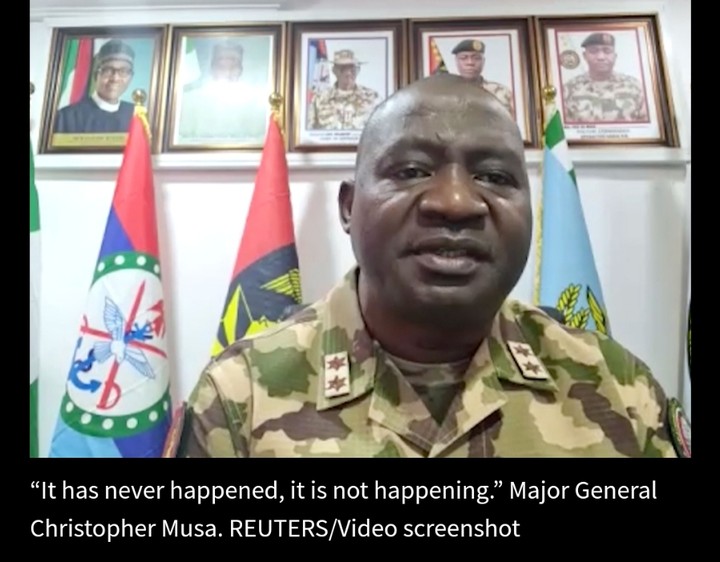
Nigerian military leaders told Reuters the army has never targeted children for killing. They said that the reporting in this article is an insult to Nigerians and part of a foreign effort to undermine the country’s fight against the insurgents.
“It has never happened, it is not happening, it will not happen,” said Major General Christopher Musa, who heads the counterinsurgency campaign in the northeast, of such killings. “It is not in our character. We are highly professional. We are human beings, and these are Nigerians that you have been talking about.”
General Lucky Irabor, Nigeria’s chief of defence staff, did not respond to requests for comment. On Dec. 2, after Reuters shared detailed findings and questions with his office, the military's director of defence information released a statement to reporters. Major General Jimmy Akpor called the Reuters accounts of child killings in this report “concocted allegations,” according to the statement. Nigerian military personnel, he said, are “raised, bred and further trained to protect lives, even at their own risk, especially when it concerns the lives of children, women and the elderly.”
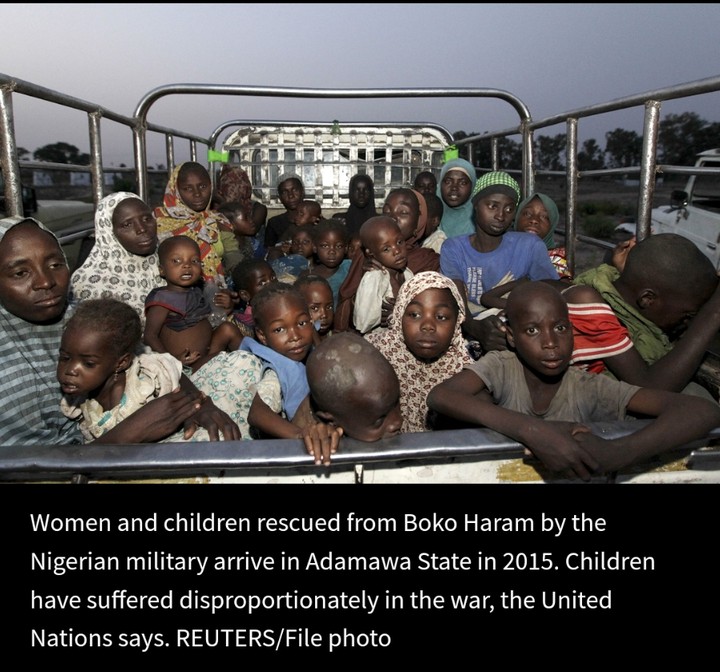
In the northeast, children often have been swept up in wartime violence and suffered disproportionately from the fallout, including displacement, unlawful detention, malnutrition and disease, according to the United Nations and other humanitarian groups.
Amnesty International reported in 2015 that the Nigerian military and allied forces had summarily killed more than 1,200 men and boys captured in the conflict. The Nigerian government ultimately dropped an investigation into Amnesty’s accusations of extrajudicial killings and other war crimes, finding insufficient evidence to support any abuses by its officers.
The International Criminal Court prosecutor concluded in 2020 that grounds existed to open an investigation into possible war crimes and crimes against humanity by both Nigerian security forces and insurgents, but the court has not opened one.
The ICC’s Office of the Prosecutor declined to comment on Reuters’ findings.
The Reuters investigation found that Nigerian soldiers took aim at children of all ages in battlezones around the northeast because the army presumed the children were, or would become, terrorists. Soldiers selected babies and toddlers for killing after rescuing them and their mothers from Islamist militants; rounded youths up for interrogation and killing in raids of homes and marketplaces; or slaughtered children along with adult civilians in counterterrorism operations that were intended to leave no survivors. When commanders ordered towns to be cleared of presumed insurgents, soldiers said they understood, and sometimes were explicitly told, that children’s lives were not to be spared.
Soldiers often cited as a reason for killing children the belief that if their fathers were insurgents, then they would grow up to be the same. The killing was also a way for some officers to avenge heavy losses in fighting with Islamist insurgents, or for soldiers to vent their anger over the deaths of their comrades.
“I don’t see them as children, I see them as Boko Haram,” said one soldier, who told Reuters his best friend was shot dead by insurgents. The soldier said he had killed children himself. “If I get my hands on them, I won’t shoot them, I will slit their throat … I enjoy it.”
Other soldiers said they had adopted a kill-or-be-killed attitude toward children because insurgents used them as fighters, informants and suicide bombers. The United Nations children’s agency UNICEF has alleged that “non-state armed groups” in Nigeria have recruited thousands of children, some as “human bombs.” It said Boko Haram had claimed responsibility for some of those attacks, in which children were made to carry explosives.
The targeted killings of children were often kept under the radar and covered up by the military, Reuters found. The killings frequently took place in and around small, remote villages, where there is little communication with other towns. Witnesses and relatives were scared into silence, and bodies were buried or burned, according to multiple sources, including soldiers and residents.
Many witnesses, traumatised and unused to Gregorian calendars, had difficulty pinpointing times and dates. In those cases, reporters used growing seasons or religious holidays as reference points. Unable to visit reported massacre sites, Reuters used satellite imagery, when available, to corroborate sources’ descriptions.
Intentionally killing civilians in an armed conflict is a war crime. If the killing is done in the context of widespread or systematic attacks on civilians, it is a crime against humanity, two international law experts told Reuters. Children do not have separate protections under the law, but their young age and vulnerability may be factored into sentencing, said Melanie O’Brien, an associate professor of international law at the University of Western Australia.
Nigeria, as a party to the 2002 Rome Statute of the International Criminal Court, falls within the jurisdiction of the ICC. The preference is for domestic courts to hold participants accountable under the law, but the ICC can also step in if a country is unwilling or unable to do so, said Kip Hale, a U.S. attorney specialising in international criminal justice.
The ICC declined to comment on Reuters’ findings.
The killing of noncombatant children may also violate the Nigerian military’s code of conduct. The most recent version publicly available, issued in 1967, prohibits killing children and states they “must not be attacked unless they are engaged in open hostility against Federal Government Forces. They should be given all protection and care.”
In his statement, Akpor said Nigerian military training institutions “focus extensively” on laws of armed combat and international humanitarian law. Musa said protection of noncombatants is a priority. “At times we even refuse to attack a location because we've noticed that there are children and there are women,” Musa said. “So because we cannot safeguard them, we refuse to strike … We have lost a number of battles because we didn't want collateral damage.”
Reuters reported on Dec. 7 that the army also has run an abortion programme in the northeast that terminated the pregnancies of thousands of women and girls, many of whom had been captured and raped by insurgents. The Reuters investigation, based on military documents, civilian hospital records and dozens of witness accounts, found that the abortions were routinely done without consent, sometimes violently. Forced abortions, too, may amount to war crimes and crimes against humanity, said O’Brien, Hale and two other legal experts.
On Dec. 9, U.N. Secretary-General Antonio Guterres called on Nigerian authorities to investigate the findings in the Reuters abortion report.
Nigerian military leaders told Reuters the abortion programme did not exist. Irabor, the defence chief, said on Dec. 8 the military would not investigate the report, saying it is untrue.
The child killings appear to lack the detailed organisation and elaborate infrastructure of the abortion programme. But as described by the sources, the killings and the abortions complement one another – aiming not just to wipe out extremists but to end the perceived insurgent bloodline.
‘Operation No Living Things’
Boko Haram began as an Islamist fundamentalist movement in Nigeria’s northeast, transforming into an armed insurgency in 2009. As the coalition of security forces conducting the counterinsurgency lost ground, then-President Goodluck Jonathan in 2013 put the Nigerian Army in charge, and it established a new unit, 7 Division, to lead the troubled war effort. The division has remained the core counterinsurgency force under current President Muhammadu Buhari, a retired general.
The army began working with the Civilian Joint Task Force (CJTF), a loose alliance of local militias whose stated mission is to support the counterinsurgency. CJTF members provide the army with intelligence on suspected insurgents, serve as interpreters and help soldiers navigate sometimes unfamiliar terrain. Though militia members officially report to their own leaders, army officers call the shots when the CJTF and soldiers deploy side-by-side in the field, Musa and three militia members said.
Bello Danbatta, a spokesman for the CJTF, told Reuters that the military and CJTF forces did not target civilians. “They are not fighting the women,” he said in an interview. “They are not fighting the children."
By late 2014, the militants had pushed government forces out of many major towns across the states of Borno, Adamawa and Yobe. As of 2016, the Nigerian military had taken back control of many of these towns, but fighting continued in the countryside.
That same year, Boko Haram split into two main factions. The splinter group, Islamic State West Africa Province, has become the region’s dominant insurgent force. Still, many Nigerian soldiers and civilians, including those in this story, refer to both groups as Boko Haram.
Children became pawns for both sides. The U.N. Office of the Secretary-General has in the past accused both the CJTF and militant groups of recruiting children into the war effort, a violation of international law. However, it commended the CJTF and the Nigerian government in a report in August for their efforts since 2017 to protect children from recruitment.
Meanwhile, the conflict has dragged on. Nigerian President Buhari and other leaders have repeatedly declared victory, even as the insurgents’ inroads in remote areas have undermined their claims. The failure to rout the enemy has drawn public criticism and put pressure on the national government ahead of elections set for February.
Tukur Buratai, a decorated general who presided over the army as its chief for nearly six years until January 2021, publicly blamed the drawn-out nature of the conflict on insurgents’ sustained indoctrination of locals. Buratai didn’t respond to a request for comment.
On the ground, soldiers and other counterinsurgency fighters told Reuters, the military has adopted an uncompromising approach toward communities it sees as infiltrated by militants.
During combat operations, soldiers told Reuters, it was common to take aim at anyone they came across in areas the army did not fully control. They were generally considered a member or supporter of the militants and therefore a legitimate target, troops said.
Army officers often branded particularly ruthless offensives “Operation No Living Things,” said four soldiers.
Musa said the army’s standard procedure is to separate out innocent women and children, and turn them over to state authorities for protection. Thousands of children have been taken to camps where they are cared for, he said.
“If we had wanted this war to end in good time, that will have been the solution: Kill everybody,” he said. “But because we take time to select and ensure that it’s only the combatants that we're after, that’s why you see that it’s been prolonged.”
A decade of war has taken a heavy toll on men of fighting age in the region. And in contested areas, males who have survived often flee at signs of trouble, some soldiers and residents said. Among the remaining civilians, children fall under greatest suspicion, they said, because they are seen as easily schooled in extremist ways.
“Boko Haram is taking them and putting something in their heart,” said the soldier who participated in the waterhole massacre. “Child fighters, they have no fear, they don’t realise the value of their own life.”
Many of the troops interviewed for this story said they were acting on orders from their commanders when they attacked children, and some expressed remorse.
Often uneducated with few job prospects, many soldiers joined the army in hopes of improving their lot, only to face paltry pay, a shortage of equipment as basic as bullets and boots, and a seemingly unending conflict. Stuck in the region for years, often without rotation, some described falling into a traumatised mindset that left them willing and even eager to kill children, especially as more and more of their comrades were wounded or died in combat.
Cultural differences deepened troops’ alienation. Though many share the region’s main faith of Islam, most hail from elsewhere in Nigeria and don’t speak the local languages. And in a war in which insurgents have forced minors to fight, soldiers said they couldn't even trust in the innocence of children.
In the first attack he witnessed on an army location, the soldier who told Reuters he wanted to avenge his friend’s death said he saw 8- or 9-year-olds carrying guns and loading ammunition into magazines. “I saw it with my own eyes,” he said. “There was one, the gun was too heavy for him, they tied it around him with a string, and he went with it.” Source: https://www.reuters.com/investigates/special-report/nigeria-military-children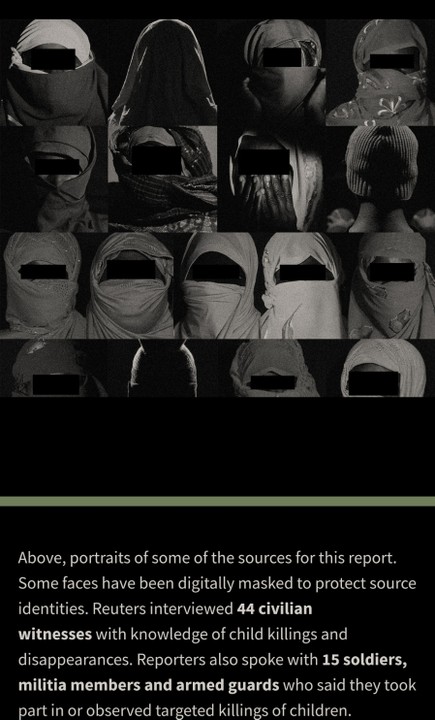

|


