Technical Discussions On International Military Equipments Doctrines Tactics Etc - Foreign Affairs (83) - Nairaland
Nairaland Forum › Nairaland General › Politics › Foreign Affairs › Technical Discussions On International Military Equipments Doctrines Tactics Etc (1164312 Views)
1 2 3 ... 80 81 82 83 84 85 86 ... 669 Reply (Go Down)
| Re: Technical Discussions On International Military Equipments Doctrines Tactics Etc by chinese8107: 5:01pm On Nov 14, 2016*. Modified: 10:58am On Nov 15, 2016 |
giles14:  in fact they sold some finished products and some compounets to China before 2008 and allow local assembly,it's license built. But later China can make it ,and make some improved compounets and export to Russia. Light Armoured Vheicle or small arms is not top secret for big empire.It's not very diffcult for industrlized nation .Russia knows Chinese vheicle bulding industry is ahead of her in making some compounets Russia doesn't have to fear it knows China can reverse enginering,or even make it better, they can TOT to each other, this benefit both side.It's called technology exchange.such as the engine and Transmission China can't make everything better than them sill many things rely on Russia.
|
| Re: Technical Discussions On International Military Equipments Doctrines Tactics Etc by giles14(m): 5:47pm On Nov 14, 2016 |
Henry240:the Iranian n Russian connection |
| Re: Technical Discussions On International Military Equipments Doctrines Tactics Etc by Nobody: 5:48pm On Nov 14, 2016 |
Nemesis2u. I watched this documentary over the weekend, 'Heroes of helmand the British army's great escape'. I kept wondering to myself, with a 60 billion dollars defence budget, why was the British army so under-equipped in Afghanistan? |
| Re: Technical Discussions On International Military Equipments Doctrines Tactics Etc by bidexiii: 6:07pm On Nov 14, 2016 |
Henry240:Nothing but oil money. |
| Re: Technical Discussions On International Military Equipments Doctrines Tactics Etc by Nobody: 6:21pm On Nov 14, 2016 |
giles14:Russia considers Hezbollah as a terrorist organization, even though they currently are on the same side in Syria. Yes, Iran. What other sources asides Iran? |
| Re: Technical Discussions On International Military Equipments Doctrines Tactics Etc by Nobody: 6:21pm On Nov 14, 2016 |
bidexiii:Lebanon has no oil, funny enough. |
| Re: Technical Discussions On International Military Equipments Doctrines Tactics Etc by sczeska: 8:18pm On Nov 14, 2016 |
This stuff is really big
|
| Re: Technical Discussions On International Military Equipments Doctrines Tactics Etc by chinese8107: 6:56am On Nov 15, 2016*. Modified: 9:01am On Nov 15, 2016 |
German LAV
|
| Re: Technical Discussions On International Military Equipments Doctrines Tactics Etc by realnas(m): 8:48am On Nov 15, 2016 |
Henry240:the Islamic Republic of iran |
| Re: Technical Discussions On International Military Equipments Doctrines Tactics Etc by realnas(m): 8:53am On Nov 15, 2016 |
Henry240:the Islamic Republic of iran pumps billions every single year to Hezbollah plus they have businesses all over the world from car dealerships, to commodities trading, narcotics, currency counterfeiting in the bekaa valley. Hezbollah is the most powerful political /military organization in Lebanon I bet you they can give most Arab armies a blooded nose |
| Re: Technical Discussions On International Military Equipments Doctrines Tactics Etc by Nobody: 4:04pm On Nov 15, 2016 |
damn car bombs slowing down the Iraqi forces advance on mosul, start from 10:10. https://www.youtube.com/watch?v=IpxZasQKGq8 |
| Re: Technical Discussions On International Military Equipments Doctrines Tactics Etc by Nobody: 6:28pm On Nov 15, 2016 |
ISIS destroy russian MI-24 Hind helicopter on the ground near palmyra ,syria
|
| Re: Technical Discussions On International Military Equipments Doctrines Tactics Etc by realnas(m): 7:32pm On Nov 15, 2016 |
africaken254:did they use an ATGM? |
| Re: Technical Discussions On International Military Equipments Doctrines Tactics Etc by Nobody: 8:20pm On Nov 15, 2016 |
realnas:most likely ,the ISIS propaganda sound has being muffled. that's why you can't actual hear much of the background sounds |
| Re: Technical Discussions On International Military Equipments Doctrines Tactics Etc by Nobody: 11:58am On Nov 16, 2016*. Modified: 12:43pm On Nov 16, 2016 |
After a considerable delay, Rustom-2, India’s long endurance Unmanned Air Vehicle (UAV) finally completed its first flight early on Tuesday in Challakere, about 200km from Bengaluru. The UAV, which is in the medium-altitude, long endurance (MALE) category of vehicles, sources in the Aeronautical Development Establishment (ADE) which developed the vehicle, said “met all the expectations” during the first flight.
|
| Re: Technical Discussions On International Military Equipments Doctrines Tactics Etc by Nobody: 12:08pm On Nov 16, 2016 |
naval lca HOT refueling
|
| Re: Technical Discussions On International Military Equipments Doctrines Tactics Etc by Nobody: 12:32pm On Nov 16, 2016 |
arjun mk2
|
| Re: Technical Discussions On International Military Equipments Doctrines Tactics Etc by Nobody: 12:34pm On Nov 16, 2016 |
pic 1 t72 with ERA mk1 pic 2 t72 with ERA mk2
|
| Re: Technical Discussions On International Military Equipments Doctrines Tactics Etc by Nobody: 2:57pm On Nov 16, 2016 |
ins vikrant coming along slowly but surely pic 2 should look like this when finished. the next aircraft carrier will be nuclear powered , though i feel that Indian navy must have built another vikrant class carrier along with the present one under construction.
|
| Re: Technical Discussions On International Military Equipments Doctrines Tactics Etc by chinese8107: 6:39pm On Nov 16, 2016*. Modified: 3:09am On Nov 17, 2016 |
http://m.ku6.com/show/G7lKCEe85tpkWUr1Y7MN4Q...html?ucbrowser Dong Fong V-Tiger EQ2070F off-road performance close to Mercedes-Benz Unimog U100 but not exactly the same https://www.xor.org.uk/unimog/uksell/graphics/percival01.jpg
|
| Re: Technical Discussions On International Military Equipments Doctrines Tactics Etc by Nobody: 7:28pm On Nov 16, 2016 |
first in flight images of rustom 2 uav
|
| Re: Technical Discussions On International Military Equipments Doctrines Tactics Etc by Nobody: 8:02pm On Nov 16, 2016 |
RUSTOM 2 (TAPAS 201), a multi-mission UAV is being developed to carry out the Intelligence, Surveillance and Reconnaissance (ISR) roles for the three Armed Forces with an endurance of 24 hours. It is capable to carry different combinations of payloads like Medium Range Electro Optic (MREO), Long Range Electro Optic (LREO), Synthetic Aperture Radar (SAR), Electronic Intelligence (ELINT), Communication Intelligence (COMINT) and Situational Awareness Payloads (SAP) to perform missions during day and night. The test flight took place from Aeronautical Test Range (ATR), Chitradurga, 250 km from Bangalore which is a newly developed flight test range for the testing of UAVs and manned aircraft. It is noteworthy that the development of UAV immensely contributes towards the Make-in-India initiative as many critical systems such as airframe, landing gear, flight control and avionics sub-systems are being developed in India with the collaboration of private industries. Defence Electronics Application Laboratory (DEAL) of DRDO has developed the data link for the UAV. Rustom- II will undergo further trials for validating the design parameters, before going for User Validation Trials. a UCAV derivative is in the work. |
| Re: Technical Discussions On International Military Equipments Doctrines Tactics Etc by Nobody: 8:20pm On Nov 16, 2016 |
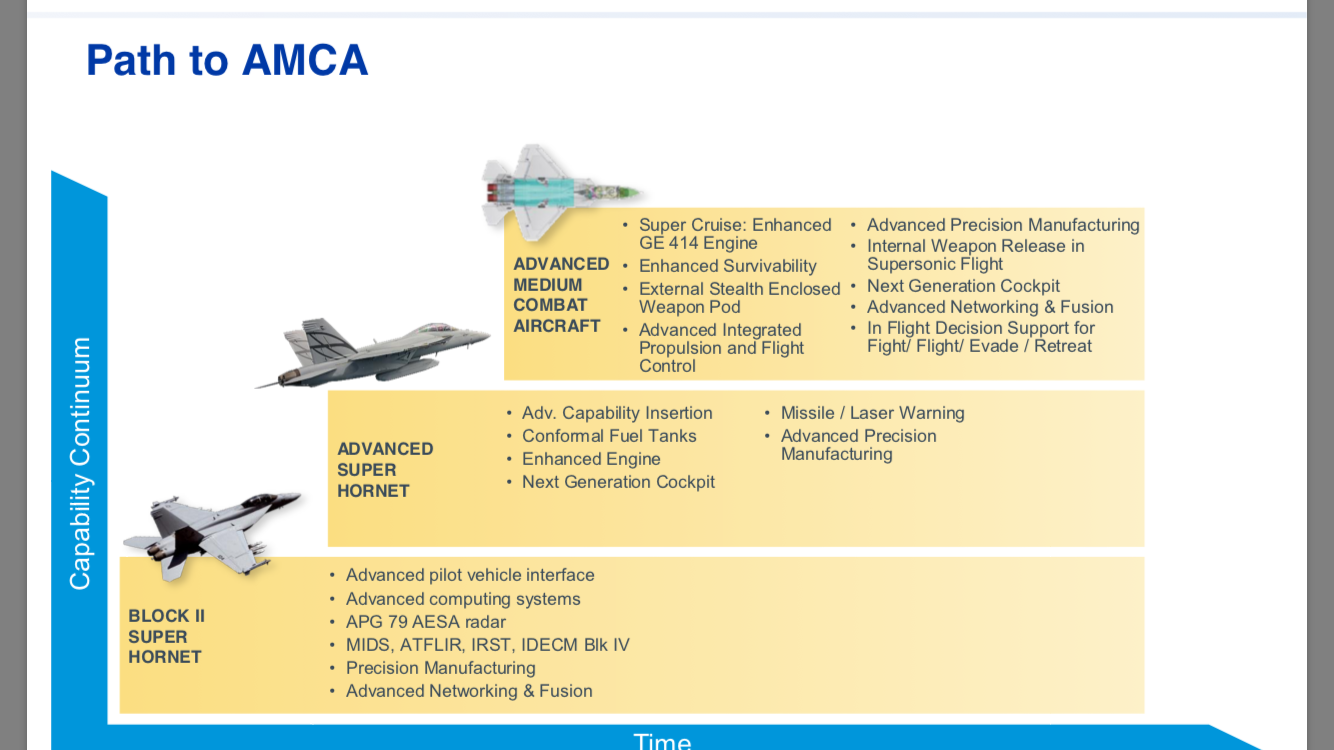
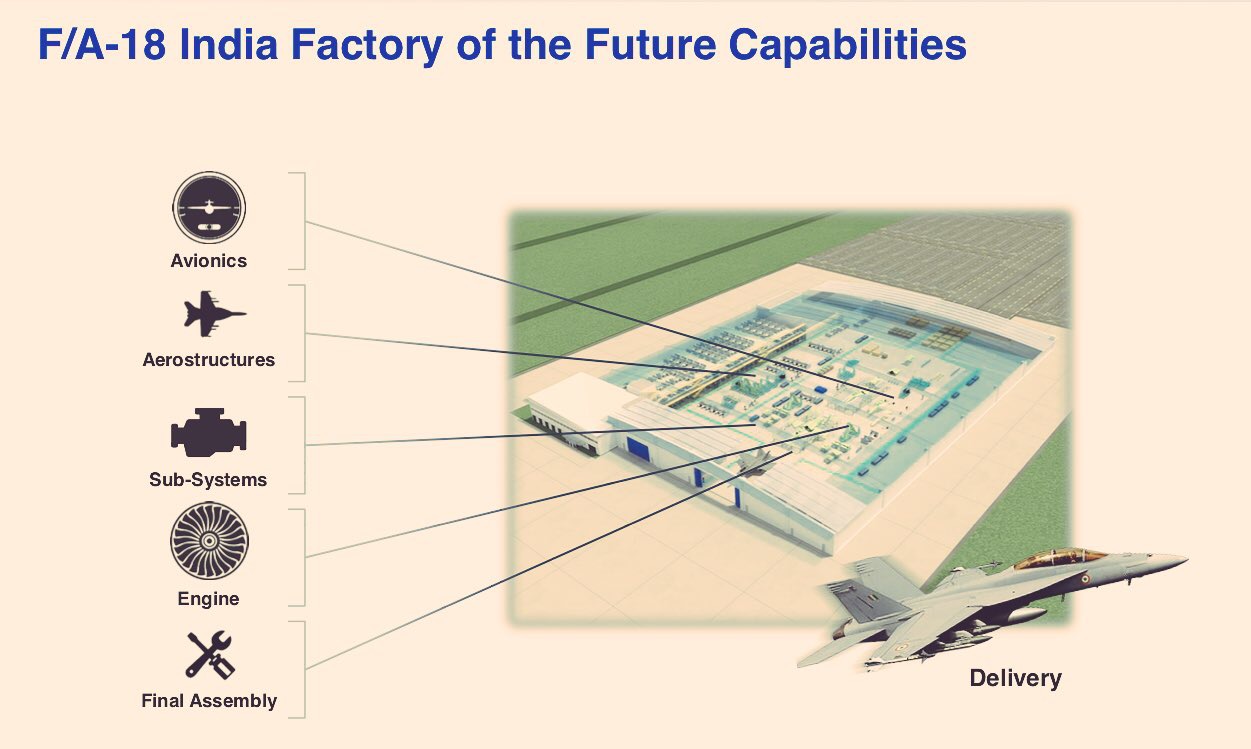
Boeing Unveils An AMCA ‘Sweetener’ (AMCA is indian 5 gen fighter program which is in initial development. design has been frozen.) As Boeing Defense revives its campaign for the F/A-18 Super Hornet in India, a slide in its presentation today on the pitch stands out significant and adds telling detail to an aspect of the effort that has remained relatively unknown — how India’s proposed Make In India Fighter programme ties in with the country’s concept fifth generation development AMCA platform. https://www.livefistdefence.com/wp-content/uploads/2016/11/IMG_7112.png First, as the slide most visibly suggests, Boeing proposes that the manufacturing facility and supply eco-system that it builds up for the F/A-18 in India in the event it is chosen, could be used to produce the AMCA. The existing facility could be leveraged, precluding the need for a greenfield setup elsewhere. https://www.livefistdefence.com/wp-content/uploads/2016/11/IMG_7115.jpg Second, also mentioned specifically in the slide is the GE 414 enhanced engine pitch. Significant. Boeing here is proposing engine commonality from the get-go to support the prospective selection of the Super Hornet platform. Both Boeing and GE are in ‘multiple stakeholder discussions’ with the DRDO, Indian Air Force (and, presumably the MoD) on this aspect, said Boeing India President Pratyush Kumar during a presentation by Dan Gillian, Boeing’s VP on the F/A-18 programme headquartered at St Louis (Livefist is in the United States at the invitation of Boeing Defense). The enhanced GE 414 would be a feature on the Advanced Super Hornet proposed as part of the Make In India pitch. How this ties in with India’s own engine development efforts and opportunities remains unclear. The indigenisation thrust need to ensure the Kaveri effort hasn’t gone to waste — the AMCA could potentially be India’s last indigenous manned fighter project for the next three-four decades. Finally, there is the suggestion that Boeing could be available to help along the AMCA programme directly as a partner or consultant in such a way that it makes the Block 2 Super Hornet -> Advanced Super Hornet -> AMCA flow more seamlessly from a development-to-manufacturing perspective. copied from livefistdefence.com pic below design of AMCA
|
| Re: Technical Discussions On International Military Equipments Doctrines Tactics Etc by tdayof(m): 3:35am On Nov 17, 2016 |
nemesis2u:Powered by what engine? |
| Re: Technical Discussions On International Military Equipments Doctrines Tactics Etc by Nobody: 4:21am On Nov 17, 2016*. Modified: 5:09am On Nov 17, 2016 |
tdayof:NPO-Saturn 36MT turboprop engines, generating around approx 100 HP , meanwhile drdo with mahindra r working on a replacement engine generating 200 HP. this is not a final product , the end product will look different with other extra refinements coming in due to MTCR membership. but given indian bureaucratic stupidity , and public sector organizations laziness , and the armed forces love for imported ass/pu**y  etc etc . including the general all round fuckery by politicians not providing funding etc this UAV might/will be delivered in the next century to fight the mosquitoes (the one that bites us) etc etc . including the general all round fuckery by politicians not providing funding etc this UAV might/will be delivered in the next century to fight the mosquitoes (the one that bites us) |
| Re: Technical Discussions On International Military Equipments Doctrines Tactics Etc by Nobody: 7:53am On Nov 17, 2016 |
2 Likes |
| Re: Technical Discussions On International Military Equipments Doctrines Tactics Etc by tdayof(m): 7:57am On Nov 17, 2016 |
nemesis2u:Is there a video of this UAV flying? LOL. why do you talk so bad of your armed forces? Oops I forgot hatred between the military and intelligence agencies. Agent nemesis |
| Re: Technical Discussions On International Military Equipments Doctrines Tactics Etc by Nobody: 8:36am On Nov 17, 2016 |
Japanese Type 96 Armoured Personnel Carrier loses a wheel during the military show
|
| Re: Technical Discussions On International Military Equipments Doctrines Tactics Etc by tdayof(m): 8:39am On Nov 17, 2016 |
africaken254:A Chinese IFV or so was posted here with the same problem however a guy here blasted him. What's with you guys and the Chinese enemity? |
| Re: Technical Discussions On International Military Equipments Doctrines Tactics Etc by Nobody: 8:52am On Nov 17, 2016*. Modified: 9:33am On Nov 17, 2016 |
Demolishing Some LCA Tejas Falsehoods Bahrain airshow: “The Tejas is an old design. It has taken 32 long years to develop! And despite being in development for so long, it’s not truly indigenous. It’s heart, the engine, is of foreign origin. So are its weapons and some avionics. Furthermore, it is so deficient in it’s performance, that the Indian Air Force (IAF) wants Rafales/Su-30MKIs/F-16s instead.” Every time the Tejas achieves some important milestone, these criticisms are repeated ad nauseum, in the popular media, on Twitter, on internet forums, and at bhel-puri stalls in Jhumritalaiyya. It’s infuriating to see an effort of this magnitude, one that has produced many successes, being panned time and again. So I’ve taken the liberty to put together this handy-dandy LCA Tejas mythbusting guide to counter them. And without wasting your time any further, I’ll jump right in False Argument 1: The Tejas is “late”. It has been under development for 32 years! The figure is technically true, but deprives the narrative of much-needed context. The Tejas’ origins can indeed be traced back to 1983, when the concept of a Light Combat Aircraft (LCA) was conceived. However, the IAF did not finalise its air staff requirements (ASRs) until 1985 (and kept on requesting major changes throughout the design and development phase, but more on that later) and initial funding did not come through until 1986. The project definition phase — the phase in which technical requirements are defined and a conceptual design prepared did not end until 1988. The final design was completed in 1990. Full funding was issued only in 1993, after which the development of a prototype commenced in earnest. Following several years of delay in the development process — delays that can at least partly be traced backto US sanctions on India following the 1998 nuclear tests — the Tejas had its first flight in 2001. From then, the project proceeded at a pace that is not too different that of comparable fighter aircraft development programmes worldwide. Consider this: the Tejas is slated to achieve final operational clearance (FOC), the stage at which an aircraft is considered fully ready for squadron service, in early 2016; fifteen years from the date of the first flight. At this time, the Tejas’ is expected to be ready to carry out every role required of it: beyond visual range (BVR) air-to-air combat, short-range dogfighting, and precision ground attack with a variety of guided and unguided weaponry. That compares well with contemporary fourth-generation fighters like the Eurofighter Typhoon and the JAS-39 Gripen. The Typhoon first flew in 1986. The definitive version with an AESA radar is still not in service today, 30 years down the line. The Tranche-2 version, which can drop precision bombs and fire BVR missiles, wasn’t available until 2008. Another European fighter, the Swedish Gripen-C, with full-spectrum capabilities, started entering service in 2002, also fourteen years after its first flight. The Tejas is about to FOC with all of these capabilities in late 2016. The fact that ADA managed to achieve similar or better timelines with the Tejas after its first flight, that too without the benefit of half a century of experience in building advanced fighters or the industrial ecosystem that enables such high-technology to proceed swiftly, is an achievement that is not given enough credit. False Argument 2: Because of the inordinate delays in development, the Tejas is now deficient. Just because the development was delayed doesn’t mean that the design is the same one from 1983. The IAF updated its requirements quite often and kept demanding additional capabilities of the design. It was a Catch-22 situation: the constant change in requirements kept the design up-to-date, but it also led to several years of delays because of the need to re-design, re-test, and re-certify the aircraft after every minor change. Off the top of my head, I can remember that the IAF demanded the following modifications pretty late into the program: Open avionics architecture. Precision bombing capabilities. Heavier A2A missiles (R-73 vs R-60). Internal EW suite that included a self-protection jammer. Inflight refueling. More capable radar and missiles (LCA Mk-1A). etc With these modifications, the Tejas went from being a simple point-defence interceptor to a full-blown (albeit short-legged) multi-role fighter. False Argument 3: The LCA falls short on several performance parameters like empty weight, range, turn rates, etc. The IAF has allowed 53 concessions/permanent waivers in the design. Like the 32-year delay, this too is a scary looking that paints a false picture of how fighter aircraft programmes work. First off, it is important to remember that the Tejas can carry out most of the tasks intended of it quite competently. It can fight other aircraft at beyond visual range (when equipped with an AESA radar and Derby/Derby-ER missiles, it could end up becoming the most capableBVR platform in IAF service. Better than the Su-30MKI and Mirage-2000). The addition of an Israeli helmet-mounted sight coupled to missiles whose seekers had a wide field of view (R-73 and Python IV/V) make it a fearsome dogfighter and compensate for minuscule shortfalls in aerodynamic performance. It can drop laser-guided bombs on ground targets with great precision. It is very easy to fly. In the words of the IAF, the fighter’s “control harmony is comparable to the best in the world… The intuitive cockpit layout and highly reliable life support systems provide for comfort as well as excellent situational awareness.” There are many such triumphs; too many, in fact, to recount here. Secondly, every fighter project concludes with specifications that aren’t met, or a few deficiencies in performance. It’s never that big of a roadblock to induction in service. And all said and done, 53 is a very small number as far as design concessions go; a pretty small portion of the entire range of capabilities. Even simpler aircraft (like the C-17) enter service with more deficiencies. These are either compensated with using technologies in other areas to offset performance shortfalls, or accepted in the interest of availability for combat. Again, I’ll go back to the Eurofighter Typhoon to illustrate my point. Remember I mentioned that it first flew in 1986? Twenty-two years later, it couldn’t independently drop a laser-guided bombon a target with any precision. Basic BVR combat capability was not available until Tranche 2 models were procured in 2008, 14 years after the first flight. Even in close air combat, its capabilities were decidedly limited. The helmet mounted sight (HMS) — a system that allows the pilot to cue weapons onto an enemy aircraft by simply turning his head and offers a quantum jump in dogfighting capabilities — did not enter service until 2010. The F-35 was hobbled by similar issues (and terrible program management) for several years. It didn’t begin to turn a corner until 2012 or so, after which it began rapidly demonstrating some of the capabilities that were expected of it. This all happened despite the likes of Boeing, EADS, and Lockheed in charge of these projects. How then do you expect the ADA, which has never developed a fighter in its entire existence, to deliver a more capable product before inducting any into operational service? Heck, even the IAF works with deficient designs all the time. They happily flew the short-legged, limited-payload Gnat and even procured it in great numbers. Ditto with the Su-7. The MiG-21, when initially inducted, was underwhelming. Its range was limited and its missiles didn’t work. The Bison is still riddled with issues. The Jaguar had a deficient nav-attack suite. It was practically useless in the long range strike until the IAF and HAL developed and implemented the DARIN upgrades. The MiG-27’s navigation system never worked well, and its reliability was terrible; at night especially, it was no better than dead weight. But none of this troubled the IAF. Why then is the LCA failing to achieve a handful design parameters something to raise a huge hue and cry about? False Argument 4(a): The LCA isn’t really indigenous. Many of its subsystems are of foreign origin. But many more of its critical subsystems are of Indian origin too! The first one that comes to mind is the carbon-fibre composite airframe. It is a very high-tech product that reduces weight (thus permitting the carriage of a substantial external payload), aids maintenance, brings down manufacturing time, and so on. The fact that some of the technology involved has been exported to Airbus is a testament to its success. Another example is the digital fly-by-wire (FBW) system, developed from scratch by ADA scientists in India after their work, notes, and equipment was impounded by Lockheed Martin in 1998. No country on earth, none, has developed such a complex system and gotten it to work perfectly on the first try. How well does it work, you ask? Well, the system was first tested on an F-16XL in the US (this was before the nuclear tests). Much to the amusement of everyone involved, the software actually improved the handling qualities of the XL in several flight regimes! No wonder the IAF says that the Tejas one of the easiest and friendliest aircraft to fly. There are many other examples. The avionics. The mission computers. The navigation equipment, displays, and human-machine interface. The EW systems. This stuff isn’t trivial by any yardstick. Now coming to the foreign components aboard the aircraft. With the exception of the Americans, and to an extent the Russians, every country has used foreign subsystems extensively in its aircraft designs. The Gripen has an American engine, a British airframe design, Swiss carbon-fibre, an Italian radar, an American flight control system, a cockpit with critical components purchased from Britain, etc. etc. This in spite of the Swedes having an industrial base that is far more advanced than India’s and extensive experience in the form of the Draken and Gripen. The Rafale and Typhoon both use American ejection seats. Their FBW uses actuators from Moog, an American company. The Russians were buying Damocles podsfor the Su-35s before the French stopped military exports after they invaded Crimea. Nearly every Chinese fighter in service today uses a Russian engine, a Russian ejection seat, and a slew of Russian weaponry. If these aircraft all qualify as “indigenous”, then surely the Tejas does too? The choice the design agency faces is quite stark: do they try to build every little component, thus reinventing the wheel at every step? Or do they use what is available easily in the market in the initial stages and then make an attempt to indigenise over the life-cycle of the product? The latter is always the more sensible way to go. In the final analysis, the Tejas is an aircraft that has been designed by Indians in India, and is tailored to Indian requirements. If that doesn’t make it indigenous, I don’t know what does. False Argument 4(b): Okay, I get that. But the aircraft’s very heart, it’s engine, is fully imported! Surely it’s an utter failure on that front? Yes and no. It has had a very protracted development cycle, and for good reason. A jet engine is arguably represents the pinnacle of modern technology, making it the most challenging system in the world to develop from scratch. It has to produce ungodly amounts of power for its size and operate at the very edge of what physics allows. The GE F404 — which ended up replacing the Kaveri on the LCA — weighs just a shade over 1000 kg and develops close to 80 kN of wet thrust. Assuming that it propels the LCA to Mach 0.9 at sea level (1,100 km/h), it’s developing about 24,400 kW or 32,700 hp. That’s 32 hp per kg. In contrast, a Formula-1 car engine generates “only” 8 or 9 hp per kg, and it’s about as far as you can get with piston engines. What does it take to generate so much power? You need critical components like turbine blade assemblies that see inlet temperatures of 1,400°C or so while being subject to extreme forces. A back-of-the envelope calculation using rectally extracted figures tells that a single high pressure turbine blade weighing 50 gm rotating at 16,000 RPM at the end of a 500 mm diameter disk will be subject to a centrifugal force of about 3,500 kgf. Imagine a two Honda Civics hanging off a tiny blade that is about as large as two of your fingers held together. Oh, and that’s not all. The 80 kN of thrust is distributed over the turbine blades, so there is a transverse load component as well. In order to sustain such loads, you need to use exotic materials and precision manufacturing techniques. Steel melts at about 1400°C, and starts rapidly losing strength at less than 500°C, so it’s obviously not an option. You need something like a nickel-based superalloy. And it can’t be simply cast or forged or machined into shape. It has to be produced via directional solidification or grown out of a single crystal in what looks more like a lab than a production shop. The shape, too, is extremely complex. It isn’t one solid piece — there are internal channels that route cold air taken from the compressor to the surface of the blade to keep it cool. And this is just the turbine. The fan, compressor, combustor, gearbox assemblies, bearings … they’re all just as complex. And they all have to be precision manufactured to ensure that microscopic imbalances don’t end up leading to excessive vibrations that could end up destroying the engine and the aircraft it propels. Then you have requirements like safety, fuel efficiency, minimum total technical life, and reliability that add multiple layers of complexity to the design. Now imagine the magnitude of effort required to develop something like this, with practically zero infrastructure and very little in terms of prior experience. And with skinflint bureaucrats refusing to approve requests for funding, test equipment, or manufacturing tools without documentation being submitted in triplicate and subject to audit after audit. Do you know how much the GTRE spent of developing the Kaveri? Rs. 2,000 crore, or approximately $640 million in equivalent US dollars (with all the exchange rate and inflation variations that happened between 1989 and now taken into account). Advanced nations spend billions on such programs, and they almost never develop clean-sheet designs. They’re always building on existing knowledge and existing designs. Consider for a moment what Jeff Immelt, the CEO of GE says. “If you could make something with 60 people in a garage, GE shouldn’t be doing it. But if you make a jet engine, there’s only like one and a half people in the world that can make a jet engine. And we are really good at that. If you want to compete with that, you’ve got to put yourself on a wayback machine and go back 25 years and invest $1 billion here for 25 years and then maybe, just maybe [emphasis mine], you’re going to be able to compete with us.” Think about that for a second. It requires 25 years. And a billion dollars. And then too, you’re more likely to fail than succeed. The Chinese have been pouring money and espionage resources into their jet engine development efforts (they have budgeted 300 billion yuan — about 45 billion in today’s US dollars — over the next 20 years on engine programs alone), and are still facing significant hurdles. Why do people feel that India would get significant results by spending just a few thousand crores? In any case, the Kaveri isn’t a complete write off. A naval derivative, the Kaveri Marine Gas Turbinemay end up powering Indian Navy vessels. It is also under consideration to power an Indian UAV. There are civilian spin-offs too. For example, Bharat Heavy Electricals Limited (BHEL) now uses the investment casting technology developed by GTRE for manufacturing blades for gas turbines used in power generation. False Argument 5: In a globalised world, there is no point re-inventing the wheel. The IAF should simply dump it and buy the Gripen/F-16/MiG-35 What is true for cell phones or cars isn’t true for military equipment. In the long run, in peace and in war, the IAF is best served by procuring fighters designed and built in India. That’s the only way it will equip itself with a large fleet on a (relatively) small budget. There are other advantages to developing the technology in-house: less dependence on foreign suppliers, leading to increased strategic independence. Creation of a stronger local economy and industrial ecosystem. The freedom to tinker with the design and optimise it to suit local requirements without running afoul of IP agreements with the OEM. Spin-offs in the civilian world. And so on and so forth. And if going indigenous is indeed the way forward, then the IAF will have to live with fielding under-performing/problematic designs at the beginning. It will have to make peace with the fact that aerospace R & D is a slow, painful process that is fraught with risk. That’s how practically everyone else did it. The Chinese did not seek out the latest and greatest toy because their initial designs (Q-5, JH-7, J-8, J-10) failed to match up to what the US, Japan, and India fielded. If the J-10B and J-20 are flying today, it is only because the PLAAF and PLAN flew inferior aircraft for decades while their industrial capabilities matured. As it is, the Tejas program’s achievements have been quite impressive: the country has developed a fourth-generation fighter that is as good as the Gripen-C from scratch. It uses more home-grown technology than the Gripen does — including such critical subsystems like the digital FBW, the composite airframe, a large portion of the avionics, etc. Many of these have been applied to the IAF’s legacy aircraft as upgrade packages. To throw it all away because of a handful of challenges here and there or because Lockheed or Boeing are offering to transfer their manufacturing lines to India would be incredibly, utterly stupid. If the Tejas is cancelled, we will have a repeat of the same thirty-year saga the next time India tries to build her own fighter. Written by /u/bernard_woolley on reddit. Reproduced with permission. https://medium.com/indian-defence/demolishing-some-lca-tejas-falsehoods-6e6b335faf97#.ft7r1vuqa 1 Like
|
| Re: Technical Discussions On International Military Equipments Doctrines Tactics Etc by Nobody: 8:55am On Nov 17, 2016 |
tdayof:lets say its the mainstream media with has blinded us with the notion that china only make knock-off and unreliable products.china has really had to fight an uphill battle(in this world when your labeled it is almost impossible to prove them wrong)consider the attitude people have about africa |
| Re: Technical Discussions On International Military Equipments Doctrines Tactics Etc by Nobody: 9:04am On Nov 17, 2016*. Modified: 9:36am On Nov 17, 2016 |
africaken254:china makes knock offs in almost everything from foodstuffs to aerospace nobody can deny that , ur falling prey to Stockholm syndrome . the issue here is about reliability which is directly related to quality and which again is directly related to costs. if u pay the chinese more money they will give u more reliable products but then again why not pay the same money to buy from more established companies worldwide. paying less money will give u cheap unreliable products everything ends and starts with the about of money ur paying , it determines the quality and reliability. |


President Zuma Had Telephonic Discussions With President Trump • Photos: Heavy U.S Military Equipments Arrives Germany Against Russian. • @elbinawi Tweets On International Qudsday • 2 • 3 • 4
Russia-Ukraine War: World News, Weapons & Battlefield Discussions - Live • American Politics Thread: Trump Is The 47th President! • Battle Field Discussion (picture/video) Of African Military .