A car unintentionally struck an SUV in President Joe Biden’s motorcade Sunday night, causing damage to both vehicles and appearing to startle the president as he left his campaign headquarters in Wilmington, Delaware.
The US Secret Service confirmed that a vehicle in the motorcade was hit by another car as Biden got into his car. There was “no protective interest associated with this event,” Secret Service spokesperson Steve Kopek told CNN in a statement, meaning that the crash was not intentional. It had been raining heavily in Wilmington.
“Today, at approximately 8:09 p.m., a Secret Service vehicle securing the President’s motorcade route was struck by another vehicle in Wilmington, DE. There was no protective interest associated with this event and the President’s motorcade departed without incident,” Kopek said, directing further questions to the Wilmington Police Department.
The crash caused a loud bang on the street, and Biden looked over to see the commotion. US Secret Service surrounded the silver sedan that caused the crash, telling the male driver to put his hands up, according to pool reporters travelling with Biden.
The impacted SUV wasn’t the president’s. Secret Service personnel escorted the president to his vehicle, where First Lady Jill Biden was already inside.
The Bidens had been visiting the president’s 2024 campaign headquarters, greeting staffers at a holiday happy hour. It marked the first time the president has visited since staffers began working out of the Wilmington office over the summer, CNN states.
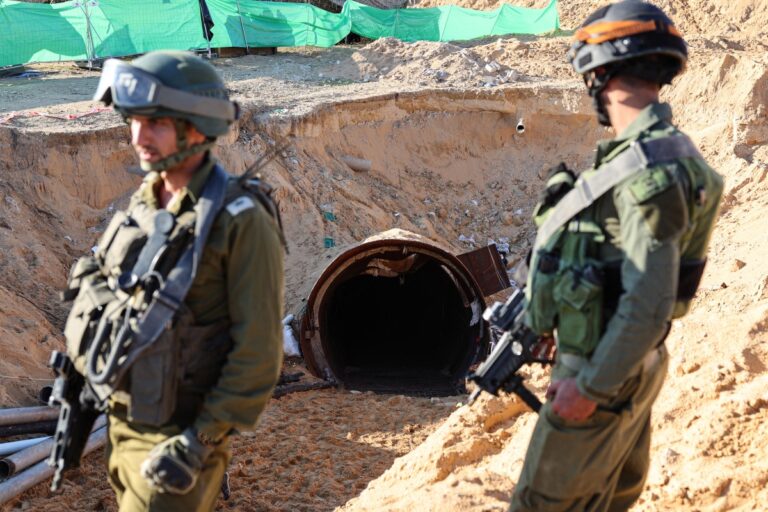
The Israeli army said on Sunday it had uncovered the biggest Hamas tunnel in the Gaza Strip so far, just a few hundred metres from a key border crossing.
Such was its size that small vehicles would be able to travel within the tunnel, an AFP photographer granted access to it reported.
The underground passage formed part of a wider branching network that stretched for over four kilometres (2.5 miles) and came within 400 metres (1,300 feet) of the Erez border crossing, the army said in a statement.
It cost millions of dollars and took years to construct, Israeli forces said, with the project led by Mohamed Yahya, brother of Hamas chief Yahya Sinwar, who is believed to have masterminded the October 7 attacks.
The honeycomb of passageways features drainage systems, electricity, ventilation, sewage and a communication network as well as rails.
The floor is compacted earth while its walls are reinforced concrete and its entrance is a metal cylinder with 1.5 centimetres (half-inch) thick walls.
Footage released by the Israeli army, which it said was filmed by Hamas, showed a small construction vehicle being driven into the tunnel, an extensive temporary warehouse filled with pre-cast concrete for lining the walls and workers digging beneath the earth using crude power tools.
The Israeli army said it had found a large number of weapons stored in the tunnel, ready to be used in an attack.
People, goods, weapons
Hamas had expended huge resources in the project, said Lieutenant Colonel Richard Hecht, an army spokesman, and did so to “serve only one purpose – attacking the State of Israel and its residents”.
He said the tunnel was deliberately built near the Erez crossing, which Israel uses to facilitate the strictly controlled entry of Palestinian workers and those travelling for medical care.
“For Hamas, attacking the people of Israel continues to take priority over supporting the people of Gaza,” he said.
The Islamist militant group launched a surprise attack against southern Israel on October 7, killing around 1,140 people, mostly civilians, and taking about 250 hostages, according to the latest Israeli figures.
In response, Israel set out to destroy Hamas and launched a relentless bombardment and ground invasion of the Gaza Strip to achieve that goal.
The Hamas-run health ministry in Gaza says Israel has killed more than 18,800 people, mostly women and children, during the war.
Dubbed the “Gaza Metro” by the Israeli military, the labyrinth of tunnels beneath the coastal territory was initially devised as a way of circumventing the crushing Israeli-Egyptian blockade, in place since 2007.
Hundreds of tunnels were built under the border with Egypt and into the Sinai Desert, allowing people, goods and weapons to cross into Gaza from the outside world.
Since the 2014 war with Israel, the tunnel network has been expanded and Hamas has made frequent use of it to facilitate its rocket launches.
A study published on October 17 by the Modern War Institute at the US military academy West Point said there were 1,300 tunnels stretching over 500 kilometres (310 miles).
The Israeli army said at the beginning of December that it had discovered more than 800 tunnels, with 500 destroyed.
Reports in Israeli media last week said that the army was considering flooding the tunnels with seawater pumped from the Mediterranean and had already conducted successful tests.
Dividend of economic reforms already manifesting – President
President Bola Tinubu has dropped hints of the scope of the planned minimum wage for Nigerian workers following the rise in the cost of living.
Tinubu,voted by editors of this newspaper as Person of the Year,says the coming wage structure will be practical, sustainable and implementable by all layers of government.
Responding to questions on his journey so far as Nigeria’s President,Tinubu says the economic reforms introduced by his government have been manifesting positive dividends.
These ,according to him, include $616m in Foreign Direct Investment (FDI) pledges.
Reminded about the current cost-of-living crisis in the country caused by spiraling inflation, high petrol price, and currency devaluation, Tinubu said: “ As your President, I am deeply aware of the economic crisis’s severe impact on Nigerians, and we are part of a global challenge with the rising costs of living.
“To help our people, my administration is taking proactive steps. We are focused on providing financial support to businesses and ensuring the availability and affordability of staple foods, which are essential for every Nigerian family.
“One of our key initiatives is the provision of N25,000 monthly to 15 million households, for a three-month period. To further support food security, we’re working with our partners, local and international, to improve agricultural practices and provide essential resources to farmers.
“In addition, the National Single Window Project is being implemented to enhance international trade efficiency.
“All these efforts are in line with our commitment to reducing the economic burden on our citizens, especially the working class and vulnerable groups.”
According to him,the reallocation of funds from the removal of the petrol subsidy is also “a strategic move to bolster our government’s finances, contributing to a stable economic environment for all.”
He added: “ in our commitment to ease the economic strain on our citizens, particularly the working class and vulnerable groups, my administration is championing the shift to cleaner energy sources.
“We recognize the benefits of Compressed Natural Gas (CNG) in providing an affordable and cleaner mass transit system. To facilitate this, we have waived the Value Added Tax (VAT) on CNG purchases. Additionally, to reduce the costs in food transportation and manufacturing, we’ve also waived VAT on diesel for six months.”
He acknowledged that “these massively important reforms have been hard” but pointed out that they have started yielding positive results for the country.
His words: “ the dividends are already manifesting, with even more in sight. We have already seen improvements in our economic outlook, as corroborated by the likes of Fitch and Moody’s. These may seem ‘academic’ to many but the impact on investor confidence is significant.”
Asked to respond to criticism of the cash transfer initiative of his government, which some see as superficial and incapable of addressing the level of poverty in the land,Tinubu insisted that he remains steadfast in “my belief in the efficacy of our cash transfer initiatives. “
He said: “These initiatives are a crucial part of our strategy to target and provide relief to the most vulnerable segments of our population, especially during the last three months of the year when the prices of basic items typically rise.
“This is not just about providing temporary support; it’s about strategically delivering assistance when it’s needed most. We continue to work closely with all key stakeholders – including state governments, civil society groups, international partners, and private sector entities like telcos and fintechs – to refine these programs. Moreover, we urge all Nigerians to be mindful of the current economic situation and avoid exploiting it for abnormal profits.
“In addition to these cash transfers, my administration is deeply committed to empowering micro, small, and medium-sized enterprises, along with nano businesses. Significant financial support is being directed to these enterprises to foster human capital development, economic growth, and financial inclusion.
“For instance, through the Ministry of Communications, Innovation, and Digital Economy, we launched the 3MTT programme, aiming to develop technical talent across Nigeria in fields such as software engineering and cloud computing. This program is designed not just to aid businesses but also to enable our youth to participate in the global gig economy, earning competitive wages while contributing to our nation’s growth.
“Our interventions extend beyond what some may call ‘cash handouts’. They are about creating a sustainable environment where Nigerians can innovate and thrive. By focusing on sectors like digital and creative industries, we are fostering growth and job creation, harmonizing efforts between monetary and fiscal bodies to build a stronger, more resilient Nigeria.
On the planned new wage structure, why it is yet to take off and fears about the ability of some of the states to implement it when the last one has not even been fully adopted all over the country,the president said: “I understand the concerns regarding the unveiling of the new minimum wage and how states will manage these changes, especially those with fewer resources. “To address this, my administration has approved a provisional increase in the federal minimum wage to N35,000 per month for a six-month period, two months of which have already been paid. This decision follows extensive consultations with the Nigeria Labour Congress (NLC) and Trade Union Congress (TUC).
“In managing the situation with the states, we are working closely with them to ensure the new wage structure is practical and sustainable. It’s important that each state’s unique financial situation is considered.
“We are focused on strategies to help states strengthen their economies, considering factors like tax efficiency and economic diversification.
“We are committed to ongoing dialogues with labour unions and state governments. This collaborative approach is crucial to ensure that the new minimum wage is fair, reasonable, and implementable across all states. Our goal is to balance the economic well-being of our workers with the overall financial health of the nation.
“We ask Nigerians to rest assured that my administration will not rest until we have delivered a sustainable solution in the best interest of Nigerians.”
Tinubu,in response to a question on the benefits of his economic missions to some parts of the world so far,said: “ It is essential to place our initiatives within the broader context of our economic recovery and growth strategy. This strategy encompasses several key reforms, including the removal of fuel subsidies, the unification of the naira’s exchange rates, the adoption of the customs single-window, the streamlining of our tax system and enhancement and diversification of our revenues.
“These strategic moves are designed to enhance liquidity and create a more attractive investment environment for both domestic and foreign investors, thereby stimulating sustainable growth.
Foreign Direct Investment (FDI) is not ‘chicken change’. FDI is substantial, long-term financial commitments made by serious enterprises and investors.
“What is happening right now is that Nigeria is re-engaging with the global market – both foreign and domestic investors. We are telling the story of our significant and far-reaching reforms and rebuilding confidence in Nigeria as an accessible and safe investment.
“We are clearly communicating that ‘Nigeria is open for business’ and that the direction of travel is clear and fully committed.
“So far, our pursuit of foreign direct investment has been met with positive outcomes. We’ve secured a $500 million deal with Germany to fund renewable energy projects, particularly in rural Nigeria.
“Additionally, through local enterprises, Nigeria will supply LNG yearly to Germany, starting in 2026, solidifying our role as a key global energy partner. Our focused efforts to attract European FDI are yielding fruit, notably with the $116 million French investment in the I-DICE program, aimed at creating 65,000 start-ups and 150,000 jobs, particularly empowering women.
“As announced on the side-lines of COP28 in Dubai, we’re deploying 100 electric buses nationally, affirming our commitment to sustainable, eco friendly initiatives and creating a platform for Public-Private-Partnerships in the mass transit category.
“Since this announcement we have received serious requests for co-investment opportunities from within Nigeria and across the world – Europe, India, China and the Middle East, key global markets my administration has been energetically engaging with.”
The Lagos State Governor, Babajide Sanwo-Olu, has approved N35,000 wage award for the state public servants.
This was just as he also approved the payment of 50% of basic salary as an end-of-year bonus for all political appointees and public servants, employees of local governments and local council development areas, Lagos State Universal Basic Education Board and the Lagos Neighborhood Safety Corps.
The approval was contained in a circular obtained by PUNCH Online, signed by the Lagos State Head of Service, Bode Agoro, with reference number CIR/HOS/’23/Vol. 1/ 109.
The circular titled ‘2023 End Of Year Bonus And Implementation Of Wage Awards’, stated that the governor approved the payments as part of his administration’s appreciation of public servants’ contribution towards the progress of the state, as well as his commitment to their welfare.
The statement further noted that the end-of-year bonus and the wage award which would be paid alongside December 2023 salary, would be non-taxable.
The statement reads, “As part of the present administration’s continuous appreciation of the contributions of all public servants towards the advancement of the state and its unrelenting commitment to the welfare of its workforce, it is hereby notified for general information that Mr. Governor has graciously approved the payment of 50% of basic salary as end-of-year bonus for all political appointees and public servants, including employees of local governments and local council development areas, Lagos State Universal Basic Education Board and Lagos Neighborhood Safety Corps.
“In the same vein, Mr. Governor has further approved the implementation of the wage award (palliative) pending the review of the national minimum wage.
“Therefore, the 50% of basic salary as an end-of-year Bonus, as well as the wage award palliative), will be paid alongside the December 2023 salary as a “non-taxable element”.
“Sequel to the foregoing, public servants are implored to continually strive for excellence in providing qualitative service delivery to the people of the State in line with Mr Governor’s THEMES+ Agenda.
“Accordingly, all heads of Ministries, Departments and Agencies are hereby enjoined to note the content of this circular and give it the service-wide publicity it deserves.”
Ex-gov imposed commissioners, advisers, others on successor
Federal lawmakers protest, ask Tinubu to intervene, why N’Assembly can’t act yet – Reps spokesman
The list of commissioners, special advisers and other key aides as well as their portfolios was handed over to the Rivers State Governor, Siminalayi Fubara, by his predecessor, Nyesom Wike, Saturday PUNCH gathered.
A close aide of the governor, who disclosed this exclusively to Saturday PUNCH, said Fubara had no input into the appointments as his predecessor was solely responsible for their selection and appointment.
The source said the resignation of some of the commissioners was a confirmation that they were not the governor’s choices, but were rather imposed by Wike, who installed Fubara as his successor.
The aide stated, “Yes, the resignation of the commissioners has shown that they were not appointed by the governor. They were never his nominees. The list of the commissioners and advisers was handed over to the governor by the former governor with instructions on portfolios and offices to occupy. Even security agents were handed over to the governor with clear instructions on where to post them.
“Is there a way the governor can appoint commissioners, advisers and others and they will be resigning this way? It is not possible. Don’t forget that we are just about seven months in office. Commissioners appointed by the governor won’t leave.”
Responding to the claim by the FCT minister that the governor and all elected officials in Rivers State did not buy nomination forms from their pockets, the source said, “Yes, the former governor was correct to say he bought the forms for everyone. But pray, with which money? You know the salary of a governor and you know the cost of nomination and expression of interest forms for the Peoples Democratic Party.
“Let those who want to go leave and the governor will assemble members of his team, and not moles planted to spy on the administration.”
More commissioners resign
The gale of resignation from the Rivers State Executive Council continued on Friday with three more commissioners joining the fray.
They are the commissioners for Transport, Dr Jacobson Nbina; Housing, Dr Gift Worlu; and Environment, Austen Ben-Chioma.
Their resignations were contained in separate letters cited by one of our correspondents and addressed to the governor through the Secretary to the State Government.
Both Nbina and Austen-Ben Chioma were also commissioners under Wike.
This brings to nine the commissioners who have so far resigned their appointments.
Nbina, who confirmed his resignation to Saturday PUNCH on Friday via the telephone said, “Yes, I resigned yesterday (Thursday).”
Asked the reason for his action, he stated, “The reason is personal to me and my family commitments. I don’t have any issue with the governor. It is very personal.”
There were reports that their action was preparing the ground for them to officially defect to the APC, though this had yet to be confirmed.
Earlier, Prof Zacchaeus Adangor, SAN (Attorney-General and Commissioner for Justice); Dr Des George-Kelly ((Works); Emeka Woke (Special Duties); Mrs Inime Aguma (Social Welfare and Rehabilitation); Isaac Kamalu (Finance); and Prof Chinedu Mmom (Education), had resigned from Fubara’s cabinet
Mmom, Adangor, Aguma, George-Kelly, Nbina and Kamalu all served as commissioners under the immediate past administration of Wike and before being reappointed by Fubara.
On his part, Emeka Woke, who also resigned from Fubara’s cabinet as special duties commissioner, was Wike’s chief of staff for eight years.
Speaking to our correspondent on Wednesday, the Caretaker Committee Chairman of the APC in Rivers State, Chief Tony Okocha, said a formal launch of the new APC in the state was scheduled for this weekend, adding, “You will see the tsunami that will happen that day.”
Assembly demolition continues
Meanwhile, the demolition of the state House of Assembly complex continued on Friday with the hallowed chambers completely pulled down.
One of our correspondents, who visited the complex around 10am, reported that there were four bulldozers inside the complex pulling down other adjoining buildings.
The Commissioner for Information and Communications, Joe Johnson, had told journalists that the decision of the state government to demolish the complex built during the administration of Dr Peter Odili was because, after the visit of the governor to assess the damage caused by the October 29, 2023 explosion, he contacted a firm that reported that the building had integrity issues and was unfit for legislative business.
“So, the government will rebuild the complex. But for the meantime, the state has provided a place for the lawmakers to be sitting pending when the building is completed,” Johnson had stated.
A team of policemen in a patrol van was stationed at the Assembly entrance, while both ends of the Moscow Road leading into the complex had security blockades though human and vehicular restrictions had been relaxed.
‘Why NASS can’t intervene’
The House of Representatives has given reasons why it will not take up the functions of the Rivers State House of Assembly, which is currently embroiled in a crisis owing to the feud between Fubara and Wike.
Fubara, the political godson of the Federal Capital Territory minister, has literally parted ways with the former governor in what has been described as the battle for the soul of the oil-rich state.
Earlier in the week, 27 lawmakers believed to be loyalists of Wike defected to the All Progressives Congress, and Fubara, who appears ready to damn the consequences, wasted no time in demolishing the state House of Assembly complex, a move seen as a masterstroke to nullify whatever decisions the lawmakers are likely to take against him.
Things have since moved very fast with a couple of top government functionaries resigning their positions in a replay of the Godwin Obaseki/Adams Oshiomhole feud a few years ago.
The tension in Rivers State has led to suggestions of possible intervention by the National Assembly to restore order by taking over the role of the state lawmakers until the return of normalcy in line with the provision of Section 11 (4) and (5) of the 1999 Constitution (as amended).
Subsection (4) provides, “At any time when any House of Assembly of a state is unable to perform its functions because of the situation prevailing in that state, the National Assembly may make such laws for the peace, order and good government of that state concerning matters on which a House of Assembly may make laws as may appear.”
Subsection (5) reads, “For the purposes of subsection (4) of this section, a House of Assembly shall not be deemed to be unable to perform its functions as long as the House of Assembly can hold a meeting and transact business.”
In an exclusive conversation with Saturday PUNCH, the deputy spokesman of the House of Representatives, Phillip Agbese, said the ongoing political turbulence in Rivers State had yet to be tabled before the Green Chamber, noting that until that was done, there could be little or no intervention in the interim.
Agbese stated, “It is true that there is a constitutional backing for the National Assembly to intervene where there are established instances of crisis in a state House of Assembly that is unable to perform its functions.
“The 10th House has not been notified of any crisis. If it is not formally aware, there is nothing much we can do by way of intervention in the crisis, but it is our wish that the matter will be resolved amicably so that Rivers lawmakers can go about the business they were elected to do by their people. This is all I can say for now.”
Protests against crisis
The political crisis in the state took a new twist on Friday as two members of the National Assembly from Rivers State and the National President of the Ijaw National Congress led separate groups to Port Harcourt to protest against the happenings in the state and registered their solidarity with the governor.
The two National Assembly members are Awaji-Inombek Abiante, who represents the Andoni/Opopo/Nkoro Federal Constituency, and Boma Goodhead, the representative of the Asari-Toru/Akuku-Toru Federal Constituency, both in the House of Representatives.
In a solidarity rally, the lawmakers led hundreds of youths who sang and marched from the popular UTC junction through Azikiwe Road, passed in front of the Government House and terminated at the entrance to the Rivers State House of Assembly complex.
Addressing the crowd, Abiante said the Rivers people were not slaves and the state was not a conquered territory.
In a veiled reference to the FCT minister, he said his local government area of Andoni did not witness any development while Wike held sway in the state despite his claims of touching every council area, and slammed him for orchestrating the planned impeachment of Fubara.
He also urged President Bola Tinubu to practice what he preaches by ensuring that good governance prevailed in Rivers State, pointing out that good governance was synonymous with respect for the rule of law.
The federal lawmaker said, “There are slaves who are always happy in chains. But if you go through the history of Rivers State, if you go through the evolution and the abolition of slavery worldwide, you will hear names from Rivers State.
“We are not slaves. We are not part of those slaves who are happy in their chains. I want to appreciate President Bola Ahmed Tinubu for telling the entire world and affirming that indeed one ingredient that can stop a violent takeover of government and that can stop the violence of humans is good governance.
“He preached it and is the chair of the Heads of Government of the West African nations. We implore him to preach the same in his country. You cannot sell what you don’t have. We cannot become a laughing stock in the comity of nations in the West African sub-region.
“I’m a member of the ECOWAS Parliament and I know that we deserve to have that respect, and he (Tinubu) has preached it. If there has to be good governance, Rivers State is a test case.
“Good governance hinges on respect for the rule of law. Some people, who we elected, have offered to vacate their seats. That is what the law says. A lawmaker should not be seen to be breaking the law.”
While taking a swipe at the members of the state House of Assembly who defected to the APC for their action, Abiante said the law stipulated that they would lose their privileges.
He added, “They should be courageous enough to park their things out of the official quarters allocated to members of the Rivers State House of Assembly. They are no longer members of the Rivers State House of Assembly.
“They should also stop being in contempt of court as the court has declared. And on their own volition, they have abandoned the responsibility given to them.
“As you leave here, go back home and begin to select those who will represent you in the House of Assembly. I have somebody who is supposed to be representing me and I saw him shamelessly saying he signed for the impeachment of the governor given to us by God.
“What does he want to impeach Fubara for? Is it the fact that for eight good years, not even a toilet was inaugurated in the life of the immediate past administration of Rivers State in Andoni?
“Not even a toilet was inaugurated and the pride is I have done everything in all the local government areas. I challenge anyone to come and tell me what was done in Andoni. Less than six months, we now have a good road to the headquarters of Andoni LGA and somebody that we elected to represent us is telling us that he wants to impeach that governor. Can that ever work?
“So, we have just sent a message to Mr President to entrench good governance and begin from Rivers State. I want to tell the Inspector-General of Police again. I stood on the floor of the House and condemned the attempted assassination of the Rivers State governor and the IG told me that it was fake news.
“How can he tell me it was fake news, something that was watched all over the world? We will forgive him. Otherwise, we would have said that a character like that is not qualified for the position. But we have forgiven him. It should not happen again.
“Governance led by Sim Fubara is for Rivers people. Any of the person or group of persons parading whatever, they are not sent by us.”
On his part, the INC President, Prof Benjamin Okaba, led many Ijaw youths to the Government House in solidarity with Fubara, whom he described as a true Ijaw son.
Amid singing and dancing, the youth displayed placards with several inscriptions to drive home their message.
Some of the inscriptions read, ‘Rivers must be from impunity and tyranny’, ‘Rivers and Ijaw people are in support of Governor Fubara’, ‘The governor must be allowed to govern’, and ‘Let’s end godfatherism’ among others.
Addressing journalists on the sidelines, Okaba stated, “These are Ijaw people gathered here on this fateful day. We are from seven states of the South-South. As we speak, over two million Ijaw youths are in Port Harcourt.
“We have decided to embark on this symbolic solidarity march to the Government House, Port Harcourt. Ijaw men and women are coming from Bayelsa, Edo State, Ondo State, from Lagos and Akwa Ibom states. If need be, we shall bring Ijaw people from all the coastal regions to show our solidarity for our son, the legitimately elected governor of Rivers State.
“The purpose of this rally is to call on President Tinubu to advise his minister to take his knees off the neck of the governor of Rivers State.”
He expressed dismay that even after the intervention of the President, the PDP governors, Rivers State Council of Traditional Rulers, elders and many democrats across the country, “Wike is still hell bent on cutting short the tenure of Fubara. We are here to resist any attempt to scuttle the process.
“We are here as Ijaw people to say that Wike has won a lot of battles, but this is a war against the Ijaw people. Let him go to the history of the Ijaw nation. The Ijaw nation has never been conquered since pre-colonial times. And we shall never be conquered.
“Wike has dared the Ijaw people. Wike has declared war against the Ijaw people and we are ready for him.”
The INC boss emphasized that Tinubu’s refusal to call caution the minister showed that he was supporting him to cause a crisis in Rivers State.
Okaba added that the Ijaw nation had suffered marginalisation for too long despite hosting oil resources and installations that sustain the country, noting that the people of the Niger Delta could no longer guarantee the safety of oil facilities in the region.
He stated that for the President to remain quiet while Wike was causing embarrassment in his own state showed that he was supporting the minister.
He added, “We are already angered that the government of President Bola Tinubu has marginalised the Ijaw people. In Delta State, where three persons were picked for federal appointments, none of them is from the Ijaw nation.
“Meanwhile, in that state, the Ijaws are the most economically viable. We are noting all of this. But for him to keep quiet and allow Wike to misbehave shows that there is some tacit support. And we shall not take that.
“As we speak our people are so angered; our people are so frustrated to the extent that we can no longer guarantee if things continue in this way the safety of the oil installations in Ijaw land and in our region.
“And if you (President) are taking us for granted; continue. A day shall tell whether the Ijaw people are still Ijaw people who will say a thing and make it come to pass.
“Since 1958, the Nigerian nation has been surviving on the oil that comes from Ijaw land. Till today, we are crying about marginalisation and we are crying over environmental degradation.
“When you talk of climate change and all that, the Ijaw nation is most affected. But daily, we are treated as if we are not humans. This must stop.
“Forty million Ijaw people are angered and aggrieved. And they are saying that a slap on Governor Fubara is a slap on the entire Ijaw nation. Any attempt to further close up the political space to remove Siminalayi Fubara from office is a call for fire.”
It is observed from the survey that corruption has become so pervasive that Nigerians need to embark on a change of attitude, change of mindset and change of behaviour.
The Independent Corrupt Practices and other related offences Commission (ICPC) says there is a high level of corruption across various sectors in the three arms of government and private sector.
The Provost of the Anti-Corruption Academy of Nigeria, Tunde Babawale, a professor, said this at the validation meeting of the Nigeria Corruption Index (NCI) Survey in Abuja
Mr Babawale said that the findings put corruption level within the legislative, judicial, and executive arms of government and private sector at 42 per cent between 2022 and 2023.
”All the sectors have been found culpable and found to be highly corrupt, the legislature, the judiciary and the executive, all of them have been found to be corrupt
”Although at the level of the state, the score differs from one state to the other, but the bottom line is that there is an overall score that we found is that over 42 per cent in our own scale is highly corrupt for the entire country.”
According to him, it is observed that corruption has become so pervasive that Nigerians need to embark on a change of attitude, change of mindset and change of behaviour.
“Meaning that people must begin to develop a high intolerance level for corruption as we are now, there is a high level of tolerance for corruption in the country.
“And, they don’t see it as a very scandalous and shocking development as it used to be in the past. We should begin to train the youth and even the old on how to develop this anti-corruption antigen,” he said.
He explained that the validation meeting was for a national survey that was carried out in 2022 which was called the Nigerian Corruption Index (NCI).
According to him, the NCI is to survey the extent of grand corruption in Nigeria, to look at the various sectors that are mostly affected by corruption as well as overall Nigerian thought in corruption.
He said the NCI focused on corruption in high places, especially the three arms of government as well as the private sector.
He noted that there had been other surveys on corruption by the National Bureau of Statistics and the United Nations Office on Drugs and Crime which were largely based on perception devoted to identifying the problem relating to petty corruption.
National Bureau of Statistics (NBS) announces Nigeria's new inflation rate
National Bureau of Statistics (NBS) He said: “The difference in what we are doing is that we are surveying the impact of the effect of grand corruption and we are also looking at it from the perspective of different sectors of society, the legislature, the executive, the judiciary, as well as the sub-national government.
“So, the thinking that it is better for us to talk about grand corruption because of the greatest impact on living conditions of Nigerians when policemen collect bribes on the roadside – that has effects, but not as much as somebody stealing N109 billion.
”So, we want to weigh the impact of such on society, how it differs from one sector to the other, and the ultimate objective is also to ensure that we are able to advise the government on policies that should be put in place in order to develop anti-corruption initiatives and interventions.”
Roles of private sector
He expressed concerns on the findings of the NCI which discovered that people had trivialised corruption, and that the private sector fuelled corrupt practices in the public sector.
“One of the things we found out is that people have built the concept of Corporate Social Responsibility fraudulently, they have used it to disguise corruption to also disguise the perpetration of corruption between the private and public sector.
“What I mean by that, private companies sometimes bring out the concept of corporate social responsibility as real corporate social responsibility, when what it is, is actually perpetuating corruption by giving officials bribes and even equipment.
“Some get cars bought for them and all of it we found out in the course of our survey. So, the government has to take a look at that. And purge it of all those impunity.”
Government action
He said there was the need for the government to look to legislative oversights sometimes used as a tool and channel for corruption.
“There is need for the government to purge the legislate oversight of a tendency by some people to also use it to take money from both the private and public sector.
“Some in the survey claimed that they sponsored trips for legislative oversights, which should not be, because the government made provision for that. Tjat has to be addressed.
“And lastly, the overall thing that was observed is that corruption has become so pervasive that we need to embark on a change of attitude, change of mindset and change of behavior,” he said.
The NCI project
Elijah Okebukola, a.profrssor and Lead researcher on the project Nigeria Corruption Index (NCI), noted that what the index did was that it measured corruption at different levels.
He said that their findings revealed that there was a high level of corruption at virtually every sphere of the sectors across Nigeria’s three arms of government.
“We have found that there is a high level of corruption at virtually every sphere of sectors in the country, in every level of government in all the spheres what index does is that it measures corruption at different levels,” he said.
The Secretary of the commission, Mr Clifford Oparaodu, represented by the Director of Legal, Henry Emorie, said that NCI was a tool aimed at helping the commission to better understand the fight grand corruption in the country.
Mr Oparaodu noted that everybody was experiencing the pervasive impact of corruption, which described corruption as a cankerworm that had insidiously woven its way into the fabric of the society, causing immeasurable damage to the nation.
While noting that the meeting would help to shed light on the area of concern as highlighted in the NCI data, he called for collective efforts to fight corruption in government and in the private sector.
Failed Steel Project: N1.5bn Staff Pay, $496m Payout To Indian Firm Spark NASS Anger
The National Assembly is set to probe the $496 million paid by the Federal Government to an Indian firm which failed to revitalise the Itakpe Iron Ore Company after three years.
This came up at a Joint Committee on Steel Development of the National Assembly yesterday.
The Global Infrastructure Holding Ltd. (GIHL) took over the National Iron Ore Mining Company (NIOMCO), Itakpe, Kogi State in 2016 and got its agreement terminated in 2019 due to non-performance.
GIHL dragged the Federal Government to court for breach of contract and it was awarded damages to the tune of $496m which had been paid.
The failed concession agreement came to the fore on Thursday when the Minister of Steel Development, Shuaibu Abubakar Audu, led officials of his ministry to the National Assembly to defend his 2024 budget.
Audu told the panel that the concession was terminated because the concessionaire was not living up to expectations.
He said, “The firm was supposed to be producing iron ore and transfer it to Ajaokuta for steel development but it was busy exporting the commodity.
“Before the exit of the last administration, the Federal Government went through litigation and settlement was reached.
“The federal government paid $496m to the Indian firm for breach of agreement.”
He, however, said President Bola Tinubu had asked him to revive the two steel Firms in Itakpe and Ajaokuta.
Audu said, “Historically, iron ore used to be produced in Itakpe. They had a lot of staff that were producing iron ore. Some of the production lines in Ajaokuta were also working.
“We are still paying the staff there because the agreement has been terminated”
Audu’s submissions infuriated a member of the Committee, Senator Natasha Akpoti Uduaghan, who queried the rationale for paying N1.5bn annually to the staff of a firm that had been concessioned.
Akpoti Uduaghan also wondered why the termination of the agreement was done in private without the public being aware of it.
She also asked whether there was a penalty for the breach of agreement by the Indian firm, because it was on the wrong side of the law.
She demanded details of the litigation and urged the committee to probe the entire concessioned deal.
She said, “The Indian firm could not perform, they denied Nigerians access to the iron ore company for three years.
“Instead of them being penalised for depriving Nigeria, it’s social and economic growth, we compensated them further by paying them $469m.
“This committee would like to see the court papers that penalised Nigeria.
“Mr. Chairman (of the Committee) let us concentrate on the budget defence now and organise a public hearing on it later.
“This is because we cannot continue to enrich some people at the detriment of our dear country.”
Officials of the ministry, who accompanied the minister to the budget defence session, also confirmed that the salaries of the workers at the firms, amounting to about N1.5bn annually, were being paid by the federal government during the three years of the concession.
The co-chair of the committee, Dr. Zainab Gimba, agreed with the submission of Akpoti Uduaghan.
The committee there resolved to hold a public hearing to probe the concession agreement at a later date.
Three vehicles and two motorcycles used by the armed robbers who invaded Ikere-Ekiti, killing three people during bank robberies in the town have been recovered.
SaharaReporters on Wednesday reported that armed robbers attacked some commercial banks in the town of Ekiti State, southwest Nigeria, leaving many customers injured.
According to videos seen by SaharaReporters, the sound of gunshots boomed in the town as residents and passersby scampered to safety.
It was also learnt that social and business activities in the town were paralysed for several hours as human and vehicular movements stopped while the robbery was going on.
The residents said the robbers used dynamite to blow open the entrance of the banks and cart away unspecified amounts of money.
However, Ekiti State Police Command's spokesperson, DSP Sunday Abutu, in a statement posted on its social media account, on Wednesday expressed displeasure over the ugly incident.
"The Commissioner, who expressed his displeasure over the ugly incident, directed the Ikere Area Commander and all the Tactical Teams within the Command to ensure the perpetrators are trailed, arrested and brought to book.
"While commiserating with the family members of those who were fatally affected and wishing those currently receiving treatment in the hospital a quick recovery, the Commissioner calls for calm and implores everyone to go about their lawful businesses as the Command will not rest until the hoodlums are made to face the full wrath of the law.
"Meanwhile, the Command's tactical squads as well as the military who were deployed to the scene immediately information was received, engaged the hoodlums who abandoned the three vehicles and two motorcycles they used for the operation and escaped into the bush.”
"The vehicles and motorcycles were recovered to the station," the statement added.
In an effort to ensure transparency and efficiency in the Nigerian civil service, the federal government has suspended the salaries of 686 civil servants over unverified records on the Integrated Personnel and Payroll Information System (IPPIS).
The move was part of ongoing efforts to streamline the country’s payroll system and eliminate ghost workers.
The Head of Civil Service of the Federation, Dr. Folasade Yemi-Esan, disclosed this in a statement signed by the director of Communication for the office of the Head of Service of the Federation, Mohammed Ahmed, on Wednesday.
Recall that out of the 59,201 civil servants who participated fully in the verification exercise earlier in the year, 11,447 officers had discrepancies in their records.
However, Yemi-Esan ordered for the verification portal to be reopened and invitation was also extended for verification exercise from October 16 to 27, 2023 for the 11,447 civil servants whose salaries were suspended to update their records online, which out of the 11,447, only 10,761 officers participated in the physical verification exercise and the 686 did not attend.
The statement read in parts: “The records of 59,201 Civil Servants, who participated fully in the verification exercise and had no discrepancies in their records were forwarded to the Office of the accountant general of the Federation for continuous payment of their salaries. However, salaries of 11,447 officers, whose records were not verified, were suspended.
“On account of the suspension, the verification portal was reopened for these officers to enable them update their records online. Thereafter, they were invited for verification exercise from 16th – 27th October, 2023.
“A total number of 10,761 officers participated in the physical verification exercise. After the verification exercise, the review of verified records was carried out, in phases, to ensure that only credible records were on the IPPIS platform.
“The names of officers with cleared records were sent to the Office of the Accountant General of the Federation immediately they were cleared as follows: i. September, 2023 – 818 officers, ii. October, 2023 – 650 officers,
iii. November, 2023 -6857 officers, iv. December, 2023 – 1407 officers and v. Total number of officers cleared – 9,732 officers.
“Some of these officers have received their salaries to date, while others will be paid in the month of December with all the arrears. Files of 1,029 officers, who have discrepancies in their records are still being expected from their MDAs to enable the office to authenticate their records after which their salaries will be restored.
“It should be noted that about 686 officers, whose salaries were suspended, did not show up for the verification exercise and their salaries remain suspended on the IPPIS platform.”
Former president Olusegun Obasanjo has informed the federal government that he is ready to testify for Nigeria “in any forum” over the disputed Mambilla power contract, TheCable can report.
Sunrise Power is in arbitration with Nigeria at the International Chamber of Commerce (ICC), Paris, France, alleging a breach of contract.
The company said it was awarded a $6 billion build, operate and transfer (BOT) contract in May 2003 by the Obasanjo administration but that the federal government repudiated the agreement.
Sunrise is asking for a compensation of $2.3 billion, claiming it had spent millions of dollars on financial and legal consultants before the contract was jettisoned.
In its defence at the arbitration, Nigeria is alleging fraud and corruption of public officials in the award of the contract — similar to the P&ID case in which a UK court nullified an $11 billion award against the country for similar reasons.
The Economic and Financial Crimes Commission (EFCC) has reportedly uncovered serious issues of fraud and has filed charges against suspects.
In a recent interview with TheCable, former President Olusegun Obasanjo had challenged Olu Agunloye, who was minister of power at the time, to tell Nigerians where he derived the authority to award a $6 billion contract to Sunrise.
Agunloye issued a statement, insisting that he had Obasanjo’s approval.
TheCable understands that Lateef Fagbemi, the attorney-general of the federation, thereafter wrote to Obasanjo seeking information on various claims made by Agunloye and Sunrise on the Mambilla project.
‘LETTER OF COMFORT’
In documents seen by TheCable, the late Olusegun Agagu, Agunloye’s predecessor, had written to Obasanjo on November 20, 2002 seeking approval to invite Tafag Nigeria Ltd and Sunrise for detailed negotiations for the construction of the power station.
On November 28, 2002, Obasanjo gave the minister the go-ahead to invite the two companies and added: “Please give the two the same parameter i.e. part participation not more than 25% higher than prevailing tariff of the thermal plant.”
However, on April 7, 2003, Agunloye, who had by now become minister of power with Agagu having resigned to contest for governorship in Ondo state, wrote to Obasanjo, asking him to recall his earlier approval for the invitation of “Messrs Tafag Nig. Ltd, Sunrise Power Ltd and Lemna International for further negotiations”.
Instructively, Lemna International was not mentioned anywhere in the previous memos.
Agunloye thereafter sought Obasanjo’s approval to issue a “letter of comfort” to Sunrise for a BOT contract.
A letter of comfort, also called “letter of intent”, indicates an initial willingness to enter into a contractual obligation without a legally enforceable contract.
In his reaction to Agunloye’s request, Obasanjo said he had no objection but asked him “to bring a memo to Council to include comparison with coal-fired plant for 4000MW to 5000MW”.
NO COMPLAINCE
In his letter to Fagbemi, Obasanjo said: “What is abundantly clear is that at no time did Dr Agunloye comply with the foregoing directive by bringing a memo to Council to include the [stated] comparison; nor can my directive be stretched to be inclusive of any approval to award any contract to Sunrise Power and Transmission Company Limited or any other person.
“In any event, my directive as stated above cannot by any stretch of imagination reasonably be extended to mean that issuing “a letter of comfort” translates to an award of contract.
“It is therefore clear that at no time was any contract awarded to Sunrise Power by anyone in my Administration.”
Agunloye wrote a letter of award to Sunrise on May 22, 2003 — a day after the federal executive contract stepped down his memo seeking the approval to go ahead.
Obasanjo maintained that no minister had the authority to commit Nigeria to beyond N25 million without express presidential consent when he was in office.
He assured Fagbemi of his “continued commitment” to assist the government “by shedding more light on these matters as may be required of me. In particular, the embarrassment to Nigeria caused by these acts of fraud, deceit and malfeasance of Dr. Agunloye and others of his ilk does no good to Nigeria or Nigerians. I have therefore resolved to make myself available to testify in Arbitration or any forum should you consider it necessary in our national interest”.
Stakeholders in the Downstream Petroleum sub-sector, drawn from the Natural Oil and Gas Suppliers Association of Nigeria (NOGASA) and the Petroleum Products Retail Outlet Owners Association of Nigeria (PETROAN), have assured that the prevailing crises in the energy sector would soon end with the envisaged return of operations at the Port Harcourt, Rivers State refinery in January.
The National President and Chairman, Board of Trustees (BoT) of NOGASA, Mr Kenneth Korie, and his PETROAN counterpart, Dr Billy Harry, who spoke separately after the inauguration of Akwa Ibom State chapters of the two industry regulatory bodies, at Ibom Icon Hotel, Uyo, Akwa Ibom State on Tuesday, said they were 100 per cent sure that the prices of petroleum products would crash when the refineries begin to function again from January.
Korie, who blamed the current hike in prices of the products on importation, said rehabilitation and upgrade of the refineries in Port Harcourt, Kaduna and Warri, which he said works on have reached advanced stages, remain the sure way of collapsing the prices of the products.
He said: “Yes, of course there is hope. The GMD NNPC has given assurance concerning that before the National Assembly. In all my talks, I have been hammering on the Port Harcourt Refinery to come on steam.
“I’m 100% sure that there will be a serious reduction in the price of petroleum products as soon as our four refineries including the Dangote Refinery, come up. But we should not expect the price to come down like it was before, because of the high exchange rate, but it will be a bit lower than what it is now.”
In the same vein, the National President, PETROAN, Dr. Billy Harry, described the inauguration of the two associations as unique, adding that it is the first time in the annals of the history of the downstream sector for such to happen.
He said it’s only when the two groups work together and act together that they would be able to overcome the challenges in the sector and ensure that Nigeria returns to the time when petroleum products are sold at a price that a common man can afford.
He said, “What we are doing today is unique, it’s epic and it’s the first in the annals of the history of the downstream sector. We are going to make it unique throughout the country because together we can make sure that the importation of petroleum products is reduced to the bare minimum.
“Together we can make sure that our refineries are working again, together we can get back to the time when petroleum products are sold at what the common man can afford. They say in Nigeria, anything that goes up will not come down again, but I can tell you with the synergy that is coming from retail outlet owners and the suppliers association of Nigeria, this is going to be something that is going to change the landscape of the economy and the economic activities of the downstream, so take this meeting as history.”
In his acceptance speech, the new state Chairman of NOGASA, Mr Sam Osung, promised to partner with the state government and the security agencies to mitigate irregularities and other unwholesome practices within the supply and distribution chain.
He said: “It’s my pleasure that today I am being considered the Chairman of NOGASA in Akwa Ibom State, which is the fastest growing stakeholders’ agency. I am going to do this job with passion, determination and commitment.
“We will partner with the state government, the regulatory agencies representing the federal government, the service chiefs and all security agencies available to mitigate irregularities within the downstream supply and distribution chain”.
A nationwide electric power collapse has occurred throwing major Nigerian cities into darkness.
According to sources at the National Control Centre at Osogbo in Osun State, the national grid collapsed at 13.49 pm.
The sources provided no information on the cause of the system failure or when power is expected to be restored.
Meanwhile, Aba Power Ltd has notified consumers in its ring-fenced area covering nine Local Government Areas in Abia State its services of the development.
Apologising for the blackout, the utility firm, Nigeria’s 12th distribution company, pledged to resume power supply once the “problem is sorted out”.
In a statement signed by Patrick Umeh, the Aba Power Managing Director, who used to be a commissioner with the Nigeria Electricity Regulatory Commission (NERC), the company said, “The NCC engineers are sparing no effort to restore electricity throughout the country as soon as possible”.
Also, parts of Lagos State have been thrown into hours of darkness.
Though our correspondent cannot independently verify the spread of the incident, a message delivered by Ikeja Electric to customers apologised for the long period of outage.
The DisCo said, ‘Dear Prestige Customer, Kindly be informed that the present outage is due to a fault in the system collapse. Supply will be restored as soon as possible. Kindly bear with us”.
*Management: Nothing wrong with using leased aircraft
A new start up, NG Eagle has been allowed to start flight operations with a leased aircraft, apparently against Nigeria’s Civil Aviation Regulation 2006 as amended, it was learnt yesterday.
The airline conducted a flight by 12 midday on Sunday, December 10, 2023 with Flight No. 2N 903, from Lagos to Abuja.
But a management staff of the airline, Roland Ahmed defended the airline and explained to THISDAY that the airline still has three Boeing 737 NG aircraft registered in Nigeria and handed over to NG Eagle by Super Bravo Limited, which were used for flight demonstration that earned the airline an Air Operator Certificate (AOC).
Ahmed explained that it has ‘Part G’ approval, which allows the airline to use leased aircraft, adding that the existing Boeing 737 NG aircraft are AOG (aircraft on ground) and needed to be maintained before the would fly again. Ahmed who confirmed that the airline operated its first schedule service on Sunday, December 10, 2023, said: “We are free to use leased aircraft because we carried out demonstration flight with Nigerian registered aircraft, which are still in our fleet but currently off spec and due for maintenance. “The two Airbus A320 we leased are in addition to our existing three Boeing B737NG that we used for demonstration. We are using leased aircraft because we already have Part G approval.”
But THISDAY checks revealed that the three Boeing 737NG are no more owned by the airline, according to the decision of the Federal High Sitting in Lagos on March 31, 2023, which ordered that the three aircraft should be returned to Arik Air in the case of Johnson Arumemi Ikhide, Mary Arumemi Ikhide vs Kamil Alaba Omokide and others.
NG Eagle was initially owned by Asset Management Corporation (AMCON), which was unable to obtain AOC after carrying out demonstration flight with the said Boeing 737 NG aircraft, so AMCON sold the process through a company it registered to take over Arik Air assets, known as Super Bravo Limited. Under the new buyer, the airline was able to obtain AOC one year after it carried out demonstration flight and when the aircraft were down for maintenance, the airline leased two Airbus A320 aircraft.
The NCAA in a letter dated December 7, 2023 with reference number, NCAA/DOLT/NGE/Vol. 1/33523 and addressed to the Accountable Manager, NG Eagle, had approved the leasing of the two Airbus A320.
When contacted to comment on the issues concerning NG Eagle, the acting Director-General of NCAA, Captain Ibrahim Danbazau told THISDAY: “I cannot talk to you because you are a press man. If you can go to the DG…”
The DG of NCAA, Captain Musa Nuhu, THISDAY learnt, is out of the country and had handed over to Danbazau who is in acting capacity.
Also, in line with the decision of the court, Femi Falana (SAN) through his Chamber, Falana and Falana wrote a letter to NCAA on October 3, 2023, concerning the order of the court on assets of Arik Air.
But THISDAY investigations revealed a new twist, which indicated that the three aforementioned aircraft were initially leased to Aero Contractors by Super Bravo Limited and the leasing was not vacated before the aircraft were handed over to NG Eagle after it obtained its AOC under a new company.
A document made available to THISDAY by inside sources from Super Bravo Limited, dated February 7, 2022, stated, “We write in respect of the above-mentioned wherein we propose the lease of the three Boeing 737 NG aircraft belonging to Super Bravo Limited to Aero Contractors of Nigeria Company Limited.
“Please be informed that Super Bravo Limited and NG Eagle Limited had signed a lease agreement in respect of the three Boeing 737 NG aircraft for the purpose of the issuance of the AOC to NG Eagle Limited.
“However, the three 737 NG aircraft have been on ground since February 2021 and no revenue has been generated to the benefit of Super Bravo as NG Eagle is yet to obtain its AOC and commence operation.
“To ameliorate our position, Super Bravo has decided to put the lease arrangement with NG Eagle in abeyance and lease its aircraft to Aero Contractors of Nigeria Company Limited pending the issuance of the NG Eagle’s AOC,” it said.
The aircraft were Boeing 737-800 NG, registration mark, 5N-BXV, serial number 35638, year of manufacture, 2009; Boeing 737-700, 5N-BXW, 33944, manufactured 2008; Boeing 737-700 and 5N-BXX, 34761.
Until Super Bravo sold the airline process to the company that bought NG Eagle, the lease agreement had subsisted and there was no written document that terminated the leasing deal, THISDAY gathered.
A surprised Aero insider told THISDAY: “A new airline has started flight operations with leased aircraft with foreign registration. This is the first time where a start-up airline with leased aircraft is put on Part G.
“First time an airline conducted a demonstration flight and it was given AOC one year after while operating a leased aircraft that is not the aircraft type it used for the demonstration flight, which is Airbus 320. See how low we have gone.
“There are some waivers you will do, it will weaken the regulator and this is one of them. It goes to show there is interest in the airline. We know the rigours airlines go through to get their AOC. They carry out rigorous demonstration flight and get their AOC in 90 days if they passed. We hope the minister will look at this. But if he intervenes, it will be taken that he is eroding NCAA autonomy,” the source said.
But when contacted, the Managing Director of Aero Contractors, Captain Ado Sanusi, told THISDAY that he would not comment on the issue.
A review of Mr Tinubu's 2024 budget shows it violates Nigeria's fiscal law and offers little hope of a better future for citizens.
By Premium Times
Background
A budget is a vital tool for achieving a country’s economic strategy. It is designed to shape its entire socio-economic landscape for the year and the future, with the budget allocation serving as a guide for the government’s long-term economic vision. Simply put, the budget is really about how much revenue the government collects, what the revenue will be used for, and how shortfalls – deficits – between revenue and expenditure will be met (in this case, through debt accumulation). It is a powerful tool for the assessment of the transparency of the management of public finances. In this regard, various constitutional and legal provisions require the government to meet certain bars, thresholds and limits to ensure that the budgetary process ensures economic stability, debt sustainability, and prosperity for all.
In this analysis, we will review President Bola Tinubu‘s proposed 2024 budget, assess the compliance of the budgetary process with legal and constitutional provisions, and conclude with a position on what the 2024 budget means for Nigeria’s economic revival. One should provide a caveat that the federal government budget is not representative of the aggregate fiscal stimulus in the economy. State and local governments also stimulate the economy through taxes, programmes and projects. Without the consolidated budget of the states and local governments, this analysis is focused on the federal budget, which accounts for around 85 per cent of aggregate fiscal stimulus.
Key Aggregates and Assumptions in the 2024 Budget
How much does the FGN expect to collect? The aggregate FGN revenue is projected at N18.32 trillion. Oil revenue is projected to increase by 344 per cent, relative to 2023, while revenue derived from the non-oil sector – corporate income tax, VAT, import and customs duty, etc – is projected at a 54 per cent increase over the 2023 forecast.
How does FGN plan to allocate its expenditure?
Aggregate expenditure is estimated at N27.50 trillion. The 2024 expenditure estimate includes statutory transfers of N1.30 trillion and non-debt recurrent expenditure of N10.26 trillion. Debt Service and Sinking Fund to retire maturing bonds issued to local contractors/creditors will cost N8.25 trillion and N243 billion, about 45 per cent of the expected total revenue.
Under the recurrent category, a total of N6.48 trillion (inclusive of N1.02 trillion for GOEs) is provided for personnel and pension costs. The aggregate amount available for capital expenditures in the 2024 budget is N8.70 trillion, higher than the 2023 provision of N8.43 trillion. There are further breakdowns on allocations to specific ministries.
How does FGN plan to finance the revenue shortfall relative to planned expenditure in the 2024 budget?
The 2024 budget deficit is projected at N9.18 trillion or 3.88 per cent of GDP, lower than the N13.78 trillion deficit recorded in 2023, mainly because of higher projected oil receipts. The deficit is projected to be financed from borrowings totalling N7.83 trillion, N298.49 billion from privatisation proceeds, and N1.05 trillion from the drawdown on multilateral and bilateral loans secured for specific development projects.
The underlying macroeconomic assumptions in the 2024 budget estimates are as follows.
– The average price of crude oil in the international market for the year will be $73.96 per barrel (pb).
– Oil production will average 1.78 million barrels per day (mbpd).
– The exchange rate of the naira to the US dollar will hover around ₦700/$1.
– The Gross Domestic Product (GDP) will grow by 3.76 per cent after adjustment for inflation.
– The country’s inflation rate will average 21 per cent.
Key Takeaway: The Numbers in the 2024 budgets do not add up.
A close look at some of the estimates throws up some questions and concerns regarding historical performance, underlying assumptions and the economy’s direction.
Revenue
The projected increase in federal revenue is overambitious relative to past trends, but one can justify some of the increase. The projected increase in oil sector revenue can partly be explained by applying a depreciated exchange rate to a higher daily oil production target than in the 2023 budget. Furthermore, some new previously uncollected sources of revenue, such as from the Development Bank of Nigeria and Galaxy Backbone, also add to higher revenue in 2024.
Nonetheless, the revenue assumptions may not be realisable. First, the daily oil production target of 1.78 million barrels in 2024 budget appears ambitious in an environment where daily oil production has averaged 1.2 mbpd for over two years. Achieving a daily average increase of more than 500,000 barrels per day in one year is a substantial challenge, given the recent decline in oil production, activities of illegal refineries, oil theft, and a weak external market. Furthermore, an undisclosed amount of oil receipt is already tied to swaps and forward contracts that will not accrue to the federation account in the foreseeable future. Similarly, non-oil receipts, especially from corporate income tax, have been pre-collected over the past few years in the “infrastructure for tax swap programme”. These all show that the revenue assumptions are either mere book entries or unrealistic.
Finally, the fiscal framework is unclear about the impact of subsidy removal on the budget. So, it is not immediately apparent that the sector has additional revenue due to subsidy removal. For example, the 2023 budget assumes a net oil revenue of 49 per cent after expending 51 per cent on cost, which included subsidy and operational costs of the oil company, 13 per cent derivation, and transfer to the Nigeria Police Trust Fund. In the 2024 budget, the projected ratio of net revenue to cost is 70 per cent to 30 per cent. While this appears to be an improvement, to the extent that other factors such as exchange rate and higher daily production assumptions contribute to the increase in the oil receipt, it is unclear whether or not the subsidy removal is making its way into the budget.
The same lack of realism is betrayed in the numbers on the non-oil revenue. A 45 per cent projected increase in income and consumption taxes in 2024 appears to be detached from the current economic realities. Projections for companies’ income tax (CIT), value-added tax (VAT), Import and Customs duties, the tax base of which are primarily driven by domestic demand pressures, appear oblivious of the decline in economic activities, closing down of factories, and lower consumption of VAT related goods due to ongoing economic hardship. Under the circumstances, the potential of achieving a 58 per cent increase in CIT or 225 per cent in consumption-based taxes is unrealistic, to say the least.
Expenditure
On the capital budget, in dollar and real value terms, the N8.7 trillion capital budget is much less than the N8.4 trillion capital budget of 2023. If one assumes that half the capital budget is based on imported components, which is now affected by a steep devaluation, and the other half is domestic input, which is now costlier due to domestic inflation of over 22 per cent, then the real purchasing power of the 2024 capital expenditure is about 67 per cent lower than the 2023 capital expenditure. In this event, it will be misleading to suggest that the capital budget has increased over that of last year. From the point of view of costs alone, citizens should brace for reduced government services and stimulus.
Some curious patterns in the capital expenditure budget merit further clarification. Some items, such as the capital expenditure of ministries, departments and agencies (MDAs), and state-owned enterprises (SOEs), appear to have increased in the predictable and realistic trend of around 10 per cent from the previous year. But the increase in some items defies economic logic. Grants and donor-funded programmes are projected to increase by 1,400 per cent (from N43 billion in 2023 to N585 billion) relative to 2022. Similarly, 100 per cent growth for capital expenditure of statutory transfers and TEFUND capital expenditure. Given these substantial growth trends, it would help to explain further why projects can be ramped up so quickly in a 12-month time frame.
Deficit
The projected fiscal deficit of 3.88 per cent of GDP will likely be underestimated at the end of the day, given the over-optimistic revenue projections and if the ambitious benchmark assumptions adopted do not materialise. Thus, the projected borrowing requirement of N7.8 trillion may require supplementary loans in 2024. Evidently, such additional loans will seriously challenge the government’s capacity to service current debts.
More importantly, it is concerning that a new government prefers to ramp up deficit spending in its first full-year budget. The realistic and prudent thing to do is to spend the first two years stabilising the economy by incentivising production. Higher production levels will increase the revenue base, create employment and enlarge people’s purchasing power. Subsequently, the momentum from these policies will put the economy on a path of fiscal responsibility as the tax base expands.
Constitutional and Legal Public Finance Management Regulations
The 2024 budget process breaches a few requirements of public finance management, including the Fiscal Responsibility Act (FRA) in a few areas. It is as if, at every step of the way, the government was determined to sidestep the law with the connivance of a supportive legislature. A few highlights are as follows:
The borrowing plan for the MTEF: In November, the President sought Senate approval for $7.86 billion and 100 million euros ($105.40 million) for the 2024-2026 borrowing plan. Key provisions of the FRA were disregarded in the process. The request did not indicate the potential sources of the debt and their potential uses. The borrowing plan may also have violated the FRA in other areas: critical supplementary details on the repayment plan, with pre-project and feasibility studies, cash flow statements and Environmental Impact Analysis were not made available. These are documents that would have to be produced by both creditors and line ministry and FMF officials before creditors part with their money and reach agreements. The Senate should have rejected a borrowing plan that does not satisfy these basic requirements in the first place. Furthermore, there is no way to assess whether the process complies with the FRA provision on what the government can finance by debt since the information was not provided to the Senate.
The 2024 budget is in breach of the FRA with respect to the size of the deficit, which at 3.88 exceeds the legal limit of 3.0 per cent.
Renewing the prospect for economic revival and revitalisation
A review of Mr Tinubu’s proposal suggests that any hope of a better future cannot be based on the 2024 budget. Nothing in the budget indicates that the government is about to set Nigeria in a direction different from the recent past. The lack of commitment to reviving private investment and production is too glaring. There is hardly any concern about the inflationary consequences of the fiscal policies, or at least there is no discussion of it. Citizens should brace for a more challenging year ahead.
The federal government has exempted the importation of liquefied petroleum gas (LPG) and its equipment from the payment of customs duty and value-added tax (VAT).
The move is expected to result in a drop in the cost of cooking gas in the country.
The ministry of finance disclosed this in a letter (dated November 28, 2023) to the special adviser to the president on energy; the comptroller-general of the Nigeria Customs Service (NCS); and the chairman of the Federal Inland Revenue Service (FIRS).
The letter was signed by Wale Edun, the minister of finance and coordinating minister of the economy.
According to the ministry, the exemption aligns with President Bola Tinubu’s commitment to enhance Nigeria’s investment climate, and promote clean cooking practices.
“In line with His Excellency, President Bola Tinubu’s commitment to improving the investment climate in Nigeria, increasing the supply of LPG to meet local demand, reducing market prices and promoting clean cooking practices, I hereby affirm Presidential directive dated July 29, 2022, with reference number PRES/88/MPR/99,” the letter reads.
“Accordingly, the importation of LPG utilizing HS Codes 2711.12.00.00, 2711.13.00.00 and 2711.19.00.00 is exempt from Import Duty and Value-Added Tax. Consequently, the Importation of LPG shall incur a 0% duty rate and 0% VAT rate, effective immediately.”
The ministry instructed the NCS and FIRS to comply with the directive pending its official gazetting.
Also, the ministry directed the NCS to comply with the presidential directive, dated July 29, 2022, and withdraw all debit notes issued to petroleum marketers who have imported LPG “using codes 2711.1.2.00.00 and 2711.13.00.00 from August 26, 2019, to the present date”.
Other items exempted from VAT and duty payment are LPG cylinders, LPG cascades, gas leak detectors, steel pipes, steel valves and fittings, LPG dispensers, gas generators, LPG trucks, among others.
Olu Verheijen, the special adviser to the president on energy, said the decision was prompted after consultations with stakeholders revealed that the lack of a clear fiscal directive has hindered investments in the LPG sector.
She spoke while informing the chairman of the Nigerian Alliance for Clean Cooking of the exemptions in a separate letter, dated November 30, 2023.
Verheijen said the paucity of investment led to a rise in the prices of cooking gas and an uptick in the use of “unhealthy fuels such as kerosene”.
In 2019, the FG had removed VAT on LPG in Nigeria.
However, reintroducing the tax in 2021, the FG commenced implementation of the 7.5 percent tax on imported LPG — exempting locally manufactured gas.
PREMIUM TIMES requested Atiku to provide copies of his academic certificates but he declined despite reminders
Former Vice President Atiku Abubakar has refused to release his academic records, despite himself this year sending his lawyers all the way to the United States to legally force Chicago State University (CSU) to release the academic records of President Bola Tinubu.
PREMIUM TIMES had, through a letter dated 3 October, 2023, requested Atiku to provide copies of the academic certificates he obtained from primary school up to the university, including Master’s degree certificate, as claimed in his filing to the Independent National Electoral Commission (INEC) when he ran in the 2019 and 2023 presidential elections. He ran on both occasions as candidate of the main opposition Peoples Democratic Party (PDP).
Seven weeks after the letter and without a response from the former vice president, PREMIUM TIMES, on 14 November, 2023, sent him a reminder dated 13 November.
PREMIUM TIMES sent copies of both the original letter and the reminder to Atiku’s residence in the highbrow Asokoro area and to his media office at the Central Business District, both in Abuja, where they were received and acknowledged. Our courier service providers returned proofs of delivery to our headquarters.
PREMIUM TIMES also spoke with Atiku’s spokesperson, Paul Ibe, who promised to ensure a prompt response to the request.
Yet, Atiku did not reply to the letter or make the requested information available to the public through other channels.
Request for Atiku’s academic records In the letter, PREMIUM TIMES stated: “We respectfully congratulate Your Excellency on your success in obtaining the academic records of President Bola Ahmed Tinubu from the Chicago State University after a valiant legal battle at the United States District Court, Northern Illinois.
“Your stated reason for the pursuit of the documents is to support your challenge of the authenticity of the certificate presented by President Tinubu to the Independent National Electoral Commission (INEC) for the 25 February, 2023 presidential election.
“We also see it as a patriotic endeavour to set high ethical standards for Nigerian public figures, in particular those seeking high public offices, and to promote the noble principles of transparency and honesty in the conduct of public affairs in our country.
“We find it especially commendable that you have chosen to do this through the judicial route, thus again cementing your reputation as a democrat and an adherent to due process.
“It is in the same interest of transparency that we hereby respectfully request your own academic records.
“Making the records available to us will demonstrate that you did not demand from your opponent what you are not willing to give.
“Sir, what we seek from you are your admission records, transcripts and certificates from all the academic institutions that you attended at home and abroad, including for the award of a Master’s degree.
“To raise even higher the bar of transparency and moral exemplariness, Your Excellency may wish to add your employment and business records as well.”
Atiku’s dogged pursuit of Tinubu’s CSU records Atiku had accused his rival in the 2023 presidential election, Mr Tinubu of the All Progressives Congress (APC), of forgery of a certificate from the American university. Atiku had questioned the copy.of the Chicago State University (CSU) certificate Mr Tinubu presented to INEC as evidence of his educational qualification to run for the highest political office in Nigeria.
Arguing that he needed the documents to strengthen his case at the Supreme Court after the Presidential Election Petition Court (PEPC) dismissed his petition against the election of the president, Atiku persuaded the United States District Court for the Northern District of Illinois to order CSU to release to his representatives the academic records of Mr Tinubu, who claimed to have graduated from the university with a Bachelor’s degree in Business Administration.
On 19 September, Jeffrey Gilbert, a US magistrate judge, granted the request and ordered CSU to release the records within 24 hours. Although Mr Tinubu filed an appeal against the order, a judge, Nancy Maldonado, dismissed the objection, concurring that Atiku had the right to access the records.
However, the Supreme Court of Nigeria, in its judgement on 26 October in which it entirely dismissed Atiku’s appeal, refused to admit the documents from the US in evidence on the ground that Atiku did not plead the allegation of forgery in his petition to the election tribunal. The court held that it lacked jurisdiction to entertain evidence not tendered before the lower court
Atiku decries Supreme Court judgement Speaking at a press conference four days later, a disappointed Atiku decried the judgement, saying the Supreme Court had legitimised “illegality, including forgery, identity theft, and perjury.”
He said: “If the Supreme Court, the highest court in the land, implies by its judgment that crime is good and should be rewarded, then Nigeria has lost and the country is doomed irrespective of who occupies the Presidential seat.”
Atiku also said the judgement implied that the Supreme Court saw nothing wrong in INEC telling the public one thing and doing something else “in order to reach a corruptly predetermined outcome.” He added, “then there is really no hope for the country’s democracy and electoral politics”.
“Obviously, the consequences of those decisions for the country will not end at the expiration of the current government. They will last for decades. I am absolutely sure that history will vindicate me.
“It is not about me; it is about our country, Nigeria. It is about the kind of society we want to leave for the next generation and what kind of example we want to set for our children and their children.
“It is about the reputation of Nigeria and Nigerians in the eyes of the world,” the former vice president also said.
Atiku’s campaign for transparency
Despite the matter deriving from an election petition, PREMIUM TIMES sees Atiku’s demand on Mr Tinubu to make public the details of his claimed academic records to be in accordance with the need for people seeking leadership positions in the country to demonstrate high standards of probity, transparency and accountability.
However, when PREMIUM TIMES asked him to demonstrate his own commitment to the same standards by being open with his own academic records, the two-time PDP presidential candidate demurred.
Although he has been seeking to lead Nigeria for over 30 years, during which he held the second highest political office in the country for eight years, gaps remain in the public knowledge about Atilu’s early life and education.
Biography
According to open source records, Atiku, who was born on 25 November 1946, was enrolled in Jada Primary School in now Adamawa State at the age of eight. In 1960, he was admitted into Adamawa Provincial Secondary School, graduating from the school in 1965 with grade three in the West African Senior School Certificate Examination.
Atiku was admitted to the Nigeria Police College in Kaduna but was forced to leave after being unable to present an O-Level Mathematics result. Thereafter, according to his profile on Wikipedia, he “worked briefly as a Tax Officer in the Regional Ministry of Finance, from where he gained admission to the School of Hygiene in Kano in 1966.”
“He graduated with a Diploma in 1967, having served as Interim Student Union President at the school. In 1967, he enrolled for a Law Diploma at the Ahmadu Bello University Institute of Administration, on a scholarship from the regional government. After graduation in 1969, during the Nigerian Civil War, he was employed by the Nigeria Customs Service (NCS).”
Siddiq controversy
In the heat of his pursuit of the academic records of President Tinubu, Atiku’s own records came under controversy when it was revealed that his WAEC certificate had been awarded to a “Siddiq Abubakar.”
Providing clarifications, his spokesperson, Paul Ibe, said Atiku sat the secondary school certificate examination as “Sadiq” Abubakar, but later swore to an affidavit to state that “Sadiq” and “Atiku” are the same person.
He added that Atiku studied at ABU and worked in the Federal Civil Service Commission and the Customs Service as Atiku Abubakar..
“It is on record that the change of name of the former Vice President reverting to Atiku Abubakar from Siddiq Abubakar is well documented in an affidavit dated 18th of August 1973, spanning over 50 years, is in the public domain,” Mr Ibe said in a press statement.
“For the purpose of clarification, all the names that Atiku Abubakar bears are names that are traceable to his family tree.
“He adopted Atiku Abubakar as his official name while in the employ of the Nigeria Customs Service. Atiku’s life is an open book,” his spokesperson said.
However, by ignoring repeated requests by PREMIUM TIMES for his academic records, Atiku curiously appears to be reluctant to allow the independent media to read certain aspects of the “open book.”
Like Atiku, like Trump
Atiku’s reluctance to release his own academic records for scrutiny, despite fighting doggedly to put those of a political rival in the public domain, is similar to the attitude exhibited by former American President Donald Trump.
Mr Trump was a prominent figure in the “birther movement” – a loose affiliation of people who claimed that his immediate predecessor, President Barack Obama, was born outside the US and was therefore not qualified to run for the office of president.
In October 2012, Mr Trump accused Mr Obama of being “the least transparent president in the history of this country” for refusing to release his birth certificate and passport records.
“We know very little about our president,” Mr Trump said at the time. In a YouTube video, Mr Trump said he would donate $5 million to a charity of Mr Obama’s choosing if the then president released his college records and applications and passport applications and records.
Following the statement, The UK Guardian newspaper asked Mr Trump for his own birth certificate and passport records. But Michael Cohen, the executive vice-president at the Trump Organisation and special counsel for Mr Trump at the time, “accused the newspaper of “trying to be funny” and said the request was “stupid’ given Mr Trump’s then lack of political aspirations.
“What’s your point?” Mr Cohen said. “Mr Trump’s not the president of the United States and he’s not running for the presidency,” The Guardian later recalled
However, when Mr Trump ran for president in 2015 and The Guardian again contacted his campaign to request the records, a spokesperson refused to share the documents.
In the 2015 report, the newspaper stated: “Now that Trump himself is running for president – in his campaign announcement he promised to crack down on Mexico, which he accused of sending “rapists” to the US – the refusal to release these documents could be seen as hypocritical. If Trump were to win the presidency in November 2016, without publishing the documentation, then he would by his own definition join Obama as being “the least transparent president in the history of this country.”
Atiku’s refusal to release his own records, despite demanding that standard from Mr Tinubu, seems hypocritical as well.
$11bn Judgement Debt: Court Awards £20m Damages in Favour of Nigeria, against P&ID
*Issues 28-day deadline for payment
A United Kingdom court yesterday directed Process & Industrial Developments (P&ID) Limited to pay Nigeria £20 million as damages and compensation following the country’s victory in an $11 billion judgment debt which was heard in October. The said sum must be paid to Nigeria in the next 28 days.
The award of the £20 million as damages was disclosed during a consequential ruling on the matter that took place in London, yesterday, to find out what next after the October ruling.
According to Arise News Channel, a THISDAY sister broadcast station, yesterday’s hearing was also to find out if P&ID would be given permission to appeal the case. “The court refused to grant P&ID permission to take the matter back to arbitration, saying that the company’s conduct during the process was reprehensible and therefore it completely set aside the $11 billion judgment.
“Nigeria was seeking at least £20 million back from P&ID to cover its damages and legal fees. Essentially, what P&ID lawyers were trying to do was to try and limit the amount it would pay to Nigeria as damages and they fought hard to see if it would be in naira. But the court ruled that they must pay £20 million to Nigeria and it must come in 28 days. Then came the request for appeal. Their request for appeal on the currency at which they were going to pay Nigeria was also denied. So, in 28 days, P&ID must pay Nigeria at least 20 million pounds,” Arise News Channel reported. Nigeria had in October, received great relief as the UK court set the country from its entanglement in the $11bn judgment debt previously awarded in favour of P&ID Limited.
In a judgment delivered by Justice Robin Knowles of the Commercial Courts of England and Wales, in the case between the Federal Government of Nigeria and P&ID, the court had upheld Nigeria’s prayer that the gas processing contract was obtained by fraud.
In the judgment delivered after five years of legal battle, Judge Knowles had said: “In the circumstances and the reasons I have sought to describe and explain, Nigeria succeeds on its challenge under section 68. I have not accepted all of Nigeria’s allegations. But the awards were obtained by fraud and the awards were and the way in which they were procured was contrary to public policy.
“What happened in this case is very serious indeed, and it is important that Section 68 has been available to maintain the rule of law. Citing Section 68 (3), Judge Knowles said: “ ‘(3) If there is shown to be serious irregularity affecting the tribunal, the proceedings or the award, the court may – (a) remit the award to the tribunal, in whole or in part, or (c) declare the award to be of no effect, in the whole or in part. The court shall not exercise its power to set aside or to declare an award to be of no effect, in whole or in part, unless it is satisfied that it would be inappropriate to remit the matters in question to the tribunal for reconsideration.’
“I was asked by Lord Wolfson KC in closing that should my judgment conclude in favour of Nigeria, as it does, to leave over the question of the order the court should make so that the parties have the opportunity to present argument once they have considered the judgment. I respect and will hear that argument as soon as that can be arranged.” Recall that P&ID had agreed with Nigeria in 2010 to build a gas processing plant in Calabar, Cross River State, but the company said the deal collapsed because the Nigerian government did not fulfil its end of the bargain.
Claiming Nigeria breached the terms of the contract, P&ID took a legal recourse and secured an arbitral award against the country.
Ondo State Commissioner for Energy and Mineral Resources, Engr. Razaq Obe, on Friday, alleged forgery of Governor Oluwarotimi Akeredolu’s signature on official documents about his ministry.
Obe, in a letter sent to the state Deputy Governor, Hon. Lucky Aiyedatiwa, a copy which was obtained by LEADERSHIP, said the irregularities in the signature of the governor were first observed when a file from my ministry was returned through the office of the Secretary to the State Government (SSG), Princess Oladuni Odu.
The commissioner noted that the file was the only one that has been returned so far out of the five files that were sent for Mr. Governor’s approval about two months ago.
He said, “Upon closer inspection, I noticed significant differences between the suspicious signature and handwriting and Mr. Governor’s known signatures and handwriting in the file.
He added that based on concerns about the gravity of the situation, he decided to seek a forensic review before disclosing his discovery.
The letter read: ”I write to bring to your attention a critical matter that requires immediate action. It has been confirmed that the signature of Mr. Governor on a certain document has been forged.
“I sent the suspicious signature, handwriting samples, and copies of the old regular signatures to forensic experts, who have now confirmed that the suspicious signature and handwriting were indeed forged.
“Despite the inherent risks involved, I have chosen to fulfil the obligations of my office by reporting this alarming development to you as the highest-ranking member of the State Executive Council after Mr. Governor. I firmly believe that this is the course of action our esteemed leader, Arakunrin Oluwarotimi Akeredolu, SAN, CON, would take in such a situation.
“Considering the possibility that such forgery may be widespread, this heads-up is of utmost importance to the government and people of Ondo State. I have attached a copy of the forensic report and relevant pages from the file for your reference.
“I urge you to treat this matter with the urgency it deserves and take appropriate actions to address the situation. We must restore the integrity of our processes and ensure that such a disturbing development is swiftly punctuated.”
Importation into the country this yuletide period will be low while prices of imported goods will rise as the Central Bank of Nigeria (CBN) has adjusted the official exchange rate from N783.174/$1 to N951.941/$1
LEADERSHIP gathered that the adjustment was made on Thursday morning by the CBN, meaning the cost of clearing cargoes in the nation’s seaports will go up.
It could be recalled that the CBN had on June 24, 2023 adjusted the exchange rate from N422.30/$1 to N589/$1 and on July 6, 2023, it was adjusted to N770.88/$1, on November 14, 2023, it was adjusted to N783.174/$1, and now adjusted to N951.941/$1
Clearing agents, however, stated that with the N194 increment, cargoes will be abandoned at the nation’s seaports while prices of goods will skyrocket as a result.
Speaking to our Correspondent, a clearing agent, Comrade Onome Monije, said freight forwarders and importers would have a bleak Christmas.
However, maritime experts have argued that the new Customs exchange rate effectively means there would be an increase in import duty payable by clearing agents to the Nigeria Customs Service (NCS) and would overall affect prices of goods in the market.
Confirming the increment, Comrade Monije, who is the public relations officer, Tin Can Island chapter of the Association of Nigerian Licenced Customs Agents (ANLCA), rued the increment, saying clearing agents will now pay more for cargo clearance at the various seaports.
She said the increment will affect vehicle clearance, saying clearing agents should engage their clients to forestall possible disagreement.
“The federal government has increased the Dollar exchange rate, from N422.30 to N589.45, then to N770.88. In November, it was moved to N783.174 ans now, we are at N951.941 to a dollar. What it implies in simple terms is that, if clearing agents have a Debit Note that has not been paid on the system or Pre-Arrival Assessment Results (PAAR) or they have given you the value and you have not captured, it has affected you directly.
“We just believe that maybe with time, we will see low exchange rate and it will become beneficial to the importers as well because once there is a change in the portal, there is nothing anybody can do about it. But if you have captured or accessed your work, you are good to go and your consignment would be released for you if you don’t have any infraction.”
She explained that only clearing agents that had done the capturing of their consignments would pay with the old exchange rate.
“Whether you have collected your value, whether you have a PAAR, if you have not done your assessment as of now, you can’t capture with that old rate. Especially for the Roll On Roll Off (RORO) or those that are doing PAAR door to door. It’s a Federal Government’s policy. We stakeholders can’t do anything for now, because it’s the prerogative of government to intervene and stabilise the foreign exchange market,” Monije added.
Some angry officers of the Nigerian Air Force (NAF) have expressed their frustration over the airstrikes on Tundun Biri in Igabi Local Government Area of Kaduna State carried out by the Nigerian Army.
Over 120 lives were reported dead and more than 60 injured after the army drone bombed villagers celebrating Maulud on Sunday night.
The NAF officers maintained that they (air troops) have more adequate training and equipment to carry out air operations “with precision” than many other services in the military.
“Every service or security agency has its dedicated role(s) even though all of us underwent the same training. The truth is, air troops are more conversant with air operations than any other troops whether in flying of drones or attack helicopters”, one of the NAF officers told Daily Trust.
But some army officers argued that there was “no big deal” in flying drones to fight enemies, adding that this was not the first time they would be flying it (drones).
“The fact that we made a mistake this time around doesn’t mean we are not capable of flying a drone against enemies. We’re capable and we have the capabilities to fly it,” the army officer said.
However, a source conversant with officials in both the army and the air force said what happened in Tudun Biri could have been avoided.
“Before dropping the bomb on the Maulud celebrants, some army officials actually hinted at some air force officials and they were cautioned on the grounds that the gathering did not seem to be that of terrorists.
“They told them (army) that terrorists don’t converge in large numbers within a community. Also, wherever you see terrorists or bandits coming together, you will see many motorcycles. There were no motorcycles at the site of the Maulud on that day. It was really unfortunate,” the source said.
Kogi State Police Command has confirmed that gunmen attacked the secretary of the state governorship election Tribunal, Mr David Umar Mike on Monday in Lokoja…
Kogi State Police Command has confirmed that gunmen attacked the secretary of the state governorship election Tribunal, Mr David Umar Mike on Monday in Lokoja and made away with sensitive petition documents on the just concluded gubernatorial election in the state.
The state police com[/b]mand’s Police Public Relations Officer (PPRO), SP William Aya, disclosed this in Lokoja on Wednesday.
[b]The police authorities said the attackers of the state governorship tribunal secretary carted away all the petition documents filed by five political parties at gunpoint.
According to the police authorities, the documents carted away from Mike include, petitions filed by four (4) Parties: Action Alliance (AA), Action People’s Party (APP), Peoples Redemption Party (PRP) and Social Democratic Party (SDP) as well as two (2) Record Books/a Bag containing his personal item.
The police added that the incident happened just before the Central Bank of Nigeria (CBN) office at about 1320hrs on Monday, while victims were on their way to the tribunal venue at the state High court complex, Lokoja.
Some states are experiencing cash crunch as the Automated Teller Machines (ATMs) no longer dispense money and banks ration cash withdrawal Over The Counter (OTC) by depositors.
The Central Bank of Nigeria (CBN) blamed the situation on ‘uneven cash flow and huge withdrawal by depositors ahead of the festivities.
Many Nigerians in some of the states already hit by the cash crunch expressed frustrations in accessing cash.
Some of the states already hit by the cash crunch, with commercial and other business activities experiencing some hitches, include Ondo, Edo, Kwara, Delta, Plateau, Jigawa and Osun among others.
In Plateau State, commercial banks were experiencing acute scarcity of cash, development that took a toll on business activities.
The Nation learnt that banks rationed cash to customers OTC in the banking hall. The ATMs were programmed to dispense limited cash. The queues were long.
In some of the banks within the Jos metropolis, only few ATMs dispensed cash. The others were deactivated because they were not loaded with cash.
The situation was, however, different in Katsina, the capital of Katsina State and other urban towns, where businesses continued without glitches.
The N1000 and N500 notes were in circulation,
In Dutse, Jigawa State, customers making bulk withdrawals from their banks had harrowing tales as commercial banks in the state cut the amount of cash paid they gave to their customers to a maximum of N20, 000.
Residents of Ilorin and environs in Kwara State were also hit by the cash crunch due to failure of commercial banks to load their ATMs with cash.
Investigations by our correspondent revealed that some of the banks within the Ilorin metropolis that had cash in their ATMs pegged the amount collectable at between N5000 and N10, 000. OTC withdrawals ranged between N10, 000 and N50, 000.
Residents of Warri, Effurun and environs in Delta State, also expressed concerns over the stress they went through to access cash.
It was learnt that the cash squeeze in these areas had been on for over a month, arising from the failure of banks to facilitate adequate cash withdrawals.
A PoS operator at the popular Robinson Plaza, off Deco Road, Warri South Local Government Area, said several operators had resorted to buying cash from traders to keep doing their businesses because banks have been issuing little or no cash.
In Akure, the Ondo State capital, residents found it difficult accessing their money in commercial banks in the state. OTC maximum withdrawal was N20, 000.
There were no cash available in many ATMs visited in Akure. The few ones that dispensed cash could only get N20, 000
Osun State residents also groaned as PoS agents hiked withdrawal charges by 50 per cent.
Bank customers in Benin, Edo State also groan over the cash crunch.
Our reporter gathered yesterday in Benin that most of the crowded banks paid only N10, 000 to customers OTC. In Lagos State, banks commenced cash rationing for customers as the lenders contended with scarcity of both old and new naira notes.
Cash rationing had worsened in the past few days as customers found it difficult to access the required volume of cash for their daily expenditure.
Customers of some commercial banks in Ajose Adeogun, Victoria Island, Lagos branches of banks complained that lenders were not meeting their cash needs.
Customers could only make N10, 000 cash withdrawals from ATMs and N20, 000 from the banking halls of banks’ branches.
But in Anambra, Ogun, Bayelsa, Niger, Akwa-Ibom and Benue states, banks attended to customers without conditions.
Reacting to the cash crunch, the CBN put the blame on the doorstep of customers’ withdrawal patterns and the Supreme Court ruling.
Speaking to The Nation, a CBN official from the Currency Operations Department, explained that the current situation was primarily driven by two key factors namely, the uneven cash flow dynamics and the uncertainty over old naira notes.
According to the official, “during the festive season, individuals and businesses tend to withdraw large sums of money for holiday expenses, placing a strain on the banking system’s ability to meet the surging demand for cash.”
He said those rushing to have access to cash were still unaware of the latest Supreme Court verdict that the old and new notes remain legal tender indefinitely.
The CBN official said the apex bank was working closely with commercial banks to ensure adequate cash circulation.
He urged the public to play their part by depositing more money and utilising digital payment options.
Oshiomhole to NLC: Insist on N35,000 for workers or no Christmas for govt, employers
Senator Adams Oshiomhole, yesterday urged the organised labour to ensure that all workers in Nigeria were paid N35,000 wage award to cushion the effect of the petrol subsidy removal before Christmas.
According to the former President of Nigeria Labour Congress, NLC, and immediate past governor of Edo State, the money must be paid to workers whether public or private failing which the employers both public and private sectors must not be allowed to enjoy a peaceful Christmas celebration.
He spoke at the 8th Quadrennial Delegates Conference of the Non-Academics Staff Union of Educational and Associated Institutions, NASU, in Abuja.
Oshiomhole said: “NLC threatened strike or something like that because that was not exactly the way we used to do it. Now N35,000 was approved but I don’t know what NLC demanded because it was not exposed to the Nigerian people. The tradition is the National Working Committee and National Executive Council would meet, debate and would say based on this increase, this is the minimum without which we would not accept.
“So, with that decision, it is not the decision of the president. It must be the decision of an organ of NLC which NASU is a prominent member. When we formed LASCO, Labour Civil Society Coalition, we did it for a purpose. Don’t lament the situation.
“Now that you have N35,000, there are workers from different states, are all the state governments implementing it? The answer is no. Why should it be no and why are they at peace? Your members are not at peace in the states. It should not be selective application. The N35,000 must affect all workers. It has to go round all workers in Nigeria whether public or private, that is the logic of nationwide strike.
“The truth is, that demand must affect every worker whether private or public. That is the logic of the demand. Once you have an agreement, it has to be obeyed at all levels.
“Please tell the NLC President that those are the issues that they must solved, so that this December, nobody goes home without that N35,000. Whether such worker is working for the federal, state, local government or the private sector, that N35,000 must be paid. If you don’t pay, there would be no Christmas for you as employer whether public or private sector.
Earlier, President of NASU, Dr. Makolo Hassan, appreciated “The President for approving three months’ wage award of N35,000 to federal employees as an interim measure to cushion/ameliorate the hardship and suffering brought upon the people of this country as a result of the removal of fuel subsidy.
“We equally appreciate state governments that have also done the same for employees of their states. In view of the fact that all state government workers are equally affected by the same hardship occasioned by the removal of fuel subsidy, we call on the remaining state governments to, as a matter of urgency, announce and implement their awards.”
Senators Put Under Pressure By Tinubu Presidency To Pass 2024 Budget Without Scrutiny –Source
Despite reports indicating that the National Assembly would pass the 2024 Appropriation Bill of N27.5tn on Tuesday, December 19, 2023, senators are yet to get a copy of the budget for scrutiny, SaharaReporters has reliably gathered.
SaharaReporters earlier reported that President Bola Tinubu last Wednesday presented to a joint session of the National Assembly the 2024 Budget, which he christened, ‘Budget of Renewed Hope’.
However, last Friday both the Senate and the House of Representatives passed the budget for a second reading.
Speaking during the plenary session, the Deputy Senate President, Jibrin Barau, hinted that the budget might be passed by the lawmakers on December 19 before embarking on their Christmas and New Year break.
Despite senators applauding President Bola Tinubu for his good intentions for the country, however, many of them decried the failure of the executive to provide the details of the budget.
The budget was passed for a second reading and referred to the Committee on Appropriations after being put to a voice vote by Barau, who presided over the session.
“The budget is hereby referred to the Committee on Appropriations and the committee is mandated to submit the report to this chamber on December 19,” Barau stated.
SaharaReporters, however, gathered on Tuesday that despite that the budget was referred to the Committee on Appropriation, copies of the budget had not been made available to senators for adequate scrutiny.
The source told SaharaReporters that the senators were being put under pressure by the presidency to pass the budget even though details had not been made available.
"The National Assembly is expected to pass the budget before 31 December. But till now, the senators don’t have a copy of the budget for scrutiny. They are under pressure to pass the budget even without details available," a Senator told SaharaReporters.
The Senator, who spoke on condition of anonymity, asked how the senators were expected to pass a national budget without having the necessary details.
"We don't know whether so many things are padded in the budget. Making a copy of the budget available to senators would allow them to look into all the sectors and make informed contributions during the debate. It will even afford us the opportunity to know how it affects different senatorial districts," the senator added.
Israel has assembled a system of large pumps with which it could flood the extensive tunnel network of the Islamist movement, Hamas, under the Gaza Strip with seawater, according to media reports.
The U.S. newspaper Wall Street Journal reported on Monday, citing U.S. government officials, that it is not known whether the Israeli government intends to use this tactic.
Israel has neither made a final decision nor ruled out such a plan, the officials were quoted as saying. Israeli forces completed the installation of large seawater pumps north of the Al-Shati refugee camp in mid-November, they said.
At least five pumps were installed, which can draw water from the Mediterranean Sea and direct thousands of cubic metres of water per hour into the tunnels, flooding them within a few weeks, the newspaper reported.
With such a tactic, Israel would be able to destroy the tunnels and drive the terrorists out of their underground hideout, it said.
On the other hand, this would threaten the Gaza Strip’s water supply, U.S. officials were quoted as saying.
Israel first informed the U.S. of this option in early November, prompting a discussion in which the feasibility and environmental impact were weighed against the military value of taking out the tunnels, the report said.
The Israeli army said it has found more than 800 tunnel shafts since the beginning of the Gaza war.
They said on Sunday that about 500 of them have already been destroyed.
Some of the tunnel shafts had connected strategic Hamas facilities underground, it said in a statement.
Many kilometres of underground tunnel routes had been destroyed.
The information could not initially be independently verified. (NAN)
The Nigerian Air Force (NAF) has listed the Falcon 900B aircraft, which is a part of the presidential air fleet, for sale, calling on interested parties to submit their offers for the acquisition of the aircraft.
Information about the sale was posted late Monday in a flyer shared on the official social media page of the NAF.
According to the flier, the aircraft was listed for sale after receiving approval from the federal government.
The announcement partly reads: “The Federal Government of Nigeria has approved the sale of Falcon 900B aircraft owned by the Nigerian Air Force (NAF).
“In compliance with provisions of the public procurement Act 2007, the NAF hereby invites all interested parties to submit bids for purchase of the aircraft. The bids can be submitted by email or physically.
“If submitted by email, the bids are to be password protected and sent to dproc@airforce.mil.ng while the password is to be sent separately to d proc2@ http://airforce.miI.ng.
“For physical submission, the quotations are to be enclosed in an envelope and sealed while the envelope is to bear the name and address of the interested company/entity as well as the description and reference to the request.
“It should also bear the statement, ‘DO NOT OPEN BEFORE 24 DECEMBER 2023’.
“Please note that the bids would be processed immediately after expiration of the deadline for submission.”
American oil firm, Barker Hughes, has expressed interest in investing in refineries in the country, as the federal government intensifies effort to end petroleum products importation.
Nigeria, a major crude oil producer, imports all its petroleum products, which has put enormous pressure on its currency in the foreign exchange market.
But speaking during a meeting with the Minister for State Petroleum Resources (Oil), Sen. Heineken Lokpobiri, on the sidelines of the 28th United Nations Climate Change Conference (COP28), Mr. Lorenzo Simonelli, Chairman, President/CEO of Baker Hughes, expressed keen interest in sustaining and enhancing their investment in Nigeria’s oil and gas industry, including the readiness to invest in refineries.
A statement by the media aide to the minister, Nneamaka Okafor, said yesterday’s meeting marked a significant milestone in the effort of the government to attract investment into the oil and gas industry.
Simonelli conveyed Baker Hughes’ commitment to contribute to the energy transformation agenda of the Renewed Hope administration, led by President Bola Ahmed Tinubu.
He emphasized the company’s readiness to collaborate with the Federal Government in advancing sustainable energy practices, aligning with the goals of COP28.
Simonelli said: “Nigeria is a blessed nation with vast potentials and great opportunities in diverse sectors. As a partner with the federal government over the years, we are inspired to direct investment in the refinery domain of the oil and gas.
”Therefore, whatever we can do to support to get started, I am willing to do that, even now.”
In his response, Senator Lokpobiri commended the global giant for its longstanding partnership with Nigeria in the energy sector.
He highlighted the company’s valuable contributions over the years and expressed optimism about deepening the collaboration through increased investment in the nation’s oil and gas industry.
Senator Lokpobiri assured the Baker Hughes delegation of the federal government’s commitment to creating an enabling environment for investments in the refinery sector.
He affirmed that adequate measures would be put in place to facilitate the seamless actualization of Baker Hughes’ investment plans, aligning with the overall vision of the Renewed Hope administration.
“I am very happy that you have joined other companies in identifying the great opportunities and government’s favourable policies in our oil and gas sector and with the advent of the PIA, we now have a workable framework that guarantees conducive environment for investment,” he stated.
Being smuggled into Tinubu COP 28 entourage was only chance to do Christmas in Dubai after UAE general visa ban on Nigerians: ‘Delegates’
A blanket travel restriction imposed in 2022 eliminated access to a top shopping destination for Nigeria’s upper middle class and political and business elite families.
EBUBE IBEH
As President Bola Tinubu continues to endure the collective backlash of Nigerians over his perceived squandering of scarce federal resources on a junket for climate discussion in which Nigeria was not slated to play any critical or unique role, Peoples Gazette has learnt that some of those on the 1,400-delegation to Dubai saw an opportunity to circumvent the cumbersome and increasingly futile process of obtaining an Emirati visa and took it.
Mr Tinubu’s participation at the so-called Conference of Parties (COP 28) global climate summit has been overshadowed by his profligate use of public funds at a time of untold economic hardship for the vast majority of Nigeria’s 200 million people. The United Nations received 1,411 people from Nigeria at the opening of the event on October 30, official disclosures said, out of which at least 589 people were direct federal employees under Mr Tinubu’s administration.
Nigeria’s delegation surpassed that of the United States, the United Kingdom and the European Union, per UN disclosures, even though Mr Tinubu himself criticised emission cuts being pushed at global climate fora as detrimental to Nigeria’s industrialisation and overall economic growth.
The official list of attendees also indicated an undetermined number of other federal employees attached to the ministry of information and other federal ministries, departments and agencies on the trip. Whereas some people on the list appeared to be genuine climate change experts and activists who were sponsored by private non-profits, an analysis of those on the trip showed the government picked the biggest tab, which easily runs into billions.
Rank and file civil servants also made the trip, including some whose purviews did not cover climate policy, like an interior ministry aide in charge of personnel management. The president’s son, Seyi, who has no official designation and was recently warned by his father to stop meddling in government functions, was also at the conference on public dole.
On Saturday afternoon, The Gazette heard from four different delegates on the trip, who said they hustled their respective departments to be accommodated on the trip in order to escape having to apply for visas to the UAE on their own, which has become nearly impossible for Nigerians over the past year. Three of the delegates are private individuals, while the last person is an official of one of the federal agencies regulating hydrocarbons, The Gazette can report.
The delegates secured guarantees of anonymity from our reporter before agreeing to speak on the controversial issue. Two of them said there were over 3,000 people who secured visas to Dubai on the back of the conference, but many of them did not show up at the conference venue at all, hence the smaller number released by the UN administrators.
“I was informed by a ministry director that the trip was coming up, and he agreed to put me on the trip after I explained to him that my sister lives in Dubai and I would like to see her and stay for Christmas,” the civil servant said. “He quickly asked his secretary to add my name. It was a smooth process for me, so I imagine it was smooth for about 3,000 others who also obtained their visas this way.”
The official went on to introduce our reporter to three other individuals who also made the trip, with one explaining their ties to a bank in Lagos.
“Even as a banker, I couldn’t get a visa to Dubai for so long. Some travel agents said they could get me a UAE visa earlier this year, but it was too expensive, so I had to let go back then,” the delegate said. “So when this opportunity came, I quickly jumped on it.”
Another one said they were not even at the venue of the conference, even though it has been underway since November 30.
“I’ll be honest and say I don’t even know the venue,” the person said. “I quickly got an apartment when I arrived and I will be spending the Christmas and New Year here.”
The individuals sidestepped the ethical questions about gaining the system in this manner, and were also not concerned about whether or not this could potentially complicate Nigeria’s ability to timely resolve the ban with the UAE.
Whether or not the presidency knew that thousands of people were issued visas without any bases remained unclear as of Sunday morning. A spokesman for the president deflected a question about the matter to the federal cabinet secretary’s office, which did not return an enquiry from The Gazette on the matter.
The UAE had, in October 2022, placed a general visa ban on all Nigerians, including citizens of at least 17 other countries. The Gulf giant alleged growing criminal activities linked to Nigerians, capitalising on a viral video of a group of cultists ensnared in a break-in as evidence of rising deviance among immigrants of African origin.
The restrictions had deprived tens of thousands of people with Nigerian passports of being able to enter Dubai, which until last year was the top shopping destination for the country’s upper middle class and political and business elite families.
The president assumed office in late May with a promise to cut public waste and improve the country’s crisis, which economists concluded was exacerbated by the laziness and brazen looting of his predecessor Muhammadu Buhari.
Mr Tinubu, who assumed office on a thin mandate of just 36 per cent of the vote with a record of public corruption, identity theft and drug dealing, saw initial public support when he removed subsidies on petrol upon assuming office. But with six months into his administration and no introduction of any serious welfare policies to sustain the poor, concerns are mounting about whether the Lagos politician sought the highest office strictly to demystify it.
Yet, his administration had sought to end the year-long visa restrictions on Nigerians, and the president himself directly met with Emirati authorities in September to discuss the crisis. A claim by a presidential spokesman that the restrictions had been listed without preconditions was subsequently exposed as a falsehood and also reported to have irritated the Emiratis.
The World Energy 2023 report has unearthed a staggering decline of 92% in Nigeria’s crude oil refining output over the past ten years, raising concerns about the country’s energy sector.
From a robust production level of 92,000 barrels per day (bpd) in 2012, the output plummeted drastically to a meagre 6,000 bpd in 2022, representing a significant drop in refining capacity.
This disconcerting data, detailed in the 72nd edition of the Energy Institute’s report, corroborates the findings in the Organisation of the Petroleum Exporting Countries’ (OPEC) Annual Statistical Bulletin 2023.
OPEC’s report also highlighted Nigeria’s sharp decline in crude oil refining capacity from 33,000 bpd in 2018 to 6,000 bpd in 2022, signifying an 81% decrease in production output.
Despite Nigeria’s possession of four government-owned refineries two in Port Harcourt and one each in Warri and Kaduna with a collective capacity to process approximately 4.45 million barrels of crude oil daily, the country remains heavily reliant on importing refined petroleum products.
In response to the crisis, the Minister of State for Petroleum, Heineken Lokpobiri, previously announced plans for the Port Harcourt refinery to commence operations by the end of the current year after several delays.
Echoing this sentiment, Mele Kyari, the Group Chief Executive Officer of the Nigerian National Petroleum Corporation Limited (NNPCL), affirmed that the Port Harcourt refinery is slated to commence operations in December 2023, followed by the Warri refinery in early 2024 and the Kaduna refinery by the end of the same year.
During a meeting with the Speaker of the House of Representatives, Tajudeen Abbas, Kyari expressed confidence in ending fuel importation by 2024, aiming to restore the nation’s self-sufficiency in refined petroleum products.
“I can confirm to you that by the end of December this year, we will start the Port Harcourt refinery; early in the first quarter of 2024, we will begin the Warri refinery, and by the end of 2024, the Kaduna refinery will come into operation.
“We will no longer discuss fuel importation by the end of 2024. I am very optimistic that this will crystallize,” he said.
The looming deadline set by the federal government under President Bola Ahmed Tinubu intensifies efforts to revitalise and restore Nigeria’s refinery operations, striving to salvage the country’s energy sector from the brink of collapse.
A South African billionaire family popularly known as Oppenheimer has acquired a controlling stake in one of Nigeria’s prominent can makers, GZ.
The acquisition was completed by Jonathan Oppenheimer, one of the sons of the second richest man in Africa, Nicky Oppenheimer, who reportedly secured the full control of GZ Industries Ltd., Nigeria’s prominent beverage can manufacturer, signaling a bet on the potential revitalization of Africa’s largest economy.
According to a report by Bloomberg, the acquisition of the remaining shares in GZ Industries from Affirma Capital (formerly Standard Chartered Private Equity) was completed through their company, Oppenheimer Partners Limited.
Although the financial specifics of the deal remain undisclosed, the private equity firm had held a significant 37.5% stake in GZ Industries, a key supplier of cans to major entities such as Coca-Cola Co.
GZ first began operations in Nigeria in 2019. Ayodeji Adelakun is the Executive Director and Group Chief Executive Officer of the company.
This move is poised to empower Jonathan Oppenheimer to steer the trajectory of GZ Industries’ expansion within sub-Saharan Africa.
The acquisition strategically aligns with tapping into this lucrative consumer base.
Oppenheimer Partners initially entered the GZI venture in 2018, coinciding with the establishment of a GZI factory in South Africa.
Presently, GZI holds a 20% market share in the South African market, engaging in competition with the financially challenged Nampak Ltd., which is in the process of selling assets and restructuring debt.
Affirma Capital’s initial investment in GZI dates back to 2012.
GZ Industries holds significant production capacity, churning out 3 billion aluminium cans annually in Africa. Out of its production figure, 1,800,000,000 of those cans are produced in Nigeria.
The Federal Airports Authority of Nigeria (FAAN), has prohibited the use of travel sacks, ‘Ghana Must Go’ by passengers at all the nation’s airports.
According to a circular by FAAN, titled, ‘Re: Prohibition of Usage Of Ghana Must Go’, signed by Manager, Airport Services, Henok Gizachew, dated November 24, the ban is particularly for passengers travelling through the country’s international airports.
Gizachew, stated that the sack was banned by the authority because it has cost the airlines huge loss and also damaged the airports conveyor belt system.
He noted that passengers who wish to use Ghana Must Go to travel must have the same well package in carton or hardcover of rectangular size.
LEADERSHIP reports that the use of the sack-like bag has been attributed to the breakdown of many of the country’s airports’ conveyor belt systems and one that has put enormous costs on the shoulders of the airport authority.
The popular Ghana Must Go sack which comes in different sizes is very popular among many Nigerian travellers because of its light weight and capacity to carry more loads.
The Public Accounts Committee, PAC, Of the House of Representatives currently investigating Ministries Departments and Agencies MDAs of the Federal Government on the alleged mismanagement of COVID-19 intervention funds from 2020-2022 has queried the Federal Ministry of Water Resources for reportedly sinking borehole between N25 million and N12.5million naira per unit describing it as unacceptable.
The Committee being Chaired by Rep Bamidele Salam (PDP-OSUN) also picked holes in the N4bn reportedly spent by the Ministry on the recruitment of 100 personnel for period of three months for a project known as Youth Engagement for Sanitation (YES) across the 774 local government areas in the country.
The Permanent Secretary, of the Ministry Mrs Didi Esther Walson-Jack told the Committee that the boreholes were sunk in some locations across the states of the Federation and the federal Capital Territory FCT Abuja.
According to the Permanent Secretary, “in total, 299 new water schemes were embarked upon during the period just as a total of 188 rehabilitations old and abandoned solar boreholes were resuscitated during the period and that that each state of the federation received 10million naira intervention items.
However, with strong dissatisfactions, members of the Committee took turns to request for existence of such projects in order to ascertain the authenticity and avoid mixing it up with projects earlier executed by members
They also sought to know the modality of recruitment of the personnel, full list of the youths, their account numbers, schedule of payments sent to respective banks and all other documents related to the project.
While speaking, the Chairman of the Committee, Rep Bamidele Salam said, “What I want this honourable committee to note is that we are going to do project verification. Not only for this Ministry but for other Ministries, Departments and Agencies who have said they have done one project or the other. The Committee will need to go and see exactly what is on ground so that we can have value for money”.
He announced the states to be visited for the physical verification to include: Osun and Ogun in South West; Akwa Ibom and Edo in South South; Imo and Ebonyi in South East; Kwara, Nasarawa and Benue in North Central; Katsina and Sokoto in North West as and Bauchi and Adamawa in North East.
In addition, the committee ordered the Permanent Secretary to tender all relevant documents related to every contract, procurement and the certificates needed to execute them. on the next date of appearance.
This came just as the Committee refused to take the submission of the representatives of the National Institute of Pharmaceutical Research and Development over the N2bn intervention funds allocated to it and insisted that its accounting Officer must appear before its person.
Also the Committee directed the management of the Federal Medical Centre, Jabi Abuja to reappear before it because of the infractions noticed in the dates of contract awards.
 Foreign Affairs › Car Crashes Into Biden’s Motorcade At Campaign Headquarters (pic) by Islie(op): 1:20pm On Dec 18, 2023