femi4: Women ranking is insignificant. We always play the usual suspects
When we end up playing qualifiers against (better prepared) teams like South Africa and Ghana and end up losing to them, I bet you guys will blame the players and coaches.
How anyone can be against regular friendlies and training sessions is beyond me.
I've figured out some of the reasons why she is complaining (apart from the obvious benefits of playing together regularly).
The FIFA rankings have been released and some "smaller" countries (e.g. Thailand) are ranked higher than Nigeria. Furthermore, Cosafa (the southern Africa football confederation) is about to restart its women's championship (now sponsored by Kwese Sports) and some southern African countries could leapfrog Nigeria in the rankings. Remember that the rankings are determined by the number of matches that a country plays (and wins) and remember also that the rankings are also sometimes used to seed teams for the World Cup qualification matches).
1 USA 2 Germany 3 England 4 France 5 Canada 6 Australia 7 Netherlands 8 Japan 9 Brazil 10 Korea People’s Republic 11 Sweden 12 Denmark 13 China PR 14 Norway 15 Korea Republic 16 Switzerland 17 Spain 18 Italy 19 New Zealand 20 Austria 21 Iceland 22 Scotland 23 Belgium 24 Colombia 25 Russia 26 Mexico 27 Ukraine 28 Finland 29 Thailand 30 Poland 31 Vietnam 32 Costa Rica 1 33 Republic of Ireland 34 Portugal 35 Nigeria 36 Wales 37 Czech Republic 38 Romania 39 Hungary 40 Chile 41 Uzbekistan 42 Chinese Taipei 43 Slovakia 44 Serbia 45 Myanmar 46 Ghana 47 Cameroon 47 Trinidad and Tobago 49 Belarus 50 Jordan
Hemenga Grand Prix has been promoting Motor Racing Events in Nigeria since 1996. It has sponsored drivers to top amateur racing tournaments, representing Nigeria at the world stage. Tournaments like, in 2005 (Rotax Max Go-Karting Championship, Malaysia) and in 2006 (Rotax Max Go-Karting Championship, Portugal). Several drivers have also been trained locally through our National tournaments such as, National Karting Championship and Lagos Grand Prix.
Hemenga Grand Prix spearheaded the formation of the Automobile Sports Club of Nigeria (ASCN) which is the FIA affiliate in Nigeria to ensure safety and fair competition as well as permit participation in FIA authorised International Championship.
We have successfully hosted the under-listed events in the past even while charting newer course on how to promote motor sports in Nigeria.
I wouldn't have believed that Chukwu Ndukwe could annoy people in another game between Nigeria and Cameroon 17 years after he infuriated me in the final of Ghana-Nigeria 2000.
It's a rally in a forest in a Spanish speaking country. A dog wanders onto the dirt road. Suddenly and at almost the same time, a racecar comes round the bend at full speed. Will the car kill the dog?? ?
Luckily the car hits a bump on the road and flies over the dog. The dog runs down the road in alarm while a soldier chases after it.
Abuja- Nigeria (PANA) -- Nigeria's President Olusegun Obasanjo Wednesday flagged off the 2006 Safari and Motor Rally of the Argungu International Fishing and Cultural Festival at the Eagle Square in the nation's capital.
The Argungu Fishing and Cultural Festival is the foremost cultural event in the larger northern part of Nigeria.
The President commended the commitment and financial contributions of the northern Kebbi State Government and the private sector towards the festival, one of Nigeria's most regarded cultural events He expressed the hope that the famous cultural event and motor rally "will grow from strength to strength and become a permanent feature on the global tourism calendar".
Kebbi Governor Adamu Aliero thanked President Obasanjo for his support towards the resuscitation of the Argungu Festival in 2004.
The Governor noted that the 2006 festival had been postponed twice due to the national population census and the crash of an ADC plane crash.
The Governor of Zamfara State, Ahmed Sani Yerimah, Minister of Culture and Tourism, Babalola Borishade, and diplomats were among those who attended the ceremony.
Note that all these races are organised by the private sector. It is customary in Nigeria for heads of international agencies to visit the president when they come to Nigeria, but that does not mean that the government is financing the events that made them come to Nigeria.
Some people have created a rally cross style track near the Eleko Beach in Lagos and rally cross races have been staged there since 2014. Here are articles and videos of the races.
Motor Sport kicks off in Nigeria with Eleko Motor race On January 6, 2017 12:51 am By Theodore Opara
The 2016 Eleko Motor Race may have come and gone but the memories will remain with the spectators and participants for a long time to come. Prior to this edition of the event, one may have wondered about the level of interest in motorsport around these parts. Well, going by the number of participants and spectators at the scenic Eleko Beach proves that this is growing phenomenon in Nigeria.
Activities started with a drivers briefing on Friday 16th December at Basilico Restaurant V.I. This involved drivers and navigators, volunteers, race control team, timekeepers and the race director. This pre-race meeting focused on the Vehicle inspection and accreditation. There was also a session on the 26-kilometer route with an in-depth training on how to navigate the course using the route book.
Saturday, December 17, morning started bright and early with a beautiful breeze blowing across the sands and through the beach house that served as race control. Alongside the drivers and their beastly machines were gathering spectators comprising of motorsports enthusiasts, fans from the inner city of Lagos as well as citizens of the Eleko Community. On hand to welcome spectators to this year’s edition was the grand patron of the Eleko Motor Race and a respected leader in the community Alhaji Saheed Balogun.
3 different races held at this edition of the Eleko motor race: the main race event which was for the competing 4X4 vehicles and two side events: The Tricycle race, and motorbike race. Both of these were specially organized for the youths of Eleko. The motor race featured a total of six racing special stages, 26km in all. The race route was specially selected to really test the skills of each team comprising of a driver and navigator along the rugged terrain. The special stages were timed to reflect each team’s performance along the route.
Back at the beach house, the over 200 spectators were entertained by the show the indigenes were putting up with the tricycle, motorbike race, while the DJs rocked party music endlessly. The entertainment climaxed during the finals of the motorbike race where riders displayed their ability to control and manoeuvre their bikes in different laps.
It seems that many people on this thread are not aware that auto races have been staged in Nigeria since the 1950s. I'm going to post articles, videos and what I remember about auto races in Nigeria.
The most famous auto race that has been staged in Nigeria is the Lagos-Sokoto Rally. People came from all over the world to take part in the rally. It is one of the four famous rallies that has been staged in Africa. The others are the Paris-Dakar Rally (which came after the Lagos-Sokoto Rally, but is no longer staged in Africa), the East Africa Safari Rally and that rally that is staged in Botswana and South Africa (I've forgotten its name).
The Lagos-Sokoto Rally became less important in the 1980s, due to the economic crisis in Nigeria. It was shortened to become the Sokoto-Argungu Rally and it was held on the sidelines of the Argungu Fishing Festival. I watched a documentary about the rally in the early 1990s and I saw Sir Ahmadu Bello flag off the 1960 edition of the rally, which was held to mark Nigeria's independence.
Meanwhile, a company called Hemenga Grand Prix set up a go-kart circuit at the car park of the cricket pitch at Tafawa Balewa Square in the late 1990s. They planned to build a full Formula 1 style circuit in the future, but that has not materialised.
In 2010 Hemenga Grand Prix recreated the Lagos-Sokoto Rally to mark Nigeria's 50th anniversary. This is and article about the race.
Independence Unity motor rally for Awolowo, Balewa, Azikiwe On September 11, 2010 12:07 am By Kate Obodo
As Nigeria gets set to mark her jubilee anniversary as a nation, a special Argungun motor rally will be staged in honour of quartet Nigeria’s foremost nationalists, Dr. Nnamdi Azikwe, Chief Obafemi Awolowo, Alhaji Tafawa Balewa and Saudarna of Sokoto, Sir Ahmadu Bello. According to CEO of Hemenga Grand Prix, Abdulrahman Agunbiade, the rally, which is tagged: Argungun Fishing Festival Golden Jubilee Unity Motor Rally, is part of activities scheduled for Nigeria’s 50th Anniversary celebration.
Agunbiade who is also the consultant to the project disclosed that the rally would hold between September 20 and 25th in four cities of Ikenne, Bauchi, Sokoto and Onitsha. He added that more than one hundred vehicles and two hundred drivers and pilots would participate in the competition.
naptu2: The heroes of my childhood were Mario Andretti (because he won everything that a human being can win), Richard “The King” Petty (because he broke almost every bone in his body) and Nigel Mansell (just because).
I watched them on “The Champions” ( “They run, they jump, they fly. They are The Champions!” I’ve searched everywhere on the internet for that show and I still can’t find it) and ABC Wide World of Sports. Later on there was the George Michael Sports Machine, Trans World Sports and Gillette World Sports Special.
I didn’t know the names of the various series back then. I knew different types of cars by sight and I knew the names of the most famous races, but I didn’t know the names of the series.
So what I’m going to do is that I’m going to post pictures of every category of car that I remember and I’m going to state the name of the series that each type of competes in.
There was no Formula E back then, so I’m not going to post pictures of any formula E car. I’m also not going to post any old car (well, maybe I might post one or two) because it’s too hard to find the ones I want and I’m feeling lazy.
So here goes.
1) Formula 1 I knew the cars, I knew some of the drivers (Mansell and Andretti), I of course knew the Monaco Grand Prix, but I had no idea that it was called Formula 1 until 1990.
I also saw another type of race car (in films, magazines, etc.) and I thought it was from a different category of auto racing. I didn’t know that they are actually older formula 1 cars. Here’s a picture of a 1950s Maserati 250F.
2) Indycar I also knew about the Indianapolis 500, but I didn’t know that it was part of a series. The Indianapolis 500 is the most important race in the Indycar championship. Indycar cars are also open wheel and open cockpit cars and the races are primarily held in North America. Indycar races are also held on racetracks and the Indianapolis Motor Speedway was one of the only two American racetracks that I knew. Here is a picture of an Indycar race car.
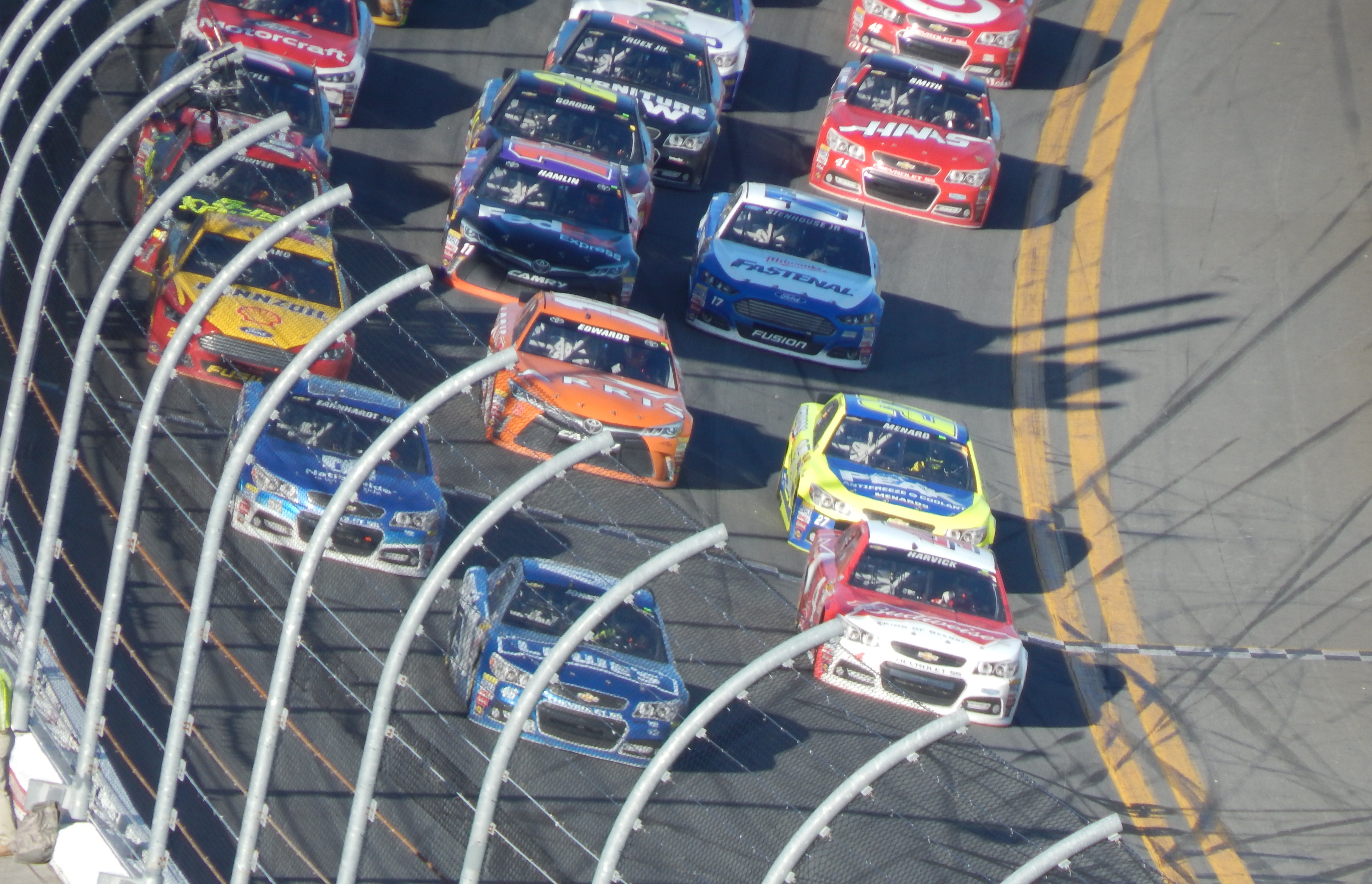
3) Stock car The only other American racetrack that I knew was the Daytona International Motor Speedway. They always talked about it on the ABC Wide World of Sports and the George Michael Sports Machine. The cars were obviously different from Formula 1 and Indycar cars. The cars are closed wheel and closed cockpit cars. They look more like the cars that you see on the street than Formula 1 cars. They are called stock cars.
a) Prototype For some reason these were the cars that really captured my imagination. It might be because they were used in lots of movies, or maybe it was because of Le Mans, I’m not sure, but these were the cars that I dreamt about.
These are closed wheel and closed cockpit race cars. They don’t look anything like street cars. They are clearly race cars, but they are also closed wheel and mainly closed cockpit cars (there are a few open cockpit cars)
The Le Mans 24 hours is an exceptional race. It’s one of the most famous races in the world. Drivers race their cars around a racetrack for 24 hours. Teams are allowed to change drivers during the course of the race. Many 1950s and 1960s movies were made about this race. The Le Mans 24 hours is not the only sports car race, neither is it the only 24 hour race, but it is definitely the most famous. Here are some prototype sports cars. A Le Mans prototype (open cockpit) https://upload.wikimedia.org/wikipedia/commons/6/60/ALMS_Prototypes.jpg
b) GT Grand Tourers (GT) racing is a type of sports car racing that is done on a racetrack. The cars are actually meant to be street cars. The rules state that the car must be available for sale to the general public before it can be entered in a GT race.
Quite a few car companies found a way to circumvent this rule in the 1990s. They produced cars that are basically prototypes and sold a few of them (usually less than 20) to the public.
The first car that I’m going to post is a proper GT racer. The other cars are basically like prototypes, but the manufacturers sold a few of the cars to the general public in the 1990s or early 2000s.
GT cars race alongside prototypes in races such as the Le Mans 24 hours, but they are categorised differently (i.e. there is a prize for the first prototype and a prize for the first GT car)
5) Rally. Rally racing is a long distance form of racing that usually takes place off road (deserts, forests, etc.). It is the most common form of auto racing in Nigeria (particularly in northern Nigeria). A rally was held to mark Nigeria’s independence in 1960 (it was flagged off by Sir Ahmadu Bello) and a race from Sokoto to Argungu has been held in recent years as part of the Argungu Fishing Festival.
The most famous rally race was the Paris-Dakar rally. Participants raced across the Sahara Desert from Paris in France to Dakar in Senegal. However, the race faced many problems, including African civil wars, drivers getting lost or injured, spectators and residents getting injured and threats by Islamic militants and it was moved to South America in 2009 (it is now known as the Dakar Rally).
Peugeot (504 & 505) and Mitsubishi (Lancer and Impreza) were very successful in the Paris-Dakar rally. Here are pictures of rally cars.
6) Drag racing There are many types of cars that are used in drag racing, but 99% of the cars that I saw being raced on sports shows were rail cars. Other cars were raced in movies, but on actual sports shows the cars were always rail cars. So when I think of drag racing I think of rail cars. Drag racing cars are the fastest of all race cars and rail cars are the fastest of all drag racers. The races are usually held on straight tracks (which are often runways of abandoned airports). The cars go so fast that it wouldn’t make sense to have tracks with bends and turns. Various kinds of fuels are used to increase the speed of the car. The most common fuel is nitro (nitromethane). You can often see flames trailing behind these cars as they race and the cars are going so fast that they often have to be stopped by parachutes.
7) Kart Karting has become popular in Nigeria since the late 1990s. A company called Hemenga Grand Prix set up a circuit at the Tafawa Balewa Square car park in the late 1990s and now there are karting facilities at malls and places like the GET Arena in Lagos. Here is a picture of a kart race.
8 ) Soap box derby I first found out about soap box derbies in a book that I read in the early 1980s. It’s actually a form of karting, but I consider it to be a different sport. It’s basically racing for kids. The cars are usually built by parents and their children. The cars have no engines and races are usually held on slopes (either natural or artificial) and the cars are propelled by gravity. Here’s a picture of a soap box derby car. https://scontent-lht6-1.xx.fbcdn.net/v/t1.0-9/20258185_1939941019596529_432333414937117710_n.jpg?oh=f9d69f0adbfeb8706b1c1d5630247a1e&oe=59F5C52E
Integrityfarms: Am just imagining which roads we have in this nation to ply this car race
There have been car races in Nigeria (particularly rally raid races) since before independence, especially in Northern Nigeria. There was the famous Lagos to Sokoto Rally in the 1950-1970s and the Argungu-Sokoto Rally in the 1980s-2000s.
Nigeria, especially northern Nigeria (Sokoto, Kano, Yobe, etc. near the Sahara Desert) is perfect for rally raid races.
 Sports › Hugo Broos Has Not Resigned. by naptu2(op): 2:25pm On Sep 02, 2017
 There are two parts to your statement.