Naptu2's Posts
Nairaland Forum › Naptu2's Profile › Naptu2's Posts
1 2 3 4 5 6 7 8 ... 2141 2142 2143 2144 2145 2146 2147 2148 2149 (of 2583 pages)
 Nairaland General › Re: List Your 5 Favorite Nairalanders And Why You Like Them by naptu2: 1:58pm On Nov 14, 2016 |
jaymichael:Thanks very much. 2 Likes |
| Politics › Re: UK Embassy In Nigeria Host Remembrance Sunday Service In Honor Of Nigerian Heros by naptu2: 9:54am On Nov 14, 2016 |
naptu2: 3 Likes 1 Share |
| Politics › Re: UK Embassy In Nigeria Host Remembrance Sunday Service In Honor Of Nigerian Heros by naptu2: 9:50am On Nov 14, 2016 |
[size=14pt]The Second World War[/size] During the Second World War, the Regiment served in many parts of the world and played a distinguished part in the defeat of the Italians in East Africa and the Japanese in Burma. The Royal West Africa Frontier Force provided the largest colonial expeditionary force to leave any colony and it was a West African division which was the first ever to be entirely supplied by air. The following paragraphs give, but a brief outline of the most complex and diverse operations in which the Nigeria Regiment took part. https://photos-b.ak.fbcdn.net/hphotos-ak-snc7/376668_10150454520787790_1427595130_n.jpg Troops of the Nigeria Regiment, 3rd West African Brigade (Thunder), boarding a Dakota Transport plane (circa 1943). At the outbreak of the war, the Nigeria Regiment consisted of five regular battalions with supporting arms and services. In the early part of 1940, plans were made for the move of the 1st West African Brigade to East Africa. The Brigade consisting of 1st, 2nd and 3rd battalions, Nigeria Regiment, 1st Light Battery, 1st Field Ambulance, 1st Infantry Brigade, Signals, and the 1st Field Company, R.E.; left Nigeria on June 3rd, 1940, together with a Gold Coast brigade. After taking part in the defence of Kenya, these brigades distinguished themselves in the Abyssinian Campaign. The Gold Coast brigade secured the west bank of the Juba after defeating the Italians at Bulo Erillo, whilst the Nigerian Brigade, by the capture of Merca, played an all-important part in the capture of Mogadishu. On February 13th, 1941, in company with the 22nd East African Brigade, the Nigerian Brigade advanced on Brava. Despite their training in bush warfare based upon the lessons of the First World War and their short training in mobile warfare, they covered 600 miles between Mogadishu and Harar in twenty-six days, pushing the enemy before them and taking a number of guns, machine guns and prisoners. In the opinion of experts, this advance was the most rapid in the history of the East Africa Campaign. The Brigade returned to Nigeria on September 5th, 1941 when it received an enthusiastic welcome and it provided the leaven of war-trained men for the great Expeditionary Force which was later to take part in the final defeat of the Japanese in Burma. In 1940 it had not been anticipated that further troops would be required except for reinforcements and no further units were raised in the earlier part of the year. On the collapse of France in May and June, 1940 however, it was immediately decided to expand the Royal West African Frontier Force on a large scale and an extensive recruiting campaign was started. By the end of 1941 the Nigeria Regiment had, apart from other services, raised thirteen battalions. These wartime battalions were built around a nucleus of 150 men from the old Reserve Battalion. The 7th Battalion came into official existence on June 8th, 1940 and from a cadre of this battalion a few months later and by local recruitment, the 12th battalion was raised. Meanwhile the Reserve Battalion had moved to Enugu where the 9th Battalion, which was originally composed chiefly of Nigeria Police (including officers) with a few regular soldiers, was raised: after some time, some of the police were recalled and the battalion on its arrival at Sokoto in January 1941, (after a few months in Calabar) absorbed a large proportion of local recruits. At the same time, the battalions which were at first to make up the 6th Battalion, the 4th Brigade Group, were being formed at Kaduna and the 6th Brigade group was being established in Sierra Leone with the 4th and 11th Nigerian Battalions under command together with a Sierra Leonean and a Gambian battalion and mostly Sierra Leonean supporting arms and services. In the early months of 1914 the 3rd Brigade Group consisting of 7th, 9th, and 12th Battalions, 3rd Light Battery, 3rd Brigade Group Company W.A.A.S.C, was formed with headquarters at Zaria. Later the 9th Battalion transferred to the 4th Brigade Group at Kaduna and the 6th Battalion came from that group to join the 3rd. The 81st and 82nd West African Divisions were then formed for service in India and Burma. The Nigeria Regiment provided the 1st (West African) Infantry Brigade (1st, 2nd and 3rd Battalions) the 3rd (West African) Infantry Brigade (5th, 9th and 10th Battalions) whilst the 4th and 11th Battalions had gone to Sierra Leone as part of the “mixed” 6th (West African) Infantry Brigade. When the Divisions went to India, the 11th Battalion remained in Sierra Leone and the 8th Battalion in Nigeria as holding battalions: the 13th Battalion was eventually disbanded and used to strengthen the 8th. In addition to these units with them supporting arms and services, the Royal West African Frontier Force also raised 43 Pioneer Companies and other group of 20 Garrison Companies which saw service in the Middle East, Palestine, Morocco and Sicily. On their arrival in India in 1943, the 3rd (West African) Infantry Brigade was detached from the 81st (West African) Division and came under the command of General Wingate who was forming a “Special Force” to carry out the Second Chindit campaign. The remainder of the two divisions took part in the campaign in the Arakan. A detailed and authentic history of the 1st (West African) Infantry Brigade in the Arakan has been published in “A Short History of the 1st (West African) Infantry Brigade in the Arakan 1944-45”. It has been seen how the brigades came into being and that the history of the Arakan campaign is available for the students of the roles played by the 1st and 4th Brigades, but this account would be woefully incomplete, as there is nothing published without some special preference to the 3rd and 6th Brigades. The two West African Divisions were made up as follows: The 91st from the 3rd Nigerian Brigade Group, the 5th Gold Coast Brigade and the 6th Brigade with the 4th battalion of the Nigerian Regiment and Brigade groups from Sierra Leone and the Gambia and their supporting services, the 82nd from the 2nd Gold Coast and 1st and 4th Nigerian Brigades and the Nigerian Recce Regiment which became one of the greatest thorns in the Japanese side in Burma. The original role of the 3rd Brigade was defence against Vichy French to the north and north-west of Nigeria and training was pursued with a view to fighting in open country and orchard bush. A similar role was the part of the 6th Brigade in Sierra Leone. In August 1914, the 3rd Brigade Reconnaissance Company was formed and by January of the following year it had become a complete unit with a full complement of equipment. Meanwhile the first Auxiliary Group was being formed in Ibadan. They were originally W.A.A.S.C and enlisted as first-line carriers trained to arms and as stretcher-bearers: their services earned much praise later on in Burma and in Nigeria they undertook important duties on works of construction. Training was interrupted intermittently from the middle of 1941 due to supposed threats of French invasion. The most important of these alarms was at the time of ‘Richelieu’ incident at Dakar and the last at the time of the British and American landings in North Africa in November, 1942. At that time, a brigade with a squadron of Free French Tanks was massed along the northern frontier of Nigeria ready to start a counter-offensive if the Vichy French should attack. All however, went off peacefully. Following exercises in January 1943, the news of the future employment of the West African Expeditionary Force was divulged and from then onwards till embarkation there was feverish activity. Training in thick jungle fighting was carried out at the Olokemeji Battle School and in swamp fighting around Lagos. On September 27, 1943 the brigade embarked at Lagos and landed in India on November 5, 1943. The 3rd Brigade which was detached from the 81st (West African) Division was introduced to a very specialised form of warfare. Shorn of its Field Battery, Recce Squadron, Group Company and Auxiliary Group, the remaining units were reorganised into ‘columns’ two to each battalion. The columns were trained for long range penetration. Equipped with unfamiliar weapons including flame-throwers and carrying their heavier weapons on mules they were required to operate behind enemy lines dependent on air-supply drops and living for long periods on the rations they carried in their packs. The brigade went into action alongside British and Ghurkha troops in March 1944. The Special Force’s object was to establish itself in the heart of Burma on the Japanese lines of communication supplying the Japanese forces including Assam and those retreating slowly in front of General Stilwell’s Chinese-American Army advancing on Myitkina from the north. Third Brigade’s initial role was to hold ‘fortresses’ on the lines of communication, based on which other columns operated against the Japanese. The six Nigerian columns, having being flown into Burma from Assam, were concentrated near Mawlu in two fortresses, ‘Aberdeen’ and ‘White City’, 6th Battalion was at the road and rail block at White City, and 7th Battalion was allocated a mobile role in the White City area. White City was almost immediately subjected to a very strong Japanese ground and air attack which was successfully resisted during the whole of April. In May it was decided that Special Force should move northward to join forces with General Stilwell. White City, was evacuated, a column of 12th Nigeria Regiment being the last to leave and the brigade moved northward, fighting a series of actions on the way. Concentrating in the area near Mogaung at the northern end of the “Railway Corridor”, later to be the main axis of the final victorious southward thrust into Burma, the brigade mounted a series of attacks on a strong Japanese defence position known as “Hill 60”. This position had orders to resist to the last man and succeded in holding out until eventually reduced by the British 36th Brigade heavily supported by artillery and air craft. Third Brigade had almost succeeded in capturing the feature on one occasion and only failed through lack of artillery and air support. By this time the brigade had suffered heavy casualties. It had fought in the most appalling conditions through the heaviest rain for four months, living on hard rations – sometimes lucky to get five days rations in a week – and seldom having a roof over its head. When hill 60 had been taken, the brigade was therefore withdrawn and after a period of recuperation, started training again in Central India at the end of 1944 for a further campaign. This time, the three battalions were divided up among composite brigades of British and Gurkha troops, with whom the Nigerians established excellent relations. The third Chindit campaign did not, however, materialise. The successful British advance in Burma had made long-range penetration no longer necessary or practicable, so Special Force was disbanded Reorganised once more on orthodox lines, the brigade joined the 81st (West Africa) Division in an arear near Madras, where training was commenced for a sea-borne invasion of Malaya. The 6th Brigade, including the 4th Battalion, Nigeria Regiment and the 6th Light Battery and a Field Survey Section, were in August 1943, the first West Africa troops to land in India. After training they proceeded to the Burma frontier area in the Arakan and before the end of the war, the 4th Battalion was established over the frontier on the headwaters of the Kaladan River valley which was the scene of its operations for nearly 14 months. The 4th Battalion was supplied entirely from the air , whilst a jeep track , known as “West Africa Way”, was constructed behind it through what seemed impossibly precipitous country. This remarkable feat covered no less than 73 miles. The rest of the Brigade and a Gold Coast brigade (the 5th) together forming the 81st Division, from which the 3rd Brigade had been detached to serve with the Chindit under General Wingate, followed and together were the first large force ever to be supplied entirely by air. In the early months of 1944 the brigade advanced down the Kaladan valley as a left flank guard to the main 15th Indian Corps’ attack on Akyab. This attack for various reasons failed and though the 4th Battalion reached further south that year than any other large body of troops on the whole front. The division had to withdraw with the rest of the corps; after delaying tactics supported by detachments of the Reconnaissance Regiment, which up to this time had been undertaking aggressive landing operations along the coast towards Akyab, it held positions near the frontier throughout the monsoon and so forestalled the much vaunted Japanese advance on Calcutta. The 4th Battalion led the return to Burma after the Monsoon by driving the Japanese off the precipitous slopes of Frontier Hill and the brigade advanced again down the Kaladan and parallel valleys. So successful was this outflanking movement, which was joined in January 1945 by the 82nd West African Division and resulted in joint capture by the two West African Divisions of Myohaung, that little resistance was put up in Akyab to the rest of the Corps. After the capture of Myohaung, the 81st Division, including the 6th Brigade, returned to India for rest and further training for an attack on Malaya, but an armistice was signed before this was launched. During the operation in the Kaladan Valley, the troops lived and fought in extreme jungle conditions, the only adjuncts of civilisation in the way of weapons, food, clothing, or shelter, being what they could carry themselves or what could be dropped from the air they faced these conditions for months on end in a way no other troops were ever called upon to do for such long periods. They acquitted themselves well and played a major part in driving the Japanese out of the Arakan. The end of the war came before the West African Divisions could carry out their plans for the attack on Malaya and so, after a period of rest and vocational training in India, they returned to their home countries in 1946 with a record of which they could be well proud. The Japanese were usually contemptuous of their foes and the following extract from a captured Japanese war diary is therefore worth recording. The enemy soldiers are not from Britain but from Africa. Because of their belief, they are not afraid to die, so even if their comrades have fallen they keep on advancing as if nothing had happened. It makes things rather difficult. They have an excellent physique and are very brave, so fighting against these soldiers is somewhat troublesome.The following are some of the honours won by Nigerian troops of the Royal West African Frontier Force during the Second World War 1939-1946: Distinguished Conduct Medal, 8; Military Medal, 58; British Empire Medal, 20; Mention in Despatches, 243; Certificates of Good Service, 39; Act of Gallantry, 1. Myohaung Day ( January 24th) is the annual day of remembrance in honour of Nigerian soldiers killed in Burma. November 11th of each year is the annual commemoration day of Nigerian soldiers killed in the two World Wars. 2 Likes 1 Share |
| Politics › Re: UK Embassy In Nigeria Host Remembrance Sunday Service In Honor Of Nigerian Heros by naptu2: 9:44am On Nov 14, 2016 |
naptu2: [size=16pt]Nigerian armed forces[/size] |
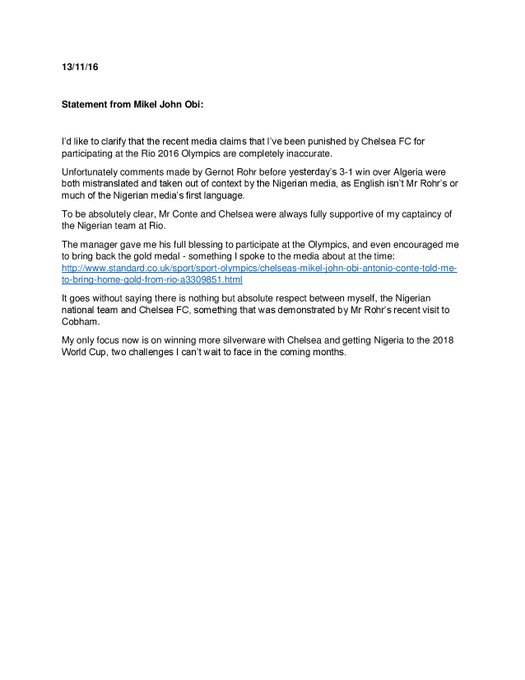
| Sports › Mikel Denies Being Punished By Chelsea For Playing For Nigeria At Rio. by naptu2(op): 2:45pm On Nov 13, 2016 |
Mikel John Obi @mikel_john_obi I would like to make a statement to clarify recent misinformation in the media about my playing at #Rio2016 and Chelsea:https://mobile.twitter.com/mikel_john_obi/status/797790654915035136 7 Likes 1 Share |
| Sports › Re: BBC African Footballer Of The Year Nominees Will Be Revealed At 7pm Today. by naptu2(op): 12:41pm On Nov 13, 2016 |
Plus234:Usually a BBC journalist presents the award to the recipient on the day that the winner is announced. For example, on many occasions the award has been given to African players that are preparing for the African Cup of Nations. One of the BBC journalists covering the competition would present the award to the player at his national team's camp during the day, then the decision would be announced on BBC Fast Track at 8pm on that day. They would also broadcast a recorded interview of the winner (Fast Track was rested some years ago). Yaya Toure receives his award from the BBC's Peter Okwoche. https://africanleadership.co.uk/wp-content/uploads/2013/12/Toure.jpg |
| Sports › Re: BBC African Footballer Of The Year Nominees Will Be Revealed At 7pm Today. by naptu2(op): 7:54pm On Nov 12, 2016 |
They told Yaya Toure to name previous winners of the award and he listed Okocha, Kanu, Abedi, Amunike, Drogba, etc, but he forgot to include himself on the list. 1 Like |
| Sports › Re: BBC African Footballer Of The Year Nominees Will Be Revealed At 7pm Today. by naptu2(op): 7:52pm On Nov 12, 2016 |
Yaya Toure 1 Like |
| Sports › Re: BBC African Footballer Of The Year Nominees Will Be Revealed At 7pm Today. by naptu2(op): 7:51pm On Nov 12, 2016 |
Peter Okwoche and Michael Essien were arguing over whether Nigeria is better than Ghana and whether Chelsea is better than Arsenal. 1 Like |
| Sports › Re: BBC African Footballer Of The Year Nominees Will Be Revealed At 7pm Today. by naptu2(op): 7:42pm On Nov 12, 2016 |
Third nominee is Andre Ayew. |
| Sports › Re: BBC African Footballer Of The Year Nominees Will Be Revealed At 7pm Today. by naptu2(op): 7:40pm On Nov 12, 2016 |
Second nominee is Riadh Mahrez |
| Sports › Re: BBC African Footballer Of The Year Nominees Will Be Revealed At 7pm Today. by naptu2(op): 7:12pm On Nov 12, 2016 |
They're interviewing him. |
| Sports › Re: BBC African Footballer Of The Year Nominees Will Be Revealed At 7pm Today. by naptu2(op): 7:12pm On Nov 12, 2016 |
First nominee is Sadio Mane. |
| Sports › Re: BBC African Footballer Of The Year Nominees Will Be Revealed At 7pm Today. by naptu2(op): 7:11pm On Nov 12, 2016 |
They've started. Eniola Aluko, Sone Aluko, Lomano Tressor Lualua are amongst the guests. |
| Sports › Re: BBC African Footballer Of The Year Nominees Will Be Revealed At 7pm Today. by naptu2(op): 12:43pm On Nov 12, 2016 |
Past winners 1991 - Abédi Pele - Marseille 1994 - Kalusha Bwalya - PSV Eindhoven / Club América 1995 - George Weah - Milan 1996 - Emmanuel Amuneke - Sporting CP /Barcelona 1997 - Nwankwo Kanu - Internazionale 1999 - Nwankwo Kanu - Arsenal 2000 - Patrick Mboma - Cagliari /Parma 2001 - Samuel Kuffour - Bayern Munich 2002 - El Hadji Diouf - Lens / Liverpool 2003 - Jay-Jay Okocha - Bolton Wanderers 2004 - Jay-Jay Okocha - Bolton Wanderers 2005 - Mohamed Barakat - Al-Ahly 2006 - Michael Essien - Chelsea 2007 - Emmanuel Adebayo - Arsenal 2008 - Mohamed Aboutrika - Al-Ahly 2009 - Didier Drogba - Chelsea 2010 - Asamoah Gyan - Sunderland 2011 - André Ayew - Marseille 2012 - Christopher Katongo - Henan Construction 2013 - Yaya Touré - Manchester City 2014 - Yacine Brahimi - Granada CF / FC Porto 2015 - Yaya Touré - Manchester City 2 Likes 1 Share |
| Sports › Re: BBC African Footballer Of The Year Nominees Will Be Revealed At 7pm Today. by naptu2(op): 12:17pm On Nov 12, 2016 |
Past winners. In the past the winner was selected solely by the votes of listeners, but they discovered that there are too many Nigerians who are ready to vote for the most prominent Nigerian footballer. Listeners from other countries started complaining that Nigerians would always win the award because of our huge population (especially after Jay Jay Okocha beat Samuel Etoo to win the award). So the BBC decided that a panel of experts would nominate the top footballers of that year and then the listeners would vote for the nominees. |
| Sports › Re: BBC African Footballer Of The Year Nominees Will Be Revealed At 7pm Today. by naptu2(op): 9:13am On Nov 12, 2016*. Modified: 1:26pm On Nov 12, 2016 |
You can also follow the event live on 1) On FM radio: Lagos Talks 91.3 FM 2)On TV: BBC World News (channel 400 on DSTV). 3) On short wave radio (SW) : BBC World Service Radio on 15400. 4) On Twitter: BBCLoveFootball @ bbclovefootball https://mobile.twitter.com/bbclovefootball?p=s BBC Africa @ BBCAfrica https://mobile.twitter.com/BBCAfrica?p=s 5) On Facebook: BBC Love African Football page on Facebook. https://m.facebook.com/LoveAfricanFootball/?fref=none BBC Africa Facebook page. https://m.facebook.com/bbcafrica/?refid=46&sld=eyJzZWFyY2hfc2lkIjoiMDcwZDhlMTY4MTJjN2Y3YjI3NDFjNDc0NGM4ZWUxMDYiLCJxdWVyeSI6ImJiYyBhZnJpY2EiLCJzZWFyY2hfdHlwZSI6IlNlYXJjaCIsInNlcXVlbmNlX2lkIjoyMTA2MjA1NDMsInBhZ2VfbnVtYmVyIjoxLCJmaWx0ZXJfdHlwZSI6IlNlYXJjaCIsImVudF9pZCI6Mjg1MzYxODgwMjI4LCJwb3NpdGlvbiI6MCwicmVzdWx0X3R5cGUiOjI3NH0%3D BBC African Footballer Of The Year event page on Facebook. https://m.facebook.com/events/950022851798468?refid=46&sld=eyJzZWFyY2hfc2lkIjoiMGNiMTAwYWQyNDk4NzRhYjNlYTI3YzAyYjJiZjBjN2MiLCJxdWVyeSI6ImJiYyBhZnJpY2FuIGZvb3RiYWxsIiwic2VhcmNoX3R5cGUiOiJTZWFyY2giLCJzZXF1ZW5jZV9pZCI6MTA3NTYyMDI4NSwicGFnZV9udW1iZXIiOjEsImZpbHRlcl90eXBlIjoiU2VhcmNoIiwiZW50X2lkIjo5NTAwMjI4NTE3OTg0NjgsInBvc2l0aW9uIjoxLCJyZXN1bHRfdHlwZSI6ODQ0fQ%3D%3D |
| Sports › BBC African Footballer Of The Year Nominees Will Be Revealed At 7pm Today. by naptu2(op): 9:12am On Nov 12, 2016*. Modified: 9:39am On Nov 12, 2016 |
[size=14pt]Countdown to BBC African Footballer of the Year 2016[/size]http://m.bbc.com/sport/football/37865378 |
| Politics › Re: Flags, Coats Of Arms, Symbols And Monuments Of Nigerian States (2016) by naptu2(op): 2:50am On Nov 12, 2016*. Modified: 4:03am On Nov 12, 2016 |
elvision1:With regards to Plateau/Jos, those are rocks, not mountains and they are an important part of its identity. Plateau State used to be a tourist haven in the past, because of its cool, mediterranean type weather and its unusual rock formations (that's why it has many excellent resorts like Rayfield and many foreign institutions like Hillcrest). Sometimes you'd see a huge rock resting on a much smaller one and it seems like a miracle that it doesn't fall off. There are many myths surrounding those rocks, including some that describe how God put them there. A lot of Plateau State Government institutions were named after those rocks. In the 1980s the football team was called JIB Rocks of Jos, the government owned a brewery that produced Rock Beer, etc. The rock formation in the logo is the Riyom Rock Formation. It is probably the most famous of all the rock formations. Jos lost its status as Nigeria's foremost tourist haven because of all the violence that began in the 2000s. I'd say that Calabar has taken over that status from Jos. https://blog.jovago.com/wp-content/uploads/2015/05/jos-plateau.jpg Below: Riyom Rocks https://blog.jovago.com/wp-content/uploads/2015/05/Riyom.jpg https://farm3.static.flickr.com/2802/4097726403_ffefcfe4f7.jpg https://mw2.google.com/mw-panoramio/photos/medium/105978123.jpg |
| Politics › Re: Flags, Coats Of Arms, Symbols And Monuments Of Nigerian States (2016) by naptu2(op): 6:59am On Nov 11, 2016 |
Nigerian flag (1960-present). Michael Taiwo Akinkumi was studying in Britain in 1958, when he heard about a competition to design the new Nigerian flag. He submitted the design below to the committee. The committee chose his design as the winning entry, but removed the sun at the centre of the flag. Thus we got our green-white-green flag. https://scontent-amt2-1.xx.fbcdn.net/v/t1.0-9/fr/cp0/e15/q65/10513307_1453251344932168_5844387099471871126_n.jpg?efg=eyJpIjoiYiJ9&oh=9d9ce987335901b139e9c4ae2e621b81&oe=58C700E2 The Flag of Nigeria was designed in 1959 and first officially hoisted on October 1, 1960. The two unique sea-green bands represent the forests and abundant natural wealth of Nigeria while the white band represents peace https://scontent-amt2-1.xx.fbcdn.net/v/t1.0-9/fr/cp0/e15/q65/10429340_1453251358265500_7754698831186489741_n.jpg?efg=eyJpIjoiYiJ9&oh=6e4e88d3bfc43a6df75ae8b19dfce985&oe=58C2E7BA The Coat of Arms Nigerian coat of arms (1960-1978). https://scontent-amt2-1.xx.fbcdn.net/v/t1.0-9/fr/cp0/e15/q65/15032241_1812434885680477_5609861123367004623_n.jpg?efg=eyJpIjoiYiJ9&oh=2a9bda44e120c38e381191f52c80c1a3&oe=58C65A6C The Coat of Arms of Nigeria has a black shield with two wavy silver bands that come together, like the letter Y. These represent the two main rivers flowing through Nigeria: the Benue River and the Niger River, Nigeria's main inland waterways, which form a confluence at Lokoja. The black shield represents Nigeria's fertile soil, while the two horses or chargers on each side represent dignity and pride. The eagle represents strength, while the green and white bands on the top of the shield represent the rich agricultural land of the inspiring country. The yellow flowers at the base are Costus Spectabilis, Nigeria's national flower. This flower was chosen for inclusion in the coat of arms as it is found all over Nigeria. On the band around the base is Nigeria's national motto since 1978, "Unity and Faith, Peace and Progress", formerly "Peace, Unity, Freedom" Nigerian coat of arms (1978-present). https://scontent-amt2-1.xx.fbcdn.net/v/t1.0-9/fr/cp0/e15/q65/14947495_1812434749013824_759252753582063270_n.jpg?efg=eyJpIjoiYiJ9&oh=092c148f51f4db4345a498c563833acd&oe=58CA69E2 https://scontent-amt2-1.xx.fbcdn.net/v/t1.0-9/fr/cp0/e15/q65/1551462_1453251374932165_7555910469000336039_n.jpg?efg=eyJpIjoiYiJ9&oh=7ae9260c197228e158353d93a3f34f70&oe=5894D7A8 2 Likes 1 Share |




1 2 3 4 5 6 7 8 ... 2141 2142 2143 2144 2145 2146 2147 2148 2149 (of 2583 pages)