Ducii's Posts
Nairaland Forum › Ducii's Profile › Ducii's Posts
1 2 3 4 5 6 7 8 9 10 (of 29 pages)
 Politics › Re: Four Outstanding Ministers From President Goodluck Jonathan’s Administration by ducii(op): 12:21pm On Oct 05, 2015 Politics › Re: Four Outstanding Ministers From President Goodluck Jonathan’s Administration by ducii(op): 12:21pm On Oct 05, 2015 |
adedayourt:me too 1 Like |
| Politics › Four Outstanding Ministers From President Goodluck Jonathan’s Administration by ducii(op): 12:19pm On Oct 05, 2015 |
The past few months have been fulfilling for some of the former ministers of the cabinet of President Goodluck Jonathan. Barely a year after they left office, the former ministers have transitioned quite successfully to international organisations and institutions. Here’s a rundown of four officials from the Jonathan administration that have come out on top. Arunma Oteh Arunma Oteh, was the former Director General of the Nigerian Stock Exchange Commission (SEC) during President Goodluck Jonathan’s administration. She was appointed Vice President and Treasurer of the World Bank Group on July 24th 2015 making her the third Nigerian woman to hold the position of Vice President of the Bank after Dr. Ngozi Okonjo Iweala and Obiageli Ezekwesili. Arunma’s greatest achievement while at the SEC was her ability to change Nigeria’s Security and Exchange Commission. She was able to restore investor confidence on the commission through strong enforcement actions by improving rules, regulations and investor education. Under her leadership the market was expanded- there was zero tolerance for rule infractions. Akinwunmi Adesina Akinwunmi Adeshina who is now the eighth president of the Africa Development Bank was the Minister for Agriculture and Rural Development under Jonathan’s administration. He is the first Nigerian to hold the seat as President of the bank. Akinwumi who became Nigeria’s Agriculture Minister in 2011, assumed the responsibility for a sector neglected for decades because of revenue generated from petroleum. Under Akinwunmi’s stewardship, food production increased by 22 million tons, food importation dropped more than a third and about 3 million jobs were also created. Ngozi Okonjo-Iweala Dr Ngozi Okonjo-Iweala who doubled as Nigeria’s former Minister of Finance and Coordinating Minister of the Economy during President Goodluck Jonathan’s regime received two appointments in September. She was appointed the new chair-elect of GAVI Alliance, and a Senior Adviser at Lazard, one of the world’s leading financial advisory and asset management firm. She is the second African to head GAVI. During her tenure as the finance minister, Nigeria’s GDP was successfully re-based for the first time in 24 years. The finance ministry through the Central Bank of Nigeria introduced the electronic banking system, also known as the cashless policy. She helped Nigeria’s economy grow by an average of 6 percent per annum over three years. Omobola Johnson The former Minister of Communications Technology from 2011-2015. Omobola Johnson was recently appointed a General Partner to head venture capital firm, TLcom Capital’s new office in Nigeria, their second office in Africa. During her tenure as Minister, she focused on the launch and execution of the National Broadband Plan, and supported the Nigerian technology industry by pioneering the government’s involvement in a local venture capital fund and building a network of start-up incubators. https://venturesafrica.com/wp-content/uploads/2015/07/Arunma_Oteh-756x1024.jpg https://venturesafrica.com/wp-content/uploads/2015/09/Akinwumi-Adesina-1728x800_c1-1024x474.jpg https://venturesafrica.com/wp-content/uploads/2015/09/Ngozi-Okonjo-Iweala-Ventures-Africa-1024x682.jpg https://venturesafrica.com/wp-content/uploads/2015/10/Mobola-Johnson-pic-07-ds-789x1024.jpg http://venturesafrica.com/these-are-the-four-outstanding-ministers-from-president-goodluck-jonathans-administration/ |
| Politics › Pics:jidenna To Celebrate Nigeria’s Independence Day In ‘classic’ African Style by ducii(op): 1:35pm On Sep 30, 2015 |
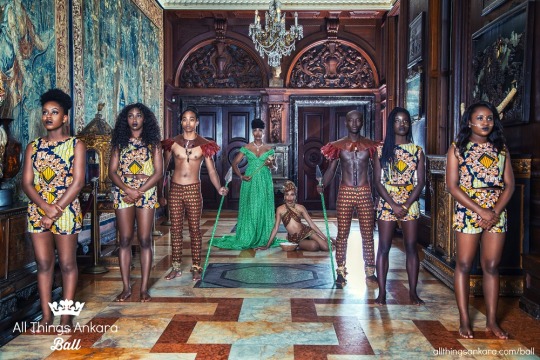
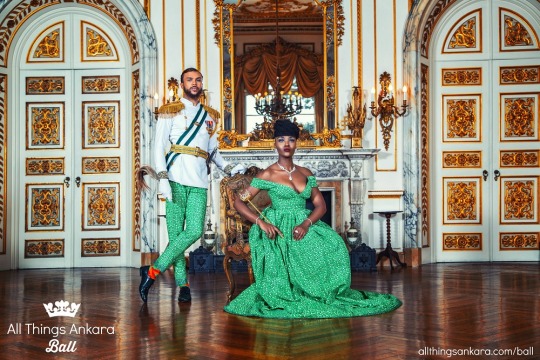
Jidenna Theodore Mobisson, commonly known as Jidenna may finally be able to ward off the recent backlash from Nigerians after his controversial interview with urban news channel VladTV. Starring Jessica Chibueze & Jidenna who are both Nigerians, the All Things Ankara site – a platform founded by Nikki Billie Jean has produced an editorial in honor of their “Nigerian Renaissance” theme. The “All Things Ankara Ball” which is in commemoration with Nigeria’s 55th independence day celebration on October 1st, marks its first ever official inaugural. The campaign images feature a combination of French Renaissance, Nigerian and other African aesthetics. Also featured is a pair, along with a few guards, flower bearers and ladies-in-waiting, with a setting which bears a close resemblance to the famous Chateau de Versailles. The official slogan for the All Things Ankara Ball is a phrase derived from Fear & Fancy (a social club co-founded by Jidenna), “Come Dry, Leave Wet”. It simply means going to a party dressed to the nines;“to perfection in the most fashionable attire” (Come Dry) but having a good time, dancing and sweating out your clothing (Leave Wet). This event also gives Jidenna, who loves to incorporate African prints into his ‘classic’ style, an opportunity to justify himself as someone who is in fact proud of his Nigerian heritage. During his infamous interview with VladTV, the rapper shared his experience of burying his father years prior, “Our family was light. Therefore when we go to our village… and when I actually buried my father, I had to bring a lot of AK47s. Because when you’re light skinned, you’re heavier target for being kidnapped. Because you’re seen as more valuable. For me being light skinned in Nigeria, in my family, it was difficult. It was always challenging. We were hounded. We were robbed.” However, his comments- specifically those related to his skin tone sparked a controversy on Twitter Nigeria, providing a base for momentary national bonding. As a blogger puts it, his comments “FINALLY led to a unified Nigeria for the first time since the election started and ended.” The All Things Ankara Ball will take place, Saturday, October 17th, 2015 at Adele H. Stamp Student Union Grand Ballroom at The University of Maryland in College Park, Maryland. https://40.media.tumblr.com/d4b13a275a5c0a32aae137dc09eda5d6/tumblr_nvfol68Heh1rqkjy0o10_r1_540.jpg https://41.media.tumblr.com/73f5d83a0037b2a1dfb1ebb01cb6e3dc/tumblr_nvfol68Heh1rqkjy0o4_r1_540.jpg http://venturesafrica.com/jidenna-to-celebrate-nigerias-independence-day-in-classic-african-style/ |
| Travel › Photos/video: Nigerian Woman Assaulted On A London Bus by ducii(op): 10:59am On Sep 23, 2015 |
A Nigerian woman was assaulted by a man believed to be a Jamaican national on a bus in Peckham, London on September 14th. The woman was reportedly hit in the face by the man after she challenged him for obstructing the way in the bus. The video was filmed by an Asian man who was also on the bus. Watch it after the cut... [img]http://3.bp..com/-oErRC1xBKow/VgHdv1OybpI/AAAAAAAGqKo/UuJ_sj1yeJQ/s1600/1.png[/img] [img]http://2.bp..com/-4P2twGW9Xvs/VgHdy97QClI/AAAAAAAGqKw/8g8LU3jrSeQ/s1600/2.png[/img] [img] https://www.youtube.com/watch?v=bgqzVyAknDI[/img] http://lindaikeji..com/2015/09/photosvideo-nigerian-woman-assaulted-on.html |
| Politics › Ben Murray Bruce’s Op-ed Piece On Nigeria, Explained by ducii(op): 9:53am On Sep 23, 2015 |
In his recent op-ed piece, Senator Ben Murray Bruce addressed a number of issues, mostly centered on what Bruce sees as Nigerians’ insistence on criticizing former President Jonathan’s policies. Unproductive criticism The will to move forward and take control of what happens in Nigeria from now on, is the main point Senator Bruce tries to drive home. He iterates the time consuming and futile attempts at blaming the country’s woes on Jonathan. In Nigeria, more time is spent on analyzing administrations than actually creating something better out of what the past administration has built. The trend seems to be more prevalent among “statesmen” or past leaders. Take for instance, former president Olusegun Obasanjo’s criticism on former president Jonathan’s railway rehabilitation: “For what reason should anybody in his right senses in Nigeria of today believe that rehabilitating the railway system which was completed in 1903 to carry three million tonnes of goods is what we need today.” Nigerian economy was progressive under Jonathan In his opening statement, he debunks the idea that Jonathan set the country back with ill-advised policies, stating that the country’s economic growth increased significantly. During the Jonathan administration, the United Nations Conference on Trade and Development (UNCTAD) ranked Nigeria as the number one country for foreign direct investment (FDI) in Africa. In its 2013 report titled Global Value Chains: Investment and Trade for Development,” it says that FDI inflows to Nigeria stood at $7.03billion. South Africa recorded $4.572 billion, Ghana ($3.295 billion), Egypt ($2.798 billion), and Angola (-6.898 billion). In a 2014 journal, the Office of the Chief Economic Adviser to the President, notes that the Jonathan administration implemented policies which boosted commerce through resumption of railway transportation. Food production companies like Flour Mills of Nigeria, petroleum product companies and haulage companies benefited from the revamped railway system. Singleness of purpose must be reflected in policies While maintaining that past leaders ought not to share the spotlight with the government of the day, saying that apportioning blame to a Jonathan only empowers him and makes him relevant. Senator Bruce recommends that governments build on existing policies, implying that policies implemented by past administrations should not be abandoned. In April 2015, Christine Lagarde, Managing Director of the International Monetary Fund (IMF) suggested one of the challenges facing African governments was the perpetual desire to begin on a clean slate. “Some of these policies need to be continued; some fiscal consolidation needs to take place and we very much hope that the next budget would reflect the good policies that have been put in place in order to resist external shocks”, she said while commenting on Nigeria’s economic policies at a World Bank-IMF Spring Meeting in Washington DC. Senator Bruce puts the current administration on blast for attempting to start from scratch in terms of governance, he implies that this track will not help Nigeria. Emefiele may be the only one not given to blame-shifting Finally, Senator Bruce commends the policies currently implemented by Governor Godwin Emefiele of Central Bank of Nigeria as one way out of the many challenges facing the country. He implies that while everyone else is performing their blame-shifting dance, Emefiele remains focused on the present and tries to steer Nigeria’s economy back to normal. Emefiele’s recent financial policies became unpopular after JP Morgan revealed plans to remove Nigeria from its Government Bond Index (GBI) at the end of the year, but as of today, Nigerian equities markets have appreciated by N277 billion in the last two weeks as investors have swooped on highly discounted equities. The market rose to N10.425 trillion from N10.148 trillion in two weeks. Time will tell, perhaps this may turn out positive for the economy. In closing, Bruce’s piece may not appeal to a lot of people but it is a sharp call for Nigerians to recognize what is important. The blame game, ethnic, and religious favoritism are major challenges to progress. For Nigeria to become great again, government of the day has to focus on what is right in front of them. Citizens also need to hold the current administration accountable for all its actions or lack thereof. http://venturesafrica.com/ben-murray-bruces-op-ed-piece-on-nigeria-explained/ |
| Politics › Bukola Saraki: Minute By Munite Breakdown Of Proceedings In Court Today by ducii(op): 3:20pm On Sep 22, 2015 |
Mr. Bukola Saraki, who was previously Kwara state governor and now Nigeria’s Senate President, has recently been embroiled in legal battles and corruption charges with Nigeria’s Code of Conduct Bureau. The Code of Conduct Bureau, on September 11, slammed a 13-count charge of corruption on Mr. Saraki, accusing him of offences ranging from anticipatory declaration of assets, to false declaration of assets in forms he filed before the Code of Conduct Bureau while he was governor of Kwara State. The Code of Conduct Bureau (CCB) is an agent of the Federal Republic of Nigeria, which was created under Schedule 5 part I of the Constitution of the Federal Republic of Nigeria (hereinafter referred to as CFRN) as amended. The Code of Conduct Bureau is responsible for the verification of assets declared by public officers and reports all discrepancies to the Ministry of Justice. The Ministry of Justice, through the office of the Attorney General of the Federation, then institutes an action against defaulting public officers before the Code of Conduct Tribunal. The Code of Conduct Tribunal (CCT) is established by the CFRN under Schedule 5 Part II and has the jurisdiction to attend to matters presented to it by the Code of Conduct Bureau and by extension, the Ministry of Justice. However, the Court of Appeal has appellate jurisdiction to decisions of the CCT. How it all started Saraki, who has been accused of falsely declaring assets and converting government properties while in public office, was due to appear before the CCT on Friday September 18, 2015 but he did not show up. The ex-governor was also required to show in court yesterday, but he was nowhere to be found. Since the battle began, Joshua Daodu the counsel to Saraki, the defendant has come up with several legal antics to either delay proceedings or nullify it completely. When the notice of the charges filed with the request to show up in court was issued, Daodu filed a motion with the Federal High Court, asking the court to grant an injunction that would prevent the CCT from proceeding with trial. The prosecution counsel, Muslim Hassan, asked the tribunal to order his arrest for failing to appear before it, arguing that the high court had parallel jurisdiction with the tribunal and as such, had no power to halt a trial of the tribunal. The Chairman of the Tribunal, Danladi Umar, issued a bench warrant against Saraki but his counsel prayed the tribunal for an adjournment until Monday. The tribunal granted the prayer of the defendant for adjournment but requested that Saraki be present in court on Monday. Daodu filed an ex-parte motion with the Court of Appeal, hoping to stay the execution of the warrant of arrest, and then alleged that the CCT could not go further with trial until the Court of Appeal reaches a decision. On Monday, Saraki was again absent in court. His counsel argued that his client did not appear because the constitution of the CCT was illegal and consequently rendered the trial ultra vires – that is, it is of no legal effect. This argument was dismantled by the provisions of the CFRN in Schedule 5 regarding the constitution of the CCT. The CCT has since ordered the police to present Saraki at the next trial date or risk facing consequences. The Court of Appeal has also dismissed Daodu’s plea for a stay of execution. Legal issues raised The first legal issue raised is in terms of the privilege of immunity granted to public officers, which it seems did not extend to the office of the Senate President and to Saraki by extension. It has since been shown that the immunity against prosecution granted to public officers under Section 308 of the CFRN only extend to the President, Vice President, State Governors and their deputies. The second legal issue raised was whether the Ministry of Justice had the right to institute an action against Saraki under the law without an Attorney General. Since Nigeria is currently without Ministers, this objection might have been sustained if not for the provisions of the law in Section of the CFRN. The court interpreted the law to establish that the office of the Attorney General is an office in the Ministry of Justice, and the Ministry of Justice was free to institute a case in the name of the Attorney General. Also, Daodu’s claim that the CCT could not judicially try Saraki for lack of jurisdiction has since been trashed. Mr Daodu might be guilty of violating professional ethics since the court granted his prayer on Friday based on self-recognizance, but he went ahead to flout court orders. The political implications Nigeria’s President, Muhammadu Buhari, was voted into power because he campaigned heavily against corruption. For a country like Nigeria, which was consistently on the “Most Corrupt Countries” list, Buhari’s promise of change was what they needed. It is perhaps Nigeria’s worst kept secret that corruption is a pervasive problem. While Saraki’s trial and the seemingly unprecedented effectiveness of the judiciary in prosecuting him might seem like a step in the right direction in this battle for change, there is also speculation that Saraki might actually be a victim of witch-hunting. Since Bukola Saraki assumed office as the Senate President, he has been on the bad side of APC party leaders. Although Buhari and Saraki are both members of the same political party, APC, there has been a bit of tension since Mr Saraki teamed up with the opposition party PDP to emerge Senate President. President Buhari has, through his spokesman, since denied allegations of witch-hunting against Saraki, underscoring that he is objective to Saraki’s ordeal in respect to the Rule of Law. As it stands, Saraki is innocent until proven guilty by the tribunal, and even then, he has recourse to the Court of Appeal. If he is convicted, he could be facing hefty fines and a jail term which commences immediately, regardless of his position. below are the live updates from #SarakiOnTrial on September 22. 22nd Sep 2015 - 11.35 am At about 10 am this morning, Nigeria’s Senate President Bukola Saraki was seen entering into the premises of the Code of Conduct Bureau. The ex-governor who is facing corruption charges with the Bureau has been absent from his previous hearings, forcing the Code of Conduct Tribunal to issue a warrant for his arrest. Dr Saraki was quoted as saying on Monday that he is a law abiding citizen, promising to show up for his hearing today as he “had nothing to hide”. Since the charges were made, Dr Saraki and his counsel Joseph Daodu (SAN) have employed several tactics to ensure the nullification of the trial, so much that other SANs and judicial personalities are accusing them of attempting to frustrate judicial proceedings. 22nd Sep 2015 - 12.13 pm Arguments ensued earlier in the proceedings regarding where the defendant would sit but that was soon resolved. The prosecution established that the item on the agenda for the day was taking the defendant’s plea. This meant that the defendant had to sit in the dock like a common criminal. The defendant, Dr Saraki, was initially reluctant to take a plea but had to do so at the insistence of both the Prosecution and the Chairman of the Tribunal. The chairman of the Tribunal has since established that the CCT is not a court that tries criminal cases and thus, the administration of criminal justice does not apply to the court. 22nd Sep 2015 - 12.17 pm Dr Saraki pleaded not guilty to all charges. The counsel to the defendant, Joseph Daodu appealed to the Tribunal to give adequate time to his client to be briefed and understand the charges as the Constitution of the Federal Republic of Nigeria prescribes. 22nd Sep 2015 - 12.19 pm The Prosecution is objecting the defendant’s plea. FYI: Tribunal Chairman, Danladi Umar, has withdrawn bench warrant against the defendant. 22nd Sep 2015 - 12.26 pm Dr Saraki is getting support from fellow senators as about 50 of them with some members of the House of Representatives are present in the Tribunal court with him. 22nd Sep 2015 - 12.48 pm The seating of the CCT has now been adjourned to allow Dr Saraki receive proper brief of the charges against him. 22nd Sep 2015 - 13.01 pm Dr Saraki’s counsel has expressed dissatisfaction over the new court date set at October 21, claiming that it is too short to plan a defence. Meanwhile, Dr Saraki claims that this is the first time he is hearing the charges brought against him. http://venturesafrica.com/what-you-need-to-know-about-the-bukola-saraki-saga/ |
| Celebrities › Top 20 Richest Musicians In Nigeria And Their Net Worth by ducii(op): 3:57pm On Sep 02, 2015 |
Who are the richest musicians in Nigeria? Music has been paying heavily in Nigeria for the past ten years. No wonder average Nigerian youths sees music as one of the the quick means to wealth and fame. Why not! When a good number of artistes have risen from nothing to something over the years, enjoying wealth that can only be imagined by their peers. The question is Who is the richest among these musicians and how much are they worth? Before you read, I want you to have these in mind:- 1. Net Worth does not necessarily mean the amount of money you have in the bank. It is how much you are worth as an asset base on your works, your achievements, investments, and popularity. So, when we talk about richest musicians in Nigeria and their net worth, some of the artistes mentioned may not have the said amount of money in the bank. 2. Album/music sells is not the only means musicians make money. They make much more money from – YouTube partnership, Loyalties, ringtones, concerts, sponsorships, endorsements, and appearances. These were factored into this rating to come up with this robust, time tested ranking of richest musicians in Nigeria. The best and most accurate you can find anywhere on the internet. 3. This list is dynamic – it changes from time to time. Someone who is on this ranking today may not be here tomorrow. 4. If you have an objection, state it in a civil manner, utilizing the comment system below. In music, your popularity determines your worth, you don’t make shit if you are not popular because popularity is what determines appearance and endorsement fees. What are the metrics to measure the popularity of an artiste? The number one means of finding out how popular a musician or music is, is by checking out the YouTube stat. If you are popular, it will show on your YouTube views, no manipulation. And if you have a great stat on YouTube, you are a great artiste, making good money even from YouTube itself. Another means is through awards but since most music awards are heavily manipulated, we are going to skip awards and use other metrics such as endorsement and ability to pull crowed and command good appearance fees. Self promotion isn’t gonna count in this rating. Here I present to you the top 20 richest musicians in Nigeria and their estimated net worth. Like I said before, this list is the most detailed and most accurate you can find anywhere. Enjoy and make a comment! 20. Patoranking This guy is making name for himself in the music and entertainment industry in Nigeria and it’s not surprising that he made the top 20 richest musicians in Nigeria despite that it has not been quite long since he breaks into the limelight. His hit song (Girlie O) featuring Tiwa Savage has grossed over 4 million views on YouTube as the time of writing this article. Patoranking’s net worth is estimated to be – $1.75 million 19. Yemi Alade How she made it? I don’t know, but she is currently the biggest female musician in Nigeria after Tiwa Savage and may overtake Tiwa in a couple of years if not months. The first day I heard “Jonny” played in my car by one of the Nigerian F.M Station, I knew something serious was about to hit us. Yemi currently has the most successful and most popular music video by any African female artiste on YouTube. The total views for “JONNY” as at this time is 13,435,171. Yemi Alade’s current net worth is – $2.1 million 18. Chidinma Ekile Chidinma has one thing going for her – she is extremely likeable. That alone has skyrocketed her take home performance fees and worth to an enviable position. From a mere contestant in the MTN Project Fame to a household name in Nigeria, Chidinma has created wealth that her peers could only dream about, enough to earn her a place on this list of richest musicians in Nigeria. Her biggest video to date is “Kedike” with 1.2 million YouTube hit, followed by “Oh Baby” featuring Falvour which currently has 600,000 views. And collective views of about 5 million for her songs, Chidinma’s net worth is put at – $2.86 million 17. Duncan Mighty Duncan Mighty has refused to step an inch away from the Niger Delta oil. With unique beats, superior voice quality, and dance step to match, he is considered one of the most successful artistes ever come out of the Niger Delta region. His most popular song on YouTube.com is “Obianuju” and “Port Harcourt Boy” which has collective views of 3.1 million. With strong affiliation to the Niger Delta politicians, Duncan mighty is estimated to worth – $3.5 million 16. Phyno The only hardcore rapper I’ve ever seen in Africa. He does it like no other, providing new dimension to rap music in Nigeria and Africa in general. Phyno is to the Igbos what Olamide is for Yorubas but he does it in a completely different fashion. So good that rap haters like me are being forced to like rap music. Phyno is a genius. Everyone wants to collaborate with him for good reasons. He is hot in the market. Phyno’s net worth is put at – $3.6 million 15. Ice Prince He broke into the limelight with “Oleku” featuring Brymo which currently has 3.2 million views on YouTube. Ice Prince Zamani is one of the finest rapper in Nigeria. To me, he is better than M.I in terms of flow. Few days ago, the picture of when he was younger and hustling hit the internet and you can see how far this guy has been transformed from a naive young boy to a world class superstar! Ice prince net worth is – $4.35 million 14. KCee Currently making serious wave in the Nigerian music scene, KCee, formerly a member of the KCPresh is one of the most fortunate guy in the industry. He picked the right beat at the right time, and the rest has become history. His hit songs “Limpopo” and “Pull Over” are currently on 14.5 million views collectively on YouTube. KCee net worth is – $4.0 million 13. Tiwa Savage Welcome the queen of music in Nigeria, the sexy mama, the first lady of Mavins Record! Tiwa Savage is among the very few Nigerian artistes whose average video is grossing over 1 million on YouTube. She currently has about five videos with more than a million views each. Eminado is currently doing 7+ million. Her net worth is – $4.85 million and may soon crossover to ten in this rating within the next couple of months. 12. Iyanya From a hungry project fame ex-winner to international famous superstar within the space of three years. Iyanya has shown that if you want to be successful in Nigeria, give them what they want and you will be blessed with wealth. Iyanya’s hit song (“Kukere” complete with it’s one unique dance step) currently has more than 15 million views on YouTube. His net worth is – $5.5 million 11. M.I Regarded as the most successful rap artiste ever in Africa, M.I has built a reputation that will be too difficult for anyone to surmount. He is among the major stakeholders in Chocolate City Records and is credited with the rise to fame of Ice Prince Zamani. For the sake of the record label and the stars that came through it, we are placing MI at number 11 on this list. His current net worth is – $5.9 million 10. Timaya Timaya’s vocal power is unmatched in the industry. He is one one the best and probably the most successful music star ever come out of the Niger Delta area. Far more successful than Daniel Wilson and others. He is truly the “Egberi Papa 1 of Bayelsa”. One of his hit track “Sanko” is about to hit 2 million views while his biggest hit “Bum Bum” featuring Sean Paul has already grossed over 16 million on YouTube. Timaya net worth is – $5.5 million 09. Banky W Two best music videos ever done in Nigeria to his credit (Lagos Party and Wizkid’s Holla at ur Boy) and a serious record label of his own, Banky W is surely a force to reckon with in the Music business in Nigeria. From Etisalat to Samsung, he has the knack to land juicy endorsement deals anytime. Started with a copycat of Rihanna’s song, he graduated to international superstar, doing original songs and winning awards. Banky W net worth is – $9.0 million 08. Wizkid From a backup artiste to Banky W to a superstar! Wizkid has been transformed into international star by just one music video – Holla at ur Boi! That video created the defining moment in his career and today, he is the Wizkid you and I know. Widely regarded as the Justine Bieber of Nigeria, Wizkid is one of the stars in the industry that many upcoming artistes look up to be just like him. What he lacks in vocal talent, he makes up in personality appeal. Wizkid net worth is – $11.5 million 07. Olamide One of the craziest rapper in Nigeria and Africa. So crazy he called himself Badoo. Olamide has built name and fortune for himself in the music industry in Nigeria. Right from the day I heard his first song, I knew he was going to be big in the music industry in Africa. His song with the highest YouTube view is “Eleda Mi” with 1.2 million views. He was able to overtake Patoranking due to the fact he has multiple singles with collective views of more than 5million. He is believed be to be the mastermind behind the rise of Shoki. Olamide’s current net worth is put at – $12.5 million 06. Davido What he lacks in physical appeal, he makes up with great vocal talent – the twisted version of Wizkid. Davido is one musician in Nigeria that I so much like his vocal talent, he is a singer and song maker extraordinaire. His two songs “Aye” and “Gobe” are currently having 15 million and 11 million respectively on YouTube. Son of a politician and business man, Davido’ net worth is – $14.5 million 05. Tu Face The musician everyone respects in the industry. Tu Face has become the present day legend in African pop culture. By the time he hangs his trumpet, he will be studied in universities across Africa. African Queen remains his biggest hit ever, meaning that this legend lives largely in the past glory He has not been able to do another song more popular than the famous African Queen or even close to it’s popularity. But what he lacks in hit songs, he makes up in reproduction, building future generation of Idibias. Tu Face net worth is – $22.5 million 04. D’Banj From life in the streets of The United Kingdom to MoHit and one of the biggest superstar Nigeria has ever seen. D’Banj has proved that what you need to become successful is in you. You don’t need to look for it elsewhere, it’s within you. His biggest song ever is the last song produced by Don Jazzy, Oliver Twist. It dethroned P-Square’s songs (Chop my Money) temporally in 2013 as the highest viewed Nigerian song on YouTube before Personally from P-Square reclaimed the number one spot. D’Banj net worth is – $25.0 million 03. Flavour Almost every artiste in the industry has featured Flavour in their songs. His vocal ability is unrivaled. He is one of the very best the industry has ever seen. From the moment he picked up the guitar, you now he is destined to the top. Flavour Nabalia is one like no other and no one could mimic him successfully no matter how hard they try. He is the one and only Flavour, and after him there may be no other Flavour. He has everything going for him. His physical appeal, pure vocal talent, and mastery of the music instruments, Flavour is everything others desires to be. His current net worth is – $28.5 million 02. Don Jazzy The only musician in this list with no song to call his own. Yet, he command so much respect and money that even the best in the industry dare not ask who is he. Don Jazzy is a builder, a producer extraordinaire and industry pacesetter. Whatever thing he lays his hands on becomes gold. He produced D’Banj to international superstar, and when D’Banj left, he produced other superstars. Dorobucci, Adaobi, Eminado, Sulurere, Banana – these are some of the major hits he produced after the MoHit saga. Don Jazzy net worth is – $35.0 million 01. P-Square – The Richest Musicians in Nigeria No one does it like P-Square in the music industry in Nigeria and Africa! When you think they’ve done their best, they come up with something completely different. They have no competition, they only compete with themselves. Outside Akon, P-Square is the biggest music stars ever come out of Africa – dead or alive! Read: P-Square Net Worth, How They Made It You may ask, how about Fela, Ndiaye, Lucky Dube, Blenda Fassie, Angelique (the double Grammy awards winner), and Awilo Logomba? Well, they are all legends of music in Africa but when it comes to earning and popularity allover Africa, they are no match to P-Square with all due respect. This is based on facts and figures. Pick up the all times African top 10 music video on YouTube, P-Square alone has 5, leaving the other 5 for the entire artistes in Africa to share! Personally = 42 million+. Chop My Money = 24 million+. Beautiful Onyinye = 22 million+. Do me = 14 million+. Teste The Money = 9 million+. The only celebrity in the Nigerian entertainment industry that has mansion in Banana Island where properties are sold in billions. They are the Cristiano Ronaldo and Lionel Messi of African music. P-Square is the only artiste in Africa you dare not book with less than $100,000. P-Square net worth is – $128.0 million Congratulation to the champions! Have an opinion? Let’s hear you – http://constative.com/celebrity/top-20-richest-musicians-in-nigeria-and-their-net-worth-2 |
| Travel › Re: Pics:please Help Share A Nigerian Immigrant's Story In The UK by ducii(op): 9:09am On Sep 02, 2015 |
semac00:Yea that's true, but i think he desperately needs help |
| Travel › Re: Pics:please Help Share A Nigerian Immigrant's Story In The UK by ducii(op): 10:05am On Sep 01, 2015 |
justwise:This guy is stuck and needs some guidance on how he can get out of this quagmire, offer some solution not to start blaming him at this instance. The mistake has already been done, now lets proffer some solutions. |
| Travel › Re: Pics:please Help Share A Nigerian Immigrant's Story In The UK by ducii(op): 6:27pm On Aug 31, 2015 |
delishpot:His wife is from the UK, he needed permission to marry her because he didn't have the legal status to do so in the UK. |
| Travel › Pics:please Help Share A Nigerian Immigrant's Story In The UK by ducii(op): 6:15pm On Aug 31, 2015 |
[img]http://1.bp..com/-lrukdIjDdfE/VeIkCD2mTdI/AAAAAAAGZ3U/5glRzjsl5yo/s1600/unnamed.jpg[/img] Nigerian man, Lekan Odesanya wrote a petition on change.org to the UK Homeland office over plans to deport him to Nigerian unlawfully. His petition below... My name is Lekan Kamson Odesanya, I am a 33 years old Nigerian DJ and photographer living at 58 stow crescent London e17. I came into UK in 2004 with a student visa and I was one month late to renew my visa which by law is an immigration offense. I was arrested on my way back from a gig with Tim Westwood in 2007 October 5th. I was granted a temporary admission to remain in UK since 8th of October 2007 with conditions I must report at London Bridge Becket house weekly.. I have been signing in at becket house since 2007 till august 2015 ,i took permission from home office to marry Miss L in 2009, i was granted yes to go ahead , in june 2009 i married my 2 years girlfriend and after this i applied for work permit to work and take care of myself and my wife since she is yet to complete a micro biology course at university, i was told to tell my wife to stop her education and move back to nigeria with me , they rejected my application on this reason , i filled in for reconsideration (appeal) which i was told i was entitled to , they wrote me to still keep signing that they will consider and get back to me from 2009 till september 22nd 2014 when i went to sign in at London bridge as usual , they forcefully carried me into a Bullion Van , Drove me to Dover Prison and kept me there for 17 days , i didn't eat (not that they didn't offer me) i was praying to God to come help me Out , A judge looked into my matter and ordered that i be released because i have been compliant , the 2 things the home office put on my name as criminal offence is Driving without insurance and Using swear word . i have never broken the law of England ,i have never post a threat or fraud or theft of anything . i don't claim any benefit or funds . i am a dj and god has blessed me with skills , i make T shirts too and i am good with children . I was released from Dover prison in October 2014 on the order of the judge who said i am eligible to remain in the united kingdom that all i need is a good lawyer and sort myself out , (i have been my own lawyer since after 2009). when i came out of dover i continue going to sign as it is requested on my bail until 13th of August when i went to sign and i had realised they were gonna take me to dover again , i escaped by saying i was going to toilet .. This Monday 24th august 2014 the immigration told police to come and bring me to them that i had escaped deportation , they came with 2 vans , i find a way to run away from them barefooted , they chased me i broke 2 ankles and was gushing blood i never stopped , i hid in between a thorn tree and covered myself with the leave , they called in chopper which was searching for almost 2 hours , God did not let them see me because my neighbours kept distracting them i am not a criminal or animal , i almost lost my life , i bleed so much a passer bye wept and cleaned me , i couldn't go to hospital because i am afraid of immigration , my 20 years old brother who is a talented footballer is a father , i am my brothers father ,i am all that he has left as Father Figure, i need to help my brother raise his son and be a good uncle ,it is our custom and tradition , Separating me and my brother and My First and Only Nephew will kill me more , i don't feel my immigration status because of my family around they give me the joy i know and thats why i am able to make thousands happy despite my situation , i have build a business here in uk , i distributed the afro beat music in uk taking Parties from London to coventry , everything about me is online , i am a devoted christian , i am lekan kamson odesanya (google me ) i need someone to help me , i am going to die please help i am 33 years old and stuck . http://lindaikeji..com/2015/08/man-petitions-uk-homeland-over-plans-to.html |
| Politics › Re: This Is How China’s Economic Slowdown Will Affect Nigeria by ducii(op): 10:38am On Aug 26, 2015 |
benedictnsi:Check the data, Agriculture contributes more, but Nigeria does not export most of our Agricultural products we consume them locally. Oil affects Nigeria because that is what we export mostly. I just attached a link of the NBC Q2 GDP valuations below. If you go through the report like i have done you will find that Oil contributes 9.80% to Nigeria's GDP, while Agriculture contributes 21.12% in real terms. file:///C:/Users/coduche/Downloads/GDP_Q2_2015.pdf |
| Politics › Re: This Is How China’s Economic Slowdown Will Affect Nigeria by ducii(op): 9:40am On Aug 26, 2015 |
benedictnsi:Agriculture contributes more now to Nigeria's GDP than oil |
| Politics › This Is How China’s Economic Slowdown Will Affect Nigeria by ducii(op): 9:33am On Aug 26, 2015 |
Barely six years after the global economic crisis, world stock markets have again been hit by the recent crash of the Chinese financial markets and a possible slowdown in the Chinese economy. Globally, investors are currently moving away from risky assets, such as stocks and government bonds, as they seek to re-evaluate exposure to risk. About two weeks ago, in a surprise move, China, the world’s second largest economy, devalued its currency the Yuan against the dollar by 4.4 percent — the largest drop in decades. According to a statement by the People’s Bank of China, the move was designed to allow the currency to reflect the true market value. In response to China’s devaluation, global prices for crude oil and some other African commodities fell further, on the suspicion that such a move means that growth in China is slower than previously thought. On Monday, China’s benchmark, the Shanghai Composite Index was down 40 percent since its peak in June of 2015 after falling another 8.5 percent. On Tuesday, the Shanghai Composite, which dropped by 22 percent over the past four days, fell by another 7.6 percent. The downward pressure on the Chinese economy has also impacted the price of crude oil. Now hovering around $38.24, West Texas Intermediate crude has lost 5.5 percent of its value since its most recent high of $40.45 in October of 2014. This presents a problem for African oil exporting countries like Nigeria and Angola who earn majority of their government revenue and foreign exchange from crude oil sales. China is currently Nigeria’s leading trade partner. Nigeria imported ₦336.5 billion worth of goods and services from Chinese companies in 2014. China’s slowdown and the devaluation of its currency present an additional problem for Nigeria because a weaker Yuan means manufactured Chinese goods will become cheaper, possibly affecting Nigeria’s ability to spur local manufacturing. Like many equities markets around the world, Nigeria’s Stock market has been affected by China’s stock market crash. At the end of Monday’s trading session, the Nigerian Stock Exchange recorded losses of about N228 billion. The average decline stood at 2.22 percent, as high losses by a majority of stocks overwhelmed modest gains. Other equities markets across Africa have fared better. At the end of Monday’s trading session, the Nairobi Stock Exchange reported a 22.3 percent rise in pre-tax profit for the first half of the year, and said it was on track to launch new derivatives market this year. http://venturesafrica.com/this-is-how-chinas-economic-slowdown-will-affect-nigeria/ |
| Politics › Exposed: Newly Appointed Head Of FIRS Holds Fake Honorary Doctorate Degree by ducii(op): 1:14pm On Aug 21, 2015 |
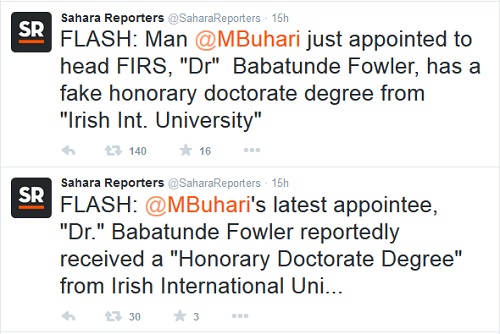
[img][/img] Newly appointed head of Federal Inland Revenue Service, Dr Williams Babatunde Fowler, holds a dubious honourary doctorate degree at Irish International University in England, reports claims. https://www.tori.ng/userfiles/image/2015/aug/21/tweets-2.jpg Dr. Williams Babatunde Fowler, who was on Thursday appointed to head Nigeria’s Federal Inland Revenue Service (FIRS) by President Muhammad Buhari, holds a dubious honorary doctorate degree in England from an institution known as the “Irish International University.” The fake institution was exposed as a degree mill by the BBC in 2008 as offering bogus and useless honorary degrees. In announcing Mr. Fowler’s appointment, presidential spokesman, Femi Adesina claimed that Mr. Folwer “had his higher education in the United States where he obtained a Bachelor's degree in Economics from the University of Wisconsin and a Master of Business Administration degree from the California State University.” He also stated that Fowler holds an “Honorary Doctorate Degree of the Irish International University”. That listing of Mr. Fowler’s academic degrees immediately began to provoke close enquiry. A United States-based university professor, Farooq Kperogi, writing on Facebook, said, “After months of delays, ostensibly to properly vet his appointees, President Buhari just appointed somebody that may turn out to be a total fraud. He appointed a certain "Dr." William Babatunde Fowler as the Executive Chairman of the Federal Inland Revenue Service (FIRS). In a news release signed by Femi Adesina, this red flag appears on the man's qualifications: "Fowler, who holds an Honorary Doctorate Degree of the Irish International University, is a Fellow of the Chartered Institute of Taxation of Nigeria and the Business Management Association of the United Kingdom." Well, Irish International University is a fraudulent, non-existent university (see http://news.bbc.co.uk/2/hi/uk_news/education/7175730.stm). “Second, the Committee of Vice Chancellors in Nigeria has ruled that people with even legitimate honorary doctorates cannot prefix "Dr." to their names, as is the practice globally (see http://www.farooqkperogi.com/.../finally-some-good-news...). I fear that if this Fowler's other qualifications are looked into, a big scandal may break out. His bachelor's degree, for instance, is said to be from the "University of Wisconsin" and his master's degree from "California State University." According to Kperogi, “The trouble is, University of Wisconsin and California State University are multiple-campus universities; you can't just say you attended the University of Wisconsin without mentioning the location. The University of Wisconsin has 26 campuses, and California State University has 23 campuses. Something is fishy here!” However, Wikipedia has a more detailed listing of Mr. Fowler’s lower degrees which appears to grant credibility to them, stating that he “obtained his first bachelors’ degree with a Bachelor of Science in Economics and a minor in Political Science in 1978.” It adds that he completed a second bachelors’ degree program at California State University, Los Angeles and also a Master of Business Administration degree program at California State University, Dominguez Hills in 1981.” Despite all that, Wikipedia does not list Fowler’s “Honorary Doctorate Degree” from the Irish International University in its citation. A cursory look at the Irish International University shows that it is a fake “university” operated by a United Kingdom aristocrat, Professor Baron Knowth, who serves as the Honorary Chancellor of the Irish International University. Despite being exposed by the BBC as a fake university offering bogus and useless honorary degrees, Irish International University has continued to do business. Several Nigerian politicians, led by former Lagos state governor and now National Leader of the All Progressives Congress (APC), Bola Tinubu, received honorary degrees from it early in 2008. In addition to Tinubu, broadcaster Bisi Olatilo, BEN TV UK owner, Alistair Soyode, Timi Alaibe, now Oba of Ugbo, Fredrick Akinrutan, Senator Grace Bent and a scion of the Ooni of Ife, all received a fake honorary degree in an event orchestrated by the fake university in London. It is not clear when Mr. Fowler received his so-called honorary degree from the fake institution, but it is generally believed that his appointment may have been facilitated by Mr. Tinubu, with whom he previously worked at Alpha-Beta, a shadowy and controversial tax revenue company. http://news2.onlinenigeria.com/headline/428241-exposed-newly-appointed-head-of-firs-holds-fake-honorary-doctorate-degree.html |
| Politics › Men Paint Former Bauchi State Gov's Face Off Undistributed Campaign Fertilizers by ducii(op): 11:02am On Aug 21, 2015 |
[img]http://3.bp..com/-iVScKGZncxk/Vdbx4TU0VgI/AAAAAAAGTng/Pm07v-Ve3YY/s1600/unnamed.jpg[/img] Undistributed bags of fertilizers purchased by former governor of Bauchi State, Isa Yuguda with his name and picture being painted over http://lindaikeji..com/2015/08/photo-men-paint-former-bauchi-state.html |
| Politics › Dangote Gets More $997m Loan For Dangote Oil Refinery by ducii(op): 4:33pm On Jul 31, 2015 |
Africa’s richest man Aliko Dangote has received $997.4 million in training grant from the U.S. Trade and Development Agency (USTDA) for his Dangote Oil Refining Company Ltd. located in Lekki, Lagos, Nigeria. “USTDA is pleased to support the Dangote Oil Refining Company’s efforts to increase Nigeria’s domestic refining capacity,” said USTDA Deputy Director Enoh Titilayo Ebong, who signed the grant agreement along with Mr. Aliko Dangote, Chairman and CEO, Dangote Group. “This program builds upon USTDA’s long history of support for vital infrastructure development in Nigeria.” The grant will fund a multi-year program to train more than 100 staff of the Company on refinery fundamentals. The training is being provided, as part of a whole-of-U.S.-government advocacy campaign, in support of UOP LLC’s (Des Plaines, Ill.) agreement, through its affiliate UOP Limited, for the provision of technology licensing and engineering services to the Dangote Oil Refining Company for the development of the Lekki refinery. In 2013, Dangote Industries Limited signed a loan agreement with a consortium of both local and international banks to the tune of $3.3 billion for the purpose of constructing the biggest Petroleum Oil Refinery & Petrochemical/ Fertilizer Plants in Nigeria. Dangote has invested $11 billion in the project which is expected to be completed by 2017. With Nigeria’s state-owned refineries largely ineffective and producing a fraction of installed capacity, Africa’s largest oil producer has become the continent’s highest importer of refined oil products. But Dangote’s refinery will change this. At completion, the facility is projected to process about 500,000 barrels of crude daily — about a quarter of the country’s total crude production. The new refinery will process crude oil to produce high-quality fuels that meet Euro V specifications for reduced emissions. The agreement between Dangote and USTDA is a major step forward in reducing dependence on imported fuels and petrochemicals in Nigeria, a country the Oil & Gas Journal estimates has the second-largest amount of proven oil reserves in Africa. UOP will conduct the training program in Nigeria to maximize the number of trainees, as the scope is focused on refining processes and engineering, as well as on health, safety and environmental skills. Dangoted recalled that just over 12 months ago, “we decided to address the paradox of Nigeria being one of the world’s leading producers and exporters of crude oil but also one of the world’s leading importers of refined petroleum products with our decision to invest in a 500,000 bpd refinery project”. He noted that such high tech capital intensive project requires the right human capital to ensure its success. The grant will, therefore, immensely help the company to address this. http://venturesafrica.com/africas-richest-man-gets-997m-us-grant-for-dangote-oil-refinery/ |
| Politics › Lagos Joins League Of Oil Producing States In Nigeria by ducii(op): 4:07pm On Jul 31, 2015 |
This week, Lagos officially added another element to its already glittering economic prospects when reports confirmed it is expected to join the league of oil-producing states in Nigeria. A joint venture led by Yinka Folawiyo Petroleum Company Limited has been exploring the Aje Field offshore Lagos, and have taken the final investment decision on the exploration of the field with drilling expected to commence later this year. Nigerian billionaire and oil magnate, Yinka Folawiyo is the operator. His oil firm holds a 25 percent interest in the field. The other partners are Vitol, which controls 24.05 percent; First Hydrocarbons Nigeria Limited, holding 16.875 percent; Energy Equity Resources Limited, 16.875 percent; Panoro Energy ASA, 12.19 percent; and Jacka Resources Limited, 5 percent. The group, which submitted an initial proposal for the field development in January 2014, has already concluded plans for the necessary pre-production arrangements needed to kick off the first phase of the Aje shallow water oil field. The planning process cost $220 million. It will produce 10,000 barrels per day of oil from two target wells in the Oil Mining Lease 113 area. The field holds an estimated 32 million barrels of oil reserves. Taofiq Tijan, a former Commissioner for Energy and Mineral Resources of Lagos State, told local newspaper Punch that in 2014 that such development was good for Nigeria “generally because our reserves base has not increased over the years as expected, because the international oil companies are not ready to invest since the Petroleum Industry Bill has not been passed.” For Lagos, this will prove a massive boost in its bid to consolidate its position as the country’s economic hub. Lagos is home to Nigeria’s most critical commercial activities. The country’s biggest air and sea ports are situated in the coastal city, as well as the head offices of the biggest companies. These, complimented by a rapidly growing population and consumer market, have propelled the growth of its economy. Experts have even suggested that Lagos alone has a larger economy than many African countries. It contributes about $80.61 billion (35.6 percent) of Nigeria’s GDP. Lagos is also the highest contributor to the Non-Oil GDP (with $129.4 billion, representing about 62.3 percent). However, its oil contribution is expected to soar with news oil discoveries. In June 2013, emerging oil company Afren Plc and its partner Lekoil announced that they had discovered a significant amount of oil reserves in the offshore Dahomey Basin in Lagos. The assertion is based on the results of drilling and wire line logs from a high impact Ogo-1 well, located on the Oil Prospecting Licence, OPL 310 offshore Nigeria. Preliminary assessments showed revealed the field holds an estimated 78 million barrels of oil equivalent. However, Afren is optimistic that further study will uncover even greater reserves. The discoveries by Afren and Yinka Folawiyo’s Joint Venture are expected to lift Lagos into the club of oil-producing states, and generate more than N30 billion worth of internal revenue every month. Lagos will become the 11th oil producing state in Nigeria, joining Akwa Ibom, Bayelsa, Rivers, Delta, Ondo, Abia, Imo, Edo Cross River, and very recently Anambra. http://venturesafrica.com/lagos-joins-league-of-oil-producing-states-in-nigeria/ 2 Likes |
| Politics › Re: (pics)match Made In Heaven – Nigeria’s Unique Food Combos(snacks) by ducii(op): 10:48am On Jul 30, 2015 |
babyfaceafrica:Yea, Naija for life |
| Politics › (pics)match Made In Heaven – Nigeria’s Unique Food Combos(snacks) by ducii(op): 10:42am On Jul 30, 2015 |
Nigerian food are just as diverse and exciting as they come. However, there are certain popular food among the lot, which are defined by their ready availability, taste or price, making them regular staple meals amongst everyday Nigerians. As with most things, Nigerians are creative with food, coming up with different combinations which might sometimes come off as weird, but are quite tasty. Whether in the street corner, in the heat of traffic, or even in the comfort of a home, here are six tasty Nigerian food combos. Roasted corn and coconut or pear (Ube) Corn which is always available during the raining season is currently the most popular street snack. It is prepared either boiled or roasted, and when eaten with with either coconut or pear as is the tradition, it is a food match made in Heaven. Hardly you take a turn through a street today without seeing a corn shed. This combination is often sold in wraps of old newspapers at very affordable prices. Roasted plantain (boli) and groundnut Mostly popular around South-South Nigeria, this classic combo is genius! Roasted plantain eaten with groundnut or fish sauce, is quite tasty and nutritious. This combo only takes the backseat at times like this when corn is in season. It is also often sold in old newspaper wraps (this is the common method of packaging roadside delicacies – recycling it is.) and is quite affordable. Bean cake (moi moi) and bread Bean cake is a tasty deep fried delicacy of Nigerians that is made from ground bean paste. While it can be enjoyed on its own, most people pair the proteinous ball with bread or soaked garri. This combo is mostly eaten as breakfast or dinner. Soaked garri with groundnut or coconut This is the holy grail of food combos in Nigeria. It is one meal that defies class or social strata. Rich or poor, every Nigerian loves their cassava flakes with groundnut or coconut. While some prefer the white (Ijebu) garri for this combo, other people, especially the south-southerners, prefer the yellow garri. It is best served with a little bit of milk, sugar or salt, and most preferably cold water. Pop corn (guguru) and groundnut This is definitely one of the cheapest and tastiest street food combos in Nigeria. The pop corn is usually hawked in two varieties – salt or sugar, depending on the choice of the customer, and is commonly paired with groundnut. You can get pop corn for a low price of N50 and groundnut for just N20; it clearly doesn’t cost much to enjoy this unique combo. Gala and Lacasera If you ply the traffic laden streets of Lagos Nigeria, or any other busy Nigerian city during rush hour, you honestly cannot ignore the sight of these two inseparable combinations. ‘Gala’ which has become likened to all wrapped beef rolls, and the beverage La casera is often served ice cold. It often leaves one wondering whether or not there is a refrigerator somewhere in traffic. This combo comes to the rescue as a perfect hunger palliative before getting home, it is one of the top selling consumables in traffic. #Pictures Below #I am sure that there are a few that I have missed here, so feel free to add yours Roasted corn and coconut or pear (Ube) https://venturesafrica.com/wp-content/uploads/2015/07/IMG_0278-1024x768.jpg https://venturesafrica.com/wp-content/uploads/2015/07/corn-ube.jpg Roasted plantain (boli) and groundnut https://venturesafrica.com/wp-content/uploads/2015/07/20141213_160201-1024x977.jpg Bean cake (moi moi) and bread https://venturesafrica.com/wp-content/uploads/2015/07/bread-akara.jpeg https://venturesafrica.com/wp-content/uploads/2015/07/akara.jpeg Soaked garri with groundnut or coconut https://venturesafrica.com/wp-content/uploads/2015/07/garri.jpg https://venturesafrica.com/wp-content/uploads/2015/07/th.jpeg Pop corn (guguru) and groundnut https://venturesafrica.com/wp-content/uploads/2015/07/guguru-gnut.jpeg Gala and Lacasera https://venturesafrica.com/wp-content/uploads/2015/07/gala-la.jpeg https://venturesafrica.com/wp-content/uploads/2015/07/lacasera.jpeg http://venturesafrica.com/match-made-in-heaven-nigerias-unique-food-combos/ |
| Politics › Reasons Why We’re Yet To Move Against NNPC — Buhari by ducii(op): 2:40pm On Jul 28, 2015 |
The Federal Government, on Monday, explained that its delay in moving against the Nigerian National Petroleum Corporation, NNPC, was because it is trying to establish the magnitude of fraud and inefficiencies the corporation, and the nation’s oil and gas industry was fraught with over the last couple of years. Speaking in an interview on the Nigerian Television Authority’s, NTA, ‘Good Morning Nigeria,’ programme, President Muhammadu Buhari disclosed that the government is already working with some individuals that are helping it to track the destination of stolen crude oil and the accounts the proceeds are paid into. He said, “Frankly, I read the stories too that I intend to break up the NNPC. I think the best way to go about it is to establish the fact of the magnitude of the inefficient ways the NNPC conducted itself. When we do that we will be on a higher moral ground to carry out whatever recommendations that have been made to us.” He maintained that the NNPC has lost track of the number of accounts belonging to it, adding that the government is discreetly working with some Nigerians to ensure that perpetrators of fraud in the oil and gas sector are brought to book. “We have to maintain high confidentiality so that we do not put at risk, some of the Nigerians that are helping us to trace some of the destination of this stolen crude and then the account where they are being paid into instead of the federal government account. “I do not think the NNPC knows how many accounts are outside there, which payments are being made for Nigerian crude which is really an outright theft. The money we want to intercept which have been going on for a number of years, a lot of Nigerians will not comprehend,” he explained. Buhari lamented the fact that the crude oil swap programme has over the years been used to defraud the country, stating also that a number of operators in the oil and gas industry have displayed lack of conscience and love for the country. He said, “These individuals have refineries all over the world. The swapping, is tied into a major killing ground for corrupt officials with an average evil to loot the country’s crude, work out how much they can bring back to us and we pay for the transportation and for the refining. The swapping programme is such a dishonest way in which Nigeria is consistently losing on daily basis, millions of dollars. I think the people who have been operating in the industry, a lot of them have displayed lack of conscience and patriotism, and only God knows the amount of damage their actions have inflicted on Nigeria.” Expressing optimism that the United States and other European countries are willing to cooperate with Nigeria in repatriating funds that are proceeds of corruption and stolen crude, the President however, stated that the Federal Government is working to ensure that it complies with the laws of these countries and provide them with the needed documents that will help expedite the repatriation. He said, “These countries are willing. I have also said that we have to comply with their system; that we have to get the document, especially the shipping documents, how we load from our terminals, their destinations. It is important to note that some of them change the crude and the destinations in the high seas and then change the account it needs to be paid into. Instead of the Federal Government account, they are paid into individual accounts. “The cooperation we need is that once we get hold of the shipping documents and we are lucky to trace them out to the countries where they sold the crude and which account it goes into and we submit the evidence in terms of loading, in terms of payments being in accounts other than the Federal Government account. “Once we do that, we are very willing to make sure that those accounts are frozen and the money repatriated to Nigeria. It is not an easy process, but I assure you that we are working very hard. We cannot say that we wait until everything is intact before we let you know. Whichever we are able to get in the following months or a couple of months, we will bring it out for Nigerians to know, with facts in our hands and prosecution started for those who perpetrated the unpatriotic action against Nigeria for so many years.” http://news2.onlinenigeria.com/news/general/425742-reasons-why-were-yet-to-move-against-nnpc-buhari.html |
| Politics › From August, Nigerians Will Pay More For Everything They Consume by ducii(op): 9:56am On Jul 24, 2015 |
The signs are already visible: the prices for tomatoes, yam, poultry, and fuel are climbing, and at an alarming rate. The worst however is yet to come. Experts have predicted that in the coming months Nigerians will pay more for virtually everything they consume, as key market indicators continue to paint a grimmer picture for Africa’s largest economy’s consumer market. A rising consumer price index (CPI) and a climbing inflation rate have been blamed for the price hike. According to a research by SB Morgen, Nigeria’s CPI grew by 10 percent over the past six months while inflation rose to 9.2 percent, from 8.6 percent last year. This has been caused by the instability of prices for both locally produced and imported goods since the beginning of 2015. The price of more commodities are expected rise as airlines and local intra-city transport services prepare to increase fares. “Living standards are expected to drop further with the upsurge in the price of consumables at a time when the average Nigerian is least empowered socially and financially to overcome the challenge posed by rising food and commodities price,” said Chinedu Ozordi, a director with SB Morgen. Beyond the market indicators, factors including the weaker foreign exchange rates, prolonged period of fuel scarcity, and insecurity in Nigeria’s Northeast have hampered food producers and retailers from operating effectively. A persistent rise in the prices of commodities will heap enormous pressure on the Nigerian consumer, particularly those in the labour force. The research revealed that large chunk of the Nigerian working class, particularly within the public sector, earn an average of N25,000 and spend 60 percent of it on feeding annually. The remaining 40 percent is split equally between transportation and miscellaneous expenses, with not enough left to save for days with such unfavourable conditions. “The average Nigerian is presently not well placed financially to cope with the rapidly increasing price of commodities,” the report explained. SB Morgen’s Chinedu goes further to highlight the current hardship facing public workers, most of whom are owed more than six-months of wages. “As a matter of fact, over 10 of the 36 states of the federation presently owe their workers at least 2 months wages, with others meeting their wage obligations beyond due dates. This in itself poses a serious challenge as the average Nigerian not only faces the challenge of increasing prices, but also a scarcity of funds to meet up the daily spending requirements.” Omair Ansari, a Renaissance Capital Frontier Consumer Sector analyst, explained in an Op-Ed published on Ventures Africa that Nigeria’s current predicaments are familiar to most frontier markets. “Political, economic, security and climate hurdles tend to be widespread in frontier markets, particularly in Sub-Saharan Africa.” The need to fulfill basic human requirements will always support consumption growth, he admits, but only if consumers are able to make purchases. Ansari says achieving this will require the incorporation of innovative solutions. “This is where we think financial technology (such as M-Pesa) is critical for frontier markets, including Nigeria.” For SB Morgen, a concerted government effort will prove vital in shielding the Nigerian consumer market from a greater damage. “The federal, state and local governments need to play their part in curtailing the persistent rise in consumer commodities to where they have reasonable control over, for example by encouraging small scale farming across the nation.” http://venturesafrica.com/from-august-nigerians-will-pay-more-for-everything-they-consume/ |
| Politics › Three Reasons Why Nigeria Will Continue To Outshine At The Mama Awards by ducii(op): 8:25am On Jul 23, 2015 |
On Saturday 18th July 2015, the fifth edition of the MTV Africa Music Awards (MAMA) was held at Inkosi Albert Luthuli International Convention Centre in Durban South Africa. This is the second time Durban is hosting the event over the last two years. For the first time ever the live telecast was aired on MTV Base, MTV and BET simultaneously. It was hosted by American Actor, producer and comedic genius Anthony Anderson with US Grammy award winner Ne-Yo and Singer and Song writer Jhene Aiko gracing the awards with their sensational performances. When Alex Okosi and Jandre Louw, conceived the idea of MTV Africa Music Awards MAMA, they didn’t expect that Nigerian artist would win the most awards barely five editions in. Prior to the launch of MAMA in 2008, African artists were awarded an MTV Europe Music Award voted by MTV Base Africa viewers for Best African artist. The first award show was held at the Velodrome, Abuja, Nigeria hosted by British DJ and Presenter Trevor Nelson. From the inception of the MTV Africa Music Awards, MAMA, Nigerians have won the most awards. However, the fact that one of the co- founders is from Nigeria has not influenced the results of the award. In 2008, Nigeria won seven awards out of ten categories followed by South Africa, which won only two. In the following years Nigeria won five out of eleven categories in 2009 and in 2015 seven out of fifteen categories. As long as Nigerians keep the creativity spirit alive and work on more collaborations with international artists they will continue to advance in the entertainment industry while increasing their fan base. Here are three reasons why Nigeria will continue win the most awards: Creativity: Nigerians are known to be very creative and have incorporated this into the Music industry. Most Nigerian artists that have won the MAMA awards have in one way or the other brought a new style of music or dance step to Africa from the Skelewu dance by Davido to Psquares’ Shekini . For instance Yemi Alade “Johnny” who won the best female act of 2015 brought her unique style of music from her energetic dance steps to unique hairstyles. You can hardly go into a club in the United Kingdom or United States of America without hearing the DJ play a Nigerian song. Spending more on promotion – Nigerian music producers spend a lot on promotion or media hype in order to ensure that artists win the awards–they go as far as travelling out of the country to shoot musical videos. On the average a musical producer spends about $402,000 on a musical video. This amount also covers transportation,accommodation, music and session fees. Popularity: Being the largest economy in Africa and the most populous black nation is an added advantage for Nigerian artists– they are well known across Africa. They have been able to build their fan base across the globe by collaborating with several artists from different continents. http://venturesafrica.com/three-reasons-why-nigeria-will-continue-to-outshine-at-the-mama-awards/ |
| Politics › EFCC Invites Saraki's Wife And Yaradua's Daughter Over Allegations Of Fraud by ducii(op): 5:44pm On Jul 22, 2015 |
According to a breaking news report by Premium Times, wife of Senate President, Bukola Saraki, Toyin Saraki and one of the daughters of former President Umaru YarÁdua, Zainab Dakingari have been invited by the EFFC over alleged fraud and money laundering. Mrs Toyin Saraki is being invited by the antigraft agency to answer questions regarding some alleged questionable flow of income into some companies which she has interest in. PT reports that Mrs Saraki is due to appear at EFFC's headquarters on July 28 Zainab Dakingari who is married to the ex-governor of Kebbi state, Saidu Zakingari is being invited by EFFC to answer questions on an alleged N2 billion fraud which was carried out during her husband's tenure. Zainab was meant to appear before EFCC team today but deferred her appointment till July 27th as she is currently out of the country. When contacted, EFCC spokesperson acknowledged that new fraud suspects have been invited by the agency "I’m aware that a new set of suspects were recently invited. It’s not impossible the two women are among them.” he said http://lindaikeji..com/2015/07/efcc-invites-sarakis-wife-and-yaraduas.html |
| Politics › Re: Why The Auto Policy Of President Goodluck Ebele Jonathan Was Successful by ducii(op): 3:59pm On Jul 09, 2015 |
Illuminator9:True talk, I think GEJ was a visionary leader one of the best presidents this country will ever see |
| Politics › Why The Auto Policy Of President Goodluck Ebele Jonathan Was Successful by ducii(op): 3:29pm On Jul 09, 2015 |
Before 2013, Nigeria was Africa’s biggest market for tokunbos—the local name used to describe used cars shipped from Europe and the US. Vehicles (mostly five to 10 years old) were brought into the country through the Lagos seaport, or smuggled through the border it shares with Benin Republic. What fuelled this massive dumping, however, was that the local manufacturing (or assembling) industry was virtually grounded, and investing in a new car was pretty expensive for the average Nigerian. During the mid and late 90s, Nigeria’s roads were littered with Peugeot-branded sedans built in the Peugeot Automobile Nigeria (PAN) factory located in Kaduna, one of the busiest commercial cities in Northern Nigeria. But as the second millennium drew closer, those cars were gradually replaced by used Mercedes Benz 300 (popularly known as V-Boot), BMW’s 3,5, and 7 series, and the Madza 626’s and 323’s. This eventually led to the demise of PAN, and many other car producers within the country. In an attempt to reverse the trend, Nigeria launched the National Automotive Policy, an initiative to promote massive investments in affordable made-in-Nigeria cars and limit excessive importation, in October 2013. [/b]It was also aimed at trimming the growing importation bill for cars, which stood at $3.4 billion as of 2012. To discourage importation, the government doubled the then tariff regime for wholly-imported vehicles, from 35 percent to 70 percent, while it offered foreign manufacturers, willing to carry out a significant portion of their production value-chain locally, tax breaks. [b]The influx Since the policy was effected in July 2014, Nigeria has been swamped with foreign manufacturers. This week, Honda, the world’s eighth largest automobile maker, confirmed that it has started building cars in Nigeria by retooling a part of its factory that previously made motorcycles. It plans to produce 1,000 of its Accord sedans annually at the plant, as well as make Nigeria its production base for Africa. German automaker Volkswagen is also set to resume production in Nigeria after a 25-year absence. Volkswagen, the second largest car maker globally, will partner with Dubai-based distribution group, Stallion, to grow its business locally. Toyota, the world’s largest car manufacturer, is also teaming up with Elizade, its local distributor, to develop a local assembly plant. Toyota currently sells about 18,000 to 20,000 vehicles in Nigeria annually. Nissan, however, is already a step ahead of the bunch. As of October last year, it had unveiled the first set of SUVs assembled in its Lagos-based assembly plant, and has since added the Almera sedan and NP300 pickups to its locally produced fleet. KIA and Hyndai, amongst others, are also keen to participate in a market that is becoming more attractive by the day. A local revival Beyond the foreign attraction, the local industry is also seeing a rapid revival. The previously grounded PAN is set to resume production as the PSA/Peugeot-Citroen is expected to start assembling Peugeot 301 sedans in its Kaduna facility before 2016. The biggest success story, however, is the rise of Innoson Vehicle Manufacturing Company Limited, a local auto manufacturer based in Eastern Nigeria. The indigenous company, founded by Nigerian industrialist, Chief Innocent Chukwuma, unveiled in December last year its new set of cars—IVM Umu, IVM Umu and IVM Uzo—manufactured in its Nnewi plant in Anambra State, South east Nigeria. 70 percent of the parts used in building the cars were locally sourced, heralding the emergence of a local car manufacturing industry that will, in the nearest future, serve the African market. Already, the company has disclosed it plans to take its brand to neighbours in West Africa, with the Republic of Benin and Ghana on its radar. The company had earlier impressed with its trucks and buses. The range of Innoson vehicles is already enjoying patronage locally, unlike in the past when indigenous manufacturers were stifled by the lack of appreciation of their products. Across Africa, locally-made goods are beginning to earn respect and desired patronage through quality assurance and competitive pricing. The price attraction When the new auto policy was initially drummed up two years ago, many Nigerians—particularly those within the low and middle income bracket—criticized the move to restrict importation of used cars, as new cars were considered too costly. But the new movers have silenced such sentiments by producing vehicles that are fairly priced. The new Innoson IVM Umu is expected to sell for about N1.5 million to N2 million, a similar going rate for an imported tokunbo Toyota Corolla (2008). Nigeria still remains one of the biggest markets for tokunbo cars within the continent, but its quest to rid itself of that title is landing it a new one—the new hub for Africa’s auto manufacturing. http://venturesafrica.com/nigerias-auto-landscape-from-dumping-ground-to-manufacturing-hub/ |
| Politics › This Guy Says This Is The Reason Behind Boko Haram... by ducii(op): 12:12pm On Jul 08, 2015 |
| Politics › Ukraine Confirms Export Of Weapons To Nigeria In Fight Against Boko Haram (Pic) by ducii(op): 2:43pm On Jul 07, 2015 |
[img]http://3.bp..com/-w-TFHEL_0GM/VZvShnDLCfI/AAAAAAAF0T4/OuT3zglETiQ/s400/1.jpg[/img] [img]http://3.bp..com/-ypDdI0K3ePA/VZvSiWunJ7I/AAAAAAAF0T8/iWF7rlUw9Gw/s1600/1.png[/img] [img]http://3.bp..com/-rQrxB9cxYN0/VZvSi_BIsfI/AAAAAAAF0UE/Ba9QyoMzOMk/s1600/2.jpg[/img] [img]http://3.bp..com/-sXOuuvVKXe4/VZvSjaWfMEI/AAAAAAAF0UQ/AZn-AwZxV6w/s400/4.jpg[/img] [img]http://4.bp..com/-RtTXZhkCa_M/VZvSoYMNhNI/AAAAAAAF0UY/Ar9Xb7arLhM/s400/3.jpg[/img] http://lindaikeji..com/2015/07/pics-ukraine-confirms-export-of-weapons.html |
| Politics › Why President Buhari Will Be Visiting U.S. This Month’ by ducii(op): 12:53pm On Jul 07, 2015 |
From the Ministry of Foreign Affairs came at the weekend confirmation that President Muhammadu Buhari will visit United States to meet with President Barack Obama on July 20, 2015. The visit is coming barely a week after the US Supreme Court legalised same sex marriage in all states of America. Briefing the press in Abuja on Saturday, the Permanent Secretary, Ministry of Foreign Affairs, Ambassador Bulus Lolo, said the President Buhari’s visit to U.S. would provide an avenue to discuss political, economic and other issues of mutual benefit to both countries, contrary to speculations that the meeting may be used by Obama to put pressure on Buhari to reverse the anti-gay marriage law passed by the National Assembly and assented to by former President, Dr. Goodluck Jonathan. Lolo said: “A statement has been made to the effect that the President will be in Washington for a meeting with Barack Obama on July 20, and I am affirming here that an invitation has been extended and President Buhari has accepted. Suffice me to say that it is true, he is going . “But the notice for the visit, let me make it clear that no nation can exist as an Ireland to itself. You do not hesitate to accept invitation simply because you must address certain issues at a time when you have a window to engage. So, he is going to Washington this month to meet with President Barack Obama. It is not expression or romance. It is due to the quality of relationship between Nigeria and America that so soon after assuming office, there is the willingness to engage Nigeria . “There is opportunities in the visit because Mr. President will use that occasion to once again state what his vision is for the country. And he will not just take this to a small crowd. The U.S. audience is a very large one. President Buhari will have that opportunity to meet not only with the government but the private sector operators. These are the occasions when countries are able to mobilize support and market the product successfully. “And so going out to Washington should be seen as an opportunity for Nigeria to enter the biggest market and get one of the best up there that one can wish to have. I see it beyond romance but a chrystalisation of a relationship that is strong and mutually beneficial to the people of Nigeria and America.” On the outcome of the President’s visit to G7 meeting, Lolo said: “The G7 have promised to support the government. They requested our President to draw up his list of requirements and priorities and submit to them for consideration. “We have every hope that with the momentum of opportunities we have, we will remain engaged with our partners, including the G7.” On Buhari visits to Chad and Niger, the permanent secretary affirmed that it was part of efforts to end the insurgency in the northern part of the country. “The President’s visits to the two countries gave him opportunities to have fruitful discussions with his counterparts on security issues, the areas of cooperation and what must be done. It has come true to all that the fight against Boko Haram will not be tackled only by military action, but by addressing the fundamental root causes of insurgency. We then can find a lasting solution to the problem. And so, the government of these countries have agreed to take military options, alongside economic, social and other supportive measures that will also bring succour to the people,” he said. “For us to win the battle against Boko Haram, we must remain engaged and work with others and because we have that opportunity so we can look at the future with hope, “ Lolo added. http://www.ngrguardiannews.com/2015/07/why-buhari-will-be-visiting-u-s-this-month/ |
| Politics › Re: Borno Residents Caution FG Against Dialogue With Boko Haram by ducii(op): 11:50am On Jul 06, 2015 |
Demmzy15:wetin you mean |
| Politics › Borno Residents Caution FG Against Dialogue With Boko Haram by ducii(op): 11:38am On Jul 06, 2015 |
Some residents of Borno on Monday cautioned the Federal Government against rushing into dialogue with the Boko Haram insurgents as a way of ending their violent campaign. Those who spoke with the News Agency of Nigeria in Maiduguri on Monday advised government to concentrate on military action against the insurgents. Shieikh Musa Usman, a Maiduguri based Islamic scholar, advised government to equip the military with the necessary weapons to face the insurgents rather than considering dialogue option. Usman said, “We heard in the media that government was considering a dialogue option with the insurgents following the recent spate of attacks in the North east. “Why should government dialogue with individuals who are only interested in killing and maiming innocent people? “Is government saying that it cannot continue with the current anti insurgency war or what? “Why must we be talking about dialogue when our neighbours are already dislodging the insurgents from their countries?.” Usman urged government to copy from the recent actions of the Chadian and Nigerien Governments in dislodging the insurgents from their countries. Malam Goni Yahuza, another scholar said that negotiating with the insurgents was a sign of weakness. “I do not support the idea of dialogue with Boko Haram because there is nothing to dialogue about. “In the first place, I do not think that the group has something to talk about apart from violence”, Yahuza said. He added that government must deploy all resources available in ending the insurgency within a reasonable time. “I believe that the Nigerian military has all its takes to crush the insurgents, what they need is proper motivation for the task. “Government must strive hard to ensure that it puts an end to the insurgency in a short while,” Yahuza said. Alhaji Mohammed Mala, a businessman, commended the gallant efforts of the Nigeria military in fighting insurgents and urged them to do more. http://www.punchng.com/news/borno-residents-caution-fg-against-dialogue-with-boko-haram/ |