G7conet's Posts
Nairaland Forum › G7conet's Profile › G7conet's Posts
 Business › Google’s Africa Investment Fund Makes First Investment In Uganda’s Safeboda by g7conet(op): 12:46pm On Dec 16, 2021 Business › Google’s Africa Investment Fund Makes First Investment In Uganda’s Safeboda by g7conet(op): 12:46pm On Dec 16, 2021 |
Internet giant Google announced today that it has made the first investment from its Africa Investment Fund in Ugandan super app SafeBoda. The undisclosed investment comes two months after Alphabet CEO Sundar Pichai announced the tech giant’s intentions to commit $1 billion over the next five years in “tech-led initiatives”, which includes a $50 million Africa Investment Fund targeted at early- and growth-stage startups on the continent. He made this known at the Google for Africa event in October. Before launching the fund, Google proved helpful in startups’ journeys via its Google for Startups Accelerator Africa program. The accelerator program has supported more than 80 startups in seed to Series A stages with equity-free mentorship and resources. Collectively, they have raised over $100 million in venture capital. Google also recently launched Black Founders Fund, a non-dilutive $3 million fund allocated to 50 startups yearly. Fintech startups and those from Nigeria, Kenya, Egypt, and South Africa get looked at the most by venture capitalists. Last year, fintech startups accounted for 25% of the VC funding which flowed into Africa, while startups from the Big Four received more than half of the continent’s total funding. VC firms and institutional fund managers who have spoken with TechCrunch recently say they want to bridge this funding gap by investing in overlooked regions and sectors on the continent. Nitin Gajria, the managing director of sub-Saharan Africa, Google, is one such and he expressed these sentiments when the company announced the Africa Investment Fund in October. “We are not restricting ourselves to certain verticals. We are focusing on investments where we believe that Google could add value,” the managing director said in October. “If there are founders building interesting products solving real challenges in Africa, that would fall squarely within our investment thesis.” Though Google’s investment in SafeBoda serves as an early reminder of Gajria’s statement, startups from the Big Four markets will likely fill the fund’s portfolio in the next couple of years. The Ugandan startup launched as a two-wheel ride-hailing platform before embarking on a super app plan two years ago. Now, it offers rides, parcel delivery, food and shop, payments, savings, and other financial services to over 1 million customers in Uganda and its second market, Nigeria. The company counts more than 25,000 drivers who have completed over 40 million orders in both markets. SafeBoda has rarely announced any of its funding rounds since its inception in 2017, but people who know the company’s dealings say it has raised over $20 million. Its investors include GoVentures of Gojek, Allianz X, Transsion Holdings, Beenext, Unbound, and Justin Kan. SafeBoda said the investment from Google’s Africa Investment Fund will help “drive its growth in Uganda and Nigeria, scaling its transportation-led app to offer new payment and financial services solutions for its expanding set of customers: passengers, drivers, and merchants.” “SafeBoda welcomes Google to their community and is excited to continue to drive innovation in informal transportation and payments in the boda boda (East Africa) or okada (West Africa) industry,” said co-founder Ricky Rapa Thomson in a statement. “This vital industry is the lifeblood of Africa’s cities and powers economic development. SafeBoda is thrilled that leading global companies such as Google see the importance of backing startups working towards these goals.” A spokesperson told TechCrunch in a written statement that the investment in SafeBoda was made to “strengthen a relationship with a potential future partner that has strategically aligned vision of better logistics and transportation.” Asked about how many investments to expect in the coming year, the spokesperson said Google isn’t setting any expectations in that regard. source
|
| Business › Edukoya Raises $3.5m To Provide Quality Secondary School Education Online by g7conet(op): 12:02pm On Dec 16, 2021 |
Edukoya, an African-focused online learning platform that empowers learners and their parents to access high-quality education, has raised $3.5 million in a pre-seed round led by Target Global. Participating in the round are angel investors like Shola Akinlade, co-founder/CEO of Paystack, Babs Ogundeyi, and Musty Mustapha, co-founders of Kuda, Brandon Krieg and Ed Robinson, co-founders of Stash and Raffael Johnen, CEO of Aux Money—among others. Founded in May but launched into beta in December this year by former Google Nigeria boss, Honey Ogundeyi, Edukoya says it wants to empower learners and their parents to take control of their learning and make it easier for them to access high-quality learning material and expert help. Specifically, the platform is built to target Nigerian secondary school learners. At least that’s its current proposition. Edukoya includes 24/7 exam preparation & homework tutor help, a data-driven question bank with step-by-step solutions, and personalised performance tracking systems. Public education in Nigeria is not great; there are too many factors warring against it, from low funding to incompetent teachers to bad government policy. So, quality education is only available to a small proportion of Nigerians. The seven-month-old startup says it offers a free, supplementary learning platform, as well as subscription packages with premium features, focused on K-12 learning and exam preparation. This offering combination is expected to reduce the uneven distribution of quality education. The platform operates a 100% online model, which promotes self-paced learning that allows learners to save time and money. https://x7d4c5z5.stackpathcdn.com/wp-content/uploads/tc/2021/12/Edukoya-Product-003-1-1024x987.jpg “Our vision at Edukoya is to redefine online education for the next generation of Africans. Africa has the fastest-growing school-age population globally, with over 260 million students and counting,” Ogundeyi, who was also the founding CMO of Kuda Bank, said while speaking on the new investment. “Our goal is to democratise access and make high-quality instruction and content accessible and affordable to every student, regardless of where he or she lives on the continent.” Lina Chong, Investment Director at Target Global, said they [Target Global] are delighted to lead this investment and partner with Ogundeyi and her impressive team of education technology pioneers. “Edukoya’s mission to provide better quality to millions of African students, combined with the team’s ability to execute on this ambition, left an immediate impression on myself and the whole team at Target Global. Their business has the potential to unlock learner potential and improve lives across generations.” https://x7d4c5z5.stackpathcdn.com/wp-content/uploads/tc/2021/12/Edukoya-Product_005-Copy-1024x796.jpg This funding is the biggest pre-seed investment for African edtech and also the biggest investment raised by a Nigerian female single founder. The company plans to use the funds to go from beta to live launch in Nigeria by 2022. It will also accelerate its product and technology as well as expand its online curriculum content coverage and on-demand tutoring feature for secondary school learners. Regarding funding, the African edtech scene was off to a slow start this year, but its pulse is finally picking up. Even though it’s a large market to serve, competition is getting stronger with the presence of platforms like uLesson that recently secured a $15m check to double-down on the same market segment Edukoya sets its eyes on. However, it’s still too early to know who will emerge as an industry leader, regardless of who launches first. source
|
| Programming › Get This Free Online Job Portal Script Developed Using Php And Mysql. by g7conet(op): 3:47pm On Dec 15, 2021 |
Features of the system Admin Side 1. Manage Companies 2. Manage Job Vacancies 3. Manage Employee 4. Manage Applicants 5. Manage Category 6. Manage Users 7. Job Seeker Side Find Job 1. Company 2. Hiring Now 3. Apply for Job 4. Job Seekers Profile 5. About Us 6. Contact Us Note: It is free of charge and you will get access to unlimited downloads of free source code https://g7conet.com/single/download-online-job-portal-using-php-with-source-code
|
| Business › Patricia Technologies Bags Coveted BAFI Award. by g7conet(op): 12:09am On Dec 14, 2021 |
Patricia Technologies, a fast-rising fintech that provides alternative solutions to payments through the use of cryptocurrency, recently clinched the coveted “Virtual Assets Exchange of the Year” Award, at the BusinessDay Banks & Other Financial Institutions (BAFI) Awards ceremony organized by the Business Day newspaper in Lagos. The BAFI Awards is annual event set up to recognize and celebrate organizations that have achieved excellence in the delivery of their financial services across the entire client/customer spectrum and contributed to the industry’s overall growth. Now in its 7th edition, the BAFI Award is universally recognized as the benchmark of excellence in Nigeria’s financial services industry. Patricia Technologies bagged the award despite stiff competition from other formidable nominees. Present at the event to receive the award on behalf of Patricia founder and CEO, Hanu Fejiro Agbodje, were the Chief Product Officer, Seun Odunsanya and the Chief Financial Officer Okay Okoroafor. Reacting to the highly revered award, Patricia founder and CEO, Hanu Fejiro Agbodje said “we are grateful for the award presented to us. We see this as another recognition for all the hours we put into making our product the best standard for our consumers. This is a testament that we have stayed true to our mantra of Doing the most. We are definitely not resting on our laurels; we will continue to push boundaries and make tech products available and accessible to all”. https://x7d4c5z5.stackpathcdn.com/wp-content/uploads/tc/2021/12/IMG_5764-1024x683.jpg The Patricia Technologies brand is not new to the BAFI award, as they were recipients of the Crypto exchange of the year award in 2020. With this recognition, Patricia will continue its future forward drive while making Crypto easy. source
|
| Webmasters › Re: My Website Shows "Blank 1" White Screen - Am I Attacked? by g7conet: 10:58am On Dec 12, 2021 |
Check your error log for possible problems. Do you update your website codes online? |
| Business › Re: A Suicide Pod Is Set To Be Launch In Switzerland by g7conet(op): 11:25pm On Dec 09, 2021 |
jaeyking:I really wonder too. Maybe sometime in the future we will begin to do like them. You never can tell, we might do worst |
| Business › A Suicide Pod Is Set To Be Launch In Switzerland by g7conet(op): 10:45pm On Dec 09, 2021 |
The company behind a 3D-printed pod that can help carry out assisted suicide has said it is confident it could be used in Switzerland as early as next year. Sarco commissioned a Swiss legal expert, who found that the machine did not break any laws in the country. But other lawyers questioned his findings. And assisted-suicide organisation Dignitas said it would be unlikely to meet "much acceptance". Assisted suicide, in which somebody is given the means to end their own life, is legal in Switzerland. About 1,300 people died there in this way in 2020. Both assisted suicide and euthanasia, in which a doctor ends the life of somebody who wants to die, are illegal in the UK. Legal debate The current method used in Switzerland is to provide the person with a series of liquids that, if ingested, will end the person's life. By contrast, the pod - which can be placed anywhere - is flooded with nitrogen, reducing the oxygen levels rapidly. The process would make the person inside lose consciousness and die in approximately 10 minutes. The suicide pod is activated from the inside and also has an emergency button to exit. Daniel Huerlimann, a legal expert and assistant professor at the University of St Gallen, was asked by Sarco to explore whether the use of the suicide pod would break any Swiss laws. He told the BBC that his findings suggested the pod "did not constitute a medical device", so would not be covered by the Swiss Therapeutic Products Act. He also believed it would not fall foul of laws governing the use of nitrogen, weapons, or product safety. "This means that the pod is not covered by Swiss law," he said. But Kerstin Noelle Vkinger, a doctor, lawyer, and professor at the University of Zurich told Swiss newspaper Neue Zurcher Zeitung: "Medical devices are regulated because they are supposed to be safer than other products. Just because a product is not beneficial to health does not mean that it is not also affected by these additional safety requirements." And Dignitas told the BBC: "For 35 years now, through the two Swiss Exit groups and for 23 years also with Dignitas, Switzerland has the practice of professional accompanied suicide with trained staff, in co-operation with physicians. "In the light of this established, safe, and professionally conducted/supported practice, we would not imagine that a technologised capsule for a self-determined end of life will meet much acceptance or interest in Switzerland." Dr. Death If the machine gets the go-ahead for use in Switzerland, the pod will not be offered for sale in a conventional way. Instead, the capsule's creator Dr Philip Nitschke, said he planned to make the blueprints available so anyone could download the design. This will be made available for free. His aim is to "de-medicalise the dying process", he said in an interview published on the Exit International website, a voluntary assisted dying charity which he founded. "We want to remove any kind of psychiatric review from the process and allow the individual to control the method themselves." He has long campaigned for the right to die, earning him the nickname "Dr. Death". Currently, there are two prototypes of the Sarco pod, with a third being printed in the Netherlands. Dr. Nitschke has previously faced criticism for the pod, with some saying that its futuristic design glamourises suicide. source
|
| Science/Technology › United Kingdom To Phase Out 2G And 3G By 2033 by g7conet(op): 12:38pm On Dec 09, 2021 |
The UK will phase out 2G and 3G mobile services by 2033, the government says. The switch-off date has been agreed with mobile-network operators Vodafone, EE, Virgin Media, O2, and Three. In July, EE owner BT revealed plans to phase out 3G by 2023, and 2G later in the decade. And many other companies have already begun phasing out technology that supports the services. Culture Secretary Nadine Dorries said the move would help the UK make a smoother transition to faster networks. She said: "5G technology is already revolutionising people's lives and businesses - connecting people across the UK with faster mobile data and making businesses more productive." The government also promised a funding boost to help future-proof the UK's mobile networks, ending the country's over-reliance on a small number of suppliers and making it easier for new equipment-makers to enter the market. "Today, we are announcing a further £50m to put the UK at the forefront of mobile connectivity and to make sure our telecoms networks are safe and secure now and in the future," Ms. Dorries said. 'Consumer-protection dimension' Assembly Research founder Matthew Howett told BBC News the change would probably come sooner than the government's 2033 deadline. The switch-off will affect all sorts of older devices, such as 3G-only smartphones. And it would be crucial for the government to act on behalf of consumers who may be slow to adjust, Mr. Howett said. "There is an important consumer-protection dimension to all this," he said. "You will of course have some people who may still rely on a 2G/3G-enabled handset to make calls in emergencies but also because devices such as smart meters run off the 2G network. "Involving these stakeholders will be crucial to avoid disruption." 5G coverage In July, Amazon warned users some of its older Kindle models would soon be unable to connect to the internet. "Starting in 2021, some prior generation Kindle e-readers will not be able to connect to the internet using a cellular connection through 2G or 3G networks," the technology giant told its US customers. Meanwhile, 5G coverage is being expanded across the UK. In July, EE announced customers would be able to receive 5G "anywhere" in the country by 2028. source
|
| Programming › Download Employee's Information System Using VB.NET With Free Source Code by g7conet(op): 12:28pm On Dec 09, 2021 |
This is an Employee's Information System developed using VB.NET and MS Access Database. This application is software-based and stores the information of the employees of a certain company. The information of employees contains the personal information of the employee and some relevant details. Features 1. Secure Login and Logout 2. Add Employee 3. Update Employee's Details 4. List Employees 5. Delete Employee 6. Search Employee from List 7. Manage System User 8. Generate Reports (List of Employees) Feel free to visit the link below and get the full source code... Don't forget to share https://g7conet.com/single/download-employee-s-information-system-using-vb-net-with-free-source-code
|
| Business › Lagos Gov, Eko Innovation Center Offer Tips On How Techpreneurs Can Get Funding by g7conet(op): 12:01pm On Dec 09, 2021 |
In a bid to address one of the critical challenges of businesses, especially among startups, the Lagos government and Eko Innovation Centre including other experts at the Art Of Technology Lagos 3.0 held recently in Lagos have offered tips on how start-ups can get funds. They also used the platform to empower innovative Tech Entrepreneurs and young innovators with equity investment and other support initiatives to thrive in the business space. The two-day hybrid conference curated by Eko Innovation Centre held 3rd and 4th of December, 2021 at the Oriental Hotel Victoria Island, had as its theme “Funding and a Connected Lagos”. In attendance were the crème de la crème in government and other experts in the technology ecosystem who spoke on investment readiness, intellectual property, startup bills, and other regulations, and policy formulations for tech startups in the tech ecosystem. https://x7d4c5z5.stackpathcdn.com/wp-content/uploads/tc/2021/12/Photo-2-1024x684.jpg Dr. Isa Ali Pantami, Nigeria’s Minister of Communication and Digital Economy who spoke at the event via a virtual platform commended Lagos and Eko Innovation Centre for making the state the Silicon Valley of Africa stating that it would continue to support the state in its quest to achieve much more. He explained further that technology deployment is changing the world, stating that the ICT sector was instrumental for the country’s exit from recession. He, therefore, urged startups to deploy technology to ease their operations in the interest of growing their business remarkably In the same vein, he said the government is determined to support the growth of startups and businesses especially with the many government agencies working closely to fund and grow the business landscape. https://x7d4c5z5.stackpathcdn.com/wp-content/uploads/tc/2021/12/Photo-3-1024x683.jpg Also, he pointed that the country has the highest number of venture capitalists and pointed that the Startup bill currently up for consideration by the federal Executive council, would further help accelerate the growth of Startups when made to the law. Noteworthy, asides from Pantami, some of the experts at the conference stated that they are optimistic that the bill when it becomes a law will contribute to the creation of an enabling environment for growth, attraction, and protection of investment in tech startups. On his part, Babajide Sanwo-Olu, Executive Governor, Lagos State said that his administration has been deliberate about deploying technology to make governance seamless and has been funding the technology space in line with its smart city agenda which has further helped the state to be the 5th largest economy in Africa. https://x7d4c5z5.stackpathcdn.com/wp-content/uploads/tc/2021/12/Photo-4-1024x683.jpg He added that from traffic management to security it is deploying technology to make the state better and as regards supporting businesses with funding, he explained that the Lagos State Science Research and Innovation Council (LASRIC) raised the bar in assisting the state in achieving its smart city agenda of making Lagos a 21st-century economy to transit to a smart city through the application of science and information technology and by also providing grants to innovators. Art of Technology (AOT) Lagos is the largest tech conference in Nigeria which brings together key stakeholders from the public and private sector to discuss policies and initiatives that will pave way for the evolution of a smarter, digital, efficient, and competitive Lagos. The event also had experts in the technology space, business, and financial sector. Some of the keynote speakers who dissected the theme and subthemes are Ola Williams, Country Manager, Microsoft; Dr. Andrew S. Nevin, Financial Services Leader & Chief Economist (PWC, NG); Olukayode Pitan, MD/CEO, Bank of Industry; Kola Aina, Founder, Ventures Platform; Tomi Davies, Collaborator-In-Chief, TVC Labs; and Aishah N. Ahmad, Deputy Governor, Financial Systems Stability Directorate, Central Bank of Nigeria (CBN) among other experts who will be speaking during panel sessions. https://x7d4c5z5.stackpathcdn.com/wp-content/uploads/tc/2021/12/Photo-5-1024x683.jpg Some of the decisions from deliberations are calls for more government and private support for startups through funding, friendly policies, leveraging technology, adopting sustainability in business, taking the opportunity of sectors they belong among others. Meanwhile, in a segment of the event titled Collaborate Lagos, 8 startups pitched their products for a chance to receive up to $100k in equity investment from the Eko innovation Centre. Collaborate Lagos is an initiative that seeks to give visibility to the best startups in Lagos. The selected startups pitched to 8 judges, 50 VCs, and a global audience. Recall earlier before the event, the Curator of Art of Technology Lagos 3.0 and Founder of Eko Innovation Centre, Mr. Victor Gbenga Afolabi, had reported that “Over the years, we get blown away by the number of startup entries for Collaborate Lagos. This year we had 168 top quality applications and we are lucky to have the best minds to help with the difficult task of selections. The startups pitching this year are Drugstore.ng, ThinkBikes, Healthstack, Eko Carbon Exchange, Retailar, Vinsighte, EonsFleet, and SabiTeach. These Creative ideas are designed to address local issues and eye global expansion. Good luck to the selected few” https://x7d4c5z5.stackpathcdn.com/wp-content/uploads/tc/2021/12/Photo-6-1024x683.jpg However, after the pitching, the judges three of the startup emerged winners. SabiTeach clinched third place presented N250,000, Retailer emerged second with 500,000 and Vinsighte clinched the first position with N1,000,000. Also, beneficiaries of LASRIC grant were also presented with cheques at the event. Afolabi said the African startup ecosystem has witnessed tremendous growth over the last few years. Albert, a lot of startups in Africa still finds it difficult to secure funds for their businesses which is the reason for the two-day conference. “Our conference had made decisions that have impacted Lagos State in Irreversible ways.” The two-day summit was building on the success of last year’s event which recorded a large turnout both physical and virtual, adding that its impact has been a phenomenon. He recalled that the maiden edition was held in 2019 and recorded over 2,000 participants in attendance, noting that one of the key successes was the launch of the Lagos Innovation Masterplan which has continued to guide the Lagos state government in achieving its SMART City agenda. Also, the second edition hosted about 8,700 participants and witnessed the launch of Startup Lagos as well as Eko Open-source projects, with key participation from over 30 countries worldwide. Noteworthy, Governor Sanwo-Olu raised the bar for government participation in Tech with a seed funding of 250million Naira to grow the Lagos Tech community at the maiden edition of AoT Lagos.
|
| Business › Nigeria-based Mobility Giant GIGM Adds E-wallet, Bill Payment Features by g7conet(op): 11:21am On Dec 09, 2021 |
GIG Mobility (GIGM, formerly GIG Motors), a Nigeria-based mobility giant, this week launched electronic wallet and bills payment features on its app, as the company looks to expand its offerings beyond road mobility. The new features allow its more than 600,000 users to “fund their e-wallet and pay bills in a matter of seconds,” GIGM said in a statement. Available in only Nigeria for now, users will be able to make payments for airtime, electricity bills, cable TV, and internet data. Over the next few years, there are plans to launch the service in other African countries, such as Ghana, where GIGM expanded two years ago. “Mobility is more versatile than it is generally perceived to be,” Jude Odum, GIGM’s Chief Operating Officer told the news agency, explaining the rationale behind the company’s move. “It is the ability to be moved or move freely and easily. The freedom associated with mobility is the experience we are making available to customers.” According to Odum, the new service was tested for about four months, during which the GIGM processed “thousands of transactions valued at millions of naira”. With the launch of the e-wallet and payments features, GIGM will be competing in a space where a plethora of fintech apps already operate. But Odum is upbeat about the company’s chances, riding on its reputation as a leading mobility brand, and expects its app user base to hit one million by the first half of next year. “Credibility is a very critical factor for making buying decisions. Customers would rather choose to deal with reliable brands over popular ones,” Odum said. “We may not be popular in the fintech space just yet [but] we are optimistic that our user base will grow rapidly in the coming months.” GIGM’s transition from a traditional transport and logistics company to a technology-first business model began with an official name change in 2019. Odum tells the news agency that the tech unit is the second-largest, after its core operations. “We have a robust tech team that has gleaned experiences from fintech and other sectors critical to the successful development and management of our products,” he said. “We have the capacity to play in this [tech] space.” In the long run, GIGM wants its app to become a one-stop-shop that caters to the needs of its customers by leveraging its tech capability. Such a super-app would eliminate the need to use multiple apps to carry out daily tasks. Hence payments and e-wallet are the first of many non-core mobility features that the company intends to offer. “The COVID-19 pandemic gave insights to the unimaginable capabilities of technology and its application,” Kenneth Nwanganga, GIGM’s Chief Technology Officer said in the statement. “As all aspects of life become digitised, Nigerians now have more reasons and opportunities to connect with the GIGM brand, beyond transportation”. Asked what other non-mobility solutions GIGM plans to launch soon, Odum said GIGM will continue to explore new offerings for its users. “Today it’s bills payment, tomorrow it could be a crowdfunding-based investment platform or a crypto wallet.” source
|
| Science/Technology › Meta’s Messenger Boss Stan Chudnovsky Is Leaving The Company by g7conet(op): 11:17pm On Dec 07, 2021 |
As Facebook transitions its corporate branding and organizes around a “metaverse” future, a number of high-profile execs have been leaving the company. Last week, former Messenger boss and current crypto czar David Marcus announced he was leaving at the end of the year. Today, Meta’s current chief of the Messenger division Stan Chudnovsky announced he will be leaving Meta “at some point in Q2 of next year.” Chudnovsky joined Facebook in early 2015 as head of product for Messenger, later becoming chief of the division in mid-2018. Before joining Facebook, Chudnovsky had co-founded the venture firm NFX and had served as PayPal’s VP of Growth after the company acquired his software startup IronPearl in 2013. “I’ve been working nonstop since I was 16, with about two-week breaks between my projects — always either starting companies, starting a venture fund (NFX) or running companies, merging companies, investing in companies or working at companies,” Chudnovsky said in his Facebook post announcing his plans. “I have no plans to retire, but I am looking forward to taking good, many months-long breaks.” After Chudnovsky leaves his role, his colleague Loredana Crisan will take over. Crisan joined the Messenger team in 2016 and previously led design at Indiegogo. source
|
| Science/Technology › Social Media Giant Instagram Announces 'take-a-break' Feature For Teens by g7conet(op): 10:51pm On Dec 07, 2021 |
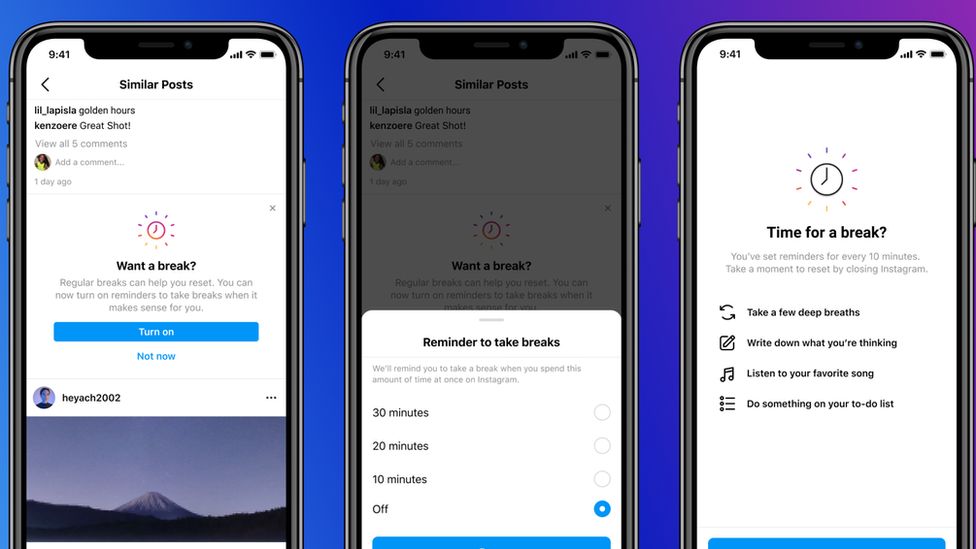
Instagram has announced new features it says will help teenagers and parents manage time spent on the app. Parents will be able to see how much time their children spend on Instagram and set time limits, while teens will get reminders to take a break. It comes a day before Instagram chief Adam Mosseri is due to appear before US Senators investigating online safety. Instagram has been under increasing pressure over teens' use of the platform in recent months. Its internal research suggesting that teens blamed Instagram for increased anxiety was the first in a series of revelations in France Haugen's leaked documents from inside Facebook. The US Senate Committee is expected to quiz Mr. Mosseri on Instagram's internal information on child safety and its plans - as well as what the committee calls "potential legislative solutions". The timing of the announcement by Instagram was "interesting", said social media consultant Matt Navarra. "Instagram's boss will want to have something new and meaningful to show US senators when they grill him... the new features will give worried parents more tools to help keep their children safe when using Instagram, but many will wonder why it has taken them so long to act." Take a break In his blog post, Mr. Mosseri announced the launch of the "take-a-break" feature, which he had tweeted about in November. It will be launched on Tuesday in the UK, Ireland, United States, Canada, Australia, and New Zealand, he said. "If someone has been scrolling for a certain amount of time, we'll ask them to take a break from Instagram and suggest that they set reminders to take more breaks in the future," Mr. Mosseri wrote. The feature would also show them tips from experts to "help them reflect and reset", he said. https://ichef.bbci.co.uk/news/976/cpsprodpb/2850/production/_122002301_264416118_655941602230750_7942810033641418285_n.png Teenage users will get notifications to turn on break reminders, he said. Instagram also said it will launch a new tool for parents in March 2022, which will let them see how much time children are spending on Instagram, and set time limits for the app. Another companion feature will allow teens to opt-in to a system that will notify parents if the teenager files a report against an Instagram user. Time limits already exist on Instagram - users can voluntarily set a time limit per day and receive a notification when that limit is hit. Digital footprint Mr. Mosseri also unveiled a new system to bulk-manage Instagram accounts. Starting in January, a new system will let any user see all their posts, or all their likes and comments, in a chronological list - and select several at once to delete in bulk. "While available to everyone, I think this tool is particularly important for teens to more fully understand what information they've shared on Instagram, what is visible to others, and to have an easier way to manage their digital footprint," Mr Mosseri wrote. Among the other measures announced on Tuesday were an expansion of the app's limits on messaging teens - so that now, people will no longer be able to tag or mention teens who do not follow them. https://ichef.bbci.co.uk/news/976/cpsprodpb/18394/production/_122002299_264262686_1271305353373262_1604747959492448517_n.png And another feature suggests that Instagram will "nudge" users towards other types of content "if people are dwelling on one topic for a while". Mr Mosseri did not elaborate on what types of content that "nudge" might apply to, how it will work, or when it will be implemented. The only example given, in an image on the blog post, was suggesting a user who had looked at beauty posts might want to explore travel, interior design or dogs. Ahead of his grilling by US politicians on Wednesday, Mr Mosseri finished his blog post announcing these new measures by saying: "I continue to welcome productive collaboration with lawmakers and policymakers on our shared goal of creating an online world that both benefits and protects many generations to come." The range of new measures was broadly welcomed by the Molly Rose Foundation, set up in memory of teenager Molly Russell who took her own life in 2017 and who viewed distressing material on Instagram. "As ever, when such announcements are made, it is the detail of the proposals that will reveal how effective the new measures are likely to be," it warned. "Shifting responsibility to parents without Instagram also taking additional steps towards greater online safety would not be adequate." The sentiment was echoed by Sarah Goodall, chief executive of social media consultancy Tribal Impact. "A lot of children, they're very isolated with their experience on social media," she told the news agency, referring to problems such as cyber-bullying. In particular, she praised the newly announced facility whereby parents will be able to receive an alert if their child reports another user of the app. However, Ms. Goodall - who is a parent herself - argued that social media companies could, in general, do more to enable parental oversight of their children's activity online. "A lot of parents that I'm teaching how to be active on social, they don't understand how to work with their children, the conversations to have, the sites to spot - and I do believe that the social platforms could do more to help," she added. source
|
| Business › How Microvest Is Building A Financially Disciplined Community by g7conet(op): 8:06pm On Dec 07, 2021 |
The reality is that while everyone’s reason for saving might vary, there’s a common goal which is financial discipline. Without a solid plan, it makes it harder to save money or cover important purchases and capital projects. This is where savings and investment platforms like Microvest come in. In recent times, There has been a rise of several fintech platforms that encourage Nigerians to save more with the click of a button. Not only does this better equip them to navigate the current economic environment, it ensures that they have a financial future. Following the launch of its savings and investment mobile app, Microvest is helping users to clearly define their vision of financial growth. According to Robert K. Okiyi, Microvest Chief Operating Officer (COO), the goal of Microvest and its existence is to provide to the public an alternative and credible platform for them to save and grow their funds. The app, which can be downloaded from the Apple Store (soon to be available) and the Google Play store, targets the everyday Nigerian. Microvest offers products that are tailored to meet the specific needs of users. For instance, its saving options come in three variants: MiSafe, MiTarget and MiLock. “Each of these options come with different interest rates, which means the higher your funds and duration, the higher the interest rate,” Okiyi explained. Here’s a breakdown of its saving plans: MiSafe is the most flexible savings plan where users can fund their wallets and create a plan with as little as ₦1,000. It allows withdrawals anytime and also gives users the opportunity to transfer funds to any bank account. MiSafe has an interest rate of 10.5% p.a MiTarget as the name implies, helps you to achieve your financial target. You are required to set a maturity date with a minimum of 90days. This plan, which is for a particular goal, has an interest rate set at about 12% p.a MiLock is an upgrade to MiTarget which allows you to save towards a particular goal. The funds are locked in a vault without access. This option helps you avoid the temptation of having to break the funds before the time of maturity. MiLock has different variants with rates up to 14% p.a In addition to these products, Microvest is heavily invested in building a community of people who will grow together and impact their world. Its MiSocial plan is a social community where users can interact, make posts, and view trending topics. One of many characteristics that sets it apart from other fintech savings platforms. The company boasts of a strategic and impressive customer experience. Ahead of its launch, Microvest started testing the platform with the help of various tech professionals. This was very helpful in terms of feedback, with a focus on making the interface very friendly as well. “We focus a lot on the customer experience as against the usual. We are transcending from just ‘customer service’ to ensuring customer experience is prioritized,” said Okiyi. Microvest’s approach is to be sustainable and consistent while ensuring to remain competitive. This is why the company recently partnered with Meristem trustees, which has a track record spanning over 16 years. “The fintech space has disrupted traditional banking which gives us the opportunity to make partnerships to become stronger,” said Okiyi. Okiyi also added that this will give users the assurance that Microvest shares the core values of a trusted company such as Meristem. “Openness, trustworthiness, and integrity are what we provide to customers,” he said. In uncertain times where the African economy has witnessed inflation and the cost of living on the rise, the company hopes to see players in the industry as people they should collaborate with. “When the going gets tough, the tough need, and seek collaboration” Okiyi added. More about Microvest [img] https://www.g7conet.com/images/EFC7A511-8896-4E8E-A2F2-20F7CEDEB15B.jpeg[/img] Before it’s commercial launch, Microvest had its app on the Google Play store with about 200 active subscribers, with 80% of them having actively consummated transactions, according to the company. In November 2021, Microvest was commercially launched after four years of conceptualizing by its co-founders. One of which, is Oladele E. Olaleru, who doubles as the Chief Technology Officer (CTO) while Robert Okiyi drives the strategy and company operations as the Chief Operating Officer (COO). According to the COO, the possibilities for fintech in Africa are broad and have come to stay. Microvest is also committed to expanding with new features that would stem from the needs of customers. “I believe that with more innovation and government support in the industry, fintech can go from what it is presently to the future, “he said. [url= https://g7conet.com/news_single/how-microvest-is-building-a-financially-disciplined-community]Source[/url]
|
| Business › Re: Funke Opeke’s Mainone To Be Acquired For $320mn By US Giant Equinix by g7conet(op): 1:01pm On Dec 07, 2021 |
Kingzy4pep:Maybe the price tag is irresistible. 2 Likes |
| Business › Re: Funke Opeke’s Mainone To Be Acquired For $320mn By US Giant Equinix by g7conet(op): 12:59pm On Dec 07, 2021 |
| Business › Re: Funke Opeke’s Mainone To Be Acquired For $320mn By US Giant Equinix by g7conet(op): 12:56pm On Dec 07, 2021 |
Crusadee:One who needs beating sited... I dodge the strike  5 Likes
|
| Business › Price Prediction: Dogecoin Teases 20% Jump And HUH Token To Surgeon Debut by g7conet(op): 12:19pm On Dec 07, 2021 |
Dogecoin’s price appears to be approaching the zone of high probability reversal, indicating that an uptrend is likely to begin shortly. Meanwhile, HUH Token looks set for a price surge on its debut and then potential volatility until as finds its feet. Dogecoin (DOGE) Dogecoin’s subsequent rally has a good chance of retesting the range high and pushing above it to establish new highs. As a result, investors should pay close attention to current levels, which indicate a buy signal. Dogecoin’s price has rallied 13% in the last six days and is currently approaching the trading range’s midpoint of $0.205. A break below this level is likely to push DOGE into the buy zone, which extends from $0.190 to $0.200. A break below this level is likely to spark increased buying activity, thereby kicking off an upswing. Investors can anticipate the Dogecoin price to retest the range high of $0.227 in this scenario. Market makers, on the other hand, will be looking for liquidity above the $0.238 swing high. Retesting this level will result in a 20% run-up. https://x7d4c5z5.stackpathcdn.com/wp-content/uploads/tc/2021/12/image-4.png In a bullish scenario, Dogecoin’s price could rise to $0.256, a 28 percent increase from $0.200. On the other hand, if Dogecoin’s price fails to hold above the buy zone, which ranges between $0.190 and $0.200, it indicates a buyer’s weakness. This development will result in a decline of DOGE to the range low of $0.183. Here, buyers have a second chance at redemption if they band together. A daily close below $0.183, on the other hand, will result in a lower low, invalidating the bullish outlook. HUH Token (HUH) HUH, Token is launching on PancakeSwap today and the price could see a debut surge due to strong fundamentals and solid presale levels. According to its creators, HUH Token’s presale allocation almost sold out completely. The current value of the token is $1 = 177 HUH Tokens, meaning the initial price will start at $0.00564. The first psychological barrier for HUH Token will be at $0.00600. If it can break this barrier then the new crypto could see a surge upward on its debut. Plenty of volatility is to be expected as the new token finds its feet. Traders cashing in on any upswings will fuel the volatility as the long-term bulls start to form a base over the next few weeks. According to their White Paper HUH Token has a total supply of 888 billion, with 1% (8,880,000,000) already allocated during the presale. It also has a normal buy fee of 15% and a normal sell fee of 20%. These tokens will be allocated in the following ways: Normal Buy Fee: 15%: -5% LP Acquisition -5% HUH Token Redistribution -5% Marketing Wallet Normal Sell Fee: 20%: -10% LP Acquisition -5% HUH Token Redistribution -5% Marketing Wallet HUH, Token will also have a Dev Wallet of 5% which will pay developers to continue improving HUH Token and adapting it for the future. The Marketing Wallet is at 10% and HUH has a large marketing strategy and is rumored to have top social media influencers signed on to help promote the token. HUH, Token aims to be listed on around 100 exchanges within the first 12 months. The creators say that they always provide back to the LP (Liquidity Pool) to dampen volatility. They have also locked in $1 million of liquidity for 2 years from launch to further enhance this sentiment, which should encourage long-term holders. source
|
| Business › Funke Opeke’s Mainone To Be Acquired For $320mn By US Giant Equinix by g7conet(op): 12:10pm On Dec 07, 2021 |
MainOne, a West African data centre and connectivity solutions provider with a presence in Nigeria, Ghana, and Côte d’Ivoire is set to be acquired for $320 million by American multinational Equinix Inc., the US company said in a statement Tuesday.source 22 Likes 3 Shares
|
| Business › Kenyan Marketforce Wants To Expand In Five New Markets Across Africa by g7conet(op): 12:40pm On Dec 06, 2021 |
MarketForce, a Kenyan B2B retail and financial services distribution startup, has expanded into five additional markets across Africa to grow RejaReja — its retailer ‘super app’ that makes it possible for informal merchants to order and pay for inventory digitally, accept payments for utility bills, and access financing for their businesses. The startup has today announced the entry of RejaReja, the B2B retail marketplace, into Ethiopia, Ghana, Tanzania, Rwanda, and Uganda, after successful pilot programs, coming about two months after it grew beyond Kenya by launching in Nigeria. MarketForce has partnered with Cellulant, a pan-African payments company that makes it possible for local and international merchants to accept “locally relevant and alternative” payment methods from their customers, to expand into these new markets. “We are working with Cellulant to open the new markets, and the reason is they already have a presence in these markets and have partnerships with both banks and billers. This will ensure that we focus on acquiring new merchants,” MarketForce’s co-founder and CEO, Tesh Mbaabu told the Newsagency. Cellulant has partnerships with 46 mobile-money operators in Africa, 120 banks and serves 35 African countries with a physical presence in 18, according to the payments firm. RejaReja is set to tap Cellulant’s coverage to grow across the continent. “We have been piloting this partnership for six months and are happy to announce the plan to extend the fruitful relationship we have built with MarketForce in Kenya…This collaboration will make our digital financial services available to millions of Africans, with the goal of significantly boosting financial inclusion and incomes for merchants across Sub-Saharan Africa,” said Cellulant chief business officer, David Waithaka. https://techcrunch.com/wp-content/uploads/2021/12/MarketForce-Tesh-Cellulant-David.jpg?resize=1536 Mbaabu said that they aim to grow their RejaReja merchants tenfold to 1 million by the end of next year. RejaReja has experienced rapid growth since its launch in December 2020 with over 87,000 orders made through the platform to date at an average basket value of $151. It is expected to record $60 million in annualized transaction volume by the end of this month. “In November we hit 100,000 merchants in Kenya and Nigeria and this number is growing quite rapidly. Currently, we are growing 40% month on month. This shows how strong our service is,” said Mbaabu. “The growth is because the merchants are seeing the value, it is a vote of confidence in our platform by the merchants. And a lot of them are using technology for their businesses for the first time,” said Mbaabu, who co-founded MarketForce with Mesongo Sibut in 2018 as a SaaS product for the formal markets. The service’s active users include Unilever, Pepsi, Safaricom, and Coca-Cola. MarketForce recently raised $2 million in seed funding. The startup’s plan for RejaReja is to have a presence in every market across sub-Saharan Africa in the near future by building an all-inclusive platform for the informal merchants, who sell a huge chunk of the fast-moving consumer goods (FMCGs) in Africa. In sub-Saharan Africa, about 80% of household retail is delivered through informal retailers but these shops are faced with a number of challenges like stockouts, earnings instability, and financing that make it hard for their businesses to grow. MarketForce, through RejaReja, is providing solutions to these challenges by ensuring next-day delivery of goods and using their data to develop the credit profiles needed to secure loans. The startup has partnered with Pezesha — a digital financial marketplace platform — to extend loans to its merchants. Mbaabu said, “we see RejaReja being the largest retail distribution network in sub-Saharan Africa.” “The goal is to empower all these merchants to grow their incomes and profits in a digital age, to access inventory, to act as special agents for various financial services, and to make extra income as a result. We are able to extend working capital loans too.” source
|
| Business › Interswitch Reiterates Commitment To Boost Nigeria’s Tech Ecosystem, Supports De by g7conet(op): 12:33am On Dec 03, 2021 |
Africa’s leading integrated payments and digital commerce company, Interswitch, has once again restated its support for Nigeria’s technology ecosystem through its sponsorship of Developers Festival (DevFest) Lagos 2021. The home-grown technology company announced today that it will be collaborating with other tech companies in Nigeria to sponsor the festival slated for Friday, December 3, at the Landmark Event Centre in Lagos. Interswitch, which was confirmed a platinum sponsor, is leveraging the sponsorship to provide tech enthusiasts an avenue to interact, exchange ideas and innovate. This sponsorship is a testament to the company’s commitment to enhance the career growth of tech enthusiasts in Nigeria, ultimately contributing to Nigeria’s continued advancement on the global tech scene. The annual event is regarded as one of the most popular developer conventions globally, drawing thousands of developers to network and celebrate the role of technology in our present-day world. This year’s event will focus on issues around the future of blockchain, mobile and web development, design, cloud computing and machine learning, among other trending topics. Hosting the event is the Google Developers Group Lagos, offering developers an opportunity to create a community and discuss their shared passion while also developing ideas that would create change – both locally and globally, through technology. At the event, the developers will also get to know more about emerging technologies and their applications. Speaking on the sponsorship, the Group Chief Marketing & Corporate Communications Officer, Interswitch Group, Cherry Eromosele, reiterated Interswitch’s passion for supporting the tech ecosystem in Nigeria. She said, “As a technology company, we are aware that most of the continent’s solutions including payment, will rely on technology. Therefore, supporting the developer’s community is one of the ways we are contributing our quota towards the development of African talent and the localization of emerging technology to participate effectively in the fourth industrial revolution. “At Interswitch, are always seeking opportunities and platforms that drive conversations around technology, as it concerns Africa; and DevFest Lagos has been identified as one of those touchpoints. There is, therefore, no gainsaying the sustained dedication of the Interswitch Group to nurturing Africa’s vast tech talents and supporting platforms that align with this goal.” Scheduled to speak at the event are illustrious subject matter experts in the tech space, who will touch on a range of issues around technology. Interswitch has been championing innovation in the payments industry in Nigeria for about 20 years and during this period, invested in growing tech talents on the continent. InterswitchSPAK is one of such initiatives that grooms and nurtures the best of Nigeria’s brightest minds in STEM careers, equipping them with problem-solving skills using technology, and providing them with financial support to pursue their career aspirations. Through its engineering team, the leading payments group is promoting an improved developer and software engineering experience and providing a platform for developers to learn the technicalities in the payment ecosystem. source
|
| Business › MTN Nigeria Issues 575m Shares Through Digital Public Offer by g7conet(op): 11:00pm On Dec 02, 2021*. Modified: 11:24pm On Dec 02, 2021 |
Nigeria’s biggest telco, MTN Nigeria, has announced that starting from Wednesday, 1 December 2021, retail investors can purchase up to 575 million shares held in MTN Nigeria at ₦169 per share lower than its share price on the stock market. This public offer is in line with MTN Group’s commitment to reduce its shareholding in MTN Nigeria from 78.8% to 65% over time. MTN listed its Nigerian business two years ago at ₦90 per share, becoming the second-largest stock by market capitalisation; its share price has since grown by about 100%. Notably, this public offer is primarily digital as the shares can be purchased online. Bolaji Balogun, CEO of Chapel Hill Denham, an investment banking firm leading the public offering, explained this to the news agency. “The beauty of it being digital is that a lot more people can participate. The customer experience is a lot better; you can complete your purchase within 3-5 minutes. It also reduces the amount of paper that’s going to be used in printing share certificates,” Balogun said. “In all, we recognise that there are Nigerians who don’t have access to a smartphone or the internet, so they can go into any money deposit bank or a nearby MTN shop/agent to make more inquiries.” The offer, which is open until Tuesday, 14 December 2021, will provide many Nigerian retail investors with an opportunity to own shares in MTN Nigeria. The minimum amount of shares that can be bought is 20 units. To encourage people to buy more, the MTN offer includes one bonus share for every 20 purchased, subject to a maximum of 250 free shares per investor—an incentive open to retail investors who hold shares for at least 12 months after allotment. Balogun added that he believes the digital sales of these shares will increase financial literacy on stocks but also expressed concern that retail investors should be wary of buying from just anyone or platform. “There are five investment bank/issuing houses mandated to sell: Chapel Hill Denham (the led), Rand Merchant bank, Renaissance Capital, Vertiva, and Stanbic IBTC. In addition to this, all the (about 200) stock broking firms in Nigeria can sell,” he said. “The primary authorised digital platform to buy from is PrimaryOffer, as seen on MTN’s site.” In addition to these, Fintech platform, Chaka, on Wednesday announced that it’s partnering with Renaissance Capital to give its customers access to this public offering. It’s important to note that the mobile money agents and MTN shops only provide information on how people can purchase from the aforementioned authorised parties. In response to this public offering announcement, MTN Nigeria’s share price fell 10% on Wednesday to a five-week low, a logical response as investors rushed to buy the lower-priced MTN public offering shares. “In my 30 years of issuing shares, I’ve never seen this number of applications in the first few hours,” Balogun said. “People typically wait until the last few days to start buying. It shows that there’s a huge benefit in doing this digitally.” MTN disclosed that if the 575 million ordinary shares are oversubscribed before the closing date, another 15%, which translates to 86 million more shares, would be offered to the public. source
|
| Sports › Semi-automated Offsides Trialled At Fifa Arab Cup And Could Be Used At 2022 Worl by g7conet(op): 11:19am On Nov 30, 2021 |
The use of technology to help officials make more accurate offside decisions will be tested at the Fifa Arab Cup, which starts on Tuesday. "Semi-automated offsides" work using between 10 and 12 cameras which collect up to 29 data points for every player 50 times per second. If it spots a potential offside an alert is sent to the video assistant referee (VAR), who has the final call. The technology could be used at the 2022 Fifa World Cup. "VAR has had a very positive impact in football and the number of major mistakes is reduced, but there are areas where it can be improved - and offside is one of them," said Pierluigi Collina, Fifa's chief refereeing officer. "We are aware the process to check offsides can take longer [than other decisions], especially when it is very tight. We are also aware that the positioning of the lines may not be 100% accurate. "For this reason, Fifa is developing a technology which could offer faster and more accurate answers. This is known as semi-automated offside. "For offside, the decision is taken after analyzing the position of players, but also their involvement in play. Technology can draw a line but the assessment remains in the referee's hands. This remains crucial." Since the introduction of VAR in Europe's major leagues, offside decisions have been among the most controversial, with some goals being ruled out by the smallest of margins. Roberto Firmino's strike for Liverpool against Aston Villa in 2019, for example, was ruled out because his armpit was offside. Planned trials of the new technology during 2020 were disrupted by the coronavirus pandemic, but tests have taken place in England, Spain, and Germany. The Arab Cup, which features 16 teams and is staged across six stadiums in Qatar, is the most significant trial for the technology yet. "It is based on limb-tracking technology," said Fifa's football technology and innovation director Johannes Holzmuller. "Software is processing this data and, in case of an offside offense, an automated alert is sent to the video operations room. That's the reason we call it 'semi-automated - in the end, it is still the VAR who has to validate and confirm the proposed offside. Then the VAR informs the referee on the pitch about the decision. "There are two focus points. The first focus is on the kick point - the moment the ball is played - and the second is which body part is closest to the goal line, the defender or the attacker. We hope with technology that we can be faster and more accurate." source
|
| Science/Technology › Student Media Giant Chegg Acquires Language Learning Startup Busuu For $436M by g7conet(op): 10:37am On Nov 30, 2021 |
Chegg, the NYSE-listed student media learning platform is acquiring Busuu, the online language learning startup established in Europe in 2008, for approximately $436 million (€385 million) in an all-cash transaction. At its exit Busuu had raised only $16.1m in total, a tiny amount even I in European terms, and testament to the sheer grit of the founders who, by the end, had built a business that had reached over 120 million learners to date across more than 160 countries. Busuu provides courses in 12 different languages to over 500,000 paying subscribers. The company’s last funding round was May 27, 2020, for $2m from GP Bullhound and ultra-high net worths. Prior to that, the previous investors had consisted of Harold Primat, McGraw-Hill Education, PROfounders Capital, Martin Varsavsky, and Johann “Hansi” Hansmann (according to CrunchBase). Dan Rosensweig, President, and CEO of Chegg said: “The addition of Busuu gives Chegg the unique opportunity to expand our business while also adding tremendous value to our existing users. It will allow us to drive further into international markets, as well as accelerate Busuu’s growth in the US market. Busuu’s team, who we have known for many years, is a great cultural fit. They have built an incredible learning service for the serious language learner, and we are excited to have them as part of Chegg.” Chegg says it expects Busuu’s full-year 2021 revenue to be approximately $45 million with year-over-year growth of greater than 20%. The $17 billion digital language market is expected to triple in size in the next five years, said a statement by Chegg. Founded in 2008 by Bernhard Niesner and Adrian Hilti, with offices in London, UK, and Madrid, Spain, Busuu has made a point of finessing its language-learning model and iterating every aspect of the platform, to the point where a study by ann academic at the University of Maryland, showed that users of Busuu needed only 13 hours of study in a two-month period to move up one college semester (typically 90-105 hours of instruction). The company offers free and paid subscriptions on a monthly, annual, and bi-annual basis. Busuu is used by individuals but also offers corporate language training. Last year it added live language tutoring after acquiring Verbling. Bernhard Niesner, CEO & Co-founder of Busuu, said: “We are proud and excited to be joining the Chegg family, a world-leading edtech company that puts students first. This partnership will give us an opportunity to leverage Chegg’s tremendous reach to fuel our expansion, particularly in the US. Our vision is to empower everyone in the world through languages, and we believe our relationship with Chegg will enable us to achieve this goal even faster.” source
|
| Science/Technology › Astra Successfully Reaches Orbit For The First Time With Latest Rocket Launch by g7conet(op): 2:03pm On Nov 20, 2021 |
There’s another launch company newly able to count itself among the small (but growing) group that has reached orbit: Astra. The Alameda-based rocket startup notched that achievement late Friday night, taking off from its launch site in Kodiak, Alaska shortly after 9 PM local time (1 AM ET). This was Astra’s ‘LV0007’ mission, the follow-up to its last try in August, which was ended short of reaching orbit after the rocket got off to a rocky start with a brief hover and sideways strafe movement just after liftoff. Astra then investigated the cause of the misfire (an early engine shutdown) before initially setting the LV0007 launch for the end of October. That was shifted due to the weather. This new launch and Astra’s first successful flight to orbit comes just under a year after the company reached space with its Rocket 3.2 test launch, during a mission that surprised everyone, including Astra’s own team, with how close it came to achieving orbit. Astra just reached orbit! 7.61km/sec at our targeted 86.0-degree inclination at an altitude of 500km. The team worked hard for this. We’re just getting started, folks. #AdAstra pic.twitter.com/NiMhCEsuCIAstra’s approach to the launch industry fits a niche that isn’t yet satisfied, with a rapid turnaround and high-volume approach to manufacturing that it claims will be able to produce small payload rockets at prices that make it possible for even more companies to get their cargo to space on dedicated missions, rather than relying on rideshare models on larger vehicles like SpaceX’s Falcon 9, or paying a relatively high price for something like Rocket Lab’s Electron. Astra’s Benjamin Lyon, the company’s Chief Engineer, will be joining us at TC Sessions: Space this year, and we’ll be sure to talk about this milestone win. source
|
| Technology Market › Amazon Opens Pre-orders For Its Halo View Fitness Band by g7conet(op): 8:11pm On Nov 19, 2021 |
Amazon announced a new version of its Halo fitness band at its September hardware event, and now you can lock in a pre-order. Halo View, Amazon’s first wearable with a display, is $50 during the pre-order period. It’ll typically cost $80. The device, which will ship sometime in December, comes with a year-long Halo membership. The plan includes workouts and nutrition guidance, and it typically costs $4 per month. Halo View has a similar design to Fitbit’s Charge bands. The AMOLED color screen displays details about your live workouts, activity history, blood oxygen, and sleep scores, among other things (some of those features are exclusive to the Halo subscription). You can view text notifications too. The swim-proof device contains a skin temperature sensor, heart rate monitor, and accelerometer. Amazon claims the battery runs for up to seven days on a single charge, and that it will fully recharge in two hours. Although Halo View doesn’t have a built-in microphone, there is integration with Alexa. If you connect to the voice assistant through the Halo app settings, you can ask an Alexa-enabled device to tell you about your health summary, sleep quality, and other information. Amazon says privacy was a key consideration in how it designed Halo. “There are multiple layers of protection in place to keep data safe and in your control,” the company claims. It also pledged not to sell health data that are linked directly to you. You’ll have the option to download your health data or delete it from the Halo app at any time too. source
|
| Science/Technology › Twitter Is Rolling Out Its Tipping Feature To Android Users by g7conet(op): 5:36pm On Nov 19, 2021 |
Twitter is [url=https://twitter.com/TwitterSupport/status/1461463681728983041?ref_src=twsrc%5Etfw%7Ctwcamp%5Etweetembed%7Ctwterm%5E1461463681728983041%7Ctwgr%5E%7Ctwcon%5Es1_&ref_url=https%3A%2F%2Fwww.engadget.com%2Ftwitter-finally-brings-in-app-tipping-to-android-users-095508562.html]rolling out[/url] its in-app tipping feature to all Android users above the age of 18, following the iOS launch in September. The social media giant says the “Tips” feature is geared toward users looking to get a little financial support from their followers through Cash App, Paypal, Venmo, and Patreon directly through the app. Android users can now get set up to receive tips from their profile by tapping the “Edit profile” button and then selecting “Tips” to start. “With Tips, we’re creating an easy way to direct people to links to your payment profiles and we’re making it easier to support the people driving the conversation on Twitter – whether you want to support a content creator, help someone fundraise, tip someone who just needs some help or thank someone for making you laugh,” the social media giant notes. Tips is now on Android!Twitter first introduced the feature in May after reports had indicated that the company was working on a direct payment option. The launch of “Tips” on Android comes a month after Twitter rolled out “Ticketed Spaces” on Android. With this feature, hosts on Spaces, Twitter’s live audio room feature, are able to sell access to Spaces. The social media giant notes that the feature is a way to support creators for their time and effort in hosting and moderating public conversations. Twitter isn’t the only social media platform pushing toward monetization and helping creators earn a living through its app. Last month, TikTok confirmed to TechCrunch that it is testing a new in-app tipping feature on its platform that would allow creators to accept money from fans outside of TikTok LIVE streams, where gifting is already supported. The company confirmed the feature is part of a limited test for the time being and is not yet widely available. TikTok and Twitter’s direct tipping features appear to be a way for the companies to compete with other digital platforms like Instagram and YouTube, which offer lucrative ways for creators to make money. source
|
| Science/Technology › Remojo Is Building Tools To Combat Digital Addiction, Starting With Porn by g7conet(op): 2:44pm On Nov 18, 2021 |
Startups geared towards men’s sexual health have been doing a brisk trade for a few years now. But while the early wave of tech businesses mostly aimed to provide (easier) access to pharmaceuticals for treating health issues like erectile dysfunction (e.g. Roman), perhaps also offering hormone tests and bespoke vitamins claimed to reduce hair loss or boost libido (Manual) — and with some branching into broader telemedicine plays over time (Ro) — more recently the category has expanded to dial-up attention on men’s mental health too. It’s a welcome — and some might say, long overdue — development. Here the UK seems to be a bit of a hotbed of entrepreneurial activity. Back in September, for example, we covered a seed round for UK-based Mojo, a subscription service for men’s sexual well-being, touting therapy instead of pills as the answer to erectile dysfunction. And while not exclusively for men, UK-based Paired is offering couples therapy via an app. Well, here’s another UK-based subscription service with a holistic approach to men’s sexual well-being and self-care — founded in the same year as Mojo (2019): The similarly named Remojo offers tech tools and in-app programs to support men with sexual health concerns — with a first focus on helping people quit porn. Taking a spin around Remojo’s website and its marketing soon implies a range of benefits could flow from quitting porn — not just time and attention saved but better in-person relationships and even, potentially, a resolution to health problems like erectile dysfunction. So there looks to be a fair amount of overlap in this burgeoning male sexual well-being space. Aside from variations in pricing (Remojo’s subscription plans are cheaper than Mojo’s), the initial difference mostly seems to be one of emphasis; aka, how to get men interested in the first place. On that, it seems a fair bet that more men consume porn than suffer from erectile dysfunction. Although Remojo’s target is men who both watch porn and want to stop. But sole founder, Jack Jenkins, is quick to emphasize that the subscription service isn’t only for men with porn addiction. Rather he says it’s designed to address a full spectrum of reasons why guys might want to stop consuming pornography — from simple self-improvement (and wanting to get more control over what’s playing on their minds); to those who find their porn consumption habits are getting in the way of real-life (and real relationships); to guys with religious convictions who feel shame around using porn, however rarely they may do it, and want help to live up to a sought for spiritual standard. Per Jenkins, a key cohort of Remojo’s users are thus Christians, Muslims, and Hindus looking for help to live up to religious ideals — and maybe also seeking a non-judgmental support community for an issue that can be taboo for them to talk about in their usual social circles. Remojo says it’s getting circa 50,000 signups per month for its subscription programs (which cost $4.99 for one month; or less if you sign up for the 3-month or year-long plan) — with users hailing from all over the world (at least where Internet access is easy) — suggesting porn consumption is a very universal concern. Currently, Remojo’s biggest markets are the US, UK, Brazil, and India. Content in the app is in English so it’s also growing in other English-speaking markets, per Jenkins. While the typical Remojo user is a guy aged between 16-35 — aka, a digital native who’s “grown up with instant access to porn at all times”. With traction like that, it’s also, unsurprisingly, attracting interest from investors. Over the past 12 months, Jenkins says Remojo has raised £1.6 million (~$2.1M) in pre-seed funding from a number of business angels, including Jens Lapinski (former TechStars Berlin MD and CEO of Angel Invest) and Jag Singh (also of TechStars Berlin and Angel Invest), along with a number of other angels in the banking/finance space, plus some (unnamed) founders chipping in. It’s now in the process of raising a Series A, according to Jenkins — who says it’s targeting £5M-£6M (~$6.7M-$8M) and expecting to close the round “by January” (hence he says they’ll “probably” skip a seed and go straight for the A). Remojo’s website touts what it bills as a “90-day reboot” — which it says is its most popular subscription plan — for quitting porn. If the tech really works that would imply major user churn every three months. But the stickiness and easy accessibility of online porn mean relapsing is a perennial risk and a blocker tool is always likely to be helpful, argues Jenkins. So he doesn’t sound at all concerned about revenues drying up (i.e. from succeeding in its mission of getting men to hard quit porn). In-app courses are another way for Remojo to provide broader, on-going utility and appeal — hence it’s offering support for other aspects of men’s sexual health and well-being; which may have been linked to (and negatively affected by) their consumption of porn (but which won’t necessarily instantly improve if/when they do stop). Jenkins bootstrapped the business himself initially — launching an MVP that let users custom block content on their smartphones to cut off access to sources of porn. Now the software is available cross-device, for Android, iOS, Windows, and macOS. And it bakes in a lot more than a simple adult content blocker that puts up a literal barrier to accessing online porn — such as the aforementioned behavioral change courses, CBT techniques, and a wider support community. Future features in the works include AI-driven porn content identification to enhance the software’s powers of blocking/filtration, with Jenkins saying it’s working on developing models that will use computer vision and audio to detect pornography viewing as it’s in progress so that the software will be able to intervene in real-time too. The current mix blends custom blocking with supportive resources. “It’s a hybrid of a few things. You’ve got research around habit formation and habit-breaking — using the findings and principles from that field. We have our in-app content director [Noah Church] has been coaching people to get free from porn addiction for seven years — he’s got a YouTube channel where he’s been delivering courses and coaching [for years],” Jenkins tells TechCrunch. “One of the foundations of the structure of the app is the ‘choice model’ — which was the recovery model developed by [Dr] Paula Hall — who’s one of the leading experts, if not the leading expert, on porn and sex addiction in the UK.” Other bits Remojo folds into its behavioral change mix are practical user insights from the program; access to an anonymous support community of others; and tools for users to track progress and be helped to stay committed/accountable (such as an accountability partner and install/PIN protection). A core component of its program is to start the user with a full ‘reboot’ — aka a period of sustained abstinence from consuming porn (where Remojo’s blocking tools and accountability features clearly play a key role). The idea is to help guys get space to develop alternative habits — and here its suggestions for filling the hole left by not consuming porn include stuff like mindfulness, exercise, and participation in (porn-free) hobbies. Jenkins says the overarching goal is changing mindsets/thinking patterns — and male self-improvement more generally — hence course content covers related/follow-on areas, such as habit change, addiction recovery, and overcoming sexual dysfunction (where it’s overlapping with Mojo). Future course content is also slated to cover broader areas like dating and help with improving a relationship/sex life with a partner, as well as courses that will aim to tailor advice for specific religious beliefs. “And for people that are maybe in a more difficult place, [we offer help with] building a more fulfilling life so that they don’t need something like porn to fill an emotional hole,” he adds. While some porn users may have deeper psychological issues linked to their use (such as childhood abuse), Jenkins argues that porn consumption itself may not have any deeper significance than being a “convenient” release. So it’s not always necessary to psychologize consumption. The app, therefore, aims to avoid judging — putting its focus on simply supporting men to regain control over their time and attention. And, well, sticking it to the attention-sucking porn industry in the process. “[Porn use is] not necessarily driven by any deep psychological issue — it’s just very stimulating, very compulsive material that just taps into people’s fundamental evolutionary drives and just hijacks it. So people can end up just watching porn purely because it’s just there and it’s so compelling,” he argues. “This problem is so universally shared. It’s basically almost all men under 35 — everywhere around the world, religious, non-religious. It’s just a huge issue and it’s very, very difficult to generalize,” he adds to the pull of online porn. “You can have people who might have such a severe addiction that they might be watching porn from anything like 3-7 hours a day all the way through to someone who maybe you’re a Muslim and you watch it once a month but that’s a huge problem for you because Islam has zero tolerance for that. And it’s affecting your self-esteem and disconnecting you from god and so on. “So the spectrum is so broad that it’s very difficult to generalize. I think what’s really gratifying for me and the team is all the different stories, comments, reviews we get from people about how their life’s changing — and in different ways.” Zooming out for a sec, concern about online porn viewing is something of a decade+ preoccupation of the UK government at this point — one that’s now driving ministers to implement sweeping online safety legislation, fuelled by a concern over the harms caused to children by easy access to inappropriate content online. Remojo’s premise is, similarly, that if guys are exposed to limitless porn from a very young age it sets them up for problems with a range of sexual well-being issues later on (and, well, 50k men a month does suggest it’s onto something.) An earlier attempt by the UK government to mandate age verification for accessing adult websites faltered, back in 2019, after a backlash over security and privacy concerns, and the viability of imposing and regulating age checks. Guys opting into their own custom porn blocker and support-to-quit community (for a fee) certainly looks a lot easier to implement. Jenkins says he formulated the idea for an app-based support tool for quitting porn after deciding to make the switch himself — not because he was addicted to porn but rather as “a conscious choice to live better and be my absolute best”. It was while he was looking for support to quit that he came across subreddits with over a million users also seeking the same kind of support — and from there he started to realize the scale of the problem and the potential business opportunity. “I started the process of quitting and cutting porn from my life completely and started looking for something to just put up a guardrail — and just block it and filter out all of that content on phones and computers, and there wasn’t really anything good out there,” he recounts. “So, being somewhat entrepreneurial, I started exploring the problem more — I thought I can’t be the only guy who wants to do this or who’s feeling like this — and so I started reaching out to people on Reddit through DMs who were actively talking about quitting porn, or porn addiction, or just problems with porn and the effect it has on their lives. “I started doing interviews with them and I was blown away by — one — how many people were talking about it on Reddit. So there are about 1.3 million people in subreddits just dedicated to, basically, quitting porn; and then also how eager they were to speak to me and share all kinds of personal stories and information and how desperate they were for a solution.” “After doing that initial user discovery I just started work on it immediately — in December 2019 — because I’d never seen that level of problem validation before for any idea that I’d ever had,” he adds. “It started out being about blocking and then, over time, my understanding of the problem that people are facing — and actually how you help them make the behavior change — break the habit or break the addiction, just change their behavior and how they think — there’s much more to it than just blocking.” Just as Mojo is hoping that treatment for erectile dysfunction can be a way to reach men with wider therapy offers (including support for porn addiction), Remojo also intends its tools to be more expansive: Jenkins says it’s aiming to replicate the app-based framework it’s devising for porn so it can be reskinned and applied to tackle a range of “modern, behavioral, digital addictions and compulsions that no one’s really dealing with” — from online gambling to social media and computer gaming addiction. “We’re going to use our framework to help people quit gambling, quit compulsive gaming and also reduce or cut social media. These will be separate brands but using the same technology, the same framework to guide people to better habits or complete abstinence from those things as well,” he says. “The exact same framework applies — we would just really change the in-app courses. But the rest of the system is exactly the same in terms of what works for habit change, behavior change, and overcoming these digital addictions.” So maybe — ultimately — Remojo will also be building products targeted at women. (It’s also yet another sign of how far attitudes around social media have skewed negative that quitting porn and quitting Facebook are being uttered in the same breath.) Another development on its roadmap is to create its own custom OS — one that’s minimalist by nature and aims to put the user in control over all the digital things trying to gobble up their attention. “We want to build a custom operating system for Android phones and also for desktop devices,” he tells us, saying it will use some of the forthcoming Series A funding to start work on that with the goal, ultimately, of “releasing a handset for digital minimalists with all of these digital wellness controls built into the operating system itself”. Though that’s likely further out. The plan for the next 12 months — when Remojo expects to be flush with Series A cash — will also be to dial up its messaging. On that, Jenkins says it wants to “start a global conversation” to change many more minds about porn consumption — and try to normalize the notion of quitting porn so it becomes as ‘vanilla’ and unremarkable as a person saying they don’t drink or smoke. “What we’ll be looking to do with the Series A is… break the taboo around the topic. And make this as normal and widely accepted as saying you don’t drink, you don’t smoke, you don’t eat meat, and so on. Make this lifestyle choice an acceptable mainstream topic or choice,” he adds.
|
| Programming › Get CRUD Application Using ASP.NET With Free Source Code by g7conet(op): 10:41am On Nov 18, 2021 |
This is an ASP.NET simple project. This will help you to understand how to create a simple web application using ASP.NET and MS SQL Server. The program includes CRUD (Create, Read, Update, and View) functionalities to manage the employee list. This program also executes the MVC (Model-View-Controller) way of organizing your codes. The model contains the pattern that is responsible for maintaining the data, the view contains the source code that displays the data to the user, and the controller contains the code that is responsible for the interactions of the model and view. Features Employee List Create New Employee View Employee Edit Employee Delete Employee About Content Contact Content Feel free to visit the link below to read more and download the full source code. https://g7conet.com/single/crud-application-using-asp-net-with-free-source-code You can as well surf through the site to get unlimited downloads of free source codes
|
| Phones › Apple To Send You Parts And Tools To Fix Your Iphone And Mac By Next Year by g7conet(op): 5:37pm On Nov 17, 2021 |
Here’s a pleasant and frankly unexpected update from Apple. The company just announced Self Service Repair, a new program designed to let users perform common repairs on devices at home. Through the program, users with damaged devices will be sent “Apple genuine” tools and components the same as the ones they use at the Genius Bar. The company will also be offering up online repair manuals (text, not video), accessible through the new Apple Self Service Repair Online Store. The system is similar to the one the company rolled out for Independent Repair Providers (of which there are currently 2,800 in the U.S. plus 5,000 Apple Authorized Service Providers), beginning with the iPhone 12 and 13, focused on display, battery, and camera fix. A similar service for M1Macs will be launching “soon” after. “Creating greater access to Apple genuine parts gives our customers even more choice if a repair is needed,” COO Jeff Williams said in a release tied to the announcement. “In the past three years, Apple has nearly doubled the number of service locations with access to Apple genuine parts, tools, and training, and now we’re providing an option for those who wish to complete their own repairs.” Apple hasn’t listed specific prices yet, but customers will get a credit toward the final fee if they mail in the damaged component for recycling. When it launches in the U.S. in early-2022, the store will offer some 200 parts and tools to consumers. Performing these tasks at home won’t void the device’s warranty, though you might if you manage to further damage the product in the process of repairing it — so hew closely to those manuals. After reviewing that, you can purchase parts from the Apple Self Service Repair Online Store. The news comes during a time of increasing push for the right to repair legislation that has been opposed by some of the biggest names in consumer electronics. The Library of Congress recently approved exemptions to the DMCA that blocked user repair. Even the president has gotten in on the act, following a May letter to Congress from the FTC, which noted, “To address unlawful repair restrictions, the FTC will pursue appropriate law enforcement and regulatory options, as well as consumer education, consistent with our statutory authority. The Commission also stands ready to work with legislators, either at the state or federal level, in order to ensure that consumers have choices when they need to repair products that they purchase and own.” Advocates of increased repairability cite numerous concerns, including lowering the pricing burden of planned obsolescence, as well as growing global concerns around e-waste — the latter of which has been a cause championed by Apple over the past several years. As smartphone tech has become more advanced, the devices have become increasingly more difficult to repair at home. It’s a long way from the days of swappable batteries — concerns that have given rise to a boutique crop of products like Fairphone, which put user repairability out front. Apple’s new program will be rolling out to additional countries later next year. The company is clearly still encouraging users to bring their devices in for repair at a licensed shop when circumstances allow (particularly in the case of those covered by AppleCare+), but for the many who’d rather take matters into their own hands, this is a nice step. source
|