Idiko1: I do not know what to make of Nigeria. What the hell is the governor of Lagos State doing in a firefighting suit? Is he a firefighter? Every day, one fool will create a dumb act for Nigeria.
Good God in heaven! Where did you see the governor in a firefighting suit??
Nchenches: It's like the woman was forceful shaking Buhari's hand. Does Buhari shake women's hand?
naptu2: Much ado about handshakes (this is another old post that has been on my mind for years).
My British cousins were recently arguing over the question of who Boris Johnson shook hands with and who he didn’t shake hands with and that reminded me of an old post that I wanted to make but couldn’t because of lack of time.
President Buhari swore in new ministers a few months after he was inaugurated and some people noticed that he did not shake hands with some of the female ministers and they decided that he did not shake the female ministers’ hands because he was a religious extremist. They held this up as evidence that Buhari was going to “Islamise Nigeria” and declare Sharia law across the country.
I knew that their position was total nonsense because I knew that Buhari had shaken hands with women in the past, but more importantly, I knew why he didn’t shake hands with the female ministers (I’ve been there before).
I’m shocked that nobody has stated the real reason that he did not shake hands with the female ministers.
My experience.
A lot of people in positions of authority came to my house when I was a kid and I shook hands with all of them. Of course I also bowed to them, but I shook hands with all of them. I also shook hands with the elderly people that came to my house, including my grandmother.
However, there were certain encounters that stuck in my mind. I remember a time that a new official was appointed to a certain position. My neighbour’s family was very influential in the institution that the official had just been appointed to head and so he paid a courtesy visit to their house and I was in their house on that day. They introduced me to him as **** son. He looked happy to see me, but something happened that stuck in my mind. I extended my hand for a handshake and there was a momentary look of surprise on his face. It lasted for less than half a second, but I noticed it. He said, “You want to shake the ****” (he mentioned his new title) and then he shook my hand.
There was another encounter that I remember. It was kind of a family event. I got to a certain house and the woman of the house was greeting everybody at the door. I bowed and shook hands with her as I greeted her. I could see a look of absolute shock on her face as I shook hands with her. Much later, my sister whispered to me, “Did you see how shocked she looked when you shook hands with her”?
You see, in Yoruba culture, it is quite unusual for a much younger person to shake hands with a much older person. The younger person is expected to prostrate, stoop, bow, kneel or curtsey. The younger person will only shake the older person’s hand if the older person extends his hand for a handshake.
Similarly, it is unusual for a person in a much lower position in an organisation to shake hands with someone in a much higher positions/someone in a position of authority except if the person in a higher position extends his hand for a handshake.
Many Muslim women do not shake hands with men that are not related to them. This can be awkward for a man who extends his hand to shake a woman. Therefore, many men do not extend their hands for a handshake except the woman extends her hand first.
Think about it the way that you would think about a hug. Would you hug a woman that you’ve just met for the first time? Would you hug a woman that you’ve just met for the first time if she extends her hands for a hug? You would probably respect the woman’s space and only hug her if she extends her hands for a hug, right?
Read this https://medium.com/@hana.jafar09/why-you-should-ask-before-hugging-someone-7825f503ac06
Obasanjo
I was shocked when there was a furore about whether President Buhari shook hands with women, because President Olusegun Obasanjo had observed this practice in a very extreme manner and yet nobody complained.
I noticed that President Olusegun Obasanjo never shook hands with women who wore hijabs, even when the women extended their hands for a handshake. I noticed this for the first time during a national honours award ceremony. An honouree extended her hand for a handshake, but President Obasanjo clasped both of his hands together in front of his chest, instead of shaking hands with her. I later noticed that he did this to any woman that either wore a hijab or was from the far north, even if the woman was Christian and even if the woman extended her hand for a handshake. Yet nobody complained.
Buhari New ministers were inaugurated in 2015 and an incident during the inauguration ceremony led to the ridiculous claim that President Buhari does not shake hands with women.
The protocol was that, after being sworn in, the minister would sign the register and then shake hands with President Buhari while smiling for the camera. It was Kemi Adeosun’s turn to shake hands with Buhari. Being a Yoruba woman, she waited for President Buhari, who is older and in a higher position of authority, to extend his hand for a handshake. President Buhari, being a northern muslim, waited for Kemi Adeosun, who is a woman, to extend her hand for a handshake. Therefore, because neither of them extended their hand first, there was no handshake.
People picked up on this and said that President Buhari does not shake hands with women and then it became a self-fulfilling prophesy. Other women, because they had heard that Buhari did not shake hands with women, did not extend their hands for a handshake when they met him and therefore, the rumours that Buhari did not shake hands with women continued.
Some people said that "Buhari's refusal to shake hands with women was proof that he was a religious extremist, a bigot and that he wanted to Islamise Nigeria".
I knew that this was just complete nonsense. How did I know? The musician, Onyeka Onwenu was a supporter of President Goodluck Jonathan and he appointed her to head an agency (I’ve forgotten the name of the agency). The members of the board of the agency went to meet and congratulate President Buhari soon after he was sworn in. This was before ministers were inaugurated. President Buhari shook hands with Onyeka Onwenu at that event.
Besides, I had seen Buhari shake hands with women when he was a military head of state in the mid-1980s.
Reference: You very well know what I mean. The very Nigerian and third world context and why I placed it in inverted commas. That where you have a crowd you automatically have prosperity whereas the facts on ground are completely at variance. And because of that the environment and in this case infrastructure suffers serious abuse.
Abuja is another location where urban slums are growing day by day. Soon it too will be called a 'mega city' but where cars fall through vandalised manhole covers simply because of poverty.
Abuja is not a mega city. I only know one definition of a mega city and it is the same definition that has been used by officials and so on. A mega city is a city with a population of more than 10 million people. Abuja does not have up to 10 million people. Lagos is a mega city because it has a population of more than 10 million people and that is one of the causes of this problem.
naptu2: Actually they do know what a mega city means.
A mega city simply means a city with a population above 10 million people.
This whole talk of "Lagos Mega City" began because an international agency stated (at the end of the 1990s or beginning of the 2000s) that Lagos will be one of the world's 5 biggest cities by 2100.
Due to this projection and the fact that they will need to improve infrastructure in order to meet the demands of such a large population, President Olusegun Obasanjo, along with Governors Bola Tinubu and Gbenga Daniel launched the Lagos-Ogun Mega City Project. The headquarters of the commission was on Queens Drive in Ikoyi. The project was meant to include the construction of a railway system that would run through Lagos and Ogun and there were several other projects attached to it.
Bola Tinubu and Olusegun Obasanjo left office. There was a bit of friction between Governor Fashola and Governor Daniel and reporters asked Fashola if the Lagos-Ogun Mega City Project was dead. Fashola's response was this:
He said that the mega city was not a project, but rather a status that was conferred on Lagos by the size of its population. He said that this large population brings challenges and it means that the government must find a means to provide healthcare for this large population (more and better equipped hospitals), it must find a way to move this large population (more means of transportation, like railways, ferries, etc.), it must be able to provide security for this large population (more policemen and police stations), etc.
However, many people have since assumed that the term mega city means, "the best city", it does not.
In the 1950s and 1960s, experts from the United Nations conducted a study and stated that there are certain cities in the developing world that would become the biggest cities in the world (population wise) in the not to distant future. They proposed that metro systems should be built in these cities in order to cope with the projected population.
I read the report decades ago and at the moment I can only remember 2 of the cities that were mentioned and these were Cairo and Lagos.
There were a series of studies and reports by foreign experts and the reports were presented to Governor Ebitu Ukiwe. Governor Ukiwe said that they should be presented to his successor to decide what he wanted to do with them.
Governor Lateef Jakande took the reports and was very serious about implementing them. The route for the Lagos Metroline was determined and the right of way was secured. However, there was a problem.
The problem that I'm going to describe below occurred on two occasions 30 years apart (1983 and 2013). There has been a lot of speculation about the problem and people have used it as a propaganda tool for partisan political warfare. If you've followed this thread then you'll know that there was serious friction between the NPN led Federal Government and the UPN led Lagos State Government. If you've followed the news in recent years then you'll also know about the battles between the APC and the PDP. I'm not going to go into those battles, rather I'll simply tell you about the economic arguments that were put forward and then I'll leave you to decide if they were valid or if people were just playing politics.
As I said, the right of way had been determined, but the project was stalled by funding issue. 70% of the project was meant to be funded via loans, while the Lagos State Government provided 10% and investors provided the balance, but the Lagos State Government needed a Federal Government guarantee before it could access the loans. In fact, it also needed Federal Government approval before it could release its funds (the 10%) which was with the Central Bank. The problem was that the Federal Government did not give the required guarantee or approval.
There were all kinds of rumours about why the Federal Government refused to approve the funds (some said that it was because Jakande did not congratulate Shagari on his re-election) but Governor Jakande decided to go straight to State House Dodan Barracks, rather than listen to rumours.
President Shagari told Governor Jakande that the delay in providing the approvals was caused by issues at the Central Bank and that he was scheduled to have a meeting with the CBN Governor later that day over this same issue. Jakande said (in the documentary that was broadcast on his birthday sometime in the 2000s) that he felt that the issue was very important, so he decided to wait at Dodan Barracks until the CBN Governor arrived for the meeting.
The CBN Governor, Abdulkadir Ahmed, said that Lagos State could not withdraw all the money that it wanted and the Federal Government could not guarantee the entire loan at that time because of the economic crisis and fuel crisis in the country (remember that this was just after the 1982 oil doom and economic collapse began). He said that Jakande could make smaller withdrawals as many times as he wanted, but that they couldn't give him everything he wanted at once.
There was a coup on December 31st, 1983 and both Shagari and Jakande were removed from office. The new military government set up a committee to review all projects that had been embarked upon by the previous civilian government (due to the financial crisis that was caused by the collapse of oil prices and the incredible level of debt that Nigeria had previously taken) and the committee recomended that the Metroline project should be halted because the country couldn't take on any more debt.
1B) Multi-modal transport
The Metroline project is often talked about, but it was not the only major transportation project that was embarked upon by the Jakande administration.
A few years ago I saw a post on Nairaland that both annoyed me and made me laugh. A Nairalander was complaining that Governor Fashola was building a ferry jetty at Osborne Road. He said that the ferry jetty would cause traffic jams and security concerns for residents of Osborne Foreshore Estate. The post angered me and made me laugh because the Nairalander did not know the origin of that jetty.
My morning commute during the Jakande era sometimes involved dropping someone off at Falomo and then taking Kingsway Road and Osborne Road to link Ring Road and then on to Marina. I passed by that area almost everyday. Osborne Road was right beside the water at that time. You could clearly see the Lagos Lagoon and Ikorodu in the distance (across the water). There was no Osborne Foreshore Estate at that time.
Governor Jakande launched a ferry service in 1983. There were two boats named Baba Kekere and Ita Faji that ran the CMS to Mile 2 route. He also planned to expand the ferry service to include places like Ikorodu, Epe, Ikoyi and Victoria Island. The Osborne jetty was built because of that plan. This was in 1983 when there was no Osborne Foreshore Estate.
The Foreshore Estate project began in the late 1980s when the Lagos State Government began sandfilling the water beside Osborne Road. The Federal Government stepped in and tried to take over the project, but the Lagos State Government sued them (this shocked me. I didn't realise that a state government could sue the Federal Military Government). President Ibrahim Babangida subsequently issued a decree that made all land on the shores of inland waterways the property of the Federal Government. All these happened when Babangida was president and Rasaki was governor. The case dragged on till the early 2000s when the Supreme Court ruled that the land belonged to the Lagos State Government and that Babangida's decree did not exist when the lawsuit began and it could not take retroactive effect.
General Babangida's administration initiated the Federal Integrated Urban Mass Transit Programme. The basic idea was to get people to use the waterways and railways in order to reduce the traffic jams on the roads.
The President launched the ferry service at the renovated Marina Jetty. Several new and refurbished green and white boats were used for the service and passengers were taken from Marina to Mile 2 and Apapa. They also talked about using the Ikoyi Jetty, but I don't think that it was actually used.
Remember that this was during the SAP era and the economic crisis was biting hard. One of the aims of SAP was to get Nigerians to use locally produced goods (besides, we had no money to buy foreign goods) and so, instead of buying foreign trains and getting foreigners to repair our tracks, NRC engineers converted a Peugeot J5 bus into a locomotive and used it to pull trains from Lagos to Ibadan. Some of the old locomotives were also repaired by NRC engineers and the engineers also rehabilitated the tracks.
The idea was that people should be able to live in Ibadan and work in Lagos and so the trains ran regular services between the two cities. President Babangida actually took a train ride from Lagos to Ibadan after commissioning the service. I remember the clip that was shown on the NTA News. It reminded me of a World War 2 movie. There were many WW2 movies that showed soldiers hanging from trains as they were being transported towards the warfront. In the clip of President Babangida's train, I saw soldiers dressed in their full battle suits 9with ballistic helmets on) standing at the entrances to the carriages as the train made its way to Ibadan.
You might remember that at the beginning of this piece I told you that, back in the early 1960s, some UN experts had recommended that Lagos, Cairo and some other cities in the developing world should have metro systems. The Cairo Metro was started in 1980 and the first section of the first line was completed in 1987. The first line was completed in 1989 and it was commissioned in 1991 by. . .by. . .President Ibrahim Babangida of Nigeria.
You see, Cairo hosted the 1991 All Africa Games and President Hosni Mubarak decided that he wanted a truly African celebration, therefore, he invited a lot of important and famous people from all over the continent to the opening ceremony.
The Nobel laurate, Professor Wole Soyinka, was invited from Nigeria, South African writer, Nadine Gordimer, was also invited (if I remember correctly, the games were still on when it was announced that she had won the Nobel Prize) and the special guest of honour was President Ibrahim Babangida of Nigeria.
(My dad jokingly prayed that President Babangida should not be at the stadium when we played our first match because Babangida usually brought bad luck to the Eagles. He wasn't at the stadium and we did very well in the tournament and won the bronze medal. That's when Emmanuel Amunike was discovered and he signed a contract with Zamalek immediately after the tournament).
President Babangida commissioned the Cairo Metro and he and President Mubarak rode in one of the trains. This was shown on the NTA News. As you can expect, Nigerian newspapers had a field day. The newspapers wondered how President Babangida felt when he was commissioning the metro, considering the fact that there was no such metro in Nigeria.
1C) Mega City Part 2
There wasn't really any push towards implementing a multi-modal system of transportation during the Abacha years. It was after democracy returned in 1999 that things kicked off again.
A report was released sometime in the late 1990s or early 2000s which stated that Lagos will be one of the ten largest megacities in the world by 2050. This report led to reactions at the federal and state level.
The reactions at the federal level were not only caused by the report, but also by a meeting that President Olusegun Obasanjo had with business leaders.
The business leaders told President Obasanjo that Lagos is the commercial capital of Nigeria and it is very important to the country's economy, yet infrastructure in Lagos is very poor. They talked about poor transport infrastructure and the perennial traffic jams that almost paralyse the city, poor electricity supply that forces them to generate their own electricity at great cost, security problems, etc.
Therefore, President Obasanjo convened another meeting with Governor Bola Tinubu of Lagos, Governor Gbenga Daniel of Ogun State and some federal officials. The President asked the governors to state the problems that they were encountering and Governor Tinubu spoke about the problems that were created by the Federal Government. He condemned the Federal Government over its actions in the Ferma vs Lastma crisis, the withholding of local government funds and other such issues and explained that these were among the major problems faced by Lagos.
Chief Anthony Anenih began replying Tinubu (basically, he was criticising the governor), but President Obasanjo stopped him and said that this was not a time for partisan politics and that they were there to solve the problems that plagued Nigerians.
Anyway, this meeting led to the creation of the Lagos-Ogun Megacity Commission. The commission was headed by Professor Akin Mabogunje, one of Nigeria's foremost town planners and geographers and its headquarters was on Queen's Drive in Ikoyi.
Remember that, at this time the City of Lagos had expanded not only population wise, but geographically to include places like Mowe and Ibafo in Ogun State and that's why Ogun State was included in the project.
The Lagos-Ogun Megacity Commission was to oversee the Lagos-Ogun Megacity Project, which included things like a metro line that would run through the two states, improvement of houses and roads in the border areas between the two states, etc.
However, before the project could gain any ground, President Obasanjo and Governor Tinubu left office in 2007.
There was a lot of friction between the ACN government of Governor Babatunde Raji Fashola of Lagos and the PDP government of Governor Gbenga Daniel of Ogun State. They clashed over control of the border areas, over payment of taxes (Ogun State insisted that people that lived in Mowe, Ibafo, etc and worked in Lagos must pay their income taxes to the Ogun State Government) and over other issues. It seemed like the Lagos-Ogun Megacity Project was dead.
Journalists asked Governor Babatunde Fashola if the project was dead and he said something that I have been trying to make people understand for a long time (before he said it and after he said it). He said that the Lagos Megacity is not a project, rather it is a recognition that Lagos will be one of the largest megacities in the world by virtue of its population and therefore strategies must be put in place to solve the problems that will be caused by having such a huge population in Lagos. I'm going to explain it in my own words.
What is a megacity? A megacity is defined as a city with a population of more than 10 million people. Lagos is a megacity because it has more than 10 million people living in it. It is projected that it will be one of the 10 largest megacities in the world by 2050. This large population creates a lot of problems and the government must look for a way to solve those problems.
For example, one of the estimates is that there will be over 32 million people living in Lagos by 2050. How will these people move around. If the idea is that everybody should have a car, then everybody will be trapped in an unending traffic jam. If the idea is that we should depend solely on the roads (including using danfo buses) then the city will be trapped in one huge gridlock.
How will you provide houses for 32 million people? How will you provide hospitals/bed space for 32 million people? How will you provide enough schools for the large number of children that will live in Lagos in 2050? How will you cope with the increase in demand for electricity? How will you provide enough well equipped policemen to meet the challenges posed by such a large population? How will you dispose of the waste that is create by so many people? How will you ensure that such a large number of people do not negatively affect the environment?
These are the questions that governments in Lagos have been trying to answer with projects like the multi-modal transport systems (the City Bus experiment, BRT, LRT [rail], ferry, etc), the Lagos Homs, Millennium Schools, the various independent power projects, the Rapid Response Squad (RRS), the parks and gardens, etc.
Some people have seen these projects and mistakenly believed that the term megacity means "the best city" or "the most developed city", but that's not what it means. It simply means a city with a population of over 10 million, that is, a very large (mega) city.
TO BE CONTINUED
There's something interesting about the projections in the table below (and similar other projections). In the past and at the moment, the biggest megacities were/are in the developed world, but in the future, the biggest megacities will be in the developing world. How will developing countries afford to take care of such a large population?
Reference: Mega city indeed. How can you 'mega lift' a city with a poverty rate (<$6.00/day) of 92 percent. This is the result. The wanton abuse of the environment and wanton destruction of infrastructure. We still do not have the wisdom to link poverty to under development.
What do you mean by mega city indeed? Do you know the meaning of the term mega city? Do you know that the fact that Lagos is a mega city is one of the causes of this problem?
Major General John Mark Inienger was governor of Bendel State from 1985-1987. He was commander of the Brigade of Guards from 1988-1989 and Ecomog field commander from 1993-1996.
In this video the Ecomog field commander, Major General John Mark Inienger, briefed the United States ambassador to the United Nations, Madeleine Albright on Ecomog operations in January 1996.
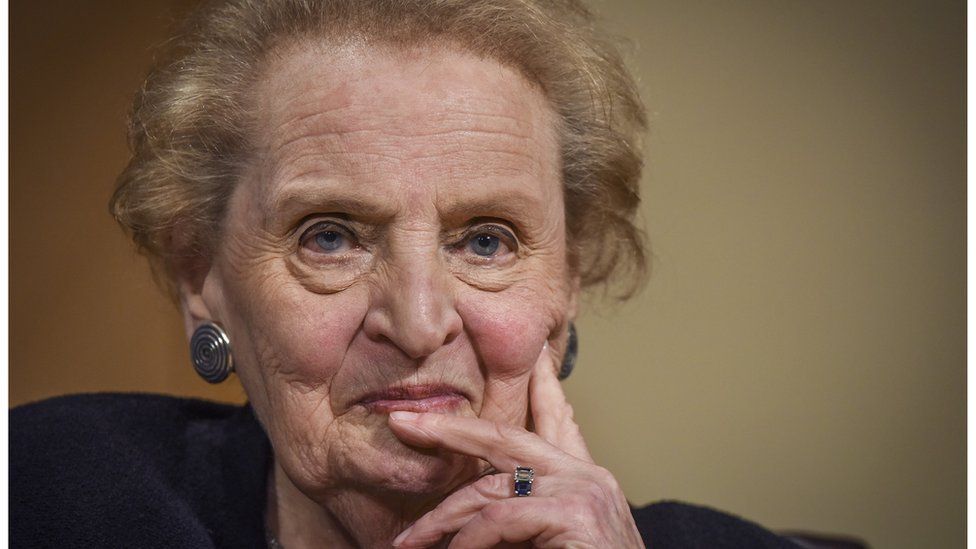
Madeleine Albright, a Czech immigrant who went on to become the first female secretary of state in US history, has died aged 84.
A long-time foreign policy veteran, Albright became America's top diplomat in 1997 during the Clinton government.
Often hailed as "a champion of democracy", Albright was instrumental in efforts to end ethnic cleansing in Kosovo.
Her death from cancer was confirmed by her family in a statement.
"She was surrounded by family and friends," the statement said. "We lost a loving mother, grandmother, sister, aunt and friend".
Among those to pay tribute to her after the announcement of her death were former President Bill Clinton and Hillary Clinton, who later followed in her footsteps as Secretary of State.
"Few leaders have been so perfectly suited for the times in which they served," the Clintons said. "Because she knew first-hand that America's policy decisions had the power to make a difference in people's lives around the world, she saw her jobs as both an obligation and an opportunity."
Nato's current Secretary General, Jens Stoltenberg, said after the announcement that Albright "was a force for freedom" and an "outspoken champion of Nato".
Former US President George W Bush said that Albright "understood first-hand the importance of free societies for peace in our world".
UK Foreign Secretary Liz Truss tweeted that the world "needs to stand by" Albright's values "more than ever".
Born Marie Jana Korbelova in Prague in 1937 - in what was then Czechoslovakia - Albright was the daughter of a Czechoslovak diplomat who was forced into exile after the occupation of his country by Nazi Germany in 1939.
She moved to the United States in 1948, the same year her family applied for political asylum, arguing that they were unable to return home as opponents of their country's communist regime. She became a US citizen in 1957.
Albright went on to work at the White House during the Jimmy Carter administration and later as foreign policy adviser to a number of vice-presidential and presidential candidates.
Soon after Bill Clinton was inaugurated in 1993, Albright was appointed ambassador to the United Nations - her first diplomatic posting.
Analysis by Anthony Zurcher, North America reporter
Madeleine Albright's story is quintessentially American.
A refugee who fled to the US with her family as a child, she made history by becoming the first woman to serve as secretary of state - the highest-ranking woman in US government up to that point.
As a diplomat, Albright helped shape the post-Soviet world during the Clinton administration, employing what she called "pragmatic idealism" to navigate uncharted geopolitical waters. That included, at times, an aggressive foreign policy that used US military might - in places like Iraq and the Balkans - when diplomacy failed.
The Nato bombing campaigns in the former Yugoslav states helped define a post-Soviet role for the Western alliance at a time when Nato's future was very much in doubt.
Albright was also champion of Nato expansion, overseeing the addition of Poland, Hungary and the Czech Republic in 1999 - a move whose repercussions are being keenly felt today.
In 1997, she became secretary of state, overcoming opposition from what some later termed the "anything but Albright" faction of the White House.
She became most famous during this time for her efforts to push the Clinton administration to intervene to stop ethnic cleansing in Kosovo being carried out by the Serbian regime of Slobodan Milosevic.
Some critics termed the subsequent Nato bombing campaign "Albright's War".
"I take full responsibility... for believing it was essential for us not to stand by and watch what Milosevic was planning to do," she said at the time. "We cannot watch crimes against humanity."
Kosovo eventually declared its independence from Serbia in 2008, nine years after the allied intervention.
Its President, Vjosa Osmani, said on Wednesday the country had lost an "invaluable friend", adding that Albright's "contribution to our freedom and democracy will never be forgotten".
In 2012, then-President Barack Obama awarded her the Presidential Medal of Freedom - the highest award available to a civilian - for her work in the Balkans. Paying tribute on Wednesday, Mr Obama lauded her "trailblazing career".
Just a month ago, on the eve of the invasion of Ukraine, Albright stepped back into the public spotlight with a New York Times editorial taking aim at Russian President Vladimir Putin, whom she first met soon after he took office in 2000.
"Ukraine is entitled to its sovereignty, no matter who its neighbours happen to be. In the modern era, great countries accept that, and so must Mr Putin," she wrote. "This is the message undergirding recent Western diplomacy.
"It defines the difference between a world governed by the rule of law and one answerable to no rules at all."
EKO BRIDGE FIRE OUTBREAK: LAGOS GIVES SQUATTERS 48 HOURS NOTICE TO VACATE AREA
oolasunkanmi2 March 23, 2022
Following the morning fire incident that engulfed some makeshift shops and containers under the Eko Bridge at Oke Arin, Apongbon on Wednesday, thereby affecting some parts of the bridge, the Lagos State Government has issued a 48 hours notice to squatters under the Bridge to vacate the area.
The Special Adviser to the Governor on Central Business Districts, Mr. Gbenga Oyerinde, issued the directive to illegal occupiers during his official visit to the scene after the fire had been extinguished and the removal of debris had commenced.
Oyerinde decried the illegal activities of squatters, traders who store items beneath the bridge and engage in other business transactions, warning that anyone caught flouting the directive to stay clear of underneath the bridge will be arrested and prosecuted.
In his words: “The issue of fire outbreak under the Eko Bridge at Oke Arin may become endemic if adequate steps are not taken to forestall future occurrence due to negligence and non-adherence to safety protocols by traders, leaders of the market associations and CDAs after several engagements on the need to take issues of safety seriously”.
Commending the men of the Lagos State Fire Service for the quick response and putting out the fire fastidiously, the Special Adviser averred that the cause of the fire outbreak has not been fully ascertained, but suggested that it may be due to the storage of explosive and combustive materials in some of the containers stored under the bridge.
Oyerinde visited the scene of the incident alongside the Permanent Secretary, LASEMA, Dr. Olufemi Oke-Osanyintolu and other State Officials.
 Politics › Re: Eko Bridge Fire Outbreak: Lagos Gives Squatters 48 Hours To Vacate Area by naptu2(op): 12:24pm On Mar 24, 2022