Odensibiri's Posts
Nairaland Forum › Odensibiri's Profile › Odensibiri's Posts
 Culture › Re: Igbo Writing by odensibiri(op): 4:19am On Aug 20, 2015 Culture › Re: Igbo Writing by odensibiri(op): 4:19am On Aug 20, 2015 |
| Culture › Re: Igbo Writing by odensibiri(op): 11:41pm On Aug 19, 2015 |
| Culture › Re: Igbo Writing by odensibiri(op): 7:13pm On Aug 19, 2015*. Modified: 7:37pm On Aug 19, 2015 |
https://i.imgur.com/xJjYwjP.png There's a group for discussing Igbo language on Google Plus, including discussion on new vocabulary and nsibiri use. It's to be a central place for 'standardising' Igbo. The requirement is that you speak [Engli-]Igbo at a conversational level. If you're interested or know anyone who is send a message. odensibiri@gmail.com. |
| Culture › Re: Igbo Writing by odensibiri(op): 7:12pm On Aug 19, 2015 |
| Culture › Re: New Igbo Language Flag by odensibiri(op): 7:11pm On Aug 19, 2015 |
https://i.imgur.com/xJjYwjP.png There's a group for discussing Igbo language on Google Plus, including discussion on new vocabulary and nsibiri use. It's to be a central place for 'standardising' Igbo. The requirement is that you speak [Engli-]Igbo at a conversational level. If you're interested or know anyone who is send a message. |
| Culture › Re: Igbo Kwenu! Kwezuo Nu! Join Us If You're Proud To Be An Igbo Guy/lady by odensibiri: 11:08pm On Aug 07, 2015 |
Akagu (Igbo nsibidi-derived writing) lessons https://www.youtube.com/watch?v=EAiCeaPwa3Y https://www.youtube.com/watch?v=8KIDfcqtf-k |
| Culture › Re: The Culture Lounge by odensibiri: 11:08pm On Aug 07, 2015 |
Akagu (Igbo nsibidi-derived writing) lessons https://www.youtube.com/watch?v=EAiCeaPwa3Y https://www.youtube.com/watch?v=8KIDfcqtf-k |
| Culture › Re: Nairaland Official Igbo, Hausa and Yoruba Dictionary by odensibiri: 11:08pm On Aug 07, 2015 |
Akagu (Igbo nsibidi-derived writing) lessons https://www.youtube.com/watch?v=EAiCeaPwa3Y https://www.youtube.com/watch?v=8KIDfcqtf-k 1 Like |
| Culture › Re: Igbo Writing by odensibiri(op): 11:41am On Aug 07, 2015 |
First two lessons (YouTube): https://www.youtube.com/watch?v=EAiCeaPwa3Y https://www.youtube.com/watch?v=8KIDfcqtf-k |
| Culture › Re: New Igbo Language Flag by odensibiri(op): 11:35am On Aug 07, 2015 |
cheruv:What ChinenyeN said, it's not a political affair just a language organisation, I have no plans to be affiliated or involved in any politics at all (hence the 'neutrality'). The flag is in the same vein of the Portuguese speaking community: https://en.wikipedia.org/wiki/Community_of_Portuguese_Language_Countries and Francophonie: https://en.wikipedia.org/wiki/Organisation_internationale_de_la_Francophonie and other language flags like these: https://commons.wikimedia.org/wiki/Category:SVG_flags_of_languages |
| Culture › Re: New Igbo Language Flag by odensibiri(op): 11:31am On Aug 07, 2015 |
nwanlecha:Thanks. Some more info can be found on this thread I created (if you haven't seen it): https://www.nairaland.com/2316663/igbo-writing |
| Culture › Re: Igbo Writing by odensibiri(op): 7:56pm On Aug 06, 2015 |
ChinenyeN:That's one of the advantages of the script. |
| Culture › New Igbo Language Flag by odensibiri(op): 7:54pm On Aug 06, 2015 |
via Facebook - Nsibiri: I made a flag for the Igbo language. The four crosses represent speech from nsibidi motifs, they are four representing Igbo spoken on all four corners of the world/universe. The third raised cross represents the individual and in extension individual/unique dialects of Igbo. The green represent life and posterity, and also symbolic of the colour of omu (tender palm fronds), therefore sacredness, as in, upholding the language. The white represents neutrality and community. I'm thinking this could be the flag an Igbo language academy down the road. I generally see the Igbo language as separate from ethnic alliances or politics. Ratio is 1:2. https://i60.tinypic.com/wwhqtg.jpg nsibiri..co.uk https://www.facebook.com/Nsibiri |
| Culture › Re: Igbo Writing by odensibiri(op): 7:51pm On Aug 06, 2015 |
1 Like |
| Culture › Re: Igbo Writing by odensibiri(op): 7:50pm On Aug 06, 2015 |
cheruv:cheruv, the reason why I put the Ikpo Nisbidi in akagu is because you need to learn akagu first, since they are linked. Even if I put it in Latin, which I don't want to do because I'm not looking for people to be relaxed, you would still need akagu to write some terms, and again what happens when you learn nsibidi and forget one crucial character? I'm willing to wait for people to learn akagu. On your second point, that is exactly a situation that nsibidi is there to help solve, every different verb has a different character (apart from more unique and obscure ones that don't have a character out of the 1400). Those there 'na' have their own unique characters. |
| Culture › Re: Igbo Writing by odensibiri(op): 10:48pm On Aug 04, 2015 |
cheruv:Nice that you caught that out, you can see where I substituted the character with akagu in absence of nsibiri. Thanks. We'll see as the writing develops as writing systems are really just at the mercy of the people who use it. The writing will have to be sent to the unicode consortium to be used on phones and computers, but that's a bit later after more people use the script.
|
| Culture › Re: Igbo Writing by odensibiri(op): 5:09pm On Aug 04, 2015 |
ChinenyeN:That's the idea, to encode Igbo to nsibidi first, and then not only can new symbols be composed using the precedent set by the other characters, but also new words can be formed by joining words together. This may be obvious, but a problem I had before starting this project was that it was difficult to understand some new terms others made because all I could see was the sound and often people don't bother or don't even know how to mark tones, but with nsibidi not only is the issue of marking tones less crucial to the pronunciation, but I can see what the poster is getting out since nsibidi characters (usually) provide semantic explanation. Like if I were to make a word up for a threading machine and called it iga, you wouldn't know 'ga' meant threading, but in nsibidi you would. Something like that. 1 Like |
| Culture › Re: Igbo Writing by odensibiri(op): 4:59pm On Aug 04, 2015 |
cheruv:The reason I didn't add town names is because they can either be broken down like in the attached image or they can be written in akagu, the same usually goes for colours which are usually only in an adjectival stage in Igbo like in the case of green (ndu ndu), in some cases there are nouns. We cannot feasibly expect Igbo writers to remember 1400 characters at all times, in the case of them forgetting the characters, akagu is there as a 'net' to fall back on, I know this because I do it myself. I have capped the writing system currently at the 1400 characters because with every character added the script becomes more difficult to learn, the reality is that different communities may choose to add their own characters, but these are the standard characters. Many Igbo words can be easily broken down to their verb root, which is why these 1400 characters cover a lot more vocabulary than you think, there are also character combinations that may be used to sound something completely different from the two characters but only use the characters for their semantic meaning. If you are familiar with Hanzi and its Japanese derivative Kanji you'll know that most Chinese writers only need to know 8000 common Chinese characters, and even they struggle with that because they have no alternative like we have akagu, they also use a standard set of Chinese characters to approximate foreign names and new ideas, for example they may use characters that have the sounds 'nai' and another that's 'ji' + 'ri' + 'ya' for Nigeria (尼日利亞), but these characters also have a meaning of their own each and it may be confusing, that's led them to simplified Chinese vs traditional, controversially introduced by the Communist party and used for more than 50 years now, and Chinese even a suggested syllabary called Bopomofo. With the Japanese, which only around 2000 words are needed for a good vocabulary, they made their life easier by creating kana symbols that were just syllables that had no value other than the syllable sound. Ask yourself how would a young child learn how to spell and be helped to pronounce 'anwu' without learning a system like akagu or just going directly to nsibidi? The reason for this project is to use indigenous symbols to approach Igbo literacy in a way that would, I think, work better. I've tried to keep as many original nsibidi characters intact as possible, if you look at the key of the Ikpo Nsibidi you'll see where I've shown the type of nsibidi characters in relation to 'old' nsibidi, whether they are modified in terms of form or meaning, whether they are simplified, whether they are newly constructed from the radicals or basic elements that recur in most 'old' nsibidi characters, and whether they are wholly original or not modified from the pre-1900 nsibidi. Many of these nsibidi symbols were simplified or modified from their original shape so that the symbols are as simple as possible and therefore easier to learn and remember, but at the same time keeping the integrity, heritage and consistency of nsibidi. There are around two symbols adopted from uri motifs. To adopt characters or symbols from foreign scripts would be contradictory to the mission of the project. I mean, if we adopt some hanzi characters, I may as well stop trying to preserve this system and just start writing Igbo in hanzi. 2 Likes
|
| Culture › Re: Igbo Writing by odensibiri(op): 8:42pm On May 21, 2015 |
Ihuomadinihu:Thanks! 1 Like |
| Culture › Re: Igbo Writing by odensibiri(op): 7:46pm On May 21, 2015 |
Ihuomadinihu:Yes. |
| Culture › Re: Igbo Writing by odensibiri(op): 7:13pm On May 21, 2015 |
Instructions: http://nsibiri..com 1 Like |
| Culture › Re: Igbo Writing by odensibiri(op): 6:56pm On May 21, 2015 |
1 Like |
| Culture › Re: Igbo Writing by odensibiri(op): 1:25am On May 19, 2015 |
Velocitron:The letters of the akagu alphabet have characters that are not in the Latin alphabet that Igbo uses. The nsibiri characters or logographs, which means that each symbol represents a word similar to how $ often represents the word 'dollar' and & represents 'and' in various languages. The nsibiri characters (letters) are simplified from pictures representing the word or idea. For example, the nsibiri character for 'ọ́nwá' (moon) is simplified from the picture of a moon. 'Nà', 'and' in Igbo is represented by talking with a symbol for unity. |
| Culture › Re: Igbo Writing by odensibiri(op): 1:20am On May 19, 2015 |
ChinenyeN:That's a good attempt. With loanwords the akagu with the 'serifs' should be used. I also prefer nsibiri. I did a test a while backs and noticed writing akagu is easier, but reading nsibiri is easier. |
| Culture › Re: Igbo Writing by odensibiri(op): 5:10pm On May 18, 2015 |
By the way, I've figure out a short cut to write nsibiri in the font face, but it's going to take a while to make. 1 Like |
| Culture › Re: Igbo Writing by odensibiri(op): 4:51pm On May 18, 2015 |
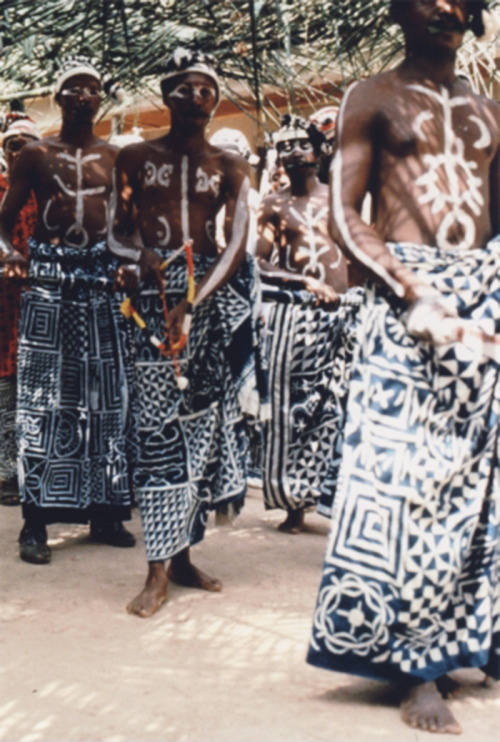
Teespice:They are nsibidi symbols that were invented probably by the Ekoi people in the Cross River Cameroon border before 1500s, e.g. before Europeans, and then it spread out to other communities in the area including Igbo. It's not Chinese, but the fact that you thought it looks like Chinese is not completely in error since both of the writing systems were initially drawn pictures which were then given names and then people started to adopt the pictures as words and the rest is literally (or literary  ) history. ) history.See this image: http://i1.w.hjfile.cn/doc/201202/chinese_scrips21286.gif This is an image of people from Arondizuogu in a burial in 1988 with nsibidi on their bodies and cloth (ukara/okara ekpe). https://40.media.tumblr.com/9f62cf65a2d9f933fcbb8e83f88ad85e/tumblr_nl7wi8MR9B1qjh37to1_500.jpg http://ukpuru.tumblr.com/post/113701341972/procession-of-leopard-society-members-during-the 5 Likes |
| Culture › Re: Igbo Writing by odensibiri(op): 4:48pm On May 18, 2015 |
AgricSalt:LOL. 1 Like |
| Culture › Re: Igbo Writing by odensibiri(op): 4:46pm On May 18, 2015 |
AfricanGod2:The prefix should be obvious from the akagu, you may wonder what happens when there are multiple akagu in a sequence and how a reader would able to tell the difference between the words, well, first of all that's why I've eliminated the need for double letters to symbolise long vowels or sounds (like in onwu, the current Latin orthography for Igbo, 'nn' and 'mm' are for long sounds, but in akagu there are separate symbols for that as well as the long vowel diacritics, the two bars at the top of some vowels). The affixes modify a verb root, so because every writing system will have to require a little bit of prior knowledge and experience, the reader can identify this because it will look like a strange verb in the middle of a sentence, of course this is if they are ever confused, which I don't think they will with experience. Haha, yes all the affixes are in akagu. I initially tried to make some affixes from nsibiri (like I formed new characters from old ones) in order to keep the system as 'original' as possible, but it came to a point where I was making new affixes every time I wrote something. If you think of any consonant-vowel syllable it probably exists in Igbo and in 3 different tones or more! So that was scraped because it was both exhausting to learn, and exhausting to make. Yes, roughly. In Igbo two combined verbs sometimes take on slightly different meanings of course because it's a new word, the ká (greater than) is usually added after a verb to denote excess, so Chiemeka is 'God has done so much [good]'. Some might argue that the ká is actually the other ká meaning 'a continuation', so 'God continue to do [good] for us], but we can deal with all that later. On that note, I should also point out that I've expanded some verbs in a way since some had different contextual meanings, so the differentiation of ká (greater than) and ká (continuation, perseverance) could just be my doing. |
| Fashion › Re: Premium Tshirts With Igbo Designs N9400 by odensibiri(op): 1:15am On May 18, 2015 |
From the UK: http://owu.bigcartel.com |
| Culture › Re: Igbo Writing by odensibiri(op): 1:11am On May 18, 2015 |
One of the reasons I wanted people in Igbo-speaking areas to be the ones that engage with it the most was so that the characters were modified (as in sound and grammar) to their languages, so that people can write nsibiri in that Igbo language. If you look at my 'Ikpo nsibiri' you'll see I've used a range of dialects as it is not based on any particular dialect. That was presumably one of the advantage of nsibiri, intelligibility between broader forms of Igbo thus eliminating the need for a rigid literary standard for Igbo. Most probably know what I may be talking about, but for example of those who don't speak Igbo an example would be (in random forms) with the word for 'thing', in various forms as: 'ihnye', 'ife', 'hnye', 'hẹ', 'hen', 'fe', and so one, all of these words would be represented by one character. Of course, the range of this intelligibility would be uncertain sometimes because of the grammar of the various form. Apart from that, if there's a sizeable group of people churning out literature in Igbo, the point of this project, then i don't mind where they are because the chances are they'll inevitably impact other Igbo speakers from other areas if, for example, a piece of literature goes big and/or the writing system goes fashionable. I also take the advice of reaching out to Igbo organisations, whatever influence they have. I could get support from the stance of nsibiri being a part of the cultural heritage of Igbo people so people won't see it as much as someone 'making something up'. My mission is also to spread the characters to Cross River languages (maybe a version of akagu for those languages can be created as akagu is specifically designed for Igbo). 3 Likes |
| Culture › Re: Igbo Writing by odensibiri(op): 1:00am On May 18, 2015 |
AfricanGod2:The symbol for 'ká' 'greater than' is from an older version of the script. I wasn't sure how to represent possible affixes (now they're completely in akagu and those symbols elided) and even then that was a test and it would be replaced with the character for 'ká' as in 'Chi' (spirit, nsibiri) + ẹ̀ (affix 'to be', akagu) + mẹ́ ('do, act', nsibiri) + ká ('greater than, surpass', nsibiri). Sorry for the confusion. |
| Culture › Re: Igbo Writing by odensibiri(op): 4:34pm On May 17, 2015 |
AfricanGod2:Good one. Hopefully the fact that there are only 1400 nsibiri characters as opposed to 3000+ in Japanese kanji and 8000+ in Chinese hanzi will help learning. 3 Likes |


 the character for mountain doesn't really reflect the geographic landmark..it only describes those mounds made by farmers in their farms. In my honest opinion, I'd suggest the adoption of the hanzi for mountain 山 kos from my view, it correctly describes it.