 Culture › Re: Yoruba Hebrew Heritage by OmoOlofin: 8:04pm On May 26, 2020 Culture › Re: Yoruba Hebrew Heritage by OmoOlofin: 8:04pm On May 26, 2020 |
Olu317:
Migration from the east is absolutely out of the question. It was alien to the Yorubas' history and thoughts about their own origin. Lol! How are you sure with Oru as a place Yoruba lived ?
Although myths are over-the-centuries exaggerations, modifications and distortions of some kernel of very ancient truth and fact; historians (unlike lay-persons) consider it a very important task to discern these nucleus of ancient truths and facts.
My research work on this:
There is no exaggeration about migration because there are many places Yoruba migrated to and it is recorded in other Yoruba towns.
A patient and careful look through the many versions of the Yoruba myth of creation & origin (including the latter versions which feature Oduduwa, Obatala, et al.) reveals this basic kernel of ancient truth and fact which have been wrapped up over the centuries by layers of exaggerations, modifications, and distortions.
This kernel of truth and fact which appears in all the different versions of the Yoruba myth of origin & creation are:
(a) The Yorubas consistently assert (through all the many versions of the myth) that they are not originally alien to their present region.
This information is incorrect. What is your Oriki? Seemingly Ora(Or/Awra) exist in Egypt, Yoruba land , Israel, Irak
(b) The Yorubas consistently assert (through all the many versions of the myth) that their first homeland (in this region) is a place characterized by a very large body of water.
scholars different from your school of thought :
This large body of water can't be Niger Benue because, linguistically, culturally, the Yoruba language didn't developed in Niger Benue Basin. This is fallacy !
These logical deductions from the extant Yoruba traditions is clearly in reasonable agreement with the scientific conlusions reached unanimously today by the body of historical scholarship -- both indigenous and non-indigenous.
My view!
Untrue because of the two information I posited don't agree with your view.
This scientific conclusion says that the first and original home of the ethnic and linguistic group of people known today as the Yorubas is to be found within today's Nigeria specifically around the Niger-Benue confluence.
History of Yoruba's:
No Sir, the Yoruba language doesn't match Niger Benue language and ethnic group don't agree culturally.
I have earlier touched on this where I cited S. A. Akintoye's reference to the traditional accounts about the roots of the man Oduduwa. See below one more time:
My view:
Your citation is null and void because, authored books.
What about the man Oduduwa? What does Yoruba traditional accounts say about his roots before Sultan Bello (followed by S. Johnson) made him into an Arab?
Oral account claims some of the following :
The Ado claim, the name is a wife to obatala.
The name preceded Yoruba state in Nigeria.
The Ileife calls him and his group as usurper
The Ilaje, of Oluigbo claims, the man is a foreigner etc
What about the man Oduduwa? What does Yoruba traditional accounts say about his roots before Sultan Bello (followed by S. Johnson) made him into an Arab?
Sultan Bello's account, is true though with moderation , as far as I am concerned because, the Sultan don't care who is Yoruba or not !
Oral account claims some of the following:
The Ado claim, the name is a wife to obatala.
The name preceded Yoruba state in Nigeria.
The Ileife calls him and his group as usurper
The Ilaje(part of Ilaje) claims, the man is a foreigner etc
The Ijebu{part of Ijebu} claims, they are older than him
Yoruba creation myth:
These creation myth are three in nature :
Interestingly, in the creation of myth of Yoruba, there are three version and didn't support your view on creation, in which two are more popular. These two version have both Obatla and odudua,while one is virtually for Ela(Orumiela). Mind you, I am tempted to ask you, if Ifaodu is Yoruba's or foreign ?
1. Orisanla’ (Obatala’):- It was the arch-divinity who was chosen by eledumare, the supreme deity to create a solid land out of the primordial abyss that constituted the earth and of populating the land with human beings. He descended from Orun (the invisible realm, the realm of the ancestors) into Aiye (the visible realm) on a chain, carrying a snail shell full of earth, palm kernels and a five-toed chicken.
He was to empty the content of the snail shell on the water after placing some pieces of iron on it, and then to place the chicken on the earth to spread it over the primordial water by doing what chickens do, which is to scratch at the ground.
According to this above version of the myth, Obatala completed this task to the satisfaction of Ele-dumare. He was then given the task of making the physical body of human beings after which Ele-dumare would give them the breath of life (emi). He also completed this task and this is why he has the title of "Obarisa" the king of Orisas.
2. The other variant of the cosmogenic myth does not credit Obatala with the completion of the task.
While it concedes that Obatala was given the task, it avers that Obatala got drunk on palm wine even before he got to the earth and he fell asleep. Ele-dumare got worried when he did not return on time, so he sent Oduduwa, Obatala’s younger brother, to find out what was going on. When Oduduwa found Obatala drunk, he simply took over the task and completed it.
He created land. The spot on which he landed from Orun and which he redeemed from water to become land is called Ile-Ife, considered the sacred and spiritual home of the Yoruba.
Obatala was embarrassed when he woke up and, due to this experience, he made it a taboo for any of his devotees to drink alcoholic beverages.
Ele-dumare forgave him and gave him the responsibility of molding the physical bodies of human beings out of clay
(in another version)
Obatala was drunk when making the bodies and some came out a bit off. That is why Obatala is the Orisa of hunchbacks, and the disabled in general as well as albinos).
The making of land is a symbolic reference to the founding of the Yoruba kingdoms, and this is why Oduduwa is credited with that achievement. Oduduwa’s progeny were sixteen in number and became Kings.
So Oduduwa was the first king of the Yoruba nation and founded Ile Ife, the ancient capital, creating a succession of kings all related to him.
However, this version incorporates history into the creation myth. It establishes the divine nature of the founder Oduduwa. Before the time of Oduduwa, the story did not involve Obatala getting drunk and Oduduwa finishing the job.
What is important is the symbolism. The chain is representative of Ogun, the five toed chicken Osun, and the palm kernels, Orunmila. These Orisa, in combination represent unity and a balance of forces.
Unity and balance
(in a cosmos of dualities and diversity) become the central paradigm of Yoruba metaphysical thought.
In Awo Fatunmbi’s words:
The world begins with one … the one that is formed through perfect balance between the powers of expansion and contraction, light and dark, … the balance between the masculine and feminine powers … and that one is a microcosm of all that is…
He has compared the chain to the double helix of DNA and the pieces of iron to Ogun as the ‘primer of evolution'.
According to modern science, iron molecules at the bottom of the ocean are believed to have interacted with oxygen to create the first organisms on earth.
Continuing the creation myth, Obatala was successful up to a point. He was unable to create civilization because he lacked the proper technology. Ogun was called in to continue the job. But Ogun, although very good at establishing civilizations, is not good at ‘running' them. In comes Orumiela to establish ethics and order; to temper Ogun’s primal energy. Obatala creates, but it is Ogun who moves creation, ‘Ogun is evolutionary energy.'
Keep in mind that Orisa and other entities featured in Yoruba myths, itan and Odu bear deep philosophical connotations that begin from the metaphysical meaning descending into the aesthetic and then epistemological through to ethical meanings and, eventually, to positive or negative social effects (it is easy to get caught up in the personalities themselves). Individual metaphysical phenomena come together as a unity of substances in a universe of relativistic existence (Okunmakinde).
This idea is expressed in the most compelling part of the story; the Snail Shell full of earth-dust.
*In the Odu Okanran Ogunda* ;
there is another version of the creation myth that is not well known. In this version, it is Orumiela (the Prophet, Orisa that represents Eledumare’s wisdom) who carries the snail shell full of the substance which creates land upon the primordial waters. The Snail Shell was taken from the seat of Olodumare and given to Orunmila with the authority to create the earth. In the process of creation, ‘ Orumiela dipped his hands into the snail shell and took out measures of earth-dust (Oro, primordial matter) with which land was created on the primordial waters.
1. Orisanla’ (Obatala’):- It was the arch-divinity who was chosen by eledumare, the supreme deity to create a solid land out of the primordial abyss that constituted the earth and of populating the land with human beings. He descended from Orun (the invisible realm, the realm of the ancestors) into Aiye (the visible realm) on a chain, carrying a snail shell full of earth, palm kernels and a five-toed chicken.
He was to empty the content of the snail shell on the water after placing some pieces of iron on it, and then to place the chicken on the earth to spread it over the primordial water by doing what chickens do, which is to scratch at the ground.
According to this above version of the myth, Obatala completed this task to the satisfaction of Ele-dumare. He was then given the task of making the physical body of human beings after which Ele-dumare would give them the breath of life (emi). He also completed this task and this is why he has the title of "Obarisa" the king of Orisas.
2. The other variant of the cosmogenic myth does not credit Obatala with the completion of the task.
While it concedes that Obatala was given the task, it avers that Obatala got drunk on palm wine even before he got to the earth and he fell asleep. Ele-dumare got worried when he did not return on time, so he sent Oduduwa, Obatala’s younger brother, to find out what was going on. When Oduduwa found Obatala drunk, he simply took over the task and completed it.
He created land. The spot on which he landed from Orun and which he redeemed from water to become land is called Ile-Ife, considered the sacred and spiritual home of the Yoruba.
Obatala was embarrassed when he woke up and, due to this experience, he made it a taboo for any of his devotees to drink alcoholic beverages.
Ele-dumare forgave him and gave him the responsibility of molding the physical bodies of human beings out of clay
(in another version)
Obatala was drunk when making the bodies and some came out a bit off. That is why Obatala is the Orisa of hunchbacks, and the disabled in general as well as albinos).
The making of land is a symbolic reference to the founding of the Yoruba kingdoms, and this is why Oduduwa is credited with that achievement. Oduduwa’s progeny were sixteen in number and became Kings.
So, Oduduwa was the first king of the Yoruba nation and founded Ile Ife, the ancient capital, creating a succession of kings all related to him.
However, this version incorporates history into the creation myth. It establishes the divine nature of the founder Oduduwa. Before the time of Oduduwa, the story did not involve Obatala getting drunk and Oduduwa finishing the job.
What is important is the symbolism. The chain is representative of Ogun, the five toed chicken Osun, and the palm kernels, Orunmila. These Orisa, in combination represent unity and a balance of forces.
Unity and balance
(in a cosmos of dualities and diversity) become the central paradigm of Yoruba metaphysical thought.
In Awo Fatunmbi’s words:
The world begins with one … the one that is formed through perfect balance between the powers of expansion and contraction, light and dark, … the balance between the masculine and feminine powers … and that one is a microcosm of all that is…
He has compared the chain to the double helix of DNA and the pieces of iron to Ogun as the ‘primer of evolution'.
According to modern science, iron molecules at the bottom of the ocean are believed to have interacted with oxygen to create the first organisms on earth.
Continuing the creation myth, Obatala was successful up to a point. He was unable to create civilization because he lacked the proper technology. Ogun was called in to continue the job. But Ogun, although very good at establishing civilizations, is not good at ‘running' them. In comes Orumiela to establish ethics and order; to temper Ogun’s primal energy. Obatala creates, but it is Ogun who moves creation, ‘Ogun is evolutionary energy.'
Keep in mind that Orisa and other entities featured in Yoruba myths, itan and Odu bear deep philosophical connotations that begin from the metaphysical meaning descending into the aesthetic and then epistemological through to ethical meanings and, eventually, to positive or negative social effects (it is easy to get caught up in the personalities themselves). Individual metaphysical phenomena come together as a unity of substances in a universe of relativistic existence (Okunmakinde).
This idea is expressed in the most compelling part of the story; the Snail Shell full of earth-dust.
*In the Odu Okanran Ogunda* ;
there is another version of the creation myth that is not well known. In this version, it is Orumiela (the Prophet, Orisa that represents Eledumare’s wisdom) who carries the snail shell full of the substance which creates land upon the primordial waters. The Snail Shell was taken from the seat of Olodumare and given to Orunmila with the authority to create the earth. In the process of creation, ‘ Orumiela dipped his hands into the snail shell and took out measures of earth-dust (Oro, primordial matter) with which land was created on the primordial waters. Can you please modify your post here so that my words which you're responding to are within "[/quote]" and "[quote]" (in the proper order)? Thanks! That way it becomes easier for me or anyone to follow through and make sense of your response -- if you intend your response to be addressed or at least read and understood. But leaving your response mixed with mine without any delineation makes the whole thing appear convoluted, and makes it look like you're simply pooling the wool over your audience's eyes -- by giving an untrue impression of reply. |
| Culture › Re: Yoruba Hebrew Heritage by OmoOlofin: 7:58pm On May 26, 2020 |
Olu317:
I can't reply you as you desire because of BOT. So, don't misunderstood my conception on response that I need reply you . But the reality is that, I will opine my view based on information from authored works and not self.
Take for instance, your mention on Arabic which I posted but unfortunately, the inscription of Arabic didn't appear as it ought to be. (1) Got the BOT gist! (2) The point I made about the Arabic is that you simply lifted the whole text (including the Arabic) from elsewhere without being mindful of what you're lifting. In other words, you actually do not know Arabic, otherwise you would have realized what's wrong with those Arabic words you pasted. But if you think you do know Arabic, then point out what your error there is, and also show the correction. To me, it seems to be all about attention. |
| Culture › Re: Yoruba Hebrew Heritage by OmoOlofin: 10:22am On May 26, 2020*. Modified: 3:28pm On May 26, 2020 |
absoluteSuccess:
Bro, no two culture forms their words based on exactly the same lexis and structure. Often, to find a word that's a perfect match for another from all antiquity may require settling for the closest possible options.
What I'm referring to is "ì/lú", since that's what we are talking about at that point and not any other, just to limit confusion that never was but must be discovered for ulterior motives. lú does not mean route, bypass, pathway, or thoroughfare. Is this thread just about making stuffs up? Someone once told me here to ignore the facts and just do my own thing. |
| Culture › Re: Yoruba Hebrew Heritage by OmoOlofin: 10:21am On May 26, 2020 |
absoluteSuccess:
Bro, no two culture forms their words based on exactly the same lexis and structure. Often, to find a word that's a perfect match for another from all antiquity may require settling for the closest possible options.
What I'm referring to is "ì/lú", since that's what we are talking about at that point and not any other, just to limit confusion that never was but must be discovered for ulterior motives. lú does not mean bypass, |
| Culture › Re: Yoruba Hebrew Heritage by OmoOlofin: 5:03am On May 26, 2020*. Modified: 5:23am On May 26, 2020 |
Olu317:
Let me clearly posit here that, I will respond as time permits.
Therefore, as regard your submission, which says, ‘ According to Paul Ozanne, there were many settlements established there [in the Ife bowl] by the fourth century century BC." P. Ozanne, 1969 cited in S.A. Akintoye, "A History of The Yoruba People", p.14.
The very issue which Willett sees here is not about whether there wasn't any artifact/find that have indeed been radicarbon dated to c.350BC.
Susan Blier's(2012) statement and Gurstele(2015) didn't support your view as stated accordingly on iron ore, activities on Ileife lande etc.
In Susan Blier's account, she says, ‘Yoruba archaeologist Akin Ogundiran (2001:27–28, 2003) provides a more scientifically grounded chronology for Ife and the broader area. His overview of artifact remains and other sources contributes to my own Ife chronology, one that combines archaeological with stylistic, oral historical, and other data.
For some periods, however, I employ different terms and distinguishing features than does Professor Ogundiran.
Most significantly, I have simplified this chronology into three main periods (with subgroupings) using the term
Florescence (cultural “flowering”) for the period of Ife’s major artistic and cultural innovation, along with periods prior to
*(pre-Florescence)* {bone of contention}
and following (post-Florescence) this era.
An early Ife date of c. 350 bce. purportedly based on radiocarbon (Folster in Ozanne 1969:32), cited by both Ogundiran (2002, p.c.) and Drewal (2009:80), has been rejected by Frank Willett (2004) and others for lack of supporting scientific evidence. I concur with this assessment.
The main art-producing era of early Ife, what I define as the
a. Florescence Period (Ogundiran’s Classical Period) is distinguished by both roulette- and cord-decorated ceramics.
Within a relatively short time span in this period, what I identify as Ife’s High Florescence, most of the early arts appear to have been made. One can date this period to c. 1250–1350 ce based on a range of factors, including the thermoluminescence tests of key metal works and the likely reign era of Obalufon II as delimited in Ife oral histories and king lists. It is this era that appears to mark the beginning of the “Odudua” or second dynasty of Ife. Associated with this High Florescence era are arts not only in “bronze” and stone, but also terracotta.
The above time frame is consistent with the dating for Ife and its arts by Peter Garlake (1977:72), based on his excavations at the Obalara’s Land and Woye Asiri sites, both of which are closely linked to King Obalufon II whose descendant and current priest is Chief Obalara. From work Garlake undertook at the Obalara Land site, he would publish five radiocarbon dates reflecting three likely phases. The first is an initial occupation period of circa the twelfth century ce. The second phase constitutes a c. fourteenth century occupation period identified with the laying of the pavements, the creation of an array of sculptures, along with the site’s eventual fourteenth–fifteenth century abandonment. The third and final phase at the Obalara Land site consists of Post-Florescence era finds subsequent to the main site occupation and abandonment.
Furthermore, you pointed out that ,
‘ Rather, the issue he sees here is that these dated finds are so little and so scanty to reasonably and sufficiently warrant the conclusion that "many settlements" have been established in the Ife bowl by that date'.
Curious Questions
1.Who owned the settlers within the *Ife bowls* without any Identify ? Clarify
2. What religion did they practised as at that 350bce or 4bce you claimed was when settlement were established?
3. Since it is accepted amongst the scholars that the oldest Yoruba dialects resides with Eastern Yoruba's. So, what language did these earlier occupants spoke at that period in time around 350bce or 4bce ?
4.Did any of these scholars such as Robin Horton (1979),Henry Drawel(2009), A Adebanji Akintoye (2010) have any clue of these hamlets that a unique ghost like group with kingly lineage subjugated and became unified ?
These are the following information, subjugating your view because, the Yoruba people, despite, meeting people were importers and producers of weaponry, iron ore, Artistic in nature, scientific, clothing mortals etc.
Andrew Gustele, ‘The House of Oduduwa: An Archaeological Study of Economy and Kingship in the Savè Hills of West Africa:
Archeological Perspective in West Africa :
The intense interests in diffusion, technology, trade, and political systems in the kingdoms of Atlantic Africa mirror the interests of early archaeologists who worked to reconstruct ancient societies. Early archaeological methods were oriented toward the taxonomic identification of technologies, facilitating explanations of societal change based on diffusion.
To Childe (1950, 1951), ancient societies were connected by expansive communication networks through which innovations could spread. The accumulation of innovative technologies leads to transformations in society, though particular institutions and agencies within a society may try to (pg 15)
halt or slow the deployment of new technologies. Though Childe (1951) promoted the diffusion of technologies as a means for identifying change in the archaeological record at all social scales, he used technology as potentially useful for broad comparisons of societies, later archaeologists eschewed the trait list definition of states as inadequate to explain the processes of state formation (e.g. Binford 1964: 425). Still, the features of states described by Childe are more applicable as a general model of the institutions in early states (Smith 2009: 22). That such features can be recognized in complex societies from varying geographies and distant times is what requires explanation. However, archaeologists no longer turn to the diffusion alone as the causal mechanism for societal change. There is enough cultural variability and potential for innovation as to not presuppose that any distinctive features of a society, such as those described by Childe, must come from some original source (Rowe 1966: 366). Even when diffusion does seem to adequately describe the distribution of some feature, it is not itself an explanation, as it does not elucidate its internal articulation (Childe 1951: 46). Similarly, the presence of trade and technologies that allow dense populations and state institutions do not explain their deployment (Wright & Johnson 1975). Instead, explanation must come from the analysis of human agency and structures. The cultural systemic approaches that developed to explain social process focused on how structures within societies emerge and change (e.g. Flannery 1972). This emphasis on large processes and impersonal forces meshed well with earlier historical inquiry into African political and economic institutions (Robertshaw 1990).
Archaeology has extended the search for the development of West African states in time and in space. The region has had a long involvement in trade, stemming from trans-Saharan connections established well before the Atlantic economy (Posnansky 1973).
Even trade networks connected West Africa with the rest of the continent, and beyond to the Mediterranean, the Near East, and South Asia (Mitchell 2005; Kelly 2013; Leone & Moussa 2013). While this research has shown the time depth of the technological flows between West Africa and the rest of the world, archaeology has made much more substantive contributions to the comparative study of states. West African societies show a great deal of variability in how they negotiated economic networks and political centralization (Posnansky 1982: 352; McIntosh 1999; Stahl 2004; Monroe 2013)
Complimenting Susan Blier's view on Yoruba's Ileife history is Andrew Gustele;
One of the best studied cases of early political centralization in West Africa is Ile-Ife, an early urban settlement and what is considered by many present-day Yoruba peoples as the foundational site of the Yoruba ethnicity. The city was first mentioned by Europeans in the mid19th century, though oral histories from Ife and surrounding kingdoms claim a much deeper history (Smith 1988: 16; Blier 2012).
Futhermore, he says, ‘ Archaeological research at Ile-Ife has largely corroborated these claims, demonstrating a history of occupation dating back to at least the 10th century CE (Willett 1971)'. Monumental sculpture, such as the Opa Oranmiyan megalith, is associated with the foundation of royal dynasties (Smith 1988: 21).
Surprisingly, I had thought, you and others claimed claimed there were no connection between West Africa and the Near East or Mediterranean etc in ancient times  ? ?
Suzanne Preston Blier says,
‘ O. Werner and F. Willett have published the results of spectographic analyses of several Ife castings ("The Composition of Brasses from Ife and Benin," Archaeometry, xvii, 1975, 141-163), which suggest, however, that the metal may have come from Lower Saxony (in the Harz region) in Europe, where mines producing related ores were being worked during the 12th and 13th centuries. (Corresponding evidence of copper being transported by caravan across the Sahara in the 11th or 12th century [1090 A.D. ? 1081 has been found in Mauritania; Theodore Monod, "Majabat al-Koubra," Bulletin de lInstitut Francais dAfrique Noire, xxvi, 1964, 1394-1402).
During this period, the African Berbers (Almoravid and Almohad Moslems) controlled much of the Western Sa- hara, the Mediterranean, and Spain. Presumably it was through them that metals were traded into this area, either by way of Spain (which, as R. W. Southern notes [The Making of the Middle Ages, New Haven, 1953, 42], had trade contracts at this time with eastern Germany) or through Sicily (and the Holy Roman Empire) both of which benefited from trade ties with the Moslem world.
Kings, Crowns, and Rights of Succession: Obalufon Arts at Ife and Other Yoruba Center.
Andrew W. Gurstele says, Archaeology has extended the search for the development of West African states in time and in space. The region has had a long involvement in trade, stemming from trans-Saharan connections established well before the Atlantic economy (Posnansky 1973).
Even trade networks connected West Africa with the rest of the continent, and beyond to the Mediterranean, the Near East, and South Asia (Mitchell 2005; Kelly 2013; Leone & Moussa 2013). While this research has shown the time depth of the technological flows between West Africa and the rest of the world, archaeology has made much more substantive contributions to the comparative study of states. West African societies show a great deal of variability in how they negotiated economic networks and political centralization (Posnansky 1982: 352; McIntosh 1999; Stahl 2004; Monroe 2013). Again,‘The House of Oduduwa: An Archaeological Study of Economy and Kingship in the Savè Hills of West Africa .
Question:
If Paul Ozanne book is well accepted within the scholarly work on Radiocarbon era, why is such, not cited in 2015 but cite (Willet: 1971) as acceptable?
Note: Don't jump into conclusion in most cases. Ten reason, that some information credited to some writers are only cited , out of Afrocentrism. Your replies often remind me of the saying that you can only wake someone who is asleep, but not someone who is pretending to be asleep. I'm still searching for the refutation in your long reply. In as much as I hate to say this, I must be frank enough to tell you that your reply was full of redherring and strawman arguments. For the most part your ideas in this reply are in-explicit, undefined, and convoluted. I suspect you were strategic about it just to give the impression of replying. Having said that, for the umpteenth time you need to always take your time to digest the very content you want to reply to. Otherwise, your reply will continue to be as misdirected as the one here. The reply to your long comment here lies in the very comment you're replying to. You just have to be eager to read too, as much as you're eager to reply too. Again, see below for the point I made earlier which already answered your ressurected contention: (3) Having said that, the aspect of your continued comment here which particularly interests me is where you cited S.P. Blier's "Art in Ancient Ife".
Your quotation of S.P Blier's words is actually from page 81, and your quotation is accurate.
However, the conclusion you've drawn from the quotation is unfortunately and terribly mistaken.
Your conclusion is that the early Ife radiocarbon date of c.350 BC, "as being speculated", is an assumption that has "been rejected in the scholarly world".
Interesting! Lol.
First of all, the c.350 BC date can not be a radiocarbon date and still be an assumption at the same time. You have to make up your mind here.
Secondly, the actual issue being discussed here which seems to have eluded your grasp is clarified in two things, namely: (1) The endnote to the same statement you've quoted from S.P. Blier, and (2) P. Ozanne's interpretation of the radiocarbon date of the archaeological finds.
Beginning with P. Ozannes' interpretation of the date. First, no scholar denies that the c.350 BC date was the result of radiocarbon dating of finds from Ife.
No there is no such denial in case you're thinking along that line. The actual issue here which F. Willett instead sees (and which S.P. Blier has simply echoed) is the seemingly extreme extent to which P. Ozanne took the date -- that is, what he took it to mean.
"According to Paul Ozanne, there were many settlements established there [in the Ife bowl] by the fourth century century BC."
P. Ozanne, 1969 cited in S.A. Akintoye, "A History of The Yoruba People", p.14.
The very issue which Willett sees here is not about whether there wasn't any artifact/find that have indeed been radicarbon dated to c.350BC.
Rather, the issue he sees here is that these dated finds are so little and so scanty to reasonably and sufficiently warrant the conclusion that "many settlements" have been established in the Ife bowl by that date.
The following endnote from S.P. Blier makes this contention even clearer. In relation to her agreement with F. Willett on this, she notes in endnote 37 that:
"As important as the Pre-Florescence Era appears to have been in Ife, we have little by way of scientific or material evidence from related excavations, much of this data coming instead from undated local artifacts, regional excavations, and Ife oral histories."
In sum, there is no such thing as your self-contradictory conclusion that the radiocarbon date of c.350 BC has being rejected in some "scholarly world". Lol.
No, what F. Willett and S.P. Blier reject instead is not the c.350 BC radiocarbon date -- that will be an absurd thing to do.
Rather, what these two reject is the idea that the radiocarbon date of c.350 BC (for very few archaeological finds from Ife) necessary leads to the conclusion that many settlements have flowered in Ife by that date.
In fact, other scholars have considered these "little" c.350 BC archaeological finds in the light of other corroborating scientific evidence (such as linguistic evidence and many collateral archaeological data from other parts of Yorubaland), thus leading them to continue to uphold P. Ozanne's conclusion that many settlements have indeed flowered in the Ife bowl by that date.
Some of such scholars (that I'm at least aware of) who considered other scientific evidences too include: Robin Horton (1979), Akin Ogundiran (2002), Henry J. Drewal (2009), and S. Adebanji Akintoye (2010). And even with your poor job on this one, there are other points as well as whole comment I made that are yet to be touched by you. Lol. Cheers! |
| Culture › Re: Yoruba Hebrew Heritage by OmoOlofin: 2:29am On May 25, 2020 |
Ilu, meaning town derived from two syllables, namely i/lu. This connotes a route, bypass, pathway or more aptly, throughfare. Does anyone else find it to be a bogus claim that lù, lu, or lú (not sure which one of these different words is intended by our 'author') means route, bypass, pathway, or thoroughfare? It is perfectly okay not to know. Such position is more noble than making claims that is known to be absolutely off. Things we read on this thread. Sighs! 
|
|
|
| Culture › Re: Yoruba Hebrew Heritage by OmoOlofin: 2:11pm On May 22, 2020*. Modified: 2:49pm On May 22, 2020 |
Obalufon:
(1) European grouping who group you people, your slave masters, they group you like grouping animals, you are trying to group us with animals i won't accept it.
(2) till 1980s they are still discovering naked people in north of Nigeria covering their butt with leaves 1940 to 50s 95 percent of ibos are naked we called them "oni hoho "naked people those are the people you want to group us with
(3)...Are you verse in yoruba science ? (1) Lol. First of all, I can't remember where I made mention of any so-called "European grouping". I'm confused and lost at this point as to which of my comments you're replying to here. You seem to have anticipated certain comments from me, and you have had some ready-made replies to them. While that is fair enough, I would have expected that you would modify your ready-made reply since my comment didn't eventually match your anticipation. But let's even pretend that I mentioned some so-called "European grouping", your contention here still boils down to a purely emotional argument devoid of any ratiocination. Your emotional argument here sounds like you would "accept" the supposed "grouping" if it had been done by Hebrews and not Europeans. Seems to me like the Europeans enslaved the bodies of our fathers of yore, while the Hebrews continue to enslave the minds of their children till date. (2) Your point (2) here makes it even further clearer that your contention is nothing more than a purely emotional contention. Brother, such emotional contentions/arguments actually hold no water from a scientific standpoint. To make my case here even clearer, consider the Binis' case below: (a) The Binis are the about closest distinct ethno-linguistic group to the Yoruboid group. [Even a layperson who does not know jack about linguistics realizes this] (b) The Binis were largely still roaming stark n@ked even until around the late-1890s/early-1900s (or perhaps much, much later). [Eyewitness European documentations attest to this fact] Will you now turn around and emotionally deny the glaring truth of point (a), just because you personally and subjectively refuse to be "grouped" with a people who were largely still roaming n@ked until recently? Will you? Listen, our emotions are actually helpless and irrelevant in the face of scientific truths. You won't dare pick up the surgical knives, etc. to conduct a C.S. on a family member on the excuse that only European surgeons ("your slave masters'" children) are available within your reach and capacity. And If you won't dare do that with surgery, why dare attempt that with any field of scientific inquiry? Leave the experts to their expertise. And the independent conclusion reached by the historians of African and Yoruba History ( including indigenous Yoruba expert linguists such as Adetugbo, Obayemi, Oyelaran, and Akinkugbe as I have mentioned earlier) is that the ethno-linguistic group of people, now known as the Yorubas, first appeared on the soil of today's Nigeria. (3) What is "Yoruba Science"? |
| Culture › Re: Yoruba Hebrew Heritage by OmoOlofin: 12:39am On May 22, 2020*. Modified: 3:20am On May 25, 2020 |
Obalufon:
prove me wrong ... i'm not historian In that case, you ought to be willing to accept the conclusions of historians. And the conclusion reached by historians (from linguistic and other evidence) is that the ethno-linguistic group of people known today by the name Yoruba first appeared in the region known today by the name Nigeria. Will you then be willing to submit to the conclusions of historical scholarship even if you dislike what the conclusions say?? |
| Culture › Re: An Oyo Successor State. by OmoOlofin: 12:30am On May 22, 2020 |
gregyboy:
Go and learn manners You mean I shouldn't have exposed you and your 2by2??  
|
| Culture › Re: An Oyo Successor State. by OmoOlofin: 11:45pm On May 21, 2020 |
gregyboy:
We dont have nothing to do with you slaves rather than giving you guys guns to kill yourself
Everything we share with the yorubas were influenced by benins Emphasis on the highlights!  

|
| Culture › Re: Yoruba Hebrew Heritage by OmoOlofin: 10:45pm On May 21, 2020*. Modified: 11:20pm On May 21, 2020 |
Obalufon:
Yoruba civilization didn't emerge here ..Our knowledge and civilization is beyond what our environment can support ,our verse knowledge of things that can not be source in our present locate is astounding ,whether we were influenced or we migrated here from somewhere.... May God forgive Afican/Yoruba historical scholarship for disagreeing with the wish of a Nairalander and "scholar", namely -- Obalufon. |
| Culture › Re: Yoruba Hebrew Heritage by OmoOlofin: 7:51pm On May 21, 2020*. Modified: 9:39am On May 22, 2020 |
adee17:
(1) Bro, you can't use contemporary historical methods to unravel black Hebrews. The methods are skewed against such by the Caucasians.
[s]In the end though, all things shall be laid bare.[/s]
(2) Yorubas are migrants and not indigenous here. That assertion should be too clear to see.
(3) Every attempt and efforts to link us here have been proved abortive. We have no common heritage, in terms of culture, language, rituals rite, etc with any tribe in Africa except those of our kits.
(4) If I may ask you my brother, do you believe the assertion of the Ijebus that they transverse and had a temporary stop at Waddai in Sudan while migrating from the Near East?
(5) Don't be deceived, history is written by the conquerer. We are not from here but we won't remember, at least majority, until fullness of time. (1) I am not sure where you got this strange and weird idea from. How did you even manage to squeeze the word "Caucasians" in there? Listen, scholarship is actually an accumulated process -- a continuum. In other words, historians today have access to more writings than historians 100 years ago had access to. In other words, they knew ("a" only), but today we now know ("a"+"b"+"c''+...). I'm still curious as to how any rational mind could hold that the present state of knowledge must be reduced to ("a" only), when in fact we now already have more additions to "a". (2) This is the very thing you seek to prove. So, please prove it.  (3) Are you serious now?  Did you even bother to re-read what you typed? Did you even bother to read the comment you were replying to? Who are these supposed scholars who made these so-called failed efforts? (4) The idea that the Ijebus are foreigners from the Near-East is simply a special case of the broader Johnsonian hypothesis of Yoruba origins. [Refer to my foregoing comment to see the sources and influences on Samuel Johnson's foreign origin hypothesis]. This special case of Wadai is only a very recent account of origin of the Ijebu people. It was first pronounced by the reigning monarch, the Awujale-IjebuOde -- Oba S.K. Adetona. Prior to him, this account is conspicuously unheard of in the oral traditions of origin of the IjebuOde people. Many "traditional sayings" till date (including those popular among the "Oṣugbo" *) indicate Ife as the origin of the Ijebu people. [ *"Oṣugbo" is the alternative name by which "Ogboni" is popularly called among the Ijebus and southern Yorubas generally.] The extant oral account of the early beginnings of IjebuOde says that there are three waves of migration into the area. The first wave is said to be led by Oluiwa who settled with his followers at Iwode -- an important part of the city. The second wave is said to be led by Arisu who settled with his followers in the Ijasi area of the city. The third and most important wave is said to be led by Ogborogan (aka Obanta) -- the founder of the present IjebuOde Kingdom. All these men are said, in the traditions, to have led their groups from Ife. (5) Lol, I shouldn't be deceived? I appreciate your advice. But as a gentle reminder: I am the one who have been citing scholarship, while you've simply written what you wished for, without any reference whatsoever. Let me ask you a question: Was your background a Christian one? Just asking! I actual have no problem with people's religious leaning. I'm asking only because it seems to me that there is a strong (if not perfect) correlation between a person's Christian background and their wish that Yorubas are Hebrews, etc. Just as there is a strong (if not perfect) correlation between a person's Islamic backround and their wish that Yorubas are Arabs, etc. |
| Culture › Re: Yoruba Hebrew Heritage by OmoOlofin: 7:02pm On May 21, 2020 |
Hi Olu317:
The following is the comment on Oduduwa's origin I promised to repost here:
In a 1969 report of a preliminary archaeological survey of Ife, Paul Ozanne noted that evidence shows that many settlements have been established in the Ife country by at least the 4th century BC.
He pointed out that the Ife area lies in a high bowl (namely, the "Ife bowl" ) surrounded by hills which form a watershed for many streams flowing out through gaps between the hills. And that into this "bowl" the earliest settlers came in some unknown antiquity.
Paul Ozanne: "A Preliminary Report of an Archaeological Survey of Ife"; also "A New Archaeological Survey of Ife," Odu, new series, 1, 1969, pp.131-148.
The idea that Oduduwa's roots was in some distant foreign land is actually alien and foreign to the early Yorubas themselves.
The most remote origin atttibuted to Oduduwa in indigenous Yoruba accounts is given in the mythology of Oduduwa's descent from heaven, as well as Obatala's, et al.
And if an interpretation of this particular mythical account would not deem Obatala (and the other actors in the account) as a non-Yoruba foreigner, then there is no reason why such interpretation of the same account would deem Oduduwa a foreigner.
For the sake of completeness, I should mention that this particular myth have absolutely nothing to do with a foreign country of origin for Oduduwa or Obatala, et al.
An examination of the earliest variant of this myth of descent of heavenly beigns supplies entirely different (unknown or unpopular) names to the charcaters involved.
This myth of descent of Oduduwa, Obatala, et al. have therefore been interpreted by historians to be a later remix of the original myth. Professor S. Adebanji Akintoye writes in his "A History of the Yoruba People" in relation to this interpretation as follows:
"As for the introduction of the names Oduduwa and Obatala into these creation myths, there seems no doubt that what we have here is a conflation of very ancient myths with later known facts at some point in Yoruba history. As will be seen in subsequent chapters, Obatala and Oduduwa were not mythical, heavenly beings; they were humans who played very significant roles in a great era of Yoruba history. Without doubt, what happened was that the contemporaries or successors of Obatala and Oduduwa added these two names to myths that had existed probably very long before their time, in an attempt to accord Oduduwa in particular the very high position he deserved in the transformation of Yoruba civilization in the most significant era in early Yoruba history."
S. Adebanji Akintoye: "A History of the Yoruba People", Amalion Publishing, 2010, pp.2-3.
In fact, if anything is known for sure about the view of Oduduwa's alleged foreign origin, then it is that this view is modern and quite alien to the Yoruba peoples' history.
To be quite specific, the foreign direction of Oduduwa's origin was first initiated towards the end of the 19th century by the Reverend Samuel Johnson in his famous "The History of the Yorubas" which was completed in 1897.
Until deep into the 20th century some of the best minds in historical scholarship simply followed Johnson's lead without questioning, even as there is a deafening silence of prior indigenous Yoruba accounts on such a foreign Oduduwa's origin. They also didn't deem it necessary to examine the roots of the Johnsonian hypothesis.
To briefly examine the influences and sources of Johnson's idea concerning the supposedly foreign roots of Oduduwa, it is sufficient to quote S. Adebanji Akintoye's A History of the Yoruba People. S. Adebanji Akintoye writes:
"Samuel Johnson was educated for the service of the church. ... .At the training institution in Abeokuta, he had schooled under a German teacher named G. F. Bühler, who while training his students as church workers, gave them a very solid grounding in ancient history --- the history of Egypt, Babylon, Greece and Rome. From such beginnings, Johnson developed a strong interest in the history and mythology of the Middle East. Moreover, Johnson's Yorubaland of the nineteenth century was increasingly affected by the growth of Islam and Christianity, two world-shaping products of the Middle East. In particular with Islam came the knowledge of Western Sudanese myths and legends through the writings of Muslims of the Western Sudan ("including Hausaland" ) --- especially some of the writings of Sultan Bello of Sokoto which contained some Sudanese myths about Yoruba origins. Above all, the nineteenth century was, in Europe, the golden age of the study of the history and civilization of ancient Egypt. The ancient Egyptian writings (the hieroglyphic script) had just been deciphered, and the expanding knowledge of the wonders of ancient Egypt was creating great excitement in the world of scholarship. The writings of the emerging class of literate Yorubas were commonly laced with Egyptian and Middle Eastern references, analogies and mythology ("a practice apparently regarded then as a marker of erudition" ) --- as a reading of the Lagos newspaper of the time will abundantly show. All these influences combined to shape much of Johnson's The History of the Yorubas, and to account for his linking of all important details of early beginnings of Yoruba history to the Middle East. Thus, Oduduwa became a personage from the Middle East, and Oranmiyan's migration northward to the Niger country became a journey with the Middle East as its intended destination. Indeed, the influence of Middle Eastern mythology pervades most of Johnson's early history chapters, all the way from his preface."
Ibid., p.56.
If anything is palpably perceptible from the foregoing quotation, it is the fact that Johnson completely favoured an account of Oduduwa's origin by Sultan Bello of Sokoto, over and above an account of Oduduwa's origin by the Yorubas themselves.
In sum, he left out the Yoruba account of Oduduwa's origin in favour a heavily-Middle-East-influenced account by an Hausa.
Johnson's excitement to incorporate a Middle Eastern thesis into his treatise is clearly seen to be at play.
Contrasting Johnson's approach on his account of Oduduwa's origin with his approach on his account of Oyo's history, S. Adebanji Akintoye notes:
"In contrast, his accounts of the history of the Oyo Empire were assembled from oral evidence he collected in places like Oyo and Ibadan where memories of the disintegration of that empire were still quite fresh; while his accounts of late nineteenth century Yoruba history were products of his own eyewitness observation of many of the events."
Ibid., p.56.
Having shown that the influences and sources of Johnson's hypothesis of Oduduwa's alleged foreign origin are themselves foreign, and based more on sentiments than it can be argued to be based on any fact, it is vital then that an inward examination of the corpus of indigenous resources on the early history of the Youba people --- as well as on Oduduwa's roots particularly --- is undertaken.
In relation to this novel undertaking which didn't begin until well into the 1900s, S. Adebanji Akintoye writes:
"Fortunately, while much effort was being expended in following Johnson's ideas about the beginnings of Yoruba history, there existed all around us, in Ife and other parts of Yorubaland, an enormous wealth of traditions, as well as evidence in the Yoruba political system and surviving practices and rituals, about Oduduwa and his era. Ultimately a different direction in the study of Yoruba history developed ("as part of a more scientific study of African history in general" ) which focused on the indigenous evidence, as well as other source material, for the reconstruction of early Yoruba history. Consequent upon these efforts, we now stand able to lay aside, with respect, the Johnsonian hypothesis about the origins of Oduduwa and of the Yoruba. All who study the history of Ife and of the Yoruba people are now generally agreed that the great political changes which began in Ife in about the tenth century were indigenous in their origin, in their unfolding and in their dramatis personae. It is on the soil of Yorubaland that Oduduwa was born and raised; it is only in that soil that his roots can be found."
Ibid., pp.56-57.
Regarding the specific region of Yorubaland where Oduduwa was born and raised, and how this ties to the account of the resistance he endured from some parties in the course of his becoming king in a unified Ife:
As is to be expected, scholars --- such as Ulli Beier, et al. --- who pioneered avoiding this obvious error inherent in the Johnsonian hypothesis did indeed make recourse to the rich corpus of indigenous Ife-Yoruba accounts.
An important account which proves particularly very useful to S. A. Akintoye's identification of Oduduwa's specific roots within Yorubaland (and how that ties to the well-known account of the resistance he endured from some quarters, in becoming the ruler of unified Ife) is the popular account of the violence, conflicts, and wars between the Oduduwa's alliance on one hand, and the Obatala's alliance on the other hand. This unrest is said (by all the variant accounts) to have lasted "a very long time".
Akin Ogundiran found, after thoroughly researching and combing through the generality of the available Ife traditional accounts on this much remembered conflict, that it must have lasted over a century.
This submission then raises the question of Oduduwa's and Obatala's participation in the conflicts.
Although the traditional accounts put Oduduwa and Obatala at the very beginning of the conflicts to their very end, we know that this is extremely unlikely given the unanimously admitted very long duration of the conflict by the generality of all the traditional accounts.
Moreover, it is seen very, very clearly from the accounts that Oduduwa emerged through the conflict as king ruling over a unified Ife.
This imagery, thus, warrants the necessary logical conclusion that both Oduduwa and Obatala were simply born into a long pre-existing and ongoing conflict by parents from opposing parties to the conflict.
In relation to the account leading to this conclusion, and the conclusion itself, Professor S. Adebanji Akintoye writes:
"There is no doubt that Oduduwa and Obatala were the most prominent persons in the last stages of the wars. Neither, therefore could have been actors, or even could have been born at the beginning of the conflicts."
Ibid., p.62.
In fact, to be emphatic, the indigenous traditions note that Oduduwa himself was born in Ife to parents who had relocated there (i.e. to the "Ife bowl" ) from one of the neighbouring hills surrounding the "bowl" --- Recall my earlier reference to a 1969 report of a preliminary archaeological survey of Ife by Paul Ozanne which notes that the "Ife bowl" is surrounded by hills forming watersheds.
In relation to this indigenous tradition regarding his specific land of birth and his "parents'" relocation, S. A. Akintoye writes:
"An examination of most of the traditions fairly definitively establish that Oduduwa was born in the stranger's area of Ife to leaders of a small group that had relocated from one of the hills beyond the elu at Ife, that he grew up in the traditions of resentment in the strangers' area, and that his youth and Obatala's youth ("both of them "sons of the soil"" ) were spent in the tradition of growing conflicts in Ife. The traditional accounts put both men in the era of conflicts from its beginning to its end, obviously because of their extremely dominant roles in its latter stages. In the light of this, it is reasonably certain that the group which became popularly known as the Oduduwa group in the traditions was led to the Ife area not by Oduduwa but by his parents or grand parents."
Ibid., p.62.
In conclusion, the idea that Oduduwa has a foreign origin outside of Yorubaland, outside of West Africa, or sometimes outside of Africa has long been set aside by historians as an over-ambitious pseudo-historical narrative. It has been set aside for a realistic historical narrative which has situated him definitively to be indigenous to Ile-Ife. |
| Culture › Re: Yoruba Hebrew Heritage by OmoOlofin: 6:05pm On May 21, 2020*. Modified: 9:48am On May 22, 2020 |
Olu317:
[s]Nl is a child's play as far as I am concerned.[/s]
(1) Kindly show where Akintoye explicitly affirm that his view on Opa Oranmiyah is explainable by him. If no, then don't jump into conclusion because you have no idea.
[s]And on the NL, is the reason I didn't even break the meaning on the obelisk/ideograms/pictographs. So, I am not perturbed[/s]
(2) but you seems to agree witg those scholars that agreed with your view of West African origin of Yoruba people
(3) but have you read if Oduduwa and group are foreigners from a reputable Professor ? First of all, I am glad you've eventually impliedly admitted that Professor Akintoye holds no such interpretation which you appear to have attributed to him in your reply to Amujale. (1) I am not sure if you really do take your time to read what you will be replying to. First, what you call "his view" is the unanimous position of contemporary historical scholarship. And this position holds that the meaning of the inscription on the Opa Oranmiyan (assuming that's what you meant where you curiously spelt "Oranmiyah" instead) is "unknown to us today". Scholars do not simply sit all day fabricating interpretations just because there isn't any textually/orally grounded interpretation yet. No, that's not what scholarship is about. (2) Although your points (2) and (3) here is not exactly what I am addressing at the moment (though related), but I am glad to inform you that the scientific evidence repeatedly points to the same fact that the ethno-linguistic group known today as the Yorubas first appeared on the soil of today's Nigeria. This is the unanimous conclusion reached from the linguistic studies conducted even by our own indigenous linguists such as Adetugbo, Obayemi, Oyelaran, Akinkugbe, et al. Akinkugbe's study being the most thorough of the inter-dialectal and external relations of the Yoruba language. She undertook the study from the point of view not only of phonology but also of lexicostatistics. The conclusion from these linguistic studies are also corroborated by archaeological results and interpretations. (3) For your point (3) here, I think you have missed an important question which you must first ask. You must first ask yourself if there is any reputable historian of African and Yoruba History today who holds such view of Oduduwa having his roots in some foreign land. Guess what! There is none. To substantiate this claim of mine, it is sufficient to borrow the exact words of S. A.Akintoye where he writes: " All who study the history of Ife and of the Yoruba people are now generally agreed that the great political changes which began in Ife in about the tenth century were indigenous in their origin, in their unfolding and in their dramatis personae. It is on the soil of Yorubaland that Oduduwa was born and raised; it is only in that soil that his roots can be found."
Reference:
S. A. Akintoye, "A History of The Yoruba People", p.57.What I think you should do at this point is the very thing that historians did beginning from the mid/late 1900s. In other words, you should pause and ask yourself who was the first person to write something about a foreign origin for Oduduwa, and from where or whom did such writer get such account. I have once commented somewhere, at some great lenght, on this specific topic of Oduduwa's origin. I will post it here as soon as I find the comment. |
| Culture › Re: Yoruba Hebrew Heritage by OmoOlofin: 4:21pm On May 21, 2020*. Modified: 3:06am On May 25, 2020 |
Olu317:
Well,opinion is quite different from Ideograms knowledge which I am well exposed into and sincerely you can call my work pseudo intellectual view from your perspective because of this platform or reason being that I haven't launch my book in the shelf.
Having stated this,I must be honest with you that I am not the type that comes online to create a remark without purpose. Interestingly, I mentioned ‘PITCHFORK ' which has got some of you or any one in doubt ‘pondering', yes pondering because even in the glory of Professor Akintoye, he will be humble to admit to it that he has no clue over what those inscription mean.
Therefore, it is no news if you see my angle differently but you have posited cited work that has confirm the reality of the ancient Yorubas language as lingua Franca in West Africa . This same linguistic connection that scholars like A.B Ellis, affirmed that Yoruba language was the Coptic language spoken in Egypt, which he compared the cognates between these two
groups.
Now Let begin to mention scholars work that claim place of origin of Yoruba's. And today , based on your view that Professor Akintoye's work that he did for four decades, still didn't solve the identity of Yoruba's. place of origin,even if he tried. Trust me, I can't condemn a very highly reputable Professor like Akintoye because is an outstanding man in scholarly work Yoruba history. But Yoruba ancestors gave a clue about their identity, which I will expose you and others to. Take for instance, Olumide, evidence includes the sculptures known as Ife marbles and the ‘Phoenician’ characters on opá orànmíyàn, an ancient granite obelisk over 18ft high at If (Johnson 1921:6)
Next;I Intend to show an information of a professor who acknowledged through oral account, and first settlers as aboriginal's view that there were Yoruba ancestors as migrants, who were different from invaders that came with YORUBA LANGUAGE!
Note:
interestingly you have showcased, the power of Yoruba language as a great language but you underestimated your ancestors power and language.
If not because of some evil and non Yoruba but assimilated Yorubas, I would have explained the meaning of what that Opa Oranmiyan stand for.
In between, ypu habe been subtle and awesome, with your approach. Shout out to Amujale! There is no need for a long distracting and unrelated piece. The issue is quite simple and straight: You made a remark which suggests that S. Akintoye agrees that the inscription is one of "Semitic or Ethiopian or Kush" I demonstrated that S. Akintoye ( as well the body of historical scholarship) does not hold any such pseudo-intellectual view. In other words, you are alone in this, and you are no more than a mere Nairaland history enthusiast like most of us.  As it stands today, no reputable historian of African or Yoruba History hold any such pseudo-intellectual "pitchfork" or MiddleEast interpretation -- Those are obsolete views held (in the past) by amateurs and non-historians like Rev. Samuel Johnson. Full Stop! |
| Culture › Re: An Oyo Successor State. by OmoOlofin: 10:32pm On May 20, 2020*. Modified: 11:42pm On May 20, 2020 |
davidnazee:
You are quick to deny ur Slave people but yet still feel a sense of pride and achievements from working in the greatest palace on earth.
It’s ok to feel that way but they are slaves. lawani:
was the oba and his chiefs slaves too? Because Yoruba was their lingua franca. Obviously, those Yoruba-speaking Bariba slaves (most likely) found a way of enslaving the Benin King right in his own palace, and his chiefs too (and the whole of Benin Kingdom at large), and then imposed Yoruba langugae as the lingua-franca  /s /sOtherwise, davidnazee must explain how these "slaves" managed to impose their Yoruba language on the Benin King, his chiefs and on Benin Kingdom at large. NB: Even his attached source admits to being unsure if these "slaves" are indeed Yorubas ethnically, or a group from another ethnicity who have themselves only adopted the Yoruba language. 
|
| Culture › Re: An Oyo Successor State. by OmoOlofin: 10:21pm On May 20, 2020 |
Olu317:
Is there any book you have on Zaire-Katanga history ? I am just curious. And if yes, let me know!
Cheers. No I don't! PS: This is TAO! |
| Culture › Re: Yoruba Hebrew Heritage by OmoOlofin: 8:23pm On May 20, 2020*. Modified: 5:01pm On May 21, 2020 |
Olu317:
Have you met Professor Banji Akintoye before to ask him if the inscription on Opa Oranmiyah was Semitic or Ethiopian or Kush ?
Like I have said,the inscription on Opa Oranmiyan is a ‘PITCHFORK'. Kindly prove me wrong! What exactly does Obelisk mean ? Ask onigegeara ,inscription on Opa oranmiyah.
Cheers . Hi Olu, this is the same member you know as TAO. I got temporarily locked out from commenting with my other accounts (spambot triggers), yet I feel very obliged to point out certain things here. You've repeatedly made a number of remarks and claims here which -- to me -- are at best not well thought-out (or reckless), and at worst untrue. Going forward, I will be devoting a huge chunk of my time to commenting on threads of this nature as I am quite certain that the Bini lies have been reasonably nipped in the bud -- at least for now. Having said that, I have right here with me the latest work by Professor Stephen Adebanji Akintoye -- "A History of the Yoruba People". This work, which is the "most complete and authoritative volume since Johnson's work in the early twentieth century", is the product of "four decades of historiography research with current interpretation and analyses". It is also important that I mention that this work enjoyed great review inputs from a galaxy of historians of African and Yoruba History such as: J.F. Ade Ajayi, Elisee Soumonni, R.C.C. Law, Toyin Falola, Funso Afolayan, and Adebayo Oyebade. All the foregoing is so that you may appreciate and be sure of the quality of scholarship that has gone into this revolutionary volume. Now, regarding your question to Amujale where you asked: "Have you met Professor Banji Akintoye before to ask him if the inscription on Opa Oranmiyah [sic] was Semitic or Ethiopian or Kush?": The most information in S. A. Akintoye's work regarding the inscriptions on the Opa Oranmiyan is found on page 79 where he makes it super clear that: (1) The Opa Oranmiyan have spiral head "iron nails studded in a curious pattern" in it. (2) This pattern of nail studs must have had some symbolic meaning, but unfortunately this meaning is "unknown to us today". Listen, it is perfectly okay to openly admit what we do not know. In sum, Professor Akintoye does not hold any such pseudo-intellectual view to the effect that the inscription is "Semitic or Ethiopian or Kush". Neither does any 'serious scholar' (or the body of contemporary historical scholarship) hold any such view. However, if you still insist -- even after this -- that this "curious" pattern does have a definitively known symbolic "pitchfork" meaning, then I pray that God should forgive Professor Akintoye, as well as the body of contemporary historical scholarship, for disagreeing with you on this. /sI will respond to each and every other related remark and claim you've made in due course. Cheers! cc: macof, OgboAto 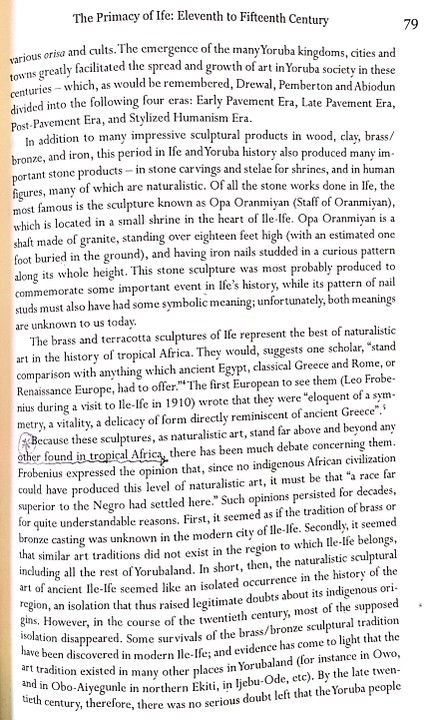
|


