PhysicsHD's Posts
Nairaland Forum › PhysicsHD's Profile › PhysicsHD's Posts
1 2 3 4 5 6 7 8 9 (of 9 pages)
 Culture › Re: RIP Jerry Lawson by PhysicsHD: 11:54pm On Apr 15, 2011 Culture › Re: RIP Jerry Lawson by PhysicsHD: 11:54pm On Apr 15, 2011 |
Wow. Didn't know that. Thanks for the article. R.I.P. to that man indeed. |
| Romance › Re: Does Bromancing Equal Homosexuality by PhysicsHD: 11:48pm On Apr 15, 2011 |
[quote author=ekt_bear link=topic=246199.msg8137399#msg8137399 date=1302906913]^-- Lol, probably not These are mostly americanized persians, not fobs[/quote]I don't think that behavior is viewed as not gay in American culture though. I wouldn't be surprised if Persian culture itself was a little effeminate. I distinctly remember reading that one Shah of Iran, despite supposedly being a Muslim, had a page (a male teenage youth) as his lover and even composed poetry in his honor! Persian, French, Greek, and a few other cultures seem to have a kind of effeminate streak stretching throughout some of their culture (art, literature, romance, and apparently even dancing). |
| Romance › Re: Does Bromancing Equal Homosexuality by PhysicsHD: 11:24pm On Apr 15, 2011 |
[quote author=ekt_bear link=topic=246199.msg8130931#msg8130931 date=1302849803]Err, that picture is not bromancing. That is two friends acting gay, lol. Now, surprisingly enough in some cultures that is cool. I've been to a Persian party before and you'd have straight dudes there humping their friends (with their girlfriends standing right there). I guess in that culture, it isn't gay. Anyway, not for me. . . would be to weird[/quote]wtf Is that what Ahmadinejad does in his spare time? |
| Nairaland General › Re: You Nigerians Should Feel Honored Today Because A Somali(me) Is Visiting Here: by PhysicsHD: 10:56pm On Apr 15, 2011 |
This thread somehow got even stupider than it was when it started. Astonishing. |
| Culture › Re: Nigerians Are Very Rude by PhysicsHD: 10:38pm On Apr 15, 2011 |
lol@ "Gratuitous insolence" That's quite a phrase. I may have to steal that. As far as nairaland, it's all due to anonymity. I usually just assume that the more rude and obnoxious a poster is on here, the more timid and meek they would be in real life. As for the police in Nigeria, I can't explain their behavior. It's dumbfounding. As for airports (immigration) there's a lot of disorder and disorganization at MMA., but I've seen some shocking rudeness at London Heathrow and in France, so it's not exclusive to Nigerians. Traveling can be stressful. |
| Culture › Re: Complaints And Notice Thread. Be Serious! by PhysicsHD: 9:56pm On Apr 15, 2011 |
Mukina, I the spam bot banned the me as PhysicsMHD for another post in this thread: https://www.nairaland.com/nigeria/topic-582176.320.html that wasn't spam. Please unban PhysicsMHD Could you also please make sure my post reappears? Thanks in advance. |
| Culture › Re: Benin Art And Architecture by PhysicsHD(op): 12:32am On Apr 13, 2011 |
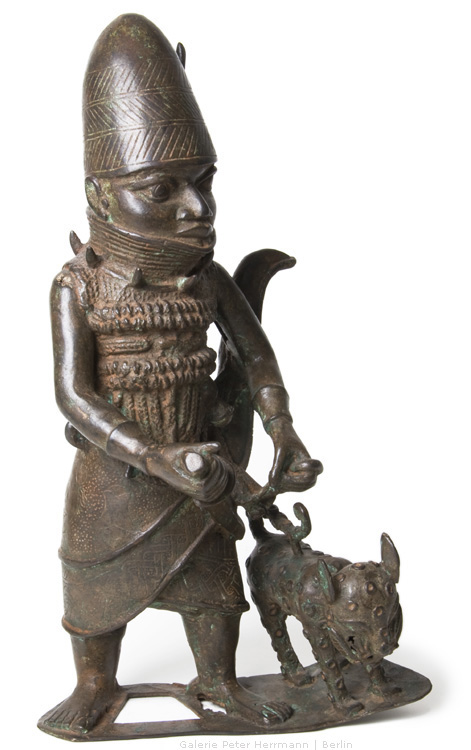
https://www.galerie-herrmann.com/arts/art3/Ife_Benin/87_Krieger_Leo/Warrior_gr.jpg Warrior with Leopard Benin, Nigeria Bronze 44 cm |
| Culture › Re: Benin Art And Architecture by PhysicsHD(op): 12:31am On Apr 13, 2011 |
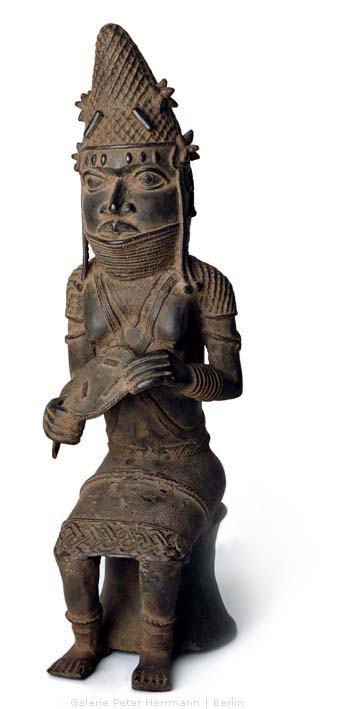
https://www.galerie-herrmann.com/arts/art3/Ife_Benin/39_Koenigin_sitzend/Queenmother_gr.jpg Queenmother Benin, Nigeria About 1700 Bronze 48 cm |
| Culture › Re: Benin Art And Architecture by PhysicsHD(op): 12:30am On Apr 13, 2011 |
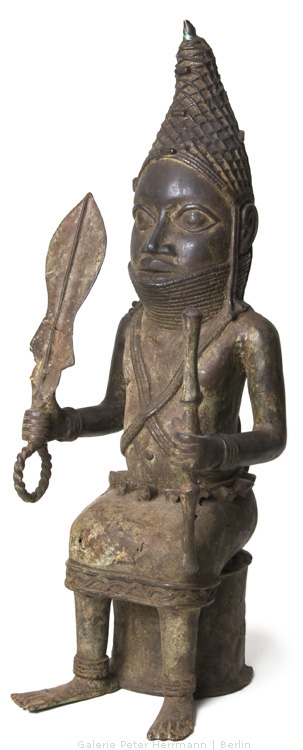
https://www.galerie-herrmann.com/arts/art3/Ife_Benin/39_1_Koenigin_sitz/Queenmother_gr.jpg Queenmother Benin, Nigeria Aboud 1600 Bronze 57 cm |
| Culture › Re: Benin Art And Architecture by PhysicsHD(op): 12:29am On Apr 13, 2011 |
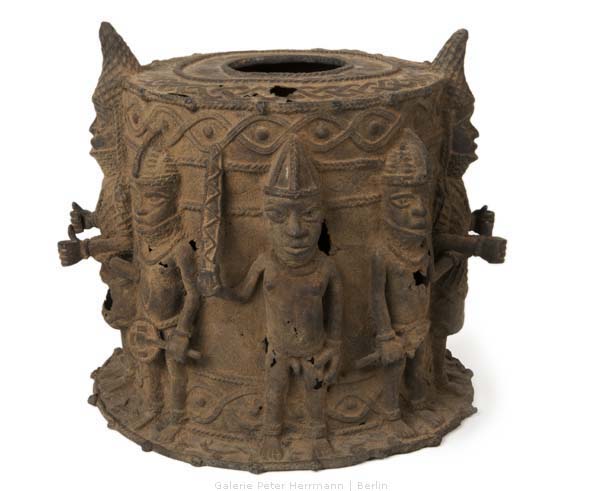
https://www.galerie-herrmann.com/arts/art3/Ife_Benin/82_Handaltar_Iyoba/Handaltar_gr.jpg Altar of the Hand Benin, Nigeria About 1750 Bronze 27 cm |
| Culture › Re: Benin Art And Architecture by PhysicsHD(op): 12:28am On Apr 13, 2011 |
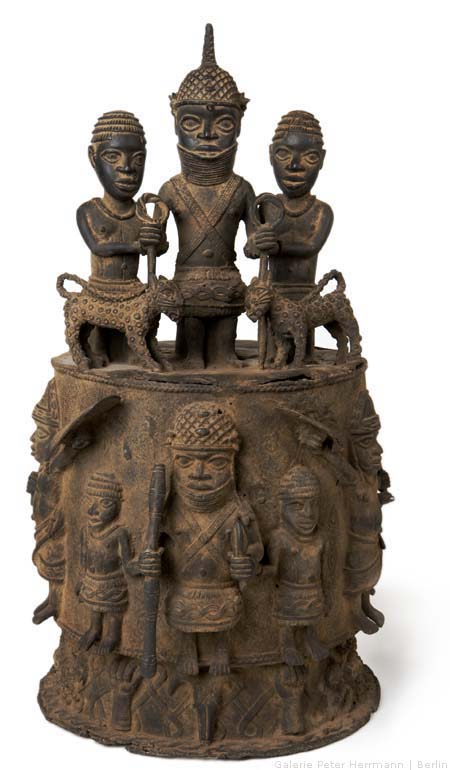
https://www.galerie-herrmann.com/arts/art3/Ife_Benin/81_Handaltar_FigGru/Oba_Figurenaufsatz_gr.jpg Altar of the Hand Benin, Nigeria About 1800 Bronze 55 cm |
| Culture › Re: Benin Art And Architecture by PhysicsHD(op): 12:27am On Apr 13, 2011 |
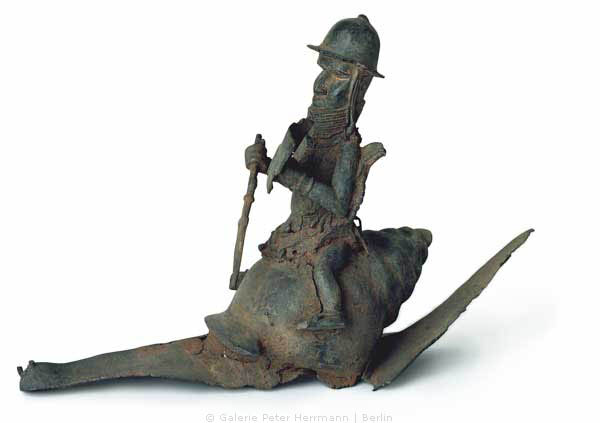
https://www.galerie-herrmann.com/arts/art3/Ife_Benin/63_Schnecke/Schnecke_gr.jpg Warrior Riding a Snail Benin, Nigeria about 1900 Bronze H - 29 cm, L - 43 cm None of the relevant literature makes mention of this or any warrior on a snail. Though the characteristic coral necklace worn by the rider marks him as a member of the royal court, the meaning of the snail can, at this point in time, only be guessed. Considering the fact that animals tend to be closely connected with specific myths, however, the snail may refer to a story concerning the founding of the kingdom of Benin, recorded by the chronicler of Benin Egharevba (1893-1980). According to that myth, the god Osanobua sent his sons to live on earth and instructed each of them to bring something useful with him on his journey. While the older ones chose things like magic or riches, the youngest, acting on the advice of a bird, brought a snail shell. Upon their arrival on earth, the sons discovered that their useful items from the sky could not be used down below. The youngest son, however, was told by the bird to turn over his snail shell, upon which an endless stream of sand began to pour out; the sand flowed continually, forming an enormous piece of land over which the son then reigned, thereby becoming the ruler of the world. This object may very well depict that proud, youngest son of Osanobua - who would later become the founder of the kingdom of Benin - sitting on his useful snail or taking it on a victory ride to celebrate his rule. |
| Culture › Re: Benin Art And Architecture by PhysicsHD(op): 12:25am On Apr 13, 2011 |
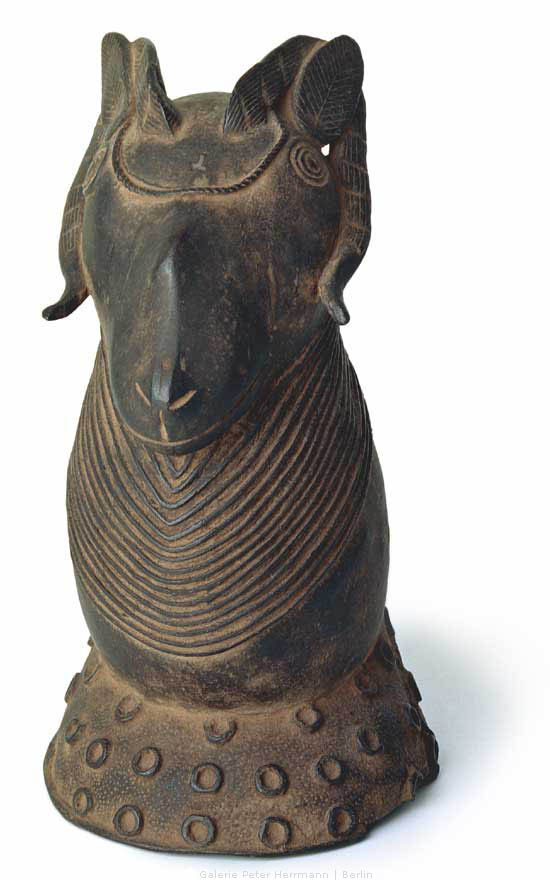
https://www.galerie-herrmann.com/arts/art3/Ife_Benin/62_Hammel/Hammel_gr.jpg Benin, Nigeria Bronze H - 33 cm, L - 33,5 cm This mutton is a very special, unique item for which there are no stylistic relatives or objects of comparison. Its technical distinctiveness and old age (600 years) - recently determined with new methods - lend this object a particular rarefaction. The head is very sensitively rendered and boasts many finely-expressed details, like ears with leaf motif and small chain. The animal's neck evolves directly into a type of base, which, for its part, is decorated with circles. |
| Culture › Re: Benin Art And Architecture by PhysicsHD(op): 12:23am On Apr 13, 2011 |
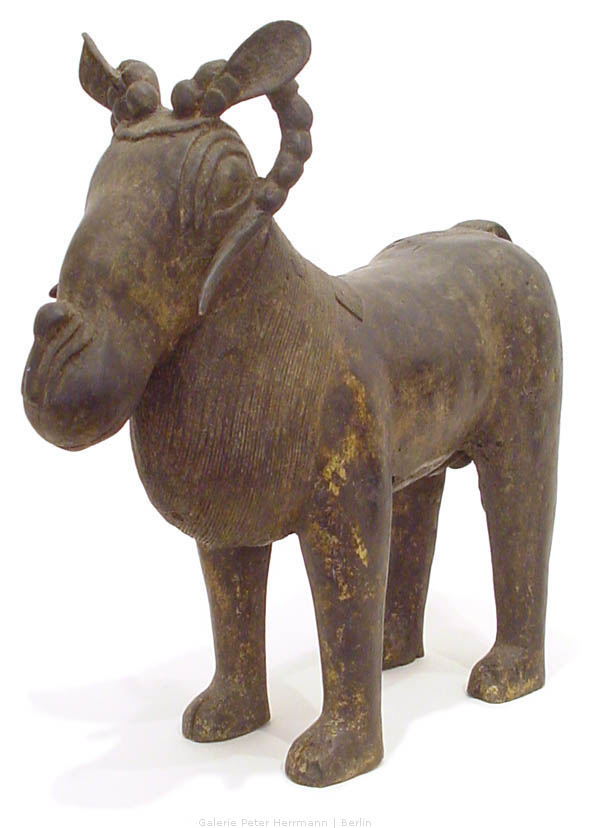
https://www.galerie-herrmann.com/arts/art3/Ife_Benin/61_Widder/Widder_400J_gr.jpg Ram Benin, Nigeria about 1600 Bronze H - 33 cm, L - 33,5 cm A very similar ram can be found in the British Museum in London, though that object is an aquamanile - that is, a ewer. Bronze objects like rams and leopards were often used as ewers for ceremonial ablutions. Though this ram is very similar to the one in London, it lacks the openings on the head and nostrils typical for an aquamanile, and was thus probably created as a symbol of royal power for the altar of a king. In Benin, the ram stands for masculinity and perseverance and was traditionally sacrificed at the Ague Ceremony, inaugurated by Oba Esigie (-1550) as part of an important festival. The naturalistic depiction and lack of symbolic overload of this ram seems to confirm its old age, as determined by TL analysis. Cp.: W./ B. FORMAN, Philip DARK: Die Kunst von Benin, Prag 1960, S. 58/ 59. Barbara PLANKENSTEINER (Hg.): Benin. Könige und Rituale. Höfische Kunst aus Nigeria, Wien 2007, S. 433. |
| Culture › Re: Benin Art And Architecture by PhysicsHD(op): 12:23am On Apr 13, 2011 |
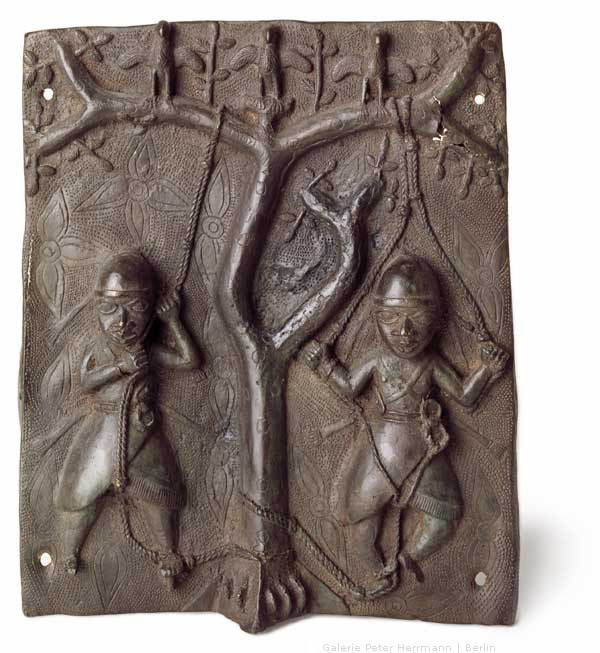
https://www.galerie-herrmann.com/arts/art3/Ife_Benin/70_Relief_Akrobaten/Relief_Akrobaten_gr.jpg Relief Plaque with Amufi Acrobats: Benin, Nigeria 16th-17th century Bronze 58 x 43 cm This relief depicts two acrobats of the Amufi ceremony. As members of one of Benin's many guilds, the acrobats are responsible for climbing trees for certain ritual purposes and for catching osprey for the Oba to sacrifice at the Ugie celebration. It is believed that these members of the Amufi guild are endued with special spiritual powers that enable them to climb the highest treetops, a feat most ordinary people would not and could not achieve. In this particular ritual, the acrobats climb a very high tree, secretly prepared with ropes the night before. Upon reaching the highest perch, they loop the ropes around themselves and leap into the air with arms and legs spread, swinging themselves in large circles and flapping their rattle-draped arms as though they were wings. On the uppermost part of the relief plaque, three big birds perch atop the tree - perhaps the ospreys caught for the Oba by the acrobats. This plaque is remarkable in that it portrays both people in motion and nature, an unusual combination for Beninese plaques. Only one other plaque is stylistically similar: the Relief Plaque with Leopard Hunt. Given that both pieces depict people in unusually contorted positions and trees bedecked with lovingly-formed leaves, one can assume that both plaques were crafted by the same artist, whom Fagg calls the "Master of the Leopard Hunt." His unique, individual style arguably makes him Benin's most significant artist. In general, the minimal stylistic variation of Beninese plaques over the course of many centuries make most efforts at attribution futile; the so-called "Master of the Leopard Hunt" is one of the few artists for whom experts make efforts at attribution. Cp.: Barbara Blackmun, in: Barbara PLANKENSTEINER (Hg.): Benin. Könige und Rituale. Höfische Kunst aus Nigeria, Wien 2007, S. 334/ 335. |
| Culture › Re: Benin Art And Architecture by PhysicsHD(op): 12:15am On Apr 13, 2011 |
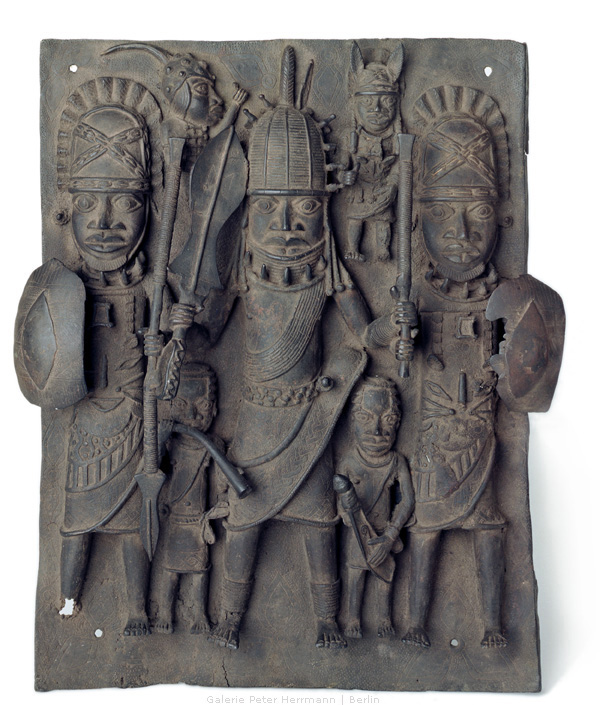
https://www.galerie-herrmann.com/arts/art3/Ife_Benin/56_Relief_170J/7Krieger_gr.jpg Relief Plaque with 7 Warriors Benin, Nigeria About 1830 Bronze 54 x 41 cm |
| Culture › Re: Benin Art And Architecture by PhysicsHD(op): 12:14am On Apr 13, 2011 |
https://www.galerie-herrmann.com/arts/art3/Ife_Benin/73_Relief_8Personen/ReliefPlaque_gr.jpg Relief Plaque with Warrior Benin, Nigeria About 1800 Bronze 50 x 40 cm |
| Culture › Re: Benin Art And Architecture by PhysicsHD(op): 12:13am On Apr 13, 2011 |
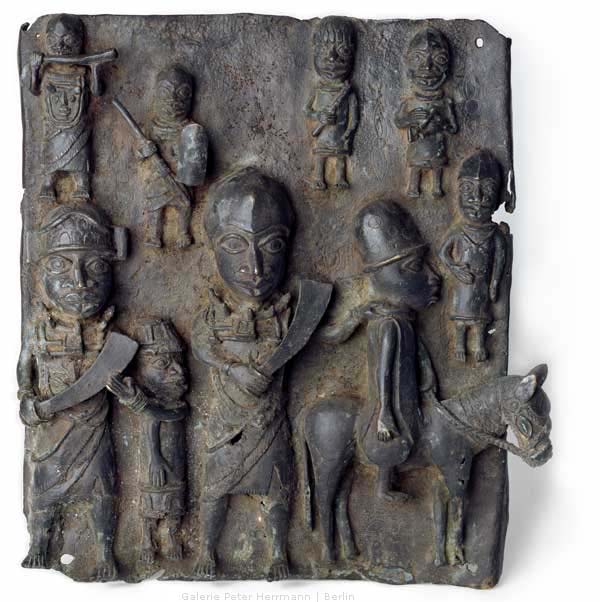
https://www.galerie-herrmann.com/arts/art3/Ife_Benin/59_Relief_9Personen/Relief_9P_gr.jpg Relief Plaque with War Scene Benin, Nigeria 19th century Bronze 49 x 45 cm Relief Plaque with War Scene: This bronze plaque depicts victorious Beninese warriors and their captives in an uncommon variety of shapes and forms and with uncommon detail. At the top left of the image, a hornblower musically accompanies the triumphal procession. The warrior in the middle drives a prisoner sitting on a small horse, holding him on a collar. The fact that the prisoner rides horseback indicates that he has a high rank, but his importance is qualified by the size ratios of the figures on the plaque; the central Beninese warrior is much larger, a clear emphasis of his position as victor. In addition, attributes like the leopard-teeth necklace and crocodile-skin helmet worn by that figure mark him as the highest ranking on the plaque. The warrior on the very left grasps the wrist of an even smaller prisoner and appears to be threatening him with his sabre. At the top of the plaque, several additional, small warriors belonging to the entourage are depicted. |
| Culture › Re: Benin Art And Architecture by PhysicsHD(op): 12:12am On Apr 13, 2011 |
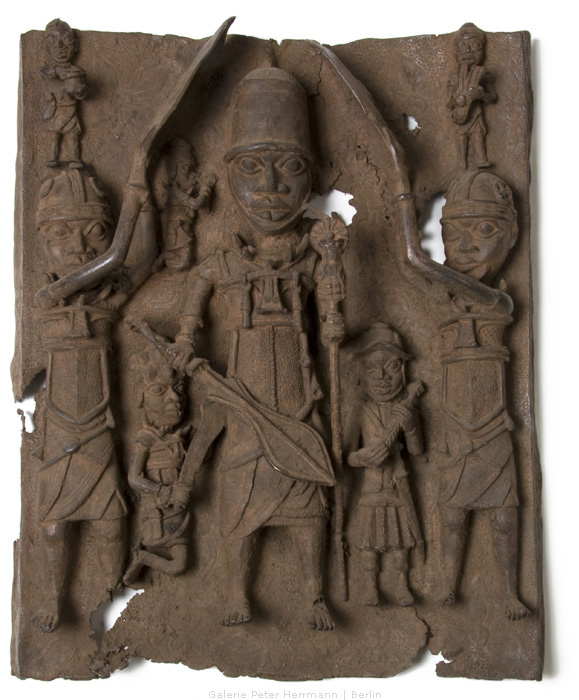
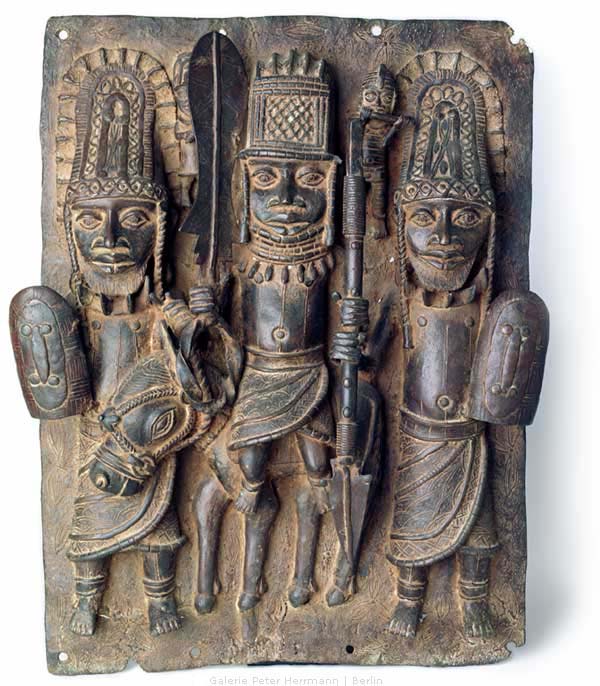
https://www.galerie-herrmann.com/arts/art3/Ife_Benin/57_Relief_Kriegsszene/Krieger_Pferd_gr.jpg Relief Plaque with Warriors Benin, Nigeria 19th century Bronze 47 x 37 cm The headdress of the three warriors on this plaque is reminiscent of that depicted on plaques of Esigie's warrior father Oba Ozolua (1481-1504) and his entourage. Ozoluas' rectangular headdress and the rounded, richly-decorated headdress of his attendants are very typical for this motif, as are the two weapons depicted on this plaque. Only the presence of the horse, not hitherto connected with Ozolua, and absence of the iron cloak for which the Oba was so famous are unusual. Cp.: Barbara PLANKENSTEINER (Hg.): Benin. Könige und Rituale. Höfische Kunst aus Nigeria, Wien 2007, S. 438/ 440. |
| Culture › Re: Benin Art And Architecture by PhysicsHD(op): 10:54pm On Apr 12, 2011 |
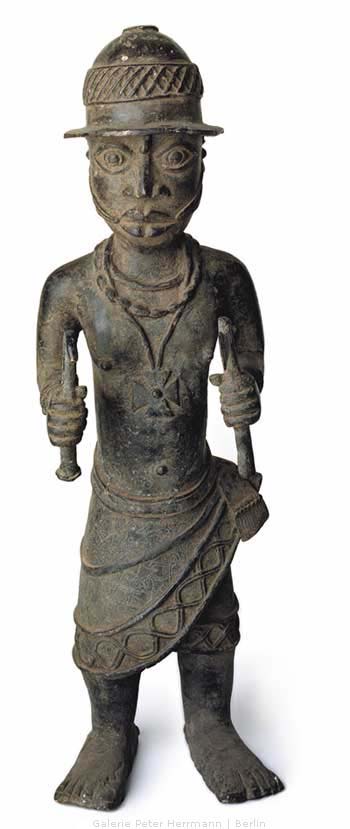
https://www.galerie-herrmann.com/arts/art3/Ife_Benin/36_Krieger_380J/Benin_380Y_gr.jpg Warrior Benin, Nigeria about 1700 33,5 cm The depiction of a warrior in this form is very rare. The figure wears a rounded, cowry-adorned helmet, leopard-teeth necklace, shield and spear, as well as a wrap-around skirt with stiff appendage. |
| Culture › Re: Benin Art And Architecture by PhysicsHD(op): 10:53pm On Apr 12, 2011 |
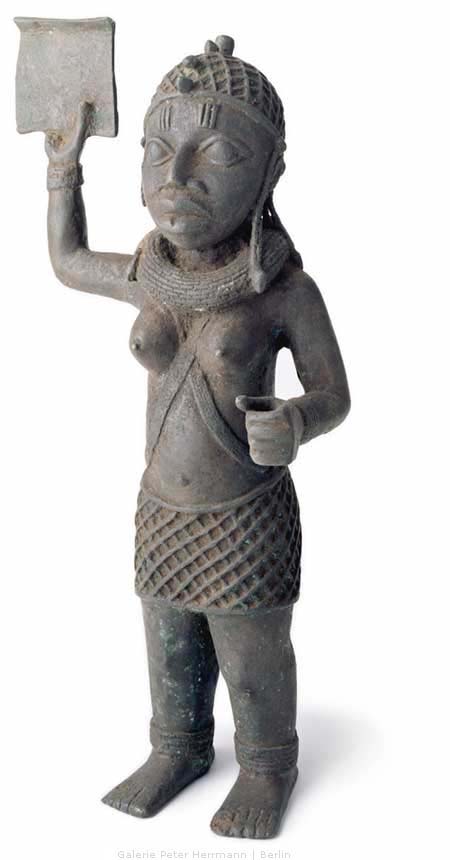
https://www.galerie-herrmann.com/arts/art3/Ife_Benin/34_Frau_500J/Women_gr.jpg Female Figure Benin, Nigeria about 1500 44 cm This figure is exceptional by mere virtue of its sex: in Benin, the depiction of women was almost exclusively reserved for Queen Mothers, with their characteristic peaked, piled-up hair-styles and coral pearls. This figure, too, wears a coral head cover, though hers lies flat against her head and lacks the braided plaits that usually hang down from such caps. The cap and the rotund coral collar - typical of 16 th -century pieces - identify her as a member of palace society, though the exact position she held and the precise meaning of the tablet-like item in her right hand cannot be definitively determined - all the more so given that no objects of comparison whatsoever are known. |
| Culture › Re: Benin Art And Architecture by PhysicsHD(op): 10:49pm On Apr 12, 2011 |
https://www.galerie-herrmann.com/arts/art3/Ife_Benin/21_Statue_m_55cm/Mann_200J_gr.jpg (Ewua-) Dignitary Benin, Nigeria + - 1800 55 cm |
| Culture › Re: Benin Art And Architecture by PhysicsHD(op): 10:47pm On Apr 12, 2011 |
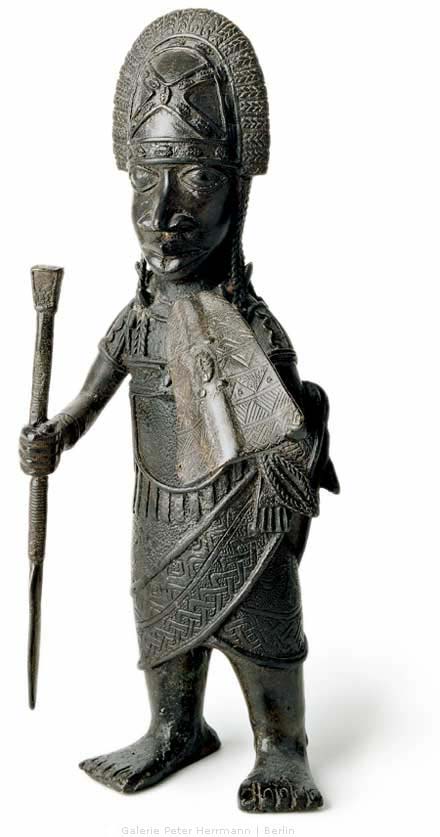
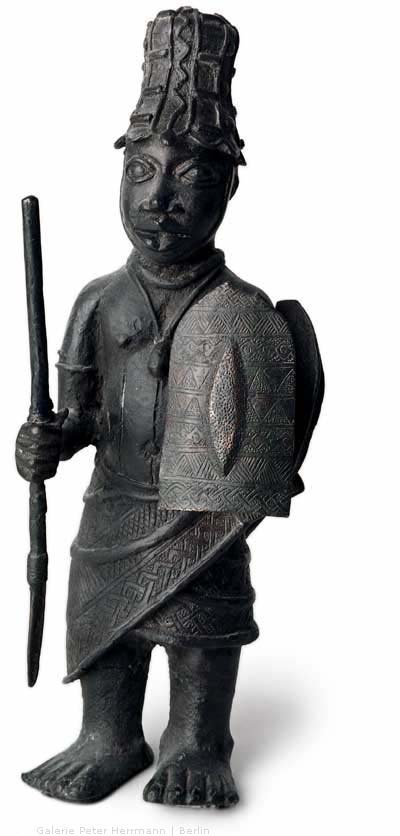
https://www.galerie-herrmann.com/arts/art3/Ife_Benin/38_Krieger/Krieger_gr.jpg Warrior Benin, Nigeria about 1880 Bronze 32 cm This warrior from Benin wears a tall, ornamented helmet, a shield, a spear and a wrap-around skirt with stiff appendage. The tall and pointy appendage is very typical for pieces from Benin. |
| Culture › Re: Benin Art And Architecture by PhysicsHD(op): 10:45pm On Apr 12, 2011 |
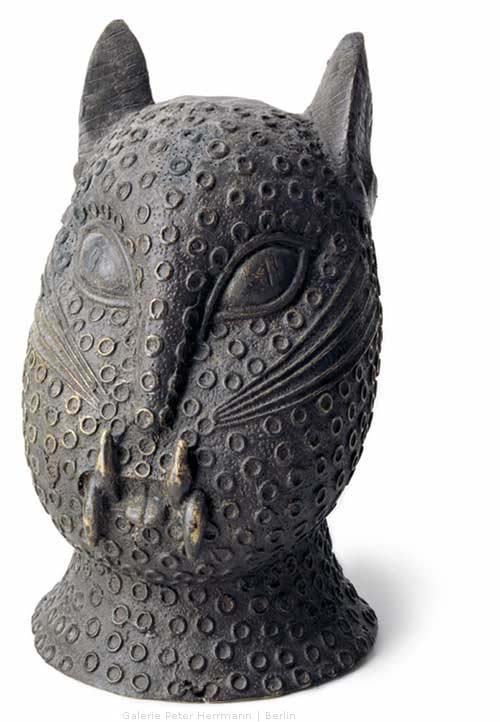
https://www.galerie-herrmann.com/arts/art3/Ife_Benin/66_Leopardenkopf/Leopard_120J_gr.jpg Leopard Head Benin, Nigeria 19th century Bronze 27,5 cm In Benin, the leopard head motif was most often used for masks worn on warriors' hips; a portrayal like this one without discernible function is much rarer. It was perhaps intended for the altar of an Oba given that in many parts of Benin, the leopard still serves as a metaphor for the king. |
| Culture › Re: Benin Art And Architecture by PhysicsHD(op): 10:43pm On Apr 12, 2011 |
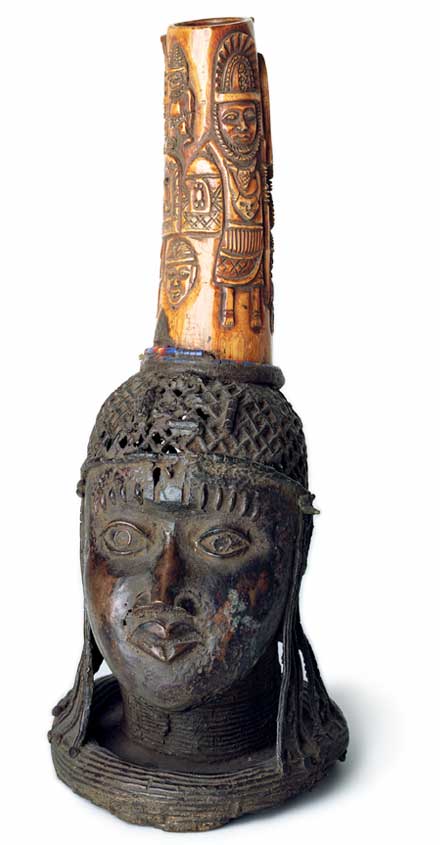
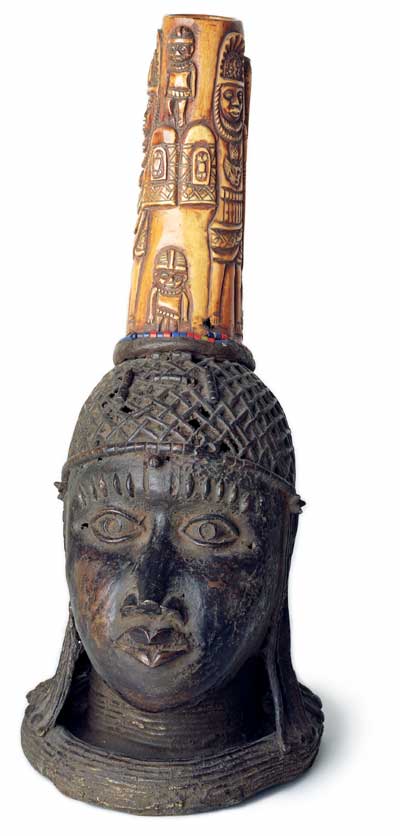
https://www.galerie-herrmann.com/arts/art3/Ife_Benin/19_2Koepfe_Ivory/Kopf2_Ivory.jpg https://www.galerie-herrmann.com/arts/art3/Ife_Benin/19_2Koepfe_Ivory/Kopf1_Ivory.jpg Two Heads with Ivory Benin, Nigeria 18th/19th century Bronze 60 and 61 cm The original ivory top pieces seen here make these two heads very valuable. Quite often, these pieces was detached from the heads and sold separately, making heads with original attachments hard to find. Stylistically, the two heads here bear reference to Benin bronzes from the 16 th century, with coral head caps, single pearls on the foreheads, flared coral collars and hanging pearl plaits. The two faces, however, do not feature the very dignified and smooth features of the earlier Benin bronzes; instead, they are idiosyncratically stylised, suggesting that the heads were intended primarily as bases for the ivory attachments. |
| Politics › Re: Nigeria's First Legal Female Senator Without Court Issues. . . Oluremi Tinubu by PhysicsHD: 7:42pm On Apr 11, 2011 |
Franca Afegbua was the first Nigerian female senator. From Bendel state. |
| Politics › Re: Let's Have Your Complaints Here by PhysicsHD: 10:41pm On Apr 08, 2011 |
Hey Mukina, the spambot attacked me for no reason and banned me as PhysicsMHD. Could you please unban PhysicsMHD and please make this post reappear: https://www.nairaland.com/nigeria?topic=635616.msg8083730#msg8083730 (the most recent post under that profile) I would just use the antispam email thing like it says, but often when I do that, the posts don't ever reappear and they get deleted from my post history (this happened a few times in that Benin art thread I made). I would prefer that this post reappear, so I'm asking you directly. |
| Culture › Re: Benin Art And Architecture by PhysicsHD(op): 5:39pm On Mar 21, 2011 |
https://www.barakatmuseum.com/Auction/ItemImgs/SK.063aw.gif Benin Bronze Bird - SK.063 Origin: Nigeria Dimensions: 11" (27.9cm) high x 5.25 " (13.3cm) wide Collection: African Art Style: Benin Medium: Bronze |
| Culture › Re: Benin Art And Architecture by PhysicsHD(op): 5:37pm On Mar 21, 2011 |
https://www.barakatmuseum.com/Auction/ItemImgs/barakat._294a.jpg Benin Bronze Head - CK.0064 Origin: Nigeria Circa: 16 th Century AD to 17 th Century AD Dimensions: 8.5" (21.6cm) high x 5.5" (14.0cm) wide Collection: African Style: Benin Medium: Bronze Location: United States |
| Culture › Re: Benin Art And Architecture by PhysicsHD(op): 5:36pm On Mar 21, 2011 |
https://www.barakatmuseum.com/Auction/ItemImgs/Leo1B.jpg Benin Bronze Leopard - CK.0001 Origin: Southcentral Nigeria Circa: 16 th Century AD to 18 th Century AD Dimensions: 7.5" (19.1cm) high x 8.75" (22.2cm) wide Collection: African Style: Benin Medium: Bronze Location: United States |