PhysicsHD's Posts
Nairaland Forum › PhysicsHD's Profile › PhysicsHD's Posts
1 2 3 4 5 6 7 8 9 (of 9 pages)
 Culture › Re: We Have No Roots In Nigeria- Obi Metzeger, Ayo King by PhysicsHD: 4:13am On Feb 15, 2011 Culture › Re: We Have No Roots In Nigeria- Obi Metzeger, Ayo King by PhysicsHD: 4:13am On Feb 15, 2011 |
lol, Africanus Horton was a stooge for the British. He went with the British to pacify the Ashanti and then turned around and started yapping about African nationalism and independence. Clown. Anyway, this thread shouldn't have turned out the way it did. There were definitely Igbo Sierra Leone people in olden times and up to the present time, although, like Yorubas in some countries other than Nigeria, they may not identify themselves under the label of Igbo. |
| Politics › Re: The President Has A Ph.D, But I think he has Low IQ by PhysicsHD: 8:56pm On Jan 20, 2011 |
The thread title is inherently contradictory. |
| Politics › Re: Nigerian Academia In Diaspora by PhysicsHD: 8:55pm On Jan 20, 2011 |
Polycarp A. Ikuenobe Polycarp Professor Education: * Wayne State University, Ph.D. 1993 Philosophy * University of Ibadan, Nigeria, M.A. 1983 Philosophy * University of Ibadan, Nigeria, B.A. 1981 Philosophy Areas of Scholarly/Teaching Interest: Philosophy of Law, Social/Political Philosophy, Africana Philosophy Selected Publications: Books 1. Philosophical Perspectives on Communalism and Morality in African Traditions, Lexington Books, 2006. 2. Symposia, Readings in Philosophy: Libertarianism, Pearson Custom Publishing, 2001. Articles 1. "Descriptive Procedural Aspects of Aquinas's Natural Law Theory," Vera Lex 5 (2004): 65-89. 2. "On the Theoretical Unification and Nature of Fallacies," Argumentation 18 (2004): 189-211. 3. "Logical Positivism, Analytic Method, and Criticisms of Ethnophilosophy," Metaphilosophy 35 (2004): 479-503. 4. "Natural Law, Liberal Principles, and the Moral Acceptance of Rules," Vera Lex 2 (2001): 133-62. 5. "Rationality, Practical Reasonableness, and the Social and Moral Foundation of a Legal System," Journal of Social Philosophy 32 (2001): 245-67. 6. "The Meta-Ethical Issue of the Nature of Lying: Implications for Moral Education," Studies in Philosophy and Education 21 (2002): 37-63. 7. "Moral Epistemology, Relativism, African Cultures, and the Distinction Between Custom and Morality," Journal of Philosophical Research 27 (2002): 641-69. http://www.kent.edu/CAS/Philosophy/department/faculty.cfm |
| Politics › Re: Nigerian Academia In Diaspora by PhysicsHD: 8:53pm On Jan 20, 2011 |
| Politics › Re: Nigerian Academia In Diaspora by PhysicsHD: 8:52pm On Jan 20, 2011 |
Winston Soboyejo, Professor Ph. D. Cambridge University (1988) Fellow of the American Society of Mechanical Engineers Fellow of the Materials Society of Nigeria Fellow of the Nigerian Academy of Science Profile Wole Soboyejo was educated at King's College London, and The University of Cambridge before coming to the the United States in 1988 to become a research scientist at The McDonnell Douglas Research Labs in St. Louis, MO. In 1992, he worked briefly as a Principal Research Engineer at the Edison Welding Institute before joining the engineering faculty of The Ohio State University in Columbus, OH. From 1997 to 1998, he was a Visiting Professor in the departments of mechanical engineering and materials science and engineering at MIT. Dr. Soboyejo moved to Princeton University in 1999 as a Professor of Mechanical and Aerospace Engineering. He is also the Director of the U.S./Africa Materials Institute, and the Director of the Undergraduate Research Program at The Princeton Institute of Science and Technology of Materials. His research focuses on experimental studies of biomaterials and the mechanical behavior of materials. Current areas of interest include micromechanical machines, nanoparticles for disease detection, biomedical systems for prostheses, and cardiovascular systems, infrastructure materials, and alternative energy systems. Principal Research Efforts * Biomaterials and nanoparticles for disease detection & treatment * MEMS and BioMEMS * Fatigue and fracture of materials * Alternative energy systems * Affordable infrastructure http://www.princeton.edu/mae/people/faculty/soboyejo/ |
| Politics › Re: For Or Against A Referendum Like What The Sudanese Did? by PhysicsHD: 1:09am On Jan 10, 2011 |
Well, when jihad is declared from the west or from edo state, or a boko haram group emerges from there, I might believe you. . . |
| Politics › Re: For Or Against A Referendum Like What The Sudanese Did? by PhysicsHD: 1:00am On Jan 10, 2011 |
jason123:@ the bold, you must be joking name one devious act committed by any non-Northern Muslim |
| Culture › Re: Benin Art And Architecture by PhysicsHD(op): 12:49am On Jan 10, 2011 |
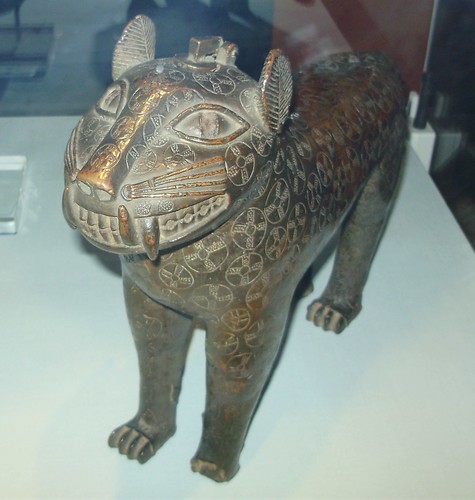
https://farm4.static.flickr.com/3599/3363667266_ea54c94be7.jpg "cat water holder It's Benin bronze and from the 14th century. Basically there is a hinge on the back of the cats head, which can be opened up to pour water inside. If you want to pour water out, then the water comes out the cats nostrils." |
| Culture › Re: Benin Art And Architecture by PhysicsHD(op): 12:45am On Jan 10, 2011 |
| Culture › Re: Benin Art And Architecture by PhysicsHD(op): 12:42am On Jan 10, 2011 |
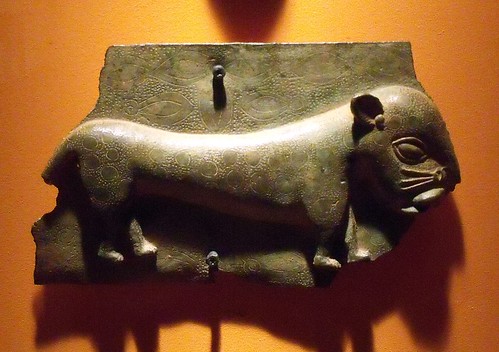
https://farm5.static.flickr.com/4085/5057238882_ae452488e9.jpg Plaque au léopard Début XVIIe siècle, Bronze, 16,5 x 29 cm, Provenance : Bénin, Nigéria, Musée Ethnographique, Stockholm |
| Culture › Re: Benin Art And Architecture by PhysicsHD(op): 12:41am On Jan 10, 2011 |
[img]http://161.58.35.145/wch/gallery/Quarter1/African/11-Benin-Culture,-Ceremonial-Totemism,-from-Nigeria,-c.-17th.jpg[/img] Benin Culture 17th Century |
| Culture › Re: Benin Art And Architecture by PhysicsHD(op): 12:39am On Jan 10, 2011 |
[img]http://161.58.35.145/wch/gallery/Quarter1/African/09-Benin-Culture,-Plaque-with-Leopard-Totemistic-Relationshi.jpg[/img] Benin Culture Plaque with Leopard |
| Culture › Re: Benin Art And Architecture by PhysicsHD(op): 12:36am On Jan 10, 2011 |
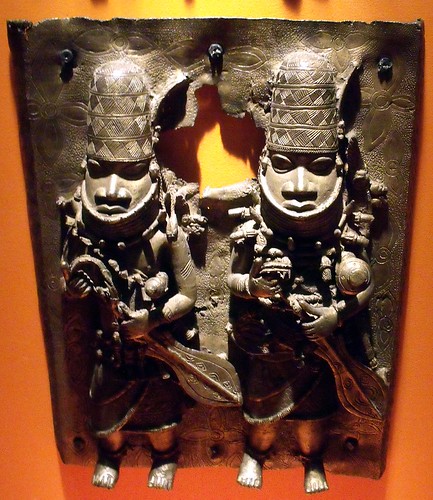
https://farm5.static.flickr.com/4084/5057314814_335d83d734.jpg Plaque de bronze avec deux guerriers Fin XVIIe siècle, Bronze, 44,5 x 34 cm, Provenance : Bénin, Nigéria, Musée Ethnographique, Stockholm |
| Culture › Re: Benin Art And Architecture by PhysicsHD(op): 12:34am On Jan 10, 2011 |
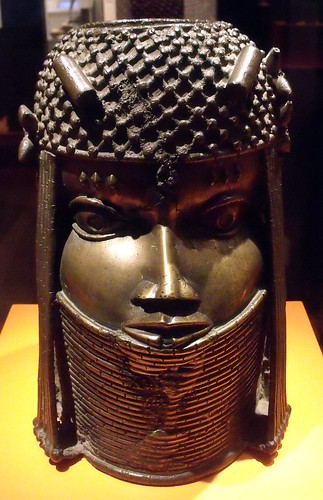
https://farm5.static.flickr.com/4084/5056446027_185e56b9c5.jpg Tête en bronze commémorative d'un chef Oba destiné à un autel des ancêtres dans le palais royal XVIIe siècle, Bronze, Provenance : Palais Royal, Etat d'Edo, Bénin, Nigéria 22 x 30,5 21 cm, Musée Ethnographique, Stockholm |
| Culture › Re: Benin Art And Architecture by PhysicsHD(op): 12:32am On Jan 10, 2011 |
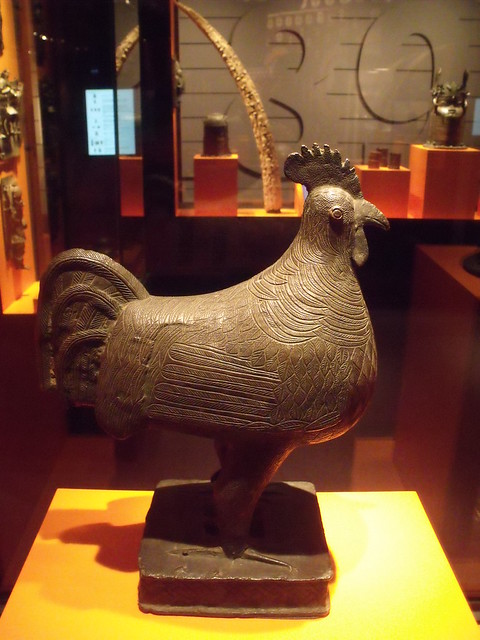
https://farm5.static.flickr.com/4091/5056936289_6d512ddc35_z.jpg Coq de bronze XVIIIe siècle, Bronze, 30,5 x 40 x 15 cm, Provenance : Bénin, Nigéria, Musée Ethnographique, Stockholm |
| Culture › Re: Benin Art And Architecture by PhysicsHD(op): 12:30am On Jan 10, 2011 |
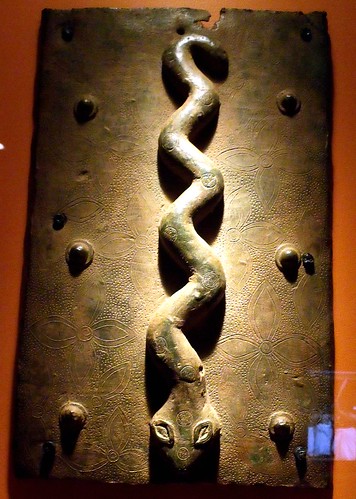
https://farm5.static.flickr.com/4110/5057345776_fd06f2a280.jpg Plaque de bronze avec un serpent Fin XVIe siècle, Bronze, 47 x 30 cm, Provenance : Bénin, Nigéria, Musée d'Ethnographie, Stockholm |
| Culture › Re: Benin Art And Architecture by PhysicsHD(op): 12:28am On Jan 10, 2011 |
Akhenaten: I have always been an admirer of the Benin Empire. The architecture, the works of art, the structure of government etc. However, I have one question.I had actually already responded to this post yesterday, but I included a long piece of an article that talked about the habitual depopulation of Benin due to war campaigns and in-fighting, so the spambot deleted the post. However the other part of what I said was: "I suspect that the Bini were just a smaller section of whatever group most of Southern Nigeria came out of, like the Idoma, Igala, Ijaw, etc. . . compared to Igbo and Yoruba. But another thing to consider is that Bini diverged from other groups such as the other groups in Edo state some of which may have come from Benin city hundreds of years ago. There are also groups like Edo-Akure, and some other Ondo Edos who identify as Yorubas now, and a few more such people in Lagos. However the most convincing argument to me comes from just looking at it in terms of math: If the population of Bini at one point is 1 million, and the population of Yoruba in Nigeria is 7-8 million at one point and both groups multiply by around 3.5 (the same rate of reproduction of Bini people and Yoruba people) over six decades, the Bini would only be 3.5 million while the Yoruba would be 24.5 - 28 million, and what started as only a 6-7 million difference becomes a 21 - 24.5 million difference, and we are left dumbfounded when there is actually nothing out of the ordinary in this. If we have 1 million Bini at one point and 6 million Igbo and Bini multiply by 3.5 and Igbo by 4 (only a slightly greater reproduction rate) over six decades we only have 3.5 million Bini but have 24 million Igbo. There was originally a 5 million difference, but it becomes 20.5 million. There is nothing bizarre about this in reality." Which I think makes a fair amount of sense. |
| Culture › Re: What Does It Mean To B A Royal Prince by PhysicsHD: 12:24am On Jan 10, 2011 |
h |
| Culture › Re: Ekpe Masquerades by PhysicsHD: 12:15am On Jan 10, 2011 |
Abagworo:^^^^ Really? I would have thought they were just a different front of the Annang/Ibibio group |
| Culture › Re: Questions about Nok People by PhysicsHD: 12:08am On Jan 10, 2011 |
| Culture › Re: Benin Art And Architecture by PhysicsHD(op): 7:41am On Jan 09, 2011 |
https://img122.imageshack.us/img122/3919/p1010061cw6.jpg https://img294.imageshack.us/img294/925/p1010063fv6.jpg https://img294.imageshack.us/img294/925/p1010063fv6.jpg https://img175.imageshack.us/img175/776/p1010065zn6.jpg https://img140.imageshack.us/img140/6828/p1010067tb4.jpg https://img230.imageshack.us/img230/8631/sanstitre2fy7.jpg https://img140.imageshack.us/img140/1921/sanstitre5xh5.jpg |
| Culture › Re: Benin Art And Architecture by PhysicsHD(op): 7:36am On Jan 09, 2011 |
PhysicsHD:Looking at this picture again, I see why some people make those ancient Egyptian claims. There are certainly rams in Nigeria though, so a foreign influence is not needed. |
| Culture › Re: Benin Art And Architecture by PhysicsHD(op): 7:29am On Jan 09, 2011 |
https://cache.virtualtourist.com/1407600-Bight_of_Benin_in_chiefs_house-Nigeria.jpg House of a chief (modern) 1 Like |
| Culture › Re: Benin Art And Architecture by PhysicsHD(op): 7:25am On Jan 09, 2011 |
From a pretty interesting facebook group: "THE IMPERIAL ARCHITECTURE OF GREAT BENIN" by Enosakhare Idubor: https://sphotos.ak.fbcdn.net/photos-ak-sf2p/v240/83/82/672240193/n672240193_855087_7873.jpg Note the roof. https://sphotos.ak.fbcdn.net/photos-ak-sf2p/v240/83/82/672240193/n672240193_860804_6019.jpg "A rare picture of the Pyramidal roofing style that was unique to Great Benin Architecture.Please note the bird on top of the roof and the snake. A 17th century Dutch explorer described the Benin palace as a collection of buildings, which would be as vast as the town of Haarlem. To a certain extent, one can envisage the architecture of Benin's palace on the basis of descriptions provided by Dutchman Olfter Dapper (1635-1689); accordingly, the scene depicted here can be reasonably interpreted as the gateway to the Oba's palace. Dapper's descriptions, for example, mention a tower crowned with bronze-cast bird and snake. Such towers were used to mark the entrance to the palace or the passageways from one courtyard to the next. The roof is not, however, decorated with palm leaves as Dapper describes, but rather with wood shingles. It is supported by pillars engraved with decorative faces, and the bird that tops it is an attribute typical for this motif. It is usually seen as an ibis, though sometimes as a thrush, and it has special meaning in Benin's culture as a soothsaying and prophesising bird. The two armed palace guards on the steps wear aprons and tall coral collars, which designate them as high-ranking members of royal court society. The two other attendants are unclothed but for a small coral necklace and a handheld fan. Above the roof, a four-leafes motif dominates the background. This motif appears very often on bronze plaques from Benin and is associated with Olokun, god of the water. Benin palace, southern Nigeria, 1668; the bird and the snake as ornamentation –› Although wood was not used for ordinary buildings, some nails found in the palace allow the possibility that wooden shingles used to cover the building. However other sources claim that palm leaves were the covering material. The same impluvium system was built and water was collected and stored in underground tanks. In African architecture, ornamentation was a constant feature, which allowed impressing the outsider, but also promoting the morale, pride and solidarity of one people. Architectural decorations were passing on through generations, and evolving towards "purified" motifs every time. One technique was the carving of walls, creating visible contrasted patterns in the strong sunlight. Painting usually used colours such as black, red, white and ochre. Pressing natural objects (pebbles or pieces of mica) into the wet clay was also common. In some palaces, pillars were often covered with bronze plaques illustrated with victories and deeds of the former obas. Bronze birds and snakes used to ornate the high towers, the bird presumably protecting against lightning, and the snake representing the power of the oba. AHIANMWEN ORO (ORO BIRD) The bird on the famous roofing is the Oro Bird(Ahianmwen Oro)It was introduced by Esigie(1504 A.D-Egharevba)after the defeat of the Idah army as part of the Ugioro which was started by Ewedo in commemoration of affluence.Ugioro itself has been in existence since 1255;but it was Esigie who cast the bird in bronze some 250 years later and installed it on the roof of the palace. Okorho Iro Eweka IKPINAME-the sea deity( BOA CONSTRICTOR) The Snake that meanders on top of the roof must be IKPINAME-the sea deity introduced by Ozolua(1481A.D.)In the Edo language,IKPIN is the name of BOA CONSTRICTOR,which is the largest snake known to the Edo people.One of the kings titles is IKPINAME NE-IWAME NO'KHURHU.That indicates the king's divinity and his custodianship of Justice and Honesty:IKPINAME drinks only clean water,not dirty or muddy one. Okorho Iro Eweka To a certain extent, one can envisage the architecture of Benin's palace on the basis of descriptions provided by Dutchman Olfter Dapper (1635-1689); accordingly, the scene depicted here can be reasonably interpreted as the gateway to the Oba's palace. Dapper's descriptions, for example, mention a tower crowned with bronze-cast bird and snake. Such towers were used to mark the entrance to the palace or the passageways from one courtyard to the next. The roof is not, however, decorated with palm leaves as Dapper describes, but rather with wood shingles." |
| Culture › Re: Benin Art And Architecture by PhysicsHD(op): 7:21am On Jan 09, 2011 |
https://wysinger.homestead.com/beninpicture_op_800x650.jpg Benin City Seventeenth-century engraving illustrating a court ceremony. In the foreground is the king of Benin on horseback, surrounded by musicians, dwarfs, and attendants with tame leopards, and leading a procession of chiefs and warriors, also on horseback. The middle ground shows the royal palace, which has high turrents surmounted by large cast-brass birds with outstretched wings. In the background, separated by a wall, is the town of Benin. Presided over by the oba, or king, the city was both a major trading center and the religious and political capital of the Edo people. From Olfert Dapper, Beschreibung von Afrika (1967: pl. opp. 486), first published in Amsterdam in 1670. https://wysinger.homestead.com/benin78.jpg Dapper, Olfert. Naukeurige Beschrijvinge der Afrikaensche gewesten. Amsterdam: Jacob von Meurs, 1668: "The King's court is certainly as large as the town of Haarlem, and is entirely surrounded by a special wall. . . . It is divided into many magnificent palaces, houses, and apartments of the courtiers. Fine galleries, about as large as those on the Exchange at Amsterdam, are supported by wooden pillars, from top to bottom covered with cast copper on which are engraved the pictures of their war exploits and battles, and they are kept very clean." Photo from: "De Stadt Benin." In Olfert Dapper's Beschreibung von Afrika. (Amsterdam, 1670) https://wysinger.homestead.com/2benin2.jpg View of Benin city in 1891 before the British conquest. H. Ling Roth, Great Benin, Barnes and Noble reprint. 1968. Image from the book African Cities and Towns Before the European Conquest, by Richard W. Hull, published in 1976 |
| Culture › Re: Benin Art And Architecture by PhysicsHD(op): 7:19am On Jan 09, 2011 |
The Ogiso Period Ogiso ("Rulers of the Sky"  , who may have numbered as many as thirty-one kings, ruling the kingdom of Benin between 900 - 1170 AD, which is the earliest period so far accounted for in Benin history (Plankensteine 2007). , who may have numbered as many as thirty-one kings, ruling the kingdom of Benin between 900 - 1170 AD, which is the earliest period so far accounted for in Benin history (Plankensteine 2007).The first ruler, according to Benin traditions, was Igodo, a prominent elder in his community (Odionwere) who exercised authority over all other elders (Edionwere). Igodo is said to have ruled all the various small communities which collectively formed the kingdom known as 'Igodomigodo', meaning 'land of Igodo' or 'town of towns'. The most prominent among the known Ogiso rulers are Igodo, Ere, Orire, Oriagba and Owodo. The kingdom began as a union of juxtaposed clusters of independent communities, each surrounded by a moat (Egharevba 1968). Fortification of Benin City The defensive fortification of Benin City, the capital, consisted of ramparts and moats, call iya, enclosing a 4000 square kilometer (2485.5 miles) of community lands. In total, the Benin wall system encompasses over 10,000 kilometres (6213.7 miles) of earth boundaries. Patrick Darling, an archaeologist, estimates that the complex was built between 800 and 1000 up to the late fifteenth century (Keys 1994: 16). Advantageously situated, the moats were duged in such a manner that earthen banks provided outer walls that complemented deep ditches. According to Graham Connah, the ditch formed an integral part of the intended barrier but was also a quarry for the material to construct the wall or bank (Keys 1994: 594). The ramparts range in size from shallow traces to the immense 20-meter-high rampart (66 feet) around Benin City (Wesler 1998: 144). The Guinness Book of World Records describes the walls of Benin City as the world's second largest man-made structure after China's Great Wall), in terms of length, and the series of earthen ramparts as the most extensive earthwork in the world. During the second half of the 15th century, Oba Ewuare the Great ordered a moat to be dug in the heart of the city. The earthworks served as a bastion and also afforded control of access to the capital which had nine gates that were shut at night. Travel notes of European visitors also described the Benin walls (e.g. Pacheco Pereira 1956: 130-147; Dapper 1668). It was finalized around 1460, at that time being the world's largest earthwork. |
| Culture › Re: Benin Art And Architecture by PhysicsHD(op): 7:15am On Jan 09, 2011 |
https://www.randafricanart.com/images/Benin_mask_of_iyoba_c1550_1_.gif Benin, Queen Mother (Iyoba) c1550 Hip Mask 9" ivory, iron, copper 1 Like |
| Culture › Re: Benin Art And Architecture by PhysicsHD(op): 7:15am On Jan 09, 2011 |
https://www.randafricanart.com/sitebuilder/images/012s_1_-436x631.jpg https://www.randafricanart.com/sitebuilder/images/hb_1978.412.323_1_-426x754.jpg Pendant Mask: Iyoba, 16th century Nigeria; Edo peoples, court of Benin Ivory, iron, copper (?); H. 9 3/8 in. (23.8 cm) The Michael C. Rockefeller Memorial Collection, Gift of Nelson A. Rockefeller, 1972 (1978.412.323) 1 Like |
| Culture › Re: Benin Art And Architecture by PhysicsHD(op): 7:14am On Jan 09, 2011 |
1 Like |
| Culture › Re: Benin Art And Architecture by PhysicsHD(op): 7:14am On Jan 09, 2011 |
1 Like |