MCentral's Posts
Nairaland Forum › MCentral's Profile › MCentral's Posts
1 2 3 4 5 6 7 8 9 10 (of 10 pages)
 Business › These 12 Nigeria Listed Companies Are Worth A Billion Dollars Or More by MCentral(op): 11:44am On May 15, 2025 Business › These 12 Nigeria Listed Companies Are Worth A Billion Dollars Or More by MCentral(op): 11:44am On May 15, 2025 |
…debunks Business Insider story MoneyCentral has been able to identify 12 Nigeria listed companies on the stock exchange (NGX) worth a billion dollar or more in market capitalization. The firms are diverse and cut across various sectors including: Telecommunications, Industrial Goods, Oil and Gas, Banking and Finance, Consumer Goods and Energy. The firms with listing on the stock exchange in Lagos Nigeria have market capitalization as at 15th May 2025 of: Airtel Africa with market capitalization of $4.93 billion (N7.9 trillion), Dangote Cement $4.64 billion (N7.42 trillion), BUA Foods $4.23 billion (N6.77 trillion), MTN Nigeria $3.64 billion (N5.83 trillion), Seplat Energy $2.05 billion (N3.289 trillion), Geregu Power $1.78 billion (N2.854 trillion). Others Nigeria billion dollar companies are: BUA Cement $1.72 billion (N2.753 trillion), Transcorp Power $1.54 billon (N2.464 trillion), Guaranty Trust Holding Company GTCO $1.45 billion (N2.32 trillion), Aradel $1.3 billion (N2.08 trillion), Zenith Bank $1.24 billion (N1.992 trillion) and Nigerian Breweries $1.065 billion (N1.704 trillion). An exchange rate of USD1 to NGN1,600 was used for the conversion from naira to dollar (see chart below). https://moneycentral.com.ng//wp-content/uploads/2025/05/NGX-Billions.png Misleading report debunked An earlier report by Business Insider Africa had erroneously stated that there was only one Nigerian company valued at $1 billion. The report quoting Visual Capitalist, said there are 5,522 publicly listed firms globally valued at $1 billion or more. “The United States leads with a market capitalization of $60.1 trillion and accounts for 1,873 billion-dollar companies—commanding 49% of the global market share,” it said. The report however conflates private companies (Unicorns) with public ones when it came to Africa. Even at that Nigeria is known to have several Unicorns (private companies worth $1bn or more) including Flutterwave, Paystack, Interswitch and MoniePoint among others. The Nigeria Stock Exchange (NGX) has an equity market capitalization of $41.9 billion and has risen 5.96% year-to-date. https://moneycentral.com.ng/companies/article/these-12-nigeria-listed-companies-are-worth-a-billion-dollars-or-more/ https://moneycentral.com.ng//wp-content/uploads/2023/08/NGX.jpg 12 Likes 3 Shares
|
| Politics › Re: CBN Wage Bill Surges To N608 Billion After Massive Layoffs by MCentral(op): 12:40pm On May 14, 2025 |
BondRiv:The wage bill is actually outrageous. N608 billion in 1-year (for probably 3,000 workers or thereabouts) is more than at least 30 State Governments budgets. |
| Politics › CBN Wage Bill Surges To N608 Billion After Massive Layoffs by MCentral(op): 2:12am On May 14, 2025*. Modified: 12:34pm On May 14, 2025 |
The Central Bank of Nigeria (CBN) saw its wage bill surge by 106% to N608.5 billion in 2024 despite laying off thousands of workers. In 2024, the CBN laid off approximately 1,000 staff members in a mass termination exercise carried out in four batches between March and May. In its summary financial statements for the Year ended December 2024 seen by MoneyCentral, the CBN revealed that costs related to the layoffs (under the other staff expenses line item) in personnel expenses rose 712% to N306.62 billion, up from N37.75 billion in 2023. “Included in the other staff expenses are early exit payments made during the year,” the CBN said. Other components of Personnel expenses that made up the massive CBN wage bill include: Other staff allowances of N191.94 billion up 14% from 2023 levels, defined benefit plan expenses of N36.577 billion up 48%, wages and salaries of N55.6 billion, up 18% and pension costs (defined contribution plans) of N17.779 billion up 2.7% compared to 2023 levels. These all added up to a CBN total 2024 wage bill of N608.54 billion, up a massive 106% in 1-year compared to N295.37 billion in 2023. The CBN layoffs, attributed to organizational and human capital restructuring, led to a lawsuit filed by disengaged staff demanding N30 billion in compensation. The affected staff argued that the process violated the CBN Act, which requires board approval for significant employment decisions, and that some were denied fair compensation. The Governor of the Central Bank of Nigeria (CBN), Olayemi Cardoso, said earlier in 2025 that the apex bank’s staff who left service in December last year initiated their voluntary disengagement with payment of full benefits. The unusually high CBN wage bill was equivalent to 51.8% of its net operating income of N1.173 trillion for 2024. https://moneycentral.com.ng/exclusive/article/cbn-wage-bill-surges-to-n608-billion-after-massive-layoffs/ https://moneycentral.com.ng//wp-content/uploads/2020/04/Central-Bank-of-Nigeria-Headquarters-e1480992190126.jpg |
| Business › CBN Records Net Operating Profit Of N1.17trn In 2024 On FX, Gold Revaluation by MCentral(op): 8:12pm On May 13, 2025 |
..profit after tax hits N38.84bn The Central Bank of Nigeria (CBN) recorded a net operating profit of N1.17trn in 2024—largely driven by significant net unrealised gains on foreign exchange (FX) revaluations. The net FX gains jumped to N11.28trn from N3.47trn alongside fair value gains of N684.16bn on gold bullion. Data from the CBN’s 2024 financials seen by MoneyCentral shows that currency issuance expenses surged to N238.65bn in 2024 (from N1.11bn in 2023), evincing higher cost of printing, processing, and disposal of banknotes. This, however, translated into a 49.05% growth in the currency in circulation in 2024 compared to the 163.51% surge in 2023, indicating a more measured liquidity management strategy by the CBN. The higher currency expense, coupled with a sharp rise in personnel expenses to N608.55bn, eroded the Bank’s profit position and resulted in an operating loss of N28.21bn. Consequent to the CBN’s efforts to clear inherited FX backlogs, losses on settled derivative settlements—mainly from swaps, forwards, and futures—rose to N13.88trn, more than doubling the N6.25trn recorded in 2023. With the Naira significantly weaker, settling these dollar-linked contracts came at a much higher cost. The CBN would have ended the year in another loss-making position but for the N72.89bn share of profit from equity-accounted investees, which ultimately lifted the CBN to a modest profit after tax (PAT) of N38.84bn, reversing the N1.16trn loss recorded in 2023FY. The Bank’s external reserves made up the largest component of total asset accounting for 46.56% of the N117.60trn recorded in 2024 (from N87.87trn in 2023), while debt instruments increased by +12.91% to N29.87trn (vs. N26.46trn), representing 25.39% of the total assets. The CBN’s external reserves grew by +6.01% YoY to USD38.84bn, while the Naira value jumped by +82.49% to N54.73trn (from N29.98trn in 2023), largely reflecting the impact of Naira depreciation. On the other hand, the non-liquid component, primarily held in gold bullion, rose by +117.9% to N2.770 trn. Despite the value increase, the volume of gold held remained constant at 687,402 troy ounces. This surge in value was driven by the rise in global gold prices, which climbed from USD2,062.98 per ounce in 2023 to USD2,624.39 per ounce in 2024. https://moneycentral.com.ng/exclusive/article/cbn-records-net-operating-profit-of-n1-17trn-in-2024-on-fx-gold-revaluation-gains/ https://moneycentral.com.ng//wp-content/uploads/2024/07/Yemi-Cardoso.jpg |
| Car Talk › Re: What Will You Do If You Were In My Position? by MCentral: 4:31pm On May 13, 2025 |
HelenaWills:This is dumb. Why didnt u tow the car to your house at the first sign of trouble and then get a trusted mechanic to work on it at our home? How can u be paying for car repairs that they just tell you to bring money for this and that and you just send the money? 13 Likes |
| Politics › Nigerian States Awash With Cash Go On Spending Spree Amid FAAC Revenue Boom by MCentral(op): 11:47am On May 13, 2025 |
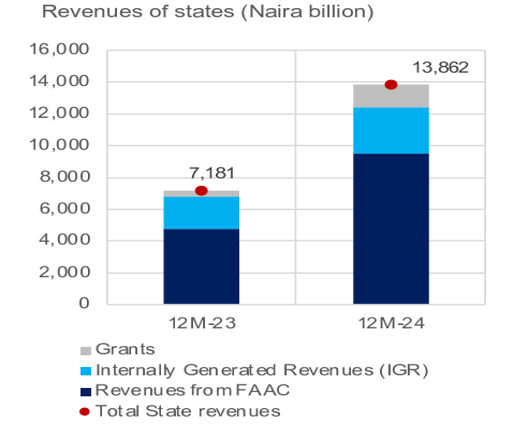
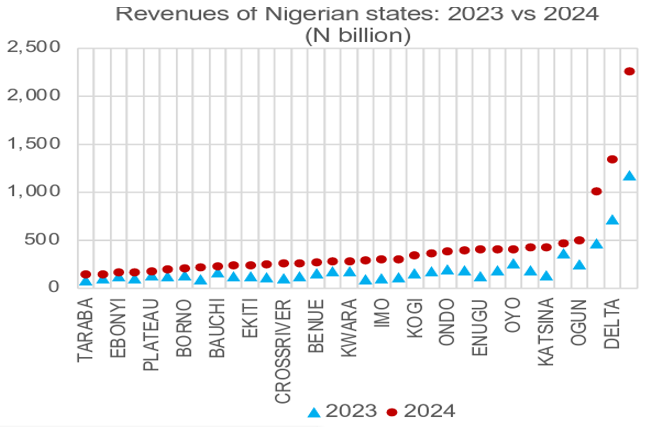
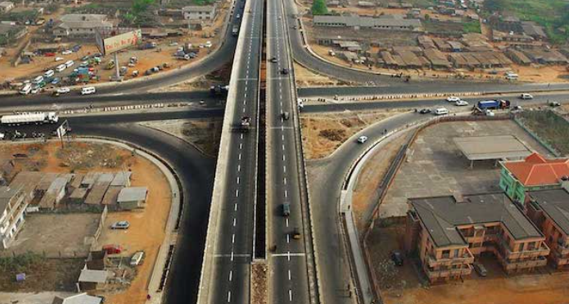
Nigerian states received more FAAC inflows leading to total revenue of N13.8 trillion in 2024, than the Federal Government (N12.3 trillion) and as a result embarked on a spending spree to build badly needed infrastructure. States are experiencing a fiscal surplus on aggregate, albeit with significant variation. Based on data compiled from various Budget Implementation Reports (BIRs), a total of 34 Nigerian states recorded an aggregate surplus of approximately N1.6 trillion (0.6 percent of GDP) in 2024, significantly higher than the N437 billion (0.2 percent of GDP) surplus in 2023, according to a World Bank biannual development report on Nigeria released on Monday. While most states maintained a near-balanced fiscal position, some, such as Niger and Ebonyi, recorded fiscal deficits, whereas others—mainly oil-producing states like Ondo, Akwa Ibom, and Delta—reported large surpluses. https://moneycentral.com.ng//wp-content/uploads/2025/05/States-revenue.png The improved fiscal position at the state level in 2024 stems from significantly higher revenues, driven in part by large refunds to states that had been deducted from FAAC. Revenues for the 34 states with available BIRs surged from N7.2 trillion in 2023 (3.1 percent of GDP) to N13.9 trillion in 2024 (5 percent of GDP). The seven oil-producing states—Abia, Akwa Ibom, Bayelsa, Delta, Edo, Imo, and Ondo—benefited the most from the FAAC windfall, accounting for 31 percent of the total revenue increase in 2024. In addition to the FAAC increase, state Internally Generated Revenues (IGR) grew by 46 percent, reaching N2.9 trillion (1 percent of GDP), while grants and aid nearly tripled to N1.5 trillion (0.5 percent of GDP), further strengthening state finances. Given the significant fiscal space created by the surge in revenues, states have substantially increased their spending, primarily on capex. State expenditures rose from N6.7 trillion in 2023 (2.9 percent of GDP) to N12.2 trillion (4.4 percent of GDP) in 2024, driven almost entirely by higher capex, which more than doubled from N3.3 trillion in 2023 to N7.4 trillion in 2024. This increase reflects the very large infrastructure gap, which many states suffer from. https://moneycentral.com.ng//wp-content/uploads/2025/05/States-revenues-2.png Sectoral data reflect this trend, with capital-intensive sectors such as transport, agriculture, mining, housing, and other industries seeing spending increases of over 100 percent, most of which is devoted to capex. Meanwhile, social sectors – including social protection, education, and health – also saw notable spending growth, albeit at lower rates of 57, 63, and 75 percent, respectively. States have been spending on infrastructure improvements across the 6 geopolitical zones. In a recent Arise TV interview, Governor Alex Otti of Abia State told Rufai Oseni that the total cost of the Julius Berger contract for Port Harcourt Road Aba was N36 billion. The Enugu State government allocated a total of N183 billion for the construction of 141 urban roads and 20 rural roads across the state. Additionally, N55 billion was allocated for the construction, reconstruction, and rehabilitation of urban and rural roads in the 2025 fiscal year. In 2024, the Lagos State government allocated N550.689 billion for infrastructure development and maintenance. This amount represents 24.28% of the entire state budget. The funding will support ongoing transportation projects, including the expansion of the rail network, road construction, and completion of the Blue and Red Lines. Additionally, the state allocated N55.924 billion for affordable housing and urban renewal projects. The Kaduna State Government awarded 78 road projects totaling 775Km in the last 21 months to March 2025, with 21 of the roads already completed and in use. The Commissioner of Public Works and Infrastructure, Ibrahim Hamza, disclosed this at the Quarterly Ministerial Press Briefing at Sir Kashim Ibrahim House, Kaduna. In 2024, Delta State, Nigeria, had a proposed budget of N714.4 billion, which includes various road projects and other development initiatives, according to the state government. https://moneycentral.com.ng/exclusive/article/nigerian-states-awash-with-cash-go-on-spending-spree-amid-faac-revenue-boom/ https://moneycentral.com.ng//wp-content/uploads/2025/05/Nigeria-states-road.png 2 Likes |
| Business › Re: Nigeria’s Equities Market Now Boasts 11 Unicorns, See List by MCentral: 9:48am On May 13, 2025 |
DaddyJapan:Ignorant analysis. Unicorns are Private Companies not listed on the Stock Exchange. Like MoniePoint, Flutterwave etc. In the context of finance and investing, a "unicorn" refers to a privately held startup company with a valuation exceeding $1 billion. This term, borrowed from mythology, signifies a company that has achieved immense value and often represents significant growth and innovation within its industry. Key characteristics of a unicorn: Privately held: Unicorns are not publicly listed on stock exchanges. |
| Car Talk › Lexus, Toyota Top The Most Reliable Used-car Brands In 2025 by MCentral(op): 12:02pm On May 10, 2025 |
Seven Japanese automakers ranked among the top 10 most reliable used car brands for 2025, with Lexus taking the top spot. Over 150,000 five- to 10-year-old vehicles from 26 brands were analyzed across 20 potential trouble areas and assigned an overall reliability rating Lexus topped the reliability rankings with a score of 81, followed by parent company Toyota with a score of 74. To come up with these reliability scores, Consumer Reports asked its members to report how many problems they’ve had with their vehicles over the past 12 months. This analysis focused only on cars from the 2015 to 2020 model year, with a sample size of over 150,000 vehicles. American manufacturers Buick and Cadillac ranked No. 6 and No. 10 with scores of 53 and 48, respectively, while Volvo, scoring 49, was the only other non-Japanese brand in the top 10 at No. 7. See the full list of reliable cars here. From this data we can see that Japanese brands are generally the most reliable when buying used, with the lowest ranked Japanese brand being Subaru, in ninth place. Toyota and its luxury arm, Lexus, hold the top two spots, while Honda and Acura come in fourth and fifth. https://moneycentral.com.ng//wp-content/uploads/2025/05/Car-Used.png https://moneycentral.com.ng/companies/article/lexus-toyota-top-the-most-reliable-used-car-brands-in-2025/ |
| Business › Banks Hike Employee Pay As Staff Costs Account For 27.44% Of Operating Expense by MCentral(op): 7:32am On May 06, 2025 |
Employee costs account for 27.44 percent of the total operating costs of Nigerian banks in the first quarter of 2025, posing challenges to banks in improving their net interest margins as lenders hiked pay for workers to cushion the impact of cost of living.https://moneycentral.com.ng/companies/article/banks-hike-employee-pay-as-staff-costs-account-for-27-44-of-operating-expenses/ 2 Likes
|
| Business › Re: Banks Increase Cost Of SMS Alerts By 50%, Blame TELCO’s Tariff Hike by MCentral(op): 8:06am On May 02, 2025 |
Antichristian2:Its a dicey situation because you could be more susceptible to fraud if you don't have instant notice of any debit on your account. Also its not every time one can check email or even have data to check. Good luck though. |
| Business › Banks Increase Cost Of SMS Alerts By 50%, Blame TELCO’s Tariff Hike by MCentral(op): 7:16am On May 02, 2025 |
Nigerian Banks have begun to increase the cost of SMS transaction alerts to customers by up to 50%, which they are blaming on tariff hike by telecommunications firms.https://moneycentral.com.ng/companies/article/banks-increase-cost-of-sms-alerts-by-50-blame-telcos-tariff-hike/ 1 Like
|
| Politics › MTN Pays N1.03bn Towards Enugu-onitsha Expressway Reconstruction In Q1, 2025 by MCentral(op): 1:34am On May 01, 2025 |
Telecommunications giant MTN Nigeria prepaid the sum of N1.03 billion towards the reconstruction of the Enugu-Onitsha Expressway in the First Quarter (Q1) of 2025. The total prepayments made so far by MTN towards repair of the road is N19.853 billion as at March 2025. “These are costs incurred towards the reconstruction of the Enugu-Onitsha expressway under the Road Infrastructure Development and Refurbishment Investment Tax Credit (“Road Tax Credit”) Scheme,” MTN Nigeria said in notes accompanying its First-Quarter (Q1), 2025 financial statement. The telecoms giant is expected to complete the dualisation of the 110-kilometre road. MTN Nigeria announced in 2024 that it achieved a significant milestone as the road reconstruction reached 17% completion. The RITC scheme grants income tax credit to companies and individuals that provide funding for the refurbishment and rehabilitation of roads. The scheme is a public-private partnership (PPP) intervention that enables the Nigerian government to leverage private sector capital and efficiency for the construction, repair, and maintenance of critical road infrastructure in key economic areas in Nigeria. Participants will be entitled to utilise the total cost (project cost), incurred in the construction or refurbishment of an eligible road as a tax credit against their future Companies Income Tax (CIT) liability, until full cost recovery is achieved. In August 2021, MTN announced plans to reconstruct the Enugu-Onitsha expressway, under the RITC. https://moneycentral.com.ng/companies/article/mtn-pays-n1-03bn-towards-enugu-onitsha-expressway-reconstruction-in-q1-2025/ https://moneycentral.com.ng//wp-content/uploads/2023/07/MTN-new-logo.jpg 1 Like |
| Business › Re: BUA Beats Dangote On Sugar Revenue For The First Time by MCentral(op): 6:24am On Apr 07, 2025 |
plumcomm:Yes the Nigerian economy is currently expanding fast and Tinubus reforms are beginning to take shape. The only potential hiccup now is if we get into aa global recession or major downturn in oil prices due to the Trump Tariffs. However that is a less than 20% probability for now. |
| Business › BUA Beats Dangote On Sugar Revenue For The First Time by MCentral(op): 5:21am On Apr 07, 2025 |
BUA Foods Plc segment or subsidiary BUA Sugar Limited has dethroned Dangote Sugar Refinery Plc on revenue, first time ever for the company, according to data gathered by MoneyCentral. The sugar segment of BUA Foods, alone, brought in N735.50 billion in revenue during 2024. That beat Dangote Sugar’s sales for the period, which came in at N661.18 billion, according to data gathered by MoneyCentral. Analysts are sanguine that the diversified product base of BUA Foods that has emerged the largest producer of the sweetener in Nigeria will continue to magnify Group’s top line growth much faster than peer rival who is struggling with huge foreign exchange losses. BUA’s victory stems from its focus on investments in expansion projects as it continues to provide a solid foundation for further growth and competitiveness. The company sources its main raw materials and food commodities from agricultural producers both domestically and outside the country as it consolidates on its backward integration policies, which is aimed at significantly reducing imports and bolster local production. To further develop the agricultural value chain and enhance local sourcing, as part of its initiative, BUA Foods plans to expand its farm-to-table initiatives to involve collaboration with external growers to source wheat and edible oils. While Dangote Sugar and most of the consumer goods firms have been recording recurring losses after tax due to foreign exchange revaluation losses as they are engulfed by macroeconomic headwinds, BUA Foods is thriving. For instance, BUA Foods posted a profit after tax (PAT) of N265.99 billion as at December 2024. On the other hand, Dangote Sugar posted a loss of after tax of N192.61 billion. While investors have sold Dangote Sugar’s stock leading to a 1-year return of -45.76% because of uncertainty about the company’s earnings, BUA Foods has a price to earnings ratio of 27 times. Established in 2005, the Sugar Division of BUA Foods Plc has two ultramodern and automated sugar refineries in Apapa, Lagos and Port Harcourt that utilise state-of-the-art equipment to refine high-quality products for industrial uses. The sugar refineries have a total combined... https://moneycentral.com.ng/companies/article/bua-beats-dangote-on-sugar-revenue-for-the-first-time/ https://moneycentral.com.ng//wp-content/uploads/2025/04/BUA-Sugar-Refinery.png 1 Like |
| Travel › Re: Enugu Air Receives First Embraer 170 Plane In Readiness For Takeoff (VIDEO) by MCentral(op): 11:35am On Mar 31, 2025 |
Jakumo:Yea and safe too |
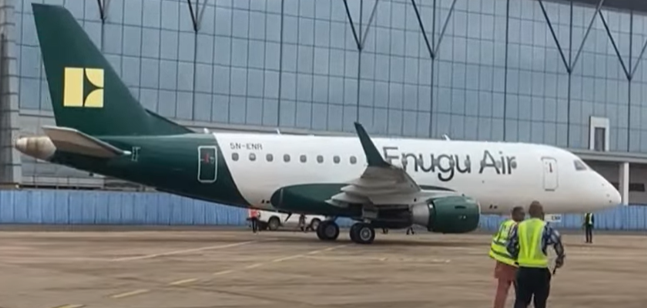
| Travel › Enugu Air Receives First Embraer 170 Plane In Readiness For Takeoff (VIDEO) by MCentral(op): 9:29am On Mar 29, 2025 |
The first Airplane in the Enugu Air fleet has just arrived the Akanu Ibiam International Airport Enugu, as the Peter Mbah led Government of Enugu delivers on its promise of a state Airline. MoneyCentral understands that the aircraft is an E170. The Embraer 170, or E170, is a regional jet developed by Embraer, known for its reliability and adaptability, suitable for regional and short-haul flights. The E170 typically seats around 72 passengers in a single-class configuration, 66 in a dual-class configuration, and up to 78 in a high-density configuration. See video below: https://moneycentral.com.ng/markets/article/enugu-air-receives-first-embraer-170-plane-in-readiness-for-takeoff-video/ https://moneycentral.com.ng//wp-content/uploads/2025/03/Enugu-Air.png |
| Politics › Dangote Industries Working Capital Loans Bite As Gross Debt Hits N14 Trillion by MCentral(op): 10:53am On Mar 26, 2025 |
…Placed on Ratings Watch Negative Dangote Industries Limited debt has risen and deteriorated the gearing metrics due to new working capital loans taken to procure crude oil for the refinery during its phased commissioning in 2024. Group earnings were also compressed in the nine-month period to 30 September 2024 (9M 2024), as the refinery was loss making during the commissioning phase, masking the profitability of other operating subsidiaries. Revenue growth substantially rose to N9.6 trillion (USD6.8 billion) in 9M 2024, primarily driven by the traded volumes of diesel, naphtha, aviation turbine kerosene (ATK), as well as strong cement and fertilizer sales, according to data from a Ratings report seen by MoneyCentral. However, the EBITDA margin fell below 10% compared to a five-year historical average of 33.7%, highlighting the inherently low oil refining margins and more so during the commissioning phase. Dangote Industries Gross debt (including shareholder loans) jumped above N14 trillion in 9M 2024 (2023: N6.4 trillion) well ahead of analysts projection of N5.4 trillion, according to GCR Ratings. This was occasioned by the substantial increase in working capital funding for the refinery operations and the impact of Naira devaluation on foreign debt. Short-term debt rose to N8.2 trillion (2023: N4.4 trillion), although refinancing risk is somewhat mitigated by the subordinated shareholder loans of N3.8 trillion that have been deferred and crude oil finance facilities that are backed by fast selling inventories. Overall, there was a marked deterioration in the leverage metrics as of 9M 2024, with net debt to EBITDA at 18x (2023: 5.6x) and net interest coverage at 0.5x (2023: 1.6x). GCR Ratings (GCR) placed Dangote Cement Plc’s national scale long-term and short-term issuer ratings of AA+(NG) and A1+(NG) respectively on Rating Watch Negative. Working capital MoneyCentral earlier reported that Dangote Refinery owned by Africa’s richest man Aliko Dangote needs at least $3 billion for working capital, to help procure adequate crude feedstock supply, which could significantly impact the refinery’s liquidity and profitability. Refineries have large working capital requirements which constitutes a significant use of liquidity and intra-month changes in working capital needs can be large because payments for crude and customer payments for products are not perfectly aligned. Changing crude prices can further exacerbate the swings in working capital, trading sources told MoneyCentral. https://moneycentral.com.ng/companies/article/dangote-industries-working-capital-loans-bite-as-gross-debt-hits-n14-trillion/ https://moneycentral.com.ng//wp-content/uploads/2023/06/Aliko-Dangote.jpg |
| Politics › Re: Access Bank Commercial Paper Issuance Raises Liquidity Red Flags Among Investors by MCentral(op): 12:18pm On Mar 25, 2025 |
Poten111:AIG was doing his Coronation thing during Wigwes time at the helm. Wasn't fully involved then. Seems since being recalled as Chairman now he is way over his head. |
| Politics › Re: Access Bank Commercial Paper Issuance Raises Liquidity Red Flags Among Investors by MCentral(op): 7:58am On Mar 25, 2025 |
sholatech:Yes Wigwe was the major executioner of the global growth vision for Access. His demise has taken a huge toll 2 Likes 1 Share |
| Politics › Re: Access Bank Commercial Paper Issuance Raises Liquidity Red Flags Among Investors by MCentral(op): 1:29am On Mar 25, 2025 |
DeLaRue:A lot of banks like to mess up the little guys, so when they fight back its usually to the end. |
| Politics › Access Bank Commercial Paper Issuance Raises Liquidity Red Flags Among Investors by MCentral(op): 1:10am On Mar 25, 2025 |
Access Bank, a wholly owned subsidiary of Access Holdings Plc is in the market to raise up to N194 Billion as part of its Series 3/4 Commercial Papers (CP) Issuance, a situation that is raising liquidity fears and worries about possible financial weakness on the part of the Tier-One Bank by investors. Access Bank is paying up steeply for the CP cash as the 180 Day Commercial paper has an implied yield of 19.45% while the 270 Day Commercial Paper has an implied Yield of 24.75%, according to the Pricing Supplement for the Offer seen by MoneyCentral. “The net proceeds from each issue of Notes will be used to support the Issuer’s short-term working capital and its lending activities, or as may otherwise be described in the Applicable Pricing Supplement,” Access Bank said. The problem with this investor’s told MoneyCentral is that Commercial Banks don’t usually go the Commercial Paper route to raise short term liquidity as they usually get access to cheap funding via huge deposit base that commercial banks rely on. For instance, as of Q3 2024, Access Bank posted total assets of ₦40.6 trillion, of which ₦11.9 trillion were in loans and advances to customers and ₦22.3 trillion in customer deposits, according to the bank’s most recent financial statement. Only Access Bank Has Issued CP among major Lenders in 5-Years Commercial papers (CP) are short-term debt instruments (up to 270 days) issued by corporations to raise quick cash, and in Nigeria, they’re mostly tracked by the FMDQ Exchange, with oversight from the Central Bank of Nigeria (CBN) and Securities and Exchange Commission (SEC). Analysis of Commercial Paper Issuance in Nigeria from 2020 – 2025 shows the largest issuers were Dangote Cement with N281.79 billion total by 2024 under a N300 billion program (expanded from N150 billion in 2021), MTN Nigeria Communications Plc, N375 billion in 2023, N127 billion (Series 1 & 2) in 2022, N52.8 billion (Series 8 & 9) earlier. Other major issuers were Flour Mills of Nigeria, Nigeria Breweries, UACN, C & I Leasing and Mixta Real Estate, among issuers that were largely no-financial firms. The data shows that Access Bank was the only commercial bank to issue Commercial Paper over the past 5-years, showing how rare it was for deposit money banks to do so. Access to CBN Discount window and Interbank market Big tier-one commercial banks have massive deposit pools and access to Central Bank of Nigeria’s (CBN’s) discount window or interbank markets for short term liquidity needs. “The big banks are less desperate for CPs unless they’re dodging high borrowing costs or need a specific liquidity jolt. Their funding is already cheap and steady,” one banking Treasury source told MoneyCentral. The interbank rate in Nigeria, as reported by the Central Bank of Nigeria (CBN), is the rate at which banks lend to each other, and it’s a key indicator of the short-term money market conditions. On March 20, 2025, the interbank rate was 30.16 percent. Meanwhile the CBN has lifted its suspension on banks borrowing from its Standing Lending Facility (SLF) and set the lending rate at 31.75%, allowing authorized dealers access to the SLF and Intraday Lending Facility (ILF). Sources tell MoneyCentral that while these rates are marginally higher than the 270 DAY Commercial Paper on offer by Access Bank, most banks would still prefer to use the CBN Intraday Facilities or Interbank market than issue CPs which lock in longer tenors which would be more expensive source of liquidity for them over time. Regulatory and Market Dynamics While some Merchant Banks have issued commercial papers (CPs) in Nigeria over the past five years (2020–2024) such as NOVA Merchant Bank, Coronation Merchant Bank, FSDH Merchant Bank, and Rand Merchant Bank, analysts MoneyCentral talked to said those were largely due to their small balance sheets size as well as the fact that they are non-deposit-taking institutions, that focus on corporate finance, advisory, and short-term lending. “Commercial Banks issuing CPs is an anomaly and Merchant Banks do it because they don’t have the deposit base of commercial banks,” another banking source told MoneyCentral. “Issuing CPs by Commercial banks could signal weakness to depositors or regulators, who expect them to self-fund via deposits or CBN facilities or the N1 trillion daily repo market.” Basel III compliance also pushes deposit money banks toward long-term bonds for Tier-2 capital, such as Eurobonds, as opposed to short-term CPs. Access Bank South Africa Credit Ratings Withdrawn as Losses Mount GCR Ratings (GCR) last week withdrew the national scale, long and short term issuer credit ratings of Access Bank (South Africa) Limited without review. The withdrawal was due to analytical reasons as GCR said it has not received adequate information from Access Bank (South Africa) Limited to meet the rating agency’s standard information sufficiency requirement. “Therefore, the issuer credit ratings cannot be sustained, meaning GCR no longer supports any previously assigned ratings,” GCR said. Its Limited issuer credit ratings were last reviewed by GCR in June 2024. Despite capital injections of Zar1.4bln (N115 billion) by Access holdings, since its acquisition of Access Bank South Africa in 2021, persistent losses have continued for the subsidiary. GCR had forecast a financial loss at year end 2024 for Access Bank South Africa, after the firm recorded losses in 2023. Capitalisation was expected to deteriorate in the short to medium term and Access Bank South Africa would have to return to shareholders or the market to increase capital soon, according to GCR. Access Bank South Africa Limited is the 24th (out of 30) largest regulated banks in South Africa, with a market share across assets, loans and deposits of less than 0.1%. To increase its market share, Access Bank Plc offered to acquire Bidvest Bank Holdings Ltd., for about 2.8 billion rand ($159 million) to help Nigeria’s biggest lender by assets expand in South Africa. The credit rating withdrawal by GCR does not imply that the entity is not servicing its debt obligations or that its financial position has deteriorated, but rather that it has failed to provide important information pertaining to its credit profile. N12.76 trillion Claimed Against Access in Lawsuits Access Bank is involved in 1,846 (One thousand, Eight Hundred and Forty-Six) cases, of which 1,843 of the cases were instituted against the Issuer (Access Bank), while the other 3 cases were instituted by Access Bank, in terms of claims and litigation in which it is currently engaged, as of 31 December 2024, according to the Law firms Wigwe & Partners and Aluko & Oyebode who signed documents as part of the Offer Memorandum. The total amount, including general damages, claimed against the Issuer in the 1,843 cases instituted against the Issuer is N12,763,485,411,444. (Twelve Trillion, Seven Hundred and Sixty-Three Billion, Four Hundred and Eight-Five Million, Four Hundred and Eleven Thousand, Four Hundred and Forty-Four Naira. The law firms said they were o the opinion that the... https://moneycentral.com.ng//wp-content/uploads/2020/05/Access-Bank.jpg https://moneycentral.com.ng/companies/article/access-bank-commercial-paper-issuance-raises-liquidity-red-flags-among-investors-on-possible-financial-weakness/ |
| Business › Oando, Dangote Cement Top List Of Most Indebted Nigerian Firms by MCentral(op): 10:11am On Mar 20, 2025 |
In this article, MoneyCentral will discuss briefly about the most indebted Nigerian firms for the year ended December 2024. Many fast-growing companies prefer debt to finance their operations or balance sheet than equity. This is because debt is cheaper as it enjoys tax-shield or is tax deductible. Also, when an entity taps the debt market to raise capital to fund existing financial obligations or working capital requirements, it doesn’t dilute the owner’s equity position in the business. However, a firm will be exposed to bankruptcy risk when it is unable to pay interest on debt, most especially during the period of higher interest rates that balloons borrowing costs. There are indications that the central bank’s aggressive monetary policy is taking its toll on firms with large debt in their books as finance costs are spiking. The Central Bank of Nigeria (CBN) held its main policy rate unchanged at 27.5 percent at the 299th meeting of its Monetary Policy Committee (MPC). Nigeria 10Y Bond Yield was 18.98 percent on Monday March 10, according to over-the-counter interbank yield quotes for this government bond maturity. Methodology To curate our list of the most indebted firms in Nigeria in 2024, we looked at the latest debt figures on the balance sheet of companies. We used trusted sources for our research. Companies are ranked according to their debt, the higher their debt, the higher they rank on our list. 1-Oando Energy Plc Total Debt-N2.76trn Oando is one of the most indebted companies in Nigeria. It is an upstream oil and gas firm renowned for its copious investments in new wells as it has assets in excess of N7 trillion. Oando has a high debt level due to its acquisitions and other transactions. 2-Dangote Cement Plc Total Debt-N2.62trn Dangote Cement is the largest producer of the building material and most capitalised firm in Nigeria. In a breakdown of loans in the financial statement, the cement maker says the loans from Bulk Commodities International, a related party, are denominated in USD with interest rate ranging from 6% to 8.5% per annum. The Company’s publicly issued bonds as at 31 December 2024 amount to ₦274 billion (2023: ₦266billion) with coupon rate of 11.85% to 23.5%. The tenure is between 3 to 10 years. 3- Seplat Energy Plc Total Debt-N2.09trn Seplat Energy is another company in the upstream oil and gas sector that is adding value to shareholders as it benefitted from the periods of higher crude oil price which bolstered cash flow. As the Company continuously reviews its funding and maturity profile, it continues to monitor the market to ensure that it is well positioned for any refinancing and or buyback opportunities for the current debt facilities – including potentially the $650 million 7.75% 144A/Reg S bond which matures in April 2026. The tenor of the Company’s $350m revolving credit facility is tied to the refinancing of the $650 million notes, whereby the current final maturity date of 30 June 2025 will automatically extend to 31 December 2026 if the notes are refinanced before 30 May 2025 4-MTN Nigeria Plc Total Debt-N972.91bn MTN Nigeria is the largest telecommunications firm in Nigeria as it continues to stamp its footprint across the country. MTN Nigeria has a loan portfolio with a consortium of local banks, foreign banks and export development agencies. 5-Dangote Sugar Plc Total Debt-N717.50bn Dangote Sugar is the largest producer of the sweetener, but it is grappling with foreign exchange revaluation losses. Most of its debt emanated from a letter of credit. In 2016, the Group received a 10-year agric loan of N2 Billion from Zenith Bank Plc, towards the expansion of its agricultural activities with two years moratorium on principal, at an interest of 9% per annum payable quarterly. 6- Nestle Nigeria Plc Total Debt-N653.70bn Nestle Nigeria is another one of the most indebted Nigerian firms on our lists. The terms and debt repayment schedules are as follows: A loan of US$ 100 million was approved for the Company by Nestle S.A. in April 2020 of which US$100 million was drawn down as at 31 December 2024.The loan has tenor of 7 years (inclusive of moratorium period of 2 years on interest’s payment only) commencing from May 2020. The facility which is unsecured attracts interest at 3 months USD SOFR plus a margin of 1160 basis points. 7- BUA Cement Plc Total Debt-N473.31bn BUA Cement is the second largest producer of the building material in Africa’s largest oil producer. 8-Notore Chemical Plc Total Debt-N358.37bn Notore Chemical Industries Plc is a Nigeria-based company. The Company’s principal activities include manufacturing, treating, processing, producing, supplying, and dealing in nitrogenous fertilizer and all substances suited to improving the fertility of soil and water. 9-BUA Foods Plc Total Debt-N316.97bn BUA Foods Plc is a food and fast-moving consumer goods (FMCG) company engaged in the processing, manufacturing, production, and distribution of products such as sugar, flour, pasta, rice, and edible oils, as well as packaged foods. 10-Total Energies Plc Total Debt-N313.66bn TotalEnergies Marketing Nigeria PLC is a Nigeria-based company, which operates the downstream sector of the oil and gas industry. The principal activity of the Company is the blending of lubricants, sales and marketing of refined petroleum products, and solar products. https://moneycentral.com.ng/companies/article/oando-dangote-cement-top-list-of-most-indebted-nigerian-firms/ |
| Business › Access Bank South Africa Credit Ratings Withdrawn by MCentral(op): 2:45pm On Mar 19, 2025 |
GCR Ratings (GCR) has withdrawn the national scale, long and short term issuer credit ratings of Access Bank (South Africa) Limited without review. The withdrawal was due to analytical reasons as GCR said it has not received adequate information from Access Bank (South Africa) Limited to meet the rating agency’s standard information sufficiency requirement. “Therefore, the issuer credit ratings cannot be sustained, meaning GCR no longer supports any previously assigned ratings,” GCR said. Its Limited issuer credit ratings were last reviewed by GCR in June 2024. Despite capital injections of Zar1.4bln (N115 billion) by Access holdings, since its acquisition of Access Bank South Africa in 2021, persistent losses have continued for the subsidiary. GCR had forecast a financial loss at year end end 2024 for Access Bank South Africa, after the firm recorded losses in 2023. Capitalisation was expected to deteriorate in the short to medium term and Access Bank South Africa would have to return to shareholders or the market to increase capital soon, according to GCR. Access Bank South Africa Limited is the 24th (out of 30) largest regulated banks in South Africa, with a market share across assets, loans and deposits of less than 0.1%. To increase its market share, Access Bank Plc offered to acquire Bidvest Bank Holdings Ltd., for about 2.8 billion rand ($159 million) to help Nigeria’s biggest lender by assets expand in South Africa. The credit rating withdrawal by GCR does not imply that the entity is not servicing its debt obligations or that its financial position has deteriorated, but rather that it has failed to provide important information pertaining to its credit profile. Taking the other side of the trade Segun Agbaje, the Group CEO of Guaranty Trust Holding Company’s (GTCO), Nigeria’s largest bank by profit and market capitalization, recently slammed the idea of GTCO expanding to South Africa. “South Africa is a mature market, All the South African companies making money are making them from Nigeria. So I am not going to South Africa to look to make money, when they are coming here to make money,” Agbaje said at a “Facts Behind the Offer” presentation to investors, at the NGX, seen by MoneyCentral. “I am really not interested in South Africa. I operate within what I consider growth economies; I am not going into any mature economy with all due respect.” https://moneycentral.com.ng/companies/article/access-bank-south-africa-credit-ratings-withdrawn https://moneycentral.com.ng//wp-content/uploads/2023/07/Roosevelt-Ogbonna-1068x600.jpg |
| Business › Tony Elumelu’s Net Worth Rises To $2.15bn As UBA, Transcorp See Rapid Growth by MCentral(op): 9:18pm On Mar 13, 2025 |
Nigeria Billionaire Tony Elumelu, CFR has a net worth of $2.15bn according to MoneyCentral’s analysis of stakes in various companies controlled by him, which have seen record growth in recent years. MoneyCentral estimated Mr. Elumelu’s net worth as of March 10, 2025, by piecing together his stakes in companies, primarily through his family-owned investment vehicle, Heirs Holdings, and his direct and indirect holdings in publicly traded entities like Transnational Corporation of Nigeria (Transcorp) and United Bank for Africa (UBA). Heirs Holdings investment portfolio spans the power, energy, financial services, hospitality, real estate, healthcare and technology sectors, operating in twenty-four countries worldwide. It is inspired by Africapitalism, the belief by Tony O. Elumelu, that the private sector is the key enabler of economic and social wealth creation in Africa. MoneyCentral defines a billionaire as an individual who has a net worth of $1 billion or more. In calculating net worth, we priced the stakes in public companies as of March 10, 2025 and included dividend income paid to that date. Private companies were valued in several ways, most often by applying price-to-sales and price-earnings ratios of similar public companies. We tried to identify and confirm all potential liabilities; however, we made no assumptions about personal debt. Moneycentral’s analysis is laid out below. Publicly Traded Stakes Transnational Corporation of Nigeria (Transcorp) Ownership: Elumelu controls a significant stake in Transcorp via HH Capital Limited, Heirs Holdings Limited and personal/family holdings. As of Full Year 2024, his family’s stake (including wife Awele Elumelu) hit 35.93% or 3.652 billion shares per latest financials. Elumelu’s 2,997,789,337 shares are held indirectly through HH Capital Limited and 68,386,431 shares are held indirectly through Heirs Holdings Limited. A further 68,276,011 are held directly. A share reconstruction exercise was concluded in 2024, leading to a reduction in the volume of shares held, however the percentage holdings remain the same. Market Value: Transcorp’s shares have surged from a reconstructed share price of N5.16 in March 2023 to N51 per share on March 10th 2025. Total market capitalization of Transcorp as at Monday March 10th was N523.8 billion. The 35.93% stake was equivalent to N187.9 billion or $125 million (at N1500/$). Growth: Transcorp Plc recorded 107% revenue growth to N407.9 billion ($271 million) in 2024, while Full Year profit rose a massive 189.7% to N94 billion ($62.6 million), signaling strength. The Board of Directors approved and paid an interim dividend of N4,064,799,029.30 or 40 kobo per ordinary share (equivalent of 10 kobo per share pre capital reconstruction). The Board of Directors has proposed N6,097,198,543.95 or 60 kobo per share as final dividend, bringing the total dividend for 2024 to N10,161,997,574 or N1.00 per share. It is instructive to note that Elumelu and family will be paid N3.65 billion as dividend for 2024. United Bank for Africa (UBA) Ownership: Mr. Elumelu is the Chairman of United Bank for Africa (UBA) and largest individual shareholder. Data from the 2023 financial statement (2024 numbers are awaited) shows that Elumelu owns a 7.43% stake in UBA. UBA has 34.2 billion shares outstanding, with Elumelu’s shares comprising 2.3467 billion indirect shares owned through Heirs Holdings Limited (1.814 billion shares), HH Capital Limited (302.29 million shares) and Heirs Alliance Limited (231 million shares) plus 195.12 million direct shares. Market Value: UBA’s share price hit N37.60 in March 10, 2025 trading, up from N23 per share a year ago in March in 2023. UBA’s market capitalisation is N1.286 trillion meaning Elumelu has a stake worth N95.54 billion or $63.69 million (at N1500/$). Growth: UBA’s gross earnings rose significantly in the 9-months 2024 period by 83.2 per cent to N2.398 trillion up from N1.308 trillion recorded in September 2023. There was a 20.2 per cent increase in Profit before Tax (PBT) to N603.48 billion from N502.09 billion recorded at the end of the third quarter of 2023, while profit after tax also surged by 16.9 per cent to N525.31 billion from N449.26 billion recorded a year earlier in the period under review. Full Year 2024 numbers are being awaited but expected to follow the same trajectory as 9-montsh 2024 results. Key Subsidiaries via Heirs Holdings Heirs Holdings was founded in 2010 and is Mr Elumelu’s private investment engine and wholly family-owned (likely held via trusts or direct shares). It controls stakes across sectors and here’s the big ones: Transcorp Power Ownership: A Transcorp subsidiary, 50% owned by the group. Mr Elumelu’s 35.93% stake in Transcorp flows through here indirectly. Value: Transcorp Power has a market captalisation of N2.73 trillion ($1.82 billion) as at March 10, 2025. Elumelu’s share via Transcorp’s 36% is $653 million, however due to the classic conglomerate discount this is already baked into the Transcorp PLC’s valuation so there will be no double-counting by us. MoneyCentral will include this in the Net worth of Mr. Elumelu in the future if personal or family owned stakes are revealed apart from ownership stakes through Transcorp PLC. Growth: Transcorp Power is growing so fast that analysts are struggling to catch up. Transcorp Power reported a 115% increase in revenue to N305.9 billion for 2024, equivalent to 61 percent of its 2031 revenue targets being achieved last year with six more years still left (2025 – 2031) in the forecast period. Profit after tax surged by 165% to N80 billion in Full Year (FY) 2024, from N30.2 billion in FY 2023. Transcorp Hotels Plc Ownership: This is another major subsidiary that is 76% owned by Transcorp Plc. It owns the flagship Transcorp Hilton Abuja. Value: Same as Transcorp Power there will be no double counting through Transcorp Hotels when determining Mr. Elumelu’s net worth. However, Transcorp’s hospitality arm has a market capitalization of N1.292 trillion or $861 million. Growth: Transcorp Hotels delivered 69% revenue growth to N70.134 billion in Full Year 2024, while profit after tax rose 138% to N14.895 billion. As the major subsidiaries (Transcorp Power and Transcorp Hotels) continue to grow it will be reflected in the valuation of the parent Transcorp Plc and as such increase Mr. Elumelu’s net worth. Heirs Energies (formerly Heirs Oil & Gas) Ownership: Heirs Energies has demonstrated remarkable operational excellence since acquiring the OML 17 block in July 2021. Within just 100 days of taking over operations, the company doubled its oil production from 27,000 to 52,000 barrels per day. The asset is 100% Heirs Holdings-owned which bought 45% of OML 17 for $1.1 billion in 2021 with Transcorp (Energy Capital Power). Heirs Energies is the sole operator of OML 17, in Nigeria’s Niger Delta. Market Value: The asset (OML 17’s) output of 52,000 bpd with 2P reserves of 1.2 billion boe, and an additional 1 billion boe resources of further exploration potential and gas assets, suggest a $1.5-$2 billion valuation in 2025. With Brent oil at $70/per barrel, Seplat a comparable indigenous oil producer with 52,947 barrels of oil equivalents per day (BOEPD) in 2024 had a market capitalization of $2.23 billion or N3.35 trillion as at March 10 2025. We would value Mr. Elumelu’s full Heirs Energies stake through control of Heirs Holding, the owners of the asset at $2 billion, dropping to $1.75 billion due to potential profit split with Transcorp PLC. Heirs Insurance Group (Heirs Insurance, Heirs Life Assurance) Ownership: 100% Heirs Holdings. Growth: Nigeria’s insurance market is small with about N1.5 trillion ($1 billion) in gross premiums in 2024. Heirs Group’s General and Life companies, combined, recorded a 59.30% increase in Gross Written Premium (GWP), rising from N19.9 billion in 2022 to N31.7 billion, for the year ending December 31, 2023, as they both enter their fourth year of operations. In addition, the Group’s earned insurance revenue for year 2023 stood at N20.5 billion, a surge of 80% from N11.3 billion in 2022, reaffirming the Group as one of the fastest-growing insurance groups in Nigeria. Value: The firm could garner a valuation of 2 times sales comparable to AXA Mansard Insurance. This would value it at N42 billion or $28 million (2x revenue, per solid growth and industry norms). Mr. Elumelu’s full stake would then be also equivalent to $28 million. United Capital Plc Ownership: Heirs Holdings has a stake (the size is unclear, but we estimate at possibly 25%). Growth: United Capital’s after tax profit surged by 111% to N24.1 billion from N11.4billion in 2023. In respect of the current year, the Directors propose that a final dividend of N0.50 kobo per ordinary share of 50 kobo each amounting to N9.0 Billion, be paid to shareholders upon approval at the Annual General Meeting. Value: United Capital has a market capitalsation of N369 billion or $246 million as at March 10 2025. A 25% stake means Mr. Elumelu’s Net Worth would be valued at $61.5 million. Other Assets used in calculating Mr. Elumelu’s Net Worth Real Estate: Mr. Elumelu owns “extensive” Nigerian property (Forbes, 2024). There are no specifics, so we assign a $75 million conservative estimate for a billionaire’s portfolio. Cash & Investments: Mr. Elumelu has got liquid assets especially with major dividends coming from all his investments. We estimate cash holdings at $50 million likely, per billionaire norms. Philanthropy Heirs Holdings is inspired by Africapitalism, the belief of the Chairman, Tony O. Elumelu, CFR that the private sector is the key enabler of economic and social wealth creation in Africa. Driven by this philosophy, Heirs invest for the long-term, bringing strategic capital, sector expertise, a track record of business turnaround success and operational excellence to companies they invest in. Mr. Elumelu’s philanthropic Foundation catalyses entrepreneurship across Africa, through the USD $100million Tony Elumelu Foundation Entrepreneurship Programme, advocacy and research. Bottomline: Tony Elumelu’s Total Net Worth Estimate is $2.15 billion https://moneycentral.com.ng/companies/article/billionaire-tony-elumelus-net-worth-surges-to-2-15bn-as-heirs-holdings-firms-see-record-growth/ https://moneycentral.com.ng//wp-content/uploads/2024/02/Elumelu-new.png |
| Business › Seplat Hedges 15.75m Barrels Of Oil At $55 Strike Price As Crude At 6-months Low by MCentral(op): 3:59pm On Mar 06, 2025 |
…hedging costs up 147% to $11.97m Seplat Energy, one of Nigeria’s largest indigenous energy producers has more than doubled its oil hedges to insure its 2025 oil exports against a price downturn as Brent crude prices hit a 6-months low. The program which covers the first 3 quarters (January – September) of 2025 would protect revenues if oil falls below $55 a barrel. Seplat significantly increased the volume of oil hedged to 15.75 million barrels of oil, up 162.5% from 6 million barrels hedged for all of 2024. “The 2025 hedging program has commenced using an equivalent strategy as previously employed, at a larger scale. Year to date 15.75 MMbbls have been hedged for 1Q-3Q 2025 at a weighted average premium of $0.76/bbl and a weighted average strike price of $55.0/bbl. Additional barrels are expected to be hedged for 4Q 2025 later in the year,” Seplat said in notes accompanying its Full Year 2024 financials seen by MoneyCentral. The hedging process involves Seplat buying put options that allow it to sell crude at a pre-determined price of $55 per barrel (bbl) in 2025 even if oil prices fall below those levels. The average strike price for hedges was lower than in 2024 which were hedged at $60.0/bbl. Seplat spent $11.97 million in buying put options to lock in prices of oil exports for 2025, about 147 percent higher than what it paid to hedge crude a year ago, according to MoneyCentral analysis of the data. Oil plunged on Wednesday to the lowest in about six months as US President Donald Trump’s trade wars hammer the outlook for demand just as OPEC+ signals it’s ready to start opening the taps on supply. Brent crude plummeted 2.4% to settle just above $69, while West Texas Intermediate dropped 2.9% to settle near $66. Both closing prices were the lowest since early September. Global benchmark Brent at one point grazed the lowest level since December 2021 during the session, before paring losses. Seplat Energy’s hedging policy aims to guarantee appropriate levels of cash flow assurance in times of oil price weakness and volatility. It is important to note that in 2024, Seplat’s total liquids production was 11.0 MMbbls of oil, meaning the company is expecting to ramp up oil production this year, largely due to the acquisition of Mobil Producing Nigeria Unlimited, MPNU, assets. “The Board and management team closely monitor prevailing oil market dynamics and given the relatively softer oil price outlook for 2025 have hedged three quarters in advance, providing longer dated cash flow assurance than our typical, two quarter in advance, strategy,” Seplat Energy said. https://moneycentral.com.ng//wp-content/uploads/2025/03/Roger-Brown-CEO-Seplat.png https://moneycentral.com.ng/energy/article/seplat-hedges-15-75-million-barrels-of-oil-at-55-strike-price-as-crude-hits-6-months-low/ |
| Business › Re: Firstbank Holds Groundbreaking Ceremony For New 40 Story HQ In Eko Atlantic by MCentral(op): 3:33pm On Mar 05, 2025 |
Kharol1234:Not really. Thousands of jobs will be created during and after the construction, There will be shops and high end restaurants that will be a part of the building. The eco-system is designed to foster innovation in financial services and sustainability. Its the making of a new financial hub for Nigeria just like Wall Street |
| Business › Re: Firstbank Holds Groundbreaking Ceremony For New 40 Story HQ In Eko Atlantic by MCentral(op): 7:06am On Mar 05, 2025 |
TUANKU:Yes its a big one for Nigeria 2 Likes |
| Business › Firstbank Holds Groundbreaking Ceremony For New 40 Story HQ In Eko Atlantic by MCentral(op): 12:26am On Mar 05, 2025 |
FirstBank, the premier bank in West Africa and a leading financial inclusion service provider, today marks a significant milestone with the groundbreaking ceremony for its new green-certified Iconic Head Office Building in Eko Atlantic City, Lagos. This ambitious project 40-story building project set to be the tallest building in Nigeria, will be an engineering and environmental delight due to its technologically advanced, eco-friendly and sophisticated construction which would set a new standard for the financial services sector in Africa. The groundbreaking ceremony signifies the beginning of a transformative journey that reinforces FirstBank’s commitment to excellence, innovation, and customer satisfaction. The new headquarters is designed with sustainability in mind, featuring a green-certified building that reduces operational costs and positions FirstBank as a leader in sustainable banking practices. According to Olusegun Alebiosu, CEO, FirstBank Group, “We are proud to mark this significant milestone in our journey towards excellence. Our new Head Office is envisioned as a world-class structure that represents our dedication to innovation, customer satisfaction, and sustainability. We believe that this development will play a crucial role in fostering economic growth and development across Africa, creating long-term value for all our stakeholders.”` With a legacy spanning over 130 years, FirstBank has consistently demonstrated its commitment to innovation, customer-centricity, and sustainable business practices. The Bank has a robust international presence, operating subsidiaries in nine countries across three continents. Femi Otedola, Chairman, FirstHoldCo, added, “Today’s gathering highlights the importance of collaboration and support from various sectors in bringing our ambitious plans for the new headquarters to life. We appreciate the unrelenting support from our customers and stakeholders as we work together to turn this vision into reality.” The groundbreaking ceremony will be attended by prominent dignitaries, including the President of the Federal Republic of Nigeria, Senator Bola Ahmed Tinubu GCFR, Senators and Lawmakers, State Governors, Federal Ministers and Captains of industry. This event marks the beginning of an exciting new chapter in FirstBank’s storied history, solidifying its role as a leader in the African financial industry. https://moneycentral.com.ng//wp-content/uploads/2025/03/First-Bank-Eko-Atlantic.png https://moneycentral.com.ng/companies/article/firstbank-holds-groundbreaking-ceremony-for-new-state-of-the-art-40-story-eco-friendly-headquarters-in-eko-atlantic/ |
| Crime › Singapore To Flog Scammers As Punishment For Severe Offenses by MCentral(op): 5:28pm On Mar 04, 2025 |
Singapore’s government will consider caning as punishment for some scam-related offenses, Minister of State for Home Affairs Sun Xueling said during a parliamentary debate Tuesday. The Southeast Asian city-state has doubled down on legislation to combat a spike in scam and cybercrime cases in recent years. Singapore’s parliament passed a bill in January allowing the police to control the bank accounts of potential targets, aiming to protect them from scams conducted remotely. Scam victims in Singapore lost a record S$1.1 billion ($817 million) in 2024, with the number of cases rising nearly 11% to 51,501 from the previous year, according to police data. Singapore uses corporal punishment for a range of crimes, including extortion, serious sexual offenses and vandalism. https://moneycentral.com.ng//wp-content/uploads/2025/03/Singapore.png https://moneycentral.com.ng/news-for-you/article/singapore-to-flog-scammers-as-punishment-for-severe-offenses/ |
| Business › Re: Dangote Cement Bails Out Parent DIL And Refinery With $675m AFREXIM Bank Loan by MCentral(op): 6:16pm On Mar 03, 2025 |
SocialJustice:Nope because you cannot buy that refinery from Dangote less than its enterprise value. Whether its EBITDA is positive today or not. It has a Discounted Cash flow expected from future which feeds into its current valuation. As long as those assets are being sweated. So yea EBITDA gives you a snapshot at a particular point in time. But doesn't tell the full story. |
| Business › Re: Dangote Cement Bails Out Parent DIL And Refinery With $675m AFREXIM Bank Loan by MCentral(op): 11:20am On Mar 03, 2025 |
SocialJustice:No the refinery is now his major source of wealth valuation per Bloomberg he is worth $28.3bn. His stake in the Refinery is valued at $18.6 billion, while Dangote Cement stake is $4.69bn. https://www.bloomberg.com/billionaires/profiles/aliko-dangote/ |


 Incredible.