Totit's Posts
Nairaland Forum › Totit's Profile › Totit's Posts
1 2 3 4 5 6 7 8 ... 212 213 214 215 216 217 218 219 220 (of 279 pages)
 Politics › Re: There Is No Dr. Ismaila Farouk: Re: Northern Elite Blasts Osinbajo by totit: 1:42am On Jun 04, 2017 |
SHAKABOOM:That moment when you finally lost it and can't help but cry and insult..  I feel your pain  |
| Politics › Re: There Is No Dr. Ismaila Farouk: Re: Northern Elite Blasts Osinbajo by totit: 1:35am On Jun 04, 2017 |
SHAKABOOM: You are yet to do that, except on the screen of your chinko phone. Dude can't even sleep anymore Lmao |
| Politics › Re: There Is No Dr. Ismaila Farouk: Re: Northern Elite Blasts Osinbajo by totit: 1:23am On Jun 04, 2017 |
O riiiiiiiiiiily?  like serious Lmoa On the contrary you are pained hence you keep announcing you're leaving but keep coming back for my deadly blow on you. Keep showing up your akpu face now I continue hammer your flattinio head SHAKABOOM 1 Like 1 Share
|
| Politics › Re: There Is No Dr. Ismaila Farouk: Re: Northern Elite Blasts Osinbajo by totit: 1:14am On Jun 04, 2017 |
SHAKABOOM:Take a look at the day dreamer kid foaming in the mouth, massaging his poor ego just to feel good Lmao. Punishment you said  Lmao I doubt you will be able to sleep tonight  Damwheat 1 Like 1 Share |
| Politics › Re: There Is No Dr. Ismaila Farouk: Re: Northern Elite Blasts Osinbajo by totit: 1:06am On Jun 04, 2017 |
SHAKABOOM:Abeg swerve jare. Me thought you hard ni 1 Like 1 Share
|
| Politics › Re: There Is No Dr. Ismaila Farouk: Re: Northern Elite Blasts Osinbajo by totit: 12:56am On Jun 04, 2017 |
SHAKABOOM: How can I ever take one like you serious, a whole bunch of sponge brain, with low and unstable, imbalance and lack of rhetoric communication. One with very low logic and nothing close to average reasoning nor any form of logical understanding of what and whom the word " common knowledge" is devoid Lmao You are a joke kid 2 Likes |
| Politics › Re: There Is No Dr. Ismaila Farouk: Re: Northern Elite Blasts Osinbajo by totit: 12:47am On Jun 04, 2017 |
SHAKABOOM:Painment! Lmao 2 Likes
|
| Politics › Re: There Is No Dr. Ismaila Farouk: Re: Northern Elite Blasts Osinbajo by totit: 12:42am On Jun 04, 2017 |
SHAKABOOM:Was that suppose to be English you wrote up there? Abeg I can't laugh anymore 2 Likes |
| Politics › Re: There Is No Dr. Ismaila Farouk: Re: Northern Elite Blasts Osinbajo by totit: 12:35am On Jun 04, 2017 |
SHAKABOOM: You lot are bunch of day-dreamer I swear. Go and get your freedom nah 1 Like 1 Share |
| Politics › Re: There Is No Dr. Ismaila Farouk: Re: Northern Elite Blasts Osinbajo by totit: 12:25am On Jun 04, 2017 |
SHAKABOOM:Night kini ?LMAO. You ipads are extremely bunch of delusion babies. Lmao No be only night mare, na night gown 2 Likes 1 Share
|
| Politics › Re: There Is No Dr. Ismaila Farouk: Re: Northern Elite Blasts Osinbajo by totit: 12:13am On Jun 04, 2017 |
SHAKABOOM: Liebpods that's still crying,begging for freedom, and on a daily basis shed crocodile tears of being marginalize want to free, who? Hahahahahaha I swear I dey gbadun your comedy show bros Lmao |
| Politics › Re: There Is No Dr. Ismaila Farouk: Re: Northern Elite Blasts Osinbajo by totit: 12:05am On Jun 04, 2017 |
SHAKABOOM You must a comedian bro. Like serious? Can't you see how you,ipods are being lambasted and use as a tissue? This must be a joke of a century. I am so enjoying how you head is being flattened on here ouch! My words hurts ain't they? Lmao 1 Like |
| Politics › Re: There Is No Dr. Ismaila Farouk: Re: Northern Elite Blasts Osinbajo by totit: 11:23pm On Jun 03, 2017 |
Ipodss are the most terrible,disgusting,unfortunate and mistake being/thing that would ever happened to this country,nigeria. Yoruba and Nigeria should see to how to take or run over their tiny land and chase them out to sambista desert abeg asap Such bunch of slaves,frustrated and hungry fellas 6 Likes 1 Share
|
| Education › Re: Statistics Of Admissions Into Degree Awarding Institutions By State Of Orgin-nbs by totit: 10:21pm On Jun 01, 2017 |
FKO81:Are you still talking about your fake,screen shot link without directly link to NBS? I hear you And what's the deal with or without ibo in Lag the stats was arrived base on each region and numbers. |
| Education › Re: Statistics Of Admissions Into Degree Awarding Institutions By State Of Orgin-nbs by totit: 10:11pm On Jun 01, 2017 |
And OP, before I go, according to numbers and or of each region Endeavor to do the calculation you'll found that even your fake/broken link says ' SW leads " do the math abeg. I am done here |
| Politics › Re: State Viability Index: Full list from Economic Confidential - Vanguard by totit: 10:07pm On Jun 01, 2017 |
| Education › Re: Statistics Of Admissions Into Degree Awarding Institutions By State Of Orgin-nbs by totit: 10:00pm On Jun 01, 2017 |
FKO81:Lmao End of discussion my bombom..showing Google screen shot without stats? Delusion at the it altitude LMAO Here is the said /fake link sef, open ya eye well well, below. I am tired disgracing and lecturing you sef. As for the insult? Keep it to yourself Oya click ya link now and see for ya self http://www.nigerianstat.gov.ng/pages/download/254GOAL
|
| Education › Re: Statistics Of Admissions Into Degree Awarding Institutions By State Of Orgin-nbs by totit: 9:39pm On Jun 01, 2017 |
FKO81:Now, finishing Even your broken link, states that SW lead, or isn't about each region numbers anymore  Oya do the math and tell us another tori abeg |
| Education › Re: Statistics Of Admissions Into Degree Awarding Institutions By State Of Orgin-nbs by totit: 9:36pm On Jun 01, 2017 |
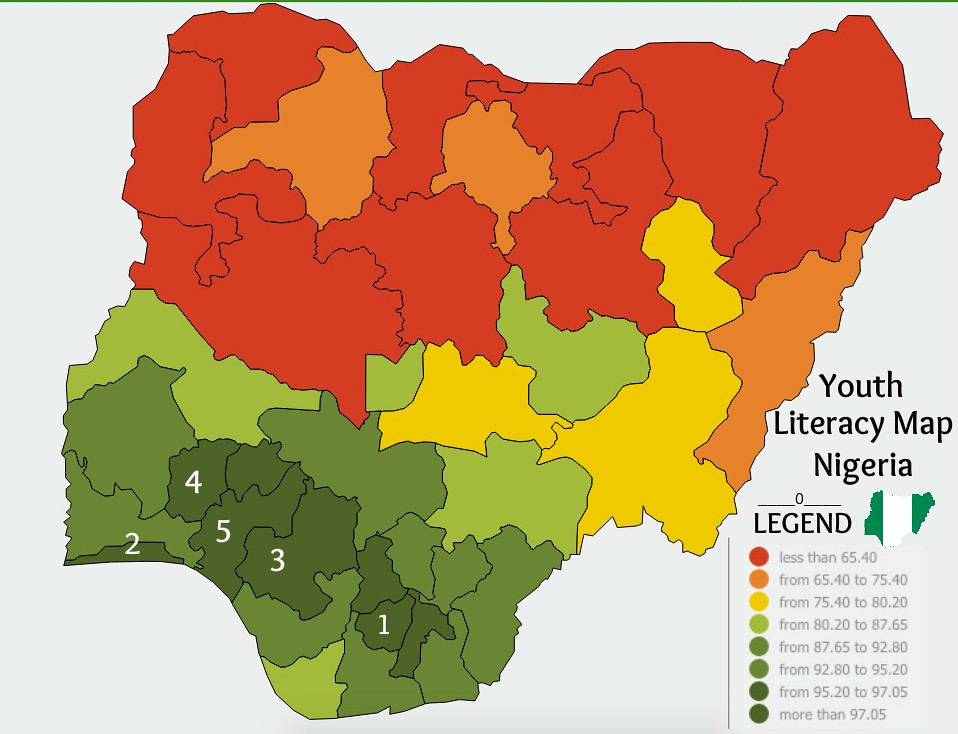
FKO81:Quit lying anymore. Here is your link ! Below(screen shot) and this proved m right after all : Below,quote ; It's 2015, the deadline for the first set of the Millennium development goals.Download the complete report here: http://www.nigerianstat.gov.ng/pages/download/254GOAL 1: TO ERADICATE EXTREME POVERTY AND HUNGER Target 1c: Halve between 1990 and 2015, the proportion of people who suffer from hunger. Indicator 1.8: Prevalence underweight children under five year of age. In the year 2008, the proportion of underweight children going by the national average was 23.1%. It went up to 27.4% in 2012 but declined to 25.5% in 2014. For lack of data, concrete trend cannot be established with this report. Although Nigeria has attained the hunger target according to other reports, yet more interventions are needed not only for the under-five children but for their mothers in order to alleviate them completely from the scourge of hunger. GOAL 2: ACHIEVE UNIVERSAL PRIMARY EDUCATION Target 2A: Ensure that, by 2015, children everywhere, boys and girls alike, will be able to complete a full course of primary schooling. Indicator 2.1: Net enrolment in primary education. In 2014, The states with very high attendance ratios included Anambra (94%), Delta (92.80), Imo (90.7), Lagos (92), Ondo (92.4), Osun (91.6), Edo (91.0), Ekiti (93.6) and FTC (94.1) while the least were Bauchi (29.9), Sokoto (24.80), Yobe (23.7), Zamfara (37.80). At the national level, the net attendance ratio was 61% in 2008 and it increased to 71% in 2012. In 2014, there was a shortfall of 2.3% and the net attendance for 2014 thus dropped to 68.7%. When classified by sectors, net attendance in the urban (84.3%) was much higher than in the rural areas (62.2%). Across the geopolitical zones, it was very encouraging in the South East (90.5%), South South (88.1%), South West (87%) and North Central (80.2%). But in the North West (50.5%) and particularly North East (42.5%) net attendance was not impressive. Although 100% attendance is expected, the result shows that Nigeria is on track.Indicator 2.2: Primay Six Completion RateNationally completion rate according to fig. 2.2 in 2004 was 82%. It increased to 87.7% in 2012 and dropped to 74.0 in 2014. Within the 2014, the completion rate was higher in the urban (84.4%) when compared with the rural (69.7). In the zones, completion rate was highest in South East (98.7%) zone, followed by South West (94.1%). Primary six completion rate was poorest in the North East (49.5%) zone. Nigeria is also on track. Indicator 2.3: Literacy rate of 15 – 24 years, women The literacy rate of youth women between 2004 and 2014 at the national level increased from 60.4% in 2004 to 80% in 2008. In 2012, it declined to 66%. Although it slightly appreciated in 2014 (66.7%), but that is insignificant. At the state level, literacy of youth women aged 15 – 24 was very encouraging in states like Rivers (98%), Enugu (97%), Imo (95%), Akwa Ibom (95%), Delta (94.1%), Anambra (93%), Ekiti (92.7%), Abia (91.3%). Conversely, literacy rate among woman of age 15 – 24 was poor in Sokoto (10.7%), Bauchi (13%), Yobe (16%) etc. Sectorally, the survey showed that there were more literate youth women (85.3%) in the urban as against the 57.8% recorded in the rural areas. In the zones the literate youth women in the South East (93.5%) were much higher than the rest of the zones. North East (33.0%) and North West (35%) had the lowest percentage of literate youth women in 2014. GOAL 3: PROMOTE GENDER EQUALITY AND EMPOWER WOMENTarget 3.A: Eliminate gender disparity in primary and secondary education preferably by 2005, and at all levels of education no later than 2015. Indictor 3.1: Ratio of girls to boys in Primary and Secondary educationNationally, the gender parity in the primary school in 2008 was 0.9. The interpretation is that in every 9 girls in primary school in 2008, there were 10 boys. It increased to 1.0 in 2012 implying 10 girls in every 10 boys. The parity index increased to 1.02 in 2014. The rural (1.01) and urban (1.01) were equal. The GDIs across the zones were exceedingly encouraging. In the secondary schools in 2012, the gender parity index was 1.02. The decline to 1.01 in 2014 was insignificant. There were no disparity in both the rural (1.0) and urban (90.98) in 2012. Nigeria has already achieved gender parity index as illustrated in fig 3.1a, being a chart of gender parity in both primary and secondary schools distributed by state in 2014. GOAL 4: REDUCED CHILD MORTALITYTarget: Reduce by two thirds between 1990 and 2015, the mortality rate among children under five years old. Indicator 4.1: Under five Mortality Rate (U5MR)About ten years ago specifically 2004 (201), Nigeria’s average under five mortality rate was very high. But right from then, there has been a steady decrease till 2014 when there was a record of only 89 children dying before their fifth birthday in every 1000 live births. See Fig4.1. Although the national average in 2014 was 89, yet some states had numbers much higher than the national average. The states include Kogi (169), Katsina (155), Kaduna (167) etc. The death prevalence in 2014 however was much more in the rural areas with 98 deaths against the 66 in the urban. North West zone with 121 and North East zone with 78 had the highest under five mortality rate than the other zones. South West zone had 45 as the least. If the rate in 2004 is adopted as the base value, it implies that some zones and states would have met the MDGs target on under five mortality before 2015. Indicator 4.2: Infant Mortality Rate (IMR) The deaths of infants under one year per 1,000 live births in Nigeria was also very high in 2004 where 100 children died without seeing their first birth day in every 1,000 live ...
|
| Education › Re: Statistics Of Admissions Into Degree Awarding Institutions By State Of Orgin-nbs by totit: 9:16pm On Jun 01, 2017 |
Cc ; Larmont Come teach the OP math abeg This only debunks your lies that SE is the most educated region.. Check your stats it reflects SW to be more educated... Try add up what you posted CLOWN... Even with the exclusion of Kwara which is a Yoruba state...Do your maths |
| Politics › Re: State Viability Index: Full list from Economic Confidential - Vanguard by totit: 9:14pm On Jun 01, 2017 |
Larmont:Bro, I already opened the dude nyash in another thread. I will quote you https://www.nairaland.com/3834784/statistics-admissions-into-degree-awarding/2#57102986 |
| Education › Re: Statistics Of Admissions Into Degree Awarding Institutions By State Of Orgin-nbs by totit: 9:00pm On Jun 01, 2017 |
FKO81:LMAO. I guess you just Google and downloaded it. Here is the real deal,your direct link to the said stats on NBS doesn't exist after all. Here is the real deal : scholes0:If you doubt it, bring your link down here, NBS Mind you here it below 1 Like
|
| Education › Re: Statistics Of Admissions Into Degree Awarding Institutions By State Of Orgin-nbs by totit: 8:42pm On Jun 01, 2017 |
kenechi072:Observe the emboldened, it conformed with his, here : It's 2015, the deadline for the first set of the Millennium development goals.Download the complete report here: http://www.nigerianstat.gov.ng/pages/download/254GOAL 1: TO ERADICATE EXTREME POVERTY AND HUNGER Target 1c: Halve between 1990 and 2015, the proportion of people who suffer from hunger. Indicator 1.8: Prevalence underweight children under five year of age. In the year 2008, the proportion of underweight children going by the national average was 23.1%. It went up to 27.4% in 2012 but declined to 25.5% in 2014. For lack of data, concrete trend cannot be established with this report. Although Nigeria has attained the hunger target according to other reports, yet more interventions are needed not only for the under-five children but for their mothers in order to alleviate them completely from the scourge of hunger. GOAL 2: ACHIEVE UNIVERSAL PRIMARY EDUCATION Target 2A: Ensure that, by 2015, children everywhere, boys and girls alike, will be able to complete a full course of primary schooling. Indicator 2.1: Net enrolment in primary education. In 2014, The states with very high attendance ratios included Anambra (94%), Delta (92.80), Imo (90.7), Lagos (92), Ondo (92.4), Osun (91.6), Edo (91.0), Ekiti (93.6) and FTC (94.1) while the least were Bauchi (29.9), Sokoto (24.80), Yobe (23.7), Zamfara (37.80). At the national level, the net attendance ratio was 61% in 2008 and it increased to 71% in 2012. In 2014, there was a shortfall of 2.3% and the net attendance for 2014 thus dropped to 68.7%. When classified by sectors, net attendance in the urban (84.3%) was much higher than in the rural areas (62.2%). Across the geopolitical zones, it was very encouraging in the South East (90.5%), South South (88.1%), South West (87%) and North Central (80.2%). But in the North West (50.5%) and particularly North East (42.5%) net attendance was not impressive. Although 100% attendance is expected, the result shows that Nigeria is on track.Indicator 2.2: Primay Six Completion RateNationally completion rate according to fig. 2.2 in 2004 was 82%. It increased to 87.7% in 2012 and dropped to 74.0 in 2014. Within the 2014, the completion rate was higher in the urban (84.4%) when compared with the rural (69.7). In the zones, completion rate was highest in South East (98.7%) zone, followed by South West (94.1%). Primary six completion rate was poorest in the North East (49.5%) zone. Nigeria is also on track. Indicator 2.3: Literacy rate of 15 – 24 years, women The literacy rate of youth women between 2004 and 2014 at the national level increased from 60.4% in 2004 to 80% in 2008. In 2012, it declined to 66%. Although it slightly appreciated in 2014 (66.7%), but that is insignificant. At the state level, literacy of youth women aged 15 – 24 was very encouraging in states like Rivers (98%), Enugu (97%), Imo (95%), Akwa Ibom (95%), Delta (94.1%), Anambra (93%), Ekiti (92.7%), Abia (91.3%). Conversely, literacy rate among woman of age 15 – 24 was poor in Sokoto (10.7%), Bauchi (13%), Yobe (16%) etc. Sectorally, the survey showed that there were more literate youth women (85.3%) in the urban as against the 57.8% recorded in the rural areas. In the zones the literate youth women in the South East (93.5%) were much higher than the rest of the zones. North East (33.0%) and North West (35%) had the lowest percentage of literate youth women in 2014. GOAL 3: PROMOTE GENDER EQUALITY AND EMPOWER WOMENTarget 3.A: Eliminate gender disparity in primary and secondary education preferably by 2005, and at all levels of education no later than 2015. Indictor 3.1: Ratio of girls to boys in Primary and Secondary educationNationally, the gender parity in the primary school in 2008 was 0.9. The interpretation is that in every 9 girls in primary school in 2008, there were 10 boys. It increased to 1.0 in 2012 implying 10 girls in every 10 boys. The parity index increased to 1.02 in 2014. The rural (1.01) and urban (1.01) were equal. The GDIs across the zones were exceedingly encouraging. In the secondary schools in 2012, the gender parity index was 1.02. The decline to 1.01 in 2014 was insignificant. There were no disparity in both the rural (1.0) and urban (90.98) in 2012. Nigeria has already achieved gender parity index as illustrated in fig 3.1a, being a chart of gender parity in both primary and secondary schools distributed by state in 2014. GOAL 4: REDUCED CHILD MORTALITYTarget: Reduce by two thirds between 1990 and 2015, the mortality rate among children under five years old. Indicator 4.1: Under five Mortality Rate (U5MR)About ten years ago specifically 2004 (201), Nigeria’s average under five mortality rate was very high. But right from then, there has been a steady decrease till 2014 when there was a record of only 89 children dying before their fifth birthday in every 1000 live births. See Fig4.1. Although the national average in 2014 was 89, yet some states had numbers much higher than the national average. The states include Kogi (169), Katsina (155), Kaduna (167) etc. The death prevalence in 2014 however was much more in the rural areas with 98 deaths against the 66 in the urban. North West zone with 121 and North East zone with 78 had the highest under five mortality rate than the other zones. South West zone had 45 as the least. If the rate in 2004 is adopted as the base value, it implies that some zones and states would have met the MDGs target on under five mortality before 2015. Indicator 4.2: Infant Mortality Rate (IMR) The deaths of infants under one year per 1,000 live births in Nigeria was also very high in 2004 where 100 children died without seeing their first birth day in every 1,000 live ...As you can see, at the emboldened,that's the link he coped it from but it's actually broken, been discarded. Here is the link, broken 1 Like
|
| Education › Re: Statistics Of Admissions Into Degree Awarding Institutions By State Of Orgin-nbs by totit: 8:32pm On Jun 01, 2017 |
kenechi072:Don't mind the liar. The problem of the youth of these generation is that they take anything you through at them especially on NL. I went through the link, dig it source but nothing but a broken link 3 Likes |
| Education › Re: Statistics Of Admissions Into Degree Awarding Institutions By State Of Orgin-nbs by totit: 8:30pm On Jun 01, 2017 |
FKO81:The said, NBS which is was discarded and hence broken long time ago, here is the direct link,broken. The PDF is not longer relevant bro That's your link, below, broken : It's 2015, the deadline for the first set of the Millennium development goals.Download the complete report here: http://www.nigerianstat.gov.ng/pages/download/254GOAL 1: TO ERADICATE EXTREME POVERTY AND HUNGER Target 1c: Halve between 1990 and 2015, the proportion of people who suffer from hunger. Indicator 1.8: Prevalence underweight children under five year of age. In the year 2008, the proportion of underweight children going by the national average was 23.1%. It went up to 27.4% in 2012 but declined to 25.5% in 2014. For lack of data, concrete trend cannot be established with this report. Although Nigeria has attained the hunger target according to other reports, yet more interventions are needed not only for the under-five children but for their mothers in order to alleviate them completely from the scourge of hunger. GOAL 2: ACHIEVE UNIVERSAL PRIMARY EDUCATION Target 2A: Ensure that, by 2015, children everywhere, boys and girls alike, will be able to complete a full course of primary schooling. Indicator 2.1: Net enrolment in primary education. In 2014, The states with very high attendance ratios included Anambra (94%), Delta (92.80), Imo (90.7), Lagos (92), Ondo (92.4), Osun (91.6), Edo (91.0), Ekiti (93.6) and FTC (94.1) while the least were Bauchi (29.9), Sokoto (24.80), Yobe (23.7), Zamfara (37.80). At the national level, the net attendance ratio was 61% in 2008 and it increased to 71% in 2012. In 2014, there was a shortfall of 2.3% and the net attendance for 2014 thus dropped to 68.7%. When classified by sectors, net attendance in the urban (84.3%) was much higher than in the rural areas (62.2%). Across the geopolitical zones, it was very encouraging in the South East (90.5%), South South (88.1%), South West (87%) and North Central (80.2%). But in the North West (50.5%) and particularly North East (42.5%) net attendance was not impressive. Although 100% attendance is expected, the result shows that Nigeria is on track.Indicator 2.2: Primay Six Completion RateNationally completion rate according to fig. 2.2 in 2004 was 82%. It increased to 87.7% in 2012 and dropped to 74.0 in 2014. Within the 2014, the completion rate was higher in the urban (84.4%) when compared with the rural (69.7). In the zones, completion rate was highest in South East (98.7%) zone, followed by South West (94.1%). Primary six completion rate was poorest in the North East (49.5%) zone. Nigeria is also on track. Indicator 2.3: Literacy rate of 15 – 24 years, women The literacy rate of youth women between 2004 and 2014 at the national level increased from 60.4% in 2004 to 80% in 2008. In 2012, it declined to 66%. Although it slightly appreciated in 2014 (66.7%), but that is insignificant. At the state level, literacy of youth women aged 15 – 24 was very encouraging in states like Rivers (98%), Enugu (97%), Imo (95%), Akwa Ibom (95%), Delta (94.1%), Anambra (93%), Ekiti (92.7%), Abia (91.3%). Conversely, literacy rate among woman of age 15 – 24 was poor in Sokoto (10.7%), Bauchi (13%), Yobe (16%) etc. Sectorally, the survey showed that there were more literate youth women (85.3%) in the urban as against the 57.8% recorded in the rural areas. In the zones the literate youth women in the South East (93.5%) were much higher than the rest of the zones. North East (33.0%) and North West (35%) had the lowest percentage of literate youth women in 2014. GOAL 3: PROMOTE GENDER EQUALITY AND EMPOWER WOMENTarget 3.A: Eliminate gender disparity in primary and secondary education preferably by 2005, and at all levels of education no later than 2015. Indictor 3.1: Ratio of girls to boys in Primary and Secondary educationNationally, the gender parity in the primary school in 2008 was 0.9. The interpretation is that in every 9 girls in primary school in 2008, there were 10 boys. It increased to 1.0 in 2012 implying 10 girls in every 10 boys. The parity index increased to 1.02 in 2014. The rural (1.01) and urban (1.01) were equal. The GDIs across the zones were exceedingly encouraging. In the secondary schools in 2012, the gender parity index was 1.02. The decline to 1.01 in 2014 was insignificant. There were no disparity in both the rural (1.0) and urban (90.98) in 2012. Nigeria has already achieved gender parity index as illustrated in fig 3.1a, being a chart of gender parity in both primary and secondary schools distributed by state in 2014. GOAL 4: REDUCED CHILD MORTALITYTarget: Reduce by two thirds between 1990 and 2015, the mortality rate among children under five years old. Indicator 4.1: Under five Mortality Rate (U5MR)About ten years ago specifically 2004 (201), Nigeria’s average under five mortality rate was very high. But right from then, there has been a steady decrease till 2014 when there was a record of only 89 children dying before their fifth birthday in every 1000 live births. See Fig4.1. Although the national average in 2014 was 89, yet some states had numbers much higher than the national average. The states include Kogi (169), Katsina (155), Kaduna (167) etc. The death prevalence in 2014 however was much more in the rural areas with 98 deaths against the 66 in the urban. North West zone with 121 and North East zone with 78 had the highest under five mortality rate than the other zones. South West zone had 45 as the least. If the rate in 2004 is adopted as the base value, it implies that some zones and states would have met the MDGs target on under five mortality before 2015. Indicator 4.2: Infant Mortality Rate (IMR) The deaths of infants under one year per 1,000 live births in Nigeria was also very high in 2004 where 100 children died without seeing their first birth day in every 1,000 live ...Your link was only found on PDF because it can't be erase on gooogle Lmao 2 Likes
|
| Education › Re: Statistics Of Admissions Into Degree Awarding Institutions By State Of Orgin-nbs by totit: 8:26pm On Jun 01, 2017 |
2 Likes
|
| Education › Re: Statistics Of Admissions Into Degree Awarding Institutions By State Of Orgin-nbs by totit: 8:22pm On Jun 01, 2017 |
Here is the truth,the latest one, direct link and confirmed : IMO lead here,i hate liars :scholes0: 3 Likes |
| Education › Re: Statistics Of Admissions Into Degree Awarding Institutions By State Of Orgin-nbs by totit: 8:14pm On Jun 01, 2017 |
FKO81:Stop lying your link/PDF did not specified what your put up there. Having downloaded and going through it I found nothing of sort. Quote the page you are referring to.  3 Likes |
| Education › Re: Statistics Of Admissions Into Degree Awarding Institutions By State Of Orgin-nbs by totit: 8:05pm On Jun 01, 2017 |
FKO81:Your are a BIG liar your quoted a link/stats but can't provide it source? 2 Likes
|
| Education › Re: Statistics Of Admissions Into Degree Awarding Institutions By State Of Orgin-nbs by totit: 7:58pm On Jun 01, 2017 |
FKO81:Show us your direct link Oya, prove to us you are not lying we don't want google search provide the link abeg 2 Likes |
| Education › Re: Statistics Of Admissions Into Degree Awarding Institutions By State Of Orgin-nbs by totit: 7:56pm On Jun 01, 2017 |
FKO81:Lmao Here. Stop lying. You are pain I burst your bubble 4 Likes
|




1 2 3 4 5 6 7 8 ... 212 213 214 215 216 217 218 219 220 (of 279 pages)