PhysicsQED's Posts
Nairaland Forum › PhysicsQED's Profile › PhysicsQED's Posts
1 2 3 4 5 6 7 8 9 10 (of 154 pages)
 Culture › Re: Interesting Images From Precolonial And Early Colonial Africa by PhysicsQED(op): 5:47pm On May 18, 2015 Culture › Re: Interesting Images From Precolonial And Early Colonial Africa by PhysicsQED(op): 5:47pm On May 18, 2015 |
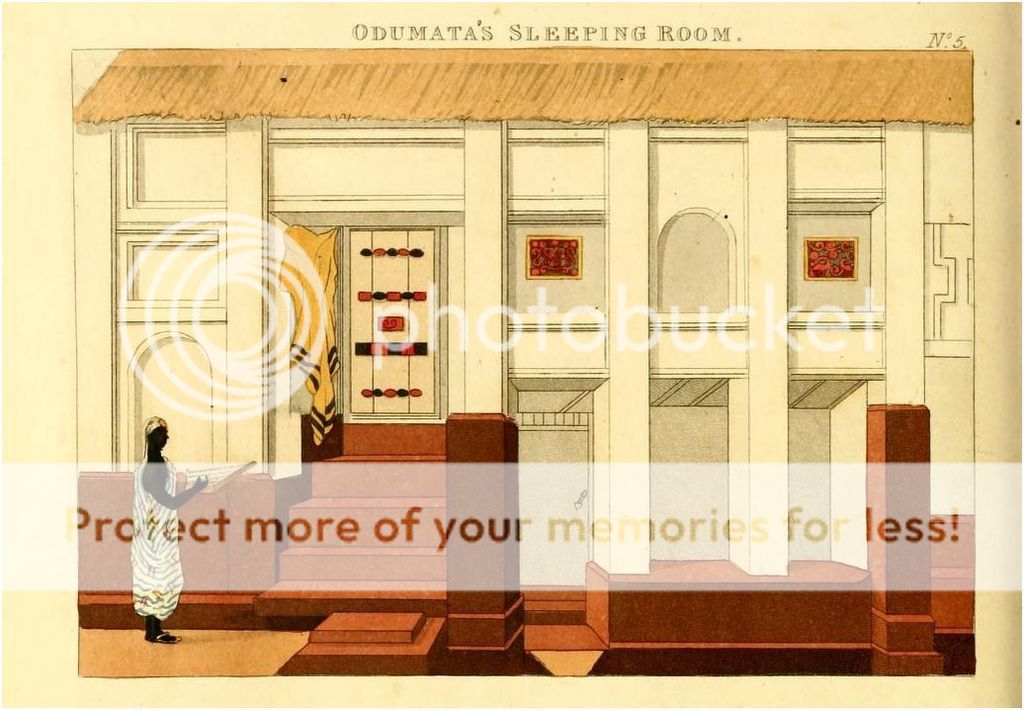
https://i374.photobucket.com/albums/oo184/fgwi0a59/Ashanti%204%20Bowdich%201819%20part%201_zpsoq4bveeo.jpg ". . .the exterior of a bed room of Odumata's, which is one side of an oblong area in a very retired angle of his house, about 25 feet by 8. . .The small gallery in front of the upper room is only wide enough for one person to walk in. The recess and small room below accommodate confidential slaves. The bed room was very small, about 8 feet square, but being hung round with a variety of gold and silver ornaments, had a very rich appearance. The bed is generally about 5 feet high, and composed entirely of large silk-cotton pillows piled one above another. The King of Gaman, we were assured, had steps of solid gold to ascend to his bed. A man wearing a crier's cap, is playing the sanko." Source: Mission from Cape Coast Castle to Ashantee, with a statistical account of that kingdom, and geographical notices of other parts of the interior of Africa (1819) by Thomas E. Bowdich |
| Culture › Re: Interesting Images From Precolonial And Early Colonial Africa by PhysicsQED(op): 5:19pm On May 18, 2015*. Modified: 8:15am On Jul 03, 2015 |
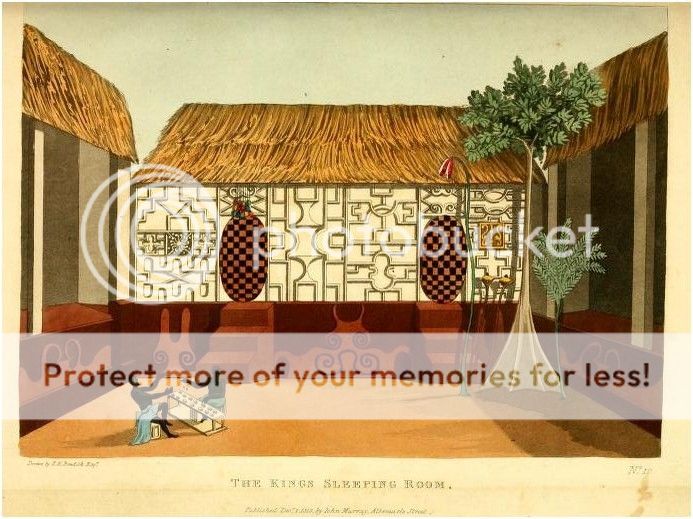
https://i374.photobucket.com/albums/oo184/fgwi0a59/Ashanti%203%20Bowdich%201819_zpsciwtenvb.jpg ". . .the exterior of the King's bed room, being one side of an inner area, about 30 feet square. The stunted silk-cotton and the manchineal tree are fetish or sacred, as are the white and red rags at the top of the pole, and the small brass cups supported by the forked sticks. The colored bags hanging over the round doors (the chequering of which is in relief) contain Moorish charms. The carving of the left hand window is cased in silver, of the right hand, in gold. The two men are playing at Worra. The King made frequent enquiries about the architecture of England, of which we gave him some idea by drawings. He was very fond of referring to a project ascribed to Sai Cudjo, and which he declared he would carry into effect directly the Gaman war was over. This was to build a house for his own immediate residence, roofed with brass pans, beaten into flat surfaces, and laid over an ivory frame work appearing within. The windows and the doors to be cased in gold, and the door posts and pillars of ivory. Whether the Moors originated or encouraged this extravagance by the descriptions in their tales, for some of the stories of the Arabian Nights were commonly in their mouths, or whether it was the scheme of his own disposition, prone to magnificence and novelty, the King dwelt ardently on the intention, and by their frequent conversations on the subject, his chiefs appeared scarcely less anxious for the execution than himself. He meditated great improvements and embellishments in his capital, on his return from the war, when it was intended that every captain should be presented with an extraordinary sum out of the public treasury, for adorning or enlarging his house. The ruined streets between Asafoo and Bantama were to be rebuilt, and the six or seven small crooms between Coomassie and Baramang, (the King's country residence,) were to be pulled down, and the inhabitants to occupy a wide street to extend from the city to that croom." Source: Mission from Cape Coast Castle to Ashantee, with a statistical account of that kingdom, and geographical notices of other parts of the interior of Africa (1819) by Thomas E. Bowdich ['Gaman' refers the Akan kingdom of Gyaman, a rival state northwest of Ashanti. An explanatory note in a later edition of Bowdich's book defines the word croom: 'The word croom, so constantly used for "hamlet" is an anglicization of the Akan kurom' for kuro mu. Kuro means a hamlet, and mu means in, or into'] |
| Culture › Re: Interesting Images From Precolonial And Early Colonial Africa by PhysicsQED(op): 4:53pm On May 18, 2015*. Modified: 8:02am On Jul 03, 2015 |
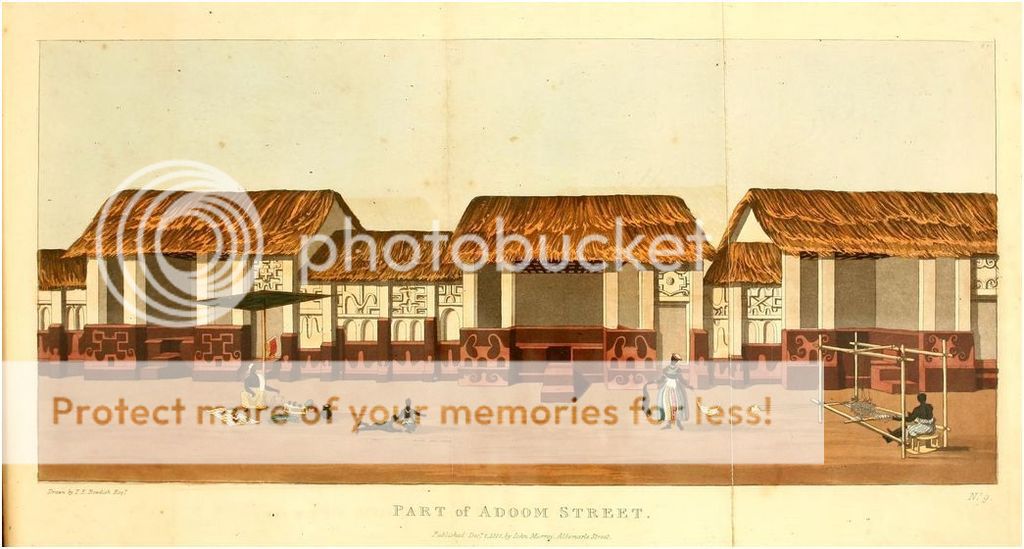
https://i374.photobucket.com/albums/oo184/fgwi0a59/Ashanti%202%20Bowdich%201819_zpsmv5p3qcc.jpg ". . .a view of part of Adoom-street: each open front denotes the residence of a captain, being used for talking palavers, receiving strangers, observing or superintending customs, and evening recreation. . .A fetish woman has just quitted the centre house; she has on a white cloth, and various pieces of rich silk are hanging round her girdle, her breasts are confined with a scarf, a fillet encircles her head, in each hand she waves a horse's tail, and she continues yelling and swinging round and round until she is quite stupified. A weaver and loom are on her right, and a market woman under her shed on the left." Source: Mission from Cape Coast Castle to Ashantee, with a statistical account of that kingdom, and geographical notices of other parts of the interior of Africa (1819) by Thomas E. Bowdich [The "fetish woman" Bowdich describes is probably some kind of priestess in a trance.] |
| Culture › Re: Interesting Images From Precolonial And Early Colonial Africa by PhysicsQED(op): 4:44pm On May 18, 2015 |
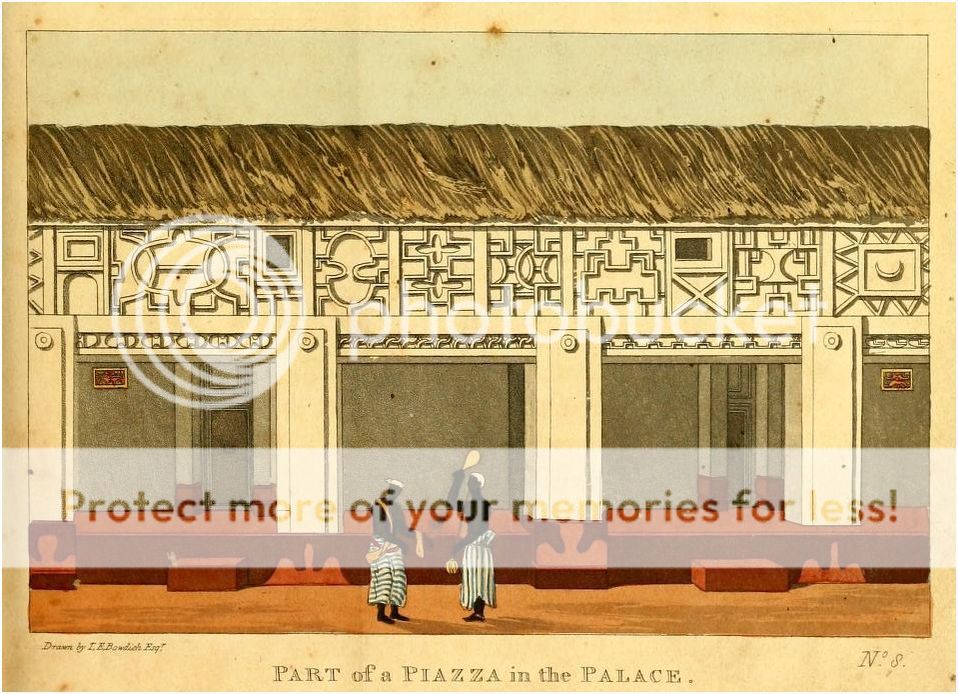
https://i374.photobucket.com/albums/oo184/fgwi0a59/Ashanti%201%20Bowdich%201819%20fnl_zpshdqnbeyv.jpg ". . .the upper end of the piazza, which is more ornamented, and appropriated to the superior captains, who have each a suite of rooms, marked by the small doors under the piazza. A woman is dancing whilst a man plays the flute and rattle." Source: Mission from Cape Coast Castle to Ashantee, with a statistical account of that kingdom, and geographical notices of other parts of the interior of Africa (1819) by Thomas E. Bowdich |
| Culture › Re: Interesting Images From Precolonial And Early Colonial Africa by PhysicsQED(op): 3:31pm On May 18, 2015 |
[img]http://images.nypl.org/index.php?id=1248633&t=w[/img] "Military Weapons of the Ashantees." Dupuis, Joseph (Author) Williams, C. (fl. 1824) (Engraver) COLLECTION Journal of a residence in Ashantee, comprising notes and researches relative to the Gold Coast, and the interior of Western Africa, chiefly collected from Arabic mss. And information communicated by the Moslems of Guinea; to which is prefixed an account of the origin and causes of the present war. DATES / ORIGIN Date Issued: 1824 TOPICS Ashanti Arms & armament -- Africa 1 Like |
| Culture › Re: Interesting Images From Precolonial And Early Colonial Africa by PhysicsQED(op): 12:10pm On May 18, 2015 |
https://www.webafriqa.net/library/history/ki-zerbo/histoire-afrique-noire/photos/pictures/18-10-ruines-fort-birni-zinderF.jpg "Ruins of the fort (Birni) of Zinder (kingdom of Damagaram - Niger) From Histoire de l'Afrique Noire, D'hier à Demain by Joseph Ki-Zerbo [Zinder was the capital of the Sultanate of Damagaram, which was an important state in the southeastern part of modern day Niger.] |
| Culture › Re: Interesting Images From Precolonial And Early Colonial Africa by PhysicsQED(op): 12:02pm On May 18, 2015 |
https://www.webafriqa.net/library/history/ki-zerbo/histoire-afrique-noire/photos/pictures/21-16-harpe-zandeF.jpg "Zande Harp. Sober and refined elegance of the lines. The war did not stop the music." From Histoire de l'Afrique Noire, D'hier à Demain by Joseph Ki-Zerbo |
| Culture › Re: Interesting Images From Precolonial And Early Colonial Africa by PhysicsQED(op): 12:00pm On May 18, 2015*. Modified: 4:18pm On May 18, 2015 |
https://www.webafriqa.net/library/history/ki-zerbo/histoire-afrique-noire/photos/pictures/20-14-portail-entree-foumbanF.jpg "Foumban. The gateway to the city." From Histoire de l'Afrique Noire, D'hier à Demain by Joseph Ki-Zerbo [Foumban or Fumban was the capital of the Bamum kingdom.] |
| Culture › Re: Interesting Images From Precolonial And Early Colonial Africa by PhysicsQED(op): 11:56am On May 18, 2015 |
https://www.webafriqa.net/library/history/ki-zerbo/histoire-afrique-noire/photos/pictures/18-9-tunique-guerre-fonF.jpg "Fon War Tunic (Dahomey, Benin). This style exists throughout the savannah of western Sudan." From Histoire de l'Afrique Noire, D'hier à Demain by Joseph Ki-Zerbo |
| Culture › Re: Interesting Images From Precolonial And Early Colonial Africa by PhysicsQED(op): 11:53am On May 18, 2015 |
https://www.webafriqa.net/library/history/ki-zerbo/histoire-afrique-noire/photos/pictures/17-7-recade-gleleF.jpg "The scepter (ax of honor) of Glélé. With the lion symbol." [img]http://www.webafriqa.net/library/history/ki-zerbo/histoire-afrique-noire/photos/pictures/586x1102x18-8-porte-palais-roi-abomeyF.jpg.pagespeed.ic.bPvQAjNF-0.webp[/img] "Abomey: Door of the palace of the kings. Above, the chameleon, the symbol of King Akaba (1685-1708). In the lower panel, the lion Glélé (1858-1889)." From Histoire de l'Afrique Noire, D'hier à Demain by Joseph Ki-Zerbo |
| Culture › Re: Interesting Images From Precolonial And Early Colonial Africa by PhysicsQED(op): 11:50am On May 18, 2015 |
https://www.webafriqa.net/library/history/ki-zerbo/histoire-afrique-noire/photos/pictures/17-6-bracelet-or-danF.jpg "Dan Bracelet (Côte d'Ivoire). Perfect blend of strength and elegance." From Histoire de l'Afrique Noire, D'hier à Demain by Joseph Ki-Zerbo [The Dan, or Gio people, are an ethnic group found in Liberia and Côte d'Ivoire.] |
| Culture › Re: Interesting Images From Precolonial And Early Colonial Africa by PhysicsQED(op): 11:45am On May 18, 2015 |
https://www.webafriqa.net/library/history/ki-zerbo/histoire-afrique-noire/photos/pictures/16-3-roi-tekyiman-brongF.jpg "King of Brong - Tekyiman (Ghana). He is surrounded by his regalia. The guard carries the sword of honor." From Histoire de l'Afrique Noire, D'hier à Demain by Joseph Ki-Zerbo |
| Culture › Re: Interesting Images From Precolonial And Early Colonial Africa by PhysicsQED(op): 11:40am On May 18, 2015 |
https://www.webafriqa.net/library/history/ki-zerbo/histoire-afrique-noire/photos/pictures/13-7-acropole-zimbabweF.jpg "Zimbabwe: the Acropolis. Judicious use of the rocky escarpment above which rose the wall 10 meters high and 7 meters thick." From Histoire de l'Afrique Noire, D'hier à Demain by Joseph Ki-Zerbo |
| Culture › Re: Interesting Images From Precolonial And Early Colonial Africa by PhysicsQED(op): 11:39am On May 18, 2015*. Modified: 1:38pm On May 18, 2015 |
https://www.webafriqa.net/library/history/ki-zerbo/histoire-afrique-noire/photos/pictures/11-3-tombeau-askia-gaoF.jpg "Askia Tomb in Gao (Mali) . Pyramidal structure, equipped with beams, which reinforce the building and gives it a very original profile." From Histoire de l'Afrique Noire, D'hier à Demain by Joseph Ki-Zerbo |
| Culture › Re: Interesting Images From Precolonial And Early Colonial Africa by PhysicsQED(op): 11:36am On May 18, 2015 |
https://www.webafriqa.net/library/history/ki-zerbo/histoire-afrique-noire/photos/pictures/10-2-quartier-goundamF.jpg "A district of Goundam (Mali). Such was the general appearance of the ancient cities of [the] Sudan." From Histoire de l'Afrique Noire, D'hier à Demain by Joseph Ki-Zerbo |
| Culture › Re: Interesting Images From Precolonial And Early Colonial Africa by PhysicsQED(op): 11:34am On May 18, 2015 |
https://www.webafriqa.net/library/history/ki-zerbo/histoire-afrique-noire/photos/pictures/09-3-maison-kumbi-salehF.jpg "Maison exhumée à Koumbi Saleh (Mauritanie). Remarquer l'aplomb des murs et les niches triangulaires pour ustensiles divers (lampes à huile en particulier) " (House exhumed at Kumbi Saleh (Mauritania). Note plumb walls and triangular niches for various utensils (oil lamps in particular) From Histoire de l'Afrique Noire, D'hier à Demain by Joseph Ki-Zerbo [If anyone has a better translation of the above caption, do post it.] |
| Culture › Re: Interesting Images From Precolonial And Early Colonial Africa by PhysicsQED(op): 11:30am On May 18, 2015 |
https://www.webafriqa.net/library/history/ki-zerbo/histoire-afrique-noire/photos/pictures/09-4-maison-tegdaoustF.jpg "House from Tegdaoust (Mauritania). The site reveals several successive levels of occupation. In the background , the sandstone escarpment of Rkiz." From Histoire de l'Afrique Noire, D'hier à Demain by Joseph Ki-Zerbo |
| Culture › Re: Interesting Images From Precolonial And Early Colonial Africa by PhysicsQED(op): 11:26am On May 18, 2015 |
On the drawings of the fortifications at Sikasso, Mali that I posted a little earlier, this is some additional information: http://translate.googleusercontent.com/translate_c?depth=1&hl=en&prev=search&rurl=translate.google.com&sl=fr&u=http://whc.unesco.org/en/tentativelists/5443/&usg=ALkJrhjObK-NCC-UlpgGjVF-9iC3QidN8A http://translate.google.com/translate?hl=en&sl=fr&u=http://fr.wikipedia.org/wiki/Tata_de_Sikasso&prev=search |
| Culture › Re: Interesting Images From Precolonial And Early Colonial Africa by PhysicsQED(op): 11:23am On May 18, 2015 |
https://www.webafriqa.net/library/history/ki-zerbo/histoire-afrique-noire/photos/pictures/09-5-ramparts-kilwaF.jpg "The walls of Kilwa. The wealth of the city explains these impressive precautions." From Histoire de l'Afrique Noire, D'hier à Demain by Joseph Ki-Zerbo |
| Culture › Re: Interesting Images From Precolonial And Early Colonial Africa by PhysicsQED(op): 11:20am On May 18, 2015*. Modified: 11:42am On May 18, 2015 |
https://www.webafriqa.net/library/history/ki-zerbo/histoire-afrique-noire/photos/pictures/08-1-eglise-farasF.jpg "Faras (Nobatia), Nubia. Remains of a Nubian brick church." From Histoire de l'Afrique Noire, D'hier à Demain by Joseph Ki-Zerbo |
| Culture › Re: Interesting Images From Precolonial And Early Colonial Africa by PhysicsQED(op): 6:40am On May 18, 2015 |
[img]http://www.webafriqa.net/library/history/ki-zerbo/histoire-afrique-noire/photos/pictures/900x1156x07-3-pylone-temple-nagaF.jpg.pagespeed.ic.oNTbbfOcAs.webp[/img] From Histoire de l'Afrique Noire, D'hier à Demain by Joseph Ki-Zerbo Caption: "Pylône du temple du lion à Naga (au Sud de Méroé, Soudan). On y voit le serpent à tête de lion qui représente le dieu Apedemak." (Pylon of the temple of the lion in Naga (south of Meroe, Sudan). It shows the lion-headed serpent representing the god Apedemak.) Source: http://www.webafriqa.net/library/history/ki-zerbo/histoire-afrique-noire/photos/large-9.html |
| Culture › Re: Interesting Images From Precolonial And Early Colonial Africa by PhysicsQED(op): 6:34am On May 18, 2015 |
[img]http://www.webafriqa.net/library/history/ki-zerbo/histoire-afrique-noire/photos/pictures/900x745x01-griot-aveugle-kayesF.jpg.pagespeed.ic.slGFqPOUp4.webp[/img] From Histoire de l'Afrique Noire, D'hier à Demain by Joseph Ki-Zerbo The caption is "Un griot aveugle de Kayes, Mali." (A blind griot, Kayes, Mali) Source: http://www.webafriqa.net/library/history/ki-zerbo/histoire-afrique-noire/photos/large-1.html |
| Culture › Re: Interesting Images From Precolonial And Early Colonial Africa by PhysicsQED(op): 6:29am On May 18, 2015 |
https://www.webafriqa.net/library/history/ki-zerbo/histoire-afrique-noire/photos/pictures/25-2-murs-forteresse-sikasoF.jpg This image was obtained from this site: http://www.webafriqa.net/library/history/ki-zerbo/histoire-afrique-noire/photos/large-57.html It gives the source of the image as being the book Histoire de l'Afrique Noire d'hier à demain (History of Black Africa from yesterday to tomorrow, 1978) by Joseph Ki-Zerbo. The caption on their site for the image is "Les murs de Sikasso (Mali) : une forteresse de 6 mètres d'épaisseur à la base et 6 mètres de hauteur. Au centre, sur une éminence, le dionfoutou (donjon), où le roi Tiéba défia et défit la puissance de Samori, et où son successeur Babemba se suicida pour ne pas tomber aux mains des Français." Google translate gives that in English as "The walls of Sikasso ( Mali ) : a fortress 6 meters thick at the base and 6 meters high. In the center, on a hill, the dionfoutou (keep), where King Tiéba challenged and defeated the power of Samori, and where his successor Babemba committed suicide to avoid falling into French hands." But anyone who can give a better French to English translation is free to post one. There is another drawing of the same fortifications at Sikasso: [img]http://www.lejardindedb.fr/local/cache-vignettes/L448xH369/tata_de_Tionghi_Site-cfc8a.jpg[/img] I obtained the image from this site: http://www.lejardindedb.fr/La-maison-du-general-7-1 Though it is also depicted here: http://www.ccfg-conakry.org/Sikasso.html If anyone could direct me to a more professional/academic source for the second drawing, I would appreciate it. |
| Culture › Re: Interesting Images From Precolonial And Early Colonial Africa by PhysicsQED(op): 5:58am On May 18, 2015 |
[img]http://images.nypl.org/index.php?id=1106714&t=w[/img] Morel, E. D. (Edmund Dene) (1873-1924) (Author) COLLECTION Nigeria, its peoples and its problems. DATES / ORIGIN Date Issued: 1911 TOPICS Africa Nigeria Africans Zaria (Nigeria) Katsina (Nigeria) Rulers -- Africa |
| Culture › Re: Interesting Images From Precolonial And Early Colonial Africa by PhysicsQED(op): 5:21am On May 18, 2015 |
[img]http://images.nypl.org/index.php?id=1252640&t=w[/img] "Abbas Gregorius and a native of Hausa, 1848. Portraits of Abbas Gregorius, the celebrated instructor of Ludolf, an Amhara from Ethiopia, and native of Hausa, probably a West African. An engraving from the Natural History of Man, by James Cowles Prichard." |
| Culture › Re: 10th Century Great Wall Of Kano And Associated Structures by PhysicsQED(m): 4:55am On May 18, 2015 |
Reviewshttp://www.worldheritagesite.org/sites/t5171.html Salvaging Kano City’s crumbling Wallshttp://thenationonlineng.net/new/salvaging-kano-citys-crumbling-walls/ Unfortunately, it seems the Kano walls may be going the way of other historical landmarks in Africa. |
| Education › Re: Successful Nigerian Academics In The Worlds Top Universities. by PhysicsQED(m): 12:45am On May 05, 2015*. Modified: 1:54am On May 05, 2015 |
sonzo666:You were indeed wrong to think that African-Americans were "lazy, stupid, etc. . ." No particular reason to assume that. However I would not say that African-Americans are doing so much better than Nigerians in this area (science). Maybe a little better or maybe about equal. Also, Clifford V. Johnson is not African American. His ancestry is from the Caribbean (the islands of Dominica and Montserrat) and his nationality is British, not American. He just works in America. Also there is a Nigerian computer scientist by the name of Faye Briggs who was an Intel Fellow. You can look him up. 2 Likes |
| Foreign Affairs › Re: PHOTO: SA Lists States That Helped Their Apartheid Fight - Nigeria Not Listed! by PhysicsQED(m): 8:31am On Apr 30, 2015 |
osystein:No. Nigeria did give financial support to the ANC (though certainly not that bizarre $61 billion figure being thrown around - which is based on the money Nigeria potentially lost by not selling oil to apartheid SA, not on actual direct contributions), and since there is a category for financial support to the ANC, Nigeria would at least have been listed there, even if Nigeria's important diplomatic actions/support are ignored or aren't considered to fall into any of those categories. I think the reason Nigeria is not listed there is because the person or persons who made that list were not really thorough researchers or actual historians. The average South African doesn't know anything about any of Nigeria's actions against apartheid, so unless the person who made that plaque was some sort of academic, it's not likely they would know anything about Nigeria's involvement. In any case, actual South African government members/officials have recognized Nigeria's contributions to the fight against apartheid on more than one occasion so omission from one particular plaque in that park does not mean so much. The plaque/board is simply not completely accurate. Of course it won't be changed just because some Nigerians on the internet feel it's inaccurate. It's up to them what countries' contributions they choose to acknowledge in their museum/park. 1 Like |
| Foreign Affairs › Re: PHOTO: SA Lists States That Helped Their Apartheid Fight - Nigeria Not Listed! by PhysicsQED(m): 4:10am On Apr 30, 2015 |
@ Shymexx This source was written by a Nigerian, but the information seems to be credible (and academic/reputable) nonetheless: https://books.google.com/books?id=_sDeDWCnnRAC&pg=PA93 Pages 90 through 94 discuss Nigeria's involvement. |
| Foreign Affairs › Re: PHOTO: SA Lists States That Helped Their Apartheid Fight - Nigeria Not Listed! by PhysicsQED(m): 4:06am On Apr 30, 2015 |
@ SirShymexx I agree with you that the "61 billion" or whatever figure claimed in those reports is ridiculous, and I don't agree with it either. After looking around a bit, I think I found where the figure was cooked up from. I think it was based on the money that Nigeria supposedly lost by not selling oil to apartheid South Africa. A similar unexplained figure (41 billion) is mentioned here: https://www.nairaland.com/2278292/apartheid-south-africa-nigerias-role#33124307 Perhaps this 41/61 billion figure is adjusted for inflation or something because otherwise I don't see how they came up with it. And in any case, losing money by opposing apartheid is not the same thing as direct financial support. That said, it seems that while Nigeria's role has been exaggerated in recent times, it was actually significant in the past. For example, Nigeria played a major role in getting most African states to recognize the MPLA (as against the apartheid South African supported UNITA) in Angola and provided financial and other support for the MPLA. It wasn't just Cuba that played an important role there. Also, I saw that you mentioned Thabo Mbeki being in exile in the UK for a while, but he was also in Nigeria for a number of years. Abraham Ordia, a Nigerian and the president of the SCSA also played a role in getting apartheid South Africa ostracized from some international sports events. Search for his name and "SCSA" and/or South Africa and you'll get some information on that. Here is one link on that guy: http://www.nytimes.com/1984/07/28/sports/africans-are-playing-on-two-levels.html Here's are some links on Nigeria's actions regarding the MPLA: https://books.google.com/books?id=-SQg3d1KXMEC&pg=PA174 https://books.google.com/books?id=Ftz_gtO-pngC&pg=PA150 Here are more academic/reputable links (like you asked of the other poster you were discussing with) that mention some of Nigeria's other actions, none of which were written by Nigerians: https://books.google.com/books?id=z7MVyj1yl7wC&pg=PA111 https://books.google.com/books?id=7VjJAAAAQBAJ&pg=PA95 https://books.google.com/books?id=zbBhLw-Hh28C&pg=PA126 (The entirety of ch. 11 of this book, titled "The Statesman," goes into detail about Obasanjo's actions. There is more info on the preceding pages). That's just what I found from a brief search, but there is probably more than just these actions. I could probably find more if I looked harder. all4naija:Actually, the Balewa administrations approach to the issue of apartheid South Africa was confused, unlike that of Murtala Mohammed and Obasanjo's administrations, which took a firm stance against apartheid South Africa: https://books.google.com/books?id=oMP4x6LVLeAC&pg=PA108 |
| Culture › Re: Origin Of The Bantu Peoples: Eastern Nigeria/Western Cameroun? by PhysicsQED(m): 5:31am On Apr 29, 2015*. Modified: 6:04am On Apr 29, 2015 |
AkanIgbo:I think the difference between the involvement of some of the Akan groups in the transatlantic slave trade and Bini involvement in the transatlantic slave trade was actually significant, though I am aware that the Akan groups had thriving economies outside of the slave trade and that they were not really dependent on it or anything. But I did not comment on the role of the Akan in the slave trade (or most of the other groups you mentioned in your first post in this thread) because my point was about the reality of Benin not playing some big role in the slave trade and the depopulation of Africa that people sometimes wrongly assume it did. I don't see what "big role" in the ruin of Africa Benin played. Every group/society/culture made some mistakes in history but I don't see this issue (the slave trade) as some area where Benin had some huge failure. I am not saying not to criticize or find fault with that kingdom - I have no objection to scrutinizing the history of African states and pointing out their flaws and mistakes - but I do think that accuracy is important when criticizing, especially to avoid perpetuating negative stereotypes and myths. If you like, say the kingdom played a "minor role" historically in contributing to Africa's/black people's problems today and that would at least be accurate and we would have no disagreement, but I just don't see the point of exaggerating Benin's role in contributing to these problems. 2 Likes |