PuristForest's Posts
Nairaland Forum › PuristForest's Profile › PuristForest's Posts
1 2 3 4 5 6 7 8 9 10 (of 19 pages)
 Investment › Re: Nigerian Stock Exchange Market Pick Alerts by PuristForest: 1:34pm On Nov 02 |
Oando:Wave 2 base forming between ₦24.6–₦31.8; wave 3 impulse expected to launch above channel resistance Ref: https://www.nairaland.com/1131485/nigerian-stock-exchange-market-pick/11101#140898845 https://ewnation.com/markets/oando-positioned-as-nigeria-s-energy-sector-recovers/ |
| Investment › Re: Nigerian Stock Exchange Market Pick Alerts by PuristForest: 3:16am On Oct 15 |
AFRIPRUD Finds Value as Registry Services Demand Grows On the broader daily chart, Africa Prudential has traced out a well-structured five-wave advance from its multi-year lows near ₦2, with the peak around ₦20 marking the completion of a grand cycle impulse labelled Wave I at the highest degree. The subsequent decline from that peak is best counted as a corrective sequence, with the current structure forming a three-wave A-B-C correction where Wave (C) is now in its terminal… https://ewnation.com/afriprud-finds-value-as-registry-services-demand-grows/ Not financial advice. |
| Investment › Re: Nigerian Stock Exchange Market Pick Alerts by PuristForest: 10:21am On Oct 13 |
WAPIC Poised as Nigerian Insurance Sector Recovers The 4-hour chart for WAPIC shows a completed five-wave impulse advance from the October 2024 lows to the July 2025 peak — labelled Wave 1 at the primary degree — followed by an extended W-X-Y double zigzag correction that has been unfolding as Wave 2 through late 2026. Within the final leg of this correction, a terminal ending diagonal or contracting structure is visible, with sub-waves i through v compressing… https://ewnation.com/wapic-poised-as-nigerian-insurance-sector-recovers/ Not financial advice. |
| Investment › Re: Nigerian Stock Exchange Market Pick Alerts by PuristForest: 9:19am On Oct 13 |
OANDO Positioned as Nigeria’s Energy Sector Recovers On the 8-hour chart, Oando is unfolding a five-wave impulse decline from the circled wave (b) high near ₦55, with waves (i) through (iii) already printed and price currently consolidating in a wave (iv) bounce around the ₦33–35 zone. The structure points to one final leg lower — wave (v) — targeting the projected wave 2 completion zone between ₦24.6 and ₦31.8, which also aligns with a key horizontal support… https://ewnation.com/oando-positioned-as-nigeria-s-energy-sector-recovers/ https://www.youtube.com/watch?v=Fin5W1bBOJw Not financial advice nor buy signal. 1 Like |
| Investment › Re: Nigerian Stock Exchange Market Pick Alerts by PuristForest: 5:38pm On Oct 12 |
VERITASKAP Steadies as Nigerian Insurance Sector Recovers The daily chart for VERITASKAP presents a complex corrective structure unfolding from the March 2026 high marked as wave X, with price completing a W-X-Y double correction into the September 2026 low labelled wave 2. Within wave Y, a clear five-wave impulse decline into the (c) low near the 1.0 area appears to have concluded, with the highlighted consolidation zone in the blue shaded region marking the likely terminal wave… https://ewnation.com/veritaskap-steadies-as-nigerian-insurance-sector-recovers/ Not financial advice. |
| Investment › Re: Nigerian Stock Exchange Market Pick Alerts by PuristForest: 7:14pm On Oct 09 |
ROYALEX Holds Ground as Insurance Sector Recovers The daily chart for Royal Exchange shows a protracted corrective structure unfolding from the September 2025 peak near ₦3.46, with price carving out what appears to be a W-X-Y or ABC expanded flat correction across multiple degrees. The most recent price action, consolidating in the ₦0.74–₦1.02 zone, has developed into a double bottom formation at a significant long-term horizontal support level, a structure that in Elliott Wave context frequently coincides… https://ewnation.com/royalex-holds-ground-as-insurance-sector-recovers/ Not financial advice, not buy signal... |
| Investment › Re: Nigerian Stock Exchange Market Pick Alerts by PuristForest: 8:40am On Oct 09 |
CHAMS Positioned for Growth in Nigeria’s Identity Tech Sector The intraday 12-hour chart shows Chams Holding completing a five-wave impulsive advance from the mid-2025 lows into the Wave (1) peak near the 5.5 level, followed by a structured corrective sequence that has since retraced the bulk of that advance. Price is currently pressing into a descending trendline resistance connecting prior wave highs, a level that has repeatedly capped upside attempts and whose breach is required to confirm the next… https://ewnation.com/chams-positioned-for-growth-in-nigeria-s-identity-tech-sector/ Not financial advice or buy signal. JAPAULGOLD Positioned as Nigeria Gold Demand Rises Japaul Gold & Ventures Plc remains one of the few listed gold-focused plays on the Nigerian Exchange, giving it an increasingly relevant position as naira devaluation continues to inflate the local-currency value of hard commodity assets. https://ewnation.com/japaulgold-positioned-as-nigeria-gold-demand-rises/ Not financial advice or buy signal. UPDC Positioned for Recovery as Real Estate Demand Builds The 4-hour chart of UPDC reveals a well-structured Elliott Wave sequence in which a five-wave impulse peaked near ₦9.6 in mid-2025, followed by a multi-phase corrective decline that has been working its way through an (a)-(b)-(c) flat or zigzag correction. Price is currently completing what appears to be wave (c) of a larger corrective structure, with a terminal low being carved out in the ₦3.0–₦3.3 zone — consistent with wave… https://ewnation.com/updc-positioned-for-recovery-as-real-estate-demand-builds/ Not financial advice or buy signal. |
| Investment › Re: Nigerian Stock Exchange Market Pick Alerts by PuristForest: 2:46pm On Sep 30 |
WAPIC Eyes Growth as Nigeria’s Insurance Sector Expands Wapic Insurance Plc (NGX: WAPIC), a subsidiary of Coronation Group, operates at the heart of Nigeria's underinsured market, positioning it as a key beneficiary of the National Insurance Commission's ongoing recapitalisation mandate that has reshaped the competitive landscape across the… https://ewnation.com/wapic-eyes-growth-as-nigeria-s-insurance-sector-expands/ Not financial advice. |
| Investment › Re: Nigerian Stock Exchange Market Pick Alerts by PuristForest: 4:37pm On Sep 28 |
INTBREW Recovers as Nigeria Beer Demand Rebounds International Breweries Plc (NGX: INTBREW) operates within Nigeria's fast-moving consumer goods and alcoholic beverages sector, a space that has endured severe margin pressure from naira devaluation, elevated raw material costs, and weakening consumer purchasing power since 2023. https://ewnation.com/intbrew-recovers-as-nigeria-beer-demand-rebounds/ Not financial advice. JAPAULGOLD Eyes Recovery as Gold Sector Gains Momentum Japaul Gold & Ventures Plc operates within Nigeria's nascent but increasingly strategic solid minerals and gold mining sector, a space attracting renewed government attention as the Federal Government pushes diversification away from crude oil revenues. https://ewnation.com/japaulgold-eyes-recovery-as-gold-sector-gains-momentum-2/ Not financial advice. |
| Investment › Re: Nigerian Stock Exchange Market Pick Alerts by PuristForest: 11:33am On Sep 21 |
| Investment › Re: Nigerian Stock Exchange Market Pick Alerts by PuristForest: 3:55pm On Sep 18 |
JAPAULGOLD Eyes Recovery as Gold Sector Demand Holds Japaul Gold & Ventures Plc remains one of the few listed mining and natural resource plays on the Nigerian Exchange, giving it a unique positioning as global and domestic gold demand stays elevated through 2026. https://ewnation.com/japaulgold-eyes-recovery-as-gold-sector-demand-holds/ Not financial advice. |
| Investment › Re: Nigerian Stock Exchange Market Pick Alerts by PuristForest: 3:01pm On Sep 18 |
ROYALEX Trades Near Lows as Insurance Sector Awaits Recovery Royal Exchange Plc remains one of Nigeria's legacy composite insurers, operating across life, general, and healthcare underwriting segments at a time when the broader NGX insurance sector is contending with persistent inflationary cost pressures and naira volatility. https://ewnation.com/royalex-trades-near-lows-as-insurance-sector-awaits-recovery/ Not financial advice. |
| Investment › Re: Nigerian Stock Exchange Market Pick Alerts by PuristForest: 3:19pm On Sep 05*. Modified: 3:39pm On Sep 05 |
deathwing:You still believe what these cowboys say........the Kaduna Refinery was indeed engineered from its inception to act as the primary petroleum artery for the Northern Corridor, integrating rail infrastructure directly into its loading bays to supply strategic fuel depots in Kano, Katsina, Borno, and Sokoto. While the logistical blueprint was robust, the entire distribution framework was systematically undermined by rent-seeking and regulatory failure. Political elite and powerful syndicates weaponized allocation letters obtained from the presidency to secure bulk quotas of Low Pour Fuel Oil (LPFO) at subsidized rates, sometimes one of many Alhaji/Hajia allocated 200 - 300 trucks, ostensibly meant to feed domestic industries. Instead of reaching the intended manufacturing hubs, these allocations were often sold at the tarmac at a margin and or immediately diverted into long-haul road tanker fleets upon when the train tankers exited the refinery, and smuggled across international borders for arbitrage, starving local mills of the exact energy inputs they needed to survive...this was how Politics was funded, from these slush funds. Many of the key actors and beneficiaries from that era successfully transitioned their wealth into other sectors of the Nigerian economy. Today, figures and corporate entities tied to those historical supply-chain leakages maintain vast commercial empires, spanning domestic aviation (airlines), modern manufacturing plants, real estate, and financial services. This continuity highlights how capital extracted from critical public infrastructure and industrial sabotage was successfully laundered into legitimate, diversified corporate assets, leaving the broader economy to bear the long-term structural costs, this is exactly what is happening now.... 6 Likes |
| Business › Re: Diesel Pump Price Rises Above N2,000/litre In Nigeria by PuristForest: 3:02pm On Sep 05 |
Cross posted - https://www.nairaland.com/1131485/nigerian-stock-exchange-market-pick/10940#140547842 Over the weekend, AGO price slipped from 1700 to above 2000 Naira. People will say its because of the war in Iran, understood! but we are gradually sliding into a manufacturing crisis, much of the selloff in the NGX these past 3 months can be attributed to being energy related, The crisis facing modern manufacturers and businesses due to skyrocketing diesel prices mirrors the exact structural failures that decimated Kaduna’s textile industry in the late 1990s and early 2000s. Energy poverty, compounded by logistical sabotage and cheap imports, turned what was once West Africa's industrial powerhouse into a graveyard of abandoned factories. The Energy Trap: LPFO vs. AGO Just as factories today are heavily reliant on diesel (AGO) to bypass a failing national grid, Kaduna's textile mills originally relied on Low Pour Fuel Oil (LPFO) to run their heavy industrial boilers, steam plants, and generators. However, local manufacturers faced a crippling paradox: subsidized LPFO meant for domestic industries was routinely smuggled across borders or diverted by corrupt cartels for illicit profit. Factories were left high and dry, completely unable to access regulated LPFO on the open market. To stay alive, management was forced to purchase expensive Automotive Gas Oil (AGO) as a substitute. Running continuous, power-hungry textile operations—spinning, weaving, and dyeing lines—on exorbitant diesel prices quickly destroyed operating margins, making local production financially impossible The Kaduna Textile Collapse The combination of energy starvation, obsolete machinery, and an influx of cheap foreign fabrics shuttered major giants in Kaduna. The prominent textile mills that folded during this era include: Kaduna Textiles Limited (KTL): The historic pace-setter established in the 1950s, which finally collapsed in 2002. Nortex (Nortex Nigeria Ltd): Ceased operations around 2003. FinTex (Finetex Ltd): Closed down during the same cluster period in 2003. Supertex: Another major name that succumbed to the harsh economic climate. United Nigerian Textiles Limited (UNTL): Though operating slightly longer, it eventually buckled under the same systemic pressures, closing its massive complex later in the decade. Arewa Textiles Plc shut down its operations permanently in January 2005, leaving behind a long-standing battle over unpaid worker entitlements and laying off thousands of employees Nichemtex also ceased its major active manufacturing operations years ago following severe financial struggles, regulatory enforcement actions over environmental issues, and the broader collapse of the domestic textile sector. Others like Chelco and Poly Fibre also went under, wiping out tens of thousands of direct jobs. Can you imagine that at least 100,000 to 350,000 people would have been affected directly or indirectly by these shutdowns in the Northcentral within this period of 2000 - 2006...the ghost towns left behind by energy poverty and structural neglect did not just cost Nigeria its industrial pride—they manufactured the very socio-economic despair and restive, unemployed youth bulge that later made northern Nigeria a fertile ground for radicalization and insurgent recruitment...... When energy costs spike, manufacturing stalls, and when manufacturing stalls, the resulting unemployment strips away the social safety net. Energy security is, therefore, deeply intertwined with national security. The Parallel to Today When fuel and energy inputs double overnight, businesses cannot absorb the shock indefinitely. Just as the diversion of LPFO starved Kaduna mills of affordable fuel decades ago, modern spikes in diesel prices strip contemporary manufacturers and businesses of working capital. If energy overheads outpace what consumers can pay, history shows that factories and businesses will inevitably downsize/shut down, transforming vibrant industrial zones into silent monuments of unemployment. Do with this post whatever you wish, but be smart with your investments and diversify. |
| Investment › Re: Nigerian Stock Exchange Market Pick Alerts by PuristForest: 1:02pm On Sep 05*. Modified: 1:30pm On Sep 05 |
Over the weekend, AGO price slipped from 1700 to above 2000 Naira. People will say its because of the war in Iran, understood! but we are gradually sliding into a manufacturing crisis, much of the selloff we are seeing in the market is energy related, The crisis facing modern manufacturers and businesses due to skyrocketing diesel prices mirrors the exact structural failures that decimated Kaduna’s textile industry in the late 1990s and early 2000s. Energy poverty, compounded by logistical sabotage and cheap imports, turned what was once West Africa's industrial powerhouse into a graveyard of abandoned factories. The Energy Trap: LPFO vs. AGO Just as factories today are heavily reliant on diesel (AGO) to bypass a failing national grid, Kaduna's textile mills originally relied on Low Pour Fuel Oil (LPFO) to run their heavy industrial boilers, steam plants, and generators. However, local manufacturers faced a crippling paradox: subsidized LPFO meant for domestic industries was routinely smuggled across borders or diverted by corrupt cartels for illicit profit. Factories were left high and dry, completely unable to access regulated LPFO on the open market. To stay alive, management was forced to purchase expensive Automotive Gas Oil (AGO) as a substitute. Running continuous, power-hungry textile operations—spinning, weaving, and dyeing lines—on exorbitant diesel prices quickly destroyed operating margins, making local production financially impossible The Kaduna Textile Collapse The combination of energy starvation, obsolete machinery, and an influx of cheap foreign fabrics shuttered major giants in Kaduna. The prominent textile mills that folded during this era include: Kaduna Textiles Limited (KTL): The historic pace-setter established in the 1950s, which finally collapsed in 2002. Nortex (Nortex Nigeria Ltd): Ceased operations around 2003. FinTex (Finetex Ltd): Closed down during the same cluster period in 2003. Supertex: Another major name that succumbed to the harsh economic climate. United Nigerian Textiles Limited (UNTL): Though operating slightly longer, it eventually buckled under the same systemic pressures, closing its massive complex later in the decade. Arewa Textiles Plc shut down its operations permanently in January 2005, leaving behind a long-standing battle over unpaid worker entitlements and laying off thousands of employees Nichemtex also ceased its major active manufacturing operations years ago following severe financial struggles, regulatory enforcement actions over environmental issues, and the broader collapse of the domestic textile sector. Others like Chelco and Poly Fibre also went under, wiping out tens of thousands of direct jobs. Can you imagine that at least 100,000 to 350,000 people would have been affected directly or indirectly by these shutdowns in the Northcentral within this period of 2000 - 2006...the ghost towns left behind by energy poverty and structural neglect did not just cost Nigeria its industrial pride—they manufactured the very socio-economic despair and restive, unemployed youth bulge that later made northern Nigeria a fertile ground for radicalization and insurgent recruitment...... When energy costs spike, manufacturing stalls, and when manufacturing stalls, the resulting unemployment strips away the social safety net. Energy security is, therefore, deeply intertwined with national security. The Parallel to Today When fuel and energy inputs double overnight, businesses cannot absorb the shock indefinitely. Just as the diversion of LPFO starved Kaduna mills of affordable fuel decades ago, modern spikes in diesel prices strip contemporary manufacturers and businesses of working capital. If energy overheads outpace what consumers can pay, history shows that factories and businesses will inevitably downsize/shut down, transforming vibrant industrial zones into silent monuments of unemployment. Do with this post whatever you wish, but be smart with your investments and diversify. 2 Likes |
| Investment › Re: Nigerian Stock Exchange Market Pick Alerts by PuristForest: 1:29pm On Aug 28 |
VERITASKAP Eyes Recovery as Nigerian Insurance Sector Firms Veritas Kapital Assurance Plc operates within Nigeria's non-life insurance segment, a sector that has drawn renewed attention following NAICOM's ongoing recapitalisation drive compelling insurers to shore up balance sheets and improve underwriting discipline. https://ewnation.com/veritaskap-eyes-recovery-as-nigerian-insurance-sector-firms/ Not financial advice...DYOR |
| Investment › Re: Nigerian Stock Exchange Market Pick Alerts by PuristForest: 10:14am On Aug 17 |
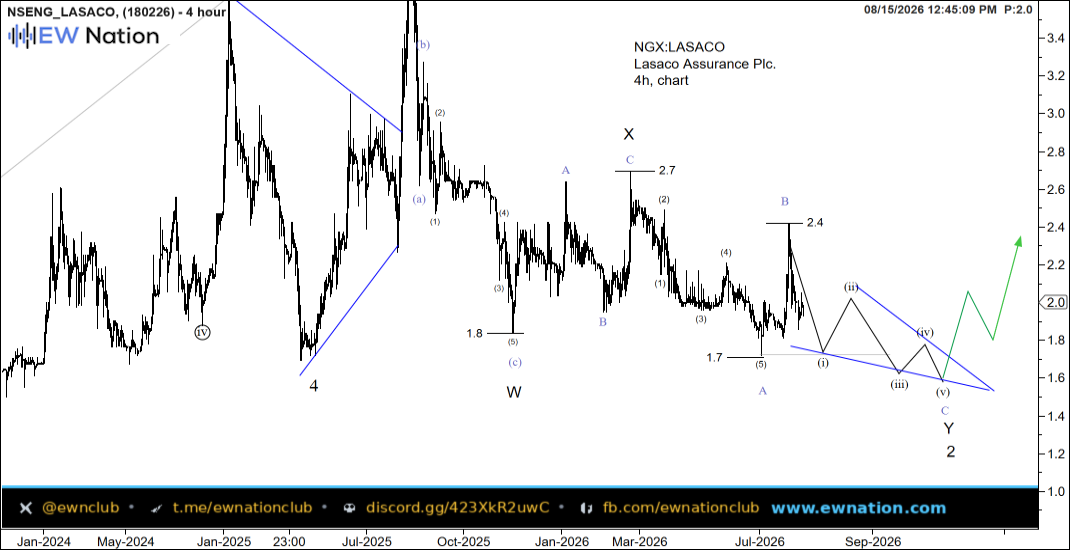
MANSARD Insurance Navigates Nigeria’s Inflation Cycle https://ewnation.com/mansard-insurance-navigates-nigeria-s-inflation-cycle/ SOVRENINS Poised as Nigeria Insurance Sector Recovers https://ewnation.com/sovrenins-poised-as-nigeria-insurance-sector-recovers/ SUNUASSUR Poised as Nigeria’s Insurance Sector Grows https://ewnation.com/sunuassur-poised-as-nigeria-s-insurance-sector-grows/ CHAMPION Brews Through Nigeria’s Consumer Slump https://ewnation.com/champion-brews-through-nigeria-s-consumer-slump/ LASACO Positioned as Nigerian Insurance Sector Recovers https://ewnation.com/lasaco-positioned-as-nigerian-insurance-sector-recovers/ https://ewnation.com/wp-content/uploads/2026/08/final_NSENG_LASACO_CD_Intraday_20260815_124510.png Not financial advice. |
| Investment › Re: Nigerian Stock Exchange Market Pick Alerts by PuristForest: 1:34pm On Aug 14 |
Streetinvestor2:i thik wapco will do 280 before any realistic reversal |
| Investment › Re: Nigerian Stock Exchange Market Pick Alerts by PuristForest: 3:40pm On Aug 13 |
SmartInsure:This is long overdue, it heavily insightful and packed with useful features, the newest addition insider trading table provides immense value by aggregating local regulatory disclosures. It gives retail investors rare transparency into what Nigerian corporate executives, board members, and major institutional holders are doing with their shares. For an opaque frontier market, this specific tool provides massive insight...well done - https://naijaticker.com/insider ---so AVACAP, exited staff are selling while employees are buying...interesting 1 Like |
| Investment › Re: Nigerian Stock Exchange Market Pick Alerts by PuristForest: 3:23pm On Aug 13 |
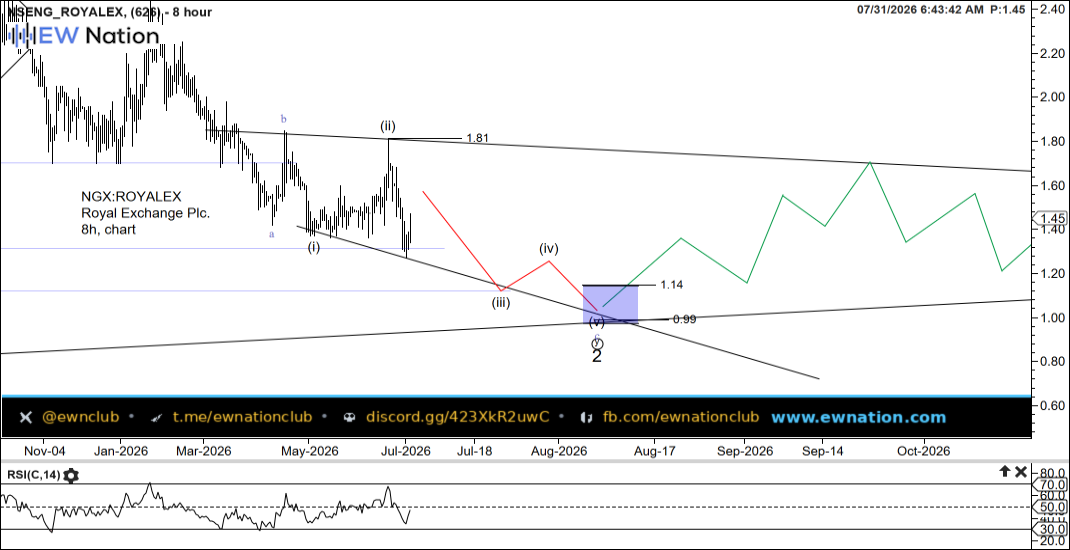
megawealth01:ROYALEX — Insurance Sector Stabilising; Wave 2 Base Forming Near 0.99–1.14 Support Zone In our last update on July 10, the daily chart framed a corrective structure with wave (y) of 2 expected to complete within the 0.95–1.23 support zone before a meaningful reversal. The current 8-hour chart, dated July 31, shows price trading at 1.45 after completing what appears to be a five-wave impulse decline from the wave (ii) high at 1.81 — with waves (i) through (v) now legible, and wave (v) terminating near the 0.99–1.14 target box. The projection arc on the chart suggests wave 2 is bottoming or has bottomed in that zone, with the green path anticipating an impulsive wave 3 advance unfolding through August and into Q4 2026. RSI has been in oversold territory consistent with a terminal wave (v) reading, lending confluence to the base scenario. A sustained hold above 1.14 and a break above the descending channel boundary would be the initial confirmation that the corrective sequence is complete and wave 3 is underway. Ref: **july 31 update** - https://ewnation.com/markets/royalex-steadies-as-insurance-sector-eyes-recovery-2/?timeframe=intraday https://ewnation.com/wp-content/uploads/2026/07/final_NSENG_ROYALEX_CD_Intraday_continuity_20260731_064343.png Not financial advice...DYOR |
| Investment › Re: Nigerian Stock Exchange Market Pick Alerts by PuristForest: 3:21pm On Aug 13 |
CHAMS Positioned as Nigeria’s Digital ID Demand Grows Chams Holding Company Plc remains one of Nigeria's most strategically positioned identity management and payment infrastructure firms, operating at the intersection of government digitalisation mandates and private-sector financial inclusion drives. https://ewnation.com/chams-positioned-as-nigeria-s-digital-id-demand-grows/ Try it out today for only : https://ewnation.com/membership-checkout/?level=14 Not financial advice. |
| Investment › Re: Nigerian Stock Exchange Market Pick Alerts by PuristForest: 2:16pm On Aug 13 |
WantsandMore:Even when you cant sell? |
| Investment › Re: Nigerian Stock Exchange Market Pick Alerts by PuristForest: 6:19pm On Aug 12 |
ACCESSCORP Gains as Nigeria’s Credit Cycle Turns Access Holdings Plc remains one of Nigeria's most systemically significant financial institutions, with a balance sheet that spans retail banking, insurance, payments, and pan-African lending corridors that few peers can match. https://ewnation.com/accesscorp-gains-as-nigeria-s-credit-cycle-turns/ Not financial advice. |
| Investment › Re: Nigerian Stock Exchange Market Pick Alerts by PuristForest: 1:12pm On Aug 12 |
Streetinvestor2:This one sha, i agree with street, the man is not wrong on the sukuk point — that's the one part of his post worth engaging with, not the Dangote/Alhaji theatrics. 13% on a sukuk that's been running 4 years, against the inflation and naira devaluation we've had since 2022, isn't a win in real terms. Nominal 13% doesn't mean much when your purchasing power has been cut by more than that over the same stretch. That's not an opinion, that's just what happens when a fixed coupon sits still while the currency it's denominated in doesn't. Which is exactly why anyone looking at the new NBET Series II bond needs to run the same math before getting excited about the 17.85%–17.95% coupon on the 7-year tranche. Headline rate looks good next to the sukuk's 13%, but 7 years is a long time to be locked into a fixed coupon in this environment. The real question isn't "is 17.9% attractive today" — it's whether that rate still beats inflation and NGN depreciation in year 5, 6, 7, the same way 13% stopped beating it for the sukuk holders. If naira weakness or inflation runs hot again over the tenor, the same "obituary" he's writing for the sukuk gets written for this one too, just a few years later. just for context, check the chart below 4 Likes
|
| Investment › Re: Nigerian Stock Exchange Market Pick Alerts by PuristForest: 10:19am On Aug 12 |
ACCESSCORP Gains as Nigeria’s Credit Cycle Turns Access Holdings Plc remains one of Nigeria's most systemically significant financial institutions, with a balance sheet that spans retail banking, insurance, payments, and pan-African lending corridors that few peers can match. https://ewnation.com/accesscorp-gains-as-nigeria-s-credit-cycle-turns/ Not financial advice. |
| Investment › Re: Nigerian Stock Exchange Market Pick Alerts by PuristForest: 9:50pm On Aug 11*. Modified: 10:30pm On Aug 11 |
What Nobody Talks About: Time OUT of the Market "Time in the market beats timing the market." It's true — for long-term compounding. But in high-volatility markets like the NGX, that saying can quietly become a limiting belief. It tells you to just hold, when in reality some of the biggest edges come from knowing when to step aside. Look at Oando (OANDO). The stock's major rally ran roughly 644 days (about 21 months) and delivered a staggering +2,355.94% from base to peak. Sounds like a "just hold it" story — until you zoom in. Over 234 days of that move (about 8 months, roughly a third of the total time), price alone accounted for +1,462.80% of that gain. The rest of the timeline was chop, correction, and consolidation — capital that could have been redeployed elsewhere, or simply left in cash waiting for the next setup. Ellah Lakes (ELLAHLAKES) tells the same story on a shorter fuse: +504.24% in just 80 trading days (about 120 calendar days). Since that peak, it's been correcting for well over a year. The pattern repeats across NGX names again and again: an explosive, compressed advance — followed by a long, grinding correction that gives back time (and sometimes price) far longer than the rally that created it. Crypto took this same "time in the market" idea and turned it into a religion: HODL. Born from a misspelled forum post, it became a badge of conviction — sell and you're weak-handed, hold and you're a believer. But HODL culture has also produced countless bag-holders: people who rode a coin up 1,000%, then rode it right back down 90%+ because letting go felt like betrayal of the narrative, not a technical decision. "Diamond hands" through an entire five-wave decline isn't discipline — it's a limiting belief dressed up as one. The actual skill isn't "stay in forever." It's recognizing wave structure well enough to: Identify when an impulsive move is likely exhausting (wave 5 targets, extension zones) Step out or trim into strength, before the correction phase eats your time and your gains Re-enter when the corrective structure completes, rather than sitting through the entire drawdown "because time in the market" Compounding matters. But so does what you're compounded into, and when. Sitting in cash during a 12–18 month corrective phase isn't timidity — it's often the more capital-efficient decision than "riding it out." Time in the market builds wealth. Time OUT of the market, used well, protects it — and frees up capital for the next impulsive move. HODL isn't a strategy. Structure is. — EW Nation 5 Likes |
| Investment › Re: Nigerian Stock Exchange Market Pick Alerts by PuristForest: 4:10pm On Aug 11 |
UCAP Rides Nigeria’s Capital Market Recovery United Capital Plc remains one of Nigeria's most diversified non-bank financial services groups, operating across investment banking, asset management, securities trading, and trustees — a positioning that makes it a direct beneficiary of the ongoing resurgence in Nigerian capital market… The 16-hour chart of UCAP completed a large five-wave advance into the wave (3) high near ₦23.4, followed by a wave (4) multi-leg corrective sequence. Within wave (4), price has traced out a clear A-B-C-D-E contracting triangle, finding support at the 38.2% retracement level near ₦16.5. The triangle’s converging boundaries and price holding above this key zone suggest the correction is reaching maturity.A confirmed breakout above the descending resistance line—clearing the ₦20.5 area—would signal that wave (5) has commenced toward a target zone of ₦28–₦29. The broader ascending support line from the wave 4 low near ₦14 continues to underpin the bullish primary trend.. https://ewnation.com/ucap-rides-nigeria-s-capital-market-recovery/ Enjoy...Not financial advice. |
| Investment › Re: Nigerian Stock Exchange Market Pick Alerts by PuristForest: 12:37pm On Aug 11*. Modified: 12:53pm On Aug 11 |
megamart247:The 23-month decline from the ₦84.55 peak in Sept 2024 shows just how much fluff has been erased from OANDO. The fact that they are pursuing a Rights Issue at ₦50 while the open market is pricing the stock at ₦35 tells you everything about the current market sentiment—it's a massive votes-of-no-confidence discount. No retail investor is going to buy a rights issue at a 30% premium when they can just accumulation on the NGX for ₦35. This implies either management is completely disconnected from current liquidity realities, or there is an institutional/underwriting backroom deal designed to absorb the shares regardless of the public price. With the recent 52-week low of ₦34.85 tapped on August 3rd, support looks incredibly weak. We anticipate a decisive breakdown below this floor, targeting a correction down into the late 20s. The upcoming two-year anniversary of the peak marks a highly critical re-pricing phase. ref: https://www.nairaland.com/1131485/nigerian-stock-exchange-market-pick/10035#138335128 https://ewnation.com/oando-positioned-as-nigeria-s-energy-sector-rebounds-2/ Enjoy..no investment advice |
| Investment › Re: Nigerian Stock Exchange Market Pick Alerts by PuristForest: 12:27pm On Aug 11 |
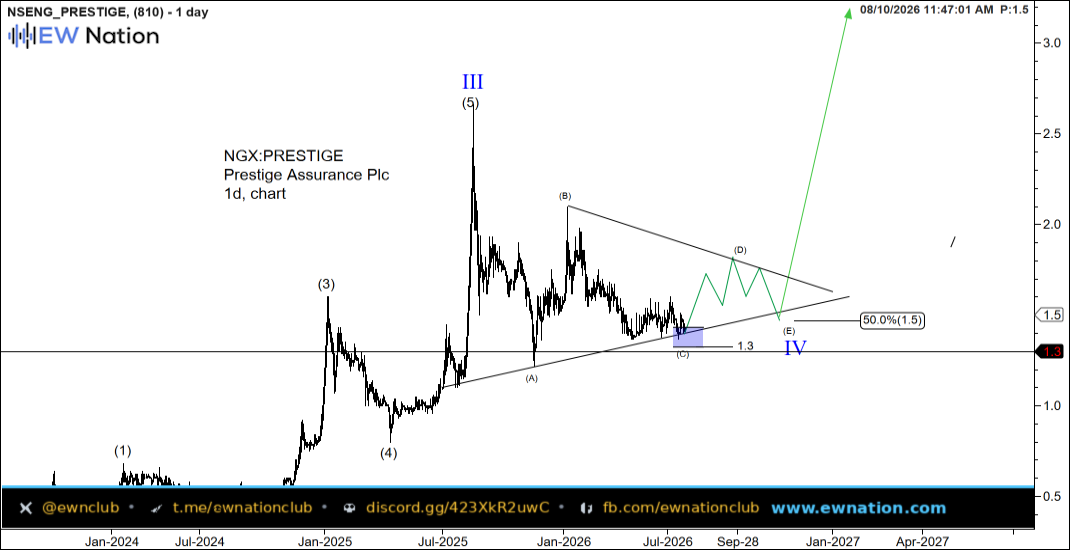
PRESTIGE Assurance Eyes Recovery on Insurance Sector Rebound Prestige Assurance Plc (NGX: PRESTIGE) operates within Nigeria's non-life insurance segment, a sector experiencing renewed regulatory and structural momentum following the National Insurance Commission's recapitalisation directive, which is compelling insurers to shore up capital bases and expand product reach. https://ewnation.com/prestige-assurance-eyes-recovery-on-insurance-sector-rebound/ https://ewnation.com/wp-content/uploads/2026/08/final_NSENG_PRESTIGE_TA_Intraday_20260810_114702.png enjoy! Not financial advice. |
| Investment › Re: Nigerian Stock Exchange Market Pick Alerts by PuristForest: 2:34pm On Aug 10 |
WEMABANK Gains Ground on Nigeria’s Digital Banking Push Wema Bank Plc remains one of Nigeria's most structurally differentiated mid-tier lenders, anchored by ALAT — the country's first fully digital bank — which continues to deepen its retail deposit franchise and expand its active user base at a pace… https://ewnation.com/wemabank-gains-ground-on-nigeria-s-digital-banking-push/ Not financial advice. |
| Investment › Re: Nigerian Stock Exchange Market Pick Alerts by PuristForest: 2:34pm On Aug 10 |
UCAP Rides Nigeria’s Capital Market Recovery United Capital Plc remains one of Nigeria's most diversified non-bank financial services groups, operating across investment banking, asset management, securities trading, and trustees — a positioning that makes it a direct beneficiary of the ongoing resurgence in Nigerian capital market… https://ewnation.com/ucap-rides-nigeria-s-capital-market-recovery/ Not financial advice. |