AfroBlue's Posts
Nairaland Forum › AfroBlue's Profile › AfroBlue's Posts
1 2 3 4 5 6 7 8 ... 64 65 66 67 68 69 70 71 72 (of 75 pages)
 Foreign Affairs › Re: Could This Anti-Islam , Pro-Israel African American Man Beat Obama In 2012 ? by AfroBlue(m): 8:32pm On Oct 29, 2011 Foreign Affairs › Re: Could This Anti-Islam , Pro-Israel African American Man Beat Obama In 2012 ? by AfroBlue(m): 8:32pm On Oct 29, 2011 |
Obama got his chedda Reporting What The Main Stream Media Refuses To Report http://tdarkcabal..com/2011/10/october-27-2011-white-hats-report-31.html |
| Properties › Re: Stubborn Tenants Refuse To Leave And Don't Pay Rent! by AfroBlue(m): 8:26pm On Oct 29, 2011 |
lawyer, you are the real deal, I enjoyed reading your story about tenacious due diligence and protecting your client!lawyer: https://www.nairaland.com/nigeria/topic-595696.0.html |
| Politics › Re: Nigeria's Golden Moments by AfroBlue(m): 8:18pm On Oct 29, 2011 |
So his success journey took him to the USA. He followed his dream. I have never seen an international artist from any country wave a flag at the Oscars, not the venue for that. The world knows, and specifically your countryman you're the best in your craft.afam4eva: Although Olajuwon instantly loved basketball, learning to play was difficult because basketball games were not televised in Nigeria, and soccer dominated the nation's sports news. Nonetheless, under the tutelage of coach Richard Mills, 17-year-old Olajuwon quickly became a leader on the Nigeria national basketball team, which took third place in the All-African tournament in 1979. The following year Olajuwon traveled to the United States to visit colleges. Disdaining the cold wind that greeted him when he arrived in New York in October of 1980, Olajuwon enrolled in the University of Houston, which offered him both a place on the basketball team and a much more familiar climate. Read more: Hakeem Olajuwon - From Handball To Basketball - Nigeria, Team, Soccer, and Coach - JRank Articles http://sports.jrank.org/pages/3499/Olajuwon-Hakeem-From-Handball-Basketball.html#ixzz1cCQnATFo |
| Politics › Re: Nigeria's Golden Moments by AfroBlue(m): 7:51pm On Oct 29, 2011 |
Would you also hate on Genevieve Nnaji if she had won that Bond Girl role, or went to Hollywood and won a Academy Award?afam4eva: Olajuwon was born to Salim and Abike Olajuwon, middle-class Yoruba owners of a cement business in Lagos, Nigeria.[5][6] "Olajuwon" translates to "always being on top" in Yoruba.[5] He was the third of six children. He credits his parents with instilling virtues of hard work and discipline into him and his siblings; "They taught us to be honest, work hard, respect our elders, and believe in ourselves".[5] Olajuwon has expressed displeasure at his childhood in Nigeria being characterized as backwards. "Lagos is a very cosmopolitan city, There are many ethnic groups. I grew up in an environment at schools where there were all different types of people."[7] During his youth, Olajuwon was a soccer/football goalkeeper, which helped give him the footwork and agility to balance his size and strength in basketball, and also contributed to his shot-blocking ability. In 1980, before arriving in the US, Olajuwon played for a Nigerian junior team in the All-Africa Games. |
| Business › Re: 'Oil Subsidy Is Fiction' - Professor Tam David-West by AfroBlue(m): 3:09pm On Oct 29, 2011 |
good article, topic related! Dele Olojede: The worst thing that happened to Nigeria is Oil http://questionmarkmag.com/2011/10/dele-olojede-the-worst-thing-that-happened-to-nigeria-is-oil/ https://questionmarkmag.com/wp-content/uploads/2011/10/Dele_Olojede_1__0-273x300.jpg |
| Politics › Re: Nigeria's Golden Moments by AfroBlue(m): 3:02pm On Oct 29, 2011 |
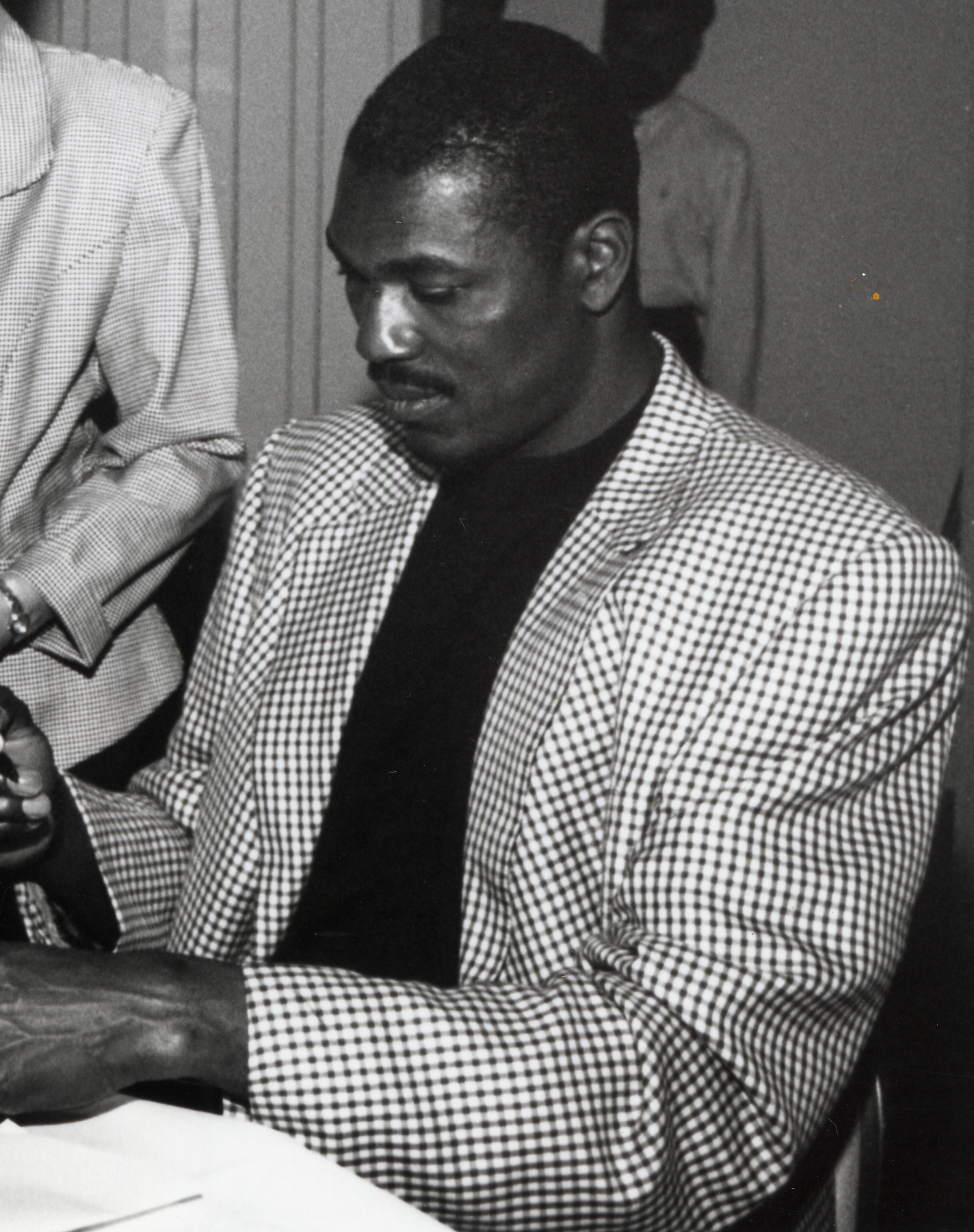
Hakeem Olajuwon Hakeem Abdul Olajuwon[1] (born January 21, 1963) is a retired Nigerian-American professional basketball player. From 1984 to 2002, he played the center position in the National Basketball Association (NBA) for the Houston Rockets and Toronto Raptors. He led the Rockets to back-to-back NBA championships in 1994 and 1995. In 2008, he was inducted into the Basketball Hall of Fame. Listed at 7 ft 0 in (2.13 m) (but closer to 6 ft 10 in (2.08 m) by his own admission),[2] Olajuwon is considered one of the greatest centers ever to play the game.[3][4] Born in Lagos, Nigeria, Olajuwon traveled from his home country to play for the University of Houston under Coach Guy Lewis. His college career for the Cougars included three trips to the Final Four. At the time, he spelled his first name Akeem. Olajuwon was drafted by the Houston Rockets with the first overall selection of the 1984 NBA Draft, a draft that included Michael Jordan, Charles Barkley, and John Stockton. Olajuwon joined the Houston Rockets and was nicknamed "Akeem The Dream" for his grace on and off the court. https://upload.wikimedia.org/wikipedia/commons/e/e3/Hakeemsigningautocropped.jpg https://www.thetruthsports.com/wp-content/uploads/2010/08/54229289.jpg https://mlb.imageg.net/graphics/product_images/p10829703dt.jpg http://en.wikipedia.org/wiki/Hakeem_Olajuwon |
| Foreign Affairs › Change Is On The Horizon by AfroBlue(op): 11:30am On Oct 27, 2011 |
[b]Change is on the Horizon is the epic story of how the world lost its soul and how it will gain it back. Directed and narrated by James Rink. Part 1 Dawn of the Golden Age - Discuses how Saint Germain helped bring about the beginnings of a enlightened era which soon fell into darkness under the helms of the Illuminati and a corrupted masonic order. https://www.youtube.com/watch?v=FlNMFUrgjyM Part 2 - The American Federal Empire. America was always meant to be always a shinning beacon of freedom and prosperity to the world. But the machinations of British bankers and the Rothschild's soon destroyed all that was once good in this great land. https://www.youtube.com/watch?v=ImefSYpySwA Part 3 - The Farmer Claim Program - Discuses how a class action lawsuit brought about in the early 1990's lead to the creation of NESARA, the National Economic Security and Reformation Act which will ultimately tear apart the New World Order and bankers plans right out from under their feet. https://www.youtube.com/watch?v=gOPIgNB-hGY&feature=related[/b] * |
| Crime › Re: A Nigerian Woman Sentenced To 11 Years In U.s. Prison For Forced Labour by AfroBlue(m): 5:55pm On Oct 26, 2011 |
[b]“House help” Gone Bad: U.S. Convicts Another Nigerian Of Trafficking By Chika Oduah https://saharareporters.com/sites/default/files/page_images/articles/2011/Bidemi%20Bello.jpg?1319425792 “I’m sorry.” That’s what Bidemi Bello, a 42-year-old Nigerian woman, told her two victims in a United States courtroom earlier this month. US. District Judge William S. Duffy, Jr. convicted Bello, a once successful London-educated businesswoman, earlier this month to 140 months in prison. Duffy also ordered Bello to pay $144,200 in restitution to her victims. Bello will be stripped of her U.S. citizenship—she was naturalized in 2004. Her victims are two Nigerian girls, known as Laome and Dupe, who were brought to the United States by Bello. Both girls are now 27-years-old. Bello had recruited Laome and Dupe from Nigeria to come to the United States to work as nannies. She had promised to treat the girls like family members and to send them to school, according to the Office of the U.S. Attorney. However, Laome and Dupe were forced to work as slaves without pay, faced to endure physical and verbal abuse. In 2001, Bello had recruited Laome, who was 17 at the time, from Nigeria. Laome worked in Bello’s large home in an upscale neighborhood in Gwinnett County, Ga. from October 2001 through March 2004. Laome eventually escaped, reportedly, with the help of one of Bello’s friends, who hid Laome in the back of car and covered Laome with blankets. Bello then went back to Nigeria, to find another “house girl.” She recruited Dupe, who was 19 at the time. Bello brought Dupe to Georgia, again promising to send Dupe to school. Dupe worked in Bello’s home from November 2004 until April 2006 until she gathered enough money to escape by taking a taxicab to a church, where pastors assisted her. Laome and Dupe were given T-visas, which authorized their stay in the United States to assist in the prosecution of Bello. T-visas http://www.uscis.gov/portal/site/uscis/menuitem.eb1d4c2a3e5b9ac89243c6a7, give victims of human trafficking a “T” nonimmigrant status. During the investigation, Bello had left the United States and was arrested upon re-entry at George Bush Intercontinental Airport in Houston, Texas. Evidence from the case shows that Laome and Dupe were routinely beaten for not responding quickly enough, not cleaning to Bello’s liking and for other perceived infractions. Case evidence revealed that wooden spoons, shoes and electrical cords were some of the items used to beat the girls. Bello had also beaten one of the girls with a rolling pin and had punched her in the mouth. “When she called me and I didn’t answer in time, she would slap me,” Laome said after the sentencing in court, according to the Atlanta Journal-Constitution. http://www.ajc.com/news/gwinnett/gwinnett-woman-sentenced-to-1200147.html The girls were forced to sleep on the floor or couch and were not allowed to shower, but were made to bathe with a bucket. Bello, reportedly, gave them food that had already spoiled. United States Attorney Sally Quillian Yates said of the case, “forcing young women to work without compensation for their services is modern-day slavery. The laws of the United States protect all victims from such abuse, regardless of where they came from or how they came to be in the United States.” http://www.fbi.gov/atlanta/press-releases/2010/atl092010.htm Bello was indicted in September 2010, and later convicted of eight charges: two counts of forced labor, two counts of trafficking for forced labor, one count of alien harboring, two counts of making false statements in an application to become a U.S. citizen and one account of “document servitude.” She had taken the girls’ passports and government documents to prevent them from leaving. A federal jury had delivered the verdict back in June after a one-week trial and deliberations that lasted an hour and 10 minutes, as reported by the Atlanta Journal-Constitution. http://www.ajc.com/news/woman-convicted-of-forcing-974199.html “The use of violence, threats and intimidation to force individuals to work is reprehensible and illegal,” said Thomas E. Perez, Assistant Attorney General for the Civil Rights Division. “In our country, we have the right to choose to perform or not perform labor or services, and the Department of Justice is committed to persecuting individuals who force persons to do work against their will. http://www.fbi.gov/atlanta/press-releases/2010/atl092010.htm Angela Blackwell lives behind Bello’s former home in Sugar Hill, Gwinnett County. Blackwell told a local television reporter that she was very concerned when she heard screaming coming from the house and had even called the police. “We heard someone say, ‘die, die, die,” Blackwell said. “It was so shocking we were thinking surely we didn’t hear that…we heard some whipping or slapping noises and then we heard some crying…I have three children and to think we were playing within a few feet of all of this going on is just disturbing—I mean, this is America,” Blackwell told the reporter. However, Bello’s attorney, federal public defender Suzanne Hashimi said that Bello was also once a house servant who had suffered from abuse. Hashimi has asked Duffy to reduce the sentence in consideration of this information. Bello’s courtroom address revealed a sense of remorse. Her only daughter reportedly has moved to Nigeria. “My actions have cost my daughter the opportunity of being raised here,” Bello said. “There is so much shame.” But Bello is not alone in her “shame.” Other U.S. -based Nigerians have been found guilty of similar charges. Last year, a Nigerian married couple in Arlington, Texas, Emmanuel and Ngozi Nnaji were convicted by a federal jury of “engaging in a nine-year scheme to compel the labor of a Nigerian victim as their domestic servant,” according to a U.S. Department of Justice press release. http://www.justice.gov/opa/pr/2010/February/10-crt-118.html The FBI reported that the couple had lured a Nigerian widow with a false promise of a salary and support for her the widow’s six children. Evidence showed that Emmanuel Nnaji, a naturalized U.S. citizen, had sexually assaulted the widow. Emmanuel, who was 50-years-old at the time of the sentencing, will face 20 years in prison. His wife, who was 40 and is a Nigerian citizen, was sentenced to nine years in prison. “The involuntary servitude and mistreatment that this victim endured is intolerable in a nation founded on freedom and individual rights,” said Assistant Attorney General Thomas Perez in a statement. In another case, Nigerian-born doctor, Adaobi Udeozor of Maryland, was sentenced to seven years and three months in prison and ordered to pay restitution of $110,249 after being convicted of conspiracy and harboring a 14-year-old girl. Udeozor’s husband, who had allegedly raped the 14-year-old, had fled to Nigeria to evade trial. He was later sentenced to over eight years in prison, according to the U.S. Dept. of Justice. http://www.justice.gov/usao/md/Public-Affairs/press_releases/press08/For, Lastly, there was Emeka and Ifeoma Udogwu, a married couple arrested and charged in New York in1999 for forcing a Nigerian girl to be their servant for nine years. A Manhattan federal court had accused the couple of conspiracy, involuntary servitude and witness tampering. The fact is what may be perceived as a cultural norm in Nigeria will not be tolerated in the United States—the maltreatment and forced servitude of “house help.” What is referred to as human trafficking has become the fastest growing crime in the world. Human trafficking is a form of modern-day slavery in which traffickers lure individuals with false promises of employment and a better life. A reported 12.3 million people, mostly women and girls, are presently facing forced labor, bonded labor and sex slavery, according to the International Labor Organization. The United Nations reports that the global enterprise has an estimated total market value of $32 billion. U.S officials take these cases quite seriously. The American CIA estimates that between 15,000 to 17,500 slaves are brought into the U.S. every year. About 50,000 of them work as domestic servants, farm workers or prostitutes. Atlanta is said to be the No. #1 hub for human trafficking in the United States. That’s one of the reasons why Georgia passed a bill that will discourage the illicit enterprise. It calls for those convicted of using coercion to traffic someone under the age of 18 to a 25-year minimum sentence. The law went into effect July 1, 2011. http://www1.legis.ga.gov/legis/2011_12/sum/hb200.htm “Human trafficking is a repugnant crime that is growing like cancer in our society,” said Ga. Governor, Nathan Deal in a press release. http://www.georgia.gov/00/press/detail/0,2668,165937316_170988643_171040, “Signing this bill into law, I join my fellow Georgians in declaring moral outrage and vowing to fight human trafficking here in our state. These criminals rob their victims of freedom and human dignity, and they destroy lives. With this bill now a law, we will find these criminals and we will punish them harshly.” Other states have similar laws. The state of California enacted the Trafficking Victims Protection Act in 2005 to “establish human trafficking for forced labor or services as a felony crime punishable by a sentence of 3,4 or 5 years in state prison and a sentence of 4, 6 or 8 years for trafficking a minor.” The state of Massachusetts also recently approved an anti-human trafficking bill, along with Maryland, New York, Texas and others. Nigerians like Bello, the Nnaji’s, the Udogwu’s and the Udeozor’s are now among the many convicts sentenced in the United States to pay the price of human trafficking of what many of ‘our people’ refer to as “common house help.” *** Chika Oduah is a news associate at NBC News in New York City and a reporter for SaharaTV. For more about Chika, visit www.chika-oduah.com https://saharareporters.com/sites/default/files/page_images/articles/2011/ChikaOduah_c.jpg?1319425792[/b] |
| Celebrities › Re: Tonto Dikeh Tatoo's Her Whole Back [picture} ! by AfroBlue(m): 4:30pm On Oct 26, 2011 |
Tramp Stamp |
| Foreign Affairs › U S Government Seeks $70m From Equatorial Guinea's President by AfroBlue(op): 11:05am On Oct 26, 2011 |
[b]October 26, 2011 US Government Seeks $70M From African Official LOS ANGELES (AP) — The son of Equatorial Guinea's president plundered his country's natural resources through corruption, spending more than $70 million in looted profits on a Malibu mansion, a Gulfstream jet and Michael Jackson memorabilia, the U.S. government said. In what appeared to be a concerted action, France last month seized 11 luxury sports cars belonging to Teodorin Nguema Obiang Mangue, a government minister in the West African country and heir-apparent to the presidency. And a Spanish investigative judge has been asked to seize properties in Madrid and Las Palmas in the Canary Islands owned by President Teodoro Obiang Nguema, his sons and some ministers, acting on a case brought by the Pro-Human Rights Association of Spain. Teodorin Obiang, who is in his early 40s, used his position to siphon millions of dollars for his own personal use, U.S. authorities said in two civil forfeiture complaints filed in the District Court in Los Angeles and Washington, D.C. The complaints say Obiang's assets can be forfeited because he engaged in misappropriation and theft of public funds for his benefit. The U.S. government is seeking to recover $70 million in stolen funds from Obiang for "the benefit of the people of the country from which it was taken." "We are sending the message loud and clear: The United States will not be a hiding place for the ill-gotten riches of the world's corrupt leaders," said Assistant Attorney General Lanny Breuer. An email message left for Purificacion Angue Ondo, Equatorial Guinea's ambassador to the U.S., was not immediately returned. President Obiang has denied charges of corruption in the past. Teodorin Obiang told a South African court in 2005, in a dispute about two Cape Town mansions valued at $4 million, that he earned $4,000 a month as a minister but that in his country it is legal for companies owned by ministers to bid for government contracts with foreign groups and receive "a percentage of the total contract." U.S. authorities believe Teodorin Obiang amassed more than $100 million through various schemes while he served as the country's forestry minister. His current government salary is about $6,800 a month, according to court documents. The U.S. action follows years of investigations including a Justice Department and Immigration and Customs Department probe that showed Obiang transferred about $75 million into U.S. banks between 2005 and 2007, and indicated U.S. banks had not shown due diligence. This came after the Obiang fortunes helped bring down the once-venerable Riggs Bank in 2004, when a U.S. Senate Committee investigation found the bank had "turned a blind eye" to evidence it was handling proceeds of foreign corruption in deposits of some $700 million deposited by its biggest customers — Equatorial Guinea government entities, senior officials and Obiang family members. One bank official gave evidence that more than a million dollars was brought to the bank in one instance in cash enfolded in plastic wrap. Some $26.5 million of that was transferred in suspicious transactions to Banco Santander in Spain, and used to buy properties being investigated there. The U.S. Senate Permanent Subcommittee on Investigations last year found that powerful Equatorial Guinea officials and their families used attorneys, real estate agents and lobbyists to circumvent anti-corruption laws. Human rights groups including the Global Witness and the Open Society Justice Initiative for years have been asking the United States to deny visas to the Obiang family and seize their property under U.S. laws against unjust or illicit enrichment. It was unclear why the action suddenly was being taken. A spokeswoman for the Department of Justice, Laura Sweeney, declined to comment "at this time" in an email response to questions. Ken Hurwitz, senior legal officer at the New York-based Open Society Justice Initiative, said he had heard reports that the Malibu property was being put up for sale. Equatorial Guinea was a backwater until American energy company Exxon Mobil discovered oil and gas there in 1994. U.S. companies continue to dominate the industry there but face growing competition. Most oil from the country, which produces billions of dollars in annual revenue, is exported to the United States. Despite its newfound wealth, life for the vast majority of the country's 680,000 people remains a struggle and the majority live below the poverty line with tens of thousands having no access to electricity or clean water, according to U.N. and World Bank figures. Earlier this year, Global Witness reported that Teodorin Obiang had commissioned plans to build a superyacht costing $380 million — nearly three times what the country spends on health and education each year. U.S. authorities said Teodorin Obiang spent $30 million on a Malibu mansion, $38.5 million on a Gulfstream jet and about $3.2 million on Michael Jackson memorabilia, including a crystal-covered glove from the "Bad" tour and a basketball signed by the singer and former Chicago Bulls star Michael Jordan. Among the other items purchased by Obiang, according to federal officials, was a 2011 Ferrari automobile valued at more than $530,000. Obiang also stored 24 luxury cars worth nearly $10 million at the Petersen Automotive Museum in Los Angeles and shipped them to France. Among the supercars seized in France last month are Maseratis, two limited edition Bugatti Veyrons, Maseratis, Ferraris, Porsches and Rolls Royces. Obiang would give various stories to banks that questioned where he had received large sums of cash from, authorities said. When Obiang opened an account at a California bank in 2007, he claimed that he acquired money from a family inheritance and from trading expensive and custom automobiles, court documents show. --- Associated Press writer Michelle Faul contributed to this report from Johannesburg. [/b] |
| Foreign Affairs › U S Government Seeks $70m From by AfroBlue(op): 11:04am On Oct 26, 2011 |
duplicate post |
| Romance › Re: Your Previous Relationship: Why Did You Break Up? by AfroBlue(m): 12:10am On Oct 24, 2011 |
Unfortunately the weak flesh got the best of me. She (my former paramour) knew I was married but came at me with reckless abandon, always bending over and showing her nicely shaped bum, and wearing low cut tops to work to showcase her bosoms. A man came only take so much, some women with charms and smiles can break down the strongest of men. I wouldn't be surprise if she had me in a juju spell back then. Anyway, I came to my senses and repented my sins before I lost my wife to that weakness. Believe me, I learned my lesson, the grass is not always greener on the other side.Floxyluv: |
| Romance › Re: Your Previous Relationship: Why Did You Break Up? by AfroBlue(m): 7:42pm On Oct 23, 2011 |
She was insatiable and wanted me to leave my matrimonial home.  |
| Foreign Affairs › Re: Gej Departs For Chogm/colonial Meeting On Sunday by AfroBlue(op): 11:34pm On Oct 22, 2011 |
https://upload.wikimedia.org/wikipedia/commons/thumb/5/5f/Elizabeth_II_greets_NASA_GSFC_employees%2C_May_8%2C_2007_edit.jpg/170px-Elizabeth_II_greets_NASA_GSFC_employees%2C_May_8%2C_2007_edit.jpg Queen Elizabeth II, current Head of the Commonwealth Structure Head of the Commonwealth Main article: Head of the Commonwealth Queen Elizabeth II, current Head of the Commonwealth Under that formula of the London Declaration, Queen Elizabeth II is the Head of the Commonwealth, a title that is currently individually shared with that of Commonwealth realms.[22] However, when the monarch dies, the successor to the crown does not automatically become Head of the Commonwealth.[23] The position is symbolic: representing the free association of independent members.[22] Sixteen members of the Commonwealth, known as Commonwealth realms, recognise the Queen as their head of state. The majority of members, thirty-three, are republics, and a further five have monarchs of different royal houses. |
| Foreign Affairs › Gej Departs For Chogm/colonial Meeting On Sunday by AfroBlue(op): 11:31pm On Oct 22, 2011 |
Jonathan Departs For CHOGM-2011 On Sunday President Goodluck Ebele Jonathan will depart Abuja for Perth, Australia, on Sunday, October 23, 2011, to participate in the Commonwealth Heads of Government Meeting, CHOGM-2011. Prior to the commencement of CHOGM-2011, President Jonathan will be a guest of the Australian Government, during which he will hold bilateral talks with Hon. (Ms) Julia Gillard, Prime Minister of Australia, attend a dinner with top Australian businessmen and be hosted to an official dinner by the Governor-General, Hon. (Ms) Quentin Bryce AC. President Jonathan will deliver the keynote address at the Commonwealth Business Forum, with the theme: “Unleashing Africa’s Potentials: A New Vision”, and participate in the Forum’s other activities, including a panel discussion on: “Africa: Creating A New Economic Power for the 21st Century”. The President will also take part in the Presidential Country Roundtables, specifically the Nigeria/Australia Mining Roundtable, and other consultations with global business leaders. The CHOGM-2011 opening ceremony is on Friday, October 28, followed by an Executive Session, while Queen Elizabeth II will host a dinner for all participating Commonwealth leaders and their spouses in the evening of the same day. Other major events in which President Jonathan will take part include a sports breakfast, a reception by the Commonwealth Secretary-General, a global polio eradication session, retreat sessions for Commonwealth leaders and an official dinner to be hosted by the Prime Minister of Australia, Hon. (Ms) Julia Gillard MP. While in Australia, President Jonathan will also hold bilateral talks with several Commonwealth leaders, including the Prime Minister of Malaysia, the Vice President of India, the Prime Minister of Canada, the Prime Minister of Antigua and Barbuda, and the High Representative of the European Union for Foreign Affairs, and meet with a cross-section of the Nigerian Community based in Australia. The president is expected back in Abuja on Monday, October 31, 2011. |
| Travel › Re: The City Of Warri In Pictures by AfroBlue(m): 11:28pm On Oct 22, 2011 |
Nice drop Jason, very beautiful city! |
| Christianity Etc › Re: Is It Okay To Pay Your Tithe To A Man Of God? by AfroBlue(m): 11:55am On Oct 20, 2011 |
Jesus was a carpenter, not a professional tithe collector. 1 Like |
| Politics › Re: Fashola At Oxford University Lecture. Pics by AfroBlue(m): 11:42am On Oct 20, 2011 |
good article from a couple of years ago. it stayed in my memory banks. The man who would tame Nigeria’s megacity By Matthew Green Published: August 7 2009 15:25 | Last updated: August 7 2009 15:25 https://media.ft.com/cms/2f51ac86-823a-11de-9c5e-00144feabdc0.jpg One Sunday afternoon in Lagos, a man leapt out into Akin Adesola, the main street on Victoria Island, and flagged down my car. He yanked open the door, swung into the front passenger seat and barked “drive”. Anger radiated from him like heat. He wore no uniform and carried no gun, but desperation imbued him with an iron authority. All the pent-up frustrations of the megacity seemed to flow through him like an electric current. He whipped out a tattered paper and jabbed his finger at a list of violations – I had failed to stop at a white line. He said I had better pay the fine now or go to the station where his superior would be less inclined to leniency. “What makes you think you can come to my country and break our laws?” he spat. His eyes bulged and beads of sweat glistened on his shaven head. He stared through the windshield at the passing cars. “I should not be out here directing traffic,” he said. “I am a graduate.” A hostage in my own car, I groped for the most obvious response to this piece of news. “What subject?” I asked. “Psychology.” “So you know Freud?” “Yes!” he said. “The founding father!” My captor had cracked a smile. The mask slipped. We talked for another 20 minutes and I learnt his name was Olabode – Ola for short. He let me go, gave me his mobile number and waved me on, smiling. As I pulled away, he resumed his vigil from a kiosk on the central reservation, waiting for another chance. Such encounters are the stuff of everyday life in Lagos, a city defined by hustle. You can see it in the traffic cops shaking down drivers for bribes, in the legions of youths braving the fumes of the “go-slow” traffic jams to sell scratch cards for mobile phones, and in the armies of motorbike taxis careering through the streets. The fabric of the city seems to defy order. A seemingly infinite low-rise checkerboard of mottled concrete, rusted tin roofs and bus-choked, cratered streets, the city of perhaps 18 million people – the biggest conurbation in sub-Saharan Africa – appears to have succumbed to the early stages of a virulent urban disease. The vast majority of people in the city lack access to adequate housing, sanitation or jobs. Travelling relatively short distances can be a teeth-grinding, hours-long ordeal. One Nigerian blogger put the case in eloquent, if extreme, terms in a January post: “A landing in Lagos … is an entrance into Dante’s city of Woe.” The slumscapes of Lagos are a powerful portent of the extremes of poverty and overcrowding to come as the trend for rapid urbanisation continues across the developing world. Nigeria’s commercial capital will be the third-largest city on the planet by 2015 after Tokyo and Mumbai, according to UN projections. Already, half of humanity lives in cities, and within two decades, it will be almost 60 per cent. Millions of people may find that their home towns start to look more like Lagos, before Lagos looks more like the rest of the world. Yet it is this beast that Babatunde Fashola, the new governor of Lagos State, has made it his mission to transform. Since coming to power in May 2007, the soft-spoken lawyer has launched a programme to build new highways, clear chaotic markets and encourage multi-billion-dollar investments in real estate. A swelling army of floppy-hatted sweepers is sprucing up the streets. Former street toughs have been given jobs as traffic wardens. Fashola wants to turn Lagos from an urban dystopia into a model of civic pride. He hopes that even its notoriously frenetic inhabitants will start to feel a little, well, calmer. Lagosians have heard such plans before. What is remarkable this time is that many people – rich and poor – believe that Fashola could really take the city’s destiny in hand. . . . A few months after meeting Olabode, I gave him a call. Most foreigners in Lagos live among the enclaves of privilege at the tips of irregularly shaped peninsulas abutting the Atlantic shore – the Victoria Island business district and the colonial-era suburb of Ikoyi. Ola lives in Oshodi, one of the hundreds of interlocking neighbourhoods that sprawl across the Nigerian mainland. Fashola has chosen his area as one of the first targets in his plan to bring the megacity to heel. To get to Oshodi from Ikoyi, you must cross the Third Mainland Bridge, a 12km concrete serpent that swerves around the edge of the city and over Lagos lagoon. On weekends, when traffic is light, riding this stretch of road is like plunging on to a rollercoaster; the sudden expanse of sea and sky feels almost sublime after the crush of the city. From its crest, you can see Makoko, a slum-on-stilts, spilling into the water. On the bridge above the smoke-shrouded rooftops, a trio of Fashola’s cleaners swept the gutters. My taxi reached the other side and swerved around three tyres placed in the road to stop cars running over a body – a dead man was curled into a foetal position on the tarmac, and was naked. Unfazed by the sight – not uncommon in a city where environmental services are, to say the least, overstretched – the driver, named Jimoh, extolled Fashola’s achievements. “Fashola, good-oh!” he said. (Lagosians often add an “oh” sound at the end of a word for emphasis, a spillover from the Yoruba language.) “Lagos is now changing-oh, because of Fashola. Everywhere is clean. Before, road is not good at all. Now, no hold-up from the main road, no hold-up at all!” We turned into the labyrinth of Oshodi. For years, the area was famous as a hang-out for thugs, hustlers and thieves. Battered yellow buses, hawkers, motorbike-taxi drivers and thousands of people would crowd on to the highway in a scene resembling a slow-motion riot. Ola lived in a two-storey block located a few minutes’ walk from the maelstrom, sharing two rooms with his wife and two children. To enter, you crossed a plank over an open drain and climbed a dank staircase. Ola was relaxed although seemed a little embarrassed by the circumstances of our first encounter. His eyes still looked weary, but he was a different man from the enraged official I’d confronted during my brief abduction. He led me from his home to the highway. The Oshodi of old had vanished. Gone were the market stalls that once crowded the central reservation, leaving a scar of bare earth. Traffic flowed freely. Ola pointed at a stream of people walking in an orderly line over a pedestrian bridge where once they would have hurled themselves pell-mell across the road. On the flyover above, passengers waited by special lanes that ensured the shiny new buses avoided the “go slows”. Blasts from horns still rent the air, but the once-permanent jam had cleared. “Before, very dirty, stinking!” Ola said, sweeping his arms on either side of the expressway as the buses and cars roared past. “You see it is very neat now!” The faster flow had some unfortunate side-effects. A crowd gathered around a man who sat panting on the ground after being knocked down by a motorbike taxi. Further along, youths were manhandling an old woman into a bus commandeered to take her to hospital after a similar spill. Ola was disappointed with the casualties. “They failed to realise that this place is now an express,” he tutted. Oshodi’s transformation was not due to some spontaneous outburst of civic duty. As we watched, a convoy of nine new Toyota Hilux pick-ups swept up the road, executed a U-turn, and parked under the bridge with military precision. The words “Lagos Clean Up” were painted on their sides. Police bearing AK-47 rifles – and some wearing battlefield-style webbing – jumped out. One officer carried a long cane. They would ensure that none of the stallholders crept back. Out of sight of the police, a trader named Austin Igbegbu described how the security forces had arrived before dawn to raze the market. Some hawkers had found space in a newly built precinct, but he was now selling shirts from a sack. “I’ve been in Lagos for 31 years, we’ve seen both military regimes and civilian regimes; people in Lagos never experienced such hardship,” he said. Obi Ifedinma, a woman trader, agreed: “Fashola has forgotten the people that voted for him.” Then a group of men, suspicious of my note taking, began to walk towards us and Ola hustled me away. Fashola likes to tour his city. He conducts frequent inspections of the sites where bulldozers and mechanical diggers are busy bending Lagos State to his will. Given the level of brute force required to realise this vision in places such as Oshodi, I was curious to see what kind of reception he would receive. I fell in at the back of the governor’s motorcade for one of his excursions. Fashola has banned the use of the sirens that the high-rollers in Nigerian business and politics often employed to push their way through traffic jams. His convoy of some 19 vehicles, including pick-ups full of police in bulletproof vests and helmets, sped through the city in silence. He rode in a black Range Rover with the plate “LasGo-1.” Sweeping through a typical Lagos landscape of ramshackle homes and smouldering rubbish, the entourage reached the site of the new Agboroko-Igboelerin road. Diggers had ripped the façades from breeze-block houses, exposing living rooms to the sky as they cleared the way for the new highway. Dressed in a white kaftan and a cap, Fashola stepped on to the dirt to meet dozens of waiting locals. Waving their arms, the crowd chanted “Baba Oh, Baba-Oh”. One man wore a T-shirt bearing the words: “Fashola – Mega Governor”. Surrounded by a gaggle of reporters and photographers, the governor made a show of rapidly consulting a chart proffered by his commissioner in charge of roads. Minutes later, the convoy rolled away. A pair of young men squeezed on to the back of a motorbike-taxi to provide a makeshift escort. “We like him very well,” said Raman Akibu, who was among those giving the most vigorous cheers. “He constructs a lot of things for us.” Fashola’s popularity is directly proportional to the amount of concrete his workmen have poured. His very visible achievements in terms of starting roads and bridges have created a sense among many Lagosians that – finally – they have a leader who is capable of delivering lasting, positive change. This is a novelty in a city with a sometimes difficult history. A staging post for the transatlantic slave trade, contemporary accounts described the original settlement as a festering, malarial heap plagued by intrigue, fetish worship and human sacrifice. Captain John Adams, in his Sketches Taken During Ten Voyages to Africa Between the Years 1786 and 1800, wrote of one “horrid custom” in particular: impaling a young woman on a stake – alive – to placate the rain goddess. . . . I met Fashola in his office in Ikeja on the mainland. A wall-mounted plasma TV screen was tuned to CNN. Piles of documents crowded his desk, as well as a recent copy of the journal, Foreign Affairs. Unlike many Lagosians – whose rapid-fire pidgin English itself seems to reflect the city’s helter-skelter pace – Fashola speaks in measured, lawyerly tones. He eschews the kind of flamboyant hand gestures employed by many more boisterous politicians, yet is publicity-conscious: a government camera crew filmed the interview. “The dream would be that it will be a much more functional city, a more business-friendly city, a safer city, and where people can find not only work, but also leisure,” he said, when I asked him what he hoped to achieve in Lagos. “The philosophy that guides this government now [is] how to make the infrastructure catch up.” The roots of Lagos’s problems are easy to diagnose: explosive population growth has far outstripped the city’s ability to cope. Post-independence political turmoil and long periods of military rule stymied effective planning. The oil boom of the 1970s, which flooded Nigeria with petrodollars, spurred a temporary surge in public works, but the pace soon slowed. A magnet for migrants from across Nigeria and west Africa, Lagos developed organically, oblivious to planning. Counting population in Nigeria is a controversial and often highly subjective exercise, but Fashola believes the city was home in the mid-1970s to about 2.5 million people. Figures vary widely, but the UN says that by next year the headcount could hit 20 million. Fashola dropped the following bombshell so calmly it would have been easy to miss: he believes the city’s optimum population is 40 million. For an outsider, it can be hard to grasp why so many Lagosians have so much faith in their governor’s ability to transform the city given the manifest depths of its problems. The answer lies in a confluence of personal and political factors that perhaps reveals as much about the way Nigeria works – or doesn’t – as it does about whether Fashola can succeed. The son of a prominent family from the Yoruba community that dominates Lagos, Fashola has acquired a reputation that embodies the very qualities Nigerians often complain have been lacking in their leaders: technocratic competence, commitment to results and, above all, integrity. While no administration in Nigeria is immune from allegations of cronyism and subterranean deal-making, Fashola has managed to avoid the whiff of grand-scale corruption that has tainted many of Nigeria’s former state governors. His personal appeal should not, however, obscure the fact that the general elections that brought the current crop of state governors to power in 2007 were among the least credible ever conducted in Nigeria, with many voters choosing to stay at home rather than risk violence at polling stations. Contests in many parts of Nigeria were essentially rigging competitions held between rival groups of thugs. There were fewer reports of abuses on polling day in Lagos, which is dominated by Fashola’s opposition Action Congress party. Yet as in other states, powerful political figures tend to play a prominent role in ensuring the emergence of their successors. After being anointed by his predecessor, Bola Tinubu, for whom he served as chief of staff, Fashola’s victory seemed assured. The continuity between the two administrations also helps explain why Fashola is making what appears to be such rapid progress. Much of the groundwork for the current programme was laid during Tinubu’s eight-year tenure. Many in Lagos believe Tinubu would have made faster progress had he not spent much of his time locked in political battles with Olusegun Obasanjo, the former president. In the two years since President Umaru Yar’Adua came to power, the dynamics have shifted. The fight between Lagos and Abuja, the capital, has faded. Instead, Tinubu is now playing an increasingly prominent role campaigning for Action Congress as it tries to wrest control of the entire southwest of Nigeria, not just its Lagos stronghold. Many in Lagos political circles believe that Fashola is serving the Action Congress’s wider agenda by showing what the party can deliver. Nigeria’s electoral system is so broken that legitimacy tends to stem from the results leaders achieve once in power. To more cynical observers in Lagos, there is a large dose of populism in Fashola’s schemes to put thousands of youths in uniform as traffic wardens, plant lawns under underpasses where muggers once lurked, and sponsor radio jingles extolling the virtues of a cleaner Lagos. It is a measure of the vacuum of good governance that even these small steps can stir such excitement. Perhaps more significant is Fashola’s success in tapping into the resources of the business community in Lagos, the commercial hub of the country. Lagos State has cleaned up its finances to the point where it can now convince investors to take up a series of bond offers designed to raise 275bn naira (£1.1bn) to fund infrastructure works. Nigeria’s fast-growing banks – keen to cement their relationships with the new man in power – snapped up the initial tranche of 50bn naira to pay for new bridges. Billboards advertise the scheme throughout the city with Fashola’s portrait and a promise – written in pidgin – to improve the city “quick quick”. At the Sky Lounge, a flashy restaurant at the top of the Eko Hotel with a sweeping view of the city lights, a pair of banking executives who bought a slice of the Lagos State bond talked in excited terms about Fashola’s plans for partnerships with private investors to build a multi-billion-dollar Atlantic shore development, housing estates, toll ferries and roads. Such ventures have tended to evolve achingly slowly in Nigeria, but the bankers believed in Fashola. “To repay this bond will be like child’s play in three years’ time,” one of them said. Twice he commented that the changes in Lagos would be “like magic”. Not everyone is so enthusiastic about the redevelopment of Lagos. Sanni Kamoru, a 55-year-old welder, stands at the edge of the traffic-choked Badagry Expressway. It is here that Fashola wants to carry through one of the boldest projects in his master plan: creating a 10 lane super-highway that will become one of the biggest roads in Africa. Like a heart surgeon scraping sclerotic arteries to save a patient, the governor intends to revive the city’s circulation using bulldozers. The idea is that settlements will then spread further out from the city centre, easing congestion and overcrowding. To achieve this, Fashola will have to demolish Kamoru’s house. “Fashola wants to kill me,” Kamoru said, tearing off his shoe and throwing it into the dirt. He pointed up at his single-storey tenement building with its corrugated iron lean-to: “I can hang myself, and I will die.” The 10-lane redevelopment will require the demolition of thousands of structures on the verge of the road, which the state government says were built in violation of planning rules. Fashola’s men have daubed the letter X in red on the sides of the condemned buildings, including Kamoru’s tenement. Kamoru lives on the income he receives from renting out the rooms. Soon, he could be destitute. The Social and Economic Rights Action Center (Serac), a Nigerian campaign group, is concerned that Fashola is failing to provide adequate compensation or alternative homes to residents standing in the path of his projects. Memories are still raw in Lagos of the demolition of the Maroko neighbourhood on Victoria Island in 1990, when Nigeria’s then military regime evicted 300,000 people. Felix Morka, a lawyer who runs Serac, estimates that another 300,000 people in various communities are likely to be affected by the demolitions for roads, drainage channels and other projects in Fashola’s face-lift. “Nigerians have been beaten almost to a pulp by bad governance,” he says. “This government is making an effort to put down some construction and some real investment and that’s to be commended. [But] the idea that this is a licence to be lawless, arbitrary, doesn’t add up.” On several afternoons I sat with Olabode on a balcony overlooking his street. A sound like the clip-clop of a pantomime horse heralded the arrival of a Hausa shoeshine boy – he was banging his brush on his box of polish to attract customers. Purveyors of herbal medicine walked past in a pair, one using a megaphone to advertise their wares. Housewives carried buckets of water on their heads after paying to fill up at boreholes. Entrepreneurial zeal was everywhere, yet the government seemed almost absent. Only a new sign with the name of the road attested to Fashola’s beautification scheme. Ola had given up his job as a traffic warden. The pay was too low; the stress of donning his menacing mask too high. I had the impression he was relying heavily on the support of friends and relatives. His ambition was to open a “viewing centre” like the shack down his street where men paid a few naira to crowd on to benches to watch English Premiership football on satellite television. As a psychology graduate, it was the best he could hope to achieve. His plan embodied the make-money-anyhow spirit of Lagos, though it was hard to see where he would find the cash to get started. For Fashola – or any governor – the real achievement would be to find a way to channel the city’s boundless energy away from the daily fight for survival and into jobs that would give millions like Ola a sense of security. Some time after Ola had first stopped my car, I was again apprehended near Akin Adesola. Police with rifles sprang out of the darkness and one filmed the car with a video camera. “Now we have documentary evidence,” he told me, triumphant. This was Fashola’s new discipline taken to its extreme: police deployed to arrest violators of his one-way system, regulated by new traffic lights. I had taken a wrong turn and been caught red-handed. I dipped down and touched the cracked pavement at the officer’s feet – the ultimate symbol of respect. The police laughed and waved me on. Whatever the schemes of its leaders, Lagos will write its own story. https://media.ft.com/cms/3ce449fe-823e-11de-9c5e-00144feabdc0.jpg https://media.ft.com/cms/4d53a3ba-823f-11de-9c5e-00144feabdc0.jpg Authorities shut down the New Africa Shrine, a music venue, for breaching environment laws |
| Foreign Affairs › Answers Of An Alien From Andromeda - Nibiru - Elenin - Events by AfroBlue(op): 5:14am On Oct 20, 2011*. Modified: 5:50am On Jul 03, 2012 |
Watch this. 67º - ANSWERS OF AN ALIEN FROM ANDROMEDA - Nibiru - Elenin - Events https://www.youtube.com/watch?v=ePymfevLjRM&feature=player_embedded#! |
| Foreign Affairs › Re: Black Is Back And We Demand Social Justice, Peace And Reparations by AfroBlue(m): 4:47am On Oct 20, 2011 |
daps! |
| Foreign Affairs › The Son Of Africa Claims A Continent’s Crown Jewels by AfroBlue(op): 4:46am On Oct 20, 2011 |
[b]Article by an great Aussie journalist! The Son of Africa Claims a Continent’s Crown Jewels By John Pilger October 19, 2011 "Information Clearing House" -- On 14 October, President Barack Obama announced he was sending United States special forces troops to Uganda to join the civil war there. In the next few months, US combat troops will be sent to South Sudan, Congo and Central African Republic. They will only “engage” for “self-defence”, says Obama, satirically. With Libya secured, an American invasion of the African continent is under way. Obama’s decision is described in the press as “highly unusual” and “surprising”, even “weird”. It is none of these things. It is the logic of American foreign policy since 1945. Take Vietnam. The priority was to halt the influence of China, an imperial rival, and “protect” Indonesia, which President Nixon called “the region’s richest hoard of natural resources …the greatest prize”. Vietnam merely got in the way; and the slaughter of more than three million Vietnamese and the devastation and poisoning of their land was the price of America achieving its goal. Like all America’s subsequent invasions, a trail of blood from Latin America to Afghanistan and Iraq, the rationale was usually “self defence” or “humanitarian”, words long emptied of their dictionary meaning. In Africa, says Obama, the “humanitarian mission” is to assist the government of Uganda defeat the Lord’s resistance Army (LRA), which “has murdered, raped and kidnapped tens of thousands of men, women and children in central Africa”. This is an accurate description of the LRA, evoking multiple atrocities administered by the United States, such as the bloodbath in the 1960s following the CIA-arranged murder of Patrice Lumumba, the Congolese independence leader and first legally elected prime minister, and the CIA coup that installed Mobutu Sese Seko, regarded as Africa’s most venal tyrant. Obama’s other justification also invites satire. This is the “national security of the United States”. The LRA has been doing its nasty work for 24 years, of minimal interest to the United States. Today, it has few than 400 fighters and has never been weaker. However, US “national security” usually means buying a corrupt and thuggish regime that has something Washington wants. Uganda’s “president-for-life” Yoweri Museveni already receives the larger part of $45 million in US military “aid” – including Obama’s favourite drones. This is his bribe to fight a proxy war against America’s latest phantom Islamic enemy, the rag-tag al Shabaab group based in Somalia. The RTA will play a public relations role, distracting western journalists with its perennial horror stories. However, the main reason the US is invading Africa is no different from that which ignited the Vietnam war. It is China. In the world of self-serving, institutionalised paranoia that justifies what General David Petraeus, the former US commander and now CIA director, implies is a state of perpetual war, China is replacing al-Qaeda as the official American “threat”. When I interviewed Bryan Whitman, an assistant secretary of defence at the Pentagon last year, I asked him to describe the current danger to America. Struggling visibly, he repeated, “Asymmetric threats … asymmetric threats”. These justify the money-laundering state-sponsored arms conglomerates and the biggest military and war budget in history. With Osama bin Laden airbrushed, China takes the mantle. Africa is China’s success story. Where the Americans bring drones and destabilisation, the Chinese bring roads, bridges and dams. What they want is resources, especially fossil fuels. With Africa’s greatest oil reserves, Libya under Muammar Gaddafi was one of China’s most important sources of fuel. When the civil war broke out and Nato backed the “rebels” with a fabricated story about Gaddafi planning “genocide” in Benghazi, China evacuated its 30,000 workers in Libya. The subsequent UN security council resolution that allowed the west’s “humanitarian intervention” was explained succinctly in a proposal to the French government by the “rebel” National Transitional Council, disclosed last month in the newspaper Liberation, in which France was offered 35 per cent of Libya’s gross national oil production “in exchange” (the term used) for “total and permanent” French support for the NTC. Running up the Stars and Stripes in “liberated” Tripoli last month, US ambassador Gene Cretz blurted out: “We know that oil is the jewel in the crown of Libyan natural resources!” The de facto conquest of Libya by the US and its imperial partners heralds a modern version of the “scramble for Africa” at the end of the 19th century. Like the “victory” in Iraq, journalists have played a critical role in dividing Libyans into worthy and unworthy victims. A recent Guardian front page carried a photograph of a terrified “pro-Gaddafi” fighter and his wild-eyed captors who, says the caption, “celebrate”. According to General Petraeus, there is now a war “of perception … conducted continuously through the news media”. For more than a decade the US has tried to establish a command on the continent of Africa, AFRICOM, but has been rebuffed by governments, fearful of the regional tensions this would cause. Libya, and now Uganda, South Sudan and Congo, provide the main chance. As WikiLeaks cables and the US National Strategy for Counter-terrorism reveal, American plans for Africa are part of a global design in which 60,000 special forces, including death squads, already operate in 75 countries, soon to be 120. As Dick Cheney pointed out in his 1990s “defence strategy” plan, America simply wishes to rule the world. That this is now the gift of Barack Obama, the “Son of Africa”, is supremely ironic. Or is it? As Frantz Fanon explained in Black Skin, White Masks, what matters is not so much the colour of your skin as the power you serve and the millions you betray. www.johnpilger.com[/b] |
| Foreign Affairs › Re: Is It True Jews Control America? by AfroBlue(m): 8:45am On Oct 18, 2011 |
Olodostein:[quote][/quote]My research turned up a higher power of influence. This article is dated but full of history and very topic related. Also, there is a new Black Pope that took over in 2008. The one in the link is the only black pope that was allowed to retire. Enjoy the read! The Black Pope - The Most Powerful Man In The World? Rick Martin Interviews Eric Jon Phelps, Apr 15, 2000 http://www.illuminati-news.com/black-pope1.htm So, you thought you were pretty well informed by now about all of the main players on the "conspiracy" playing field? You’ve maybe been hearing for years about (or bumped into on your own) the various elements of society who control our world from behind the scenes. You’ve gotten familiar with the role played by, for instance, the Khazarian Zionists (who invented the word "Jew" to disguise their adopted heritage, as distinguished from the biblical Judeans), or the role played by the Banksters (banking gangsters) controlling the economies of the world, by the CFR (Council on Foreign Relations), the Trilateral Commission, the Bilderbergers, the Committee of 300 (the 17 wealthiest so-called "elite" families)—the Rothschild's in England and Rockefellers in America and Bronfman's in Canada, and on and on, comprising the physical power structure of the New World Order puppets under the direction of darkly motivated, other-dimensional "master deceivers" commonly known as Lucifer or Satan and their "fallen angel" cohorts. While all of those details contribute to understanding the Larger Picture, what you are about to read fills in a most important Missing Link in this entire structure. And I don’t mean a little side issue; I mean a link so central—yet so well hidden from general public view, and for so long—that even the most studied of "conspiracy theory" scholars probably have not put together much of the information that is going to be presented here. |
| Foreign Affairs › Re: Occupy Wall Street Is A Fake Opposition Movement Created By The Us Govt! by AfroBlue(m): 8:29am On Oct 18, 2011 |
| Foreign Affairs › Us Supreme Court To Hear Nigeria-shell Rights Case by AfroBlue(op): 7:34am On Oct 18, 2011 |
[b]US Supreme Court to hear Nigeria-Shell rights case WASHINGTON (AFP) - The Supreme Court said Monday it will consider a lawsuit accusing Royal Dutch Shell of human rights abuses, a case that could make US firms liable for torture or genocide committed overseas. The plaintiffs -- relatives of seven Nigerians killed by the country's former military regime -- sued the Anglo-Dutch energy giant and other firms for apparently enlisting the government to suppress resistance to oil exploration in the Niger Delta in the 1990s. The case will assess the potential liability of corporations -- not just natural persons -- under the Alien Tort Statute, a US law dating back to 1789 which scholars say was meant to assure foreign governments that the United States would help prevent breaches of international law. Ad The 12 Nigerian plaintiffs charge Shell with "complicity in human rights violations committed against them in the Ogoni region of the Niger Delta in Nigeria between 1992 and 1995," according to their complaint put before the court. "These violations included torture, extra-judicial executions and crimes against humanity." The Kiobel versus Royal Dutch Petroleum case will be heard by the high court alongside a new torture case, Mohamad versus Rajoun, which involves the family of an American who died from torture injuries in 1995 inflicted by Palestinian Authority officers. A US appeals court in New York ruled in both cases that corporations or political organizations were immune to such liability. The Supreme Court's 2011-2012 term began this month, and the nine justices are expected to issue their decision on the cases by the end of the session next June or July. The Kiobel case was part of a broader set of legal complaints by Nigeria's Ogoni people, who argued that Royal Dutch Shell was complicit in murder, torture and other abuses committed by the country's former military government. The victims included Nigerian writer and activist Ken Saro-Wiwa and others executed in 1995 in what plaintiffs said was a campaign of repression backed by the oil giant. Saro-Wiwa had led a non-violent campaign to protest environmental destruction and abuses against the Ogoni people in the Niger Delta before he was hanged along with other activists after his trial in a military court. In 2009 Shell agreed to pay out $15.5 million to relatives of the victims, in what it hoped would be the end of a long legal battle and avoidance of a potentially embarrassing court case. Shell maintained its innocence throughout, saying the settlement was a "humanitarian gesture" to help the Ogoni, but human rights lawyers in New York two years ago hailed the agreement as a precedent for holding Shell and other oil giants responsible for activities in countries with repressive governments. That case did not mark the end of Shell's legal troubles. Esther Kiobel, wife of Ogoni activist Barinem Kiobel, who was executed along with Saro-Wiwa, did not participate in the settlement and pressed on with her suit. [/b] |
| Politics › Re: How Would You Spend 4.97 Trillion-naira ($31.8 Billion) Nigerian Budget by AfroBlue(m): 6:35pm On Oct 17, 2011 |
Delta007:[quote][/quote]The only barrier of mass production of solar power is the blocking of its progress by the status quo and the vested interest of the petroleum industry, and the greedy corrupt fingers feasting off the profits. Like every other industry, the more units that are produced the more the costs go down. By improving the efficiency with which resources are used, technological change enables a larger quantity of goods and services to be produced with a given quantity of resources. China is also investing in solar power. Also there are free energy patents developed by Nikola Tesla which are kept secret, and under lock and key. |
| Romance › Re: My Nigerian Boyfriend Hates Me,because I Am Not Nigerian by AfroBlue(m): 6:05pm On Oct 17, 2011 |
10 SIGNS HE WANTS TO BE MORE THAN JUST FRIENDS http://madamenoire.com/78313/10-signs-he-wants-to-be-more-than-just-friends/7/ |
| Politics › Re: How Would You Spend 4.97 Trillion-naira ($31.8 Billion) Nigerian Budget by AfroBlue(m): 5:21pm On Oct 17, 2011 |
I always read about the need for sufficient energy but never anything about developing a viable solar energy industry. Germany has laws on the books to achieve a goal of mass use of solar power and thus far have been successful. I think more countries should invest in this model. http://en.wikipedia.org/wiki/Solar_power_in_Germany Government involvement Average insolation in Europe. Solar power in Germany has been growing considerably due to the country's feed-in tariff which was introduced by the German Renewable Energy Act. The FiT costs 1 billion euros per month to subsidize new solar installations and the cost is spread across all rate-payers.[16] The German government has set a target of 66 GW of installed solar PV capacity by 2030. Cloudy Germany a Powerhouse in Solar Energy http://www.washingtonpost.com/wp-dyn/content/article/2007/05/04/AR2007050402466.html |
| Romance › Re: My Nigerian Boyfriend Hates Me,because I Am Not Nigerian by AfroBlue(m): 5:08pm On Oct 17, 2011 |
Ms op, try keeping your legs closed until he steps up to the plate with respect for you. If he won't take you home to meet his family then he is only using you for one thing. |
| Politics › Re: Nlc: Subsidy Removal A Declaration Of War by AfroBlue(m): 4:57pm On Oct 17, 2011 |
Time to get busy Nja 99%! Check the news, the uprising has begun in Uganda https://allafrica.com/img/csi/00170738_1171a410ee8b6197c742837faafab403/w510.jpg A demonstrator takes on a police officer during a demonstration organized by opposition parties, who were calling people to walk to work in protest at recent fuel price increases in Uganda's capital Kampala suburb of Ntinda. (file photo) Nigeria: Fuel Subsidy Removal - Labour Threatens Mass Uprising Clifford Ndujihe, Victor Ahiuma-Young, Henry Umoru, Gbenga Ariyibi and Caleb Ayansina 17 October 2011 Lagos — THE Nigeria Labour Congress, NLC, has advised the Presidency to cut social spending and jettison its planned fuel subsidy removal to avoid the wrath of Nigerians and save the nation from social uprising. It warned that indices that gave rise to the uprising in North Africa and the Arab world were everywhere in Nigeria. This came as strong indications emerged weekend that heads may roll in the oil industry following the resolve of Senate Probe Panel on fuel subsidy to expose the cartel in the alleged N1.5 trillion fuel subsidy fraud. The panel disclosed that the Federal Government had been financing the fuel subsidy through a secret account, adding that the government might spend over N1.3trillion on fuel subsidy this year alone as against the N240 billion that was voted for it in the 2011 budget. NECA to state position today Meanwhile, employers in the country under the umbrella of Nigeria Employers Consultative Association, NECA, will today state their position on the controversial fuel subsidy removal.A statement by the body said “the Director-General NECA will be having a press briefing on the fuel subsidy removal. The briefing will throw more light on the actual position of the Organised Private Sector on the removal of fuel subsidy.” Also, Bishop of Abeokuta Archdiocese, Martins Adewale and the Congress for Progressive Change (CPC) tasked government on fixing of the nation’s refineries. NLC, NUPENG kick Restating its opposition, organised labour said hijacking the private sector forum and smuggling a fake endorsement for removal by the so-called private sector would not make Nigerians accept such a calamity. In a statement by its Acting General Secretary, Comrade Owei Lakemfa, NLC implored the Federal Government to cut social spending instead of orchestrating endorsement of its fuel subsidy removal plot. The statement read: “The NLC advises the Presidency to learn from the October 15 Global Day of action against corporate greed and cut in social spending, rather than orchestrate endorsement of its fuel subsidy removal gambit. The global protests on Saturday is a red card for the ruinous programme of subsidy removal and cuts in social spending and an indication that the North African uprising is spreading. The Federal Government should face this reality and address growing poverty, hunger and anger amongst the masses. Hijacking the private sector forum and smuggling a fake endorsement removal will not make Nigerians accept such a calamity. Save beneficiaries of government largesse, no employers utilizing petroleum products will endorse subsidy removal.” Speaking also on deregulation, National President of the National Union of Petroleum and Natural Gas, NUPENG, Comrade Igwe Achese, said the timing for deregulation was wrong in view of the fact that the Petroleum Industry Bill, PIB, which embraces all activities of the oil sector had not been passed into law. He said the union would vehemently resist any form of deregulation that was import driven, stressing the need for government to come up with specifics on how to ensure that the local refining capacity was increased over a period of time. He also stressed the need for government to engage all stakeholders in the economy and state categorically how it intended to use the proceeds from the removal of fuel subsidy and how that decision would reduce poverty and unemployment. “NUPENG is not against deregulation; our position is that if government must deregulate, it should not be import-driven. What we are against is import-driven deregulation. We have already given government conditions for deregulation and part of it is that the refineries must work optimally; government must make the depots to function properly. Currently, we are still haulaging when we have depots but because of pipeline vandalism the depots are not functioning. Before government comes up with deregulation policy, it must first pass the PIB which is all encompassing into law”, he said. Senate beams searchlight Speaking with journalists in Abuja, Co-chairman of the panel and Chairman Senate Committee on Appropriation, Senator Ahmed Mohammed Maccido (PDP, Sokoto North) said that the committee was prepared to unmask the persons described as a cartel that had allegedly hijacked the subsidy. Senate President David Mark had last Wednesday expressed concern over the existence of a cartel which he said was milking the nation dry, and challenged his colleagues to open up the sector for the overall interest of Nigerians. He mandated the joint Senate committees on Appropriation, Petroleum and Finance to immediately conduct full scale investigation into the alleged fuel subsidy fraud following a motion by former governor of Kwara State, Senator Bukola Saraki (PDP, Kwara Central) on conflicting expenditure profile of the Federal Government on fuel subsidy. Speaking further on what the panel intended doing, Maccido stressed that it would not only step on toes, but also would go ahead to name the members of the ‘cabal’ that had been accused of milking the country dry. Senator Maccido noted that though the subsidy was being financed from crude oil sales, such spending was not captured in the budget, adding that the committee had earlier raised such observation in a meeting with President Goodluck Jonathan. According him, funds for subsidy were being spent without recourse to the National Assembly, just as he disclosed that the executive had at the last meeting promised to ‘make amend’, adding that the Senate had not been given details of where the subsidy being removed would be utilized. “The thing here is there are lots of questions as to where the N1.3 trillion came from because it has not even been appropriated by the National Assembly. We learnt that it was money that was got from a particular sale. The money was gotten from particular crude sales lawfully but unfortunately, the money was not appropriated by the National Assembly. We were not informed as to what that particular money was being kept aside for. They just went ahead and used it for subsidy. If they had written a letter to the National Assembly, informing us of the action they took, that would have been better but it wasn’t like that. “We took up the issue with them when we met the President and his economic team last Monday and I believe they were ready to make amends. As you are aware, we budgeted N240 billion but the irony is that they have spent more than N1 trillion. So, you can imagine the difference between what we budgeted for and what was expended.” On the way forward, he said: “The Senate has inaugurated a committee on this particular issue. We are going to investigate it; we are going to find out where those monies came from, we are going to find out how those monies are being spent, if it’s being spent rightly or not, we know what to do. In any case, I believe this investigation will form a basis for our agreement as to whether subsidy should be removed or not.” Fix refineries – Cleric Relatedly, Bishop of Abeokuta Archdiocese, Martins Adewale, yesterday advised the Federal Government to repair the country’s refineries before implementing its decision to remove fuel subsidy. CPC doubts govt’s sincerity Adewale spoke as the CPC doubted the government’s sincerity in doing the needful with the expected proceeds. In a statement by its National Publicity Secretary, Engr. Rotimi Fashakin, the CPC said little or nothing would be achieved with the fuel subsidy savings without transparency. Alleging that the government abused the privatisation programme, failed to maintain the nation’s four refineries and account for the proceeds of the Excess Crude-oil Account, the party said the citizenry should not be punished for the negligence of their leaders. “Would the argument on ‘subsidy’ still make sense if the nation’s refineries are producing at optimal capacity? With the recent revelation that more money (un-appropriated) is being spent on ‘subsidy’ than that budgeted for the current financial year, are we not being deceived by this regime? With no sustained welfare package for the Nigerian people in the critical areas of decent living, would this proposed removal of the ‘subsidy’ not be at variance with Section 14 (b) of the Nigerian constitution which states that: ‘the security and welfare of the people shall be the primary purpose of government,’ it said. Tinubu, Akande, warn against subsidy removal Meantime, former Governor of Lagos state, Asiwaju Bola Tinubu and the national chairman of the Action Congress of Nigeria (ACN), Chief Bisi Akande, yesterday, condemned the proposed removal of oil subsidy by the federal government. The duo spoke separately with newsmen in Ado Ekiti shortly after attending the thanksgiving service marking Governor Fayemi’s one year in office. They said the planned removal would further impoverish the masses. Tinubu described the proposal as a misplaced priority and asked the federal government to review the monthly allocation first in favour of the states before thinking of removing oil subsidy. Akande, however, said the federal government does not believe in transparency, alleging that some people in government have been feeding fat on oil subsidy. The former civilian governor of Osun State said rather than remove oil subsidy, government should first put in place infrastructure such as good roads; pipe borne water and good transit system. Anglican Church gives conditions In like manner, The Church of Nigeria (Anglican Communion) weekend cited the judicious use of the money realised from fuel subsidy removal as a condition for the Church to give its nod to government’s decision to remove subsidy and increase fuel price in 2012 |
| Culture › Senegal Starts Movement To Stop Female Genital Mutilation by AfroBlue(op): 7:18am On Oct 17, 2011 |
Senegal Curbs a Bloody Rite for Girls and Women http://www.nytimes.com/2011/10/16/world/africa/movement-to-end-Core-cutting-spreads-in-senegal.html?_r=1 https://graphics8.nytimes.com/images/2011/10/16/world/16senegal-span/senegal-articleInline.jpg SARE HAROUNA, Senegal — When Aissatou Kande was a little girl, her family followed a tradition considered essential to her suitability to marry. Her femalecore was sliced off with nothing to dull the pain. But on her wedding day, Ms. Kande, her head modestly covered in a plain white shawl, vowed to protect her own daughters from the same ancient custom. Days later, her village declared it would abandon female Core cutting for good. Across the continent, an estimated 92 million girls and women have undergone it. But like more than 5,000 other Senegalese villages, Sare Harouna has joined a growing movement to end the practice. Photos http://www.nytimes.com/slideshow/2011/10/16/world/africa/16senegal.html?ref=africa |




1 2 3 4 5 6 7 8 ... 64 65 66 67 68 69 70 71 72 (of 75 pages)