 Politics › Re: Rail Modernisation: Any Hope For Narrow Gauge? by Blue3k2(op): 5:21pm On Dec 13, 2019 Politics › Re: Rail Modernisation: Any Hope For Narrow Gauge? by Blue3k2(op): 5:21pm On Dec 13, 2019 |
Nigeria is wasting time not getting this deal done expeditiously. If you really want to stop trucks from clogging up the road move the cargo on rail. The big profits will come from cargo trsnsport not subsidized passengers transport anyway. Lol Ghana might end up beating Nigeria to the punch fixing its narrow guage lines with same company. |
| Politics › Re: Senate probes DSS court invasion by Blue3k2(op): 2:06pm On Dec 13, 2019 |
Kay512:
Presidency already said the DSS do not necessarily need executive order to act. That doesn't mean answer anything and why there's need to investigate him. He didnt say the didnt acted without my permission. The Senate has subpoena powers to make sure so let them cover all bases. |
| Politics › Re: Senate probes DSS court invasion by Blue3k2(op): 9:28pm On Dec 12, 2019*. Modified: 5:19am On Dec 13, 2019 |
Flier:
Common wake up! Too early too sleep it’s 8;30 pm Bigcowhorn:
Keep dreaming its not a bad thing. Musso16:
Who’s investigating who? Are you a learner! Bizibi:
which Senate are you talking about
Let me just assume this comment is a joke for us to laugh. This is the only practical solution to the issue. If you prefer whining that's fine most people do. I dont see rational complaining if there's no solution. |
| Politics › Rail Modernisation: Any Hope For Narrow Gauge? by Blue3k2(op): 6:43pm On Dec 12, 2019 |
Two years after American Corporation, General Electric (GE) withdrew from Nigerian Railway Corporation's narrow gauge concession, it seems modernising the nation's centenary asset has reached a dead end, writes ADEYINKA ADERIBIGBE.
Say what you will, the narrow gauge and its very aged rolling stocks - tracks, coaches, wagons and loco (for locomotive engines) - still remains one of the prized assets of the Nigerian Railway Corporation (NRC).
Through several walks in and out of turbulence in its 129 years of existence, the workers, especially those in operations, hold unfettered allegiance to the old train, regaling their younger colleagues with stories of the 'good old days of the railway when being a railway worker was an honour badge in social circuit.'
Then came the 'season of the locusts' when the railway sank to its nadir - almost getting to bankruptcy, when workers were owed interminably, and retirees' woes mounted unfettered. From being a sought after place to work, it sank into the most ignoble.
But then, the workers became their own motivation and, without any external help, they threw themselves back to work. Today, the good days look well on their way back and workers' salaries are regular and the golden age seems to be on its way.
The narrow gauge
The nation was upbeat when the President Muhammadu Buhari-led administration, in May 2016, announced the American Corporation, General Electric (GE), as its preferred concessionnaire for the narrow gauge.
The Minister of Transportation, Rotimi Amaechi, said the government threw its weight behind GE because it was in a hurry to give Nigerians a new travel experience, which would be complemented by the speed train whenever it comes on stream.
He assured Nigerians that GE would spearhead the modernisation of the narrow gauge to run at par with the standard gauge.
But, a year on, after series of assurances and talks with the government's Transaction Advisors, GE walked away from the concession deal.
GE's action laid to rest speculations about its preparedness to take over the assets that the Federal Government has been showcasing as one of its poster projects.
GE walked away because it removed transportation business from its portfolio. It said it wanted to concentrate on its core competence - healthcare and power generation.
Under the agreement, GE was to inject $2.7 billion into the narrow gauge modernisation, including the tracks and provision of rolling stock.
It was to introduce 20 locomotives and 200 wagons within the first 12 months of the take-off of the temporary agreement. By the second year, it would strip the Nigerian Railway Corporation (NRC) of its rail assets as it consolidates on the modernisation, while the corporation operates as the regulator.
Initially, a roll out was fixed for May 2017. Rather, what commenced were series of meetings by the Transaction Advisory Committee (TAC), government appointed consultants with the new operator.
Amaechi, changed the take-off date to December 2017. Again it failed.
Amaechi insisted that private investors' participation in the railway was in line with global best practices.
'While the government owns the rail tracks, investors are usually encouraged to own the rolling stocks, both coaches and wagons.'
The narrow gauge connects the food and industrial or productive centres of the nation.
Logisticians said an active narrow gauge would assist in the rapid development of the agriculture, mining and steel sectors and link same directly to sea ports for export.
But the greatest gain would have been the take-over of the cost of continuous rehabilitation and maintenance of the narrow gauge from the Federal Government.
Outside the 1,100 kilometres Western line (Lagos-Kano narrow gauge track), regarded as the most lucrative route and the major rail backbone, which includes Lagos, Abeokuta, Ibadan, Ilorin, Kano, Funtua, Zaria, and Kaura-Namoda, the GEwould also take over the Eastern line - Port Harcourt-Maiduguri route, which includes Port Harcourt, Aba, Umuahia, Enugu, Makurdi, Jos, Gombe and Bauchi to Borno State.
Growing freight movement
'The activation of the narrow gauge was meant to grow freight movement exponentially. We have over 30 million tons worth of freight on the Lagos-Kanoroute and presently the train hardly moves above 1,000 tons. While the Port-Harcourt-Maiduguri route is currently moving nothing, we are anticipating 11 million tons on that route,' Amaechi had said.
That was why GE had opted for cargo as its preferred choice of line of trade. It proposed to move one million tons of freight in the first year and outstrip as importers are explore the new deal.
The new proposition is a departure from government's projections, which had wanted to have more friendly passenger shuttle. Intercity shuttle, as presently run, is epileptic with the rusty coaches, driven by aging locomotives that take no fewer than 72 hours travel time between Lagos-Kano.
'This is absolutely unacceptable. The railway system will not be able to attract any quality passenger traffic with such tradition. We must look at fast-tracking things at the railway,' Amaechi said.
C2C
The journey of General Electric'sintervention in the nation's rail sector started in 2009, when it signed a Country-to-Company (C2C) agreement with the Federal Government to support the financing, design and building of infrastructure and capacity across the rail, power and healthcare.
This agreement was renewed for another five years at the Head of States conference in Washington, DC in 2014, a deal which was inherited by the Buhari administration in 2015.
Under the agreement, GE is to partner with the Ministry of Power to develop 10GW power over the next 10 years, assist the Ministry of Health to develop diagnostic centres across the country, and help the Ministry of Transportation in the modernisation and expansion of the nation's locomotive assets.
On its website www.ge.com/africa the firm said, GE would be transferring the agreement to Transnet International, a member of a four- firm consortia led by GE, which had been holding series of meetings with FG's Transaction Advisers over the take-over model of the narrow gauge. Other members are: APMT Ltd, and Sino Hydro.
While Transnet handles the modernising of the tracks, APMT handles the container cargoes, while Sino Hydro handles the operationalising of the locomotives.
The source which preferred not to be mentioned, said: 'While the concession agreement had covered Lagos to Kano, GEhad insisted on shuttling between Apapa and EBJ (Ebute Metta junction).
Again, while the Nigerian government would love passenger/cargo services, GEhad insisted it would only run freight services. These are issues that are still being negotiated before GE threw in the towel,' the source added.
GE's withdrawal may however have thrown the window open for fresh negotiations for new bidders. Mr Patrick Adenusi saw this possibility when he said, GE's withdrawal might thrown spanner into the nation's march into a modernised narrow gauge system.
According to him, when the picture becomes clearer, the National Assemblymay need to pass a resolution requesting the executive government to begin the process for the award of the concession again in view of GE's withdrawal.
The NRC Managing Director, Engr. Fidet Okhiria, said though Federal Government is yet to shop for another firm to take over GE's bid, it remained open to receiving fresh bidder and Amaechi has foreclosed any further negotiation with the other parties to the concession agreement. But even if this is accepted would the consortia be willing to accept the government's terms, or would they be insisting on working within Lagos alone or interested only in freight services?
The reality: Nigerians may just have to wait much longer for the modernisation of the narrow gauge to materialise.
But while the nation wait, Okhiria said the corporation will continue to run the narrow gauge tracks until the government finds a replacement.
'We have suspended services on the narrow gauge to allow for the replacement of tracks as a result of the ongoing construction of the standard gauge.
'While this is going on, we are embarking on the massive rehabilitation of all the wagons and coaches we are using on the Iddo-Ijoko and the Lagos-Kano corridor.'
He said the NRC will continue to keep the narrow gauge busy and functional. 'We will continue to rehabilitate the tracks and make the coaches more cozy for our people pending the time we would see other bidders for thenarrow gauge.' Source: https://m.marketscreener.com/GENERAL-ELECTRIC-COMPANY-4823/news/Rail-modernisation-Any-hope-for-narrow-gauge-29713228/ |
| Politics › Re: Senate probes DSS court invasion by Blue3k2(op): 5:20pm On Dec 12, 2019 |
Mrpsly247:
Which do u think is possible in this Nigeria case In my opinion it's amending the constitution. It's in the NASS self serving interest and they're always crying about certain officials not showing up to their invitations/summoms. It lastly make Nigeria no different from the United states where their legislature has the same power via Article II, Section 4 of the constitution. Mynd44 believes impeaching is easier since it takes less steps. I disagree since its more controversial and it's yet happen before. Article II, Section 4 provides:
The President, Vice President and all civil Officers of the United States, shall be removed from Office on Impeachment for, and Conviction of, Treason, Bribery, or other high Crimes and Misdemeanors. |
| Politics › Re: Senate probes DSS court invasion by Blue3k2(op): 5:14pm On Dec 12, 2019*. Modified: 5:59pm On Dec 12, 2019 |
Im interested to see how much the information from the AG , House and Senate investigations vary. Hopefully they actually get back with some interesting information within a week. I don't know if the AG gave any time frame on theirs though. |
| Politics › Re: Senate probes DSS court invasion by Blue3k2(op): 4:52pm On Dec 12, 2019 |
Mrpsly247:
Then I can say we are F*vked... Lol if you believe that there's no need to whine. The answer is simple amend the constitution to allow for impeachment of federal officials without the presidents approval. The other one is impeachment assuming there's enough evidence. |
| Politics › Re: Senate probes DSS court invasion by Blue3k2(op): 4:39pm On Dec 12, 2019 |
Mrpsly247:
They make laws not investigate abuses to those laws... If there has been a working system what we would have had was an immediate suspension of the DSS boss and his tools that desecrated our judicial temple pending the findings of the supreme court The senate has the responsibility to investigate the executive branch as part of it oversight responsibility. NASS doesn't have the power to impeach federal officials without the presidents permission. 
|
| Politics › Re: Senate probes DSS court invasion by Blue3k2(op): 4:18pm On Dec 12, 2019*. Modified: 9:32pm On Dec 12, 2019 |
|
| Politics › Re: Senate probes DSS court invasion by Blue3k2(op): 4:12pm On Dec 12, 2019 |
These Senate needs to investigate if Buhari had anything to do with order. If he did I assume thst would be grounds for impeachment. Nigerians shouldnt be excited over pointless gestures like punch referring to Buhari as major general. It doesn't matter at the end of day. |
| Politics › Senate probes DSS court invasion by Blue3k2(op): 4:06pm On Dec 12, 2019 |
The Senate has mandated its committee on Judiciary, Human Rights and Legal Matters to investigate Friday’s invasion of a federal high court and rearrest of the publisher of Sahara Reporters, Omoyele Sowore, by operatives of the State Security Service (SSS).
This comes almost a week after the incident.
Nigerians have criticised the lawmakers for failing to react and address the issue.
The chairman of the Senate committee on Judiciary and Human Rights and Legal Matters, Opeyemi Bamidele (Ekiti Central), raised the matter during plenary on Thursday.
He came under Order 43 of the Senate Standing Rule.
Order 43 allows for a lawmaker to raise and issue but prohibits other lawmakers from making contributions or debating the said issue.
He said the “alleged” invasion of the courtroom by “alleged DSS officials”, has raised a lot of concerns in different quarters in Nigeria.
“The leaders and members of the judiciary are particularly concerned about this happening because they believe that the courtroom is meant to be a sanctuary. But for us as a Senate, we cannot begin to take a position or analyse issues based on conclusions without facts.
“Yet, much as we cannot just jump into conclusions, we cannot pretend not to know that Nigerians are concerned about this development,” he said.
Mr Bamidele said he came under Order 43 so as not to “generate any controversy or make the Senate to begin to debate an issue that we need fact and evidence about.”
He prayed that as elected representatives of the people, the Senate mandates its committee on National Security and Intelligence to interface with the relevant security agencies and investigate the matter and report back to this Senate.
The Senate President, Ahmad Lawan, simply said the matter be investigated by the Judiciary committee.
The committee is expected to report back after a week.
Already, the House of Representatives has mandated its relevant committees to investigate the actions of the SSS.
Mr Sowore was arrested alongside another activist, Olawale Bakare, on August 3 for planning a protest to call for good governance.
They were charged with treasonable felony, fraud and insulting President Muhammadu Buhari.
The court granted the duo bail twice but the SSS refused to release them until Thursday night.
However, less than 24 hours later, the SSS rearrested them within the federal high court in Abuja, sparking national outrage.
In a bid to justify the action of the SSS, the presidency said Mr Sowore’s call for revolution was aimed at overthrowing the democratically elected of Nigeria.
Many Nigerians and organisations have condemned the act and called for the sack of the Director-General of the State Security Service (SSS), Yusuf Bichi, over the illegal detention of Omoyele Sowore, and Friday’s invasion of a federal court.
The Nigerian Bar Association also called for the suspension of Mr Bichi. Source: https://www.premiumtimesng.com/news/headlines/367907-finally-senate-reacts-to-court-invasion-sowores-arrest-by-sss.html
|
| Politics › Re: Nigeria: Serap Gives Senate Ultimatum To Stop Paying Kalu's Salaries by Blue3k2(op): 7:27pm On Dec 11, 2019 |
AkeNathan:
How thieves are paid with taxes from law abiding citizens is mind-boggling
Please stop paying a concicted felon with my tax This clowns argument is so dumb. If the supreme court finds him guilty years later he gets to keep his money naturally. Their contemp for the tax payer is too much. |
| Politics › Re: Nigeria: Serap Gives Senate Ultimatum To Stop Paying Kalu's Salaries by Blue3k2(op): 7:18pm On Dec 11, 2019 |
SERAP is right his seat should be vacated and payments stopped. These politicians are looking out for their own interests. Take this case to court and ask for an injunction stopping them paying him. |
| Politics › Nigeria: Serap Gives Senate Ultimatum To Stop Paying Kalu's Salaries by Blue3k2(op): 7:13pm On Dec 11, 2019 |
The Socio-Economic Rights and Accountability Project (SERAP) has issued the Senate a seven-day ultimatum to suspend payment of salaries and allowances to former Governor of Abia State, Mr. Orji Uzor Kalu, pending the outcome of any case at the court of appeal.
Kalu, a serving senator and Chief Whip in the Senate, was last week sentenced to 12 years in prison after a Lagos Division of the Federal High Court convicted him for N7.65 billion fraud.
The Senate had at the weekend said Kalu would continue to receive his salaries and all other entitlements while in prison
This is despite that he will not be performing any legislative function from prison.
The spokesperson of the Senate, Godiya Akwashiki, said until the case gets to Supreme Court and a final judgment is given, Kalu remains a serving lawmaker.
"He is still a senator. This is the first court. The matter is going to Supreme Court; so, he still has the opportunity to appeal up to the Supreme Court level.
But SERAP said it was giving the Senate leadership seven days to suspend, pending the outcome of any case at the court of appeal, payment of salaries and allowances to the convicted senator, stressing that monthly payment of N14.2m monthly to Kalu while in prison and unable to sit and perform the functions of a sitting senator is unconstitutional.
"We are re giving Senate leadership led by Dr. Ahmad Lawan seven days to suspend (pending the outcome of any case at the court of appeal) payment of salaries and allowances to Kalu who last week was sentenced to 12 years in prison after conviction for N7.65 billion fraud.
"Monthly payment of N14.2million monthly to Kalu while in prison and unable to sit and perform the functions of a sitting senator is unconstitutional. Kalu ordinarily ceases to be a senator, as per the provisions of section 66 of the 1999 Constitution of Nigeria (as amended).
"Section 68(1) provides that a senator shall vacate his/her seat if any circumstances arise that would cause him/her to be disqualified for election as senator," SERAP said in a statement yesterday.
Kalu was tried and convicted alongside his company, Slok Nigeria Limited, and Udeh Udeogu, who was Director of Finance and Accounts at the Abia State Government House during Kalu's tenure as governor. Source: https://www.thisdaylive.com/index.php/2019/12/10/serap-gives-senate-ultimatum-to-stop-paying-kalus-salaries/ |
| Politics › Re: We Are Yet To Receive Official Document For Airport Concession, National Carrier by Blue3k2(op): 5:46pm On Dec 10, 2019 |
“We are yet to be updated on the second runway of Abuja Airport. No document has been given or sent to us about it. But, there is an urgent need for a second runway. But on the second runway, we have it on the 2020 budget, there are some funds allocated to it, but I think that amount cannot undertake the project fully. If you're so concerned why not invite the minister to talk about it. Dont complain like you have no options. |
| Politics › Re: We Are Yet To Receive Official Document For Airport Concession, National Carrier by Blue3k2(op): 5:19pm On Dec 10, 2019 |
Lol how did hadi sarika kept his job with few accomplishments to his name. He failed to concession the airports and only presented a logo for Nigeria air. The existence of ibom air just makes him look worse. Are the new terminals enough to keep his job. |
| Politics › We Are Yet To Receive Official Document For Airport Concession, National Carrier by Blue3k2(op): 5:09pm On Dec 10, 2019 |
Despite the several months of campaigns over the federal government’s plans to concession four international airports across the country, the Chairman of Nigeria’s Committee on Aviation, Honourable Nnolim Nnaji at the weekend has declared that the lower legislative chamber was yet to receive any official document on the airports’ concession plan.
This is just as he said the committee was yet to have a detailed document on the proposed national carrier – Nigeria Air.
Speaking in an interview with some journalists in Lagos, Nnaji however, stated that it will not be proper for the Aviation Committee to make categorical statements on the supposed important projects in the aviation sector since it was yet to receive any formal document from the Ministry of Aviation.
On the airports’ concession, he declared: “The issue of concession has been hearsay, officially the House of Representatives has not seen any documentation on the project. We just hear about the project like other people, there is no document. Until we get the document and study it we cannot make any comments on the project. We can only talk about it then,
“The same condition applies to the proposed national carrier, Nigeria Air. We do not act on hearsay, we act based on documents made available to us. That is why we cannot comment on the issue.”
Nnaji, while calling on the government to create a pool of funds to intervene on aviation infrastructure, added that the quality of facilities in any airport speaks volume of the image of a country.
The government according to him should think out of the box by considering non – aeronautical sources of bringing revenue to airports to run as serious business just as
he said there was the need to work out models that will attract private sector players into the aviation sector, as existing funding models from the government was not enough to fix lingering gaps in airport and air navigation facilities.
His words: “We just completed oversight duties of touring some airports, especially Lagos Airport to assist the agencies in areas of need. The oversight was quite interesting, eye-opening because it exposed us to the inner workings of the aviation sector, especially the aeronautical aspects of the industry. We will work closely with the Ministry of Aviation and the agencies to see what they do with the monies approved in the budget.”
The Lawmaker equally hinted that the lower chamber was yet to be updated on plans by the government to construct a second runway for Abuja Airport, saying: “We are yet to be updated on the second runway of Abuja Airport. No document has been given or sent to us about it. But, there is an urgent need for a second runway.
Stating the importance of these issues and their need to be handled officially, Nnaji said: “This is why we insist on getting documents on them before we could engage the issues around them. But on the second runway, we have it on the 2020 budget, there are some funds allocated to it, but I think that amount cannot undertake the project fully.” Source: https://tribuneonlineng.com/we-are-yet-to-receive-official-document-for-airport-concession-national-carrier-plan-―-nnaji/amp/ |
| Politics › Re: West Africa Single Currency - A Journey To Nowhere? by Blue3k2(op): 5:05pm On Dec 10, 2019 |
urahara:
Why does inflation rate matter for regional currencies ? Im not sure. Im guessing its because the dont want unstable nations to join the monetary union. Ounce they merge they will have bound by same policy. |
| Politics › Re: West Africa Single Currency - A Journey To Nowhere? by Blue3k2(op): 9:09pm On Dec 09, 2019 |
a single-digit inflation rate at the end of each year; a fiscal deficit of no more than four per cent of the Gross Domestic Product (GDP); a central bank deficit-financing of no more than 10 per cent of the previous year's tax revenue, and gross external reserves that can give import cover for a minimum of three months. Nigeria struggling to get it inflation to below 10%. The other is issue is meetimg revenue targets. That's an issue with tax collection and economic diversity. I dont know about the other. According to him, complicating matters further was the extent to which outside forces, especially France, would shape the currency union's trajectory. France isn't the issue. They've done a great managing the currency compared to the other countries in the region. The francophone nations are already demanding their reserves back from France. France could abandon it the currency without a consequences to their economy. |
| Politics › Re: West Africa Single Currency - A Journey To Nowhere? by Blue3k2(op): 8:20pm On Dec 09, 2019 |
It is almost two decades when the idea of adopting a single currency in West Africa was conceived. only Togo out of the 15 ECOWAS member countries has been able to fulfil all four convergence criteria required for a smooth transition by the target date. You would think Nigeria would be leading by example but it's only leads discussions. This currency is getting off the ground anytime soon. I really dont believe Nigeria would be willing to surrender control over its currency. |
| Politics › West Africa Single Currency - A Journey To Nowhere? by Blue3k2(op): 8:13pm On Dec 09, 2019 |
By Obinna Chima
Obinna Chima wonders if West African countries can ever meet the target of adopting a single currency in the region, especially with January 2020 no longer achievable
It is almost two decades when the idea of adopting a single currency in West Africa was conceived.
However, till date, the region is still far from achieving this objective which some analysts have now likened to a journey to nowhere.
At a meeting organised by the Economic Community of West African States' (ECOWAS) ministerial committee of ministers of finance and governors of central banks in the region held in Abuja, last week, the focus once more was on the proposed single currency initiative for the region.
In 2000, the countries of West Africa expressed their desire to speed up the process of monetary integration.
This, then crystallised in a project for the two-phased creation of a single currency in West Africa.
Under this plan, in the first phase, a single currency called 'ECO' was to be launched by Member States of the West African Monetary Zone (WAMZ) in January 2015. This, was however, launched in June this year. ECO was expected to boost economic development in the region and improve cross border trade.
But in the second phase of the agreement, WAMZ was to merge with West African Monetary Union (WAMU) to create a single currency in all fifteen ECOWAS Member States by January 2020, according to a report by the African Development Bank (AfDB).
For the ECO to be implemented, ten convergence criteria were set out by the West African Monetary Institute (WAMI). These were divided into four primary and six secondary criteria.
The four primary criteria to be achieved by each member country are: a single-digit inflation rate at the end of each year; a fiscal deficit of no more than four per cent of the Gross Domestic Product (GDP); a central bank deficit-financing of no more than 10 per cent of the previous year's tax revenue, and gross external reserves that can give import cover for a minimum of three months.
On the other hand, the six secondary criteria to be achieved by each member country are: Prohibition of new domestic default payments and liquidation of existing ones; tax revenue should be equal to or greater than 20 percent of the GDP; wage bill to tax revenue equal to or less than 35 per cent; public investment to tax revenue equal to or greater than 20 per cent; a stable real exchange rate, and positive real interest rate.
West Africa currently covers 15 countries and eight currencies being used in the region. They include the Cedi (used in Ghana), Dalasi (Gambia), Liberian Dollar (Liberia), Escudo (Cape Verde), Guinean Franc (Guinea), Leone ( Sierra Leone), Naira (Nigeria) and CFAF Franc (used by 8 member countries of the West African Monetary Union: Benin, Burkina Faso, Cote d'Ivoire, Guinea-Bissau, Mali, Niger, Senegal and Togo).
To proponents of the single currency initiative, which is to emulate the Euro, that is currently being used by the Eurozone, they believe it would offer West African countries the opportunity to pool their monetary resources in order to pursue their common and individual objectives.
However, with few days to the 2020 target, it is clear that the objective of adopting a single currency will not materialise.
In August 2018, WAMI, had raised concerns that no member country of the West African Monetary Zone (WAMZ) including Nigeria, had met all convergence criteria towards the implementation of a single currency for the sub-region.
Situation Report
Nigeria's Minister of Finance, Budget and National Planning, Mrs. Zainab Ahmed, at the weekend, gave a clear picture of where the region currently stands regarding the single currency initiative.
According to Ahmed, the 2020 implementation deadline set for the adoption of single currency by ECOWAS member states is constrained by the continuing macroeconomic vulnerabilities in the respective economies.
She stated that till date, only Togo out of the 15 ECOWAS member countries has been able to fulfil all four convergence criteria required for a smooth transition by the target date.
Nevertheless, she said the regional economies were improving despite the global slowdown, as they continue to record relative stability in oil production and prices and increasing investment in agriculture.
Ahmed, noted that Nigeria had nonetheless continued to record progress towards meeting the macroeconomic criteria, particular as it regards its debt levels.
Specifically, the minister said Togo remained the only country that has met the convergence criteria within the last two years, a development which makes it difficult to operationalise the proposed currency union, which is already christened as 'ECO'.
She further admitted that macroeconomic stability remains uncertain in the region.
She said there had been a failure by most ECOWAS countries to implement critical roadmap activities to achieving the target.
Nevertheless, she said some significant progress had been recorded by member states in the areas of inflation targeting, flexible exchange rate, the establishment of the ECOWAS central bank as well as the adopted ECO as the single currency.
Ahmed further enjoined the gathering to be steadfast towards meeting all convergence criteria for a smooth monetary union.
Noting that Nigeria currently supported the established of ECOWAS central bank in no distant future, she tasked the meeting to work out a befitting name and location for the institution which is expected to facilitate regional trade among others.
Ahmed, also seized the opportunity to reassure the ECOWAS member countries that the country remained committed to trade liberalisation.
Is the Target Achievable?
To the Director General, West African Institute of Financial and Economic Management (WAIFEM), Dr. Baba Musa, the issue of having a single currency within the ECOWAS is a laudable initiative that has to be carefully implemented.
He pointed out that the idea was to imitate Europe, which is made up of countries that are much more developed in education, transportation, infrastructure and other aspects of economic life.
Musa explained: "We have also seen how they have developed over the years and the issues that are arising. So, if you are a late starter, you are to take advantage of it and avoid the mistakes of those who preceded you.
"The objective of this is to promote the economic prosperity of the 15 ECOWAS countries. The idea is, as a Nigerian, if I want to go to Sierra Leone or Gambia, I do not need to take US dollars there. If I have an ECO, I could just collect ECO and go and do my business and then come back. So, rather than taking the foreign exchange rate of the nation to go to another country to do business, I would use my local currency to do that.
"So, the cost of business is expected to go down if we implement the Eco. But the truth is that, have we met the conditions to bring the currency on board, which is the issue?
"We have had what we call the convergence criteria and in 2015 there was an agreement amongst the Heads of States that there must be sustained meeting so as to be able to reach the convergence level.
"In terms of convergence, what we found was that that a country would meet all the convergence in year one, in a year two later, they would miss some, which has been the trait amongst all of them. That shows us some things we need to look at."
Continuing, Musa pointed out that, "If countries are missing the convergence criteria, what are the reasons? In many cases we do not determine the price of commodities that affect revenue and so many other indicators. So, are we designing policies that respond to those volatilities?
"In many cases you find out that countries are not implementing policies that avoid those types of volatilities which brings us to the issue of continuing fiscal sustainability because most of the targets that are missed relate to the fiscal issues.
"In this case what it tells us is that we need to look inward into our fiscal and make it sustainable so that it would be able to meet these convergence criteria.
"They have announced that by 2020, we would have a single currency. The implementation would start, but not in a physical form, rather it might be a virtual currency, pending when all the countries would converge and address the issue.
"On the aspect of politics, it is really about educating our politicians to understand the relevance of economics and at least implement policies that would stabilise the economy."
Tahiru Azaaviele Liedong, who is an Assistant Professor of Strategy, at the University of Bath, argued that a single currency could help address West Africa's monetary problems, such as the lack of independence of central banks and non-convertibility of some currencies.
According to him, ultimately, a single currency and its associated regional institutions could also boost investor confidence and promote trade within the sub-region.
But sadly, Africa does not trade with itself. Overseas trade represents 80 per cent of total trade on the continent.
Trade between African countries accounts for a woeful 15 per cent, compared to 40 per cent and 60 per cent between North American and European countries respectively.
The story is not different for West Africa where trade between countries is extremely low.
In the current circumstances, the necessity of a single currency is untenable if trade is the main motivation, except the regional commission is hoping West Africa will trade more with itself or attract more investors after the launch, Liedong stated, in a publication.
To the Lead Economist and Director of the African Governance and Development Institute, Dr. Simplice Asongu, ensuring that all members meet the convergence criteria is only the first step toward creating a successful West African currency union.
He, however, pointed out that ECOWAS countries were already beset by insecurity and corruption, and they currently have many arbitrary tariff and non-tariff barriers in place. Furthermore, the region's supply-chain infrastructure remains inadequate.
"And, should Nigeria join, the union could be subject to a significant structural imbalance: with Africa's largest economy, Nigeria accounts for 67 per cent of the bloc's total GDP," Asongu noted.
According to him, complicating matters further was the extent to which outside forces, especially France, would shape the currency union's trajectory.
"ECOWAS includes eight Francophone countries - Benin, Burkina Faso, Côte d'Ivoire, Guinea-Bissau, Mali, Niger, Senegal, and Togo - that have had a single currency, the West African CFA franc, since the days of French colonial rule.
"In fact, it was initially proposed that ECOWAS's remaining seven countries - Cape Verde, The Gambia, Ghana, Guinea, Liberia, Nigeria, and Sierra Leone - should first form a monetary union on their own.
"Once this new currency union had proved functional and valuable for its members, it would be much easier to convince those using the CFA franc to join their West African partners.
"After all, the France-backed currency, which is currently pegged to the euro, offers significant advantages, including exchange-rate stability and lower interest rates.
"Members of the West African CFA franc currency union might not want to risk these benefits by joining an unproven currency union with countries that have a history of high interest and inflation rates. And France itself has an interest in the CFA franc countries' rejection of the ECO, because they deposit half of their foreign reserves in the French treasury," he explained.
Also, the Brookings Institution, a Washington-based non-profit public policy organisation, noted that this initiative can only become feasible if member states are willing to subordinate national interests to regional interests.
The Washington-based non-profit organisation wondered if Nigeria would ever give up its currency the naira?
"The bottom line here is that even with strong institutions of governance, the euro experiment continues to face serious challenges--both economic and political. At the outset, the deutsche mark was seen as a success of hard money orthodoxy--a stable currency regime protected from manipulation for political ends. Embedded in the postwar industrial success of the then-West Germany, it won praise from capitals around Europe.
"The euro lessons show that even with robust institutions and strong political commitment, sustaining a single currency remains a challenge. These challenges are likely to be much more difficult to surmount in West Africa where the pre-conditions for success, including strong political will and robust institutions, are evidently absent," it added.
The institution stressed that the proposed currency would clearly not be the panacea for West Africa's myriad problems, including high levels of unemployment, especially among the burgeoning population of youth and the increasing numbers of the poor.
"The lessons from the eurozone highlight continuing challenges among a group of highly developed countries with very strong institutions. ECOWAS will do well to heed these lessons. Second, efforts by member states to strengthen domestic macroeconomic frameworks are important.
"Third, concerted efforts must be made to reduce the inordinate bureaucratic delays that severely constrain exports and imports at the border. Launching the single regional currency, the ECO, by January 2020 is, at best, an expensive distraction that the people of West Africa can ill afford at this particular moment," it stated.
From the foregoing, achieving the single currency target next year or even in the coming years would be a herculean task and the initiative will not in any way benefit Nigeria considering the size and level of sophistication of its economy, compared with others in Nigeria.
If Nigeria succumbs to this pressure, the country may end up using its resources to fund the union.
What West Africa needs to do presently is to focus on significantly improving trade within the region before considering talking about adopting a single currency. Source: https://www.thisdaylive.com/index.php/2019/12/09/wafrica-single-currency-a-journey-to-nowhere/
|
| Politics › Re: Presidency Justifies Sowore's Rearrest, Says He's Person Of Interest To DSS by Blue3k2(op): 5:32pm On Dec 08, 2019 |
obidark:
look....arguing with people like you is givin me a headache....
sowore was arrested,right....??
was he granted bail....??....yes or no....??
if he was not,then who says he was rearrested if he was not even released to start with....??
because you appear in court doesnt mean you are free....
wtf.... He was detained and released. I asked you was the arrest legally justified? It seems you're unable to answer this question. They had no legal reason to arrest him or bring him to jail. Its that simple. You dont rearrest someone in middle of court proceedings. Your questions are pointless dumb as always. You really have a talent for it. Go take your medicine for that headache. |
| Politics › Re: Presidency Justifies Sowore's Rearrest, Says He's Person Of Interest To DSS by Blue3k2(op): 5:10pm On Dec 08, 2019 |
joe4christ:
Impeached by who, the rubber stamped NASS, You're joking right Are you contend whining on social media exclusively? They bend to pressure like anyone else hence why hate speach bill and social media bill weren't passed. Threaten to recall them if need be. obidark:
their job is writin in the constitution....dss dont need anybody to tell them what to do.... It's their job to arrest people without a warrant? If they had legal authority to arredt him they would have. Anyone interfering would have been arrested along side him. You do it's illegal to interfere with police officers duties right... |
| Politics › Re: Presidency Justifies Sowore's Rearrest, Says He's Person Of Interest To DSS by Blue3k2(op): 4:55pm On Dec 08, 2019 |
the DSS did not require the permission of the Presidency in all cases to carry out its essential responsibilities that were laid down in the Nigerian Constitution. Good to see they're starting to tell the truth. Lol it's their right to rearrest him arbitrarily without a warrant? I still believe the DSS didnt act without being prompted. It's the sane way they disobey court orders knowing they wont be fired or serve jail terms. They pay fines at most with tax payers money. NASS should investigate then impeach if they find proof. Anything else is just a wesk half measure. Call and email your representatives if you agree. Its better than whining on social media and doing nothing. Question for thread. Are these actions worthy of impeachment? |
| Politics › Presidency Justifies Sowore's Rearrest, Says He's Person Of Interest To DSS by Blue3k2(op): 4:46pm On Dec 08, 2019 |
By Olawale Ajimotokan in Abuja
The Presidency has justified the re arrest of the convener of #RevolutionNow, Omoyele Sowore, by the operatives of Department of State Services (DSS), by stating that the latter was planning a revolution to overthrow a democratically elected government of Nigeria.
Global outrage has continued to trail Friday morning rearrest of Sowore in the premises of the Federal High Court of Abuja, by DSS officers, few hours after he was released on bail by Justice Ifeoma Ojukwu
The Senior Special Assistant to the President on Media & Publicity, Garba Shehu, said in a statement on Sunday that the DSS was only exercising its power by rearresting Sowore.
The presidential spokesman accused Sowore of calling for a revolution to overthrow the democratically elected government of Nigeria, adding the DSS did not require the permission of the Presidency in all cases to carry out its essential responsibilities that were laid down in the Nigerian Constitution.
He said anyone who had followed Sowore’s actions and words would agree he is a person of interest to the DSS.
Shehu insisted that no government will fold its arms and allow anybody to openly call for destabilisation in the country.
“He did so on television, and from a privileged position as the owner of a widely read digital newspaper run from the United States of America.
“He founded an organisation, Revolution Now, to launch, in their own words, “Days of Rage”, with the publicised purpose of formenting mass civil unrest and the elected administration’s overthrow,” Shehu said.
He said the Sowore was not an ordinary citizen expressing his views freely on social media and the internet, but a presidential candidate himself, who ran – and lost – as the flag bearer of the African Action Congress (AAC) in the February 23 general elections.
“Nigeria’s democracy was a long time in the making, and was achieved after decades of often harsh, military-led overthrows of government: the kind of situation Sowore was advocating.
‘To believe in and desire armed revolution is not normal amongst ‘human rights activists’, as Sowore has been incorrectly described,” Shehu stressed.
He said Nigeria was already grappling with an insurgency that has killed thousands of people and rendered millions of people homeless in the north-east region of our country courtesy of the war of terror engendered by Boko Haram militants.
The Presidential aide warned that Nigerians do not need another spate of lawlessness and loss of lives in the name of ‘revolution’, as Sowore is a New York resident and who can easily disappear and leave behind whatever instability he intends to cause, like the leader of the Independent People of Biafra (IPOB) Nnamdi Kanu. Source: https://www.thisdaylive.com/index.php/2019/12/08/presidency-justifies-sowores-rearrest-says-hes-person-of-interest-to-dss/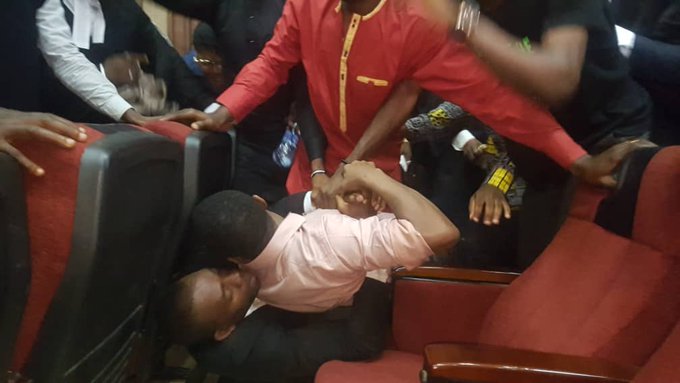
|
| Politics › Re: How Border Closure Cost Nigeria International Maritime Council Seat ― Dakuku by Blue3k2(op): 5:00am On Dec 06, 2019 |
our African brothers mobilized against us for reasons best known to them. Benin Republic told us bluntly, ‘If you want our vote, go and reopen your land borders. Lol sucks to suck. Nigeria lost to Kenya by 1 vote. Oh well better luck next time. Saraki said it was a matter of paramount national interest that “Nigeria gets a seat on the maritime table. What makes it so strategic? |
| Politics › How Border Closure Cost Nigeria International Maritime Council Seat ― Dakuku by Blue3k2(op): 4:47am On Dec 06, 2019 |
By Tola Adenubi with agency report
More facts have emerged on why Nigeria lost by a single vote to Kenya in the just concluded International Maritime Organization (IMO) elections held in London, the United Kingdom over the weekend.
According to the Director-General of Nigeria Maritime Administration and Safety Agency(NIMASA), Dr Dakuku Peterside, while speaking to an online medium Shipping World exclusively, the closure of Nigeria’s land border, coupled with an unprecedented international conspiracy is the reason behind Nigeria’s loss to Kenya in the crucial IMO elections.
According to the NIMASA DG, ” our African brothers mobilized against us for reasons best known to them. Benin Republic told us bluntly, ‘If you want our vote, go and reopen your land borders.
“The last time, we lost by 12 votes. This time around, we lost by a margin of one vote. These issues have nothing to do with NIMASA, rather it was international politics. Our neighbours all voted against us for closing the land borders while Switzerland voted against us because the Nigerian Navy seized their vessel for more than two years.”
In a related development, the Minister of State for Transportation, Dr Gbemisola Saraki, who led the country’s delegation to the IMO Council elections at the weekend said the campaign for the 2021 bid had already begun. Saraki said it was a matter of paramount national interest that “Nigeria gets a seat on the maritime table.
She said the country would, as a first task, appraise the factors behind its narrow loss.
“We are going to go back to the countries that voted to ask them what they did not think we have done well or why they did not vote for us,” Saraki stated.
But she insisted Nigeria had done remarkably well in reforming its maritime sector to meet the United Nations Sustainable Development Goals (SDGs). She pointed to the milestones in maritime safety and security, gender equality, and environmental responsibility.
Saraki was delighted by the determined effort of the Nigerian delegation to campaign for the Category C seat.
Nigeria had come within a whisker of returning to Category C of the IMO at the weekend in London after losing the IMO Council election by just one vote. Though, the country missed its bid for membership of the Governing Council, IMO’s highest decision making organ, Nigeria’s performance was a remarkable improvement from 2017, when it lost by 12 votes. Nigeria polled 110 votes to come 21st at the weekend, one short of the 111 polled by Kenya, which came 20th, the cut-off point for Category C membership of the Council.
The Nigerian delegation also included the Managing Director, Nigerian Ports Authority (NPA), Hadiza Bala Usman; Chairman Senate Committee on Maritime transport , Senator Danjuma Goje, Chairman, House of Representatives Committee on Maritime Safety, Education and Administration, Lynda Ikpeazu; Permanent Secretary, Federal Ministry of Transportation, Sabiu Zakari; Rector of the Maritime Academy of Nigeria (MAN), Oron, Duja Effedua and Barr. Hassan Bello, Executive Secretary Nigerian Shippers Council (NSC). Source: https://tribuneonlineng.com/how-border-closure-cost-nigeria-international-maritime-council-seat-―-dakuku/ |
| Politics › Re: Nigeria: Improving Firefighting Capacities by Blue3k2(op): 4:50pm On Nov 29, 2019 |
This is really pathetic. It's amazing how states and local governments dont prioritize their safety. Everyone must be waiting for the city to burn down before they get their acts together. Aside from buying more equipment their need to be fire codes. A few simple rules can prevent diaster. Anyone that fails to abide by them gets fined or building shut down.
• Smoke alarms in the building
• sprinkler system in building along with fire exitingusers.
• occupancy limits
• city needs install fire hydrants for fire fighters if they haven't already. Etc |
| Politics › Nigeria: Improving Firefighting Capacities by Blue3k2(op): 4:43pm On Nov 29, 2019*. Modified: 5:08pm On Nov 29, 2019 |
The rate at which people are dying and property worth billions of naira is being consumed by fire in this country in recent times has reached alarming proportions. Fire outbreaks across the country are caused by different things, ranging from bush burning to electrical faults to improper storage of fuel to careless handling of domestic fires. In almost all cases however, fire outbreak was aggravated by lack of adequate fire fighting equipment. Fire fighting trucks and equipment are in short supply in most state capitals. This is not to mention local government headquarters and rural areas, where they are virtually non-existent. This is disgraceful for a country of 200 million people.
According to a Daily Trust report two weeks ago, majority of the states have between one to four functional fire trucks. For example, Plateau has four fire trucks, Cross River has one, Edo has two and two water tankers, Kebbi has three old trucks and six grounded ones. Anambra State, which suffered some of the worst fire disasters caused by fuel tankers in recent weeks, had to rely on neighbouring Delta State for support. Rivers, with three serviceable trucks, relies mainly on Shell, Total and Agip oil companies to respond to emergency situations.
Kogi has two trucks to serve 21 local government areas while the number of it's personnel dropped from 185 to 19 due to retirement and deaths. Taraba state government supplied 16 trucks to its local governments but 14 have been sold out. Kwara has four trucks - two in Ilorin, one at Offa and the other at Omun-Aran. The seven fire engines in Benue are no longer serviceable.
In addition, the fire services across the states lack other basic facilities such as boots, jackets, hoses, fire extinguishers, fire blankets and branches that release water with pressure. As such in most cases the firemen cannot respond quickly to distress calls because they are incapacitated. The number of personnel is also inadequate to cope with the scope of fire outbreaks such as the ones witnessed in Balogun market in Lagos, Onitsha market, the petrol tanker accident in Ibadan, or the Kantin Kwari and Sabon Gari Market fire outbreaks in Kano. All these incidents came with much loss of lives and property. Hundreds of people have died and the losses in property are counted in billions of Naira.
It is not surprising therefore that the "World Life Expectancy Report" in 2016 ranked Nigeria first in the world for deaths by fire. Any time Nigeria is at the top of any global chat, it is usually for the wrong reasons. It is bad enough that people are left poor and vulnerable, but it is worse that their lives and property go up in flames every now and then without any visible efforts to stop it or at least reduce it to the barest minimum. Protection of lives and property is a major responsibility of government, and fire outbreak is one of the biggest threats to both in Nigeria.
Federal and the state governments should therefore rise and live up to their responsibilities. All the various governments can afford to buy fire engines because the cost is not prohibitive. A ladder truck could cost about $350,000 [N92.7m] with both trucks equipped with basics like hoses to hydraulic extrication tools and training. With good planning and commitment,the two upper tiers of governments can buy one each every quarter. If this is done every state and the federal government will be able to build a fleet of fire engines that will place them in a good position of discharging their duties of protecting the lives and property of their citizens.
Assembling adequate firefighting equipment should however be accompanied by stepped-up public awareness on fire prevention as well as stepped-up inspection of offices, factories and residential houses by fire departments to eliminate hazards and give citizens crash training in fire fighting. Source: https://www.dailytrust.com.ng/improving-firefighting-capacities.htmlFront page: Lalasticlala mynd44 |
| Politics › Re: Buhari Expresses Concern Over Lack Of Interest In Technical-based Institutions by Blue3k2(op): 3:53pm On Nov 29, 2019 |
“The dearth of skilled manpower at the middle level should provide a huge opportunity for our youths who attend technical-based institutions or are willing to develop themselves in any of them.
“Nation all over the world have come to realise the importance of technical vocational education training in strengthening economies and building formidable industries.” Buhari is right on this. I'd recommend Buhari copy German education system. Their dual education system does focus on vocational education with apprenticeships. The best thing to do is educate young peole on their options out highschool. Essentially there's 4 paths to pick. • jump into workforce immediately • go to university • join the military • vocational training |
| Politics › Re: Buhari Expresses Concern Over Lack Of Interest In Technical-based Institutions by Blue3k2(op): 3:37pm On Nov 29, 2019 |
These trade schools just have to do better job advertising. You spend less time in school then get to work making good money. HVAC and welding are good options. the apathy towards the technical education by the youths is detrimental to the manpower needs of emerging industries in the country. Future students need to know this. Is there shortage of technically trained people? How much do these trades pay? Lastly what is the employment trend in this field. |
| Politics › Buhari Expresses Concern Over Lack Of Interest In Technical-based Institutions by Blue3k2(op): 3:29pm On Nov 29, 2019 |
President Muhammadu Buhari on Thursday expressed concern over youths lack of interest in technical-based institutions in the country.
The President who stated this during the maiden convocation ceremony of the Federal Polytechnic, ile – Oluji, Ondo state, noted that the apathy towards the technical education by the youths is detrimental to the manpower needs of emerging industries in the country.
Speaking through the chairman of the governing board, National Board for Technical Education (NBTE), Prof Modupe Adelabu, President Buhari said: “It is imperative to note that though vocational education is important for preparing necessary manpower for a developing economy, such as ours, the youth of school ages in our country are apathetic towards it.
” Enrolment into technical-based educational institutions at tertiary level is still at an appalling percentage.
“Records of enrolments into universities in recent years show a progressive increase while those of into technical-based institutions have only been marginal.
“The dearth of skilled manpower at the middle level should provide a huge opportunity for our youths who attend technical-based institutions or are willing to develop themselves in any of them.
“Nation all over the world have come to realise the importance of technical vocational education training in strengthening economies and building formidable industries.”
According to President Buhari, some countries like China, Singapore, Malaysia and India have been strengthening their economies through the development of technical-based institutions.
He said: “On our part, we will continuously provide the needed support and enablement for the development and enhancement of technical and vocational education in Nigeria.”
The Vice-Chancellor of the institution, Prof Adedayo Fasakin, said that paucity of funds was a major challenge facing the institution.
“We still face the challenge of low and irregular release in terms of capital and overhead allowances”, even as he called for a special case for increase capital and overhead allocation to the polytechnic.
Fasakin said that the institution welcome donations and all forms of support.
”We welcome collaborative relationship through Build – Operate – and Transfer BOT arrangement.”
Governor Rotimi Akeredolu of Ondo state commended the authorities of the school over the development of the institution within the four years of its establishment, urging that it should help produce students that will meet the manpower needs of the country. Source: https://tribuneonlineng.com/buhari-expresses-concern-over-lack-of-interest-in-technical-based-institutions/ |


