FKO81's Posts
Nairaland Forum › FKO81's Profile › FKO81's Posts
1 2 3 4 5 6 7 8 ... 35 36 37 38 39 40 41 42 43 (of 126 pages)
 Properties › Re: Ernest Azudialu Obiejesi's Nestoil Tower, Lagos (Video And Photo Documentry) by FKO81(op): 8:32am On Jun 02, 2017 Properties › Re: Ernest Azudialu Obiejesi's Nestoil Tower, Lagos (Video And Photo Documentry) by FKO81(op): 8:32am On Jun 02, 2017 |
EmeritusMbaM:  Comparing Anambra and Osun is like comparing China to Zimbabwe 1st Osun 2nd Anambra
|
| Properties › Re: Ernest Azudialu Obiejesi's Nestoil Tower, Lagos (Video And Photo Documentry) by FKO81(op): 7:07am On Jun 02, 2017 |
EmeritusMbaM:Blockhead stay clear when men are debating because you know nothing, go and develop your poor Osun stop hoping on properties owned by hard working Nigerians in Lagos, Poverty is ravaging your domain
|
| Properties › Re: Ernest Azudialu Obiejesi's Nestoil Tower, Lagos (Video And Photo Documentry) by FKO81(op): 6:47am On Jun 02, 2017 |
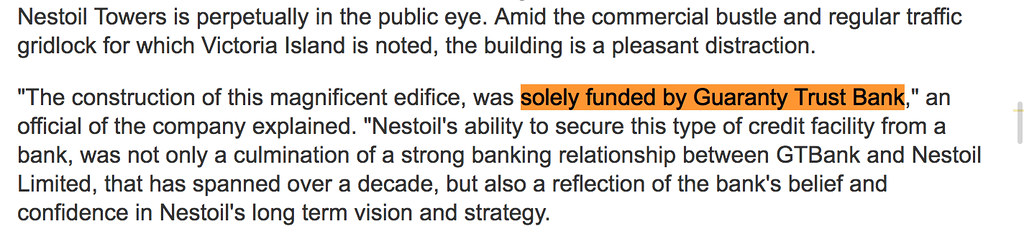
bilazego:Don't mind them, no link to support their claim, I have searched all over Google still demanding for them to provide credible link but non, this is the same tactics they use to blackmailed Innoson  solely funded ke soul win ni solely funded ke soul win ni 1 Like
|
| Properties › Re: Ernest Azudialu Obiejesi's Nestoil Tower, Lagos (Video And Photo Documentry) by FKO81(op): 6:38am On Jun 02, 2017 |
Obijackson owner of nestoil is Nigeria biggest shareholder in Julius beger, and the tower was constructed by JB Only recently Nestoil acquired IMPaC OIL and GAS Engineering Company, how does this acquisition fit into your overall strategic growth plan? Engineering services is a crucial part of the entire EPCC chain ie Engineering, Procurement, Construction and Commissioning. Nestoil is the foremost EPCC provider in the Nigerian oil and gas sector. Before the acquisition of IMPaC, the “engineering” aspect was usually outsourced to third-party companies. The acquisition of IMPaC is aimed at adding significant value to this chain. IMPaC is a world class engineering services company and its acquisition has impacted positively in our overall growth plan. In addition to meeting our in-house engineering services needs, IMPaC is also actively providing such services to other companies. The acquisition adds substantial resources to our existing portolio and fits perfectly into our one-stop shop consolidation strategy. IMPaC renders a broad range of engineering and consultancy services to the oil, gas and power sectors of the onshore and offshore energy industry. Specifically, IMPaC provides integrated development and innovative solutions for exploration and production facilities, offshore structures as well as pipelines and landfalls. The scope of competence includes all necessary utility systems, platforms or vessels. The engineering also includes transportation and marine installation of topsides and modules. So it really cuts across the entire chain: Procurement, Construction, Installation and Commissioning, and, if required, operations and maintenance. Your business interests is now so diversified that one can hardly keep track with you, tell us about this hunger for new business investment and how you are keeping track of these investments? We have typically diversified by identifying appropriate value adding opportunities. This way, we have pioneered the introduction of skills, technology and knowledge. This has been the driving force behind our growth. Recently we entered into a joint venture with the Dutch company A. Hak drillcon to form Nesthak, a company that specialises in horizontal directional drilling [HDD]. Horizontal directional drilling is a trenchless method of installing underground pipes, conduits and cables along a prescribed path by using a surface-launched drilling rig, with minimal impact on the surrounding area. HDD constitutes an important component of many pipeline construction projects and this drilling technique is an environmentally friendly, safe, reliable and efficient alternative to conventional construction methods. HDD is more efficient, often more economical, faster and, above all, has much less impact on the environment. So, Nesthak clients are able to take advantage of our local pipeline construction expertise with A. Hak’s advanced technology. Again, in alliance with Damen Shipyards of the Netherlands, we are presently constructing a modular floating drydock. This will streamline and consolidate our drydocking activities and meet our objectives of safe working conditions, high quality craftsmanship, more competitive pricing and overall reliability. So it’s all about appropriate diversification. We have also expanded laterally into telecommunications with Smile Communications Nigeria Ltd. “Smile” is a new telecommunications company in Nigeria focused on the provision of high-quality, reliable, superfast internet services using 4G LTE technology. Smile acquired unified access service licence in 2009 and commenced commercial operation in March this year at Ibadan. With Smile, we deliver affordable, high-quality and easy-to-use broadband internet access and communication services to customers across Africa. The brand Smile is at the forefront of harnessing technologies to create innovative solutions that enable the cost-effective deployment of advanced communication services to everyone in Africa. It launched its first commercial network services in Kampala, Uganda in November 2009, where it provides its customers with voice and messaging services, with or without the ownership of a handset and expanded to Tanzania, Uganda and the Democratic Republic of Congo. . Our services are now available in Lagos, with plans to cover Port Harcourt and Abuja in a few months. To support our diversification, we have embarked on aggressive senior management recruitment that will enable us monitor our investments in various sectors. We have all our investments very much in focus. What informed the restructuring of Nestoil being carried out by KPMG – is it designed to make the company conform to international best practice or what? Yes. Indeed we engaged the services of KPMG/Alliance Law Firm to guide us through the process of restructuring. This was informed by the need to ensure that our continued growth is anchored on international best practice culture regime. The Board felt that there was a need to set up structures and implement key corporate governance principles that will position Nestoil and its associate companies as a world class group. So far we are very much on track.The restructuring by KPMG will include Enterprise Restructuring that will see Nestoil Plc and other associate companies prepare for their IPO within the next 18 months. Your foray into power has not been as successful as you would have wished, at least for now. Is this affecting the timelines for your growth plan? Certainly not. Challenges are usual in business, particularly at the level where we are playing. We are currently developing the Okija Independent Power Plant.The first phase, which we are working on presently, is a 495MW open cycle plant worth $700 million. Steady power generation is a pathway to economic growth. It’s a long-term investment and we are ready for the long haul. An international bid process has selected GE, Julius Berger and Daewoo as the EPC contractors for construction beginning January 2016. Many see Nestoil as reference point for the success story of the local content law. What is your reaction to that? Understandably, we are proud to be a reference point. Despite seeming odds, we persisted and steadily developed what is arguably one of the largest diversified oil and gas industry service groups in Nigeria, with the ability to implement highly complex projects in areas such as pipeline construction, pressure vessel fabrication, mechanical and civil works, flowstation upgrade, dredging, oil exploration and production. These works are done by a highly motivated workforce that is 98% Nigerian. The Local Content Act has also allowed indigenous companies to grow on an unprecedented scale and acquire assets. For example, Nestoil’s strategic business unit – Gobowen Exploration and Production Limited - led the NECONDE Consortium (consisting of Gobowen Exploration and Production Limited, Aries Exploration and Production and Poland’s Kulczyk Oil Ventures) to acquire a 45% participating interest in OML 42, a large oil block in the swamps of Niger Delta from Shell Petroleum Development Company of Nigeria Limited, Total E&P Nigeria Limited, and Nigerian Agip Oil Company Limited. The remaining 55% participating interest in OML 42 is held by NNPC. With nearly 1 billion barrels of crude oil and trillions of cubic feet of gas, OML 42 is one of the biggest assets in the Shell divestment drive. In addition, Gobowenacquired substantial shares in the Oriri field (OML 88) in the Niger Delta from Goland PDC and have also acquired 51% participating interest in OPL 917 – an onshore block – among other assets we are contemplating. We are a prime example of how local companies can make an impact if given a level playing field to perform. People who are interested in participating in the oil and gas sector, see us as a symbol of encouragement. Nestoil can be replicated by other Nigerians, but they have to be patient, committed and be willing to learn over time. These are attributes we imbibed and are still practising till date. The Group known as Obijackson Group has grown into several other companies with diverse cross-sector interests in different aspects of the economy. We have offices on three continents and employ well over 2,000 people. Another area we are particularly proud of at Nestoil is our drive for community development. Our community relationships are a vital component of our business operations, and is reflected in a number of our philanthropic commitments channeled mostly through our foundation - The Obijackson Foundation. We work quietly to enhance academics, sporting events and providing the necessary socio-economic support to society. How has the policy worked and the challenges still faced by indigenous companies and what needs to be done to increase local participation in the oil industry? The Local Content Act changed the Nigerian oil and gas landscape as it gave more local companies opportunity to compete on a level playing field. As an economic policy, it has positive implications for employment with significant multiplier effect. Finance and capacity building has continued to be a challenge, but I am of the view, these challenges are usual for such a far reaching policy as the local content concept. There are also issues of adequate well-trained personnel. Again, this I believe will be conquered over time. The situation now is much better than we met it when we set up shop over two decades ago. And it can only get better. One of our associate companies, Energy Works Technology Limited has the largest and one-of-a-kind offshore fabrication facility in West Africa. Recently, we successfully rolled out the first of 3 Clad Plates being 90+4mm Thick Clad weighing 20 Tonnes for SPDC Soku Nag Separator – this feat is a first for the Nigerian Fabrication Industry. A lot of people say doing business in Nigeria is very tough; tell me what it has been like for you especially bearing in mind the sensitive nature of the sector you operate in? It was and still is a tough environment to say the least particularly in our sector. The early days were quite challenging, primarily because the climate of the early nineties was not receptive to an indigenous player competing against better established foreign entities. Confidence, finance, pedigree, qualified personnel, were all teething problems associated with that era. But we persevered. With the benefit of hindsight, we were pioneering a movement that paved the way for greater local participation and ultimately made the Local Content Act realisable. Rapidly, you seem to be trying to consolidate your presence in the upstream. What has informed this new and aggressive drive? Our drive to go upstream is being fuelled by our drive to cover the entire oil and gas value chain, and ensure forward and backward integration. We started out as an oil and gas service company, then moved to acquire oil and gas assets as a way of consolidating our hold in oil and gas production. Our oil and gas assets would be useful in our quest for power generation. Our extensive gas reserves from our joint ownership of OML 42, for example, can be used to generate power. This would no doubt transform you from an oil service company working for the IOCs to a competitor with IOCs Yes of course. Our block is already producing oil – just like the IOCs produce oil. So yes, that makes us basically competitors in the same market. Your company is currently undertaking the construction of a massive seventeen-story building to house your corporate headquarters; tell me how significant the project is for the overall profile of your company? The Nestoil Towers ia another testimonial of our commitment to investment in the Nigerian economy, innovation and environmental consciousness. It has been designed and is being constructed as a green building. By constructing a certified green building, we are responding to some of the most important challenges of our time: climate change, over dependence on non-sustainable sources of energy – with an ecologically responsible solution. Upon completion, our new corporate head quarters will be a veritable symbol of how a local company participation in oil and gas, can add value to the Nigerian economy. It is a bold statement of strategic importance to our company. The project is progressing smoothly and by God’s grace we shall commission the building sometime in 2015. The structure is being built to meet the Leadership in Energy and Environmental Design (LEED) standards of certification and has a Silver rating. LEED was developed by the U.S. Green Building Counsel to provide a framework for applicable and measurable green building solutions.
|
| Properties › Re: Ernest Azudialu Obiejesi's Nestoil Tower, Lagos (Video And Photo Documentry) by FKO81(op): 6:35am On Jun 02, 2017 |
EmeritusMbaM:Respect and adore by your leaders Go and develop your poor enclave, Lagos is no man's land, stop hoping on structures built by hardworking Nigerias, lazy...
|
| Politics › Re: Count Niger Deltans Out Of Agitation To Divide Nigeria, Says Wike by FKO81(m): 6:27am On Jun 02, 2017 |
TheCabal:Crash like window xp when Ogun with high IGR was among states declared bankrupt, rated by NPF with highest number of suicide cases in Nigeria, seriously in debt, can't pay full workers salaries or fund projects
|
| Politics › Re: Count Niger Deltans Out Of Agitation To Divide Nigeria, Says Wike by FKO81(m): 6:18am On Jun 02, 2017 |
All politcs just to give northerners and Westerners hope Gov Wike know where he belong, other eastern politics can do the same, that's one of the characters of being a politician He knows his root 1 Like
|
| Properties › Re: Ernest Azudialu Obiejesi's Nestoil Tower, Lagos (Video And Photo Documentry) by FKO81(op): 5:24am On Jun 02, 2017 |
All tribes developed Lagos, even Northerns, former military leader, politicians, business tycoon all have structures in Lagos, just like Eko atlantic city been develop by Lebanese brothers, tomorrow land grabbers will claim the properties with GTB on media , No tribe can claim Lagos for life this is fact, even if Nigeria cease to exist, it will still remain no man's land except you guys are ready to face east and north with others. According to Emir of Kano Sanusi Lamido Sanusi, he said they need Lagos more than Nigerdelta oil , they know the volume of their investments, do you think Dangote is stupid investing in Lagos, we will remind you guys the history of eko when the time comes
|
| Properties › Re: Ernest Azudialu Obiejesi's Nestoil Tower, Lagos (Video And Photo Documentry) by FKO81(op): 4:54am On Jun 02, 2017 |
FKO81:
|
| Properties › Re: Ernest Azudialu Obiejesi's Nestoil Tower, Lagos (Video And Photo Documentry) by FKO81(op): 4:50am On Jun 02, 2017 |
afonjadie:Don't mind envious tribe they can only rant online as usual Lagos is no man's land developed by alll. More structures own by Igbos
|
| Properties › Re: Ernest Azudialu Obiejesi's Nestoil Tower, Lagos (Video And Photo Documentry) by FKO81(op): 4:23am On Jun 02, 2017*. Modified: 4:55am On Jun 02, 2017 |
afonjadie:Don't mind the boy there is no link to support his GTB loan claims, that was how they used the same bank to blackmail Innoson |
| Properties › Re: Ernest Azudialu Obiejesi's Nestoil Tower, Lagos (Video And Photo Documentry) by FKO81(op): 12:45am On Jun 02, 2017 |
PearlStreet:Gradually  . we are now in state house of assembly soon Alausa government house Awories, Binis, Eguns, Nupes etc migrated to Lagos earlier before Igbos, Hausas, Ijaws later joined, Igbos fast buying up lands in Lagos, you can only rant online . we are now in state house of assembly soon Alausa government house Awories, Binis, Eguns, Nupes etc migrated to Lagos earlier before Igbos, Hausas, Ijaws later joined, Igbos fast buying up lands in Lagos, you can only rant online
|
| Properties › Re: Ernest Azudialu Obiejesi's Nestoil Tower, Lagos (Video And Photo Documentry) by FKO81(op): 12:25am On Jun 02, 2017 |
PearlStreet:Lagos is no man's land go an face your slums cities and earthquake ravaging zone
|
| Properties › Re: Ernest Azudialu Obiejesi's Nestoil Tower, Lagos (Video And Photo Documentry) by FKO81(op): 11:55pm On Jun 01, 2017 |
Obijackson owner of nestoil is Nigeria biggest shareholder in Julius beger, and the tower was constructed by JB Only recently Nestoil acquired IMPaC OIL and GAS Engineering Company, how does this acquisition fit into your overall strategic growth plan? Engineering services is a crucial part of the entire EPCC chain ie Engineering, Procurement, Construction and Commissioning. Nestoil is the foremost EPCC provider in the Nigerian oil and gas sector. Before the acquisition of IMPaC, the “engineering” aspect was usually outsourced to third-party companies. The acquisition of IMPaC is aimed at adding significant value to this chain. IMPaC is a world class engineering services company and its acquisition has impacted positively in our overall growth plan. In addition to meeting our in-house engineering services needs, IMPaC is also actively providing such services to other companies. The acquisition adds substantial resources to our existing portolio and fits perfectly into our one-stop shop consolidation strategy. IMPaC renders a broad range of engineering and consultancy services to the oil, gas and power sectors of the onshore and offshore energy industry. Specifically, IMPaC provides integrated development and innovative solutions for exploration and production facilities, offshore structures as well as pipelines and landfalls. The scope of competence includes all necessary utility systems, platforms or vessels. The engineering also includes transportation and marine installation of topsides and modules. So it really cuts across the entire chain: Procurement, Construction, Installation and Commissioning, and, if required, operations and maintenance. Your business interests is now so diversified that one can hardly keep track with you, tell us about this hunger for new business investment and how you are keeping track of these investments? We have typically diversified by identifying appropriate value adding opportunities. This way, we have pioneered the introduction of skills, technology and knowledge. This has been the driving force behind our growth. Recently we entered into a joint venture with the Dutch company A. Hak drillcon to form Nesthak, a company that specialises in horizontal directional drilling [HDD]. Horizontal directional drilling is a trenchless method of installing underground pipes, conduits and cables along a prescribed path by using a surface-launched drilling rig, with minimal impact on the surrounding area. HDD constitutes an important component of many pipeline construction projects and this drilling technique is an environmentally friendly, safe, reliable and efficient alternative to conventional construction methods. HDD is more efficient, often more economical, faster and, above all, has much less impact on the environment. So, Nesthak clients are able to take advantage of our local pipeline construction expertise with A. Hak’s advanced technology. Again, in alliance with Damen Shipyards of the Netherlands, we are presently constructing a modular floating drydock. This will streamline and consolidate our drydocking activities and meet our objectives of safe working conditions, high quality craftsmanship, more competitive pricing and overall reliability. So it’s all about appropriate diversification. We have also expanded laterally into telecommunications with Smile Communications Nigeria Ltd. “Smile” is a new telecommunications company in Nigeria focused on the provision of high-quality, reliable, superfast internet services using 4G LTE technology. Smile acquired unified access service licence in 2009 and commenced commercial operation in March this year at Ibadan. With Smile, we deliver affordable, high-quality and easy-to-use broadband internet access and communication services to customers across Africa. The brand Smile is at the forefront of harnessing technologies to create innovative solutions that enable the cost-effective deployment of advanced communication services to everyone in Africa. It launched its first commercial network services in Kampala, Uganda in November 2009, where it provides its customers with voice and messaging services, with or without the ownership of a handset and expanded to Tanzania, Uganda and the Democratic Republic of Congo. . Our services are now available in Lagos, with plans to cover Port Harcourt and Abuja in a few months. To support our diversification, we have embarked on aggressive senior management recruitment that will enable us monitor our investments in various sectors. We have all our investments very much in focus. What informed the restructuring of Nestoil being carried out by KPMG – is it designed to make the company conform to international best practice or what? Yes. Indeed we engaged the services of KPMG/Alliance Law Firm to guide us through the process of restructuring. This was informed by the need to ensure that our continued growth is anchored on international best practice culture regime. The Board felt that there was a need to set up structures and implement key corporate governance principles that will position Nestoil and its associate companies as a world class group. So far we are very much on track.The restructuring by KPMG will include Enterprise Restructuring that will see Nestoil Plc and other associate companies prepare for their IPO within the next 18 months. Your foray into power has not been as successful as you would have wished, at least for now. Is this affecting the timelines for your growth plan? Certainly not. Challenges are usual in business, particularly at the level where we are playing. We are currently developing the Okija Independent Power Plant.The first phase, which we are working on presently, is a 495MW open cycle plant worth $700 million. Steady power generation is a pathway to economic growth. It’s a long-term investment and we are ready for the long haul. An international bid process has selected GE, Julius Berger and Daewoo as the EPC contractors for construction beginning January 2016. Many see Nestoil as reference point for the success story of the local content law. What is your reaction to that? Understandably, we are proud to be a reference point. Despite seeming odds, we persisted and steadily developed what is arguably one of the largest diversified oil and gas industry service groups in Nigeria, with the ability to implement highly complex projects in areas such as pipeline construction, pressure vessel fabrication, mechanical and civil works, flowstation upgrade, dredging, oil exploration and production. These works are done by a highly motivated workforce that is 98% Nigerian. The Local Content Act has also allowed indigenous companies to grow on an unprecedented scale and acquire assets. For example, Nestoil’s strategic business unit – Gobowen Exploration and Production Limited - led the NECONDE Consortium (consisting of Gobowen Exploration and Production Limited, Aries Exploration and Production and Poland’s Kulczyk Oil Ventures) to acquire a 45% participating interest in OML 42, a large oil block in the swamps of Niger Delta from Shell Petroleum Development Company of Nigeria Limited, Total E&P Nigeria Limited, and Nigerian Agip Oil Company Limited. The remaining 55% participating interest in OML 42 is held by NNPC. With nearly 1 billion barrels of crude oil and trillions of cubic feet of gas, OML 42 is one of the biggest assets in the Shell divestment drive. In addition, Gobowenacquired substantial shares in the Oriri field (OML 88) in the Niger Delta from Goland PDC and have also acquired 51% participating interest in OPL 917 – an onshore block – among other assets we are contemplating. We are a prime example of how local companies can make an impact if given a level playing field to perform. People who are interested in participating in the oil and gas sector, see us as a symbol of encouragement. Nestoil can be replicated by other Nigerians, but they have to be patient, committed and be willing to learn over time. These are attributes we imbibed and are still practising till date. The Group known as Obijackson Group has grown into several other companies with diverse cross-sector interests in different aspects of the economy. We have offices on three continents and employ well over 2,000 people. Another area we are particularly proud of at Nestoil is our drive for community development. Our community relationships are a vital component of our business operations, and is reflected in a number of our philanthropic commitments channeled mostly through our foundation - The Obijackson Foundation. We work quietly to enhance academics, sporting events and providing the necessary socio-economic support to society. How has the policy worked and the challenges still faced by indigenous companies and what needs to be done to increase local participation in the oil industry? The Local Content Act changed the Nigerian oil and gas landscape as it gave more local companies opportunity to compete on a level playing field. As an economic policy, it has positive implications for employment with significant multiplier effect. Finance and capacity building has continued to be a challenge, but I am of the view, these challenges are usual for such a far reaching policy as the local content concept. There are also issues of adequate well-trained personnel. Again, this I believe will be conquered over time. The situation now is much better than we met it when we set up shop over two decades ago. And it can only get better. One of our associate companies, Energy Works Technology Limited has the largest and one-of-a-kind offshore fabrication facility in West Africa. Recently, we successfully rolled out the first of 3 Clad Plates being 90+4mm Thick Clad weighing 20 Tonnes for SPDC Soku Nag Separator – this feat is a first for the Nigerian Fabrication Industry. A lot of people say doing business in Nigeria is very tough; tell me what it has been like for you especially bearing in mind the sensitive nature of the sector you operate in? It was and still is a tough environment to say the least particularly in our sector. The early days were quite challenging, primarily because the climate of the early nineties was not receptive to an indigenous player competing against better established foreign entities. Confidence, finance, pedigree, qualified personnel, were all teething problems associated with that era. But we persevered. With the benefit of hindsight, we were pioneering a movement that paved the way for greater local participation and ultimately made the Local Content Act realisable. Rapidly, you seem to be trying to consolidate your presence in the upstream. What has informed this new and aggressive drive? Our drive to go upstream is being fuelled by our drive to cover the entire oil and gas value chain, and ensure forward and backward integration. We started out as an oil and gas service company, then moved to acquire oil and gas assets as a way of consolidating our hold in oil and gas production. Our oil and gas assets would be useful in our quest for power generation. Our extensive gas reserves from our joint ownership of OML 42, for example, can be used to generate power. This would no doubt transform you from an oil service company working for the IOCs to a competitor with IOCs Yes of course. Our block is already producing oil – just like the IOCs produce oil. So yes, that makes us basically competitors in the same market. Your company is currently undertaking the construction of a massive seventeen-story building to house your corporate headquarters; tell me how significant the project is for the overall profile of your company? The Nestoil Towers ia another testimonial of our commitment to investment in the Nigerian economy, innovation and environmental consciousness. It has been designed and is being constructed as a green building. By constructing a certified green building, we are responding to some of the most important challenges of our time: climate change, over dependence on non-sustainable sources of energy – with an ecologically responsible solution. Upon completion, our new corporate head quarters will be a veritable symbol of how a local company participation in oil and gas, can add value to the Nigerian economy. It is a bold statement of strategic importance to our company. The project is progressing smoothly and by God’s grace we shall commission the building sometime in 2015. The structure is being built to meet the Leadership in Energy and Environmental Design (LEED) standards of certification and has a Silver rating. LEED was developed by the U.S. Green Building Counsel to provide a framework for applicable and measurable green building solutions. 1 Like
|
| Properties › Re: Ernest Azudialu Obiejesi's Nestoil Tower, Lagos (Video And Photo Documentry) by FKO81(op): 11:40pm On Jun 01, 2017 |
Afonjas with bitter hearts, and propaganda there is no link that subjected GTbank 100% sole funded Nestoil, just like Dangote refinery so many banks are funding the projects, I guess tomorrow you guys will use GTB to claim the refinery on media , Igbos controls big banks that can fund the project.
|
| Properties › Re: Ernest Azudialu Obiejesi's Nestoil Tower, Lagos (Video And Photo Documentry) by FKO81(op): 11:28pm On Jun 01, 2017 |
20CRATES:Envious tribe Can you provide the link  |
| Properties › Re: Ernest Azudialu Obiejesi's Nestoil Tower, Lagos (Video And Photo Documentry) by FKO81(op): 11:02pm On Jun 01, 2017 |
judgedredd22:Envious tribe that was how you guys used GTB to blackmail Innoson, you forgot Diamond bank gave load to coleman owned by Yoruba man, Fidelity funded Lagos Alausa power project, same with other Igbo banks Zenith bank and UBA. Igbos and Hausas/Fulanis, Lebanese, Indians, Chines and other tribes made Lagos, you can only dream and write trash online, be ready to face this tribes. Land grabbers
|
| Properties › Re: Ernest Azudialu Obiejesi's Nestoil Tower, Lagos (Video And Photo Documentry) by FKO81(op): 10:48pm On Jun 01, 2017 |
EvilMetahuman:Go and rescue your people in Kwara first, Lagos is no man's land
|
| Politics › Re: IG Of Police Storms Anambra, The Safest State In Nigeria- Pictures by FKO81(m): 10:37pm On Jun 01, 2017 |
NCP:Gov Obiano admire by..... 1 Like
|
| Education › Re: Statistics Of Admissions Into Degree Awarding Institutions By State Of Orgin-nbs by FKO81(m): 10:17pm On Jun 01, 2017 |
totit: Do the math by region, mind you some Igbos use Lagos as their state of origin, add aniomas and Rivers Igbo
|
| Education › Re: Statistics Of Admissions Into Degree Awarding Institutions By State Of Orgin-nbs by FKO81(m): 9:42pm On Jun 01, 2017 |
totit:B.l.o.ckhead can you use your Google This is end of discussion for edu
|
| Education › Re: Statistics Of Admissions Into Degree Awarding Institutions By State Of Orgin-nbs by FKO81(m): 9:41pm On Jun 01, 2017 |
totit:B.l.o.ckhead can you use your Google
|
| Education › Re: Statistics Of Admissions Into Degree Awarding Institutions By State Of Orgin-nbs by FKO81(m): 9:33pm On Jun 01, 2017 |
Omofunaab2:Google social statistics report 2015 by national Bureau of statistics, come back and thank me after you are through with information it contains 1 Like
|
| Education › Re: Statistics Of Admissions Into Degree Awarding Institutions By State Of Orgin-nbs by FKO81(m): 9:27pm On Jun 01, 2017 |
totit:Oboy you google social statistics report 2015 by national Bureau of statistics.
|
| Education › Re: Statistics Of Admissions Into Degree Awarding Institutions By State Of Orgin-nbs by FKO81(m): 9:14pm On Jun 01, 2017 |
http://www.google.com.ng/url?sa=t&rct=j&q=&esrc=s&source=web&cd=4&ved=0ahUKEwjMwLqdqp3UAhVLKlAKHaKXBS8QFghAMAM&url=http%3A%2F%2Fwww.nigerianstat.gov.ng%2Fdownload%2F486&usg=AFQjCNGTAqYXilADVX9A1af2RMHXSJ5S6Q[/quote]This is from NBS, below the table Joint admission matriculation board (JAMB)
|
| Education › Re: Statistics Of Admissions Into Degree Awarding Institutions By State Of Orgin-nbs by FKO81(m): 8:55pm On Jun 01, 2017 |
totit:I guess you are the only one having problem with the link I know you are really disappointed, I understand your present condition take heart THIS IS END OF DISCUSSIONS FOR EDUCATION DEBATE IN NIGERIA
|
| Education › Re: Statistics Of Admissions Into Degree Awarding Institutions By State Of Orgin-nbs by FKO81(m): 8:23pm On Jun 01, 2017 |
totit:Sorry bro! you are just fooling yourself here go a sue NBS if you are pain 1 Like
|
| Education › Re: Statistics Of Admissions Into Degree Awarding Institutions By State Of Orgin-nbs by FKO81(m): 8:10pm On Jun 01, 2017 |
totit:PDF format from NBS file kindly download and open, are you a leader http://www.google.com.ng/url?sa=t&rct=j&q=&esrc=s&source=web&cd=4&ved=0ahUKEwjMwLqdqp3UAhVLKlAKHaKXBS8QFghAMAM&url=http%3A%2F%2Fwww.nigerianstat.gov.ng%2Fdownload%2F486&usg=AFQjCNGTAqYXilADVX9A1af2RMHXSJ5S6Q 2 Likes
|
| Education › Re: Statistics Of Admissions Into Degree Awarding Institutions By State Of Orgin-nbs by FKO81(m): 8:01pm On Jun 01, 2017 |
totit:http://www.google.com.ng/url?sa=t&rct=j&q=&esrc=s&source=web&cd=4&ved=0ahUKEwjMwLqdqp3UAhVLKlAKHaKXBS8QFghAMAM&url=http%3A%2F%2Fwww.nigerianstat.gov.ng%2Fdownload%2F486&usg=AFQjCNGTAqYXilADVX9A1af2RMHXSJ5S6Q 2 Likes |
| Education › Re: Statistics Of Admissions Into Degree Awarding Institutions By State Of Orgin-nbs by FKO81(m): 7:56pm On Jun 01, 2017 |
More 1 Like
|
| Education › Re: Statistics Of Admissions Into Degree Awarding Institutions By State Of Orgin-nbs by FKO81(m): 7:55pm On Jun 01, 2017 |
4 Likes
|
| Education › Re: Statistics Of Admissions Into Degree Awarding Institutions By State Of Orgin-nbs by FKO81(m): 7:50pm On Jun 01, 2017 |
miniyi018:Data from National bureau of statistics you guys have been deceived by Lagos/Ibadan media for too long, Igbos are leading in educationhttp://punchng.com/education-why-south-west-and-north-should-be-worried/ Education: Why South-West and North should be worried Someone from the South-East or South-South could see it as a reason for chest-thumping, but for me, it portends grave danger. Why do I say so? I will explain shortly. Those who had not been following the trend in education could dismiss this as a flash in the pan. But it is not so. I have followed the trend since the late 1980s. From 1996 when the late military dictator, Sani Abacha, created 36 states out of Nigeria, the three states that have been producing the highest number of applicants in the examination organised by the Joint Admissions and Matriculation Board have been Imo, Anambra and Delta. The Guardian of August 26, 1999, page 31, had some statistics about the 1999 UTME examination. It showed that the six states with the highest number of applications were: Imo (44,274), Delta (36,375), Anambra (34,206), Ogun (33,375), Edo (29,057), and Osun (22,950). Conversely, the states that produced the least number of candidates were all Northern states: Borno (1,572), Katsina (1,054), Taraba (882), Sokoto (782), Kebbi (794), and Yobe (535). The Registrar of JAMB then, Prof. Bello Ahmad Salim, lamented the poor showing of the Northern states, noting that the 65,000 applications from the 19 states of the North were just 20,726 higher than the number of applications from only Imo State. If Imo and Delta states’ applications were combined, that would amount to 80,649 applications: over 15,000 higher than the applications from the 19 states of the North. In 2007, The Guardian newspaper of June 1, page 3, published the results of the 2007 University Matriculation Examination. The top six states with the highest number of candidates were Imo (93,065), Anambra (64,689), Delta (61,580), Edo (57,754), Akwa Ibom (47,928), and Ogun (47,227). The last six were: Kebbi (4,682), Sokoto (3,925), Taraba (3,832), Zamfara (2,904), Jigawa (2,541), and Yobe (2,516). For the 2012 results released by JAMB and published by Vanguard of March 31, the top five states were: Imo (123,865), Delta (88,876), Anambra (84,204), Osun (73,935), Oyo (71,272). The least five states were: Jigawa (11,529), Kebbi (7,364), Yobe (6,389), Zamfara (5,713), and Sokoto (5,664). In the Unity School admission of 2013, the states that got the highest cut-off marks were: Anambra – Male (139) Female (139); Imo – Male (138) Female (138); Enugu – Male (134) Female (134); Lagos – Male (133) Female (133); Delta – Male (131) Female (131); Ogun – Male(131) Female(131); Abia – Male (130) Female (130). The states that got the lowest cut-off scores were: Zamfara – Male (four) Female (two); Yobe – Male (two) Female (27); Taraba – Male (three) Female (11); Sokoto – Male (nine) Female (13); Kebbi – Male (nine) Female (20); Bauchi – Male (35) Female (35). So, for those from the South-West and North who may give the excuse of the South-East and South-South states getting these results by the help of “special centres,” it is a case of trying to hide behind a finger. Instructively, the South-West, which was the first to receive Western education, and was ahead in education, has lost its place in education in Nigeria. Something is killing the interest of the South-West children in education. The six South-West states need to see this as an emergency that transcends party affiliation. This scenario is a source of danger because the South-East and South-West have been counter forces to each other. Whatever feat the South-West produces, the South-East counters it, and vice versa. We can see it in the literary feats of Chinua Achebe and Wole Soyinka, the football feats of Shooting Stars and Rangers, the political feats of Nnamdi Azikiwe and Obafemi Awolowo, the academic feats of University of Nigeria, Nsukka and University of Ife, Ile-Ife (now Obafemi Awolowo University), and so on. This healthy rivalry enhances stability, peace and growth in the nation. But if this downward trend continues, in future, that balancing of forces between the South-West and the South-East will no longer exist. And given that the indigenes of the South-East and the South-South dwell in large numbers in the South-West, a time will come when the South-West could feel angry that the indigenes of the South-East and South-South are taking over positions that the South-West indigenes should occupy in the South-West. This may cause problems as witnessed in the xenophobic attacks in South Africa last year. So, it is in the interest of all that the South-West stage a come-back in education. 6 Likes
|


1 2 3 4 5 6 7 8 ... 35 36 37 38 39 40 41 42 43 (of 126 pages)