Napata77's Posts
Nairaland Forum › Napata77's Profile › Napata77's Posts
1 2 3 4 5 6 7 8 ... 35 36 37 38 39 40 41 42 43 (of 67 pages)
 Politics › Re: Are Nigerians From Ancient Egypt? by Napata77(op): 6:01am On Feb 14, 2023 |
christistruth01:Yoruba sculpture has been frequently compared to Ancient Egyptian. Sudanese, ie Nubian culture is what gave birth to Egyptian culture. There is virtually no difference between the two. Sudan even has more pyramids than Egypt, and they are older and smaller. Pharaoh Amenhotep - 1300s BCE https://i.pinimg.com/564x/b0/04/e8/b004e8f31aa022913f4de57d7a7350d5.jpg Ife Bronzes, 12th century AD https://i.pinimg.com/564x/aa/09/62/aa0962b6d115e42ca67e32be4b95aa84.jpg https://i.pinimg.com/originals/70/73/d2/7073d27ce633fb536ab806f83ef7dc1e.png 1 Like |
| Politics › Re: Are Nigerians From Ancient Egypt? by Napata77(op): 5:09am On Feb 14, 2023*. Modified: 2:30am On Feb 15, 2023 |
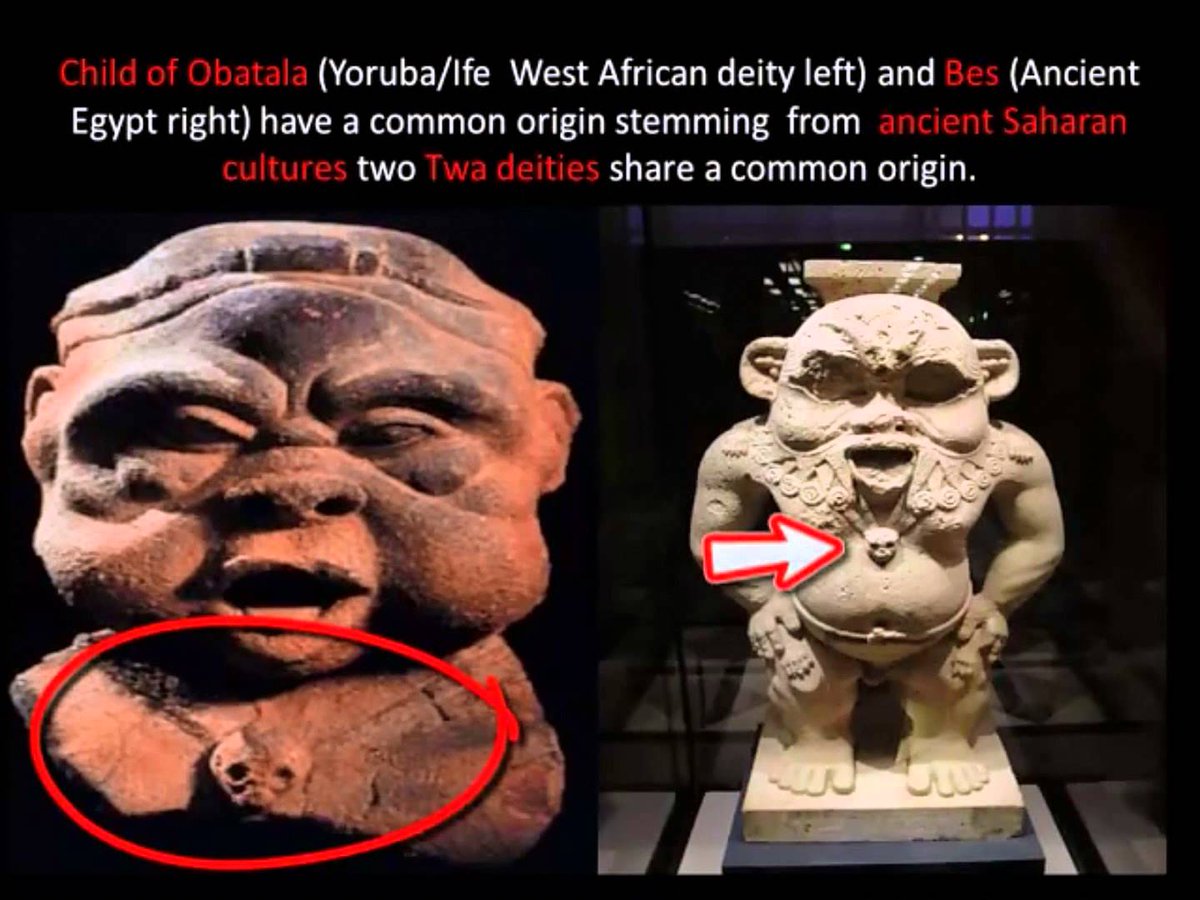
https://pbs.twimg.com/media/DOOl5G3WAAA6OUI.jpg When I saw the image above, and the identical nature of the two deities, the Child of Obatala of the Yorubas, and the Egyptian god Bes, I thought, ''so the child of Obatala's name is 'Bes' in Ancient Egyptian''. I then said to myself ''I wonder what the child of Obatala's name is in Yorubaland. I bet it has the word 'bes' or similar in it''. I then researched Google, and found this site owned by a Yoruba chief, https://owulakoda./2011/01/19/olowu-the-son-of-obatala/ and boom! The Yoruba name for the Son of Obatala is AJI BOS IN. ie, 'BES'  According to Wiki, ''Bes may have been a Middle Kingdom import from Nubia or Somalia, and his cult did not become widespread until the beginning of the New Kingdom. Worship of Bes spread as far north as the area of Syria and as far west as the Balearic Islands (Ibiza) in Spain, and later into the Roman and Achaemenid Empires. Bes was a household protector, becoming responsible – throughout ancient Egyptian history – for such varied tasks as killing snakes, fighting off evil spirits, watching after children, and aiding women in labour by fighting off evil spirits, and thus present with Taweret at births.... Like many Egyptian gods, the worship of Bes or Beset was exported overseas. While the female variant had been more popular in Minoan Crete, the male version would prove popular with the Phoenicians and the ancient Cypriots. The Balearic island of Ibiza derives its name from the god's name, brought along with the first Phoenician settlers in 654 BC. These settlers, amazed at the lack of any sort of venomous creatures on the island, thought it to be the island of Bes (<איבשם> ʔybšm, *ʔibošim, yibbōšīm "dedicated to Bes" ) ''Yibbosim''? ''Ibosim''? AJIBOSIN? Coincidence? I don't think so.  One more thing. Although his name was 'Bes' in Egypt, the vowel 'E' is actually a guess by interpreters, because the Egyptians did not write vowels in their hieroglyphics. So the rendition would simply be 'BS', and it would be modern-day interpreters of the text that would guess what vowel was actually used by the speakers. So it could very well have been pronounced 'iBosi' by the ancient Egyptians, matching 'Ajibosin'. 1 Like 1 Share |
| Politics › Re: Are Nigerians From Ancient Egypt? by Napata77(op): 5:06am On Feb 14, 2023 |
Praxis758:100% correct. I might also add that the desertification of the once fertile, populated Sahara played a big part in African migration southwards into west and central Africa. |
| Crime › Re: Nigerian Pharmacy Student Arrested In India With 15.56 Grams Of Heroin by Napata77: 1:21am On Feb 14, 2023 |
chinemezeq:YOU don't get to tell THEM to ''decide'' anything or to ''have a referendum''. Who born you? You dey crase? It is for THEM to decide they want a referendum. And so far, their lips are sealed, as they are part of the Nigerian family, so take a hike, you secessionist traitor. 1 Like 1 Share |
| Politics › Are Nigerians From Ancient Egypt? by Napata77(op): 11:58pm On Feb 13, 2023*. Modified: 8:09am On Feb 14, 2023 |
| Politics › Re: I'm Obedient, But See Why I Cannot Say For Sure If Obi Will Win. by Napata77: 10:56pm On Feb 13, 2023 |
Trollronaldo:Colonised mumu. Who is 'Jesus Christ'? What evidence have you seen that he existed? Do you know the whites who taught you the story are in dispute today about his actual existence, with many claiming it is a total fabrication, with no evidence of his life whatsoever? Are you even aware there is such a debate? Oyinbo came and scammed you with a fairytale so they could steal your land and resources, with your eyes closed and praying to your new 'white' saviour. Don't open your eyes yet, you hear? Mr Jesus Christ. |
| Crime › Re: Nigerian Pharmacy Student Arrested In India With 15.56 Grams Of Heroin by Napata77: 10:36pm On Feb 13, 2023 |
chinemezeq:We have already begged you to go, but your terrorist leader refused because he wasn't given the south-south and Benue, which he claimed to be Igboland, being a thief and a terrorist criminal. Why I rejected 5 Igbo states - Nnamdi Kanu https://www.vanguardngr.com/2017/07/rejected-biafra-5-igbo-states-nnamdi-kanu/ 7 Likes 1 Share |
| Crime › Re: Nigerian Pharmacy Student Arrested In India With 15.56 Grams Of Heroin by Napata77: 10:30pm On Feb 13, 2023*. Modified: 1:16am On Feb 14, 2023 |
searchlight:You care about ''our national treasury'' but you don't care about your kinsmen disgracing ''our country'' overseas with their drug dealing. Did your parents not teach you that reputation is even more important than money, more so in a globalised digital universe? Idiot. Your national treasury. 6 Likes |
| Crime › Re: Nigerian Pharmacy Student Arrested In India With 15.56 Grams Of Heroin by Napata77: 10:11pm On Feb 13, 2023 |
ALL JOKES ASIDE, THIS HAS GOTTEN SCANDALOUS. WE NEED OHANEZE TO CALL A MEETING OF STAKEHOLDERS IN THE IGBO COMMUNITY, AND FIND A WAY TO END THIS NONSENSE OF IGBO YOUTHS GOING TO INDIA TO PUSH DRUGS. WHAT SORT OF EMBARRASSMENT IS THIS, BIKONU? ALMOST EVERY SINGLE DAY? IT HAS GOTTEN OUT OF HAND COMPLETELY. 11 Likes 2 Shares |
| Business › Re: Cash Crunch: Lagosians Groan As Shoprite Reject Old Naira Notes by Napata77: 6:47am On Feb 13, 2023 |
So-called cashless policy is an evil mechanism designed to control humanity. Cashless policy means the govt will know exactly what you spend your money on, and they can switch off your ability to spend by shutting access to your 'cashless' account based on any reason they dream up, such as your refusal to take their next deadly 'vaccine'. |
| Politics › Re: You Can't Bully Your Way To Aso Rock, Kashim Shettima Advise Obi & His Followers by Napata77: 6:39am On Feb 13, 2023 |
OyeofIkoTuN:He's telling you the truth, you stupid IPOB secessionists pretending to be Nigerian. 1 Like |
| Politics › Re: Breaking: UFO Detected In Jigawa, Nigeria by Napata77: 4:53am On Feb 13, 2023 |
LikeAking:No nau.....after all don't we still use bow and arrow in military combat, and mount horses, camels, and donkeys for transport? Donkey. |
| Politics › Re: Obi Can Not Win Because 92% Of His Supporter Are Igbos, by Napata77: 4:38am On Feb 13, 2023 |
adekolaelect:DON'T MIND THE STUPID TRAITORS. IF YOU SEE HOW THEY GO ON SOCIAL MEDIA AND ABUSE NIGERIA ON A DAILY BASIS, YOU WILL WEEP. CALLING THE COUNTRY ALL SORTS OF UNPRINTABLE NAMES. NOW THEY WANT TO RULE US. THEY CAMPAIGN NOT EVEN BY TRYING TO WIN HEARTS AND MINDS, BUT BY ABUSING EVERYBODY WHO DOESN'T OBEY THEIR IPOB-LIKE COMMAND TO SUPPORT PETER OBI. I MEAN, COME ON... MAKE THEM COME CARRY PRESIDENCY, MAKE WE SEE. NONSENSE. |
| Politics › Re: Obi Can Not Win Because 92% Of His Supporter Are Igbos, by Napata77: 4:29am On Feb 13, 2023 |
Fulanipussy:NO, YOU BIAFRAN CRETIN, IN OUR INNERMOST MINDS, NIGERIA IS ABSOLUTELY NOT A ''ZOO''. IT IS A BEAUTIFUL DEVELOPING COUNTRY LIKE 80% OF NATIONS ON EARTH. YOU SPITEFUL, TRAITOROUS BASTARDS WHO NOW WANT TO RULE OVER YOUR 'ZOO ANIMALS' AS YOU SEE US, ARE BEING TOLD BY US TO TAKE A FCKING HIKE, AND GET THE HELL OUT OF OUR SIGHT. |
| Travel › Re: Did You Know SUDAN Has More PYRAMIDS Than Any Country On Earth? by Napata77: 2:20am On Feb 13, 2023 |
datigbogirl:You're absolutely right. You see, the ancient Greeks referred to Africans as ''the blameless Ethiopians'', with 'Ethiopia' the name given to all Africa south of Egypt. The 'blameless Ethiopians' are always spoken of in ancient texts as having high moral integrity. They were famous for their piety. According to Diodorus of Sicily, the 30 BC Greek explorer, Ethiopia was 'the land of the gods', and he wrote that ''the sacrifices of the Ethiopians are particularly believed to be pleasing to the Divinity.''. The core of African philosophy was and is spirituality, human oneness and brotherhood. In an increasingly greedy, selfish, godless, and materialistic world, it is unsurprising that Africans would lag behind in the development of deadly weapons of mass destruction aimed at mass killing entire human populations to seize their riches and wealth. In short, Satan took over the world, and God's people were left hapless. But He shall return to restore His people to their previous heights, and deal with the wicked.. As prophesied. It could well happen by the major powers of today destroying themselves in a glorious cataclysm. |
| Travel › Re: Did You Know SUDAN Has More PYRAMIDS Than Any Country On Earth? by Napata77: 1:59am On Feb 13, 2023 |
musicwriter:Excellent. |
| Travel › Re: Did You Know SUDAN Has More PYRAMIDS Than Any Country On Earth? by Napata77: 1:39am On Feb 13, 2023 |
adecz:The pyramids of Egypt were also built by black Africans, because Ancient Egypt was a black civilization. |
| Travel › Re: Did You Know SUDAN Has More PYRAMIDS Than Any Country On Earth? by Napata77: 1:17am On Feb 13, 2023 |
whytediamond:Na long story bro... |
| Foreign Affairs › Re: Why Is The US So Great? by Napata77: 12:31am On Feb 13, 2023 |
Cotd...The Ashantis of the “Gold Coast” know how to make “cotton fabrics, turn and glaze earthenware, forge iron, fabricate instruments and arms, embroider rugs and carpets, and set gold and precious stones.” Among the people of the banana zone we find rough basket work, coarse pottery, grass cloth, and spoons made of wood and ivory. The people of the millet zone, because of uncertain agricultural resources, quite generally turn to manufacturing. Charcoal is prepared by the smiths, iron is smelted and numerous implements are manufactured. Among them we find axes, hatchets, hoes, knives, nails, scythes and other hardware. Cloaks, shoes, sandals, shields and water and oil vessels are made from leather which the natives have dressed. Soap is manufactured in the Bauchi district, glass is melted, formed and colored by the people of Nupeland, and in almost every city cotton is spun and woven and dyed. Barth tells us that the weaving of cotton was known in the Sudan as early as the eleventh century. There is also extensive manufacture of wooden ware, tools, implements and utensils. Leo Africanus writing of Timbuktu in the sixteenth century said: “It is a wonder to see what plenty of Merchandize is daily brought hither and how costly and sumptuous all things be. . . . Here are many shops of artificiers and merchants and especially of such as weave linen and cloth.”1 Kuka, on the west shore of Lake Chad, and Sokoto, in the northwestern part of the empire of the same name, are the principal manufacturing centers of this district. Here cotton is spun and woven into cloth; skins are tanned and manufactured into boots, shoes and saddles; and implements, ornaments and tools are wrot of iron. Throughout the continent of Africa we find evidences of the industrial ability of the natives. Anthropologist and geologist, scientist and man of letters alike record the achievements of the African people along this line. W. E. B. Du Bois and Augustus Granville Dill (eds.), “The Negro-American Artisan,” Atlanta University Publications, No. 17 (Atlanta 1912), pp. 25–26. 1 Like |
| Foreign Affairs › Re: Why Is The US So Great? by Napata77: 11:57pm On Feb 12, 2023*. Modified: 12:38am On Feb 13, 2023 |
Otobong3374:Stupid, ignorant dunce. When you don't know your history, how will you not reason like a DONKEY and claim all your ancestors did was build artefacts? You're so stupid and ignorant, you don't even realise that the Africans enslaved were skilled in a variety of professions and industrial skills which they had perfected in Africa, and that they helped build America. ''Though slaves in the Americas are typically portrayed as either field hands or domestic servants, many slaves were in fact skilled workers whose crafts were a vital part of the American economy, particularly in the antebellum South. There is ample evidence for skilled African and African American slave labor, including the manifests of slave ships, which identify artisans such as wood-carvers and metalworkers. Records of sale from the early years of the slave trade through the mid-nineteenth century indicate a higher price for skilled individuals. The narrator of Fifty Years in Chains; or, the Life of an American Slave, describing a slave auction, relates the sale of several skilled slaves: "a carpenter … and a blacksmith [who can] put new steel upon an axe or mend a broken chain … and a good shoemaker, well acquainted with the process of tanning leather" (Ball 1859, p. 99). Skilled slaves arrived with knowledge of a wide range of traditional African crafts—pottery making, weaving, basketry, wood carving, metalworking, and building construction—that would prove valuable in the Americas, particularly during the preindustrial colonial period, when common household goods, such as thread, fabric, and soap, were all made by hand. Colonial labor shortages and a general scarcity of goods intensified the need for skilled slave labor. Some planters required slaves with specific skills and were willing to pay slave traders a premium for them. Rice planters in the coastal low country of South Carolina and Georgia, for example, were willing to pay more for slaves from Africa's Windward Coast (present-day Senegal to Côte d'Ivoire), as these individuals were skilled in rice cultivation and processing. Their skills included the ability to weave winnowing baskets and to carve wooden mortars and pestles for processing the grains of rice. During the colonial period, traditional African skills were preserved in some measure, despite the trauma of displacement, largely because of the practical need for handcrafted items. Early pottery from South Carolina often revealed a distinct West African form; winnowing or fanning baskets from the Low Country used both the form and technique of baskets made in Senegambia. In particular, items made by slaves for personal use reflect African tradition; examples include small ceramic face vessels (resembling Kongo pottery) found at burial sites in South Carolina, which are thought to have served a ritual function, and drums made from gourds or wood. (Not surprisingly, few drums survived; many slaveholders prohibited the making or use of drums for fear of their potential use in a rebellion.) Skilled Slave Labor and Plantation Enterprise As the plantation economy grew, so too did the need for skilled slave labor. Most plantations had facilities for spinning thread and weaving fabric, as well as for blacksmithing, coopering (barrel making), and carpentry. The list of slaves at Mount Vernon in 1799, the year of George Washington's death, reveals that, of the 184 slaves listed, more than one-quarter were described as skilled workers; they included carpenters, bricklayers, blacksmiths, coopers, millers, distillers, spinners, weavers, and seamstresses. At Thomas Jefferson's plantation at Poplar Forest, Virginia, slaves performed tasks that included brick making, blacksmithing, woodworking, and masonry.'' https://www.encyclopedia.com/humanities/applied-and-social-sciences-magazines/skilled-labor-overview 1 Like |
| Car Talk › Re: Jamaica To Order Vehicles From Nigerian Manufacturer, INNOSON by Napata77(op): 11:38pm On Feb 12, 2023 |
Adaisback:Very good. That is what we want to hear.  |
| Car Talk › Re: Jamaica To Order Vehicles From Nigerian Manufacturer, INNOSON by Napata77(op): 11:33pm On Feb 12, 2023 |
Elidrisy20:Ya man. |
| Car Talk › Re: Jamaica To Order Vehicles From Nigerian Manufacturer, INNOSON by Napata77(op): 10:24am On Feb 12, 2023 |
musicwriter:You're right. If Innoson had gone to Harvard or Cambridge, he would have started by looking for some white oyinbo firm to 'partner' with. |
| Car Talk › Re: Jamaica To Order Vehicles From Nigerian Manufacturer, INNOSON by Napata77(op): 10:19am On Feb 12, 2023 |
Flying cars are the next big thing in transport. Some prototypes have been tested successfully. It would be great to see a Nigerian firm enter that scene. https://www.asme.org/getmedia/6f8ddb22-45b5-4c0c-ab6b-fe975b9efb24/flyingcars_header.jpg |
| Sports › Re: Victor Osimhen Is World's Best No. 9 by Napata77: 10:04am On Feb 12, 2023 |
hopefulLandlord:Mumu. You go ever gree say your own reach? Cursed people. 4 Likes |
| Car Talk › Re: Jamaica To Order Vehicles From Nigerian Manufacturer, INNOSON by Napata77(op): 8:49am On Feb 12, 2023 |
MrDetermined:Dangote started with a 50,000 dollar loan from his uncle. 1 Like |
| Car Talk › Re: Jamaica To Order Vehicles From Nigerian Manufacturer, INNOSON by Napata77(op): 8:18am On Feb 12, 2023 |
Believeintruth:How did FG support Dangote in a way they haven't supported Innoson? Are the two in the same line of business, requiring identical forms of support? Innoson is always thanking the FG for its support, while a TOAD like you is here typing tribalistic rubbish. So you know more than Innoson what he needs from the FG? Just go away. Professional victim. |
| Car Talk › Re: Jamaica To Order Vehicles From Nigerian Manufacturer, INNOSON by Napata77(op): 8:11am On Feb 12, 2023 |
Shantyken:Jamaicans don't reason like that. For them it is a PRIDE issue. Racial pride. These are descendants of West African slaves, with a very long history of battling white racism and oppression. Having black-built vehicles on their roads means more to them than mere monetary considerations. For them, it's a statement of black emancipation. 1 Like |
| Car Talk › Re: Jamaica To Order Vehicles From Nigerian Manufacturer, INNOSON by Napata77(op): 8:00am On Feb 12, 2023*. Modified: 10:13am On Feb 12, 2023 |
MrDetermined:Oh please just SHUSH. Professional government haters. Nobody has supported INNOSON more than the federal government of Nigeria. Even more than your fellow Igbo citizens and state govts who shun his vehicles. Every chance he gets he THANKS the FG for its support. Just shut up let us hear, abeg. 1 Like |
| Car Talk › Re: Jamaica To Order Vehicles From Nigerian Manufacturer, INNOSON by Napata77(op): 7:57am On Feb 12, 2023 |
Vyzz:SA? SA know who be dem brotha or sister? Abeg talk another thing. |
| Politics › Re: First Railways Assembly Plant In Nigeria Near Commissioning In Kajola, Ogun by Napata77: 7:50am On Feb 12, 2023 |
plaindealer:Thanks bro. I'll take your advice and ignore these worthless professional malcontents. |
| Politics › Re: First Railways Assembly Plant In Nigeria Near Commissioning In Kajola, Ogun by Napata77: 6:56am On Feb 12, 2023 |
Aboguede:Ok, go and compare yourself with Japan and Germany and the USA since you are mates with them. Never mind that you gained independence barely 60 years ago, while they've been independent 300 years plus, and your annual budget is in the tens of billions of dollars, while theirs is in the trillions of dollars. |




1 2 3 4 5 6 7 8 ... 35 36 37 38 39 40 41 42 43 (of 67 pages)