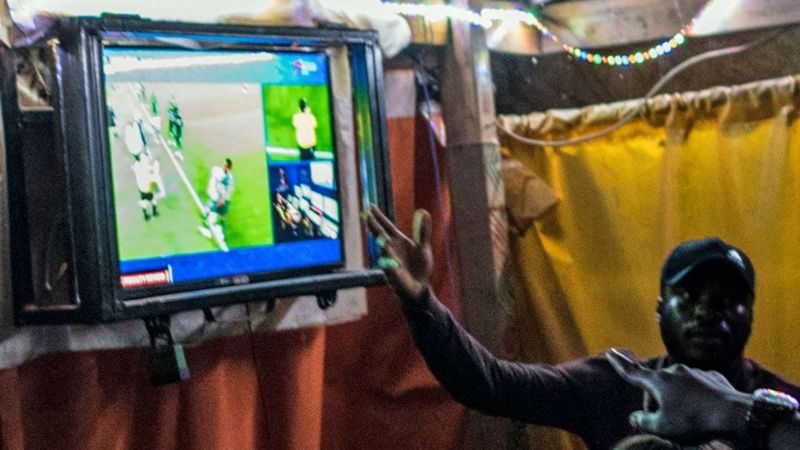
Islamic police in Nigeria’s northern city of Kano have started closing down sports betting shops, which they say are operating illegally.
“As you know betting is forbidden in Islam,” Mujahid Aminudeen, deputy chief of the Sharia police force, known as the Hisbah, told the BBC.
The crackdown was prompted by complaints from community leaders and parents, worried about the growing number of gambling addicts, he said.
On the first day of raids, 30 shops were closed in one suburb alone and their owners sent home with a warning, the Sharia officer said.
But Mr Aminudeen warned that now that the public was aware that the Hisbah was clamping down on gambling, those flouting the rules would be arrested.
Kano city is the capital of Kano state, which has a majority Muslim population and operates the Islamic legal system - Sharia - alongside secular law.
Bookmakers and bars tend to be allowed to operate in Kano's Christian neighbourhoods, though they too can face action if the Hisbah thinks Muslims are frequenting them.
However, the current crackdown is focused on Muslim areas of Kano, a sprawling city and the economic hub of northern Nigeria.
Sports betting shops can be found all over the city - most have televisions screens with customers watching the outcome of international football matches or horse races on which they have staked money.
Mr Aminudeen said such bookmakers had been able to operate under the radar as they had opened under false pretences.
“They don’t have licences to operate as they were given permission to run video games centres, which they later converted to betting shops," he said.
The sports betting industry has expanded dramatically in recent years across the West African nation, which is roughly divided between a mainly Muslim north and a largely Christian south.
Many people go to bookmakers - to enjoy the camaraderie of other gamblers - though mobile apps are also popular to wager on the outcome of events and teams.
Nigeria's crippling economic crisis has also meant people are willing to risk a small amount in the hope of winning big.
But this had led to widespread addiction and parents were even complaining that children were dropping out of school to gamble, Mr Aminudeen said.
“These economic issues we are facing in Nigeria is God telling us to change our ways by stopping sins," he said.
The raids on Tuesday had focused on Munjibir, considered a resort area in the north-east of the city - with visitors flocking there at weekends.
“I am advising those running those betting shops to either shut down or we’ll arrest them and take them to [a Sharia] court,” Mr Aminudeen said.
It is not clear what punishment they would face - often such infringements carry a fine.
Sharia was introduced in Kano in 2000 - as it was in 11 other Muslim-majority northern states - and prostitution, gambling and the consumption of alcohol were banned.
Okpebholo Visits Uzodimma, Says ‘We Have Blessings Of God, Oba Of Benin’
He also thanked the governor for his crucial role that led to his victory at the recently concluded September 21 governorship election.
By Eyitope Kuteyi October 2, 2024
Edo State Governor-elect, Senator Monday Okpebholo, on Wednesday visited Governor Hope Uzodimma at the Imo State Government House in Owerri.
He was accompanied by his deputy, Honourable Dennis Idahosa; the senator representing Edo North, Adams Oshimhole and the All Progressives Congress (APC) Chairman in Edo State, Jarrett Tenebe.
Addressing Uzodimma in the Imo State capital, Okpebholo said he has the blessings of God and that of the Oba of Benin, Ewuare II.
He thanked the governor for his crucial role that led to his victory at the recently concluded September 21 governorship election.
“We are here with our leader, Adams Oshiomhole, in conjunction with my deputy and the state chairman of our party to say a big thank you to you.
“We contested election, and by his grace, we have won the election. We are here to tell you that the next step is to develop Edo State.
“We have the blessings of God and the blessings of the Oba of Benin. Today we are here to say thank you and extend his greetings to you,” Okpebholo said.
Responding, Governor Uzodimma said he will continue to support Okpebholo in his quest to deliver good governance to the people of Edo state.
Uzodimma, who is also Chairman of the Progressives Governors Forum, said he is happy to welcome Okpebholo to the PGF.
He charged the incoming governor to justify the confidence reposed on him at the polls.
I am deeply honored to have received the Governor-elect of Edo State, Senator Monday Okpebholo, along with the Deputy Governor-elect, Hon. Denis Idahosa, former National Chairman of our party, H.E. Senator Adams Oshiomhole, and Hon. Jarrett Tenebe, the State Chairman of our party in Edo State.
This visit, coming after a hard-fought electioneering period, is a testament to the unity and strength of the Progressive Governors’ Forum, which stood by Senator Okpebholo throughout this journey. I expressed my profound appreciation for their commitment and congratulated Senator Okpebholo on his well-deserved victory at the polls.
As the people of Edo State have entrusted him with their mandate, I advised the Governor-elect to focus on delivering progressive governance that reflects the aspirations of the citizens. While reassuring him of our continued support, I noted that President Bola Ahmed Tinubu has also offered his fatherly blessings for the journey ahead and as such, I urged him to go all out and deliver.
Some people spread a rumour that the government was establishing an IDP camp for Fulanis at the university and some crazy people went to burn down the university auditorium.
Jigawa to establish 27 CNG conversion centres, says Gov Namadi
Governor Umar Namadi has announced plans to establish compressed natural gas conversion centres across the 27 local government areas of Jigawa.
News Agency of Nigeria • September 26, 2024
Governor Umar Namadi has announced plans to establish compressed natural gas conversion centres across the 27 local government areas of Jigawa.
Mr Namadi said this in a statement by his media aide, Hamisu Gumel, on Thursday.
The governor, who spoke at the inauguration of a petrol filling station, Safa and Fresh International Limited, on Wednesday in Dutse, said the CNG centres would establish a partnership with the company.
Mr Namadi said the establishment of the CNG stations would reduce fuel costs by 60 per cent, adding that it would provide a significant relief for state residents.
He said the investment initiative aligned with his administration’s 12-point agenda, aimed at job creation and economic development.
While highlighting the state’s public-private partnerships (PPP) policy, Namadi urged the company to explore the Jigawa Invest platform for more insights into the policies.
“Your intention to establish CNG stations in all 27 local government areas is a welcome development. The Jigawa State Executive Council has already resolved to set up CNG stations to alleviate the hardship caused by the rising cost of petroleum products.
“We are ready to partner with you in this initiative and offer you the majority shareholding of the company. Our goal is to ensure that the right things are done for our people, and we will support you in every way,” Mr Namadi said.
The managing director of the company, Ibrahim Yusuf, restating commitment to boost investment in the state.
He said the company would also train 100 youth as technicians in each of the 27 LGAs in the state.
Greenville LNG, a domestic gas liquefaction and distribution company in Nigeria, has started dispensing and fuelling vehicles with its more eco-friendly and cost-reducing alternative energy offering, compressed natural gas (CNG).
This is a heart-warming development for vehicular commuters and businesses in Nasarawa State, as it has practically upscaled hope for a more secure energy sourcing, utilisation and future in the state.
The CNG is now readily and cheaply available at its pioneering LNG/CNG gas station in the Nasarawa State Capital, Lafia.
With palpable excitement amongst state officials, commuters and transportation operators in Lafia, Greenville LNG has begun fuelling the newly acquired CNG-powered commuter buses of the Nasarawa State transport company, Nasarawa Luxury Ride with its CNG product at its Gas hub station in Lafia.
The Nasarawa State Government in its strong commitment to the industrial renaissance and development of the State through environmentally friendly businesses that operate, comply with and promote regulated global carbon emission protocols, had purchased Compressed Natural Gas (CNG)-powered buses from JAC Motors to be used for both intra and interstate travels by the Nasarawa Luxury Ride transport company.
According to senior State officials in Lafia, reasonable and lawful considerations for sustainable human health and safety as well as reasonable environmental protection concerns are the drivers of the Nasarawa State Government’s robust campaign for transition from heavy and corrosive carbon emitting fossil fuels to the use of the cleaner, more environmentally friendly, cheaper, and also more readily available Compressed Natural Gas (CNG) and Liquefied Natural Gas (LNG).
With more interstate commuter routes set to be launched, the Nasarawa Luxury Ride transport company currently operates two interstate travel routes: Lafia to Abuja FCT, and Lafia to Jos in Plateau State with its new CNG-powered buses being cost-efficiently fuelled by Greenville LNG’s top quality CNG-dispensing facilities in Lafia.
It would be recalled that His Excellency Governor Abdullahi A. Sule had during the Nasarawa State Investment Summit which held in Lafia in May emphasised the State Government’s agenda to meaningfully transit from heavy and costly fossil fuels to the use of the cleaner, more affordable and readily available Greenville LNC-CNG alternative energy sources for the industrial renaissance and economic transformation of Nasarawa State. Sequel to the Summit in Lafia, the media had widely reported the visionary advice of Governor Abdullahi Sule to energy investors in the State the effect that “With the Greenville LNG Gas Hub Station now in Lafia, I would advise energy investors in Nasarawa State that instead of building a petrol station, they should now invest in LNG-CNG daughter Stations”.
The Governor had counselled energy investors in the State to take opportunity and advantage and begin to invest in the construction of Greenville LNG’s franchised daughter stations across the State going forward. The reasoning, it was reported, “is contingent on the fact that it is a technological reality as well as proactive commercial foresight to develop new energy businesses and related infrastructure to align with the now readily available, more affordable, and cleaner LNG and CNG offerings provided in the State by Greenville LNG, Nigeria’s pioneer domestic gas infrastructure developer.” Governor Abdullahi Sule had given the pragmatic advice during the Energy Roundtable discussion at the Nasarawa Investment Summit which was held at the Conference Hall of the Nasarawa State Government House in Lafia.
With understandable enthusiasm and excitement, both the State Government’s and senior Greenville LNG’s officials say the company’s now fully constructed LNG-CNG Gas Hub station in Lafia, even as it now operationally dispenses LNG and CNG to CNG-powered automotives, is due for official commissioning by the Nasarawa State Governor, His Excellency Engr. Abdullahi A. Sule at the soonest convenience of key stakeholders this August. As one Greenville LNG official puts it, “the energy transition to a more secure, cleaner and cheaper energy offering is now in Lafia with the Greenville LNG-CNG Hub station in the Nasarawa State capital.”
Greenville LNG is Nigeria’s private sector’s leading producer and distributor of LNG and CNG for the domestic market. With the company’s efficient virtual pipeline consisting of more than 600 specialized LNG-powered gas delivery trucks capable of driving about 1,200 kilometres and 1,800 kilometres without the need to refuel. Grenville LNG from its Rumuji Gas Plant in Rivers State and from its active Gas hubs, delivers sustainable and more affordable LNG and CNG energy supplies to every part of Nigeria. With Gas Hub stations in Rumuji, Benin, Shagamu, Koton-Karfe, Kaduna and now Lafia, Greenville is working progressively to open 25 Hubs to enable the delivery of cleaner, more cost-efficient and more readily available LNG and CNG fuels for homes, the automotive industry and other industrial concerns, and for independent power plants outside the national power grid across the geo-spatial and economic spectrum of country.
Installation of CNG pumps required for new licence, NMDPRA tells marketers
by Bunmi Aduloju May 15, 2024
The federal government has directed marketers to include compressed natural gas (CNG) pumps in retail stations nationwide.
Farouk Ahmed, chief executive officer (CEO) of the Nigerian Midstream and Downstream Petroleum Regulatory Authority (NMDPRA), gave the directive during a meeting with suppliers of petroleum products on May 14 in Abuja.
“We will require that CNG add on to be put in point of the petrol stations. And the new applications will be one of the requirements that you must have a CNG add on in your petrol station,” he said
Speaking to journalists after the meeting, Ahmed said potential retail licensees would now be required to establish a CNG point in their filling stations before receiving final approval from the government.
“We also discussed the CNG revolution and our collective effort to ensure that we reduce the burden on the economy by having an alternative to PMS which is very costly especially due to exchange rate fluctuations and instability,” he said.
“We are looking at gas because we have it in abundance, we have over 200 trillion cubic feet of gas. All we need is to harness the industry to produce, invest and be good for the consumer and CNG is the way to go.”
Ahmed said the addition of CNG at petrol stations would provide easy access to consumers.
“But of course, we have to address the supply side and we are working with the producing companies; our sister agency, NUPRC; and NNPC Limited as well as Gas Aggregation Company of Nigeria (GACN) to ensure that the product is also available at a competitive cost to the consumers,” Ahmed said.
He added that the regulatory authorities plan to lessen the burden of the importation and consumption of petrol.
“We explored the possibility of converting the energy requirement of retail outlets and depots by the stakeholders (here) going into solar. But of course, there is a high entry cost and we have discussed that and it is going to be in phases,” Ahmed said.
“By doing so, we will reduce the demand for diesel in terms of powering our generators by utilising solar options.”
On May 13, the federal executive council (FEC) said all new vehicles, generators or tricycles procured by the government and its agencies must be powered by CNG or solar.
‘WE’LL NOT SET PRICE FOR DANGOTE REFINERY’
Ahmed said the federal government would not set the price of petroleum products from the Dangote refinery.
“NMDPRA will not determine how much it is sold or how much you are buying. It is their own decision to go to Dangote refinery and purchase, and for Dangote refinery to determine the price they sell,” he said.
As a regulator, Ahmed said NMDPRA is more interested in ensuring the nation is well supplied.
Asiko is not only an indigenous entity, grown with indigenous talent, I am proud to say that we are a unique offering in the energy space in Africa with a specific strategic focus: delivering off- grid clean energy to every corner of Africa and becoming the largest independent utility company doing so spanning gas (Propane, LPG and LNG), as well as electricity. Alex Ogedegbe Chairman, Board of Directors
We are excited to announce that we have kicked off an autogas adoption and utilisation trial in Kano to accelerate energy transition and support the National Gas Expansion Programme (NGEP).
The autogas trial project resulted in the conversion of two minibuses and five Keke Napep vehicles from a petrol-powered engine to a dual fuel (LPG and petrol) engine. The conversion was done over two a 2-week period, with no financial obligation or expense incurred by the vehicle owners or operators.
The autogas filling station is a significant part of the project and was built to enable a successful trial and study. The autogas station, housed within the premises of our gas facility in Bompai Kano, can dispense LPG (Liquefied Petroleum Gas) to facilitate convenient refuelling for the converted buses and Keke Napep. Through this trial, we expect to significantly lower operational costs for vehicle owners and operators by up to 40%.
The autogas trial project was lauded by the Emir of Kano, Alhaji Aminu Ado Bayero, who expressed his excitement about the initiative. According to the Emir, who was represented by Ma’ikagama Kano, Alhaji Bello Idi Wudil, the people of the ancient city of Kano will key into the autogas trial because it is an affordable and cleaner alternative to PMS.
Also at the event was the chairman of the National Gas Expansion Program in the office of Petroleum Gas, Dr Muhammad Ibrahim, who described the initiative as an auspicious and epoch-making one.
This autogas trial and its expected benefits underscore Asiko’s commitment to empowering its host communities and building a network of clean energy solutions for a more sustainable future.
Light at the end of the subsidy tunnel: How Nigeria can leverage Autogas for a more sustainable tomorrow
The recent announcement by the Federal Government (FG) to halt the subsidisation of Premium Motor Spirit (PMS), popularly known as Petrol or gasoline, has left many struggling to come to terms with this new reality. Faced with soaring petrol prices and an expected rise in the cost of living, the average Nigerian, who survives on less than $1 a day, is first in line to feel the short-term impact of the fuel subsidy removal.
Today, the price of petroleum retails at around 500 Naira per litre at all filling stations operated by the Nigerian National Petroleum Corporation (NNPC), a sharp increase of about 200%, which has, as expected, catalysed commodity inflation in almost every other sector. Transportation costs have now nearly doubled in the country, an unsurprising effect for a country dependent on petrol for our residential, commercial, transportation, and industrial operations.
However, in the face of this seemingly daunting climate, the Nigerian government has an opportunity to ameliorate the financial impact of the subsidy removal. This opportunity is gas!
Up until now, the subsidy on petrol resulted in a paradox where imported petrol was sold cheaper post subsidy than domestic gas, leading to large quantities of gas being flared.
The potential of gas in Nigeria’s current economic climate – an Autogas perspective
Asiko, with a view that the removal of subsidy was inevitable, made a strategic decision in 2021 to invest in converting standard petrol vehicles to Liquefied Petroleum Gas (LPG) Autogas. We converted several standardised vehicles (Toyota Corollas, which were popular with ride hailing services like #Uber and #Bolt) to investigate the competitiveness of LPG Autogas over subsidised and non-subsidised PMS on a Naira per kilometre metric. We evaluated two OEMs and deployed the converted fleet of Corollas in groups (urban and inter-state). Over a 12-month study period, Asiko determined that for all groups:
• Autogas is competitive against non-subsidised petrol; • Vehicles running on LPG Autogas can save up to 30% on fuel costs (more on Autogas Natural Gas).
In addition to Autogas LPG, there is also Autogas CNG. There is enormous potential in this area as well, and Asiko’s early investment in CNG truck heads has proven economically viable against equivalent diesel units in our fleet, with cost savings of over 50%.
What lies ahead – Opportunities and Possibilities
With the end of the subsidy era, now is the time to intensify our collective efforts to revolutionise the energy landscape by turning our attention to gas. In addition to being a cleaner, more reliable and eco-friendlier energy source, it proves now to be more pocket friendly than gasoline based on today’s market realities. Adopting Autogas (LPG or NG) for transportation is a win-win for the Nigerian government and people.
ALLEGIANCE CNG LIMITED (ACL) is a duly incorporated limited liability company existing under the laws of the Federal Republic of Nigeria, with its office at L-36 Ewet Housing Estate, Uyo, Akwa Ibom State, Nigeria.
ACL desires to establish several Compressed Natural Gas (CNG) stations and infrastructure services in Akwa Ibom State to promote clean energy solutions and revolutionize the energy landscape in Nigeria as well as to stimulate a more sustainable energy future by promoting widespread adaptation of CNG as a cost-effective and environmentally friendly alternative to hydrocarbon products.
ACL is in collaboration with Akwa Ibom State University (AKSU) to set up a Compressed Natural Gas Training Unit through the University’s Centre for Automotive Training, Transport and Logistics (CATTL), to train trainees, members of the Nigerian Automobile Technicians Association (NATA) and members of the general public in the Conversion, Maintenance, Repairs and Servicing of Fossil Fuel Vehicles and Plants to Compressed Natural Gas.
The operation of ACL includes Upstream – which focuses on exploration, extraction, and production; Midstream – which focuses on gas storage, compression, transportation, and distribution; and Downstream – which focuses on distribution, marketing, and end-user engagement.
 Politics › Re: Dutch Government Commits €120 Million To Lagos Renewable Energy Project by naptu2: 6:19am On Oct 03, 2024