
The Great Zimbabwe - Culture - Nairaland
Nairaland Forum / Nairaland / General / Culture / The Great Zimbabwe (14769 Views)
Lost Jewish Tribe 'found In Zimbabwe/South Africa'- The Real Black Jews / The Great Yorubas, People Of A Unique And Vast Culture / The Great Songhai Empire (2) (3) (4)
| The Great Zimbabwe by Nobody: 10:30pm On Jul 24, 2012 |
|
| Re: The Great Zimbabwe by Nobody: 10:36pm On Jul 24, 2012 |
    |
| Re: The Great Zimbabwe by Nobody: 10:48pm On Jul 24, 2012 |
| Re: The Great Zimbabwe by SmoothCrim2015: 10:50pm On Jul 24, 2012 |
| Re: The Great Zimbabwe by PhysicsQED(m): 11:26pm On Jul 24, 2012 |
 One of the soapstone birds. 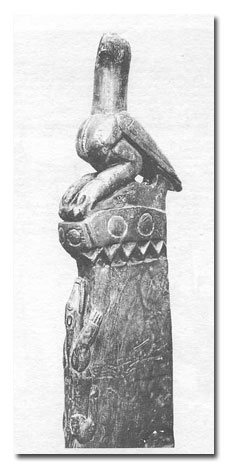 |
| Re: The Great Zimbabwe by PhysicsQED(m): 11:31pm On Jul 24, 2012 |
 |
| Re: The Great Zimbabwe by PhysicsQED(m): 11:35pm On Jul 24, 2012 |
The "Hill Complex" area of Great Zimbabwe:  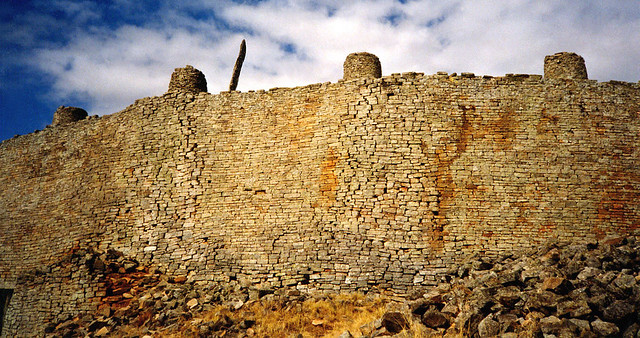  View from the Hill Complex:  |
| Re: The Great Zimbabwe by PhysicsQED(m): 11:47pm On Jul 24, 2012 |
THE FIVE BASIC HISTORICAL QUESTIONS (5 BHQs) ON GREAT ZIMBABWE The five Basic Historical Questions (5 BHQs) are a fundamental set of questions that should be used to summarize and analyze a culture or civilization. The answers to these questions put the civilization in historical context and this gives our research structure and meaning. 1. When Did the Civilization Begin (Time Period)? The civilization of Great Zimbabwe reached its zenith from 1100–1450 AD, although local Shona-speaking farmers had settled in present-day Zimbabwe nearly a thousand years earlier. 2. Where Was the Civilization Located? The location of Great Zimbabwe is in south central Africa, in current-day Zimbabwe, between the Zambezi (north) and Limpopo (south) rivers. The Great Zimbabwe site is situated on a high plateau, mostly over 1000 m. (3,250 ft.) 3. Why is the Civilization Important? The Great Zimbabwe civilization is important for several reasons: -The Zimbabwe site, featuring the Great Enclosure wall, is one of the most astounding regions with monuments in Africa, second only to the Nile Valley pyramid region. -The ancient plan of Great Zimbabwe is in two parts: the hill complex and the valley complexes. The hill complex is where the king kept many of his treasures. Although he lived in the Imba Huru (or Great Enclosure) in the valley, he spent considerable ritual time on the hill. Several important enclosures exist within the hill complex. The principles ones are the ritual enclosure, the smelting enclosure and the iron-keeping enclosure. -The valley complexes are dominated by the Imba Huru. The height of the main wall of the Imba Huru is about 32 feet, it is 800 feet long, and utilizes an amazing 15,000 tons of granite blocks. The impressive blocks were constructed without mortar. The building of this complex took skill, determination and industry, and thus the Imba Huru demonstrates a high level of administrative and social achievement by bringing together stone masons and other workers on a grand scale. -The extensive trading network made Great Zimbabwe one of the most significant trading regions during the Medieval period. The main trading items were gold, iron, copper, tin, cattle, and also cowrie shells. Imported items included glassware from Syria, a minted coin from Kilwa, Tanzania, and Persian & Chinese ceramics from the 13-14th centuries. -Great Zimbabwe was an important commercial and political center. In addition to being in the heart of an extensive commercial and trading network, the site was the center of a powerful political kingdom, which was under a central ruler for about 350 years (1100–1450 AD). The site is estimated to have contained perhaps 18,000 inhabitants, making it one of the largest cities of its day. The conclusion is inescapable that Great Zimbabwe had a condensed population sufficient for it to be considered a town, or even a city. However, many Western writers have attempted to reduce the significance of Great Zimbabwe by several methods: by estimating low population numbers (e.g. only 5,000 instead of 18,000 inhabitants); calling the dwellings “huts” instead of homes; calling the areas “villages” instead of towns or cities; and identifying the rulers as “chiefs’ instead of kings. These writers are well aware that smallness means less significance. 4. How Did the Civilization Begin? The Great Zimbabwe site was settled around 350 AD by Shona-speaking farmers, who migrated into this elevated plateau region to avoid the tsetse flies, which can kill both people and cattle by causing “sleeping sickness.” The disease trypanosomiasis, or more commonly sleeping sickness, is transmitted by the various species of tsetse flies, which transmit the disease through their saliva. The Great Zimbabwe site was a safe haven high enough to avoid the flies, and this allowed the Shona-speaking migrants to farm and raise their cattle. Eventually, developments led to the formation of the Great Zimbabwe state at the end of the 11th century. Two general theories (technological innovations and intensified trading activities) have been advanced to explain the rise of the Zimbabwe state. 5. How Did the Civilization Decline? Great Zimbabwe declined and was abandoned around 1450 AD for unknown reasons. The migrants left Zimbabwe and founded the northern kingdom of Monomotapa and other successor states. There has been much speculation about Zimbabwe’s decline as theories of its fall have ranged from over-farming, the population depleting the land resources, a drastic weather change, and a decline in the important gold trade. Further research will have to provide more information on this question. Much of the wealth which remained at Great Zimbabwe was removed through the centuries by European explorers, treasure hunters, souvenir seekers, and plunderers such as Richard Hall. The site is but a shell of what it once was, as the artifacts were vandalized by these European groups and destroyed or hauled away by them and eventually sent to various museums throughout Europe, America, and South Africa. Today, there are about 20,000 tourists who visit the site each year and they continue to cause additional damage to the ruins, as these tourists climb the walls for thrills and to find souvenirs. http://libtv.com/Manu/zimbabwe.htm |
| Re: The Great Zimbabwe by PhysicsQED(m): 11:51pm On Jul 24, 2012 |
   (For some perspective)  |
| Re: The Great Zimbabwe by PhysicsQED(m): 11:54pm On Jul 24, 2012 |
| Re: The Great Zimbabwe by PhysicsQED(m): 11:56pm On Jul 24, 2012 |
"Great Enclosure" entrance (one of them) [img]http://dudewereinafrica.files./2012/01/great-zimbabwe-1-of-6.jpg[/img] [img]http://www.cs.indiana.edu/%7Etloos/Africa/GZEntrance.jpg[/img] |
| Re: The Great Zimbabwe by PhysicsQED(m): 11:58pm On Jul 24, 2012 |
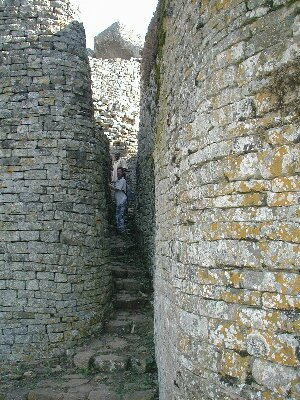
A passage in the great enclosure (might be the same as the one above)  |
| Re: The Great Zimbabwe by PhysicsQED(m): 12:04am On Jul 25, 2012 |
 |
| Re: The Great Zimbabwe by PhysicsQED(m): 12:05am On Jul 25, 2012 |
 |
| Re: The Great Zimbabwe by Nobody: 12:27am On Jul 25, 2012 |
Interesting posts, PhysicQED..  |
| Re: The Great Zimbabwe by Nobody: 2:35pm On Jul 25, 2012 |
Let's breathe life back to this thread.. |
| Re: The Great Zimbabwe by Zairois: 8:33pm On Jul 26, 2012 |
I love seing things like this in black africa just makes me smile with my heart. |
| Re: The Great Zimbabwe by igbo2011(m): 8:37pm On Jul 26, 2012 |
Monomotopia!!! Thanks for the great posts shymmexx. Can you do some on Mali, Benin and Dogon? I loved your songhai onea. This needs to be taught in schools around the world especially in Africa. There needs to be more afrocentric schools. |
| Re: The Great Zimbabwe by Nobody: 10:20pm On Jul 28, 2012 |
igbo2011: Monomotopia!!! Thanks for the great posts shymmexx. Can you do some on Mali, Benin and Dogon? I loved your songhai onea. This needs to be taught in schools around the world especially in Africa. There needs to be more afrocentric schools. Thanks, brother.. There are different threads about Benin and Dogon, but I'll create one for Mali. |
| Re: The Great Zimbabwe by Nobody: 5:14pm On Nov 24, 2013 |
PhysicsQED: The "Hill Complex" area of Great Zimbabwe: |
| Re: The Great Zimbabwe by Nobody: 11:49am On Nov 25, 2013 |
Nice pics of Great Zimbabwe. Unbeknownst to many, these stone ruins are found throughout the entire south west African region, with Great Zimbabwe being the one that seems to have withstood the weather best. There was clearly a massive network of wealthy, advanced cities in that region in the distant past. |

 .[4] A second suggests that Zimbabwe is a contracted form of dzimba-hwe which means "venerated houses" in the Zezuru dialect of Shona, as usually applied to the houses or graves of chiefs.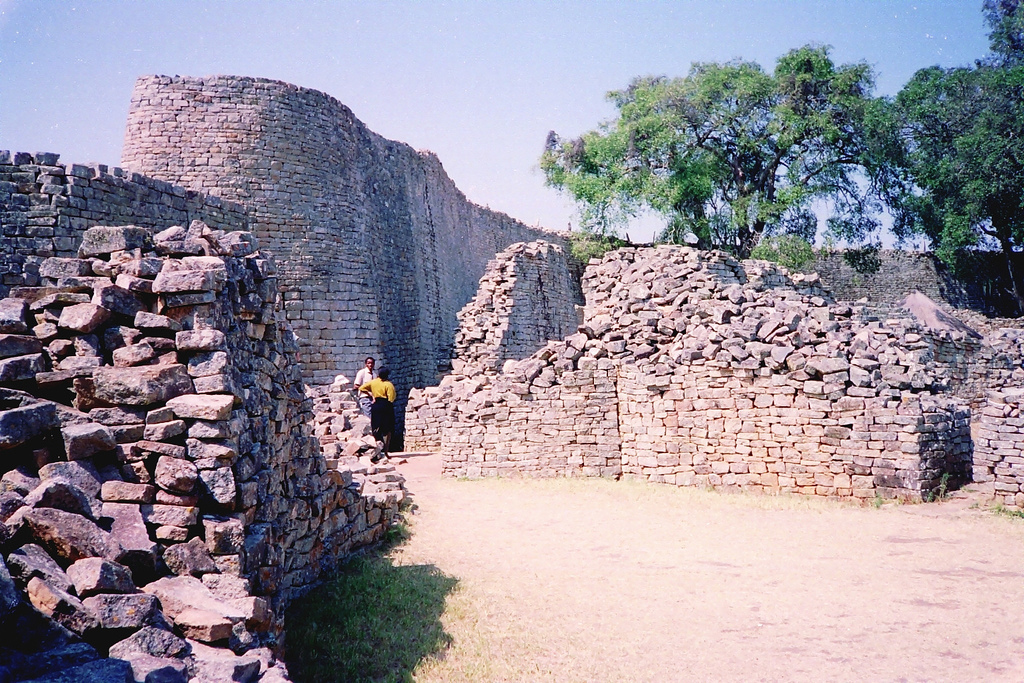


(1) (Reply)
Yoruba's After The Fall Of Oyo Empire / History Of Ebira People: Outspoken, Talented And Hardworking People / India Spiritual Temple!!!! Solution To Problems!!!!
(Go Up)
| Sections: politics (1) business autos (1) jobs (1) career education (1) romance computers phones travel sports fashion health religion celebs tv-movies music-radio literature webmasters programming techmarket Links: (1) (2) (3) (4) (5) (6) (7) (8) (9) (10) Nairaland - Copyright © 2005 - 2024 Oluwaseun Osewa. All rights reserved. See How To Advertise. 45 |