Kmariko's Posts
Nairaland Forum › Kmariko's Profile › Kmariko's Posts
1 2 3 4 5 6 7 8 9 10 11 12 13 14 15 (of 20 pages)
 Politics › Re: The Destruction of Black Civilization by Chancellor Williams by kmariko: 2:14pm On Nov 08, 2014 Politics › Re: The Destruction of Black Civilization by Chancellor Williams by kmariko: 2:14pm On Nov 08, 2014 |
Seun please please This great history must be made front page every month. Meaning repeat it every month This will be one of the greatest contribution of Nairaland in furthering knowledge. 2 Likes |
| Politics › Nigeria 2015 Election Results Projections By University Of Oxford Analysts by kmariko(op): 4:49am On Nov 07, 2014*. Modified: 5:05am On Nov 07, 2014 |
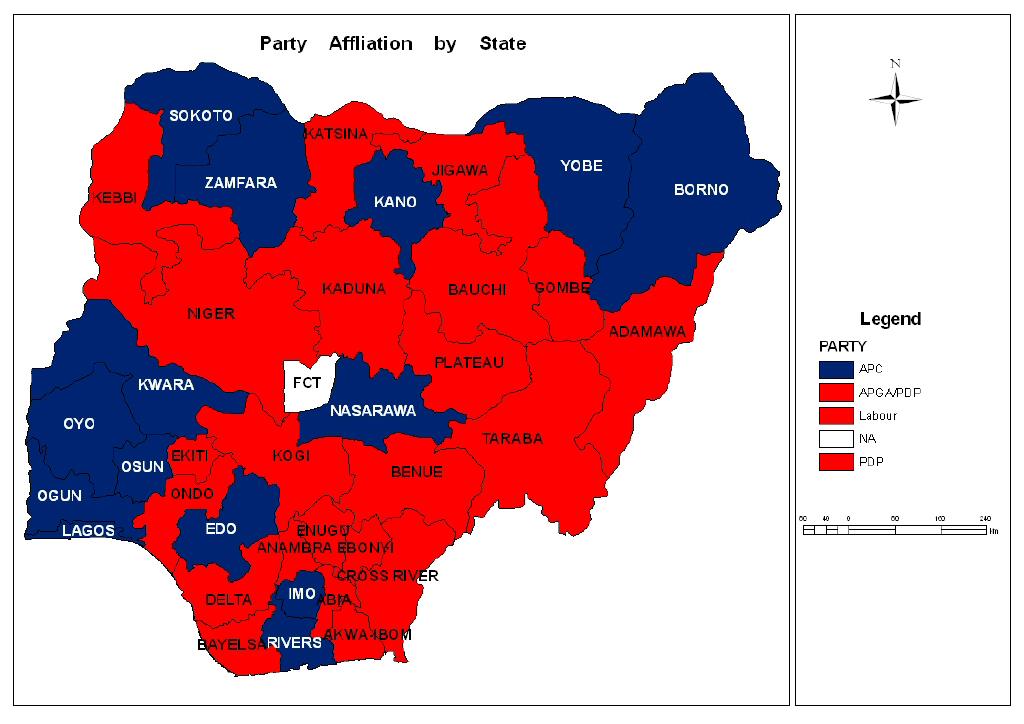
2015 Election Projections https://africanarguments.org/wp-content/uploads/2014/10/NigeriaElectionsMap1.jpg Projections: If the rule that incumbents win 85% of the time with a 60% share of votes holds, for the 10 states with incumbents running for re-election in the governorship elections, a likely outcome is that the APC wins 6 seats while the PDP wins 4. There are 18 vacant seats which will have no incumbent contesting. In 2011, the PDP won 60% of such seats while opposition parties (although before uniting as the APC) collectively won 40%. Working with this admittedly crude assumption (based on just five vacant seats contested in 2011), the PDP is therefore likely to win 10 governorship states while the APC gets 8 states. Therefore in states holding elections in 2015, it is likely that the PDP ends up with 14 states and the APC with 14. If these figures are added to the other states without governorship elections, the tally is: PDP: 14 states + 3 non-participating states = 17 APC: 14 states + 3 non-participating states = 17 APGA = 1 non-participating state Labour = 1 non-participating state Total 36 states This could mean that PDP and allied parties will control 19 states, fewer than the 22 it currently does. However, these are broad generalisations and it is difficult to identify the specific states in question. Nigeria Elections Presidential election projections Going by the initial rule we applied, if the PDP candidate is incumbent President Goodluck Jonathan, he might seem to have an 85% chance of winning with about 60% of the votes. However, given Nigeria’s Federal system, the proportion of vacant governorship seats and the rapidly changing alliances in the political landscape, other variables may come into play. We can assume that states largely support the same party for Presidential elections as they do for Governorship elections (although in 2011 a number of mainly northern states, as well as ACN states in in an electoral pact with PDP in the South-West, bucked the trend). Going by the 85% assumption, if local incumbency is the prime factor, since 22 of the states are currently PDP or allied parties in the current dispensation, the PDP may win the Presidential vote in 21 states (19 PDP states and 2 APC states), and the APC meanwhile would win Presidential votes in 15 states (12 currently APC and 3 PDP states). This is likely to be enough for a simple majority.[1] If however, we go by the projected trends in the governorship elections as useful pointers, we end up with a different result, with both parties winning in 17 states each. The absolute numbers of voters cannot be predicted but it may be significant that the APC goes into the election controlling two states with the largest number of registered voters, Lagos (6.1 million registered voters in 2011) and Kano (5 million). Also remember that section 134 (1) of Nigeria’s 1999 Constitution lays down two conditions for a victory; one is a majority of votes cast, but the other is a minimum of 25% of registered voters in two-thirds of Nigeria’s states (i.e. 24 states). Currently, with support of Labour and APGA, the PDP controls enough states to ensure that. However, in 2011 Bauchi state did not reach the needed minimum even when controlled by PDP, delivering only 16.05% of the vote for the party’s candidate, while Katsina, also PDP, only just scraped over the minimum with 26.1%. So it is reasonable to assume that if support or turnout is low in PDP-ruled northern states, not all may deliver the 25% minimum needed to secure a win for the party’s candidate. In such a circumstance, the Constitution states that candidates would be forced into a second-round run-off election. Such a situation has not previously occurred under Nigeria’s present electoral system. Therefore, of three possible outcomes – outright PDP win, outright APC win, or a run-off election – the most likely outcome based on our projections from current data is that neither party would manage both factors for an outright victory so there would need to be an additional run-off election. Neither is it clear which party that situation would favour. On one hand a nationally incumbent party may retain more resources to continue mobilising, but on the other, both the voting public and important political intermediaries may perceive momentum in the opposition which galvanises support for them popularity. If the presidential election does not favour an outright win for the PDP, it may also further weaken the PDP’s chances at the subsequent gubernatorial level given the proportion of vacant seats (18) to incumbent re-elections (10). The deciding states for the presidential election and the overall fortune of the two parties will be those 18 vacant seats, which also happen to have 54.4% (40.03 million) of 2011’s registered voters, including 10 of the 14 states with the largest number of registered voters, underlining just how open this race really is. Some Caveats Incumbency advantages are very dependent on specific local factors, such as candidates, coalitions, party machinery, electorate sophistication, local issues and more; therefore it is hard to make a solid prediction on the outcomes. Importantly, the 2015 elections appear as if they will be a two-party race in all states, although this may also change if heavyweights who lose primaries in the two major parties decide to leave them. In such a situation, the advantages of incumbency calculated from the 2011 multi-party elections may have less predictive value at the gubernatorial elections because the APC is a merger of three parties with varying strengths; the ACN, CPC and ANPP. This is additionally complex in states (such as Kano, Imo and Kwara) where PDP governors crossed over to the APC. In that case, the advantage of incumbency would go beyond 11% because we would need to consider what proportion of the 2011 vote for other parties in the merger (i.e. CPC and ANPP) will be scooped up by APC. Additionally, in most of the states where the governor crossed over from the national ruling PDP with some or all of his supporters, the PDP still has a solid state structure. While we are able to make some plausible projections where incumbents are re-contesting in 2015, it is difficult to do so for the 18 vacant seats because the parameters so far cannot test the strength of the opposition merger. What we can say however is that these seats will be hotly-contested. Since presidential elections occur before governorship elections, it is possible these projections may have little predictive value on the outcome of the presidential elections because the patterns of voting for the governorship and presidential elections are considerably different.[2] Moreover, there is no clear pattern – beyond an assumed incumbency advantage – by which states vote for a presidential candidate. Several factors come into play such as the interaction of local and national coalitions, incumbency, popularity of presidential candidates, local actors – governorship candidates and power brokers, relative party strength and structure, type of identity allegiances, and historical political behaviour of states. Zainab Usman is a DPhil Candidate at the University of Oxford. Oliver Owen is Junior Research Fellow in International Development at the Oxford Department of International Development. |
| Politics › Nigera's GDP Still Under-valued by kmariko(op): 5:32am On Nov 06, 2014 |
Nigeria’s economy still undervalued despite rating A NUMBER of vibrant sectors in the economy may not have been fully captured especially in the small and medium scale business levels of the economy in the process of rebasing. Speaking exclusively with The Guardian in Abuja, Head,Real Sector and Households Statistics, National Bureau of Statistics(NBS), Isiaka Olarewaju, explained that emerging feed backs from recent rebasing recently carried out,showed that a number of small and medium scale business levels were not captured. According to him, “It will surprise you to know that since the last rebasing exercise, the NBS has not rested on its oars. We have continued to monitor developments in and around our economy and have discovered that a number of sectors which contribute significantly to the nation’s Gross Domestic Product(GDP) have not been captured. So what that means is that in the subsequent exercise, Nigeria’s GDP figures will increase ,based on new additions to the mainstream which have already been captured” . Nigeria’s economy had remained unmeasured in the 23 years, until it was rebased in April to fall in line with the United Nations Statistical Commission’s programming known as System of National Accounts(SNA). The commission stipulates that all countries of the world must carry out rebasing of their economy once in every five years. According to Olarewaju who described rebasing as the updating of Gross Domestic Product using statistical data, the bureau has opted for base year estimates, which entails constant valuation of the economy to identify growth or drop in any sector of the economy. This he said will help the country in understanding the status of of the economy rather than waiting for the next five years to analyze trends. He pointed out that GDP is calculated as value added outcomes of production of goods and services in all areas of the economy. But in order to analyze one year’s worth with another, to see whether their is growth or not, a base year estimates is compiled to show the way forward. Olarewaju said that one of the advantages of recapturing areas not hitherto known is to help government have access to accurate data, and to guide policy makers on decisions that would help them plan better for all citizens of the country. On why the increasing growth in the economy cannot be equated directly to individual economic wealth, he said that the exercise covers broader measurement of human progress, to measuring output growth which tends to concentrate on economic growth. He said however that with better planning, resources would be well distributed and many more lives enhanced by government deliberate policies for growth. Tuesday, 04 November 2014 17:16 Chuka Odittah,Abuja for Guardian News papers |
| Politics › Re: 100 African Cities Destroyed By Europeans by kmariko: 4:57am On Nov 06, 2014 |
ProfCorruption:Please people like me " history junkies" would sincerely like to know your family's history and by extension the "clan" or "village so that we might have an accurate set of our cultural understanding of some of the problems here in Nigeria. Please I seek your indulgence for such knowledge.. Thanks |
| Politics › Re: 100 African Cities Destroyed By Europeans by kmariko: 12:59am On Nov 06, 2014 |
ROSSIKE:I do quite understand sir, Sometimes you just have to gently let them figure out and understand how "special" their reasonings really are |
| Politics › Re: 100 African Cities Destroyed By Europeans by kmariko: 12:31am On Nov 06, 2014 |
ROSSIKE:Rossike please go easy on the child. we need to understand their mind set. Its only then that it can be systematically torn up and rebuilt to imbibe the real history of their great ancestors. |
| Politics › Re: 100 African Cities Destroyed By Europeans by kmariko: 8:16pm On Nov 05, 2014 |
tinkinjow:Please, the above assertions you made was predicated on your research, the books you read, a complete knowledge of sub-saharan history or what?. Please do enlighten us. |
| Politics › Re: 100 African Cities Destroyed By Europeans by kmariko: 5:51pm On Nov 05, 2014 |
@ Op Thanks so much for the link... This is one of the best posts on this forum so far this year... I for one believe that the worst thing that happened to Africa was contact with Europeans... The Japanese despite their internal divisions ---leading to waring states....were unanimous in rejecting western influence untill they have fully developed their civilization and cultural way of life. 2 Likes |
| Politics › Nigeria Teledensity Now At 95% by kmariko(op): 5:36am On Nov 05, 2014 |
Today, the country can also boast of achieving 95 per cent teledensity. Teledensity is the number of telephone connections for every hundred individuals living within an area. It varies widely across the nations and also between urban and rural areas within a country. Indeed, The Guardian checks yesterday, showed that as at October 2013, Nigeria had 121.8 million active subscriptions and about the 12 months after, there has been over 80 per cent growth to the tune of over 133.3 million. Within the same period, the number of connected lines also moved up. As at September 2013, Nigeria had 158.2 million connected lines, which according to the Nigerian Communications Commission (NCC) statistics is now 177.5 million. In specific, the GSM technology with operators including MTN Nigeria; Globacom; Airtel and Etisalat increased their collective subscriptions from 118.4 million to 130.8 million. Unfortunately, the CDMA and the Fixed Wired/Wireless maintained a downward profile moving from 2.4 million to 2.2 million and 362,392 to 190,507 respectively. Though within the period about 15, 000 subscribers may have exchanged their operators through the Mobile Number Portability, MTN Nigeria, whose parent body in South Africa complained last week of the arm experiencing lull in its growth, still controls 45 per cent of the Nigerian market with about 58.2 million subscribers. MTN claimed that the decline was largely impacted by regulatory restrictions and even instability in Nigeria’s northern areas where an insurgency by Boko Haram militants is taking place. “MTN reported encouraging results for the third quarter… however, performance was impacted by continued aggressive competition and stringent regulatory requirements,” said MTN’s Chief Executive Officer, Sifiso Dabengwa, in a statement. “Nigerian operation faced a challenging regulatory environment resulting in lower-than-expected growth,” he added. Though Dabengwa described the regulatory restrictions relating to the dominant-operator as having led to a “marginal decline” in the subscriber base in Africa’s most populous country, he, however, said the situation “will affect second-half revenue growth.” Meanwhile, Globacom, which recently displaced Airtel as the second largest operator in Nigeria still maintained the position with 21 per cent market share and 27.5 million subscribers. Airtel controls 19 per cent market share and has 25.5 million subscribers with Etisalat gradually picking up at 15 per cent market share and about 20 million subscribers. The CDMA, whose only major player remains Visafone continue to struggle to remain afloat. Visafone currently has about 154, 464. The Executive Vice Chairman of the Nigerian Communications Commission (NCC), Dr. Eugene Juwah recently blamed the downward fortunes of the CDMA on poor capitalization stressing that most of the operators that failed to even return borrowed capital to the bank and subsequently couldn’t get more financing. Guardian; Tuesday, 28 October 2014 19:40 Written by Adeyemi Adepetun |
| Politics › Re: I Received My US Citizenship Today And I'm Unburdening My Heart About Africa by kmariko: 3:04am On Nov 01, 2014 |
@ Op I think you are being economical with the truth. 1. You got your citzenship today, october 30 2014 right .... based on the title of your thread. 2. You inferred that you worked for USAID from you conversation with ROSSIKE See last i checked the agency though an independent federal agency only employs American citizens except " foreign contractors" which you are not as you live in the US Does that mean that you were hired before, during or immediately after you got your citzenship. It simply doesn't add up. I would have loved to engage you in this conversation , but ROSSIKE as ususal is doing a very fine job. 2 Likes |
| Politics › Astronomical Rise In Electronic Financial Transactions by kmariko(op): 5:18am On Oct 31, 2014 |
Nigeria records N80bn electronic transactions daily October 31, 2014 by Agency Reporter 0 Comments PoS machines | credits: File copy As the adoption of electronic payment system increases in the country, about N80bn is electronically transferred daily from one bank account to the other in Nigeria. This was disclosed by the new Group Managing Director and Chief Executive Officer of Diamond Bank Plc, Mr. Uzoma Dozie, citing current statistics on business transactions. Speaking on ‘Media Trends in Business and Big Data Management’ at the Society and Technology Conference and Exhibition 2014 in Lagos, Dozie noted that in compliance with global financial trends and the cashless policy of the Central Bank of Nigeria, electronic payment had created a new order in financial transactions. He said it had also afforded Deposit Money Banks the opportunity to create financial products and services that were customer-centric. According to Uzoma, e-money is virtually stored monetary value in wallets or accounts, noting that the platform allows the account holder to access the value of the money with ease, exchange and transfer electronically. “The financial industry has moved through various stages; at the moment, value is being stored virtually. Customers have come to the realisation of the ease associated with e-money,” he said in a statement. Dozie further noted that Diamond Bank had risen to the challenge of the new order of electronic banking through the development of products such as BETA, which incorporates the traditional method of savings in an account with low minimum account balance and low fees, bearing interest. “Diamond Bank also has a mobile App which has functions for financial transactions and lifestyle products. The App can be installed on smart phones and tablets. Customers should not be put off from using this App because it is easy to use; has functional content and secured platform for business,” he added. According to the statement, since December 2011 when the CBN introduced Cashless Nigeria, Diamond Bank has remained committed to introducing real-time electronic banking, mobile banking app for smart phones and tablets among others. |
| Politics › New Power Grid On The Way by kmariko(op): 5:09am On Oct 31, 2014 |
Chinese firm to construct new power grid – FG October 31, 2014 by Okechukwu Nnodim 1 Comment Minister of Power, Prof. Chinedu Nebo A Chinese firm, Shandong Power Equipment Company Limited, is to construct a new power grid for the country, the Federal Government has said. The Minister of Power, Prof. Chinedu Nebo, disclosed this in Abuja on Thursday while signing a Memorandum of Understanding with SPECO for the construction of a new national grid system. The minister said he had no doubt that SPECO had the financial muscle to undertake the project, adding that the firm’s net worth was in excess of $300bn. He said SPECO also possessed the expertise to make the difference in Nigeria’s quest to build a robust and vibrant national grid. Nebo was quoted to have said that the existing grid line was not competitive enough, as the 330KVA currently in use was far below what was obtainable in China, India and the United States. He said the three countries had systems that exceeded 1,050KVA transmission capacities. “As Nigeria is currently at the threshold of the launch of its ambitious national industrial revolution, power will be required to drive it. The Industrial Revolution Plan will be dead without power and power will be dead without transmission,” the minister said. The representative of the Chinese firm, Kay Zhang, said the company had what it takes to provide Nigeria with world class transmission project. SPECO, he said, was currently serving 1.1 billion Chinese and covering about 88 per cent of China’s land, adding that the company was the seventh of the top 500 firms in the country. Meanwhile, the Federal Ministry of Power on Thursday announced its intention to work with the National Association of Nigerian Students to check the menace of vandalism of oil and gas pipelines and electricity infrastructure across the country. It said the partnership was to ensure that the goal of adequate and constant power supply to every Nigerian became a reality. Nebo said this at the headquarters of the ministry after receiving an award of excellence from the leadership of NANS. He said the students’ association would be engaged as agents of change in the fight against sabotage of government assets in the sector, a hazard which had greatly undermined the efforts of both the past and present administrations in the provision of uninterrupted power supply. On capacity building, the minister said the National Power Training Institute would incorporate students into its programme, as they would have undergone necessary skill acquisition before graduation. This, he said, would enable them to have seamless transition as mechanical and electrical engineers to contribute positively in the new power sector. The minister also spoke about the plan of his ministry to leverage on its proposed National Power Sector Apprenticeship Scheme to reduce the over dependence of the sector on foreign expertise. “Our people have the right to know. NANS should be involved in our sensitisation efforts as we will gladly support any robust programme aimed at building enterprise and patriotism,” Nebo said. Earlier, the NANS President, Mr. Tijani Usman, commended the minister for stabilising the sector, stressing that there had been noticeable improvement in the supply of power nationwide. He requested the minister to consider incorporating students in the consumer forum, training modules at NAPTIN and active participation in anti-vandalism of pipelines and other power infrastructure campaign |
| Business › Nigeria’s GDP On Steady Rise In Spite Of Insurgency by kmariko(op): 4:56am On Oct 31, 2014 |
Amb. Martin Uhomoibhi, outgoing Permanent Secretary in the Ministry of Foreign Affairs, said on Thursday that Nigeria’s economic growth rate had been steady despite the insurgency.http://www.pmnewsnigeria.com/2014/10/30/nigerias-gdp-on-steady-rise-in-spite-of-insurgency/ 18 Likes |
| Politics › German And French Foreign Ministers In Nigeria Why?? by kmariko(op): 4:18am On Oct 30, 2014 |
Does anyone out there have a clue on why the French and German foreign ministers are visiting Jonathan at the same time. What sinister (  ) message from Europe are they delivering. Is it to do with the EPA that Nigeria rightly refused to endorse. ) message from Europe are they delivering. Is it to do with the EPA that Nigeria rightly refused to endorse.[img]51638315.jpg?eJwljD0LAjEQRP_L1Cl2L-aIaa8SPAUjqJXka-[img] |
| Politics › China Backs Nigeria On Yuan Reserves by kmariko(op): 3:28am On Oct 30, 2014 |
Chinese ambassador backs plan to convert Nigerian foreign reserves from dollars to Yuan on October 29, 2014 / in Business 6:26 pm / Comments Abuja – The Chinese Ambassador to Nigeria, Mr Gu Xiaojie, has expressed support for the plan by the Central Bank of Nigeria (CBN) to convert more of the country’s 39 billion dollar foreign reserve to Yuan. Speaking at a Forum on Wednesday in Abuja, Xiaojie described the plan as “ a very encouraging development’’. He said it demonstrated the “closeness’’ between both countries, which currently have an annual bilateral trade volume of 13 billion dollars. “Nigeria is among few countries, or two or four countries, in the world that have parts of their foreign reserve in Renminbi (RMB) currency and we are happy about that. “We have noticed that the Central Bank of Nigeria is increasing its share of Chinese RMB Yuan in its foreign currency. “Talking about financial cooperation there are more opportunities, wider range of things we could do in finance because China has the biggest foreign reserve in the world. “For such a big country (like Nigeria) you have to have all kinds of securities.’’ Xiaojie said China had noted the positive growth in Nigeria’s economy, including the fundamental growth in the micro economy. “The government is handling the financial micro economy very cautiously with the international cooperation and I think you are doing the right thing. “We hope that there will be closer cooperation in the area of financing and micro economy,’’ he said. In January the CBN had hinted of plans to convert more of Nigerian reserves from dollars to Yuan. At present 80 per cent of Nigeria’s foreign reserves are held in U.S. dollars. The apex bank started converting its reserves into Yuan in 2011. (NAN) www.vanguardngr.com/2014/10/ |
| Politics › Doing Business In Nigeria Now Easier by kmariko(op): 3:05am On Oct 30, 2014 |
Doing business in Nigeria now easier – World Bank on October 30, 2014 / in News 12:40 am / Comments By Emma Ujah, Abuja Bureau Chief ABUJA—The World Bank has given a positive assessment of doing business in Nigeria and 34 other countries of Sub-Saharan Africa. According to the global body, the report of this year’s study on Doing Business indicated that almost all nations in the continent took deliberate steps to implement reforms which made doing business easier for private sector operators. “The report, Sub-Saharan Africa has had a great year of reform, with 35 of 47 economies recording at least one reform that makes it easier to do business – 75 reforms in total”, it said yesterday. Nigeria alone undertook 10 regulatory reforms in its push towards making private sector operators take charge of the economy. Majority focused on improving business incorporation, trade, and credit reporting systems, allowing Nigeria to gradually narrow the gap with the best regulatory practices in the region. The report finds that Nigeria ranks among the top five economies in Sub-Saharan Africa in two areas – the ease of getting credit and the strength of minority investor protections. Between 2013 and 2014, Nigeria saw an increase of 3.6 points in its distance to frontier score, greater than the global average increase of 0.8. This, the World Bank report said “is due in large part to an increase in the coverage rate of Nigeria’s credit reporting system and a reduction in the company registration fee that made it less costly to start a business.” Nigeria is one of the 11 economies with a population of more than 100 million where the report now covers two cities, providing new insights into the variability of business regulation within economies. Lagos and Kano were covered in the report. “This year, for the first time, the DB team analyzes business regulations in Kano as well as Lagos making Nigeria one of few countries where the report covers two cities”, the bank said. It added, “Francophone Africa had an excellent year, with Benin, Cote d’Ivoire, Democratic Republic of Congo, Senegal and Togo counted among the top ten reformers globally. Senegal is the global top reformer, with 6 reforms, closely followed by Cote d’Ivoire and the DRC with 5 reforms each”. www.vanguardngr.com/2014/10/business 1 Like |
| Business › Nigerian Manufacturers Capture Eastern, Southern African Markets by kmariko(op): 4:55am On Oct 23, 2014 |
Nigeria’s non-oil exports have received a big lift with local manufacturing exporters capturing new markets in Eastern and Southern Africa.http://businessdayonline.com/2014/10/boost-for-non-oil-exports-as-manufacturers-capture-eastern-southern-african-markets/ 18 Likes 3 Shares |
| Politics › Abuja-kaduna Rail Line Will Be Completed And Handed Over In December by kmariko(op): 3:06am On Oct 22, 2014 |
By Favour Nnabugwu Federal Government has said that the construction of Abuja (Idu)-Kaduna Standard guage rail line is 85 percent complete and would be delivered by December this year. The Minister of Transport, Senator Idiris Umar, said this in Abuja at the 2014 Ministerial Press briefing on the programmes and projects of the ministry and its agencies. He said the ministry has been working in the past two years to provide the nation alternative transport system with the railway. He said that out of the projected 187.5km rail line, the ministry has achieved 155 km, adding that the remaining 32 km would be completed and delivered by the end of this year. He said that the Abuja-Kaduna standard guage rail project was funded with the $500 million facilities from the China Exim Bank. Also, he said that the construction and the rehabilitation of Itakpe-Ajaokuta-Warri standard guage rail line would be completed by the second quarter of 2015, adding that the construction of the Lagos-Ibadan standard guage (double track) 2 x 180km had been awarded and would commence as soon as funding arrangement is concluded. He said the ministry has also awarded rehabilitation contracts to the tune of N1.616 trillion covering 1,796 km rail lines. “These include the construction of the Lagos-Ibadan 180km standard guage valued at $1.53 billion, awarded to CCECC Nig. Ltd; the Itakpe-Ajaokuta-Warri standard guage line covering 274km, awarded to Julius Berger at a cost of N33.1 billion; the Lagos-Kano modernisation rail project, awarded to CCECC Nig. Ltd. at a cost of $8.3 billion covering 1,342.50km, out of which $257.4 million has been paid by the federal government. Through the Nigerian Railway Corporation, NRC and with the administration’s determination to revive and modernise the railway system in line with the 25-year strategic vision to bring back the railways to remove the pressure on roads, the rail lines are getting renewed attention, which was unprecedented since the 1980s.” Giving further update on ministry’s achievements, Senator Umar said the main target was to connect the six geopolitical zones via speed rails so as to make transportation of persons and goods easier and less stressful.” He said the number of passengers’ conveyed by rail line increased from 4,155,988 in 2012 to 4,328,789 in 2013 with a projection of over 5,000,000 passengers by the end of 2014. “This was as a result of increased stabilisation of the tracks after completion of rehabilitation of the Western line. “The target set for delivery of freight and passenger services in 2013 were substantially achieved. More coaches and wagons are required to meet the high demands for the service”, the minister said source: http://www.vanguardngr.com/2014/10/ 5 Likes |
| Politics › Nigeria: Personal Well Being Index Rises. by kmariko(op): 4:27am On Oct 17, 2014 |
HIGHLIGHTS of September 2014 Portfolio of Indices published by NOIPolls show that Personal Well-Being Index (PWBI) increased by 2.3-points to stand at 45.6-points , a peak position so far in 2014. In addition, there was an increase in all indicators that comprise the PWBI with the highest increase observed in the Personal Security Index with 7.2-points, Consumer Confidence Index (CCI), rising by 0.6-point to stand at 71.3-points even as the two indicators that make up the CCI revealed that the Present Situation Index (PSI) increased by 2.3-points while the Expectation Index (EI) declined by 0.6-point. According to the September NOIPolls results released on Tuesday, “Nigerians are most satisfied in terms of Religion (89.2-points); Social Interaction (78.2-points), Physical Health (75.4-points) and Personal Security (60.2-points). Additionally, Nigerians are somewhat neutral with respect to their Achievement in Life (56.8-points) and Standard of Living (53.1-points). On the other hand, Nigerians remain discontented with their Personal Economic Situation (43.4-points); this has remained the lowest ranked indicator since January 2014 despite a 3-points increase this month. Monthly trend analysis shows that all the indicators that comprise the PWBI experienced an increase; the highest and lowest increases were observed in the Personal Security Index and Religion Index with 7.2-points and 1.4-points respectively. Furthermore, the Personal Security Index is at the highest point so far in 2014 suggesting that Nigerians are at present more satisfied with their personal security. Further findings from trend analysis shows that the PWBI has been on the increase since July 2014 and experienced a substantial increase of 2.3-points in September 2014 which is the highest point (45.6-points) over nine months. Additionally, the average PWBI from January 2014 till date is 42.7-points and the current September reading is 2.9-points above this average. The Personal Well-Being Index and Consumer Confidence Index Polls conducted in September 2014 involved telephone interviews of a random nationwide sample of 1,000 randomly selected phone-owning Nigerians aged 18 years and above, representing the six geopolitical zones in the country. According to NOIPolls: “With a sample of this size, we can say with 95% confidence that the results obtained are statistically precise within a range of plus or minus 3%.” NOIPolls Limited introduced its portfolio of indices; the NOIPolls Personal Well-Being Index (PWBI), the NOIPolls Consumer Confidence Index (CCI) and the NOIPolls Eagle 30 Business Confidence Index (EBCI). The NOIPolls Personal Well-Being Index measures factors impacting on the lives of everyday Nigerians; thereby producing a complete view of the individual’s personal well-being. The NOIPolls Consumer Confidence Index provides consumer assessments of the economic situation and their intentions and expectations for the future. The NOIPolls Eagle 30 Business Confidence Index measures business leaders’ perceptions and expectations about the Nigerian business environment using the top 30 companies in the country. Nigerian businesses, financial and government agencies largely depend on their perceptions and micro assessment of consumers’ expectation in making decisions. At best, they draw conclusion on the business environment based on information from their immediate surroundings while the minority conduct surveys that are time and money consuming. However, the introduction of these indices provides indicators that will ensure stakeholders can detect and respond to changes in consumer behavior, the economy, and the business environment in Nigeria. Guardian october 14, 2014 |
| Politics › Nigerian Railways: Five Million Commuters Used Rail Transport by kmariko(op): 4:19am On Oct 17, 2014 |
MINISTER of Transport, Senator Idris Umar, has said that an estimated five million commuters from across the country have used rail transport system between last year till date. The minister, who made the disclosure yesterday in Abuja during the 2014 ministerial press briefing of his ministry, attributed the high level of patronage to increased stabilisation of the tracks following rehabilitation of the western line. Umar, who however did not disclose any contract sums for procurements made or contracts awarded by the ministry this year, also pointed out that more coaches and wagons were procured by the Federal Government to cushion the growing demands for rail transportation sub-sector. He said: “The number of passengers conveyed by rail increased from 4,155,988 in 2012 to 4,328,789 in 2013 with a projection of over 5,000,000 passengers in 2014. This was as a result of increased stabilisation of the tracks after completion of rehabilitation of the western line. The targets set for delivery of freight and passenger services were substantially met. More coaches and wagons are required to meet the high demands for the services. While promising that the Federal Government will complete work on the ongoing Abuja-Kaduna inter-state railway project, in conjunction with the Chinese company, CCECC, the out-going minister said the project covering 187.5km is 85 per cent completed, saying it would be delivered by end of the year. On the feasibility studies awarded for survey work and other sample exercises, the minister said that five different studies awarded at undisclosed sums have been completed, while six others, which were either recently awarded or previously signed, are currently ongoing. Routes with completed feasibility studies, he said, include the Lagos-Abuja high-speed line (615km), Ajaokuta-Obajana-Jakura-Boro-Abuja with additional line from Otukpo, to also include Anyinga-Ejule-Ida-Adoru-Nsuuka-Adani-Omor -Anaku-Aguleri-Nsugbe-Onitcha rail line covering a total 821km. Others are the Zaria-Kaura Namoda-Nnewi-Owerri-Illela-Birni Konni (Niger Republic), covering 520km, followed by Benin-Agbor-Onicha-Nnewi-Owerri-Aba with additional line from Onitcha-Enugu-Abakaliki, covering 500km. Also, the Eganyi-Lokoja-Abaji-Abuja line, covering 280km, have their feasibility studies completed. But the Kano-Bichi-Katsina-Jibiya route covering 354km, Sokoto-Birni Kebbi-Jega-Yaur-Makera covering 408km, Aba -Ikot Epene-Ibiono-Itu-Odukpani Calabar covering 340km, Port Harcourt-Aba-Umuahia-Enugu-Makurdi-Lafia-Kuru-Bauchi-Gombe-Biu, Maiduguri, most of which were stalled by problem of insurgency in the North-East, are among routes with ongoing feasibility studies. On port infrastructure, the minister said that the rehabilitation of the East and West Moles (breakwaters) in Lagos pilotage district have been completed, saying also that there is continuous dredging and maintenance of the navigable channels through long-term joint venture agreements. He said also that automation of the ports system has helped to reduced cost, as well as the electronic payment system, which has also curtailed revenue loss to the Federal Government Guardian; Fiday october 17, 2014 |
| Politics › IPMAN To Build 3 Billion Dollar Refineries by kmariko(op): 3:53am On Oct 07, 2014 |
IPMAN acquires 1,000 hectares for $3bn refineries October 6, 2014 | Filed under: main story | Author: Editor The Independent Petroleum Marketers Association of Nigeria (IPMAN) acquired more than 1,000 hectares in Kogi and Bayelsa for the proposed three billion Dollars (N495 billion) refineries, Chinedu Okoronkwo, IPMAN National President, said in Lagos on Monday. IPMAN had earlier in July concluded a business deal with some international investors to build two refineries worth about three billion Dollars at Itobe, Kogi, and Abbe in Bayelsa. The foreign investors had conducted feasibility studies on the project in August. Okoronkwo said that the Federal Government had through the Minister of Petroleum Resources, Mrs Diezain Alison-Madueke, welcomed the investor’s initiative to commence work on the two refineries. He urged the Ministry of Power to support the IPMAN refinery initiative by providing the sites access to the national grid. He said when completed in 24 months, the refineries would initially produce about 200,000 barrels of petrol per day. Okoronkwo said that IPMAN’s aim was to contribute in the management of existing national capital flight that characterised the oil and gas sector following the absence of a functional refinery. “The cost of taking crude and bringing it back as refined products will be reduced. We want government to give us the necessary licences and enabling environment to operate,’’ he said. BusinessDay 07/10/2014 1 Like |
| Politics › Re: Do You Recognise Anybody Here: Maybe Your Parents Or Grandparents by kmariko(op): 7:44pm On Oct 05, 2014 |
delishpot:Sorry Will try again |
| Politics › Do You Recognise Anybody Here: Maybe Your Parents Or Grandparents by kmariko(op): 7:40pm On Oct 05, 2014*. Modified: 8:01pm On Oct 05, 2014 |
[img]file] |
| Politics › Re: Akon Performs In Giant Bubble To Avoid Ebola by kmariko: 4:40pm On Oct 05, 2014 |
Take a step back and look at Akon's history with the giant crowd-surfing bubble. He has used it at numerous concerts in Australia, India, and Dubai, to name a few. And it's not just Akon — other performers crowd-surf in a similar fashion, such as Diplo, the Flaming Lips, and Sugarland. Akon has yet to comment on the incident. If you still think this was a way for Akon to avoid Ebola, well, we hate to burst your giant bubble, but it's safe to say this was all in fun . |
| Politics › Re: Awka is the Dirtiest Capitals In The East by kmariko: 1:22pm On Oct 03, 2014 |
[quote author=Chinazaekperem5 post=/post/26827440]  [/quote] [/quote] |
| Politics › Breaking News: Enugu PDP Selects Ifeanyi Ugwuanyi For 2015 Governorship by kmariko(op): 5:15am On Sep 27, 2014 |
EXCLUSIVE: Enugu PDP endorses Ifeanyi Ugwuanyi for 2015 governorship Posted by: The Citizen in Headlines September 26, 2014 Hon. Ifeanyi Ugwuanyi The Enugu State chapter of the Peoples Democratic Party 9PDP) has unanimously endorsed the candidature of Hon. Ifeanyi Ugwuanyi as the candidate of the party for the 2015 governorship election in the state, THE CITIZEN can exclusively report. Rising from a stakeholders meeting called at the instance of the governor, Sullivan Chime in Enugu on Friday evening, the stakeholders formerly endorsed the candidature of Ugwuanyi as the party’s flag bearer for the forthcoming election in the state. With this endorsement, it has rested the thriving grape vine in the state of who will be crowned the “Special Candidate”. according to a reliable source who confided in THE CITIZEN, Ugwuanyi will be the only candidate the party will present for the primaries billed to hold at the end of November. “His emergence has followed the tradition of Chime’s administration since 2007 where the party’s candidates for elections are based on consensus principle. It is always a compromise and method has been working perfectly well in Enugu,” he said. Born on the 2nd of March 1964, Ugwuanyi is representing Igboeze North/Udenu Federal Constituency and he is the present Chairman of the House of Representatives Committee on Marine Transport. He is also a member of House Committee on Defence, Population, Privatization and Commercialization, Science & Technology, States & Local Government Affairs. He is a three time member of the House of Representatives as he was first elected in 2003. Earlier, other candidates nursing the ambition in the governorship race which the party had zoned to the Enugu North Senatorial zone included two-term senator and Chairman, Senate Committee on Works, Ayogu Eze; Ambassador Fidel Ayogu; PDP State Chairman and former Pro-Chancellor of the Federal University of Technology, Owerri, Chief Vita Abba; Speaker of Enugu State House of Assembly, Eugene Odoh; two-time Commissioner for Information, Chuks Ugwuoke; Commissioner for Enugu Capital Territory, Ik Ugwuegede, MD of Enugu State Housing Authority, Ikeji Asogwa and former Commissioner for Education, Professor Simon Ortuanya. https://thecitizenng.com/wp-content/uploads/2014/09/Hon.-Ifeanyi-Ugwuanyi.jpg http://thecitizenng.com/headline-2/exclusive-enugu-pdp-endorses-ifeanyi-ugwuanyi-for-2015-governorship/ |
| Politics › Re: Photos: Another 1st Made-in-nigeria APC Under President GEJ by kmariko: 3:25am On Sep 24, 2014 |
skullz: Would Nigeria be the first country to build APC's from Ford chasis?Sometimes you dont bother yourself High education is not meant for everyone. Reserve it for those who seek it. Thanks for sharing though 11 Likes |
| Islam › Islamism And The Death Of Cosmopolitanism by kmariko(op): 11:18pm On Sep 20, 2014 |
A byproduct of the depredation of the national security state and resurgent Islamism has been the slow death of the cosmopolitanism that distinguished great Middle Eastern cities like Alexandria, Beirut, Cairo and Damascus. Alexandria was once a center of learning and multicultural delights (by night, Mark Twain wrote in Innocents Abroad, “it was a sort of reminiscence of Paris”). Today Alexandria is a hotbed of political Islam, now that the once large Greek-Egyptian community has fled along with the other non-Arab and non-Muslim communities. Beirut, once the most liberal city in the Levant, is struggling to maintain a modicum of openness and tolerance while being pushed by Hezbollah to become a Tehran on the Med. Over the last few decades, Islamists across the region have encouraged—and pressured—women to wear veils, men to show signs of religiosity, and subtly and not-so-subtly intimidated non-conformist intellectuals and artists. Egypt today is bereft of good universities and research centers, while publishing unreadable newspapers peddling xenophobia and hyper-nationalism. Cairo no longer produces the kind of daring and creative cinema that pioneers like the critically acclaimed director Youssef Chahine made for more than 60 years. Egyptian society today cannot tolerate a literary and intellectual figure like Taha Hussein, who towered over Arab intellectual life from the 1920s until his death in 1973, because of his skepticism about Islam. Egyptian society cannot reconcile itself today to the great diva Asmahan (1917-1944) singing to her lover that “my soul, my heart, and my body are in your hand.” In the Egypt of today, a chanteuse like Asmahan would be hounded and banished from the country. Read more: http://www.politico.com/magazine/story/2014/09/the-barbarians-within-our-gates-111116_Page2.html#ixzz3DtfIOEGH |
| Politics › The Final Collapse Of Arab Civilization A 21st Century Tragedy by kmariko(op): 11:10pm On Sep 20, 2014 |
ith his decision to use force against the violent extremists of the Islamic State, President Obama is doing more than to knowingly enter a quagmire. He is doing more than play with the fates of two half-broken countries—Iraq and Syria—whose societies were gutted long before the Americans appeared on the horizon. Obama is stepping once again—and with understandably great reluctance—into the chaos of an entire civilization that has broken down. Arab civilization, such as we knew it, is all but gone. The Arab world today is more violent, unstable, fragmented and driven by extremism—the extremism of the rulers and those in opposition—than at any time since the collapse of the Ottoman Empire a century ago. Every hope of modern Arab history has been betrayed. The promise of political empowerment, the return of politics, the restoration of human dignity heralded by the season of Arab uprisings in their early heydays—all has given way to civil wars, ethnic, sectarian and regional divisions and the reassertion of absolutism, both in its military and atavistic forms. With the dubious exception of the antiquated monarchies and emirates of the Gulf—which for the moment are holding out against the tide of chaos—and possibly Tunisia, there is no recognizable legitimacy left in the Arab world. Is it any surprise that, like the vermin that take over a ruined city, the heirs to this self-destroyed civilization should be the nihilistic thugs of the Islamic State? And that there is no one else who can clean up the vast mess we Arabs have made of our world but the Americans and Western countries? No one paradigm or one theory can explain what went wrong in the Arab world in the last century. There is no obvious set of reasons for the colossal failures of all the ideologies and political movements that swept the Arab region: Arab nationalism, in its Baathist and Nasserite forms; various Islamist movements; Arab socialism; the rentier state and rapacious monopolies, leaving in their wake a string of broken societies. No one theory can explain the marginalization of Egypt, once the center of political and cultural gravity in the Arab East, and its brief and tumultuous experimentation with peaceful political change before it reverted back to military rule. Nor is the notion of “ancient sectarian hatreds” adequate to explain the frightening reality that along a front stretching from Basra at the mouth of the Persian Gulf to Beirut on the Mediterranean there exists an almost continuous bloodletting between Sunni and Shia—the public manifestation of an epic geopolitical battle for power and control pitting Iran, the Shia powerhouse, against Saudi Arabia, the Sunni powerhouse, and their proxies. There is no one single overarching explanation for that tapestry of horrors in Syria and Iraq, where in the last five years more than a quarter of a million people perished, where famed cities like Aleppo, Homs and Mosul were visited by the modern terror of Assad’s chemical weapons and the brutal violence of the Islamic State. How could Syria tear itself apart and become—like Spain in the 1930s—the arena for Arabs and Muslims to re-fight their old civil wars? The war waged by the Syrian regime against civilians in opposition areas combined the use of Scud missiles, anti-personnel barrel bombs as well as medieval tactics against towns and neighborhoods such as siege and starvation. For the first time since the First World War, Syrians were dying of malnutrition and hunger. Iraq’s story in the last few decades is a chronicle of a death foretold. The slow death began with Saddam Hussein’s fateful decision to invade Iran in September 1980. Iraqis have been living in purgatory ever since with each war giving birth to another. In the midst of this suspended chaos, the U.S. invasion in 2003 was merely a catalyst that allowed the violent chaos to resume in full force. The polarizations in Syria and Iraq—political, sectarian and ethnic—are so deep that it is difficult to see how these once-important countries could be restored as unitary states. In Libya, Muammar al-Qaddafi’s 42-year reign of terror rendered the country politically desolate and fractured its already tenuous unity. The armed factions that inherited the exhausted country have set it on the course of breaking up—again, unsurprisingly—along tribal and regional fissures. Yemen has all the ingredients of a failed state: political, sectarian, tribal, north-south divisions, against the background of economic deterioration and a depleted water table that could turn it into the first country in the world to run out of drinking water. Read more: http://www.politico.com/magazine/story/2014/09/the-barbarians-within-our-gates-111116.html#ixzz3Dtcu84Rf |
| Politics › Re: China Builds The World's Largest Supercollider by kmariko(op): 11:08pm On Sep 20, 2014 |
Idrismusty97: So wetin you want make we do now?maybe we should start taking another hard look at china besides making affordable products for the rest of us |
| Politics › China Builds The World's Largest Supercollider by kmariko(op): 10:55pm On Sep 20, 2014 |
Beijing, China - Chinese scientists are racing to complete plans for a supergiant particle collider that, when built, will dwarf every other accelerator on the planet. The underground particle-smashing ring aims to be at least twice the size of the globe's current leading collider - the Large Hadron Collider (CERN) outside Geneva. With a circumference of 80 kilometres, the Chinese accelerator complex would encircle the entire island of Manhattan. A preliminary conceptual design for this leading-edge particle physics laboratory is now being drafted by China's elite sphere of physicists, joined by a circle of Western counterparts. Called the Circular Electron Positron Collider (CEPC), China hopes it will shine as a symbol of the country's rise as a global superpower in terms of pure scientific research. "This machine is by and for the world," explains Professor Gao Jie, one of the leaders of the project at the Institute of High Energy Physics in Beijing. Beijing plans to speedily expand cooperation between China's foremost physicists and their European and American counterparts with the new collider. The new collider research outpost, situated on the Avenue of Eternal Peace in the centre of Beijing, is aiding in the conceptual design that plans to be submitted to China's top leadership in December, according to Professor Arkani-Hamed, a scholar at Princeton's Institute for Advanced Study, the one-time home of Albert Einstein. Fundamental changes to science The collider complex is initially designed to smash together electrons and their anti-matter counterparts, and later more massive protons, at velocities approaching the speed of light. This process hopes to recreate, inside the accelerator, the hyper-energy conditions that dominated following the Big Bang. Physicists aim to explore the origins of matter, energy, and space-time. China's bigger collider will ultimately be able to reach higher energy levels than CERN; this might help physicists discover a new range of particles beyond those already charted in the Standard Model of Particle Physics. China will without question become the world leader in the field [of physics].- Professor Arkani-Hamed, Institute for Advanced Study Arkani-Hamed says that a perfect circle-shaped city, hosting the globe's leaders in experimental particle physics, new-technology firms and other future-oriented scholars and designers, could be created inside the massive Chinese collider complex. The Collider complex would also host a multipurpose science-technology campus aimed at conducting secondary and supplemental science experiments. With the unveiling of the new collider, he forecasts, "China will without question become the world leader in the field [of physics]". This collider will also act as the newest star in the firmament of particle physics, and leading scientists worldwide will rapidly gravitate toward it, says Arkani-Hamed, "for original approaches to outstanding problems in particle physics, including the proposal of large extra dimensions, new theories for the Higgs boson, novel realizations of super symmetry [and] theories for dark matter". Gerard 't Hooft, winner of the Nobel Prize in Physics in 1999, told Al Jazeera that China's collider project "will bring hundreds, probably thousands of top class scientists with different specialisations, from pure theory to experimental physics and engineering from abroad to China". A theoretical physicist at Utrecht University in the Netherlands, Professor 't Hooft has been a central figure in the development of the Standard Model of Particle Physics, whose theories on the fundamental building blocks and forces of nature have been tested over the last half century at powerful colliders in the US and Europe. The next stage in the revolution of understanding these primary particles and forces, and their interactions, Professor 't Hooft predicts, could partially unfold in China with the construction of the electron accelerator and then the more powerful proton collider. Within the same 80km tunnel, the collider complex plans to be divided between two different super colliders. The Circular Electron Positron Collider (CEPC) smashes together electrons and anti-electrons, while the Super Proton Proton Collider (SPPC) will be used to study the super-speed collisions of protons. The CEPC is designed to study with precision the Higgs boson and how it decays following a collision. The SPPC might uncover a new range of particles beyond those already known. Professor Gao Jie, formerly a visiting scholar at the French Laboratoire de l'Accélérateur Linéaire, says both the Circular Electron Positron Collider and the Super Proton Collider will be global projects. "China welcomes participation from the world on machine design, construction, and experiments for sure," he says. Global participation Professor Arkani-Hamed has already started inviting leading scientists in particle and accelerator physics to sojourn and lecture at Beijing's new Center for Future High Energy Physics. New subatomic particle could be Higgs boson The centre is set to ramp up exchanges with scholars around the world as they explore the mysteries remaining within and beyond the Standard Model, he says. China's colossal collider could attract thousands of American scientists focused on high-energy experimental physics, he says, because the US has lost its edge in terms of constructing world-leading accelerators. When the US abandoned contstructing the Superconducting Super Collider as a result of balloon costs, many experimental physicists in the US relocated to the Large Hadron Collider on the Swiss-French border. And "the US has not put forward an ambitious agenda for driving the future of fundamental physics in the 21st century," he says. Many US physicists, Arkani-Hamed predicts, will be drawn into the orbit of China's supergiant accelerator ring even before it starts operations. Chinese and Western scholars at the Center for Future High Energy Physics are now sketching out rough designs for the CEPC. They will initially focus on deepening understanding of the Higgs boson, discovered at the CERN complex in 2012, and the mechanism underlying the origin of mass of subatomic particles. Although CERN has also begun exploring the potential to construct a super collider, its scheduled deadline for completing a preliminary conceptual design for the project is not until 2018 - fours years behind China's timetable. Meanwhile, he says that with an 80km collider complex, "you could actually build a city inside the ring". Scientists, Internet entrepreneurs, software designers and museum operators from around the world might stake claims in this Chinese collider cosmopolis of the future, says Arkani-Hamed. "This could be a scientific utopia," he adds. Source: Al Jazeera |
| Politics › Re: Enugu, The Pride Of The East. by kmariko: 1:48pm On Sep 17, 2014 |
cjrane: You absolutely can not do without an airport , but you DO NOT NEED A SEAPORT.Sorry should have read Airport OR seaport |