 Culture › Re: The Power The Oba Of Benin Wield In The Past by TAO12: 8:33am On Aug 18, 2021 Culture › Re: The Power The Oba Of Benin Wield In The Past by TAO12: 8:33am On Aug 18, 2021 |
nisai:
If not for the Oba's advisers and the consideration of Oranmiyan Omo olofin on the part of Ogedengbe, Benin present dynasty would have been Owa Adimula.
Ogedengbe agbogun gboro adi fonfon loju ogun. O s'oko ekiti s'oko akoko, eni akoko nb'imo sin. Obanla olori awon Ipaye. Ogedengbe lo l'oke anaye.
Omo won ni Ilesa. Ijesa ni won omo onile obi. Omo eleni ateeka, omo eleni ewele. Emi o le ki agba ijesa ki nma je obi t'ogbo. Okeke l'aso ode igbajo elegodo tiemi l'aso ode ijesa. Iran ijesa nii sin tolotolo eru won (Bini  ) nii sin pepeye. ) nii sin pepeye.
Thank u Tao. I retrieved my account and I have seen your mail. Really appreciate.
The PDFs ain't opening. Finally!  I’m glad you could retrieve the email. I was very bothered. Thank God. As for the PDFs, you would have to create an account to fully access the materials and download them. I love the oriki by the way. |
| Culture › Re: The Power The Oba Of Benin Wield In The Past by TAO12: 8:21am On Aug 18, 2021*. Modified: 9:20pm On Jan 31, 2022 |
gregyboy:
[s]Owan and estako they are both in edo North..
You mean the oba appeased lol sre you telling such lies to appease your obsessed ego
Lol, he appeased him with slaves who does that when he initially came to raid for slaves.
...
When he could conquer the whole edo north and get what needed in folds......
Lol, you're clown
Ogendegbe fled like a goat when he heard the oba of benin wanted his head, he didn't even penetrate into edo central(esan)
The Yorubas should have also bribed Benin too when the Benins took them for slaves and cut the neckes of the Yoruba slaves to bury the oba of benin[/s] Your lies repeated many times are still lies. The only people who are killed to bury your oba are his Edo wives and his Edo slaves-subjects. You are a slave of the Yoruba-Oba of Benin. Aren’t you? His children also go about killing any Edo they come across in the streets. [Ask me for references]. Ogedengbe was appeased with many gifts and more slaves than he planned to capture. He was literally begged by your Oba so he can leave and not approach towards the palace. |
| Culture › Re: The Power The Oba Of Benin Wield In The Past by TAO12: 6:55am On Aug 18, 2021*. Modified: 8:35am On Aug 18, 2021 |
gregyboy:
[s]The ibadans and nupe raided edo fringes around edo north which was far from Benin they raided it for slaves, soon as words got to the oba of Benin that edo north was been raided he dispatched a general at esan to drive off the raiders and they fled back to ibadan.
Ogedengbe the leader of the ibadan raiders after fleeing edo north continued is raiding in yoruba towns until he was capture by the britsh and imprisoned like a criminal that he was and later hung for his atrocities[/s] Eeerrm, sorry! The article didn’t talk about Edo fringes. It talks about Benin kingdom. Ogedengbe ransacked Owan/Etsako. And the Oba of Benin had to appease him out of town with rich gifts, slaves, etc. Peace!  |
| Culture › Re: Indigenous Ogbona People In Edo State Celebrate New Yam Festival "Esi" by TAO12: 12:42am On Aug 18, 2021 |
. |
| Culture › Re: Indigenous Ogbona People In Edo State Celebrate New Yam Festival "Esi" by TAO12: 12:26am On Aug 18, 2021*. Modified: 12:43am On Aug 18, 2021 |
. |
| Culture › Re: The Power The Oba Of Benin Wield In The Past by TAO12: 7:32am On Aug 17, 2021*. Modified: 9:19pm On Jan 31, 2022 |
Your first screenshot shows the opinion of a Bini man as related to a foreigner. And that is supposed to be a historical fact?? LMAO! Your second screenshot which claims that Oyo lost a section of Eastern Yoruba frontier to Benin is actually a claim which comes straight from a Bini source. Check the footnote 70 and thank me later. Prof. R. C.C. Law knew exactly what he was doing. It is all one-sided, self-serving claims of greatness by Binis themselves. Know truth as shown in my attachment below. 
|
| Culture › Re: The Name Lagos, Was Called Ekonunuame By The Benins by TAO12: 12:29am On Aug 17, 2021*. Modified: 7:26am On Aug 17, 2021 |
gregyboy:
Thought as much Haha E pain am die. He had to edit my comment. Whenever losers lose, they also lose creativity as well as originality. He proved himself a loser. LMAO! 
|
| Culture › Re: The Name Lagos, Was Called Ekonunuame By The Benins by TAO12: 10:21pm On Aug 16, 2021 |
gregyboy:
[s]Patch patch historian history is not patch patch or jabber jabber, history flows
Lol, i have debunked everything you put up there before even the artifact am not going to be doimg it again
Not when you dont bring something new
Tao11 bring something new to the table
Stop cutting corners. Lol[/s] Tell a new lie, and get a new refutation. LMAO! By the way, why did you steal my screenshot ?? ?? You mean say the thing pain you reach bone ?? You’re a real disgrace to yourself, family and friends. A Benin-child is born = A loser in life is born. 
|
| Culture › Re: The Name Lagos, Was Called Ekonunuame By The Benins by TAO12: 7:51pm On Aug 16, 2021 |
gregyboy:
As usual na patch patch Think4Myself:
See epistle full of lies
Get a life Those comments of mine are strictly for those who are able to make use of their brain. Revert here to read when the ban on your brain has been lifted by your oba. But I appreciate you for helping me push it virally. Good luck. 
|
| Culture › Re: The Name Lagos, Was Called Ekonunuame By The Benins by TAO12: 7:48pm On Aug 16, 2021 |
gregyboy:
[s]Who they breathe... Lol
Tao11 dey breathe lies
One thing about lies you have to cover it up with more lies to make it sound like truth
So at the end of the day.. You will end up with a long epistle because of patch patch...
Every yoruba monarch called ile ife by its name and called the ooni by is title ooni
But somehow the benins called it differently
And not even similar.. But Tao11 is patching things up for me to believe by force
Tao11 i really don't have time for your rubbish
We benins ruled the entire lagos and tumbled on the entire yorubaland
And yet our wasn't yoruba... That's were the pain comes from[/s] (1) History works are usually much longer. (2) They are strictly for those who are capable of using their brain. (3) Come back here whenever the ban on your brain has been lifted by your oba. (4) Your oba is a Yoruba man, and he is subservient to the great overlord at Ife. (5) Get mad if you can. 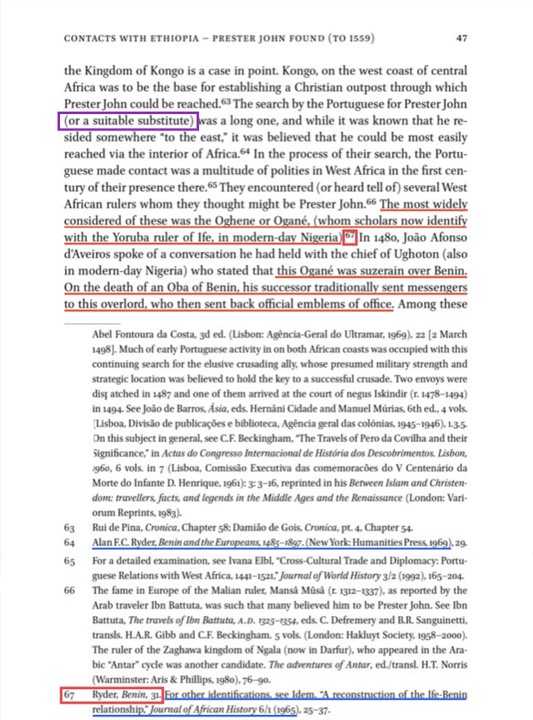

|
| Culture › Re: The Name Lagos, Was Called Ekonunuame By The Benins by TAO12: 12:57pm On Aug 16, 2021 |
gregyboy:
[s]I thought Etinosa1234 have seen the light...
Anyway since youre now depending on benin
People as source of evidence then we have delt a big blow to your lying machines, that youre now result in using benins as evidence
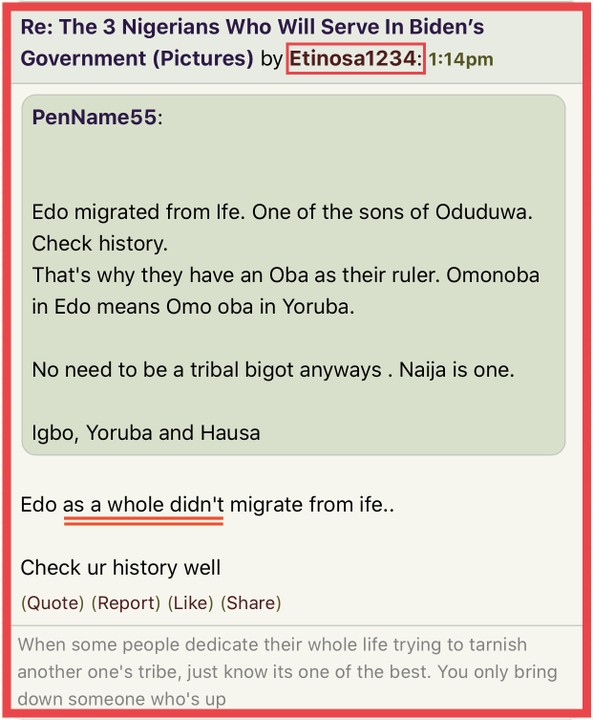
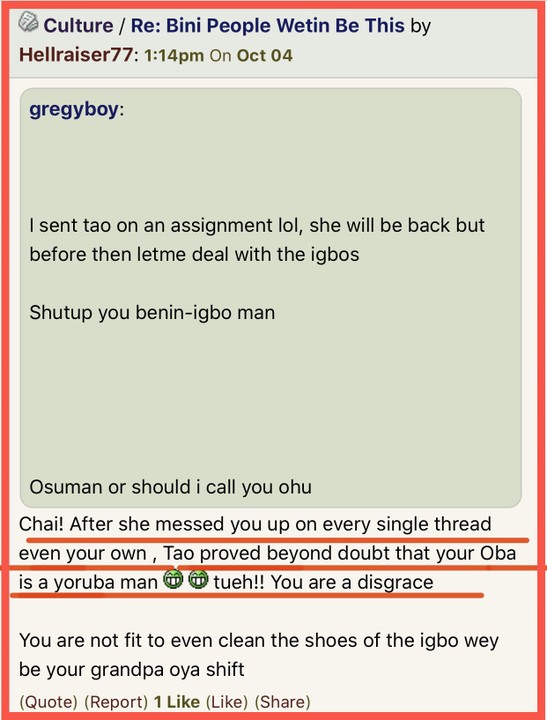
[/s]Lol The word “ testimony” is of course too much for a Benin brain to grasp. Your plight is understandable. Las-las, na you go be the last man standing. Haha! 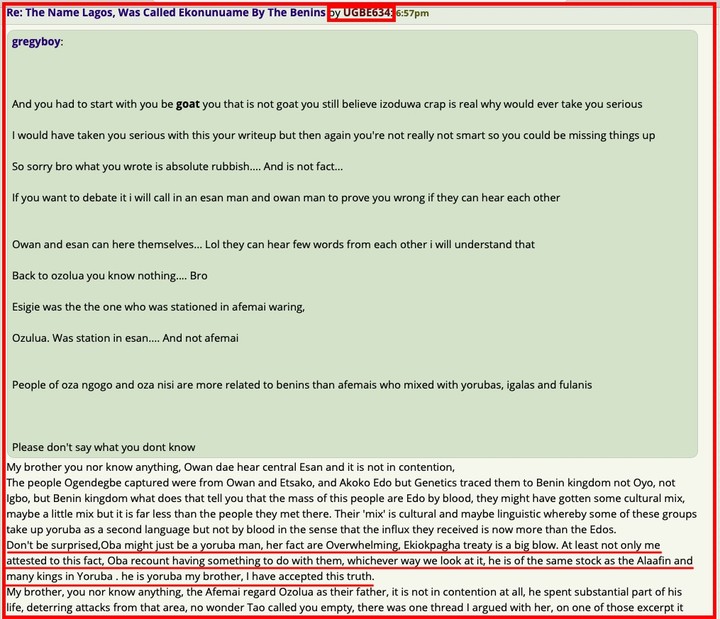

|
| Culture › Re: The Name Lagos, Was Called Ekonunuame By The Benins by TAO12: 12:53pm On Aug 16, 2021 |
Show us the “ DiSpRoVeD”!! LMAO! gregyboy:
[s] as disproved this before... Lol
Lets do it again in the simplest way not in any calculation up there
The benin said the location of oghnene nuhe is
East and not west
Ife lies in west.... And not east
So why all those japper japper you put up there as calculation[/s] https://www.nairaland.com/6482972/name-lagos-called-ekonunuame-benins/26#104847769Who should be blamed for your illiteracy?? Me, yourself, or your parents? Make your pick. 
|
| Culture › Re: The Name Lagos, Was Called Ekonunuame By The Benins by TAO12: 11:19am On Aug 16, 2021 |
IFE is roughly about 174 miles away from Benin City. However, the alleged distance of 900 miles is NOT mentioned anywhere in the text. Instead, the distance between Benin City and the Ogane’s place [as given in the text] is 250 leagues. However, this number (250 leagues) wasn’t obtained (by the Portuguese) from any Bini informant. This fact is extremely clear from the text itself. In fact, the Binis who lived in the 1400s/1500s did not measure distance in leagues, miles, etc. As such, they couldn’t have given such information. Instead, the Binis of the 1400s, 1500s, etc. measured distance in natural terms, e.g. on the basis of celestial bodies such as the Moon, etc. Interestingly, the distance obtained from the Binis by the Portuguese was given in terms of the Moon. This is given in the text. The Binis informed the Portuguese that it takes twenty (20) moons journey to go from Benin city to the Ogané’s place. It was on the basis of this received information (i.e. 20 moons journey away) that the Portuguese imagined what the distance in “leagues” should be. The distance in leagues was NOT received from the Binis. The text is clear on this. The W/African context is also clear on this. Having said that, the natural question now becomes: Is this number (20 moons journey from Benin City to the Ogane’s place) realistic for IFE if it is indeed the Ogane’s place?? In other words, could the distance from Benin City to Ile-Ife possibly have been twenty moons journey in some “traditional” terms? Let’s do the Maths on the basis of average numbers & the “traditional” context. The data to be used for the Math is NOT on the basis of Google map’s algorithm which assumes a walking trip with zero tiredness, zero rests, zero stops, zero pauses, zero relaxations, zero camps, constant rapid pace, etc. Instead, the data to be used is on the basis of the real life situation, average numbers, & traditional context. Datum 1: C. G. Okojie’s “Ishan Native Laws and Customs,” p. 210. provides the first data as follows: The walking trip from Uromi (in Ishan) to Benin City on a course of some 50 miles “ traditionally” took an average of 5 months. ~ Cited in A.F.C. Ryder (1965), p.27. Datum 2: IFE is roughly about 174 miles away from Benin City (even over the ancient Benin-Owo-Ife route). These two data leave an answer of about 17.4 months [NOT moons] as the “ traditional” walking time from Benin to Ife. In other words, IFE is 17.4 months journey away from Benin city on the average “ traditionally”. Question: How many “moons” are 17.4 months equivalent to? To answer this, two pieces of data will be adduced. Datum 3: It takes the Moon 27.322 days to go around the earth. In other words, there are [exactly] about 27.322 days in one “moon”. Datum 4: There is an average of 30.47 days in one month. Summary:(1) The “traditional” walking distance from Benin to Ile-Ife took an average of 17.4 months (2) 17.4 months are equivalent to 530.178 days (i.e. 17.4 months * 30.47days per month). (3) 530.178 days are equivalent to 19.4 moons (i.e. 530.178 days / 27.322 days per moon). In conclusion, the facts and figures turn out to prove that the “traditional” trip from Benin city to Ile-Ife took an average of 19.4 moons. This answer is therefore astoundingly accurate for all practical intents and purpose. From this again, we see that Ife is indeed the place of the Ogané of the Portuguese text. The Bini informant knew exactly what he was talking about. PS: References to this great overlord (to whom Benin obas are subservient) is documented not once, not twice, not thrice by independent Europeans; but at least five separate times spanning centuries prior to the 1800s. Peace! |
| Culture › Re: The Name Lagos, Was Called Ekonunuame By The Benins by TAO12: 11:19am On Aug 16, 2021*. Modified: 8:28pm On Aug 16, 2021 |
You Benins are actually too foolish to be ignored. Ignoring you means, to you, that you’ve stated facts. Jokers. Crowther is not a historian, he is a linguist. He didn’t write a Yoruba history book. His books are generally grammar books, dictionary, etc. being a linguist. Although he sometimes set aside introductory notes to Yoruba creation stories as well as Oyo kingship (being from Osoogun), and this introductory notes usually takes roughly 3% of the entire pages. A sane mind wonders then how the next thing on his mind to write about (in a books of language) would be Ife-Benin connection. You’re hoplessly delusional. Moreover, Mr. Cyril Punch who toured Yoruba cities and was also in Benin wrote in his 1889 Journal that: “As a town, Benin was inconsiderable compared with places like Ibadan, Iseyhin, Shaki, Modakeke, and Abeokuta. There was no wealth, nor was there even power, except the power of the influence of fetish, and the sense of the spirit of a long past of atrocities, which, if not supernatural, were at any rate unnatural to a degree which is indescribable. I remember the return of two of Miller Brothers' men from a visit they paid to Benin after I had been there. They arrived at Guatun one evening, and showed plainly in their faces the mental strain that their visit had been to them.”As for the Ife ‘bronze’ sculptures, the quotation here (is from an academic, expert, and professional Art Historian) shows IFE on the same pedestal as Greek, Rome, and Egypt. “[The Ife sculptures] would stand comparison with anything which Ancient Egypt, Classical Greece and Rome, or Renaissance Europe had to offer”. ~ Frank Willett, “Ife and Its Archaeology,” The Journal of African History, Vol. 1, No. 2 (1960), p. 239. No such comparison with the great arts of the world is recorded for Benin. Show me one —————— Regarding the father-Ife/son-Benin classic connection, refer again to the following comments for a harsh reminder (and some trauma) which you were earlier on being endowed with: This is not true. Eyewitness testimony/writings from the late-1400s & early-1500s which references the monarch of the Ife kingdom & his suzerainty over Benin kingdom exist. NB: Yes, there used to be a debate in academia in the 1970s/1980s (between the mainstream scholars on one hand; and one, two, or three others on another hand) over the identity of this suzerain.
This debate was particularly on the usage of the word “east” in those early writings.
In present time, however, there is no single academic historian who holds the notion that this suzerain (of the early writings) is other than the Ooni of Ife [i.e. Ọ̀ɣọ̀ni Ufẹ̀ in the Ife dialect of the Yoruba language].
The symbol ⟨ɣ⟩ being the voiced velar fricative with its consonant sound as in this audio sample.
This conclusion is reinforced by the fact that no king, throughout the Guinea Forest of West Africa matches the specific sacral details given in those early writings, except the Ooni of Ife.
In addition to this significant fact, the debate over the word “east” was subsequently quelled by the fact that from Atakpame (in present-day Togo) to the kingdom of Benin (in present-day Nigeria), from Èkó (next to the Atlantic Ocean) to Ọ̀yọ́-Ilé (not far from the Niger River) Ife is known by the interesting epithet: Ibi ojúmọ́ ti ń mọ́ wá — i.e. “the place from where the sun rises”.
For some written references to the widespread usage of this epithet (in reference to Ife) among the natives of this region of West Africa, please refer to:
(A) Rev. D. Hinderer, “Diary Impression,” June 4, 1851, Ibadan, C.M.S.
(B) R. Horton (1979), p. 85., citing B. Maupoil (1943), A. Akinjogbin (1967:41-43), R. Smith (1969:31), as well as A. Obayemi (1976:206).
This reverential (rather than literal) epithet of Ife informed the literalist Europeans’ writings whose source(s) are Benin spokespersons of their king.
Hence the appearance of the word “east” in the early European writings in reference to the kingdom of the Ọ̀ɣọ̀ni (who is transliterated in the early writings as “Hooguanee”, “Ogané”, etc.).
Side Note: Binis, till today, still sometimes refer to the Ooni as Oghene. Refer to the entry “ɔɣɛnɛ” (i.e. “ọghẹnẹ”) in Hans Melzian’s “A Concise Dictionary of the Bini Language of Southern Nigeria” where its second definition is given as: “Bini name for the ↄni at Ile Ife”
Moreover, another piece of historical evidence which quelled the academic debate on the word “east” (as is seen in the early writings in reference to this overlord) are early maps.
There are maps (e.g. from the early 1500s) which show the phrase Dominion of the Orguene annotated across the western half of today’s Nigeria.
These historical information leaves anyone (not only the historians) with the only logical conclusion that the appearance of the word “east” in those early writings is of course not literal.
In conclusion, contrary to your ignorant assumption, there are writings from the early 1500s (on the basis of interviews of Bini representatives in the late 1400s) which references the king of Ife & his overlordship on Benin kingdom and other places.Apart from early writings, there are other types of historical evidence which also establish clearly that there exist a classic (i.e. pre-1800) father & son relationship between Ife & Benin respectively. These other type of historical evidence which I come to here are classical artifacts from the hard science of archaeology. One crucial examples in this regard is discussed below. The artifact shown in this link is the image of an Ooni of Ife. ~ S. P. Blier, “Art in Ancient Ife,” 2012, Figure 17. The Ife naturalism of this artifact, its facial striations, as well as its classical Ife ceremonial costume and the pair of chest ornament help art historians (as well as Benin chroniclers alike) with identifying this image as an Ooni of Ife. What is very, very crucial here is that this artifact was found in the archaeological deposits of Benin. To be more precise, it was excavated from the royal palace of Benin kingdom. Furthermore, the production date of this artifact has now been established by science. This artifact is dated, by thermoluminescence technique, to the year 1420 [± 60 years]. ~ Calvocoressi & David, “A New Survey of Radiocarbon and Thermoluminescence Dates for West Africa,” 1979, p. 19. For more pictorial angles (and details) regarding this particular artifact, please refer to: (A) W. Fagg, “A Bronze Figure in Ife Style at Benin,” British Museum, June 1950, Plate Fa, Fb, Fc(B) F. Willett, “Ife in the History of West African Sculpture,” McGraw-Hill, 1967, Figure 89. (C) C. Adepegba, “The Descent from Oduduwa,” 1986, Plate 4. In other words, a more-than 500-year-old ‘bronze’ cast of an Ooni Ife was discovered in the (archaeological deposits of the) palace of Benin kingdom. In conclusion, it thus becomes clear that there exists a classical (i.e. pre-1800) father & son relationship between Ife & Benin respectively. Again, this conclusion which I have inevitably reached is not mine. This is simply the conclusion of historical scholarship. This can be seen in the following works: A. Akinjogbin (1967), F. Willett (1973), R. C. C. Law (1973), R. Horton (1979), A. Obayemi (1980), R. Smith (1988), B. Adediran (1991), D. Bondarenko (2003), S. A. Akintoye (2010), A. Ogundiran (2020), et al. A beautiful summary of this conclusion of scholars of African history (some of whose names and works are listed above) is shown in the page below from Adam Knobler (2016), p.47. Peace! PS: (1) Omonoba (king’s child) Akenzua II visited Ooni of Ife at Ife.
Not because the Ooni was having a party, but because Akenzua himself just became Benin king.
(2) Omonoba (king’s child) Erediauwa (i.e. Akenzua II’s successor) also visited Ooni of Ife at Ife.
Not because the Ooni was having a party, but because Erediauwa himself just became Benin king.
(3) Omonoba (king’s child) Ewuare II (i.e. Erediauwa’s successor) also visited Ooni of Ife at Ife.
Not because the Ooni was having a party, but because Ewuare II himself just became Benin king.
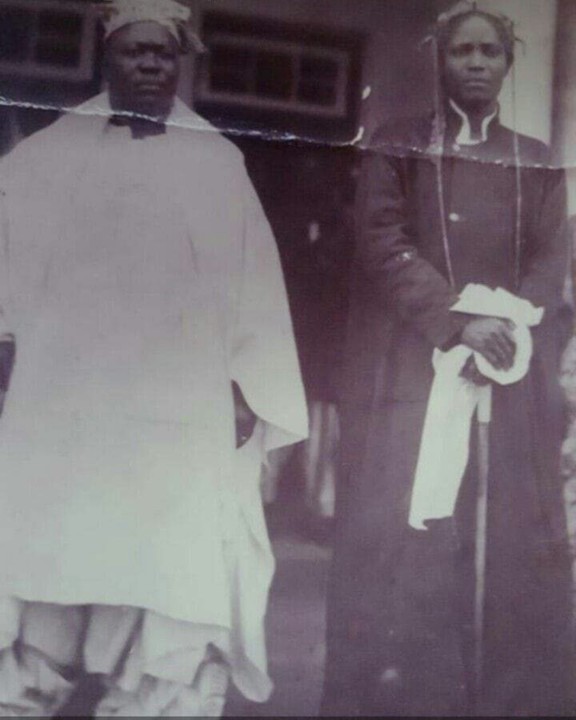
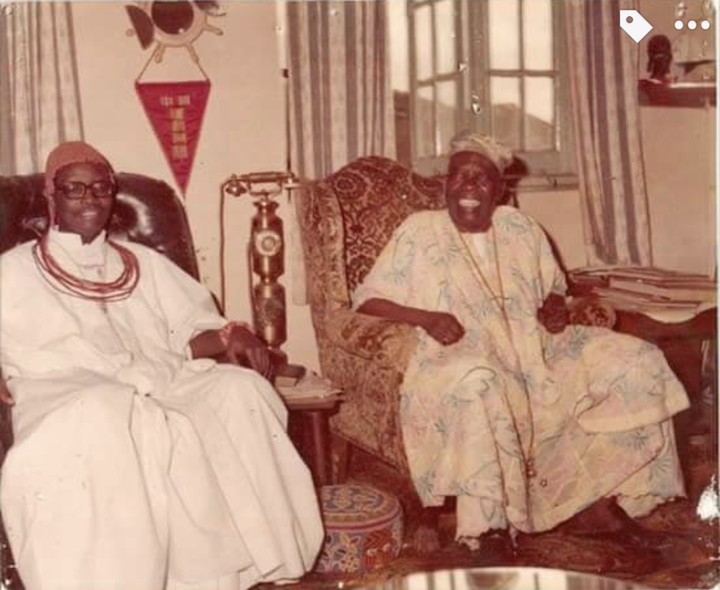
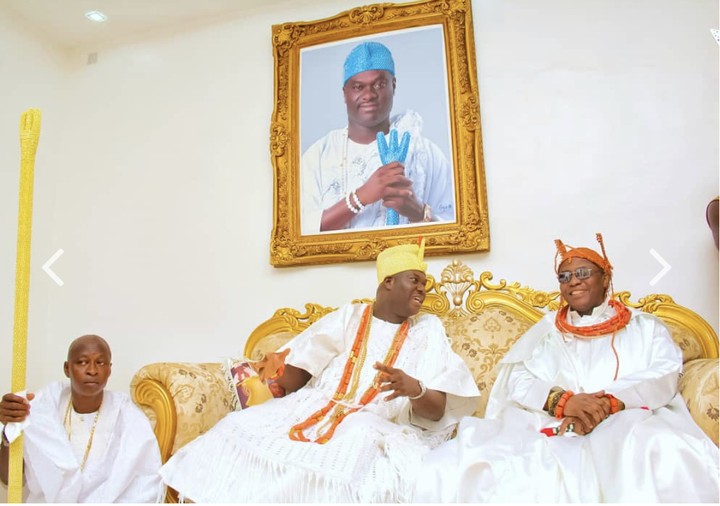
The three of them were so humble in the presence of their father & overlord. Who born monkey? 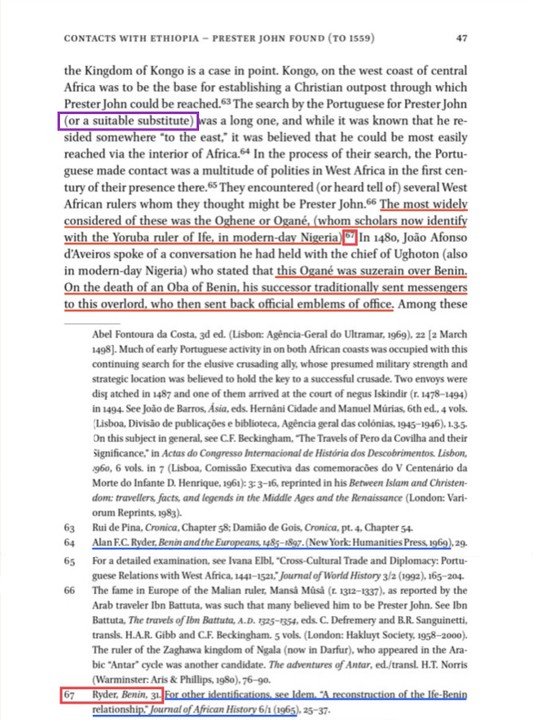
|
| Culture › Re: The Name Lagos, Was Called Ekonunuame By The Benins by TAO12: 11:17am On Aug 16, 2021 |
gregyboy:
Youre looser..... And a talkative Nope! A “Benin-child” is born = A “loser-in-life” is born. But things are changing lately. See attached. 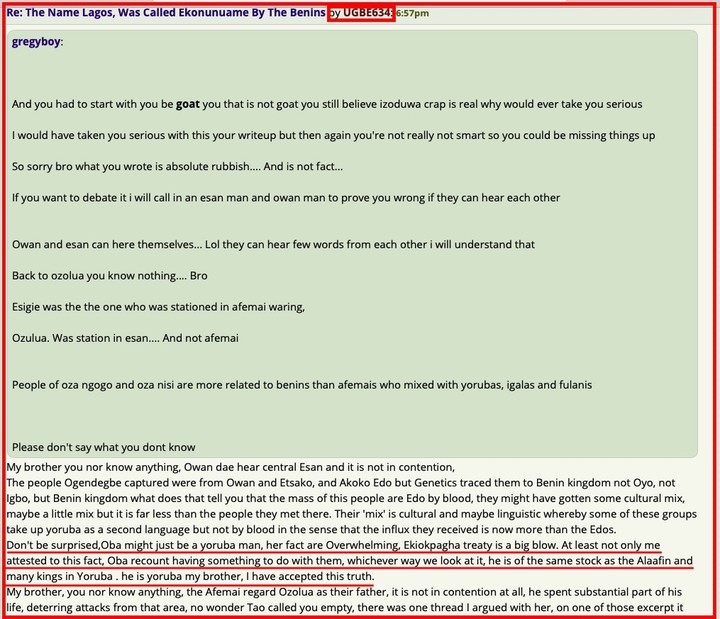

|
| Culture › Re: The Name Lagos, Was Called Ekonunuame By The Benins by TAO12: 10:49am On Aug 16, 2021 |
gregyboy:
[s]So our benin brothers is now your historians you quote.. Lol[/s] No! Your Benin brothers are mere testimonies (I know that’s a very big word for you) to the fact that historical facts, truth, etc. can still have its way through a Benin skull regardless of the ban on brain usage by your oba. 


|
| Culture › Re: The Name Lagos, Was Called Ekonunuame By The Benins by TAO12: 10:39am On Aug 16, 2021*. Modified: 8:31pm On Aug 16, 2021 |
samuk:
[s]I understand your pain and emotional outburst. I wouldn't have expected less from you, not after I have exposed the politics behind the Benin/Ife connection fairytale . Take it easy, you didn't really believe that the truth will be hidden forever, do you.
The situation is so bad that you now rely on comments from Benin people on nairaland as evidence to support your fairytale. You are now like a broken record that repeats itself. Meanwhile I am chipping away what's left in your Benin/Ife fallacy.
I have already shown the relationship between Benin and Yoruba in the earlier part of this thread.
The relationship was filled with blood of many Yoruba traditional rulers that were beheaded by successive Obas of Benin before 1897. But after 1897, the story changed, it was as if Benin didn't have history pre 1897. It was as if Benin began a new dynasty after oba Ovonramwen.
Benin automatically became Yoruba relatives. Benin princes even started bearing Yoruba names, meanwhile, no Benin prince had Yoruba name in the previous 900 years, people started writing stories/lies to cement this new found relationship, forgetting that the Europeans have been painstakingly documenting Benin history for over 400 years.[/s] Samuk the obese midget is struggling to have his head above water. I can see you really have big ambitions — that is, to transform cheap lies into truth. I’m any case, there is no rest for your until you first make peace with truth. See below: TAO11:
You Benins are actually too foolish to be ignored. Ignoring you means, to you, that you’ve stated facts. Jokers.
Crowther is not a historian, he is a linguist. He didn’t write a Yoruba history book. His books are generally grammar books, dictionary, etc. being a linguist.
Although he sometimes set aside introductory notes to Yoruba creation stories as well as Oyo kingship (being from Osoogun), and this introductory notes usually takes roughly 3% of the entire pages.
A sane mind wonders then how the next thing on his mind to write about (in a books of language) would be Ife-Benin connection. You’re hoplessly delusional.
Moreover, Mr. Cyril Punch who toured Yoruba cities and was also in Benin wrote in his 1889 Journal that:
“As a town, Benin was inconsiderable compared with places like Ibadan, Iseyhin, Shaki, Modakeke, and Abeokuta. There was no wealth, nor was there even power, except the power of the influence of fetish, and the sense of the spirit of a long past of atrocities, which, if not supernatural, were at any rate unnatural to a degree which is indescribable. I remember the return of two of Miller Brothers' men from a visit they paid to Benin after I had been there. They arrived at Guatun one evening, and showed plainly in their faces the mental strain that their visit had been to them.”
As for the Ife ‘bronze’ sculptures, the quotation here (is from an academic, expert, and professional Art Historian) shows IFE on the same pedestal as Greek, Rome, and Egypt.
“[The Ife sculptures] would stand comparison with anything which Ancient Egypt, Classical Greece and Rome, or Renaissance Europe had to offer”.
~ Frank Willett, “Ife and Its Archaeology,” The Journal of African History, Vol. 1, No. 2 (1960), p. 239.
No such comparison with the great arts of the world is recorded for Benin. Show me one
——————
Regarding the father-Ife/son-Benin classic connection, refer again to the following comments for a harsh reminder (and some trauma) which you were earlier on being endowed with:
This is not true.
Eyewitness testimony/writings from the late-1400s & early-1500s which references the monarch of the Ife kingdom & his suzerainty over Benin kingdom exist.
NB: Yes, there used to be a debate in academia in the 1970s/1980s (between the mainstream scholars on one hand; and one, two, or three others on another hand) over the identity of this suzerain.
This debate was particularly on the usage of the word “east” in those early writings.
In present time, however, there is no single academic historian who holds the notion that this suzerain (of the early writings) is other than the Ooni of Ife [i.e. Ọ̀ɣọ̀ni Ufẹ̀ in the Ife dialect of the Yoruba language].
The symbol ⟨ɣ⟩ being the voiced velar fricative with its consonant sound as in this audio sample.
This conclusion is reinforced by the fact that no king, throughout the Guinea Forest of West Africa matches the specific sacral details given in those early writings, except the Ooni of Ife.
In addition to this significant fact, the debate over the word “east” was subsequently quelled by the fact that from Atakpame (in present-day Togo) to the kingdom of Benin (in present-day Nigeria), from Èkó (next to the Atlantic Ocean) to Ọ̀yọ́-Ilé (not far from the Niger River) Ife is known by the interesting epithet: Ibi ojúmọ́ ti ń mọ́ wá — i.e. “the place from where the sun rises”.
For some written references to the widespread usage of this epithet (in reference to Ife) among the natives of this region of West Africa, please refer to:
(A) Rev. D. Hinderer, “Diary Impression,” June 4, 1851, Ibadan, C.M.S.
(B) R. Horton (1979), p. 85., citing B. Maupoil (1943), A. Akinjogbin (1967:41-43), R. Smith (1969:31), as well as A. Obayemi (1976:206).
This reverential (rather than literal) epithet of Ife informed the literalist Europeans’ writings whose source(s) are Benin spokespersons of their king.
Hence the appearance of the word “east” in the early European writings in reference to the kingdom of the Ọ̀ɣọ̀ni (who is transliterated in the early writings as “Hooguanee”, “Ogané”, etc.).
Side Note: Binis, till today, still sometimes refer to the Ooni as Oghene. Refer to the entry “ɔɣɛnɛ” (i.e. “ọghẹnẹ”) in Hans Melzian’s “A Concise Dictionary of the Bini Language of Southern Nigeria” where its second definition is given as: “Bini name for the ↄni at Ile Ife”
Moreover, another piece of historical evidence which quelled the academic debate on the word “east” (as is seen in the early writings in reference to this overlord) are early maps.
There are maps (e.g. from the early 1500s) which show the phrase Dominion of the Orguene annotated across the western half of today’s Nigeria.
These historical information leaves anyone (not only the historians) with the only logical conclusion that the appearance of the word “east” in those early writings is of course not literal.
In conclusion, contrary to your ignorant assumption, there are writings from the early 1500s (on the basis of interviews of Bini representatives in the late 1400s) which references the king of Ife & his overlordship on Benin kingdom and other places.
Apart from early writings, there are other types of historical evidence which also establish clearly that there exist a classic (i.e. pre-1800) father & son relationship between Ife & Benin respectively.
These other type of historical evidence which I come to here are classical artifacts from the hard science of archaeology. One crucial examples in this regard is discussed below.
The artifact shown in this link is the image of an Ooni of Ife. ~ S. P. Blier, “Art in Ancient Ife,” 2012, Figure 17.
The Ife naturalism of this artifact, its facial striations, as well as its classical Ife ceremonial costume and the pair of chest ornament help art historians (as well as Benin chroniclers alike) with identifying this image as an Ooni of Ife.
What is very, very crucial here is that this artifact was found in the archaeological deposits of Benin. To be more precise, it was excavated from the royal palace of Benin kingdom.
Furthermore, the production date of this artifact has now been established by science. This artifact is dated, by thermoluminescence technique, to the year 1420 [± 60 years].
~ Calvocoressi & David, “A New Survey of Radiocarbon and Thermoluminescence Dates for West Africa,” 1979, p. 19.
For more pictorial angles (and details) regarding this particular artifact, please refer to:
(A) W. Fagg, “A Bronze Figure in Ife Style at Benin,” British Museum, June 1950, Plate Fa, Fb, Fc
(B) F. Willett, “Ife in the History of West African Sculpture,” McGraw-Hill, 1967, Figure 89.
(C) C. Adepegba, “The Descent from Oduduwa,” 1986, Plate 4.
In other words, a more-than 500-year-old ‘bronze’ cast of an Ooni Ife was discovered in the (archaeological deposits of the) palace of Benin kingdom.
In conclusion, it thus becomes clear that there exists a classical (i.e. pre-1800) father & son relationship between Ife & Benin respectively.
Again, this conclusion which I have inevitably reached is not mine. This is simply the conclusion of historical scholarship. This can be seen in the following works:
A. Akinjogbin (1967), F. Willett (1973), R. C. C. Law (1973), R. Horton (1979), A. Obayemi (1980), R. Smith (1988), B. Adediran (1991), D. Bondarenko (2003), S. A. Akintoye (2010), A. Ogundiran (2020), et al.
A beautiful summary of this conclusion of scholars of
African history (some of whose names and works are listed above) is shown in the page below from Adam Knobler (2016), p.47.
Peace!
PS: (1) Omonoba (king’s child) Akenzua II visited Ooni of Ife at Ife.
Not because the Ooni was having a party, but because Akenzua himself just became Benin king.
(2) Omonoba (king’s child) Erediauwa (i.e. Akenzua II’s successor) also visited Ooni of Ife at Ife.
Not because the Ooni was having a party, but because Erediauwa himself just became Benin king.
(3) Omonoba (king’s child) Ewuare II (i.e. Erediauwa’s successor) also visited Ooni of Ife at Ife.
Not because the Ooni was having a party, but because Ewuare II himself just became Benin king.
The three of them were so humble in the presence of their father & overlord.
Who born monkey? 


|
| Culture › Re: The Name Lagos, Was Called Ekonunuame By The Benins by TAO12: 5:55am On Aug 16, 2021 |
And it was never my fault that samuk’s brain is under lock and keys. Visit these comments of mine again, samuk, whenever your oba lifts the ban he placed on the use of brain. It was never my fault that samuk failed Maths basic arithmetic at school — hence his PTSD from Math. In any case, your people who can read and who know some arithmetic have been following my comments, and their testimonies are attached below. TAO11:
IFE is roughly about 174 miles away from Benin City.
However, the alleged distance of 900 miles is NOT mentioned anywhere in the text.
Instead, the distance between Benin City and the Ogane’s place [as given in the text] is 250 leagues.
However, this number (250 leagues) wasn’t obtained (by the Portuguese) from any Bini informant. This fact is extremely clear from the text itself.
In fact, the Binis who lived in the 1400s/1500s did not measure distance in leagues, miles, etc. As such, they couldn’t have given such information.
Instead, the Binis of the 1400s, 1500s, etc. measured distance in natural terms, e.g. on the basis of celestial bodies such as the Moon, etc.
Interestingly, the distance obtained from the Binis by the Portuguese was given in terms of the Moon. This is given in the text.
The Binis informed the Portuguese that it takes twenty (20) moons journey to go from Benin city to the Ogané’s place.
It was on the basis of this received information (i.e. 20 moons journey away) that the Portuguese imagined what the distance in “leagues” should be.
The distance in leagues was NOT received from the Binis. The text is clear on this. The W/African context is also clear on this.
Having said that, the natural question now becomes:
Is this number (20 moons journey from Benin City to the Ogane’s place) realistic for IFE if it is indeed the Ogane’s place??
In other words, could the distance from Benin City to Ile-Ife possibly have been twenty moons journey in some “traditional” terms? Let’s do the Maths on the basis of average numbers & the “traditional” context.
The data to be used for the Math is NOT on the basis of Google map’s algorithm which assumes a walking trip with zero tiredness, zero rests, zero stops, zero pauses, zero relaxations, zero camps, constant rapid pace, etc.
Instead, the data to be used is on the basis of the real life situation, average numbers, & traditional context.
Datum 1: C. G. Okojie’s “Ishan Native Laws and Customs,” p. 210. provides the first data as follows:
The walking trip from Uromi (in Ishan) to Benin City on a course of some 50 miles “traditionally” took an average of 5 months.
~ Cited in A.F.C. Ryder (1965), p.27.
Datum 2: IFE is roughly about 174 miles away from Benin City (even over the ancient Benin-Owo-Ife route).
These two data leave an answer of about 17.4 months [NOT moons] as the “traditional” walking time from Benin to Ife.
In other words, IFE is 17.4 months journey away from Benin city on the average “traditionally”.
Question: How many “moons” are 17.4 months equivalent to? To answer this, two pieces of data will be adduced.
Datum 3: It takes the Moon 27.322 days to go around the earth.
In other words, there are [exactly] about 27.322 days in one “moon”.
Datum 4: There is an average of 30.47 days in one month.
Summary:
(1) The “traditional” walking distance from Benin to Ile-Ife took an average of 17.4 months
(2) 17.4 months are equivalent to 530.178 days (i.e. 17.4 months * 30.47days per month).
(3) 530.178 days are equivalent to 19.4 moons (i.e. 530.178 days / 27.322 days per moon).
In conclusion, the facts and figures turn out to prove that the “traditional” trip from Benin city to Ile-Ife took an average of 19.4 moons.
This answer is therefore astoundingly accurate for all practical intents and purpose.
From this again, we see that Ife is indeed the place of the Ogané of the Portuguese text. The Bini informant knew exactly what he was talking about. PS: References to this great overlord (to whom Benin obas are subservient) is documented not once, not twice, not thrice by independent Europeans; but at least five separate times spanning centuries prior to the 1800s. Peace! 


|
| Culture › Re: The Name Lagos, Was Called Ekonunuame By The Benins by TAO12: 5:43am On Aug 16, 2021*. Modified: 8:31pm On Aug 16, 2021 |
And samuk, the obese midget has known no peace since his own people began to embrace truth rather than his fictional missive. See the attachments at my second comment below for some testimony from samuk’s Bini brothers. TAO11:
You Benins are actually too foolish to be ignored. Ignoring you means, to you, that you’ve stated facts. Jokers.
Crowther is not a historian, he is a linguist. He didn’t write a Yoruba history book. His books are generally grammar books, dictionary, etc. being a linguist.
Although he sometimes set aside introductory notes to Yoruba creation stories as well as Oyo kingship (being from Osoogun), and this introductory notes usually takes roughly 3% of the entire pages.
A sane mind wonders then how the next thing on his mind to write about (in a books of language) would be Ife-Benin connection. You’re hoplessly delusional.
Moreover, Mr. Cyril Punch who toured Yoruba cities and was also in Benin wrote in his 1889 Journal that:
“As a town, Benin was inconsiderable compared with places like Ibadan, Iseyhin, Shaki, Modakeke, and Abeokuta. There was no wealth, nor was there even power, except the power of the influence of fetish, and the sense of the spirit of a long past of atrocities, which, if not supernatural, were at any rate unnatural to a degree which is indescribable. I remember the return of two of Miller Brothers' men from a visit they paid to Benin after I had been there. They arrived at Guatun one evening, and showed plainly in their faces the mental strain that their visit had been to them.”
As for the Ife ‘bronze’ sculptures, the quotation here (is from an academic, expert, and professional Art Historian) shows IFE on the same pedestal as Greek, Rome, and Egypt.
“[The Ife sculptures] would stand comparison with anything which Ancient Egypt, Classical Greece and Rome, or Renaissance Europe had to offer”.
~ Frank Willett, “Ife and Its Archaeology,” The Journal of African History, Vol. 1, No. 2 (1960), p. 239.
No such comparison with the great arts of the world is recorded for Benin. Show me one
——————
Regarding the father-Ife/son-Benin classic connection, refer again to the following comments for a harsh reminder (and some trauma) which you were earlier on being endowed with:
This is not true.
Eyewitness testimony/writings from the late-1400s & early-1500s which references the monarch of the Ife kingdom & his suzerainty over Benin kingdom exist.
NB: Yes, there used to be a debate in academia in the 1970s/1980s (between the mainstream scholars on one hand; and one, two, or three others on another hand) over the identity of this suzerain.
This debate was particularly on the usage of the word “east” in those early writings.
In present time, however, there is no single academic historian who holds the notion that this suzerain (of the early writings) is other than the Ooni of Ife [i.e. Ọ̀ɣọ̀ni Ufẹ̀ in the Ife dialect of the Yoruba language].
The symbol ⟨ɣ⟩ being the voiced velar fricative with its consonant sound as in this audio sample.
This conclusion is reinforced by the fact that no king, throughout the Guinea Forest of West Africa matches the specific sacral details given in those early writings, except the Ooni of Ife.
In addition to this significant fact, the debate over the word “east” was subsequently quelled by the fact that from Atakpame (in present-day Togo) to the kingdom of Benin (in present-day Nigeria), from Èkó (next to the Atlantic Ocean) to Ọ̀yọ́-Ilé (not far from the Niger River) Ife is known by the interesting epithet: Ibi ojúmọ́ ti ń mọ́ wá — i.e. “the place from where the sun rises”.
For some written references to the widespread usage of this epithet (in reference to Ife) among the natives of this region of West Africa, please refer to:
(A) Rev. D. Hinderer, “Diary Impression,” June 4, 1851, Ibadan, C.M.S.
(B) R. Horton (1979), p. 85., citing B. Maupoil (1943), A. Akinjogbin (1967:41-43), R. Smith (1969:31), as well as A. Obayemi (1976:206).
This reverential (rather than literal) epithet of Ife informed the literalist Europeans’ writings whose source(s) are Benin spokespersons of their king.
Hence the appearance of the word “east” in the early European writings in reference to the kingdom of the Ọ̀ɣọ̀ni (who is transliterated in the early writings as “Hooguanee”, “Ogané”, etc.).
Side Note: Binis, till today, still sometimes refer to the Ooni as Oghene. Refer to the entry “ɔɣɛnɛ” (i.e. “ọghẹnẹ”) in Hans Melzian’s “A Concise Dictionary of the Bini Language of Southern Nigeria” where its second definition is given as: “Bini name for the ↄni at Ile Ife”
Moreover, another piece of historical evidence which quelled the academic debate on the word “east” (as is seen in the early writings in reference to this overlord) are early maps.
There are maps (e.g. from the early 1500s) which show the phrase Dominion of the Orguene annotated across the western half of today’s Nigeria.
These historical information leaves anyone (not only the historians) with the only logical conclusion that the appearance of the word “east” in those early writings is of course not literal.
In conclusion, contrary to your ignorant assumption, there are writings from the early 1500s (on the basis of interviews of Bini representatives in the late 1400s) which references the king of Ife & his overlordship on Benin kingdom and other places.
Apart from early writings, there are other types of historical evidence which also establish clearly that there exist a classic (i.e. pre-1800) father & son relationship between Ife & Benin respectively.
These other type of historical evidence which I come to here are classical artifacts from the hard science of archaeology. One crucial examples in this regard is discussed below.
The artifact shown in this link is the image of an Ooni of Ife. ~ S. P. Blier, “Art in Ancient Ife,” 2012, Figure 17.
The Ife naturalism of this artifact, its facial striations, as well as its classical Ife ceremonial costume and the pair of chest ornament help art historians (as well as Benin chroniclers alike) with identifying this image as an Ooni of Ife.
What is very, very crucial here is that this artifact was found in the archaeological deposits of Benin. To be more precise, it was excavated from the royal palace of Benin kingdom.
Furthermore, the production date of this artifact has now been established by science. This artifact is dated, by thermoluminescence technique, to the year 1420 [± 60 years].
~ Calvocoressi & David, “A New Survey of Radiocarbon and Thermoluminescence Dates for West Africa,” 1979, p. 19.
For more pictorial angles (and details) regarding this particular artifact, please refer to:
(A) W. Fagg, “A Bronze Figure in Ife Style at Benin,” British Museum, June 1950, Plate Fa, Fb, Fc
(B) F. Willett, “Ife in the History of West African Sculpture,” McGraw-Hill, 1967, Figure 89.
(C) C. Adepegba, “The Descent from Oduduwa,” 1986, Plate 4.
In other words, a more-than 500-year-old ‘bronze’ cast of an Ooni Ife was discovered in the (archaeological deposits of the) palace of Benin kingdom.
In conclusion, it thus becomes clear that there exists a classical (i.e. pre-1800) father & son relationship between Ife & Benin respectively.
Again, this conclusion which I have inevitably reached is not mine. This is simply the conclusion of historical scholarship. This can be seen in the following works:
A. Akinjogbin (1967), F. Willett (1973), R. C. C. Law (1973), R. Horton (1979), A. Obayemi (1980), R. Smith (1988), B. Adediran (1991), D. Bondarenko (2003), S. A. Akintoye (2010), A. Ogundiran (2020), et al.
A beautiful summary of this conclusion of scholars of
African history (some of whose names and works are listed above) is shown in the page below from Adam Knobler (2016), p.47.
Peace!
PS: (1) Omonoba (king’s child) Akenzua II visited Ooni of Ife at Ife.
Not because the Ooni was having a party, but because Akenzua himself just became Benin king.
(2) Omonoba (king’s child) Erediauwa (i.e. Akenzua II’s successor) also visited Ooni of Ife at Ife.
Not because the Ooni was having a party, but because Erediauwa himself just became Benin king.
(3) Omonoba (king’s child) Ewuare II (i.e. Erediauwa’s successor) also visited Ooni of Ife at Ife.
Not because the Ooni was having a party, but because Ewuare II himself just became Benin king.
The three of them were so humble in the presence of their father & overlord.
Who born monkey? Take heart samuk. 


|
| Culture › Re: The Name Lagos, Was Called Ekonunuame By The Benins by TAO12: 10:09pm On Aug 15, 2021*. Modified: 12:20am On Aug 16, 2021 |
I will continue using evidence, proof, & ratiocination to debunk Benin lies on Yoruba history; I don’t care how many Nairaland pages I push to achieve that. I will continue to help more Binis, et al. realize that the Obas of Benin are Yoruba sons— and I don’t care how many Nairaland pages I push to achieve that. There is no going back on that. No amount of reverse pleading can stop that. The three screenshots attached below (i.e. one from an anti-Yoruba Igbo man, and the other two from two staunch anti-Yoruba Bini men) shows that truth wins always even though it may take time. Peace! 


|
| Culture › Re: The Name Lagos, Was Called Ekonunuame By The Benins by TAO12: 8:32pm On Aug 15, 2021*. Modified: 8:29pm On Aug 16, 2021 |
TAO11:
You Benins are actually too foolish to be ignored. Ignoring you means, to you, that you’ve stated facts. Jokers.
Crowther is not a historian, he is a linguist. He didn’t write a Yoruba history book. His books are generally grammar books, dictionary, etc. being a linguist.
Although he sometimes set aside introductory notes to Yoruba creation stories as well as Oyo kingship (being from Osoogun), and this introductory notes usually takes roughly 3% of the entire pages.
A sane mind wonders then how the next thing on his mind to write about (in a books of language) would be Ife-Benin connection. You’re hoplessly delusional.
Moreover, Mr. Cyril Punch who toured Yoruba cities and was also in Benin wrote in his 1889 Journal that:
“As a town, Benin was inconsiderable compared with places like Ibadan, Iseyhin, Shaki, Modakeke, and Abeokuta. There was no wealth, nor was there even power, except the power of the influence of fetish, and the sense of the spirit of a long past of atrocities, which, if not supernatural, were at any rate unnatural to a degree which is indescribable. I remember the return of two of Miller Brothers' men from a visit they paid to Benin after I had been there. They arrived at Guatun one evening, and showed plainly in their faces the mental strain that their visit had been to them.”
As for the Ife ‘bronze’ sculptures, the quotation here (is from an academic, expert, and professional Art Historian) shows IFE on the same pedestal as Greek, Rome, and Egypt.
“[The Ife sculptures] would stand comparison with anything which Ancient Egypt, Classical Greece and Rome, or Renaissance Europe had to offer”.
~ Frank Willett, “Ife and Its Archaeology,” The Journal of African History, Vol. 1, No. 2 (1960), p. 239.
No such comparison with the great arts of the world is recorded for Benin. Show me one
——————
Regarding the father-Ife/son-Benin classic connection, refer again to the following comments for a harsh reminder (and some trauma) which you were earlier on being endowed with:
This is not true.
Eyewitness testimony/writings from the late-1400s & early-1500s which references the monarch of the Ife kingdom & his suzerainty over Benin kingdom exist.
NB: Yes, there used to be a debate in academia in the 1970s/1980s (between the mainstream scholars on one hand; and one, two, or three others on another hand) over the identity of this suzerain.
This debate was particularly on the usage of the word “east” in those early writings.
In present time, however, there is no single academic historian who holds the notion that this suzerain (of the early writings) is other than the Ooni of Ife [i.e. Ọ̀ɣọ̀ni Ufẹ̀ in the Ife dialect of the Yoruba language].
The symbol ⟨ɣ⟩ being the voiced velar fricative with its consonant sound as in this audio sample.
This conclusion is reinforced by the fact that no king, throughout the Guinea Forest of West Africa matches the specific sacral details given in those early writings, except the Ooni of Ife.
In addition to this significant fact, the debate over the word “east” was subsequently quelled by the fact that from Atakpame (in present-day Togo) to the kingdom of Benin (in present-day Nigeria), from Èkó (next to the Atlantic Ocean) to Ọ̀yọ́-Ilé (not far from the Niger River) Ife is known by the interesting epithet: Ibi ojúmọ́ ti ń mọ́ wá — i.e. “the place from where the sun rises”.
For some written references to the widespread usage of this epithet (in reference to Ife) among the natives of this region of West Africa, please refer to:
(A) Rev. D. Hinderer, “Diary Impression,” June 4, 1851, Ibadan, C.M.S.
(B) R. Horton (1979), p. 85., citing B. Maupoil (1943), A. Akinjogbin (1967:41-43), R. Smith (1969:31), as well as A. Obayemi (1976:206).
This reverential (rather than literal) epithet of Ife informed the literalist Europeans’ writings whose source(s) are Benin spokespersons of their king.
Hence the appearance of the word “east” in the early European writings in reference to the kingdom of the Ọ̀ɣọ̀ni (who is transliterated in the early writings as “Hooguanee”, “Ogané”, etc.).
Side Note: Binis, till today, still sometimes refer to the Ooni as Oghene. Refer to the entry “ɔɣɛnɛ” (i.e. “ọghẹnẹ”) in Hans Melzian’s “A Concise Dictionary of the Bini Language of Southern Nigeria” where its second definition is given as: “Bini name for the ↄni at Ile Ife”
Moreover, another piece of historical evidence which quelled the academic debate on the word “east” (as is seen in the early writings in reference to this overlord) are early maps.
There are maps (e.g. from the early 1500s) which show the phrase Dominion of the Orguene annotated across the western half of today’s Nigeria.
These historical information leaves anyone (not only the historians) with the only logical conclusion that the appearance of the word “east” in those early writings is of course not literal.
In conclusion, contrary to your ignorant assumption, there are writings from the early 1500s (on the basis of interviews of Bini representatives in the late 1400s) which references the king of Ife & his overlordship on Benin kingdom and other places.
Apart from early writings, there are other types of historical evidence which also establish clearly that there exist a classic (i.e. pre-1800) father & son relationship between Ife & Benin respectively.
These other type of historical evidence which I come to here are classical artifacts from the hard science of archaeology. One crucial examples in this regard is discussed below.
The artifact shown in this link is the image of an Ooni of Ife. ~ S. P. Blier, “Art in Ancient Ife,” 2012, Figure 17.
The Ife naturalism of this artifact, its facial striations, as well as its classical Ife ceremonial costume and the pair of chest ornament help art historians (as well as Benin chroniclers alike) with identifying this image as an Ooni of Ife.
What is very, very crucial here is that this artifact was found in the archaeological deposits of Benin. To be more precise, it was excavated from the royal palace of Benin kingdom.
Furthermore, the production date of this artifact has now been established by science. This artifact is dated, by thermoluminescence technique, to the year 1420 [± 60 years].
~ Calvocoressi & David, “A New Survey of Radiocarbon and Thermoluminescence Dates for West Africa,” 1979, p. 19.
For more pictorial angles (and details) regarding this particular artifact, please refer to:
(A) W. Fagg, “A Bronze Figure in Ife Style at Benin,” British Museum, June 1950, Plate Fa, Fb, Fc
(B) F. Willett, “Ife in the History of West African Sculpture,” McGraw-Hill, 1967, Figure 89.
(C) C. Adepegba, “The Descent from Oduduwa,” 1986, Plate 4.
In other words, a more-than 500-year-old ‘bronze’ cast of an Ooni Ife was discovered in the (archaeological deposits of the) palace of Benin kingdom.
In conclusion, it thus becomes clear that there exists a classical (i.e. pre-1800) father & son relationship between Ife & Benin respectively.
Again, this conclusion which I have inevitably reached is not mine. This is simply the conclusion of historical scholarship. This can be seen in the following works:
A. Akinjogbin (1967), F. Willett (1973), R. C. C. Law (1973), R. Horton (1979), A. Obayemi (1980), R. Smith (1988), B. Adediran (1991), D. Bondarenko (2003), S. A. Akintoye (2010), A. Ogundiran (2020), et al.
A beautiful summary of this conclusion of scholars of
African history (some of whose names and works are listed above) is shown in the page below from Adam Knobler (2016), p.47.
Peace!
PS: (1) Omonoba (king’s child) Akenzua II visited Ooni of Ife at Ife.
Not because the Ooni was having a party, but because Akenzua himself just became Benin king.
(2) Omonoba (king’s child) Erediauwa (i.e. Akenzua II’s successor) also visited Ooni of Ife at Ife.
Not because the Ooni was having a party, but because Erediauwa himself just became Benin king.
(3) Omonoba (king’s child) Ewuare II (i.e. Erediauwa’s successor) also visited Ooni of Ife at Ife.
Not because the Ooni was having a party, but because Ewuare II himself just became Benin king.
The three of them were so humble in the presence of their father & overlord.
Who born monkey? Peace! 


|
| Culture › Re: The Name Lagos, Was Called Ekonunuame By The Benins by TAO12: 7:41pm On Aug 15, 2021*. Modified: 7:56pm On Aug 15, 2021 |
Now, the attached are some testaments to what truth is capable of doing even in the face of the severest oppositions (i.e. Igbo and Binis). Now that is progress. You keep lying, while more people keep choosing truth regardless of the discomfort that comes with their choice of truth. Peace 


|
| Culture › Re: The Name Lagos, Was Called Ekonunuame By The Benins by TAO12: 8:19pm On Aug 14, 2021 |
gregyboy:
Lol, Ugbe is a yoruba man Just like you’re a Yoruba man according to your Lord, @Truthvalue. @UGBE634, what is your thought on this allegation by @gregyboy?? He thinks you’re a Yoruba man because you admitted the truth without mincing words. 
|
| Culture › Re: The Name Lagos, Was Called Ekonunuame By The Benins by TAO12: 8:13pm On Aug 14, 2021*. Modified: 1:52am On Aug 15, 2021 |


|
| Culture › Re: The Name Lagos, Was Called Ekonunuame By The Benins by TAO12: 7:48pm On Aug 14, 2021*. Modified: 1:50am On Aug 15, 2021 |
DEBUNKED:gregyboy:
[s]Only if the ooni of ife was really oghane n uhe
You wont br here trying to convince us to think otherwise
Ife is west oghene is east but tao11 says no..
That west means east and east means west... Lol
In my who life of reading yoruba history is only the benins that have called ooni of ife, oghene u uhe amongst all Yorubas kings... Lol that calls ooni as ooniIs God not wonderful
That only the benins calls ooni of ife oghene n uhe amongst all other Yoruba kings...
I wonder why the oba benin could not know that is father name was ooni and not oghene
Tao11 can you help out
West is east and east is west [/s] https://www.nairaland.com/6482972/name-lagos-called-ekonunuame-benins/25#104790300 
|
| Culture › Re: The Name Lagos, Was Called Ekonunuame By The Benins by TAO12: 5:39pm On Aug 14, 2021*. Modified: 1:49am On Aug 15, 2021 |
TAO11:
IFE is roughly about 174 miles away from Benin City.
However, the alleged distance of 900 miles is NOT mentioned anywhere in the text.
Instead, the distance between Benin City and the Ogane’s place [as given in the text] is 250 leagues.
However, this number (250 leagues) wasn’t obtained (by the Portuguese) from any Bini informant. This fact is extremely clear from the text itself.
In fact, the Binis who lived in the 1400s/1500s did not measure distance in leagues, miles, etc. As such, they couldn’t have given such information.
Instead, the Binis of the 1400s, 1500s, etc. measured distance in natural terms, e.g. on the basis of celestial bodies such as the Moon, etc.
Interestingly, the distance obtained from the Binis by the Portuguese was given in terms of the Moon. This is given in the text.
The Binis informed the Portuguese that it takes twenty (20) moons journey to go from Benin city to the Ogané’s place.
It was on the basis of this received information (i.e. 20 moons journey away) that the Portuguese imagined what the distance in “leagues” should be.
The distance in leagues was NOT received from the Binis. The text is clear on this. The W/African context is also clear on this.
Having said that, the natural question now becomes:
Is this number (20 moons journey from Benin City to the Ogane’s place) realistic for IFE if it is indeed the Ogane’s place??
In other words, could the distance from Benin City to Ile-Ife possibly have been twenty moons journey in some “traditional” terms? Let’s do the Maths on the basis of average numbers & the “traditional” context.
The data to be used for the Math is NOT on the basis of Google map’s algorithm which assumes a walking trip with zero tiredness, zero rests, zero stops, zero pauses, zero relaxations, zero camps, constant rapid pace, etc.
Instead, the data to be used is on the basis of the real life situation, average numbers, & traditional context.
Datum 1: C. G. Okojie’s “Ishan Native Laws and Customs,” p. 210. provides the first data as follows:
The walking trip from Uromi (in Ishan) to Benin City on a course of some 50 miles “traditionally” took an average of 5 months.
~ Cited in A.F.C. Ryder (1965), p.27.
Datum 2: IFE is roughly about 174 miles away from Benin City (even over the ancient Benin-Owo-Ife route).
These two data leave an answer of about 17.4 months [NOT moons] as the “traditional” walking time from Benin to Ife.
In other words, IFE is 17.4 months journey away from Benin city on the average “traditionally”.
Question: How many “moons” are 17.4 months equivalent to? To answer this, two pieces of data will be adduced.
Datum 3: It takes the Moon 27.322 days to go around the earth.
In other words, there are [exactly] about 27.322 days in one “moon”.
Datum 4: There is an average of 30.47 days in one month.
Summary:
(1) The “traditional” walking distance from Benin to Ile-Ife took an average of 17.4 months
(2) 17.4 months are equivalent to 530.178 days (i.e. 17.4 months * 30.47days per month).
(3) 530.178 days are equivalent to 19.4 moons (i.e. 530.178 days / 27.322 days per moon).
In conclusion, the facts and figures turn out to prove that the “traditional” trip from Benin city to Ile-Ife took an average of 19.4 moons.
This answer is therefore astoundingly accurate for all practical intents and purpose.
From this again, we see that Ife is indeed the place of the Ogané of the Portuguese text. The Bini informant knew exactly what he was talking about. PS: References to this great overlord (to whom Benin obas are subservient) is documented not once, not twice, not thrice by independent Europeans; but at least five separate times spanning centuries prior to the 1800s. Peace! |
| Culture › Re: The Name Lagos, Was Called Ekonunuame By The Benins by TAO12: 5:37pm On Aug 14, 2021*. Modified: 8:23pm On Aug 16, 2021 |
Ogane is NOT a place. Ogane is a ruler. TAO11:
You Benins are actually too foolish to be ignored. Ignoring you means, to you, that you’ve stated facts. Jokers.
Crowther is not a historian, he is a linguist. He didn’t write a Yoruba history book. His books are generally grammar books, dictionary, etc. being a linguist.
Although he sometimes set aside introductory notes to Yoruba creation stories as well as Oyo kingship (being from Osoogun), and this introductory notes usually takes roughly 3% of the entire pages.
A sane mind wonders then how the next thing on his mind to write about (in a books of language) would be Ife-Benin connection. You’re hoplessly delusional.
Moreover, Mr. Cyril Punch who toured Yoruba cities and was also in Benin wrote in his 1889 Journal that:
“As a town, Benin was inconsiderable compared with places like Ibadan, Iseyhin, Shaki, Modakeke, and Abeokuta. There was no wealth, nor was there even power, except the power of the influence of fetish, and the sense of the spirit of a long past of atrocities, which, if not supernatural, were at any rate unnatural to a degree which is indescribable. I remember the return of two of Miller Brothers' men from a visit they paid to Benin after I had been there. They arrived at Guatun one evening, and showed plainly in their faces the mental strain that their visit had been to them.”
As for the Ife ‘bronze’ sculptures, the quotation here (is from an academic, expert, and professional Art Historian) shows IFE on the same pedestal as Greek, Rome, and Egypt.
“[The Ife sculptures] would stand comparison with anything which Ancient Egypt, Classical Greece and Rome, or Renaissance Europe had to offer”.
~ Frank Willett, “Ife and Its Archaeology,” The Journal of African History, Vol. 1, No. 2 (1960), p. 239.
No such comparison with the great arts of the world is recorded for Benin. Show me one
——————
Regarding the father-Ife/son-Benin classic connection, refer again to the following comments for a harsh reminder (and some trauma) which you were earlier on being endowed with:
This is not true.
Eyewitness testimony/writings from the late-1400s & early-1500s which references the monarch of the Ife kingdom & his suzerainty over Benin kingdom exist.
NB: Yes, there used to be a debate in academia in the 1970s/1980s (between the mainstream scholars on one hand; and one, two, or three others on another hand) over the identity of this suzerain.
This debate was particularly on the usage of the word “east” in those early writings.
In present time, however, there is no single academic historian who holds the notion that this suzerain (of the early writings) is other than the Ooni of Ife [i.e. Ọ̀ɣọ̀ni Ufẹ̀ in the Ife dialect of the Yoruba language].
The symbol ⟨ɣ⟩ being the voiced velar fricative with its consonant sound as in this audio sample.
This conclusion is reinforced by the fact that no king, throughout the Guinea Forest of West Africa matches the specific sacral details given in those early writings, except the Ooni of Ife.
In addition to this significant fact, the debate over the word “east” was subsequently quelled by the fact that from Atakpame (in present-day Togo) to the kingdom of Benin (in present-day Nigeria), from Èkó (next to the Atlantic Ocean) to Ọ̀yọ́-Ilé (not far from the Niger River) Ife is known by the interesting epithet: Ibi ojúmọ́ ti ń mọ́ wá — i.e. “the place from where the sun rises”.
For some written references to the widespread usage of this epithet (in reference to Ife) among the natives of this region of West Africa, please refer to:
(A) Rev. D. Hinderer, “Diary Impression,” June 4, 1851, Ibadan, C.M.S.
(B) R. Horton (1979), p. 85., citing B. Maupoil (1943), A. Akinjogbin (1967:41-43), R. Smith (1969:31), as well as A. Obayemi (1976:206).
This reverential (rather than literal) epithet of Ife informed the literalist Europeans’ writings whose source(s) are Benin spokespersons of their king.
Hence the appearance of the word “east” in the early European writings in reference to the kingdom of the Ọ̀ɣọ̀ni (who is transliterated in the early writings as “Hooguanee”, “Ogané”, etc.).
Side Note: Binis, till today, still sometimes refer to the Ooni as Oghene. Refer to the entry “ɔɣɛnɛ” (i.e. “ọghẹnẹ”) in Hans Melzian’s “A Concise Dictionary of the Bini Language of Southern Nigeria” where its second definition is given as: “Bini name for the ↄni at Ile Ife”
Moreover, another piece of historical evidence which quelled the academic debate on the word “east” (as is seen in the early writings in reference to this overlord) are early maps.
There are maps (e.g. from the early 1500s) which show the phrase Dominion of the Orguene annotated across the western half of today’s Nigeria.
These historical information leaves anyone (not only the historians) with the only logical conclusion that the appearance of the word “east” in those early writings is of course not literal.
In conclusion, contrary to your ignorant assumption, there are writings from the early 1500s (on the basis of interviews of Bini representatives in the late 1400s) which references the king of Ife & his overlordship on Benin kingdom and other places.
Apart from early writings, there are other types of historical evidence which also establish clearly that there exist a classic (i.e. pre-1800) father & son relationship between Ife & Benin respectively.
These other type of historical evidence which I come to here are classical artifacts from the hard science of archaeology. One crucial examples in this regard is discussed below.
The artifact shown in this link is the image of an Ooni of Ife. ~ S. P. Blier, “Art in Ancient Ife,” 2012, Figure 17.
The Ife naturalism of this artifact, its facial striations, as well as its classical Ife ceremonial costume and the pair of chest ornament help art historians (as well as Benin chroniclers alike) with identifying this image as an Ooni of Ife.
What is very, very crucial here is that this artifact was found in the archaeological deposits of Benin. To be more precise, it was excavated from the royal palace of Benin kingdom.
Furthermore, the production date of this artifact has now been established by science. This artifact is dated, by thermoluminescence technique, to the year 1420 [± 60 years].
~ Calvocoressi & David, “A New Survey of Radiocarbon and Thermoluminescence Dates for West Africa,” 1979, p. 19.
For more pictorial angles (and details) regarding this particular artifact, please refer to:
(A) W. Fagg, “A Bronze Figure in Ife Style at Benin,” British Museum, June 1950, Plate Fa, Fb, Fc
(B) F. Willett, “Ife in the History of West African Sculpture,” McGraw-Hill, 1967, Figure 89.
(C) C. Adepegba, “The Descent from Oduduwa,” 1986, Plate 4.
In other words, a more-than 500-year-old ‘bronze’ cast of an Ooni Ife was discovered in the (archaeological deposits of the) palace of Benin kingdom.
In conclusion, it thus becomes clear that there exists a classical (i.e. pre-1800) father & son relationship between Ife & Benin respectively.
Again, this conclusion which I have inevitably reached is not mine. This is simply the conclusion of historical scholarship. This can be seen in the following works:
A. Akinjogbin (1967), F. Willett (1973), R. C. C. Law (1973), R. Horton (1979), A. Obayemi (1980), R. Smith (1988), B. Adediran (1991), D. Bondarenko (2003), S. A. Akintoye (2010), A. Ogundiran (2020), et al.
A beautiful summary of this conclusion of scholars of
African history (some of whose names and works are listed above) is shown in the page below from Adam Knobler (2016), p.47.
Peace!
PS: (1) Omonoba (king’s child) Akenzua II visited Ooni of Ife at Ife.
Not because the Ooni was having a party, but because Akenzua himself just became Benin king.
(2) Omonoba (king’s child) Erediauwa (i.e. Akenzua II’s successor) also visited Ooni of Ife at Ife.
Not because the Ooni was having a party, but because Erediauwa himself just became Benin king.
(3) Omonoba (king’s child) Ewuare II (i.e. Erediauwa’s successor) also visited Ooni of Ife at Ife.
Not because the Ooni was having a party, but because Ewuare II himself just became Benin king.
The three of them were so humble in the presence of their father & overlord.
Who born monkey? Peace! 


|
| Culture › Re: The Name Lagos, Was Called Ekonunuame By The Benins by TAO12: 12:12pm On Aug 14, 2021 |
Think4Myself:
[s]Nobody should reply this tao12 she desperately needs the attention you give her[/s] I am the one initiating the replies — not the other way round. Check the records. 
|
| Culture › Re: The Name Lagos, Was Called Ekonunuame By The Benins by TAO12: 10:59am On Aug 14, 2021*. Modified: 11:44am On Aug 14, 2021 |
samuk:
[s]You have spoken and the readers have seen your position. You must allow Olu317 his opportunity to reply to the question.
The question was for both of you and not just you.
Stop trying to prove that you and only you knows it all.
Olu317, the readers are eagerly waiting for your reply to my question on the middle east origin of Oduduwa.
You guys can't be confused about the origin of your forefather and yet trying to impose him on others.
We are waiting......[/s] (1) IF you’re waiting on historical consensus regarding the roots of Oduduwa, then that is obviously sensible. And the historical consensus is that Oduduwa is from the community of Oke- Ora. This is not TAO. This is historical consensus. (2) IF, instead, you are waiting on Olu (not historians), then you’re only exposing yourself as a huge dense & a giant disgrace. I go with the historians. Whom do you go with, samuk? Olu I guess. LMAO! (3) In any case, your obas are Yorubas. ~ Says TAO; says your Olu; says historical consensus. Samuk attached! 
|
| Culture › Re: The Name Lagos, Was Called Ekonunuame By The Benins by TAO12: 9:47am On Aug 14, 2021*. Modified: 12:38pm On Aug 14, 2021 |
TAO11:
IFE is roughly about 174 miles away from Benin City.
However, the alleged distance of 900 miles is NOT mentioned anywhere in the text.
Instead, the distance between Benin and the Ogane’s place [as given in the text] is 250 leagues.
However, this number (250 leagues) wasn’t obtained (by the Portuguese) from any Bini informant. This fact is extremely clear from the text itself.
In fact, the Binis who lived in the 1400s/1500s did not measure distance in leagues, miles, etc. As such, they couldn’t have given such information.
Instead, the Binis of the 1400s, 1500s, etc. measured distance in natural terms, e.g. on the basis of celestial bodies such as the Moon, etc.
Interestingly, the distance obtained from the Binis by the Portuguese was given in terms of the Moon. This is given in the text.
The Binis informed the Portuguese that it takes twenty (20) moons journey to go from Benin city to the Ogané’s place.
It was on the basis of this received information (i.e. 20 moons journey away) that the Portuguese imagined what the distance in “leagues” should be.
The distance in leagues was NOT received from the Binis. The text is clear on this. The W/African context is also clear on this.
Having said that, the natural question now becomes:
Is this number (i.e. 20 moons journey from Benin City to the Ogane’s place) realistic for IFE if it is indeed the Ogane’s place??
In other words, could the distance from Benin City to Ile-Ife possibly have been twenty moons journey in some “traditional” terms? Let’s do the Maths on the basis of average numbers & the “traditional” context.
The data to be used for the Math is NOT on the basis of Google map’s algorithm which assumes a walking trip with zero tiredness, zero rests, zero stops, zero pauses, zero relaxations, zero camps, constant rapid pace, etc.
Instead, the data to be used is on the basis of the real life situation, average numbers, & traditional context.
Datum 1: C. G. Okojie’s “Ishan Native Laws and Customs,” p. 210. provides the first data as follows:
The walking trip from Uromi (in Ishan) to Benin City on a course of some 50 miles “traditionally” took an average of 5 months.
~ Cited in A.F.C. Ryder (1965), p.27.
Datum 2: IFE is roughly about 174 miles away from Benin City (even over the ancient Benin-Owo-Ife route).
These two data leave an answer of about 17.4 months [NOT moons] as the “traditional” walking time from Benin to Ife.
In other words, IFE is 17.4 months journey away from Benin city on the average “traditionally”.
Question: How many “moons” are 17.4 months equivalent to? To answer this, two pieces of data will be adduced.
Datum 3: It takes the Moon 27.322 days to go around the earth.
In other words, there are [exactly] about 27.322 days in one “moon”.
Datum 4: There is an average of 30.47 days in one month.
Summary:
(1) The “traditional” walking distance from Benin to Ile-Ife took an average of 17.4 months
(2) 17.4 months are equivalent to 530.178 days (i.e. 17.4 months * 30.47days per month).
(3) 530.178 days are equivalent to 19.4 moons (i.e. 530.178 days / 27.322 days per moon).
In conclusion, the facts and figures turn out to prove that the “traditional” trip from Benin city to Ile-Ife took an average of 19.4 moons.
This answer is therefore astoundingly accurate for all practical intents and purpose.
From this again, we see that Ife is indeed the place of the Ogané of the text. And the Bini informant knew exactly what he was talking about. PS: References to this great overlord (to whom a Benin king is subservient) is documented not once, not twice, not thrice by independent Europeans, but at least five sepearate times spanning centuries prior to the 1800s. Peace! Cc: nisai, rhektor, r4bbit, nisiw365, lifeisgood12, macof |
| Culture › Re: The Name Lagos, Was Called Ekonunuame By The Benins by TAO12: 9:45am On Aug 14, 2021*. Modified: 7:06pm On Aug 14, 2021 |
samuk:
[s]We are getting somewhere.
Olu317 TAO11 has spoken and she believes her position that Oduduwa was originally a native of Ife is more historically right than your middle east propaganda.
The floor is yours to tell us why you disagree with TAO11 on the origin of your forefather Oduduwa. Perhaps you care to show us you DNA scientific evidence that linked Yoruba people to the middle east against TAO11 fairytale history.
Whilst at it, perhaps you could share more light on the odus coptus of Ifa that talked about the origin of Oduduwa.
The readers will also be interested on the story of queen of sheba being buried in Ijebu Ode.
Let me quickly gi and get my popcorn......[/s] You’re trying too desperately to take the heat away from you. (1) Historical consensus is that your oba is a Yoruba man. (2) Historical consensus is that Oduduwa is a Yoruba man. Focus on historians rather than on Olu or TAO. Your grievances are well noted though. Peace! 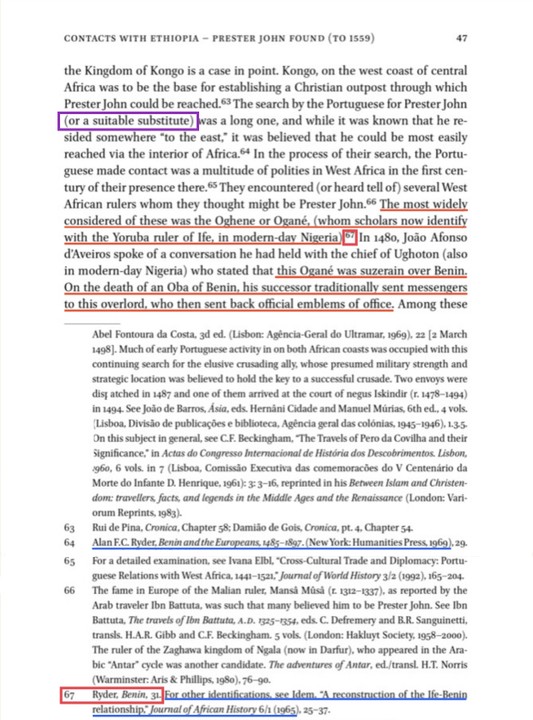
|
| Culture › Re: The Name Lagos, Was Called Ekonunuame By The Benins by TAO12: 9:34am On Aug 14, 2021 |
haffaze777:
My dear sister please temper justice with mercy,do you know the gravity of what you are doing to this people?do you know how many year it will take them to recover from this fatality?some may take it to their grave and that's why I'm pleading on their behalf but if you insist on continue hammering them with fact and they decide to commit suicide,know that my hand no dey ooo You have a point. But wait oo, my intention is not kill them na. PS: Not all of them will commit suicide sha. See the attached screenshot for instance. 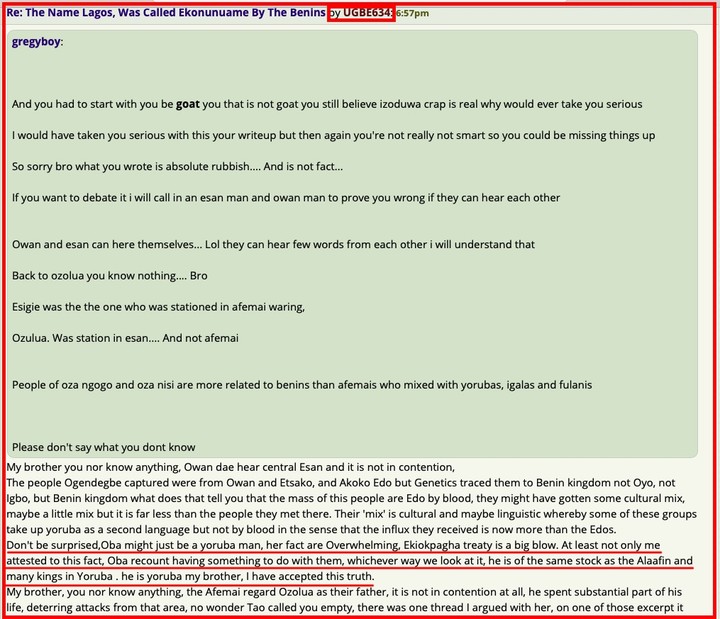
|


