AgentOfAllah's Posts
Nairaland Forum › AgentOfAllah's Profile › AgentOfAllah's Posts
1 2 3 4 5 6 7 8 ... 26 27 28 29 30 31 32 33 34 (of 46 pages)
 Christianity Etc › Re: RE: How Is Jesus’ Death A Sacrifice If He Rose From The Dead? by AgentOfAllah: 7:14am On Mar 28, 2016 Christianity Etc › Re: RE: How Is Jesus’ Death A Sacrifice If He Rose From The Dead? by AgentOfAllah: 7:14am On Mar 28, 2016 |
TrueBorn:This is fair! So I cannot be blamed for my disbelief if Jesus hasn't revealed himself to me. If d Scripture was inspired by God, how can there be any mistakes in it? How can d it be false?IF, and oh, what a BIG IF! Also want to say this: all Scripture is God-breathed 2 Tim 3:16. For no prophecy at any time was brought by the will of man but men moved by the Holy Spirit spoke from God. 2 Pet 1:21And then you justify your belief that the scripture is inspired by god using text from the same scripture under investigation. Consider the following scenario: A man drives up to you one day Man: I was sent by the Dangote to bring you to him as he wishes to give you =N=2,000,000,000 You: Was it Dangote that sent you? Man: Yes, of course! What's your next line of action? a) Hop into the car and take your chances? b) Remain skeptical and ask him for further proof? |
| Christianity Etc › Re: RE: How Is Jesus’ Death A Sacrifice If He Rose From The Dead? by AgentOfAllah: 2:27pm On Mar 27, 2016 |
TrueBorn:If you are going to claim anything is true, and you want that truth to be accepted by others, then there must be an external, independent, falsifiable yardstick, itself, beyond reproach, with which to assess the veracity of your claim. So my question to you is: how do you know everything the Bible says about Jesus is true? Bear in mind the implication of the word "everything". Supposing just half a statement about Jesus in the Bible is found to be false, your claim becomes entirely false. 1 Like |
| Christianity Etc › Re: Christianity; The Reason For Science by AgentOfAllah: 12:32pm On Mar 25, 2016 |
KingEbukasBlog:It goes without saying that the subgroup within a population of organisms which is better adapted to the environment than the rest of the population is the subgroup that is going to eventually outpopulate the remaining. This is irrespective of how that advantage was acquired in the first place. Now, given that the environment is ever changing, it stands to reason that new advantageous adaptations will help a subgroup within the subgroup outpopulate the rest again. This process continues in a cascaded series of events, so that at any given time, when an observer wishes to observe the latest population, they will not just be observing the original species, but a variant of it, with cumulative adaptations that make it apparently distinct from the original species. So, adaptation is not just related to evolution, it is the fundamental building block upon which evolution is predicated. On speciation, before attempting to answer any question on the subject, one must attempt, first, to define 'species'. One of the obvious implications of the theory of evolution is that it obscures whatever apparent nuances there may have been between species in the past, and rightly so! It makes no sense to simultaneously promote a common ancestry of all species and emphasise dodgy invariant distinctions as well. This is not to say there are no existing definitions of species, but it means every definition can always be met with a fatal example. One definition says they are the largest group of population where two individuals can mate and successfully produce fertile offspring, but where would that leave asexual organisms, that are, themselves, fantastic in their many distinct expressions? Another definition suggests a species is any group that has exactly the same number of chromosomes; and the same number of nucleotides in each chromosome. But where would this leave large populations of amphibians and plants that do not have the same number of chromosomes, but successfully mate and produce viable offspring? The subject of species is a nebulous one which the theory can do without, though is conveniently used for it descriptive power. However, no matter what definition you use, evolution can sufficiently explain the process that led to the so-called speciation. 1 Like |
| Christianity Etc › Re: Christianity; The Reason For Science by AgentOfAllah: 3:07pm On Mar 24, 2016 |
KingEbukasBlog:Let me explain how evolution works differently, so that you might understand this a little better: Evolution is a function, not of time, but of events in time. It is very helpful to think of evolution as a destructive force than a creative one. Evolution is a lion pursuing a herd of antelopes. The surviving antelopes do not need to be faster than the lion to survive, they just need to be faster than other antelopes. The surviving antelopes will then reproduce and have on average, faster offspring than previous generations. This increases ever so slightly, the lion's next effort to get an antelope on its dinner menu. You see, the lion has inadvertently created faster antelopes, not because it wanted to, but because it killed off the genes of the slower ones. This is basically how evolution works. If antibiotics weren't discovered, there would be no need for bacteria to evolve into more resistant species, even after a million years, provided all other conditions remained the same. The malignant irony is that our quest to eliminate bacteria has enabled us create monster bacteria (a sort of balance restoration, if you like). Put simply, if the changing conditions of the environment do not threaten the existence of any population, they have no reason to evolve. In fact, a population that is threatened by changing conditions is more likely to extinct than evolve. Only on infinitesimally rare occasions (we're talking much less than 1%), when a favourable mutation occurs, does evolution happen. Again, this is why 99.9% of all species are extinct. Also explains why species are extincting faster today, than ever before! Humans have made sudden drastic changes to the environment that many existing species cannot cope with. Yankari used to have hundreds of lions at some point in the past. Today, it is estimated that only 5 Lions exist here. In the next 50-100 years, perhaps, lions will probably extinct completely in Nigeria because they cannot cope. The situation is just as precarious in other parts of West Africa. On the other hand, some worm species in Chernobyl are increasingly changing their sexual habit (by becoming less asexual), possibly because sexually dimorphic organisms have more robust gene pool that enhances resistance to radioactivity than asexual ones. 1 Like |
| Christianity Etc › Re: Christianity; The Reason For Science by AgentOfAllah: 2:13pm On Mar 24, 2016 |
winner01:1) Define species 2) Tell me exactly why and how you reckon "adaptation" happens? What has been OBSERVED in reality are the coelacanth, the horseshoe crab, the caddisflies, the trilobite and other embarrassments to evolution which have each lived for not less than 200 millions years and have been thought to be extint millions of years ago until re-discovered. Normally, they have retained their wonderful features and have disgraced evolutionists.Okay, this is a loaded statement, so let's get systematic about it. Could you clarify how the existence of the creatures you've mentioned falsify the theory of evolution P.S. Trilobites really are extinct, as far as we know. But if you've discovered any living one yourself, then you're walking on a terrific goldmine, my friend. There is no point wasting anyones time, when evolutionists actually OBSERVE one specie changing into another distinct specie and not rely on blind faith that macro-evolution must be true, then you can continue with your pro-evolution epistles.You accept "micro-evolution", I presume. So what are the limits of micro-evolution, and how can these limits be tested scientifically? Thanks 1 Like |
| Christianity Etc › Re: Christianity; The Reason For Science by AgentOfAllah: 6:18am On Mar 23, 2016 |
winner01:"Something arising from nothing"? Not sure what you're on about. But to the best of my knowledge, evolution is silent on the origin of life. If you don't know this, then your knowledge of the subject is severely defective. I suggest you educate yourself on the subject matter instead of debunking the imaginary "flaws" you've fabricated. Changed appearances huh? People can read those papers and see for themselves.Yes, I encourage people to read the papers themselves, which is why I have included links at any given opportunity. Ill just repost my challenge to you. What has NEVER been observed is the change from one distinct SPECIES to another. Observation is key in science. Don't redefine science. Good luck again.I'm not sure I understand your challenge, but if your reference to "distinct species" is about the biological taxonomic rank, then your statement makes you out to be utterly ignorant about the subject you so ferociously disdain. I want you to ask yourself what you mean by species, then spend some time pondering upon the product of crossing a panthera Leo and a panthera Tigris, which are clearly "distinct species". Listen, you seem confused about the basics of this subject, and to be sure, ignorance is not necessarily a bad thing though. I'm also ignorant about a lot of things. It only becomes dangerous when it is mixed with arrogance, in which case you're in danger of promoting fallacies with confidence. I recommend you take a breather and actually do some reading, so that even when you disagree, it'll not be on silly fabricated assumptions that a high school biology student shouldn't make. |
| Christianity Etc › Re: Christianity; The Reason For Science by AgentOfAllah: 7:10pm On Mar 20, 2016 |
winner01:Luck was a poor choice of word, on my part, but I'll explain why I used it deliberately. First, let me clarify that this is not really luck, it is a statistical inevitability known as "Regression to the mean". Random mutations happen all the time, most deadly, some beneficial! About 99.9% of all species weren't lucky enough to acquire the beneficial random mutations that a statistically insignificant 0.1% got, which enabled them survive. Evolution killed the 99.9% off. Though they are semantically equivalent, I can't help but feel "extinction of the weakest" would have communicated the point of evolution theory better than "Survival of the fittest". Evolution ultimately conveys the improbability of existence, and suggests why the improbable 0.1% still exists. If you had a big die with 100 faces, the chances of you landing on face 20 after a throw is 1%. It is highly improbable that even after 100 throws, you will have recorded 20 once. However, if you throw the die 1,000 times you will be closer to the mean expected value of 1% than after the first hundred throws. 10,000 throws will even get you closer to 1% and so on. Ultimately, given enough throws (or time), and this is the crucial bit of information, you will definitely regress to the mean 1%. Eventually, getting the expected value of 1% after 1,000,000 tries becomes less of an improbability, and more certain. The implication of this is that certainty of expected value grows with time (or number of tries if you like). "Time" is that thing which evolution has had in order to make the improbable expectation of 0.1% a certainty, so that the 0.1% that survived didn't result from luck, but from probabilistic certainty. Why did I use luck? Because from the point of view of any of those 0.1% that survived, there was always a 99.9% chance that their species wouldn't have! Remember I am part of the 0.1%, so I consider myself extremely lucky to not have suffered the same fate of the dead majority! Adaptation!!!. Just like bacterial populations grown for thousands of generations in a lab became more and more genetically adapted to their environment each generation (experiment done by Dr. Richard E. Lenski, Michigan State University).As per the emboldened, what is evolution if not adaptation of organisms to their ever evolving environments? To be fair, your comment to which I responded begged for a single occurrence of beneficial mutation, and I gave you one. Call it adaptation if you like, it was still mutation, and it was beneficial...at least, to the species in question. If these species become impervious to the potency of the very medicine that killed them, then they can be said to have evolved. When you say the organisms "have always resembled their parents", you should be careful about digging yourself into a hole! Appearances can be quite deceptive, as a cheetah will assert that it is not running mates with the leopard! Nor is a Lion the same as mountain lions, or Bonobos and Chimps. I can go on and on. My question to you is why you think, given enough time, the mutations would not cascade into speciation? You mentioned R. Lenski's ongoing experiment. Clearly, you are out of touch if you think the E. colis haven't changed appearances {N. Philippe et al.}. One particular species has even changed its metabolism process too!! Check their WEBSITE. Please, actually read about this experiment in the links I shared before you make factually defective statements such as the one you made above. Thanks 3 Likes 2 Shares |
| Christianity Etc › Re: Christianity; The Reason For Science by AgentOfAllah: 3:57pm On Mar 20, 2016 |
KingEbukasBlog:A joke? Obviously, the point of my analogy is lost on you. You are gravely mistaken to think evolution suggests some magical transition. Let me be clear: Lions are cats! Humans are apes! There is NO magical transition. Transition is a continuum that has been happening, is happening and will continue to happen till we all eventually go extinct...Evolution is a game of extinction nature will inevitably win. We, the survivors, are merely buying time. 5 Likes 1 Share |
| Christianity Etc › Re: Christianity; The Reason For Science by AgentOfAllah: 3:49pm On Mar 20, 2016 |
winner01:My intention was clearly to have a civil academic discussion with you, and while you are entitled to feel justified in not "bothering to quote such people", it is no less unfortunate that you consider dismissal a virtue over seeking mutual understanding through clarifications. This disposition is telling on your general attitude towards science. When he wrote "micro-evolutionary events (mutations) which were acquired over time, which then became macro-evolutionary. "I cannot read your mind to know what kind of examples you require, which is why you need to be forthcoming and ask before characterising people's work as "lame pseudoscience". Actually, the fact that the clarification you accuse me of not providing is completely irrelevant to my original point (i.e. that micro-evolution is an inexorable precursor to macro-evolution) suggests you didn't really understand the point in question, which makes me wonder what yardstick you've used in your unfair charaterisation. Nevertheless, I will, at this time, address the specific topic of "beneficial mutation", since it seems to trouble you. Actually, you are on the right track if you believe no mutation is beneficial. Mutations happen on DNA strands all the time, and are caused by a number of reasons, including by spontaneous alterations {Beth Montelone (1998)}, Error from strand repairs {Michael Lieber (2011)}, induced alterations (chemical {A. Pfohl-Leszkowicz and R. Manderville (2006)} and UV radiation {S. Kozmin et al.}). The vast majority of these mutations are believed to be ineffectual (neutral mutations in Bio-speak), although, the position that mutations can be "neutral" in the true sense of that word is quite polemic. This is however, the best case scenario. In the worst case, evidence has suggested that most mutations are harmful. One estimate by S. Sawyer et al. puts this value at ~95% in a specified species, while attributing 5% to beneficial/"neutral" mutation. To me, "neutral" mutation simply means "we haven't detected any effect yet", and since neutral mutations are more likely to be harmful than beneficial, I think even the 95% is probably an optimistic estimate. As you can see, you are mostly correct, and only slightly off the mark to think mutations are harmful. The statistics are stacked in your favour! In simple short terms, nature conspires to kill every living thing! This is so because living things are highly ordered systems. An ordered system is any system that creates negative local entropy by consuming energy. In nature, entropy must be positive, everything tends towards positive entropy, so if nature is to deal with living things, it will mostly be by trying to kill us in order to increase our entropy (Second law of thermodynamics). This, in fact, is the reason why it is estimated that 99.9% of all species are extinct {W. Kunin and K. Gaston, "The biology of rarity:Causes and consequences of rare common differences" (1997) Ch. 7} Existing species are the anomaly, and they only exist because every now and then, however improbable, beneficial mutations do happen, and when they happen, they do what they do best: allow the living thing that should naturally not exist another go at survival. But make no mistake, we are only among the lucky 0.1%. Now, back to your 'almost' question. Are there observable examples of beneficial mutations? Most Definitely! One such example is the increasing resistance of bacteria to antibiotics as a result of reproduction by lucky bacteria species whose random mutations allowed them to become resistant to current antimicrobial formulas {Center for Disease Control and Prevention}. These mutation, while providing no benefit to human populations, is obviously beneficial to the bacteria species that acquired them. For obvious reasons, mutations are a lot easier to spot in unicellular organisms that in multicellular ones, which explains why many lab experiments are able to demonstrate evolution more effectively on such small scales. 5 Likes 2 Shares |
| Christianity Etc › Re: Christianity; The Reason For Science by AgentOfAllah: 1:27pm On Mar 20, 2016 |
KingEbukasBlog:But man is not any more or less an ape than a lion is any more or less a cat. The suggestion of a magical transformation is as ridiculous to me as it is to you. 2 Likes |
| Christianity Etc › Re: Christianity; The Reason For Science by AgentOfAllah: 12:16pm On Mar 14, 2016 |
DabELLs:I am not a Christian, and I have neither lied nor "twisted things". Actually, the only person doing the twisting here is you. ح-ى The root, its derivatives may be used to mean "expand-extend"Or by synonymous substitution, 'spread'! And this is the context of the Qur'ans usage, as attested to by all classical translations. By the way, you forgot the 'Dal' and 'alif'. The root word, as I said, is "د-حا-وا", not "ha-y" as you have written. ...or"egg دحية"Most arabic speakers use the word baid بيض for eggs while dahya دحية is still used in many countriesI've not come across any reference where "دحية" ("Duhiya" ) is used to describe "egg", as you claim, but if you have, please share! It is specifically used to describe the place in which an ostrich lays its eggs because before ostriches lay eggs, they "spread out and flatten" ("الأُدْحِيُّ" or "ud-hiy" ) the earth, which goes back to the root, "د-حا-وا". I believe ostriches are the only birds that do this, which is why some desperate apologetic wrongfully synonymised the word with the egg of an ostrich. Please read about the proper interpretation of that verse HERE, before you callously spread falsehood out of desperation! Like I said earlier, even if that word meant ostrich egg, it would definitely be wrong because an ostrich egg is a prolate spheroid, while the earth is closer to an oblate spheroid. These two shapes are markedly distinct. So you're better off sticking to the classical interpretation of that verse. At least, this way, you can always assert the earth is somewhat spread out, and no one will dispute that. Even though, it's not exactly a remarkable revelation. 1 Like |
| Christianity Etc › Re: Christianity; The Reason For Science by AgentOfAllah: 10:35am On Mar 14, 2016 |
DabELLs:First of all, the earth is an oblate spheroid, and an ostrich egg is a prolate spheroid, these two shapes aren't equivalent, so your analogy is wrong. Secondly, the word "دَحَاهَا" ("dahaahaa" ) was translated by all the classical translators of the Qur'an to mean "spread out", that is, a verb, not a descriptive word. This means this is how it has always been understood by scholars of the Qur'an. The suggestion that the Qur'an claims the earth was spherical is a convenient modern day reinterpretation of something that was at best vague. This is a form of cognitive bias, confirmation bias, to be precise. That is, affirmation after the fact! To put this dahaahaa nonsense to rest, the word "dahaahaa", like "duhiya" ("ostrich egg" ), comes from the same root word, "دحاوا" ("dahawa" ), and it literally means "spread". Look it up in any major Arabic dictionary or translator (google, bing) if you don't agree. That word is simply not derived from ostrich egg. No serious Arabic speaker thinks it is, only phony, desperate apologetics. 1 Like |
| Christianity Etc › Re: Christianity; The Reason For Science by AgentOfAllah: 8:22am On Mar 14, 2016 |
DabELLs:Where is it said in the Quran that the earth is spherical? |
| Christianity Etc › Re: Christianity; The Reason For Science by AgentOfAllah: 3:33pm On Mar 13, 2016 |
cloudgoddess:Winner01, the quote above is correct. If you are mathematically inclined, I did a modest proof that demonstrates the equivalency between micro & macro evolution a long while back, on a thread about the subject of evolution on this very forum. I thought you might find it interesting, so I'll shamelessly plagiarise my work and post it here, complete with personalised and graphical demonstrations for your pleasure sir. https://s24.postimg.org/b7dlw4yud/Slide1.jpg https://s24.postimg.org/ixke1a15x/Slide2.jpg So to say micro-evolution does not lead to macro-evolution is to make a mathematically illogical statement, which shifts the burden of proof on you. Hence, you must show that the LIM(t→ ΔT) (m) =/=M according to equation 5. For example, if you were accumulating brown grains of sand in a De rica can, one after the other, eventually you'll have a heap of brown sand. A heap of brown sand looks nothing like a grain of brown sand, yet you know one results in another. Supposing you continue to accumulate into another De rica container, and high winds come and mixed your brown sand with white sand, by the time your next De rica can is filled, you'll have a mixture of white and brown heap of sand, which will look nothing like the brown heap of sand or the initial brown grain. Now consider the following example: Assuming your name is Winner01 Methuselah the third, and you have been gifted with two superpowers, namely the power of longevity which will make you live for more than 10,000 years, as well as the power to make someone sleep for a long time before waking them up. Now, because you will live for so long, you wished to kill boredom, so you develop a hobby, breeding red-Birdy. Now, while you're busy with your breeding, your naughty son saw your red- Birdy and started startling it, so you sent you naughty son to sleep until your breeding experiment is done. Your breeding experiment, represented by the matrix below, is carried out with especial interest in three different features as follows: Try A: Mate only the off-springs of red Birdy with the largest bone structures. Try B: Mate only the off-springs of Red Birdy with the largest bone structures and darkest colours. Try c: Mate only the off-springs of Red Birdy with the largest bone structures, darkest colours and Biggest beaks. Find the result below: https://s24.postimg.org/ppat44q5h/Slide3.jpg Red-Birdy Matrix 10,000 years later, you're happy with the outcome of your breeding experiment. You now have three new species of red Birdy: Big-red-Birdy (BRB), Big Black-red-Birdy (BBRB) and Big-Beaked-Black-red-Birdy (BBBRB). So you decide to wake little Winner01 up and show him your beautiful birds. Little Winner01 will say "Oh daddy, when did you buy these three different kinds of birds". But you know better, so you'll say "Son, I didn't buy them. They are off-springs of a common ancestor 'S' the red-Birdy". Your son says, "No, I don't believe that such a small red-Birdy can produce a BBBRB that looks nothing like it, unless you prove it to me at this instant". You will have no way of proving this to your son in a lab because if you take two little red-Birdies, they will never be able to produce one BBBRB. You'll need exactly the same amount of time and similar conditions to reproduce BBBRB to your son. Alternatively, you show your son that there are DNA signatures of little red-Birdy in BBBRB, and your son is thenafter, satisfied. Likewise, when you ask for instantaneous evidence for speciation, that is not a reasonable request, not only because of the length of time involved in evolution, but also the fact that many of the conditions have since changed, which cannot be replicated. For example, there once was an ice-age, which for sure, caused living organisms to evolve so as to survive the harsh climate. Such evolutionary events cannot be replicated today, without the ice-age conditions. As such, to prove evolution, we depend on DNA signatures that all living organisms share, as well as fossil records. DNA signatures and fossil records are scientifically observable and repeatable. So the question one has to ask is: Why do all living things share these signatures? The answer to that question is that the differences in the DNA of all living things were micro-evolutionary events (mutations) which were acquired over time, which then became macro-evolutionary. Everyday, we observe the micro-evolutionary events take place in the lab and in nature, and we have no reason to assume it just stops there. Since you're the one assuming it stops there, the burden of proof is on you to show that such an assumption is valid. I hope you understand evolution better now. 2 Likes 1 Share |
| Christianity Etc › Re: Christianity; The Reason For Science by AgentOfAllah: 2:42pm On Mar 13, 2016 |
Richirich713:Newton may be one of the greatest scientists ever liveth. Alas, that doesn't imply that his knowledge of science was infallible, let alone, his knowledge of vague concepts such as god. One great example of Newton's fallacies was his assumption of an infinite, static and uniform universe. Olber's paradox, a thought experiment, complete with its own mathematical proof showed that this cannot be so! Aside from Obler's paradox, many experiments, including the discovery of microwave background, and the redshift discovered by Hubble have demonstrated that the universe is neither static nor uniform. The point here is that Newton could be wrong about the things in which he believed, even if his scientific works were remarkable in many ways. 2 Likes |
| Politics › Re: Nigerians Prefer Imported Ladies To Made-in-nigeria Women - Dino Melaye by AgentOfAllah: 3:44pm On Mar 02, 2016 |
This is rather uncouth and unfunny! 1 Like |
| Politics › Re: Buhari Please Save Rev King From Been Killed – Ndigbos Beg by AgentOfAllah: 4:32pm On Feb 28, 2016 |
kestolove95: Choi! Now that you have killed 1,000 people with this your grammar, shey make we come kill you join? 1 Like |
| Education › Re: Hardest Challenge Ever? by AgentOfAllah: 11:12pm On Feb 24, 2016 |
Sagamite:I don't think you read my comment attentively, I gave the equation for the total number of spheres in each layer of cannon ball, and it is: Tbase = (N2 + N)/2, so if the top layer, the tip of the pyramid is 1 sphere, the second layer will have N = 2, which means Tbase = (22 + 2)/2= 3. Provided N is an integer, this equation does not allow for a 2-sphere layer, so I don't know where you got the impression that I implied you can balance a spherical cannon ball on two others. Secondly that layer will not form a tetrahedral pyramid, so you have broken the given rule.I think you've grossly misunderstood the nature of the problem. Of course you cannot form a tetrahedral pyramid with a single triangular layer. Such an absurd construct was never suggested anywhere. What has been said is that given a tetrahedral pyramid with N number of layers, counted latitudinally from the base to the tip, the total number of balls needed to form such a pyramid is: N(N+1)(N+2)/6, of which, each layer, proceeding from the base to the tip, will have total number of balls equal to (Ni2+N)/2 for {i = N, N-1, N-2, N-3, ... 3, 2, 1} See the images below for more https://dcsymbols.com/map_cube/cannonballs.jpg [img]http://3.bp..com/_oFB9sXQiV5Q/S9muKpbd6oI/AAAAAAAAGbg/TqIrMAaaVlo/s800/Pyramid.JPG[/img] I even doubt one can place 3 cannonballs on 4 cannonballs, so I suspect the structure of the next layer too is unrealistic.Refer to the foregoing explanation Again, a 4 cannonballs layer is not tetrahedral.You seem confused. Of course, you cannot have a 4 cannon balls layer, it wouldn't satisfy the Tbase equation, but you can have 4 layers of triangulated cannon balls to form a tetrahedral pyramid. If you refer to the second image above, we have 5 layers there. But if you knock off the bottom one, we'll be having 4. Whatever pyramid you are able to achieve with this, even if we ignore its structural infeasibility, will not be a tetrahedral pyramid.I hope with the images, you can now appreciate better, the feasibility of the tetrahedral pyramid of cannon balls. The base is a triangle and simultaneously a face. Add that face to the three others that must necessarily form from the three sides of the basal triangular plane, and you have a pyramidal tetrahedral! |
| Education › Re: Hardest Challenge Ever? by AgentOfAllah: 5:24pm On Feb 24, 2016*. Modified: 5:41pm On Feb 24, 2016 |
Sagamite:Lol dude, you've just confused yourself! The last answer, 680 (i.e. 120 + 560), which was provided by ladokuntlad was correct. He just didn't show a mathematical proof for it. I don't think there is yet a mathematical proof, I spent time thinking about it, but I haven't successfully developed one yet. Let me clarify the question for you: A tetrahedral pyramid, as the name implies, is a tetra (four) faced pyramid. If we must assume anything, it should necessarily be that the cannon balls are of the same material, shape and volume, thus, such a tetrahedral pyramid of cannon balls, if 7 lines were to be drawn from their edges to intersect at their vertices, can only form four faces (including the base) of the same equilateral triangle. Now, we are told that two tetrahedral pyramids, each having a total of 10 balls were combined to form one larger pyramid in which all 20 balls were used, and you suggest the larger pyramid cannot have up to 20 balls. This is incorrect, the larger pyramid has exactly 20 balls and you will see why in a moment. First, let's examine how a tetrahedral pyramid of cannon balls is formed. We proceed from the base. We know the base is an equilateral triangle with cannon balls of equal shape, material and volume. Such a triangle is formed if we stack the balls horizontally in an increasing order of 1 ball per line (the same way billiard balls are arranged as the example below) O OO OOO OOOO What does the sum of this arrangement look like to you? It looks to me like: Sumbase = 1+2+3+4+5.....N. Here, 'N' is the number of rows. This is simply the sum up to the Nth term of an arithmetic series Sum = N/2 ((2a + (N-1)d), where d, sequential difference = 1, and a, the first term = 1. This term can be simplified thus: Sum = (N2 + N)/2 = Sumbase. Now we know the sum of the base of the pyramid, so we are getting somewhere. Now, to get a pyramid, you will have to vertically stack a preceding equilateral triangle value over the base until the last ball as shown below O L1 + O OO L2 + O OO OOO L3 + O OO OOO L4 OOOO Notice the relationship between the number of balls on one side and the number of vertical stacks you will need..that's right, they are equal! So if you had four balls on one side of the triangle, you'll have four rows of vertical stacks. 5 side balls = 5 vertical stacks etc. This is helpful because if we started arranging from the top (single) ball on the tip of the pyramid, then the position of the subsequent layer (L2) is also equal to the number of balls on the side of the triangle the makes up that layer, which is 2. Triangle in L3 has 3 side balls...and so on! Now we can formulate our tetrahedral pyramid formula from two useful pieces of information. 1) Number of balls in a triangle is: Sumbase = (N2 + N)/2, where N is number of side balls 2) Number of side balls, N, is equal to row number of triangle in a tetrahedral pyramid, given we start counting from the tip. So the total number of cannon balls in any tetrahedral pyramid can be given by: Ntet = S{1,N} (N2 + N)/2. Where S{1,N} is the summation symbol sigma from N=1 to N. This can be simplified thus: 1/2 ( S{1,N} N2 + S{1,N} N) But S{1,N} N2 = Sum of squares identity = N(N+1)(2N+1)/6, and S{1,N} N = (N2 + N)/2 again Simplifying, you get: Ntet = N(N+1)(N+2)/6 or N+2 [size=16pt]C[/size] 3 This formula gives you the expected number of cannon balls in the pyramid for any given value of N. Supposing we plug N = 3, you will find that the number of cannon balls needed is 10. This means you can form a complete tetrahedral pyramid with 10 cannon balls. Hurrah! If you had an identical pyramid with another ten cannon balls, can you form a valid complete pyramid by combining them, provided you have to use all the balls? By combining, we have 20 balls. So is there any N that will give us 20? If such a number exists, then it is a complete tetrahedral pyramid of cannon balls. Since N = 3 gave us 10 cannon balls, we can only go higher, so lets try N = 4 (4)(4+1)(4+2)/6 = 4*5*6/6 = 20! So you see, these identical stack of cannon balls will definitely form another stack of tetrahedral pyramid. The next question wants us to find two lowest values for Na and Nb such that Na =/= Nb =/= 0, whereby if you added (Na+2 [size=16pt]C[/size] 3) + (Nb+2 [size=16pt]C[/size] 3), it will produce a third value, (Nc+2 [size=16pt]C[/size] 3), such that Nc is an integer not equal to zero. 120 + 560 = 680 actually satisfies this condition, where Na = 8, Nb = 14 and Nc = 15 You can easily use the tetrahedral sum formula to generate an infinitely long vector from N = 1 to N = infinity, and then manually search for three tetrahedral numbers a, b, c such that: a+b=c. While this process is based on trial and error, and can be tedious, it will eventually produce results, which is how ladokuntlad was able to determine that 680 (i.e. 120 + 560) was right. With the help of a computer algorithm and a good programmer, I was able to determine another set of numbers that satisfy this condition: 2,699,004 + 12, 794, 200 = 15, 493, 204, Where Na = 252, Nb = 424 and Nc = 452. My challenge is this though: Can you come up with a formal proof/algorithm with which we can easily derive any such set of numbers if we wanted to? |
| Science/Technology › Re: 10 Facts About The Sun You Probably Didn't Know by AgentOfAllah: 2:17pm On Feb 22, 2016 |
fayahsoul:Please define "creative potential"? And don't answer with statements like "cosmic womb" or "universal amniotic fluid"....It's tiring trying to figure out what you mean by such ambiguous crap. Like i said darkness is not absence of light. It's a kind of energy that is parent to all other energies. Think of it as the stem cell of other energies. Of course scientist are, for the most part, clueless as to what exactly darkness/dark energy is. They detect its presence and pervasiveness but they don't know what it is. Do you think light is propagated through nothingness?What you've just said is that "dark" is a word used to describe something that is yet to be understood. There is no new revelation here! The word has some pretty useful applications physically and metaphorically. In a physical sense, it IS the absence of light. When there is no light, you simply cannot visually sense what is around you, thus you are in the dark. Likewise, if you are in the dark, metaphorically speaking, it means you know there is something, you just don't know what it is yet. As such, the word is terrifically useful when naming tell-tale observations like "dark" matter or "dark" energy. This, in no way suggests that "darkness" is a thing. And, if there is a medium through which light is propagated, such a medium is not known yet. Although, as far as we know, EM waves will propagate, even through a perfect vacuum. Bottom line is, if you wish to claim such a thing as darkness exists, you must first define it clearly; and the terribly vague statements you've made haven't helped me understand what you mean. I know all that mister and besides it's basic chemistry not physics. However what i want to draw your attention to is the quantum reality of which said electron is composed of. The radiation released from within the electron comes from where exactly? is the inside of an electron illuminated or in darkness?If you don't know that the photoelectric effect, whence came the discovery of discrete energy states of light propagation was a breakthrough in Physics, not Chemistry; and even earned its discoverer the Nobel prize in PHYSICS, then I'm afraid you don't know as much as you think you do! I'll not even bother discussing this point with you because the ferocity of your posturing is proportional to the depth of the hole you keep digging for yourself. What radiation is released from within what electron? You need to do some reading on particle interactions! There is still darkness in broad daylight. The earth is surrounded and pervaded by darkness and at any given time, depending on your location, there is both "broad daylight" and darkness on earth.You seem confused. A bright summer day with clear skies cannot be said to be dark, yet you can still notice the distinct shine of a halogen lamp. What has this got to do with the daylight/night-time cycle of the earth? You dont seem to understand that light cannot be sensed without darkness. Even when you consider the physiological transduction of light from your eyes to your brain all the process occur in darkness. Can there be a mountain without a valley?You don't need darkness to sense light, you just need a light sensor whose sensitivity threshold can distinguish between normal radiation noise and meaningful signal. That's how your eyes work! Does energy have distance, velocity or acceleration?. The total energy of any system is given by: ET = K.E. + P.E. Can you think of another way to write kinetic energy? I can: 1/2 MV2. Oh look! A velocity variable!!! Who would have known? Can you figure out which of those quantities can be used to derive potential energy? Don't make me spoon feed you! You misunderstood my statement. My reference to black bodies was to highlight its mode of interaction with light hence its relationship with darkness. The point being that there is light in darkness. So just because you cant see light doesn't mean its absent.What is this mode of interaction of light with black bodies, and how does this show that there is light in darkness. Where/when have I suggested that my inability to see light means light is absent? EM waves are propagated through any given body in any combination of these three ways. 1) Transmission (T), 2) Reflection (Re), 3) Radiation (R). The absolute relation between the incident energy and these three modes is always given by: ( ET + ERE + ER ) / (Ein) = 1. When ET = ERE = 0, the medium through which such a light has passed is said to be a black body, and that EM is totally absorbed and converted to heat, which is then radiated. This relation makes a black body a perfect radiator too, which is why black things tend to be hotter than white ones under any given light intensity/frequency. That's what makes fancy physics experiments like Crooke's radiometer work so well! Darkness like all other forms of energy can neither be created nor destroyed therefore it's eternal. Light on the other hand is a by-product of interaction between specific types of energy.What is darkness? 2 Likes 1 Share |
| Science/Technology › Re: 10 Facts About The Sun You Probably Didn't Know by AgentOfAllah: 7:53pm On Feb 21, 2016 |
fayahsoul:What do you mean by "creative substance"? Some scientist have refered to it as dark energy while others call it the aether.I don't know of any serious scientist who thinks darkness is equivalent to dark energy, or that there is such a thing as aether. The word "dark" in dark energy is used as a placeholder for "unknown source" of detected energy. You can however refer me to the scientist's work where dark energy is equated to darkness. It will make an interesting read for me. In fact light itself comes from darkness.No it doesn't, it mostly comes from radiation, of which the most common form is through conservation energy, when an electron relaxes from an excited state to a lower energy state. Revisit your physics. Can you see light without darkness? Darkness circumscribes lightStaring into an active halogen lamp in broad daylight should answer your question. It is always ahead of light and creates that necessary contrast for our perception of light.By what measure is it ahead of light? Distance, velocity or acceleration? Also darkness does contain and transmit information almost instantly. An absolute dark body does not reflect light. It absorbs it completely.Black bodies do not transmit information, they radiate. The only information you can extract from a perfect black body is its temperature, and this has no direct relationship with the energy absorbed. Moreover, all black bodies are characteristically equivalent. Thus, they do not transmit information. Darkness is indeed eternal but light is an effect.I don't know what you mean by this. |
| Education › Re: Hardest Challenge Ever? by AgentOfAllah: 7:24pm On Feb 21, 2016 |
ladokuntlad:Can you formally prove it though? |
| Education › Re: Hardest Challenge Ever? by AgentOfAllah: 5:32am On Feb 21, 2016*. Modified: 5:05pm On Feb 21, 2016 |
My heuristic guess is 14. And if I'm correct, I don't think it is fair to characterise this as the hardest challenge ever. I can prepare a mathematical proof later, if you wish to know how I worked it out. ----------------------------------------------------------------------------------------------- Self correction: My previous answer is totally wrong. Having been fully awakened, I can now appreciate the complexity of the problem better. I was previously under the impression that the solution was the two smallest possible pyramids, but it is now clear to me that this sum will in no way form a larger pyramid. Let's thinks about it again and give it another try |
| Science/Technology › Re: 10 Facts About The Sun You Probably Didn't Know by AgentOfAllah: 6:02pm On Feb 15, 2016 |
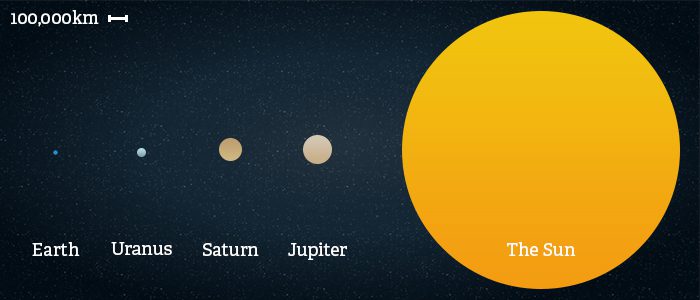
johnydon22:After reading your response to charlesm91, I couldn't resist playing this trick on you. Here, I'll show that the speed of darkness can be faster than that of light. Consider the following scenario: We know it takes light 8 seconds to travel from the sun to earth. Now, supposing you were standing at a position roughly equidistant from the earth and the sun, to form a triangle with height, 2 astronomical units. Now, imagine you have a torchlight whose beam disperses at an angle of 30o, and is so strong, that it outshines the sun, even after 2 A.U. If you were to put your finger exactly in front of the torchlight, and wave it across the face of the torch with a period of 1 second, your finger will cast a shadow that will intermittently eclipse parts of the sun and the earth at 1 second intervals. This is 8 times faster than the amount of time light travels from the sun to earth. Surely, this violates the claim that light is the fastest thing... So darkness can occasionally be faster!  https://i68.tinypic.com/fa6gqh.jpg Is darkness faster than light? The trick, of course, is that the said shadow doesn't really carry any information from the sun to earth, so it isn't really a thing. It is just the absence of something (light). So, the correct answer was in the first statement you made. "Nothing like speed of darkness" See VSauce's video on the same subject here https://www.youtube.com/watch?v=JTvcpdfGUtQ |
| Science/Technology › Re: 10 Facts About The Sun You Probably Didn't Know by AgentOfAllah: 5:45pm On Feb 15, 2016*. Modified: 6:14pm On Feb 15, 2016 |
. |
| Science/Technology › Re: He-goats Try To Rape Another Goat (video) by AgentOfAllah: 3:18pm On Feb 15, 2016 |
akike:And I thought you knew with certainty. Well, I am now sceptical about your claim. Anecdotes aren't substitutes for sound evidence. |
| Science/Technology › Re: 10 Facts About The Sun You Probably Didn't Know by AgentOfAllah: 11:34pm On Feb 14, 2016 |
Hysmady:At some point, earth was the centre of the universe, then we found we're just one of many planets orbiting the Sun. Now we know we're just one of many stellar systems orbiting around the centre of the milky way. We also now know that the milky way is one of many galaxies in a local cluster of galaxies, so it is not inconceivable that our universe may well be one from a cluster of parallel universes...although, this veers into the realm of speculation. 1 Like |
| Science/Technology › Re: 10 Facts About The Sun You Probably Didn't Know by AgentOfAllah: 4:35pm On Feb 14, 2016 |
johnydon22:Nice. But though Canis majoris is one of the largest stars to have been discovered, it is NOT the largest star in the universe. No one knows what the largest star in the universe is because no one has ever observed the whole universe. The largest star discovered thus far is UY Scuti, but there's no way of telling if there are larger stars outside of the observable limits of our universe. 3 Likes 1 Share |
| Science/Technology › Re: He-goats Try To Rape Another Goat (video) by AgentOfAllah: 1:24pm On Feb 14, 2016 |
akike:I haven't, but I wouldn't rely much on my experience. This may very well be a prevalent behaviour of goats of which I am ignorant, given my limited encounter with them, to start with. |
| Science/Technology › Re: He-goats Try To Rape Another Goat (video) by AgentOfAllah: 12:56pm On Feb 14, 2016 |
akike:So how did you know it was drugged? |
| Science/Technology › Re: He-goats Try To Rape Another Goat (video) by AgentOfAllah: 3:23am On Feb 14, 2016 |
akike:Not hard to believe, considering how persistent it was. How can one tell that it is drugged though, and do you know the type/name of drug used? Thanks |


 . You see, this is exactly why i wont waste my time with you.


1 2 3 4 5 6 7 8 ... 26 27 28 29 30 31 32 33 34 (of 46 pages)