Anonymous6's Posts
Nairaland Forum › Anonymous6's Profile › Anonymous6's Posts
1 2 3 4 5 6 7 8 ... 116 117 118 119 120 121 122 123 124 (of 156 pages)
 Culture › Re: BBC's Documentary On The 'Bronze Cast Head Of The Ife King' by anonymous6(op): 10:41pm On Nov 05, 2011 |
OTHERS Part 1 [flash=500,500] https://www.youtube.com/watch?v=2fLVW1jx7tE&feature=related[/flash] Part 2 [flash=500,500] https://www.youtube.com/watch?v=gF9BUOmgTQs&feature=related[/flash] Part 3 [flash=500,500] https://www.youtube.com/watch?v=fHzWEtZNxPQ&feature=related[/flash] Part 4 [flash=500,500] https://www.youtube.com/watch?v=C9wywulUX08&feature=related[/flash] Part 5 [flash=500,500] https://www.youtube.com/watch?v=jhFMHLux8tI&feature=related[/flash] Part 6 [flash=500,500] https://www.youtube.com/watch?v=EYMJJS6nxsg&feature=related[/flash] Part 7 [flash=500,500] https://www.youtube.com/watch?v=LW7BF2omOys&feature=related[/flash] Part 8 [flash=500,500] https://www.youtube.com/watch?v=ICEDZBxE8Sw&feature=related[/flash] 1 Like 1 Share |
| Culture › Re: The Art And Architecture Of Yorubaland! by anonymous6(f): 10:22pm On Nov 05, 2011 |
BEAUTIFUL THREAD PART 1 [flash=500,500] https://www.youtube.com/watch?v=BS4n28-JuCU&feature=related[/flash] PART 2 [flash=500,500] https://www.youtube.com/watch?v=8N_KeN2I_kQ&feature=related[/flash] PART 3 [flash=500,500] https://www.youtube.com/watch?v=oTNaR_tCdbs&feature=related[/flash] |
| Culture › Re: BBC's Documentary On The 'Bronze Cast Head Of The Ife King' by anonymous6(op): 9:57pm On Nov 05, 2011 |
Rgp92:cosign 100% https://www.styleweekly.com/imager/an-exhibit-on-the-ife-art-now-on-display-at-the-virginia-museum-of-fine-ar/b/original/1469681/f27d/arts_feature1-1.jpg http://www.styleweekly.com/richmond/bits-of-the-kingdom/Content?oid=1469680 http://cometonigeria.com/forum/index.php?topic=1896.0 http://web.me.com/egchouston/Blog/Art/Entries/2011/1/6_Dynasty_and_Divinity__Ife_Art_in_Ancient_Nigeria_Closes_January_9at_the_MFAH.html |
| Culture › Re: BBC's Documentary On The 'Bronze Cast Head Of The Ife King' by anonymous6(op): 7:14pm On Nov 05, 2011 |
Rgp92:I agree, I know I am proud of my culture & when I saw this documentary from BBC I had to post it, to show people how great our cultures was in the ancient times & still is The Ife Head https://www.creativetourist.com/wp/wp-content/uploads/2010/01/The-Ife-Head.jpg http://www.creativetourist.com/features/inspired-by-the-ife-head 1 Like |
| Culture › BBC's Documentary On The 'Bronze Cast Head Of The Ife King' by anonymous6(op): 4:20pm On Nov 05, 2011 |
BBC Does A Documentary On The "bronze Cast Head Of The Ife King" Of Nigeria PART 1 [flash=500,500] https://www.youtube.com/watch?v=BS4n28-JuCU&feature=related[/flash] PART 2 [flash=500,500] https://www.youtube.com/watch?v=8N_KeN2I_kQ&feature=related[/flash] PART 3 [flash=500,500] https://www.youtube.com/watch?v=oTNaR_tCdbs&feature=related[/flash] Ife? http://en.wikipedia.org/wiki/Ife Another thread of Yoruba art and architecture https://www.nairaland.com/nigeria/topic-770881.0.html 3 Likes 1 Share |
| Politics › Re: Nigeria Origin Of Civilization (not Egypt But Nigeria) by anonymous6(f): 3:08pm On Nov 05, 2011 |
I have heard about the Yoruba and Egyptian connection; and I believe it because it has been said in the beginning of Africa many tribes migrated from some where else originally; they say the first humans in Africa were from the east of north east of Africa before different groups started to spread around to different parts of africa. well I hope this article will help: [b]yoruba: the egyptian connection "THE ODUDUWAN REVOLUTION In the first chapter, we talked about the aboriginal nature of the Yoruban peoples. In this chapter, we shall talk of a possible migration from ancient Egypt. Many traditions point to a fact that an alien group (Egyptians) immigrated to Yoruba land and mixed with the original population. Many oral traditions are replete with these stories. The Awujale of Ijebu land has shown that the Ijebus are descended from ancient Nubia (a colony of Egypt). He was able to use the evidence of language, body, scarification, coronation rituals that are similar to Nubians’ etc, to show that the Ijebus are descendants of the Nubians. What the present Awujale claimed for the Ijebus, can be authenticated all over Yoruba land. The Awujale even mentioned (2004) that the Itsekiri (an eastern Yoruba dialect) are speaking the original Ijebu language. Since the Nubians were descended or colonized by the Egyptians, the Ijebu, and by extension, all Yoruba customs, derived from the Egyptian. Many traditional Yorubas have always claimed Egypt as their place of original abode, and that their monarchical tradition derives from the Egyptians’. Apostle Atigbiofor Atsuliaghan, a high priest of Umale-Okun, and a direct descendant of Orunmila, claimed that the Yorubas left Egypt as a result of a big war that engulfed the whole of Egypt. He said the Egyptian remnants settled in various places, two important places being Ode Itsekiri and Ile-Ife.Chief O.N Rewane says “Oral tradition has it also that when the Yorubas came from South of Egypt they did not go straight to where they now occupy. They settled at Illushi, some at Asaba area – Ebu, Olukumi Ukwunzu while some settled at Ode-Itsekiri,.” (O.N. Rewane Royalty Magazine A PICTORIAL SOUVENIR OF THE BURIAL AND CORONATION OF OLU OF WARRI, WARRI 1987) Since these oral traditions are passed on by very illiterate people, we can augment whatever is recorded with written sources. Concerning the migration of some of the Yoruban ancestors from the east, Conton says: The Yoruba of Nigeria are believed by many modern historians to be descended from a people who were living on the banks of the Nile 2,000 years ago, and who were at the time in close contact with the Egyptians and the Jews. Sometime before AD 600, if this belief is correct, this people must have left their fertile lands, for reasons which we can not now discover and have joined in the ceaseless movement of tribes west wards and south-wards across our continent. We can only guess at the many adventures they and their descendants must have had on their long journey and at the number of generations which passed before they arrived. All we can be certain about is that they were a Negro people (of which ancient Egypt probably had at least one community as we have seen) and that one of the many princely states they founded on their arrival in West Africa…, was Ife.’ Conton WF (1960. 71 Although we agree with Conton that some of the Yoruban ancestors migrated from Egypt, we tend to toe the scientific line of Cheik Anta Diop, that the ancient Egyptians were pure Negroes. Aderibigbe, an indigenous scholar, also accepts that the Yorubas migrated from Egypt. He says: “The general trend of these theories, most of them based on Yoruba traditions, is that of a possible origin from “the east”. Some scholars, impressed by the similarities between Yoruba and ancient Egyptian culture – religious observation, works of art, burial and other customs – speak of a possible migration of the ancestors of the Yoruba from the upper Nile (as early as 2000BC – 1000BC) as a result of some upheavals in ancient Egypt”. (AB ADERIBIGBE 1976) Unlike Conton, Aderibigbe was able to pinpoint a cause for the Yoruban migration – war. Olumide Lucas did a lot of job to show similarities and identities between the ancient Egyptians and the Yoruban peoples. The date that Aderibigbe gave (2000BC – 1000BC) is much earlier than that given by Conton. Aderibigbe’s date corresponds to that of the Hyksos invasion of Egypt 2000-1500BC. On the possible eastern origin of the Yorubas, Tariqh Sawandi says: “The Yoruba history begins with the migration of an east African population across the trans-African route leading from Mid-Nile river area to the Mid-Niger. Archaeologists, according to M. Omoleya, inform us that the Nigerian region was inhabited more than forty thousand years ago, or as far back as 65,000BC. During this period, the Nok culture occupied the region. The Nok culture was visited by the “Yoruba people”, between 2000BC and 500BC. This group of people was led, according to Yoruba historical accounts by king Oduduwa, who settled peacefully in the already established Ile-Ife, the sacred city of the indigenous Nok people. This time period is known as the Bronze Age, a time of high civilization of both of these groups. According to Olumide J. Lucas, “the Yoruba, during antiquity, lived in ancient Egypt before migrating to the Atlantic coast”. He uses as demonstration the similarity or identity of languages, religious beliefs, customs and names of persons, places and things. In addition, many ancient papyri discovered by archaeologists point at an Egyptian origin. (Tariqh Sawandi: Yorubic medicine: The Art of divine herbology – online article). Ademoyega commented that the Ekiti section of the Yorubas must have migrated to their present area around 638AD when the Muslims took over Egypt and forced some of the Yoruba people to migrate to their present area. So, we see that the Yoruba did not come in one migration, but in many different migrations – in waves. The first possible migration might be connected with the Hyksos invasion. Some words in the Yoruban vocabulary echo the words used in Egypt in predynastic times and in the early dynastic periods. Some Egyptian gods of this period have strong identities with Yoruban deities. For instance, gods such as Adumu (Adumu) Hepi (Ipi) Ausar (Ausa), Horise (Orise), and Sámi (Sámi) Nam (Inama) are present in Yoruba. All these gods existed in the pre-dynastic and early dynastic periods of Egypt. TODAY, AMONG THE ITSEKIRI-YORUBAS ,THESE GODS CAN STILL BE PHYSICALLY SEEN, AT LEAST, ONCE A YEAR! Neighbouring peoples are already initiated into the various gods systems and beliefs in yorubaland.the agban ancestral worship was first organized in Urhoboland during the funeral ceremony of chief Ayomanor of Sapele (1949). The Ipi system was first organized in Urhoboland in March 11, 2005. We can also see words that existed in the Graeco-Roman period in some of the Yoruban dialects. When the Romans took over Egypt, they infiltrated the Egyptian area with their language. In present Yoruba, we can still find words of Roman descent. For instance, the Yoruba called the palm frond ‘Mariwo’. This word is derived form the Latin Rivus (River). One of the declensions of river is Rivo (by the river).Since the Yoruban possesses no “V”, the word become riwo. Thus, the word “Omariwo” means the child by the river. Some other words like Sangi (blood in Itsekiri-yoruba dialect) thought to have been derived form the Portuguese were actually brought as a result of the Roman Conquest of Egypt. Sangi is blood and the Latin term is Sanguis. Some eastern Yoruba use the term “Ihagi” which is clearly a corruption of the Roman Sanguis. A Christian army in 540AD invaded Egypt and some persons believed to have reached Yoruba land were driven from Egypt. With the commencement of the Arab period in Egypt, some indigenous Egyptians who never wanted to accept the Islamic religion escaped to present Yoruba land. It was probably in this period that words such as Keferi (Kafri pagan in Arab) infiltrated into the Yoruboid vocabulary. All said and done, more than fifty percent of the Yoruboid vocabulary of today can be deduced either directly or indirectly from the ancient Egyptian. These are the original ancient Egyptian language devoid of Arab and Latin words that are very few in the Yoruboid vocabulary It is not really certain when king Oduduwa came from Egypt. He must have come in one of the many migrations. But since the Yoruba religious discourse has a lot of identities with Egyptian, Oduduwa would have left Egypt at a very early period perhaps after the Hyksos invasion of 2000-1500BC ,but not later than 30BC. Could the Yoruba have migrated from a white Egypt? Far-from the truth! PROOFS OF EGYPTIAN NEGRONESS 1. Egypt was a part of Africa and therefore should be black 2. The Egyptians believe that Egypt was a colony of Ethiopia, and that the religion was brought to Egypt by King Horus from the south (inner Africa). Thus when the Egyptians died, they buried their corpses with their faces facing the South West (the direction of West Africa, home of the Yoruba) 3. Some West African peoples claim that their ancestors migrated to ancient Egypt. The Yorubas claimed that a mystic-prophet Orunmila (Oritse Udeji among the Itsekiri) migrated to Egypt and established a religion. Archaeology and cross-cultural studies have shown that Negroes migrated from West Africa to ancient Egypt. 4. Anthropologists have discovered, to their dismay, that Egyptian cultural traits: divine kingship, forms of burial, Osirian cult, etc., permeate some parts of Negro Africa. 5. Some deities exist in Egypt and in Negro Africa, such as Adumu, Hepi, Inama, Sami Horise etc. 6. The Greeks referred to the Egyptian as “Hoi Aiguptos”, (black people); the Egyptians referred to themselves as Kam (black in their language.) 7. Melanin test proved that the Egyptians were black. 8. Osteological measurements which are less misleading than craniometry in distinguishing a black man from a white man has proved that the ancient Egyptians belonged to the black race. Lepsius, a German Savant at the end of the nineteenth century, made the studies and his conclusion remains valid. Future studies have not contradicted the “Lepsius canon”, which in broad figures gave the bodily proportion of the ideal Egyptian: short armed and of Negroid or Negrito physical type. 9. Most West African claim Egyptian ancestry. If they are black, their ancient Egyptian ancestors must be black. 10. Ancient paintings on caves and temples in Egypt depict blacks. At first there were only black paintings, in later times, the blacks were shown ruling over whites and yellows (Asians). 11. Ancient statues and carvings found in Upper and Lower Egypt showed black skins, and features. 12. Ancient monuments such as the pyramid have been replicated in other parts of Africa. A typical example is the Warri pyramid recorded in Roth (1671). 13. Language similarities exist between the Egyptians and some groups in west Africa such as the Wolof and particularly more so, the Yorubas ( more then 500 similar words have been discovered bearing identical meanings. See Yoruba is Atlantis by the same authors: to be published). 14. Recent findings of Genetics and Molecular Biology and Linear Analysis have proved the Egyptians were Negroid. 15. The testimony of classical writers such as Plato, Homer, Aristotle, Pythagoras etc., portrays the Egyptians as blacks. 16. the physical photograph of Yuyi of ancient Egypt is Negroid (Barbara Mertz : Red Land ,Black land: 1967) In order to prove the Egyptians origin of the Greek oracle of Dodona, Herodotus says: “And when they add that the dove was black, they gave us to understand that the woman was Egyptian”. The doves mentioned in a text “Epirus” stands for two Egyptian women, reputed to have brought the oracle from Tebu (Thebes)[today there are two Tebus in Yoruba land] in Egypt to establish the oracle of Dodona in Greek and Libya. Another antiquarian, Lycinus, describing a young Egyptian, mentioned Negroid features. “This boy is not merely black; he has thick lips and his legs are too thin … His hair worn in a plait behind shows that he is not a free man.” The mention of “black”, “thick lips” and hair worn in plaits behind are totally of African origin. In those days Itsekiri owned slaves (mostly Sobo) were either clean-shaven, or they wore their hair in plaits until they regained freedom. Thus, unknowingly, Lycinus had drawn an identical cultural affinity between the Kamites and the Yorubas. Marcelinus, a Latin historian writes: “The men of Egypt are mostly brown or black with a skinny and desiccated look.” Appolodorus, who lived in the first century before our era, commented on Egypt as Negroes: “Aiguptos captured the country of the black footed ones and called it Egypt after himself.” Aristotle – an ancient Greek philosopher, a disciple of Plato – in a naive way showed that the Egyptians were black, hear him: “Those who are too black are cowards, like for instance the Egyptians and the Ethiopians, but those who are excessively white are also cowards as we can see from the example of women, the complexion of courage is between the two”. Herodotus, 485-425BC, the father of history, further said concerning the ancient Egyptians: “It is in fact manifested that the Colchidians are Egyptian by race. Several Egyptians told me that in their opinion that the Colchidians were descendants of the soldiers of Sesostris. I had conjectured as much myself from two pointers, firstly because they have black skins and kinky hair (to tell the truth this proves nothing for other peoples have them too) and secondly more reliably for the reason that alone among mankind, the Egyptians and the Ethiopians have practiced circumcision since time immemorial. The Phoenicians and the Syrians of Palestine themselves admit that they learnt the practice from the Egyptians, while the Syrians in the river Thermodon and the Pathenoise region and their neighbours the Macrons say they learnt it recently from the Colchidians. These are the only races which practice circumcision, and it is observable that they do it in the same way with the Egyptians. As between the Egyptians themselves and the Ethiopians, I can not say which of them taught the other the practice, for among them; it is quite clearly a custom of great contiguity. As to the further strong proof to my belief is that all those Phoenicians trading to Greek cease to treat the pudenda after the Egyptian manner and do not subject their offspring to concussion”. Herodotus mentioned black skins and kinky hair as features of the Colchidians of being descendants of the Egyptians; he also mentioned the survival of circumcision. It should be noted that Abraham – the Arab patriarch of the Jews – learnt circumcision from Hagar, his Egyptian slave wife, whence the custom spread to the Jews. Herodotus also commented that other peoples (those in inner Africa and the black Sumerians and Canaanites) also had kinky hair. The towns of ancient Egypt: On (Annu) or Heliopolis, Hermonthis, Dendera, Tebu etc., were developed by Annu, the pre-dynastic blacks of Egypt. Skeletons of the Negro Annu were ubiquitous in ancient Egypt, Mene, the first pharaoh of the first dynasty, sometimes identified with the God-man Osiris (A black forerunner of Christ) was a Blackman. Zoser, Sesostris, Amenhopis, Khufu, Menthuhotep, Queen Amuses, Nefertari etc., were also all Negroes. The Egyptian religion and other cultural practices show strong African and more so Yorubic characteristics. These can be seen in the following areas: 1. The lost wax method of brass or bronze making, which was common to both the Yoruba peoples (particular Ife) and the ancient Egyptians. 2. The ritual of initiation 3. Striving to achieve the ultimate in “Good” and truth (summun bonum) 4. The doctrine of transmigration of soul and reincarnation is widely believed in, by both peoples. 5. The concept of the ‘god king’. 6. Aspiration to achieve the great ‘good’ of the gods – ‘wealth health and long life’. 7. The Yorubic regalia, in most cases, are strikingly similar to pharoanic ones. 8. Veneration of the Ram in both places. Among the eastern Yorubas (Itsekiri especially, most of the water deities are depicted as ram following the predynastic and pharoanic patterns). 9. Both peoples answer the theophorous names. LINGUISTIC SIMILARITIES Since Ferdinand de Saussure, the surest way to prove a cultural contact between peoples is to adduce linguistic evidence (Ferdinand de Saussure (1972) General HISTORY OF Africa). One of the largest inhabitants of Egypt were Yoruboid , and it will be expected that a good percentage of their language will be yoruboid ,too. See the table below. EGYPT YORUBA 1. Wu (rise) Wu (rise) 2. Ausa (Osiris, father of the gods) Ausa (father) 3. Ere (python/ Serpent) Ere (Python / Serpent) 4. Horise (a great god) Orise (a great god) 5. Sen (group of worshippers) Sen ( to worship) 6. Ged (to chant0 Igede (a chant) 7. Ta (sell / offer) Ta (sell/offer) 8. Sueg (a fool) Suegbe (a fool) 9. On ( living person) One ( living person) 10. Kum (a club) Kumo( a club) 11. Enru (fear / terrible) Eru (fear / terrible 12. Kun / qun (brave man) Ekun (title of a brave man) 13. Win (to be) Wino (to be) 14. Odonit (festival) Odon (festival) 15. Ma or mi (to breath) Mi. (to breathe) 16. Tebu (a town) Tebu (a town) 17. Adumu (a water god) Adumu (a water god) 18. Khu (to kill) Ku (die) 19. Rekha (knowledge} Larikha (knowledge) 20 Hika (evil) Ika (evil) 21 Mhebi (humble) Mebi, humble to ones family 22 Sata (perfect) Santan (perfect) 23 Unas (lake of fire) Una (fire) 24 Tan (complete) Tan (complete) 25 Beru (force of emotion) Beru (fear) 26 Em (smell) Emi (smell) 27 Pa (open) Pa (break open) 28 Bi (to become) Bi (to give birth, to become) 29 Hepi (a water god) Ipi (a water god) 30 Sami (water god) Sami (a water god) 31 Osiri (a water god) Oshiri (a water god) 32 Heqet – Re (frog deity) Ekere (the frog) 33 Feh (to go away) Feh (to blow away) 34 Kot (build) Ko (build) 35 Kot (boat) Oko (boat) 36 Omi (water) Omi (water) 37 Ra (time) Ira (time) 38 Oni (title of Osiris) Oni (title of the king of Ife) 39 Budo (dwelling place) Budo (dwelling place) 40 Dudu (black image of Osiris) Dudu (black person) 41 Un (living person) Una (living person) 42 Ra (possess) Ra (possess/buy) 43 Beka (pray/confess) Be or ka (to pray or confess) 44 Po (many) Po (many/cheap) 45 Horuw (head) middle Egyptian Oruwo (head) (Ijebu) 46 Min (a god) Emin (spirit) 47 Ash (invocation) Ashe (invocation) 48 Aru (mouth) Arun (mouth ) Ilaje 49 Do (river) Odo (river) 50 Do (settlement) Udo (settlement) 51 Shekiri (water god) Shekiri (a water god) 52 Bu (a place) Bu ,a place 53 Khepara (beetle Akpakara (beetle) 54 No (a water god Eno (a water god) 55 Ra -Shu (light after darkness Uran-shu (the light of the moon 56 Run-ka (spirit name) Oruko (name) 57 Deb/dib to pierce Dibi (to pierce) 58 Maat (goddess of justice Mate (goddess of justice) 59 Aru (rise) Ru (rise up) 60 Fa (carry) Fa (pull) 61 Kaf (pluck) Ka (pluck) 62 Bu bi (evil place) Bubi (evil place) 63 In- n (negation In-n (negation) 64 Iset (a water god) Ise (a water god) 65 Shabu (watcher) Ashonbo (watcher) 66 Semati (door keeper) Sema (lock/shut the door) 67 Khenti amenti (big words of Osiris Yenti – yenti (big, very big) 68 Ma (to know) Ma (to know) 69 Bebi, a son of osiris) Ube, a god 70 Tchatcha chief (they examined the death to see if they tricked tsatsa (a game of tricks, gambling ) 71 Ren( animal foot) Ren (to walk) 72 Ka (rest) Ka (rest/tired) 73 Mu (water) Mu (drink water) 74 Abi (against) Ubi (against / impediment) 75 Reti (to beseech) Retin (to listen) 76 Hir (praise) Yiri (praise) 77 Ta(spread out) Ta (spread out) 78 Kurud (round) Kurudu (round) 79 Ak – male Ako (male) 80 Se – to create Se (to create) 81 Hoo (rejoice) Yo (rejoice) 82 Kamwr (black) Kuru (extremely black 83 Omitjener (deep water) Omijen (deep water) 84 Nen, the primeval water mother) Nene (mother 85 Ta (land) Ita (land junction) 86 Horiwo (head) Oriwo (head) 87 Ro (talk) Ro (to think) 88 Kurubu (round) Kurubu (deep and round) 89 Penka (divide) Kpen (divide) 90 Ma-su (to mould) Ma or su (to mould) 91 Osa (time) Osa (time) 92 Osa (tide) Osa ( tide) 93 Fare (wrap) Fari (wrap) 94 Kom (complete) Kon (complete) 95 Edjo (cobra) Edjo (cobra) 96 Didi (red fruit) Diden (red) 97 Ba (soul) Oba (king) soul of a people 98 Ke (hill) Oke( hill 99 Anubis (evil deity) Onubi (evil person) 100 Kan (one: Middle Egyptian) Okan one) 101 Nam (water god) Inama (water god) The words above are used to show that most Yoruban words are identical to the ancient Egyptian. BINIS: THE ODUDUWAN LEGACY Since the month of May 2004, there has been a raging intellectual battle on the personality of Oduduwa. The Binis claim he was a Bini prince, the Ifes claim otherwise. This approach will be purely scientific and will be as objective as possible. The following areas: (1) The personality of “Oduduwa” {Ikaladeran?}; (2) archaeological researches; (3) the linguistic linkages; (4) scientific analysis of the myths; and (5) Benin’s historical debt to Oduduwa will be analyzed. (a) The monarchies; (b) the water religion, (c) bead manufacturing (d) salt industry; and (e) the Lagos conquest, will be scientifically analysed. 1. THE PERSONALITY OF “ODUDUWA” The personality of Ikaladeran; whether he was the man who later became Oduduwa will be scientifically analyzed In this discourse, Oduduwa is seen as the founder of the Yoruba monarchical system, or at least, a founder of a prominent dynasty in Yoruba history. There must have been many dynasties in Ife, as Ife legends put pre-Oduduwa monarchs at more than ninety. The personality of Oduduwa has suffered many attacks in recent times. The Binis claim he was a Benin prince (Ekaladerhan), who later became Imadoduwa or Izoduwa, and then Oduduwa. The Igbos claim he was an Igbo man from Nri. Some Igalas claim he hailed from Igala land. The Igalas have many Ifes, and they claim Oduduwa was from one of such Ifes. The Igala language is close enough to the Yoruba, to assert a common origin for both peoples. The present writers are holding the following positions: 1. The Yorubas are aborigines or autochthonous to their present environment; 2. The monarchical structure seems to be alien. The present writers tend to place the origin of the Yoruba monarchy in ancient Egypt and Nubia. This is because a lot of Egyptian related relics, words and practices can still be discerned among the Yorubas, particularly among the following: Ife (where the Ifa oracle and Yoruba monarchical system blossomed); Ijebu (with some ancient settlements; Ijebu Ode, the seat of the Awujale, Ode, the seat of Lenuwa, in present day Ogun Water side Local Government, Oke-Eri, purported to be the home of the biblical queen of Sheba, called Bilikisu in Ijebu legends), Ugbo, the ancient city of the Ilajes, Idanre (the home of Ogun, the god of iron), all show some similarities and identities in their monarchical and religious authorities.Basil Davidson, Olumide Lucas, Tariqh Sawandi, and even the present Awujale of Ijebu land, have pointed to ancient Egypt or Nubia as the origin of Yoruba monarchical system. All the above have used the similarities or the identities of cultural practices to substantiate their claims. If the Yorubas left the Egyptian or the Nubian axis, they must have left during turbulent periods of war, economic stagnation or religious persecution. Thus, we shall examine the periods of upheavals in black Egypt and black Nubia; and examine when the Yoruban aristocracy descended from the Nile valley. They may not be one migration, but several migrations and the personality called Oduduwa, must have led one of the various migrations. The first crop of migrants or southward push of the Egyptians took place about 2000BC – 500BC. The Hyksos invasion (2000-1500BC) caused some of these southward migrations. Many of the black Egyptians seemed to have moved to Yoruba land during this period. . The second wave of migrations will correspond to what Laoye Sanda, of the department of Public Administration,The Polytechnic,Ibadan refers to as the black Nubian emigrants. The Nubians were black, they occupied present day Sudan, which was an integral part of the Egyptian Empire. The vocabulary, body scarification, and religious discourse resemble those of the Ijebus and more so, the Itsekiri. The 1984 Awujale’s coronation manual will make this manifest. These migrations occurred about 500BC. A third wave of migration took place between 90BC and 30BC. The present writers feel the personality called Oduduwa, came in that migration trend. A fourth migration will correspond to the Christian conquest of Egypt, about 100AD. The last wave of migration will correspond to the Arab enforced emigration, between 700AD – 1100AD, when the Arabs had consolidated their control over Egypt; they chased the last batch of traditional worshipping Egyptians from Egypt. This occurrence would have led to many Yoruba claiming that their ancestors were chased from somewhere in the Middle East for not accepting Islam. The proof of archaeology There has been a dearth of archaeological researches in Nigeria. Whatever research has been done is not final, for new finds can be found in future. The most ancient archaeological finds in Nigeria are the following: (1) the relic at Iwo Eleru (with a radio carbon date of about 12,000BC). Iwo Eleru is close to Akure, Ondo State. (2) The findings at Igbo-Ukwu of about 6000BC. (3) The findings at the Mejiro cave near Oyo (about 4000BC). The Nok culture that is more than 1000BC. (4) The Oke-Eri walls and graves purported to be more than a thousand years. The walls are reputed to be the biggest in the world, but for the walls of China. (5) The bronze heads at Ife about 1000AD. (6) The bronze heads at Benin about 1400AD. This might authenticate the Ife claim that the Binis got the civilization of bronze casting from the Ifes. Both the Binis and the Ifes claim that Igueghae was the one who taught the Binis how to cast bronze, during the reign of the Oba Oguola, fourth king from Eweka, the son of Oramiyan, a distant descendant of Oduduwa from Ife. THE LINGUISTIC LINKAGES According to the studies of philology and etymology, most of the languages in Nigeria in the Kwa group of languages have a meeting point. The Yorubas and Idoma separated some six thousand years ago; while the Yoruba and Igalas separated about 2 thousand years ago; two thousand years ago corresponds to the time that the Yoruba dialects: Ekiti, Ijebu, Oyo, Itsekiri, Ilaje, Ikale etc started having distinct dialectical identities. Linguistic studies have indicated that Yorubas in the Eastern Flanks of the Yoruba nation; Ekiti, Yagba, Kabba, Owo, Ijebu, Itsekiri and to some extent the Ifes, speak the most ancient Yoruba dialects. Glottochronological studies have shown that the dialects in the south east are more ancient than those of central Yoruba land and western Yoruba land. The table displays it further still. A table showing east to west ancientness of the Yoruboid languages. ENGLISH ITSEKIRI YORUBA OYO – YORUBA RESPECT OGHO OWO MONEY OGHO OWO LOOK GHO WO SAY GIN WI FORBID GHO( r ) WO( r ) THEM AGHAN AWON The table shows that the Itsekiri dialect retains the more ancient “gh” or “g” guttural sound to the more liquid “w” of the Oyos. If it is taken that the Yoruban ruling class came from Egypt, the southern Yoruba block, particularly the Itsekiri, would have served as an initial stopping point and a secondary course of dispersal. The table displays it further still EGYPTIAN ITSEKIRI-YORUBA OYO-YORUBA ADUMU (Water god) ADUMU (Water god) ADAMU (A god) Kuku (Darkness) Okuku (Darkness) Ouku (Darkness) Dudu (Black Image of Osiris) Dudu (black ) Dudu ( black ) Omi (Water) Omi (Water) Omi (Water) Heket-Re (Frog god) Ekere (Frog) Akere (Frog) Horise (Sky god) Orise (Sky god) Orisa (A god) Hika (Evil) Ika (Evil) Ika (Evil) Shu (Evil god) Eshu (Evil god) Eshu (Evil god) Co-opted from 500 word-word correlation between, Yoruba and Egyptian languages . From the above, it means that the eastern Yoruba blocs such as the Itsekiri, Ilaje, Ijebu and the Owo are more cognate with the Egyptian than those of Oyo or Ife. . The Awujale has testified that the Itsekiri are speaking the original Ijebu dialect. . This is why Bolaji Idowu derived the origin of Oritse to the Itsekiri-Owo axis within the eastern Yoruba kingdoms, It is proper here to state that the word “Orise” is almost cognate with the Egyptian, Horise. Both deities represent very high gods, Both deities were first water divinities before they became sky or heavenly divinities. Both words are derived from identical etymological origins. Hori(Ori) means head in both places. “Se”, means a source in both places. Thus both words mean a source of creation in both places. This type of linguistic similarity or identity cannot have arisen by mere accident - there was a concrete historical intercourse. The Binis call God Oyisa, a corruption of the eastern Yoruba form. This is certain because the Binis cannot derive the meaning of Oyisa by breaking the word into morphemes as the Yoruba can display, or draw up any identity with ancient Egypt. A SCIENTIFIC ANALYSIS OF THE MYTHS 1. Oduduwa – The myth of Oduduwa seems to be valid. Minus the fact that many Yoruba claim descent from Oduduwa, some Urhobos and even Ijaws also claim descent from Oduduwa. 2. Ekaladerhan – This name exists in very little, if at all it exists, in the oral tradition of any of the Bini neighbors. There has been no relevant oral tradition among any of the circumjacent peoples that can recognize Ekaladerhan or identify him as Oduduwa. So, the Ife claim concerning Oduduwa seems to be more tenable. 3. Oduduwa’s descent from heaven – The Ife’s have been totally embarrassed by the invectives thrown on them by the Binis in their I claim that Oduduwa fell from the sky. Yes! It is true. People can fall from the sky as modern interaction between earthmen and those from other planets have authenticated, and this can be displayed both in mythology and in real hardcore science in many parts of the world. The story of Ezekiel in the bible, the story of the Dogon mystic tribe of Mali are cases in point. Then, some Yoruba ancestors would have been some of the Umales (aborigines) using their Umale-Olunas (spaceships) to travel across the universe, as this can still be sighted in Yoruba land today. 4. The huge bodies of water which the Bini and Yoruba mythologies claim their ancestors landed, would have been one of two waters (1) the Atlantic ocean, the home of Umale-Okun at the coastal flanks of Yoruba land , or the Mediterranean which was the biggest body of water known to the ancient Negro Egyptians. BINI AND EASTERN YORUBA HISTORICAL LINKAGES - The Monarchies There are areas where the eastern Yorubas and the Binis have a lot of historical linkages. It is an indisputable fact that the founder of the present Itsekiri dynasty was Ginuwa, the first son of Oba Olua of Benin. The Binis ruled over most parts of Ondo state: Akure and Ode-Ondo, to be more specific. They even established dynasties in some of these places, including Owo. There are a lot of titles that the Eastern Yorubas derived from the Binis. Those titles include: Ologbotsere, Iyatsere, Otsodin, Olisan (Oliha) etc. There are also many areas where the Binis are indebted to the Eastern Yorubas. Many of these have not been given prominence by historians. But the more we delve into History, the more we are convinced of Binis indebtedness to the Yorubas, particularly the Itsekiri-yorubas. Some of this indebtedness are the Bini religious discourse, the conquest of Lagos, the manufacture of salt etc. THE CONQUEST OF LAGOS On face value, the Lagos conquest seemed to have been done by the Binis. Many authorities however, agree that it is the Itsekiri of Warri that served in the Navy that attacked Lagos. The assertion is likely to be true because of the following (1) The Binis are not watermen and could not easily travel on the lagoons to Lagos. (2) The name ‘Olu’ is common among Lagos Obas eg. The Olu of Ikeja, the Olu Eko of Eko (Eleko) etc. The name ‘Olu’ is Itsekiri or Oyo-yoruba and not Edo or Bini (3) The Eyo masquerade attire and dance style is similar to that of Awankere of Warri. It is true that the Eyo masquerade originated in Ijebu, but the attire is purely of Warri origin. This will authenticate a not-too-popular Okere(Warri) legend, that it was the descendants of Ekpen that accompanied Orhogbua (Osogbua) to conquer Lagos. . . Also, the drums used by the Awori people bear striking resemblance to the Itsekiri drums, but bear no resemblance to the Bini drums. In summary, the material culture of the Aworis is far more akin to the Itsekiri than to the Binis. Now hear the authorities: Captain Leonard says; “Of the Jekri (Itsekiri) also there is much more definite, although to a certain extent contradictory evidence. According to one account, they are said to be closely connected with the Yoruba, the Warri kingdom having extended to and embraced Lagos as well as some of the surrounding territories to this day (1906), in fact, Jekri inhabit the strip of country, along the coast from the Benin river westward to Lagos” This might be due to the fact that Itsekiri held most of the trading posts along the coast when Leonard was writing. Captain Leonard in another section of his work says: “And from all accounts, it is more than possible, if not evident that the army of warriors who founded Lagos proceeded in reality from Warri, but doubtless by the command of the king of Benin”. . Corroborating Leonard and Nirven that the Itsekiri aristocracy has at least some politico-economic interests in Lagos, H. Ling Roth says “Such corals as the Binis had, were obtained through Jekri traders either from the Benin River or Lagos”. ORIGIN OF BINI BEADS The Itsekiri have always claimed that beads started with them and that the Binis got their beads from them. Settlements such as Omadino, Inorin, Ureju and Korobe area of the Warri kingdom are the ancient Itsekiri settlements with the bead industry. The people of Ureju and Korobe in Koko claimed to have given Ogboruware (Ewuare), probably a usurper to the Bini throne, beads for the first time. There is a legend among the Korobes, that Ogboruware (Ewuare), had his swelling disease as a result of an affliction placed on him by Korobe, a legendary spiritual woman. Now hear the authorities: H Ling Roth says According to Bold, coral beads, “are the intrinsic treasures of the rich, being held in highest estimation and from their rarity, are only in the hands of a few chiefs, whose avidity for them is immeasurable, the species admired are the pipe beads of various dimensions and are valued at ten large jars of oil an ounce, of the smaller sort, and so on in the proportion for the larger sized”. Mr. Punch informs me that “as a matter of fact, the king of Benin had few, if any of the large coral beads such as Nanna, Dore, Dudu and Jekri chiefs obtained from the merchants in the Benin River. His coral was insignificant pipe agate and was only significant when made up into vests and hats. The Benin value more the agate beads and especially the dull agate was a king’s gift and no one could wear such a necklet unless it was given to him by the king. It was death in fact, to wear it otherwise. The shiny crystalline agate, with white quartz, anyone could wear. Such corals as the Binis had were obtained through Jeiri traders, either from the Benin river or Lagos. The Binis said it was dug up at the back of Benin but everything in the days I am speaking 14 – 15 years ago (from 1898) which was at all mysterious came from the back of Benin . Eve de Negri says, “This coral was first discovered (so it is told) during the fifteenth century in the reign of Oba Ewuare. This type of coral was obtained from a tree, growing on the sandy bank of the Benin River”. PC llyod also commented that Itsekiri legends claim that their ancestors, the Umales, got the blue corals from particular trees that were growing in the Jekri country. from the above quotations, it is evident that the Benin got their beads from the Itsekiri, and the Itsekiri legends that they gave beads to Oba Ogboruware (Eware), has to be positively examined by scientific historians. BINIS LEARNT ABOUT SALT FROM THE ITSEKIRI The Binis are land-bound people and they know very little about salt. Itsekiri legends testify that they gave salt to Binis for the first time The Itsekiri are known as the manufacturers of salt, Alagoa, H Ling Roth, and Obaro Ikime, agree to this position. H. Ling reports, “According to Roupel’s officials, king Osogbua (Orhogbua) is credited with discovering salt in the Jekiri country”. Pg. 142.H Ling Roth Great Benin It is now factual that Orhogba discovered salt when he came to the Jekiri (Itsekiri) country to seek the assistance of the Itsekiri navy in order to attack Lagos. In 1818 they also sought the assistance of Kaye, an Itsekiri mystic-warrior in order to attack Akure. He was given Ologbo some 25 kilometres south of Benin city. The itsekiri were the major salt producers in the Niger delta area. On this hear Alagoa: “the itsekiri supplied clay pots to to such Ijo communities as the Gbaramatu and Bassan, and and also sold salt to traders from eastern delta who took it up the Niger………Other Ijo exchanged dried fish and salt ,which was manufactured by the Itsekiri ,with the Urhobo ,Isoko and Igbo groups along the periphery of the Niger Delta and along the Lower Niger” (Alagoa 1989:729) WATER RELIGION OF THE BINIS The cult of Olokun (the water religion) of the Binis seems to be purely alien. This is due to the following reasons: (1) the Binis are a land based people. Their main occupations are; farming, hunting and sculpture. So it will be unthinkable for the Binis to have a water religion as a major cult. (2) If a water religion exists among the Binis, and it has become prominent, the Binis might have copied from one of their riverine neighbors (3) these neighbours are the Ijaws, the Itsekiris, the Ilajes, and more distant neighbours being, the Asabas, the Onitshas, the Afenmai or Igala people around the river Niger. The Afenmais and the Igalas seem too distant from Benin to have a good influence on them. The Asabas and the Onitshas, also, seem to be too far away form Benin. Minus that, they don’t seem to have any serious water cult to influence the Binis to have a viable water religion. Thus, the Bini (a land locked people) must have had their water religion from the Ijaws, the Itsekiris or the Ilajes. The Bini religious discourse has nothing to do with the Ijaws. Besides that, the Ijaws that are the immediate neighbours of the Binis did not have any significant civilization. These Ijaw neighbours are the Egbemas, the Arogbos, the Apois–now Yoruba-speaking–the Ogbe-Ijohs, the Isabas, the Gbaramatus, the Ogulaghas, the Oburutus, and the Meins. No significant civilization or kingdom has emerged from these Ijaw clans. E.J Alagoa asserted that most of these Ijaws did not arrive their area by 1500, which is quite recent according to historical chronology. The cases settled in the Supreme Court between the Ijaws and the Itsekiri; place the date of Ijaws coming to these areas at the early 19th century. Now, hear Prof.Alagoa , an Ijaw doyen of history: “Pereira’s record suggests that those Ijo groups now living west of the Forcados and east of the Bonny had not yet arrived at their present territory by 1500”. Thus, it is unthinkable for the Binis to have copied the water religion from the Ijaws. The Itsekiri and the Ilajes receive the likelihoodof having given water religion to the Binis for the following reasons:1)The Binis situate the home of Olokun, the god of the sea, in the Atlantic Ocean. Both the Itsekiris and the Ilajes are in the Atlantic coast. (2) The Bini religious discourse shows a strong Yoruba affinity. The name, Olokun, (Olu Okun) is an eastern Yoruba name that can apply to the Itsekiri as well as Ilajes, as eastern Yoruba dialects. The Binis call God Osa, which is the same word that the Itsekiri call father. The other Bini word for God, Oyise, is clearly corruption of the much older Itsekiri name, Oritse. . In the early days of November 2004 , the Bini Monarch invoked an Ilaje deity, Aiyelala, to recover some property that was stolen from the Oba Market in Benin . This will authenticate the Ilaje story of the Binis coming to Ugbo once every year to serve Umaleokun, the water god of the Ugbo Yoruba H. Ling Roth went further, quoting Burton says: “Similar to other west Africans, the Bini When drinking,the Binis always pour a few drops upon the ground, muttering the while (Mobia, Malaku Mobia (Mobie, Umalokun, Mobie) – Ibeg, O Malaku (Umale-Okun, fetish guardian of lands and waters 1 beg of thee to defend me against all evil, to defeat and destroy all my foes”. This said, a broken bittock of Kola (stercula acuminata) is thrown upon the ground, and is watered with a few drops of palm wine.” Burton Pg. 281. Mobia (Mobie) is however the Jekiri for “1 beg you : 59. It is evident that the Bini religious discourse was, and to some extent is, still infiltrated with Itsekiri and Ilaje. This is most evident in the water religion of the Binis. From the above, we see that some of the most important aspects of the Bini civilization: their bead industry, the cult of Olokun (Olu Okun – King of the sea), their salt industry etc are from the eastern Yoruba land of Itsekiri and to some extent the Ilajes. Apart from this, the Itsekiri warrior, Ikaye, saved the Bini kingdom from being crushed by the Akures. For his settlement Oba Semede gave him Ologbo. Again when there was leadership dispute between Obaseki and Aigwobasinwin, it was an Itsekiri chief, Dore Numa, who restored the Benin monarchy. He also gave them a lot of beads which the Bini aristocracy has not returned till today. It is therefore unthinkable that Ife, where the Yoruba kingship blossomed, would have copied from Benin. This is most evident when we consider the following facts: (I) The name, Oba (the Edo word for king), is copied from the Yorubas, particularly those from Ife (2) the heads of the Obas of Benin were taken to Ife, until very recently. The place where the heads of the Obas of Benin were buried is still called “Orun Oba Ado”, “the heaven of the kings of Benin”. (3) The Binis normally take permission from the Ooni, to crown new kings. There is no recorded history that the Oonis took permission from the Binis before getting crowned (4) The official language in the court of the Oba of Benin until 1934 was Yoruba. There was no time that Bini language was spoken in Ife. The Portuguese and other Europeans who were in the Bini area for more than 500 years (from 1486 when they got to Benin till 1960.)had no knowledge of Oduduwa being a Bini man. So, scientifically speaking, the Ife position seems more tenable than that of the Benin. Oral traditions can be fabricated. So, rigorous history of the 21st century must be purely scientific – even if we recourse to oral tradition, they must face scientific testing and not based on moribund oral tradition. Aspects such as linguistic analysis, archaeological discoveries, cultural practices etc, must come into the forefront when reconstructing the history of preliterate peoples like the Binis and the Ifes. THE EDOS ARE DESCENDED FROM THE IRIGBO OF ODE_ITSEKIRI In one of their accounts, the Edos claim discent from God himself, who they say is the grand father of Iso (Sky) who in turn is the grand father of Idu, ancestor of the Binis. One of the brothers of Idu called. Olukumi (the Yorubas were first called Olukumi, today a tribe called olukumi, speaking a language very similar to Itsekiri-Yoruba, and the legends claim they all descended from Egypt, are to be found in parts of Edo and Delta States) lived with him in Uhe (Ife) before they left to found Benin. Michael Crowder: “The story of Nigeria”, Page 63. The word Olukumi in Itsekiri, means a friend of mine. The word Olukumi, rather than Ore is still used in Ife is evident that Idu and his brothers left to Ile-Ife, after the southward migration of the Yorubas to Ode-Itsekiri and thence to Ile-ife. This is why the story of a watery terrain remains in the tradition of the Binis and the Ifes who are located very far from the Atlantic coast. The vast expanse of water, where the ancestors of the Binis and the find themselves is no other place than the Itsekiri territory of the Atlantic coast. At a time, the powerful Bini kingdom was paying tax to the Olu of Warri when the yoke of imperialism crumbled the once great kingdom of the Guinea. Concerning this issue Michael Crowder says: “With the decline of Ughoton the Benin had to use theports of the Benin river and thus, pay dues to the Olu of Warri in whose territory the ports was located”.17 In conclusion the Itsekiris introduced the following to Benin: salt, beads, and the worship of Umale Okun. The Itsekiri under Dore also helped the Binis to revive their monarchy. "[/b] http://www.raceandhistory.com/cgi-bin/forum/webbbs_config.pl/noframes/read/2139 |
| Culture › Re: Yoruba Leaders Warn Against Extinction Of Yoruba Culture, Tradition by anonymous6(f): 2:50pm On Nov 05, 2011 |
I think everything will be all right with the Yoruba culture because Yoruba society in general are preserving Yoruba in their own way. In Lagos the primary language is Yoruba and the Yoruba film industry is more important then the nollywood industry in Yorubaland. One thing about Yoruba's is that they care more for their language then English, even when most are educated and can speak English very well, they still take Yoruba language very important. |
| Culture › Re: Questions about Nok People by anonymous6(f): 2:27pm On Nov 05, 2011 |
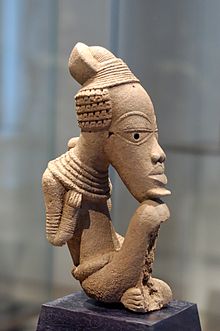
All I know is the Nok was the earliest civilization in Nigeria. Also they are the ancestors of Yoruba's & Benin's [b]"The Nok culture appeared in Nigeria around 1000 B.C. and mysteriously vanished around 500 AD in the region of West Africa. This region lies in Central Nigeria. The culture’s social system is thought to have been highly advanced. The Nok culture was considered to be the earliest sub-Saharan producer of life-sized Terracotta. It is suggested that the society eventually evolved into the later Yoruba Civilization of Ife.[citation needed] The refinement of this culture is attested to by the image of a Nok dignitary at the Minneapolis Institute of Arts. The dignitary is portrayed wearing a "shepherds crook" affixed with an elastic material to the right arm ([3], [4]). The dignitary is also portrayed sitting with flared nostrils, and an open mouth suggesting performance. According to some accounts, based on artistic similarities to both early Yoruba art forms and Nok forms, there are connections between them and the contemporary Yoruba Race. Later brass, bronze, soapstone and terracotta sculptures of the Yoruba Ife and Yoruba Esie civilizations show significant similarities with those found at Nok. Iron use, in smelting and forging for tools, appears in Nok culture in Africa at least by 550 BC and more probably in the middle of the second millennium BC (between 1400 BC and 1600 BC depending on references).[1]"[/b] http://en.wikipedia.org/wiki/Nok_culture [b]"In 1943 clay shards were discovered during tin mining operations on the southern and western slopes of the Jos Plateau. When reconstructed they were found to be representations of human heads and animals. At the time no archaeologists were present in the region and reconstruction work was carried out by art historians. The disturbance caused by the mining operations meant that the finds could not be dated with any accuracy. Similar discoveries have been made across a large region of the plateau, stretching 500 km east to west and 300 km north to south. Both the terracotta sculptures and the society which made them are known by the name of the village near to which the first discovery was made: Nok. Since 1943 archaeological studies, especially at two important sites at Taruga and Samun Dukiya, have provided more accurate information. The pottery has been dated, mainly by thermo-luminescence testing and radio-carbon dating, to a period from 500 BCE to 200 CE. In addition to the Nok terracotta sculptures, domestic pottery, stone axes and other tools, and iron implements have been discovered. The Nok Culture spanned the end of the Neolithic (Stone Age) and start of the Iron Age in sub-Saharan Africa. Archaeological evidence at the two sites suggest that these were permanent settlements, and centres for farming and manufacturing - this is the oldest evidence for an organised society in sub-Saharan Africa. Iron working, smelting and fabrication of iron tools became widespread in the region form around 350 BCE. Archaeologists disagree whether this was an independent development (methods of smelting may have derived form the use of kilns for firing terracotta) or whether the skill was brought south form the North African coast by traders (records suggest that Phoenician traders were crossing (what is now) the Sahara at that time. Nok culture terracottas are heralded as the prime evidence of pre-colonial civilization in sub-Saharan Africa, and it is suggested that the society eventually evolved into the later Yoruba kingdom of Ife. Later brass and terracotta sculptures of the Ife and Benin cultures show significant similarities with those found at Nok."[/b] http://africanhistory.about.com/od/kingdoms/a/NokCulture.htm Nok sculptured art https://nokculture.com/sitebuildercontent/sitebuilderpictures/nokside-hair.jpg http://nokculture.com/ https://upload.wikimedia.org/wikipedia/commons/thumb/e/e2/Nok_sculpture_Louvre_70-1998-11-1.jpg/220px-Nok_sculpture_Louvre_70-1998-11-1.jpg [flash=500,500] https://www.youtube.com/watch?v=iVT--v-fAKw&feature=channel_page[/flash] |
| Celebrities › Re: I Love Nigerian Men But: Yvonne Nelson by anonymous6(f): 1:58pm On Nov 05, 2011 |
ceomike:I'm happy for Yvonne Nelson, it seems Ghana should watch out with their bans on ghollywood actors/actresses because Yvonne seems to have become more popular & successful as a result. It is sad that power failure is a problem in Nigeria & non-Nigerians are really noticing it. Yvonne Nelson [img]http://themantsekev.files./2011/08/yvonne-nelson.jpg[/img] |
| Celebrities › Re: A Picture Of Charly Boy With A Python by anonymous6(f): 2:16pm On Nov 04, 2011 |
he's a WEIRDO, so nobody should be surprised by his bizarre behavior with his snake friend |
| Culture › Re: The Itsekiris. by anonymous6(f): 1:47pm On Nov 04, 2011 |
The Itsekiri's are a tribe of mixed origin, and one of their ancestors are the YORUBA's [b]"The Itsekiri (also called the, Isekiri, Itsekri or Ishekiri or Itsekhiri) are an ethnic group of Nigeria's Niger Delta area, Delta State. The Itsekiri presently number between 800,000–1,000,000 people and live mainly in the Warri South, Warri North and Warri South West local government districts of Delta State on the Atlantic Coast of Nigeria. Significant communities of Itsekiris can be found in parts of Edo and Ondo states and in various other Nigerian cities including Lagos, Sapele, Benin City, Port Harcourt and Abuja. Many people of Itsekiri descent also reside in the United Kingdom, the USA and Canada. The Itsekiris traditionally refer to their land as the Kingdom of Warri or 'Iwerre' as its proper name – which is geographically contiguous to the area covered by the three Warri local government districts. The area is a key centre of Nigeria's crude oil and natural gas production and petroleum refining and the main town Warri (a multi-ethnic metropolis) forms the industrial and commercial nucleus of the Delta State region. The Itsekiri monarch is known by the title 'Olu of Warri'. The Itsekiris speak a language very closely akin to Yoruba and Igala but which has also been significantly influenced by other languages particularly Portuguese, Edo (Benin), English and a few borrowings from neighbouring Ijo and Urhobo languages. Although linguistically related to the Yoruba ethnic group, however, the Itsekiris are of very mixed ethnic origins (primarily of Yoruba (Ijebu, Ilaje,Ondo and Owo), Edo, Igala, Urhobo,Ijo and Anglo-Scottish and Portuguese descent) and are today mainly Christian (Protestant and Roman Catholic) by religion. Thus having had 6 centuries of direct cultural exposure to Western Christianity and other African influences, contemporary Itsekiri language and culture has successfully evolved into a hybrid of the many cultures that have influenced its development. Similarly owing to the complex genetic mix of most Itsekiris over the centuries, many individuals self-identifying as Itsekiri would usually be a complex mix of any of the aforementioned ethnic and racial groups."[/b] "Whilst genetically, the Itsekiris are a complex mixture of the many different ethnicities and races that have settled in their area, however, the Itsekiri language is very closely related to the south-eastern and Ijebu Yoruba dialects and to the Igala language of North Central Nigeria. It has also been influenced significantly by the Bini, Portuguese and English languages due to centuries of interaction with people from those nations. However, it remains a key branch of the Yoruboid family of languages even retaining archaic or lost elements of the proto Yoruba language due to its relative isolation in the Niger-Delta where it developed away from the main cluster of Yoruba language dialects." http://en.wikipedia.org/wiki/Itsekiri_people [b]"The ITSEKIRI Now, we may first try to describe the Itsekiri peopl e whose kingdom is Warri. As already pointed out, the Dutch map of 1705 referred to above, marks their homeland as Awyri which over time had variously been spelt Iwere, Ouere, Oere, Warree, Wari. and now Warri. The Edo and the Yoruba call them Iwere. The people who constitute the Itsekiri tribe have diverse origins: early settlers from Ijebu, some from Igala and Aboh came to settle in various communities such as Omadino, Ureju, Ugborodo , Inroin, etc at various times out of human memory . Then a party from the Benin Royal family about the end of the 15th century set up a monarchy which constituted these erstwhile autonomous mini-communities into a nationality which it is today. Prof. P. C Lloyd says that "in the English literature they are known as Warri or Jekri, though in the 19th century they were often referred to as Benin since contacts with them were first made on the banks of the Benin River". Here was a Kingdom founded by the royal party from Benin, but by the early sixteenth century through th e seventeenth, it had done so much overseas trade to match or exceed that of the mother - kingdom; the reason being its advantageous position within the empire on the rim of the Atlantic. The Itsekiri speak a Yoruba dialect whose vocabulary has been widened by the infusion of a large number of Portuguese, Bini and English words. As an introduction of the influence of the Bini culture in Itsekiri land, it is pertinent to recall part of the address presented to Prince Solomon I.A Akenzua, then Edaiken of Uselu (now His majesty the Oba of Benin by the Itsekiri community in Benin) by the Itsekiri community in Benin on the occasion of his retirement from public service and return home in 1973. We would like to recall the special historical relationships that bind your people and ours. Both Bini and Itsekiri histories agree that Ginuwa, a prince, as your goodself, left this great city to found the Iwerre (Warri) Kingdom about 1480. In the 15th and 16th centuries, these two kingdoms emerged as a civi l izing force in this part of the world and provided great splendour which attracted European adventurers, missionaries and merchants alike. The visit of D' Aviero of Portugal of Benin City in 1485 and the establishment of a Catholic Mission in Benin about 1515 AD were great historical developments that have had their parallels only in Iwerreland. At the beginning of the 17th century, a son of a reigning Olu went to Portugal for ten years (as the Oba's ambassador went to Portugal between 1481 and 1495 to be educated in the best schools and returned with a Portuguese lady of a high birth as his wife, their son , Antonio Domingo was Olu of Warri in the 1640s. The site of the Catholic Cathedral (St. Anthony) built in Ode-Itsekiri, is still called (Satoni), we have proud similar chieftaincy titles-Iyatsere as Iyase; Ologbotsere as Ologhosere; Uwangue as Uwanguel Otsodi as oshodin and many other, Even your present esteemed title of Edaiken compares with "Daniken", the last ceremonial stage of the Olu-Elect bef ore coronation. And, our Itselu means "sacred quarters" of the Olu's mother as Uselu in Benin. Aslo, our war songs, lyrics and burial songs have common roots with Bini ceremonial songs. Truly, these cultural bonds span the vast areas of royalty, chieftnancy, language, music and dancing, rituals to dynastic ties. The Warri throne, being a direct off-shoot of the Benin monarchy, bears all its attributes. Historically, the Olu of Warri, like the Oba, is the personal focus of the people's loyalty and affection. The crown, highly glamorised, is the symbol of supreme authority in both kingdoms. The Olu, like the Oba (aiguobasinwin) does no wrong and can not be queried or challenged (Afo massin; Afo were tse were); he is the keeper of the corporate conscience of his people. The Oba is titled Uku-Akpolokpolo, which literally means high and extremely very large. In essence, it means next to God, divine and infinite. He is also addressed: Ogie N'Ogbomwan be edge uwuikomwam; i.e king who can confer life a n d death. A similar title of the Olu of Warri is Ogie-uwu i.e , king over death. The Oba is also addressed: Ekpen N'uwa i.e the tiger at home. In spite of the contemporary societal forces which have constrained the practical meanings of these titles, in the nitty-gritty of the norms of Benin and Warri societies, these mind-bending titles, theoretical as they are, still do provide the pillars and sign-posts that guide most traditional activities. These titles remain stilted and honorific. Examining some royal titles in Benin and Warri, one would be amazed at the striking oneness of their roots. Even in some cases, Warri tended religiously to follow Benin titles every sixty years on the average. The fourth Olu of Warri, Ojoluwa who ascended the throne in 1550 assumed the title of the fifteenth Oba of Benin Ozolua who reigned in 1483; the fifth Olu Esigie who became king in 1570 bore the title Esigie, the sixteenth Oba of Benin who came to the throne in 1504. And the thirteenth Olu Akengboye (1710) took t he title of the twenty-second Oba Akengboi (1669). Others who followed were the fortheeenth Olu Atogbwua (1735) who bore the title Orhogbua, the seventeenth Oba (1550). And the sixteenth Olu Akengbuwa (1807) took the title of the thirtieth Oba Akengbuda (1750). Even Erejuwa in Warri and erediauwa in Benin sound alike. In both cultures, part from the crown, and other high-profile symbols of royalty are swords and scarlet cloth. The Itsekiri have derived the names of these items from Bini."[/b] http://www.edofolks.com/html/pub123.htm |
| Romance › Re: How Important Is Tribe In Nigerian Relationships? by anonymous6(f): 3:02am On Nov 03, 2011 |
coogar:Thanks |
| Romance › Re: How Important Is Tribe In Nigerian Relationships? by anonymous6(f): 2:56am On Nov 03, 2011 |
coogar:Yes, A Yoruba man all the way. It is a very low possibility that I will marry out of my tribe regardless of what they offer but I am not saying it isn't possible but highly unlikely, plus there wouldn't be a chance for me to fall in love with someone outside my tribe if I don't go into that level in the first place with a man outside my tribe. |
| Romance › Re: How Important Is Tribe In Nigerian Relationships? by anonymous6(f): 2:48am On Nov 03, 2011 |
coogar:I don't agree, sorry I see nothing wrong in staying with your own tribe. Most people in Nigeria find love in their own tribe, so it shouldn't be a problem. There is inter-tribal marriage but it will always be low with certain tribes in Nigeria. Not every group has to be mixed. |
| Romance › Re: How Important Is Tribe In Nigerian Relationships? by anonymous6(f): 2:27am On Nov 03, 2011 |
coogar:It doesn't matter about how educated or civilized people are, Majority of Nigerians(especially the Yoruba's and Hausa's) will always prefer & would only want to marry their own tribe, and their is nothing wrong with that |
| Celebrities › Re: Barack Obama Dislikes His Daughters Watching The Kardashian Reality Show by anonymous6(op): 1:23am On Nov 03, 2011 |
BootyOnMe:OMG, lol |
| Romance › Re: How Important Is Tribe In Nigerian Relationships? by anonymous6(f): 1:12am On Nov 03, 2011 |
cheikh:well you are right at times their are more southerns in the north then vice versa but most of the romantic encounters with hausa men tend to be when these men go to the south not vice versa The most aggressive men in Nigeria, I wouldn't really know by tribe because I feel that runs with all of them but it is more stronger in some men then others I think; tricky question |
| Romance › Re: Marriage b/w Igbo Man And Yoruba Woman by anonymous6(f): 6:44pm On Nov 02, 2011 |
[quote author=tpia@ link=topic=242722.msg9467732#msg9467732 date=1320255071]There are a few yoruba women married to igbo men but its not really common. I cant count up to ten of them that i personally know.[/quote]exactly, I only know three couples like that but those type of couples are still small or rare. Yoruba women & igbo men just don't connect with each other 1 Like |
| Celebrities › Re: Kris Humphries' Family Says Kim Is Making A Massive Mistake by anonymous6(f): 3:45pm On Nov 02, 2011 |
rokiatu:Like ENews would even listen but that attitude is kicking them in the butt now because it was mentioned in the news that ENews may pull the plug on one of the kardashain reality shows as a result of this fiasco. |
| Celebrities › Re: Kim Kardashian Has Finally Spoken! - Released A Statement On Her Blog! by anonymous6(f): 3:11pm On Nov 02, 2011 |
There is nothing wrong with Kim releasing a statement, after reading her statement it seems she has realized her mistakes but if she is expecting sympathy from the public it is far to late for that; the damage has been done. In a way I feel she & Kris has brought disgrace to themselves and family and nobody will take them seriously any more, It is sad but it's the truth. For me personally I don't feel sorry for Kim or Kris but I don't hate them either both were famous for nothing & got a dose of their own medicine. they put their private lives in view for the public to see and that action is in-directly haunting them now and will always follow them years to come as a joke, especially Kim kardashian because this is not the first flip up she has ever done in her life(Jay Leno and David Lettermen have already been making fun of them already on their late night comedy show already and it is growing). Cartoon picture of Kim and kris https://worldwidetweets.com/wp-content/uploads/2011/05/kris-humpries.jpg |




1 2 3 4 5 6 7 8 ... 116 117 118 119 120 121 122 123 124 (of 156 pages)