 Politics › Re: Ayade Orders Arrest Of Civil Servants Leaking Information To Media by Blue3k(m): 3:38pm On May 12, 2020*. Modified: 4:34pm On May 12, 2020 Politics › Re: Ayade Orders Arrest Of Civil Servants Leaking Information To Media by Blue3k(m): 3:38pm On May 12, 2020*. Modified: 4:34pm On May 12, 2020 |
“We have reported about how Ben Ayade has been collecting money from local government, how he has been asking them to raise money for Coronavirus disease (COVID-19) pandemic, and to also raise money for the Obudu Airport he’s planning to build,” he said. Lol tyrant Ayade knows no shame. Were these transactions state secrets. The Margaret Ekpo International Airport, Calabar, had a total of N540.8 million generated revenue, though collected more put at N559.6 million, the expenditure was as much as N2.50 billion, giving a deficit of N1.94 billion. |
| Politics › Re: Work Must Stop On Any Airport Currently Under Construction by Blue3k(m): 9:01pm On May 11, 2020 |
Enugu should be finished then concessioned or sold off. If has enough traffic to be viable. I dont know about the rest. |
| Politics › Re: Work Must Stop On Any Airport Currently Under Construction by Blue3k(m): 8:57pm On May 11, 2020 |
SLAP44:
Of course, you are saying the same thing I am saying, which is that the FG should remove their leprous fingers from viable investments. Whether state, regional or individual control of the airport will still be profitable. That last sentence isn't true. Even the article everyone is citing doesn't believe that. Most of the airports get little traffic to begin with. That's why it was suggested the be concessioned in blocks. The Guardian learnt that the poor revenue and zero profit sprees were not unconnected with the perennially low traffic inflow in and out of the airports.
The International Air Transport Association (IATA) lately stated that for an airport to be viable and self-sustaining, it must have at least five million passengers a year. Today, only Lagos and Abuja airports could boast of at least five million passengers annually. |
| Politics › Re: Work Must Stop On Any Airport Currently Under Construction by Blue3k(m): 8:49pm On May 11, 2020 |
SLAP44:
The solution should be regionalism, let every region determine what they want to do or don't want to do.
The useless method of the federal government trying to hold back some regions by claiming that they don't have money is totally unproductive.
There are some regions that by nature are not business inclined, regions that don't need the airport can close their airports and those that need more can open more in every state. This issue has nothing to do with a lack regionalism. Akwa Ibom has it's own stste owned airport opperates it with no issues. Other states are building their own for better or worse. States can either buy the airports from the FG or ask them to complete concession process. |
| Politics › Re: 17 FG Airports Not Viable, May Shut Down Over Lossesnigeria by Blue3k(op): 6:19pm On May 11, 2020*. Modified: 8:24pm On May 11, 2020 |
Apparently due to the political uproar that forbids shutdown, some stakeholders have urged the government to expedite the concession programme for the airports, and attendant restructuring of the Federal Airports Authority of Nigeria (FAAN) for sustainability. Nigeria loves bleeding money. They should've concessioned these airports like they promised in 2016. Who cares about political uproar when they're not ready to fork over cash. There's nothing stopping them from bidding on the airport. The SW states did it as block for MMIA. The airport in the south that has become the ghost of its old self is that in Calabar. It records only one flight a day since Donald Duke left as governor of Cross River State. The Uyo Airport has taken over. Owerri is bubbling. What is this guy talking about. FAAN data and article show this is mostly false. The only fact he got right is Uyo airport having more taffic than calabar. |
| Politics › 17 FG Airports Not Viable, May Shut Down Over Lossesnigeria by Blue3k(op): 4:38pm On May 11, 2020*. Modified: 5:50pm On May 11, 2020 |
• Facilities incur N26.1b deficit in three years
• How to overcome challenge, by stakeholders
At least 17 out of the 20 airports owned and managed by the Federal Government have turned out to be unviable and have operated at a loss for three years.
Except the trio of the Murtala Muhammed International Airport (MMIA), Lagos; Nnamdi Azikiwe International Airport (NAIA), Abuja; and Port Harcourt International Airport (PHIA), Rivers State, none of the other airports has sufficient revenue to cover the cost of operations alone.
Investigations by The Guardian showed that additional funding from high-traffic Lagos and Abuja airports’ excess revenue to the tune of N26.1 billion cushioned the operational cost deficits incurred by the unviable airports in 2017, 2018 and 2019.
With zero revenue being recorded following the lockdown occasioned by the coronavirus pandemic and recent flight restrictions for another four weeks, the Federal Government is in a dilemma on what to do with the airports; either to keep running them at a loss regardless of liability or temporarily closing them till the economy and passenger traffic start looking up.
Apparently due to the political uproar that forbids shutdown, some stakeholders have urged the government to expedite the concession programme for the airports, and attendant restructuring of the Federal Airports Authority of Nigeria (FAAN) for sustainability.
FAAN owns and manages all the public airports in the country on behalf of the Federal Government. Among them are 20 that are directly owned by the Federal Government and four state-owned airports.
A fact-sheet of revenue and expenditure of the 20 federal airports and FAAN headquarters in the last three years, obtained by The Guardian, showed huge revenue shortfall and deficits across the board.
For instance, the Kaduna International Airport that was upgraded during the 2017 closure of Abuja airport has in the last three years pooled a total of N1.027 billion in generated revenue. Of the sum, N716.7 million was collected. However, the expenditure was in excess of N4.41 billion, leaving a deficit of N3.69 billion.
The Mallam Aminu Kano International Airport, Kano, did not fare better. The airport in 2017, 2018 and 2019 pooled a total of N8.28 billion in generated revenue and collected N7.16 billion but its expenditure totalled N9.6 billion, leaving a shortfall of N2.44 billion.
The Kastina Airport managed to make a total of N250.8 million in generated revenue in three years, out of which only N42.1 million was collected. Its cost of operations was put at N1.58 billion, leaving a deficit balance of N1.54 billion.
In the same situation, Sokoto Airport had a total of N725.7 million generated revenue, out of which N400.1 million was collected. The cost of operation was in excess of N2.71 billion, which gave a shortage of N2.31 billion.
In the South, Ibadan airport in three years made a total of N349.2 million in generated revenue and collected N244.9 million. The expenditure amounted to N1.39 billion with a deficit of N1.14 billion. Ilorin International Airport generated a total of N437.1 million revenue in three years and collected N264.2 million. The expenditure was in excess of N2.453 billion, giving a shortfall of N2.19 billion.
Ditto for Akure airport. The facility pooled a total of N175.8 million in generated revenue and collected N168.7 million. But the expenditure was N1.06 billion, leaving a difference of N893.7 million.
The Benin airport in Edo State also ran at a loss. The airport generated a total of N993.2 million in three years and collected N930.1 million. The total cost of operations was put N2.02 billion, leaving a shortfall of N1.09 billion.
The Margaret Ekpo International Airport, Calabar, had a total of N540.8 million generated revenue, though collected more put at N559.6 million, the expenditure was as much as N2.50 billion, giving a deficit of N1.94 billion.
Similarly, Sam Mbakwe International Cargo Airport, Owerri, amassed a total of N1.25 billion in generated revenue and collected N1.08 billion. Expenditure was, however, N2.50 billion, with a shortage of N1.42 billion.
The Guardian learnt that the poor revenue and zero profit sprees were not unconnected with the perennially low traffic inflow in and out of the airports.
The International Air Transport Association (IATA) lately stated that for an airport to be viable and self-sustaining, it must have at least five million passengers a year. Today, only Lagos and Abuja airports could boast of at least five million passengers annually.
Apparently without consideration for viability, some state governments, like Abia and Ekiti, are bent on building new airports.
Meanwhile, the Federal Government is at a crossroads on what to do with the airports that are still operating at a loss. The 2016 plan to concession the airport is still on, yet sustaining all the airports at FAAN’s N4 billion monthly overhead is a tough call during lean times.
A temporary closure of some of the airports was considered but not feasible given the political hullabaloo that awaits such a move, The Guardian has learnt.
Aviation consultant and Chief Executive Officer of Beljune Konzult Limited, Chris Aligbe, said it was expedient for the Federal Government to keep supporting FAAN and other regulatory and service providers with grant, pending the time the airlines will return to pre-coronavirus capacity.
Aligbe said aviation infrastructure abhored temporary shutdown. More so, they are readymade tools in the hand of politicians. He observed that some of the unviable government-owned airports were built by state governments for political aggrandizement.
“It was after building them that they found that they did not have resources to run them and quietly pushed them to the Federal Government through the back door. That was how they got into the care of FAAN.
“But we cannot shut them down, especially for political reasons. It is never going to be easy. If you try to do that, the impact will be more on the northern airports than on the south. The airport in the south that has become the ghost of its old self is that in Calabar. It records only one flight a day since Donald Duke left as governor of Cross River State. The Uyo Airport has taken over. Owerri is bubbling. Enugu will pick up because, at a time, it was behind Lagos and Abuja, even ahead of Port Harcourt International Airport.
“But in the north, you will have to shut down Sokoto, Bauchi, Gombe, Minna, and Ilorin maybe, among others. In the west, maybe Akure. Hence, it becomes highly political and more dangerous. So, for the length of time that it will take the airlines to bounce back, the agencies and the airports will have to keep running with the government’s support,” Aligbe said.
The Secretary General of the Aviation of Safety Round Table Initiative (ASRTI), Group Capt. John Ojikutu (rtd), urged the government to concession all the airports, and not the big four alone, to run efficiently and profitably.
Ojikutu advised that the Lagos and Abuja airports should be concessioned in blocs with four or six others.
“Lagos could go with Kano and some others in the south but not Enugu or PHIA. Abuja could go with Enugu but not with PHIA. PHIA could go with Kaduna and others but not with any other mentioned.
“My idea of concession is only for the non-aeronautical. These include the passenger terminal buildings, cargo terminals, aircraft parking areas, car parks and tollgates. FAAN could become a holding company overseeing the concession airports on behalf of the government,” Ojikutu said.
The Chairman, House of Representatives Committee on Aviation, Nnolim Nnaji, earlier called for the unbundling of FAAN ahead of the move to concession major airports. Nnaji said it was a glaring fact that Nigeria’s airports were not just underdeveloped, but grossly underutilised.
Indeed, FAAN headquarters in the last three years generated N16.10 billion in revenue and collected N15.02 billion. Its expenditure was put at N59.41 billion, leaving a deficit of N29.1 billion.
The Chairman, NIGAV Centre, Fortune Idu, said FAAN was overburdened with managing 22 airports and paying salaries of over 12,000 workers from the revenue generated by Lagos and Abuja airports.
Idu said it was only FAAN, among airport authorities in the world, that had such a peculiar business model of airport subsidisation.
According to him, the body remains critical to the “fragile aviation industry” and should be carefully considered and properly repositioned to save the industry. Source: https://m.guardian.ng/news/17-fg-airports-not-viable-may-shut-down-over-losses/ |
| Politics › Re: How Britain’s Labour Government Facilitated The Massacre Of Biafrans In Nigeria by Blue3k(op): 3:38pm On May 11, 2020 |
abduljabbar4:
It's always their grandparents. That Nigeria seized their money and gave them 20 pounds, that ojukwu released awolowo, that the Yoruba betrayed them, that the entire NATO and UN directly helped Nigeria during the war, etc all came from their grandparents. The same people now will tell their children about how Buhari sent herdsmen to kill them and how the president was cloned. I even bought some of their stories before wise nairalanders like legendhero came to debunk the claims with sound proofs. It's not hard to debunk most historical lies because they cant cite sources. They just like tellimg stories. |
| Politics › Re: FAQs About Nigeria's 2019 Poverty Statistics by Blue3k(op): 1:30pm On May 11, 2020 |
rdokoye:
In short, Nigeria's statistics on poverty are highly speculative; they're simply based on surveys, with a miniscule sample size. How can you extrapolate from 600 respondents in a state like Lagos that has 20 million people? Or in a place like Ogun State, which has over 4 million people in it? It's too small, ideally, you'd want to measure 20% of the populace, given the limitations, but surveying 40 million people is unreasonable. If you know 20% is unreasonable why not give a better answer. The US Bureau stats uses less than 200 thousand people for surveys. |
| Politics › Re: FAQs About Nigeria's 2019 Poverty Statistics by Blue3k(op): 4:06am On May 11, 2020*. Modified: 6:48am On May 11, 2020 |
socialmediaman:
You just did what I said don’t do. I read the bla bla bla explanation which shows their incompetence over the years since modern data modeling systems became available globally. Oya let them mention the name of the new baseline for data collection and implementation and you’ll see it’s been available for at least 10 - 15 years. We make yearly budgets to finance the activities of some incompetent and corrupt fools who are working in NBS for no reason other than nepotism.
I visited their office at CBD once and was given a tour and all I could do was SMH at the slow and old systems and lack of adequately qualified personnel Lol you dont find it silly to whine about them not answering an impossible question? Its fine if you want complain they sucked in previous years if you want to change subject. If the government choose to fund them adequately the would've already done these things. Funding is their excuse for not updating the unemployment rate since 2018. |
| Politics › Re: FAQs About Nigeria's 2019 Poverty Statistics by Blue3k(op): 3:15am On May 11, 2020 |
socialmediaman:
The report couldn’t answer one of the most important questions; whether poverty was rising or falling in Nigeria, just some bla bla bla explanation of changed modeling structure You'll just have to wait a few years till the next poverty stat is released to compare. Then you can get an apples to apples comparison. It is not possible to say whether poverty increased or decreased between 2009/10 and 2018/19, because of the
changes made in the survey design and implementation. |
| Politics › Re: FAQs About Nigeria's 2019 Poverty Statistics by Blue3k(op): 1:57am On May 11, 2020*. Modified: 10:10pm On Aug 01, 2020 |
The survey was conducted by the National Bureau of Statistics in collaboration the World Bank. It seems the world bank did participate in this poverty stats collection. This should comfort people who disbelieved the latest stats. The fact is the poverty stat just upset certain people because it didn't align with their expectations. The methodology itself seems like it improved overall. |
| Politics › FAQs About Nigeria's 2019 Poverty Statistics by Blue3k(op): 1:47am On May 11, 2020*. Modified: 2:23am On May 11, 2020 |
FREQUENTLY ASKED QUESTIONS ON THE NIGERIAN LIVING STANDARDS SURVEY
(NLSS) NLSS 2018/19
1. What is the Nigerian Living Standards Survey (NLSS)?
a. The NLSS is a household-based survey conducted by the National Bureau
of Statistics in collaboration with the World Bank. The main objective of
the survey is to collect information on the living conditions of the Nigerian
population. The survey collected data on individual and household
demographics (age, gender, marital status, among others), access to
education, health and basic services, employment, assets, and income.
The survey is used to measure the prevalence of poverty and to estimate
a wide range of socio-economic indicators including benchmarking of the
Sustainable Development Goals.
2. Who conducts the survey?
a. The survey was conducted by the National Bureau of Statistics in
collaboration the World Bank.
3. How often is it carried out?
a. Conventionally, the survey is meant to be carried out every 3 – 5 years.
The last round of the survey was conducted in 2009/10, making it almost
ten years since the last official poverty estimates. The most recent round
was conducted in 2018/19, albeit with notable changes in the
methodology. The next round is scheduled for 2023.
4. When was the survey conducted?
a. The survey was conducted between 2018 and 2019. The planning and
preparation for the survey started early in 2018; however, the actual field
work and data collection for the survey was done between September
2018 and October 2019. This is typical of surveys collecting data on
consumption in countries with large rural population, to account for
seasonality. The analysis and validation of the responses started in
November 2019 and was concluded in March 2020.
5. Who are the target respondents?
a. The target population of the survey are individuals in households across
the country, by states (including FCT), both urban and rural dwellers.
6. What was the sample size and response rate of the survey?
a. The sample design was initially intended to cover 600 households per
state, making 22,200 households nationwide. However, due mainly to
challenges in Borno State, only 22,110 households were sampled. The
overall response rate exceeded 95 percent, which is one of the highest for
a household survey of this magnitude
Poverty Estimates
2. Why is there no poverty estimate for Borno state?
a. In order to estimate poverty for the state of Borno, the selection of the
households would have to be statewide and random. Due to the security
situation in Borno, many areas were inaccessible. The NBS collected
information from 530 households in Borno from areas that remained
accessible despite the security situation. However, making estimates
based on these 530 households would only reflect poverty in safer
communities in Borno and would therefore not be representative of the
state as a whole.
3. Is poverty rising or falling in Nigeria?
a. The NLSS 2018/19 is a new baseline for tracking the status of poverty in
Nigeria. With support from the World Bank, the NBS adopted best practice
in the collection and processing of the data. As is often the case, such
improvements come at the expense of giving up some degree of
comparability with earlier rounds of the survey while achieving high
standards in survey practice. Aside from the use of electronic devices for
data collection, a 7-day recall for recording household consumption and
expenditure was adopted for this round, as opposed to the monthly
consumption diary used in previous rounds. In addition, additional efforts
were made to measure food quantities in households using non-standard
units of measurement, resulting in better quantification of food
consumption. All these new changes and improvements, as well as the lag
between this round and the last round make it problematic to compare,
therefore, a deliberate decision was made to use the 2018/19 round as
the new baseline. As such, it is not possible to say whether poverty
increased or decreased between 2009/10 and 2018/19, because of the
changes made in the survey design and implementation.
Using the data
1. Why are these data relevant?
a. The results of the NLSS are extremely useful and important for Nigeria and
Nigerians. Primarily, the data is useful for policymaking, for research and
for holding government at various levels accountable to their promises. It
can help targeting government interventions, designing of policy and
programs, as well as monitoring the implementation and status of existing
ones. The information is also useful to the private sector for business and
investment decision making, as well as to development sector operators
to guide the operations.
2. How can I access the poverty report and data?
a. E-library of NBS website (http://nigerianstat.gov.ng/elibrary). The
datasets are currently under preparation. Source: http://www.nigerianstat.gov.ng/download/1093Front page: Lalasticlala mynd44 


|
| Politics › Re: How Britain’s Labour Government Facilitated The Massacre Of Biafrans In Nigeria by Blue3k(op): 11:14pm On May 10, 2020 |
Bump |
| Politics › Re: Nigeria Faces Battle From Within To Keep Reform Promises Made To IMF by Blue3k(op): 7:33pm On May 06, 2020 |
Lol the International masters made nigeria have forced nigeria to be reasonable for once. No more subsidized fuel, power. Prices and taxes are going up hopefully the economy trends the same direction or it's going be ugly. |
| Politics › Nigeria Faces Battle From Within To Keep Reform Promises Made To IMF by Blue3k(op): 7:23pm On May 06, 2020 |
There’s no consensus within the Nigerian government on the economic reforms the country will undertake as part of promises made to the International Monetary Fund (IMF) to revive an economy reeling from lower oil prices and the Covid-19 pandemic, according to sources familiar with the matter.
In a letter to intent requesting for the $3.4 financial assistance under IMF’s rapid financing instrument, the federal government made promises to rid the economy of fuel, foreign exchange and electricity subsidies as well as boost non-oil revenue, resolve debt sustainability challenges and improve public sector transparency.
“There is still significant opposition to the economic reforms contained in the letter of intent to the IMF and while the finance minister may be supportive of the reforms, she needs pillars of support to overcome some factions who oppose her,” a source who did not want to be quoted said.
“Those who oppose reform are working hard to present reformers as agents of foreign governments without the interest of Nigeria at heart,” another source familiar with the matter said.
While the government seems to have already embarked on some of these reform promises made to the IMF, enough hasn’t been done to put other reforms beyond reasonable doubt.
For instance, the move to end petrol subsidies has been well publicised by the government since the collapse in crude oil prices presented a long awaited opportunity to ditch the wasteful practice.
At a meeting on March 18, the federal executive council agreed that it would begin moves to deregulate the downstream oil sector by adjusting petrol retail price to any development in the global oil market.
However, analysts are not convinced the era of subsidies would not return if oil prices turned the corner. Instead they are calling for a legislation that legally abolishes the practice and dissolves some agencies that would be rendered irrelevant and redundant in a fully liberalised market.
The government has revealed no plans to back up its claim to end fuel subsidies with any legislation.
The government also promised the IMF to create specific budget lines to facilitate the tracking and reporting of emergency response expenditures and reporting funds released and expenditures incurred monthly on a transparency portal. This unprecedented level of transparency in Nigeria is supposed to ensure the funds are used for what the purpose for which they were disbursed.
The government also promised it will not introduce measures or policies that would exacerbate the current balance-of-payments difficulties like imposing new or intensify existing restrictions on the making of payments and transfers for current international transactions or trade restrictions.
This runs counter with what is currently obtainable where there are restrictions on international transactions and the country’s land borders remain shut.
Regarding the promise made to force a convergence of the multiple exchange rates in Nigeria, there is some momentum building that it may happen even though it will face stiff resistance from within government.
The CBN already adjusted its official exchange rate to N360/$ from the N306/$ level it has been for more than three years. There’s some belief within government circles that the multiple rates are expected to converge at the more market-reflective Investors and Exporters window rate which is closer to N400/$.
Nigeria’s power reforms were also underway until the Covid-19 halted plans to adopt a market-reflective tariff starting April 1.
Nigeria is getting technical assistance and financial support from the World Bank to implement far reaching power reforms that would boost the country’s power generation capacity and capping tariff shortfalls this year to N380 billion while moving to full cost-reflective tariffs in 2021.
The government’s revenue drive through raising non-oil taxes is also on-going. In February, the government raised its Value Added Tax (VAT) rate by 50 percent to 7.5 percent from 5 percent. The impact was immediate when revenue from VAT was up 30 percent to N120 billion in February 2020 from N92 billion collected in February 2019.
In the letter of intent to the IMF, the government said it planned to raise its tax to GDP ratio to 15 percent through further VAT reforms, rise in excises, and removal of tax exemptions— once the crisis passes. In 2019, Nigeria’s tax to GDP ratio was 7 percent, well below the frontier market average of 15 percent and South Africa’s 25 percent.
In line with the Fiscal Responsibility Act, the government has also promised the IMF that it will reduce the Federal Government deficit to under 3 percent of GDP and eliminate recourse to central bank financing by 2025.
The existing stock of overdrafts held at the CBN will also be securitized, the government said in its letter to the IMF.
The plan to securitise CBN’s overdrafts to the government has long been in place before the IMF loan was sought. Source: https://businessday.ng/business-economy/article/nigeria-faces-battle-from-within-to-keep-reform-promises-made-to-imf/ |
| Politics › Re: Nigeria's growing debt and Revenue problem explained. by Blue3k(op): 7:06pm On May 06, 2020 |
Lol everyone complaining about the government taking IMF loan should know the other options involve taxing them more and or cutting spending. We'll see if the government actually scraps and mergers these ministries departments and agencies (MDAs). They promised their "masters" the IMF they wont continue subsidizing fuel and will raise electricity tarrifs. |
| Politics › Re: NBS 2019 Poverty Stats By State by Blue3k(op): 1:30pm On May 05, 2020 |
seunny4lif:
No need arguing with him Yeah the conversation has run it course. |
| Politics › Re: NBS 2019 Poverty Stats By State by Blue3k(op): 3:47am On May 05, 2020 |
omonnakoda:
We are digressing 2nd time don't put words in my mouth. I said hybrid 2nd time ,this is excruciatingly circular. Anything new? You're hybrid theocracy arguement is wrong. A hybrid implies both elements are present. If you dont have government based on having both theocratic rulers its not a hybrid. All that's present is democratic rule. There's no political power with the emirs or any other traditional post. I'm done with the other topic like I said begore. If you feel its islam that's the issue cool. I read you arguements and already shown there's plenty of exceptions to the rule. If 6 states arent enough that's alright. |
| Politics › Re: NBS 2019 Poverty Stats By State by Blue3k(op): 8:59pm On May 04, 2020 |
omonnakoda:
They are a hybrid theocracy they have Sharia courts, they have Islamic police.
You are the one with a weak grounding in logic hence your repeated resort to external examples.That us s poor substitute for an argument
Whether or no not there is a de facto theocracy in Zamfara is not verified by what happens in the SW. Ok so you also believe Nigeria states are defacto monarchies? If northern Nigeria is a hybrid theocracy then that should as be true. We're talking about a system of government so it doesn't matter if it foreign. What matters is do those too similar. It's like saying both nigeria and America are federal states. There's no theocracy because they dont have political power. That's the crux of my argument. There's no hybrid because the systems weren't fused. The democraticly elected leaders make the laws and administer them. Sharia courts are federal courts of appeal. Nigeria itself should be considered a theocracy by that logic. The hishba serve under democratic control not theocratic. The emirs just traditional stools at the end of the day. |
| Politics › Re: NBS 2019 Poverty Stats By State by Blue3k(op): 7:19pm On May 04, 2020 |
omonnakoda:
I am talking about the traditional system of government and their de facto not de jure operation especially in rural settings.
The primary law in rural Zamfara is Sharia.
We are comparing Yoruba land to Those places. LIKE I said it is not an absolute but relative theocracy by comparison.
The Islam in Yoruba land versus that in Sokoto etc do quit eith the ridiculous interjection of England.
The issue is not Islam itself but the difference in practice and understanding. There are Sharia courts and that is a sign of theocracy, they even have Islamic police There's no basis to say they're a theocracy. Ths sharia opperates because the elected officials made laws not traditional rulers. They have no power in other areas as proven by Sanusi. If it doesn't fit into definition in any form then it's clearly something else. The sharia courts are federal courts so is Nigeria a sharia country by your logic? Is SW a democratic monarchies by your logic? If the answers no you're being logically inconsistent. You dont want to compare and contrast other countries because it hurts your arguments on. |
| Politics › Re: NBS 2019 Poverty Stats By State by Blue3k(op): 6:58pm On May 04, 2020 |
omonnakoda:
Theocracy can have all kinds of variants but the key issue is religious based law not religious RULERS. That is nonsense.
Religious rulers derive authority from religious law.
Emirs ARE RELIGIOUS RULERS
Theocracy does not have to be absolute or pure but often is a hybrid of theocracy and monarchy
Just like some so called democracies have constitutional monarchies
Bringing Irag or Iran are diversionary.
The point is Islam Northern Nigeria is closer to a theocracy than in Yoruba land.
Let us stick to that comparison nothing to do with Iran.
Only Muslims can become Emirs and the system is essentially a theocratic one especially in the rural areas where government impact is minimal just like in Yoruba land Oro festivals take place and restrict women movement. Purists may argue it is unconstitutional but it happens in practice even in Lagos state.
BY a similar token we have flogging for stealing EVEN IN ABUJA,
We saw s policeman arrested for breaching Sharia law in one of the Northern states. There's nothing diversionary from giving examples to prove point. Northern Nigeria isnt a theocracy by definition of the word. It's a democracy since they have zero political power. All the power rest with the elected officials and the traditional rules just exist by statues. By your logic every Nigerian state is constitutional monarchy of sorts. The UK is also a theocracy because the queen is the head of the Anglican church. |
| Politics › Re: NBS 2019 Poverty Stats By State by Blue3k(op): 5:53pm On May 04, 2020 |
omonnakoda:
Theocracy is not just the Emir but the entire system. Theocracy simply means Sharia law The practice of Sharia in Yoruba land is non existent compared to Zamfara.
Sanusi's financial stability is irrelevant. That is projecting your own value system They don't reason like that at all .Rather they have a deterministic world view that everything that happens is Allah's will0
He still has an environmental impact for his fecundity in terms of the amount of resources e.g land water security that his genetic pool consumes and in that culture no one will buy that argument from him where the mindset is one of whose progeny inherits the earth.
I believe their understanding of Islam accounts for many of their problems.
There is Islam in Yoruba land but we understand it differently Theocracy doesn't mean having religious laws but being ruled by religious rulers or supreme being. Iran is a theocracy while Iraq isn't. They both practice sharia law. These are democratic states run by religious people. Sanusi finances are relevant. How else would you determine his family planning. Your opinion on their world view is noted. Definition of theocracy
1: government of a state by immediate divine guidance or by officials who are regarded as divinely guided
2: a state governed by a theocracy |
| Politics › Re: NBS 2019 Poverty Stats By State by Blue3k(op): 5:16pm On May 04, 2020 |
omonnakoda:
Ultimately there is a very different Islam in Yoruba land
School enrolment rates are low and Boko is Haram ideas are widespread going back a very long time
Did Sanusi practice family planning. How many children does he have?
There is no running away from the fact that Attitudes to family planning,child marriage, female education, female participation in the economy are all driven by their understanding of Islam.
Islam in the North is a theocracy with the Emir at the top. There is nothing like that in Yoruba land where Islam exists and intermarries other Faith's. Sanusi did as far as I know. He's financially stable and takes care of his children. Unless you proof to the contrary we can reasonably assume he's well off. There's no theocracy. The emir has no political power like the like the Ayatollah of Iran. Sanusi wouldn't have been booted out if that were the case. These post are just traditional post with no constitutional political powers. It seems we cant change each others opinions. You want to believe it's islam thst told them to not plan families or educate themselves. Those polls conducted show most peoples attitudes. With good government policies and culture shift then they'll be ok. Blaming Islam just convenient excuse for their degeneracy for lack of a better word. |
| Politics › Re: NBS 2019 Poverty Stats By State by Blue3k(op): 4:53pm On May 04, 2020 |
omonnakoda:
It is multifactorial but 'family planning" what does tha mean exactly ?
Family planning as a technology? Its availability? Its acceptability?
Family planning penetration in much of Northern Nigeria a function of Islam and therefore a subset of Islam alongside illiteracy which again in that space is a subset of Islam hence ideas like "Boko Haram"
Many in that space consider family planning to be Haram
So when you say " family planning" you need to explain what you mean.
The same family planning technology is ubiquitous but attitudes and knowledge vary largely because of the peculiar Islamic culture that leads to higher rates of female illiteracy and child marriage Unless their version of Islam demands muslims not get an education or hold off kids or marriage until financially stable it's not an excuse. Their refusal to use condoms or birth control isnt about Islam. The leaders they vote for aren't if they dont do follow herd mentality. Even Sanusi comments weren't considered anti Islamic. The only point I can give you child marriage and literacy rates. Even then on girl child education the vast majority agree its important. The failure falls with patents not teaching and state stepping in. Noipolls actually 


|
| Politics › Re: NBS 2019 Poverty Stats By State by Blue3k(op): 4:20pm On May 04, 2020 |
omonnakoda:
I did not say Sharia made them poorer.
Did I ?
There is no need for a specious argument. The point is in Nigeria there is a strong correlation between poverty and Islam especially those states that practise Sharia
We have observed that there is a strong correlation between dying from the coronavirus in the USA and being black .That does not imply that being black made them die does it?
If you make a list of the poorest states in Nigeria most of them are in the North and of those most are Islamic states that is the OBSERVATION Correlation doesn't equal causation so what's your point. You dissgreed with me saying family planning was the issue saying it's Islam until I asked about SW muslims. Then you added sharia as a caveat. You did imply it was their Islamic sharia law that was cause. |
| Politics › Re: NBS 2019 Poverty Stats By State by Blue3k(op): 4:03pm On May 04, 2020 |
omonnakoda:
Official Sharia law is a proxy for their variant of Islam. Sharia has always been on ground across Northern Nigeria even in states that did not jump on the political declaration unless you want to feign ignorance?
Are you unaware that there is a Grand Khadi of Abuja?
Are there no Sharia courts in Kaduna,Adamawa,Niger states? In other words there's no way to prove sharia made them poorer. If the states are not officially sharia states they dont need to be counted. Sharia courts are federal courts so they put them where they need them. There's point in bringing up FCT when it's an another exception to your premise. There's multiple states with higher rates of povery without being sharia states. The big issue is family clearly family planning and education. The fact the work mainly as famers means they earn less on average. If their culture was similar to SW muslims they'd be better off. Taraba 87.72% Ebonyi 79.76% Adamawa 75.41 Enugu 58.13% Nasarawa 57.30% Plateau 55.05% 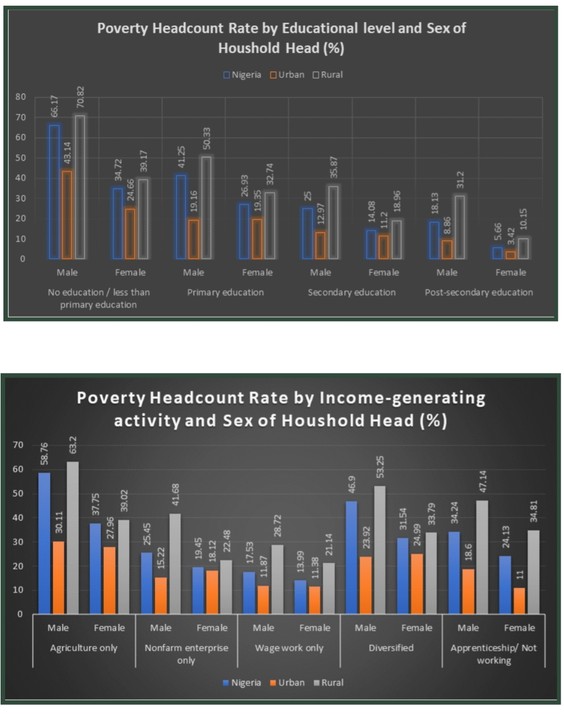
|
| Politics › Re: NBS 2019 Poverty Stats By State by Blue3k(op): 3:24pm On May 04, 2020*. Modified: 4:11pm On May 04, 2020 |
omonnakoda:
Plenty ?
now you are talking rubbish
The states with the highest poverty are states with Sharia law .Of course there are exceptions or outliers but they are not "plenty".
Which states got the highest Conditional Cash Transfer?
The Islamic states.
Adamawa and Taraba are close to Borno and have a huge burden of IDPs occasioned by Boko Haram and other militants There's plenty of exceptions to make your premise flaud. Those states have always been poor even before sharia. Do you have proof sharia increased their poverty rates? The states with the most poor people islamic so it's no surprise the got most cash. If you're going to give them that excuse give it the rest of the north east states. There povery rates would naturally drop just like theirs without warfare. |
| Politics › Re: NBS 2019 Poverty Stats By State by Blue3k(op): 3:13pm On May 04, 2020*. Modified: 3:48pm On May 04, 2020 |
omonnakoda:
Don't put words in my mouth. There are poor states in the south too.
The fact is the poorest states in Nigeria are those with Sharia law
Zamfara State 73.98%
Kano State 55.08%
Sokoto State. 87.73%
Katsina State. 56.42%
Bauchi State 61.53%
Borno State.
Jigawa State. 87.02%
Kebbi State. 50.2% It's flaud premises but you're wedded to it. There's plenty of states with sharis thst rank higher. Enugu has higher poverty rate than kano. Plateau is higher than Kebbi. Plenty of the top states dont have sharia. Even before sharia they were still poor. Do you have proof it made them more improverished? Taraba 87.72% Ebonyi 79.76% Adamawa 75.41 Enugu 58.13% Nasarawa 57.30% Plateau 55.05% |
| Politics › Re: NBS 2019 Poverty Stats By State by Blue3k(op): 2:56pm On May 04, 2020 |
omonnakoda:
There is no Sharia in Yoruba land. Islam without Sharia is like odourless shit Most northern states arent sharia but they're poor. The north central and north east are pretty bad. There's more to the story but if that's your opinion ok. Davash222:
So, what does that mean? It means they didn't collect data. Look at the other charts and it says N/A. |
| Politics › Re: NBS 2019 Poverty Stats By State by Blue3k(op): 2:52pm On May 04, 2020 |
omonnakoda:
Islam Are muslims a minority in the SW? If islam the only major factor then the should dragging them down aswell. Lol does their version of Islam forbid family planning? Davash222:
Borno 0.0
How  There's an asterix. |
| Politics › Re: NBS 2019 Poverty Stats By State by Blue3k(op): 2:42pm On May 04, 2020 |
Juliusmalema:
Not a parameter.
Osun state is fantastically poor. Not according to the NBS. |
| Politics › Re: NBS 2019 Poverty Stats By State by Blue3k(op): 2:38pm On May 04, 2020*. Modified: 4:29pm On May 04, 2020 |
It seems the SW is the least povery overall. All the states are pretty low. Im surprised to see delta beat out alot of states. Other than that the main thing the charts tell me is poor family planning leads to poverty. The higher the household size the more improverished generally.
PS: let me know if the 1st pic is unclear. 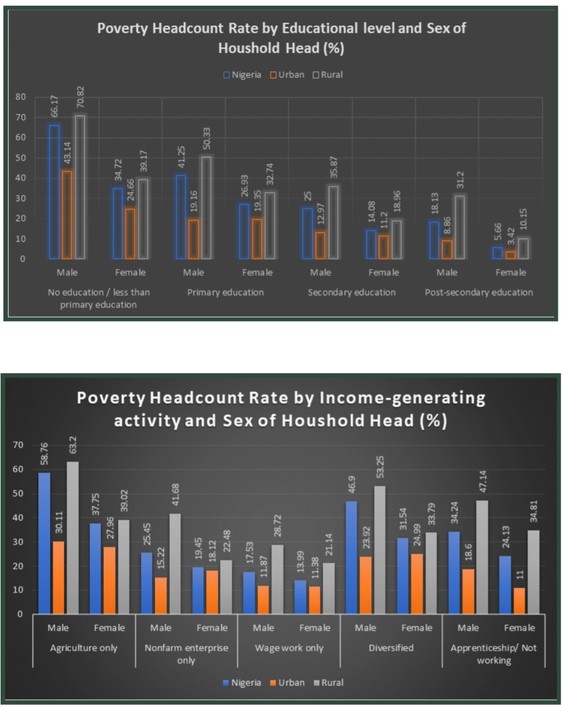
|


