Lol this case wont go far. You have to prove that's what his words meant. Little Rufi tweet can be interpreted as him just saying he's going to run a train on your mom. Personally I didnt see his words as a rape threat.
LibertyRep: Like someone asked above, how many tonnes of smoked fish woukd they have sold to have sustained them this long against armies of three countries.
The leaves of BH dancing on top of the river has the drummer beneath the river.
dokyOloye: Story story,story!! How many tons of smoked fish will they sell to procure one antiaircraft gun?
Let's do some basic math. ISS reports they charge fish dealers N1000 and individual fisher men N5000. Assuming they have 500 people paying both taxes for 365 days that's N270m million revenue. This doesn't include other taxes on cattle and kidnapping ransoms.
This problem is directly related to the arm banning fishing. If they simply regulated it the terrorist would have defacto monopoly. ISWAP were quite clever in their tax policy. They were fair and didnt do any double taxation. Assuming they have 500 people paying both taxes for 365 days that's N270m million revenue.
In ISWAP-controlled areas, fishermen, fish dealers and cattle rearers are all expected to pay taxes. Fish dealers pay an average of N1 000 (US$2.8 ) for every carton of fish leaving the island daily. [b]Individual fishermen using canoes each pay N5 000 (US$13.8 ) for one-time fishing permits.
Cattle rearers pay according to the number of cows they have. Sources familiar with the tax system on the islands say there is no multiple taxation, which affects legitimate businesses in Nigeria. Cattle rearers don't worry about their cattle being rustled, and there is little to no harassment or abuse of civilians by ISWAP fighters.
Natural resources are "curse" when it makes the bulk of the countries earnings. If the state hardly depends of population for tax revenue it can lead to bad policy making. The same government that always looking to save forex and ban food items is blind to this issue.
The sector contributes about 6 per cent to the nation’s economy while the country depends on imported fish to meet domestic demand, with total fish imports amounting to about $1.2 billion and exports valued at $284 million in 2013.
Currently, almost 9 million tonnes of fish are produced domestically, while the annual demand for fish is around 2.7 billion tonnes.
It's too bad the diversification efforts are all talk. All they have to is keep the water clean, don't allow illegal fishing and piracy. These some of the major issues government should address.
The issue is always government. Exxon Mobil does this because they're not punished for their polluting. The refuse to fund NOSDRA so they can feign ignorance. NNPC also has a big role in this mess considering they have 60% stake.
“I was present and saw seaweed and little oil. Seaweeds were on the shore. There was not much oil. We took samples of the seaweeds to run a test in the lab to see if there is a sign of anything but the agency did not give approval or funding to run the test,” a NOSDRA scientist in the state who identified himself as Gideon said.
ExxonMobil, as a field operator, holds 40 per cent interest in the oil production while the Nigerian National Petroleum Corporation (NNPC) owns the remaining 60 per cent.
On July 3, 2019, Nsopikpo Afia took his bundles of fishing net, put them on his canoe and left the Uton riverbank at Iwochang community in Ibeno Local Government Area of Akwa Ibom State to fish in the Qua Iboe.
Qua Iboe is a river that rises near Umuahia in Abia State and flows in a southeastern direction through Ibeno, which is one of the largest fishing settlements on the Nigerian coast.
In the middle of the river, Mr Afia threw his nets with the hope of catching as many fish as possible. After some minutes, he brought out his nets and was disappointed.
The nets only caught a few fish. He became sad. But that was not the worse incident. His nets had been soaked with crude oil and seaweed clung on the nets as a result of oil operations in the river area. He saw the spilt oil on the water but he was unaware it could have a devastating impact on his nets.
Oil Spills
Oil spill refers to the release of liquid petroleum hydrocarbon into the environment both on land and the marine ecosystem, mainly due to operational failures.
Oil spills include releases of crude oil from offshore platforms, drilling rigs and wells, as well as spills of refined petroleum products (such as gasoline, diesel) and their by-products. Oil spills have contaminated many rivers, streams, and soils in the Niger Delta, a region made up of oil-producing states including Akwa Ibom.
Oil spills raise concerns about seafood safety, endanger fish hatcheries in coastal water and contaminate commercially valuable fish flesh. Oil exploration has over the years impacted negatively on the physical environment of the oil-bearing communities and has increased the rate of environmental degradation and perpetuated food insecurity as a result of the death of fish.
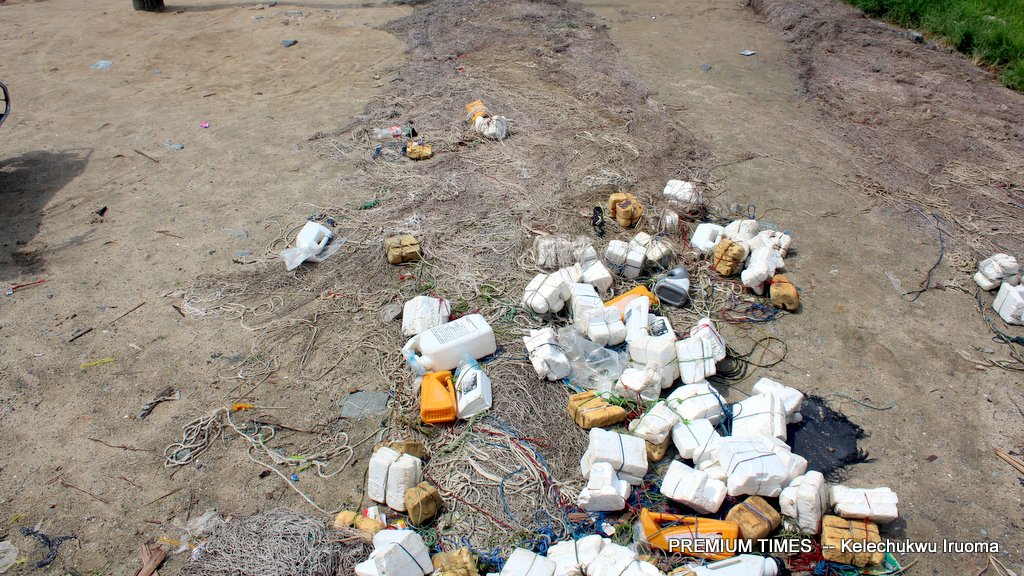
Nsopikpo Afia sits on his canoe as helpless after oil spills destroyed his fishing nets
The fisheries sector in Nigeria supports about 7 million Nigerians, of whom 80 per cent are from the Niger Delta. The region’s small-scale fish farmers supply a large amount of the country’s domestic fish production annually.
The sector contributes about 6 per cent to the nation’s economy while the country depends on imported fish to meet domestic demand, with total fish imports amounting to about $1.2 billion and exports valued at $284 million in 2013.
Currently, almost 9 million tonnes of fish are produced domestically, while the annual demand for fish is around 2.7 billion tonnes.
Mr Afia said the oil spill in Ibeno has affected his livelihood.
“It’s been three months now,” he said last November. “I have not gone back into the river to resume fishing. I have been suffering and begging relatives and friends for money to feed myself and family. I am also looking for money to get new nets.”
“Anytime there is an oil spill — usually thick — it will cover our nets and render them useless,” said Mr Afia. “We don’t have fish anymore. The oil does not allow our nets to catch fish.”
Distraught
Mr Afia’s bundle of nets were on the floor in the riverbank with the hope the sun would dry them and remove the crude oil. Weeks passed and no possibility the nets would still be able to catch fish.
On a day in October, he sat on his long canoe looking confused. His fishing partner stood behind him with his head down. He was worried that in a few months to come, they still would not get new nets to go back to the river to fish.
Sunday Kwesi’s two canoes at the Uton riverbank as he no longer fishes due to the contamination of his fishing nets
ExxonMobil has been operating in the Qua Iboe area for more than 50 years. It has numerous offshore fields in the Bright of Biafra in southeastern Nigeria, east of the Oso field.
The crude, from fields 20 to 40 miles offshore from Nigeria’s South-astern region, are brought to shore via a seabed pipeline system to the Qua Iboe Terminal (QIT).
QIT is located on the eastern side of the Qua Iboe river estuary and contains nine crude oil storage tanks with a total capacity of 4.5 million barrels. ExxonMobil, as a field operator, holds 40 per cent interest in the oil production while the Nigerian National Petroleum Corporation (NNPC) owns the remaining 60 per cent.
First spill
Ibeno community leaders said Ibeno first experienced oil spill in 1998 and it was immediately cleaned by the oil corporation but the company found it difficult to clean subsequent oil spills immediately they occurred until they caused damages.
Sunday Kwesi, a Ghanaian, arrived Akwa Ibom in 2004. He had always loved fishing. His grandfather and father were fishermen. He decided to settle in Ibeno, where he became a commercial fisherman. He said he was successful in fishing but started experiencing challenges whenever an oil spill occurs, contaminating the river.
“Because of the oil spill, my thick nets only last only for two years. But if not touched by oil, nets can stay for 20 years. But because of the spill, it does not last longer again,” he lamented on a bright day in October.
Mr Kwesi’s nets were also on the riverbank hoping the sun would dry the oil. He said he feared that the nets would not be able to catch fish anymore even if they dry. Like Mr Afia, Mr Kwesi abandoned fishing for weeks due to the oil spill. He wanted to buy new nets but he could not afford it.
READ ALSO: Nigeria spent N722.3 billion on fuel subsidy in 2018 – NEITI Report
“One bundle of the net is N1 million and I need like 20 bundles for commercial fishing,” he said.
He used to get enough fish in the river but since the oil spill started, things had gotten worse. As a result, Mr Kwesi started travelling on the water to neighbouring countries to fish. He has two big canoes. On the canoes are flags of countries he has travelled to fish.
“I go to Cameroon, Liberia, and Ghana to fish. Now there is a serious oil spill problem. How will I get money to take care of my family? I need help,” he said bitterly.
Nsopikpo Afia and Sunday Kwesi’s contaminated fishing nets on the sea bank.
Contaminated beach
Ibeno has a beach, where people go swimming and have fun. People from various communities and towns go to the beach to enjoy themselves. But the beach has been contaminated by the spill. Community leaders have stopped people from swimming on the beach due to the danger.
The beach is one of the beaches on the Atlantic Ocean along the shorelines of Ibeno. It is one of the longest sand beaches in West Africa and a tourist attraction.
“When oil spills, our beach suffers from seaweed everywhere and small particles of oil,” said James Eshiet, Ibeno Youth President. “That is where many people enjoy themselves. They go there to swim but now we do not go near the beach.”
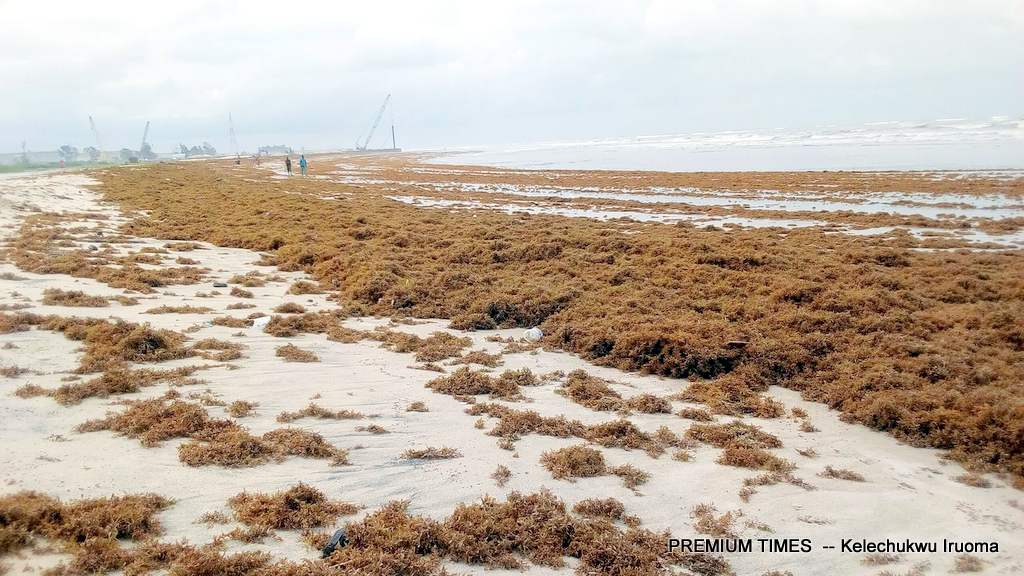
In June 2010, there was a report of an oil spill on the beach. In September 2019, community youth also reported an oil spill on the beach. When the reporter visited the beach in October 2019, it was empty. Stalls at the riverbank were closed due to low patronage. The bank of the beach was filled with seaweeds.
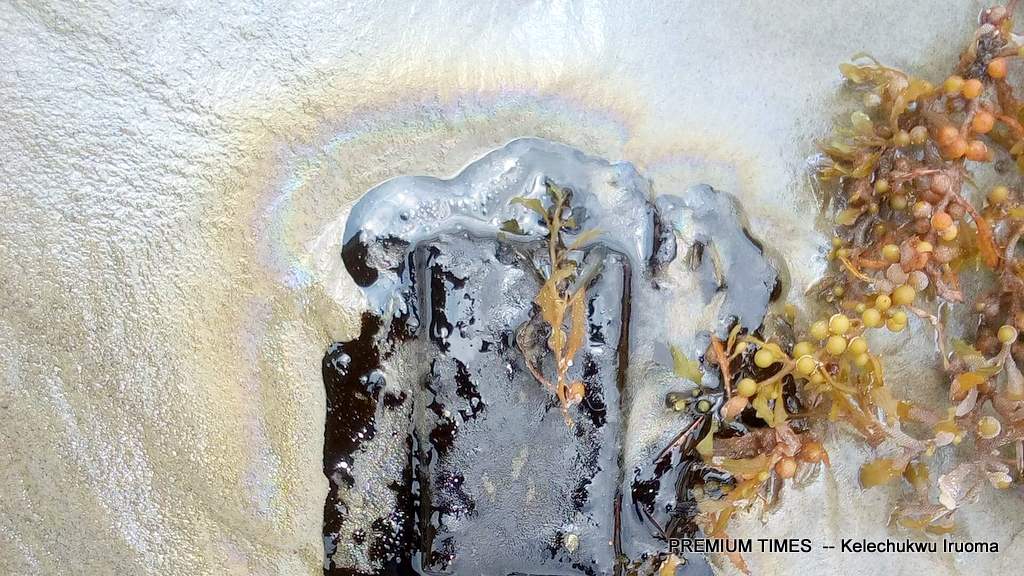
The reporter was informed that an oil spill occurred two weeks back (mid-September) that contaminated the beach. Mr Eshiet said ExxonMobil changed its pipes, which led to the oil spilling with seaweeds and thick oil particles all over the beach and its bank.
“The seaweed is as a result of the production because it clings to their pipes underneath the water,” said Gabriel Emmanuel, the youth president of Iwo-okpom, one of the communities in Ibeno. “When the spilled oil and seaweed come to our shore, we tell them that this is what they have caused but they deny it.”
The massive seaweed from the ExxonMobil pipeline’s at the riverbank of the Ibeno beach when the oil spilled.
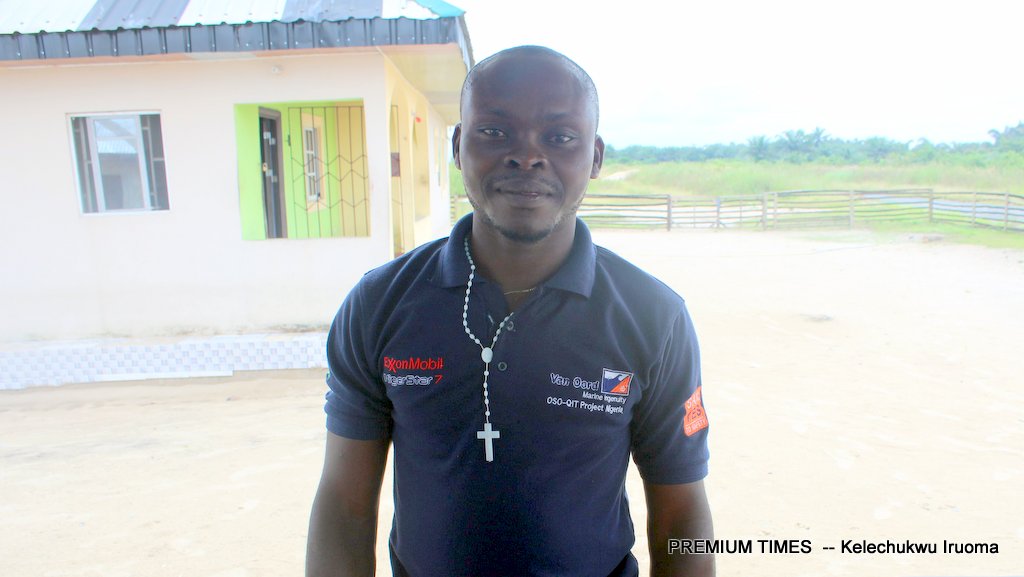
ExxonMobil spokesperson, Ogechukwu Udeagha, denied oil ever spilling in Ibeno, describing it as “speculation and non-specific event”.
“We have no evidence of oil spill around that period. Changing pipelines is what we always do. A government agency can confirm the oil spill. NOSDRA can confirm this and tell us it was not cleaned and it caused damages,” he said.
Scientists Confirm Spill
The National Oil Spill Detection and Response Agency (NOSDRA) is a federal agency that embarks on Joint Investigation Visits (JIV), ensures the remediation of impacted oil spill sites and monitors oil spill drill exercises and facilities inspection.
This reporter contacted two NOSDRA environmental scientists at the Uyo office, who both confirmed there were separate oil spills and massive seaweeds reported within the period specified.
“I was present and saw seaweed and little oil. Seaweeds were on the shore. There was not much oil. We took samples of the seaweeds to run a test in the lab to see if there is a sign of anything but the agency did not give approval or funding to run the test,” a NOSDRA scientist in the state who identified himself as Gideon said.
A senior environmental scientist and NOSDRA’s then Zonal Director at the Uyo Field Office, Irvin Obot, also confirmed ‘negligible’ oil spill and massive seaweed that engulfed the beach shore.
“There was little oil though negligible but there were massive seaweeds. The oiling was very negligible,” Mr Obot who was later transferred to Abuja, said. “Seaweed or sea vegetables are forms of algae that grow in the sea. Seaweed usually clings to the pipelines in the water. When there is an oil spill, seaweed leaves the pipelines to the shorelines or riverbank.”
Thick oil that spilled from ExxonMobil’s pipeline at the Ibeno beach riverbank
Mr Eshiet said the last cleaning done by ExxonMobil was in 2012. “Since then, we have had serious oil spills but the clean up had never been done. They have chemicals they pour inside the river so that the oil spill will not reach here [riverbank] but sometimes it does not work.”
He said letters have been written to ExxonMobil to always clean up spills when they occur “but they fail to respond.”
The negligence from the oil corporations led to a protest by the angry Ibeno youth in 2017 demanding the oil company to clean up the spilled sites. The company, however, said the spills did not emanate from their productions.
Numerous challenges
Apart from the effects of the oil spill on fish production and the contamination of the beach, other challenges affect the communities and they claim the oil company has failed to help them solve them.
Akpanam Bassey, a fisherman, said they are dying from air pollution due to the oil operations.
“We don’t have good water. We don’t live up to 80 years. People now die at the age of 40, 50 and 60 years,” he lamented. “We cry to the federal government to assist us and talk to ExxonMobil to control the oil spill.”
“If you’re in Ibeno and you decide to stay inside your house, you will feel and hear vibrations all over the place. We are supposed to be benefiting from these people to save our lives but the money for the development of Ibeno is being taken elsewhere,” Mr Eshiet said.
He said the rainwater people use is not safe for drinking due to the flare.
“When it rains and you put your bucket outside, the colour of the water will be black. You keep it for some days and when you filter it, you see oil particles underneath the bucket. It is God that is saving us,” Gabriel Emmanuel, the youth president of Iwo Okpon community said.
There was initially potable water to drink in the community but since the oil spill started, they no longer get potable water anymore. They have protested countless times and nothing is forthcoming.
“When the youth stage a protest to the office of ExxonMobil in Ibeno, they send trucks full of soldiers to scare them away. They get harassed and beaten for protesting against the operations of the oil company that has destroyed their livelihood,” Ani Effiong, youth president of Inua Eyet Ikot lamented.
Mr Effiong asked the government to look into what they are going through. “What we are inhaling, drinking and eating daily is capable of giving typhoid, malaria, among other illnesses. Children unborn will feel the impact of the negativity.”
They are not happy that ExxonMobil is not cooperative in addressing the problem of the oil spill in Ibeno. They are also sad that the oil firm does not allow people to use its hospital, he said.
“Before we used to go to the ExxonMobil hospital for treatment but we were stopped,” said Bassey Etem, the treasurer of Ibeno Youth Forum. “There are not enough doctors in our hospital. We do check-ups once every month and once every two months to detect any sickness. The flare and chemicals are too much. We cannot even enjoy anything here.”
But Mr Udeagha disagreed with Mr Ibeno who claimed they do not get support from the oil firm.
“We have done ‘things’ for Ibeno. We provide them with free electricity. These are the things that people do not talk about. They are always complaining,” the oil company’s spokesperson said.
For Mr Afia, what he wants from the oil firm is a replacement of his fishing net.
“We have not been feeling the dividends of our oil from the federal government and ExxonMobil,” said Afia. “The government and ExxonMobil should provide us with nets because the oil spill contaminated and spoiled them.”
TheCable on Friday that his final approval was neither sought nor received for the execution of the agreement which has now become binding on the country.
If Buhari gave them Authority to make deal what difference does it make. Im not sure why the author put this detail in the article. Th bigger failure is not taking 80 million dollars settlement.
Dedetwo: By the end of six month into the Nigeria/Biafra war, the seaports in eastern region have been overrun by the 3MCDO. I ask again what sea blockade are you talking about when Biafra has no seaport? Even the airspace was partially blanketed in part because the MIGs did have night navigational system in order to enforce total day/night airspace blockade of Biafra. Which operational seaport in Biafra did Nigerian navy had to patrol in order to enforce a blockade?
There were ports in Biafra like portharcourt for example. How did you think the oil was being transport? These basics were covered in the first link I posted. The nigerian navy maintain 24 hour patrols to maintain blockade. After 1968 the navy focused blocked on water ways after capturing Bonny, Port Harcourt, Warri, Sapele, Calabar, and Oron.
The Nigerian Navy's contribution to the war made invasions of bonny sucessfully. If the weren't being constantly resupplied the would being battled back. Again the stopped weapons, food and trade. This essentially made them locked because they were encircled.
Cited sources:
Naval Military Operations in Bonny during the Nigerian Civil War 1967-1970
By Chukwuma C. C. Osakwe, Lawrence Okechukwu Udeagbala
Nature and Impact of Involvement of the Navy in the Nigerian Civil War, 1967-1970
When Babatunde Fashola was minister of power, Sunrise reportedly asked for a compensation of $80 million but he was said to have insisted that the company did not do any work at all.
After Fashola’s exit, representatives of the federal government and Sunrise met in London agreed on a $200 million “full and final payment” in November 2019 for the arbitration to end.
Abubakar Malami, attorney-general of the federation, has written Leno Adesanya, chairman of Sunrise Power Transmission Company of Nigeria Ltd (SPTCL), to seek a review of the $200 million settlement reached over the Mambilla power project dispute.
TheCable reported on Wednesday that President Muhammadu Buhari has declared that Nigeria does not have the money to pay Sunrise to withdraw its $2.354 billion claim against the country at the International Chamber of Commerce (ICC) in Paris, France, over an alleged breach of contract.
Same day, Sunrise’s legal counsel demanded that Nigeria must commit to paying $200 million settlement claims by Friday, April 24, or face the consequences.
The dispute has stalled the $5.8 billion project — potentially Africa’s second biggest hydroelectric power plant — as Sinohydro Corporation Limited, the Chinese company currently handling the project, is also joined as a party in the arbitration.
In his letter dated April 22, 2020 and marked “without prejudice”, Malami said: “Unfortunately, due to the unforeseen intervening circumstances and the attendant global economic downturn which has resulted in the re-channelling of resources for combating the global Covid-19 pandemic, coupled with the fact that the Federal Government’s crude oil earnings have slumped from the melt down, resulting in the review of her budget, it has become inevitable that Federal Government should review the entire Negotiation after the pandemic has subsided. This is done in the best interest of the parties, and the anticipation of SPTCL’s goodwill in these times when companies and corporations worldwide seem to be displaying their most humane disposition of suspending profits for Corporate Social Responsibility (CSR).”
The AGF requested that Sunrise should “hold all further actions to enable us come together to resolve the issued amicably to the benefit of all”.
Sunrise Power Transmission Company of Nigeria Ltd (SPTCL) dragged Nigeria to arbitration in October 2017 seeking the award for “breach of contract” in relation to a 2003 agreement to construct the 3,050MW plant in Mambilla, Taraba state, on a “build, operate and transfer” basis.
When Babatunde Fashola was minister of power, Sunrise reportedly asked for a compensation of $80 million but he was said to have insisted that the company did not do any work at all.
After Fashola’s exit, representatives of the federal government and Sunrise met in London agreed on a $200 million “full and final payment” in November 2019 for the arbitration to end.
Although Buhari gave the go-ahead for the meeting to be held to reach a final settlement, senior presidency officials told TheCable on Friday that his final approval was neither sought nor received for the execution of the agreement which has now become binding on the country.
Dedetwo: No, it is not the case. I am not saying Biafra did not have a navy as in case of personnel however Biafra did not have warships to even attempt to burst the Nigeria blockade which was not even orchestrated by the its naval force. When the 3MCDO occupied Calabar and Port Harcourt while 2nd Div occupied midwestern region, it is absolute waste of time talking about naval blockade. With above military occupation of the stated areas, where did Biafran operate?
Are you claiming the naval blockade was orchestrated by some other military? If you are cite your sources on the thread. Dont act like the other two posters telling stories.
There's no debating the fact Biafra didnt have the naval capacity to stop a blockade. It's the major reason for their down fall and encirclement by Nigerian military. The blockade wasn't a waste of time discussing because you even stated they couldn't sell oil due to the blockade. It also made it more difficult to get ammunition. The Biafran troops opperated in Imo and had their stronghold in hinterlands.
Dedetwo: Biafra had no warship. The only frigate in the service of Biafran navy was NNS Ibadan which has faulty gun battery. Nigeria did not take out Biafran ships to enforce the blockade. Rather it was during the landing of Nigerian troops in Bonny (Ubani) where Nigerian navy engaged Biafran navy. Be mindful that NNS Lokoja was a landing craft commanded by a British, Lt Cdr Joe Cox. Lt Akin Aduwo, was not even a navigator, commanded NNS Ogoja with Sub. Lt. D. Okujagu as his 2ic. Cdr. Nelson Soroh commanded NNS Nigeria with Lt. M. Adelenwa as 2ic. I guess NNS Sapele was a supply ship manned Lt. Adulahi. If not for the information secretly given to Nigerians by Lt Cdr. Chiazor, the Biafrans would have taken out the Nigerian ships at Warri through a clandestine operation.
In the so-called showdown between Biafran and Nigerian navies, the only trained navigator was Oduh via the favor of his best friend Aduwo who incidentally took him out of the fight before it started. As a result of this battle, there was not time Biafrans tried to burst the blockade blanket Nigeria threw at Biafra because Biafra had no navy to challenge it.
Are telling me a frigate is not a warship? NNS Ibandan was incapacitated during that naval battle. Experience just beat firepower that day. There's always an excuse to any loss.
The ships that took part in the coastal operations in Bonny were: NNS Nigeria, the flagship under the command of Captain Soroh; NNS Penelope, under the command of Commander James Rawe, which was the Nigerian Navy scout ship; NNS Lokoja, a landing ship, under the command of Lt. Cdr. A. Joe; NNS Ogoja was under the command of Lt. Cdr. Akin Aduwo; NNS Benin was under the command of Lt. Fingesi; NNS Enugu was under the command of Lt. A. Abdullahi; MV Bode Thomas was under the command of Captain Laniyan, Merchant Ship and Logistic Ship, Nigerian Port Authority; MV King Jajawas a Merchant Ship and Logistic Ship belonging to the Nigerian Port Authority. 29 There was also the Army’s 3rdMarine Commando Division consisting of elements of the Lagos Garrison Organisation and a recently trained battalion comprising newly recruited men from littoral towns and cities such as Rivers and Cross River. 2 This battalion had just been raised with intensive training at Bonny Camp, Victoria Island, Lagos. The division was under the command of Lt. Col. Benjamin Adekunle.
LarryBee1k: I'm not saying you're lying oh. Pls where is source of your comment.
Dont expect it to ever come. They're good with telling stories but the second you ask them to cite source its an issue.
Dedetwo: What Biafran navy were you talk about in the above post? Biafran was a dilapidated Nigerian frigate named NNS Ibadan which Lt. P. J. Oduh sailed to Calabar for sea worthiness and never returned to Lagos.
You know I was referring to their improvised navy. Lol that's am Interesting way of saying Oduh stole ship before defecting.
Dedetwo: The first must important reason why the silly blockade worked was Biafra was not allowed even for day to function as an independent country without being foisted with a war. If Biafra had exist, at least, for six month, it would have been able to acquire two frigates and few helicopter gunships.
I dont think Ojukwu had to declare Biafra immediately. It woukd be weird not to expect war soon after. Lastly Ojukwu was already sourcing weapons in 1966 in preparation for the war. Israel was on his first go to but they weren't very helpful till 1968.
You're deflecting again, is it so difficult for you to produce your sources? It's pretty obvious you made up the story. Nigeria did have multiple warship in it'a navy prior to the war. There's the NNS Ogoja, NNS Nigeria, NNS Lokoja, NNS Sapele etc. If you're not aware of Nigerian navy history simply read the first source I provided. As stated previously the BNS Ibandan was stolen from the Nigerian navy.
Nigeria hired mercenaries because they were more competant than their airforce. Its not that they didnt have ships. The Nigerian airforce is credit with shooting down multiple planes on Biafran side.
Again simply cite the sources you're using. Does Chinua Achebe have evidence or is he just telling stories like yourself. It shouldnt be this difficult for you to produce evidence if you actually read it anywhere.
gidgiddy: As at 1967 when the war started, the Nigerian Military had rely on Russia for the war planes that flew over Biafra, flown by Egyptian pilots.
Now how do you think that Nigeria would have had huge Warships by 1967? Do you know how much those things cost?
A standard war plane can cost over 200 million dollars. Warships, the size that can sail the high seas and enforce a blockade can cost 2 or 3 times that amount and you would need severl of them to effect a blockade.
Do you really believe that in 1967, the Nigerian government had many millions of Dollars to buy wahips for the Nigerian Navy? Of course not
I even watched just today on YouTube and old video of Chinua Achebe being interviewed in Biafra and he accused Britain of being two faced for offering food aid to Biafra while blockading Biafra.
Maybe the Nigerian navy did have some small boats or ships in 1967 but there is no wat at all that Nigeria could have afforded to own a full fledged naval Warship without going bankrupt
ChoCho54: You can gloat to high heavens. But remember karma is already paying the murderers as we speak and no end in sight
Lasliticlala please help this propagandist get the attention he dearly needs seeing how the old thread has refused to move forward
[/s]
Stop acting foolish unless its part of your culture. Only you clowns will ignore the idiot bringing up lock down to cry about my simple retort. Again movidy gloating these are just simple facts.
Lol nothing I said is propaganda. I can back up my statements with sources. Its only clowns like yourselves that make wild claims without any sources.
It's weird people find it so hard to believe the Nigerians navy could enforce a blockade. It seems like post war myths. Biafra only had a few civilians crafts and 1 stolen warship. If anyone can cite any scholary article, book, news report that shows British directly imposed blockade post it.
My civil war sources:
• Naval Military Operations in Bonny during the Nigerian Civil War 1967-1970
By Chukwuma C. C. Osakwe, Lawrence Okechukwu Udeagbala
• Through the Imperial Lens: The Role of Portugal in the Nigeria-Biafra War.
KunleyY19: The pandemic gave Buhari a reason to pay them not that he wants to do it willingly. Just wait till after the whole ish and see what will become of those who don't enroll on IPPIS.
Lol covid 19 is the excuse for everything now. I'll doubt he'll fire anyone. We'll just see another pointless stalemate.
The governor, who said Kaduna and Kano states were in the process of evacuating almajirai of Bauchi extraction, added that the state government had prepared the NYSC Camp in the state to keep them pending when they will be reunited with their families.
Lol it's crazy it took a pandemic to get these guys to stop this nonsense. These deadbeats should learn to take care of their kids. Anyone that's not collected will end up being foster kids.
GamalNasser: Stop hating on me man I am not the cause of your delay in life , you chose a crooked form if journalism which takes time mature , you will be 50 years before one small Politician will employ you as media person and he will still sack you because you are empty and filled with jealousy...enjoy your thread I have a 5 km run this night still so let me go dress up . #tooblessed
[/s]
Ok Anambra mumu. I get it you filed a bunch of imaginary patents and have billions in monopoly money stashed away. We both know you're too stupid to refute my points. Lol hopefully you dont pass on your mental retardation or chronic lying to your kids.
helinues: Your mood today high gan. Glaring from your typing.
Telling your comments are dumb means I'm in a bad mood? At least you know your was dumb.
GamalNasser: I can't waste my brilliant beautiful mind debating with a pretentious Zombie who wants to support Buhari from inside the closet and who still thinks Buhari has something somewhere to offer ...Na I have moved on to better things I got products to launch and a billion dollar empire to build ..
[/s]
Lol you're truly a lying mumu. When you dont anything reasonable to say you start telling these idioic tales. Go build you're monopoly money empire clown. We both know you dont have counter argument to anything I wrote anyway.
Lamb101: With this your attitude? No Body will want to argue with you Just be going
That's a pretty stupid way of reasoning. Men are supposed to agree with arguements based off how sound the logic is. Lol even their counter argument cant debunk what I said so what now.
Lol 3 comments yet nobody can give a reasonable counter argument. You guys dont have the intelligence for debate. Its funny how you guys divert conversation when you font have anything meaningful to add.
helinues: ASSU, the known striking lecturers are the ones not being sincere except if op is one
Lol what a dumb comment. If they're not being sincere why not fire them?
GamalNasser: Pretentious Zomb on the prowl..Make I commot here
Lol mr imaginary patents why not refute my points. You shouldn't be talking since you're clearly too dull to make meaningful contributions to the topic. Stick to your mumu lies.
Lol stop diverting the conversation ASUU. It's clear you have nothing reasonable to comment. Who cares if APC wins in 2023 if you're not fight visable corruption in universities.
The only reason they wont fire these insubordinate lectures is because it's not politically expedient. There's no legitimate reason I've seen for their refusal to comply with IPPIS and BVN orders. Foolishness like this is why striking is illegal for federal employees in America. The tax payers money is taken but no service is delivered. The only thing more idiotic is the government shut downs in America.
The federal government under buhari cant uphold agreements. It's bee. Reported lecturers registered for IPPIS the were still paid their feburary salary late. The new directive pay everyone despite not registering shows the government is weak at enforcing rules. What's the incentive to obey if you strike and be insubordinate?
Buhari could copy Ronald Reagan's example by firing these striking federal workers. They're refusing to comply with a lawful directive. Just give these workers a simple ultimatum ordering register and resume work or have your employment terminated. The only thing to consider is if there's enough qualified people to replace them.
 Politics › Re: North Normal Writes El Rufai’s Wife, Demands Apology For Threatening To Sue by Blue3k(m): 8:59pm On Apr 26, 2020