 Politics › Over 2 Million People Engage In Illegal Mining For Survival — FG by Blue3k2(op): 12:08pm On Aug 20, 2018 Politics › Over 2 Million People Engage In Illegal Mining For Survival — FG by Blue3k2(op): 12:08pm On Aug 20, 2018 |
Abubakar Bwari, the Minister of State, Ministry of Mines and Steel Development, says more than two million people in Nigeria depend on illegal mining for their livelihood.
Mr Bwari made this known at a two-day “First National Stakeholders’ Discourse on Opportunities and Challenges of Artisanal Mining in Nigeria’’ on Monday in Abuja.
According to him, most of the miners are poor and unemployed living in rural areas and employing crude methods and household implements to exploit these minerals which they sell to feed their families.
He said they were mostly found mining precious minerals like gold, silver, lead/zinc, sapphire, emerald, tourmaline, aquamarine, gypsum, barytes, silica sand, granite, sandstones, clay, and salt among others.
“We cannot afford to criminalise their activities and we cannot also fold our arms and watch as they damage the lives of our people and the environment,’’ he said.
He said some of the environmental problems which include lead poisoning, mercury pollution, deforestation, poor sanitation, and heavy metals pollution among others were caused by Artisanal and Small Scale Mining in Nigeria (ASM).
Mr Bwari said that the use of inappropriate mining methods and unwholesome mineral ore processing techniques impact dangerously on public health as they exposed people to heavy metal pollution and outbreak of infectious diseases.
He, however, said the forum was to address the myriad of challenges posed by illegal mining.
According to him, the ministry has made strenuous efforts to regulate ASM activities over the years.
The minister of state said that in the last three years, the ministry’s regulatory mechanisms had led to some measure of success.
“We are more than ever before determined to ensure better policing of artisanal miners through the newly constituted Mines Police.
“We have also increased the monitoring capacity of our Mine Inspectorate with the recent purchase of new vehicles.
“The formalisation policy of the ministry has also led to the registration of more artisanal miners into mining cooperatives.’’
Mr Bwari said the ministry had trained more than 250 members of these cooperatives across the country.
He urged the participants to provide lasting solutions to the thorny issue of integrating artisanal miners into formal mining in Nigeria.
“As the theme of this conference clearly shows, there are great opportunities in the artisanal and small scale mining subsector which can lead to growth in the economy, while also enriching the lives of the miners themselves,’’ he said.
The minister of state also donated a Toyota Hilux to the Executive of the Miners Association of Nigeria to aid the activities of the association.
Also speaking, Abdulkadir Muazu, the Permanent Secretary of the ministry, said the stakeholders gathering was to brainstorm on the issues associated with artisanal mining in Nigeria.
Mr Muazu said ASM had implications that were cross sectoral in their nature such as poor regulation which had affected host mining communities, national economic development and security.
He said that artisanal mining activities had also been linked to smuggling, social disruption, child labour, influx of illegal migrants, and outbreak of diseases due to poor sanitary environment under which mining camps thrive.
“On the contrary though, artisanal mining has been known to provide jobs and livelihoods to great number of people around the world.
“Globally, it is estimated that more than 40 million people are engaged in the sector producing more than a filth of the world’s gold, tin and tantalum supplies.
“ASM also accounts for more than 80 per cent of global supply of gemstones, especially sapphire, emerald, tourmaline, rubelites, aquamarine, and topaz.
“More than 90 per cent of Nigeria’s mineral production comes from the artisanal miners and these miners use inappropriate methods and very rudimentary tools to exploit mineral deposits,’’ he said.
Jean Bakole, the Regional Director Band Country Representative for Nigeria and ECOWAS, UNIDO, quoting the World Bank report said that 80 countries were involved in ASM practices and there were 100 million Artisanal miners globally.
Mr Bakole, represented by Yemi Banjo, Environmental expert with UNIDO, called for more support from mining stakeholders to holistically address ASM activities in Nigeria.
Shehu Sani, the President, Miners Association of Nigeria said the association would continue to support the ministry to reduce illegal mining in Nigeria.
(NAN) Source: https://www.premiumtimesng.com/business/business-news/279108-over-2-million-people-engage-in-illegal-mining-for-survival-fg.html |
| Politics › Deep-seated Corruption In Nigeria by Blue3k2(op): 10:44am On Aug 20, 2018 |
One of the biggest problems in the African continent is corruption, but in Nigeria, corruption has gotten to a frightening level. It has reached the level whereby government policies and actions decided by incorrigibly corrupt officials. It does not make any difference which party is in power, whether it is the People Democratic Party (PDP) or President Mohamed Buhari led All People Congress (APC).
As a matter of fact, the current President Mohammed Buhari led All People Congress (APC) has taken corruption to a different dangerous dimensional height. Do not be deceived by the noise that this present government is fighting corruption.
Under this APC government, not only that corruption determines all government policies and actions, but also by who is imprisoned and who is not imprisoned, no matter the crime committed. That means it is insignificant who lives and who dies.
The case that comes to mind is that of “One Good Samaritan” in the Nigerian Diaspora who used his personal financial resources to salvage the Niger Delta Amnesty programme in Russia. A programme initiated by President Musa Yaradua to compensate the economic condition of the oil-producing region in Nigeria.
As at today, the Nigerian official authorities are yet to refund the money to the Nigerian in Diaspora.
“We have obtained series of letters written by His Excellency, Ambassador of Nigeria to the Russian Federation Chief Assam E Assam appealing for the immediate refund of the money. The Charge d’Affairs at the Nigerian Embassy Moscow has brought the issue to the attention of Nigerain Minister of Foreign Affairs, Mr Geoffrey Onyema and the current Nigerian Ambassador to Russia, His Excellency, Professor Steve Ugbah, has also brought the issue to the attention of the Senate President (Hon) Dr. Bukola Saraki,” according to an Embassy official when contacted.
The issue was debated on the Senate floor of National Assembly where all the Senators of the Federal Republic of Nigeria anonymously ordered that the Amnesty office in Abuja make payment without any further delay.
Details are available here. (Senate orders Amnesty programme to refund Russian based Nigerian N217M: www.youtube.com).
All of the authoritative letters written by four previous Nigerian Ambassadors, the letters written by Ministry of Foreign Affairs and including the order by the Senate have not been respected. The Good Samaritan in Diaspora was told that only the intervention of corruption could help resolve the issue and that shows how bad and deep-seated corruption is in Nigeria.
Interestingly, the Niger Delta Amnesty office in Abuja under the leadership of Professor Charles Dokubo said recently when contacted that his file was missing in their office and could not be traced. The Niger Delta Amnesty programme sent 95 Nigerian students to Russia on various academic courses, before the end of first year preparatory course, 45 of them deported to Nigeria.
The key reason was approach fraught with deep-seated corruption connected with the delay in payment or outright non-payment of all the necessary fees including tuition to the Russian universities. Resultantly, the remaining 50 were served with deportation letters for failure to non-compliance of terms of agreement with the universities on the side of the Amnesty office in Abuja.
On 12 September 2011, the remaining Amnesty students with their deportation letters violently attacked the Nigerian Embassy Moscow damaging property including cars and furniture and inflicting injuries to a number of staff at the Embassy. The Amnesty students occupied the Embassy, protested and demanded for the payment of all necessary fees including their hostel and monthly stipends.
To pacify the rampaging students, the Nigerian Embassy through His Excellency, Maj. Gen. Mai Shelpidi, pleaded with him for financial assistance to enable, at least, pay the Amnesty students’ monthly allowances. The “Good Samaritan” obliged and made available the sum of US$60,000 to the Embassy of Nigeria for the payment of monthly allowances that, in fact, calmed down the protesting students and made them go back to their hostel.
Also available on record is a letter of commendation (an authentic document) given to the “Good Samaritan” by the Embassy of Nigeria. The situation was, indeed, a problem, fast turning into huge embarrassment to Nigerian Embassy Moscow and, of course, the Federal Government of Nigeria.
As the Niger Delta Amnesty students were facing deportation and the problem was fast turning into a huge embarrassment for the Nigerian Embassy and the Federal Government of Nigeria, the authorities pleaded with the Good Samaritan. Mr Patterson Ogon, has taken over as the Coordinator of Niger Delta Amnesty programme Russia, has failed to address the repayment.
The Good Samaritan used his personal resources to salvage the Niger Delta Amnesty programme in Russia only to discover that getting refund of his money would be an uphill task.
As at the time of filing this report, he is preparing with a team of lawyers to take the matter to a Russian court of arbitration. He has solicited the full-fledged support of African community in Russia to stage a massive protest in front of Nigerian Embassy Moscow. The newly arrived Nigerian Ambassador to the Russian Federation, His Excellency, Professor Steve Ughah, has declined to comment when contacted. Next report follows soon. Source: https://moderndiplomacy.eu/2018/08/19/deep-seated-corruption-in-nigeria/ |
| Politics › Re: Why Nigeria Must Address Regional Inequality by Blue3k2(op): 10:16am On Aug 20, 2018*. Modified: 12:29pm On Aug 20, 2018 |
2 million people are engaged in illegal mining in nigeria, what percentage do you guys think are from NW and NE. If they unlocked those areas with modern equipment and funding there could be real industry and export potential. The other issue is illegal miners harm environment and do not pay taxes. Anything that goes wrong will be everyones collective problem while they reap private benefits. |
| Politics › Re: Why Nigeria Must Address Regional Inequality by Blue3k2(op): 12:13pm On Aug 19, 2018 |
The North East is sbout to have North East redevelopment commission lets see how the do. I doubt they can do much better than NDDC which isnt saying much. |
| Travel › Re: Nigerian Passengers Pay Higher To African Countries Than Within Europe, UAE by Blue3k2(op): 12:07pm On Aug 19, 2018 |
This could all be solved by simply liberalising air markets. The protectist stance African countries takes does more harm than good. Alot of issues in Africa are self inflicted. |
| Travel › Re: Nigerian Passengers Pay Higher To African Countries Than Within Europe, UAE by Blue3k2(op): 12:01pm On Aug 19, 2018 |
Read the article and find out. post=70415603:
For what reasons nah?! |
| Travel › Nigerian Passengers Pay Higher To African Countries Than Within Europe, UAE by Blue3k2(op): 11:43am On Aug 19, 2018*. Modified: 11:59am On Aug 19, 2018 |
Passengers traveling from Nigeria to other African countries are paying over double of what they will have paid going to countries within Europe, United Arab Emirates (UAE) and other continents, BusinessDay’s findings show.
Experts have said the reason why airfares within Africa is ridiculously higher than other continent is because there are lack of competition, connectivity and enabling environment to make air fares affordable for an average African.
In addition to these, African countries have refused to sign on to the Yamoussoukro Decision, also known as open skies agreement, which allows for liberalization of rules for international aviation markets and minimizes government intervention.
BusinessDay compared ticket prices across Africa and Europe’s largest economies.
An average price for return ticket from Lagos to Kenya on Ethiopian Airline, Kenya Airways and RwandAir ranges from N350,000 to N400,000 and N320,000 to N350,000 from Lagos to Egypt using Kenya Airways, Etihad, Turkish Airline and Ethiopian Airline.
Also, average price of a return ticket from Lagos to SouthAfrica using South African Airways, Kenyan Airways and Rwand Air costs between N450,000 to N500,000 and costs between N300,000 to N350,000 from Lagos to Morocco on Royal Air Maroc and Egypt Air.
On the other hand, an Easy Airline return ticket from Milan to France cost about 50 pounds, which is equivalent to N25,400, using black market exchange rate of N508 to a pound.
Also, an Emirates airline return ticket from Dubai to Bahrain costs 925dihrams, which is equivalent to N90,660.
Average price of a return ticket on from Germany to Poland costs between N85,000 to N110,000. While an average price of a return ticket on from New York to Miami using United Airlines, JetBlue and Spirit Airline cost between N40,000 to N55,000.
For developing countries like Latin America and South Asia, the prices of tickets although high, but relatively cheaper than prices of tickets with Africa.
BusinessDay’s checks show that average prices of tickets from Brazil to Mexico goes for N250,000 to N280,000. From India to Afghanistan on Sprice Jet and Air India, prices of tickets is between N170,000 to N180,000.
In addition to these, prices of tickets from Bangladesh to Sri Lanka on Bimen Bangladesh and Jet Airways cost 147,000 to 160,000, while from New Delhi IGI (DEL) to Mumbai (BOM) in India, tickets cost between N35,000 to N50,000.
“Without the enabling environment for airlines to function and implementation of the open skies agreement, air fares will continue to be high amongst African countries,” Ikechi Uko, a Nigerian travel business consultant and tourism expert told BusinessDay.
Uko said in spite of the fact that African countries have protected their skies, all their Airlines are dying. “Countries with Open Skies are doing better in aviation, so where is the wisdom against Open Skies?” he added.
Ayodeji Ebo, managing director, Afri Invest told BusinessDay that part of what is responsible for the high airfares is the cost of operations, as this varies from one country to another.
“Annual charges for licences various countries may vary. The impact on the average Nigeria is that it increases your cost of living and that increases your purchasing power and that limits the average Nigeria from travelling for recreational, business or education purposes.
“If there are major business opportunities there, the cost of flight alone will discourage such investment and make it not viable by the time you factor in the costs,” Ebo added.
Tayo Ojuri, an industry expert and Chief Executive Officer, Aglo Limited, an aviation support service told BusinessDay that prior to this time, what has been the big challenge has been the fact that there has been restrictive bilateral agreements between intra-African markets and this has restricted the growth and development of Air services in Africa.
“With this single Africa Air market, it will offer potential for aviation to be the engine of growth. There will be an issue if the legal technicalities are not well spelt out. What has been a deterrent is the fact that many African countries still believe in protecting their national interest and this cannot be compared to the benefits of open skies.
“The only airline in Africa taking advantage of this open skies policy is Ethiopian airline. Asky airline was set up to take Ethiopia to through both African countries and into other continents,” Ojuri said.
He explained that part of the benefits of open skies is that the benefits of open skies are that it will increase air service connectivity, it will reduce air fares by over 25percent, it will help with integration of Africa and it is convenient and time saving.
IFEOMA OKEKE Source: https://www.businessdayonline.com/news/article/nigerian-passengers-pay-higher-african-countries-within-europe-uae/ |
| Politics › SIFAX To Build, Operate Multi-million Dollar Dry Port In Gambia by Blue3k2(op): 11:24am On Aug 19, 2018 |
Eromosele Abiodun
SIFAX Group has signed a Memorandum of Understanding (MoU) with the government of Gambia to build and operate a dry port in the country’s capital, Banjul. A dry port (sometimes inland port) is an inland intermodal terminal directly connected by road or rail to a seaport and operating as a centre for the transshipment of sea cargo to inland destinations.
The company, in a statement, said the MoU was signed by Group Managing Director, SIFAX Group, by Mr. John Jenkins and Managing Director, Gambia Ports Authority (GPA), Mr. Abdoulie Tambedou.
“After the signing ceremony, the SIFAX Group delegation, which also included Group Executive Vice Chairman, Dr. Taiwo Afolabi and General Manager, Business Development and Strategic Planning, Mr. Saheed Lasisi also met with the Gambian President, Mr. Adama Barrow, where prospects of extending the company’s investment plan to other sectors of the country’s economy was discussed extensively. The terms of the MOU include a multi-million dollar investment in the building and operations of the dry port to decongest the Port of Banjul in a public-private partnership business model,” it stated.
While thanking the president for the opportunity to invest in the country, Afolabi assured him and the people of Gambia of SIFAX Group’s willingness to open up the economy of the country by not only building and operating a world-class Inland Container Terminal but also invest in other sectors that will help the Gambia grow and compete favourably among her peers in the continent and beyond.
He said: “SIFAX Group believes in making Africa the focus of its investment hub. We are of the view that Africans stand a better chance to sincerely develop and tap the array of business and growth opportunities that abound in the continent. We have been doing this in some West African countries and we are sincerely grateful to the president for opening the doors of The Gambia to us. Our promise is that the country’s economy will feel our impact as we don’t intend to limit our interventions to the maritime sector alone. We have identified other areas we will be willing to invest in the nearest future.”
On his own part, Jenkins assured them that the company would rely heavily on its 30-year-old business experience acquired working in various sectors and countries as it sets out to turn around the country’s maritime sector.
“We are delighted as a company to begin this journey of investing in The Gambia. As a company, we have a record of success in all the sectors and countries we operate. We will bring our experience and expertise to bear in the running of the dry port. The project will help in decongesting the Port of Banjul, create employment for the people of Gambia and make the port very profitable and competitive. These are some of the values SIFAX Group will bring to the table,” Jenkins said.
President Barrow thanked the delegation for choosing Gambia for their investment foray, adding that the country needed a lot of investment, both local and foreign, to grow the economy. He promised to provide the necessary enabling environment for SIFAX Group and other foreign investors to thrive. Source: https://www.thisdaylive.com/index.php/2018/08/17/sifax-to-build-operate-multi-million-dollar-dry-port-in-gambia/ |
| Politics › Re: Why Nigeria Must Address Regional Inequality by Blue3k2(op): 10:54am On Aug 19, 2018 |
Economic diversification and human capital development is answer. Being overly reliant on subsistence agriculture can't and wont work. Exploiting untapped mineral resources and building rail infrastructure is only one piece of puzzle. They should take Bill Gates advice by investing more in the people.
Top down policies from federal government wont solve issue. The states in NW and NE have to do their part. There's plenty of opportuinity in food processing, manufacturing and mining. |
| Politics › Why Nigeria Must Address Regional Inequality by Blue3k2(op): 10:10am On Aug 19, 2018*. Modified: 10:28am On Aug 19, 2018 |
by Josephine OkojieAugust 19, 2018 | 3:32 am
Despite the economic development recorded in the country, two regions are still lagging behind the other four in terms of development and investments.
Many in these two regions remain unemployed, malnourished and locked in poverty.
The lack of a holistic approach to inclusive growth by various Nigerian governments is becoming a damper on the country’s economic growth and development.
Regional inequality in the country is a huge structural problem for the entire economy which cannot continue to be ignored, according to economists.
Poverty in the country has strong regional concentrations, especially in the north, resulting in significant levels of regional disparity.
Nigeria has six geo political regions which are: South-West, South-South, South-East, North-East, North-West and the North-Central. Of these regions, the North-East and North –West have remained excluded from the growth process of the entire economy.
More worrisome is the fact that the poverty index in the North-East and North-West region is rising and not in any way showing signs of decreasing youth restiveness and the Boko Haram insurgency.
In 2016, the United Nations said that 5.1 million people in the North-Eastern region urgently need food and livelihood assistance resulting from long term social and economic exclusion, along with violent conflict in the region.
The UN also stated that seven out of 10 people in the region were living below the extreme poverty line, as security crisis rocking the region has forced farmers to abandon their farmlands.
The region has the lowest rate of child enrolment, highest number of unemployed young people, highest poverty levels and faces the challenge of inter-religious conflicts including the Boko Haram crisis.
Boko Haram’s over seven-year insurgency in the region has crippled economic activities and worsens the region inequality rate, with hundreds of people killed and over 2million people displaced.
The failure of the government to engage the youth population in productive activities in these regions is a waste of the country’s most essential human capital as well as a disservice to the economic development of Nigeria.
It is apparently due to their non-engagement in productive ventures that the present generation of Nigerian youths take to political thuggery.
Most of the states in the north east region’s Internally Generated Revenue (IGR) are poor, compared to other states in the country. The region depends on the Federal Government for revenue and has failed to explore natural resources.
Historically, government investments into those regions have been driven by agricultural interest. Despite the North-West and North Central being landlocked, there have been huge federal investments over the years in these regions to drive agriculture growth.
This has been primarily as a result of the large landmass, favourable conditions for agriculture and the necessity of preventing droughts in these regions.
But analysts say much more investments is still needed in the region and called on the government to take up an inclusive growth approach by adopting a regional thinking approach in directing national investments.
A functioning, fast and efficient rail system between the rich and poor regions would make the less developed regions accessible and this would increase interconnectivity among all regions in Nigeria, thereby pushing commerce and creating economic growth.
Josephine Okojie Source: https://www.businessdayonline.com/news/article/nigeria-must-address-regional-inequality/Front page: Lalasticlala |
| Politics › Re: Osun Awarded Concession Of Airport To Company Registered in October 2017 by Blue3k2: 4:33pm On Aug 18, 2018 |
The first smoking gun was discovered here on nairaland. I wonder why some people refused to see the warning signs. Good job to skeptics. |
| Travel › Re: Osun MKO Abiola Airport In Ruins Despite Multi-Billion Naira Funding by Blue3k2(op): 4:04pm On Aug 18, 2018*. Modified: 5:44pm On Aug 18, 2018 |
This projected failed due the same fraud and corruption that usually plauges these high cost projects. This company should have never been given a contract to begin with. If the state followed their own procurement laws they would have avoided this mess. To secure the contract, the only known face to AWOL, Nurudeen Ogunlade, Chief Executive Officer (CEO), registered the company on October 3, 2017, about twenty-three days to the time Mr Aregbesola signed the concession agreement.
Mr Ogunlade, self-made CEO of the company, also presented persons believed to be his family members, Ogunlade Akanbi and Ogunsola Hassan, as directors. Then, the three, and one Ogunlade Sifau, were listed as shareholders, records obtained from the CAC show.
The company has no record of previous construction works in Nigeria or any other country. And until October 2017, the company had no office, no aviation linkage, no website and no social media handles. In order to gain Mr Aregbesola’s confidence, Mr Ogunlade courted two partners to be involved in the project. They were Biray Group, a Turkish construction firm, which was deployed to front as a technical partner; while the Exim Bank of Turkey was presented as financial partner.
In spite of these permutations, AWOL was not able to deliver the first part of the project after expiration of eight-month agreement period. |
| Travel › Osun MKO Abiola Airport In Ruins Despite Multi-Billion Naira Funding by Blue3k2(op): 11:14am On Aug 18, 2018*. Modified: 3:55pm On Aug 18, 2018 |
“This is the airport. This is where you are going,” the motorcyclist, Folahan Joseph, said as we approached a bushy enclosure.
The dark patch of damp on the fence speaks audibly of neglect. The expanse of land spanning about 839 hectares is the site of an abandoned airport project at Ido-Osun in Egbedore Local Government Area of Osun State.
Eight months ago, Mr Joseph heard what he said was one of the best news of his life. The state government, owing to the dearth of fund, had decided to concession the construction of the airport named after the multi-billionaire business mogul and widely acclaimed winner of the 1993 presidential election, the late Moshood Abiola.
“I was happy the day I saw them (the contractor and state officials) at the site,” the Mass Communication National Diploma holder said. “We thought they would work on it fast and some of us will get jobs there, but see what it is now. Nothing has been done.”
Mr Joseph, like other residents of the state, was still that hopeful work would start on the site; until the Osun State governor, Rauf Aregbesola, suddenly announced that the concession had failed.
“Simply put, concessionaire of the proposed ‘MKO Abiola International Airport in Ido-Osun’ has failed,” Mr Aregbesola declared during “Ogbeni Till Day Break,” an interactive session with the media and members of the public in May. Surprisingly, the announcement came the same month the airport was expected to take off.
For many years, since the administration of former Governor Olagunsoye Oyinlola, the completion of the project has eluded inhabitants of the community and the state at large.
But what could account for the failure of a project which has been awarded multiple times and for which the state government has expended billions?
THE GENESIS
Documents made available to this newspaper revealed that the expanse of land on which the airport was to be located had been acquired in 1936 for aircraft flight operations. Then, Nigeria’s Governor-General, Bernard Bourdillon, through the southern province, paid £103 and three shillings to the then Baale of Ido Osun and 15 farmers who sought compensation for destruction of their crops for him to justifiably purchase and occupy the land as its new rightful owner.
https://i2.wp.com/media.premiumtimesng.com/wp-content/files/2018/08/Preserved-for-history-the-control-tower-used-by-the-British-during-World-War-2.jpg?zoom=3&w=600&h=450&crop&ssl=1
Preserved for history, the control tower used by the British during World War 2 After acquisition, an airstrip, which served as take-off and landing platform for the West African Frontier Force who fought alongside British Army during the Second World War, was constructed by the British Empire. It then commenced the designation of Ido-Osun as the first community where aviation activity took place in West Africa.
Several years after, efforts to turn the ground into an airport started with one of the state’s former governors, Olagunsoye Oyinlola, before his exit in 2010.
Mr Oyinlola’s administration, in its attempt to construct a modern airport on the same expanse of land, acquired more land.
However, no meaningful work started until October 2012 under the current administration of Mr Aregbesola.
The Osun State Ministry of Works did not reply to a Freedom of Information request for history and financial expenditure on the project.
The contract was first awarded to Aeronautics Engineering at the cost of N4.5 billion in October 2012. Sometime later, it was reviewed to N11 billion to accommodate more features.
Of this amount, the state government noted that it had spent N3.6 billion. Thereafter, the project got abandoned mid-way, prompting the need for a re-award.
In October 2017, the state government revived its intention to continue the project but having entered a huge financial constraint, the Aregbesola administration opted for concession.
THE CONCESSION SOLUTION
In a concession agreement, the contract was awarded at N69 billion to a firm named All Works of Life (AWOL) International Limited. However, the company was to work with two partner companies named Biray Group, for the technical aspect, and Exim Bank of Turkey, where funds for the project was to be obtained.
https://i0.wp.com/media.premiumtimesng.com/wp-content/files/2018/08/AWOLs-signpost-at-the-entrance...now-removed.jpg?zoom=3&w=600&h=338&crop&ssl=1
AWOL’s signpost at the entrance…now removed But, generally, the pact was for AWOL to fund and construct the airport 100 per cent. Also, the concession was to last for 30 years before permanent transfer of ownership would be made to the state government.
While the process runs, the Osun government would earn five per cent of profits from land rent, taxes collected and receive other necessary dues before the transfer.
This new design was welcomed as a great improvement on the initial plan, hence the high increase in its upward reviewed cost.
AWOL, in the new agreement, would build an airport with cargo and hanger as the first of its kind in West Africa and third in Africa after South Africa and Egypt. The runway was also expanded from the initial 3.0 kilometres to 3.5 kilometres.
After the first eight months of work, the airport was expected to have an ultramodern commercial complex, terminal buildings, control tower, standard civil infrastructure, maintenance building and power house, staff training centre, fire-fighting station, security infrastructure, apron and taxiways and dual-carriage-road leading from Osogbo, the state capital, to the airport, among several other catchy attractions.
On its completion, the airport was to display an array of exquisite five-star hotels, Cultural Centre, Water Park, Recreation Centre and Garden, Butterfly Museum and Casinos within a period of two years, all in the bid to attract patronage.
https://i2.wp.com/media.premiumtimesng.com/wp-content/files/2018/08/A-banner-showing-the-project-plan-in-AWOLs-office.jpg?zoom=3&w=600&h=338&crop&ssl=1
A banner showing the project plan in AWOL’s office With all that set, Mr Aregbesola signed the agreement amid great joy and hope, given that in another eight months, the airport would take off with five aircraft, three passengers’ helicopters and one cargo aircraft by AWOL Int’l. That was the thought. That was the plan. That was the collective expectation.
All that hope, at best, only materialised in mounting of a sign post by AWOL.
On June 26 when this reporter first visited the project site, two security men working for AWOL were at the entrance. They told the reporter they would only grant entrance into the project site if the Chief Executive Officer (CEO) of the company, Nurudeen Ogunlade, gave permission. This was despite the termination of contract between AWOL and Osun State Government.
The state government had on March 5 issued a 21 days’ notice of termination of contract to AWOL. On expiry, another letter was written to the company on April 6 requesting the company to vacate the project site immediately. This was followed by a petition to the police on April 20. Yet, AWOL remained on site.
https://i0.wp.com/media.premiumtimesng.com/wp-content/files/2018/08/Vacation-notice-served-AWOL-and-petition-to-police.jpg?zoom=3&w=600&h=481&crop&ssl=1
Vacation notice served AWOL and petition to police On another visit in company of the state Commissioner for Works, Kazeem Salami, on August 1, AWOL’s signpost and flags hoisted at the entrance of the site had been removed, suggesting the company finally vacated the site.
The 3.5 kilometres runway had been marked, dredged with drainage on each side covering up to 500 metres of the whole way. Many drain boxes waiting to be fixed lie at both sides of the runway for 500 metres.
https://i1.wp.com/media.premiumtimesng.com/wp-content/files/2018/08/Drain-boxes-waiting-to-be-fixed.jpg?zoom=3&w=600&h=450&crop&ssl=1
Drain boxes waiting to be fixed The terminal and control tower is still abandoned but the six cross culverts on the runway have been completed and awaiting filling to raise to required altitude.
Mr Salami said the runway was dug 30-feet deep, after which bad materials were removed and replaced with laterite.
All these works, he noted, was done by Aeronautic Engineering, the company to which the contract was initially awarded.
SIDE-LINING THE STATE PROCUREMENT LAW
To note that the concession started on a wrong foot, as there was no recourse to laid-down procurement rules, would not be quite off the mark. Visits to the Ministry of Works and the State Public Procurement Agency (PPA) showed that these agencies were not fully involved in the award of the contract.
Enacted in 2015, the Osun Public Procurement Law clearly defines the terms of award of contract for public goods and services.
While signing the bill into law, Mr Aregbesola boasted of a new dawn in the state’s procurement policy when he declared, “Just today, Wednesday, February 10, 2016, a report in one of the newspapers compared the airport we are building in Osun to similar ones built by other states and concluded that ours is the cheapest, even when we have the longest runway. It is the need to have these values codified into law and make it bounding principles of governance for whoever is in government that motivated us to make this law.”
https://i2.wp.com/media.premiumtimesng.com/wp-content/files/2018/08/Surrounded-by-bush-the-proposed-control-tower.PNG.jpg?zoom=3&w=600&h=350&crop&ssl=1
[quote[Surrounded by bush, the proposed control tower.PNG Investigations however revealed that, perhaps, the state government forgot about this promise in the process that led to the award of contract to AWOL.
For instance, the law stipulates the process of procurement implementation in Section 29 and allows only for a competitive bidding process of goods and services with monetary value above N50 million.
Under this arrangement, a procuring agency is expected to first advertise its contract tender in the national dailies and call for bids from interested parties. It will then receive and evaluate bids, communicate the evaluation to PPA, obtain approval from PPA, thereafter announce and publicise the award to the chosen contractor after due approval.
It is after completion of bidding process, AWOL or any winning contractor is expected to obtain a certificate of compliance from PPA upon which such contractor would proceed to commence work.
As the law clearly stipulates in Section 25(3), “The procuring entity shall award a procurement contract after the agency (PPA) has issued a certificate of compliance.”
None of these requirements, according to our findings, was fulfilled in the AWOL concession.
Investigations revealed that in the case of M. K. O. Int’l Airport, ‘No advertisement, no bid opening, evaluation or approval’ was carried out.
Rather, the state government bequeathed the contract to the favoured AWOL.
https://i0.wp.com/media.premiumtimesng.com/wp-content/files/2018/08/A-section-of-the-runway-1.jpg?zoom=3&w=600&h=406&crop&ssl=1
A section of the runway (1) PREMIUM TIMES investigations show that the contractor was sought among the circle of people close to the state government. It was further alleged that the contractor, having previously worked with some state government officials, sealed the deal behind closed-doors even before the public announcement; thus giving further credence to the allegations that basic procurement procedures were by-passed.
Confronted with these facts, the Director-General of PPA, Ayo Fatoberu, declined to offer any comments on the involvement or otherwise of the agency.
He simply told this reporter: “I don’t think I want to grant an interview on that aspect of the job.”
Moves were also made to clearly ascertain whether the state assembly approved the concession. But when prompted, House Chairman on Finance and Appropriation, Kamil Oyedele, rebuffed the reporter’s inquiries.
On his part, the state Information Commissioner, Adelani Baderinwa, justified the process on the peculiarity of the project and the state’s lack of funding capacity.
He said: “It wasn’t as if we had ready hands that wanted to do the job. So, if you find one that is interested… the peculiar situation of that particular projects warrants such. You are able to see somebody who is interested in it, you know how much that is going to be expended and it’s not going to be government’s money. On the basis of that, the concession agreement was done properly.”
PREMIUM TIMES’ requests to obtain relevant documents, sent to AWOL’s partner company, Biray; and the Ministry of Works, were not responded to.
A civil servant privy to the processes, who asked not to be named for fear of victimization, said relevant agencies, especially the Ministry of Works, which is supposed to monitor the procurement process, were side tracked from the onset.
“The state government was actually eager to complete the project. And that was why they entered the first agreement in 2012. But by the time they released the first, second and third payments, the contractor had ran into trouble and that was the end,” she said.
“Later, the project was reviewed but there was no fund to execute it. That was why the government opted for concession. So, the state government set up a committee comprising three commissioners who were the ones that spoke with the AWOL team. They then came up with a two-paper agreement to build the airport.
“But in the whole process, I don’t think the Ministry of Works was carried along. And the contractor only presented the output but he didn’t give enough details on the technical specification for the project which is supposed to be the responsibility of the works ministry. But like I said, they were not in the know.
“I think the contractor later realised that project requires some technical expertise such as the expansion of runway which need to have an alignment and others. But because he didn’t have the technical know-how, that was why by the time they approached the works ministry, it was too late.”
https://i0.wp.com/media.premiumtimesng.com/wp-content/files/2018/08/Drainage-system-for-the-runway.jpg?zoom=3&w=600&h=800&crop&ssl=1
Drainage system for the runway Mr Salami debunked the allegation saying the PPA as well as the ministry he oversees were carried along in the process.
“We are always the consultant to any job,” he replied to a question on the role of the ministry. “There were staff from the Public Procurement Agency too with Ministry of Works’ staff. We even set up project monitoring committee for supervision. AWOL said we should send five people to be responsible for the committee.
“Ordinarily, we should be in charge to supervise the job and make sure the job is done in accordance with design and specification. Our job is to make sure good jobs are delivered to the state government.”
Mr Salami added that the firm which the contract was awarded to previously, Aeronautic Engineering, was also in charge of monitoring AWOL
“We have a consultant, Aeronautic Engineering, being paid by the state government to make sure all the jobs are done in accordance with ICAO or any regulation body. Apart from them, the JCT and PMC project monitoring committee,” he said.
UNQUALIFIED AWOL: A BIG SCANDAL
Findings by this newspaper revealed that prior to October 2017 when the contract was awarded, no company that goes by the name AWOL International Limited, ever existed. It was also found that for the many months preceding the signing of the concession on October 26, 2017, the company had no documented registration with the Corporate Affairs Commission (CAC), Abuja, as required by procurement law.
https://i2.wp.com/media.premiumtimesng.com/wp-content/files/2018/08/Cattle-graving-on-a-portion-of-the-expanse-1.jpg?zoom=3&w=600&h=338&crop&ssl=1
Cattle graving on a portion of the expanse To secure the contract, the only known face to AWOL, Nurudeen Ogunlade, Chief Executive Officer (CEO), registered the company on October 3, 2017, about twenty-three days to the time Mr Aregbesola signed the concession agreement.
Mr Ogunlade, self-made CEO of the company, also presented persons believed to be his family members, Ogunlade Akanbi and Ogunsola Hassan, as directors. Then, the three, and one Ogunlade Sifau, were listed as shareholders, records obtained from the CAC show.
The company has no record of previous construction works in Nigeria or any other country. And until October 2017, the company had no office, no aviation linkage, no website and no social media handles.
One of the journalists present during the concession agreement said Mr Ogunlade, without a company, used to facilitate travels and tours for people; and so, he was surprised to see him engage in construction of an airport.
The journalist added that Mr Ogunlade he knew, used to take people on tours and vacations abroad. “That was what we know him for,” the journalist stressed; “so, it was strange to people who are even close to him that he would handle an airport project,” he noted.
CONCESSION IRREGULARITIES
Even though the contract was awarded to AWOL, the company had close to nothing to do in its implementation; a factor that was further played up as evidence of its incompetence. This was also evident in the nature of the agreement as noted by a source.
In order to gain Mr Aregbesola’s confidence, Mr Ogunlade courted two partners to be involved in the project. They were Biray Group, a Turkish construction firm, which was deployed to front as a technical partner; while the Exim Bank of Turkey was presented as financial partner.
In spite of these permutations, AWOL was not able to deliver the first part of the project after expiration of eight-month agreement period.
Commenting on AWOL’s competence, Mr Baderinwa, the information commissioner, said the company breached the trust of the state government in its proposal and contract agreement.
“Fortunately, we got a renewal of mandate in 2014 and the governor was still interested. So, he asked that people should scout for a project financing contractor to which it would be concessioned. The state government wanted a contractor that would be interested in staking its money into supporting the project from start-to-finish. That was how we were on it for quite some time until middle of last year when a concessionaire came in the name of AWOL.
“The governor got convinced that yes, probably the Messiah had come eventually. But, it is so unfortunate. What the man said he is, he is not. There were terms of agreement as to when the first phase of the agreement will be completed but the time passed and there was nothing done. He was still running around to source for money. So, the governor did not hesitate to terminate the contract.” Source: https://www.premiumtimesng.com/news/headlines/280641-investigation-osun-mko-abiola-airport-in-ruins-despite-multi-billion-naira-funding-concession-1.html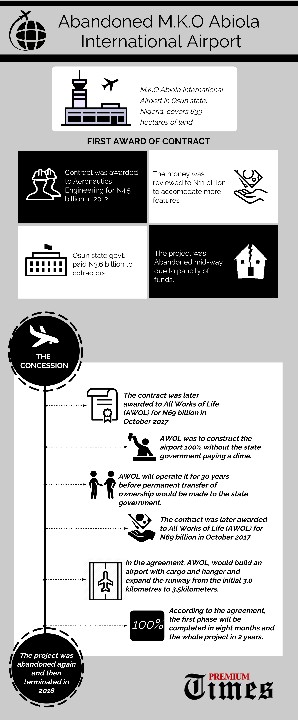
|
| Politics › Re: FOI: Despite Court Of Appeal Ruling, Lagos Refuses To Open Its Books by Blue3k2(op): 2:22pm On Aug 17, 2018*. Modified: 2:06am On Aug 18, 2018 |
If the appellate courts cant agree the supreme court needs to step in to give final ruling. Alot of fraud will be uncovered if the supreme court agrees that FOI applies to all tiers of government. If they dont people have to get law passed in their state if they care about transparency.
Front page: Lalasticlala |
| Politics › FOI: Despite Court Of Appeal Ruling, Lagos Refuses To Open Its Books by Blue3k2(op): 2:16pm On Aug 17, 2018 |
Despite a Court of Appeal decision in April stating that the Freedom of Information Act is applicable to all states in Nigeria, the Lagos State government has refused to disclose its education budget.
An appellate court in Akure in March had ruled that Nigerian states had no powers to reject requests filed under the FOI Act, especially on information around public expenditure.
Last May, to civic organisation, BudgIT, filed an FOI request to the Lagos State government asking for a breakdown of the state’s education budget between 2015 and 2018.
The state government, through its ministry of justice, refused to accede to the request.
“After a careful review of the FOI Act and the recent judgment of the Court of Appeal (Edo State Division) in EDOCASA V OSAKUE & 8 ORS delivered on 28th March, 2018, it is the advise of this Office that the FOI Act is not applicable to State Governments except the FOI Act is domesticated by the State Government (being at the discretion of the State to enact a similar law),” read the government’s response signed by Hameed Oyenuga, Director of Advisory Services and Judicial Liaison.
“In view of the above, we further advise that any request in line with the FOI Act should not be acceded to as Lagos State has not domesticated the law and as such not applicable to the Lagos State government.”
One law, multiple rulings
The Freedom of Information Act was signed into law in 2011 by former President Goodluck Jonathan to make public records more easily accessible to the people.
But various state governments had continued to argue that the law requires to be similarly passed by their houses of assemblies.
Last November, an Ikeja Division of the Lagos State High Court ruled that ruled that the FOI is applicable to the Lagos State government and does not require “domestication” by the state to have an effect.
The Lagos State government promptly lodged an appeal at the Court of Appeal seeking to set aside the ruling.
In March this year, another appellate court in Benin gave a different ruling from that given by the one in Akure, holding that the FOI is not binding on state governments as they are not “a stooge to the federal government.”
Atiku Samuel, the head of research at BudgIT, said the Lagos State government’s decision to pick court judgments to obey shows its insincerity.
“We suspect that something is actually wrong,” Mr Samuel told PREMIUM TIMES.
“What we did was to ask some critical questions especially around education and then the result was so disheartening, the state government again decided that information should not be for the general public.
“We feel that that’s condemnable giving the fact that the government of Lagos State are just the custodians of the income of the people that had been passed over to them.”
It wasn’t the first time Mr Samuel organisation had run into a brick wall while seeking information from the Lagos State government.
Last January, a similar request for the government’s financial statement relating to its revenue over the past five years did not get a response.
“It shows clearly that there is something the state government is hiding from the people, and that explains why the educational system – the educational institutions in Lagos are the way they are,” Mr Atiku said.
“Virtually all secondary schools in the state are in a very bad state despite the huge revenue the state had been collecting over the years. The budget would have been the pointer to where the problem lies.”
The Lagos State government is renowned for ignoring FOI request on its activities from journalists and civil society organisations.
Adetokunbo Mumuni, executive director of Social Economic Rights and Accountability Project, SERAP, told PREMIUM TIMES that the Supreme Court would be the final arbiter on the FOI issue.
“It only shows a lack of transparency on the part of the government and that they cannot be talking about transparency and accountability when some of their dealings are shady and not open, it’s as simple as that,” said Mr Mumuni, whose organisation is challenging in court the state government’s refusal to account for spendings on public schools in the state following a $90 million World Bank loan.
“If they try to pick one judgment and rely on it, whereas another judgment said it is possible, then until we have a final pronouncement from the Supreme Court that’s when we can say we are at the end of it.” Source: https://www.premiumtimesng.com/news/top-news/280552-foi-despite-court-of-appeal-ruling-lagos-refuses-to-open-its-books.html |
| Christianity Etc › Re: Christians Not Allowed Places Of Worship In Some Northern Tertiary Institutions by Blue3k2(op): 6:54pm On Aug 16, 2018 |
You should read and find out. Afamed:
Which of the Northern Federal institutions? |
| Christianity Etc › Christians Not Allowed Places Of Worship In Some Northern Tertiary Institutions by Blue3k2(op): 6:45pm On Aug 16, 2018 |
Christians Not Allowed Places Of Worship In Some Northern Tertiary Institutions - Bishop Kukah
The Bishop of the Roman Catholic Diocese of Sokoto, Matthew Kukah, has alleged marginalisation of Christian students in some tertiary institutions in northern Nigeria.
Speaking at a book launch organised by PREMIUM TIMES Books on Wednesday, Mr Kukah accused northern governors of aiding the alleged injustice.
“As I’m talking here now, whether it is Bayero University, Usman Dan Fodio University, most of the universities and tertiary institutions in northern Nigeria, Christians don’t have a place to worship after over 40 years of the existence of these universities and these are the areas where the intellectuals, those who are going to govern Nigeria, this is where they are.
“Up till today, as I’m talking to you, you can’t find a single governor in northern Nigeria that will effortlessly sign a certificate of occupancy for the building of a church. Nowhere,” Mr Kukah lamented.
The cleric said the academic and security environment in the country discourage having frank discussion on insecurity.
He accused Nigerian scholars of fuelling crisis by their views and teachings.
“Northern Nigeria is literally a closed book. And our inability to understand northern Nigeria collectively as a nation accounts for most of the crisis we still face in this country.
“We have a very serious crisis in our country. A crisis that relates to the fact that those who are in academia are simply miniature gods of ethnic hegemony. We can see from reactions, Boko Haram, politics in Nigeria, 2019 and others, when you listen to academicians, what we are saying are not different from what the people in our villages feel.
“We were barely six months or so into this crisis when I published an article titled ‘Bread, not bullet.’ I was trying to make the point that we needed a much more robust engagement based on our common humanity. We needed to hear the stories leading people to this kind of life rather than just turning this into a gun battle. Suddenly, few years later, we are shamelessly pretending that weapons for fighting have not been bought or money has been squandered.”
Mr Kukah said the orientation of northern children prepares them for violence against non-Muslims.
“I live in Sokoto and I have windows of my churches broken because young children are throwing stones at the cathedral. I had one of my parishioners went blind three years ago. His house was by the roadside. Children coming from Quranic studies threw stones to his house. I’m asking the question, what are these children being thought about the other person? This is a very serious crisis in northern Nigeria.
“These kids will grow up and I can’t stop them from burning my church because they have given them, their superiors have given them impression that somehow, not being a Muslim, you belong to a different specie.”
He urged Nigerians to come together to identity themselves first as humans and not religious adherents. He gave instances to buttress his point.
“The point I’m making is that people are behaving like I cannot be a non-Muslim and study Islam. We have a crisis at our hands. A cousin of mine who is a non-Muslim just came back from Egypt. His Arabic is most likely better than that of most people in Nigeria but, in the course of his programme, he was sent out on the ground that he’s doing too much of Arabic and truly he was digging much more than the people that are teaching.
“We used to have a professor who was a priest. In fact, many call him a Muslim because everything about him is Muslim but he ran into a problem in the University of Ibadan because Muslims are now saying, ‘can you be a priest and talk to us about Islam?’
“Really, one of the problems northern Nigeria must address is the limit of intellectual curiosity. These are some of the boundaries that Raufu crosses effortlessly.
“A cousin of mine, he’s dead now, living in Kano called me one day and said his little son just brought a beautiful result but had 85 per cent in Arabic. And he said to me, why will this boy have 85 per cent in Arabic? I asked what is the problem? He said no, he got 70 per cent in CRK, why will he go and have 85 per cent in Arabic? I said Arabic is a subject. He said no, he could become a Muslim tomorrow.”
Mr Kukah praised Raufu Mustapha, the editor of the two books unveiled, for his unrelenting hope in Nigeria while alive.
“I spent a good part of my evening at Raufu’s office and I would listen to him talk about Nigeria and I always marvelled at the depth of his scholarship,” he said.
“In a very strange kind of way, this ray of hope that he had in the horizon. Things were very bad but he always believed that there was a lot of hope.” Source: https://www.premiumtimesng.com/news/top-news/280422-christians-not-allowed-places-of-worship-in-some-northern-tertiary-institutions-bishop-kukah.html |
| Politics › Re: Lai Mohammed Lied, Nigerian Govt Paid ‘large Ransom’ To Free #dapchigirls – UN by Blue3k2(op): 3:56pm On Aug 16, 2018 |
Im surprised the UN would expose by leaking this information out. We can expect Response from Presidency soon if people keep keep talking about this. |
| Politics › Re: Lai Mohammed Lied, Nigerian Govt Paid ‘large Ransom’ To Free #dapchigirls – UN by Blue3k2(op): 3:36pm On Aug 16, 2018 |
All this information is cool but it doesnt explain why Boko Haram qould keep Leah. If it is about money the would just pay extra and claim total victory. It's weird to say least I can't understand either parties logic. One of them, Leah Sharibu, who reportedly refused to denounce her Christian faith, is still with the abductors. Front page: Lalasticlala |
| Politics › Lai Mohammed Lied, Nigerian Govt Paid ‘large Ransom’ To Free #dapchigirls – UN by Blue3k2(op): 3:05pm On Aug 16, 2018*. Modified: 3:50pm On Aug 16, 2018 |
Contrary to the claim by the Nigerian government through the Information Minister Lai Mohammed, the government paid a “large ransom” to free scores of female students kidnapped by the Boko Haram from their school in Dapchi, Yobe State, earlier this year, the United Nations has said.
Over 100 girls were kidnapped from the Dapchi school by a Boko Haram faction in February this year with about 105 of them later released by the terrorists. One of them, Leah Sharibu, who reportedly refused to denounce her Christian faith, is still with the abductors.
Following the release of the girls, about a month after they were kidnapped, Mr Mohammed told journalists that it was not true ransom was paid for their release.
‘’It is not true that we paid ransom for the release of the Dapchi girls, neither was there a prisoner swap to secure their release,” Mr. Mohammed told journalists in Maiduguri with his statement circulated by his office to media organisations including PREMIUM TIMES.
“What happened was that the abduction itself was a breach of the ceasefire talks between the insurgents and the government; hence it became a moral burden on the abductors. Any report that we paid ransom or engaged in prisoner swap is false.”
A UN report has now shown Mr Mohammed’s claim to be false.
The report recently submitted to the UN Security Council on Boko Haram and related terrorist organisations, said such ransom and the predominance of cash economy was providing oxygen for the insurgency around the Lake Chad region.
The UN report is titled “22nd Report of the Analytical Support and Sanctions Monitoring Team”, related to Resolution 2368 (2017) regarding “Islamic State in Iraq and the Levant – ISIL – (Da’esh), Al-Qaida and associated individuals and entities.”
“In Nigeria, 111 schoolgirls from the town of Dapchi were kidnapped on 18 February 2018 and released by ISWAP on 21 March 2018 in exchange for a large ransom payment,” the report stated.
The UN report negating the Nigerian government’s stance reflects the manner of propaganda the Nigerian government and its military have been using to fight the war against Boko Haram.
PREMIUM TIMES reported how the Nigerian military has repeatedly lied about military casualty in the war and, along with the government, claimed the Boko Haram sect was already defeated.
The government’s stance appears to be that suppressing information, or as in this case lying about it, would reduce the efficacy of the insurgents and thus limit their ability to carry out their terrorist acts.
The Dapchi girl’s ransom would not be the first by the Nigerian government to free victims held by Boko Haram. Huge ransom was also paid by the Buhari administration to free many of released Chibok girls kidnapped in 2014, senators including the leader of ruling party in the Senate, Ahmed Lawan, said. Although the move is largely welcomed by many Nigerians as it ensures freedom for the victims, experts fear it has helped fuel the insurgency by ensuring the Boko Haram has access to funds to buy more weapons and sustain themselves; a stance shared in the UN report.
OTHER SOURCES OF FUNDING
Apart from ransom, the UN also listed other ways the Boko Haram group is being funded.
“…extortion, charitable donations, smuggling, remittances and kidnapping as parts of ways Boko Haram is funded,” the report stated as quoted by the News Agency of Nigeria.
The report also stated how some “doctrinally based non-governmental organisations” were funding Boko Haram and other terror groups.”
“The number of doctrinally based non-governmental organisations sending funds to local terrorist groups was growing, and Member States were concerned that radicalisation was increasing the threat level in the Sahel.
“Meanwhile, Boko Haram (QDe.138) and the Islamic State West Africa Province (ISWAP) have had a similar impact in their areas of control, including the Lake Chad basin.
“The predominance in the region of the cash economy, without controls, is conducive to terrorist groups funded by extortion, charitable donations, smuggling, remittances and kidnapping.”
According to NAN, “the report was signed by Edmund Fitton-Brown, Coordinator, Analytical Support and Sanctions Monitoring Team, who said the report was “comprehensive and independent”, and Kairat Umarov, Chair, Security Council Committee. Source: https://www.premiumtimesng.com/news/headlines/280418-lai-mohammed-lied-nigerian-govt-paid-large-ransom-to-free-dapchigirls-un.html |
| Politics › Super Highway, Super Headache by Blue3k2(op): 12:31pm On Aug 16, 2018 |
Judex Okoro, Calabar
Cross River State in the last couple of years has been noted as a frontline tourism destination in the country. In an effort to keep pace with the vision of past administrations and, perhaps, carve a niche for his administration, Prof. Ben Ayade, at his inauguration/ swearing ceremony on May 29, 2016, promised to execute three signature projects including the 260-kilometre super highway, the Bakassi Deep Sea Port and garment factory.
“Let me use this opportunity to announce our signature projects; we shall undertake the construction of a dual carriage super highway from Calabar through Ikom and Ogoja to the Ranch Resort in Obudu.
According to Ayade, the 260-kilometre super highway is planned to lead from a proposed deep sea port at Esighi in Bakassi Local Government Area run through the Cross River National Park and up to Katsina Ala in Benue State. Experts have estimated it at a cost of N700 billion or about $3.5 billion
Committed to executing the project, Governor Ayade, six months into office invited President Muhammadu Buhari on October 20, 2015 to perform the ground-breaking ceremony of the super highway project at Akamkpa based on interim Environmental Impact Assessment (EIA) report by the Federal Ministry of Environment.
However, three years after, the dream super highway project seems to be a mirage as it has been dogged by series of challenges ranging from finance, administrative bottlenecks and allegations of environmental degradation by the host communities.
Besides the EIA brouhaha, there has been persistent knocks and scarthing criticisms from non-governmental organisations, alleging that the Cross River super highway should not be constructed because of carbon emissions and global warming. Some of these NGOs further argued that some of the best preserved rain forests in Nigeria are the Cross River National Park and the Ekuri Community Forest, adding that the forests are under serious threat which could destroy the enormous biodiversity including rare and endangered species. Indeed, it has been nicknamed by some analysts as ‘super trouble.’
But the most disturbing issue is the non-implementation of compensations of the host communities who have lost farmlands and community forests. The communities include Esighi in Bakassi Local Government Area, Ekuri and Okokori villages of Akamkpa and Obubra as well as Bekwarra.
Expressing concern on the ill treatment meted out on affected communities since the land was acquired in 2015, one of the NGOs based in the state, the Peace Point Action, berated the state government for allegedly refusing to pay compensation to individuals and communities whose farmlands, economic crops, forest and plantations were destroyed during initial earthwork on the proposed highway route.
Coordinator of the group, Umo Isuaiko, said it was surprised that since late 2015 when the people’s economic crops and forest were destroyed, no compensation has been paid and therefore called on government to immediately pay compensation to the affected people to ameliorate their sufferings whether or not government continued with the project.
He said it was high time the state government followed due process in acquiring land because the Land Use Act says government holds the land in trust for the people and could only acquire it with their consent for overriding public interest.
“The alleged realignment of the Cross River National Park to pave way for the super highway is illegal and should be stopped forthwith,” he stated.
Isuaiko further advised the government to ensure that 23 conditions contained in the fourth provisional EIA approved by the Federal Ministry of Environment were met as anything to the contrary would not be accepted.
Also condemning non-payment of compensation, Executive Director of Rainforest Resource and Development Centre (RRDC), Mr. Odey Oyama, alleged that the proposed super highway was a gimmick by the administration to create access into the forests land of the state so as to have opportunity to exploit the timbers for their own economic gains.
Speaking during a workshop which had its theme, “Media sensitization and forest community concerns and super highway” organised of Media professionals in the state, Oyama maintained that if the rate of deforestation in the state continued unabated, Cross River might losing her vast rain forest before 2040.
Further lashing out at government, an environmental consultant, Tony Atah, said the super highway being one of the first major project of the present administration should have united the people but has brought doubts and pain in the minds of many due to lose of vast acres of land and tree crops.
“The super highway is not a development issue at all; rather, a governance issue. If we are not able to sit down as Cross Riverians and discuss, understand what it is all about, we may spend our money without achieving anything.”
In the same vein, lead speaker on media advocate on Cross River Super highway, Pamela Brade, questioned the sincerity of the government for proposing to construct a road ten kilometres to the right and ten kilometres to the left, adding that such will rather wipe out villages that should have benefited from the super highway project.
But the government dismissed the allegations.
Speaking on efforts to ensure that the EIAs guidelines were met, Commissioner for Information, Rosemary Archibong, said: “It’s unfortunate that in spite of our commitment to construct superhighway and deep sea port with a view to decouple the state of dependence on federal allocation, the agencies responsible for approvals thwarted our efforts.
“The land Use Act of 1978 permits the governor to make use of land within his jurisdiction for the benefit of its citizens. Some Non-governmental Organizations (NGOs) are conniving with perceived political opponents of the state government to frustrate the project.”
She said the ministry of lands is working out modalities to ensure every community is compensated accordingly, advising NGOs not to join opponents to politicise the super highway project.
“In order to ensure the success of the project, we have sacrificed the 10-kilometer span limiting ourselves to 70 meters. So, I expect them to cooperate with us as we have met all the requirements as far as EIA requirement is concerned,” she said. Source: http://sunnewsonline.com/super-highway-super-headache/ |
| Business › Re: Firs Shuts Down Tinapa Over Alleged Tax Evasion by Blue3k2(op): 11:18am On Aug 16, 2018 |
Wow that sucks. The tax man came during summer vacation. Oh well hopefully they get this issue sorted out quick. |
| Business › Firs Shuts Down Tinapa Over Alleged Tax Evasion by Blue3k2(op): 10:51am On Aug 16, 2018 |
By Ike Uchechukwu
Calabar—The Federal Inland Revenue Service, FIRS, has shut Tinapa business /leisure resort as well as Marina Resort both in the heart of Calabar, Cross River State, over alleged non-payment of tax by both organisations.
The closure, which started on Tuesday, has paralyzed activities in both resorts which serve as the biggest hospitality and tourism spots in Calabar, thereby leaving fun seekers, tourists and visitors alike stranded.
Vanguard gathered that FIRS officials entered the premises of the business resorts with heavily armed security men and sealed off their main offices. Read more at: https://www.vanguardngr.com/2018/08/firs-shuts-down-tinapa-over-alleged-tax-evasion/Front page: Lalasticlala |
| Politics › Lagos Light Rail Project Dragging Too Long — PDP by Blue3k2(op): 10:38am On Aug 16, 2018 |
The Lagos State chapter of the Peoples Democratic Party (PDP) has decried what it called the “frequent delays” in the delivery of the state light rail project.
The Publicity Secretary of the party in the state, Taofik Gani, expressed the concern in a statement in Lagos on Wednesday.
The PDP was reacting to a statement by the state government that the first phase of the project (Blue Line), which commenced in 2008, could only be delivered in 2022.
The state government had initially promised 2011 and then 2018 as delivery dates for the 27km light rail project running between Marina, Mile 2 and Okokomaiko.
Kolawole Ojelabi, Director of the Lagos Area Metropolitan Authority (LAMATA) had on Sunday said the shift in date followed a comprehensive review of all the aspects of the project by the state government.
He explained that the foreign consultants engaged to do the technical and due diligence on the project said detailed work would not finish on it before 2022.
The PDP, however, said the project had almost become a drain pipe consuming the state’s resources endlessly.
According to Mr Gani, the amount of money spent did not reflect the level of work done so far on the project.
Mr Gani said it was surprising that Babatunde Fashola, the immediate past governor of the state, now the Minister of Works, could not support the project”s delivery.
“This project was estimated to end within two years, now it is to end in 2022, that is 12 years after due delivery date.
“All monies purportedly spent on the project did not reflect in the work done.
“So many property owners in the axis are still crying for compensation even as government claim total payment of compensation. It is a lie.
“We demand a probe of this project and indeed many other projects suffering the same fate as the rail project,” he said. Source: https://www.premiumtimesng.com/regional/ssouth-west/280342-lagos-light-rail-project-dragging-too-long-pdp.html |
| Politics › Apapa Wharf Road Ready In September — NPA MD by Blue3k2(op): 5:42am On Aug 13, 2018 |
The Managing Director, Nigerian Ports Authority (NPA), Ms Hadiza Usman, has said that the 2km Apapa Wharf Road being reconstructed would be completed and opened to motorists by the end of next month.
Usman made the disclosure in an interview in Lagos on Sunday.
The managing director said that the reconstruction which would cost N4.34 billion would enable the Federal Government to achieve its goals as regards the Ease of Doing Business.
She said that NPA was working with the Federal Ministry of Power, Works and Housing to rehabilitate all ports’ access roads in the country to ensure a level playing field and to also facilitate trade.
According to her, NPA and the Federal Ministry of Power, Works and Housing will develop a mechanism for funding all reconstruction and rehabilitation of ports’ access roads.
She said that government had also approved the commencement of reconstruction of Tin-Can Island Port access road to Mile that the contractor would start work any moment.
She also said that the Apapa Port had been illuminated for 24-hour port operations, noting that the authority was working toward an electronic gate system to stop touting within the port environment.
Usman said that NPA had put in place an aggressive monitoring mechanism, adding that the authority visited the site from time to time to check the progress and any bottleneck within the construction area.
The Minister of Power, Works and Housing, Mr Babatunde Fashola, had on June 16, 2017, signed a N4.34 billion Memorandum of Understanding (MoU) with Dangote Group and other stakeholders for the reconstruction of Apapa Wharf Road.
The project is being funded by AG Dangote Construction Company Ltd., an arm of the Dangote Group, the Nigerian Ports Authority (NPA) and Flour Mills of Nigeria.
Fashola had explained that the gridlock in Apapa became compounded and had reached an unbearable level as transporters ignored the old system of moving cargo through rail to trucks and containers.
He said that the choice of the transporters to use road instead of rail for haulage increased gridlock, caused degeneration as well as well hardship to residents of Apapa.
He commended the leadership role’ of the stakeholders in solving the complex problems in Apapa and its environs.
According to him, the situation has caused stress to residents, business owners and other stakeholders in the state.
“As a result of all these unsavoury practices, we have reached a point of near total gridlock. It is difficult to move cargo in or out; difficult for residents to get home and this must stop,’’ he said.
Fashola said that it took time to reach an agreement on the project because the stakeholders were putting up an effective design that would address the drainage problem because the area was water-logged.
The minister said that though the three parties (Dangote, Flour Mills and NPA) were funding the project, the Federal Ministry of Power, Works and Housing would supervise it through all the stages to ensure quality and compliance to standards.
The construction commenced on July 17, 2017. (NAN). Source: https://www.vanguardngr.com/2018/08/apapa-wharf-road-ready-in-september-npa-md/Front page: Lalasticlala |
| Politics › Re: LCCI Proposes 13% Derivatives To States Hosting Ports by Blue3k2(op): 7:23am On Aug 08, 2018 |
Bump |
| Politics › Re: LCCI Proposes 13% Derivatives To States Hosting Ports by Blue3k2(op): 8:32pm On Aug 05, 2018 |
This sounds like plan b since special funds bill was rebuffed. It could work if it extends to all ports types. As Nelly said It ain't no fun unless we all get some. His other suggestion about moving administration of ETLS to NIPC is a good plan. Ruwase said that it was imperative for derivation principle to be applied to Customs Duty and Value Added Tax (VAT) in the spirit of equity. |
| Politics › LCCI Proposes 13% Derivatives To States Hosting Ports by Blue3k2(op): 8:15pm On Aug 05, 2018*. Modified: 8:43pm On Aug 05, 2018 |
The Lagos Chamber of Commerce and Industry (LCCI) says the 13 per cent derivatives principles applied to oil producing areas should be extended to states hosting the nation’s ports.
The President of LCCI, Mr Babatunde Ruwase, made the suggestion at a news conference on the state of the economy yesterday in Lagos.
Ruwase said that ports activities created profound negative externalities to host states and exerts tremendous pressure on the states’ facilities, which significantly affects roads, health facilities, traffic, environmental management and pollution.
“These are costs that are borne by the states in which the ports are located and offers basis to argue that derivation principles should be applied to revenue generated through customs’ duties from the ports,” he said.
Ruwase said that the basis for derivation principles to oil producing areas was the negative externalities of oil production.
“The same logic should apply to Lagos State that suffers tremendous negative externalities because it is hosting the busiest ports in the country,” he said.
Ruwase said that it was imperative for derivation principle to be applied to Customs Duty and Value Added Tax (VAT) in the spirit of equity.
According to him, it allows state to provide facilities and infrastructure to support economic activities.
He said there was increasing complaint by exporters regarding difficulty of exporting goods from Nigeria to other West African countries.
This, Ruwase said, was due to the bureaucratic bottlenecks of registration of products under the ECOWAS Trade Liberalisation Scheme (ETLS).
The ETLS was currently managed by the Ministry of Foreign Affairs.
“In the past, Nigeria used to have Ministry of Integration and Economic Cooperation which has responsibility for facilitating trade with other African countries, but this ministry has fused into the Ministry of Foreign Affairs.
“We believe that the administration of ETLS should be moved from Ministry of Foreign Affairs to the Ministry of Industry, Trade and Investment, specifically the Nigeria Investment Promotion Commission (NIPC),” Ruwase said.
He said that it would improve the administration of ETLS and serve exporters better.
On political instability and investment climate, Ruwase urged political actors to demonstrate restraint and refrain from activities that could weaken stability of polity and create avoidable social tension as electioneering activities increases.
He said there was a strong nexus between political stability and economic progress, adding that recent events in the polity were a cause for concern.
Ruwase said that an unstable political environment would escalate investment risk, create anxiety and weaken investors’ confidence.
“No meaningful investment can take place where there is no regard for rule of law.
“We should not create a situation where citizens and investors lose confidence in the state institutions.
“A loss of confidence in state institution is a recipe for anarchy; we, therefore, need to ensure the credibility and integrity of our institutions,” he said.
Ruwase said that respect for rule of law, independence and neutrality of institutions, especially non-partisan security agencies and judiciary, was critical at this present time. Source: http://shippingposition.com.ng/main-news-381Front page: Lalasticlala |
| Politics › Re: Buratai Warns Commanders Against Fleeing From Terrorists by Blue3k2(op): 4:40pm On Aug 03, 2018 |
If the solders are really suffering shortage of equipment you really cant blane them for a strategic retreat. How exactly are the suppose to hold position? If they are cowards sanction them. |
| Politics › Buratai Warns Commanders Against Fleeing From Terrorists by Blue3k2(op): 3:48pm On Aug 03, 2018 |
The Chief of Army Staff, Tukur Buratai, has circulated a set of operational guidelines warning Nigerian Army commanders of grave consequences should they abandon their positions in the face of firepower from Boko Haram insurgents.
The 180-word memo, sent to all commanders at all levels, formations and locations in the nine-year-long war against Islamist militants across Nigeria’s North-east, was a direct response to the recent killing and maiming of soldiers and officers by terrorists, amidst renewed fears of a resurgent Boko Haram.
At least two officers and 43 soldiers have been killed in Boko Haram attacks on military targets between July 13 and 26, a shocking setback that sent the country’s top military brass seething, PREMIUM TIMES learnt.
“Recent occurrences in” ‘Operation Lafiya Dole’ “where units abandon their positions cowardly in the face of action” from Boko Haram terrorists “without reasonable resistance is worrisome,” Mr Buratai said in the July 27 memo to all commanders, adding that it “portrayed” them as “incompetent and cowardly”.
“It also has the potentials to rubbish all the laudable gains made” in the war against Boko Haram
“Consequently,” Mr Buratai, a lieutenant-general, said any commander who “abandons his position in the face” of enemy fire “leading to avoidable death of troops and loss of equipment will be subjected” to harsh punishments as enumerated in the Armed Forces Act.
“All should be reminded that the law recommended any officer or soldier found guilty of cowardly behavior ‘shall on conviction by a court martial be liable to suffer death or any less punishment provided by the Act,’ depending on the circumstances of the case.”
Multiple military sources authenticated the document to PREMIUM TIMES, days after political activist Deji Adeyanju first disclosed its content to his followers on Twitter.
A misplaced swagger
A spokesperson for the Nigerian Army would not comment on the memo, but commanders and other soldiers on the field said they found it “intimidating, distracting and disturbing.”
The troops, who spoke under strict anonymity to avoid being punished for unathorised interaction with the media, said Mr Buratai completely failed to discuss the real triggers of the recent killings of soldiers and the general resistance of Boko Haram fighters.
“He’s supposed to provide strategic intelligence to the troops,” a commander said. “But had severally informed them and the world that BH is completely defeated.”
The commander, who noted that Mr Buratai would likely start with officers found wanting in the recent attacks on a military base in Yobe and another in Jakana, Borno State, said the troops lacked adequate supplies. Between July 21 and 26, 17 soldiers were killed and 18 wounded in multiple Boko Haram attacks
“All the armoured vehicles and T72 tanks brought by former President Goodluck Jonathan (which this gov’t refused to sustain) have broken down and in a state of disrepair,” the officer said.
The officer said reinforcements for detachments under attacks are often late, when they come at all. This has led them having to beg for support from neighbouring countries.
“Imagine Cameroonian soldiers had to come 60 kilometres into Nigeria to support us in Sambisa,” he said. “We keep begging them to support us becuase they have the equipment that we don’t have.”
“Same thing being done with Chad at the Lake Chad region, it is really sad,” the officer said before quoting the apocryphal saying that defines insanity as doing the same thing over and again while expecting a different result.
Since July 13, at least 45 soldiers and commanders have been killed in confrontation with Boko Haram.
The terrorists also stormed military brigades to kill troops and cart away equipment and supplies, including food items in large quantity. At least 50 were wounded in critical conditions.
The sudden surge in attacks on troops followed months of remarkable drop in Boko Haram attacks on soldiers.
While civilians were still being regularly killed, and some troops being lost in intermittent ambushes, whole-scale attacks targeting military formations and detachments were rare since the October 2016 killing of scores of soldiers in River Komadogou Yobe.
Although military commanders and soldiers affected by the attacks at the time told PREMIUM TIMES inadequate supply of food, equipment and arbitrary deductions in their allowances were to blame, the Army launched a probe into the incident without disclosing its outcome.
A few weeks after in December 2016, some soldiers attempted to lynch Victor Ezeugwu, the commander of Nigerian Army 7 Division headquartered at Maimalari cantonment, after he left them on the battlefront for two days without food supplies.
In an incident as recent as last November, soldiers on the battlefront complained to PREMIUM TIMES they were going weeks without allowances, which they had long decried as inadequate in the circumstance.
Another source said Mr Buratai’s apparently premature victory lap, largely drawn from the position of President Muhammadu Buhari, has given troops a false sense of the complexity of the war, as well as the timeline of the withdrawal.
“So, it is not only the problem about lack of food or equipment to fight Boko Haram or even the small allowances but everyone is relaxed that Boko Haram had been defeated,” another military commander said.
Striking Balance
But Mr Buratai’s warning was silent on whether the troops would see an immediate improvement in their welfare, equipment and supplies and air support that would boost their morale on the battlefield.
It only said that Section 47 of the Armed Forces Act would be activated against soldiers who retreat in the face of Boko Haram attacks.
Although the section prohibited troops from abandoning their outposts in the face of enemy fire, it also contains clauses that allowed troops to preserve their lives under clear conditions.
“It shall be a valid defence under this section if the surrender or abandonment of a place, post or thing by a person charged with its defence is justified by reason of superior order, the utmost necessity such as want of provisions, water, logistic support, the absence of hope or relief, inability to offer further resistance or the certainty or extreme probability that no further efforts could prevent the place, post or thing falling into enemy hands,” the law said.
Security analyst Mukhtar Dan’Iyan told PREMIUM TIMES the law was balanced enough and Mr Buratai’s threats would only further worsen the situation unless they are immediately reversed and the working conditions of troops prioritised instead.
“Mr Buratai is only following the footsteps of Alex Badeh who said they would kill troops who run from enemy fire and bury them on the field,” the New York-based analyst said. “That did not turn out well because it was not the best approach to take.”
“It is still not the best approach to take now because we all know Nigerian soldiers are brave they want to fight to win,” he said. “But you cannot do that when you are facing superior firepower, that is a suicide mission.”
The expert said Nigerian soldiers are not contracted to die on the battlefronts but to help defend the territorial integrity of their fatherland from internal and external aggression.
“Nigeria is not Iran which found young persons and sent them to the battlefield and died during the Gulf War,” he said. “Our soldiers are supposed to help their country but they are not sent to deliberately die there. They are not getting the support they need to boost their morale and be successful.”
“We can only hope that Mr Buratai would relax on his anger on his men because it is not going to make them fight hard, but would only demoralise them further,” Mr Dan’Iyan said.
Experts also drew a connection between the harsh conditions troops face in the Boko Haram war and the growing rate of suicide amongst those deployed in the North-east. Last November, a captain on active deployment was gunned down by a sergeant.
In June, another captain committed suicide after undergoing initial examination for mental health symptoms. The military said the incidences would be investigated, but it was unclear whether anything was done to forestall a repeat.
Political and security analyst Chris Ngwodo told PREMIUM TIMES Mr Buratai should be interrogating the apparent and remote causes of the renewed Boko Haram exploits that suggested the insurgents have regrouped after months of relative success by the military.
“The narrative was that the war was being gradually won,” Mr Ngwodo said. “The issue is what has changed to create the kind of attacks that we are seeing now?”
“What has changed that contributed to the low morale of our soldiers, who have been commended for their gallantry,” he said. “Why are they now being called cowards by their leadership?”
“These are the issues that must be interrogated,” the analyst said in Abuja. “I do not think that is the most effect way of turning around the performance of the military in the North-east.” Source: https://www.premiumtimesng.com/news/headlines/278792-boko-haram-army-chief-buratai-spits-fire-warns-commanders-against-fleeing-from-terrorists.html
|
| Travel › Lagos-ibadan Rail Ready December by Blue3k2(op): 2:29am On Aug 03, 2018 |
The Lagos-Ibadan standard rail line would be commission in December, transport minister Rotimi Amaechi gave the assurance in Lagos on Thursday.
After a closed door meeting with Gov.Akinwunmi Ambode of Lagos State, Amaechi thanked members of the communities whose property were affected by the construction.
He said the contractors handling the project would commence work on the Lagos axis next week on both the standard gauge lines.
The Lagos-Ibadan rail tracks
The minister said the Lagos State Government had been very helpful in the payment of compensation to those affected.
The federal government, he said, was looking for private partnership to build the two mega Stations in Lagos.
He said that the one at Apapa and the other at Ebute-Meta would be expanded to accommodate a mall and hotel.
Amaechi said discussions were also on with the contractor handling the narrow gauge lines.
He explained that newly awarded contract for Tin Can-Oworonshoki-Ojota road would also aid in evacuating cargoes from the Ports in addition to the two rail lines which would both terminate at the Apapa seaport.
Host Ambode thanked the Federal Government as well as the Minister of Works, Power and Housing for expediting action described the efforts being made as a two-prong approach to ease the Apapa gridlock.
He reiterated the State Government’s commitment to collaborate with the Federal Government on the project as it would alleviate the sufferings of the people.
The News Agency of Nigeria (NAN) reports that both the Federal and the State Governments have been making concerted efforts in the last few weeks to find lasting solutions to the traffic gridlock which had caused a lock down on both businesses and private activities in the Apapa axis.(NAN) Source: https://www.vanguardngr.com/2018/08/lagos-ibadan-rail-ready-december/
|
| Politics › Re: Eastern Ports Recorded 39% Of Dry Cargoes In Q1 Says Peterside by Blue3k2(op): 6:00am On Aug 02, 2018 |
You claim they're cooking books and engaging in "unhealthy competition" yet they haven't driven their competitors out of business. There are only two new companies the federal government has concessioned ports terminal to in delta port being Green Leigh Nig. Ltd. And Associated Marine Services. The rest of companies have been same since 2007. Source: http://nigerianports.gov.ng/terminals/docadams:
As has been revealed he mentored Intel on the principle of unhealthy competition and cutting corners in financial accounting. You may say Atiku is no longer in charge of intel, but his legacy still looms large. Or is there any new logistic service coy now in competition with Intel? |


