The story of Jaja recounts a man of servile status hurdling intimidating odds to attain wealth and power, and founding in the latter half of the 19th century the most prosperous city-state in the Delta area of Nigeria. He has rightly been described as, perhaps, the most enterprising and accomplished of all African merchant princes on the west coast of Africa in the 19th century (Fajana and Biggs 1976:137-138). He first traded in Bonny but later founded a new flourishing trading settlement in 1869 in Opobo, a site where he felt he could best control the traditional sources of supply of palm oil in the region (Cookey 1974). As far as Nigerian nationalist historiography is concerned, Jaja`s greatness could be found in his principled resistance to foreign political control. Indeed, Fajana and Biggs (1976:137) describe Jaja as the first Nigerian nationalist of the nineteenth century. Thus, Jaja’s principled oppositions to British influence in the Niger Delta has largely been interpreted by some historians as the precursors to Nigeria’s nationalist struggles. https://africaphotography.org/sites/default/files/styles/media_gallery_large/public/Passavant%20Grey%20Album%2023750.jpg
Portrait of king Jajah with rappa. "Joja is resting his arm on a British-imported rattan chair, he wears a small-brimmed hat, and sports a suit jacket and shirt over a 'wrapper' a British-borrowed word describing the cloth that covers the lower half of his body. [...] ...the plaid cloths draped over his right shoulder and on the imported rattan chair are unquestionably Indian madras, a type of cloth the British were trading to the Ijo in large quantities after 1850." (Martha G. Anderson and Lisa Aronson in Schneider, Röschenthaler, Gardi: Fotofieber. Basel 2005. Original English version). Circa 1870-1888
However, Rotimi and Ogen (2008) argued that Jaja just like Nana Olomu of itsekiri`s stiff opposition to foreign penetration and the fierce resistance against British imperialism were essentially informed by their fervent desire to protect by all means their considerable commercial interests. Contrasting Jaja and Nana with their contemporaries such as Sultan Attahiru of Sokoto, Oba Ovonramwen of Benin and Awujale Aboki Tunwase of Ijebuland, to mention but a few, who fought relentlessly to defend the corporate existence and political sovereignties of their respective kingdoms (Crowder 1968:134-136; Oduwobi 2004:34-36; Ayandele 1992: 21), Rotimi and Ogen (2008) concluded that "the wars that Jaja and Nana fought were basically trade wars meant for the protection of their trading monopolies. Hence, their greatest significance lies in their roles as entrepreneurs cum super-merchants and not as proto-nationalists." Whether Jaja was supporting his business interest by fighting against the British or was genuinely fighting for the total emancipation of Opoboland, the end result was that Jaja succeeded in creating serious troubles for the British imperialist by proving that an African is capable of standing up to any man in whatever field of endeavor, irrespective of their race. Jubo Jubogba, also known as Jo Jo Ubam by the Igbo and as Jaja of Opobo, first, by the Europeans and later by most people, was born about 1821 in Amaigbo village in the Orlu district of Eastern Nigeria (Isichei 1976:98). Though he was originally an Igbo enslaved person, he became acculturated into Bonny society so successfully that even his enemies agreed that his state was one of the best administered entities on the west coast of Africa during the pre-colonial era (Crowder 1968:119). Apart from his outstanding business acumen, he had a keen understanding of Western values. He was fluent in English and even sent one of his sons to a Glasgow school. He also set up a secular school in his capital and lived in a European-style house, as did his chiefs. Jaja’s secular school was under the tutelage of a Kentucky born African American, Emma
White who relocated to Opobo and even changed her name to Emma Jaja (Isichei 1976:98; Ayandele 1966:81). In fact, Crowder (1968:119) states that “Jaja, ruler of a small but rich state, was clearly in the process of modernizing it independently of European rule”. A British palm oil merchant, Alexander Cowan went to Opobo for Alexander Miller Brother and Company in 1887 and made the following comments: "There can be no doubt Ja-Ja was the most powerful potentate the Oil Rivers ever produced. He was just as shrewd and fore-seeing as he was powerful…He could be stern, and he was strict, but he was always just, and the form of government he set up was as near perfect as anything of its kind could be. Every man had the right of appeal, and, though in effect his own authority was never questioned, he conformed to his own rules, and governed through his council of chiefs (Pedler 1974:74)."
KING JAJA OF OPOBO: NATIONALIST, FIRST NIGERIAN RICHEST MAN AND THE MOST ACCOMPLISHED ENTREPRENEUR OF THE 19TH CENTURY WEST COAST OF AFRICA Jaja of Opobo (full name: Jubo Jubogha; 1821–1891) was the first known Nigerian richest man, nationalist, a merchant prince and the founder of Opobo city-state which now forms part of Nigeria`s River State. Jaja whose real name was Mbanaso Okwaraozurumbaa was also a savvy political and military strategist, brought to the Bonny Kingdom as a slave, who was perhaps the most troublesome thorn in the flesh of 19th-century British imperial ambition in southern Nigeria.
EARLY LIFE AND BACKGROUND
Jubo Jubogba, also known as Jo Jo Ubam by the Igbo and as Jaja of Opobo, first, by the Europeans and later by most people, was born about 1821 at Úmuduruõha, Amaigbo village in the Orlu district, now Imo State of Eastern Nigeria (Isichei 1976:98). At birth he was given a native Igbo name Mbanaso Okwaraozurumba and was the third son of his parents, the Okwaraozurumba. Painting of Jaja of Opobo, anheuser-busch.com According to different oral sources, Jaja was sold into slavery in the Niger Delta under circumstances which are far from clear. One version of the oral traditions says that he was sold because, as a baby, he cut the upper teeth first, an abominable phenomenon in traditional Igbo society. Another version claims that he was captured and sold by his father's enemy. Regardless, he was bought by Chief Iganipughuma Allison of Bonny, by far the most powerful city-state on the Atlantic coast of Southeastern Nigeria before the rise of Opobo.
To follow the Ja Ja story or, indeed, revolution, an explanatory note is necessary. Until the end of the 19th century, the Delta communities played a crucial role in European and American trade with Nigeria. Acting as middlemen, these communities carried into the interior markets the trade goods of European and American supercargoes stationed on the coast and brought back in exchange the export produce of the hinterland, basically palm oil. As the Delta is dominated by saline swamps and crisscrossed by a labyrinth of creeks and rivers, the canoe was indispensable for trade. The Delta society was organized in Canoe Houses. A Canoe House was the pivot of social organization and also, notes K.O. Dike, "a cooperative trading unit and a local government institution." It was usually composed of a wealthy merchant (its founder), his family, and numerous slaves owned by him. A prosperous house could comprise several thousand members, both free and bonded, owning hundreds of trade canoes. In this intensely competitive society, leadership by merit - not by birth or ascriptions - was necessary if a house was to make headway in the turbulent, cut-throat competition that existed between houses. Any person with the charisma and proven ability, even if of servile birth, could rise to the leadership of a house, but could never become king. Ja Ja would achieve this, and much more.
Finding young Ja Ja too headstrong for his liking, Chief Allison made a gift of him to his friend, Madu, a chief of the Anna Pepple House, one of the two houses of the royal family (the other being the Manilla Pepple House). Ja Ja was slotted into the lowest rung of the Bonny slave society ladder, that of an imported slave, distinct from that of someone who was of slave parentage but born in the Delta.
As a youth, he worked as a paddler on his owner's great trade canoes, traveling to and from the inland markets. Quite early, he demonstrated exceptional abilities and business acumen, quickly identified with the Ijo custom of the Delta, and won the hearts of the local people as well as those of the European supercargoes. It was unusual for a slave of his status to make the transition from canoe paddling to trading, but Ja Ja - through his honesty, business sense, and amiability - soon became prosperous.
For a long while, Ja Ja turned his back on Bonny politics, concentrating his immense energies on accumulating wealth through trade, the single most important criterion to power in the Delta. At the time, Bonny politics were volatile as a result of the irreconcilable and acrimonious contest for supremacy between the Manilla Pepple House and the Anna Pepple House to which Ja Ja belonged. Coincidentally, both houses were led by remarkable characters of Igbo slave origins - Oko Jumbo of the Manilla House and Madu (after him Alali his son) of the Anna House.
In 1863, Alali died, bequeathing to his house a frightening debt of between £10,000 and £15,000 owed to European supercargoes. Fearing bankruptcy, all of the eligible chiefs of the house declined nomination to head it. It was therefore a great relief when Ja Ja accepted to fill the void. With characteristic energy, he proceeded to put his house in order by reorganizing its finances. Conscious that the palm-oil markets in the hinterland and the wealth of the European trading community on the coast constituted the pivot of the Delta economy, he ingratiated himself with both sides. In a matter of two years, he had liquidated the debt left behind by his predecessor and launched his house on the path of prosperity. When less prosperous and insolvent houses sought incorporation into the Anna House, Ja Ja gradually absorbed one house after another.
LIFE HISTORY AND LEGENDARY WORKS
By 1867, his remarkable success had become common knowledge throughout Bonny. The British consul to the area, Sir Richard Burton, had cause to remark that although Ja Ja was the "son of an unknown bush man," he had become "the most influential man and greatest trader in the [Imo] River." Predicted Burton: "In a short time he will either be shot or he will beat down all his rivals." Burton's words proved prophetic. Ja Ja's successes incurred the jealousy of opponents who feared that, if left unchecked, his house might incorporate most of the houses in Bonny and thereby dominate its political and economic arena. Oko Jumbo, his bitterest opponent, was determined that such a prospect would never materialize. [img]http://2.bp..com/-3t804FNUdDs/UYt3Ig4BO3I/AAAAAAAAASc/WIDZFMjeJTU/s640/King+Jaja+of+Opobo+Kingdom.jpg[/img] Statue of King Jaja
Meanwhile, two developments occurred in Bonny, serving to harden existing jealousies. First, in 1864, Christianity was introduced into the city-state, further polarizing the society. While the Manilla House welcomed the Christians with a warm embrace, the Anna House was opposed to the exotic religion. Not surprisingly, the missionaries sided with the Manilla House against the Anna House. Second, in 1865, King William Pepple died and, with this, the contest for the throne between the two royal houses took on a monstrous posture. Three years later, in 1868, Bonny was ravaged by fire, and the Anna House was the worst hit. In the discomfiture of his opponent, Oko Jumbo saw his opportunity. Knowing that the fire had all but critically crippled Ja Ja's house, he sought every means to provoke an open conflict. On the other side, Ja Ja did everything to avoid such a conflict, but, as Dike states, "Oko Jumbo's eagerness to catch his powerful enemy unprepared prevailed."
On September 13, 1869, heavy fighting erupted between the two royal houses. Outmatched in men and armament, though not in strategy, Ja Ja pulled out of Bonny, accepted defeat, and sued for peace with a suddenness that surprised both his adversaries and the European supercargoes. Peace palaver commenced and dragged on for weeks under the auspices of the British consul. This was exactly what Ja Ja planned for. It soon became doubtful if the victors were not indeed the vanquished. Ja Ja had sued for peace in order to gain time to retreat from Bonny with his supporters with little or no loss in men and armament. A master strategist, he relocated in the Andoni country away from the seaboard at a strategic point at the mouth of the Imo river, the highway of trade between the coastal communities and the palm-oil rich Kwa Iboe and Igbo country. There, he survived the initial problems of a virgin settlement as well as incessant attacks of his Bonny enemies. In 1870, feeling reasonably secure, Ja Ja proclaimed the independence of his settlement which he named Opobo, after Opubu the Great, the illustrious king of Bonny and founder of Anna House who had died in 1830. As Dike writes: [I]t is characteristic of the man that he had not only a sense of the occasion but of history… . Kingship was impossible of attainment for anyone of slave origins in Bonny. Instead he sought another land where he could give full scope to his boundless energies. Long before the war of 1869, Ja Ja had been carefully planning to found his own state. The war merely provided him with the occasion to implement his design. In naming his new territory Opobo, Ja Ja was appealing to the nostalgia and historical consciousness of his followers while giving them the impression that he was truly the heir of the celebrated king. That this impression was widespread and accepted by most Bonny citizens may be judged from the fact that of the 18 houses in Bonny, 14 followed Ja Ja to Opobo.
To no avail, the British consul tried to coerce Ja Ja to come back to Bonny. Against the admonition of the consul, and in the face of Bonny's displeasure, many British firms began to trade openly with Opobo while others transferred their depots there. By May of 1870, the Ja Ja revolution had driven the death-knell on Bonny's economy. British firms anchoring there are said to have lost an estimated £100,000 of trade by mid-1870. The city-state fell from grace to grass as Opobo, flourishing on its ashes, became in Ofonagoro's words, "the most important trade center in the Oil Rivers," and Ja Ja became "the greatest African living in the east of modern Nigeria."
For 18 years, Ja Ja ruled his kingdom with firmness and remarkable sagacity. He strengthened his relations with the hinterland palm-oil producers through judicious marriages and blood covenants which bound the parties into ritual kingship. He armed his traders with modern weapons for their own defense and that of the state. He thus monopolized trade with the palm-oil producers and punished severely any community that tried to trade directly with the European supercargoes. In 1873, the British recognized him as king of independent Opobo, and Ja Ja reciprocated by sending a contingent of his soldiers to help the British in their war against the Ashanti kingdom in the Gold Coast (now Ghana). Queen Victoria expressed her gratitude in 1875 by awarding him a sword of honor. It seemed a honeymoon had developed between Opobo and Britain.
Ja Ja's reign has been described as a striking instance of selective modernization. He retained most of the sociopolitical and cultural institutions of Bonny, such as the house system, and stuck steadfastly to the religion of his fathers, arguing that Christianity was a serious ferment of societal destabilization. While recognizing the value of Western education and literacy, he objected to its religious component. Thus, he sent his two sons to school in Scotland but insisted they acquire only secular education. He established a secular school in Opobo and employed an African-American, Emma White, to run it. An Englishman who visited Opobo in 1885 stated that the standard of the pupils in the school compared quite favorably with that of English children of the same age. The honeymoon between Ja Ja and the British turned out to be meteoric: the ultimate ambitions of the two ran at cross-purposes. Ja Ja guarded his independence jealously, had a tight grip on the interior markets and confined British traders to Opobo, away from these markets. He made sure that the traders paid their comeys (customs and trade duties) as and when due.
But in the 1880s, the clouds of British imperialism were closing in menacingly on Opobo, the overthrow of indigenous sovereignties having been initiated by John Beecroft, the first British consul to Nigeria (1849-54). British imperialism had begun to assert itself forcefully; British officials on the spot were increasingly ignoring indigenous authorities, while British traders had begun to insist on trading directly with the hinterland palm-oil producers. Ja Ja tackled these formidable problems judiciously and with restraint.
In July 1884, fearing German intrusion in the Delta, the British consul, Edward Hewett, rushed to the area, foisting treaties of protection on the indigenous sovereignties. With a veiled threat from a man-of-war, Ja Ja too was stampeded into placing his kingdom under British protection. But unlike the other African monarchs, this was not before he had sought explanation for the word "protectorate," and had been assured by the consul that his independence would not be compromised. Hewett wrote to Ja Ja informing him, inter alia (among other things), that: the queen does not want to take your country or your markets, but at the same time she is anxious that no other nation should take them. She undertakes … [to] leave your country still under your government; she has no wish to disturb your rule. At Ja Ja's insistence, a clause providing for free trade in his kingdom was struck off before he agreed to sign the treaty.
The following year, European powers entered into the Treaty of Berlin which set the stage for the scramble and partition of Africa among themselves, without regard to the wishes of Africans. The treaty provided for free navigation on River Niger and other rivers, such as the Imo, linked to it. On the basis of this, the British consul asserted that British firms were within their rights to trade directly in the interior palm-oil markets. That same year, 1885, Britain proclaimed the Oil Rivers Protectorate, which included Ja Ja's territory. Sending a delegation to the British secretary of states for the colonies to protest these actions by right of the treaty of 1884, Ja Ja's protest fell on deaf ears. A man of his word, he was shocked at Britain reneging on her pledge.
Worse times were yet to come as political problems were compounded by economic dispute. The 1880s witnessed a severe trade depression that ruined some of the European firms trading in the Delta and threatened the survival of others. The surviving firms responded to the situation in two ways. First, they reached an agreement among themselves, though not with complete unanimity, to offer low prices for produce. Second, they claimed the right to go directly to the interior markets in order to sidestep the coastal middlemen and reduce the handling cost of produce. As would be expected, Ja Ja objected to these maneuvers and proceeded to ship his own produce directly to Europe. The British consul directed the European firms not to pay comey to Ja Ja anymore, arguing that in shipping his produce directly to Europe, he had forfeited his right to receive the payment. Once again, Ja Ja sent a delegation to Britain to protest the consul and the traders' action. Once again, this was to no avail.
Under a threat of naval bombardment, Ja Ja signed an agreement with the British consul in July 1887 to allow free trade in his territory. By now, he knew that Britain's imperial ambition was growing rapidly, and he began transferring his resources further into the Igbo hinterland, his birthplace. But as Elizabeth Isichei points out, "he was confronted with a situation where courage and foresight were ultimately in vain."
Harry Johnston, acting vice-consul, a young hothead anxious to advance his colonial career, imagined that Ja Ja would be a perfect stepping-stone to attain his ambition. Arriving at Opobo on a man-of-war, Johnston invited Ja Ja for a discussion on how to resolve the points of friction between Opobo and the British traders and officials. Suspicious of Johnston's real intentions, Ja Ja initially turned down the invitation but was lured to accept with a promise of safe return after the meeting. Said Johnston: I hereby assure you that whether you accept or reject my proposals tomorrow, no restrictions will be put on you - you will be free to go as soon as you have heard my message.
tourists dressed in traditional Ijaw dress at the Statue of King Jaja of Opobo
But again the British reneged on their pledge: Ja Ja would not return to his kingdom alive. Once on board the warship Goshawk, Johnston confronted him with a deportation order or the complete destruction of Opobo. Nearly 18 years to the day when he pulled out of Bonny, Ja Ja was deported to the Gold Coast, tried, and declared guilty of actions inimical to Britain's interest. Still afraid of his charm and influence on the Gold Coast, even in captivity, Johnston saw to it that he was deported to the West Indies, at St. Vincent Island.
With the exit of Ja Ja, the most formidable obstacle to Britain's imperial ambition in Southeastern Nigeria had been removed. But the circumstances of his removal left a sour taste in certain British mouths. Lord Salisbury, British prime minister, could not help criticizing Johnston, noting that in other places Ja Ja's deportation would be called "kidnapping." Michael Crowder describes the event as "one of the shabbiest incidents in the history of Britain's relations with West Africa." Among the indigenous population, it left a deep and lasting scar of suspicion of Britain's good faith and, for a long time, trade in the area all but ceased.
In exile, Ja Ja is said to have borne himself with kingly dignity. He made repeated appeals to Britain to allow him to return to Opobo. In 1891, his request was granted, belatedly as it turned out: Ja Ja died on the Island of Teneriffe en route to Opobo, the kingdom built with his sweat and devotion. His people gladly paid the cost of repatriating his body and spent a fortune celebrating his royal funeral. Today, an imposing statue of Ja Ja stands in the center of Opobo with the inscription: A king in title and in deed. Always just and generous.
ALSO REFERRED TO AS NIGERIA'S M0ST EXPENSIVE NEIGHBORHOOD
Banana Island, is an area of Ikoyi, Lagos, Nigeria, 8.6 kilometres east of Tafawa Balewa Square. Part of the Lagos Local Government Area of Eti-Osa in Central Lagos, it is known for its wealthy, multi-cultural community and has some of the most expensive real estate in Nigeria. Banana Island has one of the highest density of millionaires within its boundaries.
According to the Elites Magazine, this beautiful island has become the most preferred abode of the rich. Many years ago, Banana Island distinguished itself as a no go area for the middle class, leaving the rest of Lagos such as Ikeja GRA, Victoria Island and Lekki for the average millionaires in Lagos. A first time visitor to this island is greeted by the sight of well laid lawns with beautiful flowers and well paved roads. The quietude and untainted environment is a major attraction as well. Beautiful trees are also planted in canopy form to serve as umbrella and to supply fresh air. Banana Island is an artificial island in Ikoyi, Lagos State. It is located in the Lagos Lagoon and attached to the North-Eastern Ikoyi island by a dedicated road strip which is linked to the existing road network. It was constructed by HiTech, the construction arm of the Chagoury Group and is a joint venture with the Nigerian Federal Ministry of Works and Housing.
The banana shaped island is approximately 1,630,000 square meters in size and it has been zoned into 536 plots consisting of 100 closes, which serve to enhance the banana shape of the island. The island is so designed to enhance the historically residential nature of Ikoyi. Residents are provided world class utilities including underground electrical systems, as against the overhead. Plot sizes range from 1000 square metres to 4000 square metres. The island is designed for a mixed development with plots for residential, commercial, recreational areas, a main piazza, primary and secondary schools, fire and police stations, clinics, hotels and club-houses. Utilities offered include underground electrical systems, an underground water supply network, central sewage system and treatment plant, street lighting and satellite telecommunications networks, as well as overhead and storm water covered drainage.
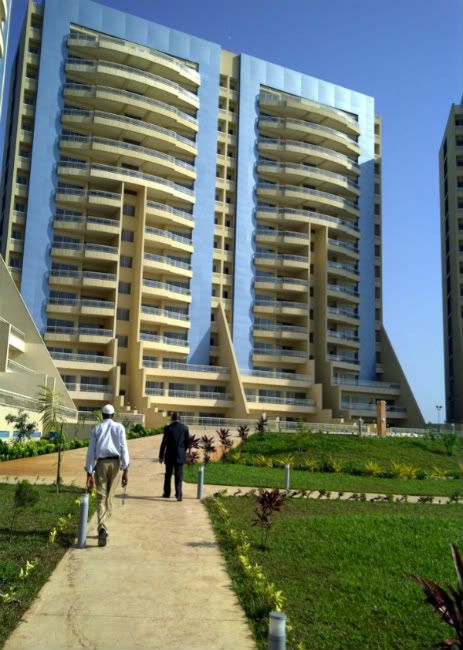
Banana Island is not just home to some of the finest Nigeria real estate, it also habours some of the most expensive properties in Nigeria. Indeed, beauty and comfort come at a price. And that price can be jaw-dropping. One of the most outstanding features of the island is the Ocean Parade Towers rising into the sky at eight floors with a penthouse. The facilities include central air conditioning, central gas syetem, laundry machine, refrigerator, gas cooker, CCTV, swimming pool, and 24 hour electrivcity supply, made possible with standby generators, a squash court, and a 24 hour security. Banana Island is reputed to be Nigeria’s most expensive neighbourhood. It is on par TriBeCa in New York Shibuya in Japan, La Jolla in San Diego, Carlifornia, Seveth Arrondissenent in Paris, Kessington Palace Gardens in London or Victoria Peak in Hong Kong. Averagely, the price of a luxury flat in Banana Island ranges between $130,000 and $200,000. This excludes $15,000 USD service charge per annum. Also, any potential tenant will be required to pay two years rent in advance. And like other luxury apartments in other areas in Ikoyi, Victoria Island and Lekki, come with in-built or detached boys quarters for domestic servants.
Normally, a plot of land in Banana Island goes for hundreds of millions. However, in most cases, billions of naira go into the erection of these buildings. Many Multi-National Companies have taken Banana Island to be their regional headquarters.
Banana Island is a man-made island in Lagos State, Nigeria that is slightly curved in shape – like a banana. It is located in the Lagos Lagoon and is connected to Ikoyi Island by a dedicated road which is linked to the existing road network near Parkview Estate. The island was constructed by the Lebanese-Nigerian Chagoury Group in partnership with the Federal Ministry of Works and Housing and is considered to be on par with the Seventh Arrondissement in Paris, La Jolla in San Diego, and Tokyo’s Shibuya and Roppongi neighbourhoods.
HISTORY
Panoramic view of Banana Island taken from the Lekki-Ikoyi Link Bridge. The original Banana Island construction project entitled "Lagoon City" was the brainchild of the Late Chief Adebayo Adeleke, a University of London trained Civil Engineer (MICE), and CEO of City Property Development Ltd. Chief Adebayo Adeleke had originally commissioned a new urban development in Maroko, Victoria Island, but that project had been 'acquired' by the Lagos State government with no financial consideration paid. Following a lengthy 10 year court case, Lagos State government offered other parcels of land as consideration for the Maroko development.
Many scoffed at Chief Adeleke's decision to select the Ikoyi Island perimeter, however they were unable to appreciate the foresight of the Chief, who promptly engaged the Westminster Dredging Company to dredge the foreshore, and create six interlinked and symmetrical islands. He wanted to create a development that would "Make Nigeria Proud", and engaged Minoru Yamasaki the architect of Manhattan's Twin Towers, to design replica twin towers as the flagship iconic buildings on the main island.
To complete the Lagoon City concept, Chief Adeleke planned an aesthetic design including a City Airport, which was a vision conceived long before the London Docklands Development, London City Airport, Dubai's Palm Islands or Hong Kong's Chek Lap Kok Airport. Unfortunately for the Chief, as soon as he had reclaimed the land and the brilliance of the idea was unveiled, others were determined to wrestle the land from him, and the project was 'acquired' again with no consideration being paid to City Property Development Limited. The 'acquisition' is currently being challenged in various courts, and there are Caveat Emptor warnings in place to warn prospective buyers that their investment could be at risk in future. There is also litigation pending in the UK and European courts regarding this matter.
The subsequent developers were principally interested in maximising the yield of the land at the expense of the aesthetic innovative design foreseen by Chief Adebayo Adeleke. Consequently the land was filled in to create a banana shaped island, which has resolutely failed to achieve any international iconic architectural acclaim, as it is now a residential scheme rather than the commercial development originally envisaged.
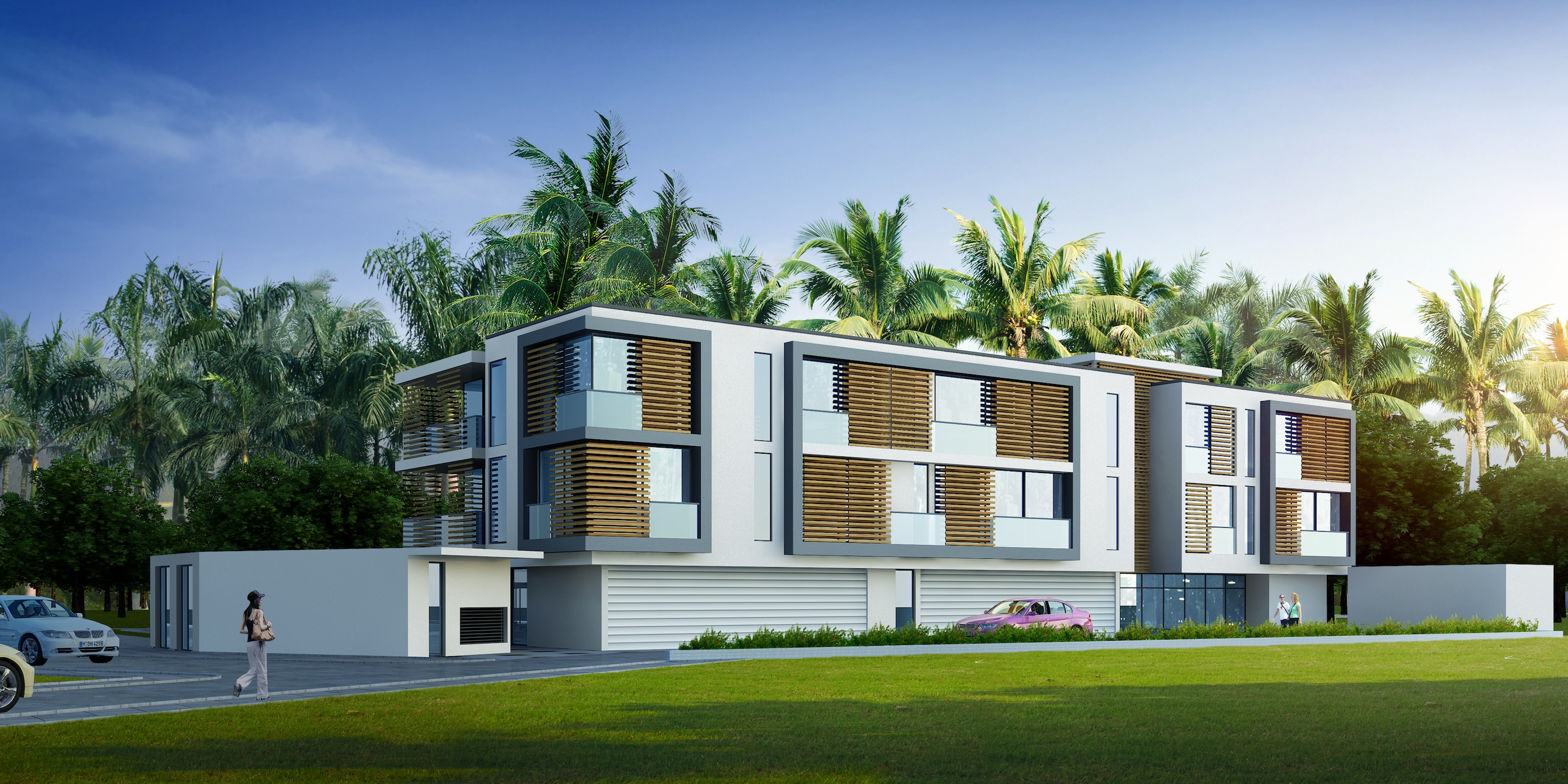
The Island is a planned, mixed development with dedicated areas for residential, commercial and recreational activities. On the residential side of the Island, planning permission is not granted for dwellings over 3 storeys high. The developers also intend to develop a main piazza, a club-house, a primary and secondary school, a fire and police station and a medical clinic. They are also negotiating to build a 5-star hotel on the island, along with an array of smaller Guest Houses.
Etisalat was reported to have acquired a N6 billion on the island. Other companies such as Zain, MTN, Globacom, Zenon Oil, and many other companies have their headquarter offices in Banana Island. Many prominent Nigerians are known to have erected eye-popping edifices in Banana Island as well.
Banana Island hosts several high end residential developments such as Ocean Parade Towers - a series of 14 luxury tower blocks strategically situated at one end of the island to take advantage of 180 degree panoramic views overlooking the lagoon. Similar to many of the developments on the island, it has dedicated leisure facilities such as a private health club - with tennis courts, squash courts and a swimming pool surrounded by extensive gardens. At launch flats in Ocean Parade sold for over US$400,000.
POPULAR HOUSES IN BANANA:
Mike Adenuga - Billionaire owner of Globacom - Nigeria’s second-largest telecom operator and oil exploration firm Conoil. Iyabo Obasanjo - Daughter of former President Olusegun Obasanjo and Oluremi Obasanjo, Elected to the Nigerian Senate representing Ogun Central Senatorial District of Ogun State, Senior Fellow at Harvard's Advanced Leadership Initiative. Saayu Dantata - Son of Alhassan Dantata - the wealthiest man in West Africa at the time of his death in 1955. Kola Abiola - son of MKO Abiola - prominent businessman, publisher and politician. He is widely regarded as the presumed winner of the 1993 presidential elections.
NOTE=> THESE PICTURES DO NOT BELONG TO T.I.N MAGAZINE, THEY ARE RESULTS FROM SEARCH ENGINES.
Olamide Bobo Tweet 2 Kiss Dániel Laye Tweet 3 Olamide Melo Melo Tweet 4 Olamide Lagos Boys Tweet 5 Wiz Khalifa See You Again (feat. Charlie Puth) Tweet 6 Simi Jamb Question Tweet 7 Burna Boy Soke Tweet 8 Reekado Banks Katapot Tweet 9 Omi Cheerleader (Felix Jaehn Remix Radio Edit) Tweet 10 Taylor Swift Bad Blood (feat. Kendrick Lamar) Tweet 11 Janelle Monáe & Jidenna Yoga Tweet 12 DaVido & Meek Mill Fans Mi (feat. Meek Mill) Tweet 13 Ed Sheeran Thinking Out Loud Tweet 14 Wande Coal Ashimapeyin Tweet 15 Ellie Goulding Love Me Like You Do Tweet 16 The Weeknd Can't Feel My Face Tweet 17 Kiss Daniel Woju (Remix) [feat. DaVido & Tiwa Savage] Tweet 18 Lil Kesh Gbese Tweet 19 AdekunleGOLD Orente
Aso Rock Presidential Villa is the Nigerian Presidential Complex which houses the residence and office of the Nigerian President. It is variously called Aso Villa, The Villa, Aso Rock and State House.
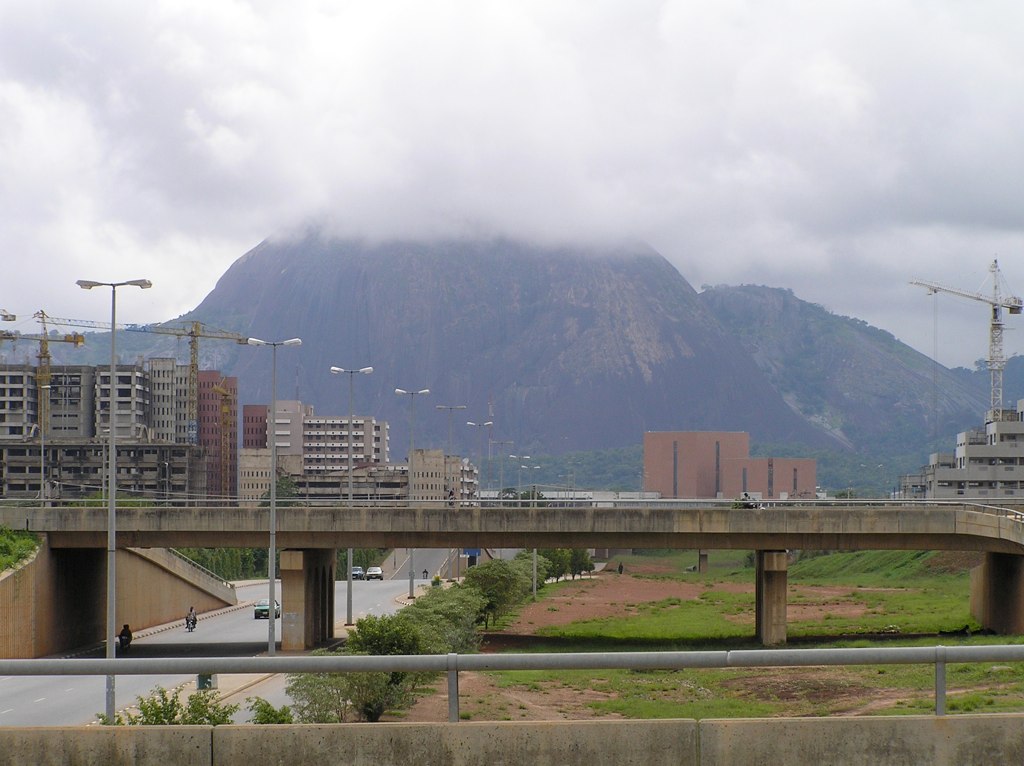
The Aso Villa is located in the three arms zone in the Central Business District of Abuja. The National Assembly Complex and the Nigerian Supreme Court are also located in the three arms zone. The Presidential Villa is built on the valley of the geographical feature, Aso rock. The villa is named after this geographical outcrop, Aso rock. The palatial residence was completed in 1991, the same year the military junta of Ibrahim Babangida relocated the national capital from Lagos to Abuja. Aso Villa encompasses the 400 meter monolith Aso Rock, located within the Three Arms Zone of Abuja metropolis. Aso Villa has had the following occupants as Presidents;
Ibrahim Babangida Sani Abacha Abdulsalam Abubakar Olusegun Obasanjo Umaru Musa Yar’ adua Goodluck Ebele Jonathan. Muhammadu Buhari (Current President)
A new occupant in the person of Muhammadu Buhari came in on the 29th of May 2015. Buhari recently appointed a transition committee to ensure smooth take-over of the government.
Aso Rock is a large outcrop that is on the outskirts of Abuja, the capital of Nigeria. The Aso Rock is a 400-metre monolith and is the city's most noticeable feature. The Nigerian Presidential Complex, Nigerian National Assembly, and Nigerian Supreme Court are located around it. Much of the town extends to the south of the rock. "Aso" means victorious in the native language of the (now displaced) Asokoro ("the people of victory". Aso Rock was the site of the 2003 Aso Rock Declaration, issued by Heads of Government of the Commonwealth during the CHOGM held in Abuja. It reaffirmed the Commonwealth's principles as detailed under the Harare Declaration, but set the 'promotion of democracy and development' as the organisation's priorities.
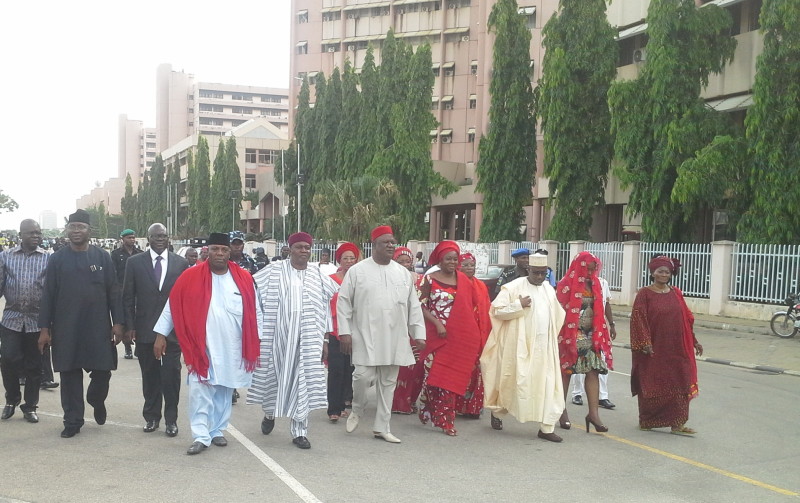
Sorry we are not providing real pictures of inside Aso-Villa. The reason is the Federal Government doesn't permit guests for Tourism visits like other counties we could have visit and get some real captures from inside the villa, so the pictures you'll be seeing are the ones captured of the president and federal officials inside Aso Villa. -
This is true to some extent, especially for the new webmasters who really wanna create a top notch for themselves, running from nairaland to facebook to tweeter and back to nairaland to search for traffic .
As for those who have been long in the game, they can just outsource most of their work..
On a second thought, planning is everything. if you plan things well and you wanna keep a wife/ gf, then its possible..
Where there is a will...
YOU GOT IT ALL.. EXACTLY WHAT IS HAPPENING TO ME...
After a few weeks of research, T.I.N MAGAZINE Has come up with a list of the ten most popular Nigerian websites as of 2015. NOTE: Our rating is not based on Alexa's ranking in anyway because we are not rating this with the number of visits a site has but the popularity they have in the country, sites which people out there love and know very well. In our research we asked a few hundreds of youths and adults before we came up with this list. Thanks.
TOP TEN MOST POPULAR SITES IN NIGERIA 2015
10] PUNCHNG.COM
Popularity Cause: Natural
Punchng.com is the official website of the popular Nigerian news paper "THE PUNCH". They update all news featured in the news paper on the website daily and in different categories. In our research we discovered the website gained its popularity from its Newspaper being Nigeria's most read newspaper. Most people often search the name online to visit the main website for news. We discovered punchng.com is known by many youths who do not want to buy and read its news papers, mostly youths of the working class also known by a few students and adults.
Punchng.com is concluded the 10th most popular site in Nigeria as of 2015.
9] JOBBERMAN .COM
Popularity Cause: Natural+Advertisements
Jobberman is the most popular job vacancy listing site in Nigeria, started in 2009. They help employers fill their vacancies quickly and cost-effectively by giving them access to the most relevant pool of qualified job-seekers and professionals. In our research we discovered the website is naturally popular due to being the first of its kind in Nigeria and also popular due to the high seeking rate of jobs in Nigeria, the popularity is also gained by few a advertisements on TV, and online. We discovered the site is majorly known by youths, and a very large number of students and the working class but not known by Adults. Jobberman .com is concluded the 9th most popular site in Nigeria 2015
8] LINDAIKEJI..COM
Popularity Cause: Natural.
Lindaikeji..com is Nigeria’s number one gossip blog, which gets most of its visitors from the country. It focuses on celebrity gossip, politics, odd news and every other type of occurrence Linda thinks should make the news. Was started in 2007. In our research Lindaikeji's blog gained its popularity via being one of the first its kind in Nigeria and also by the personality of the owner. We also noticed the blog url is not very well known by its visitors but the names "Lindaikeji blog" is well known. Also popular for breaking many entertainment gists "gossips". We discovered the site is known by many youths mostly students and the working class and a few adults and all mostly females. Lindaikeji..com is concluded the 8th most popular site in Nigeria as of 2015
7] .NG
Popularity Cause: Natural
Formerly still known by many as that, is an online portal that delivers Nigerian Music, Video, News and Technology Content on a daily Basis to Nigerians Home and Abroad. Was started in 2009. In our research the website has gained its popularity with tech tutorials and Nigerian music and music videos download, also known for all round entertainment gists. We discovered the site is known by a very large number of students, also known by many working class all mostly males, And known by a very low number of adults. .ng is concluded the 7th most popular site in Nigeria.
6] OLX. COM.NG
Popularity Cause: Advertisements
OLX is the leading consumer to consumer (C2C) online marketplace in Nigeria where Individuals Buy,Sell, Rent or Find everything locally in all 36 states and the FCT, through Free Classifieds Advertisements of pre-owned Mobiles, Computers, Electronics, Furniture, Appliances, Cars, Bikes, Properties, Apartments, Jobs and much more. The site got its popularity based on the kind of service it offers in which only a few other sites does that and mostly the popularity came via many adverts on different platforms, Radio,TV,Billboards,Online and more... OLX is now where most Nigerians believe they can buy and sell. We discovered the website is known by many youths mostly students, and many youths in the working class level and a few adults. And is here by concluded the 6th most popular site in Nigeria as of 2015
5] NAIRALAND.COM
Popularity Cause: Natural
Nairaland.com is a big, broad discussion forum for Nigerians, was started in 2005. Covers dozens of topics including politics, romance, technology, careers, business, and entertainment. With over a million members, the number one Nigerian community online continues to grow. In our research the popular forum has gained its popularity lets say by age?search visits? or its many popular topics? Ok. We believe the Forum gained it with the three, What most people keeps talking about is Google/Nairaland they mention they are not visitors nor fans but Google search engine takes them to Nairaland whenever they search for their wishes many said they got to know Nairaland that way. And also we noticed Nairaland topics are quite much for visitors to explore. Well, Alexa once rated it the most visited African website and Nigerian website for quite a longtime before it was stripped off its position in 2015. Many also talked about knowing the site a longtime ago; knew it for Jobs search,And also Nigerian news. In addition many claim they've heard of it or seen something like it online. We discovered the site is known by many youths majorly the working class, Also many students and Many Adults. Nairaland.com is concluded the 5th most popular site in Nigeria as of 2015.
4] NAIRABET .COM
Popularity Cause: Natural+Advertisements
Nairabet .com is number one sport betting website not only in Nigeria but the whole of Africa started in 2009. spends more in advertising from online, radio, to TV (even sponsored 2014 FIFA world cup on DSTV), brand ambassador, Akin Alabi is a lucrative marketer. In our research we noticed the site's popularity was gained because of the type of platform it is, and also being the first of its kind in Nigeria. Like we mentioned earlier Advertising is actually its major source popularity even though the platform would have gone wild without much advertisements. And even many calls the name of the website in replacement for other Nigerian betting sites. We discovered the site known by many youths majorly: student,the working class, and a few adults. We also noticed the site is known by many non internet users. Nairabet is hereby concluded the 4th most popular sites in Nigeria as of 2015.
3] NAIJ.COM
Popularity Cause: Advertisements
Naij.com calls itself "Nigeria’s number one news site". Started in the 2010. The Nigerian portal provides news coverage, a lot more about music, weather, jokes, job, games, events and lots more... In our research we noticed Naij.com is indeed Nigeria's most popular news website as it almost known by every Nigerian using the internet. the reason for the fame is Naij which started as curator getting news from authoritative sources and posting it on the website offers a lot of services, and even we believe by now Naij.com offers the highest online services in Nigeria. Cuts across sections like: flirchi.naij.com, Jobs.naij.com,Mail.naij.com more... And a lot of mobile services with Wap.naij.com. In addition Naij.com's many adverts is always all over the internet since starting the platform in which only a few internet users wouldn't have seen these adverts before before. We discovered the site is known by many youths mostly students, the working class, and many adults too. Naij.com is concluded the 3rd most popular site in Nigeria and Most popular news site in Nigeria as of 2015.
2] KONGA.COM
Popularity Cause: Advertisements
Konga.com is Nigeria’s Largest Online Mall, was started in 2012. With over 100,000 products at great prices, exceptional customer experience and Nationwide delivery, and most recently adopting a marketplace business model, Konga.com is revolutionizing the way Nigerians buy and sell. In our research we noticed the store gained this spot because of the type of brand it is and being the first retail store in Nigeria and because of the billboard,radio,tv and online adverts the website is quite known by almost everyone who uses the internet. We discovered the site is known by many more youths mostly student,the working class and a lot of adults. Konga.com is concluded 2nd most popular site in Nigeria in 2015.
1] JUMIA. COM.NG
Popularity Cause: Advertisements
This site is also another popular Nigerian online retail store started in 2012. It features products like electronics, books, beauty products,more.. In our research we actually noticed the online store has become famous than its visits. Due to the too much adverts and the purpose it serves. And if you have not seen its advert on TV, you'll hear it on radio and if neither of the two you will surely see it on billboards and if not that too you must definitely see the too many adverts online. We discovered the site is known by a large number of youths, Students,Working class and also known by many Adults too. JUMIA. COM.NG is hereby concluded Nigeria's most popular site in 2015.
NOTE: This is list is judge based on no one's opinion and it is not judge based on Alexa ranking it is a result of a research carried out by T.I.N MAGAZINE to know the most popular websites of the year.
T.I.N MAGAZINE visited computer village lagos state in the month of June, to learn more about the popular market and also take exclusive pictures, too bad we couldn't take a video. Well, this market is a thing i think you should sit down and read more about. Read more about it below.
INTRODUCTION
Computer village Lagos Nigeria is the computers and computer accessories market in Lagos. You can find a wide array of branded computers and cloned PCs here. Popular brands include Compaq, Dell, Toshiba, Acer, and several others. This Lagos computer market is also host to a multitude of computer accessories, digital cameras and camera accessories, and mobile phones and accessories. The computer village Lagos Nigeria is located at the heart of Ikeja the capital of Lagos state. This computer market is awash with computer technicians good and bad. Be careful when to buy computers in this market. If you're not careful, you may end up with a refurbished PC.
Visit the computer village Lagos Nigeria for . . . Digital cameras and accessories Mobile phones and accessories Desktop Computers and accessories Laptops and accessories Notebooks and accessories UPS and accessories Voltage stabilizers and accessories Computer repair Electrical parts Iphones, ipads, and everything electronic
MINI HISTORY
The present location of this market was a residential area until late 1999 or early 2000 when Internet technology became a household name in corporate Nigeria. Knowing that a major industry was about to spring forth, savvy businessmen took position in the most vantage location of Ikeja – Otigba Street to commence trading in IT equipments and devices. By 2003 a year after GSM services were introduced to Nigeria, computer village had become a household name among Telecommunication users, especially small businesses and end users.
MORE ABOUT
Ikeja computer village makes Ikeja itself stand out from other towns in Lagos,the so-called largest IT market in West Africa. Like other well known markets in Lagos it is very busy and rowdy. But it differs greatly from other markets in that it is home to the major dealers of Mobile Phones and computers as well as their accessories.
The market was never planned to be what it is so finding your way around it might be problematic if you are a first time visitor. However the right people to buy from usually own larger sized stores than the road side sellers or the ones with smaller shops. In addition their stores are well stocked with variety of products or with large number of a single items or related products.
Most of the buildings are multistory with the phone and computer repairers usually found in the interior parts. Sellers usually like to be seen or would place outdoor signs. You should buy new stuff from these people. Presently the major dealers include representatives of the major brands TECNO, HP, DELL, TOSHIBA, PACKARD BELL, FUJITSU SIEMENS among others for computers while those for phone leaders include NOKIA, SONY ERICSSON, MOTOROLA and SAGEM. Well, we must say most of the buildings inside it has "TECNO" labelled on it.
Surprisingly cloth sellers are also coming into the market, and at the time of my last visit, over 100 canteens were situated within or around the market. In addition there are telephone and computer repairers around the market and these are the ones to patronize for refurbished used phones and computers.
Among the many products on sale include mobile phones and mobile phone accessories, (memory cards, chargers, batteries, casings etc). Also computers and computer accessories including DVD writers, Mother boards, LCDs, Keyboards, RAM cards among others). Occasionally you might come across other digital products like camcorders, digital cameras and flat screen televisions among other electronic devices.
THE FUN
Computer village is a never boring place to be, we noticed that during our visit, it is a very large area with various streets and many people in out every second. The sound of music all over is another thing is another interesting to mention and the ever amazing street dancers dancing for various brands all over.
joywendy: He likes to have things his way and because of this,Sometimes he is seen as a sadist who doesn't care about others views if it doesn't well correlate with his. (Though true to some extent but not entirely true) I think he is actually a very sensitive person who tries to mask his sensitive side by being strict and putting up this-i don't give a damn attitude.
He is too comfortable with the way things are hence the slow rate of change for the past few months and years and. It may be has a result of him been afraid to take some risk.
I also think his online personality and offline personality are worlds apart.
HighIQ: Rich men should remember that their wealth are for the poor. A wealthy person must endeavour to help every poor men in his environment without exempted. It is not a favour, but it is a must and your responsibility.
I TOTALLY AGREE WITH YOU.. IF I WERE IN THEIR POSITION I KNOW OF A LOT OF THINGS I WOULD DO WITH MY MONEY TO HELP OTHERS.. I'M GONNA CREATE DIFFERENT PLATFORMS TO HELP MY FELLOW NIGERIANS..
I KNOW SOME PEOPLE ARE GONNA SAY IT'S BECAUSE I HAVEN'T GOTTEN IT YET, BUT TRUST ME THAT'S EXACTLY WHAT I WOULD DO IF I COULD BE THAT RICH, EVEN NOT UNTIL I AM THAT RICH.
ANYWAYS THERE'S TILL PLENTY OF TIME FOR ME THOUGH, STILL VERY YOUNG AND I REALLY BELIEVE I'M GONNA BE THIS RICH SOONER THAN EXPECTED BECAUSE GOD SEES MY HEART WITH WHAT I'M GONNA DO WITH MONEY.
I RESPECT MIKE ADENUGA OUT OF THOSE PEOPLE.. HE 'S MADE SOME INFLUENCE WITH HIS MONEY
T.I.N MAGAZINE have just rated and compiled up a countdown of ten richest men and women in nigeria as of the year 2015. The rating was set based on the Real-time Forbes estimates of the richest personalities in nigeria and other credible net worth raters. some people's rating might have been judged based on 2014's most recent rating due to the fact they have not declared their assets and they haven't been looked into since then.
Mohammed Indimi is the founder and chairman of Oriental Energy Resources, Limited. This company has interest in the oil sector, especially in the Nigerian Upstream Oil and Gas sector. Mohammed Indimi founded his company in 1990 and has expanded the company’s portfolio that it now has assets in Offshore Nigeria. These assets include the Ebok Field (OML 67), Okwok Field (OML 67, and OML 115).
In the year 2014, Forbes listed Mohammed Indimi as the Africa's number 37th richest man.
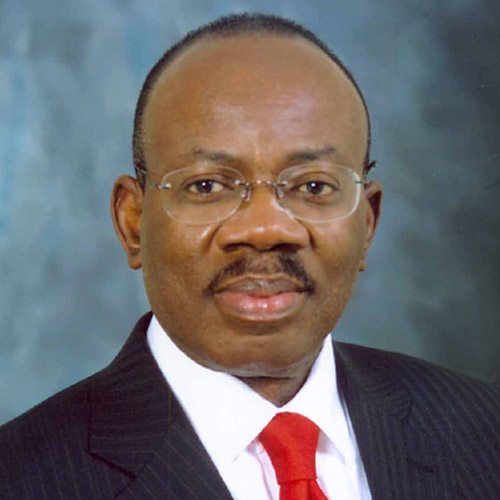
Jim Ovia is the founder of Zenith Bank Group, a bank he is the largest individual shareholder with about 9.3% stake. He is also an investor in real estate across Nigeria. His other assets include Visafone, a mobile telecommunication outfit.
In August 2014, Jim Ovia commenced the construction of $1.5 billion petrochemical complex in Akwa-Ibom State Nigeria.Forbes listed Jim Ovia as the 30th richest man in Africa in the year 2014.
Orji Uzor Kalu is the chairman of SLOK Holding and the Daily Sun and New Telegraph newspapers in Nigeria, who served as the governor of Abia State, Nigeria from May 29, 1999, to May 29, 2007. Prior to his election, he served as the chairman of the Borno Water Board and the chairman of the Cooperative and Commerce Bank Limited. Kalu was also a member of the Progressive Peoples Alliance (PPA) and the chairman of the PPA Board of Trustees. He was the party's candidate for president in the April 2007 general election.
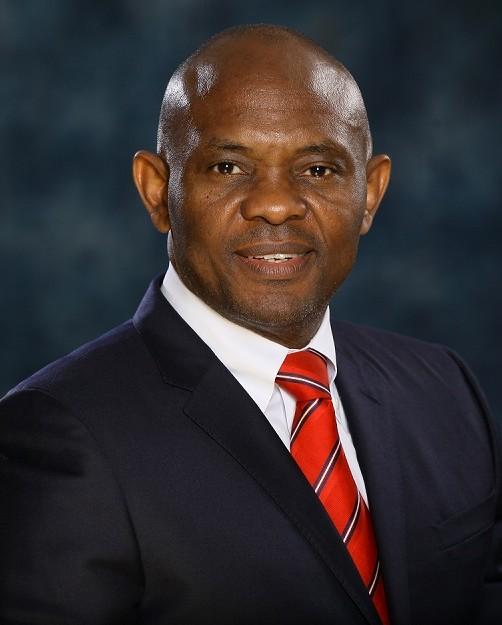
Tony O. Elumelu is an economist by training, a visionary entrepreneur and a philanthropist. Tony is the Chairman of Heirs Holdings, the
United Bank for Africa, Transcorp and founder of The Tony Elumelu Foundation. Elumelu holds the Nigerian national honours, the Commander of the Order of Nigeria (CON) andMember of the Order of the Federal Republic (MFR). In 2011
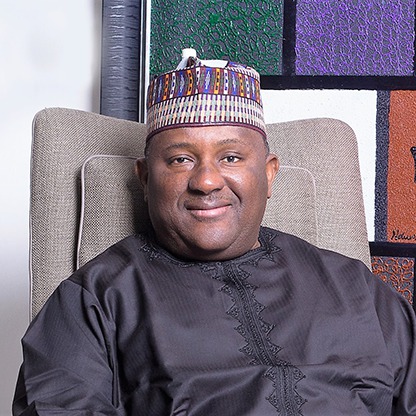
AbdulSamad Isyaku Rabiu CON is a Nigerian businessman. His father, Khalifah Isyaku Rabiu was one of Nigeria's foremost industrialists in the 1970s and 1980s. Abdul Samad is the founder and chairman of BUA Group, a Nigerian conglomerate with interests in manufacturing, infrastructure and agriculture with a revenue in excess of $2.5 billion. He is also the chairman of Nigerian Bank of Industry.
In 2013, Forbes estimated Abdul Samad's wealth at $1.2 billion, bringing him to the global billionaire's club.
Femi Otedola is a Nigerian businessman. He is Chairman of Forte Oil Plc, and appeared as one of only two Nigerians (alongside Aliko Dangote) to appear on the 2009 Forbes list of 793 dollar-denominated billionaires in the world, with an estimated net worth of over US$1.2 billion. Femi Otedola is the Nigerian President and Chief Executive Officer of Zenon Petroleum and Gas limited.
General Theophilus Yakubu Danjuma GCON FSS psc is a Nigerian Jukun soldier, politician andmulti-millionaire businessman and philanthropist. He was Nigerian Army Chief of Army Staff from July 1975 to October 1979. He was also Minister of Defence under Olusegun Obasanjo. Danjuma is chairman of South Atlantic Petroleum (SAPETRO).
OCCUPATION: Business tycoon: oil and printing industries
NET WORTH: $2.2 billion(June 2015)
Folorunsho Alakija is a Nigerian businesswoman who has replaced Isabel dos Santos as the richest African woman, and also is the richest woman of African descent in the world. She is a business tycoon involved in the fashion, oil and printing industries. She is the group managing director of The Rose of Sharon Group which consists of The Rose of Sharon Prints & Promotions Limited and Digital Reality Prints Limited and the executive vice-chairman of Famfa Oil Limited. Alakija is ranked by Forbes as the richest woman in Nigeria with an estimated net worth of $2.6 billion As of 2015.
OCCUPATION: Founder of Globacom, Chairman of Conoil
NET WORTH: $4.1 billion (June 2015)
Mike is a Nigerian business tycoon, and one of the richest black people in the world. His company Globacom controls Nigeria's second-largest telecom operator, he also owns stakes in theEquitorial Trust Bank and oil exploration firm Conoil (formerly Consolidated Oil Company). Forbes has estimated his net worth at $4.6 billion as of March 2013 which makes him second wealthiest Nigerian behind Aliko Dangote.
Dangote is a Nigerian billionaire businessman, who owns the Dangote Group, which has interests in commodities. The company operates in Nigeria and other African countries, including Benin, Cameroon, Ghana, South Africa, Togo and Zambia. As of January 2015, he had an estimated net worth of US$18.6 billion.
Dangote is ranked by Forbes magazine as the 67th richest person in the world and the richest in Africa.[ He surpassed Saudi-Ethiopian billionaire Mohammed Hussein Al Amoudi in 2013 by over $2.6 billion to become the world's richest person of African descent.
NOTE: THIS RATING IS NOT BASED ON ANYONE'S OPINION, IT IS A COMPILED RATING BY T.I.N MAGAZINE FROM CREDIBLE ASSETS RATERS LIKE "FORBES", AND OTHERS.
Equado: intels pentium would not play any of the 3 version of crack released, wait for version 4 crack or change your system
Hey bro been a long time... CAN THIS PC SPECS PLAY FIFA 15?
HP PAVILION TOUCHSMART 17-E155NR - 17.3" - A PRODUCT DETAILS
The true value of touch is all in your hands. The compact, powerful HP Pavilion TouchSmart 17 notebook gives you everything you need to supercharge your day - at home, at school, virtually anywhere. Touch never looked so good with optimized graphic performance and a slim, polished profile that shows off your sophisticated side.
Specifications
General  Product Type: Notebook  Operating System: Windows 8.1 64-bit Edition
Processor / Chipset  CPU: AMD A series A4-5000 / 1.5 GHz  Number of Cores: Quad-Core  Cache: L2 - 2 MB  64-bit Computing: Yes
Memory  RAM: 4 GB ( 1 x 4 GB )  Max RAM Supported: 8 GB  Technology: DDR3L SDRAM  Form Factor: SO DIMM 204-pin  Slots Qty: 2  Empty Slots: 1
Battery  Technology: 6-cell lithium ion  Capacity: 47 Wh
AC Adapter  Input: AC 120/230 V ( 50/60 Hz )  Output: 65 Watt
Connections & Expansion  Interfaces: HDMI ¦ Headphone/microphone combo jack ¦ VGA ¦ USB 2.0 ¦ 2 x USB 3.0 ¦ LAN  Memory Card Reader: Yes ( SD Card )
Software  Software Included: CyberLink PowerDirector, CyberLink Power2Go, Skype, CyberLink Label Print, HP Recovery Manager, 7-Zip, HP Support Assistant, Amazon, HP ProtectSmart, HP ePrint, Netflix, HP SimplePass, CyberLink Media Suite, HP CoolSense, CyberLink YouCam DE, HP Connected Music, HP Connected Photo, HP Utility Center, CyberLink PhotoDirector, HP Savings Center, Micr
Miscellaneous  Color: Anodized silver  Included Accessories: Power adapter  Localization: English / United States  Pricing Type: Remarketed
Dimensions & Weight  Width: 16.5 in  Depth: 10.5 in  Height: 1.3 in  Weight: 7.7 lbs
Environmental Standards  ENERGY STAR Qualified: Yes
Bonny Island is situated at the southern edge of Rivers State in the Niger Delta of Nigeria near Port Harcourt. In the early 1990s the Federal Government of Nigeria, in collaboration with 3 international partners, Shell Gas BV., CLEAG Limited [ELF] and AGIP International BV. started the multi-billion dollar project Nigeria Liquefied Natural Gas Limited (Nigeria LNG). Due to its strategic position, the island hosts various oil companies including Royal Dutch Shell, Mobil, Chevron, Agip, and Elf. Port Harcourt is the closest city to Bonny Island. Ferries are the main form of transport to and from the island. Public secondary schools on the island includes: Bonny National Grammar School, Government Girls Secondary School, Community Secondary School, Lucille Education Center, Kingdom Heritage with so many more very educative schools on the Island.
It's been said the city is the only city in Nigeria which has a 24hour electricity for quite a longtime and still continuing.
HISTORY
Somewhere at the edge of the Atlantic Ocean facing the Bight of Bonny sits the island of Bonny. This serene Niger Delta community has several historical and economic symbolisms for the Nigerian nation. It was the melting point of economic activities right from the 16th century. It serves as Christianity’s first port of call in West Africa. It is also home to so many illustrious sons and daughters of Nigeria. This significant constituent of the larger Ijaw ethnic nationality has her local dialect, Ibani spoken across her various communities. With a thriving traditional system and robust cultural heritage it stands out as one of the foremost local communities in Nigeria. Her traditional institution is headed by Edward William-Dappa Pepple who serves as natural ruler and Amanyanabo-in-Council and ably assisted by a Council of Chiefs headed by Reginald Abbey-Hart who is also chief and head of Captain Hart major house. Her political leadership currently rests on the shoulders of Nelson Ben Irimagha who bears the traditional title of Amasenibo. The community is subdivided into two main segments – the mainland and the hinterland. The mainland is comprised of the Township, Sandfield, Iwoama, Orosikiri, Aganya, Ayambo, Akiama, Workers Camp, Finima and some outlying fishing settlements lying along the Bonny River’s coastline. The hinterland includes the villages that serve as home to indigenes of Bonny kingdom.
After the migration from Orupiri to Okoloama (Bonny town), the eldest of the group, Opuamakuba became the leader. When Opuamakuba became very old, the elders and priests persuaded him to hand over to Alagbariye who was then the high priest. When the Ibani left Orupiri, they brought with them to Okoloama, only a son of their national god, Kala Ikuba (Ikuba Junior). Opu-Ikuba.(Ikuba Senior) was left behind at Orupiri, Alagbariye served as high priest of Ikuba and succeeded Opuamakuba as ruler. Since there was no fresh water at Okoloama, the elders consulted oracles. It was revealed by the oracles that water could be obtained only through the sacrifice of the king’s child. Accordingly, Alagbariye sacrificed his daughter, Osunju, to the fresh water deities and so secured good drinking water for the people.
Religion The Ibani people are Christians. Majority of the inhabitants of the area converted to Christianity in the early 1800’s. The Christian faith in Bonny was introduced by King William Dappa Pepple, who while in England elected to become a Christian King so that God will grant him power and wisdom to rule his people. King William Dappa Pepple was Baptised by Reverend G. H. McGill and later confirmed by Dr. Tait, the Bishop of London. At the behest of king William Dappa Pepple the Church Missionary Society in London sent Bishop Samuel Ajayi Crowther, the first Black African Bishop, to Bonny in 1864 to establish the Gospel of our lord Jesus Christ in Bonny. From Bonny Christianity spread to the neighboring communities of Tuwon and Nembe in 1868, Kalabari in 1878, Okrika in 1878, Andoni ,Ogoni, Ikwerre and the hinterlands of Eastern Nigeria. On January 24, 1889, Bonny Christians presented their beautiful church to Bishop Samuel Ajayi Crowther as his Cathedral. This he accepted and St. Stephen’s church in Bonny became the first Cathedral in Nigeria and the second Cathedral in West Africa. The Church was eventually dedicated by the Bishop on 27th February , 1889. Bishop Crowther’s throne which he hallowed on February 27, 1889, remains till this day at the Lady chapel in Stephen’s Cathedral Bonny. On April 27, 1952 Bishop Dimieari from Bonny was enthroned as the inaugural Diocesan Bishop of the Niger Delta Diocese at the St. Stephen’s Cathedral in Bonny. Bonny continued to blaze the trail with Rev. Cannon T. T. Green who was ordained a Deacon on December 20th 1953 at the St. Stephen’s cathedral Bonny. He graduated with a Bachelors Degree in 1958 from St. John’s College, Dunelm, England , to become the first graduate pastor in the Niger Delta Diocese and in fact east of the River Niger in Nigeria. Before the advent of Christianity the early settlers in Bonny were worshipers of indigenous religions, very little of that remains today as majority of the natives have converted to Christianity. CLICK HERE TO READ MORE ABOUT BONNY
Bonny Nature Park Bonny Nature Park, being developed by Nigeria LNG is becoming popular for eco-tourism. The park covers the rain forest, mangrove swamps and area of sandy soil with fresh water ponds and tall timbers between the swamp and beach. It harbours some creatures like the pygmy hippo and reptiles including crocodiles, monkeys and some different bird species.
RedCard1: The only way Wizkid and Davido influences me is that they make me believe I can make money at my young age. Tiwa Savage can't sing and that is final. D'banj can't sing too and he's no1? If D'banj must make the list then, you have to extend it to 40 and place him at the bottom. 2face is overrated, same with Banky W. Asa should be no1 cos she's the best. Flavour should be placed higher on the list cos the guy can sing.
You are talking about the best singers here.. the list is talking about the influence they have in the industry and Nigeria as a whole.
T.I.N MAGAZINE have just rated and list Nigeria's ten most influential singers of 2015. The listings were rated according to the level of influence each singer has in the music industry and Nigeria as a whole. This list wasn't judged based on the fame or money a singer has but their influence in someway or the other. The no.1 person on the list is to be considered to be the most Influential singer in Nigeria for year 2015.
NOTE: This list is only for singers not rappers, if you want to see the list for rappers click here
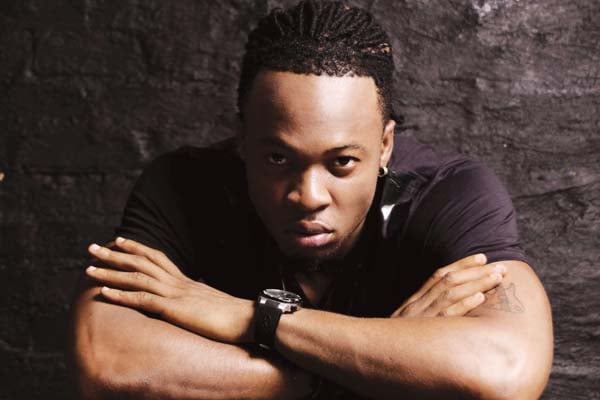
Flavour N'abania or simply Flavour, is a Nigerian singer, songwriter, multi-instrumentalist and performer. Flavour is popularly known across Africa and the world for his hit song "Nwa Baby (Ashawo Remix)",Ada,Baby Oku and more... The singer is quite much accepted my many for his unique style of music. Flavour can be said to be one the few Nigerian artists who make money across Africa doing shows and concerts because of his huge fan base across all other African countries. He has received numerous awards a few which includes City People Entertainment Awards Musician Of The Year (Male) Himself Nominated Best Collabo of the Year "Oh! Baby (You & I)" Video of the Year "Ada Ada" Won MTV Africa Music Awards 2014 Best Live Act Won The Headies Best Collabo "Orobo" (Sound Sultan featuring Excel and Flavour), Nigeria Music Video Awards (NMVA) Video of the Year "Ada Ada" Won Best High Life Video Won Best Indigenous Concept. He has also kept up the act this year which makes his influence quite obvious. He is no.10 on this list.
A?a is a Nigerian French singer, songwriter, and recording artist. Her stage name "A?a" means "Hawk" in Yoruba language. She has won multiple awards like; 2008: Prix Constantin 2011: French Music Awards Victoires de la Musique nomination for 'Female Artist of the Year Recording of the year- Bibanke by Asa Headies 2008 Headies Awards Album of the year – Asa 2008 Won Headies Next Rated Award- Asa 2006 And more. ASA Songs are one of the most accepted and loved nigerian songs abroad. She has a huge fan base in FRANCE and in the UNITED STATES. Asa's type of music is quite different from most Nigerian artists type of music. She's been concluded to be the 9th most influential singer in Nigeria as 2015.
WizKid,is a Nigerian recording artist, songwriter and performer. He started his musical career at age 11, releasing a collaborative album with Glorious Five entitled Lil Prinz (2001). In 2009, he signed a record deal with Banky W.'s imprint Empire Mates Entertainment. His work and contribution to the Nigerian Music Industry has earned him several achievements, including a BET Award, a MOBO Award, three The Headies Awards, two Channel O Music Video Awards, four Nigeria Entertainment Awards, a Ghana Music Award, two Dynamix All Youth Awards, two City People Entertainment Awards, and a Future Award. In addition, he has been nominated three times at the MTV Europe Music Awards as well as four times at the World Music Awards. He was ranked 5th on Forbes and Channel O's 2013 list of the Top 10 Richest/Bankable African Artists. In February 2014, Wizkid became the first ever Nigerian musician to have over 1 million followers on Twitter. He has performed in several different cities, including Houston, Dallas, Toronto, Vancouver, New York City, Providence, Calgary, Atlanta, Washington DC, and Chicago. Wizkid toured London in 2012 and performed at the HMV Apollo on 4 June 2012.He also performed at the BBC Radio 1Xtra Live 02 Academy in Brixton alongside Trey Songz, Tulisa, Kendrick Lamar and Angel. He is proudly a father of one. He's had various collaborations with many big foreign artists. He's been rated among top ten most famous people in Nigeria in 2015
Wizkid has been concluded to be the number eight on this year's list.
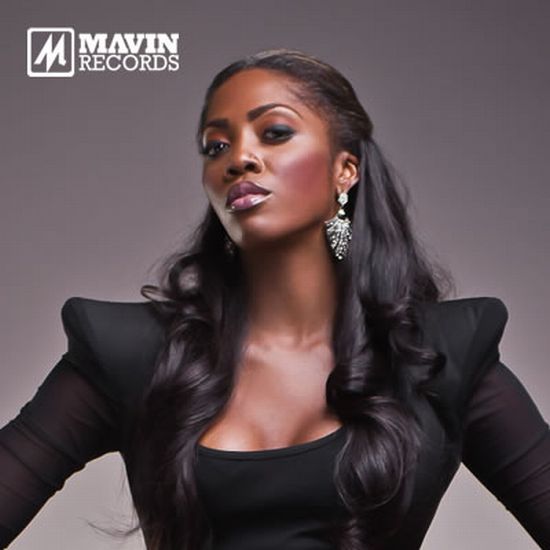
Tiwa Savage, is a Nigerian singer-songwriter, recording artist, performer and actress. She is currently signed to Sony/ATV Music Publishing and Mavin Records. She co-wrote the track "Collard Greens & Cornbread" off Fantasia Barrino's Grammy-nominated album Back to Me. Savage was featured on Solar Plexus, a compilation album that was released a day after the establishment of Mavin Records. On 3 July 2013, she released her debut studio album Once Upon a Time. Savage sings in English and Yoruba. As a singer, her achievements include one MTV Africa Music Award, two The Headies Awards, one Channel O Music Video Award, one Nigeria Music Video Award, and two City People Entertainment Awards, among others. In December 2011, she co-hosted the second season of Nigerian Idol alongside IllRymz. Moreover, she made her film debut with Joke Silva and Ireti Doyle in the stage adaptation of For Coloured Girls. Savage became the first African female artist to be associated with the Pepsi brand after signing an endorsement deal with them.
Savage has been involved in many youth empowerment and breast cancer screening projects across Nigeria. Savage helped raise money for an organisation that build schools in her hometown. In July 2013, Savage signed an endorsement deal with MTN Nigeria allegedly worth N30 million. She also signed endorsement deals with Pepsi, Forte Oil, and Maggi.
Tiwa Savage is often said to be the queen of the Nigeria music industry. She currently has over a million followers on twitter. She's been concluded to be the seventh most influential singer in Nigeria as of 2015
Davido, is an American-born Nigerian recording artist, performer and record producer. His 2011 single, "Dami Duro", was well-received throughout Nigeria. Along with his elder brother Adewale Adeleke, Davido is the co-owner of HKN Music. He has produced for numerous artists, including Naeto C, Skales, Tiwa Savage and Sauce Kid. In 2012, he signed an endorsement deal with MTN Nigeria. In 2013, Davido partnered with Guinness for the "Guinness World of More" concert. Davido has won a BET Award, a Kora Award, a Channel O Music Video Award, a Ghana Music Award, a Nigeria Music Video Award, two MTV Africa Music Awards, two African Muzik Magazine Awards, five The Headies Awards, seven Nigeria Entertainment Awards and two Dynamix All Youth Awards, among others.
"Skelewu", the third single from the upcoming album, was released on August 13, 2013. It was ranked 5th on the aforementioned list of the top 10 songs of 2013. The song peaked at number 1 on Afribiz's Top 100 chart. A dance competition with a cash prize of $3000 (N480,000) was announced days after the release of the song. Davido uploaded an instructional dance video onto YouTube and asked fans to upload videos of themselves dancing to "Skelewu". On October 10, 2013, Davido declared Bello Moshood Abiola the winner of the competition.
Davido is also quite known for many charity works as he make visits and donations to many orphanage homes every year, he has also helped quite a number of people get through health problems in many cases financially. And the popular singer have also just graduated getting a bachelor's degree in MUSIC this year despite him being an A-LIST public figure whom a lot of people were expecting him to dropout of school. He was also listed this year among the top ten most famous people in Nigeria 2015.
Davido is hereby concluded to be the 6th most influential artist of 2015.
Femi Kuti, is a Nigerian musician and the eldest son of afrobeat pioneer Fela Kuti. Like his father, Femi has shown a strong commitment to social and political causes throughout his career. He created his own band Positive Force in the late 1980s with Dele Sosimi (Gbedu Resurrection), former key-board player of Fela Anikulapo Kuti. His international career began in 1988 when he was invited by the French Cultural Centre in Lagos and Christian Mousset to perform at the Festival d'Angoulême (France), the New Morning Club in Paris and the Moers Festival in Germany. Also in 2002, Femi contributed a remake of his father's classic song, "Water No Get Enemy", to Red Hot & Riot, a compilation CD in tribute to Fela Kuti that was released by the Red Hot Organization and MCA. His track was created in collaboration with hip hop and R&B artists, D'Angelo, Macy Gray, The Soultronics, Nile Rodgers, and Roy Hargrove, and all proceeds from the CD were donated to charities dedicated to raising AIDS awareness or fighting the disease. Femi Kuti's voice is featured in the videogame Grand Theft Auto IV, where he is the host of radio station IF 99 (International Funk 99, described as "playing a great selection of classics from West Africa, the US and elsewhere". Femi has been nominated for a Grammy award four times in the world music category in 2003, 2010, 2012 and 2013 but has never won. He is also a member of the Agricultural campaign crew led by D'BANJ a campaign which its goal is to promote Agriculture and end poverty in Africa. He's been concluded to be the 5th most influential singer in Nigeria as of 2015.
Banky W, is a Nigerian R&B artist. BANKY can be said to be one of the few Nigerian artists who does real R&B and successful with it. He is the founder and owner of Empire Mates Entertainment (E.M.E.) record label as a platform to get his music to his fans and bringing up young stars in the building. He along with Sasha P were the first official ambassadors of Samsung electronics in Nigeria. He is a brand ambassador for Ciroc, ultra-premium vodka. He has also won different credible awards like: John Lennon Song Writing Award 2006, R&B Category, for 'My Regret’, Best R&B Artiste, Nigerian Entertainment Awards 2006,Best Male R&B Artiste, Urban Independent Music Awards, USA, 2006,BestInternational Album, Nigerian Entertainment Awards 2007 for 'Mr Capable’,Best R&B Video, Nigerian Music Video Awards 2008 for 'Don't Break My Heart’ As a philanthropist, he launched the “I AM CAPABLE” scholarship fund, which provides tuition, room & board at private universities for youth who are in need and meet the grade requirements. He’s also on the board of trustees of the “LightupNigeria” Project, which is focused on achieving constant electrical power supply in Nigeria, as well as various other charitable society building and empowering projects. He has also been extremely successful in many Corporate Marketing Campaigns, having been featured prominently in projects like Etisalat’s 0809ja Launch, Cocacola-Nigeria’s World Cup Theme Song, and Microsoft’s Anti-Cyber Crime Initiative. Last but not least, he is an accomplished Master of Ceremonies/Host, as he has successfully anchored numerous high profile events such as The HipHop World Awards (2009), Nigerian Breweries Legend Extra Stout Product Launch, and The Gulder Ultimate Search Celebrity TV Show Launch.
Banky played a major role in mobilizing the Nigerian youth to participate in the Occupy Nigeria series of protests in January 2012. The protests were to resist the implementation of the government's fuel subsidy removal policy.
Not to mention he is responsible for bringing up a few nigerian trending artists like wizkid,skales,shaydee and more.
He has been concluded to be the 4th most influential Singer in Nigeria as of 2015.
P-Square are a Nigerian R&B duo composed of identical twin brothers Peter Okoye and Paul Okoy. They produce and release their albums through Square Records. In December 2011, they signed a record deal with Akon's Konvict Muzik label. In May 2012, they signed a record distribution deal with Universal Music South Africa. In 2010, P-Square was named the Artist of the Year at the Kora Awards in Ouagadougou, Burkina-Faso while they were in London for a Concert at the Troxy, and they will receive a sum of $1 Million Dollars as the award winners, in Ebebiyin City.
The twin pop stars have broken barriers and set standards right from their debut work, captivating us with breath-taking videos and dance moves that would do more than raise an eyebrow from Usher Raymond. Five albums later, Peter and Paul Okoye are still at it, collaborating with international artistes and signing major distribution deals with top international labels. They are arguably the most loved Nigerian singers of all time as their fan base is quite a huge one, both in Nigeria and overseas. P-square has been concluded to be the third most influential singers of 2015.
2face Idibia, is a Nigerian singer, songwriter and record producer. He officially discontinued the use of the name Tuface and selected Tu-baba as his stage name. He is one of the most decorated and successful Afro pop artists in Africa. He is also one of the most bankable artists in Africa. 2Face has received one MTV Europe Music Award, one World Music Award, five Headies Awards (Hip-hop award), four Channel O Music Video Awards and one BET award for his musical work, four MTV Africa Music Awards, one MOBO award, one KORA award, and numerous additional nominations.
2Face has established an NGO called 2Face Idibia Reach-Out Foundation. which motto is service to humanity. In 2009, 2Face was appointed as ambassador by National Agency for Food and Drug Administration and Control. He released a song "Man Unkind" to raise awareness on the menace of fake and sub-standard food and drug products in Nigeria. In 2009, he was presented with the prestigious International Youth Ambassador for Peace Summit and the Nigeria Youth Merit Award by the National Youth Council of Nigeria in recognition of his contributions to youth development in Nigeria.
He is one of the most influential,most consistent,most decorated, and most successful musician in his generation. Even his peers attest to that. From humble beginnings in Jos, he has grown to become Africa’s most iconic pop star, clearing the path for hundreds of others after him. Respected at home and abroad by almost everyone that matters, Idibia is now building his Hypertek dreams, mentoring younger acts like W4, Rocksteady and Dammy Krane. His 6th Studio album has been revealed to be the best selling album ever on Itunes Nigeria.
He's been rated to be the second most Influential Singers in Nigeria as of 2015
1] D'BANJ
D'banj is a Nigerian singer-songwriter, harmonica player, and businessman. He has won several music awards, including the awards for Best African Act at the MTV Europe Music Awards 2007, Artist of the Year at the MTV Africa Music Awards 2009, Best International Act: Africa at the 2011 BET Awards, and Best-selling African Artist at the 2014 World Music Awards. D'banj is currently best known internationally for his 2012 summer hit "Oliver Twist", an uptempo dance fusion of Afrobeat and electronic dance music that topped the African charts 2011 and was a top 10 hit in the UK singles chart in 2012 reaching No. 2 on the UK R&B chart. In December 2012 D'banj signed a mega deal with Sony,Speaking on the importance of the deal to Sony to be able to assist with bringing D’Banj’s music to millions of fans. The deal is being described as a “Pan African, multi-album deal with Sony Music’s RCA Records
On 23 June 2012, D'banj performed at the Hackney Weekend to celebrate the 2012 Summer Olympics, which was headlined by Jay-Z and Rihanna. He performed alongside his friend, and fellow Universal Music Group label mate, Rita Ora on 30 August 2012 at the SCALA London Live Music, Clubs and Arts Venue to celebrate the release of her debut album Ora. He also performed at the AFCON 2013 closing ceremony held in South Africa.On 18 April 2015 ,D'banj perfromed at the Global citizen earth day a Free Concert on Capitol Hill (Washington Monument Grounds) for the 45th Anniversary of Earth Day put on by Global Poverty Project and the Earth Day Network. With D'banj's first album came his first endorsement from an energy drink called Power Fist.In May 2013, D'banj was named the Bank of Industry (BOI) ambassador. In November 2013, D'banj re-signed a multi-million Naira deal with Globacom, the company he parted ways with in 2010. In October 2014, D'banj was named the official African ambassador for Beats by Dre. In February 2015, D'banj was named the official African ambassador for Ciroc Nigeria. D'banj is the founder of Koko Foundation for Youth and Peace Development. He is also Nigeria's first United Nations Youth Ambassador for Peace. Dbanj is a ONE campaign ambassador; he released the song "Cocoa Na Chocolate" in support of agriculture investments.'Cocoa Na Chocolate' featured 18 other African artists and won Best African Collaboration at the All Africa Music Awards in 2014. In 2015, he was applauded by World Bank Chief, Jim Yong Kim for using his music power and high celebrity status to bringing attention to serious and critical issues in Africa with special focus on agriculture and poverty alleviation.
D'BANJ can be said to be the most recognized Nigerian and African Artist all over the world. He's got quite some relationship with big international artists majorly American artists and others. He's been looked up to by many young lads in music industry.
D'BANJ HAS HEREBY BEEN CONCLUDED TO BE NIGERIA'S MOST INFLUENTIAL SINGER OF 2015.
NOTE: This list is not based on anybody's opinion it is a list rated according to how much influence each singer has made in 2015 basically rated and judge by our magazine crew.
TIN MAGAZINE(www.takemetonaija.com) released this list for the year 2015 it is not an all time listing the ratings might change in next year's listing.
T.I.N MAGAZINE VISITED THE NOT VERY POPULAR FALLS IN EKITI STATE ON THE 15th OF MAY, THE WATERFALLS IS LOCATED IN IPOLE ILORO, EKITI STATE NIGERIA. DURING OUR VISITATION WE DISCOVERED THIS ATTRACTION CENTRE HAS BEEN DUMPED BY THE PEOPLE AND THE GOVERNMENT AS THE GATE WAS LOCKED WITH NOBODY AROUND THE AREA.
ARINTA WATERFALLS IS ANOTHER BEAUTIFUL ATTRACTION CENTRE EKITI STATE HAS, YOU CAN SEE THE INTERESTING BEAUTIFUL FOREST IN WHICH IT IS LOCATED, FULLY GREEN WITH THICK BUSHES QUITE AN INTERESTING NATURAL FOREST VEGETATION.
The Arinta waterfalls are a wonder spectacle to behold, cascading down rocky hills from a great height to form a flowing pool of spring water amidst natural forest vegetation. Arinta Waterfalls is a spectacle to behold, watch and marvel at. The falls cascade down the rocky hills from a great height, amidst natural forest vegetation to form a flowing pool of spring water. The place is ideal for relaxation, picnics, mountain-climbing, hiking, bush trails and religious retreats.
WELL, WE SHALL BE POSTING MORE DETAILS+HISTORY THIS ATTRACTION CENTRE IN FEW DAYS. SO FOR NOW YOU CAN KINDLY CHECKOUT THE BEAUTIFUL PICTURES AND VIDEO WE GOT FROM THIS PLACE, AND YOU REALLY SHOULD SEE THIS VIDEO AS IT SHOWS AMAZING SCENES FROM INSIDE THE GREEN THICK FOREST YOU WILL LIKE IT, YOU ARE GONNA KNOW EXACTLY WHAT WE ARE TRYING TO DESCRIBE HERE.
Equado: bro, there two types of the installer files, there's 13gb and there's 9.4gb. I meant what's the name of your processor. I use a corei7, what's yours?
I REALLY DONT KNOW IN PARTICULAR. BUT ITS INTEL PENTIUM
Equado: 1st of all the 13gb you got is not d crack, but the original game. And for that game to work you need a crack file(1.4mb) or you buy the game on origin. Fifa 15 is different from all fifa games ever cracked, its much more complicated, the team that usually crack the game was able to make 60% of cpu's work on the game, and if your cpu isn't among the 60% it won't work for you. What's your processor type?
Thanks 2.4 processor, yours?. and do u know where i can get this 1.4mb stuff? ps: the official game size is 9.3 gb check ea's site
Equado: ok, let me explain this better, I installed the cracked version and its playing without the origin pop up. Origin only pops up when your cpu is not supported by the game, you either wait for the next crack or you buy the game directly from origin. Origin always popped up on my old laptop, but I got a system that its cpu supported the game. Get it now?
Thanks for your time bro, but i am no kid when it comes to fifa and pc games in general. What i am trying to get here is if the cracked version i got is ok yours might be different from mine in which is what i am trying to ask. You keep insisting on the cpu this and that are you saying they will have to crack a game version for each pc? do you know since when they've been cracking this stuff? since last year, i dont think you really understand this, let me explain to you the criteria in which a cracked version is used in judging if your pc will work with their cracked version is this.. your pc's RAM i got 4gb,your bit i got 64bit, your OS i got windows 7, sometimes your processor. in the cracked version i got they said listed these requirements for their cracked version in which all my pc fits in.
I checked up for this problem online and i saw many solution videos on youtube in which their process seems too complicated some seems like not working.
What i need your help on is know the particular cracked version you've got, and two when it comes to getting a game cracked their some games in which you dont have to install after copying in it on ur pc all you have to do is open and start playing e.g Need for speed by E.A also, their some you have to install just like fifa 14.
the cracked i got here is a total file size of 13gb. i learnt their are many cracked versions out there which is what i am trying to figure out if i can get a very well version for my pc thanks. Whats the size of your cracked version?
Equado: yes, I do. Am a hard core fifa fan, what am saying is that the team that cracked the fifa haven't added about 40% cpu 2 support the game. Yours may be one of them, as long as origin activation pops out, your cpu aint supported yet
Equado: nothing you can do about this bro, its just that your cpu doesn't support the crack as yet. Pray a new version crack is released that'll support ur cpu
My PC specs totally meet up. its windows7 64bit and I gat that. its the fault of the people who cracked the game on PC.
Well, with the look of things I totally doubt if there is any entertainer in Nigeria richer than dbanj. The guy gets not less than 3 endorsements every year.. Forget about the Broke rumor if you want to compare it should be dbanj and psquare not don jazzy. Don jazzy isn't an artist he doesn't perform and does not get much endorsements and besides he spends most of his money on his record label and artist. All I can say is Don jazzy is a very influential and generous man. I love him!!
Dbanj has got the fame and money. PS: he is arguably the most influential entertainer in Nigeria now. And the most popular artist in Africa.
 Culture › Re: Hero:king JAJA OF OPOBO Full Biography,history Battle With The British(pictures) by Codedrock(op): 4:32pm On Jul 26, 2015


 .
. .
.
 but not entirely true)