Politics › Re: Police Deny Senator Sani's Claims of ‘terrorists’ Attacking Abuja-Kaduna Train by KRSWon: 1:27pm On Oct 22, 2021 Politics › Re: Police Deny Senator Sani's Claims of ‘terrorists’ Attacking Abuja-Kaduna Train by KRSWon: 1:27pm On Oct 22, 2021 |
richmond500:
So train was attacked by terrorists after detonating bombs on railway yet no casualty, no body from that train reported the news except senator Sani?
The police sef should stop denying everything, Silence at some point is golden It's now clear as day that the train was attacked. Why were you so quick to believe the police force's denial when they have an extensive history of not telling the truth?  |
| Politics › Re: Falana To Buhari: Don't Let Police Disrupt Upcoming #EndSARS Protest by KRSWon: 8:37am On Oct 15, 2021 |
thebosstrevor1:
If you want to die, you are free to do it alone...stop involving others or brainwashing people into stupidity thebosstrevor1:
MOST PEOPLE ARE UNEMPLOYED BECAUSE OF THE LAST ENDSAR DESTRUCTION OF THEIR SOURCE OF INCOME.
ALL THE ORGANISERS OF THE ENDSAR PROTEST ARE BUSY TRAVELING ALL OVER THE WORLD WHILE YOU SUFFER.
THE MOMENT ENDSAR STARTED, THE SUFFERING OF THE MASSES STARTED HRMK:
if falana wants the protest to take place,he shuld be ready to lead it with all his children!u dont lure innocent youths to their early graves while ur own kids are kept safe!WHO IS FOOLING WHO HERE? You mean just like the suffering and death Buhari, Amaechi and APC caused? https://www.vanguardngr.com/2014/11/buhari-amaechi-others-protest-rally-fg/amp/Are Buhari and APC also "brainwashers"? Why are you people such hypocrites? |
| Politics › Re: Falana To Buhari: Don't Let Police Disrupt Upcoming #EndSARS Protest by KRSWon: 8:26am On Oct 15, 2021 |
egunna:
what ever gibberish u are coming up with comes way after national security.what ever freedom u think u have is sacrificed at d altar of national security.lagos is still recovering,u want d street urchins to continue from where dey stopped abi?if u like,go and join Dem,una go sleep cell together. So Buhari and APC leadership are "street urchins" according to you, right? https://www.vanguardngr.com/2014/11/buhari-amaechi-others-protest-rally-fg/amp/Buhari and his friends should have ended up in a jail cell, yes? |
| Politics › Re: Your Guns, Teargas Won't Deter Us From Protesting— #endsars Campaigner Tells Lag by KRSWon: 8:05am On Oct 15, 2021 |
Afamed:
No one ask you for this long story. Just come out to protest ,shikena I just might, since there's absolutely nothing wrong with peaceful protests when there's a just cause. |
| Politics › Re: Your Guns, Teargas Won't Deter Us From Protesting— #endsars Campaigner Tells Lag by KRSWon: 7:58am On Oct 15, 2021 |
dwas:
Anyone seen protesting in Lagos Endsars should be arrested and prosecuted. How long are we going to be destabilising the already tense atmosphere.
DJ switch and Sowore businesses are not in Lagos.
The question is what is the end game in this. What is their purpose. Are there still Sars ? Have they ever thought for once what resulted outcome could be.
There many people hungry these days that any unrest in Lagos would be immediately hijacked. Shops and businesses will be looted. Why creating such unrest and inflicting pain on others. BSsniffer:
The army should shoot any SoB that comes out to block the tollgate. Useful Yoruba idiots will have themselves to blame. But it was perfectly fine for Buhari to gather people and protest whenever he lost an election? What if the government of the day had shot dead Buhari and his followers then? When people have gotten tired and fed up and are protesting innocent people getting murdered, robbed or exploited by police, that's when protests suddenly become a problem? |
| Politics › New Report By Polling Institute Suggests Deepening Social Mistrust In Nigeria by KRSWon(op): 4:04pm On Sep 24, 2021 |
New Social Cohesion Report By African Polling Institute Suggests Deepening Social Mistrust In Nigeria
https://www.africanvibes.com/wp-content/uploads/2021/08/President-Buhari-1.jpg
Lack of trust, equity, and ethnic exclusion appears to be some of the factors fueling social mistrust in Nigeria. This is the finding of the 2021 social cohesion report revealed in a spirit-raising event in Abuja, organized by the African Polling Institute (API) on Thursday, 26th August 2021.
API is an independent, non-profit, and non-partisan opinion research think-tank that conducts opinion polls, surveys, social research, and evaluation studies at the intersection of democracy, governance, and economic conditions to support better public advocacy, practice, and public policy in Africa.
With the support of the Ford Foundation, API conducted the nationwide Citizens Perception Survey. The aim of the institute was to measure social cohesion in Nigeria. The research lasted from April to May 2021.
What does social cohesion mean?
Social cohesion is the willingness of citizens of a country to work together to ensure the country’s survival, growth, and prosperity. Furthermore, API undertook social cohesion survey to develop a social cohesion index for Nigeria and measure citizens’ perception of the country’s state of social cohesion.
API findings on Nigeria
https://www.africanvibes.com/wp-content/uploads/2021/08/Bell_Ihua4-1024x683-2-768x512.jpg
API surveyed a cross-section of Nigerians, and the results are pretty fascinating. About 49% of Nigerians are disappointed in the country while 42% feel genuinely proud. However, 65% of citizens expressed concern that Nigeria today is more divided than four years ago.
Furthermore, 82% of respondents said they are comfortable with having a dual identity of being both Nigerian and members of other ethnic groups. In addition to the survey, 55% of citizens trust their religious leaders more than the President Buhari administration. These figures reveal growing citizens’ distrust toward the state. It also emphasizes the long developmental stagnation and preference for ethnicity over nationalism.
API contacted about 8,114 citizens but completed 5,363 interviews. This represents a response rate of 66.09%. According to the Institute’s head, Prof Bell Ihua, API conducted all interviews face-to-face using the Stratified Random Sampling technique. All participants were 18 years and above.
In addition, API conducted the interviews in five major languages of the country namely English, Pidgin, Hausa, Igbo, and Yoruba. It assigned geographic quotas so that all senatorial districts and states were proportionately represented in the sample.
The Nigeria Social Cohesion Index is at 44.2%, which is below the 50% point. This indicates that Nigeria is not socially cohesive enough. Recall that in the 2019 survey, 55% of citizens said they were proud of being Nigerians. In the current (2021) survey, the number has reduced dramatically to 42%.
How to improve social cohesion in Nigeria
Social cohesion is not about developing a homogenous society, according to Dr. Hussaini Hassan the keynote speaker at the API event. He also added that social cohesion is about creating pathways to inclusiveness in a diverse society like Nigeria.
There is no doubt that the absence of concrete government action on Boko Haram insurgency, kidnapping, and banditry is one of the leading reasons for growing mistrust. Thus, improving transparency and accountability in governance can foster social cohesion.
Also, several sectors in the country need restructuring—including the military. Traditional and religious institutions including civil society, need to collaborate to end the menace of insecurity in the country. This also means training the military and empowering them to enforce law and order. Considering Nigeria’s stormy history and the past civil war, banditry and Boko haram attacks will always be ethnicized. https://www.africanvibes.com/new-social-cohesion-report-by-african-polling-institute-suggests-deepening-social-mistrust-in-nigeria/ |
| NYSC › Re: NYSC Admits Advice On Ransom Payment On Pamphlets, Begins Probe by KRSWon: 3:25pm On Sep 24, 2021 |
REMINDER:
When this government denies they did something, note that they actually did it. |
| Politics › Re: 'I Am Not A Nigerian. I Was Paid To Protest' – African-American In New York by KRSWon: 2:51pm On Sep 24, 2021 |
How will Buhari supporters complain about dissenters "demarketing" Nigeria to the world when the government engages in this sort of practice abroad? |
| Politics › We’ll Judge You By The Company You Keep, FG Warns Southwest Agitators by KRSWon(op): 4:32pm On Sep 21, 2021*. Modified: 4:53pm On Sep 21, 2021 |
- Buhari to address UN General Assembly on Tuesday
- Gbajabiamila denies comparing IPOB , Yoruba Nation agitators with Boko Haram , ISWAP
- IPOB , not a terrorist organisation , says Ohanaeze
- Speaker has lost touch with realities of the present situation , say Afenifere , YOV
• 65% of Nigerians question the country ’ s continuous existence as a nation – Report
- Independence Day : Youths announce nationwide protest , list nine demands
The Nigerian Indigenous Nationalities Alliance for Self -Determination ( NINAS ), the umbrella body for self -determination groups in the country , yesterday, resumed their protest at the United Nations ( UN ) headquarters in New York , United States .
Members of the self - determination groups, Ilana Omo Oodua , representing Yorubaland ; Lower Niger Congress, representing the South -South and Southeast ; and Middle Belt Renaissance Movement representing the Middle Belt Region were seen displaying placards with different inscriptions as they marched to the UN headquarters.
Yoruba Nation agitators resuming their protest at the United Nations Headquarters in New York …yesterday .
They chanted anti-oppression songs and asked President Muhammadu Buhari to resign . They were also seen chanting ‘We want the Yoruba Nation now , declare Independent Biafra now ’!
While some of the protesters wore white outfits, others wore black, holding Yoruba Nation and IPOB flags. They also held pictures of young people killed in Nigeria.
But the Presidency has faulted Yoruba nation agitators for ‘ keeping association’ with the proscribed Indigenous People of Biafra ( IPOB ) in reaction to the protest at the UN headquarters.
[b]In a statement by the Senior Special Assistant to the President on Media and Publicity, Garba Shehu , yesterday, the Federal Government also threatened to judge the Yoruba Nation agitators by the company they keep , saying that no one will take them seriously .
Part of the statement read: “ For Nigerian diaspora groups to use the world ’s largest platform – the United Nations General Assembly – to garner attention to their causes is not unexpected , it was , however shocking , to see ‘ Yoruba Nation ’ advocates yesterday unequivocally throw their lot in with IPOB . IPOB is a designated terrorist organisation . It has now publicly revealed a 50 , 000 strong paramilitary organisation.
“ It regularly murders security services and innocent civilians, with a significant uptick of violent attacks this year . And it is currently attempting to hold Nigerian states hostage with orders to stay at home under threat of terror . Without a doubt , Nigerians and the entire world will judge the Yoruba nation by the company it keeps.
“ No one can take seriously this organisation if it continues its IPOB association. When their allies systematically trample human rights, it raises sober questions about their claims to uphold the values of the UN . The cooperation is a worrying development , once parsed with Yoruba nation’ s increasingly violent rallies in Nigeria .
“ Actions and associations speak louder than words . Yoruba Nation’ s talk of human rights promotion must therefore be ignored,” the statement said.[/b]
The Presidency, thereafter, appealed to the UN to discountenance their demand. President Buhari will address the 76 th Session of the high-level General Debate of the United Nations General Assembly on Tuesday, September 24 .
A provisional list of speakers showed that Buhari would be the second speaker on the day. The President would deliver his address around 9 : 00 a .m . (about 2:00 p.m. Nigerian time) to other world leaders during the morning session.
THE Speaker of the House of Representatives, Femi Gbajabiamila , yesterday, stirred the hornets' nest in Abuja when he said “miscreants and criminals masquerading as separationist activists have emerged across the country to wreak havoc, take lives and commit economic sabotage against fellow Nigerians and against the state.”
In a veiled reference to IPOB and Yoruba nation agitators, Gbajabiamila said during plenary on the resumption of the House from 2021 annual legislative recess that “ their inclination for devastating violence against fellow citizens, appetite for destruction of private property, disruption of academic activities, commerce, and industry, propensity for defiling institutions of the state, society and community as well as their refusal to engage in debate, or to consider the possibility of dissenting opinions and alternative viewpoints , are no different from Boko Haram and ISWAP. ”
He said from experience, neither appeasement nor overwhelming violence alone will work.“ We have been down this road before; we know what the consequences of inaction can be . We also know that we cannot afford to be reactionary in our approach. This is the time to convene our best efforts to articulate a political, economic , military, and policing strategy to address both the manifestations and root causes of this emerging threat. Given space and time, they will take our nation down the same path of destruction.”
But in a late reaction last night, Lanre Lasisi , Special Adviser on Media and Publicity to the Speaker, debunked the reports that the Speaker said IPOB and Yoruba nation agitators are the same as Boko Haram .
He said: “ In view of the impression created by the said reports, it has become necessary to clarify that the Speaker, in his speech, never mentioned any group . For the records, the Speaker said some miscreants and criminals are taking advantage of the separationist agitations to carry out their activities .
“ This is what the Speaker said: ‘ We must now add to these concerns an emerging threat that presents the same clear and present danger . In the South of Nigeria, East and West , miscreants and criminals masquerading as separationist activists have emerged to wreak havoc , take lives and commit economic sabotage against fellow Nigerians and the state .”
HOWEVER, apex Igbo socio-cultural organisation, Ohanaeze Ndigbo, said , yesterday, that IPOB is not a terrorist organisation , insisting that it was an error for anybody to compare it with terrorist group like Boko Haram and ISWAP. Ohanaeze noted that IPOB , on the contrary, was an organisation fighting against injustice.
National Publicity Secretary of Ohanaeze Ndigbo, Chief Alex Chiedozie Ogbonnia, stated that IPOB emanated following series of injustices being meted out by successive administrations against Ndigbo, “ as if they are not wanted in Nigeria ” , stressing that, its agitation will stop the moment there is equity , fairness , and justice in the land .
“ The divergence between IPOB and Ohanaeze is that Ohanaeze acknowledges that the injustice is there. They are asking for a solution within Nigeria and that is with restructuring and dialogue with certain level of diplomacy , whereas IPOB is approaching it with force. That is all. It does not make them a terrorist organisation ,” Ogbonnia said.
Also reacting, the IPOB stated that Gbajabiamila should be ashamed that the country they inherited was heading for the rocks, stressing that “ what should be their paramount concern is how to regain the confidence of Nigerians in the system and not IPOB.”
IPOB ’s spokesperson , Emma Powerful, who insisted that the Speaker does not deserve a reaction of the group, urged him to find a solution to the alleged efforts by the Fulani to divide the country and subject its citizens to its whims and caprices.
[b]When contacted, the National Publicity Secretary of Afenifere , Comrade Jare Ajayi , said the view expressed by Gbajabiamila signposted the low level of intellectualism in the hallowed corridors of power in Nigeria.
“ If an uninformed person had spoken in the manner that the fourth citizen in Nigeria spoke , one might excuse him or her. But for a person of Gbajabiamila’ s status to have spoken the way he did is not only disappointing and unfortunate , but it is also frightening. Frightening because it gives us an insight into what the thinking of those at the helms of affairs currently is.
“How , for God’ s sake , can any reasonable person liken those who are advocating for self -determination to Boko Haram , ISWAP etc , who have demonstrated that they are unrepentant terrorists . Yes, some youths, especially in the Southeast , maybe over reaching themselves under the guise of enforcing IPOB’ s sit -at- home order, but likening them to avowed terrorists amounted to playing to the gallery.
“ Bringing self-determination agitators in the Southwest into the calculation worsened the matter for Gbajabiamila . At what time and in what circumstance are the pronouncements and activities of Yoruba nation advocates indicative of criminality ?”
A Yoruba diaspora group , Yoruba One Voice ( YOV) , also yesterday , said with the statement credited to the Speaker, it is evidence that the Speaker has lost touch with the realities of the present situation in the country.
YOV, in a statement by its Publicity Secretary , Mrs . Omoladun Orolugbagbe , said the Speaker as part of the conspiracy that brought Nigeria on its kneel , disclosing that Gbajabiamila had always been a sell-out with no history of commitment to the ideals of the common people in Nigeria .[/b]
“On Tuesday , President Buhari sought another $4 billion loan, the lawmakers had apparently approved the loan without a single idea or thought of the backlog of loans and the amount involved in servicing these loans . This is the duty of the lawmakers to check excesses of the executive , especially, when it has to do with the future of the country , not trying to be men -pleasers to the powers at the center. ”
This is coming as the 2021 Nigeria Social Cohesion Survey report released by the Africa Polling Institute has revealed that 65 per cent of Nigerians are questioning the reason for the continued existence of Nigeria as a nation.
Executive Director , Africa Polling Institute , Prof. Bell Ihua , said the report is against the backdrop that Nigeria as a nation is drifting apart along the political , religious , and ethnic divide.
Speaking to newsmen in Abuja, yesterday, during the release of the report, Ihua lamented the wide division and polarisation among social, ethnic , religious , and political lines in the country despite many years of nationhood since independence .
He said the survey highlighted issues of marginalisation in appointments , corruption , gender equity , identity trust , and social cohesion , self - worth , and future expectations as it affects Nigerians and the role of politicians who fan the embers of violence and division during campaign and electioneering.
Ihua mentioned that the aim of the report was to assist the country in planning to achieve national cohesion amongst various social-cultural, ethnic and religious groups in the country .
He said, “ despite all these gloomy findings , data gathered can assist the government in future national planning and provide a platform where Nigerians will think more nationalistic and not separatist .”
[b]MEANWHILE , activists and revolutionists have announced plans to hold a nationwide protest on October 1 – Independence Day – in the country . The protest is necessitated by nine demands , according to a statement by the Coalition for Revolution issued yesterday.
The statement , signed by CORE ’s co -convener , Baba Aye, and co - convener , Gbenga Komolafe, was titled : ‘Poverty , insecurity, police brutality : CORE organises actions for October. ’
Among their demands is the recognition of those who died during the # EndSARS protests as national heroes, with a national apology.
They complained that the administration of President Buhari has taken “ the incompetence , corruption , and repressive tendencies of the country’ s ruling class to the height of infamy .”
They also lamented that tens of thousands of workers have been sacked, while more have suffered salary cuts.
Some of the demands for the #1 stOctoberProtest include Reinstatement of all sacked public sector workers , reversal of salary cuts in both the public and private sector , provision of needed credit for small businesses in the informal economy to get back on their feet , and full respect for the constitutionally guaranteed freedoms of expression and assembly.
The demands also include the immediate release of all detainees and prisoners being held for participating in peaceful protests or exercising their right to free speech; recognition of the #EndSARS rebellion ’s martyrs as national heroes, with ; their names immortalized ; full implementation of the outstanding Memoranda of Understanding and all other collective agreements reached with the National Association of Resident Doctors ( NARD ) & Joint Health Sector Unions ( JOHESU); adequate public funding of health and education to ensure quality health and education for all ; and implementation of the N 30 , 000 national minimum wage in all states and private companies as stipulated in the 2019 National Minimum Wage Act .[/b] https://m.guardian.ng/news/well-judge-you-by-the-company-you-keep-fg-warns-southwest-agitators/ |
| Christianity Etc › Re: If Jesus Didn't Charge For Healing Then Why Are Pastors Doing So? by KRSWon(op): 1:56pm On Sep 21, 2021 |
Vision101:
@Commentor
Which beginning?
@me
The beginning of Christianity. So many negative things were written and said concerning Jesus and the early Christians. "The beginning"? These pastors and healers have gotten rich off of the preaching and healing Jesus provided for free, while their parishioners remain in poverty. Was that something the prophets and early Apostles did? Were the early Apostles accused of doing such? |
| Christianity Etc › If Jesus Didn't Charge For Healing Then Why Are Pastors Doing So? by KRSWon(op): 8:18pm On Sep 20, 2021 |
Was Christ a rich man? Are these pastors and faith healers better than or superior to Christ?
Do they have special abilities that Christ didn't have?
Didn't Peter rebuke Simon Magus for wanting to pay for the Holy Spirit? Aren't the followers or "patients" and "clients" of these people doing the same thing? |
| Politics › Electricity Deficit: SEPLAT Says Nigerians Are Using 22 Million Generators by KRSWon(op): 9:33am On Sep 06, 2021 |
The electricity challenge confronting the country appears to have attained a worrisome dimension as there is an estimated 22 million small generators in households use and MSMEs in Nigeria.
Operations Director/Executive Director, Selattyn Energy Plc, Mr. Effiong Okon, stated this during a panel session at the 44th edition of the Society of Petroleum Engineers (SPE) Nigeria Annual International Conference and Exhibition (NAICE) with the theme “Energy Security and Sustainable Development in Nigeria” held in Lagos last week.
Okon said these generators are expensive to buy and run and responsible for particulate and greenhouse gas (GHG) pollution.
The Seplat Director, who was the lead presenter at the panel, maintained that energy security remained the bedrock of the nation, as Nigeria should have a robust energy base to meet its present and future energy needs for it to sustainably develop.
He added that economic development is a function of both access to energy and the quality of the access.
Providing insight into the country’s current energy challenges, he said: “Nigeria has less than 11GW generating capacity on grid and much of it remains unused owing to inefficiencies and gas supply constraints; distribution is not well developed across the country and suffers poor maintenance, with frequent blackouts which leads to supplementing on-grid generation with generators.
According to him, the power deficit has direct and indirect impact in achievement of the Sustainable Development Goals (SDGs); of which, going forward, energy demand is expected to grow, driven by increasing prosperity and standard of living in the emerging world.
By Compound Annual Growth Rate (CAGR) calculated for 2020-2030, Nigeria will remain an important country playing in the next decade with 31 billion boe of reserves (ranked 2 in 1P, 2P); and up till 2030, oil will remain the predominant play (approximately 60 per cent of total production); but with faster decline than gas, gas will become more important in the long-term (from 30 per cent of total production in 2015 to approximately 40 percent production in 2030).
“It’s critical for oil and gas companies to target the right growth opportunities to remain relevant and create value,” Okon advised.
Seplat, he said, understood that the country is fast transitioning from an oil driven to a gas electricity market, with an emerging renewable sector, and that gas is to serve as the transition fuel in the path to a sustainable future.
He stated: “Seplat aims to expand beyond our E&P core to drive integrated gas solutions in monetising gas resources in the domestic market. This is critical to driving sustainable industrial growth and address the power (electricity) deficit in the Nigerian market.
“Evolution from fossil fuels (oil) to cleaner (low carbon – gas) and more sustainable forms of energy (renewables) and balancing emissions through offsetting & the purchase of carbon credits will support the climate change ideology.”
Beyond Seplat’s mitigation strategies/actions on decarbonization, he said the company’s growth aspiration is to displace biomass with LPG as cooking fuel whilst targeting to become carbon neutral by achieving net-zero emissions.
“Seplat’s drive for domestic gas utilization is to support Nigeria’s gas to power and industry programmes, with our transformation journey focused on understanding and investing in energy transition. Equally key in our aspirations is to generate employment in our host communities using local workforce, contractors and vendors,” Okon explained.
He maintained that Seplat Energy Plc is committed to providing the required energy for Nigeria’s sustenance now and in the future given the country’s huge growth potential.
The Seplat Director, who was the lead presenter at the panel, maintained that energy security remained the bedrock of the nation, as Nigeria must have a robust energy base to meet its present and future energy needs for it to sustainably develop. He added that economic development is a function of both access to energy and the quality of the access.
Meanwhile, Seplat won two awards – Best Indigenous Exhibitor and Overall Best Exhibitor awards at the SPE (NAICE) 2021.
The coveted awards were presented to the company at the closing ceremony/awards night of the conference & exhibition.
The Seplat exhibition booth had enriching in-booth activities featuring lectures, presentations, video documentary of Seplat’s business and CSR programmes, and free eye care accessible to numerous exhibition participants who visited the Seplat’s booth. https://www.sunnewsonline.com/electricity-deficit-nigerians-using-22m-generators-seplat/
|
| Politics › Re: Man Who Went To Buy Food For Sick Mum And Was Tagged ESN Is Released- Pics by KRSWon: 11:08am On Sep 04, 2021 |
Lovenorth:
Misleading and malicious write up Would you mind explaining what exactly is "misleading" or "malicious" about this particular report? |
| Politics › Re: Man Who Went To Buy Food For Sick Mum And Was Tagged ESN Is Released- Pics by KRSWon: 11:05am On Sep 04, 2021 |
All that needs to be said... 
|
| Politics › Re: Christian Nations Need To Stop Their Jihad by KRSWon: 1:14pm On Sep 03, 2021 |

|
| Politics › Re: Arrest Of Chamberlain Usoh & Kayode Okikiolu Of Channels TV ... - Shehu Sani by KRSWon: 9:22pm On Aug 26, 2021 |
BreakingNews21:
Which arrest? Punch is reporting a summons and invitation. Nothing on the Channels website.
It must hurt the soul being a political party jumping jobless ex-senator.
https://www.channelstv.com/
BREAKING: NBC summons Channel TV presenters over anti-Buhari interviews
https://punchng.com/breaking-nbc-summons-channel-tv-presenters-over-anti-buhari-interviews/
"Olalekan Adetayo and Kayode Oyero
26 August 2021
The National Broadcasting Commission has summoned Channels Television presenters, Chamberlain Usoh and Kayode Okikiolu, The PUNCH has learnt.
Usoh, Okikiolu and two other anchors of the TV’s ‘Sunrise Daily’ breakfast programme were invited to the Abuja office of the regulator on Thursday over some comments made against the President, Major General Muhammadu Buhari (retd.) by two guests on the programme this week.
Competent sources confirmed to our correspondents that the presenters who left Lagos this morning to honour the invitation are already in Abuja." From Channels themselves (Sunrise Daily's broadcaster): Sunrise Daily’s lead anchor and producer, Chamberlain Usoh, confirmed their arrest via telephone. https://thestreetjournal.org/dss-arrests-channels-tv-presenters-over-anti-buhari-interviews/ |
| Politics › Re: NBC Query Letter To Channels TV Over Ortom Interview by KRSWon: 9:10pm On Aug 26, 2021 |
emmadothings:
This how gullible people like u deceive their gullible brothers..Buhari said ipob was a dot in a circle and not Igbos you fool So what exactly was “And the way they are spread all over the country, having businesses and properties" in reference to? He was basically conflating "Igbos" and "IPOB" for added insult. |
| Politics › Re: President Buhari Lauds GDP 5.01% Growth In Q2 2021 by KRSWon: 8:12pm On Aug 26, 2021*. Modified: 9:00pm On Aug 26, 2021 |
blinking001:
Records are they for all to see. The peoples General works in silence, putting his critics to shame. CXLVII:
Why do you hate good news. michoim:
Yes. Gradually, we are getting there. Children of hate notwithstanding.... As I pointed out in the other thread: The news should be "5%" FROM WHERE in accordance with previous growth numbers. 5% growth from 0.1% previous growth or even an earlier - 3% decline is not impressive. I mean, from the article itself: “The Q2 2021 growth rate was higher than the -6.10% growth rate recorded in Q2 2020 and the 0.51% recorded in Q1 2021 year on year, indicating the return of business and economic activity near levels seen prior to the nationwide implementation of COVID-19 related restrictions. Buhari literally has the worst recorded economic performance per tenure out of any president since the start of the democratic era: "GDP performance of Nigeria’s Presidents since 1999
Olusegun Obasanjo, 1999-2007 ( 6.95%)
According to data from Nairalytics, under Olusegun Obasanjo, Nigeria’s first democratically elected president since the return to democracy in 1999, the economy grew by just 0.58% in his first year of presidency. Its highest rate of 15.33% was achieved in 2002. In his final year as president (2007), GDP growth was 6.59%. Obasanjo’s presidency averaged a GDP growth rate of 6.95% during his 8 years in office.
Under Obasanjo’s presidency, Nigeria experienced private sector reforms in telecoms, banking, and pension administration. His government also laid the foundation for other market reforms carried out by subsequent Nigerian presidents.
Umaru Musa Yar’Adua, 2008-2010 (7.98%)
The late Yar’Adua’s presidency witnessed a period of the large commodities boom, the 2008 financial market crash which left Nigeria largely unharmed, and a reversal of the sale of NNPC refineries, due to lack of transparency in the process.
Economic growth in 2008 was 6.76%. In 2010, it hit a peak of 9.13%, averaging 7.98% for Yar’Adua’s short time in office.
Goodluck Ebele Jonathan, 2011-2015 (4.80%)
GEJ took over as president after the death of his predecessor in 2010 and was later elected President in 2011. His presidency saw the rollout of reforms including fuel deregulation which was hit by the “#OccupyNigeria” protests, and also the successful implementation of the first phase of Nigeria’s reforms, which saw the deregulation of Distribution and Generation of PHCN assets into the GenCos and DisCos of today (transmission is still in the hands of the Transmission Company of Nigeria, which distributes the power to DisCos nationally).
Jonathan’s 2011 presidential year saw economic growth at 5.31%. The highest growth rate was 6.22% recorded in 2014. Nigeria’s GDP growth averaged 4.80% under his leadership, from 2011 to 2015."
Muhammadu Buhari, 2016-2020 (0.31%)
"Buhari’s administration historically signified the transfer of leadership to an opposition party in Nigeria’s democratic history, an election where promises to diversify the economy from crude oil were made, alongside others.
For several reasons, the administration has fallen short of its promises although it has scored fairly good points in social welfare schemes executed under the National Social Investment Programme (NSIP). Notable among these programs are the National Home-Grown School Feeding Programme (NHGSFP); N-Power program aimed at creating jobs for 1 million beneficiaries; GEEP programme to provide loans to an additional 1 million traders, farmers and market people; and the Social Register, to accommodate an additional 1 million households. Others include the TRADERMONI, MARKETMONI, FARMERMONI, MSME Survival Fund, and N75 billion National Youth Investment Fund (NYIF).
Under the Buhari administration, the economy has experienced rising food inflation and currency inflation which have seen Nigeria’s GDP per capita fall to the level it was 40 years ago.
His 2016 presidential year experienced a decline of -1.58%. The highest growth thus far is 2.27% recorded in 2019. Although his administration ends in 2023, from his arrival in 2016 to 2020, GDP growth under his leadership averaged 0.31%." https://nairametrics.com/2021/05/21/gdp-performance-of-nigerias-presidents-since-1999/Rochasstatue:
Baba to the world!!!!!
Competence no be by masquerading, it's by taking simple, transparent steps.
More energy my President.
More death to ipob and pdp The same PDP where Buhari is performing substantially worse economics-wise than each of their presidents? |
| Politics › Re: Nigeria’s Economy Grows 5% In Q2 2021 — Strongest Since 2014 by KRSWon: 4:38pm On Aug 26, 2021 |
thebosstrevor1:
Upon all the abuses by wailers who are members of pdp, IPob and odua nation.
Buhari is not perfect but he is doing something Exactly what is the "something"? The news should be "5%" FROM WHERE in accordance with previous growth numbers. 5% growth from 0.1% previous growth or even an earlier - 3% decline is not impressive. I mean, from the article itself: “The Q2 2021 growth rate was higher than the -6.10% growth rate recorded in Q2 2020 and the 0.51% recorded in Q1 2021 year on year, indicating the return of business and economic activity near levels seen prior to the nationwide implementation of COVID-19 related restrictions. Buhari literally has the worst recorded economic performance per tenure out of any president since the start of the democratic era: "GDP performance of Nigeria’s Presidents since 1999
Olusegun Obasanjo, 1999-2007 ( 6.95%)
According to data from Nairalytics, under Olusegun Obasanjo, Nigeria’s first democratically elected president since the return to democracy in 1999, the economy grew by just 0.58% in his first year of presidency. Its highest rate of 15.33% was achieved in 2002. In his final year as president (2007), GDP growth was 6.59%. Obasanjo’s presidency averaged a GDP growth rate of 6.95% during his 8 years in office.
Under Obasanjo’s presidency, Nigeria experienced private sector reforms in telecoms, banking, and pension administration. His government also laid the foundation for other market reforms carried out by subsequent Nigerian presidents.
Umaru Musa Yar’Adua, 2008-2010 (7.98%)
The late Yar’Adua’s presidency witnessed a period of the large commodities boom, the 2008 financial market crash which left Nigeria largely unharmed, and a reversal of the sale of NNPC refineries, due to lack of transparency in the process.
Economic growth in 2008 was 6.76%. In 2010, it hit a peak of 9.13%, averaging 7.98% for Yar’Adua’s short time in office.
Goodluck Ebele Jonathan, 2011-2015 (4.80%)
GEJ took over as president after the death of his predecessor in 2010 and was later elected President in 2011. His presidency saw the rollout of reforms including fuel deregulation which was hit by the “#OccupyNigeria” protests, and also the successful implementation of the first phase of Nigeria’s reforms, which saw the deregulation of Distribution and Generation of PHCN assets into the GenCos and DisCos of today (transmission is still in the hands of the Transmission Company of Nigeria, which distributes the power to DisCos nationally).
Jonathan’s 2011 presidential year saw economic growth at 5.31%. The highest growth rate was 6.22% recorded in 2014. Nigeria’s GDP growth averaged 4.80% under his leadership, from 2011 to 2015."
Muhammadu Buhari, 2016-2020 (0.31%)
"Buhari’s administration historically signified the transfer of leadership to an opposition party in Nigeria’s democratic history, an election where promises to diversify the economy from crude oil were made, alongside others.
For several reasons, the administration has fallen short of its promises although it has scored fairly good points in social welfare schemes executed under the National Social Investment Programme (NSIP). Notable among these programs are the National Home-Grown School Feeding Programme (NHGSFP); N-Power program aimed at creating jobs for 1 million beneficiaries; GEEP programme to provide loans to an additional 1 million traders, farmers and market people; and the Social Register, to accommodate an additional 1 million households. Others include the TRADERMONI, MARKETMONI, FARMERMONI, MSME Survival Fund, and N75 billion National Youth Investment Fund (NYIF).
Under the Buhari administration, the economy has experienced rising food inflation and currency inflation which have seen Nigeria’s GDP per capita fall to the level it was 40 years ago.
His 2016 presidential year experienced a decline of -1.58%. The highest growth thus far is 2.27% recorded in 2019. Although his administration ends in 2023, from his arrival in 2016 to 2020, GDP growth under his leadership averaged 0.31%." https://nairametrics.com/2021/05/21/gdp-performance-of-nigerias-presidents-since-1999/ |
| Politics › Bandits Threaten To Kill Ex- Katsina Teacher Over Failure To Pay Ransom by KRSWon(op): 1:32pm On Aug 25, 2021 |
The abductors of Christopher Tyom, a former contract teacher in Katsina State have threatened to kill him if his family fails to pay the N5 million ransome they demanded in the next two days.
Christopher Tyom who lost his teaching job with the Katsina State government in January this year has been in bandits’ den for about a month now.
One of the relatives while speaking with DAILY POST disclosed that the bandits said they will kill him and dump his remains at a location where they would communicate to his family if they fail to pay the ransom in two days.
“Earlier today, when one of our relatives who spoke to the kidnappers on phone was pleading with them to release him since he has no money, they replied him that if after two days they did not receive the N5 million, they will kill him and dump his body where the family can come and carry it,” the victim’s relative disclosed.
DAILY POST gathered from his friends and relatives that some personal belongings of the victims including his motorcycles and a little portion of rented farm land which he cultivated were sold before they could raise the sum of N150,000 offered to the hoodlums but they rejected the money.
“We sold his motorcycles, the rented farm land which he cultivated that has now been overtaken by weeds before we were able to raise the sum of N150,000 but it was rejected by the bandits.”
A source also told DAILY POST that his relatives and well wishers also raised the sum of N50,000 in addition to the 150,000 realized from the sales of his property which they took to the bandits to secure his release but it was turned down by the bandits.
According to another source who spoke to DAILY POST on condition of anonymity, the bandits told the victim’s relatives communicating with them that they are not serious about saving the victim considering the sum of 150,000 they took to them.
Christopher Tyom who was abducted early this month in Kankara, same town where over 300 school students were kidnapped last year in Katsina State was said to have been mistaken for his neighbour who owns a car, nevertheless, they held him bound even after they were reliably informed that he was not the owner of the car.
DAILY POST further gathered that efforts to raise money from the Indigenous Nigeria Association in the state to help secure the victim’s release suffered a setback as the President of the association who was sworn in a few months back lamented that he inherited a zero account from his predecessors.
He, however, said they are praying daily for divine intervention for the victim and would contact the family should anything comes up.
Another relative of the victim told DAILY POST that the victim’s family said they don’t know anywhere to get additional money from for the bandits. They appeal to good spirited Nigerians to come to their aid.
“We don’t have any more money to add. All we are doing now is to pray for God’s divine intervention and to send helpers to us,” One of his relatives attest
Recall that in the early month of August, one other victim, Charles Chukudi was also kidnapped from Malumfashi a day after Christopher was kidnapped from Kankara.
However, Chukudi along with one other victim kidnapped from Funtua referred to as Architect Hassan have since regained their freedom from the bandits after paying the demanded ransom. https://dailypost.ng/2021/08/25/bandits-threaten-to-kill-ex-katsina-teacher-over-failure-to-pay-ransom/ |
| Science/Technology › Nigeria’s Regulatory Clampdown Is Rattling Startups by KRSWon(op): 9:47am On Aug 24, 2021 |
Founders and investors worry that an obscure government agency could be given far-reaching powers to control the booming tech sector.
Since mid-2020, a flurry of regulatory activity has put the Nigerian tech ecosystem on the defensive, forcing many startups to grow silently with minimal media attention and spooking investors both at home and abroad. But now, a leaked document, which represents the most brazen attempt by the Nigerian government to oversee technology innovation in the country, has escalated concerns.
The new bill bestows an obscure agency called the National Information Technology Development Agency (NITDA) with broader powers to license and tax technology companies. Many local tech insiders believe the government agency, set up in 2007 to advise and develop guidelines to foster the Nigerian tech sector, now looks more likely to hinder innovation in Africa’s fastest growing tech ecosystem.
NITDA had been working on the revamp for months, and its director general, Kashifu Inuwa Abdullahi, wants to upgrade it from a largely advisory agency to become a key regulator of Nigeria’s booming tech sector.
Under the bill, NITDA would be solely responsible for issuing licences as well as registering and determining which companies can operate in the country’s tech sector. Companies with annual revenue exceeding approximately $243,000 (100 million naira) will have to pay a 1% levy to the agency’s development fund. Those companies that fail to comply with the new rules risk jail time or a fine no less than approximately $73,000 (30 million naira).
“I think a lot of this is coming from some drafting lawyer,” Iyin Aboyeji, general partner at Future Africa, a venture fund, told Rest of World. He described the tech community’s engagement with the agency to date as “unstructured” and stressed the need to “stamp out” bad policy before it takes root.
While the NITDA amendment bill may be new, much of the regulatory risk for Nigerian startups has been in the fintech subsector and has often been generated by the Central Bank of Nigeria. Just this week, it secured a court order to freeze the bank accounts of the bank accounts of fintech stock trading platforms Risevest, Bamboo, Trove and Chaka for six months for allowing the trading of cryptocurrencies.
Young founders are concerned about the intense government scrutiny but almost none wanted to share their fears on the record. Over the last decade, the country’s tech ecosystem — dubbed the “new oil” — has blossomed, despite a stagnant economy and limited government support. Nigeria is home to two of Africa’s four unicorns — Flutterwave and Interswitch — and has attracted over a billion dollars in venture capital investments. Yet the country’s uncertain regulatory environment continues to dampen investor confidence in Africa’s biggest market.
In 2020, new state and federal regulations banned bike hailing, blocked some international money transfer companies from transferring money to Nigeria until they obtained a local license, and threatened logistics companies with new levies.
Kola Aina, founder of Ventures Platform, a pan-African venture fund, told Rest of World that a certain amount of regulation is inevitable. “All we are saying is that in nascent markets like Nigeria, regulation needs to be progressive and aim to support the growth of our ecosystem as opposed to hamper[ing] it,” he said.
“When we look at a business, frankly I look at how its industry is regulated in the U.S. and the U.K.,” said Mobolaji Adeoye, managing partner of Lagos-based venture firm, Consonance Investment Managers. “Nigeria usually follows their lead, but should we even be following their lead?” he asked. “We are somewhat over-regulated for our stage of development.”
Many tech industry insiders said privately they believe last October’s #EndSARS protests against police brutality triggered further regulations. As the protest raged, and Nigerians abroad and at home crowdfunded it, the Central Bank of Nigeria ordered banks to block several accounts involved, forcing many donors and activist organizations to switch to cryptocurrency to bypass any restrictions.
Five months later, the Central Bank of Nigeria blocked financial services providers from working with cryptocurrency operators. Another regulatory order from the country’s Securities and Exchange Commission blocked retail stock trading platforms operating without a license. And in June, the government banned access to Twitter in Nigeria, the country’s first attempt at controlling access to social media. The Nigerian information minister said this week the government is in negotiations with Twitter to lift the ban by the end of the year.
As the Nigerian business environment becomes more difficult, there are concerns it will hurt investor confidence, particularly for those who have invested over the last decade, while the industry was in its earliest stages. One local venture capitalist at a firm with a significant Nigerian startup portfolio said their firm is considering allocating more resources to other markets that "seem to be more stable." The investor asked not to be identified discussing government policy. Others believe Nigerian startups, many of which are incorporated abroad, will brace themselves with backup plans to move their offices abroad, maintaining only a skeletal presence in Africa’s biggest market.
Despite multiple regulatory setbacks, Nigerian startups remain resilient. Many startups affected by recent government actions continue to grow, albeit with different business models or regulatory engagement processes. Former bike-hailing startups Gokada and MAX found new growth opportunities in the logistics industry. OPay, which once attempted an aggressive bike-hailing expansion, has grown into one of Nigeria’s biggest agency banking companies, raising new funding at a $1.5 billion valuation.
For example, a few cryptocurrency platforms told Rest of World they are recording even faster growth in Nigeria as customers switch to peer-to-peer (P2P) transaction options. Before the Central Bank of Nigeria order, stock trading apps gradually gained legitimacy, after the SEC introduced a new license category for their sakes.
The NITDA bill raises the stakes even further by giving a single agency the sole power to determine who can operate a technology company and what digital products come to market, regardless of the industry. The draft bill also clashes with the Nigerian Startup Bill, a tech industry–led initiative that seemed to anticipate government overreach by lobbying for a more startup-friendly business environment. Isa Pantami, Nigeria’s minister of Communications and Digital Economy, and other key government officials have publicly supported the bill, but now industry insiders are not so sure if it will have the desired impact given the NITDA bill.
“The NITDA act is quite problematic,” said another investor who didn’t want to be identified discussing government policy. “Every agency just feels like they have to entrench themselves in every facet of our lives.” https://restofworld.org/2021/nigerias-regulatory-clampdown-is-rattling-startups/ |
| Politics › Nigeria’s Regulatory Clampdown Is Rattling Startups by KRSWon(op): 9:41am On Aug 24, 2021 |
Founders and investors worry that an obscure government agency could be given far-reaching powers to control the booming tech sector.
Since mid-2020, a flurry of regulatory activity has put the Nigerian tech ecosystem on the defensive, forcing many startups to grow silently with minimal media attention and spooking investors both at home and abroad. But now, a leaked document, which represents the most brazen attempt by the Nigerian government to oversee technology innovation in the country, has escalated concerns.
The new bill bestows an obscure agency called the National Information Technology Development Agency (NITDA) with broader powers to license and tax technology companies. Many local tech insiders believe the government agency, set up in 2007 to advise and develop guidelines to foster the Nigerian tech sector, now looks more likely to hinder innovation in Africa’s fastest growing tech ecosystem.
NITDA had been working on the revamp for months, and its director general, Kashifu Inuwa Abdullahi, wants to upgrade it from a largely advisory agency to become a key regulator of Nigeria’s booming tech sector.
Under the bill, NITDA would be solely responsible for issuing licences as well as registering and determining which companies can operate in the country’s tech sector. Companies with annual revenue exceeding approximately $243,000 (100 million naira) will have to pay a 1% levy to the agency’s development fund. Those companies that fail to comply with the new rules risk jail time or a fine no less than approximately $73,000 (30 million naira).
“I think a lot of this is coming from some drafting lawyer,” Iyin Aboyeji, general partner at Future Africa, a venture fund, told Rest of World. He described the tech community’s engagement with the agency to date as “unstructured” and stressed the need to “stamp out” bad policy before it takes root.
While the NITDA amendment bill may be new, much of the regulatory risk for Nigerian startups has been in the fintech subsector and has often been generated by the Central Bank of Nigeria. Just this week, it secured a court order to freeze the bank accounts of the bank accounts of fintech stock trading platforms Risevest, Bamboo, Trove and Chaka for six months for allowing the trading of cryptocurrencies.
Young founders are concerned about the intense government scrutiny but almost none wanted to share their fears on the record. Over the last decade, the country’s tech ecosystem — dubbed the “new oil” — has blossomed, despite a stagnant economy and limited government support. Nigeria is home to two of Africa’s four unicorns — Flutterwave and Interswitch — and has attracted over a billion dollars in venture capital investments. Yet the country’s uncertain regulatory environment continues to dampen investor confidence in Africa’s biggest market.
In 2020, new state and federal regulations banned bike hailing, blocked some international money transfer companies from transferring money to Nigeria until they obtained a local license, and threatened logistics companies with new levies.
Kola Aina, founder of Ventures Platform, a pan-African venture fund, told Rest of World that a certain amount of regulation is inevitable. “All we are saying is that in nascent markets like Nigeria, regulation needs to be progressive and aim to support the growth of our ecosystem as opposed to hamper[ing] it,” he said.
“When we look at a business, frankly I look at how its industry is regulated in the U.S. and the U.K.,” said Mobolaji Adeoye, managing partner of Lagos-based venture firm, Consonance Investment Managers. “Nigeria usually follows their lead, but should we even be following their lead?” he asked. “We are somewhat over-regulated for our stage of development.”
Many tech industry insiders said privately they believe last October’s #EndSARS protests against police brutality triggered further regulations. As the protest raged, and Nigerians abroad and at home crowdfunded it, the Central Bank of Nigeria ordered banks to block several accounts involved, forcing many donors and activist organizations to switch to cryptocurrency to bypass any restrictions.
Five months later, the Central Bank of Nigeria blocked financial services providers from working with cryptocurrency operators. Another regulatory order from the country’s Securities and Exchange Commission blocked retail stock trading platforms operating without a license. And in June, the government banned access to Twitter in Nigeria, the country’s first attempt at controlling access to social media. The Nigerian information minister said this week the government is in negotiations with Twitter to lift the ban by the end of the year.
As the Nigerian business environment becomes more difficult, there are concerns it will hurt investor confidence, particularly for those who have invested over the last decade, while the industry was in its earliest stages. One local venture capitalist at a firm with a significant Nigerian startup portfolio said their firm is considering allocating more resources to other markets that "seem to be more stable." The investor asked not to be identified discussing government policy. Others believe Nigerian startups, many of which are incorporated abroad, will brace themselves with backup plans to move their offices abroad, maintaining only a skeletal presence in Africa’s biggest market.
Despite multiple regulatory setbacks, Nigerian startups remain resilient. Many startups affected by recent government actions continue to grow, albeit with different business models or regulatory engagement processes. Former bike-hailing startups Gokada and MAX found new growth opportunities in the logistics industry. OPay, which once attempted an aggressive bike-hailing expansion, has grown into one of Nigeria’s biggest agency banking companies, raising new funding at a $1.5 billion valuation.
For example, a few cryptocurrency platforms told Rest of World they are recording even faster growth in Nigeria as customers switch to peer-to-peer (P2P) transaction options. Before the Central Bank of Nigeria order, stock trading apps gradually gained legitimacy, after the SEC introduced a new license category for their sakes.
The NITDA bill raises the stakes even further by giving a single agency the sole power to determine who can operate a technology company and what digital products come to market, regardless of the industry. The draft bill also clashes with the Nigerian Startup Bill, a tech industry–led initiative that seemed to anticipate government overreach by lobbying for a more startup-friendly business environment. Isa Pantami, Nigeria’s minister of Communications and Digital Economy, and other key government officials have publicly supported the bill, but now industry insiders are not so sure if it will have the desired impact given the NITDA bill.
“The NITDA act is quite problematic,” said another investor who didn’t want to be identified discussing government policy. “Every agency just feels like they have to entrench themselves in every facet of our lives.” https://restofworld.org/2021/nigerias-regulatory-clampdown-is-rattling-startups/ |
| Politics › CNN: Lagos Battling Floods, Rising Seas; Soon Unlivable Experts Warn by KRSWon(op): 8:27am On Aug 23, 2021 |
Lagos, Nigeria (CNN) - Cars and houses submerged in water, commuters wading through buses knee-high in floods, and homeowners counting the cost of destroyed properties.
Welcome to Lagos during rainy season.
Residents of Nigeria, Africa's most populous nation, are used to the yearly floods that engulf the coastal city during the months of March to November. In mid-July, however, the major business district of Lagos Island experienced one of its worst floods in recent years.
"It was very bad, and unusual," Eselebor Oseluonamhen, 32 told CNN.
"I drove out of my house ... I didn't realize it had rained so much ... There was heavy traffic on my route because of the flood. The more we went, the higher the water level. The water kept rising until it covered the bumper of my car ... then there was water flowing inside my car," Oseluonamhen, who runs a media firm on the Lagos mainland, recalled.
Photos and videos posted to social media showed dozens of vehicles inundated with water after torrential rain. The floods paralyze economic activity, at an estimated cost of around $4 billion per year.
Home to more than 24 million people, Lagos, a low-lying city on Nigeria's Atlantic coast, may become uninhabitable by the end of this century as sea levels rise due to climate change, scientific projections suggest.
The problem is exacerbated by "inadequate and poorly maintained drainage systems and uncontrolled urban growth," among others, according to a study led by the Institute of Development Studies.
Nigeria's hydrological agency NIHSA has predicted more catastrophic flooding in September, usually the peak of the rainy season.
Eroding coastline
Lagos is partly built on the mainland and a string of islands.
It is grappling with an eroding coastline that makes the city vulnerable to flooding, which Nigerian environmentalist Seyifunmi Adebote says is attributable to global warming and "human-induced action over a prolonged period."
Sand mining for construction is a major contributor to shoreline erosion in Lagos, environmental experts have said.
Manzo Ezekiel, a spokesman for Nigeria's emergency management agency (NEMA), told CNN that the riverbank of Lagos' Victoria Island is already being "washed away ... particularly in the V.I area of Lagos." "There's this problem of the river bank being washed away. The increase in water level is eating into the land," Ezekiel added.
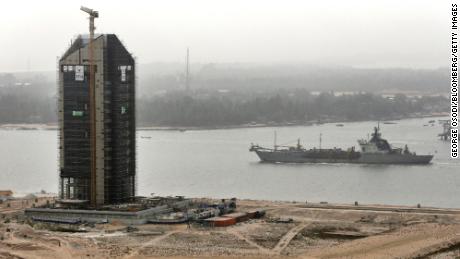
https://cdn.cnn.com/cnnnext/dam/assets/210731110847-restricted-eko-atlantic-nigeria-02-12-2016-large-169.jpg
A cargo ship passes along a waterway during construction at the Eko Atlantic city site in February 2016.
In Victoria Island, an affluent Lagos neighborhood -- an entirely new coastal city christened 'Eko Atlantic' -- is being built on land reclaimed from the Atlantic Ocean, and will be protected from rising waters by an 8-kilometer-long wall made from concrete blocks, developers say.
Other critics have argued that adjacent areas not protected by the wall will be left vulnerable to tidal surges. CNN has contacted Eko Atlantic for comment.
Coastal cities at risk of being submerged
Low-lying coastal cities in some parts of the world may be permanently submerged by 2100, one study's findings showed. The study published by research group Climate Central stated that affected areas could sink below the high-tide line if sea levels continue to rise.
"As a result of heat-trapping pollution from human activities, rising sea levels could within three decades push chronic floods higher than land currently home to 300 million people," the study said. "By 2100, areas now home to 200 million people could fall permanently below the high tide line," it added.
Global sea levels have been predicted to rise more than 6 feet (2 meters) by the end of this century.
This leaves Lagos, which experts say is less than two meters above sea, in a precarious state, given that a chunk of Nigeria's coastline is low-lying. In a study from 2012, the UK's University of Plymouth found that a sea-level rise of just 3 to 9 feet (about 1 to 3 meters) "will have a catastrophic effect on the human activities" in Nigerian coastal environments.
Adebote told CNN that Lagos' fate "would depend on how we prioritize this science prediction and what corresponding actions we take as a response." "It is only a matter of time before nature pushes back and this could be a disaster," he added.
Nigeria deadly floods
Perennial flooding in Nigeria's coastal areas has left many dead and scores displaced. According to NEMA data, more than 2 million people were directly affected by flooding in 2020.
At least 69 people lost their lives in flood disasters last year. In 2019, more than 200,000 people were affected by floods with 158 fatalities.
"Every year we witness flooding in Nigeria. It is a problem that climate change has brought and we are living with it," Ezekiel told CNN.
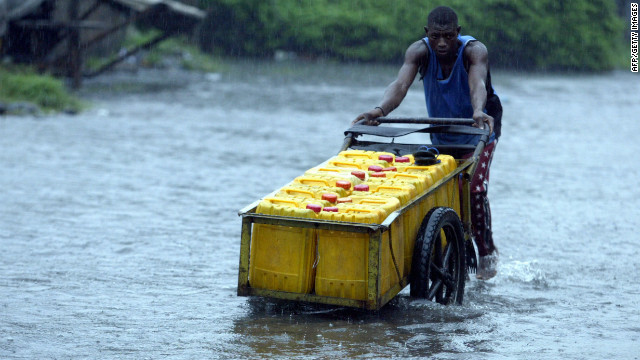
https://cdn.cnn.com/cnnnext/dam/assets/120618123241-lagos-flooding-yellow-story-top.jpg
A man in Lagos wades through the aftermath of a heavy downpour in 2012.
Beyond Lagos' vulnerability to climate change, poor drainage systems and clogged street gutters in large swathes of the city are believed to have escalated its flooding challenges.
"As much as climate change plays a part in rising sea levels, what you can see in this video is predominantly a drainage system issue," a social media user tweeted while reacting to a video of the recent flooding in Lagos.
However, as flooding rages in some areas, low-income neighborhoods constructed on reclaimed wetlands have to contend with sinking buildings.
Keeping Lagos afloat
Adebote told CNN that for Lagos to stay afloat in the face of floods and rising sea levels, it must adapt to climate change.
"We need to look at our infrastructures -- drainage systems, waste management facilities, housing structures ... How resilient and adaptive are these infrastructures in the face of environmental pressures and when put side-by-side with our growing population?" he said.
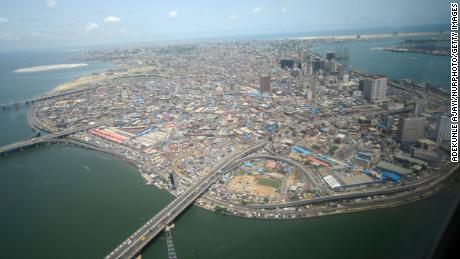
https://cdn.cnn.com/cnnnext/dam/assets/210731104757-restricted-lagos-island-nigeria-04-13-2016-large-169.jpg
An aerial view of Lagos Island in Lagos, the commercial capital of Nigeria, in April 2016.
Authorities in Lagos have since commenced the clearing of the state's water channels to mitigate perennial flooding.
Nigeria's President Muhammadu Buhari has also expressed the country's willingness to partner with global allies in tackling climate change.
"We look forward working with President [Joe] Biden and Vice President [Kamala] Harris. We have great hope and optimism for the strengthening of existing cordial relationships, working together to tackle global terrorism, climate change, poverty, and to improve economic ties and trade," Buhari wrote in a January tweet.
But Adebote remarks that government responses to climate action "have been largely poor."
"There is a lot that must be done and will take consistent and deliberate actions on the parts of various stakeholders for Nigeria to properly take climate actions, especially in adapting to the impacts that are already threatening our livelihood," he added.
An environmental activist, Olumide Idowu, urged government authorities to partner with the private sector in order to boost funds to tackle the issues.
"Government should look at private sector partnerships in order for them to drive climate finance to solve the flooding issues," Idowu told CNN.
Nigeria's economy has struggled in recent years, shrinking financing for climate change and other critical sectors. Authorities are nonetheless still pledging to ramp up the country's climate change response.
Last month, Nigeria's Ministry of Environment announced a presidential approval for a revamped national policy on climate change, aimed at addressing "most, if not all, of the challenges posed by climate change and climate vulnerability in the country," a spokesman for the ministry wrote in Twitter post. https://edition.cnn.com/2021/08/01/africa/lagos-sinking-floods-climate-change-intl-cmd/index.html |
| Politics › Re: FG‘s Refusal To Declare Armed Fulani Herdsmen ‘terrorists’ Encourages Killings by KRSWon(op): 1:07pm On Aug 16, 2021 |
|
| Politics › FG‘s Refusal To Declare Armed Fulani Herdsmen ‘terrorists’ Encourages Killings by KRSWon(op): 9:01am On Aug 16, 2021 |
The Middle Belt Movement for Justice and Peace, MBMJP, has lamented that the circle of killings being perpetrated by armed herdsmen militia in Benue, Kaduna and other states of the federation is festering because the federal government refused to tag the armed herders as terrorists.
The MBMJP insisted that if the federal government wants to put an end to the armed herdsmen induced crisis in parts of the country the federal government should stop treating the matter with kid gloves and take decisive action to end the killings by immediately declaring armed herdsmen as terrorists.
The Convener of the MBMJP, Comrade Joe Bukka who spoke weekend while reacting to the circle of violence and killings in parts of Kaduna state urged the federal government to mete the same treatment accorded the Indigenous People of Biafra, IPOB, to armed Fulani herdsmen.
“This government should exhibit honesty and sincerity in tackling the issue of armed herdsmen in this country, because we cannot continue like this.
“Armed herdsmen are turning parts of the country into a huge killing field particularly in Benue and Kaduna as well as several other states in the country and the federation has adamantly refused to speak to them in the language they will understand.
“The Global Terrorism Index rates the Fulani militia group as the fourth deadliest terrorist organisation in the world; so our question is why is the federal government refusing to tag them a terrorist organization like it did to IPOB and deal decisively with them?
“It is unfortunate that we are being taken through this path by a government that seem to be exhibiting double standards in tackling the security challenge facing the country and until there is sincerity of purpose on the part of the government which should start by declaring armed Fulani militia a terrorist organization, the circle of violence, sacking of communities and killings will fester. https://www.vanguardngr.com/2021/08/fgs-refusal-to-declare-armed-fulani-herdsmen-terrorists-encourages-killings-in-benue-other-states/ |
| Politics › Re: See The Underage Girl Nnamdi Kanu Impregnated PHOTOS by KRSWon: 10:29pm On Aug 12, 2021 |
OyigboUpdate:
Lol when someone post bad of IPOB u call it anti Igbo. U think the mods are not educated. U can also post ill of APC no body will ban u for anti Hausa.
IPOB is not a tribe stop confusing yourself thinking you're confusing Admins And yet, the president himself referred to all Igbos as "IPOB" |
| Politics › Re: See The Underage Girl Nnamdi Kanu Impregnated PHOTOS by KRSWon: 10:02pm On Aug 12, 2021 |
|
| Nairaland General › Re: BREAKING: FG to lift Twitter ban in a matter of days -Lai Mohammed by KRSWon: 9:19am On Aug 12, 2021 |
rottennaija:
Twitter now understands they can't be playing around with other countries security. As far as Nigeria is concerned, how exactly did Twitter do that? |
| Politics › Re: Campbell: What FBI Probe Of Abba Kyari Means For Buhari Government by KRSWon: 9:19am On Aug 09, 2021 |
Aren't these things we have known long since? 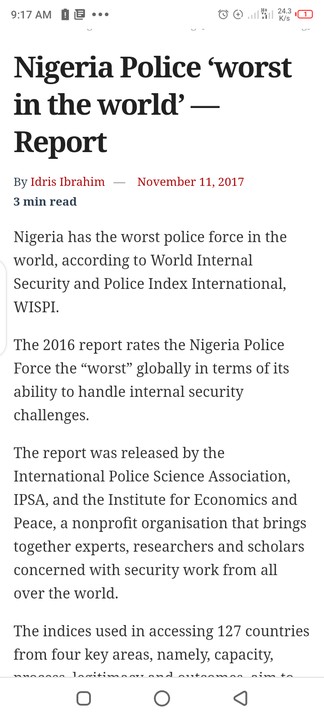
|
| Politics › Re: Babangida: Corruption Is Now Worse Than It Was Under Me by KRSWon: 7:57am On Aug 08, 2021 |
|
| Politics › Re: Babangida: Corruption Is Now Worse Than It Was Under Me by KRSWon: 11:34pm On Aug 06, 2021 |
|
| Politics › Re: Osinbajo Cautions Nigerians Against Divisive Actions, Utterances by KRSWon: 11:39am On Aug 02, 2021 |
|