Osystein's Posts
Nairaland Forum › Osystein's Profile › Osystein's Posts
1 2 3 4 5 6 7 8 ... 17 18 19 20 21 22 23 24 25 (of 25 pages)
 Events › Re: Afro-chinese Marriages Boom In Guangzhou by osystein(op): 2:33am On Jul 26, 2014 Events › Re: Afro-chinese Marriages Boom In Guangzhou by osystein(op): 2:33am On Jul 26, 2014 |
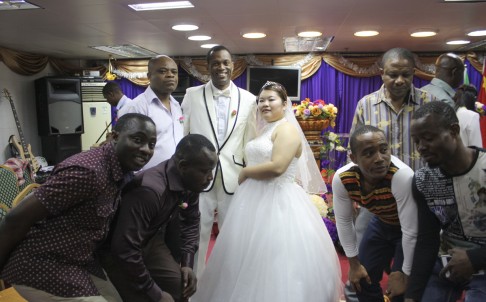
Decibel: Pishure or Idonbirithttps://m.scmp.com/sites/default/files/styles/486x302/public/2014/05/30/scmp_13apr14_fe_afr_985_jen_wed_copy.jpg?itok=Rqwl81be Jennifer Tsang and Eman Okonkwo at their wedding in Guangzhou in April. Photo: Jenni Marsh |
| Events › Afro-chinese Marriages Boom In Guangzhou by osystein(op): 2:20am On Jul 26, 2014*. Modified: 4:42am On Jul 26, 2014 |
Eman Okonkwo’s foot-tapping at the altar is not a sign of nerves. The groom’s palms aren’t sweaty, there are no pre-wedding jitters and certainly no second thoughts. Today he is realising a dream imagined by countless African merchants in Guangzhou: he is marrying a Chinese bride. Seven days earlier, Jennifer Tsang’s family was oblivious to their daughter’s romance. Like many local women dating African men, the curvaceous trader from Foshan, who is in her late 20s–that dreaded “leftover woman” age– had feared her parents would be racially prejudiced. Today, though–having tentatively given their blessing–they snuck into the underground Royal Victory Church, in Guangzhou, looking over their shoulders for police as they entered the downtown tower block. Non-state- sanctioned religious events like this are illegal on the mainland. Okonkwo, 42, doesn’t have a single relative at the rambunctious Pentecostal ceremony, but is nevertheless delighted. “Today is so special,” beams the Nigerian, “because I have married a Chinese girl. And that makes me half-African, half-Chinese.” In Guangzhou, weddings like this take place every day. There are no official figures on Afro-Chinese marriages but visit any trading warehouse in the city and you will see scores of mixed-race couples running wholesale shops, their coffee-coloured, hair-braided children racing through the corridors. While Okonkwo’s dream of becoming Chinese through matrimony is futile–the Guangzhou Public Security Bureau (PSB) denies African husbands any more rights than a tourist–his children, should he have any and they be registered under Tsang’s name, will possess a hukou residency permit and full Chinese citizenship. The relationship with Africa that China has so aggressively courted for economic gain–2012 saw a record US$198 billion of trade between the pair–is producing an unexpected return: the mainland’s first mixed-race generation with blood from a distant continent and the right to be Chinese. “CHOCOLATE CITY” OR “Little Africa”, as it has been dubbed by the Chinese press, is a district of Guangzhou that is home to between 20,000 and 200,000, mostly male, African migrants (calculations vary wildly due to the itinerant nature of many traders and the thousands who overstay their visas). Africans began pouring into China after the collapse of the Asian Tigers in 1997 prompted them to abandon outposts in Thailand and Indonesia. By exporting cheap Chinese goods back home, traders made a killing, and word spread fast. Guangzhou became a promised land. It is easy to believe that every African nation is represented here, with the Nigerian, Malian and Guinean communities the most populous. But Little Africa is a misnomer; in the bustling 7km stretch from Sanyuanli to Baiyun, in northern Guangzhou, myriad ethnicities co-exist. Uygurs serve freshly baked Xinjiang bread to Angolan women balancing shopping on their heads while Somalis in flowing Muslim robes haggle over mobile phones before exchanging currency with Malians in leather jackets, who buy lunch from Turks sizzling tilapia on street grills, and then order beer from the Korean waitress in the Africa Bar. Tucked away above a shop-lined trading corridor, the bar serves food that reminds Africans of home–egusi soup, jollof rice, fried chicken. Whereas Chungking Mansions conceals Hong Kong’s low-end trading community, in dilapidated Dengfeng village–Little Africa’s central thoroughfare–the merchants, supplied by Chinese wholesalers, are highly visible. And it’s in this melee of trade where most Afro-Chinese romances blossom. Amadou Issa came to China in 2004. We meet in Lounge Coffee, a hangout popular with African men who like a cigarette with their croissant, while a Celine Dion CD plays in the background. Through the nicotine haze, the 34- year-old from Niger–rated by the United Nations as one of the world’s least developed nations– tells me he arrived at Baiyun International Airport with US $300, simply wanting “to survive”. Today, he owns a five million yuan (HK$6.3 million) flat in Zhujiang New Town, Guangzhou’s smartest district, drives a car worth US$64,000 and speaks Putonghua. Issa ships 50 to 200 containers home per year–full of construction materials, because “they’re the most lucrative”–and makes an average US$2,000 on each container. A friend, Yusuf Sampto–a trader with three shops in West Africa’s Burkina Faso–pulls up a chair. They excitably describe stuffing suitcases with “literally millions” of US dollars to move their profits back to China once the goods have sold (they declare the cash at customs, they say). African banks can’t be trusted, they explain, and it’s impossible for a migrant to open a current account in the mainland. Like most of Guangzhou’s successful traders, Issa has a Chinese wife. “She used to work for a company I ordered from, and we became friends,” he says. “We had a Chinese wedding and a Muslim wedding. Her name was Xie Miemie but I renamed her Zena.” Zena is from Hainan Island and Issa was the first African man her family had ever seen. “Initially, they were unsure about me, but now, when I’m not there, they ask my wife, ‘Where is your import husband?’” Issa chuckles. Youssou Ousagna also gets along well with his in-laws. The retired footballer moved from Senegal to Sichuan province in 2005, having been scouted by Chengdu Tiancheng FC. In 2007, after an injury had ended his playing career, Ousagna moved to Guangzhou, where he met his Hangzhou-born wife–she worked at the pharmacy from which he picked up medicine for ongoing football injuries. Her parents are both doctors, her sister is a surgeon and her brother a policeman in Guangzhou. This middle-class family have welcomed their Muslim son-in- law. “With most Chinese, communication is the problem,” Ousagna says. “I speak Mandarin, so we understood each other. No problem.” Outside Little Africa, however, racism remains deep-seated, says Gordon Mathews, a professor of anthropology at the Chinese University of Hong Kong who is researching low-end globalisation in Guangzhou. “I know three or four relationships where the couple had expected it to lead to marriage, but as soon as the Chinese family met the African boyfriend, they had to end it,” he says. “Marrying a black person is still marrying down in China.” Racial prejudice on the mainland hit the headlines in 2009, when Lou Jing, an Afro-Chinese singer, then 20, appeared on an American Idol imitation television show, sparking controversy and drawing racial slurs online. “How can a mixed-race contestant become a Chinese idol?” bloggers demanded. Chinese prejudice against Africans is normally based on three aspects: traditional aesthetic values, an ignorance of African culture and society, and the language barrier. Furthermore, until the 1970s, foreigners were not permitted to live in the mainland, let alone marry a Chinese. When a child is born, the parents must register its ethnicity with the authorities: of the 56 boxes they can tick, “mixed-race” is not an option. But there are factors other than racism that might lead a family to reject a mixed marriage. Linessa Lin Dan, a PhD student at the Chinese University of Hong Kong researching Afro-Chinese relations in Guangzhou, says many African men who propose already have wives in their home countries–Muslims are permitted by their religion to take multiple spouses. Furthermore, Lin has heard tales of husbands returning to Nigeria on a business trip, leaving a mobile-phone number that doesn’t connect and disappearing. “The Chinese wife is left with their children, and shamed for marrying a hei gui[black ghost],” says Lin. Generally, though, the African bachelors in Guangzhou are not desperate asylum seekers: they are highly eligible businessmen. Like Ousagna and Issa, they often own a car, have a stable income and speak Putonghua. Forty per cent of African migrants surveyed in Guangzhou for the book Africans in China (2012), by former University of Hong Kong professor Adams Bodomo, had received tertiary education–some even held a PhD. As one Congolese merchant tells Post Magazine, “To start a business in China you have to be quite well-to-do. In the early days, the air ticket alone cost US $2,000.” Despite their eligibility, most African grooms in Guangzhou marry Chinese economic migrants whose disapproving families reside far from the city. In business terms, it is the ideal merger, says Lin, who believes most Afro-Chinese marriages are a cynical play for better business. “Opening a shop is very difficult for foreigners,” she says. “You need a Chinese passport or the landlord will ask for a bribe. A Chinese wife can speak to suppliers. It’s useful to have a Chinese partner. “Many Chinese women want to marry Africans because they are from poor rural areas, often Hunan or Hubei provinces. Marrying a foreigner is a way to upgrade their social status, because the Africans have money.” Instead of taking a factory job, a Chinese woman who marries an African man often becomes head of his wholesale shop, should he open one, and a key player in his export business. Pat Chukwuonye Chike–a garment trader by day and Nigerian hip- hop artist known as Dibaocha Sky by night–has a Chinese wife who doubles as a business partner. But, he says, if African men could legally work in China, many might not take a local wife. “That is my sacrifice,” says the married father-of-two. “My wife cannot cook. My mother-in-law helps look after the children, and she is poisoning them against Africa. She’s an old woman, she knows the game she’s playing. There is crisis everywhere– terrorists were in Guangzhou last week–it is a sin to make my children scared of Nigeria.” Africans in Guangzhou fall into two groups: those with valid documentation and those whose visas have expired. For those who have overstayed, a Chinese wife is more than a business partner; she is key to survival. Last August, a major police bust on an African-led drug ring turned life into a daily fight against deportation for overstayers. From dusk till dawn, police checked passports in Guangyuan Xi Lu, the Nigerian annex of Little Africa, where most of the city’s overstayers can be found. “When Nigerians land at Baiyun Airport many throw away their passports,” Lin says. “They only get seven- to 30-day visas [less than most other Africans]–it’s not enough time to make their fortunes.” Overstayers face a 12,000 yuan fine and must pay for their 6,000- yuan air ticket out of the country. Those with Chinese wives went underground while their spouses manned their businesses. “During this period, Nigerians with Chinese wives survived better,” says Lin. While the crackdown proved a Chinese wife’s worth, the loyalty displayed points to genuine devotion in Afro-Chinese romances. Pastor I.G., of the Royal Victory Church, has a Chinese wife, and children. One Sunday I ask him, “Is it love or business?” The Nigerian sighs. He feels “slighted” by repeated assumptions his eight-year marriage is economically motivated. He met Winnie, a native of Guangdong province, at church and the pair are united in their evangelic mission (“God knows it’s China’s time,” he says). Winnie, 34, is a pastor at the church’s 100-worshipper-strong Chinese arm while he leads the larger African congregation. Their tactile body language speaks volumes about their union. Michelle Zhang Nan, 35, doesn’t fit the profile of a trader’s wife, either. When we meet at McDonald’s, she is dressed in an expensive A-line dress and kitten heels. Her three-year-old son, Calvin, trails behind as she carries a tray of Big Macs and milkshakes. A university graduate whose parents are government officials, Zhang lives in Guangzhou but has a prized Beijing hukou and owns a phone-battery retail business. “I liked the way he did business,” she says, of falling in love with her South African husband. “If I was married to a Chinese man, I could not be a strong woman like I am today. My husband is 11 years older and he teaches me.” She notes that a Chinese man would benefit equally from taking an African wife, but that is unheard of in Guangzhou. As one bootylicious Liberian hairdresser, who works on the third floor of a tower block, says, “Chinese men aren’t manly, they aren’t sexual to us.” (East African prostitutes working in Little Africa, however, report that 50 per cent of their clients are Chinese men who “want to try it”, according to Matthews.) continue reading. .. http://scmp.com/magazines/post-magazine/article/1521076/afro-chinese-marriages-boom-guangzhou-will-it-be-til-death |
| Romance › Re: Why Are South African Women Crazy About Naija Guys? by osystein(m): 1:46am On Jul 26, 2014 |
Another interesting fact, Nigerian women are most unfaithful in the world – Durex A survey conducted by condom manufacturer, Durex, in which 29,000 people in 36 countries were interviewed has ranked Nigerian women as the most unfaithful in the world. www.channelstv.com/2012/07/16/nigerian-women-are-most-unfaithful-in-the-world-durex/ 2 Likes |
| Romance › Re: Why Are South African Women Crazy About Naija Guys? by osystein(m): 1:40am On Jul 26, 2014 |
here's the answer  South African men are having far less sex than their counterparts around the world, according to a survey released on Tuesday. Men in the country have sex on average 52 times a year, Pharma Dynamics found in its survey. This paled in comparison to the global average of 104 times a year. www.timeslive.co.za/lifestyle/2014/07/22/south-african-men-hard-up-for-sex---only-get-half-world-s-average [center]here's the answer South African men are having far less sex than their counterparts around the world, according to a survey released on Tuesday. Men in the country have sex on average 52 times a year, Pharma Dynamics found in its survey. This paled in comparison to the global average of 104 times a year. www.timeslive.co.za/lifestyle/2014/07/22/south-african-men-hard-up-for-sex---only-get-half-world-s-average [/center]here's the answer South African men are having far less sex than their counterparts around the world, according to a survey released on Tuesday. Men in the country have sex on average 52 times a year, Pharma Dynamics found in its survey. This paled in comparison to the global average of 104 times a year. www.timeslive.co.za/lifestyle/2014/07/22/south-african-men-hard-up-for-sex---only-get-half-world-s-average |
| Travel › Re: Top 10 Signs You’ve Been In Nigeria Too Long by osystein(m): 10:29am On Jul 25, 2014 |
when you start envying Igbos. 2 Likes |
| Travel › Re: Top 10 Signs You’ve Been In Nigeria Too Long by osystein(m): 10:21am On Jul 25, 2014 |
when you do anything for money. |
| Travel › Re: Top 10 Signs You’ve Been In Nigeria Too Long by osystein(m): 10:18am On Jul 25, 2014 |
when you fart infront of others without feeling embarrassed. 1 Like |
| Travel › Re: Top 10 Signs You’ve Been In Nigeria Too Long by osystein(m): 10:14am On Jul 25, 2014 |
when generator noise don't irritate you. 3 Likes |
| Travel › Re: Top 10 Signs You’ve Been In Nigeria Too Long by osystein(m): 10:13am On Jul 25, 2014 |
When you're able to lie with a straight face, when you cheat anada without feeling bad. 3 Likes |
| Romance › Re: Why Are South African Women Crazy About Naija Guys? by osystein(m): 8:01am On Jul 25, 2014 |
ANAMBRA11: who cary diz mumu thread put for front pagelmaoo.. 2 Likes |
| Romance › Re: Why Are South African Women Crazy About Naija Guys? by osystein(m): 4:43am On Jul 25, 2014 |
Ashantiking: Don't get me started on u igbos. U are always beating your chest. We control the economy in lagos, we control the economy in Ghana, we control the economy in Cameroon. But when one take a look at your part of Nigeria, nothing to be found.Another black loser, jealous of ndiigbo, u wish u were igbo, don't u? |
| Romance › Re: Why Are South African Women Crazy About Naija Guys? by osystein(m): 4:01am On Jul 25, 2014 |
Ashantiking: Nigerians say this about the men in every country they go to. You say that about Ghanaians, South Africans, african Americans, Jamaicans in Britain. U guys really need to shut up with all that bs.Every black guy is a loser except ndiingbo (especially from anambra), you should know that. |
| Romance › Re: Why Are South African Women Crazy About Naija Guys? by osystein(m): 3:31am On Jul 25, 2014 |
Ibos as usual, always causing trouble. 1 Like |
| Romance › Re: Why Are South African Women Crazy About Naija Guys? by osystein(m): 3:22am On Jul 25, 2014 |
Igbos as usual, always looking for trouble. |
| Foreign Affairs › Re: Who Has The Strongest Military In Africa? by osystein(mod): 6:29am On Jul 24, 2014 |
To be honest, sercurity guards in SA are better trained and more competent than the useless nigerian military. While SA standards are first world, everything about Nigeria is 3rd and even 4th world. 2 Likes |
| Politics › Re: Eko Atlantic Is Starting To Rise by osystein(m): 4:15am On Jul 24, 2014 |
Everyone pls ignore the idiot, he's a real mental case, i've seen him on other forums trolling non stop like he's doing here. I've seen him dissing SA also, like he does Nigeria. 1 Like |
| Politics › Re: Eko Atlantic Is Starting To Rise by osystein(m): 4:02am On Jul 24, 2014 |
Aigbofa: Sonny Okosuns will be turning in his grave. Poor man he sang his heart out about "fire in Soweto burning on his people"He's ghnian, check his other moniker.... www.nairaland.com/kwametut www.nairaland.com/kwamenkria 1 Like |
| Politics › Re: Eko Atlantic Is Starting To Rise by osystein(m): 3:42am On Jul 24, 2014 |
sostoz: How many blacks on that unda 20 cricket? Awodwa? Ungum Xhosa ?he's ganian, he's other monikers are kwame tut and kwame nkria. 1 Like |
| Politics › Re: Eko Atlantic Is Starting To Rise by osystein(m): 3:39am On Jul 24, 2014 |
Litmus: Most Nigerians are like you. I look at Africa and pray for the best for all Nations. Who wouldn't want to see progress in every corner of Africa ? Actually, apart from Saudi Arabia i cant think of one nation in the entire world that i even feel deserves failure let alone wish failure. Unfortunately, the rest of African don't seem to feel the same way.The rest of Africa seem a place of lost, jealous, bitter souls... pitifulHe's ganian with an inferiority complex. 1 Like |
| Politics › Re: Eko Atlantic Is Starting To Rise by osystein(m): 3:37am On Jul 24, 2014 |
overhypedsteve: this awodwa guy is not very wise is he, he is so foolish that he does not realise that he is peeing on nelson mandela's grave by calling an african black, he doesnt know the history of african libration struggle well enough to realise that it was the brotherly nature of this legends that laid the foundation for the freedom we now enjoy, he doesnt know that without our identity and unity as blacks there would be no black africa,i ve always thought of the southafricans as the strongest pan africanists in the continent due to the discriminations and challenges they got as a result of their skin colour, but this awoonja guy is proving me wrong, he projecting the southafricans as a delusional set of people, but i know he cant be right, cus like i said earlier, he is not too wisePls ignore that ganian troll, He's not a south african. 1 Like |
| Travel › Re: Nigerians Among Races That Excel In America by osystein(m): 11:31pm On Jan 10, 2014 |
She probably chose Nigerian so she doesn't come across as racist, the list includes a group from each race, go figure. Chinese, Indians and Nigerians are most definitely boasted by their over-population, obviously there's selection for the most talented and ambitious when it comes to immigrating to the US. |
| Sports › Re: Questions? Comments? Complaints? Talk To The Moderators Here by osystein(m): 7:17pm On Jan 10, 2014 |
honeric01: done.. pls keep reporting to the mods any troll you find around by clicking the report to moderator's sign.www.nairaland.com/kwame%20tut Here is the ghanain troll again with his other handle, pls ban both his accounts from the sports section, or else he'll spamm all the CHAN threads throughout the tournament. |
| Sports › Re: Questions? Comments? Complaints? Talk To The Moderators Here by osystein(m): 11:28am On Jan 10, 2014 |
mod can u pls ban this spamming troll from the Chan thread www.nairaland.com/awodwagyanoniwe |
| Politics › Drug Use On The Rise In Nigeria's Biggest City by osystein(op): 1:13pm On Jan 07, 2014 |
2014-01-07 10:04 Kano - Drug abuse in northern Nigeria's largest city has been on the rise in recent years, with anti-narcotics officials and experts warning of serious social consequences if the problem is not tackled. Kano has the country's highest drug abuse rate based on the number of seizures, arrests of addicts and convictions of arrested dealers, according to the National Drug Law Enforcement Agency (NDLEA). "It is a painful fact that Kano tops the drug abuse chart in Nigeria, a trend that all hands must be on deck to change if we are to save our upcoming generation from ruin," the Kano commander for the NDLEA, Garba Ahmadu, told AFP. "The use of hard drugs, especially among the youth, has become a real social menace and cuts across all social strata, with children from both rich and poor backgrounds deeply into it." On December 6 the NDLEA destroyed more than 10 metric tonnes of drugs, including cannabis, cocaine and methamphetamine, with an estimated street value of some $1.4m. The Hisbah, Kano's so-called "morality police" which enforces Islamic law, separately impounded 100 000 cartons of glue during a raid on a city warehouse. More unconventional drugs are also being used, not just codeine-laced cough syrup which has become popular among married women, but solvents and powerful horse stimulants. Unemployment, broken marriages blamed According to Mairo Bello, who runs a youth charity called the Adolescent Health Information Project, high divorce rates and a resulting breakdown in family values contribute to drug use. Hundreds of factories in Kano have closed in the past two decades because of power supply problems and competition from cheaper Asian goods, putting many out of work and leaving them unable to provide for their families. Unemployment rates in Kano, which was famous for its textiles and tanneries, are the highest in Nigeria, according to the government. In 2011, the National Bureau of Statistics said as many as two-thirds of the population (67%) were out of work. "The government needs to resuscitate dead industries by providing the needed infrastructure to get the youth employed and off drugs," said Nu'uman Habib, who teaches sociology at Kano's Bayero University. Kano, like the rest of northern Nigeria, is majority Muslim, with men allowed to take up to four wives, which has also contributed to social problems. High birth and divorce rates compound financial burdens and often see families on the streets when marriages break down, Bello said. As a result, children often turn to drugs to blot out hardships. "I'm from a broken home," said 23-year-old Usman Umar. "My parents divorced when I was nine and I continued to live with my father, who remarried. "My stepmother treated me harshly. She would molest and insult me but my father would not do anything to protect me, which forced me to stay outside the house most of the time and hang out with friends I made in our neighbourhood. "They introduced me to drugs, starting with cigarettes and moving to hashish, cough mixture with codeine and other psychotropics. "A lot of young men take drugs to get high and forget their frustration. When you take it you feel happy and your worries disappear." Reconciliation, rehabilitation, mass weddings The Kano state authorities and the Hisbah have responded to the use of drugs because of concern at the extent of their use. Last year, the state governor Rabiu Musa Kwankwaso launched a programme to target fake and illicit drugs while the manufacture, sale and consumption of codeine-laced cough syrup was banned to curb its abuse. "It is no longer drug abuse but substance abuse as drug users now experiment with anything that will get them high," Habib said. The state government has established a sports institute and vocational training centres for young people and set up a drug rehabilitation centre for addicts. Children sent to the city by their parents from impoverished villages, who often find themselves on the streets, will be sent back when a ban on begging comes into effect. The Hisbah has in addition set up a Matrimonial Dispute Resolution Office to try to reconcile warring families. Mass weddings of divorcees have also been held to help keep children of divorced parents from ending up on the streets and turning to drugs. In the past year alone, more than 2 000 women have been married off in this way. |
| Health › Re: Man Gives Birth To Baby Girl: His Wife Is The Father (Argentina) by osystein(m): 8:32pm On Jan 03, 2014 |
People should at least think about the poor child when they wanna do these things. I feel so sorry for the little one. |
| Politics › Re: See The African Countries Doing The Most To Boost Its Energy Supply by osystein(m): 9:52pm On Jan 02, 2014 |
2 Likes |
| Politics › Re: South Korea In 1964 .a Few Years After Nigeria's Independence by osystein(m): 1:40am On Jan 02, 2014 |
Obiagu1: ^^^Hey dumbo.. Did u read the comment I was replying to? The guy claimed that South Africa didn't receive any support from the west which is totally not true, do you think if Nigeria had that level of support it wouldn't be more developed now? |
| Politics › Re: South Korea In 1964 .a Few Years After Nigeria's Independence by osystein(m): 12:54am On Jan 02, 2014 |
revolt: pleasreeeeeeeeeeee stop giving excuses for nigerias retrogression. babbling about we not having the same support south Korea got from U.S.You have no clue about anything, South Africa just like South Korea received alot support from the west, even during the sanctions the west invested and traded with the country more than other African countries . I saw this in military thread in the foreign affairs section. South Africa today has one of the top defense industry in the world and support from the west played a huge role in it. [quote author=chris365 [size=13pt] South Africa Growth of the Defense Industry[/size] South Africa's domestic arms industry originated in 1940 with the appointment of an Advisory Committee on Defence Force Requirements to study and to assess the country's military-industrial potential. Relying on its recommendations, the government, with British assistance, established six factories to produce or to assemble ammunition, bombs, howitzers, mortars, armored vehicles, and electronic equipment Before the voluntary UN arms embargo was declared mandatory in 1977, South Africa received military technology through licensing agreements, primarily with West Germany, Italy, Israel, France, Belgium, and Canada. Licensing and coproduction agreements in the 1970s and 1980s made it difficult to distinguish between fully indigenous military manufactures and those that relied on foreign manufacturing capabilities [size=13pt] Defying International Embargoes[/size] Despite the numerous international embargoes against arms trade with South Africa in the 1970s and 1980s, it nonetheless developed the most advanced military-industrial base on the continent. in the deliberate refusal by several countries to comply with the embargoes; in Pretoria's use of clever and covert circumvention techniques; and in its ability to develop and to exploit advanced commercial and "dual-use" technologies for military applications. By the late 1960s, South Africa had acquired at least 127 foreign production licenses for arms, ammunition, and military vehicles. South Africa had purchased fighter aircraft, tanks, naval vessels, naval armaments, and maritime patrol aircraft, primarily from Britain. After that, military equipment was carefully maintained, upgraded, and often reverse-engineered or copied, after the embargo made it difficult to obtain replacements or replacement parts. During the 1970s, South Africa expanded and refined its ability to acquire foreign assistance for domestic military production. Its broad-based industrial growth enabled it to shift imports from finished products to technology and components that could be incorporated into locally designed or copied military systems. Through this maneuver, multinational firms and banks became major sources of technology and capital for South Africa's defense industry, even during the embargo era. Dual-use equipment and technology--such as electronics, computers, communications, machine tools, and industrial equipment--and manufacturing techniques were not subject to embargo and were easy to exploit for military applications. South African engineers also were able to modify, to redesign, to retrofit, and to upgrade a wide range of weapons using foreign technology and systems. South Africa also invested in strategic foreign industries; recruited foreign technicians to design, to develop, and to manufacture weapons; rented and leased technical services, including computers; and resorted to cover companies, deceptive practices, third-country shipments, and outright smuggling and piracy to meet its defense needs. By the 1980s, the defense industry, as extensive as it was, was nonetheless incapable of designing and producing some advanced military systems, such as high-performance combat aircraft, tanks, and aerospace electronics. The new Government of National Unity in 1994 faced the dilemma of whether to dismantle the defense industry many of its leaders had reviled for two decades or to preserve a lucrative export industry that still employed tens of thousands of South Africans. After some debate, President Mandela and Minister of Defence Joe Modise decided to maintain a high level of defense manufacturing and to increase military exports in the late 1990s http://www.photius.com/countries/south_africa/national_security/south_africa_national_security_growth_of_the_defens~2506.html so please stop deceiving yourselves and some ignorant south africans that you developed your defence industry alone during sanctions. western countries traded with SA, helped you with your military capabilities. even SA was Britains largest trading partner in Africa under sanctions. while Nigeria was completely abandoned because we didn't have European settlers. Fact do you think i just come here blabbing without proof like you. i'm just not accustomed to the copy and paste mentality you people depend on to pass information.  like i said earlier, Nigerian defence industry is very young and wholly indigenous and so far we are doing very well. deal with it or go flush your head in a toilet. [/quote] |
| Nairaland General › Re: Welcome To 2014 by osystein(m): 12:09am On Jan 01, 2014 |
Have a great new year everyone.. 1 Like |
| Politics › Re: Let's Have Your Complaints, Suggestions & Enquiries Here by osystein(m): 4:07am On Dec 29, 2013 |
pls put this on the front page. www.nairaland.com/1572130/top-nigerian-achievers-year-2013#20527224 |
| Politics › Re: Top Nigerian Achievers Of Year 2013 by osystein(m): 4:05am On Dec 29, 2013 |
Great stuff, Lets hope 2014 will see more achievements. 2 Likes |



1 2 3 4 5 6 7 8 ... 17 18 19 20 21 22 23 24 25 (of 25 pages)