Anyigala's Posts
Nairaland Forum › Anyigala's Profile › Anyigala's Posts
 Christianity Etc › Re: Jesus Will Never Accept This ! by Anyigala(m): 1:25am On Nov 14, 2012 Christianity Etc › Re: Jesus Will Never Accept This ! by Anyigala(m): 1:25am On Nov 14, 2012 |
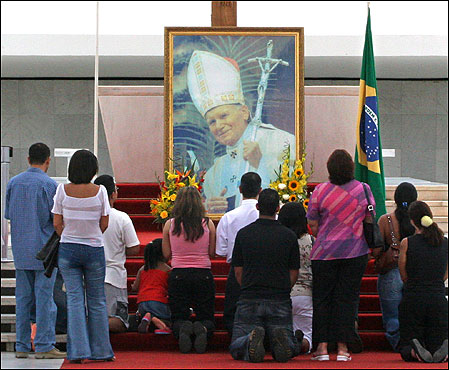
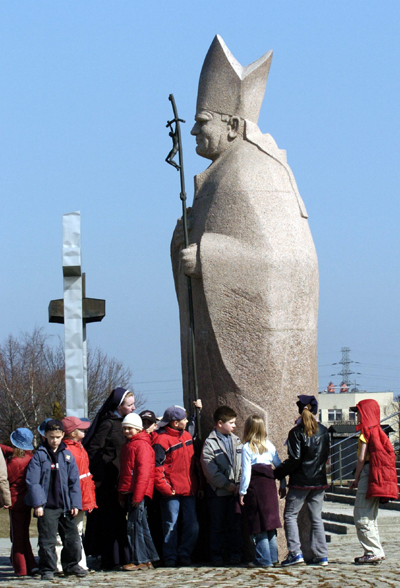
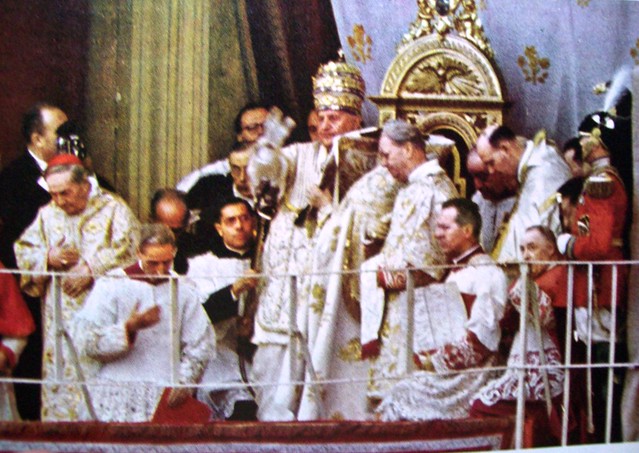
frosbel: [size=13pt]5 The devil led him up to a high place and showed him in an instant all the kingdoms of the world. 6 And he said to him, “I will give you all their authority and splendor; it has been given to me, and I can give it to anyone I want to. 7 If you worship me, it will all be yours.”This is becoming very childish and silly. So you scanned through the internet to copy random pictures you are very much aware does not support whatever it is you are trying to accuse Catholic Church of. Those seminarians prostrating are been ordained as priest. It’s symbolises their unworthiness for the office they are to be assume and their dependence upon God and the prayers of the entire Church for their success in there new ministry. Pope John XXIII was consecrating the Host and everyone was kneeling behind him. It is what every Catholic does during Eucharistic prayer because we believe that after the prayer, the host is no longer host but true body and blood of Christ (John 6). So, they were not worshiping Pope if it’s what you are driving at. They knelt in prayer in the presense of Jesus Chrit in the Eucharist. We also pray for the dead as well. Unless you think it is Idol worshipping also. Yes, the people kneeling in front of Pope John Paul’s picture were praying for his repose and his intercession. That picture was from World Youth day 2011 in Madrid where more than 2 million young catholic from all over the world gathered to pray and share there faith. Pope John Paul II died in 2005 and that picture was taken last year. I don’t know your issue with people walking past Pope John Paul’s Statue, Pope John Paul XXIII blessing the Bishops during the 2nd Vatican council, the election of Popes or their Mitre (Hat). Oh, do you also have problem that the Pope is been carried on a Chair. Probably a very sick man too. Or that people were cheering and greeting him. Maybe you will rather he was in a convoy of 30 cars or on a private jet. You lifted the pictures from websites that actually explained what was happening, but no... common sense will not be allowed to mess up your anti catholic rant. I have been on nairaland for about three months and you alway have something negative to say about Catholic Church. I don’t have problem with your negativity but when it bothers to making wild and completely insane accusations, it becomes very unchristian. It’s bad to judge others, but to add false accusation as well is very sinful. Your anti Catholic rants are becoming a poison and it will do you alot of good to snap out of it quickly. Stop reading all these anti catholic books and myths floating around the internet. The Church is almost 2000 years and gate of hedes will NOT prevail againts it. Bigger and more powerful treats have come and gone, Frosbel is a small potatoes. 2 Likes |
| Christianity Etc › I Fought The Church, And The Church Won. by Anyigala(op): 12:44am On Nov 07, 2012 |
Jason Stellman was born and raised in Orange County, CA, and served as a missionary with Calvary Chapel of Costa Mesa in Uganda (’91-’92) and in Hungary (’94-’00). After becoming Reformed and being subsequently “dismissed” from ministry with Calvary, he went to Westminster Seminary California where he received an M.Div. in 2004. After graduation he was ordained by the Pacific Northwest Presbytery of the Presbyterian Church in America and called to plant Exile Presbyterian Church in the Seattle area, where he served from 2004 until resigning in the Spring of 2012. He is the author of Dual Citizens: Worship and Life Between the Already and the Not Yet (Reformation Trust, 2009), and The Destiny of the Species (forthcoming from Wipf and Stock Publications). In 2011 he served as the prosecutor in the trial of Peter Leithart in the Pacific Northwest Presbytery of the PCA. He currently resides in the Seattle area with his wife and three children. He was received into full communion with the Catholic Church on September 23, 2012. His Story. Part of me has wished for a while now that I was born early enough to have been a fan of The Clash back in the Seventies. The first song I ever heard by them (several years after its release) was their cover of Sonny Curtis’s hit, the chorus of which goes, “I fought the law, and the law won.” Despite being a fairly law-abiding guy, I can relate to being on the losing side of a battle, only mine was not against the law, but against the Church. As many of you know, I recently resigned from my pastoral ministry in the Presbyterian Church in America . My stated reasons for stepping down were that I could no longer in good conscience uphold my ordination vow that as a PCA minister I sincerely accept the Westminster Confession and Catechisms as containing the system of doctrine taught in Holy Scripture. More specifically, I no longer see the Reformed doctrines of Sola Scriptura and Sola Fide as faithfully reflecting what the Bible teaches, which is why I will, Lord willing, be received into full communion with the Catholic Church sometime in the next several months. The purpose of this piece is not to unpack those claims in detail (there will be plenty of time for that in the future), but rather to provide a little more insight into the process that led up to my resignation, as well as to respond briefly to those who have sought to analyze me and the supposed internal psychological factors that must have led to my making such a drastic decision. The Lure of Rome? One of the things I found especially curious (slash bemusing, slash maddening) while reading the diagnoses of my volunteer analysts was the fact that my being drawn to, or lured by, Rome was simply assumed, and that the only real question was what, exactly, was it that ultimately did it. Was it some positive aspect of Catholicism that appealed to me, or was it a nagging drawback of Protestantism that finally proved to be the deal-breaker? Now, I realize that I went into a period of radio silence during the weeks following my resignation (one that was not exactly self-imposed, but that has turned out to be a blessing), and that this created something of a vacuum that invited speculation on the part of some. But now that I am no longer “off the grid,” I would like to clear something up once and for all: Catholicism never held any allure for me, nor do I find it particularly alluring now. Now to be honest there has always been an attraction of a “Wouldn’t-it-be-nice” or “stained-glass-windows-are-rad” variety, but when it came to an actual positive drawing to Rome or a negative driving away from Geneva, there has never been any such thing. In fact, since much of my theological output has been part of the public domain for so long (especially in the form of my preaching, teaching, and writing), this claim of mine can actually be proven. If anyone cares to go back and listen to or read what I was talking about right up until the day I was confronted with the claims of the Catholic Church as they relate to those of Protestantism, the inquirer will easily discover that I was about as staunchly confessional an Old School Presbyterian as anyone would want to meet. There was not even the slightest hint of discontent with my ecclesiastical identity, not a trace of longing for greater certitude, nor a smidgen of regret that my soteriology didn’t have enough works in it. I will raise the pot even more: I wrote a book whose entire purpose was to demonstrate, in the highest and most attractive terms possible, how ironically boastworthy all the supposed disadvantages of amillennial Protestantism are. Messiness? Lack of infallible certitude? The need for faith over sight? Check, check, and check. Further still, so far from longing for a type of kinder, gentler Catholicism that I could disguise in Reformed garb, I was the prosecutor in a doctrinal trial against a fellow minister in my presbytery for espousing views that I, and many others, considered dangerously close to being Catholic. No, there was never any desire to place human works anywhere but where the Reformed confessions say they belong: in the category of sanctification and never justification. In a word, I was as happy and comfortable in my confessional Presbyterian skin as anyone, and the trust I had earned from many well-known and respected Reformed theologians, as well as having graduated with honors from one of the most confessionally staunch and academically rigorous Reformed seminaries in the nation, should be sufficient to dispel any notions that I never really understood Reformed theology in the first place or that I was always a Catholic in Protestant clothing. Driven, Not Drawn One of the things that made fighting against the claims of the Catholic Church so frustrating was that there was no single, knock-down-drag-out argument to refute; neither was there an isolated passage of Scripture or silver-bullet issue of theology to deal with. If it had been simply a matter of answering one specific challenge that came from a single direction, the battle would have been much easier to win. But as it happened, there were two distinct issues that were coming under attack (Sola Scriptura and Sola Fide), and the attacks were coming from multiple directions: the biblical, the historical, and, in the case of Sola Scriptura, the philosophical as well. In the case of Sola Scriptura, I, as a self-described Reformed non-evangelical, considered the distinction between Solo- and Sola Scriptura as absolutely essential to my own spiritual identity. It was the evangelicals who were the heirs of Anabaptism, not the Reformed; it was the evangelicals who espoused “no creed but Christ,” not the Reformed; it was the evangelicals who interpreted the Bible in isolation from history and tradition, not the Reformed. Therefore as one can imagine, when I was confronted with Catholic claims that called this crucial distinction into question, it was a sucker-punch of epic proportions. Needless to say, my confessional brethren and I did not appreciate our ancestral city of Geneva being confused with Saddleback. But the more I read and wrestled, the more I began to see that Geneva was not being “confused with” Saddleback at all; the two were just different sides of the same coin (or to be more precise with the metaphor, they were sister-cities in the same Protestant county). Readers of this site have no need for the arguments to be rehearsed here, so suffice it to say that, philosophically speaking, it became clear to me that Sola Scriptura could not provide a way to speak meaningfully about the necessary distinction between orthodoxy and heresy (or even between essentials and non-essentials); neither could it justify the 27-book New Testament canon, create the unity that that canon demands, or provide the means of avoiding the schism that that canon condemns. Historically speaking, the idea that the written Word of God is formally sufficient for all things related to faith and practice, such that anyone of normal intelligence and reasonably good intentions could read it and deduce from it what is necessary for orthodoxy and orthopraxy, is not a position that I see reflected in the writings of the early Church fathers. While there are plenty of statements in their writings that speak in glowing terms about the qualitative uniqueness of Scripture, those statements, for them, do not do away with the need for Scripture to be interpreted by the Church in a binding and authoritative way when necessary. This discovery in the church fathers is unsurprising if the same position can be found in the New Testament itself, which I now believe it can. To cite but one example, the Church in her earliest days was confronted with a question that Jesus had not addressed with any specificity or directness, namely, the question of Gentile inclusion in the family of God. In order to answer this question, the apostles and elders of the Church gathered together in council to hear all sides and reach a verdict. What is especially interesting about Luke’s account of the Jerusalem Council is the role that Scripture played, as well as the nature of the verdict rendered. Concerning the former, James’s citation of Amosis curious in that the passage in the prophet seems to have little to do with the matter at hand, and yet James cites Amos’s words about the tent of David being rebuilt to demonstrate that full Gentile membership in the Church fulfills that prophecy. Moreover, Scripture functioned for the Bishop of Jerusalem not as the judge that settled the dispute, but rather as a witness that testified to what settled it, namely, the judgment of the apostles and elders. Rather than saying, “We agree with Scripture,” he says in effect, “Scripture agrees with us” (v. 15, 19). And finally, when the decision is ultimately reached, it is understood by the apostles and elders not as an optional and fallible position with which the faithful may safely disagree if they remain biblically unconvinced, but rather as an authoritative and binding pronouncement that was bound in heaven even as it was on earth (v. 28). Despite some superficial similarities, no existing Protestant denomination with an operating norm of Sola Scriptura can replicate the dynamic, or claim the authority of the Jerusalem Council (or of Nicaea, Constantinople, and Chalcedon for that matter). The fact that the Bible’s own example of how Church courts operate was hamstrung by Protestantism’s view of biblical authority was something I began to find disturbingly ironic. Moving on to Sola Fide, I found myself wrestling with this issue from both a historical and biblical perspective as well, and this is what ultimately proved to be the coup de grâce for me as a Protestant. As long as I believed that Catholicism mucked up the gospel so severely, its arguments about authority remained merely annoying, like a stone in my shoe that I would eventually get used to (after all, better to be unauthoritatively right about justification than authoritatively wrong about it). But when I began to dig into the issue more deeply and seek to understand Rome on its own terms, I began to experience what some have referred to as a “paradigm crisis.” A severe one. As a Protestant minister, I had always operated under the assumption that the fullest treatment of the gospel, and of justification in particular, came from the apostle Paul, and that the rest of what the New Testament had to say on these issues should be filtered through him. But as I began to investigate again things that I had thought were long-settled for me, I began to discover just how problematic that hermeneutical approach really was. If justification by faith alone was indeed “the article on which the church stands or falls,” as Reformed theology claimed, then wouldn’t we expect it to have been taught by Jesus himself, somewhere? Moreover, wouldn’t John have taught it, too? And Peter, and James? Shoot, wouldn’t Paul himself have taught the imputation of alien righteousness somewhere outside of just two of his thirteen epistles? Having realized that I was using a few select (and hermeneutically debatable) passages from Romans and Galatians as the filter through which I understood everything else the New Testament had to say about salvation, I began to conclude that such an approach was as arbitrary as it was irresponsible. I then sought to identify a paradigm, or simple statement of the gospel, that provided more explanatory value than Sola Fide did. As I hope to unpack in more detail eventually, I have come to understand the gospel in terms of the New Covenant gift of the Spirit, procured through the sacrifice and resurrection of Christ, who causes fruit to be borne in our lives by reproducing the image of the Son in the adopted children of the Father. If love of God and neighbor fulfills the law, and if the fruit of the Spirit is love, having been shed abroad by the Spirit in our hearts, then it seems to follow that the promise of the gospel is equivalent with the promise of the New Covenant that God’s law will no longer be external to the believer, but will be written upon his mind and heart, such that its righteous demands arefulfilled in us who walk not after the flesh, but after the Spirit. And again unsurprisingly, when I turned to the early Church fathers, and especially Augustine, it was this very understanding of the gospel that I encountered over and over again. Conclusion While the case for the Catholic Church may not be immediately obvious or easily winnable, the fact remains that Rome’s claims are philosophically compelling, historically plausible, and biblically persuasive. Yet despite the claims of most Reformed believers who, when wrestling with the issue of people like me leaving Geneva for the supposedly-greener pastures of Rome, insist that such a move betrays a “quest for illegitimate religious certainty,” the fact is that if it is a sense of personal and psychological certitude that one is searching for, Catholicism will more than likely disappoint. Ironically enough, Protestantism provides more certitude for the seeker than Catholicism does, since the ultimate basis for the truthfulness of its claims is one’s agreement with one’s self and one’s own interpretation of Scripture. But if what you are searching for is not subjective certitude but the Church that Jesus founded, the Catholic Church’s case for being that Church, when harkened to with charity, humility, and faith seeking understanding, is as compelling as it is disruptive. And make no mistake, the Catholic Church is disruptive. It is audacious and confrontational, sucker-punching and line-in-the-sand drawing. Like the Lion Aslan from C.S. Lewis’s Chronicles of Narnia, it is not a tame Church, and will make no promise not to devour and discomfit its subjects as they partake of its life-giving water, causing them to constantly bend the knee and cede their worldly wisdom to the foolishness of the cross. In the words of Aslan to Jill, who expressed fear about letting down her guard to drink from the water by which he stood, “There are no other streams.” Or the words of Peter to Jesus when asked if the Twelve would forsake Him because of His difficult and demanding message, “Lord, to whom shall we go? You have the words of eternal life.” The Catholic Church, wistfully alluring? Hardly. Tidy and tame? Not by a long shot, for once discovered it demands that the seeker relinquish the one thing above all others that offers him confidence, namely, his own autonomy. In fact, submitting oneself to the authority of the Catholic Church is the most harrowing experience a person will ever endure, which is why the suggestion that converts from Geneva to Rome are simply opting for a feel-good, fairy-tale romance betraying an “over-realized eschatology” and desire to skip blissfully down the yellow-brick road to heaven, utterly trivializes the entire ordeal. In a word, I fought the Church, and the Church won. And what it did was beat me, but it didn't draw me, entice me, or lure me by playing upon some deep, latent psychosis or desire on my part for something Protestantism just couldn't provide. Catholicism went from being so obviously ridiculous that it wasn't even worth bothering to oppose, to being something whose claims were so audacious that I couldn't help opposing them. But what it never was, was attractive, and in many ways it still isn't. But what Catholicism is, I have come to discover, is true. |
| Christianity Etc › Re: A Catholic Statement Downgrading Jesus. by Anyigala(m): 8:57pm On Nov 06, 2012 |
chukwudi44: I think the title of this thread should be changed to "is the eucharist really the body and blood of Jesus"seconded. You cannot get the true meaning of what Dr Rice meant if you don't no what Catholics believe Eucharist to be. Actually, what all Christians believe Eucharist to be for about 1500 years. |
| Christianity Etc › Re: Why I Am Catholic -former Pentecostal Pastor Relieves Experience by Anyigala(m): 5:18pm On Nov 06, 2012 |
It’s important that we revisit what Christ says about His body and blood in John 6. In John 6, he tells his followers that they must eat His body and drink His blood, what He didn’t do is tell them how. In Matthew 26, He tells them how. So starting with John 6 discourse, If you haven’t read it recently, you should. In it, Jesus states repeatedly, and in no uncertain terms, that He is the Bread of Life that our eternal salvation is tied to eating His Body and drinking His Blood, that His Flesh really is true Food and His Blood really is true Drink. The question you should ask yourself is this, “If Jesus was trying to say that the Eucharist is really His Body and Blood, what more could He have said?” Even more striking, the Jewish audience listening to Him doesn’t initially take Him literally. Their initial reaction to His claim, “I am the Bread come down from Heaven” is to be shocked that He claimed to come from Heaven (John 6:41-42). At this point, Jesus clarifies how literally He means the “Bread” part: “I am the living Bread that came down out of Heaven; if anyone eats of this Bread, he will live forever; and the Bread also which I will give for the life of the world is My Flesh.” (John 6:51). It’s only at this point that the crowd becomes shocked by the Bread imagery (Jn. 6:52). In other words, it’s not as if we have Jesus using a metaphor, and the crowd naively assuming that He means it to be literal. It's something nearer the opposite: we have the crowd initially assuming Jesus is speaking metaphorically, and Jesus going out of His way to make sure that they don’t think that. And after the crowd protests, “how can this Man give us His flesh to eat?” Jesus answers (Jn. 6:53-58), by explaining six different times that He means this literally in the span of six verses: 1.“Truly, truly, I say to you, unless you eat the Flesh of the Son of Man and drink His Blood, you have no life in yourselves.” (Jn. 6:53) 2.“He who eats My Flesh and drinks My Blood has eternal life, and I will raise Him up on the last day.” (Jn. 6:54) 3.“For My Flesh is True Food, and My Blood is True Drink.” (Jn. 6:55) 4.“He who eats My Flesh and drinks My Blood abides in Me, and I in Him.” (Jn. 6:56) 5.“As the living Father sent Me, and I live because of the Father, so he who eats Me, he also will live because of Me.” (Jn. 6:57) 6.“This is the Bread which came down out of Heaven; not as the fathers and died; he who eats this Bread will live forever.” (Jn. 6:58). And to top all of this off, this discourse occurs at Passover time (John 6:4), one year prior to the Institution of the Eucharist at the Last Supper (Mt. 26:20-29). Because after Jesus says all of this, and the crowd is outraged (Jn. 6:60), He says in John 6:63. “It is the Spirit who gives life; the flesh profits nothing; the words that I have spoken to you are spirit and are life.” You may ask, doesn't verse 63 prove that He's speaking figuratively?” The typical Protestant understanding of the passage is dangerously wrong: taking John 6:63 literally like that would discredit not only (a) the Eucharist, but (b) everything Christ just said about the necessity of eating His Flesh, (c) the Incarnation, and (d) the Passion of Christ. Because if Christ's Flesh is worthless, then His taking on Flesh is worthless, and His sacrificing His Flesh on the Cross is worthless. But these conclusions can't be right (as any Christian would recognize). Instead, Christ means that the flesh profits nothing in isolation that it needs to be quickened by the Spirit. If enemies of Christ had overwhelmed Him against His will, killing Him and cutting His Body to pieces, would that have saved anyone? No. The Passion works only because Christ voluntarily lays down His Life (John 10:11). That is, for the Passion (and the Eucharist) to work, Jesus must be both the High Priest (Heb. 4:14) and the Sacrifice (1 Cor. 5:7). Or put another way, the Spirit and Flesh must be operating in union. This distinction is an incredibly important one. It's both what separates the Eucharist from cannibalism, and what separately Christianity from something like human-sacrificing pagan cults. Last few points. 1.“Spirit” doesn't mean “metaphor.” 2.If Christ wanted to describe His words as metaphoric in John 6, He could easily have done so. He seems to have gone to great lengths to do the opposite (see esp. John 6:55). I'd be incredibly cautious of (a) overlooking all of John 6:25-60, for the sake of v. 63; or (b) reading v. 63 as somehow negating the rest of this Chapter. 3.If Jesus literally means that His Flesh is worthless, this would destroy all of Christianity, not just Catholicism. 4.Compare this passage with Romans 8, talking about living according to the Spirit, not the Flesh. That's not a denial of the Incarnation, or a condemnation of the flesh, but of our sinful natures, or living like animals. (I think most Protestants agree with this point, since the alternative is dualism). 5.Catholics don't think that the Eucharist works apart from the operation of the Spirit (which is why we call upon the Spirit at every Mass, and consider this a necessary part of the Eucharistic Rite). |
| Christianity Etc › Re: Atheists In The House, What Are Your Views On Abortion? by Anyigala(m): 2:08am On Nov 05, 2012 |
It is wrong and misleading to think that its only Christians that are against abortion. The case against abortion can be made biologically and socially. It is a scientific fact that life begins at inception. This is not a religious thing,science is just confirming what the bible says. The argument is when or if a mother has the right to kill this living human being in her womb. Some country think that abortion is illegal from inception to birth, other think that the baby in the womb is not a person and has no legal right therefore can be be killed up until birth. Other countries like UK makes it illegal to have abortion after 24 weeks. Canada and France think its ok to abort up until birth. The implication is that human life has different legal definitions according the geographical space the pregnant woman finds herself. If life begins at inception, why and who has the right to take that life? Whoever thinks that this is about women's right has got the whole debate wrong and is frankly listen to a lot of political and feminist nonsense. No one is dictating to women what to do with their vag, it is their right to do whatever and give it to who ever they want to give it to. That right does not extend to another living human even if it is in their womb. People are now aborting their babies for some very sickening reasons: for being a girl, having deformity, down syndrome, or simply for the fact they wanted one child and the woman finds out she is carrying twins. In UK, annual abortion stands at 180,0000, France is close to 250,000 and USA averages 500,000. In the last 40 years, the number of babies murdered in this three countries alone is topping 70 million.Unsurprising,about 0.001% of all recorded abortions in UK was a result of the woman's health been at risk or due to rape. You see, its a given that sex leads to pregnancy . Why kill the innocent, obvious result of the act when you can eliminate the cause which is random sex. As long a woman is sleeping around when she is not ready to settle down, the inevitable outcome is pregnancy and you cannot call it unwanted. Its like saying that you have unwanted accident when you play on a busy motor way everyday. |
| Christianity Etc › Re: Does The Roman Catholic Church Deny The Jesus Of The Bible? by Anyigala(m): 1:02am On Nov 03, 2012 |
pastormustwac: "Whom Do Ye Say That I Am?"What an absolute rubbish!! You have been doing a lot of cut and paste on this forum with your anti-Catholic propaganda and frankly very disgusting. I doubt if you even read what you have just pasted, a glance through it has convinced me not to bother responding to this old tired article. |
| Christianity Etc › Re: Why Do Catholics Pray With The Rosary, And Bow To Mary's Statue? by Anyigala(m): 6:39pm On Nov 02, 2012 |
ijawkid: SMH!!!!Sometimes when i don't have my beads, i count with my fingers. I guess that finger counting is also pagan worshipping as well. You see, The God we worship is the most powerful, and the creator of the whole world - both visible and invisible He created. Christ died and resurrected and by doing so, He destroyed all pagan gods. And with the authority He has given us, we can rightfully claim back all the days set aside for Sun gods or monkey gods. No longer shall we say that 25th December was a pagan date, No! Its Christ's day because He created all the days and months and He owns them. My point is this, so what if you think that beads is a Buddhist thing? Our God is the greatest and we claim everything he created back. No excuses, no apologies. This is not by our power but by what Christ did for us 2000 years ago - that singular act gave us the right to be called children of God. Having said all these, it will still be a mortal sin to if we reclaim God's creations and worship them as our god. That is not what we do in the Catholic church and it was never done. |
| Christianity Etc › Re: Why Do Catholics Pray With The Rosary, And Bow To Mary's Statue? by Anyigala(m): 6:17pm On Nov 02, 2012 |
You don't worship your parents or your village chief when you bow to greet them do you? Unless bowing is now the same thing as worshipping. As for repeating a prayers, i have seen countless Pastors and protestants repeating "thank you Jesus" like 70 times,"Holy ghost fire" 100times and the list goes on. When the speak in tongues, almost everything they say is repeated over and over again. If speaking in tongue is a form of prayer which it is, then Catholics are not the only guilty party. Rosary is about meditation and reciting Our Father and Hail Mary at the same time. Its more meditation than recital. We meditate on some of the most important events in Jesus Christ's life. We call these events Msyteries, and we have four of them: Joyful = From the annunciation of His birth to when He was found in the Temple teaching. Sorrowful = From His agony in the garden of Gastemane to His Crucifixion. Glorious = From His resurrection to the outpouring of the Holy Spirit and Assumption of Mary to Heaven. The illuminious = From His baptism, 1st Miracle, transfiguration to the His Last supper and and institution of the Eucharist. We meditate and ponder all these events while we recite the rosary. As you can see, everything centres on Jesus Christ and we ask Mary to intercede for us as well. We don't ask her to forgive us our sins or to grant us salvation because that will be blasphemy. |
| Christianity Etc › Re: All People Must Be Subject To The Authority Of The Pope In Order To Be Saved by Anyigala(m): 5:29pm On Nov 02, 2012 |
pastormustwac: The catholic church did not write the scriptures in the bible.Anyone that some how link Constantine with writing the bible or founder of Catholic church should never be taken serioulsly. |
| Christianity Etc › Re: Paganism And Catholicism: Sun Worship Symbols by Anyigala(m): 5:20pm On Nov 02, 2012 |
Boomark: Those that worship 'amadioha' will also tell you that they serve a living god. And they might have done that for more than 60yrs. You can't come here and tell us you worship satan, na to fall your catholic hand be that.I really don't have much to say to you. If by repeating this falsehood you derive your 10 minutes satisfaction and self importance, by all means knock yourself out. However, we all know what the Bible says about judging and more so,false accusation. |
| Christianity Etc › Re: Paganism And Catholicism: Sun Worship Symbols by Anyigala(m): 5:25pm On Nov 01, 2012 |
As a Practising Catholic for more than 25 years, and having been to mass in a number of states in Nigeria and Europe for some times now, i can categorically say that we don't worship Stars, Moon, Sun, Rome,Pope, Mary, Saints, Status, Candles, incents, Chairs or tables. WE WORSHIP THE LIVING GOD, CREATOR OF HEAVEN AND EARTH-YOU KNOW, GOD OF ABRAHAM,MOSESE,ISAAC AND JACOB. THE I AM. (pun intended). I have a feeling that some protestants that come up with this nonsense actually think that by repeating it all the time it will become true one day. Well, It will not because,lie is lie and truth is truth. We worship the living God and only the living God and that what it is. |
| Christianity Etc › Re: Peter Is NOT The Foundation Of The Church by Anyigala(m): 5:07pm On Nov 01, 2012 |
truthislight: do you imagined that we are blind and cannot read?Well, i guess i have nothing more to add to this debate since you cannot, logically, historically or biblically refute Catholic Church's claim that Christ is Her founder and Peter was the first Pope. Blessings. |
| Christianity Etc › Re: Peter Is NOT The Foundation Of The Church by Anyigala(m): 7:04pm On Oct 31, 2012 |
Some of Protestant interpretation of Matthew 16 after the reformation. Let’s look at them one by one. A. Petros v. Petra First, is the famous "Petros / Petra" distinction in Matthew 16:18. Peter's name in Greek is Petros, while Jesus says upon this Petra I will build My Church. Some Protestant authors argue that this means that Peter isn't the Rock Jesus will build upon: At this point Jesus uses the Greek word for a small rock (Petros) and for a large rock (petra) instead of the Aramaic based Cephas (a stone). This was by design. It is the Petros (the man) declaring the petra (the foundational belief of the Christian Church). It is this belief that Jesus is the Christ and the Son of the living God that will stand against hell and gain salvation. Everything rests on these two points. This line of argumentation doesn't work for a number of reasons. First, Jesus spoke to Peter in Aramaic, not Greek. We know this from John 1:42, in which John clarifies that he's translating the Aramaic Kepha (or Cephas) to the Greek Petros. Paul repeatedly refers to Peter as Cephas . This is significant, since as Brent Kercheville admits in the Christian Monthly Standard, “the Aramaic kepa , which underlies the Greek, means '(massive) rock'.” So Jesus spoke in Aramaic, and Matthew translated into Greek (as he did with everything Jesus said). Why does Matthew use "Petros" instead of "Petra"? Because they meant the same thing, and Petros is the masculine version of the word for rock, Petra. That is, Matthew didn't want to give Peter a girl's name. And bear in mind that contrary to what Raymond claims above, in the Greek of Jesus; day it's not true that Petros meant "small rock," and Petra meant "large rock." Even John Calvin, while denying that Peter was the Rock on which the Church was built, conceded that "There is no difference of meaning, I acknowledge, between the two Greek words 休赳矧 (Peter) and 疠赳�, (petra, a stone or rock,)." Finally, Raymond's interpretation just doesn't work. As a stand-alone theological concept, sure: we can all affirm that Jesus is Rock. But in this passage, Jesus isn't the Rock He's referring to, just as He wasn't the shepherd He was referring to in John 10:3. Go back to the passage. Peter is blessed because (1) God the Father revealed to him that Jesus is Christ; (2) he is Peter, Rock; (3) upon this Rock Jesus will build His Church; (4) Peter has the Keys to the Kingdom; and (5) Peter has the power to bind and loosen sins. To say that # 1, 2, 4, and 5 are about Peter, but that 3 isn't because it refers to some other Rock (Jesus Himself, faith, etc.) leads to an interpretation which borders on incoherent. It would be as if God began to bless Abraham in Genesis 17 and then, without any way for a reader to know what was going on, started blessing a different Abraham, before coming back to the Abraham we know and love. So even though it's true that Christ is elsewhere described as Rock, in this passage, the Rock has to be Peter, or the passage stops making sense. Even D.A. Carson concedes that "If it were not for Protestant reactions against extremes of Roman Catholic interpretations, it is doubtful whether many would have taken ‘rock’ to be anything or anyone other than Peter." B. Did Jesus Change Peter's Name in Matthew 16? This is one of the strangest arguments. To try and break the parallel with Abram/Abraham, some Protestants authors claim that "the name Peter 'is not now given for the first time, for Matthew has used it throughout in preference to 'Simon' (which never occurs without 'Peter' until v. 17), and Mark 3:16 and John 1:42 indicate that it was given at an earlier stage'" (Shape of Sola Scriptura, p. 188). Look at those examples. Matthew, in narrating the Gospel, calls Simon "Peter," even before his name is changed by Christ. And Mark 3:16., in a list of Apostles, starts with "Simon (to whom He gave the name Peter)." In both cases, it's a narrative technique to make sure the reader knows that Simon and Peter are the same guy. Likewise, if you say something like "when Bob Dylan was a child..." you're not saying he was called Bob Dylan then; you're just using the name everyone now knows him by (saying "when Robert Allen Zimmerman was a child" will just get you confused looks). John 1:42 is even more extreme: Jesus looked at Simon and said, “'You are Simon son of John. You will be called Cephas' (which, when translated, is Peter).” Jesus depicts the changing of Simon's name as a future event in John 1:42. In Matthew 16:18, that prophesy comes true, when He says "you are Peter." And John makes clear the point from A., that the name given by Christ is Cephas, not Petros, and that Petros is what Peter's name is "when translated." C. Did This Authority Die with Peter Ironically many Protestant commentators readily concede that Jesus may very well have been referring to Peter when He said, 'Upon this rock.' Rome's argument is not helped by this concession, because regardless of whether the 'rock' refers to Peter, to Peter's faith or to Christ, Rome has read much more into the text than can be found there. While many Protestants have not allowed for the possibility that the 'rock' is Peter because they believed that this would entail accepting the entire Roman Catholic argument, many Roman Catholics have assumed that if they can demonstrate the 'rock' is a reference to Peter then they have somehow proven that Christ established the Roman Catholic papacy in Matthew 16. The leap from 'this rock' being a reference to Peter to the doctrine of the papacy, however, is textually groundless. One protestant authors argues that “even if we assume that the 'rock' does refer to Peter. What have we lost (if we are Protestant) or gained (if we are Roman Catholic)? Nothing. Because even if the passage is speaking of Peter, it says absolutely nothing about succession, infallibility, supreme jurisdiction or any other fundamental elements of the modern papacy” The answer he provides to his own question above is obviously untrue. To say that the Catholic position is "not helped by this concession" is likewise untrue. Instead, he is doing what all too many Protestant apologists do in this position: namely, demand that every verse supporting the papacy support every single aspect of the papacy that they find questionable. And if a single passage doesn't prove, in explicit terms, "succession, infallibility, supreme jurisdiction," etc., they act as if proves nothing. There has to be some sort of middle ground. Just as the Trinity isn't proved by a single verse, but by looking at the interrelation of numerous passages, the papacy is the same way. That said, many of the things he claims aren't in this passage are. If this passage means what it appears to, papal succession has to be true. "Hades" literally means the grave, although it's often a metaphor for Hell. If the Church's authority dies with Peter, then Hades has literally won. The grave triumphs over Peter's authority, and his authority is quenched. This interpretation is, of course, supported by times when we see Apostolic succession in practice, like Acts 1, in which Matthias is chosen to replace Judas; and in Acts 14:23, in which Paul and Barnabas ordain presbyters ("elders," priests) for the flock; or in Acts 6:1-6, when the Apostles ordain deacons by laying on hands. So from Matthew 16, we can see that the Church will overcome death (including, of course, Peter's death). And in Acts (as well as early Church history), we see how this was done: the Apostles ordained And it doesn't stop with the Apostles ordaining successors: in Titus 1:5 and 2 Timothy 2:2, we see Paul instructing the men he's ordained to ordain others and pass the Gospel along through them. Likewise, papal infallibility is testified to in at least two different manners, perhaps three. First, the binding/loosening power (Matthew 16:19) establishes explicitly that nothing Peter binds or loosen contradicts what God has bound or loosened. The debate over whether Peter or God binds and loosens first is irrelevant to this point: the fact is that whatever Peter declares bound or loosened he declares with the full authority of God behind him. Second, the Church built upon Peter will never be overcome by Hades. If Peter or his successors can make declarations binding upon the whole Church that are wrong (as Protestants claim not only can happen, but has), then Hades prevails over the Church established by Christ. The Petrine Church ceases to be reliable. And finally, there's at least a hint of a third promise of infallibility. Look at the way that Peter is protected in Matthew 16:17. He knows Jesus is Christ because of the Father revealing it, not his own merits. If everything depended on Peter, the Church would collapse. But if it's God working through Peter, we know He's trustworthy. And v. 17 shows God working through Peter quite plainly. As for "supreme jurisdiction," that's entailed in the binding/loosening as well. In Matthew 18:17-18, the Church has the binding/loosening authority because She's the last stop. If you refuse to listen "even to the Church," you're out. Peter's got the same authority, for the same reason. He's the last resort in a theological dispute: when Rome speaks, the matter is settled. |
| Christianity Etc › Re: Peter Is NOT The Foundation Of The Church by Anyigala(m): 6:59pm On Oct 31, 2012 |
truthislight: @AnyigalaI have to disagree with your interpretation here. You see Christ asked His apostles two questions - Who to men say i am? Who do you say i am? The second questions was as if He wanted to know who God the Father will reveal His true identity to. When Simon was revealed the true identity of Jesus, the discourse instantly moved from Jesus to Simon. Christ gave him the name Peter(Rock), promise to build His future Church upon that Rock and also to give him the keys to the kingdom of heaven and power to bind and loose. He went on to promise him that gates of Hades will not overcome this Church. "This Rock" as you emphasised was Peter a person and not Peter's revelation of Chrsit. Your interpretation makes little sense. Christ changed Simon name to Peter (Rock) and upon that Rock (Peter) He will build His Church. |
| Christianity Etc › Re: Peter Is NOT The Foundation Of The Church by Anyigala(m): 4:59pm On Oct 26, 2012 |
The single clearest demonstration of Peter's primacy from Scripture is Jesus' blessing of Peter in Matthew 16:17-19. I. What Scripture Says A. The Critical Blessing Matthew 16:13-19 says, 13 When Jesus came to the region of Caesarea Philippi, He asked His disciples, “Who do people say the Son of Man is?” 14 They replied, “Some say John the Baptist; others say Elijah; and still others, Jeremiah or one of the prophets.” 15 “But what about you?” He asked. “Who do you say I am?” 16 Simon Peter answered, “You are the Messiah, the Son of the living God.” 17 Jesus replied, “Blessed are you, Simon son of Jonah, for this was not revealed to you by flesh and blood, but by My Father in Heaven. 18 And I tell you that you are Peter, and on this rock I will build My church, and the gates of Hades will not overcome It. 19 I will give you the Keys of the Kingdom of Heaven; whatever you bind on Earth will be bound in Heaven, and whatever you loose on Earth will be loosed in Heaven.” There's a lot to unpack, so let's take it one part at a time. B.From Abram and Simon to Abraham and Peter specifically, let's look at v. 17-18 first. To understand what's going in this passage, compare it to Genesis 17:3-8, 3 Abram fell facedown, and God said to him, 4 “As for me, this is My covenant with you: You will be the father of many nations. 5 No longer will you be called Abram; your name will be Abraham, for I have made you a father of many nations. 6 I will make you very fruitful; I will make nations of you, and kings will come from you. 7 I will establish my covenant as an everlasting covenant between me and you and your descendants after you for the generations to come, to be your God and the God of your descendants after you. 8 The whole land of Canaan, where you now reside as a foreigner, I will give as an everlasting possession to you and your descendants after you; and I will be their God.” What do we see? First, we see God blessing Abram personally, and creating a covenant people (the Jews) with him. God promises a whole litany of things to Abram, out of His sheer Graciousness (that is, Abram doesn't earn these promises, they're just given to him). And finally, in the midst of these promises, God changes Abram's name to Abraham, to signify the promises He's just made. Look at how neatly that parallels what's happening between Jesus and Peter. First, we see Jesus blessing Peter personally, and creating a covenant people (the Church) with him. Second, there's a whole litany of promises again. Jesus announces (1) the blessing that Peter has already received (Divine revelation that Jesus is the Christ), and then blesses him further, promising (2) to build the Church upon him, (3) to give him the Keys to the Kingdom of Heaven, and (4) to give him the power to bind and loosen sins on Earth and in Heaven. Like Abram/Abraham, Simon/Peter doesn't earn the blessings - the one thing he does right (declaring Jesus the Christ) is because the Father chose to reveal it, not his own intelligence or wisdom. And finally, in the midst of this, between blessings (1) and (2), Jesus changes Simon's name to Peter. With Abram to Abraham, it was because he was to be the father of many nations, and that's what Abraham means. With Simon to Peter, it was because he was to be the Rock upon which Jesus built His Church, and that's what Peter means. The significance of this shouldn't be missed: Jesus creates the name Peter. That is, it's one of only a handful of names (others include Adam, Abraham, and Israel) which are created by God Himself. And in each of those times, it's for a very specific purpose: the creation of mankind, the creation of the Jewish people, the creation of the Jewish nation, and now the creation of the Church. C. The Keys Now let's move on to the next part of this blessing, the giving of the Keys to the Kingdom of Heaven in v. 19. There are three things to note. First, this blessing is never given to any of the other Apostles, or anyone else. Second, the power Peter possesses is parallel to the power that Jesus Christ Himself holds in Heaven (Revelation 1:18; Revelation 3:7). And finally, the giving of the Keys has some serious implications. Look at Isaiah 22:20-24, in which God says: 20 “In that day I will summon my servant, Eliakim son of Hilkiah. 21 I will clothe him with your robe and fasten your sash around him and hand your authority over to him. He will be a father to those who live in Jerusalem and to the people of Judah. 22 I will place on his shoulder the key to the house of David; what he opens no one can shut, and what he shuts no one can open. 23 I will drive him like a peg into a firm place; he will become a seat of honor for the house of his father. 24 All the glory of his family will hang on him: its offspring and offshoots—all its lesser vessels, from the bowls to all the jars. In giving Eliakim the Keys to the House of David, God is making him palace administrator (something like prime minister), and giving him the ability to speak and act on behalf of the House of David. We see this in 2 Kings 18:18, for example, when the Assyrians arrive: "They called for the king; and Eliakim son of Hilkiah the palace administrator, Shebna the secretary, and Joah son of Asaph the recorder went out to them." So they call for the King (Hezekiah), and Eliakim shows up with his secretary and recorder. When Peter receives the Keys to the Kingdom of Heaven, then, he's got the ability to speak and act on behalf of the Kingdom of Heaven, the Church. D. The Binding and Loosening of Sins This power to bind and loosen sins is a disciplinary power. We can tell this from the other time it's granted, in Matthew 18:15-18, 15 “If your brother or sister sins, go and point out their fault, just between the two of you. If they listen to you, you have won them over. 16 But if they will not listen, take one or two others along, so that ‘every matter may be established by the testimony of two or three witnesses.’17 If they still refuse to listen, tell it to the church; and if they refuse to listen even to the church, treat them as you would a pagan or a tax collector. 18 “Truly I tell you, whatever you bind on earth will be bound in heaven, and whatever you loose on earth will be loosed in heaven. We can tell from this that the power to bind and loosen is connected to the power to excommunicate. All have sinned and fall short of the glory of God, and there's a lot of wisdom necessary to know when someone's marriage to sin is so grave that the best thing you can do for them to ostracize them from the Church, and treat them as you would a pagan or a tax collector. You don't want some sort of "three sins, you're out" rule, but you also can't have people trampling on God's Commandments without any sort of rebuke. Knowing when to bind and loosen is a challenge for Christian leadership, and God promises to respect these judgments (an alternative translation of the passage says that whatever you bind and loosen "will have been" bound and loosened in Heaven, suggesting that the Church's binding and loosening is dictated by God). Whatever the case, we know that the binding and loosening power granted to the Church is enormous. Regardless of whether it's God responding to the Church's rulings, or the Church's rulings derived from God acting first, we know that the Church's judgments on Earth have the full weight of Heaven behind them. So it's remarkable that this enormous power is given not only to the Church acting as a whole (Matthew 18:17-18), but also to Peter, acting as head of the Church (Matthew 16:19). When Jesus says to Peter, "whatever you bind on Earth will be bound in Heaven," He's speaking in the singular. Catholicism retains this distinction and recognizes the two recipients of this binding/loosening power. So, for example, only Church Councils and the pope are capable of speaking infallibly. All of this, in my opinion, lays out Peter's authority in the Church in clear terms. He's called to be the Rock upon which Jesus will build His Eternal Church (which will never be overcome by Hell), he's given the ability to speak on behalf of the Kingdom of God, and to individually bind and loosen sins in the way that the Church collectively can. No one else anywhere in Scripture is given this level of authority by Christ. So Peter not only is the leader (as we've shown from the previous posts), and not only was called to minister to the others, but was clearly called to serve as God's chief representative (His "vicar," if you will) on Earth. Next - Refuting Protestants reponses. |
| TV/Movies › Re: Omotola: Nollywood Can "Compete" With Hollywood by Anyigala(m): 2:16pm On Oct 22, 2012 |
I wanted to ignore this gibrish from this lady but i couldn't. Nollywood or Crapwood cannot compete with Chinko-wood or Bollywood sef. Films made in Hongong or India are way too sophisicated and of high quality compare to my dear Nollywood crap. The problem with Nollywood is the same problem Nigeria has - copy copy, follow follow and get-rich-quick syndrome. Only in Nigeria will one person write, produce, direct and act in a movie. All these will be done in less than two months. The result is carbage after carbage being produced. Time, money, professionalism,creativity, technical skills are the ingredigents of success in the film industry and my people are two eager to make money that they end up distroying the inddustry. |
| Sports › Re: Victor Anichebe Refuses To Wear "Kick It Out" Jersey. by Anyigala(m): 1:58pm On Oct 22, 2012 |
Rio Ferdinand and his fellow black players got it so wrong. By chosing not to support the campaign, they have done more harm to the cause than good. I am sorry to say this but Ferdinand is not the brightest person around. They failed to see the bigger picture here, EPL and FA has done so much to fight racism in football than any other country in Europe and should be supported not undermined by some childish militancy from the people that should be throwing their weight behind it. Terry's case was different because he denied that he made a racist comment. FA took the Captainship from him even before they heard his case. They allowed the police to press charges of which if had been convicted would have resulted to a more severe punishment both from the law and FA. However, he won the case and the FA still punished him after the court had acquited him. To bury the matter, he accepted their verdict and issued an apology. When Man U sack him i will like him to go to Italy or Spain, there he will see how far England has come in tackling raicism in football and the society in general. 1 Like |
| Christianity Etc › Re: The Irrationality Of Being More "Christian" Than The British by Anyigala(m): 11:08pm On Oct 20, 2012 |
I am from Anambra, and the last time a checked, the French brought Catholicism to my state followed by the Irish missionaries who built School, hospitals and Churches that my grand father and father attended not BRITISH! Yes, Nigerian government did try to do the secular thing when they forcefully took missionary schools from the Church in the 70s. Having managed to completely mess it up, they are now handing them back to the Church-at least in my state as far as i know. UK government you mentioned also know that Church and state can work closely in some areas, that is why they still fund more than 2000 Catholic schools. The idea that Christianity brings death and war is quite funny because The fact is that the biggest atrocities ever committed in human history was not by Christians or Christian leaders but by two people/ regime who had a deep resentment for Christians, Stalin and Hitler. Together these two men accounted for the death of more than 80 million people in the last century alone. Add another 70 to 80 million state sponsored massacre in the name of legalized abortion in Western Europe in the last 50 years. That vast majority of Brits are secularist doesn't concern me. The aggressive secularism we are seeing in the Western world now is young and not yet tasted. With time it will be tried and tested and i will bet my last penny that it will not survive the test of time because its shallow with no substance. You cannot make up morality as you go along in life, their most be a grounding principle and Secularism will not give you that. Finally, no respected historian in the West disputes the major roles Christianity,in particular Catholic Church played in the Western European civilization and development - from Art, Literature, Science, Law, Economics and University system to name but a few. The western Europe owe everything they take for granted today to the brave faithful Christians that died defending their faith and countries from the Muslim Turks in the 16th centuries. |
| Christianity Etc › Re: Jesus Christ IS NOT God - The Conclusion and a Gripping rebuttal by Anyigala(m): 5:33pm On Oct 17, 2012 |
Holy Spirity and God is the same. Now i have to borrow from two of the greatest Christian minds of the past and our time. Saint Augustine of Hippo and Fr Robert Barrow. It is a long read but i hope that it will help someone understand the TRINITY better. Blessings.. "Thus far almost everything I have said about God could be echoed by a faithful Jew or Muslim, believers in the one God. So what is it, precisely, that makes the Christian doctrine of God distinctive? The answer is given every time we make the sign of the cross and invoke the three divine persons, the Father, the Son, and the Holy Spirit. We are signaling that God is one, but not monolithically so; rather in his unity he is a communion, a family of love. Where does this doctrine come from? As is always the case with Christian teaching, we have to go back to Jesus. Jesus consistently referred to himself as one who had been sent by the Father; and in this regard he would seem little different from, say, Abraham or Moses or Isaiah. But as we have seen in the first chapter, there is something that sets Jesus apart from those figures, namely, that he spoke and acted in the very person of God. Therefore Jesus was sent by another whom he acknowledged as divine, yet he himself is divine also. The Father was clearly other than the Son he sent; nevertheless, the Son could say, “I and the Father are one” (John 10:30). And to make things even more complex, Jesus promised his disciples at the Last Supper that he and his Father would send an “advocate,” a Spirit who would lead the church into the fullness of Truth. It was this “breath” (pneuma) that blew through the church at the first Pentecost, sustained the early Christian community, and brings divinizing life to believers in Jesus: “no one can say, ‘Jesus is Lord,’ except by the Holy Spirit” (1 Corinthians 12:3). Now, the first believers were all Jews, trained in the strict monotheism of Israel and holding passionately to the great Shema, the Jewish declaration of faith from the sixth chapter of the book of Deuteronomy: “Hear, O Israel! The Lord is our God, the Lord alone!” Yet they knew that the one God had revealed something new about himself in Jesus and the Holy Spirit. None of the pioneers of the Christian faith summed up this novelty more succinctly than did Saint John, who in his first letter said simply, “God is love.” He wasn’t defending the proposition that God has love, or that love is one of God’s attributes; he was saying that love names the very essence of God. And this means that God must be, in his own life, an interplay of lover (the Father), beloved (the Son), and shared love (the Holy Spirit). What the Bible bequeathed to the great tradition was this tension, this dilemma: how to square the Shema with the claim that God is love. For the first several centuries of the church’s life, some of the greatest minds in both the east and the West struggled to work out the right balance between the two. The discussion swung between the poles of tritheism (belief in three gods) and Monarchianism (the belief in the supreme unity of God), and no finally satisfying resolution was achieved until the fourth century when three brilliant theologians from Asia Minor — Basil, Gregory of Nazianzus, and Gregory of Nyssa — and one supreme genius from North Africa — Augustine of Hippo — brought their powers of reflection to bear on the matter. Within the confines of this short essay, I have space to consider — however inadequately — only Augustine’s meditations. Throughout the course of twenty years, during his intellectual prime, Augustine composed a text entitled De Trinitate (About the Trinity) in which he sought to clarify and explain the church’s doctrine of the one God in three persons. In the ninth book of that text Augustine lays out a remarkably illuminating analogy for the Trinity, which has proven over the centuries to be massively influential on other theologians. Taking his cue from the book of Genesis, Augustine speculates that, though all things reflect the Trinity to varying degrees, the best model of the Trinity would be the human person himself, the one made “in the image and likeness of God.” When we look within — and Augustine was one of the greatest masters of introspection — we find, he says, a mirror of the Trinity in the very dynamics of human consciousness. The ground of the intellect, the mysterious source from which all intellectual activity surges forth, Augustine called mens. It would be wrong to translate this simply as “mind,” for that reduces its meaning too drastically. Mens is closer to esprit in French or Geist in German, designating the full range of spiritual energy. Mens is capable of a doubling or mirroring activity by which it poses itself as an object for its own contemplation. This Augustine calls notitia sui, or self-knowledge. Though this sounds rather abstract, we all acknowledge notitia sui whenever we say, “What was I thinking?” or whenever we engage in introspection under the guidance of a therapist or counselor, searching out our motives and bringing to consciousness our often unconscious impulses. And when mens comes to self-awareness through notitia sui, it falls in love. Again, we sense this whenever, through introspection or counseling, we come to a richer understanding of ourselves and experience, thereby, a deeper level of self-acceptance. What Augustine finds so intriguing about these dynamics is that though their components are separate from one another, though they can be clearly distinguished one from the other, they do not constitute a dividing of the mind into three. For example, when I say, “What was I thinking?” I’m certainly distinguishing mens from notitia sui, but I’m not falling into schizophrenia. It was precisely this tensive ambiguity that makes the analogy so apt. The Father, Augustine claimed, is the mens of God, the dark, elemental ground of the divine life. The Father is capable of a perfect and utterly interior act of self-othering. The mirror or Word of the Father, his notitia sui, is the Son. When Father and Son gaze at each other, they breathe hack and forth their mutual love, and this is the amor sui of God, or the Holy Spirit. Hence we have three dynamisms but not three Gods; we have a lover, a beloved, and a shared love, within the unity of one stance, not a one plus one plus one adding up to three, but a one times one times one, equaling one. The one God of Israel — “I am who am” — is a play of subsistent relations — “God is love” — and thus we learn the deepest meaning of verb “to be” is “to love.” It was the Son, the Father’s beloved, who became incarnate in Jesus, and it was the Holy Spirit, the love breathed back forth between the Father and the Son, that came to dwell in the church. And the church’s mission, therefore, is to make real in the world precisely this love that God is". 1 Like |
| Christianity Etc › Re: Jesus Christ IS NOT God - The Conclusion and a Gripping rebuttal by Anyigala(m): 5:24pm On Oct 17, 2012 |
One radical thing Jesus did which we are all familiar with is in Matthew 9:11. He can either be an imposter/ liar or our Lord and God. We have to make up our mind. In Matthew 9:11 "Some men brought to him a paralytic, lying on a mat. When Jesus saw their faith, he said to the paralytic, "Take heart, son; your sins are forgiven." The Jews understood quite well what happened there. They knew that ONLY GOD can forgive sins and now you have this son of a carpenter going around Judea forgiving sinners. If i steal from someone, I will ask for forgiveness from that person and hope he forgives me. If someone hurts me, i can forgive that person When we sin we offend God, even when we think didn't hurt anyone, we are hurting God and only God can forgive us for that sin. This was precisely what Jesus Christ did in Matthew 9:11. The only logical conclusion to His action is that the young man has hurt and offended God(Christ)and God(Christ) rightly forgave him. No other Prophet or founder of any world major religion past or present has ever gone around forgiving people their sins. God and only God has the power to forgive all sins because our sins offend Him greatly. This is John Wesley’s view on In John10:30 “I and the Father are one” Not by consent of will only, but by unity of power, and consequently of nature. Are - This word confutes Sabellius, proving the plurality of persons: one - This word confutes Arius, proving the unity of nature in God. Never did any prophet before, from the beginning of the world, use any one expression of himself, which could possibly be so interpreted as this and other expressions were, by all that heard our Lord speak. Therefore if he was not God he must have been the vilest of men. There is no other title of deity-ship you can give Christ but what he claims to be. To say that Christ is not God is to cease believing in the Bible and consequently cease been a Christian. . |
| Christianity Etc › Re: Pst. Chris Ojigbani: Courtship Before Marriage Is A Waste Of Time by Anyigala(m): 4:16pm On Oct 15, 2012 |
Women use sex to get love, men use love to get sex. When you eliminate sex in courtship, you get realness. The Pastor is not totally correct in some of his assessments. 1 Like |
| Christianity Etc › Re: Why Don’t Nigerian Pastors Preach Contentment? *picture* by Anyigala(m): 10:44am On Oct 14, 2012 |
| Christianity Etc › Re: Do You Think Legalizing Abortion Will Be A Good Idea? by Anyigala(m): 10:22am On Oct 14, 2012 |
@Unclenna, your logic is very contradictory and makes no sense. If you believe that abortion is murder which I myself believe it is, why would you want it to be legalized? The logical conclusion from your comment is that people should have the right to murder others. Then, why not legalize all forms of murder and leave it to each individual to chose to do the right thing. Abortion is taking another life and that is a scientific fact. You do not need religion to tell you that abortion is evil. No good Christian should support or even suggest the legalization of killing defenceless babies. 1 Like |
| Family › Re: Is Marriage An Achievement? by Anyigala(m): 2:47pm On Oct 12, 2012 |
Not necessary. How can it be an achievement? Any tom, dick and harry can get married these days. You can even get your friends and family members to foot the wedding bill and take care of your kids. Real achievement is not just getting married but also, taking good care of your family. |
| Family › Re: High School Bullying...A Victim Or The Oppressor? by Anyigala(m): 2:38pm On Oct 12, 2012 |
We were bullied and tortured so often in my junior secondary school days that we had a big celebration when our senior prefect suddenly died in the middle of the term. Looking back, I often ask myself what would have made us to celebrate the tragic death of a fellow student? All I can say is that back then, going to school wasn’t so much fun. It was worse for boarding students. I am glad that few years later, the new principal barred bulling and any form of physical or psychological torturing by senior students. |
| Christianity Etc › Re: Either You Unite With The Church Doctrine Or You Are Against The Bible...... by Anyigala(m): 12:52am On Oct 12, 2012 |
| Politics › Re: Why Are Nigerians In Diaspora So Bitter? by Anyigala(m): 2:49am On Oct 06, 2012 |
Nigerians in diaspora are disappointed not bitter. Disappointed because when you have lived in a country where things work the way they should and your country is not making any progress its bound to frustrate you and maybe to some extent make you bitter. Sometimes one has to get out of the box to see how uncomfortable the box really is. A friend came to visit me from Nigeria and I was driving around town explaining to her why we cannot back in a double yellow and red line marks on the road. She she told me that she cannot wait to go back to Lagos that UK has so many rules. This is a clear case of stepping out of box to see how bad the box is,unfortunately my friend still couldn't see it. |
| Christianity Etc › Re: Do You Think Jesus Is God? If Yes Then Answer These Questions by Anyigala(m): 7:02pm On Oct 05, 2012 |
As some people have posted already, there are numerous instances in the Bible where Christ explicitly equal Himself to God. Also, some of His actions logically equal Him to God. One example, Christ in more than one occasion forgive peoples' sins. Now, I can forgive someone that sin against me, but only God can forgive someone generally because our sins offends Him. This is what Jesus Christ precisely did in Matthew 9:2 "Some men brought to him a paralyzed man, lying on a mat. When Jesus saw their faith, he said to the man, “Take heart, son; your sins are forgiven.” He is also called Lord and God in numerous occasions by His disciples but he never for once tell them not to. Finally, This is what C. S Lewis has to say about this topic: “I am trying here to prevent anyone saying the really foolish thing that people often say about Him: I’m ready to accept Jesus as a great moral teacher, but I don’t accept his claim to be God. That is the one thing we must not say. A man who was merely a man and said the sort of things Jesus said would not be a great moral teacher. He would either be a lunatic — on the level with the man who says he is a poached egg — or else he would be the Devil of Hell. You must make your choice. Either this man was, and is, the Son of God, or else a madman or something worse. You can shut him up for a fool, you can spit at him and kill him as a demon or you can fall at his feet and call him Lord and God, but let us not come with any patronizing nonsense about his being a great human teacher. He has not left that open to us. He did not intend to.” |
| Family › Re: Why This Rise In Marriage Failure? by Anyigala(m): 4:28pm On Sep 29, 2012 |
| Christianity Etc › Re: I Will Never Marry A Catholic. by Anyigala(m): 5:59pm On Sep 21, 2012 |
As a cradle Catholic growing up, i remember arguing with my Mum and Aunties when they insist that their daugthers will not marry a non-Catholic. I found it incomprehensible that a Christian will not be allowed to marry another Christian because of his or her denomination. 15yrs later, I now know that i cannot marry a non-Catholic unless she is willing to join the Church. Why, you may ask? Jesus Christ is the Church's groom and the Church is His bride. We are married to Christ through the Church in a spiritual sense. On the practical note, devout Catholics cannot seperate their faith from the Church. Which means, everything we believe and do in the Church is part and parcel of our faith in Christ. The Church:teaches 1. Against pre-marital sex 2. Against masturbation 3. Against any form of contraception (yes, especially when married) 4. Against any form of Abortion 5. Living a life purity and chastity ( especially when married) 6. The Eucharist is the summit of the Church. Holy communion is critically important in our daily life (Real presence of Christ in that little host and wine). 7. We we beleive in Infant baptism. 8. We believe in confession of sin to priest. All these things i have mentioned are partly or completely rejected by most protestant and Evangelical Churches and that was precisely why my mother was so against her daugthers marrying a non- Catholic. It is not because they are bad people or Sinful people,far from it. She was trying to keep her daughters in the One Holy Catholic and Apostolic Church where the fullness of faith is found. 2 Likes |
| Christianity Etc › Re: Which Church Will You Advice A New Convert To Attend ? by Anyigala(m): 5:17pm On Sep 10, 2012 |
Blessings, In the name of Our Lord Jesus Christ for His grace in your life and for the journey you are about to embark on. What you have found is the most precious thing in the world and hold on tight to it. As a new convert, I will advise you to pray and don’t get tired of praying. Ask God to lead you to the right path but also, use your brain. He that has found you will not lead you to a false Church. When you pray, discern what the Church teaches. If they call themselves Bible believing Church, they must teach/believe the followings, otherwise they are cherry picking what suits them. God Bless you in your search . 1. Does the church have ministers who can forgive sins in the name of Jesus (John 20:21-23)? 2. Does the church have a healing rite for the dying that forgives the sins of the person who is dying (James 5:14-15)? 3. Does the church meet daily for the breaking of the bread ( Matthew 6:11, Acts 2:42-46)? 4. Does the church teach that you must physically eat the flesh of Jesus and drink His blood to have life in you (John 6:53)? 5. Does the church history date back to the time of the Apostles (Acts 1:20-26)? 6. Does the church teach that individuals can suffer for the sake of the church, because Christ’s sufferings were lacking (Colossians 1:24)? 7. Does the church teach that salvation isn't a sure thing (Matthew 10:22, 2 Peter 2:20)? 8. Does the church teach that prayers in heaven go through heavenly intercessors before reaching God (Revelation 5:8, Revelation 8:3)? 9. Does the church teach that saints in heaven are alive and can appear to humans? (Mark 9:4-5, Matthew 27:52-53) 10. Does the church teach that one must physically suffer to keep from losing one’s salvation (1 Corinthians 9:27, 1 Peter 2:19-21)? 11. Does the Church preach Christian unity, or division (1 Corinthians 1:10-13)? 12. Are the church's decisions ratified in heaven as well as on earth (Matthew 18:18)? 13. Is the Mother of Jesus considered to be the most blessed Woman, and do they call her blessed (Luke 1:42-48)? 14. Does the church teach that the church itself (rather than the Bible) is the pillar and bulwark of truth? (1 Timothy 3:15) 15. Does the church teach that the LovePeddler of Babylon is a "great city" where Jesus Christ was crucified? (Revelation 11:8 and Revelation 17:18). 16. Does the Church teach that celibacy is a good thing? (Matthew 9:12, Luke 18:29-30, 1 Corinthians 7: 25-27, 1 Corinthians 7:32-38, Revelation 14:3-5). 17. Does the Church teach that life begins at conception? (Deuteronomy 30:19, Jeremiah 1:5, Psalm 139:13, Luke 1:43-44,Luke 23: 2). 18. Does the Church teach that contraception is intrinsically evil? (Genesis 1:28, Psalm 127:3-5, Genesis 38:8-10). 19. Does the Church teach that divorce and remarriage is adulterous? (Matthew 5:3, Mark 10:11-12, Luke 16:18) 20. Does the Church teach that good works are a very necessary component of our faith? (Matthew 25:31-46, James 2:26, Colossians 1:10, Matthew 7:21, Revelation 20:12-13, Romans 2:6. 21. Does the Church teach that Jesus Christ established his earthly Kingdom on earth before He was crucified? (Matthew 3:2, Matthew 16:19). 22. Does the Church teach sexual sins are transgressions that will keep one from gaining entry into heaven, or do they now say that they are no longer sinful? (Romans 1:24-32, 1 Timothy 1:9-10, Ephesians 5:19-21, Colossians 3:5). |
| Christianity Etc › Re: Confessing Sins To A Priest , Right Or Wrong ? by Anyigala(m): 6:12pm On Jun 28, 2012 |
"Have you heard of the Harlot church that rides the beast ?" " Then the angel carried me away in the Spirit into a wilderness. There I saw a woman sitting on a scarlet beast that was covered with blasphemous names and had seven heads and ten horns. The woman was dressed in purple and scarlet, and was glittering with gold, precious stones and pearls. She held a golden cup in her hand, filled with abominable things and the filth of her adulteries. The name written on her forehead was a mystery: Babylon the great the mother of LovePeddlers and of the abominations of the earth. I saw that the woman was drunk with the blood of God’s holy people, the blood of those who bore testimony to Jesus." - Revelation 17 : 3-6" Well, you didn't answer any of the questions i asked instead you quote Revelation to me, the same Revelation Martin Lurther wanted to throw out from his version of The New Testament. Back to your question, Yes i know so much about my Catholic faith and i like to have a cordial face to face and civilised debate about my Catholic faith. Since that will not be possible, let me do it here. It would have been nice if you had quoted the whole passage. The passage you just quoted dosen't make any sense but i have an idea where you are trying to go with it. If you have time read on.. “And I saw the woman, drunk with the blood of the saints and the blood of the martyrs of Jesus. When I saw her I marvelled greatly. But the angel said to me, "Why marvel? I will tell you the mystery of the woman, and of the beast with seven heads and ten horns that carries her. The beast that you saw was, and is not, and is to ascend from the bottomless pit and go to perdition; and the dwellers on earth whose names have not been written in the book of life from the foundation of the world, will marvel to behold the beast, because it was and is not and is to come. This calls for a mind with wisdom: the seven heads are seven mountains on which the woman is seated; they are also seven kings, five of whom have fallen, one is, the other has not yet come, and when he comes he must remain only a little while. As for the beast that was and is not, it is an eighth but it belongs to the seven, and it goes to perdition. And the ten horns that you saw are ten kings who have not yet received royal power, but they are to receive authority as kings for one hour, together with the beast. These are of one mind and give over their power and authority to the beast; they will make war on the Lamb, and the Lamb will conquer them, for he is Lord of lords and King of kings, and those with him are called and chosen and faithful." And he said to me, "The waters that you saw, where the harlot is seated, are peoples and multitudes and nations and tongues. And the ten horns that you saw, they and the beast will hate the harlot; they will make her desolate and naked, and devour her flesh and burn her up with fire, for God has put it into their hearts to carry out his purpose by being of one mind and giving over their royal power to the beast, until the words of God shall be fulfilled. And the woman that you saw is the great city which has dominion over the kings of the earth." If you look at the very last line (verse 17) above, you will see that the LovePeddler of Babylon is a “great city that has dominion over the Kings of the earth”. Now we all have to ask ourselves if the Vatican has any dominion over any Kings of the earth today. Well there aren’t that many Kings around anymore, for one thing, and even if you transpose the word “president” for “king”, it’s laughable to say that the Vatican has dominion over any president or ruler of a country today, with all of the legalized abortion, contraception, divorce and remarriage, etc., that is going on in most countries today. And in countries that do have Kings, like Saudi Arabia, certainly the Vatican has zero dominion over Muslim countries. So which city is John talking about anyway? The 7 mountains that the LovePeddler sits on with the 7 Kings gives us a clue. The Vatican does not sit on one of the 7 hills of Rome, which are Aventine Hill, Caelian Hill, Capitoline Hill, Esquiline Hill, Palatine Hill, Quirinal Hill, and Viminal Hill. Vatican Hill sits across the Tiber River from ancient Rome, and was a crucifixion site (where Peter was crucified upside down). It was not made part of the city of Rome until the 9th Century, well after John wrote the book of Revelation. And since we know that 5 of the 7 kings have already fallen in John’s time, and the other 2 must remain “a little while”, the city had to exist in John’s time, 1rst Century AD. This is all confirmed by Revelation 1:1, which says: "The revelation of Jesus Christ, which God gave him to show to his servants what must soon take place; and he made it known by sending his angel to his servant John, " “Soon” would NOT be 8 centuries later, for sure. So this means that the LovePeddler of Babylon is a great city that had to have existed in the first century. Which city might that be? Revelation 11:8 gives us the answer: “and their dead bodies will lie in the street of the great city which is allegorically called Sodom and Egypt, where their Lord was crucified.” Jerusalem, the great city where Jesus was crucified, seems to be the great city, or the LovePeddler of Babylon! But wait a minute – Isn’t Jerusalem the Holy City? How in the world could anyone say that Jerusalem is the LovePeddler of Babylon? For the record, Jerusalem also sits on 7 hills, namely, Scopus, Nob, Mount of Corruption, Old Mount Zion, Ophel, Rock, and New Mount Zion. And at the time of John, Jerusalem did have a lot of power over many Kings of the earth (because Jerusalem was the center of worship of God), as well as being a center of commerce. Well, let’s look elsewhere in the bible, and in the words of our protestant brothers and sisters, we will let scripture interpret scripture. For example, in Isaiah 1, God is castigating Israel for its many sins, even referring to Israel as Sodom and Gomorrah in Isaiah 1:10: Hear the word of the LORD, you rulers of Sodom! Give ear to the teaching of our God, you people of Gomorrah! In Revelation 11:8 above, we learned that the LovePeddler is allegorically called SODOM! And in Isaiah 1:21 below, God calls Jerusalem a harlot, which is another word for LovePeddler: “How the faithful city has become a harlot, she that was full of justice! Righteousness lodged in her, but now murderers.” Israel is also called a harlot in Jeremiah 3:6: “The LORD said to me in the days of King Josiah: "Have you seen what she did, that faithless one, Israel, how she went up on every high hill and under every green tree, and there played the harlot?” Ezekiel 16:2 says that Jerusalem has abominations: “Son of man, make known to Jerusalem her abominations, “ And these abominations are described by God as harlotries in Ezekiel 16:26-30: “You also played the harlot with the Egyptians, your lustful neighbors, multiplying your harlotry, to provoke me to anger. Behold, therefore, I stretched out my hand against you, and diminished your allotted portion, and delivered you to the greed of your enemies, the daughters of the Philistines, who were ashamed of your lewd behavior. You played the harlot also with the Assyrians, because you were insatiable; yea, you played the harlot with them, and still you were not satisfied. You multiplied your harlotry also with the trading land of Chaldea; and even with this you were not satisfied. "How lovesick is your heart, says the Lord GOD, seeing you did all these things, the deeds of a brazen harlot;” It would seem that God is describing Jerusalem as a harlot because He considered Jerusalem to be one with Him, as a man marries a bride. But Jerusalem and its people always seemed to going after pagan wives, worshipping false idols like the golden calf, and generally not being true to the covenant God had established with them during the time of Moses. And now, in John’s time, the leaders of Jerusalem were teaming up with pagan Rome to not only kill the apostles and prophets, but also the Messiah Himself. Jesus Himself condemns Jerusalem in Matthew 23:29-38: "Woe to you, scribes and Pharisees, hypocrites! for you build the tombs of the prophets and adorn the monuments of the righteous, saying, `If we had lived in the days of our fathers, we would not have taken part with them in shedding the blood of the prophets.' Thus you witness against yourselves, that you are sons of those who murdered the prophets. Fill up, then, the measure of your fathers. You serpents, you brood of vipers, how are you to escape being sentenced to hell? Therefore I send you prophets and wise men and scribes, some of whom you will kill and crucify, and some you will scourge in your synagogues and persecute from town to town, that upon you may come all the righteous blood shed on earth, from the blood of innocent Abel to the blood of Zechariah the son of Barachiah, whom you murdered between the sanctuary and the altar. Truly, I say to you, all this will come upon this generation. "O Jerusalem, Jerusalem, killing the prophets and stoning those who are sent to you! How often would I have gathered your children together as a hen gathers her brood under her wings, and you would not! Behold, your house is forsaken and desolate." Here we see Jesus foretelling the destruction of Jerusalem by pagan Rome in 70 AD. Why? Because they killed the prophets and stoned the ones sent to them. This should sound familiar, because in Revelation 18:20, 24 we heard that "Rejoice over her, O heaven, O saints and apostles and prophets, for God has given judgment for you against her!" "And in her was found the blood of prophets and of saints, and of all who have been slain on earth." So here we see in Revelation that the LovePeddler of Babylon killed apostles and prophets. Apostles were those that had actually been with Jesus, and prophets only existed up until the first century, way before the Vatican was established. One trap that some fundamentalists fall into is their sincere mistaken belief that the Catholic Church wasn't started until Constantine came along in the 4th Century. While that isn't true (we have the writings from the early Church Fathers that confirm that the Catholic Church began with Peter's commissioning), the question has to be asked then how can the LovePeddler of Babylon be the Catholic Church, because the LovePeddler had to be around in the first century when the last prophet was killed. So Jesus and Revelation agree that Jerusalem has killed the ones sent to it, and Jesus predicts the coming destruction of Jerusalem in this generation, which happened about 40 years later, in 70 AD. And who destroyed the LovePeddler of Babylon? Babylon did, which was pagan Rome. Babylon is a code name for Rome, which symbolized sexual and immoral excess. Revelation 17:16 says that the ten horns (symbolizing the rulers of pagan Rome) will destroy the LovePeddler by fire, which is exactly what the Romans did to Jerusalem in 70 AD. And then Revelation 17:14 says that the Lamb will conquer them both. This happened in the 4th Century, when Constantine became the first Christian emperor of Rome, who stopped all of the religious persecutions of Christians with the Edict of Milan in 313 AD. Constantine built the Vatican directly on top of the tomb of St. Peter, on Vatican Hill, outside the city of Rome. And so what or who is 666? In numerology, each letter is assigned a value. In Greek, the name Caesar Nero, the emperor alive at the time Revelation was written, adds up to 666. Nero killed his own brother and mother, and was generally known as the most decadent of all the emperors of Rome. John was trying to tell the Christians alive at the time that Jesus would eventually triumph over wicked Jerusalem and pagan Rome. The stubborn Jews of that day, like the murderous Saul, were turning in Christians to the Roman authorities to be tortured and murdered. Thankfully, on his way to Damascus, Saul saw the light of Christ and became the saintly Paul. But there was a price to be paid, as Nero not only killed Peter for preaching the Truth, but also Paul, who died by being beheaded (he was a Roman citizen, and therefore escaped crucifixion). And for the record, the word Antichrist appears nowhere in the book of Revelation ! St. John does describe who the antichrist is in 1 John 2 - An antichrist is someone who denies that Jesus is the Messiah. |