Crayola1's Posts
Nairaland Forum › Crayola1's Profile › Crayola1's Posts
1 2 3 4 5 6 7 8 ... 39 40 41 42 43 44 45 (of 45 pages)
 Culture › Re: Pictures Of OBI Of Onitsha Doing Ofala Ceremony by Crayola1: 6:51am On Nov 09, 2011 Culture › Re: Pictures Of OBI Of Onitsha Doing Ofala Ceremony by Crayola1: 6:51am On Nov 09, 2011 |
So when facts come out that it was borrowed and re-borrowed again, I do hope your song doesn't get a second chorus and fourth verse lol I always wonder for someone who claims the superiority of their ethnic group, you are looking quite petty now  Ileke-IdI:So after roaming the streets you come home to do "real work" lmao I can't say I've seen you in the politics section though, I have head if a mad woman that claims crazy for sense, you wouldn't be familiar with her would you? Anyway, I have fan letters that need mailing now, I suggest you close of that defunct thing you call a "fan club" and get serious lol |
| Culture › Re: Pictures Of OBI Of Onitsha Doing Ofala Ceremony by Crayola1: 6:46am On Nov 09, 2011 |
Anyway, the ceremony looks very nice, it would be nice if Nigeria harness its cultural diversity to open up another avenue of revenue in the nation. Anything that lessens the dependence of oil to support the country is a plus in my book  |
| Culture › Re: Pictures Of OBI Of Onitsha Doing Ofala Ceremony by Crayola1: 6:44am On Nov 09, 2011 |
Ileke-IdI:Well as they say "The truth hurts" lmao no wonder you are looking through my posts for a guiding light lol I'm not Ouija board you know?! You wont find a hidden message in my posts if you circle the first letter of every sentence  I am a fan of fact though, and for revisionists and trolls who have nothing better to do but score points, they have to fall back on humor and jokes because BS rarely every stands up for very long So I thank you for adding yourself among my collection of fans, I will continue to dazzle you with my "magic" https://www.skyscrapercity.com/images/smilies/tyty.gif |
| Culture › Re: Pictures Of OBI Of Onitsha Doing Ofala Ceremony by Crayola1: 6:35am On Nov 09, 2011 |
Well I do hope you give credit where credit is due of course from Nigeria's Northern friends who were kind enough to pass it onto your people of course  |
| Culture › Re: Pictures Of OBI Of Onitsha Doing Ofala Ceremony by Crayola1: 6:32am On Nov 09, 2011 |
Ileke-IdI:I thought we were all for multiculturalism? You borrowed from them, why not give back, its the least you can do The simple solution to the problem is go into purdah and guard you fashion from thieves or strip naked, though of course that look has been copied so many times unfortunately |
| Culture › Re: Pictures Of OBI Of Onitsha Doing Ofala Ceremony by Crayola1: 6:30am On Nov 09, 2011 |
Ileke-IdI:Lol [img]http://4.bp..com/-JECHcrzu65w/TmZ05xToTSI/AAAAAAAAAgc/dQwpoVWnpW8/s1600/bros.jpg[/img] So what is the noise then, the Agbada no more belongs to the Yoruba than anyone else lmao Jesus the stuff people waste good bandwidth on Well you are the curio and historian of fashion of Nigeria shouldn't it be you who does the posting lmao Of course now, I wouldn't want to spoil the good fun of the young boys and girls that frequent Nairaland Troll away my friend |
| Culture › Re: Pictures Of OBI Of Onitsha Doing Ofala Ceremony by Crayola1: 6:09am On Nov 09, 2011 |
Well I'm not going to argue with someone who wants to make a point for the sake of talking: http://www.adireafricantextiles.com/agbadainfo.htm http://findarticles.com/p/articles/mi_m0438/is_2_35/ai_94010397/ http://www.bakareweate.com/texts/the%20agbada.pdf http://books.google.com/books?id=zmKZ7-y4Q3gC&pg=PA100&dq=agbada+clothing&hl=en&ei=zAm6TpWXKMvAtgeezJWqBw&sa=X&oi=book_result&ct=result&resnum=7&ved=0CFIQ6AEwBg#v=onepage&q=agbada%20clothing&f=false http://books.google.com/books?id=r_pUDOWOB7MC&pg=PT64&dq=agbada+clothing&hl=en&ei=zAm6TpWXKMvAtgeezJWqBw&sa=X&oi=book_result&ct=result&resnum=8&ved=0CFcQ6AEwBw#v=onepage&q=agbada%20clothing&f=false http://books.google.com/books?id=Q_lCFcabj0MC&pg=PA59&dq=agbada+clothing&hl=en&ei=Qwq6Ts2nJcGTtwfi342iBw&sa=X&oi=book_result&ct=result&resnum=2&ved=0CDcQ6AEwATgK#v=onepage&q=agbada%20clothing&f=false http://books.google.com/books?id=1u4EAQAAIAAJ&q=agbada+clothing&dq=agbada+clothing&hl=en&ei=Qwq6Ts2nJcGTtwfi342iBw&sa=X&oi=book_result&ct=result&resnum=5&ved=0CEYQ6AEwBDgK Yes, the Yoruba adopted the dress around the same time of the Jihads of Uman Dan Fodio, so yes they "borrowed" the style of dressing from others, put their own spin on it of course. If you like you can prove me wrong with your own facts and documentation. But if you rather continue with your chest thumping let me not stop you I have no horse in this race, but I detest unnecessary noise making, |
| Culture › Re: Pictures Of OBI Of Onitsha Doing Ofala Ceremony by Crayola1: 5:04am On Nov 09, 2011 |
The Yoruba borrowed from others as well so I don't really see the big revelation here  I swear some people will kick up unnecessary dust for anything. In this life everything is borrowed and re-purposed for use, the Arabs gave it to the Hausa who gave it to the Yoruba who knows who gave it to Arabs or who inspired them  I don't understand the false and unnecessary superiority some have When someone opened up a thread saying Southerners stole Fulani clothing, some were not swearing in the name of multiculturalism lol now they are singing a different song https://www.nairaland.com/nigeria/topic-529557.0.html Let's enjoy the thread for what it is no? A celebration of one aspect of Nigerian culture, instead of turning this thread into another "competition to score points" |
| Culture › Re: Nigerian Woman Are More Beautiful Then East Africans by Crayola1: 9:13pm On Nov 04, 2011 |
Amharic is not taking over, its only in Eritrea and Ethiopia, in East Africa Swahili is the main language across borders  |
| Nairaland General › Re: [DELETE} by Crayola1: 9:47pm On Oct 28, 2011 |
So only Nigerians are ugly, what a sick mentality. There are beautiful people in both nations and ugly as hell people in both if you honestly want to pretend anyone group has a monopoly I have a bridge in Brooklyn I have for sale. If that's all you have to contribute to this site why bother? There are Ethiopian forums you can discuss how beautiful so and so are? Or do you just, busy yourself trollling? |
| Politics › Re: Why Are Northern Governors Not Declaring Free Education For Their Kids. by Crayola1: 4:50pm On Oct 21, 2011 |
nagoma:Oh so that's what you were doing, most people when debating a topic provide sources to back up their claim because I could make up anything I want and sell it as fact. So please stop talking to me one on one and provide sources, links, post and etc from journals and other verifiable sources, not just for my sake but for others who may think you are making it up as you go along. The rule is if its not common knowledge back it up with a source. Did I ask you to immigrate? No, so anyway. Dude why are you serenading? I really can't say I care one way or the other who you respect, its not my place to enforce or monitor who you and do not like. The problem is I provided and have offered you the sources that challenge your assertions that the Northern Elite even during the time of colonialism did not want Western education. How do you think the man that wrote one of the articles found this out? From their writings, from school rosters, from the writings of the colonial administration, the fact that a official school stood somewhere at one point is another source. What exactly would this writer get out of saying the Northern Elite liked Western education? And that at point they were willing to have Yoruba teachers from Lagos come north to teach the students when the British teachers would not be able to come in time. It was a combination of factors, British policy in the north, the various opinions on education by the emirs (some favored it for all others did not) but yes Western Education was largely limited and kept out any way you slice it or dice it. I have offered several times now to allow you to see the document in full. No but you rather pull facts out of your a.s.s and tell me stories, stories I have no way of verifying or even knowing if its true or not beyond "your word" and you are surprised I find you to be full of it, I wonder why. The irony is that you claim to be someone who is scholarly and yet have not followed the most important tenant of academic researchhttps://www.skyscrapercity.com/images/smilies/rolleyes.gif namely citing your sources. Is it because you can't find them? Or it so much easier to brush up on your BS skills? First you told me that Emirs didn't want western education which is what they would have had to receive in the 1960's now they were forcing girls and boys to go learn the same evil "Western Education" oh boy the irony. So lets see: You started off with your bullshitery of "primitiveness" to make a point, by the way you have yet to tell me if it was primitiveness that lead to conversions of Islam in the North as it led to conversions of Christianity in the South ? Get back to me on that Next you wrote me a soliloquy of more bullshitery, saying Emirs were against Western Education, your source? Your a.s.s of course Now, Emirs forced children to school to study same evil stuff the emirs did not want a part of Sweet Jesus the crap is crazy I away your next love letter of crap probably 30% more batshit crazy that the last couple, and yes I'm incorrigible, it happens when your teacher is clearly a dunce. . twentycent:+1 good response |
| Politics › Re: Why Are Northern Governors Not Declaring Free Education For Their Kids. by Crayola1: 7:13pm On Oct 20, 2011 |
nagoma:Not really, I've been cool calm and collective while being insulted by someone I think is feeling a little betrayed that he was lied to about his own history https://www.skyscrapercity.com/images/smilies/laugh.gif I'd be pissed too if I was conned that bad I am talking about the period from which In direct rule was installed so late 19th century onward. Western education was part bait part realization that in order for indirect rule to work, Africans would eventually have to be somewhat educated to undertake various tasks required in the colonial administration. Also Western education was to make Africans amicable to colonial cause, in effect dumb down the masses into happy sheep that would forever look up to the British/French/etc. However, they didn't realize that African would quickly catch the irony of colonialism they were taught the principles of freedom and liberty but denied those same things. Its no surprise that Africans began challenging colonialism in the areas where Western Education and Christianity were prevalent and these same protests largely died down in the North where after brutal put downs of rebellions, everyone fell in line. Instead of mentioning it would be nice if you brought up a source like I have done, The Northern elite saw the benefits of Western Education they may have not been fans of the missionaries but they did see the benefit in what they were offering, largely Western education. Which is why they flooded the few schools available in the North at the time and protested for more schools to be offered to the elite class and to the commoners. Thank you, I love how we are talking about education and you are quoting me facts about the Royal Niger company in the North which became defunct because they were unable to turn over the same profit as they did in the South. Once again you are insulting me but, whatever its the only tool you have at your disposal https://www.skyscrapercity.com/images/smilies/laugh.gif Even though we have recorded evidence from Lugard who say in some cases he brutally put down Northerners to force the others to accept British demands, which ultimately they did otherwise the Northern Nigeria Protectorate would have not existed. So even though I have a fact checked reliable source that shows that Northern elite clamored for Western Education, with the source name and all if you like I can link it to you in its entirety, you really are going to go along with your homespun version of the truthhttps://www.skyscrapercity.com/images/smilies/laugh.gif Okay It doesn't upset me one bit I was just trying to help you from making yourself look like a complete fool, you can continue using it if you want? Though you never answered my question? Why exactly did the Fulani and others abandon their traditional culture and religion and take up an Islamic one? According to you that's a sign of primitiveness  Do explain that bit to me also? Would you agree that the North was primitive when compared to Morocco? China? The Mayans? Or how about explaining to me how you define primitive in your own words, using your own criteria Do explain that bit to me also? Would you agree that the North was primitive when compared to Morocco? China? The Mayans? Or how about explaining to me how you define primitive in your own words, using your own criteria I know African Americans are awesome I'm glad you are not surprised about that fact No wonder you have no retort but primitiveness Sucks hard to be you I see.So if you want and this is not just for you but others as well: All in full The Policy of In-direct rule as written by Fredrick Lugard himself in his own words How emirs viewed Western Education The Mahdist Uprising and how in cemented the relationship between the British and the Sokoto Caliphate Plus much more |
| Politics › Re: Why Are Northern Governors Not Declaring Free Education For Their Kids. by Crayola1: 1:25pm On Oct 20, 2011 |
nagoma:Ok so now you are mad I use actual verifiable sources? Again who is the arrogant one in this discussion? Everything I have said can be fact checked you on the other hand for the most part are telling me what you "think" happened and now are mad when you have been called to task. 1)And yet I have sources that say that it was a mix of colonial policy and leader apathy, but sometimes leaders did want to bring education to the North, however by the time the British were exiting their power was drastically reduced and the power was now in the hands of the political elite that in some cases were sluggish to improve Northern education. 2) I was not offended by the use of the word I was just appalled at the level of your arrogance and ignorance, using such outdated thinking to explain why Southern Nigeria is better educated than the North, especially when your explanation is so laughable no real anthropologist would take you seriously. Was the culture and traditional religion of your ancestors so primitive that they had to abandon it for Islamic culture? See how ignorant that sounds and yet instead of addressing the real reasons for the educational attainment gap you would rather cling on to a false sense of superiority The problem it wasn't factual at all it was something you pulled out of your a.s.s and ran with it. The south east started metal work in the 9th century and the earliest form of writing in what is present day Nigeria, Benin was a marvel to the Europeans that visited it, some roads in the South west actually had a form of pavement, on and on and on? So tell me who is primitive? No you took your bitterness and decided to make up your version of the truth, that Lugard wanted to keep the North deaf and dumb and thought Islam made the masses meek and valuable to the colonial system tells you all you need to know about who was primitive in the European opinion. Every damn African was primitive in their opinion, sorry if that troubles your poor heart. Sorry they didn't think you were so awesome that they were calling the shots in your part of the world despite your supposed superiority. That's why you are so pissed and stay busy insulting me, the tales by moonlight that they told you about being superior to the South were all lies, the British punked you like they did everyone else Bring your evidence, silly it be the first time you bring anything out that you didn't fabricate. On that note the Incans and Mayans performed human sacrifice as well and built aqueducts, stone monuments, and other things and by all accounts made you guys look primitive, please go educate them as well joker. Or the Europeans who practiced cannibalism and human sacrifice at one point in their history as well. Or Americans who had witch trials not to long ago. Go tell them they are primitive and tell me how it went Well we know who actually has fact and who is bitter and pissed he was wrong Honestly if that is how you think people are justified to insult you, honestly if I honestly felt that you actually worth it, I might insult you too. But the fact not one source has appeared on your end tells me all I need to know about you I wouldn't be surprised if you support the status quo of education for the elite and the masses can find their own way. Nairaland insults everyone if you haven't noticed, so climb off the high horse and go sit down somewhere. Igbo are this Yoruba are that Hausa are this so everyone gets their fair share. Cry me a river, build a boat, and get over it. I'll give the British credit, when the brainwash they do a damn good job |
| Culture › Re: Art And Architecture Of The Igbo People by Crayola1(op): 3:05am On Oct 20, 2011 |
https://upload.wikimedia.org/wikipedia/commons/thumb/1/18/Nigeria_location_map.svg/250px-Nigeria_location_map.svg.png Igbo-Ukwu (Igbo: Great Igbo) is a town in the Nigerian state of Anambra which was the site of three famous archaeological sites that revealed a highly sophisticated metal-working culture. The first, Igbo Isaiah, was uncovered in 1938 by Isaiah Anozie a local villager who stumbled upon the bronze works while digging beside his home. Subsequent excavations by Thurston Shaw in 1959 resulted in the discovery of two other sites, Igbo Richard and Igbo Jonah containing the remains of an ancient culture, including jewelry, ceramics, a corpse adorned in what appears to be regalia, and many assorted bronze, copper, and iron objects. Radiocarbon dating placed the sites around the 10th century or earlier, which would make the Igbo-Ukwu culture the earliest known examples of bronze casting in the region centuries before the more famous Ife bronzes. Archaeological site actually three sites in southeastern Nigeria, associated with the Nri-Igbo. The three sites include Igbo Isaiah (a shrine), Igbo Richard (a burial chamber), and Igbo Jonah (a cache). https://www.onlinenigeria.com/Culture/public/images_upload/1.jpg [img]http://migrationstoriesofnigerianigbo.files./2010/09/igbo-ukwu_bowl22.gif[/img] [img]http://migrationstoriesofnigerianigbo.files./2009/11/igbo-ukwu3.jpg[/img] [img]http://pics.livejournal.com/cnsofo1/pic/000060f7[/img] https://www.motherlandnigeria.com/pictures/pendant.jpg https://www.africatoyou.com/photos/QYA127.jpg https://0.tqn.com/d/archaeology/1/0/f/w/igbo_ukwu_vessel.jpg [img]http://1.bp..com/_sMl7AN1EAgs/TP2aTutlBMI/AAAAAAAAAaY/N8MjBuCrnfA/s1600/Igbo-Ukwu+Bronze+Bowl.JPG[/img] [img]http://migrationstoriesofnigerianigbo.files./2010/07/igbo-ukwu.jpg[/img] https://www.jemolo.com/alta/imgni16.jpg [img]http://3.bp..com/-VxBHKhceilY/TcCDGxTxvRI/AAAAAAAAAVg/QdgAqzzl3l8/s1600/scabbard.jpg[/img] [img]http://afrotreasures.biz/images/T/OS80017-1.jpg[/img] [img]http://afrotreasures.biz/images/T/OS80027-1.jpg[/img] [img]http://www.africanart.nl/images/stories/Igbo-Ukwu_band_2.jpg[/img] https://images.imagestate.com/Watermark/2356868.jpg https://25.media.tumblr.com/tumblr_lpzne4GKy21qzix81o1_500.jpg [img]http://schools.nashua.edu/myclass/lavalleev/Art%20History%20Pictures/ch15/15-04.jpg[/img] https://africart.yourbusinesstips.com/Nigerian%20Bronze%20Bell.gif [img]http://www.thenationonlineng.net/2011/thumbnail.php?file=Igbo_6_263346586.jpg&size=article_medium[/img] https://www.africatoyou.com/photos/QYB127.jpg Sorry for the post delay spam bot fault, 1 Like 3 Shares |
| Politics › Re: Why Are Northern Governors Not Declaring Free Education For Their Kids. by Crayola1: 2:40am On Oct 20, 2011 |
nagoma:Primitive is actually an outmoded word that anthropologist avoid using today because of its strong negative connotations. If you were recording history on culture in the 19th and early 20th century then you would not be seen out of place using the world, however, use the word "primitive" today an it would be considered backwards or colonialist thinking. Who determines what is and is not primitive? Based on who's definition? Much of Africa would be considered "primitive" if compared to ancient China, do you not agree? While Europeans were living in the dark ages West Africa flourished, who is primitive in this case? Historical the ones who determined what is primitive was Europeans, so are you saying that Europeans do not have biases that would determine what they considered culture? Despite all the historical monuments in Egypt, Egypt was colonized so obviously they were considered beneath Whites as well. Once again you have no idea what you are talking about, but instead you rather busy yourself claiming the false superiority over Southerners despite the fact the British were just as brutal in the North and colonized the region along with the rest. Look at what Lugard says about Islam, he believes that it stupefies the African mind and makes them a good colonial subject. Would that not mean he found Northerners just as primitive and silly as the average African? That just dangle the Koran in their face and they'll shut up and be good colonial subjects. Here is what Emirs and the elite thought of education, you are welcome by the way: That northern Nigeria1 lags far behind southern Nigeria in Western educational development today is a truism which requires no qualification. The seeds of this educational imbalance were sown during the colonial period. The emirs who, up to the establishment of the Northern Regional House of Assembly in I947, were the vanguard of the northern political leadership, have been largely blamed for contributing to the educational backwardness of northern Nigeria by their deeds and omissions. It has been asserted, for example, that the absence of any deep commitment on the part of the emirs ensured that the limits of educational growth established by the level of government investment were never challenged.2 We have been made to understand also that they rarely pressed the British administration to build more schools.3 Indeed, it has been alleged that throughout British rule in northern Nigeria (I 900-60) no emir ever asked the British administration for more money for the development of education in his emirate.4 It has also been suggested that the emirs did not encourage the development of Western education out of fear that a new educated class outside the malam class would challenge their political and religious authority.5 Again it has been suggested that the majority of the emirs, district and village heads refused to send their most ' promising' sons to school and that the ones they allowed to attend were so low on the family scale that they had little chance of ever holding a hereditary position in local government, thus prejudicing the value of Western education.[/b]6 Indeed Professor Heussler is of the view that had the 'British approach been merely deferential, a type [b]During the period covered by this article the British claimed to be ruling northern Nigeria in accordance with the principles of indirect rule as expounded13 by Sir Frederick (later Lord) Lugard, the first High Commissioner of the Protectorate of Northern Nigeria (I900-6), and C. L. Temple, the first Resident of Bauchi province, who later became the Lieutenant-Governor of norther Nigeria (I9I4-I7). [b]It is generally assumed that under the system of indirect rule not only were the powers which the emirs exercised before the inception of British rule preserved but also increased. Put in another way, the British ruled northern Nigeria together with the emirs and through indigenous institutions.14 The impression given by such a statement is that the emirs remained the indisputable rulers of their respective emirates despite the establishment of British rule. This impression is largely responsible for the misrepresentation of their role in the development of Western education. For it is assumed that since they remained the de facto rulers of their respective emirates, they ought to have used their authority over their British partners to bring about accelerated educational development if they had been ardent supporters of Western education. But recent studies15 on British administration in northern Nigeria have shown that it was not a diarchy ruled jointly by the emirs and the British. It was a British colonial territory ruled and governed by the British alone. The emirs were British assistants and not rulers -if by a ruler we mean one who exercises supreme or sovereign authority. Indeed, under the terms of their letters of appointment emirs were stripped of sovereign authority. They were required to obey all the orders of the Governor; failure to comply would lose them their posts. [/b]16 For instance, they were warned that they had no power to appoint their officials except with the consent of the Governor and that in judicial matters and 'in all other matters in the Government of the land, it is your duty to follow the orders of the Resident. . .' They could also neither raise taxes, except those sanctioned by the British administration, nor spend native administration revenue, without the sanction of the Governor.17 No one understands the advantages of education at the [Zaria elementary] school better than the Emir of Zaria [Aliyul who has induced thirty-four parents and guardians to send their boys to school during the year, He wishes his own sons and proteg6s to have the benefits of a liberal education [but] he does not want the sons of rich traders, sons of men belonging to dynasties other than his own,23 or sons of men whom for various reasons he does not like, to have the same attainment as the sons of his own men.24 It is small wonder, then, that the majority of the emirs clamoured to have their sons and brothers admitted to native administration schools and to Kaduna College, which until 19.48 was the only secondary school in northern Nigeria. The chief reason why most of the emirs refused to send their 'promising' sons to the chiefs' sons' school at Nassarawa during its short existence (I9IO-I2) was not because they did not realize the necessity of Western education, nor that they feared that their sons would be vulnerable to conversion to Christianity, but because they did not wish to put at risk their sons' lives by making them undertake a hazardous and dangerous journey to Kano. It must be remembered that during the period under consideration the only easily available means of transport was horseback or trekking. Under these circumstances it required exceptional courage amounting to hardihood for any emir, or anyone else for that matter, be he a Muslim or not, to allow his son or sons to undertake this type of journey which in most cases involved several hundreds of miles. That the chiefs' sons' school which was established at Sokoto in 1905 by Resident J. A. (later Sir John) Burdon to cater for the education of the sons of the emirs and chiefs in Sokoto province was well attended29 tends to suggest that ab ovo the emirs in the province appreciated the aims of Western education. It is possible, therefore, that the majority of the emirs, like their counterparts in Sokoto province, appreciated the aims of government-sponsored education for their sons from its inception in I9IO. But rather than sending their sons to the chiefs' sons' school at Nassarawa most of them demanded to have their own schools. And, when the British administration gave in to this demand in 1912, by agreeing to establish primary schools at all the provincial headquarters, and elementary schools at the headquarters of the major emirates, the emirs reciprocated by being among the first to patronize the new schools and by urging other members of the nobility to do the same. The attitude of the majority of the emirs to missionary enterprise, particularly education, was indeed lukewarm and in few cases enthusiastic.38 But if some emirs were at one time or another opposed to having mission stations established in their emirates, as indeed was the case, it was not on religious grounds per se, but rather out of political considerations. The Emirs and the Spread of Western Education in Northern Nigeria, 1910-1946 Author(s): Peter Kazenga TibenderanaSource: The Journal of African History, Vol. 24, No. 4 (1983), pp. 517-534 Some of the Northern Elite did push for schooling of commoners but there was just as much opposition against it and by the time power went from traditional to political leaders, education had largely stagnated in Northern Nigeria, and to this point the status quo has been kept for the most part. Furthermore in-direct rule was utilized through all of Nigeria, I know it may be hard point for you to get but yes the North answered to White men too despite their "alleged" "non-primitiveness" |
| Politics › Re: Why Are Northern Governors Not Declaring Free Education For Their Kids. by Crayola1: 8:40pm On Oct 19, 2011 |
I'll post the other half of my sources when I get back from class Enjoy the read. |
| Politics › Re: Why Are Northern Governors Not Declaring Free Education For Their Kids. by Crayola1: 8:25pm On Oct 19, 2011 |
nagoma:I said your comment was silly, I did not call you silly nor ignorant as you have done to me: [b] What a silly comment [/b]if you are human and live with other humans and form a community that is a civilization, and who are you to determine what is primitive? Can Southerners call Northerners primitive now because the majority cannot read and write? Benin, Oyo, Nri, and etc were all civilizations that contributed large bodies of work that provide proof of their greatness. The problem was that Northern leaders allied themselves with the British and instead of educating the masses they preferred to keep their citizens in the dark to cling to power, silly people don't protest much, add religion and you have zombies willing to follow. The reason why the South progress was that they were more amicable to change, life is not static, and yes they still have plenty of their culture on display in addition to borrowing from the West. While the North has developed thugs and bandits that want to continue off where the former Northern elite started, keeping the masses illiterate and in the dark. The irony is that you have people dying up North and killing for a religion that is not even theirs and you say Southerners are the ones blinded and dumb, yes the South is having the last laugh indeed. Some people and their unjustified sense of superiority, probably one of the elite himself who eggs on the poor and illiterate about how special they are to Southerners, and how they are infidels That's being arrogant, wow I guess challenging anything you say is arrogance, who is the arrogant one then? As you requested: The reactionary nature of the administrators' views helps explain the paralysis in their response to the ever increasing pressure by missionaries to be allowed to preach in Muslim areas. Missions did not passively accept being manipulated by administrators. Colonial government was effectively established in what was then called the Northern Protectorate by 1906.7 None of the three earliest missions to the North, the Church Mission Society (CMS), the Sudan United Mission (SUM) and the Sudan Interior Mission (SIM) can be credited with coherent organization in the region before 1910.8 Still, as early as 1911, the SIM was complaining to the Secretary of State for the Colonies about the anti-Christian/pro-Muslim bias of administrators.9 A particular point of contention was the prohibition of Christian proselytizing in Muslim emirates. Since the Colonial Government designated any area with a Muslim ruling caste a Muslim emirate, regardless of whether a majority of the populace still followed traditional gods, the import of this decision was to keep missionaries out of the bulk of the territory. The conflict between administrators and missionaries is a neglected aspect of the larger story of the implementation of the policy of indirect rule in Northern Nigeria. [/b]Thomson, and Sir Donald Cameron who followed him as Governor, clipped the wings of northern administrators in other ways besides mandating that they aid Christian missions.10 [b]It must also be acknowledged that by the late 1920's the flood of outsiders, especially Christian Southerners, brought north by the completion of the rail system undermined the administrators' hope that they could control contact between Northern societies and the rest of the world. From the beginning British administrators sought to control the impact on Northern societies of African conversion to Christianity. In predominantly Muslim territories, or territories under Muslim control, this determination expressed itself in a covert effort to keep the missionaries at bay while a government-nurtured Islam matured and spread. In areas where the bulk of the population continued to maintain traditional beliefs under traditional authorities, 415 [b]'Indirect rule' is the term used to describe British colonial policy in Nigeria which was based on the principle of developing indigenous political institutions to serve the needs of the colonial regime. Muslim emirs and traditional political rulers were called upon to tax and extract labor service from the people under their authority. Converts claimed that in freeing themselves from ancestral beliefs, they were simultaneously freeing themselves from any bonds to those who represented those beliefs. [/b]Thus they were not obligated to pay taxes or to provide laborers for the work details Christian leaders mocked not only the political authority of traditional or 'pagan' rulers, but that of Muslim rulers as well. [/b]Bako, a CMS 'teacher,' would have his chair taken down to the Native Court, which in Kabba township was under the jurisdiction of the local emir. Once seated, he 'frequently interrupted the Alkali [Muslim judge], discussing his judgements with him in open Court.'28 The temerity of converts did not stop there, however. And when Lugard left Nigeria in 1906, he left it up to his successor, Sir Percy Girouard, to lobby for final Colonial Office support for Miller's plan, something Girouard declined to do. [b]Miller went ahead and opened his schools, but opposition, from the Colonial Office to Girouard down to the Residents, combined with Muslim apathy, lead to their failure. By 1910 Vischer had two schools along the lines conceived by Miller up and running in Kano.52 425 Here's why Lugard agreed to limit Christianity in the North, his opinion on islam: [b]Islam as a militant creed which teaches contempt for those who are not its votaries, panders to the weakness of the African character-self conceit and vanity. [/b]Centuries of lawless strife have made the African a worshipper of force, and he has been quick to adopt the creed of the conqueror, chiefly for the prestige it brought. Its very excesses, the capture of women as slaves and concubines, and the looting of villages, though hateful enough when he is himself the victim, form the beau ideal of his desires if he can be the aggressor. It is the law of might to which he is habituated. And there is much else which appeals to the African and suits his conditions in the religion of Mahomet. It sanctions polygamy, which is natural to the tropics. It not merely approves the institution of domestic slavery, but has done much harm by countenancing the ruthless raiding for slaves. It has the attraction of an indigenous religion spread by the people themselves, or by men of like race with similar social standards, and not depending on the supervision of alien teachers.62 Thus although Islam was 'a religion incapable of the highest development,' for Lugard, 'its limitations suit the limitations of the 427 Andrew E. Barnes people.'63[b] It was much better equipped than Christianity for disciplining the African and turning him into an obedient subject[/b]: And as I said the emirs beholden to the British did not allow Christian missionaries who brought with them western education up North. So yes part of in-direct rule was that in order to keep their position they must agree to British terms, which did not favor western education in the North, why did the Northern leaders not protest or circumvent British rule to educate the populace, would that not be the same as being in cahoots? That is not to say they themselves did not value Western education, in fact they demanded it for their sons, there were a few that worried about the education of the commoners, but the general consensus was the education of the elite only. And I'm African American by the way |
| Politics › Re: Why Are Northern Governors Not Declaring Free Education For Their Kids. by Crayola1: 7:22pm On Oct 19, 2011 |
Dan Gombe:What a piss poor excuse why did Senegal become 95% muslim after colonialism, their kids had to go missionary school as well and that did not stop them from re-enforcing their values and culture in their children. |
| Politics › Re: Why Are Northern Governors Not Declaring Free Education For Their Kids. by Crayola1: 7:20pm On Oct 19, 2011 |
nagoma:I love how disagreeing with someone makes them angry, you have insulted me several times and I have responded in manner you honestly do not deserve. Thank you for your sources however, I have the document straight from the source, that being Lord Lugard instructing others on how best to implement in-direct rule in addition to the benefits, the reasons why he did not immediately stop slavery in the North and various other facts. Would you like a copy? In addition to that in-direct rule was used in both halves of Nigeria and it was its success in the North that Lugard began to make it official policy in other territories held by the British. 2.However you dress it up, the end result is the large educational gap between the North and South. Do you at least agree to that? I believe it is you who prefers ignorance: Frederick Lugard, who assumed the position of High Commissioner of the Protectorate of Northern Nigeria in 1900, often has been regarded as the model British colonial administrator. Trained as an army officer, he had served in India, Egypt, and East Africa, where he expelled Arab slave traders from Nyasaland and established the British presence in Uganda. Joining the Royal Niger Company in 1894, Lugard was sent to Borgu to counter inroads made by the French, and in 1897 he was made responsible for raising the Royal West African Frontier Force (RWAFF) from local levies to serve under British officers. During his six-year tenure as High Commissioner, Sir Frederick Lugard (as he became in 1901) was occupied with transforming the commercial sphere of influence inherited from the Royal Niger Company into a viable territorial unit under effective British political control. His objective was to conquer the entire region and to obtain recognition of the British protectorate by its indigenous rulers, especially the Fulani emirs of the Sokoto Caliphate. Lugard's campaign systematically subdued local resistance, using armed force when diplomatic measures failed. Borno capitulated without a fight, but in 1903 Lugard's RWAFF mounted assaults on Kano and Sokoto. From Lugard's point of view, clear-cut military victories were necessary because their surrenders weakened resistance elsewhere. Lugard's success in northern Nigeria has been attributed to his policy of indirect rule, which called for governing the protectorate through the rulers who had been defeated. If the emirs accepted British authority, abandoned the slave trade, and cooperated with British officials in modernizing their administrations, the colonial power was willing to confirm them in office. The emirs retained their caliphate titles but were responsible to British district officers, who had final authority. The British High Commissioners could depose emirs and other officials if necessary. [b] In practice, however, British administrative procedures under indirect rule entailed constant interaction between colonial authorities and local rulers—the system was modified to fit the needs of each region. In the north, for instance, legislation took the form of a decree cosigned by the governor and the emir, while in the south, the governor sought the approval of the Legislative Council. Hausa was recognized as an official language in the north, and knowledge of it was expected of colonial officers serving there, whereas only English had official status in the south. [/b]Regional administrations also varied widely in the quality of local personnel and in the scope of the operations they were willing to undertake. British staffs in each region continued to operate according to procedures developed before unification. Economic links among the regions increased, but indirect rule tended to discourage political interchange. There was virtually no pressure for fuller unity until the end of World War II. Lugard's immediate successor, Sir Hugh Clifford (1919–25), was an aristocratic professional administrator with liberal instincts who had won recognition for his enlightened governorship of the Gold Coast. The approaches of the two governors to colonial development were diametrically opposed. In contrast to Lugard, Clifford argued that it was the primary responsibility of colonial government to introduce as quickly as practical the benefits of Western experience. He was aware that the Muslim north would present problems, but he evinced great hopes for progress along the lines that he laid down in the south, where he anticipated "general emancipation" leading to a more representative form of government. Clifford emphasized economic development, encouraging enterprises by immigrant southerners in the north while restricting European participation to capital intensive activity. Until he stepped down as Governor-General in 1918, [b]Lugard primarily was concerned with consolidating British sovereignty and with assuring local administration through traditional leaders. He was contemptuous of the educated and Westernised African elite, and he even recommended transferring the capital from Lagos, the cosmopolitan city where the influence of these people was most pronounced, to Kaduna in the north. Although the capital was not moved, Lugard's bias in favor of the Muslim north was clear at the time. [/b]Nevertheless, Lugard was able to bequeath to his successor a prosperous colony when his term as Governor-General expired. Uneasy with the amount of latitude allowed traditional leaders under indirect rule, Clifford opposed further extension of the judicial authority held by the northern emirs, stating bluntly that he did "not consider that their past traditions and their present backward cultural conditions afford to any such experiment a reasonable chance of success." He did not apply this rationale in the south, however, where he saw the possibility of building an elite educated in schools modeled on a European method. [/b]These schools would teach "the basic principles that would and should regulate character and conduct." [b]In line with this attitude, he rejected Lugard's proposal for moving the capital from Lagos, the stronghold of the elite in whom he placed so much confidence for the future. Journal of African History, 31, (I990), pp. 2I 7-244 217 Printed in Great Britain REVOLUTIONARY MAHDISM AND RESISTANCE TO COLONIAL RULE IN THE SOKOTO CALIPHATE, 1905-61 BY PAUL E. LOVEJOY York University, Ontario AND J. S. HOGENDORN Colby College, Maine A WAVE of revolutionary Mahdism swept through the western emirates of the Sokoto Caliphate during the years of the colonial conquest (I897-I9o3).2 It culminated in an insurrection that began at Kobkitanda in French Niger late in the year 1905 and spread to Satiru, about 220 kilometres away in British Northern Nigeria, early in I906. The revolutionary Mahdists sought the overthrow of all established authority, including the colonial regimes and local officials who collaborated with the Europeans. The uprising of 1905-6 revealed strong divisions on the basis of class, an insight first made by A. S. Mohammad in his study of Satiru.3 This movement received virtually no support from the Fulbe aristocracy of the Caliphate. Instead it attracted radical clerics, disgruntled peasants and fugitive slaves. The absence of aristocratic involvement distinguishes revolutionary Mahdism from all other forms of contemporary Mahdism. Mahdism has usually challenged established authority, and consequently its revolutionary potential in the context of the colonial conquest has been widely recognized. A suggestive study by Thomas Hodgkin first compared Mahdism, messianism and Marxism as expressions of anti-colonialism.' Hodgkin contended that Mahdism was one type of revolutionary ideology, but he did not distinguish among the various strands of Mahdism. He did accurately note, however, that Mahdism could be revolutionary to the degree that it provided a universal ideology that transcended kinship, locality, ethnicity and pre-colonial state structures. Mahdism could appeal to Islamic This study is part of a larger project on the economic and social impact of the colonial conquest on the Sokoto Caliphate. We wish to thank Abubakar Sokoto Mohammed, Kimba Idrissa, Andrew Roberts and David Robinson for their comments, and A. H. M. Kirk-Greene and Colin Newbury for their advice and encouragement. The research was funded by grants from the Social Science and Humanities Research Council of Canada (for Lovejoy) and the Guggenheim Foundation (for Hogendorn). The authors also wish to thank York University and Colby College for their generous support. 2 For details of the conquest, see D. J. M. Muffett, Concerning Brave Captains. A History of Lord Lugard's Conquest of Hausaland (London, I964); Richard H. Dusgate, The Conquest of Northern Nigeria (London, I985); Kimba Idrissa, 'La formation de la colonie du Niger, I880-I922: des mythes a la politique du "mal necessaire"' (these pour le doctorat d'etat, Universite de Paris, VII, I987). 3 Abubakar Sokoto Mohammad, 'A social interpretation of the Satiru Revolt of c. I894-1906' (M.Sc. thesis, Ahmadu Bello University, I983), I64, 172-3. Also see Kimba Idrissa, Guerres et Societes. Les populations du Niger occidental au XIXe siecle et leurs reactions face a la colonisation (I896-I906) (Niamey, 198I), 171-2. 4 Thomas Hodgkin, 'Mahdism, messianism and Marxism in the All these forms of Mahdism were in evidence in the years immediately before and after the conquest of the Sokoto Caliphate. Our purpose is to identify carefully 'revolutionary Mahdism' within the larger context of the colonial conquest and to show how the 'revolutionary' character of the uprising of I905-6 differed from other forms of Mahdism.7 [b]The uprising of I905-6 was a turning point in the consolidation of colonial rule in Niger and Northern Nigeria. Until then, the French and British presence was fragile. As many scholars have shown, the British were successful in obtaining the collaboration of the Sokoto aristocracy in defeating the rebels at Satiru,8 while the French secured similar aristocratic support in overcoming the Mahdists at Kobkitanda and Karma.[/b]9 [b]Most scholars agree that the suppression of the revolt re-enforced the alliance between the colonial authorities and the Muslim aristocracy. [/b]Kimba Idrissa and A. S. Mohammed have recognized that the revolt crossed the colonial Would you like a link to this as well? frontier between Niger and Northern Nigeria, but most scholars only mention this fact in passing. J.-P. Rothiot even disputes Idrissa's claim of a coordinated uprising within Niger.10 It is our contention that the pancolonial dimension of the i905-6 uprising provides essential evidence for establishing the revolutionary significance of this movement. THE I905-6 UPRISING The revolt was supposed to begin on the Id al-Kabir, which fell on 5 February I906, but in fact it began on 8 December I905 at Kobkitanda, I50 kilometres south of Niamey in French Niger, when local villagers killed two gardes-cercles from Dosso. The leader of the revolt was a blind Zarma cleric, Saybu dan Makafo. The attempt to arrest Saybu and his supporters spread the revolt through much of the region between Dallol Mawri and Dallol Bosso. 1 The first sizeable action in the French zone occurred at Kobkitanda on 4 January I906. The Mahdists lost an estimated 30 men, the French I2, including one French officer. Saybu's followers retreated to Sambera, I5 kilometres to the south. In subsequent battles, another twenty Mahdists ( would you like a link to this as well, straight from the source that yes in fact the Sokoto elite did work in tandem with the colonial authorities which was the plan all along under in-direct rule? You know what happened next ? When the Mahdist were defeated |
| Politics › Re: Why Are Northern Governors Not Declaring Free Education For Their Kids. by Crayola1: 5:50pm On Oct 19, 2011 |
nagoma:Its not subjective, if you were not so quick to jump for joy because you got the "British seal of approval" you would know that. Do you know the policy that was used to rule your country? I doubt you do. The policy of in-direct rule devised by Fredrick Lugard the general-governor of Nigeria, allowed the British to rule Nigeria cheaply and effectively and reduced the need for a large colonial presence, under the guise of promising to protect traditional institutions. This meant that in the North the Sultan and Emirs would be allowed to retain their positions as long as the collected taxes and upheld British law, the Obas in the South West the same thing, and in the South East warrant chiefs were installed because these areas were considered "state-less" societies in other words areas without a traditional ruler. The Sultan after seeing the many defeats at the hand of the British complied with the British position, the British promised to keep out Missionaries (and the western education that came along with them) and the Sultan agreed that at the end of the day the British would ultimately have the final say on matters. So yes Northern leaders effectively kept their citizens in the dark to hold onto power. While in the South seeing the benefits of western education, i.e. jobs and few meager positions in the British colonial Administration Southerners began to take up Western Education and a growing educated elite began to form in Lagos (the former capital) Lugard did not like the African elite in Lagos and thought they one day may pose a threat and wanted to move Nigeria's capital up North but before that occur he was sent to Hong Kong, and his replacement was against the idea and left the capital in Lagos. This is largely the reason why southern ethnic groups began to flood the North for job opportunities they had the education for the civil service jobs while Northerners did not which created animosity between the two regions. Go and check everything I said and you'll find a source to back it up, I know it pains you to think that the people who supposedly were protecting your culture, put their own needs before the needs of the people but that is the truth. Instead of finding a middle ground between Islam and Western Education they prevented it from reaching the North until much later, which is why you still see the large education gap between the two regions. But yes your highly opinionated version of the truth, that because Southerners were so primitive they had no choice but to embrace Western ideals can be verified with what sources? I think its you who is emotional, I would be too if I was hoodwinked that badly, all Nigerians got a bad deal but some worse than others, I guess you never knew you were the member of the worse party |
| Politics › Re: Why Are Northern Governors Not Declaring Free Education For Their Kids. by Crayola1: 1:37am On Oct 19, 2011 |
Obviously the southerners who were not in touch with any civilization and were living a primitive life as recently as the 18th and 19th centuary are now having the last laugh. The changes in the world , the industrial revolution and movement of the focus of civilization to the West means that people who have some conflicting heritage to defend are at a great disadvantage and at a loss unless they realize that the world has moved on. This is where the North got stuck. They think (or at least there masses think they have a heritage of civilization to protect).What a silly comment if you are human and live with other humans and form a community that is a civilization, and who are you to determine what is primitive? Can Southerners call Northerners primitive now because the majority cannot read and write? Benin, Oyo, Nri, and etc were all civilizations that contributed large bodies of work that provide proof of their greatness. The problem was that Northern leaders allied themselves with the British and instead of educating the masses they preferred to keep their citizens in the dark to cling to power, silly people don't protest much, add religion and you have zombies willing to follow. The reason why the South progress was that they were more amicable to change, life is not static, and yes they still have plenty of their culture on display in addition to borrowing from the West. While the North has developed thugs and bandits that want to continue off where the former Northern elite started, keeping the masses illiterate and in the dark. The irony is that you have people dying up North and killing for a religion that is not even theirs and you say Southerners are the ones blinded and dumb, yes the South is having the last laugh indeed. Some people and their unjustified sense of superiority, probably one of the elite himself who eggs on the poor and illiterate about how special they are to Southerners, and how they are infidels |
| Culture › Re: Art And Architecture Of The Igbo People by Crayola1(op): 2:33am On Oct 16, 2011 |
Great additions |
| Culture › Re: Art And Architecture Of The Igbo People by Crayola1(op): 1:18am On Oct 16, 2011 |
Architecture Igbo Family Compound https://www.liverpoolmuseums.org.uk/ism/collections/graphics/igbo_compound.jpg Mbari Houses [img]http://content.lib.washington.edu/cgi-bin/showfile.exe?CISOROOT=/buildings&CISOPTR=6050[/img] [img]http://content.lib.washington.edu/cgi-bin/showfile.exe?CISOROOT=/buildings&CISOPTR=6077[/img] Family Home https://www.everyculture.com/images/ctc_03_img0809.jpg House in Owerri Figure of a motor transport magnate and symbols of his (horse) power [img]http://mccoy.lib.siu.edu/jmccall/jones/igbo/misc3.JPG[/img] Gate https://www.gestaltalumni.org/gestalt/images/phocagallery/image028.jpg Tower [img]http://2.bp..com/_jeBv7EEofYQ/TLvDiw1p7LI/AAAAAAAAAKQ/QUdZLOjpDz0/s1600/Dike%27s+Tower.png[/img] Mud Molding in Onitsha [img]http://2.bp..com/-w65Fym20lzc/Tpb0vqBb_cI/AAAAAAAAAok/IfCLviEPiY4/s1600/models.jpg[/img] Chi Shrine [img]http://2.bp..com/-yPZH6TrB2Fo/TpbmMQtQyFI/AAAAAAAAAn0/sFFj5AEpXWI/s400/chi%2Bshrine.jpg[/img] Mbari plan [img]http://4.bp..com/-SPANqYqLfiI/TnaAJJjTfbI/AAAAAAAAAmc/QZm_wuIggGI/s400/mbari-plan.jpg[/img] Carved door [img]http://2.bp..com/-HSTaxH44VbQ/TnZ-SKuRM4I/AAAAAAAAAmU/tLl7Ozux9CQ/s400/doors-mud.jpg[/img] Nri door [img]http://4.bp..com/-IbGXoy2KYI8/TnZYxkXViZI/AAAAAAAAAl0/PBzpZbhCrD8/s400/nri.jpg[/img] Decoration of Ibo Houses [img]http://1.bp..com/-qqWJHjUaX08/TWAuPFbypEI/AAAAAAAAAPo/YuQchCwFB04/s400/Note%2Bon%2BIbo%2BHouse%2B2.jpg[/img] [img]http://2.bp..com/_jeBv7EEofYQ/TVLtl3l6HBI/AAAAAAAAAPc/31MZW_rBE18/s400/Note%2Bon%2BIbo%2BHouse.jpg[/img] |
| Culture › Re: Art And Architecture Of The Igbo People by Crayola1(op): 1:10am On Oct 16, 2011 |
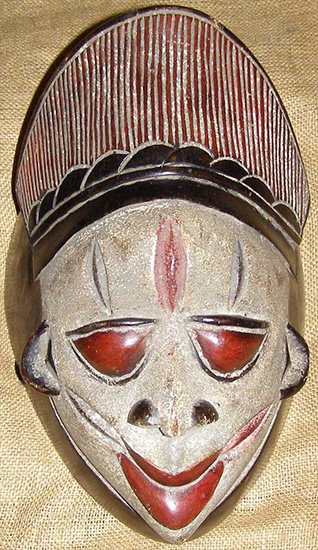
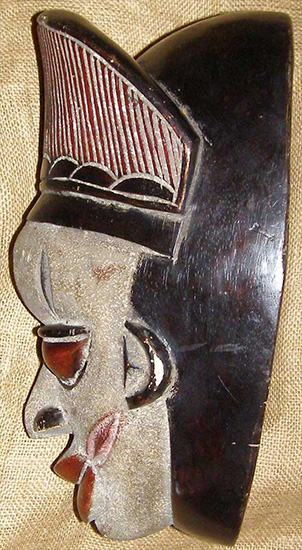
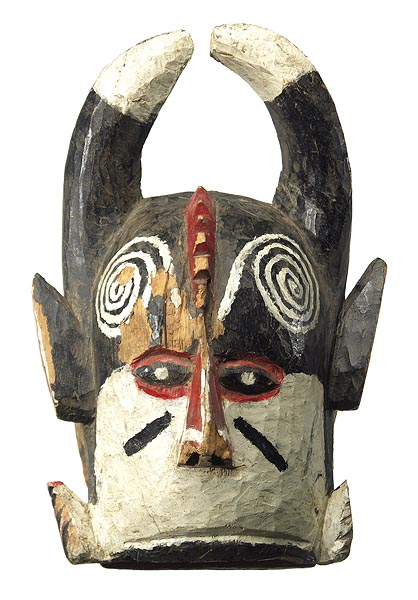
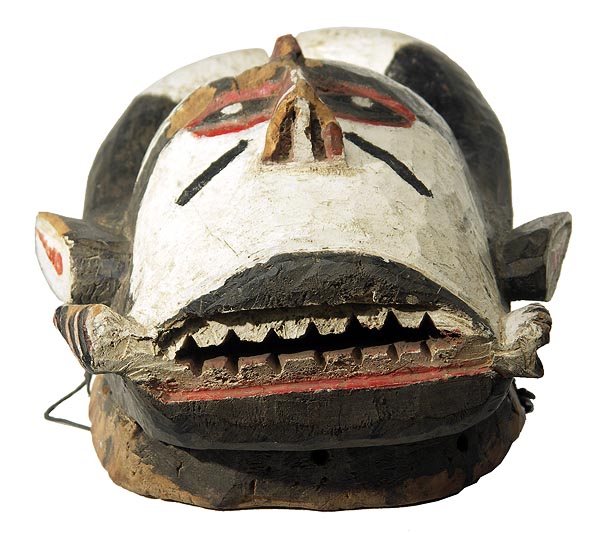
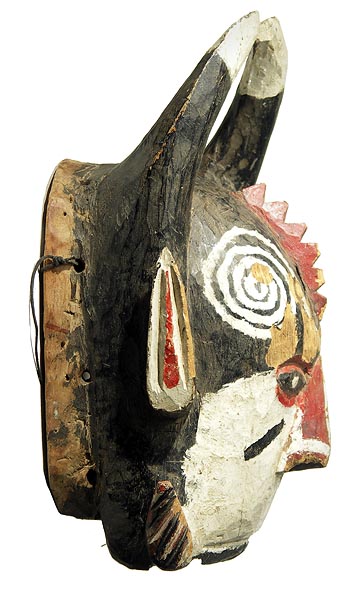
Igbo Masks https://www.randafricanart.com/images/Sothebys_Igbo_mmwo_mask.jpg https://www.randafricanart.com/images/Sothebys_Igbo_mmwo_mask_2.jpg agbogho mmwo, of hollowed helmet-like form, the stylized facial features including a pierced, diamond-shaped mouth beneath the sharp nose bisecting the slit eyes and decorated with linear and circular scarification, the whole surmounted by a complex openwork coiffure comprised of three arching bands punctuated by circular and cylindrical motifs; varied aged surface with areas of red, white, black and blue pigment. This mask represents numerous attributes of the ideal of female beauty among the Igbo. Worn each year for 'The Fame of Maidens' ceremony, it is intended to instruct youths in attitudes necessary for moral as well as physical beauty. Physically, height and litheness, good posture, a straight nose and small mouth are all ideals. These traits are physical indices to the moral ideals of purity, obedience, good character and generosity (Cole and Aniakor 1982: 121). https://ocean-anaedo.org/images/049_Msk-Igbo.jpg African art and masks of the Igbo (Ibo) people of Nigeria. This hand-carved wooden mask from the Igbo people is 14 inches tall, and 8.75 inches wide. https://www.genuineafrica.com/images/Igbo/Igbo_Mask_7Large.jpg https://www.genuineafrica.com/images/Igbo/Igbo_Mask_7LargeSide.jpg Mask 25 18.5"high x 13"wide x 9"deep https://www.hamillgallery.com/IGBO/IgboMasks/IgboMask25.jpg https://www.hamillgallery.com/IGBO/IgboMasks/IgboMask25u.jpg https://www.hamillgallery.com/IGBO/IgboMasks/IgboMask25s.jpg Acali mask Igbo people, Afikpo District, Nigeria 11.5 inches, wood, pigment and plant fiber This is a face mask that is commonly used in okumkpa performances in the Igbo town of Afikpo and surrounding villages in southeastern Nigeria. Okumkpa is a theater tradition staged after the Dry Season Festival. Among the Afikpo Igbo, putting on a mask transforms the performer into a spirit (mma). Such masks are generally associated with a deity of the secret society called egbele, but the spirit of the deity is not perceived as residing in the mask but as remaining in the sacred bush--the mma is viewed as a manifestation of it. Ottenberg (1975: 18-19) informs us that the acali mask is generally worn by the youngest players in okumkpa performances and that it is one of the least common Afikpo masks. It does not appear to have been used. https://www.masksoftheworld.com/images/African-Igbo-Mask-4a.jpg IGBO MASK / HEADDRESS 1, 39" https://www.hamillgallery.com/IGBO/IgboMasks/IgboMask01s2.JPG https://www.hamillgallery.com/IGBO/IgboMasks/IgboMask01f.JPG [img]http://www.hamillgallery.com/IGBO/IgboMasks/IgboMask01JPG[/img] https://www.hamillgallery.com/IGBO/IgboMasks/IgboMask01fd.JPG https://www.hamillgallery.com/IGBO/IgboMasks/IgboMask01rd1.JPG https://www.hamillgallery.com/IGBO/IgboMasks/IgboMask01rd2.JPG https://www.hamillgallery.com/IGBO/IgboMasks/IgboMask01rd3.JPG Igbo maiden spirit mask Height 17 1/4 in [img]http://uima.uiowa.edu/assets/Uploads/_resampled/SetWidth500-2006377small.jpg[/img] Igbo Mask 19th Century [img]http://migrationstoriesofnigerianigbo.files./2010/07/igbo-mask-19th-century.jpg[/img] |
| Culture › Art And Architecture Of The Igbo People by Crayola1(op): 12:37am On Oct 16, 2011 |
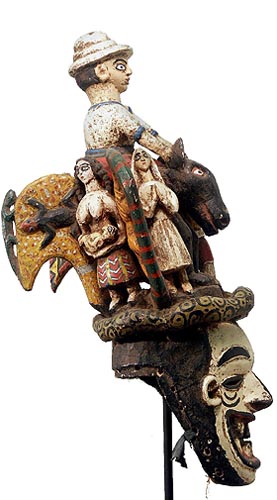
I think there was a thread on this once but I was unable to find it, so I decided to restart one again Figure Representing Ugonachonma (The Eagle Seeks Out Beauty) https://www.sujaro.com/i_040statues/images/ms497.h.large.jpg https://www.sujaro.com/i_040statues/images/ms497.h.zoom.jpg https://www.sujaro.com/i_040statues/images/ms497.i.zoom.jpg https://www.sujaro.com/i_040statues/images/ms497.j.zoom.jpg https://www.sujaro.com/i_040statues/images/ms497.k.zoom.jpg The description that went along with it: Origin: Igbo Tribe, Nigeria Composition: wood, pigment dyes (including kaolin, indigo, and red ochre), glass, natural materials One of the most important wooden pieces in the collection, this very old figure has significant evidence of age and use consistent with the ritual utilty the piece has within its tribal cultural context. This piece is from the central Igbo region and represents Ugonachonma (translated as “The Eagle Seeks Out Beauty”). It possesses a sophisticated, attractive coiffure (with reflective mirrored-glass inserts common to young women of marrying age from wealthy families) and a long neck (considered a feature of a beautiful young woman), with scarification (also for beauty). The white pigment on the legs is thought to “exaggerate the Igbo preference for light-colored skin and evokes the practice of washing dark skin with a chalky solution to create a contrasting ground for indigo uli patterns.” Following in the background given on this piece, “Ugonachonma served as centerpieces for largely secular-age grade dances”. Young, beautiful maidens are thought to be associated with eagles, as the maidens are praised as “eagle’s kola” after the prized kola nut shared at Igbo ceremonies (Visona, A History of Art In Africa, p. 289). The Igbo occupy the present east central state of Nigeria and parts of the present mid-western state. The Igbo speak a common language, but with different dialects. Most Igbo traditionally live in scattered villages, which form the basic social units, cosmologically, they believe in the existence of the Supreme Being whom they call Chuku or Chineke. There are other minor deities under him, Anyanwu (The Sun), Iwa (The Sky) Ale (The Earth). Ale, the most important minor deity, is connected with ancestors-Noiche and Ajoku, the divinity associated with Yams. The ancestors usually appear as masked dancers (Mmuo) who dance during festivals and funerals (Ref: Lois Woods Museum). Crest Mask with Human and Animal Elements https://www.sujaro.com/i_010masks/images/mm120.a.zoom.jpg https://www.sujaro.com/i_010masks/images/mm120.b.zoom.jpg https://www.sujaro.com/i_010masks/images/mm120.d.zoom.jpg https://www.sujaro.com/i_010masks/images/mm120.f.zoom.jpg https://www.sujaro.com/i_010masks/images/mm120.g.zoom.jpg Origin: Igbo Tribe, Nigeria Composition: wood, rattan, pigment, nails Age: early 20th century This head crest is an enigma. The carving style, especially the delicate human face, suggests that it was made by the Igbo, but the cap-style headdress is not part of the Igbo masking tradition. It most likely comes from southern Igbo territory, where influence from the Idoma (the Igbo’s southern neighbors) would be most prevalent. The Idoma carve crest masks (similar to this piece, with distinctly different facial features) called Eku, that combine the elements of many animals with human features. An important related piece from the Igbo was published in "Nigerian Art: The Meneghelli Collection." Pair of Large Seated Ntekpe Figures https://www.sujaro.com/i_060terracotta/images/tc030.a.zoom.jpg https://www.sujaro.com/i_060terracotta/images/tc030.b.zoom.jpg https://www.sujaro.com/i_060terracotta/images/tc030.c.zoom.jpg https://www.sujaro.com/i_060terracotta/images/tc030.e.zoom.jpg Origin: Igbo Culture, Nigeria Composition: terracotta, pigment Age: 20th century These ntekpe figures were originally part of a family shrine that honored one of the many Igbo deities. Most Igbo households would erect at least one such shrine, usually near the entrance to the Home. The ntekpe figures were considered "children of the shrine" and its deity. Their function was to protect the inhabitants of the house and to help when needed. Covered Tekpe Bowl with Two Snakes https://www.sujaro.com/i_060terracotta/images/tc029.a.zoom.jpg https://www.sujaro.com/i_060terracotta/images/tc029.b.zoom.jpg Origin: Igbo-Izzi Culture, Nigeria Composition: terracotta, pigments, libations Age: 19th century The northeastern area has a divination system and shrine complex quite distinct from those of other Igbo areas. Many family compounds have at least one shrine containing ceramic vessels and figures. The shrines are placed at compound entrances, outside houses, in domestic gardens, as well as in small sheds of their own. The Tekpe, are considered "children" of the shrine and its deity, and are there to help and protect it. Tekpe bowls are depicted with great variety. Some show human faces with an open mouth, others depict animals and miniature figures. This bowl shows two entwined snakes covering the lid, under which magical substances would have been placed (Ref: Cole, "Igbo Arts: Community and Cosmos"; Neyt, "The Arts of the Benue"; Schaedler, "Earth and Ore" .This piece was thermoluminescence tested by Laboratory Ralf Kotalla (Germany), and found to be authentic, having been fired (created) between 1876 and 1920 A.D. Tekpe Bowl with Slithering Snakes https://www.sujaro.com/i_060terracotta/images/tc008.a.zoom.jpg https://www.sujaro.com/i_060terracotta/images/tc008.c.zoom.jpg https://www.sujaro.com/i_060terracotta/images/tc008.b.zoom.jpg https://www.sujaro.com/i_060terracotta/images/tc008.d.zoom.jpg |