 Politics › Re: Orsu, Imo Villagers Beg Soldiers To Save Them From ESN And Unknown Gunmen by gowaga68: 2:45pm On Apr 24, 2022 Politics › Re: Orsu, Imo Villagers Beg Soldiers To Save Them From ESN And Unknown Gunmen by gowaga68: 2:45pm On Apr 24, 2022 |
It's well. |
| Politics › Re: Gunmen Abduct 10 Herders, ‘Steal 300 Cows’ In Anambra, Demand ₦4 Million by gowaga68: 2:35pm On Apr 24, 2022 |
When did retaliation become terrorism? TruthinAction:
Not all herders are terrorist. Some do their business quietly. There are even Christians among the fulanis. The one thing I know is that the federal government will step into action since it concerns the herdsmen. |
| Politics › Re: Gunmen Abduct 10 Herders, ‘Steal 300 Cows’ In Anambra, Demand ₦4 Million by gowaga68: 2:33pm On Apr 24, 2022 |
Let's pray no retaliation. |
| Crime › Re: We Were Kidnapped By Southerners In Delta, Handed Over To Fulani For Ransom Nego by gowaga68: 2:24pm On Apr 24, 2022 |
Mokason288:
Let me educate you why
Fulani Herdsmen can’t go around kidnaping Deltans any more , not on Gov Okowa’s watch
[s]So the bastard’s hide in the deepest part of the forest and use locals for monetary gain [/s] |
| Crime › Re: We Were Kidnapped By Southerners In Delta, Handed Over To Fulani For Ransom Nego by gowaga68: 2:24pm On Apr 24, 2022 |
It's not news of kidnapping in such part of the country but the collaboration with the Fulani or Hausa Fulani is another development if I must say.
Nigeria which way na? |
| Culture › Re: Alaafin Of Oyo’s 18 Wives Now Available For Suitors - Oyo Chief by gowaga68: 3:26am On Apr 24, 2022 |
|
| Politics › Re: IPOB Vows To Protect Hausas Against Unknown Gunmen Attacking S/East Residents by gowaga68: 1:05am On Apr 24, 2022*. Modified: 3:27am On Apr 24, 2022 |
The hausa's don't need your protection, keep that to yourselves. |
| Crime › Re: Fulani Herdsmen Attack Jato-Aka In Benue, Slaughter Family Of 5 (Graphic) by gowaga68: 12:15pm On Apr 23, 2022 |
Hmm! Killing a toddler is totally bad just as killing any soul unjustly.
May they find peace. |
| Foreign Affairs › Re: Work From Home To Beat Putin, Says EU by gowaga68: 9:16am On Apr 22, 2022 |
Matter arising. |
| Politics › Re: Unknown Gunmen Burn Goods, Shops In Anambra (Video, Photos) by gowaga68: 9:20am On Apr 21, 2022 |
I feel sad for the shop owner though it's Family affair. |
| Politics › Re: Easter Turns Bloody In Orlu As Unknown Gunmen Clash With JTF (photos, Video) by gowaga68: 12:10pm On Apr 18, 2022 |
As some do text here "Na them them". |
| Foreign Affairs › Re: India Prepares To Boost Russian Coal Imports Amid Western Sanctions by gowaga68: 9:43pm On Apr 14, 2022 |
Ukrain are about to lose the area in pink, lavender, yellow, and olive green. MangekyoAlt:
Boris Johnson a month and a half ago, "Now we will cripple the economy of the Russian Federation"
Vladimir Putin "It is impossible to isolate a large country like Russia"
Na now I dey understand Wetin putin talk here sef  When Putin said this, he wasn't talking aboit Russia's huge land masses. He was referring to Russia's natural resources since apparently Russia is the country with the most natural resources in the entire world When Putin said this, he wasn't talking aboit Russia's huge land masses. He was referring to Russia's natural resources since apparently Russia is the country with the most natural resources in the entire world
https://miningdigital.com/top10/top-10-countries-based-on-natural-resources
https://www.statista.com/statistics/748223/leading-countries-based-on-natural-resource-value/
This means that in dark hours like this, Russia can just start doing bonanza with their unlimited natural resources and customers go line up full everywhere
China has been ramping up import of Russian Oil, gas, coal etc. India said they cannot let this bonanza by the Russians pass them by
Turkey said they will NOT sanction Russia as doing that may complicate the access they currently have to Russian cheap oil, gas and other resources. Japan immediately commented that Tearing off the oil contract they have with Russia is not on the table. South Korea, the so called USA ally too is busy ramping up Russian goods import. Hungary said they are ready to pay in Ruble or any currency russia wants, provided they continue getting that cheap, oil and gas russia showers her customers with OPEC said they cannot afford to lose Russian gas
Meanwhile, to celebrate this invasion, Russia needs to secure one thing in ukraine.
There's a huge, like extremely huge oil reserve in the shores of Crimea. Russia secured that one in 2014. Now, Ukraine's biggest natural resources reserve is located in Donbas, Eastern Ukraine. If Ukraine loses that, they've lost everything. I'm readong now that Russian troops are gathering for a major offensive to capture Donbas and other eastern states in ukraine. If putin can get Donbas, and that sweet untapped oil, Russia wins, Ukraine loses big time 
|
| Foreign Affairs › Re: NATO Admits It Wants ‘ukrainians To Keep Dying’ To Bleed Russia, Not Peace by gowaga68(op): 7:36pm On Apr 14, 2022 |
Seems Russia is prepared to pay the automate price which only time will tell. Elvictor:
That thing Putin do US for Syria pain them ehnn, well, we will see if Russia will take L in Ukraine |
| Foreign Affairs › NATO Admits It Wants ‘ukrainians To Keep Dying’ To Bleed Russia, Not Peace by gowaga68(op): 6:55pm On Apr 14, 2022 |
NATO Admits It Wants ‘Ukrainians to Keep Dying’ to Bleed Russia, Not Peace NATO sees Ukrainians as mere cannon fodder in its imperial proxy war on Russia. By Ben Norton The US-led NATO military alliance has made it clear that it is willing to fight to the last Ukrainian in order to bleed Russia and advance Western geopolitical interests. In a shockingly blunt admission, The Washington Post acknowledged that some NATO member states want “Ukrainians to keep fighting, and dying” in order to prevent Russia from making political gains. In an April 5 report on peace talks between Ukraine and Russia, the major US newspaper disclosed that NATO is afraid that Kiev may give in to some of Moscow’s demands. The Washington Post wrote explicitly: “For some in NATO, it’s better for the Ukrainians to keep fighting, and dying than to achieve a peace that comes too early or at too high a cost to Kyiv and the rest of Europe.” Anonymous Western diplomats emphasized that “there are limits to how many compromises some in NATO will support to win the peace,” and that they would rather prolong the war in Ukraine if they can prevent Russia from having its security concerns met. The newspaper said that NATO members are desperate not to give “Russian President Vladimir Putin any semblance of victory,” and are more than willing to force Ukrainians into the meat grinder to do so. US National Security Advisor Jake Sullivan noted that the administration of Ukrainian President Volodymyr Zelensky is closely coordinating with Washington, and is in “near-daily contact” with the White House. It is evident who is really in charge. The newspaper likewise revealed that the US military has more than 100,000 troops deployed in Europe. The Washington Post has a close relationship with the US government. The newspaper is owned by $200-billionaire Jeff Bezos, one of the richest human beings in history. Bezos is also the founder and executive chairman of mega-corporation Amazon, which has tens of billions of dollars worth of contracts with the CIA, Pentagon, NSA, FBI, ICE, and other US government agencies. If The Washington Post is disclosing this information about NATO, with quotes from senior White House officials, it clearly got the green light from its handlers in Washington. This report is a semi-official confirmation that NATO sees Ukrainians as mere cannon fodder in its imperial proxy war on Russia. In fact, some Western officials have stated this openly. A former senior State Department official, hard-line right-wing war hawk Eliot A. Cohen, boasted in an article in The Atlantic magazine that the “United States and its NATO allies are engaged in a proxy war with Russia.” He effused proudly, “They are supplying thousands of munitions and hopefully doing much else—sharing intelligence, for example—with the intent of killing Russian soldiers,” adding, “the more and faster the better.” The State Department veteran declared that the “stream of arms going into Ukraine needs to be a flood.” This is exactly what NATO member states are doing: flooding Russia’s neighbor with weapons. Instead of supporting peace talks with Russia, the United States and European Union have been actively escalating the war, sending Ukraine billions of dollars worth of weapons, including tens of thousands of anti-tank missiles, thousands of anti-aircraft missiles, and hundreds of kamikaze drones, as well as tanks and armored vehicles. What goes unmentioned is how US and European arms corporations have heavily profited from the war. The stocks of private military contractors skyrocketed after Russia sent its troops into Ukraine on February 24, as Western governments pledged to substantially increase their military expenditure. The Joe Biden administration immediately delivered $350 million in weapons in late February, before pledging an additional $13.6 billion in aid for Ukraine in March, of which $6.5 billion in military support. The foreign ministers of NATO met at the military alliance’s headquarters in Brussels on April 6 and 7 and pledged to escalate the war in Ukraine even further. The Western politicians were joined by representatives of several non-NATO members, including Japan, South Korea, Georgia, Finland, Sweden, Australia, and New Zealand. Ukrainian Foreign Minister Dmytro Kuleba traveled to Brussels for the meeting, where he dispelled any doubt that NATO wants more war instead of peace. “I came here today to discuss three most important things: weapons, weapons, and weapons,” Kuleba summarized. NATO Secretary-General Jens Stoltenberg similarly declared, “After the invasion, allies stepped up with additional military support, with more military equipment, and it was a clear message from the meeting today that allies should do more and are ready to do more to provide more equipment, and they realize and recognize the urgency.” Stoltenberg boasted that direct NATO military support for Ukraine goes back to 2014 and that tens of thousands of Ukrainian soldiers were trained by NATO in the past eight years, long before Russia invaded. NATO transparently prefers that Ukrainians keep sacrificing their lives in hopes of weakening and destabilizing Russia. Meanwhile, Ukrainians who think peace should be the solution, not more war, face dire consequences. A Ukrainian negotiator who had participated in peace talks with Russia, Denys Kyreyev, was murdered, reportedly by the Security Service of Ukraine (SBU), which is notorious for being influenced by neo-Nazis and other far-right extremists. All of this extreme violence and warmongering flies directly in the face of NATO’s claim to be a supposed “defensive” alliance. The reality is NATO has never been devoted to defense, let alone democracy. Among the military alliance’s founding members in 1949 was the fascist dictatorship of Portugal. During the first cold war, NATO supported former Nazi collaborators and fascists in its infamous Operation Gladio. With NATO support, far-right extremists carried out terrorist attacks in Europe to try to repress the left-wing, especially during Italy’s notorious Years of Lead. When the first cold war ended, NATO continued to expand onto Russia’s borders, repeatedly violating promises made by the United States, Britain, and France that the military alliance would not move “one inch eastward” after the reunification of Germany in 1990. In bombing campaigns in the 1990s, NATO destroyed and carved up the former Yugoslavia, which no longer exists as a country. Then NATO helped the United States launch its war in Afghanistan in 2001, and maintained a joint military occupation until 2021. In 2011, NATO waged war on Libya, the most prosperous country in Africa. The Western military campaign shattered Libya’s state. Foreign fossil fuel corporations soon pillaged the North African nation’s massive oil reserves. Still today, in 2022, Libya has no unified central government. It does, however, have open-air slave markets for Sub-Saharan African refugees. The ruins of Libya, Afghanistan, and former Yugoslavia show what NATO truly offers the world. And the US-led military alliance is now prepared to sacrifice Ukraine to advance the interests of Washington and Wall Street. Called from: https://www.globalresearch.ca/nato-admits-wants-ukrainians-keep-dying-bleed-russia-not-peace/5777411 |
| Politics › Re: Muslim Appointees Of Vice-President Yemi Osinbajo (Video & List) by gowaga68: 6:51pm On Apr 14, 2022 |
Election is all about votes. So who ever the cap fits let him wear it. |
| Politics › Re: Unknown Gunmen Beat People Collecting PVCs At Imo Collection Center by gowaga68: 6:45pm On Apr 14, 2022 |
Very good development. |
| Politics › Re: Bandits Take Over Taraba Villages, Rape Housewives by gowaga68: 1:57am On Apr 11, 2022 |
immortalcrown:
I laugh because tribal sentiment is the reason things like this gain ground.
Jonathan who was making a progress against the bandits was voted out by the same region because he is from another region. It is now all about Baba and his change. make una enjoy am.
A similar problem is developing in the East. Tribal sentimentalists keep blaming ESN while denying the injustice of Nigeria on IPOB. IPOB was using only words of mouth until Nigeria government began to massacre innocent Easterners and IPOB members. The government that claims to be democratic for that matter began to kill people for saying their minds. Now that criminals who have been looking for an opportunity to operate are hijacking ESN's sit-at-home, the sentimentalists are attacking only IPOB without admitting the fact that the government of Nigeria is the root cause.
It is even worse in the East. Soldiers do not hurt innocent northerners when battling bandits in the north. But the soldiers make innocent easterners scapegoats for criminal activities in the East, and the sentimentalists support the soldiers for doing so in the East.
Has there ever been a python dance in the North? Are northerners told to alight from vehicles and raise up hands in the air? The answer is no. But all these things and more happen in the East.
The same way banditry would have reduced in the North if Jonathan was given a second term is the same way ESN would not have existed to give criminals an opportunity if Nigerian government handled IPOB the right way.
Only hypocrites and fools claim to be making efforts to solve a problem while denying the actual cause of the problem.
To be frank, Northerners and Southerners are more guilty of the tribal sentiment. Tinubu campaigned for Buhari and refuses to admit Buhari's regime is so disappointing. The same Tinubu himself, in his quest to be the next president of Nigeria, has said he will continue from where Buhari stops. But an average Yoruba man will support Tinubu because of tribalism. And [s]an average Hausa will choose Tinubu over Peter Obi because Obi is an Igbo person[/s]. An average Igbo man will not support Orji Kalu, Amechi and Rochas. The Igbo man will not do it because he admits those politicians have bad reputations home and abroad. An average Igbo man will rather choose Atiku over Amechi, Orji and Rochas, |
| Jobs/Vacancies › Re: Taraba Government Sells ₦3,000 Form To 10,000 Youths Only To Employ 160 by gowaga68: 12:03am On Apr 10, 2022 |
gonment at work! |
| Romance › Re: I'm Crushing Or Liking My Reverend, What Can I Do? by gowaga68: 11:55pm On Apr 09, 2022 |
Give your husband the same thing you just texted on here  AntiMen:
What reason will I give my husband for not following him to church. |
| Foreign Affairs › Re: Vladimir Putin’s 20-Year March To War In Ukraine And How The West Mishandled It by gowaga68(op): 1:10pm On Apr 04, 2022 |
I've been getting lot of bot ban on here. I'll try see what could be done on your request. topelenege:
Thanks for this vital information.
Please can you be kind enough to send the remaining part of the article cos ‘wsj’ will not reveal the rest of the article.
Thanks. |
|
|
| Foreign Affairs › Re: Germany Considers Nationalization Of Russian Companies, Gazprom And Rosneft by gowaga68: 8:14am On Apr 03, 2022 |
|
| Foreign Affairs › Vladimir Putin’s 20-Year March To War In Ukraine And How The West Mishandled It by gowaga68(op): 7:50am On Apr 03, 2022 |
In early November, months before the war began, CIA Director William Burns visited Moscow to deliver a warning: The U.S. believed Russian President Vladimir Putin was preparing to invade Ukraine. If he went ahead, he would face crippling sanctions from a united West.
The American spy chief was connected on a secure Kremlin phone with Mr. Putin, who was in the Black Sea resort of Sochi, isolated from all but a few confidants. The Russian leader made no effort to deny Mr. Burns’ charge. Instead, he calmly recited a list of grievances about how the U.S. had for years ignored Russian security concerns.
As for Ukraine, Mr. Putin told Mr. Burns, it wasn’t a real country.
After returning to Washington, the CIA chief advised President Biden that Mr. Putin hadn’t yet made an irrevocable decision, but was strongly disposed to invade. With European nations heavily dependent on Russian energy, the Russian military modernized, Germany going through a change of governments and the U.S. increasingly focused on a rising China, Mr. Putin gave every sign of seeing this winter as his best opportunity to bring Ukraine back under Moscow’s control.
Over the next three months, Washington struggled to persuade its European allies to mount a unified front. The U.S. itself was trying to balance two aims: talking Mr. Putin down while avoiding actions that he might treat as a provocation; and arming Ukraine to make an invasion as costly as possible.
In the end, the West managed neither to deter Mr. Putin from invading Ukraine nor reassure him that Ukraine’s increasing westward orientation didn’t threaten the Kremlin.
By now, this had become a well-established pattern. For nearly two decades, the U.S. and the European Union vacillated over how to deal with the Russian leader as he resorted to increasingly aggressive steps to reassert Moscow’s dominion over Ukraine and other former Soviet republics.
A look back at the history of the Russian-Western tensions, based on interviews with more than 30 past and present policy makers in the U.S., EU, Ukraine and Russia, shows how Western security policies angered Moscow without deterring it. It also shows how Mr. Putin consistently viewed Ukraine as existential for his project of restoring Russian greatness. The biggest question thrown up by this history is why the West failed to see the danger earlier.
Washington, under both Democratic and Republican presidents, and its allies at first hoped to integrate Mr. Putin into the post-Cold War order. When Mr. Putin balked, the U.S. and its European partners had little appetite for returning to the strategy of containment the West imposed against the Soviet Union. Germany, Europe’s biggest economy, led the EU’s big bet on peace through commerce, developing a dependence on Russian oil and gas that Berlin is now under international pressure to reverse.
The North Atlantic Treaty Organization made a statement in 2008 that Ukraine and Georgia would one day join, and over nearly 14 years never followed through on membership. The EU drew up a trade deal with Ukraine without factoring in Russia’s strong-arm response. Western policies didn’t change decisively in reaction to limited Russian invasions of Georgia and Ukraine, encouraging Mr. Putin to believe that a full-blown campaign to conquer Ukraine wouldn’t meet with determined resistance—either internationally or in Ukraine, a country whose independence he said repeatedly was a regrettable accident of history.
Vladimir Putin celebrates the fourth anniversary of Russia's annexation of Crimea in Moscow in 2018.
The roots of the war lie in Russia’s deep ambivalence about its place in the world after the end of the Soviet Union. A diminished Russia needed cooperation with the West to modernize its economy, but it never reconciled itself to the loss of control over neighbors in Europe’s east.
No neighbor was as important to Russia’s sense of its own destiny as Ukraine. The czars’ takeover of the territories of today’s Ukraine in the 17th and 18th centuries was crucial to Russia’s emergence as a major European empire. Collapsing Russian empires lost Ukraine to independence movements amid defeat in World War I and again in 1991, when Ukrainians voted overwhelmingly for independence.
After the chaotic 1990s, the security-service veterans around Mr. Putin who took over Russia’s government complained bitterly about what they saw as the West’s encroachment on Moscow’s traditional sphere of influence in Central and Eastern Europe. An array of newly democratic countries that had been Moscow’s satellites or former Soviet republics joined NATO and the EU, seeing membership of both institutions as the best guarantee of their sovereignty against a revival of Russian imperial ambitions.
Key moments in NATO’s eastward expansion
Since the end of the Cold War, a string of countries have joined NATO or sought to do so.
Viewed from elsewhere in Europe, NATO’s eastward enlargement didn’t threaten Russia’s security. NATO membership is at core a promise to collectively defend a member that comes under attack. The alliance agreed in 1997 not to permanently station substantial combat forces in its new eastern members that were capable of threatening Russian territory. Russia retained a massive nuclear arsenal and the biggest conventional forces in Europe.
Mr. Putin thought of Russian security interests more broadly, linking the preservation of Moscow’s influence in adjacent countries with his goals of reviving Russia’s global power and cementing his authoritarian rule at home.
The link became clear in Ukraine’s 2004 presidential election. Mr. Putin let the U.S. know in advance who should win.
When White House national security adviser Condoleezza Rice visited Mr. Putin at his dacha outside Moscow in May that year, the Russian leader introduced her to Ukrainian presidential contender Viktor Yanukovych. Ms. Rice concluded that Mr. Putin had arranged the surprise encounter to signal his close interest in the election’s outcome, she recalled in a recent interview.
Mr. Yanukovych’s initial election victory was marred by allegations of fraud and voter intimidation, triggering weeks of street protests and strikes that were dubbed the Orange Revolution. Ukraine’s supreme court ordered a new vote, which pro-Western candidate Viktor Yushchenko won.
The Kremlin saw the Orange Revolution as U.S.-sponsored destabilization aimed at pulling Ukraine out of Moscow’s orbit—and as a prelude to a similar campaign in Russia itself.
To ease Moscow’s concerns, the Bush administration outlined the limited financial support it had given to Ukrainian media and nongovernmental organizations in the name of promoting democratic values. It totaled $14 million. The White House thought the modest sum was consistent with Mr. Bush’s “freedom agenda” of supporting democracy but hardly enough to change the course of history.
The gesture only confirmed Russian suspicions. “They were impressed at the result that they thought we got for $14 million,” recalled Tom Graham, the senior director for Russia on Mr. Bush’s National Security Council.
Three months after losing Ukraine’s government to a pro-Western president, Mr. Putin decried the breakup of the Soviet Union as “the greatest geopolitical catastrophe of the century.”
U.S. intelligence learned in 2005 that Mr. Putin’s government had carried out a broad review of Russian policy in the “near abroad,” as the Kremlin termed former Soviet republics. From now on, Russia would take a more assertive approach and vigorously contest perceived U.S. influence.
Ukrainian officials heard the message too. When President Yushchenko’s chief of staff, Oleh Rybachuk, visited the Kremlin in November 2005, he discussed the Orange Revolution with Mr. Putin. Mr. Rybachuk described the street protests as an indigenous movement of Ukrainians who wanted to choose their own political course.
Mr. Putin brusquely dismissed the notion as nonsense. He said he had read all of his intelligence services’ reports and knew the movement had been orchestrated by the U.S., the EU and George Soros, Mr. Rybachuk recalled in an interview.
At a separate encounter, Mr. Bush asked Mr. Putin why he thought the end of the Soviet Union had been the greatest tragedy of the 20th century. Surely the deaths of more than 20 million Soviet citizens in World War II was worse, Mr. Bush said. Mr. Putin replied that the USSR’s demise was worse because it had left 25 million Russians outside the Russian Federation, according to Ms. Rice, who was present.
Mr. Putin showed another face to Western European interlocutors, however, encouraging them to believe that he wanted Russia to be part of the wider European family. Soon after becoming president, he wowed Germany’s Parliament with a speech promising to build a strong Russian democracy and work with the West. Speaking in fluent German, perfected while he was a KGB officer in the former East Germany, he declared: “The Cold War is over.”
George W. Bush, right, and Vladimir Putin walk to a press conference at the Bush family compound in Kennebunkport, Maine, in July of 2007.
He charmed politicians and business leaders around Europe and opened pathways for lucrative trade. European leaders called Russia a “strategic partner.” German Chancellor Gerhard Schröder and Italian Premier Silvio Berlusconi were among those who considered him a close friend.
Mr. Putin was personally active in facilitating good economic relations, recalled longtime German diplomat Wolfgang Ischinger. In one meeting, the issue of bureaucratic obstacles to German purchases of Russian wood came up. Mr. Putin phoned the relevant minister and resolved the matter in minutes.
“Putin said ‘Right, problem solved—what’s next?’ ” Mr. Ischinger remembered.
Perceptions changed in January 2007, when Mr. Putin vented his growing frustrations about the West at the annual Munich Security Conference. In a long and icy speech, he denounced the U.S. for trying to rule a unipolar world by force, accused NATO of breaking promises by expanding into Europe’s east, and called the West hypocritical for lecturing Russia about democracy. A chill descended on the audience of Western diplomats and politicians at the luxury Hotel Bayerischer Hof, participants recalled.
“We didn’t take the speech as seriously as we should have,” said Mr. Ischinger. “It takes two to tango, and Mr. Putin didn’t want to tango any more.”
Related Video
Ukraine War: What’s Next for U.S. and NATO in Their Push Against Russia
Mr. Putin’s demeanor with pro-Western leaders became more aggressive. In a meeting with a Balkan head of state during an energy summit in Croatia, Mr. Putin railed against NATO and called its severing of Kosovo from Serbia the greatest violation of international law in recent history. Years later, he would cite Kosovo as a precedent for seizing Crimea from Ukraine.
His rage rising, Mr. Putin rattled through grievances. He shouted expletives at his translator, who was struggling to keep up.
“The room fell silent. It was incredibly awkward: The president of the mighty Russian Federation was bullying a mere interpreter trying to do their job,” one participant said.
In Ukraine, President Yushchenko was struggling to fulfill the hopes of the Orange Revolution that the country could become a prosperous Western-style democracy. Fractious politics, endemic corruption and economic stagnation sapped his popularity.
Mr. Yushchenko sought to anchor Ukraine’s place in the West. At the World Economic Forum in Davos in January 2008, he met with Ms. Rice, by then the U.S. Secretary of State, and implored her for a path to enter NATO. The procedure for joining the alliance was called a Membership Action Plan, or MAP.
“I need a MAP. We need to give the Ukrainian people a strategic focus on the way ahead. We really need this,” Mr. Yushchenko said, Ms. Rice recalled.Ms. Rice, who was initially uncertain about having Ukraine in NATO, gave a noncommittal answer. When the request was debated in the National Security Council, Mr. Bush said NATO should be open to all countries that qualify and want to join.
A NATO summit was set for April 2008 in Bucharest, in the vast Palace of the Parliament built for Romania’s former Communist dictator Nicolae Ceauşescu. The alliance’s summits are usually well scripted in advance. Try as it might, the White House couldn’t overcome German and French resistance to offering a MAP to Ukraine and Georgia.
Berlin and Paris pointed to unsolved territorial conflicts in Georgia, low public support for NATO in Ukraine, and the weakness of democracy and the rule of law in both.
Ms. Merkel, remembering Mr. Putin’s speech in Munich, believed he would see NATO invitations as a direct and deliberate threat to him, according to Christoph Heusgen, her chief diplomatic adviser at the time. She was also convinced Ukraine and Georgia would bring NATO no benefits as members, Mr. Heusgen said.
Ms. Merkel told Mr. Putin in advance that NATO wouldn’t invite Ukraine and Georgia to join, because the alliance was split on the issue, but the Russian leader remained nervous, Mr. Heusgen recalled.
As the NATO summit approached, Mr. Bush held a videoconference with Ms. Merkel, but it soon became clear that no consensus would be reached beforehand.
“Looks like a shootout at the OK Corral,” Mr. Bush said, according to James Jeffrey, the president’s deputy national security adviser at the time.
Ms. Merkel was flummoxed by the American reference and turned to her interpreter, who confessed that he, too, had no idea what the U.S. president meant.
Over dinner in Bucharest, Mr. Bush made his case for giving Ukraine and Georgia a MAP—to no avail. The next day, Ms. Rice and national security adviser Stephen Hadley tried to find a compromise with their German and French counterparts.
Ms. Rice, a Soviet and Russia expert, said Mr. Putin wanted to use Ukraine, Belarus and Georgia to rebuild Russia’s global power, and that extending the shield of NATO membership could be the last chance to stop him. German and French officials were skeptical, believing Russia’s economy was too weak and dependent on Western technology to become a serious threat again.
In the final session, Ms. Merkel debated in a corner of the room with leaders from Poland and other eastern members of NATO, who advocated strenuously on behalf of Ukraine and Georgia. Lithuanian President Valdas Adamkus strongly criticized Ms. Merkel’s stance, warning that a failure to stop Russia’s resurgence would eventually threaten the eastern flank of the alliance.
Mr. Bush asked Ms. Rice to go join the animated discussion. The only common language among Ms. Merkel, the east European leaders and Ms. Rice was Russian. So a compromise statement was negotiated in Russian and then drafted in English, Ms. Rice said.
“We agreed today that these countries will become members of NATO,” it read. But it didn’t say when. And there was no MAP.
Many of Ukraine’s supporters were heartened. But some officials in Bucharest feared it was the worst of both worlds. NATO had just painted a target on the backs of Ukraine and Georgia without giving them any protection.
“The fact is we rejected Ukraine’s application and, yes, we left Ukraine in a gray zone,” Radoslaw Sikorski, Poland’s foreign minister at the time, said in an interview.
Mr. Putin joined the summit the next day. He spoke behind closed doors and made clear his disdain for NATO’s move, describing Ukraine as a “made-up” country.
In public comments that day, he also questioned whether Crimea had been properly transferred from Russia to Ukraine during the Soviet era. Daniel Fried, who was the top State Department official on Europe, and Mariusz Handzlik, then the national security adviser to Poland’s president, jumped to their feet in shock. It was an early sign that Mr. Putin wouldn’t let the status quo stand.
Four months later, the Russian army invaded Georgia, exploiting a conflict between Georgia’s government and Russian-backed separatists. Russia didn’t take Tbilisi, the Georgian capital, but it showed it had no qualms about intervening in neighboring countries that wanted to join NATO.
Mr. Putin’s fears of a Ukrainian-style popular revolution infecting Russia were heightened by a wave of demonstrations in Russian cities beginning in 2011, when tens of thousands took to the streets to protest against the lack of democracy. “For fair elections” was the protesters’ slogan.
Mr. Putin believed the protests were a U.S.-sponsored effort to overthrow him, said Ivan Krastev, a Bulgarian political scientist who later attended a dinner hosted by Mr. Putin in Sochi. The Russian president told his guests that people didn’t take to the streets spontaneously but rather were incited by the U.S. Embassy, Mr. Krastev said. “He really believes it.”
The Kremlin organized large countermarches, which were billed as “anti-Orange demonstrations.”
Sporadic pro-democracy protests continued for nearly two years, despite rising repression. Mr. Putin cracked down on opposition parties, free media and nongovernmental organizations.
The concurrent Arab Spring protests, which toppled several authoritarian rulers in the Middle East, further heightened Mr. Putin’s fear, said Mr. Heusgen, the adviser to Ms. Merkel.
“He then became a fervent nationalist,” said Mr. Heusgen. “His great anxiety was that Ukraine could become economically and politically successful and that the Russians would eventually ask themselves ‘Why are our brothers doing so well, while our situation remains dire?’ ”
Ukraine hung in the balance again.
President Putin believed the U.S. was behind pro-democracy rallies in Russia, such as the 'march of millions' protesting his inauguration in 2012.
Mr. Yushchenko slumped to 5% of the vote in Ukraine’s 2010 presidential elections. Mr. Yanukovych won—fairly this time, said international observers—after campaigning for friendly relations with the West and also Russia. He found it was difficult to have both.
Mr. Yanukovych negotiated a free-trade agreement with the EU. At the same time, however, he was under pressure from Mr. Putin to join a customs union with Russia, Belarus and Kazakhstan. EU officials said Kyiv couldn’t do both, because the customs rules would clash.
The EU, following its standard playbook on trade and governance, demanded that Ukraine revamp its judiciary and improve the rule of law as a precondition for a trade deal. Russia used sticks and carrots: At various moments it blocked goods imports from Ukraine, but it also offered Kyiv cheaper gas prices and a $15 billion loan.
In November 2013, Kyiv abruptly suspended talks with the EU, citing Russian pressure. Mr. Putin called the draft EU-Ukraine deal a “major threat” to Russia’s economy.
At an EU summit in Lithuania, Mr. Yanukovych defended the suspension and asked the EU to include Moscow in a three-way negotiation about the deal. EU leaders replied that letting a third party infringe on others’ sovereignty was unacceptable.
“We expected more,” Ms. Merkel sternly told Mr. Yanukovych in a conversation caught on camera.
“We have great problems with Moscow,” Mr. Yanukovych replied. “I have been left alone for 3½ years in very unequal circumstances with Russia,” he said.
Antigovernment protests spread across Ukraine that winter. The largest were on Kyiv’s central Independence Square, known locally as the Maidan. To the protesters, the EU association agreement was more than a trade deal: It expressed hopes of reorienting Ukraine toward the more democratic and prosperous part of Europe. Culled from: https://www.wsj.com/articles/vladimir-putins-20-year-march-to-war-in-ukraineand-how-the-west-mishandled-it-11648826461
|
| Foreign Affairs › Re: Lithuania Abandons Russian Gas. First European Nation To Do So. by gowaga68: 3:35am On Apr 03, 2022 |

|
| Foreign Affairs › Re: Russia Says It Won't Cut Off Gas Supplies Yet In Rouble Payment Row by gowaga68: 3:32am On Apr 03, 2022 |
Akasammyoka:
Putin is starting to quiver. Many will soon follow Lithuania to leave this Russian gas and fuel, this am sure 
|
| Foreign Affairs › Re: Dead Decaying Bodies Litter The Streets Of Kyiv, Ukraine (Graphic Photos, Video) by gowaga68: 3:25am On Apr 03, 2022 |
Candidlady:
Iam NORTH!, from east! You crazy bigots from a region where cowardice is what you guys sleep and dine on! Tinubu kissing Elrufias flat hairy as$..
Abacha was right!!! Your region drum of war is a lullaby to us over here! |
| Islam › Re: Ramadan Moon Sighted In Saudi Arabia, Fasting Begins Saturday by gowaga68: 10:06pm On Apr 01, 2022 |
Segzy22:
[s]You people have been brainwashed by a womanize[/s]r!!!! |
| Foreign Affairs › Re: US Calls For ‘Strong African Response’ To Russian Aggression by gowaga68: 8:32am On Apr 01, 2022 |
"We never want to pretend we have a great influence that other countries have, but we are being approached. (To) condemn one (side) ... forecloses the role we could play," ~South African President Cyril Ramaphosa |
| Foreign Affairs › Re: US Calls For ‘Strong African Response’ To Russian Aggression by gowaga68: 8:32am On Apr 01, 2022 |
Northernblood5:
[s]1. Donation is scam?. They donate to Africa, but the Idiots you guys vote in Stole the money.
2. Exploiting Africans resources? Can you point out any where in Nigeria news that heavy European company was discovered to be mining our resource without the knowledge of the government? Are you guys okay at all?
3. Europeans Invaded Africa quite alright but, in a way it really help countries that really wants to grow. Check your history very well, not only Africans that was invaded and some of those countries that gave in to some Western culture are doing very well today. Don't forget that India was colonized by British. They gave in to Technology, today they are among World powers with Nuclear weapons .
4. Russia may not have colonized any African country, But they are ready to Detonate Massive Nuclear materials that will send civilization away. Infact, materials that will make you wish to be dead due to hunger
5. Yes, we are not Slaves and have power over our decision. Thanks to a white man Abraham Lincoln that outlawed it. Infact, study your history well, WEST AFRICAN CORRUPT CHIEFS kept on selling slaves to Portuguese Marchants until 18th century which is one of the things that led to British invasion.[/s] |
| Foreign Affairs › Re: Suspected Arms Depot In Western Russia Destroyed By Ukrainian Missile by gowaga68: 11:02pm On Mar 30, 2022 |
osazsky:
[s]northerners na wah..america toppled the taliban govt in 3 weeks and handed the presidency to the idiots who could maintain it..they stayed there for 20 years to ensure stability...the problem started when the idiot president started to liase with Taliban fighters to destabilize america..immediately america discovered this they had to leave they had no other option as it's not thier land..my problem with Putin is by now ..after 2 months he is supposed to topple zlensyky govt and install his own president..this thing is taking too long this was not wat we read in books abt russia..zero intelligence.. there is even an incidence where russia planes destroyed it's own ground troops.. hundred of russian troops check google..then d Ukraine ghost pilots who brings 5 fighter jets a day..russia has weapons but no man power..its military is not well trained..they should focus on this..cuz u will need it in ground engagement..war is much more than dropping bombs from planes ..survival instinct on ground is paramount..and thier soldiers are too young some look like toddlers.. 15..16..17[/s] |
| Foreign Affairs › Re: Suspected Arms Depot In Western Russia Destroyed By Ukrainian Missile by gowaga68: 10:56pm On Mar 30, 2022 |
Toktee:
And after a month Putin have not hold unto a single captured village,the attacker is always on offensive but Putin hunters are on defensive 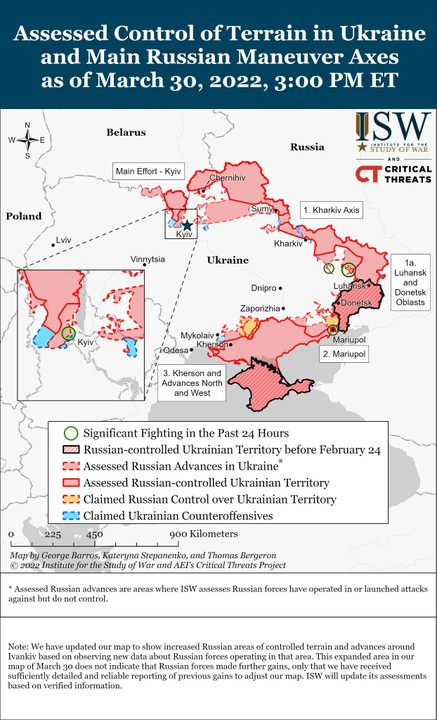
|


