Lakal's Posts
Nairaland Forum › Lakal's Profile › Lakal's Posts
1 2 3 4 5 6 7 8 9 10 (of 12 pages)
 Culture › Re: The Art And Architecture Of Yorubaland! by lakal(op): 4:46pm On Oct 15, 2011 Culture › Re: The Art And Architecture Of Yorubaland! by lakal(op): 4:46pm On Oct 15, 2011 |
Back to bronze!  https://www.africainfinite.com/images/cat-449585.jpg Owo, Yorubaland. (Undated) This Yoruba bronze ritiual vessel is topped with the deity Yemoja who is a mother goddess; patron deity of women, especially pregnant women; and the Ogun river. Her parents are Oduduwa and Obatala. There are many stories as to how she became the mother of all saints. She was married to Aganju and had one son, Orungan, and fifteen Orishas came forth from her. They include Ogun, Olokun, Shopona and Shango. Other stories say that Yemaya was always there in the beginning and all life came from her, including all of the orishas. This rare vessel also features many other figures and was created by the lost wax casting method. |
| Culture › Re: The Art And Architecture Of Yorubaland! by lakal(op): 4:35pm On Oct 15, 2011 |
Switching subjects, were Imperial Oyo's calvary horses outfitted similarly? A picture of a royal palace horse in Oyo, Yorubaland (1960). https://i56.tinypic.com/2lbp85d.jpg |
| Culture › Re: The Art And Architecture Of Yorubaland! by lakal(op): 4:33pm On Oct 15, 2011 |
A master weaver with his finished product. Meko, Yorubaland in 1950. https://i56.tinypic.com/2nrmwk6.jpg |
| Culture › Re: The Art And Architecture Of Yorubaland! by lakal(op): 4:32pm On Oct 15, 2011 |
| Culture › Re: The Art And Architecture Of Yorubaland! by lakal(op): 4:29pm On Oct 15, 2011 |
Men used horizontal looms (women used upright looms) traditionally to do their weaving, making cloths that were long and narrow, as opposed to women's looms, which made shorter and wider cloths. https://i56.tinypic.com/v7zh1g.jpg |
| Culture › Re: Yoruba Mythology by lakal(m): 4:15pm On Oct 15, 2011 |
[size=16pt]Two Yoruba songs in praise of twins (Courlander, 1973; Olaleye-Oruene, 1983).[/size] Fine looking twins, natives of Ishokun, Descendants of treetop monkeys. Twins saw the houses of the rich but did not go there, Twins saw the houses of great personages but did not go there Instead they entered the houses of the poor. They made the poor rich, they clothed those who were naked. Majestic and beautiful looking twins, natives of Ishokun, Let me find means of eating, let me find means of drinking. Majestic and beautiful looking twins, come and give me The blessing of a child. |
| Culture › Re: Yoruba Mythology by lakal(m): 4:13pm On Oct 15, 2011 |
exotik:Ah, I see. If your people don't have myths of their own (pele), I welcome you to this thread. The Yorubas are a welcoming people. |
| Culture › Re: Yoruba Mythology by lakal(m): 4:11pm On Oct 15, 2011 |
Transatlantic Spread The population of the West Indies and of the Eastern coast of South America largely originates from the previous African “Slave Coast” corresponding to the present-day coast of Nigeria and Benin. It is therefore not surprising that traditional Yoruba twin beliefs have been transposed in Latin America. Such is the case of Brazilian traditions of the Candoble and Macumba in the region of Salvador de Bahia and of the Umbanda in Rio de Janeiro and Sao Paulo. These traditions have maintained the Yoruba Orishas including the sacred Ere Ibeji. In the Umbanda, the sacred twins are assimilated to the Christian twin saints Cosmas and Damian. The latter are colloquially called “the two young men” and are celebrated at the end of September in a feast especially devoted to children (Zuring, 1977). https://www.randafricanart.com/images/Yoruba_figure5.jpg |
| Culture › Re: Yoruba Mythology by lakal(m): 4:08pm On Oct 15, 2011 |
| Culture › Re: Yoruba Mythology by lakal(m): 4:07pm On Oct 15, 2011 |
[size=16pt]The Ibeji Belief System[/size] As the Yoruba believe that twins share the same combined soul, when a newborn twin dies, the life of the other is imperilled because the balance of his soul has become seri- ously disturbed. To counteract this danger a special ritual is carried out. After consulting the Babalawo, an artisan will be commissioned to carve a small wooden figure as a sym- bolic substitute for the soul of the deceased twin. If both twins have died, two of these figures are made (Figure 2; Jantzen & Bertisch, 1993; Mobolade, 1971; Stoll & Stoll, 1980). These effigies are called Ere ibeji (from ‘ibi’ = born and ‘eji’ = two; ere means sacred image). By virtue of his immortal soul hosted by his ibeji, the departed twin remains as powerful as the living one. The ibeji(s) will have to be cared for by the parents or later on by the surviving twin. Therefore, these figures are symbolically washed, fed and clothed on a regular basis, according to a popular Yoruba saying “dead ibeji expenses are expenses for the living” (Courlander, 1973). According to these customs, the mother enjoys certain privileges even if both her twins have died (Stoll & Stoll, 1980). |
| Culture › Re: Yoruba Mythology by lakal(m): 4:06pm On Oct 15, 2011 |
[size=16pt]Twins in Yoruba Society[/size] In traditional African societies, twins were considered of preternatural origin and raised emotional reactions oscillat- ing from fear and repugnance to hope and joy (Leroy, 1995). In ancient times, the Yoruba used to reject and even sacrifice newborn twins (Leroy, 1995). Strangely enough, historical scales were tipped so that twins are nowadays not only well accepted but welcomed, their birth being an occa- sion of great rejoicing. A feast will be organised for the whole community and even for neighbouring villages if the twins are the children of a prominent member of the tribe (Chappel, 1974; Stoll & Stoll, 1980). It is believed that twins are able to bestow happiness, health and prosperity upon their family. However, since they can also bring about disaster, disease and death, they will be treated with all due respect, loving and care. Their upbringing is therefore far more permissive than that of other children (Stoll & Stoll, 1980). The first born twin, whether a boy or a girl, is always called Taiwo, meaning ‘having the first taste of the world’, whereas the second is named Kehinde, meaning ‘arriving after the other’. Although being born first Taiwo is consid- ered as the younger twin. His senior Kehinde is supposed to send out his partner to see what the outside world looks like. As soon as Taiwo has given a signal by crying, Kehinde will follow. Kehinde is supposed to be more careful, more intelligent and more reflective, while Taiwo is believed to be more curious and adventurous, but also more nonchalant (Olaleye-Oruene, 1983; Stoll & Stoll, 1980). On the third day after the birth of twins, a visit is paid by the parents to the Babalawo, the Ifa priest of the com- munity. Through the interpretation of the Ifa oracle which includes no less than 1,600 sayings, he is able to drive out whatever evil spirits may threaten the newborn twins (Chappel, 1974; Courlander, 1973; Thompson, 1971). He will dedicate the twins to the Orisha Ibeji god of twins and if deemed necessary will appoint for them an additional patron such as Eshu or Shango. Contrary to these latter prominent deities, the specific god of twins is a minor Orisha who is never figuratively represented. The Babalawo communicates to the mother a series of instructions on how to treat her twins: which colours they should wear or avoid, which food is recommended or pro- hibited, which animals are dangerous for them, etc. (Olaleye-Oruene, 1983; Stoll & Stoll, 1980). The powers of the Babalawo included the ability to give the order to let one of the twins starve to death if he was thought to be possessed by evil spirits that could not be exorcised. This custom is a reminder of the theme of “the good and the bad twin” which is part of the mythical beliefs of many archaic tribes (Leroy, 1995). |
| Culture › Re: Yoruba Mythology by lakal(m): 4:03pm On Oct 15, 2011 |
exotik:Wasn't aware that you had a Yoruba dictionary. In any case, (I'm unsure of your ethnicity) don't your people have their own mythology? Run along now and create a thread for that. |
| Culture › Re: Yoruba Mythology by lakal(m): 3:20pm On Oct 15, 2011 |
exotik:I know, obviously incorrect! Na oyinbo write am. |
| Culture › Re: Are Africans Proud Of Black Americans? by lakal(m): 2:56pm On Oct 15, 2011 |
Listen to 2:24-2:34 and the title of this video. I'm guessing you might not know much about Americans. Thia guy is most definitely American. [flash=400,300] https://www.youtube.com/watch?v=5tSnnJKTfZU&feature=related[/flash] |
| Culture › Re: Are Africans Proud Of Black Americans? by lakal(m): 2:49pm On Oct 15, 2011 |
Black Americans and Southern white Americans definitely say home training. |
| Culture › Re: Yoruba Mythology by lakal(m): 2:21pm On Oct 15, 2011 |
The Yorubas have a superstition which has close points of resemblance to the "changeling" superstition of Northern Europe. It is referred to in many folk-lore tales, and the following is an example. "There lived at Otta" (a village on the River Ibo, which is a tributary of the Ogun) "a woman named Bola, who had a male child. When the child was small the mother carried him on her back when she went to market, but when he became about nine months old she used to lay him down on a mat in her house, fasten the door, and go to market by herself. After this it always happened that when she returned from the market she found that all the food she had left in the house had disappeared. This seemed to her very strange, and she at first suspected her neighbours, but she always found the doorfastening untouched, and was unable to fathom the mystery. "One day a neighbour came to her and said, 'I am going to the market at Orichi to-morrow morning early, and therefore must ask you to repay me the string of cowries that you sent your little boy to borrow from me.' Bola, much astonished, declared that she had borrowed no cowries from the woman, and had sent no one to her; but the neighbour persisted that Bola's child had come to her, and had borrowed a string of cowries in the name of his mother. 'Come, then,' said Bola, 'and see my child.' "The two women went into the house where the child was sleeping on his mat. 'You see him,' said Bola, 'there he is, sleeping. Do you not see that be is yet too young, to walk? How then could he come to you? And how could he ask you for cowries, seeing that he cannot yet talk? "The neighbour looked closely at the child, and then solemnly declared that it was really he who had come to her, but that when he came he was much big er than he was now, and had the appearance of a child of about ten years of age. "When Bola, heard this she was much distressed. She could not doubt her neighbour's word, and she feared that her child must be possessed by an evil spirit. She paid the neighbour the string of cowries, and begged her to say, nothing; then, when the child's father came to the house, she told him the whole story. "The father and mother decided to search into the mystery. The father, therefore, carefully hid himself in the house, one day while the mother and child were out. Then Bola returned to the house with the child, put him down on the mat, said to him, 'Sleep good while I go to the market,' and then went out, and fastened the door as usual. "Scarcely had Bola gone, than the father, from his hiding-place, saw the baby stand up, and begin to grow till he became a big boy. Then he went to the calabashes where the food was kept, and was beginning to eat it, when the father came out from his hiding-place. "Immediately the child saw his father he became a little baby again, and lay on the floor crying. He was possessed by a spirit. His mother came back, and they beat him to drive the spirit out, so that the spirit fled." The parallel between this tale and the changeling stories of Northern Europe is close. In the latter, as in the Yoruba version, the changeling, while in the presence of its foster-mother and others, affects to be an infant, but throws off his disguise as soon as he imagines himself to be alone. See, for instance, the tale called "The Father of Eighteen Elves," in Arnason's collection of Icelandic legends. The only difference-an important one, it is true-is in the genesis of the changeling. In Europe it is an elfin child, who is substituted for a stolen human child, but here it is the child himself who is possessed by an evil spirit, just as an Abiku possesses a child, though with different results. We also find a superstition which recalls that of the were-wolf, for the hyena (Kpelekpe) is often supposed to be a man who assumes that disguise at night, to prey upon sheep and cattle, and, if the opportunity offers, upon human beings. Such man-hyenas are believed to be able, by means of certain howls and cries, to compel people to go out to them in the dark forest to be devoured. A similar belief is found in Abyssinia. The weird "laugh" of the hyena, and its nocturnal habits, no doubt account for this superstition, just as similar causes have led to the owl being universally regarded as a bird of ill omen. A belief in metamorphosis is universal, and is not limited to a change to an animal form, since men and women are sometimes transformed into trees, shrubs, rocks, or natural features. The shrub buje, whose fruit is used to stain the skin in imitation of tattoo marks, was a Yoruba belle of that name, who was metamorphosed. Her story will be found among the Tortoise Stories in the chapter on Folklore. The Iyewa lagoon is also said to have been a woman. The story runs that a poor woman, named Iyewa, had two children, whom she had a hard struggle to support; but she used every day to go with them into the forest to gather firewood, which she carried to the town and sold for food. One day, when following her customary avocation, she and the children, finding wood scarce, wandered further into the forest than usual, and, when it was time to return, they could not find their way out. They walked hither and thither looking for the path, but in vain, and at last, tired out and tormented with thirst, they lay down to rest under a large tree. This rested their limbs, but their thirst increased, and the two children filled the forest with their lamentations, crying to their mother for water. The poor woman, half distracted, sprang to her feet, and again searched in every direction for the path and for water, but fruitlessly, and when at last she returned to her children she found them almost at the last gasp. Then, prostrating herself upon the earth, she called upon the gods to come to her assistance and save her children. The gods listened to her prayer, and Iyewa was at once changed into a lagoon, at which the children drank and so recovered; while next day they were found by neighbours who had come in search of them, and taken back to the town. When the children grew up they built a house by the side of the lagoon, which, in memory of their mother, they called Odo Iyewa, "The Lagoon of Iyewa." |
| Culture › Re: Yoruba Mythology by lakal(m): 2:19pm On Oct 15, 2011 |
TREE-SPIRITS. Several varieties of trees are believed to be inhabited by indwelling spirits, which are not exactly gods, but answer more to the hama-dryads of Ancient Greece, or to the elves of mediaeval Europe. The Ashorin tree is, one which is inhabited by a spirit who, it is believed, would, if its attention were not diverted, drive away anyone who attempted to fell the tree. The woodman therefore places a little palm-oil on the ground as a lure, and when the spirit leaves the tree to lick up the delicacy, proceeds to cut down its late abode. The Apa, frequently called the African mahogany, is inhabited by an evil spirit, and is commonly seen encircled with palm-leaves, and with an earthen pot at its foot to receive the offerings of woodcutters. It is believed to emit a phosphorescent light by night. The wood of this tree is in some demand for the construction of drums, which are hollow wooden cylinders covered with hide at one end; but before it can be out down the spirit must be propitiated by an offering, usually consisting of a fowl and some palm-oil. The Apa is the emblem of vengeance. The Iroko (silk-cotton tree) is also inhabited by a spirit, but it is not very powerful or malicious, and when a man desires to fell such a tree it is sufficient protection for him to invoke the indwelling spirit of his own head by rubbing a little palm-oil on his forehead. The Iroko is used chiefly for building, whence probably it comes to be the emblem of refuge. A proverb, referring to the risks a man runs in cutting down trees inhabited by spirits, says "The axe that cuts the tree is not afraid, but the woodman covers his head with etu" (a magic powder). These customs may be compared with those of the modern Greeks of Siphinos, one of the Cyclades. Mr. Bent says that when the woodcutters have to cut down a tree they suppose to be inhabited by a spirit (hamadryad), they are exceedingly careful when it falls to prostrate themselves humbly and in silence, lest the spirit should chastise them as it escapes. Cato also instructs a woodcutter that, in order to escape the consequences of thinning a sacred grove, he must sacrifice a hog, and beg permission to thin the grove in order to restrain its overgrowth. As is the case among the Ewe tribes of the Slave Coast, wizards and witches are by the Yorubas believed to hold nocturnal meetinus at the foot of trees tenanted by spirits, more especially the Apa, whose indwelling spirit is believed to assist them in their malpractices. Here, too, the owl again appears, but now, instead of the bird being the messenger or agent of the tree spirit, it is the wizard (Aje) himself, who metamorphoses himself into an owl and proceeds on the mission of death. Witchcraft is, in the minds of the natives, the chief cause of sickness and death. They cannot, they think, attribute these evils to the gods, unless they occur in some way special to a god; as, for instance, when a man is struck by lightning, in which case the event would be attributed to Shango-or contracts small-pox, when the disease would be attributed to Shanpanna; for they are very careful to keep on good terms with the gods, by scrupulously observing their religious duties. They consequently attribute sickness and death, other than death resulting from injury or violence, to persons who have for bad purposes enlisted the services of evil spirits, that is to say, to wizards and witches. Witches are more common than wizards, and here, as elsewhere in the world, it is the oldest and most hideous of their sex who are accused of the crime. Properly speaking, a person charged with witchcraft should be subjected to trial by ordeal, and then, if found guilty, immediately executed; but the excited populace, filled with superstitious terror, frequently acts without waiting for proof, and puts the accused to death without trial. Curiously enough, the phenomenon that so frequently occurred in England, when a belief in witchcraft was an article of faith, appears here also; and old women, accused of being witches, very often acknowledge that they are, and charge themselves with deaths which may have recently occurred in the community. Amulets and charms (onde) are numerous and of various kinds. Some, like the vo-sesao of the Ewe tribes, are really the badges of different gods, such as the ajude, or iron armlet worn by hunters, who are the servitors of Ogun, god of iron, and possess no virtue of themselves, being merely useful as serving to remind the gods that the wearers are under their protection. Others are amulets proper, and are believed to derive a protecting power from the gods, from whom they have, through the agency of the priests, been obtained. Amulets are generally sewn up in leather cases; those obtained from Mohammedans, and which usually consist of a verse from the Koran, always are. The name onde means "one in bondage," and is compounded of eni, "a person," or "one who," and ide, "the act of being confined." This name seems to point to the former existence of a belief similar to that now held by the Tshi-tribes in regard to the Suhman; namely, that the amulet is animated by an indwelling spirit, who has been confined therein by a superior power. At the present time, however, the onde cannot be regarded in any way as being animated, or an orisha. Prayers are never addressed to it, nor are offerings presented to it; it is merely the instrument or vehicle through which the god from whom it was obtained acts, and by means of which events which affect the wearer of the onde are brought to the knowledge of the god. An onde for the protection of the person is worn on the body, being tied round the wrist, neck, or ankle, or placed in the hair. Others, for the protection of property, are fastened to houses, or tied to sticks and stumps of trees in cultivated plots of ground. In consequence of their being tied on to the person or object they protect, the word edi, which really means the act of tying or binding, has now the meaning of amulet or charm, just as in Ewe the word vo-sesa (amulet) is derived from vo and sa, to tie or bind. Another word sometimes used to express amulet is ogun, which, however, more properly means medicinal preparation, poison, or magical drug. The following are some examples of current superstitions. (1) The fur of the choro, a kind of hare, is a charm which protects the house from fire. (2) A house fumigated with the bark of the crun tree is purged of evil spirits and, consequently, of sickness. Charcoal made from the wood of this tree is largelyused as a medicine. (3) Powder made of the leaves of the sensitive plant, is a charm to make the inmates of a house fall into a deep sleep, and is used by thieves. (4) To kill an ajako, a kind of jackal, brings misfortune upon the slayer. A proverb says, "He who kills an ajako will suffer for it." (5) The flocking of vultures denotes impending war. These birds prey on the slain, and so, by an inversion of ideas, are supposed to cause war. (6) To break the bones of the crane called agufon causes calamity. (7) Whoever touches the nest of the bird called ogarodo will die. The Yorubas have the same superstitions in regard to the hooded crow, porcupine, tortoise, and wild cat (ogboya) as have the Ewe tribes.[1] By country-custom no Yoruba may milk a cow, and in consequence cows are always tended by foreignborn slaves, usually Fulani. We find a curious example of the manner in which objective and subjective connection are confused in the expression, Abede ni ti okira-" Right through is the cutting of the sword-fish." This saying is used as a charm by warriors, and is believed to ensure success, because it is supposed that the sword-fish (okira) cuts in two all its foes in the sea. |
| Culture › Re: Yoruba Mythology by lakal(m): 2:12pm On Oct 15, 2011 |
As seen in the previous story, a nickname for Ijapa, the tortoise is the "bald-headed elf"or "Ajapa." [size=16pt] Ijapa and the Elephant[/size] My alo is about Tortoise and the elephant. The bald-headed elf one day told the other animals that he would ride the elephant, but all the animals said: "No, you can't ride the elephant." The bald-headed elf said: "Well, I will make a wager that I will ride the elephant into town." And the other animals agreed to the wager. Tortoise went into the forest and met the elephant. He said to him: "My father, all the animals say you are too stout and big to come to town." The elephant was vexed. Ile said: "The animals are fools. If I do not come to town it is because I prefer the forest. Besides, I do not know the way to town." "Oh!" said the bald-headed elf, "then come with me. I will show you the way to the town, and you can put all the animals to shame." So the elephant followed him. When they were near the town the bald-headed elf said: "My father, I am tired. Will you kindly allow me to get, on your back." "All right," said the elephant. He knelt down, and Tortoise climbed -up on his back. Then they went on along the road. The bald-headed elf said: "My father, when I scratch your back you must run, and when I knock my head against your back you must run faster; then you will make a fine display in the town." The elephant said: "Very well." When they came near the town, the bald-headed elf scratched the elephant's back, and he began to run. He knocked his back with his head, and the elephant ran faster. The animals, when they saw this, were frightened. They went into their houses, but they looked out of their windows. And Tortoise called out to them: "Did I not say I would ride my father's slave to town?" "What do you mean by 'your father's slave'?" said the elephant, growing angry. "I am only praising you," said Tortoise. But the elephant saw the other animals laughing, and grew more angry. "I will throw you down on the hard stones here, and break you to pieces," he cried. "Yes, yes, that is right," said the bald-headed elf. "Throw me down here. That will be all right. 'Then I shall not die; then I shall not be hurt. If you really want to kill me, you ought to carry me to a swamp. There I shall die at once, for the mud and water will drown me." The elephant believed the bald-headed elf. He ran to the swamp, and threw Tortoise into the mud. Then he stretched out his foot to kick him, but the bald-headed elf dived in the mire, and came up in another place. The other animals were there, looking on, and Tortoise called out to them, "Did I not say I would ride my father's slave to town?" When the elephant found that he could not catch the bald-headed elf, he ran away at full speed back to the forest. When he reached there he said to the other elephants, "Do you know what that broken-back has done to me?" And he told them the story. The other elephants said, "You were a fool to carry that broken-back to town." Since then the elephant has not come to town any more. |
| Culture › Re: Yoruba Mythology by lakal(m): 2:01pm On Oct 15, 2011 |
A folk-tale. Tortoise, or Ijapa, is a major trickster figure among the Yoruba. IJAPA TIROKO and the rock of yams My alo is about Tortoise. There was a famine, and there was a great scarcity of food all through the country. One day the lizard was in a plantation searching for something to eat, when he found a large rock full of yams. The owner of the plantation was near the rock. He cried "Rock, open," and the rock opened. He went in and took yams, and came out again. Then he said, "Rock, shut," and the rock closed up. The lizard saw all this. He heard also what the man said, and he went home. Next morning, at rooster-crow, he went to the rock. He said, "Rock, open," and the rock opened. He went in and carried out yams to take home and eat. Then he said, "Rock, shut," and the rock shut. Every day the lizard did this. One day Tortoise, the bald-headed elf, met the lizard on the road carrying yams. He said to him, "Where did you get your food from, comrade? The lizard said, "If I were to tell you that, and take you to the place, I should be killed." The baldheaded elf answered, "No, I will not say a word to anyone. Please take me." And the lizard said, "Very well, then; come and call me to-morrow morning at rooster-crow, and we will go together." Next morning, long before rooster-crow, Tortoise came to the house of the lizard. He stood outside the house and cried "Kekere-ke." Again he cried "Kekere-ke." Then he went in and woke the lizard. "The rooster has crowed," he said. "Let me sleep," said the lizard; "it is not yet rooster-crow." "Very well," said Tortoise. And they both went to sleep till rooster-crow. Then the lizard got up, and the two went together. As soon as they arrived at the. place the lizard said, "Rock, open," and the rock opened. The lizard went in, took yams, and came out again. He said to Tortoise, "It is time to go. Take your yams and come." "Wait a minute," said Tortoise. "Very well," said the lizard. "Rock, shut." And he went away without waiting. Tortoise, the bald-headed elf, helped himself to yams. He put yams on his back and yams on his head; he put yams on his arms and yams on his legs. The lizard had already gone home. He lighted a fire. Then he lay on his back, with his feet in the air, as if he were dead; and he remained like that all day. When Tortoise, the bald-headed elf, was ready to go, he wanted to make the rock open. But he could not remember what he ought to say. He said many many words, but not the right words; and the rock remained shut. By-and-bye came the plantation-owner. He opened the rock, and found Tortoise inside. He took him and beat him. He beat him badly. "Who brought you here?" asked the man. "It was the lizard who brought me," replied Tortoise. Then the man tied a string to Tortoise, and took him to the lizard. When the man reached the house of the lizard, he found the lizard lying on his back, with his feet in the air, as if he were dead. He shook him. He said to him, "This bald-headed elf says it was you who took him to my plantation, and showed him my store of yams." "I?" said the lizard. "You call see for yourself that it is impossible. I am not in a state to go out. I have been sick here for three months, lying on my back. I do not even know where your plantation is." Then the man took Tortoise and smashed him. And Tortoise, groaning and moaning, said in a pitiful voice, "Cockroach, come and mend me. Ant, come and mend me." And the cockroach and the ant mended him. And the places where they mended him are those parts of Tortoise which are rough. |
| Culture › Re: Yoruba Mythology by lakal(m): 4:16am On Oct 15, 2011 |
[size=16pt]The God-King, Sango[/size] In Yoruba myth, Sango once ruled as the fourth Alafin of Oyo. After his extraordinary life and controversial death, his friends revered him as a god. His cult has enjoyed the royal patronage of the Alafin of Oyo, who is regarded as his descendant. Sango's cult played an important role in securing the people's loyalty to the Alafin in the days of the Oyo Empire. Sango's devotees regard him as the embodiment of great creative potential, unfortunately one that was tragically and unpredictably tempted to exceed its own limits and thereby destroyed what it had created. This dedication to the power over life and death and to creativity is reflected in Sango's shrines, such as the one found at the compound of Baale Koso in Oyo, which overflow with carvings, ceramics, and other artwork. A well-carved mortar, ritual container, figure, or dance staff is believed to be able to better focus the worshippers attention on the important attributes of the god and to better lure the spirit to the shrine. Small images of twins (ere Ibeji) are also often stored in the shrine, as legend states that Sango was himself a twin. In 1910, Leo Frobenius took this photo of an interior of a Sango shrine in Ibadan. It impressed him greatly, and he wrote that "a lofty, long and very deep recess made a gap in the row of fantastically carved and brightly painted columns. These were sculptured with horsemen, men climbing trees, monkeys, women, gods and all sorts of mythological carved work. The dark chamber behind revealed a gorgeous red ceiling, pedestals with stone axes on them, wooden figures, cowrie-shell hangings, " Carvings of horsemen, with archers and foot-soldiers at their sides, are depicted on many objects including houseposts, doors, and festival masks, such as this Epa mask. The Oyo Empires three centuries of military dominance depended heavily upon the victories of its cavalry. Large war horses, costing up to 120,000 cowries each, had to be imported from the northern savanna regions. This left a great impression on the forest peoples, where horses were expensive and could not survive for long. Sango worshipers may be called to follow him in many ways. Most are taught by their parents and family, others consult a diviner. Sometimes men and women are suddenly possessed or called to Sango in a dream. Many of the devotees are female, and even male priests dress as females. Most carvings and wooden figures associated with Sango also depict females. Sango's symbol, the twin-stone ax, or oshe Sango, is believed to be energized with protective powers. It is used as a badge of membership in the cult. Sango is a god who possesses his devotees by entering their heads. When a priestess has been seized by the spirit of the god, she will dance with the wand in her left hand. A twin-stone ax rises out of the top of the wand's carved head, symbolizing this dramatic change and representing priest and deity simultaneously. As she moves, a chorus of women call out the praises of Sango, and an orchestra of drummers beat out sharp, erratic, staccato rhythms on their Bata drums. Suddenly, the priestess will wave her wand fiercely, threatening the audience, mimicing with her movements lightning lashing from storm clouds and then quietly receding. The Neolithic stone axes, or thunderstones of Sango, are held aloft in a caryatid wooden bowl (arugbe Sango). In some areas, an inverted mortar serves as a pedestal (odo Sango), like the one depicted here of a Sango priestess and a dog. The sound of yams being pounded in a mortar resembles the pounding of thunder in the heavens. By inverting the mortar, the priestess hopes to mute Sango's destructive power. The sides of the ritual mortar are carved with Sango-associated emblems and figures, such as in this example, a priestess holding a gourd rattle (shere) used to call the deity, and a dog, symbol of faithfulness and speed in the forest. A kneeling women holding her bosoms in respect, as in this housepost depicting a kneeling Sango priestess, or offering a fowl in thanks, or holding a bowl filled with kola nuts is a popular subject in Yoruba art. Figures in this pose are known as olumeye, meaning "one who knows honor." They are found on the altars of many Yoruba deities. The model for the pose is that of a kneeling young bride, with her hair dressed in a traditional crested style called agogo. Her strands of waist beads signify virginity. As a decorative support at the entrance to a Sango shrine, the female may be depicted as a priestess wearing beaded dance panels (yata Sango). |
| Culture › Re: Yoruba Mythology by lakal(m): 4:13am On Oct 15, 2011 |
exotik:Go and hug transformer, were alaso ni e. |
| Culture › Re: Yoruba Mythology by lakal(m): 3:49am On Oct 15, 2011 |
Seriously speaking, why can't there be a Yoruba thread on Nairaland without certain fools showing their ignorance? Are people threatened by someone else's culture?  |
| Culture › Re: Yoruba Mythology by lakal(m): 3:46am On Oct 15, 2011 |
exotik:But that wasnt your point, was it? Let me indulge you. LOL. Bini might not be a BIni Word. Lagos might not be a word in English. However there is still a "correct" way to say it according to speakers of those languages. |
| Culture › Re: Yoruba Mythology by lakal(m): 3:31am On Oct 15, 2011 |
exotik:What is there to correct? If you pronounce "Yoruba" as "Yoruba", you are most definitely not Yoruba. |
| Culture › Re: Yoruba Mythology by lakal(m): 11:03pm On Oct 14, 2011 |
In traditional Yoruba mythology, Esu is not the devil. 1 Like 1 Share |
| Culture › Re: Is The Igbo Language Dying? by lakal(m): 3:39pm On Oct 14, 2011 |
Bandit C.:If you would have asked, you would know that there is a reason. It's mostly Yorubas from Lagos and Ogun State, just like many Ijaws and Efiks have English surnames. So English surname = lack of heritage? Some of you people have never been outside of your village. (And I know Igbos that have English surnames. Doesn't make them any less Igbo). |
| Culture › Re: The Art And Architecture Of Yorubaland! by lakal(op): 10:30pm On Oct 13, 2011 |
Aso-oke and the striped female-style wrappers of course had a place on masquerade costumes. The Gelede masquerade of Western Yorubaland, which honors the older women, ancestors and deities known as "mothers" (Iya mi, my mother) of the community utilized these wrappers, as seen in this early 20th Century photograph. https://www.michaelbackmanltd.com/sitebuilder/images/mb5-422x480.jpg |
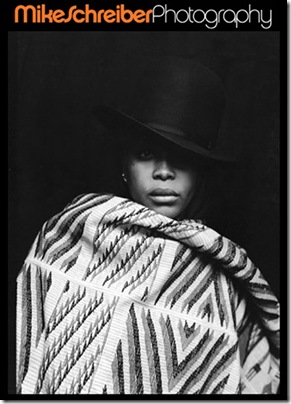
| Culture › Re: The Art And Architecture Of Yorubaland! by lakal(op): 12:05pm On Oct 13, 2011 |
https://lh5.ggpht.com/_o3RfR0wD8Y8/TWYPduvgkaI/AAAAAAAAJGM/FvyAyo8krVE/BADUwithNAME_thumb%5B52%5D.jpg?imgmax=800 From ARISE magazine, issue 11. Erykah Badu wears a vintage Yoruba aso olona cloth. Aso olona (“cloth with designs”) are woven on the upright loom by Yoruba women in the vicinity of the city of Ijebu-ode and were worn as insignia of office by chiefs and officials in the Oshugbo/Ogboni association of Earth priests and priestesses. The style dates back to at least the C18th. Source: adireafricantextiles..com 1 Like |
| Culture › Re: The Art And Architecture Of Yorubaland! by lakal(op): 12:03pm On Oct 13, 2011 |
[img]http://4.bp..com/_o3RfR0wD8Y8/SyeGRu28iBI/AAAAAAAAALk/xTAySuVK3FA/s400/Asooke353.jpg[/img] Superb and rare early C20th woman's wrapper. Each strip combines fine hand spun indigo checked "etu", "guineafowl pattern," with magenta "alaari" - silk from the trans Saharan trade. It would have been an extremely expensive and prestigious cloth in its day. In searching for these early cloths I look for pieces where all the original hand stitching is intact, as here. After almost a century many have begun to come apart at the seems and been restitched using a sewing machine, often in a less than careful way. Intact pieces like this have a pleasing completeness but are extremely rare. Dates from circa 1900-1920 and is in excellent condition. |
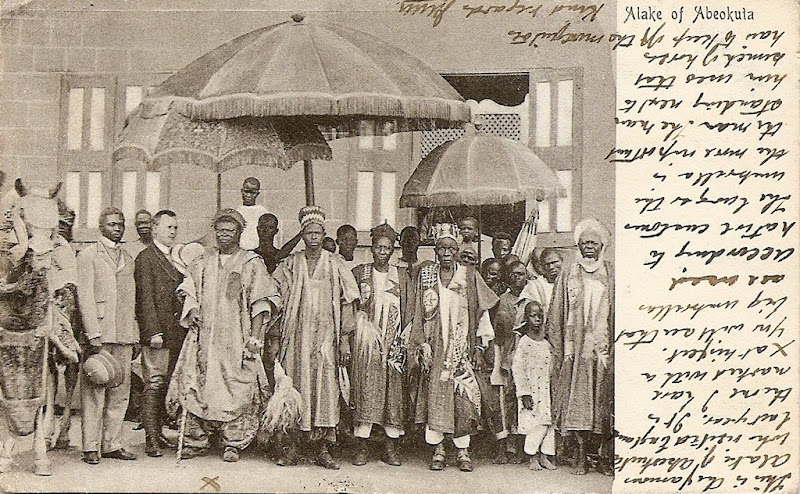
| Culture › Re: The Art And Architecture Of Yorubaland! by lakal(op): 12:00pm On Oct 13, 2011 |
https://lh6.ggpht.com/_o3RfR0wD8Y8/TVKh71jIdlI/AAAAAAAAJE8/CZ2soYacE5g/s1600/alake%5B3%5D.jpgumb%5B1%5D.jpg?imgmax=800 Examples of traditional Agbadas in this photo. Vintage postcard, circa 1900, author’s collection. The Alake of Abeokuta was the senior king of the leading town of the Egba Yoruba in south western Nigeria. source:adireafricantextiles..com 1 Like |
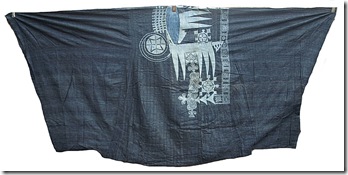
| Culture › Re: The Art And Architecture Of Yorubaland! by lakal(op): 11:58am On Oct 13, 2011 |
https://lh5.ggpht.com/_o3RfR0wD8Y8/TVKh56f7qmI/AAAAAAAAJE4/fakP-v9tFJg/AGB092%5B4%5D.jpg?imgmax=800 Agbada is the Yoruba name for a type of flowing wide sleeved robe, usually decorated with embroidery, which is worn throughout much of Nigeria by important men, such as kings and chiefs, and on ceremonial occasions like weddings and funerals. The Hausa name for the robes is riga. Although today they are often still made from hand-woven cloth, the painstaking and beautiful hand embroidery that was used in the past is very rarely seen. Fine old robes have become family heirlooms passed on from father to son and worn with pride at major celebrations. In the past prestige robes were traded over vast distances and similar or related garments are found throughout much of West Africa. |