Lakal's Posts
Nairaland Forum › Lakal's Profile › Lakal's Posts
1 2 3 4 5 6 7 8 9 10 (of 12 pages)
 Culture › Re: Alj Harem Studies On The Olukumis (old Yoruba Language) In Delta Ugbodu by lakal(m): 7:29am On Oct 23, 2011 Culture › Re: Alj Harem Studies On The Olukumis (old Yoruba Language) In Delta Ugbodu by lakal(m): 7:29am On Oct 23, 2011 |
This whole Olukumi issue is very interesting: I don't think that the Olukumi-speaking people see themselves as anything but residents of their respective villages, nowadays. (I'll leave that Anioma = Igbo/not Igbo fracas). It's generally agreed that Olukumi comes from Ondo/Owo dialect Oluku mi (my friend). The name Olukumi or "lucumi" is still used to refer to Yorubas in Cuba. |
| Culture › Re: Francophones Speak Good French But Nigerians Barely Speak English by lakal(m): 2:49pm On Oct 21, 2011 |
odumchi:I don't think that saying "Speak good French" is grammatically incorrect. "Speak good French" and "Speak French well" mean two different things, though. "Good French" refers to the type of French being spoken. "Speak French well" refers to the ability of the speaker to speak French. 1 Like |
| Culture › Re: Widow Banished From Ekiti For Refusing Traditional Oath by lakal(m): 4:21pm On Oct 19, 2011 |
Na wa o. |
| Culture › Re: The Art And Architecture Of Yorubaland! by lakal(op): 2:24am On Oct 18, 2011 |
Abeg, carry una wahala go. This thread is about the art and architecture of Yorubaland. |
| Culture › Re: Is Ibo Food Better Or More In Variety Than Calabar/akwa Ibom Food? by lakal(m): 10:08pm On Oct 17, 2011 |
Igbo food is different from Efik/Ibibio food, from what I've noticed. I really like Efik/Ibibio foods, but I've also had them more often than Igbo dishes. As for attracting more people between Igbo and Yoruba food? At pan-Nigerian parties, Yoruba-style foods seem to win. Even my Igbo friends admit Yoruba parties have the best food. |
| Culture › Re: Help, My Happiness Is At Stake Because Of Tribal Issues by lakal(m): 11:42pm On Oct 16, 2011 |
Onlytruth:I can also give the story of my Aunt who is married to an Igbo big man from Delta State. They have five children and she had to flee their house due to him making death threats and abusing her and the children. Don't you think everyone has stories? Nonsense. |
| Culture › Re: Help, My Happiness Is At Stake Because Of Tribal Issues by lakal(m): 11:34pm On Oct 16, 2011 |
arsenefc:Rewind 200 years into the past. You might not even be able to marry from the village next to you for whatever reason. To this day, Ekitis and Ijebus have mutual distrust towards each other in marriage, among the Yorubas. Igbos have their own clan/state wahala within themselves to this day. If you only go by what other people tell you or what others believe, you may never get anywhere. |
| Culture › Re: Help, My Happiness Is At Stake Because Of Tribal Issues by lakal(m): 11:28pm On Oct 16, 2011 |
Onlytruth:Biafra did a number on some of you peoples' psyche. Yoruba people are not jealous of the Igbo. Seriously. In terms of marriage partner, we will marry whoever we fancy. If I wan marry Yoruba girl, no shaking. If na Igbo girl I dey find, ko si wahala. Yorubas don't care as much as some of you seem to. Most times the kids of Igbo-Yoruba marriage speak Yoruba and have Yoruba names. I think that's what is really burning some of una  |
| Culture › Re: Help, My Happiness Is At Stake Because Of Tribal Issues by lakal(m): 11:22pm On Oct 16, 2011 |
Some of you are so backwards and bigoted that you should be ashamed to post what you post. Awon alaironu buruku. |
| Culture › Re: The Art And Architecture Of Yorubaland! by lakal(op): 4:36pm On Oct 16, 2011 |
https://i41.tinypic.com/a09ziw.jpg Gelede Masque. Yoruba people, Benin, Southwest Nigeria. Wood. H.: 34 cm. Inv.: MNAM 71.7.1. Photo: J.G. Berizzi. Location :Musee du Quai Branly, Paris, France Photo Credit : Réunion des Musées Nationaux / Art Resource, NY |
| Culture › Re: The Art And Architecture Of Yorubaland! by lakal(op): 4:33pm On Oct 16, 2011 |
https://i42.tinypic.com/m938tx.jpg Steatite (soapstone) Yoruba head. Nigeria, c. 17th-19th c. Location :Private Collection Photo Credit : Werner Forman / Art Resource, NY |
| Culture › Re: The Art And Architecture Of Yorubaland! by lakal(op): 4:31pm On Oct 16, 2011 |
https://i43.tinypic.com/2w3apub.jpg Drum in the form of a kneeling woman with an offering bowl. Probably used by the Ogboni society. Yoruba, from South-western Nigeria. Wood, skin. 20th century. Location :Coll. C. Vogel, New York, NY, U.S.A. Photo Credit : Werner Forman / Art Resource, NY |
| Culture › Re: The Art And Architecture Of Yorubaland! by lakal(op): 4:30pm On Oct 16, 2011 |
https://i43.tinypic.com/vnmbrq.jpg Bronze horse head bell. Yoruba people. Ijebu, Nigeria. Brass, 13.4 x 9 cm. Inv. 73.1997.4.11. Photo: Jean-Gilles Berizzi. Location :Musee du Quai Branly, Paris, France Photo Credit : Réunion des Musées Nationaux / Art Resource, NY |
| Culture › Re: The Art And Architecture Of Yorubaland! by lakal(op): 4:29pm On Oct 16, 2011 |
https://i44.tinypic.com/25fqgb9.jpg Vessel, 17th-18th century. Yoruba, Owo group. Nigeria, Guinea Coast. Ivory, wood or coconut shell inlay, Height 5 in. Gift of Mr. and Mrs. Klaus G. Perls, 1991 (1991.17.129). Location :The Metropolitan Museum of Art, New York, NY, U.S.A. Photo Credit : Image copyright © The Metropolitan Museum of Art / Art Resource, NY |
| Culture › Re: The Art And Architecture Of Yorubaland! by lakal(op): 4:27pm On Oct 16, 2011 |
https://i41.tinypic.com/2n7gp7d.jpg Mother and Child. Yoruba, Abeokuta, Nigeria. Wood, beads. Gift of Walt Disney World Co., a subsidiary of The Walt Disney Company. Location :National Museum of African Art, Smithsonian Institution, Washington, DC, U.S.A. Photo Credit : Jerry L. Thompson / Art Resource, NY |
| Culture › Re: The Art And Architecture Of Yorubaland! by lakal(op): 4:26pm On Oct 16, 2011 |
Zoomorphic cup. Youruba people, Benin. Polychrome wood, 18.3 x 17.9 x 16 cm. Inv.: 71.1889.101.62. Gift of Alexandre L. d'Albeca. Former collection: Musee de l'Homme. Location :Musee du Quai Branly, Paris, France Photo Credit : Musee di Quai Branly/Scala / Art Resource, NY |
| Culture › Re: The Art And Architecture Of Yorubaland! by lakal(op): 4:23pm On Oct 16, 2011 |
https://i44.tinypic.com/20g15co.jpg Terracotta head of an African male. Ife, Nigeria. 12-14th century CE. Terracotta with polychrome traces, 15.5 x 11.5 x 12.3 cm. Inv. 73.1996.1.4. Photo: Jean-Gilles Berizzi. Location :Musee du Quai Branly, Paris, France Photo Credit : Réunion des Musées Nationaux / Art Resource, NY https://i44.tinypic.com/10r2uft.jpg Ram's Head fragment, 11th-12th CE. Ife, Nigeria. Terracotta. Location :Obafemi Awolowo University, Ife, Nigeria Photo Credit : Jerry L. Thompson / Art Resource, NY |
| Culture › Re: The Art And Architecture Of Yorubaland! by lakal(op): 4:20pm On Oct 16, 2011 |
https://i42.tinypic.com/dp7oyg.jpg Terracotta head. Ife sculpture from Nigeria. Location :National Commission for Museums and Monuments, Lagos, Nigeria Photo Credit : Werner Forman / Art Resource, NY https://i44.tinypic.com/14j2d50.jpg Ife terracotta sculpture thought to depict a gagged sacrificial victim. Nigeria, Ife culture. Ife. Ca. 13th CE. Material Size: Terracotta. Location :Ethnologisches Museum, Staatliche Museen, Berlin, Germany Photo Credit : Werner Forman / Art Resource, NY |
| Culture › Re: The Art And Architecture Of Yorubaland! by lakal(op): 4:18pm On Oct 16, 2011 |
https://i43.tinypic.com/25k3os8.jpg Male head. 12th-15th century. Nigeria, Ife culture. Terracotta, h. 19cm. Inv. III C 27530. Photo: Dietrich Graf. Location :Ethnologisches Museum, Staatliche Museen, Berlin, Germany Photo Credit : bpk, Berlin / (name of museum) /(name of photographer) / Art Resource, NY https://i40.tinypic.com/vz78tx.jpg Male head. Nigeria, Ife. 12th-15th century. Terracotta, h. 17 cm. Inv. III C 27526. Photo: Dietrich Graf. Location :Ethnologisches Museum, Staatliche Museen, Berlin, Germany Photo Credit : bpk, Berlin / (name of museum) /(name of photographer) / Art Resource, NY |
| Culture › Re: The Art And Architecture Of Yorubaland! by lakal(op): 4:15pm On Oct 16, 2011 |
Some of the lesser-seen Ife artworks. https://i40.tinypic.com/29kykr9.jpg Aroye Pot, Ife, Nigeria. 14th-15th CE. Terracotta. Location :Obafemi Awolowo University, Ife, Nigeria Photo Credit : Jerry L. Thompson / Art Resource, NY https://i40.tinypic.com/65d8c0.jpg Ritual pot, 13th-14th CE. Ife, Nigeria. Terracotta. Location :Obafemi Awolowo University, Ife, Nigeria Photo Credit : Jerry L. Thompson / Art Resource, NY |
| Culture › Re: Are Africans Proud Of Black Americans? by lakal(m): 1:54am On Oct 16, 2011 |
But isn't this Tpia the same one that said we don't have tattoos in Yoruba culture? lol. |
| Culture › Re: Are Africans Proud Of Black Americans? by lakal(m): 1:53am On Oct 16, 2011 |
tpia@:Americans do say "boku", just sounds more like "bookoo." Same meaning. If you put home training + manners into a search engine, here is your first result: Basic Black: Home Training for Modern Times |
| Culture › Re: Art And Architecture Of The Igbo People by lakal(m): 1:32am On Oct 16, 2011 |
My favorite Igbo-Ukwu artwork: the roped pot. West African peoples were producing aesthetically wonderful art over 1,000 years ago.  https://www.onlinenigeria.com/Culture/public/images_upload/1.jpg Igbo-Ukwu (9th Century AD). Bronze pot on a stand roped together. |
| Culture › Re: Art And Architecture Of The Igbo People by lakal(m): 1:25am On Oct 16, 2011 |
| Culture › Re: Yoruba Mythology by lakal(m): 11:20pm On Oct 15, 2011 |
rgp922:Shango's axe (Ose Sango) is universally used in the traditional Yoruba religions. The priests hold it when they represent Sango. It's also thought that the ram's head came from the earlier thunder god, Jakuta. |
| Culture › Re: The Art And Architecture Of Yorubaland! by lakal(op): 5:39pm On Oct 15, 2011 |
https://farm4.static.flickr.com/3013/2922781729_ddd72c9a81.jpg Crown, Yoruba peoples, Nigeria, Late 19th to early 20th century, Copper alloy The four staring faces are said to represent the all-seeing gods or ancestors. Their protruding eyes signify when the spiritual eye replaces ordinary vision. The two figures with mudfish legs refer to supernatural powers in two realms, land and water-or reality and spirit. The projecting stem of the crown may allude to stored spiritual power in the wearer's head and also show that the wearer is exempt from everyday chores such as the carrying of loads on one's head. |
| Culture › Re: The Art And Architecture Of Yorubaland! by lakal(op): 5:09pm On Oct 15, 2011 |
https://i632.photobucket.com/albums/uu46/africana0/ekiti8.jpg Bronze staff. Ekiti, Yorubaland. Undated, but similar to other Ogboni/Osugbo bronze objects. |
| Culture › Re: The Art And Architecture Of Yorubaland! by lakal(op): 5:04pm On Oct 15, 2011 |
This one is reminiscent of the "Sankofa" bird of the Akan. https://www.beadparadise.com/media/images/standard/myor2028_yoruba_bronze_bird_fetish.jpg Unique and antique: bronze bird fetish from the Yoruba tribe circa early 1900s. 55mm tall x 19mm wide. Heavy solid cast bronze foul figurine |
| Culture › Re: The Art And Architecture Of Yorubaland! by lakal(op): 5:02pm On Oct 15, 2011 |
https://i52.tinypic.com/2j31ls6.jpg This is a pair of Yoruba bronze figures; each one sitting on a separate bronze stool. They were created by the old lost wax casting method. These bronze figures are 11.5" and 10.5" in height. They are also both about 3 ½ inches in width and 3 ½ inches in depth. They date from the late 19th Century through the early 20th Century. Their condition is excellent with a nice patina and a small area of verdigris. |
| Culture › Re: The Art And Architecture Of Yorubaland! by lakal(op): 4:58pm On Oct 15, 2011 |
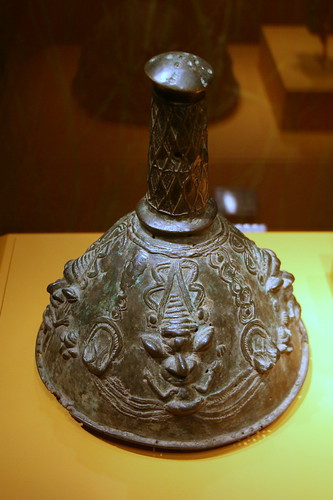
https://i53.tinypic.com/10h4rah.jpg Ijebu Bronze Face Bell Origin: Nigeria Dimensions: 8 in (20.32 cm) H Materials: Bronz |
| Culture › Re: The Art And Architecture Of Yorubaland! by lakal(op): 4:51pm On Oct 15, 2011 |
https://www.beadparadise.com/media/images/standard/myor2027_small_bronze_animal_fetish_yoruba_african_trade_bead.jpg Small Bronze Yoruba Animal Fetish Cute bronze animal fetish from the Yoruba tribe circa early 1900s. 55mm long x 24mm tall x 17mm wide; solid bronze. |
| Culture › Re: The Art And Architecture Of Yorubaland! by lakal(op): 4:49pm On Oct 15, 2011 |
https://www.africainfinite.com/images/cat-449583.jpg Owo, Yorubaland (undated). This Yoruba bronze sculpture features a King surrounded by his court servants and was created by the lost wax casting method. Lost-wax casting sometimes called by the French name of cire perdue (from the Latin cera perduta) is the process by which a brass or bronze sculpture is cast from an artist's carving usually made from wax. Very intricate works can be achieved with this method, depending on the carver's skills. |