LRNZH's Posts
Nairaland Forum › LRNZH's Profile › LRNZH's Posts
1 2 3 4 5 6 7 8 ... 43 44 45 46 47 48 49 50 51 (of 113 pages)
 Politics › Re: Armoured Tank Nigerian Soldiers Captured From Boko Haram Recently (Photo) by LRNZH(m): 9:05pm On Feb 19, 2015 Politics › Re: Armoured Tank Nigerian Soldiers Captured From Boko Haram Recently (Photo) by LRNZH(m): 9:05pm On Feb 19, 2015 |
You were the guy posting pictures from all over Africa claiming they were GEJ procurements. Your pics dont mean anything till you show us a documented article on GEJ's tanks procurement. Save your fake tanks that could not defeat BH. 45 Likes 2 Shares |
| Travel › Re: VIDEO: Scrambling Passengers for GEJ's Disorganised Trains In Lagos by LRNZH(m): 9:01pm On Feb 19, 2015*. Modified: 9:32pm On Feb 19, 2015 |
Akpan107:Your dreams are unlike Joseph's in the Bible. Pls do not derail this thread with your fake dreams. Are you not ahamed of GEJ's Transformation trains? cc: Lalasticlala, Obinoscopy, Maclatunji, Ishilove, OAM4J, Justwise, Disguy |
| Politics › Re: Armoured Tank Nigerian Soldiers Captured From Boko Haram Recently (Photo) by LRNZH(m): 8:51pm On Feb 19, 2015 |
Cannonleo:I thought you guys claimed GMB did not buy weapons for the NA. Show us GEJ procured tank before I engage you in any meaningful discussion. Oh by the way learn to spell please. 53 Likes |
| Politics › Re: #SWISSLEAKS: David Mark’s Wife, Dangote, Adenuga Named Swiss Accounts Operators by LRNZH(m): 8:48pm On Feb 19, 2015 |
... |
| Travel › Re: VIDEO: Scrambling Passengers for GEJ's Disorganised Trains In Lagos by LRNZH(m): 8:44pm On Feb 19, 2015 |
galaxi:Are these not the 'celebrated' GEJ TRANSFORMATION trains again? I am ashamed at our trains in the 22nd century. Everytime a GEJite is shown facts he/she develops amnesia. |
| Politics › Re: NIMASA Behind Dirty Campaigns Of Hate Against Buhari - APC Campaign by LRNZH(m): 8:42pm On Feb 19, 2015 |
Collynzo9:Abeg go siddon. You must not comment rubbish on all threads 1 Like |
| Politics › Re: #SWISSLEAKS: David Mark’s Wife, Dangote, Adenuga Named Swiss Accounts Operators by LRNZH(m): 7:58pm On Feb 19, 2015 |
sunkoye:Everybody is waiting for CHANGE. The purported fresh air is heavily polluted and toxic. |
| Politics › Re: SR Dares Obanikoro To Sue In The USA by LRNZH(m): 7:55pm On Feb 19, 2015 |
Koro go enter 1 chance if he dares try it. Penitentiary things |
| Politics › Re: Nigerian Senate Express Confidence In Jega, INEC; Okay Card Readers For Election by LRNZH(m): 7:51pm On Feb 19, 2015 |
It implies PDP has devised another means of rigging the election. Agents of darkness. 60 Likes |
| Politics › Re: Naira To Officially Exchange At N197/$ by LRNZH(op): 7:39pm On Feb 19, 2015 |
People can twist facts o..... See above for example. 1 Like |
| Politics › Re: #SWISSLEAKS: David Mark’s Wife, Dangote, Adenuga Named Swiss Accounts Operators by LRNZH(m): 7:32pm On Feb 19, 2015 |
IbnSultaan:Amen. Oyedepo's gates of hell is also for them besides Boko Haram. |
| Education › Re: ASUU Threatens Strike Over Death Of ABU Professor by LRNZH(m): 7:29pm On Feb 19, 2015 |
Reckless lawlessness under GEJ's govt. We are tired! Watch how this matter will be swept under the carpet by GEJ just like the Chibok girls or Diezani's 'lootery' . 3 Likes |
| Politics › Re: #SWISSLEAKS: David Mark’s Wife, Dangote, Adenuga Named Swiss Accounts Operators by LRNZH(m): 7:12pm On Feb 19, 2015 |
benuejosh:This is the most conscientious decision any patriot will take in Nigeria today. 1 Like |
| Politics › Re: Buhari Jets Out To UK, To Address CHATAM House by LRNZH(m): 7:10pm On Feb 19, 2015 |
FastShipping:I don't even want to get into this discussion in details. GEJites malicious posts being pushed to front page without verification is an appallig trend. Period. 3 Likes |
| Politics › Re: Buhari Jets Out To UK, To Address CHATAM House by LRNZH(m): 7:03pm On Feb 19, 2015 |
Meanwhile a poo thread is alleging GMB is in the UK for medical checkup. Very dumb GEJites on NL  cc: Seun, Lalasticlala, Obinoscopy, Maclatunji 4 Likes |
| Politics › Re: #SWISSLEAKS: David Mark’s Wife, Dangote, Adenuga Named Swiss Accounts Operators by LRNZH(m): 7:01pm On Feb 19, 2015 |
benuejosh:My brother. Worse things are now happening under GEJ and some ignoramuses are supporting that for another 4 years. 2 Likes |
| Politics › Re: NIMASA Behind Dirty Campaigns Of Hate Against Buhari - APC Campaign by LRNZH(m): 6:42pm On Feb 19, 2015 |
The same NIMASA that has been literally handed over to Tompolo. It should be scrapped sef. 3 Likes |
| Politics › Re: #SWISSLEAKS: David Mark’s Wife, Dangote, Adenuga Named Swiss Accounts Operators by LRNZH(m): 6:41pm On Feb 19, 2015 |
David Mark....6 Million Pounds as Governor and Minister... Well, Stealing is Not Corruption -GEJ 1LRNZH:cc: Lalasticlala, Obinoscopy, Maclatunji, OAM4J, Ishilove 1 Like |
| Politics › Senate Summons Service Chiefs Over Election Postponement by LRNZH(op): 12:57pm On Feb 19, 2015 |
[img]http://media.premiumtimesng.com/wp-content/files/2012/10/716x433xService-chiefs-Nigeria-e1371833851712.jpg.pagespeed.ic.0XX05kkAZl.webp[/img] The Nigerian Senate has summoned the nation’s service chiefs to explain the reasons security agencies were unavailable to provide security during the originally scheduled dates of elections. The Senate made this decision at plenary after meting with the Chairman of the Independent National Electoral Commission, Attahiru Jega, on Wednesday. The Senate Minority Leader, George Akume, moved the motion that the service chiefs be invited for questioning after the INEC chairman said he could not answer some questions put to him. The lawmaker representing Kwara central, Bukola Saraki, while speaking to reporters after the plenary, said it is necessary for the service chiefs to be summoned because there were only a handful of questions that Mr. Jega could answer. Mr. Saraki said security issues relating to the elections could not be answered until the service chiefs are present. “So we are still back to that issue of security,” Mr. Saraki said. “I think that further emphasizes what we were saying yesterday, that the Senate and the National Assembly still need to invite the service chiefs to give us assurance. “He (Mr. Jega) said categorically that he cannot answer that question that we need to have the Service Chiefs to answer that question. “If we keep on talking to Professor Jega, we cannot hold him responsible for that. What we can hold him responsible for, he has given a good explanation already. “The most important thing is holding election on that day and the only person that can answer that as he said is that we should bring the service chiefs to answer that. “So next week, we hope the leadership will do the right thing,” Mr. Saraki said. Senators of the All Progressives Congress briefed the press on the need to summon the service chiefs to answer the security questions instead of Mr. Jega. The lawmaker representing Osun central senatorial district, Olusola Adeyeye, said the service chiefs should be summoned for compelling INEC to postpone the elections. He mentioned that the army did not have a right to influence the date of elections. The elections were postponed from February 14 and February 28 to March 28 and April 11 because the Service Chiefs told the INEC Chairman the military would be unavailable to provide security. http://www.premiumtimesng.com/news/top-news/177118-senate-summons-service-chiefs-over-election-postponement.html 3 Likes |
| Politics › Re: How Obasanjo Tackled Every Successive Administration After Him by LRNZH(op): 12:52pm On Feb 19, 2015 |
miteolu:Yesso |
| Politics › Re: Naira To Officially Exchange At N197/$ by LRNZH(op): 12:51pm On Feb 19, 2015 |
redcap:Well, Mallam rates will keep increasing irrespective of this directive unless something is done about our import based economy my with no real sector. In fact, a lot of connected people buy at those subsidised rates from RDAS and WDAS to sell at Mallam rates. They will not make much profits any longer. That's the only impact if you ask me. Buy it won't help the Naira rates. |
| Politics › Re: How Obasanjo Tackled Every Successive Administration After Him by LRNZH(op): 10:33am On Feb 19, 2015 |
Baba Iyabo causing grief since 1980. |
| Politics › Re: GEJ Approves Over 20 Armed Soldiers, Police, C-Defence To Edwin Clark's Compound by LRNZH(op): 10:32am On Feb 19, 2015 |
tociano009:Oyedepo copy in the house...  1 Like |
| Politics › Naira To Officially Exchange At N197/$ by LRNZH(op): 10:24am On Feb 19, 2015 |
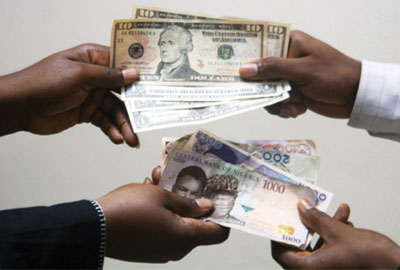
The Central Bank of Nigeria, CBN, yesterday, in a bid to salvage the Naira from speculators scrapped the official window where it sells dollar to end users through banks twice a week. https://www.vanguardngr.com/wp-content/uploads/2011/01/naira-Dollar.jpg Naira-Dollar The Naira will now be sold at the ruling inter-bank market rate indicating an implicit devaluation of the currency. The Naira yesterday at the inter-bank market sold for N197 to the dollar. Financial Market Dealers Quote, FMDQ, a group comprising Nigeria’s main commercial banks and the central bank, said commercial banks have also been banned from re-selling CBN dollars to other banks, another attempt to end speculation in the naira. The CBN had at the liberalization of the economy opened the Whole Sale Dutch Auction but later replaced it with the Retail Dutch Auction System where banks bid for foreign exchange on behalf of their customers. Scrapping its window of direct sale of foreign exchange The CBN in scrapping its window of direct sale of foreign exchange to end users said all foreign exchange needs are to be sourced from the inter-bank market whose rate is N197 to a dollar. This implies that Nigerians who need foreign exchange will now approach their banks and buy at the ruling rate. There had been about three different markets for purchasing foreign currency in the country. These are the CBN window called the Retail Dutch Auction System, where the CBN sell dollars to end users twice a week at a much cheaper rate, the inter-bank where banks sell foreign exchange independently sourced by them at a higher rate, the bureau de change which margin is slightly higher than that of CBN, and the open market where small retailers sell forex on the streets at a more higher rate. The existence of several markets has always given the impression that the Naira is over valued and some form of subsidy where those who buy from CBN sold at higher rate at the inter-bank market called round tripping. The apex bank in a statement signed by its [b]Director of Communication, Mr Ibrahim Mu’azu, yesterday said: “The managed float exchange rate regime, which the bank had adopted following the liberalisation of the foreign exchange market, has for the most part been successful in ensuring exchange rate stability in line with its mandate. “In recent times, however, with the sharp decline in global oil prices and the resultant fall in the country’s foreign exchange earnings, the bank has observed a widening margin between the rates in the inter-bank and the RDAS window, thus engendering undesirable practices including round-tripping, speculative demand, rent-seeking, spurious demand, and inefficient use of scarce foreign exchange resources by economic agents. “This has continued to put pressure on the nation’s foreign exchange reserves with no visible economic benefits to the productive sector of the economy and the general public. “In view of the foregoing, it has become imperative that appropriate actions be taken to avert the emergence of a multiple exchange rate regime and preserve the country’s foreign exchange reserves. RDAS/WDAS closed “Consequently, we wish to inform all authorized dealers and the general public that, with effect from the date of this press release, the Retail Dutch Auction System (RDAS/WDAS) foreign exchange window at the CBN is hereby closed. Henceforth, all demand for foreign exchange should be channelled to the Interbank Foreign Exchange Market.[/b] For the avoidance of doubt, all authorized dealers and the general public should note that the CBN will continue to intervene in the inter-bank foreign exchange market to meet genuine/legitimate demands. Nigeria’s foreign exchange reserves, which was $5.4 billion in 1999, rose to an overwhelming level of $51.3 billion at end of 2007 and further to $53.0 billion in 2008, but owing to the crash in the international price of crude oil in 2008 and the aftermath of the global financial crisis, the reserve declined to $42.4 billion in 2009 further declined from $38.138 billion at the end of April 2014 to $33.04 billion in February 2015. Reactions Reacting to the development, market operators welcomed the CBN action, saying it is long over due. Mr. Bismarck Rewane, Managing Director/Chief Executive, Financial Derivative Company Limited said: “This means that the Naira is now priced at its fair value. It is one of the best moves the CBN has made in terms of stopping this nonsense that is going on at RDAS or no RDAS. It is now time to price the market at its fair value and take away all the middlemen and round tripping. “So this is the true value of the currency, the speculators are out of business. Hitherto, products were not priced at RDAS window. For example airline tickets have been priced at N202 per dollar for the past six weeks. So what are we talking about? As a matter of fact, because the price is now high the demand will reduce and the currency will now have some respite. Speaking for the organized private sector, Director General, Lagos Chamber of Commerce and Industry, Mr Muda Yusuf said: “The closure of the RDAS foreign exchange window has the following implications: It will result in the escalation of production costs for firms that had access to this forex window. Such firms will experience cost increases of up to 20 per cent. “This will also impact on sales performance, profit margins and ultimately capacity utilization of manufacturing firms. Import duty and other port charges which are computed as a percentage of import costs will also increase. This implies additional pressure on operating costs for erstwhile beneficiaries of the CBN RDAS forex window. Firms funding requirements (in naira) will increase as firms will need to source more funds in the banks to fund their forex needs. On his part, Razia Khan, Managing Director, Head, Macro Global Research, Standard Bank said: “With Nigeria foreign reserves under pressure, and amid growing concern that a wide RDAS-inter-bank spread would encourage ‘round-tripping’, the CBN will now stop RDAS auctions, effectively discontinuing its foreign exchange subsidy for certain categories of demand. This is positive news, and should help create more transparency in the Nigerian market. However, with oil prices currently at levels where foreign reserves will be difficult to replenish, the CBN’s appetite for continued support of the inter-bank foreign exchange rate will be closely monitored. Kunle Ezun, a currency analyst said: “This is implicit devaluation. There won’t be any change in the inter-bank market rate because since last week, this is what the CBN has been doing. Also this is what the market actually advised them to do. They advised the CBN, you can’t keep subsidising the naira in RDAS, why don’t you put everybody on the same platform.” http://www.vanguardngr.com/2015/02/naira-to-exchange-at-n197/#sthash.f0pwJW2W.dpuf |
| Politics › Re: DOWNLOAD: Nigeria 2015 Budget Proposal GEJ Doesn't Want Nigerians To See by LRNZH(op): 9:52am On Feb 19, 2015 |
shaqhead:You got it right. In a couple of days, we should download and dissect this budget they don't want us to see. In sure it ll monstly be recurrent expenditure to oil the bureaucracy holding Nigeria back. 1 Like |
| Politics › DOWNLOAD: Nigeria 2015 Budget Proposal GEJ Doesn't Want Nigerians To See by LRNZH(op): 1:49am On Feb 19, 2015*. Modified: 2:10am On Feb 19, 2015 |
[img]http://media.premiumtimesng.com/wp-content/files/2014/12/800x345xNgozi_Okonjo_Iweala_Presents_Budget.jpg.pagespeed.ic.3eS9S8gF88.webp[/img] Since submitting the 2015 Budget to the National Assembly in November last year, Nigeria’s Budget office, although required by law to publish the budget details have failed to do so, preferring to keep it secret. PREMIUM TIMES, courtesy BudgIT, has obtained authentic copies of the proposal handed to federal lawmakers for vetting and approval. We are making them available in downloadable formats below in public interest. 1. Independent National Electoral Commission --> [url]http://premiumtimesng.com/docs_download/Nigeria%202015%20budget%20proposals/01.%20Independent%20National%20Electoral%20Commission.xlsx[/url] 2. National Assembly --> [url]http://premiumtimesng.com/docs_download/Nigeria%202015%20budget%20proposals/01.%20NASS.xlsx[/url] 3. National Judicial Council --> [url]http://premiumtimesng.com/docs_download/Nigeria%202015%20budget%20proposals/01.%20National%20Judicial%20Council.xlsx[/url] 4. Public Complaints Commision --> [url]http://premiumtimesng.com/docs_download/Nigeria%202015%20budget%20proposals/01.%20Public%20Complaints%20Commission.xlsx[/url] 5. Statutory Transfer & Debt Service --> [url]http://premiumtimesng.com/docs_download/Nigeria%202015%20budget%20proposals/01.%20Statutory%20Transfers%20&%20Debt%20Service.xlsx[/url] 6. Presidency --> [url]http://premiumtimesng.com/docs_download/Nigeria%202015%20budget%20proposals/1.%20Presidency.xlsx[/url] 7. Secretary General of the Federation --> [url]http://premiumtimesng.com/docs_download/Nigeria%202015%20budget%20proposals/2.%20Secretary%20General%20of%20the%20Federation.xlsx[/url] 8. Ministry of Youth Development --> [url]http://premiumtimesng.com/docs_download/Nigeria%202015%20budget%20proposals/3.%20Youth%20Devt.xlsx[/url] 9. Ministry of Police Affairs --> [url]http://premiumtimesng.com/docs_download/Nigeria%202015%20budget%20proposals/4.%20Police%20Affairs.xlsx[/url] 10. Police Formationds and Commands --> [url]http://premiumtimesng.com/docs_download/Nigeria%202015%20budget%20proposals/5.%20Police%20Formations%20and%20Command.xlsx[/url] 11. Ministry of Women Affairs --> [url]http://premiumtimesng.com/docs_download/Nigeria%202015%20budget%20proposals/6.%20Women%20Affairs.xlsx[/url] 12. Ministry of Agriculture --> [url]http://premiumtimesng.com/docs_download/Nigeria%202015%20budget%20proposals/7.%20Agriculture.xlsx[/url] 13. Ministry of Water Resources --> [url]http://premiumtimesng.com/docs_download/Nigeria%202015%20budget%20proposals/8.%20Water%20Resources.xlsx[/url] 14. Auditor-General --> [url]http://premiumtimesng.com/docs_download/Nigeria%202015%20budget%20proposals/9.%20Auditor-General.xlsx[/url] 15. Independent Corrupt Practices Commission --> [url]http://premiumtimesng.com/docs_download/Nigeria%202015%20budget%20proposals/10.%20ICPC.xlsx[/url] 16. Ministry of Defence --> [url]http://premiumtimesng.com/docs_download/Nigeria%202015%20budget%20proposals/11.%20Defence.xlsx[/url] 17. Ministry of Education --> [url]http://premiumtimesng.com/docs_download/Nigeria%202015%20budget%20proposals/12.%20Education.xlsx[/url] 18. Federal Capital Territory --> [url]http://premiumtimesng.com/docs_download/Nigeria%202015%20budget%20proposals/13.%20Federal%20Capital%20Territory.xlsx[/url] 19. Ministry of Foreign Affairs --> [url]http://premiumtimesng.com/docs_download/Nigeria%202015%20budget%20proposals/14.%20Foreign%20Affairs.xlsx[/url] 20. Ministry of Finance --> [url]http://premiumtimesng.com/docs_download/Nigeria%202015%20budget%20proposals/15.%20Finance.xlsx[/url] 21. Ministry of Health --> [url]http://premiumtimesng.com/docs_download/Nigeria%202015%20budget%20proposals/16.%20Health.xlsx[/url] 22. Ministry of Trade and Investment --> http://premiumtimesng.com/docs_download/Nigeria%202015%20budget%20proposals/17.%20Trade%20and%20Investment.xlsx 23. Ministry of Information --> http://premiumtimesng.com/docs_download/Nigeria%202015%20budget%20proposals/18.%20Information.xlsx 24. Ministry of Communication Technology --> http://premiumtimesng.com/docs_download/Nigeria%202015%20budget%20proposals/19.%20Communication%20Technology.xlsx 25. Ministry of Interior --> http://premiumtimesng.com/docs_download/Nigeria%202015%20budget%20proposals/20.%20Interior.xlsx 26. Head of Service --> http://premiumtimesng.com/docs_download/Nigeria%202015%20budget%20proposals/21.%20Head%20of%20Service.xlsx 27. Ministry of Justice --> http://premiumtimesng.com/docs_download/Nigeria%202015%20budget%20proposals/22.%20Justice.xlsx 28. Ministry of Labour and Productivity --> http://premiumtimesng.com/docs_download/Nigeria%202015%20budget%20proposals/23.%20Labour%20and%20Productivity.xlsx 29. Ministry of Power --> http://premiumtimesng.com/docs_download/Nigeria%202015%20budget%20proposals/24.%20Power.xlsx 30. Ministry of Science and Technology --> http://premiumtimesng.com/docs_download/Nigeria%202015%20budget%20proposals/25.%20Science%20and%20Technology.xlsx 31. Ministry of Transport --> http://premiumtimesng.com/docs_download/Nigeria%202015%20budget%20proposals/26.%20Transport.xlsx 32. Ministry of Petroleum Resources --> http://premiumtimesng.com/docs_download/Nigeria%202015%20budget%20proposals/27.%20Petroleum%20Resources.xlsx 33. Ministry of Works --> http://premiumtimesng.com/docs_download/Nigeria%202015%20budget%20proposals/28.%20Works.xlsx 34. Ministry of Lands and Housing --> http://premiumtimesng.com/docs_download/Nigeria%202015%20budget%20proposals/29.%20Lands%20and%20Housing.xlsx 35. Ministry of Mines and Steel --> http://premiumtimesng.com/docs_download/Nigeria%202015%20budget%20proposals/30.%20Mines%20and%20Steel.xlsx 36. Ministry of Aviation --> http://premiumtimesng.com/docs_download/Nigeria%202015%20budget%20proposals/31.%20Aviation.xlsx 37. Salaries and Wages Commission --> http://premiumtimesng.com/docs_download/Nigeria%202015%20budget%20proposals/32.%20Salaries%20and%20Wages.xlsx 38. Ministry of Environment --> http://premiumtimesng.com/docs_download/Nigeria%202015%20budget%20proposals/33.%20Environment.xlsx 39. Ministry of Tourism Culture & NOA --> http://premiumtimesng.com/docs_download/Nigeria%202015%20budget%20proposals/34.%20Tourism%20Culture%20&%20NOA.xlsx 40. National Planning Commission --> http://premiumtimesng.com/docs_download/Nigeria%202015%20budget%20proposals/15.%20Finance.xlsx 41. Sports Commission --> http://premiumtimesng.com/docs_download/Nigeria%202015%20budget%20proposals/36.%20Sports%20Commission.xlsx 42. National Security Adviser --> http://premiumtimesng.com/docs_download/Nigeria%202015%20budget%20proposals/17.%20Trade%20and%20Investment.xlsx 43. Ministry of Niger Delta --> http://premiumtimesng.com/docs_download/Nigeria%202015%20budget%20proposals/38.%20Niger%20Delta.xlsx 44. Special Duties (SGF) --> http://premiumtimesng.com/docs_download/Nigeria%202015%20budget%20proposals/39.%20Special%20Duties%20(SGF).xlsx 45. Special Duties and Intergovernmental Affairs --> http://premiumtimesng.com/docs_download/Nigeria%202015%20budget%20proposals/40.%20Special%20Duties%20and%20Intergovernmental%20Affairs.xlsx 46. Fiscal Responsibility Commission --> http://premiumtimesng.com/docs_download/Nigeria%202015%20budget%20proposals/41.%20Fiscal%20Responsibility%20Commission.xlsx 47. ICRC --> http://premiumtimesng.com/docs_download/Nigeria%202015%20budget%20proposals/42.%20ICRC.xlsx 48. National Population Commission --> http://premiumtimesng.com/docs_download/Nigeria%202015%20budget%20proposals/43.%20National%20Population%20Commission.xlsx 49. Code of Conduct Bureau --> http://premiumtimesng.com/docs_download/Nigeria%202015%20budget%20proposals/44.%20Code%20of%20Conduct%20Bureau.xlsx 50. Code of Conduct Tribunal --> http://premiumtimesng.com/docs_download/Nigeria%202015%20budget%20proposals/45.%20Code%20of%20Conduct%20Tribunal.xlsx 51. Revenue Mobilization --> http://premiumtimesng.com/docs_download/Nigeria%202015%20budget%20proposals/46.%20Revenue%20Mobilization.xlsx 52. Federal Civil Service Commission --> http://premiumtimesng.com/docs_download/Nigeria%202015%20budget%20proposals/47.%20Federal%20Civil%20Service%20Commission.xlsx 53. Police Service Commission --> http://premiumtimesng.com/docs_download/Nigeria%202015%20budget%20proposals/48.%20Police%20Service%20Commission.xlsx 54. Federal Character Commission --> http://premiumtimesng.com/docs_download/Nigeria%202015%20budget%20proposals/49.%20Federal%20Character%20Commission.xlsx 55. CRF Charges --> http://premiumtimesng.com/docs_download/Nigeria%202015%20budget%20proposals/50.%20CRF%20Charges.xls 56. 2015 SURE Program_Bill --> http://premiumtimesng.com/docs_download/Nigeria%202015%20budget%20proposals/2015%20SURE%20Program_Bill.xls 57. 2015 TOC --> http://premiumtimesng.com/docs_download/Nigeria%202015%20budget%20proposals/2015%20TOC.xlsx 58. Consolidated Summary & Bill_v2 --> http://premiumtimesng.com/docs_download/Nigeria%202015%20budget%20proposals/Consolidated%20Summary%20&%20Bill_v2.xls 59. SURE_P_2015 --> http://premiumtimesng.com/docs_download/Nigeria%202015%20budget%20proposals/SURE_P_2015.xlsx Entire 2015 Budget Proposal --> [url]http://premiumtimesng.com/docs_download/Nigeria%202015%20budget%20proposals[/url] http://www.premiumtimesng.com/news/headlines/177004-download-nigeria-2015-budget-proposal-the-jonathan-govt-does-not-want-nigerians-to-see.html 1 Like |
| Politics › Re: How Obasanjo Tackled Every Successive Administration After Him by LRNZH(op): 12:43am On Feb 19, 2015 |
If more potent leaders like GMB can be addressed by OBJ's letters, then who is GEJ? GEJ fumbled and wobbled through the whole Baba Iyabo issue with so many naive reactions. |
| Politics › Re: How Obasanjo Tackled Every Successive Administration After Him by LRNZH(op): 10:29pm On Feb 18, 2015 |
Going by history, GEJ's administration has reached its tail end. Fear the Ebora of Owu cc: Lalasticlala, Obinoscopy, Ishilove, Maclatunji, OAM4J |
| Politics › Re: GEJ Approves Over 20 Armed Soldiers, Police, C-Defence To Edwin Clark's Compound by LRNZH(op): 10:25pm On Feb 18, 2015 |
tociano009:Oyedepo has many copycats on NL |
| Politics › How Obasanjo Tackled Every Successive Administration After Him by LRNZH(op): 10:18pm On Feb 18, 2015 |
[img]http://media.premiumtimesng.com/wp-content/files/2015/02/640x353xobasanjo.png.pagespeed.ic.96qdN5njYO.webp[/img] As far back as December 2013, when former President Olusegun Obasanjo wrote a letter to President Goodluck Jonathan, expressing concern about the direction of the latter’s administration, it was clear the former president was on a familiar mission. In the 18-page letter dated December 2, the unmistakably angry Mr. Obasanjo expressed irritation at the way the Jonathan administration was handling the affairs of the Nigerian state. He spoke of an alleged threat to the unity of Nigeria and complained about the president’s renege on a promise he made in 2011 to spend only one term of four years in office. He also lambasted the administration over what he described as the increasing cases of corruption in government and the alleged training of snipers ahead of the 2015 general elections, among others. Expectedly, multiple criticisms and praises greeted the letter. Some individuals and groups expressed deep anger over the leaked letter and even called for Mr. Obasanjo’s head. The opposition National Conscience Party, NCP, accused the former president of treason, alleging that he was inciting Nigerians against the government. The Presidency also joined the fray in a noticeable bout of anger. In a letter dated December 20, Mr. Jonathan described Mr. Obasanjo’s letter as a threat to national security.” The president denied all allegations levelled against him by the former President. On the flip side, a few organisations came to Mr. Obasanjo’s rescue. The All Progressives Congress asked the National Assembly to commence investigation into the allegations. The party specifically asked the parliament to initiate impeachment process against Mr. Jonathan. A non-government organisation, SERAP, internationalized the issue when it requested a UN agency to probe the allegations made in the letter. Mr. Obasanjo was not one to be swayed by such criticisms or praises. In November 2014, at a book launch in honour of the pioneer Chairman of the Independent Corrupt Practices and Other Related Offences Commission, Mustapha Akanbi, the former president rated Mr. Jonathan’s performance as “below average.” He also said the nation’s economy “is in doldrums, if not reversed.” The following month, while hosting South-West women in his Abeokuta home, Mr. Obasanjo accused Mr. Jonathan of squandering $2 billion Excess Crude money left by his administration. He also said his administration left $25 billion to his successor, Umaru Yar’Adua who subsequently raised it to $35 billion. He also said he left $40 billion in Nigeria’s foreign reserves account after paying the nation’s outstanding debt at the time and that Mr. Yar’Adua raised it to $60 billion. He, however, regretted that the Jonathan administration depleted the reserves to $40 billion. From far away Kenya where he had gone to launch his new book, “Under My Watch” Mr. Obasanjo reportedly endorsed the APC presidential candidate, Muhammadu Buhari, against Mr. Jonathan, who is the candidate of his own party, the PDP. Although he later clarified the Kenya statement, saying he did not endorse the APC candidate, Mr. Obasanjo launched a fresh attack on Mr. Jonathan at a press briefing on Saturday, which ultimately led to his exit from the PDP on whose platform he ruled the nation between 1999 and 2007. He had alleged that Mr. Jonathan, believed to be his godson, was working towards tenure extension by organizing a controversial election and possibly leave power the same way former Ivorien President, Laurent Gbagbo did. However, not many have realized that Mr. Obasanjo, who governed the country as a military head of state between February 1976 and October 1979, was merely doing what he had penchant for. Since he left office in 1979, Mr. Obasanjo has never failed in fiercely criticizing his successors and predecessors, especially on issues of national unity whenever he had the opportunity. He enjoys doing so, arguably. On a number of occasions, the former president had fired letters, the type he sent to Mr. Jonathan, to the nation’s leaders, warning against destructive trends and events in a country he said he fought hard to unite during the civil war. At other times, he organized lectures and conferences to make his protests known. A few times, he tore at his immediate successor, Shehu Shagari, the nation’s president between 1979 and 1983. He did so virtually to all the nation’s heads of state or presidents. In fact, the only administrations he never criticized were his. A common trend that runs across his attacks on his predecessors is that something terrible happened to almost all of the regimes soon after he criticized them. Muhammadu Buhari/Tunde Idiagbon Despite styling itself “the offshoot of the Murtala/Obasanjo regime,” the Buhari/Idiagbon administration came under a barrage of attacks from Mr. Obasanjo, who repudiated that honour. Mr. Buhari served in the Murtala/Obasanjo administration (1976-1979) as a military governor of the old Borno State and later petroleum minister. Although, he played a role in stabilizing the Buhari/Idiagbon administration and even nominated ministers to it, including Onaolapo Soyele (Finance Minister), Mr. Obasanjo was soon to become uncomfortable with some of the regime’s policies. He sought opportunities to meet Mr. Buhari to offer his advice. Perhaps, the administration appeared too deaf to listen to the former head of state, forcing him to go public. At a lecture he gave to the Agriculture Society in Ibadan, the Oyo State capital, in August 1985, Mr. Obasanjo criticised the Buhari administration for allegedly running what he called “tilted federalism.” Interestingly, before the lecture, Mr. Obasanjo had sent an advanced copy of the lecture to Mr. Buhari. That same month, Mr. Buhari regime was sacked in a palace coup led by Ibrahim Babangida, the then Chief of Army Staff. As Mr. Buhari himself confessed some years later, “He (Obasanjo) sent an advance copy of the address to me. Indeed, he criticised my administration but I could recall that he visited me several times. In my own case, there was never an attempt to stop him from coming to see me. I expected him really to be coming to discuss with me. “Before he wrote the address, I sat with him to discuss the issue and I explained to him what he perceived as my administration being rather partisan in a way. I asked him for such incidents and I was given the example of NEPA, where senior officers were retired…. “So, I pointed out that really, there was no question of one section of the country being punished at that time. There was no incident to prove this but as you know General Obasanjo like everybody else had to be susceptible to the pressures of his locality. “I tried to explain but the General still went ahead to read the address. Of course, by coincidence, I was removed the same month.” Babangida Administration A couple of times, Mr. Obasanjo criticized the policies of the Ibrahim Babangida administration which rule the country between 1985 and 1993. The former head of state was particularly sad that the regime refused to give human face to the Structural Adjustment Policy, SAP, and the endless transition programme. On several occasions he granted press interviews to both local and international media to express his frustrations. In those interviews, he explained that he made efforts to see Mr. Babangida to discuss the issues, but that those efforts were futile. He reportedly wrote letters, but the president never acknowledged any. When Mr. Obasanjo suspected that the military president was reluctant to leave office, he convened a summit on May 25, 1993, at his Ota farm, which was impressively attended. Among the retired military generals he assembled to discuss the state of the nation were Mr. Buhari; his former deputy, Tunde Idiagbon; former Army Chief of Staff, Theophilus Danjuma; former Chief of General Staff, Ebitu Ukiwe; former External Affairs Commissioner, Joe Garba, and another former Chief of Army Staff, Alani Akinrinade. From the political class came Olusola Saraki, Adekunle Ajasin, Datti Ahmed, Margaret Ekpo, Lateef Jakande, Mahmud Waziri, Onyemobi Onuoha, Rufus Mohammed, Olu Akinfosile, Abubakar Rimi, and a few others. Proferssors Adebayo Adedeji, Bolanle Awe and David Iornem represented the academia. In his opening address, Mr. Obasanjo expressed concern about the increasing demands for secession and threats to national unity, among other issues. “You can probably understand any personal anguish as a man who had fought for the unity of Nigeria with men who lost their limbs and lives when I hear people propound the theory of break up,” he said. “Brothers and sisters, we will not be twice lucky. The world has changed somewhat since 1960s. There are so many forces and interests out there that will successfully militate against Nigeria surviving a second secessionist attempt.” During the six-hour meeting, the participants at the summit expressed the fear that Mr. Babangida would not hand over power because of his winding and prolong transition. They also expressed worry about the inability of the political class to present a common front against the military president. They called for the decentralisation of resource control within a strong and united Nigeria. The meeting also set up a new body known as Association for Democracy and Good Governance in Nigeria, ADGN, to further promote their agenda against the Babangida regime. Before the summit, Mr. Obasanjo had informed Mr. Babangida about his plan to host the meeting at the Gateway Hotel, Ota, but curiously the junta made to abort it. Unknown to government, the former head of state secretly provided another venue – his farm. Four months after the summit, the gap-toothed Babangida hurriedly left power and fled to his home town, Minna. That was after he deceitfully organized a presidential election, which he claimed was inconclusive, but which was clearly won by Moshood Abiola. The nullification of the election threw the country into turmoil. Mr. Obasanjo was involved in the negotiation that installed his kinsman, Ernest Shonekan as head of the Interim National Government, ING, which Mr. Babangida hurriedly packaged. He allegedly opposed handing over of state power to Mr. Abiola. Shonekan Administration The contraption called ING did not last long enough to attract Mr. Obasanjo criticism. It lasted 82 days between August and November, 1993. Abacha Administration Quite early in 1994, Mr. Obasanjo, at a lecture organised by Arewa House in Kaduna, sternly criticised the Abacha administration, which assumed office in November of the previous year, of lacking in credibility and moral fiber. He also accused the administration of habouring dark design to perpetuate itself in power and blamed Mr. Babangida for Mr. Abacha’s ascension to power. “General Babangida is the main architect of the state in which the nation finds itself today and General Sani was his eminent disciple, faithful supporter and beneficiary.” It was not clear if Mr. Obasanjo was angered by the upstaging of the ING, which he was involved in floating, or he was truly concerned about the state of the nation. He had launched an international campaign against Mr. Abacha, accusing him of lacking in ethics and transparency. At home, Mr Obasanjo opened discussions with some leaders and began to build bridges, particularly in the Eastern flank of the country. Mr. Abacha was uncomfortable with the development and was worried about the former head of state’s offensive. The taciturn general decided to tame Mr. Obasanjo and other critics, including his (Obasanjo) erstwhile deputy, Shehu Musa Yar’Adua. Mr. Abacha perceived Mr. Yar’Adua’s political activities were undermining his own self-succession agenda. In 1995, they were implicated in a phantom coup plot and jailed. While Mr Yar’Adua later died in prison, Mr. Obasanjo did not regain his freedom until the emergence of the Abdulsalami Abubakar regime which replaced Mr. Abacha after the latter’s death in June 1998. Adulsalami Abubakar Adminsitration The 11-month administration June 1998-May 1999) freed Mr. Obasanjo from Makurdi Prison where he was serving life sentence. He was soon to be drafted into politics by some northern elements led by, interestingly Mr. Babangida whose administration he had fought. The former head of state won the presidential election. Mr. Abubakar, who allegedly played a prominent role in Mr. Obasanjo’s emergence as president never experienced the other side of his successor apparently because he was in prison and also because that administration was short-lived. Umaru Musa Yar’Adua Administration Shortly before Mr. Yar’Adua became critically ill and eventually died, Mr. Obasanjo was no longer comfortable with him despite playing major role in his (Yar’Adua) emergence as President in 2007. Reason: Mr. Yar’Adua had reversed virtually all the policies of his predecessor and was already investigating some aspects of Mr. Obasanjo’s regime. Mr. Obasanjo’s position as the Chairman, PDP Board of Trustees, which he had awarded himself while leaving power could not help persuade the new president’s from going for his benefactor’s jugular. Indeed it was speculated that Mr. Yar’Adua was contemplating arresting Mr. Obasanjo. In his book, “The Accidental Public Servant,” a former FCT Minister, Nasir el-Rufai claimed that the former president was living in mortal fear that his successor would pick him up someday. Then Mr. Yar’Adua illness! Mr. Obasanjo worked underground to see the president’s deputy, Goodluck Jonathan succeed the ailing president. He soon saw an opening to go public. At the 7th Annual Trust Dialogue organised by Media Trust Limited, publishers of Daily Trust, which he chaired, on January 20, 2010, Mr. Obasanjo admonished his successor to follow the “path of honour and morality” and resign if he knew he was no longer fit to carry on as President. It did come to many as a shock, however, having helped to install that administration. Five months after, precisely in May. Mr. Yar’Adua died in office. http://www.premiumtimesng.com/news/headlines/177057-how-obasanjo-tackled-every-successive-administrations-after-him.html |
| Politics › GEJ Approves Over 20 Armed Soldiers, Police, C-Defence To Edwin Clark's Compound by LRNZH(op): 9:50pm On Feb 18, 2015 |
[img]http://lh5.googleusercontent.com/proxy/zs_XPe_t9DWtLBAnsvi_t-5JD4zjqPOlcRpdkJEOOsUEtvqOj0rlJ5wn_HHAj3qvZfUL0wVfC-x-BmsgsJF0wNomlDVkgJnpg5dujxeeiOhuzMMsIBBMHUbuguXCoTU9-1NQKd709TkDByHSYa06te3GINkvfW0uLMhlpIe-oqP3gfmVVzEyj8D1fb4=w477-h308-nc[/img] As the Nigerian army continues to battle insurgents with poorly supplied soldiers in the north, President Goodluck Jonathan has deployed more than 20 armed security agents to his godfather, Mr. Edwin Clark. The security personnel include soldiers, mobile policemen, and civil defence agents and all of them are armed with sophisticated weapons. As early as 10am, the security operatives were seen inside the compound, drinking various brands of beer and wine next to several exotic cars. They later sauntered onto the nearby Haile Selassie Street to harass pedestrians and passing by vehicles. On Tuesday when our correspondent visited the house, the security men were seen drinking inside the compound again. A forlorn-looking Sgt. Anthony Bekalobe refused to take a Star Beer, which was being distributed by a Lance Corporal in the army. Police Inspector Moses Chukwuma was seen happily drinking several cans of Star Beer with other soldiers in the compound. Meetings are held daily with many anti-election supporters of Jonathan at Mr. Clark’s residence, Mr. Clark is said to preside over them. Edwin Clark is the head of a group calling for the removal of the Chairman of the Independent National Electoral Commission, Prof. Attahiru Jega. [url]http://saharareporters.com/2015/02/18/jonathan-approves-more-20-armed-soldiers-police-civil-defence-edwin-clark%E2%80%99s-compound[/url] |




1 2 3 4 5 6 7 8 ... 43 44 45 46 47 48 49 50 51 (of 113 pages)