plaindealer: Nigerians are running and shouting all over the place that they are suffering because of non availability of the new Naira notes that banks and ATMs are not dispensing, now some governors won an injunction to alleviate your so called suffering and you are still mad and upset, you still don't want your suffering to be alleviated.
It's either many of you are hypocrites, disingenuous, liars or just too odiously political and tribal to even see what's in your own best interest.
The governors have no problem securing the new notes and they are definitely not suffering because of the new notes, they are not the one lining up for hours trying to withdraw money from the ATM or fighting in banking halls, you are so how are they your problem?
Is the misguided and incompetently created and administered policy the governors policy?
The governors are not the problem, people like you are really the problem because you can not see or reason beyond your nose.
The commentator you addressed and his co-travellees want the baby cut in half. Sadly, nothing short of this will appease them.
Now while I am in compete agreement with everything you have written here, it also behoves us to ask how some of our compatriots became so desensitised to human suffering. Why do they feel disenfranchised to the point where even self-immolation is seen as a viable option?
At Fitch Solutions, we believe that problems in Nigeria’s oil sector will slow headline growth from 3.0% in 2022 to 2.5% in 2023. Growth in private consumption will remain dependent on the growth of the labour force, rather than increased productivity. Without a substantial rise in oil output or major reforms across the economy, we expect that Nigeria’s economy will significantly underperform its African and emerging market peers over the coming years. We retain our view that the ruling party’s Bola Ahmed Tinubu is the candidate most likely to win Nigeria's February 2023 presidential election. Growing support for Peter Obi, the Labour Party's nominee, is likely to split the opposition vote, limiting chances for the People Democratic Party's Atiku Abubakar.
The election is falling apart in front of their eyes.
I heard Sanwo Olu is suspending his campaign whilst APC wants the elections to be postponed by a month.
So while not repeat an Old report by Fitch Solutions(not Fitch Ratings by the way) on "projections" on anan elections when EVERY scientific actual polling says that Obi will win.
Leveraging over 100 years of experience on over 20,000 entities around the world, Fitch Solutions is the authoritative source of Fitch Ratings highly regarded credit research, and multi award-winning ratings data, including Fitch Ratings ESG Relevance Scores Data.
PM News should have made it clear that it was referring to an old report! That aside, I find little to quibble here.
It does not take the brains of Einstein to figure that with opposition votes split in the manner described, the ruling party will return to power again. In the cold light of day, this is the political calculus we all have to contend with - once we set aside emotion and sentiments.
HomoSapiien: Tinubu already said the policy is aimed at scuttling the election and implementing an interim government, thereby taking the country back to the 90s.
We really can’t afford this happening again.
Made bank to bank transfer since yesterday, up till now, I’m yet to receive anything.
Can’t
Well...some would sooner cut the baby in half than preserve life.
Nigeria's political class has a lot to answer for.
Of course it will. Even to the most blinkered Nigerian, it surely must be obvious that the cost of implementing a currency swap now outweighs its benefits.
I am afraid our nation's political Central Bank Governor and his puppeteers overreached themselves on this one.
Udora Orizu writes that members of the House of Representatives are putting relevant stakeholders on their toes, as they commence investigation into whistle-blower’s allegation of illegal sale of 48 million barrels of Nigeria’s Bonny Light crude in China in 2015
Members of the House of Representatives are currently investigating a whistle-blower’s allegation of illegal sale of 48 million barrels of Nigeria’s Bonny Light crude in China in 2015 and the insurance status of the cargo.
The lawmakers are also investigating all crude oil exports and sales by Nigeria from 2014 to date, with regards to quantity, insurance, revenue generated, remittances into the Federation Account or other accounts as well as utilisation of the revenue for the period under review.
Over the years, the increasingly audacious and humongous theft of crude oil poses a multiplicity of threats to oil companies and all tiers of governments, the livelihoods of citizens and communities, and, mostly importantly, to national security. This theft often comes with threats to the lives of officials trying to curb the menace or the whistleblowers.
Last year, the Group Chief Executive Officer (GCEO) of the Nigerian National Petroleum Company Limited (NNPCL), Mr. Mele Kyari, said he had received several death threats from people who are not happy with efforts being made by the federal government to ensure increased transparency, accountability as well as an end to crude oil theft which has seen the country recording severe revenue losses.
In July 2020, an oil trading firm, Samano Sa De CV, wrote a letter to the Group Managing Director of the Nigerian National Petroleum Corporation, Mele Kyari, demanding five percent reward for exposing the diversion and theft of 48 million barrels of crude oil.
In a letter signed by a lawyer, Gboyega Oyewole, on behalf of the whistleblower titled, ‘Formal Request for the Payment of five per cent Whistleblower Compensation For Information Furnished In Respect of Crude Oil Stolen from the Federal Republic of Nigeria’, it was stated that in October 2015, the stolen crude was moved to China without the knowledge of President Muhammadu Buhari and sold illegally by some government officials with the proceeds not remitted to the government’s coffers.
Reacting to the allegation, Nigerian National Petroleum Corporation (NNPC) in a statement issued by its solicitor, Afe Babalola and Co, stated that the entire story was a hoax designed to blackmail, defraud and embarrass the system operators and the nation at large.
The statement reads: “The management of the corporation states emphatically that these publications are replete with falsehoods, offensive, gold-digging and a calculated attempt by the said SAMANO SA DE CV (SAMANO) working in concert with its local and international agents to intimidate, blackmail and extort money from the Federal Government of Nigeria and NNPC. Given the attention which these publications have generated, NNPC deems it necessary to make the following clarifications.
“For context, as of 2015, the daily production of crude oil in Nigeria was below 1.6 million barrels. Therefore, 48 million barrels of crude oil would have been the total production capacity of the country for a whole month. It was and remains simply impossible for one-month crude oil production for the entire country to disappear without any record or trace from the shores of the country. Consequently, the Federal Government terminated all communications with SAMANO as it became apparent that its claim was a hoax.
“When SAMANO realised that the Federal Government was no longer interested in the non-existent stolen crude, it resorted to blackmail and intimidation of key officials of the government. SAMANO threatened that it would publicise the fact that the non-existent crude had been recovered, sold and proceeds looted by senior government officials and other personalities when it knew this was absolute falsehood.
“SAMANO made several demands including that it be paid the sum of $125,000,000 by the government officials to prevent it from disclosing this false information to the public. This demand soon metamorphosed into harassment as SAMANO embarked on a mischievous exercise to embarrass the Federal Government of Nigeria on international media platforms and before several international institutions like the Organisation of Petroleum Exporting Countries (OPEC), all in a calculated bid to blackmail the Federal Government of Nigeria and NNPC into paying it a significant amount of money as compensation.
“As a result of the constant harassment, NNPC was constrained to make a formal report to the Department of State Security (DSS) and Nigeria Police while other victims wrote petitions in respect of the same subject to the Attorney-General of the Federation. After a thorough investigation by the police and DSS and confessions by agents of SAMANO, it was discovered that the allegations of conspiracy, forgery, obtaining money by false pretence, blackmail and extortion were well-founded and that some of the fraudulent activities of one Mr Ramirez and Mr Jose Salazar Tinajero (both agents of SAMANO) constituted a threat to the national security of Nigeria.”
Lawmakers Probe Alleged Theft
Two years later, the House of Representatives resolved to constitute an adhoc committee to investigate the allegation.
The resolution followed the unanimous adoption of a motion moved by Hon. Ibrahim Isiaka, titled ‘Alleged Loss of over $2.4 Billion in Revenue from Illegal Sale of 48 Million Barrels of Crude Oil Export in 2015, Including Crude Oil Exports from 2014 till Date.’
The panel will also investigate all proceeds recovered through the Whistle-Blowers Policy and the level of compliance by the policy.
At the commencement of the probe, the Chairman of the Ad-hoc Committee, Hon. Mark Gbillah, vowed that the parliament will unearth the facts behind the allegations.
He said it will engage local and foreign stakeholders to unravel the facts behind the alleged loss from 2014 till date. The lawmaker, who assured all the whistleblowers of utmost confidentiality about their identities, said the investigation was in line with President Buhari’s anti-corruption drive.
He said progress is being made in the investigations as the committee had obtained recordings and photographs of the meetings, documentation to show e-mail trail and discussions and even bank account statements of very highly placed people where the transactions took place.
At it’s sitting last week, the lawmakers grilled the Head, National Central Bureau, NCB, Interpol, AIG Garba Baba Umar for allegedly inviting whistleblowers for questioning shortly after it commenced investigation into the matter.
The lawmakers specifically queried why the individuals who were witnesses and ready to give them evidence would suddenly be tagged “fugitive” and declared wanted by the police.
Gbillah while warning against harassing and intimidating the witnesses, said the committee was not on a witch-hunt mission but fulfilling its constitutional mandate in the interest of the Nigerian people.
The committee also summoned the Director, Public Prosecution (DPP) and others, hinting of their decision to embark on a trip to Mexico to meet with the country’s officials on the issue for more information.
He said: “There is an allegation that sometime in 2015, a presidential committee was set up which included the late chief of staff to the president, Abba Kyari, the late GMD of the NNPC, Maikanti Baru, the former DG DSS, Daura. It was chaired by retired General Mohammed Umar and the current CEO of NNPCL, Mele Kyari, was then the group general manager, crude oil marketing department, the attorney general at some point also became a member of the committee.
“That committee is said to have travelled to China at the insistence of a whistleblower of Mexican citizenship about the existence in China of millions of barrels of Nigeria’’s crude and this individual expressed an interest to purchase this crude which the government at the time allegedly needed to investigate first so this committee went to China, confirmed the existence of this crude, but this individual concerned alleges that when the process of selling this crude commenced they were no longer contacted and they have evidence of the fact that the crude was sold without the money being remitted to the coffers of the Nigerian government.
“Now when these issues started to occur they said they were being intimidated and threatened and had spurious allegations made against them that involved them being charged to court over this matter and eventually the matter was discontinued and in their own point of view they said allegedly because when they were the revelations of the details of the documents, text exchanges between them started to come to the fore, the parties involved did not want it to become public knowledge.
“Now fast forward to now, because that case was stalled. It may interest you to know that at the time when these allegations seemingly occurred the department that was sent in by the police to investigate this was the Force CID, then under the DIG Michael Ogbizi now retired. The report is supposed to have been made and forwarded for action by the Attorney General. But it will also be something we would want to understand why now if it is related to that issue why is the Interpol writing to some of these individuals.
“We would also want to get the documents and facts at his disposal. They said they have recordings, photographs, some of which they have shown the Committee, e-mail correspondence, text messages and a lot of that related to this issue and other documents. But the Nigerians who are involved are still within the country. Two of them were the ones who approached us willing to give detail of what transpired in this whole situation but considering the fact that you were not involved in that initial investigation, I want to first start by asking how come you write letters to these individuals after the committee’s investigation had commenced and after they had indicated desire to give evidence to this committee”.
Reacting, the Head of NCB, Umar said they were not investigating anyone. He stressed that their role was to grant the request from the ministry of justice as mandated by law. He directed further inquiries to the office of the Attorney General of the Federation.
As Nigerians await the outcome of the probe, the committee has hinted on their decision to embark on a trip to Mexico to meet with the country’s officials on the issue for more information.
"Barbarians Who Will Burn in Hell": FFK Slams PDP over Photo of Atiku as Nigeria's Messiah
- A photo of Atiku Abubakar posing as Nigeria's messiah has attracted the wrath of an APC chieftain, Femi Fani-Kayode
- Fani-Kayode, because of the said photo, has described the PDP as a bunch of barbarians who will burn in hell
- The APC bigwig in a tweet on Tuesday, February 7, wondered if the PDP has no boundaries and holds nothing as being sacred
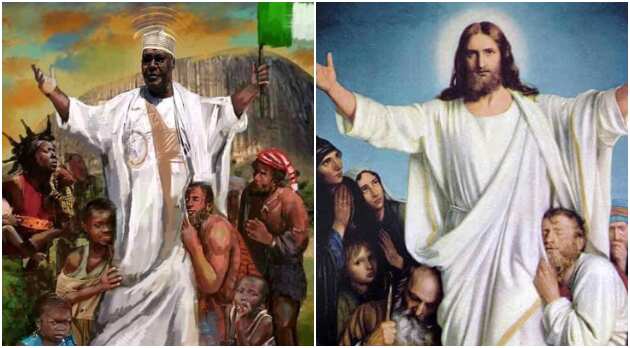
The Peoples Democratic Party (PDP) on Tuesday, February 7, got some serious tongue-lashing from Femi Fani-Kayode, a chieftain of the All Progressives Congress (APC). Via his Twitter page, Fani-Kayode berated the PDP's Presidential Campaign Council (PCC) over a photo in which Atiku Abubakar was portrayed as Nigeria's messiah.
In the photo, Atiku stood with his arms wide open as some people held his robe. As the photo seems somewhat similar to that of Jesus Christ as the world's saviour, the APC bigwig described the PDP as a "bunch of blasphemous & godless fascists & barbarians who will burn in hell."
FFK (as he is fondly called) wondered if the opposition party has no boundaries in its campaign for the former vice president and if nothing is sacred to the political platform. He tweeted:
"For the @atiku PCC & @OfficialPDPNig to go this low sickens me. Have they no shame? Are there no boundaries? Is there anything they are incapable of saying or doing? "Is nothing sacred to them? They are a bunch of blasphemous & godless fascists & barbarians who will burn in hell."
Like him or loathe him, El Rufai always provides cogent arguments in his inimitable way. This is what I expect from all our public administrators.
Unlike other governor-colleagues on both sides of the divide, who see nothing wrong with burying heads in the sand at a time like this, you can always count on Ortom, Wike or El Rufai to throw the cat among the pigeons.
Wait a minute, is this not the same man who was arrested last year?
Yoruba nation's very own Simon Ekpa
He gives his name as Tajudeen Olanrewaju. He claims to be a leader in the Ogboni Cult. He was seen participating at the Yoruba Nation Rally that held briefly before it was forcefully dispersed by security operatives on Saturday, July 3rd, 2021, at the Gani Fawehinmi Freedom Park, Ojota, Lagos. He even granted press interview where he proudly expressed support for the self determination of the Yoruba people of Nigeria being agitated for by the organisers of the rally
N3TRAL: There's nothing like "British Legalese". We speak English in Nigeria and received our judicial system from them.
The bulk of our legislations like the Marriage Act, Wills Act, Property and Conveyancing Act, Sales of Goods Act, etc are received English law. More recent laws enacted by the Federal legislature and States' Legislative houses are plagiarized British laws. Most of our legal precedents are gotten from Britain.
Any legal writing pattern a Nigerian lawyer adopts was probably first used by a British lawyer.
There are different types of English spoken and written around the world - fact. When you do forensic work , as I do, you learn to pick out these subtle differences.
"I am after having" -- Hiberno-English "The below diagram" - Hindu-English (Hinglish) "It is what it is" - American-English
wwwihy: Interpol is looking for Akin Osuntokun, DG Labour Party PCC
This looks like a forged letter to me. It has no named officer as its signatory and the postcode in the sender's address is not valid - 5E11 SEN
Other tell tale signs include the bad grammar: "disavowing falsified documents which mislead through falsehood" "demand issuance of official public statement" "malign acts from within your office"
The International Monetary Fund (IMF) in its latest World Economic Outlook update for January, released last night, has reviewed upwards growth projections for Nigeria in 2023 from 3.0 per cent which was projected in October last year to 3.2 per cent as it retained the growth forecast for 2024 at 2.9 per cent.
Earlier this month, the World Bank had further reviewed the country’s projected growth to 2.9 per cent from 3.1 per cent last year. The World Bank in its January Global Economic Prospects released had said Nigeria’s slower growth for 2023 and 2024 is a reflection of the downturn in its oil sector as well as the aftermath of rising insecurity and flooding.
Improved growth projection for Nigeira by the IMF also impacted forecast for Sub Saharan Africa which saw a slight upward review form 3.7 per cent to 3.8 per cent in 2023, whilst 2024 remained at 4.1 per cent. Global growth is projected to fall from an estimated 3.4 percent in 2022 to 2.9 percent in 2023, then rise to 3.1 percent in 2024.
According to the IMF WEO for January, the Sub Saharan Africa growth is projected to remain moderate at 3.8 percent in 2023 amid prolonged fallout from the COVID-19 pandemic, although with a modest upward revision since October, before picking up to 4.1 percent in 2024.
“The small upward revision for 2023 (0.1 percentage point) reflects Nigeria’s rising growth in 2023 due to measures to address insecurity issues in the oil sector. In South Africa, by contrast, after a COVID-19 reopening rebound in 2022, projected growth more than halves in 2023, to 1.2 percent, reflecting weaker external demand, power shortages, and structural constraints.”
For the global economy. the forecast for 2023 is 0.2 percentage point higher than predicted in the October 2022 World Economic Outlook (WEO) but below the historical (2000–19) average of 3.8 percent. The rise in central bank rates to fight inflation and Russia’s war in Ukraine continue to weigh on economic activity.
“The rapid spread of COVID-19 in China dampened growth in 2022, but the recent reopening has paved the way for a faster-than-expected recovery. Global inflation is expected to fall from 8.8 percent in 2022 to 6.6 percent in 2023 and 4.3 percent in 2024, still above pre-pandemic (2017–19) levels of about 3.5 percent.
“Signs are apparent that monetary policy tightening is starting to cool demand and inflation, but the full impact is unlikely to be realized before 2024. Global headline inflation appears to have peaked in the third quarter of 2022.But underlying (core) inflation has not yet peaked in most economies and remains well above pre-pandemic levels. It has persisted amid second-round effects from earlier cost shocks and tight labor markets with robust wage growth as consumer demand has remained resilient.
“Medium-term inflation expectations generally remain anchored, but some gauges are up. These developments have caused central banks to raise rates faster than expected, especially in the United States and the euro area, and to signal that rates will stay elevated for longer. Core inflation is declining in some economies that have completed their tightening cycle.
The Chinese own 5 ports in the USA - fact. Mind you, 80% of ports in that country are also foreign-owned - fact.
It is a new dawn.
A powerhouse in global trade, China has more shipping ports at home than any other country. Key investments add about another 100 ports in at least 60 nations. And Beijing is looking for more.
By Chiagozie Nwonwu, Fauziyya Tukur, and Yemisi Oyedepo BBC Global Disinformation Team
A BBC investigation has discovered that political parties in Nigeria are secretly paying social media influencers to spread disinformation about their opponents ahead of general elections in February.
The BBC's Global Disinformation Team has spoken to whistle-blowers working for two of Nigeria's political parties, and prominent influencers who have described it as "an industry".
The whistle-blowers say parties give out cash, lavish gifts, government contracts and even political appointments for their work.
We changed their names to protect their identity. "Yemi" is a prominent strategist and "Godiya" a politician.
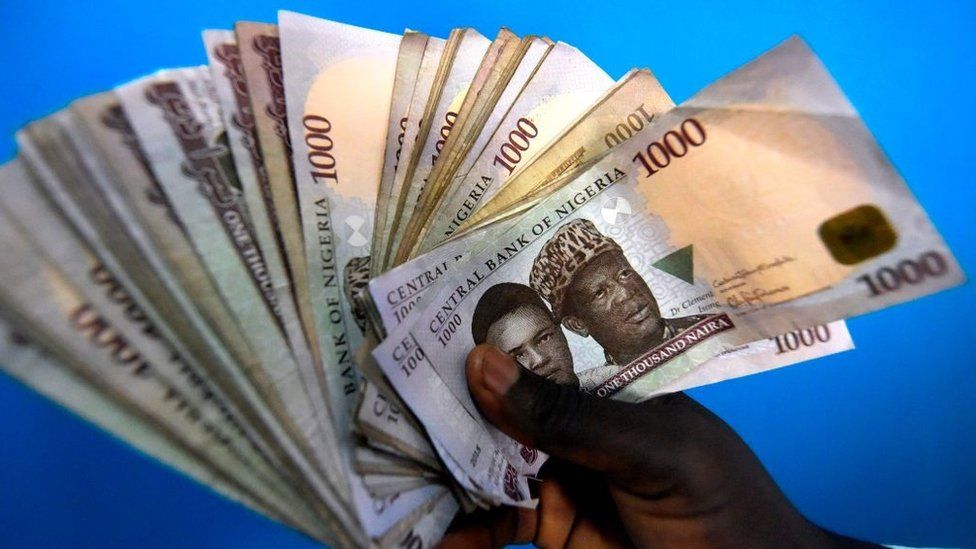
"We've paid an influencer up to 20m naira ($45,000; £37,000) for delivering a result. We've also given people gifts. Other people prefer to hear: 'What do you want to do in government, be a board member, be a special assistant?'," says Godiya.
Situation rooms are commonplace in the run-up to an election. It's where political parties strategise, develop plans and monitor their campaigns' success. But in the rooms the whistle-blowers described to us, there was another function: following how false narratives assigned to influencers were performing.
Strategist Yemi says fake stories are developed to improve their candidates' chances: "You can deliberately misinform in a suitable way for you."
The BBC has spoken to multiple influencers who have confirmed that payment in exchange for false political posts is widespread.
One influencer who asked not to be named - with almost 150,000 Facebook followers - told us he is paid by political parties to post completely false stories about political opponents. He says he does not do it openly but rather plants false stories through other micro-influencers he hires.
Separately, Rabi'u Biyora is a major influencer known for supporting the governing All Progressives Congress (APC) party.
He told us he was "wooed" by an opposition party to stop promoting the APC's candidate, and give his support to their candidate instead.
Posts on his Facebook timeline confirm he did just that. He told us he did not receive gifts of any kind to do so. But we discovered a Facebook post from 2019 in which he said he received a car and money from a party in exchange for his support on social media.
We put this finding to him, but he stopped responding to us.
Tactics With an estimated 80 million Nigerians online, social media plays a huge role in national debates about politics. Our investigation uncovered different tactics used to reach more people on Twitter. Many play on divisive issues such as religious, ethnic and regional differences.
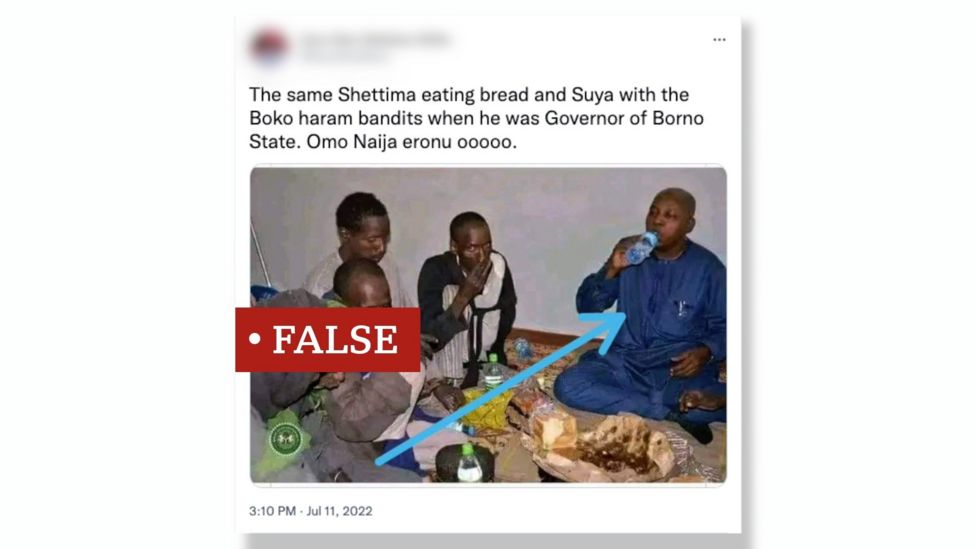
In July, influencers widely shared posts associating Kashim Shettima, the APC's candidate for vice-president, with members of the Islamist militant group Boko Haram.
This false narrative gained momentum on Twitter and was shared thousands of times, spilling onto WhatsApp and other platforms.
Using reverse image search, we found that those in the picture with Mr Shettima were nomadic Fulani parents whose children he had enrolled in secular schools in 2017, not members of Boko Haram.
A month later, influencers promoted a claim without evidence that Labour Party presidential candidate Peter Obi was linked to, and following orders from, the Indigenous People of Biafra (Ipob) - a separatist movement designated in Nigeria as a terror group. His party denies this.
Those who shared this information included Reno Omokri - special assistant to former opposition President Goodluck Jonathan - who has more than two million followers on Twitter.
When approached for a comment, Reno Omokri said he stands by his accusations, but insists he has not been paid by the main opposition People's Democratic Party (PDP) to campaign on their behalf.
Meanwhile, false claims that the PDP presidential candidate, Atiku Abubakar, fell ill and was rushed out of the country have been shared several times on Twitter.
Godiya, the politician we interviewed, says political parties tell influencers to elicit as much emotion as they can with their paid posts.
"We use images that may not even be relevant to the story we are trying to spin. We can take pictures from East Africa in the 1990s in warzones and attach them to a tweet about how my ethnic group is being killed. When people get emotional they retweet, they like, and it gets traction," she says.
According to the whistle-blowers, the hired influencers are sometimes given an idea that they should frame in their own words. At other times, they are given the actual tweets that need to be published at specific times.
They say influencers are paid based on the number of followers they have. They also say payment happens mostly in cash to avoid a paper trail.
Moral compass It is not illegal for political parties to hire social media influencers in Nigeria, but spreading disinformation on social media is a breach of the country's laws and Twitter's policy.
The BBC has asked Nigeria's main political parties, APC, PDP, and the Labour Party, about the whistle-blowers' allegations. They did not reply to our request for comment.
In response to our findings, Twitter has taken down some of the accounts we reported to them and said it had a responsibility to protect electoral conversations from interference, manipulation, and false information.
However, there are concerns about the platform's capacity to tackle misinformation in Africa after Elon Musk's takeover of the company, when its continental headquarters in Ghana was closed and nearly all its staff fired.
The BBC has reached out to Twitter again after these changes, but received no response.
Idayat Hassan, director at the Centre for Democracy and Development, says the activities of these influencers amounted to "political interference".
"It is undermining trust in democracy, undermining trust in the electoral system, and it is instigating conflict," she says.
But politician Godiya sees it a different way, and defends the tactic: "It is a game. Somebody had to win, and God help me, I will not be on the losing side."
 Celebrities › Re: Seun Kuti Accuses Peter Okoye Of Calling Him A Tribalist by Talawaka: 10:27pm On Feb 08, 2023