Christianity Etc › Re: Question: Did Jesus Read The Bible? by unphilaz(m): 9:33pm On Feb 18, 2016 Christianity Etc › Re: Question: Did Jesus Read The Bible? by unphilaz(m): 9:33pm On Feb 18, 2016 |
limamintruth:
Hahahaha, this is what i call sweet nonsense (sorry to say)  Your argument cannot hold water bro., cos just as you ignorantly argued that no where in your quran was the term 'ever' used in addressing Moses as first believer, so also nowhere did the quran refer to Adam as the first 'ever' believer. Furthermore in line with your myopic explanation, nowhere was it stated that either Moses or Muhammed are first believers 'only amongst their generation/people'. Meaning, the way the quran refer to Adam as first believer is the same way Moses et al were also addressed (without specifics to 'amongst their people' as you desperately tried to include. So you can very well now see that your argument is completely flawed Your argument cannot hold water bro., cos just as you ignorantly argued that no where in your quran was the term 'ever' used in addressing Moses as first believer, so also nowhere did the quran refer to Adam as the first 'ever' believer. Furthermore in line with your myopic explanation, nowhere was it stated that either Moses or Muhammed are first believers 'only amongst their generation/people'. Meaning, the way the quran refer to Adam as first believer is the same way Moses et al were also addressed (without specifics to 'amongst their people' as you desperately tried to include. So you can very well now see that your argument is completely flawed  Simply admit you have no answer to my question rather than assuming what is not stated in quran, lol. Simply admit you have no answer to my question rather than assuming what is not stated in quran, lol. 
Millions of muslims who witnessed the time of your Prophet or which muslims are you referring to above? 
And hope you know that the human brain is not immune from memory distortion during recall? 
Thus, the reconstructive process of memory recall is subject to distortion by other cognitive functions in the Human Brain. This is basic human science  (& I guess this was what your Caliph Uthman had to contend with during his reign ) (& I guess this was what your Caliph Uthman had to contend with during his reign )
So i'l appreciate if you provide us with a more appropriate answer to my previous question cos your explanation as i highlighted above doesnt just make any sense. 
And while at it, here's another question for you :
why are there many numerical contradictions in the Quran?
We know that God cannot make an error in doing simple calculations. So the question is:
"How many days did it take to create the Heavens and Earth?"
(Quran-7:54): Your guardian-Lord is Allah who created the heavens and earth in Six Days (Quran-10:3): Verily your Lord is Allah, who created the heavens and earth in Six Days (Quran- 11:7): He it is Who created the heavens and earth in Six Days Quran-25:59: He Who created the heavens and earth and all that is between, in Six Days
While we can see that the above verses clearly state that God (Allah) created the heaven and the Earth in 6 days; the verses below stated differently thus -
(Quran-41:9): Is it that ye deny Him who created the earth in Two Days ?
(Quran- 41:10): He set on the (earth) Mountains standing firm high above it, and bestowed blessing on the earth, and measured therein all things to give them nourishment in due proportion, in FOUR DAYS…
(Quran-41:12): So He completed them (heavens) as seven firmaments in Two days and …
Now kindly do the math then:
2(for earth) + 4(for nourishment) + 2 (for heavens) = 8 days;
How then did the quran arrive at its 6days in some of its verses? |
| Christianity Etc › Re: Question: Did Jesus Read The Bible? by unphilaz(m): 9:22pm On Feb 18, 2016 |
limamintruth:
First, Jesus Christ understood not only Aramaic. Secondly, Christ Jesus is The Word of God made manisfest in flesh/human form. Note also that He didnt write the Bible. So the issue of which language he spoke shouldnt logically be a cause for argument. And unlike your quran, the word of God as contained in the Bible overshadows any language barrier. Meaning any language may be used to spread God's message of the Bible.
The Biblical verses on forgiveness which you quoted & delibereately tried so hard to distort out of context are not admonitions to God, but solely admonitions to us humans (as a guide to righteous living here on earth).
No where in these verses was it stated that salvation through Jesus is wrong as you claim. And yes, Jesus took our curse and freed us eternally from sin. Thus, anyone who believes in Him will enjoy the freedom from sin He established through His death on the cross.
However, if truly you know of any Bible verse that expressly condemn Christ's sacrifice of Himself for our salvation, kindly share same here 
And while waiting for the appropriate evidence from you, do enrich your brain with the following:
◄John 4:42 ► (NIV)
They said to the woman, "We no longer believe just because of what you said; now we have heard for ourselves, and we know that this man really is the SAVIOUR of the world."
KJV
And said unto the woman, Now we believe, not because of thy saying: for we have heard him ourselves, and know that this is indeed the Christ, the SAVIOUR of the world.
◄Matthew 1:21 ► NIV
She will give birth to a son, and you are to give him the name Jesus, because he will SAVE his people from their sins."
KJV
And she shall bring forth a son, and thou shalt call his name JESUS: for he shall SAVE his people from their sins.
◄PROPHECY ON CHRIST'S DEATH/SACRIFICE FOR OUR SINS►
Isaiah 53 KJV
1 Who hath believed our report? and to whom is the arm of the LORD revealed?
2 For he shall grow up before him as a tender plant, and as a root out of a dry ground: he hath no form nor comeliness; and when we shall see him, there is no beauty that we should desire him.
3 He is despised and rejected of men; a man of sorrows, and acquainted with grief: and we hid as it were our faces from him; he was despised, and we esteemed him not.
4 Surely he hath borne our griefs, and carried our sorrows: yet we did esteem him stricken, smitten of God, and afflicted.
5 But he was wounded for our transgressions, he was bruised for our iniquities: the chastisement of our peace was upon him; and with his stripes we are healed.
6 All we like sheep have gone astray; we have turned every one to his own way; and the LORD hath laid on him the iniquity of us all.
7 He was oppressed, and he was afflicted, yet he opened not his mouth: he is brought as a lamb to the slaughter, and as a sheep before her shearers is dumb, so he openeth not his mouth.
8 He was taken from prison and from judgment: and who shall declare his generation? for he was cut off out of the land of the living: for the transgression of my people was he stricken.
9 And he made his grave with the wicked, and with the rich in his death; because he had done no violence, neither was any deceit in his mouth.
10 Yet it pleased the LORD to bruise him; he hath put him to grief: when thou shalt make his soul an offering for sin, he shall see his seed, he shall prolong his days, and the pleasure of the LORD shall prosper in his hand.
11 He shall see of the travail of his soul, and shall be satisfied: by his knowledge shall my righteous servant justify many; for he shall bear their iniquities.
12 Therefore will I divide him a portion with the great, and he shall divide the spoil with the strong; because he hath poured out his soul unto death: and he was numbered with the transgressors; and he bare the sin of many, and made intercession for the transgressors.
With regards to your argument on the issue of Judas death, permit me to once again refer you back to my earlier response to you as seen repeated below :
Bible account on how Judas died is as rightly recorded in the book of Mathew, while Apostle Peter's brief analogy of Judas death was stated figuratively, hence shouldnt be interpreted literarily.
Lets then carefully analyse Acts 1:18 as you mentioned:-
" Now this man purchased a field with the reward of iniquity(i.e sin of betrayal), and falling headlong(i.e deeper in sin by further committing suicide), he bursts asunder in the midst, and all his bowels gushed out(i.e his innate secret was exposed).
v. 19 states: And it was known unto all the dwellers in Jerusalem[can you now see how this v.19 corroborates my explanation above ]; in so much as that field is called in their proper tongue, Aceldama, that is to say, The field of blood. (Its named as such cos the field was bought with blood money).
Therefore, Acts 1:18 never mentioned or inferred that Judas fell from any hill/rock/mountain mister.
Infact, why not ask yourself this simple question then:
If indeed we are to interprete the verse above literarily (as you insist we should) and this same verse states that Judas fell 'headlong', why then was it his belly that burst open & not his head/brain? |
| Christianity Etc › Re: Question: Did Jesus Read The Bible? by unphilaz(m): 9:13pm On Feb 18, 2016 |
Empiree:
[quote author=truthman2012 post=31761106]I used to wonder too as it is very difficult to differentiate Muhammad and his Allah.
Because when you too proud to learn this is what happens. Very simple thing you dont understand. Read the Qru'an:
Allah Says in the Holy Quran Chapter 35 Surah Fatir verse 8:
Then is one to whom the evil of his deed has been made attractive so he considers it good [like one rightly guided]? For indeed, Allah sends astray whom He wills and guides whom He wills. So do not let yourself perish over them in regret. Indeed, Allah is Knowing of what they do.
Numerous verses of the quran say ''obey Allah and his messenger''.
Yes, by obeying the messanger He sent, you then obey God by conforming with His message. Is that difficult to comprehend....seriously?
Muhammad enjoyed the same power as Allah himself.
False!
^Pointing fingers again. Why then you worship Jesus and ascribed Divinity to him? Haven't Christians today "enjoyed" the same power with God? |
| Christianity Etc › Re: Question: Did Jesus Read The Bible? by unphilaz(m): 9:13pm On Feb 18, 2016 |
[quote author=Empiree post=31765488][/quote] |
| Christianity Etc › Re: Question: Did Jesus Read The Bible? by unphilaz(m): 9:06pm On Feb 18, 2016 |
malvisguy212:
God bless you ,Allah cannot be the true God,is words are not steady ,uptil today,I am still trying to differentiate between Allah and muhammed, but I can't they are both one person. Example muhammed thought Arron is the sister of Mary and you know the christians in nijran always exposed him;
(Surah 19:27, 28). It reads:
"Carrying the child, (Jesus), she (Mary)
came to her people, who said to her:
"Mary, this is indeed a strange thing!
Sister of Aaron, your father was never a
LovePeddler-monger, nor was your mother a
harlot."" [The Koran, Dawood's
translation, pages 215, 216].
This verse states that after Mary gave
birth to Christ, her townsfolk reproached her. They thought she was not married, and assumed that she committed sexual sin because she gave birth. In their reproach, they called her, "Sister of Aaron". This mistake was discerned by the Arabic Christians of Najran. There is a record of them exposing Muhammad's mistake about Mary.
In Sahih Muslim, the Hadith related by
Mughirah ibn Shu'bah, #5326, says:
"When I came to Najran, they (the
Christians of Najran) asked me: You read "Sister of Harun", (i.e. Mary), in the
Qur'an, whereas Moses was born well
before Jesus. When I came back to
Allah's Messenger I asked him about
that, and he said: "The (people of the old age) used to give names (to their
persons) after the names of Apostle and
pious persons who had gone before
them."" [Sahih Muslim, translated by
Abdul Siddiqi].
the excuse muhammed gave here exposed his illiteracy, Muhammad said that this manner of using the idiom, "sister of Aaron", was done by the pious people of the "old age", i.e. people who lived during Mary's time. Those people called their fellow citizens after pious persons who had lived earlier. But the Christians of Najran did not recognize the use of this idiom. Although they lived some 600 years after Christ's time, they were familiar with their own religious stories, and certainly those of the Jews. But this idiom struck their ears as peculiar. If the idiom were familiar to them, they would not have objected. But the expression "sister of Aaron", when applied to Mary in relation
to Aaron, was not familiar.
Further, they did not recognize the
technique or model in which this idiom
was used. Had they known the custom
that Muhammad said existed, of people
calling other people "brother" or "sister"
of ancient pious people, like possibly,
"sister of Moses", "brother of David",
"sister of Abraham", "brother of Isaac",
they would have understood what the
Quran was saying and raised no
objection. But both the idiom, and the
model in which it is used, were foreign to them.
If there would be one place where Mary
or someone else might be called "sister
of Aaron", it might be in the Bible. But
there is no place where Mary or anyone
else is metaphorically called "sister of
Aaron".the Arab christians understand that the people of old called there pious ones "SON" and "DAUGHTER" muhammed was soo wrong, who inspired him to write this error? Satan offcorse. |
| Christianity Etc › Re: Question: Did Jesus Read The Bible? by unphilaz(m): 9:03pm On Feb 18, 2016 |
malvisguy212:
non of you guys have been able to use the quran and proved the bible is corrupted,Many Muslims today say the Bible is corrupted. But there is nothing in the Quran that supports this. There is not one word in the Quran that teaches that the Scriptures of the Jews and Christians have been perverted by man. Instead, the opposite is true. The Quran supports the Bible.
Isn't it interesting that the Muslims'
Quran has nothing to say about the
corruption of the Scriptures of the largest religion on earth? During Muhammad's time Christian influence was known in Mecca. There were Jewish and Christian settlements in the Hijaz, and Christianity ringed the Saudi peninsula. Yet not one word is spoken by "Allah" concerning the Scriptures of their faith and not one word on the corruption of His previous Word.
The New Testament contains the stories
of Jesus identifying Himself as the Son of God, Jesus predicting His crucifixion,
death, and resurrection, Jesus calling
God "Father". Jesus' teachings are
contradicted by Muhammad in the
Quran time and time again. Further, the
Quran contradicts even the Old
Testament stories related to such Biblical figures as Gideon, Saul, David, and Noah. Why didn't Islam's "Allah" speak up on corruption if these Scriptures were inaccurate of false?
These themes are fundamental, why
would the Muslims' god fail to address
their corruption? If such a corruption had actually taken place, wouldn't "Allah" have revealed it in the Quran? The Quran is full of vague statements,
misquoted biblical stories, myths from
pagan, Jewish, and Christian backgrounds, yet "Allah" has nothing to
say about the corruption of His previous
word. How could such an omission occur?
One has to wonder who Muhammad's
"Allah" really was. He certainly didn't
appear to be the "All Knowing", or at
least, if he knew, he wasn't telling.
Or was it that "Allah" didn't know
because Muhammad didn't know?
Jesus taught that false prophets would
come into the world and mislead many.
There are passages from the Quran,
Hadith, and Sira, that deal with this
The Quran clearly testifies that the
Scriptures of the People of the Book, i.e., the Old and New Testaments, are the uncorrupted Word of God. Below is a review of Muhammad's words in the
Quran that present this.
1) 3:50 - "I come to confirm the Torah
which preceded me..."
2) 5:46 - "After them we sent forth Jesus,
the son of Mary, confirming the Torah
already revealed
3) 35:31 - "What We have revealed to you
in the Book is the truth confirming
previous Scriptures. God knows and
observes His servants.
4) 5:46 - 48 "After them we sent forth
Jesus, the son of Mary, confirming the
Torah already revealed, and gave him
the Gospel, in which there is guidance
and light, corroborating what was
revealed before it in the Torah, a guide
and an admonition to the righteous.
Therefore let those who follow the Gospel
judge according to what God has
revealed therein.
5) 5:66 - "If they observe the Torah and
the Gospel..."
6) 10::94 - "If you doubt what We have
revealed to you [Muhammad], Ask those
who have read the Scriptures before
you."
7) 2:113 - "The Jews say the Christians
are misguided, and the Christians say it
is the Jews who are misguided. Yet they
both read the Scriptures..."
Muhammad believed in the truths of the Bible. But he did not know what the Bible taught. His ignorance led him to make statements that displayed his lack of knowledge. His self-contradictions prove he was not a prophet of God. |
| Christianity Etc › Re: Question: Did Jesus Read The Bible? by unphilaz(m): 9:02pm On Feb 18, 2016 |
truthman2012:
Good talk bro. Islam of allah is double-faced, designed to lead mankind into deception and eventually take them to hell. When allah speaks in the quran, he would debunk his own statements in the next verses. The quranic quotes you made confirms the bible is true but characteristically, allah denied it in other verses. This is no surprise as we know his true identity. The Devil is a liar. |
| Christianity Etc › Re: Question: Did Jesus Read The Bible? by unphilaz(m): 8:52pm On Feb 18, 2016 |
Empiree:
[b][/b]Reference above^^^^ The first Muslim on earth was Adam (peace be upon him)
This is why Qur'an is unique. It's commited to memory by millions of muslims worldwide.
Good enough. Honestly, you have no real argument against me. If you had original Aramaic bible which Jesus(peace be upon him) spoke would have helped you. That's why you dont have it written on the side like we do to our Qur'an. Some english versions have Arabic Qur'an on the side for cross references. You cant do that. That's why I just have to dismiss your case here. Sorry buddy.
Oh really? Check this out too. On the account of Jesus, you christians believe his 'death' on the cross is a source of your salvation. At the same time, your bible said curse is the one that is hanged. Now here are contradictions:
Galatians 3:13 Good News Translation (GNT)
But by becoming a curse for us Christ has redeemed us from the curse that the Law brings; for the scripture says, “Anyone who is hanged on a tree is under God's curse.”
^this verse is saying Jesus was cursed according to your Bible. Now here is the opposite....
1 Corinthians 12:3Good News Translation (GNT)
I want you to know that no one who is led by God's Spirit can say “A curse on Jesus!” and no one can confess “Jesus is Lord,” without being guided by the Holy Spirit.
Oya, starting fooling me again
Now on sin, there is nothing in the bible to suggest Jesus wanted to die for your sins. According to Christians, "blood of Jesus" was necessary for their salvation. This is contrary to Jesus's teachings. Why can't God just forgive without shedding human blood. This is what Jesus said...he thought people how to pray for forgiveness.
Matthew 6:13-14Good News Translation (GNT)
Do not bring us to hard testing, but keep us safe from the Evil One.’ “If you forgive others the wrongs they have done to you, your Father in heaven will also forgive you."
Matthew 6:12New Life Version (NLV)
Forgive us our sins as we forgive those who sin against us.
Another proof is in the Bible that you dont need blood to be shed to have salvation. Proof of this can be found where someone asked Jesus what he can do to have eternal life. The passage is located in:
Luke 10:25-27Good News Translation (GNT)
A teacher of the Law came up and tried to trap Jesus. “Teacher,” he asked, “what must I do to receive eternal life?”
Jesus answered him, “What do the Scriptures say? How do you interpret them?”
The man answered, [size=14pt]“‘Love the Lord your God with all your heart, with all your soul, with all your strength, and with all your mind’; and ‘Love your neighbor as you love yourself.’”[/size]
Then, the man said: “You are right,”
Jesus replied; [size=15pt]“do this and you will live.”[/size] Luke 10:28-29
Very simple. What do you need "blood of Jesus" for? Then, this mumbo jumbo came up from nowhere:
Matthew 26:28Good News Translation (GNT)
“this is my blood, which seals God's covenant, my blood poured out for many for the forgiveness of sins."
Hebrews 9:22Good News Translation (GNT)
Indeed, according to the Law almost everything is purified by blood, and sins are forgiven only if blood is poured out.
This is crazy^ no doubt is the reason christian nations invading countries and spilling blood all over the world. The above contradict.
This is crazy interpretation that doesnt relate at all. First all, there isnt anything like parable. You simply suggest here that the verse speaks in parables. But your Bible says there is nothing like parable in it. 2 Peter 1:20New American Bible (Revised Edition) (NABRE)
[size=14pt]Know this first of all, that there is no prophecy of scripture that is a matter of personal interpretation[/size]
In the foortnotes of this verse in the same Bible it reads:
Now compare your unfounded interpretation with others that i researched on this subject.
http://www.josh.org/resources/study-research/answers-to-skeptics-questions/are-the-two-accounts-of-the-death-of-judas-contradictory/ This is contrary to your interpretation that "bursting open" means confessing his sin.
This article here contradicts yours: https://carm.org/bible-difficulties/matthew-mark/how-did-judas-die-hanging-or-falling-down
Cc: allnaijablogger ,this is where you need to come for normal intelligent and scholarly debate. Not bashing unnecessarily like others. We all can learn here. There is no fight on this thread. Thanks
[size=1pt]Ubenedictus[/size] |
| Christianity Etc › Re: Question: Did Jesus Read The Bible? by unphilaz(m): 8:49pm On Feb 18, 2016 |
Empiree:
Nonsense!!!
What else is new?. Evangelists! I hail thee
You people point to two references from the Quran, 6:14 and 6:161-163, and claim these references show Muhammad as the first Muslim and then turn your attention to another verse of the Quran (7;143) concerning Moses being the first of the believers. Just to further your agenda you may also highlight other Quranic references indicating there were Muslims before Muhammed (pbuh) and Moses namely the first man Adam (Sura 2:30, 34-35, 37) and Abraham as well as other Prophets (Sura 4:163, S. 6:84) as believers. However you and other critics mainly use the Quranic verse about Moses (7:143) and try to put it along side the two concerning Muhammed (6:14 and 6:163) and you then allege contradiction/error.
Here Is The Refutation
Quite simply, the Quran does not claim Muhammed nor Moses to be the first ever Muslim. The critic imposes a faulty understanding on the Quranic verses and alleges a contradiction when there is no contradiction/error.
Despite this it is still thorough and beneficial to offer explanations in order to clear any confusion as well as help highlight the errors of the critics in the hope they realise their mistakes and abjure themselves and eventually become amongst the guided ones, Insha’Allah
Now lt's keep it simple. I feel it is logical to begin this simple refutation with analyzing the reference concerning Moses and then build upon this in a methodical fashion so that you and fellow christian readers can follow with ease. Did the Quran claim Moses to be the first ever believer?
7:143 sees Moses saying he is the first of the believers. However, we do see that this is true as he (Moses) was the first believer amongst his own people. Here is the link http://quran.com/7/143
Moses does not say he is the first believer ‘ever’. He merely claims he is the first of the believers and knowing the context one understands he is not claiming to be the first ever believer from humankind but the first amongst his people to believe, this is apparent as it is a relative term to the “believers” and situational-context tells us that the believers at the time of Moses were essentially the Children of Israel and thus we realise that Moses is referring to himself as the first to believe amongst the Children of Israel.
Critic like yourself fail to mention this and try to present this verse as meaning Moses is the first ever to believe amongst humanity, this is unfair and misleading on the part of the critic especially considering the word “ever” is not in the verse. There is further clarification of the Arabic phrase of the Quran ascribed to Moses (“awwalu almumineena”= “first of the believers”) as there is another reference in the Quran (26:51) where this term comes up and thus explaining the meaning of Moses’ statement of being the “first of the believers (“awwalu almumineena”).
So basic principle of Tafsir (explaining the Quran) is used by explaining a verse of the Quran (the verse concerning Moses, 7:143) by using another part of the Quran (26:51). So what do we learn about the statement of Moses in 7:143 by looking at Q26:51?. http://quran.com/26/51
26:51. “Verily! We really hope that our Lord will forgive us our sins, as we are the first of the believers [in Mûsa (Moses) and in the Monotheism which he has brought from Allâh].”
I dont need to go into the context of the verse, that may be too inundated.
It is not up for debate whether Muhammad (pbuh) was the first Muslim or not. Quite simply he was the first Muslim in the sense that Muhammad was the first Muslim (i.e. who has submitted to God) amongst his own people (the Quraish) at that particular phase in history. This is completely correct. Hence there is no contradiction as Adam was the first Muslim ever while Muhammad was the first Muslim amongst his own people.
There are two Quranic references (6:14 and 6:162-163) the critics bring up, so it is appropriate to analyse the two references. The first of the Quranic references the critics cite (6:14) shows that Allah instructs Muhammed to “say” (Qul): “Verily, I am commanded to be the first of those who submit themselves to Allâh (as Muslims).”:
[b]Qur'an 6:14. Say (O Muhammad SAW): “Shall I take as a Walî (helper, protector, etc.) any other than Allâh, the Creator of the heavens and the earth? And it is He Who feeds but is not fed.” Say: “Verily, I am commanded to be the first of those who submit themselves to Allâh (as Muslims).” And be not you (O Muhammad SAW) of the Mushrikûn [polytheists, pagans, idolaters and disbelievers in the Oneness of Allâh].[/b]http://quran.com/6/14
Also note the same applies to the second Quranic reference (6:162-163) in that it also begins with Qul (say) and Mohammed is instructed to say: “… I am the first of the Muslims”: Here is the link http://quran.com/6/162-163
There isnt any contradictions. It's very simple. I could have simply said Adam was the first muslim ever on earth. Abraham made Islam permanent. Moses was also the first muslim in his time. Jesus was the first muslim in his time. And Muhammad perfected islam and became the first muslim among his people until end of time. Simple isn't without lengthy post. May Allah's blessings and peace be upon them all. Amin |
| Christianity Etc › Re: Question: Did Jesus Read The Bible? by unphilaz(m): 8:45pm On Feb 18, 2016 |
Empiree:
You despirate so bad to just copy/paste whatever you want. Anyways, this is typical anti-islamic missionary deceit. Some Anti-Islam missionaries have use the references of a highly reverted commenter of Islam As-Suyuti to claim that Quran is incomplete. This claim like any other claim is totally baseless and absurd. Here is what is quoted
It follows that anything that comes only from Kitab al-Masahif must be held in suspension until corroborated by an independent, reliable source or declared authentic by one of the competent authorities, or adduced by them.
It is reported from Ismail ibn Ibrahim from Ayyub from Naafi from Ibn Umar who said: "Let none of you say 'I have acquired the whole of the Qur'an'. How does he know what all of it is when much of the Qur'an has disappeared? Rather let him say 'I have acquired what has survived.'" (as-Suyuti, Al-Itqan fii Ulum al-Qur'an, p.524).
This reference to the Itqan is untraceable as no edition of it is in less than two volumes to my knowledge.
The above refers to a famous saying of Ibn `Umar, once again deceptively/ignorantly mistranslated so as to mislead readers to think it means other than its actual meaning.
The words used by Ibn `Umar for the terms given as "acquired," "disappeared," and "what has survived" above were -- I am quoting from memory -- respectively "ahattu" (I have encompassed), "faatahu" (escapes him), and "ma tayassara minhu" (whatever amount of it has been facilitated).
The actual meaning of Ibn `Umar's words is:
"Let no one say: I have encompassed the whole of the Qur'an [its meanings]. How does he know what all of it is when much of the Qur'an escapes him? Rather, let him say: I have encompassed whatever amount of it has been facilitated [for me to know]."
Ibn Umar was famous for his strictness in refraining from interpreting the Qur'an, even criticizing Ibn `Abbas's interpretive zeal in the beginning, then accepting its authority. He was not referring to the collection of the Qur'an! But only to the ethics of the exegete, in the same line as Ibn `Abbas's saying narrated by al-Tabari and cited by al-Suyuti and al-Zarkashi: "There are ambiguous verses in the Qur'an which no one knows besides Allah. Whoever claims that he knows them, is a liar."
So, Quran is complete, perfect, error free and this is proven in every way. Now, you can say all you want about Qur'an been partly lost. I only asked for one thing, bring physical evidence not articles.
Let me seal this this off by rephrasing missionaries dilema thus:
Answer:[/b]One of the most common myths about the Qur’an, is that Usman (r.a.), the third Caliph of Islam authenticated and compiled one Qur’an, from a large set of mutually contradicting copies. The Qur’an, revered as the Word of Allah (swt) by Muslims the world over, is the same Qur’an as the one revealed to Prophet Muhammad (pbuh). It was authenticated and written under his personal supervision. We will examine the roots of the myth which says that Usman (r.a.) had the Qur’an authenticated.
[b]Prophet Muhammad (pbuh) himself supervised and authenticated the written texts of the Qur’an
Whenever the Prophet received a revelation, he would first memorize it himself and later declare the revelation and instruct his Companions (R.A. – Radhi Allahu Taala Anhu) – May Allah be pleased with him who would also memorize it. The Prophet would immediately ask the scribes to write down the revelation he had received, and he would reconfirm and recheck it himself. Prophet Muhammad (pbuh) was an Ummi who could not read and write. Therefore, after receiving each revelation, he would repeat it to his Companions. They would write down the revelation, and he would recheck by asking them to read what they had written. If there was any mistake, the Prophet would immediately point it out and have it corrected and rechecked. Similarly he would even recheck and authenticate the portions of the Qur’an memorized by the Companions. In this way, the complete Qur’an was written down under the personal supervision of the prophet (pbuh).
Order and sequence of Qur’an divinely inspired
The complete Qur’an was revealed over a period of 23 years portion by portion, as and when it was required. The Qur’an was not compiled by the Prophet in the chronological order of revelation. The order and sequence of the Qur’an too was Divinely inspired and was instructed to the Prophet by Allah (swt) through archangel Jibraeel. Whenever a revelation was conveyed to his companions, the Prophet would also mention in which surah (chapter) and after which ayat (verse) this new revelation should fit. Every Ramadhaan all the portions of the Qur’an that had been revealed, including the order of the verses, were revised and reconfirmed by the Prophet with archangel Jibraeel. During the last Ramadhaan, before the demise of the Prophet, the Qur’an was rechecked and reconfirmed twice. It is therefore clearly evident that the Qur’an was compiled and authenticated by the Prophet himself during his lifetime, both in the written form as well as in the memory of several of his Companions.
Qur’an copied on one common material
The complete Qur’an, along with the correct sequence of the verses, was present during the time of the Prophet (pbuh). The verses however, were written on separate pieces, scrapes of leather, thin flat stones, leaflets, palm branches, shoulder blades, etc. After the demise of the prophet, Abu Bakr (r.a.), the first caliph of Islam ordered that the Qur’an be copied from the various different materials on to a common material and place, which was in the shape of sheets. These were tied with strings so that nothing of the compilation was lost.
Usman (r.a.) made copies of the Qur’an from the original manuscript
Many Companions of the Prophet used to write down the revelation of the Qur’an on their own whenever they heard it from the lips of the Prophet. However what they wrote was not personally verified by the Prophet and thus could contain mistakes. All the verses revealed to the Prophet may not have been heard personally by all the Companions. There were high possibilities of different portions of the Qur’an being missed by different Companions. This gave rise to disputes among Muslims regarding the different contents of the Qur’an during the period of the third Caliph Usman (r.a.). Usman (r.a.) borrowed the original manuscript of the Qur’an, which was authorized by the beloved Prophet (pbuh), from Hafsha (may Allah be pleased with her), the Prophet’s wife. Usman (r.a.) ordered four Companions who were among the scribes who wrote the Qur’an when the Prophet dictated it, led by Zaid bin Thabit (r.a.) to rewrite the script in several perfect copies. These were sent by Usman (r.a.) to the main centers of Muslims.
Diacritical marks were added for non-Arabs
The original manuscript of the Qur’an does not have the signs indicating the vowels in Arabic script. These vowels are known as tashkil, zabar, zair, paish in Urdu and as fatah, damma and qasra in Arabic. The Arabs did not require the vowel signs and diacritical marks for correct pronunciation of the Qur’an since it was their mother tongue. For Muslims of non-Arab origin, however, it was difficult to recite the Qur’an correctly without the vowels. These marks were introduced into the Quranic script during the time of the fifth ‘Umayyad’ Caliph, Malik-ar-Marwan (66-86 Hijri/685-705 C.E.) and during the governorship of Al-Hajaj in Iraq. Some people argue that the present copy of the Qur’an that we have along with the vowels and the diacritical marks is not the same original Qur’an that was present at the Prophet’s time. But they fail to realize that the word ‘Qur’an’ means a recitation. Therefore, the preservation of the recitation of the Qur’an is important, irrespective of whether the script is different or whether it contains vowels. If the pronunciation and the Arabic is the same, naturally, the meaning remains the same too.
Allah Himself has promised to guard the Qur’an Allah has promised in the Qur’an : "We have, without doubt, sent down the Message; and We will assuredly Guard.it.(from.corruption).".[Al-Qur’an 15:9] So if you have another Qur'an different from the one version we have in Arabic, bring it forward and let's contest. |
| Christianity Etc › Re: Question: Did Jesus Read The Bible? by unphilaz(m): 8:40pm On Feb 18, 2016 |
limamintruth:
This is for you @empiree cool :-
Notable Islamic scholars have in the past, affirmed the omission/loss/absense of various qur'anic verses(that existed prior to the the time of Caliph Uthman as was revealed to the Prophet) in the subsequent Uthman's standard codex Qur'an presently in use.
An example of such scholar is 'As-Suyuti' (died 1505), who was one of the most famous and revered of the commentators of the Qur'an, & quotes Ibn ‘Umar al Khattab as saying:
"Let no one of you say that he has acquired the entire Quran, for how does he know that it is all? Much of the Quran has been lost, thus let him say, ‘I have acquired of it what is available’" (As-Suyuti,Itqan, part 3, page 72). cheesy
Again, A’isha the favorite wife of the Prophet, says, also according to a tradition recounted by As-Suynti,
"During the time of the Prophet, the chapter of the Parties used to be two hundred verses when read. When ‘Uthman edited the copies of the Quran, only the current (verses) were recorded" (73).
As-Suyuti also tells this story about Uba ibn Ka’b, one of the great companions of Muhammad:
This famous companion asked one of the Muslims,
"How many verses in the chapter of the Parties?" He said, "Seventy-three verses." He (Uba) told him, "It used to be almost equal to the chapter of the Cow (about 286 verses) and included the verse of the stoning". The man asked, "What is the verse of the stoning?" He (Uba) said,
"If an old man or woman committed adultery, stone them to death."
Since there was no single document collecting all the revelations after Muhammad’s death in 632 C.E., many of his followers tried to gather all the known revelations and write them down in codex form. Soon we had the codices of several scholars such as Ibn Masud, Uba ibn Ka’b, ‘Ali, Abu Bakr, al-Aswad, and others (Jeffery, chapter 6, has listed fifteen primary codices, and a large number of secondary ones).
As Islam spread, we eventually had what became known as the metropolitan codices in the centers of Mecca, Medina, Damascus, Kufa, and Basra. As we saw earlier, ‘Uthman tried to bring order to this chaotic situation by canonizing the Medinan Codex, copies of which were sent to all the metropolitan centers, with orders to destroy all the other codices.
If then there were omissions in the present Qur'an, the next question begging for answer will definitely be if there were additions also?
In response to this question, it is worthy of note that the authenticity of many verses in the Qur'an has been called into question by several Muslims themselves.
1. Many Kharijites, who were followers of ‘Ali in the early history of Islam, found the sura recounting the story of Joseph offensive, & an Intimate tale that did not belong in the Qur'an.
2. Most scholars believe that there are interpolations in the Koran; these interpolations can be seen as interpretative glosses(or further explanatory notes) on certain rare words in need of explanation. More serious are the interpolations of a dogmatic or political character, which seem to have been added to justify the elevation of ‘Uthman as caliph to the detriment of ‘Ali. Then there are other verses that have been added in the interest of rhyme, or to join together two short passages that on their own lack any connection.
3. Because of the process by which the Quran came into being, an average reader of the Qur'an in use will notice how historical narratives are jumbled together and intermingled; an evidence that many different hands have been at work therein, and caused discrepancies, adding or cutting out whatever they liked or disliked. Are such, now, the conditions of a revelation sent down from heaven?
CONTRADICTIONS IN THE QURAN:
The supposed 'perfect' Qur'an consist of several contradictions and inconsistencies that most muslims wont want to admit lipsrsealed
A typical example lies thus:
Who Was the First Muslim according to the Qur'an?Muhammad [6:14, 163], Moses [7:143], some Egyptians [26:51], or Abraham [2:127-133, 3:67] or Adam, the first man who also received inspiration from Allah [2:37]?
According to several passages in the Quran, MUHAMMED was the first Muslim:
Say: Shall I choose for a protecting friend other than Allah, the Originator of the heavens and the earth, Who feedeth and is never fed?Say: I am ordered to be the first to surrender [aslama] (unto Him). And be not thou (O Muhammad) of the idolaters. Surah 6:14 Pickthall
Say, verily my Lord hath directed me into a right way, a true religion, the sect of Abraham the orthodox; and he was no idolater. Say, verily my prayers, and my worship, and my life, and my death are dedicated unto God, the Lord of all creatures: He hath no companion.This have I been commanded:I am the first Moslem(Wa 'Ana 'Awwalu Al-Muslimin). Surah 6:161-163 Sale
He hath no associate. This am I commanded,and I am the first of the Muslims. Surah 6:163 Rodwell
Say (O Muhammad): Lo! I am commanded to worship Allah, making religion pure for Him (only).And I am commanded to be the first of those who are muslims(surrender unto Him). Surah 39:11-12 Pickthall
..............
This is however contradicted by both the Quran and various Islamic traditions which refer to the presence of true believers both before and during Muhammad’s alleged "call" to prophethood.
The Quran mentions that Adam, Noah, the Patriarchs, the twelve tribes of Israel, Moses, Jesus etc., were all believers and many of them even messengers who lived a long time before Muhammad:
(One of such verses that states this are as seen below)
Behold, thy Lord said to the angels: "I will create a vicegerent on earth." They said: "Wilt Thou place therein one who will make mischief therein and shed blood?- whilst we do celebrate Thy praises and glorify Thy holy (name)?" He said: "I know what ye know not."… And behold, We said to the angels: "Bow down to Adam" and they bowed down. Not so Iblis: he refused and was haughty: He was of those who reject Faith. We said: "O Adam! dwell thou and thy wife in the Garden; and eat of the bountiful things therein as (where and when) ye will; but approach not this tree, or ye run into harm and transgression."… When learnt Adam from his Lord words of inspiration, and his Lord Turned towards him; for He is Oft-Returning, Most Merciful.
Surah 2:30, 34-35, 37
So why the inconsistencies then?
And which verse should we then believe as the right answer to the question on who the first muslim really is? shocked grin cheesy
Goodnight notwitstanding! wink
Goodnight notwitstanding! |
| Christianity Etc › Re: Question: Did Jesus Read The Bible? by unphilaz(m): 8:38pm On Feb 18, 2016 |
limamintruth:
Just like Caliph Uthman & the subsequent seven Readers distorted the Quran right?
Lol, lemme indulge you cos I can see this has become a mantra of some sort for you.
The R.S.V preface amongst some others, have indeed critiqued K.J.V as being defective primarily due to the change (since 1611) in English usage. Many forms of word expressions have become archaic/obsolete and no longer understood by the common reader. Thereby posing a great problem, as some of the English words in constant use by K.J.V now convey a different meaning from that which they had in 1611.
Some few examples of such archaic expressions in the King James Version are the use of: "wottest" for '"know"; "let" for "restrain" ( II Thess. 2); "conversation" for "conduct"; "take no thought" for "be not anxious" ( Matt. 6); etc. The K.J.V has transcended to such an extent in time wherein 17th century English becomes unintelligible, and a new translation is not only permissible, but even demanded. This was a vital concern of the Reformation & the subsequent revisions.
Now you are really beginning to sound confused mister 
Or else, how would you claim to have a problem with the word 'version' and not have a problem with 'translation'? It sounds dumb to me really. 
In case you dont know, the word "Version" is simply "A particular form of something differing in certain respects(e.g lang., punctuations, expression style e.t.c) from an earlier form or other forms of the same type of thing". Thus, 'version' & 'translation' are two similar words that can be used interchangeably as clearly shown in the Thesaurus dict. below:
"translation [ trans- ley -sh uh n, tranz- ]
Main Entry: translation
Part of Speech: noun
Definition: rewording; interpretation
Synonyms: adaptation, construction, crib*, decoding, elucidation, explanation, gloss, key, metaphrase, paraphrase, reading, rendering, rendition, rephrasing, restatement, simplification, transcription, transliteration, VERSION"
http://www.thesaurus.com/browse/translation
So you see, these are synonymous words that are identical; hence, you cant claim to be in love with one and detaste the other.
.
Lol, you are just being unnecessarily adamant @empiree. Everything you pasted above is totally offpoint pls
This is what a renown Islamic website states on the issue in question:
"There are various versions of the Arabic Quran that are still in print. They differ in many aspects although they convey the same meaning. God has provided us with the tool to verify the correct version and confirm His preservation of the Quran. The Mathematical miracle of the Quran has proved that the Hafs transmission maintained the built-in mathematical structure of the Quran."
http://submission.org/verify_are_all_Arabic_versions_of_Quran_the_same.html
Many other famous scholars hav also referred to the Hafs, Warsh, e.t.c as Quranic versions too. So i wonder why you are being adamant against the truth.
Dont tell me you are this desperate in your faultfinding quest?
How on earth does "O.T scriptures" become synonymous to "old covenant"
This are totally two different things; the first refers to the entire books that make up the Old testament, while the latter refers to the 'covenant that existed between God and His people in the time of the ancient Prophets.
So while the Old Testament scriptures have & will always remain unchanged, the Old covenant needed to be renewed with the coming of Christ Jesus. If you wish, i can make out time from my tight schedule to acquaint you more on this issue.
...................
Also, the two verses you quoted in Isaiah are very clear and precise.
The first verse you cited there highlights the titles of christ Jesus,
while
The second unequivocally states His name. i.e Immanuel
Again if you want, i dont mind giving you an illustration using you as example.
A name is different from a title e.g your name may be Obafemi, while your title is 'His Excellency'. Understand?
Sorry i'm not yoruba (neither do i understand or speak the lang.)
And i cant spot any blaspemy in the Malachi verse you quoted pls.
So if you dont mind, kindly highlight and bring out the blasphemy that you allege lies therein. Peace! |
| Christianity Etc › Re: Question: Did Jesus Read The Bible? by unphilaz(m): 8:32pm On Feb 18, 2016 |
Empiree:
Isaiah 9:6Good News Translation (GNT)
A child is born to us!
A son is given to us!
And he will be our ruler.
He will be called, “Wonderful[a] Counselor,”
“Mighty God,” “Eternal Father,”
“Prince of Peace.”
Isaiah 7:14Good News Translation (GNT)
Well then, the Lord himself will give you a sign: a young woman[a] who is pregnant will have a son and will name him Immanuel
According to footnote of Isaiah, it defines Immanuel as: This name in Hebrew means “God is with us.” My question is how's "Immanuel equate "Mighty God", "Eternal Father"?
Saul killed himself 1 Sam.31:4
Samuel 31:4Good News Translation (GNT)
He said to the young man carrying his weapons, “Draw your sword and kill me, so that these godless Philistines won't gloat over me and kill me.” But the young man was too terrified to do it. So Saul took his own sword and threw himself on it.
Someone killed Saul. 2 Sam.1:5-10
2 Samuel 1:5-10King James Version (KJV)
10: So I stood upon him, and slew him, because I was sure that he could not live after that he was fallen: and I took the crown that was upon his head, and the bracelet that was on his arm, and have brought them hither unto my lord. |
| Christianity Etc › Re: Question: Did Jesus Read The Bible? by unphilaz(m): 8:26pm On Feb 18, 2016 |
limamintruth:
For the very last time, my simple response to your barrage of irritating questions on the omitted/included Bible verses ish is thus:
Most of the books of the Bible were originally written in Hebrewaic language. Thus, the first Bible was in Hebrewaic language i.e to say the Hebrewaic Bible existed first.
Subsequently, with the spread of christianity in Rome and much of europe, it was necessary to have a Latin Bible translation. However, because of the wide disparity between the Hebrewaic dialect and the Latin dialect, the translation wasnt an easy task to do. Thus, the translators had to attach certain marginal notes to specific chapters for easy understanding.
Then as years went by, it once again became imperative to introduce an English Bible translation also. The K.J.V became the first printed English Bible and it was solely derived directly from the Latin translation. Remember that the Latin Bible translation had marginal notes included therein as i'v clearly stated above. Hence, while both the first hebrewaic & greek Bible translations remained as they were, the Latin Bible translation had some marginal notes included in it.
However, when the latin Bible was being translated to English (and titled K.J.V), these existing marginal notes were included, not as notes again, but as verses on their own accord. Understand also that the Holy Bible, as one of the oldest existing Holy books on earth (2nd only to the Jewish Torah from whence much of the old testament is even derived), has transcended through several civilisations, peoples and languages from the Hebrewaic Bible at first to the Greek Bible, then the Latin Bible translation; & finally the English translations (as well as the availability of the Bible in thousands of other smaller languages across the globe now ).
Therefore in conclusion, kindly note that while those English Bible versions with the omitted verses(e.g R.S.V) were derived directly from the ancient Greek Bible translation, the likes of K.J.V that possess further explanatory verses attached were derived directly from the ancient latin Bible.
This is my final answer to your back&forth questions on omitted &/or added verses please.
The presence and/or absense of this explanatory verses does not in any way contradict or alter the perfect message of God as recorded in the Holy Bible. Hence, the Bible account on King Saul as narrated in 1 Samuel 13 of ALL versions are both true and correct. There is absolutely no contradiction therein cos one of the two accounts there is an extension of the other (i.e to say they complement the message; not conflict with each other) and we christians are aware of these extensions/further explanatory verses in our Bible study. Hence, its never an issue for believers
Mu..mu, the Arabic Quran has DIFFERENT VERSIONS too and two of these several versions were mentioned in my previous post i.e Hafs version & Warsh version. So what again are you blabbing
And about the contradictions in these Quranic versions, kindly go thru my previous post for that. I'm done with the back&forth ish.
The OT Scriptures were first given to Israel, God's chosen nation of old. Romans 3:1-2 tells us that God had committed to the Jews the safekeeping and writing of the Holy Scriptures.
Knowing well the divine nature of the Scriptures, that the words of the sacred pages were the very words of the Almighty God, they copied the Scriptures with great precision and accuracy employing very strict rules.
For instance:
(1) "No word or letter could be written from memory; the scribe must have an authentic copy before him, and he must read and pronounce aloud each word before writing it."
(2) "The revision of a roll must be made within 30 days after the work was finished; otherwise it was worthless. One mistake on a sheet condemned the sheet; if three mistakes were found on any page, the entire manuscript was condemned."
(3) "Every word and every letter was counted, and if a letter were omitted, an extra letter inserted, or if one letter touched another, the manuscript was condemned and destroyed at once."
These very strict rules of transcription show how precious the Jews had regarded the inspired words of God, and how precise their copying of these inspired words must have been. Such strict practices in writing "give us strong encouragement that we indeed possess authentic Old Testament scripture just like the New Testament; being the same one which was originally given by inspiration of God."
The words of the Scriptures are important (Deut 8:3, Matt 4:4, Luke 4:4). God uses His words to communicate His Truth so that we might know who and what He is and how we might be saved through Him. The Bible clearly tells us that it is God's written words (i.e"All of Scripture) that are inspired (2 Tim 3:16); and from these inspired words come all the doctrines that are sufficient and profitable for the spiritual growth and maturity of the believer (2 Tim 3:17).
The Bible also clearly says that God Himself will preserve all His inspired words to the jot and title without the loss of any word, syllable or letter (Ps 12:6-7, Matt 5:18, 24:35).
...................
Now to your question(s), i want you to note that the Word of God in the Holy Bible is forever infallible and inerrant.The Church today has a 100% Perfect Bible without any iota of error of contradiction.
Bible account on how Judas died is as rightly recorded in the book of Mathew, while Apostle Peter's brief analogy on Judas in verses 18 & 19 of Acts 1 is solely stated figuratively, hence shouldnt be interpreted literarily.
Lets carefully analyse the aforementioned Acts 1:18 & 19 then:-
v.18 Now this man purchased a field with the reward of iniquity(i.e sin of betrayal), and falling headlong(i.e deeper in sin by further committing suicide), he bursts asunder in the midst, and all his bowels gushed out(i.e his innate secret was exposed).
v. 19 further states:
And it was known unto all the dwellers in Jerusalem(meaning all residents of Jesus heard about Judas now uncovered sin against Jesus, as committed by him in secret) [..& can you now see how this v.19 corroborates my explanation above ]; in so much as that field is called in their proper tongue, Aceldama, that is to say, The field of blood. (& is named as such cos the field was bought with blood money).
Therefore, Acts 1:18 never mentioned or inferred that Judas fell from any hill/rock/mountain as you wrongly assume. Why not even reason it this way if really you are smart:
lets say Judas did actually die by falling from a high surface 'headlong' as erronously assumed by you, why then was it his belly that burst open & not his head/brain? Hope you can now understand my position that there's absolutely nothing contradictory here. cos if only you applied an unbiased mind without deliberately seeking fault(s) where none exist, you would have been able to discern the true content of these verses rightly. But alas, your desperation for faults got the best of you and you became misled. |
| Christianity Etc › Re: Question: Did Jesus Read The Bible? by unphilaz(m): 8:17pm On Feb 18, 2016 |
limamintruth:
Abeg park well jare; you are nothing but a confirmed dum..bo mister. Are you trying to tell us now that the words "fought" and "kill" are synonymous or what Pls just because you are dumb doesnt mean we all are ok.
Cos of these two entirely different words, what we now have in your arabic quran is one verse with different meanings. And that is a very good example of quran's several pure contradictions.
As for your deliberate Bible mistinterpretation, I initially didnt want to reply to it, with the way it reeks of pure desperation.
However, being the generous guy that i am , i'l answer you. But first, i'l advise you go back and carefully re-read the Bible verses you quoted
I want you to note that the Holy Bible indeed records that Saul reigned for 42yrs as king in all. And nothing in 1 Samuel 13:1 negates this; rather, 1 samuel 13 only gives a detailed narration of what happened in Saul's second year reign.
Thus, 1 Sam. 13:1 is not there to inform us(the readers) about the number of years Saul reigned as king over Isreal, but to let us know the event that actually occurred in his 2nd year reign as king.
Thus, to explain the verse to you in simple, this is what it states:
"Saul reigned first year; and when he had reigned the second year(or 2yrs) over Isreal, [.dash.dash.dash happened as recorded in the subsequent verses] .
So this verse is not conclusively saying that Saul only reigned for two years as king, but only informs us of what happened in his 2nd yr as king.
Abeg park well jare; you are nothing but a confirmed dum..bo mister. Are you trying to tell us now that the words "fought" and "kill" are synonymous or what Pls just because you are dumb doesnt mean we all are ok.
Cos of these two entirely different words, what we now have in your arabic quran is one verse with different meanings. And that is a very good example of quran's several pure contradictions.
As for your deliberate Bible mistinterpretation, I initially didnt want to reply to it, with the way it reeks of pure desperation.
However, being the generous guy that i am , i'l answer you. But first, i'l advise you go back and carefully re-read the Bible verses you quoted
I want you to note that the Holy Bible indeed records that Saul reigned for 42yrs as king in all. And nothing in 1 Samuel 13:1 negates this; rather, 1 samuel 13 only gives a detailed narration of what happened in Saul's second year reign.
Thus, 1 Sam. 13:1 is not there to inform us(the readers) about the number of years Saul reigned as king over Isreal, but to let us know the event that actually occurred in his 2nd year reign as king.
Thus, to explain the verse to you in simple, this is what it states:
"Saul reigned first year; and when he had reigned the second year(or 2yrs) over Isreal, [.dash.dash.dash happened as recorded in the subsequent verses] .
So this verse is not conclusively saying that Saul only reigned for two years as king, but only informs us of what happened in his 2nd yr as king.
Of course i know you have nothing sensible to scribble down in response to my post; Its so obvious my comment is beyond your comprehension. Hence you need not sweat it @empiree.
Wow, with all due respect now you sound like a hopeless clo.wn indeed.
I indirectly referred you to that particular link on purpose, so that you wil have something to make further research on without having to drag me into your silly endless argument on same issue.
- First, you mocked the Holy Bible for having several English translations and i immediately proved to you that your qur'an also has several English translations also. (Yours with even many terrible inconsistencies.
- You then went ahead to myopically claim that your English Qur'an is not to be regarded as the actual Qur'an (cos according to you, the only original quran there is, is the one written in arabic) & you further alleged that your arabic Qur'an is just one with no version at all.
Thus in my last post, i once again exposed your ignorance about the many versions of your arabic qur'an in existence.
Thus far, i'v now realise that you are just a very confused kid who totally lacks any sensible thing to offer in this discuss.
I therefore politely ask you to quit mentioning me henceforth boy.
[Do take this as my parting gift though ]:
Subhii al-Saalih, a respected Islamic scholar summarized the differences in the several (arabic) Qur'an versions into seven categories.
1.Differences in grammatical indicator (i`raab).
2.Differences in consonants.
3.Differences in nouns as to whether they are singular, dual, plural, masculine or feminine.
4.Differences in which there is a substitution of one word for another.
5.Differences due to reversal of word order in expressions.
6.Differences due to some small addition or deletion.
7.Differences due to dialectical peculiarities.
(And also the difference in the status of the Basmalah as well ). |
| Christianity Etc › Re: Question: Did Jesus Read The Bible? by unphilaz(m): 8:08pm On Feb 18, 2016 |
limamintruth:
Lol, nice try, but so inadequate i must say
You tried so hard to portray the word 'basic/fundamental' as synonymous to the word 'decisive' to defeat my argument on the inconsistency of the Quran's English translation, but you once again only succeeded in shying away from the actual point in issue.
Anyways, 'basic &/or fundamental' clearly differs from the word 'decisive' in meaning. While the former refers to a foundation or start-point of sth, the latter refers to producing a specific result/output.
Therefore, these two distinct words cannot be used interchangeably because they are not synonymous in any way. Doing so will definitely create variations/inconsistencies. Enough said!
* I can also see you 'indirectly' asserted in your response that Quran in English lang. translation (which according to you, shouldnt even be refered to as the quran) is an inferior version of Quran in arabic right? So does that mean you 'allegedly perfect' quran automatically loses (more of) its value/perfection the moment it becomes translated to any non-arabic lang.?
If yes, then its obvious its supposed value/perfection as a divine book comes not from the message it carries/contains, instead, only on the language it was conveyed in. Now i know why the spirit of God remains absent in it.
..............
You think so right? Or better still, you wish so right?
I guess you need to sit back and allow me to enlighten you on your quran then, since its so obvious you know not your reverred book as i thought.
Lets start with a little bit of history as it relates to Quran:
"The Concise Encyclopedia of Islam, as compiled by practising muslims, records the following thus:
Certain variant readings (of the Qur'an) existed and, indeed, persisted and increased as the Companions who had memorised the text died, and because the inchoate (basic) Arabic script, which lack vowel signs and even necessary diacriticals to distinguish between certain consonants, was inadequate;
In the 4th Islamic century, it was decided to have recourse (to return) to "readings" (qira'at) handed down from seven authoritative "readers" (qurra'); in order. Moreover, to ensure accuracy of transmission, two "transmitters" (rawi, pl.ruwah) were accorded to each. There resulted from this seven basic texts(al-qira'at as-sab', "the seven readings", each having two transmitted versions(riwayatan) with only minor variations in phrasing, but all containing meticulous vowel-points and other necessary diacritical marks. The authoritative "readers" are:
- Nafi`(from Medina; d.169/785)
- Ibn Kathir(from Mecca; d.119/737)
- Abu `Amr al-`Ala'(from Damascus; d.153/770)
- Ibn `Amir(from Basra; d.118/736)
- Hamzah(from Kufah; d.156/772)
- al-Qisa'i(from Kufah; d.189/804)
- Abu Bakr `Asim(from Kufah; d.158/778)"
.......
Therefore, it is an established fact that the Arabic Qur'an has been passed down from men called "the Readers". They were famous reciters of the Qur'an in the early centuries of Islam. The way these men recited the Qur'an was formerly recorded in textual form by other men called the "Transmitters". There are in fact more Readers and Transmitters than those listed above. The table below lists the some of the commonly accepted Readers and their transmitted versions and their current area of use.
The Reader | The Transmitter | Current Area of Use
"The Seven"
Nafi` | Warsh | Algeria, Morocco, parts of Tunisia, West Africa and Sudan
QalunLibya, Tunisia and parts of Qatar
Ibn Kathiral-Bazzi | Qunbul
Abu `Amr al-'Ala'al-Duri | Parts of Sudan and West Africa
al-Suri |
Ibn `AmirHisham | Parts of Yemen
Abu Bakr `Asim | Hafs | Most of muslim world in general.
[See Abu Ammaar Yasir Qadhi,An Introduction to the Sciences of the Qur'aan, at p. 199.]
What the above means is that the Arabic Qur'an has come to exist through many transmitted versions. One cannot recite or read the Qur'an except through one of these versions. Each version has its own chain of narrators (isnad) like a hadith. There are more versions than those listed above but they are not considered authentic because their chain of narration is considered weak. Not all of these versions are printed or used today, but several are.
Lets then examine two of these accepted versions and their contrasts.
A COMPARISON BETWEEN TWO ARABIC QUR'AN. VERSIONS
To make things easy to understand, lets now compare two arabic Qur'ans from different parts of the world to see if they are identical. The Qur'an on the left is now the most commonly used Qur'an and is according to Imam Hafs' transmitted version. The Qur'an on the right is according to Imam Warsh's transmitted version and is mainly used in North Africa.
When you compare these Qur'ans it becomes obvious that they are not identical.
There are four main types of differences between them.
1.Graphical/Basic Letter Differences
2.Diacritical Differences
3.Vowel Differences
(4.Basmalah Difference; which i'l exclude here cos the disparity here is basically a matter of each transmitter's opinion than facts)
The following examples of these differences are from the same word in the same verse. On some occasions the verse number differs because the two Qur'ans number their verses differently. Also, the letter Qaaf in the Warsh version is written with only one dot, and the Faa has a single dot below.
1. Graphical/Basic Letter Differences
THE QUR'AN ACCORDING TO IMAM HAFS | THE QUR'AN ACCORDING TO IMAM WARSH
http://www.answering-islam.org/Green/seven/hafs_21.4.gif qaala 21:4
He said(qaala): "My Lord knows ..."
http://www.answering-islam.org/Green/seven/warsh_21.4.gif qul 21:4
Say(qul): "My Lord knows ..."
These words are spelt differently and mean different things. This difference changes the subject of the verb. In the Hafs version the subject is Muhammad, "He (Muhammad) said, 'My lord knows ...'", but in the Warsh version the subject is God, "Say: My lord knows ..." as in a command.
2. Diacritical Differences
Arabic uses dots to distinguish certain letters that are written the same way. For instance the basic symbol http://www.answering-islam.org/Green/seven/root.gif represents five different letters in Arabic depending upon where the diacritical dots are placed: http://www.answering-islam.org/Green/seven/baa.gif baa', http://www.answering-islam.org/Green/seven/taa.gif taa', http://www.answering-islam.org/Green/seven/thaa.gif thaa', http://www.answering-islam.org/Green/seven/nuun.gif nuun, http://www.answering-islam.org/Green/seven/yaa.gif yaa'. Here we see another difference between these two Qur'ans for they do not have the dots in the same place. The result is that different letters are formed.
THE QUR'AN ACCORDING TO IMAM HAFS | THE QUR'AN ACCORDING TO IMAM WARSH
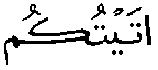
http://www.answering-islam.org/Green/seven/hafs_3.81.gif ataytukum
I gave you ... 3:81
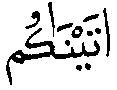
http://www.answering-islam.org/Green/seven/warsh_3.80.gif ataynakum
We gave you ... 3:80
There are different letters in these words. This difference changes the meaning from,"I", to, "we".
3. Vowel Differences
Arabic uses small symbols above and below the letters to indicate some of the vowels of a word. Here we see another difference between these two Qur'ans for they do not have the same vowels in the same place.
THE QUR'AN ACCORDING TO OF IMAM HAFS | THE QUR'AN ACCORDING TO OF IMAM WARSH
http://www.answering-islam.org/Green/seven/hafs_3.146.gif qatala
And many a prophet fought(qatala) 3:146
http://www.answering-islam.org/Green/seven/warsh_3.146.gif qutila
And many a prophet was killed(qutila) 3:146
[Also as in 3:144 in both versions]
There are different vowels in these words. This changes the meaning from the active to the passive. E.T.C
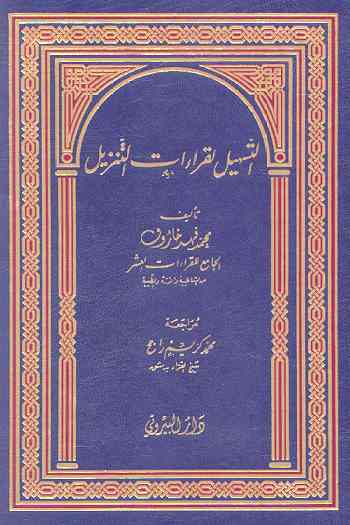
Note that only two versions of the arabic Qur'an are considered above, but as stated at the beginning, there are many other versions that could also be examined for variants. The quranic book below does this. It is a Qur'an that lists the variants from the Ten Accepted Readers.
http://www.answering-islam.org/Green/seven/10cover.jpg
(Translation)
Making Easy the Readings of What Has Been Sent Down
Author
Muhammad Fahd Khaaruun
The Collector of the 10 Readings
From al-Shaatebeiah and al-Dorraah and al-Taiabah
Revised by
Muhammad Kareem Ragheh
The Chief Reader of Damascus
Daar al-Beirut
The copyright page of the book reads as follows.
Copyright is for the publisher.
First Print
1420 - 1999
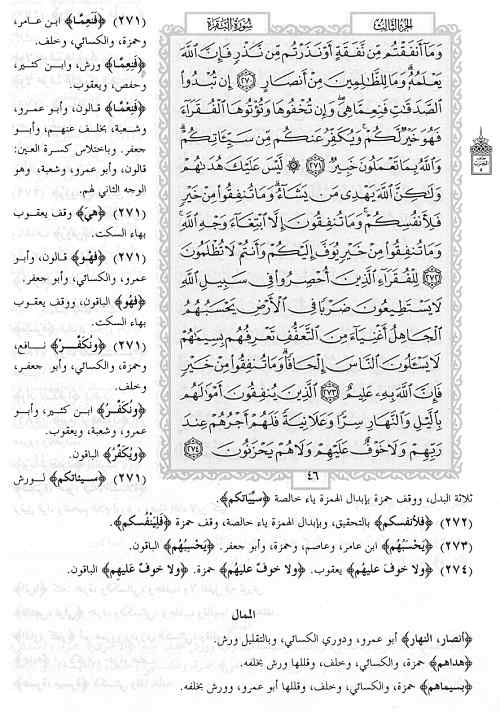
In this edition of the Qur'an, Muhammad Fahd Khaaruun has collected accepted variant readings from among the Ten Accepted Readers and included them in the margin of the Hafs version of the Qur'an. These are not all the variants. There are other variants that could have also been included but the author has limited himself to the variants of the Ten Accepted Readers. As the title suggests, this makes it easy to know what the variant readings are because they are clearly listed.
Below is a copy of a random page from this Qur'an. You can see the variant readings listed in the margin. Approximately two thirds of the verses of the Qur'an have some type of variant. This is approximately 4000 variants.
http://www.answering-islam.org/Green/seven/10page.jpg
I know some muslims will claim that the differences between these arabic Qur'an versions are only a matter of dialect, accent or pronunciation, and that they do not have any effect on the meaning at all. However this is clearly not the case. The examples of the differences given earlier show that the differences are far more than dialect, accent or pronunciation. The differences change the subject of the sentence, whether the verb is active or passive or whether it is singular or plural. These differences do affect the meaning. Comprende'? |
| Christianity Etc › Re: Question: Did Jesus Read The Bible? by unphilaz(m): 7:54pm On Feb 18, 2016 |
limamintruth:
To appreciate my answer better, permit me to briefly take our minds back to history.
Over the centuries of salvation history, the Holy Spirit inspired the authors of Sacred Scripture to write down God's revelation to us. As time went on, the Church compiled these books of God's word to form a Canon—an authoritative set of Sacred Scripture.
The books of the Old Testament were written probably between 1000 and 100 BC, an are usually distinguished as three sets: The Law (or Torah, our first five books of the Old Testament), The Prophets and The Writings. Even in the New Testament itself, we find references to the reading of the Law and the Prophets in synagogue services (e.g. LK 4:16-19), Jamnia (90-100), at which time they established what books would be considered their Sacred Scripture. At this time, the seven "deuterocanonical books"—Tobit, Judith, Wisdom, Sirach, Baruch, I and II Maccabees (and Esther)— had also been incorporated in the Septuagint, the official Greek translation of the Old Testament (c. 100 BC). These were the latest writings of the Old Testament and were written in Greek rather than Hebrew; the other books of the Old Testament—the "protocanonical books"—were older and originally written in Hebrew. Modern scholars note that Jamnia did not exclude any books definitively; these books—including the deuterocanonical books—were read and honored. Thus, many Scripture scholars have no doubt that the early apostolic Church accepted the deuterocanonical books as part of its canon of Sacred Scriptures.
With this background, we can now address why the Protestant versions of the Bible have less books than the Catholic versions. In 1534, Martin Luther translated the Bible into German. He grouped the seven deuterocanonical books of the Old Testament under the title "Apocrypha," declaring. "These are books which are not held equal to the Sacred Scriptures and yet are useful and good for reading." Luther also categorized the New Testament books: those of God's work of salvation (John, Romans, Galatians, Ephesians, I Peter, and I John); other canonical books (Matthew, Mark, Luke, Acts, rest of Paul's epistles, II Peter, and II John); and non-canonical books (Hebrews, James, Jude, Revelation, and books of the Old Testament).
Nevertheless, his action had the permanent consequence of omitting the seven deuterocanonical books of the Old Testament in Protestant versions of the Bible.
The 39 Articles of Religion (1563) of the Church of England asserted that these deuterocanonical books may be read for "example of life and instruction of manners," although they should not be used "to establish any doctrine" (Article VI). Consequently, the King James Bible (1611) printed the books between the New Testament and the Old Testaments. It should also be noted that these deuterocanonical books are more of Jewish traditions than Christ's sacred gospel of salvation. And because the catholic church inculcates so much of traditions of early believers, it still maintains these deutrocanonical books as part of the church's English Bible translation.
Therefore, these books do not in any way contradict the content of other books in the Holy Bible.
............
And now to your second question,
how does an omitted text amount to a contradiction or inconsistency if i may ask?
In case you arent aware, verse 7-8 of 1 John 5 were originally marginal note that were sunsequently included by the latin translators of the Greek-lang. version of the Holy Bible for solely explanatory purposes.
These texts are absent in the early Greek Bible version (which existed prior to the latin translation) and some of the present English Bible translations are directly derived from the Greek translation, while the others are sourced directly from the latin Bible translation (that has the included margin notes) also.
Hence, understand once more that the inclusion and/or omission of the said texts does not, in anyway, alter or contradict the message of the Holy Bible.
So, the 'GRAVE DEFECTS' indicated by RSV preface is not with regard to the message/content of the Holy Bible, but with the specific K.J.V English language Bible translation. Thus,nothing in the included/omitted texts of v.7-8 contradicts the message of the word in the Holy Bible.
BTW, 1 John 5:7 is not the only Biblical text that highlights the concept of the Trinity or states that Christ Jesus is God.
Here's some more texts for reference:
- The Father is God ( John 6:27; Romans 1:7; 1 Peter 1:2). - The Son is God ( John 1:1, 14; Romans 9:5; Colossians 2:9; Hebrews 1:8; 1 John 5:20). - The Holy Spirit is God ( Acts 5:3-4; 1 Corinthians 3:16). |
| Christianity Etc › Re: Question: Did Jesus Read The Bible? by unphilaz(m): 7:47pm On Feb 18, 2016 |
limamintruth:
Yea, islam in europe and the west thrives solely because it is allowed to do so by the peace loving and tolerant indigents who are predominantly christians. Unfortunately, same cannot be said of countries with predominantly muslims because of the intolerance of islam against other non-islamic faiths, as seen in the average muslim. Nevertheless, all muslim countries (nothwitstanding their intolerance against other faiths and excluding the few countries controlled by islamic terrorists) are witnessing more christian converts by the day. These upsurge of new christian converts in mostly muslim countries the world over arent often publicly reported cos of the the threats of deaths by the muslim majority.
Christianity has survived hundreds of years of islamic brutality and still tops the chart as the greatest religion in the world. And this will never change no matter the attacks and threats by islamists worldwide. |
| Christianity Etc › Re: Question: Did Jesus Read The Bible? by unphilaz(m): 7:46pm On Feb 18, 2016 |
limamintruth:
Lmao, So after exposing your folly in respect of the Holy Bible's English translations you criticised by enlightening you about your beloved quran's many english versions too, all you could do is to hastily scribble down this balderdash of cheap talk right ? Why not then show me the Holy Bible translations that contradict themselves then?
You still have said nothing mister. Why are you shying away from quoting the Bible verse(s) allegedely missing in the translation as mentioned by you
BlaBlaBla... As i said earlier, kindly release the name(s) of the Bible translation(s) then. Or else, your allegation remains baseless.
Lol, this is really getting interesting . So you mean the quran english translation is not regarded as the actual arabic quran right? ?
Does that mean the english translation is only a mere book of interpretation, hence, shouldnt to refered to as the actual supposed 'divine' book? Lallai kam!
Mind you the Holy Bible is not limited to only one language because it is the true message of God that is meant for all nations of the world who speak diverse languages. Our God understand all languages and listens to prayers of the believers spoken in all languages. Our God is not a God of confusion. He has a purpose for allowing nations of the earth to speak in diverse tongues.
And at least, i accurately cited an example of some quranic versions, whereas, you havent cited any Bible verse to buttress your point in your lenghthy post of gibberish.
So i can see you are the kid here.
I'l leave you with the piece of uthman quranic translations with contradictory words for you ponder upon tonight :
Yusuf Ali : He it is Who has sent down to thee the Book: in it are verses basic or fundamental (of established meaning);...
Pickthall : He it is Who hath revealed unto thee (Muhammad) the Scripture wherein are clear revelations - ...
Shakir : He it is Who has revealed the Book to you; some of its verses are decisive ...
(So kindly explain to us how the following terms (from the quranic texts above) mean the same thing mister-mallam-wannabe :-
- basic or fundamental (of established meaning)
- clear revelations
- some of its verses are decisive. ) |
| Christianity Etc › Re: Question: Did Jesus Read The Bible? by unphilaz(m): 7:43pm On Feb 18, 2016 |
Empiree:
Too much talks doesnt solve anything. All you have to do is present Quran that contradict themselves. For instance, there are some Bibles that have some verses expunged. The like of Amplified Bible which is missing many books etc. I can go on and write out more examples. But in the Quran, even english translations they are consistent. I was reading a Bible(name withheld) 2days ago and it's missing a verse like say John 13:1,2,4,5,6,7,8,10. Can you spot what i am talking about?. But you will never see this with Quran.
Let me remind you again that Quran is in arabic. It's all the same. Once it's translated in to other language(s), it's no longer Quran, it's translation of the meaning. Your (Bible) original manuscripts are lost in history.
So if you think there are inconsistencies with Quran, kindly bring them forward. I dont want to hear much talks like you did up there. That's irrelevant. All i need from you is evidence. Simple right?. ifeaan and dejign already tried this but failed. You are next. |
| Christianity Etc › Re: Question: Did Jesus Read The Bible? by unphilaz(m): 7:37pm On Feb 18, 2016 |
Empiree:
Okay now, since you admire KJV and Good News very well especially King James Version. Now, you said to "learn everything that is authentically translated". Key word is "AUTHENTIC TRANSLATION".
Good. Let's put King James Versions against each other. Before that, I will like to remind you that we Muslims believe that Isa(Jesus- peace be upon him) is human being 100%. He's a prophet and messenger of God. He is indeed God's true servant. There is no need for me to quote Qur'an since Qur;an is clear on who Jesus(peace be upon him) is. Here are contradictory accounts of who Jesus in KJV, NKJV and GNV. Son and Servant are different meanings. Bible contradict itself and also agrees with Quran that Jesus is servant of God.
Acts 3:13
King James Bible
The God of Abraham, and of Isaac, and of Jacob, the God of our fathers, hath glorified his Son Jesus; whom ye delivered up, and denied him in the presence of Pilate, when he was determined to let him go.
Good News Translation
The God of Abraham, Isaac, and Jacob, the God of our ancestors, has given divine glory to his Servant Jesus. But you handed him over to the authorities, and you rejected him in Pilate's presence, even after Pilate had decided to set him free.
New King James Version
The God of Abraham, Isaac, and Jacob, the God of our fathers, glorified His Servant Jesus, whom you delivered up and denied in the presence of Pilate, when he was determined to let Him go.
Now, dont even try to mess with me by twisting what is not and using same "taqqiyah" you used to cover up violence verses in your "holy book"....son does not equates servant. They are two different words with different meanings. Pay close attention to the two (2) KJVs carefully. |
| Christianity Etc › Re: Question: Did Jesus Read The Bible? by unphilaz(m): 7:29pm On Feb 18, 2016 |
limamintruth:
Oh, you mean just like your Caliph Uthman-created quran that also has various versions in english, as can be seen below :-
QURAN 37:102
Sahih International: And when he reached with him [the age of] exertion, he said, "O my son, indeed I have seen in a dream that I [must] sacrifice you, so see what you think." He said, "O my father, do as you are commanded. You will find me, if Allah wills, of the steadfast."
Pickthall: And when (his son) was old enough to walk with him, (Abraham) said: O my dear son, I have seen in a dream that I must sacrifice thee. So look, what thinkest thou? He said: O my father! Do that which thou art commanded. Allah willing, thou shalt find me of the steadfast.
Yusuf Ali: Then, when (the son) reached (the age of) (serious) work with him, he said: "O my son! I see in vision that I offer thee in sacrifice: Now see what is thy view!" (The son) said: "O my father! Do as thou art commanded: thou will find me, if Allah so wills one practising Patience and Constancy!"
Shakir: And when he attained to working with him, he said: O my son! surely I have seen in a dream that I should sacrifice you; consider then what you see. He said: O my father! do what you are commanded; if Allah please, you will find me of the patient ones.
Muhammad Sarwar: When his son was old enough to work with him, he said, "My son, I have had a dream that I must sacrifice you. What do you think of this?" He replied, "Father, fulfill whatever you are commanded to do and you will find me patient, by the will of God". E.T.C.
[ Therefore Mr. Ignoramus, Irrespective of how many times english as a language evolves, the content & message of the Holy Bible still remains the same forever].
Except maybe you were only referring to the alleged divine book with the following dubious history
:-
"The third caliph, Uthman, became famous, or rather infamous, for Quran burning. Distressing reports had filtered to him from battlefield generals who were fighting against the Armenians and other nations on the edge of his burgeoning Islamic empire: different versions of the Quran were overheard being recited.
Caliph Uthman had a bold idea. He made a new edition of the Quran and demanded that all other editions be surrendered and burnt. Not everyone liked this. After all, Uthman was not one of the four people Prophet Muhammad had said Muslims could trust to issue the Quran. Ibn Mas'ud, on the other hand, was. He refused point-blank to surrender his collection of the Quran, which he claimed he got directly from Muhammad.
Ali, the famous one who was Prophet Mohammed's son-in-law and the soon-to-be fourth caliph, at first refused to surrender his Quran to the flames. He finally gave in under pressure, but he was not pleased.
Some claim Ali's displeasure led him to participate in the assassination of Uthman -- staged while Uthman was reading his new version of the Quran. One report has the assassins dramatically screaming, "You changed Allah's Quran!" as they plunged knives into the fading caliph's body. Ali's followers, who became the Shiites, to this day feel that Uthman tampered with the Quran to deprive Ali's family of the hereditary right to lead Islam.
Caliph Uthman's bonfire dealt a blow to textual criticism of the Quran. Fortunately, some hidden pre-Uthmanic manuscripts survived and have slowly come to light, although access to them has been limited: their very existence goes against the party line that the Quran has never been changed. We know that Ibn Mas'ud's version was different from the modern Quran. For example, it did not include the important first sura, known as the 'Fatiha'.... " versionds |
| Christianity Etc › Re: Question: Did Jesus Read The Bible? by unphilaz(m): 6:53pm On Feb 18, 2016 |
Ifeann:
Its translations ...the different versions are translations. .it's similar to the different translations u have of the quran. Eg. Pickthall, Yusuf Ali, Al-Hilali/Khan, Malik, Shakir, Sher Ali, Khalifa, Daryabadi, Asad etc
But there is a difference. .Read on..
I would always suggest people go for the KJV and good news versions. . Learn everything that is authentically translated .
It is important to note that Christianity is also attacked from bible versions ... for example the heretical Jehovah witness have their translation where they deliberately distort the translation. .I have seen this myself. .
Children and teen versions make the bible more captivating for kids as it contains pics and imagery etc..
A lot of translations are unnecessary but some are neccessary since the Eglish language changes with time eg.. we used to use words like ye, thou, thus, thy, thee but these aren't used any more.. |
| Christianity Etc › Re: Question: Did Jesus Read The Bible? by unphilaz(m): 6:35pm On Feb 18, 2016 |
Empiree:
@ bold, since you agreed that prophet muhammad(s.a.w) accepted Gospel, then why dont you believe in him and Quran?. Why do you hate him and rainy curses on him if he accepted Gospel?. Read below.....
The Hadith (sayings and actions of Prophet Muhammad in Islam) as well point out to Biblical Corruption. Consider these hadith:
Narrated Abu Huraira: The people of the Scripture (Jews) used to recite the Torah in Hebrew and they used to explain it in Arabic to the Muslims. On that Allah's Apostle said, "Do not believe the people of the Scripture or disbelieve them, but say:-- "We believe in Allah and what is revealed to us." (2.136) (Bukhari Volume 6, Book 60, Number 12)
Narrated Ubaidullah: Ibn 'Abbas said, "Why do you ask the people of the scripture about anything while your Book (Quran) which has been revealed to Allah's Apostle is newer and the latest? You read it pure, undistorted and unchanged, and Allah has told you that the people of the scripture (Jews and Christians) changed their scripture and distorted it, and wrote the scripture with their own hands and said, 'It is from Allah,' to sell it for a little gain. Does not the knowledge which has come to you prevent you from asking them about anything? No, by Allah, we have never seen any man from them asking you regarding what has been revealed to you!" (Bukhari Volume 9, Book 92, Number 461)
Narrated 'Ubaidullah bin 'Abdullah: 'Abdullah bin 'Abbas said, "O the group of Muslims! How can you ask the people of the Scriptures about anything while your Book which Allah has revealed to your Prophet contains the most recent news from Allah and is pure and not distorted? Allah has told you that the people of the Scriptures have changed some of Allah's Books and distorted it and wrote something with their own hands and said, 'This is from Allah, so as to have a minor gain for it. Won't the knowledge that has come to you stop you from asking them? No, by Allah, we have never seen a man from them asking you about that (the Book Al-Qur'an ) which has been revealed to you. (Bukhari Volume 9, Book 93, Number 614)
The first hadith is saying that as long as the Torah agrees with the Quran, it is to be believed however if the Torah doesn't agree with the Quran then it is not to be believed. Some Christian apologetics only quotes the third Bukhari Hadith #614 to point out that Islam doesn't have anything to say about Biblical corruption. But this hadith too is saying that the Bible is corrupt. When it says changed some of Allah’s books, it means the Torah, Psalms and the Gospels and that the Bible is not reliable and Muslims shouldn't go to the people of the scripture since their books are now distorted. Also pay attention to the hadith #461 I quoted. The hadith states that the Jews AND the Christians had distorted and wrote the scripture with their own hands that was given to them. In other words their books were not the same ones given to Moses and Jesus and that’s what the Quran 3:3 is speaking about… the original books of Prophets Moses and Jesus which we clearly don’t have today.
You don't understand what Qur'an is saying because your brain is suspended between heaven and earth.
As for why did previous Holy books like torah and Gospel not protected, now pay attention to this because i know you've been throwing this question around saying no muslims can answer it. If after this answer you keep asking again, then am done with you on it. Let me rephrase your question. It's something like this, correct?
Why did Allah preserve the Quran and allow His earlier books of divine revelation to be changed or lost?
The answer to that question lies in the following three facts:
The earlier prophets and their books were sent to a particular people in particular periods of history. Once the period ended, a new prophet was sent with a new book to replace the previous book. So, it was not necessary that these books be preserved by Allah. The preservation of the earlier books was left up to the people as a test for them. Thus, when the people went astray, they changed what was written in the books which their prophets brought in order to make allowable the things which were forbidden to them. In that way, all of the earlier books of revelation became either changed or lost.
Now, take a look at the essay I posted earlier about different authors of the Bible, sound familiar?. Even you can not deny that Bible scholars have faulted your Bibles. Read further below....
Prophet Muhammad (peace be upon him) was the last prophet whom Allah sent, and he was not sent to a particular people or a particular time. He was sent to all of mankind until the end of the world. Allah said in the Quran,
"I have only sent you (Muhammad) as a giver of glad tidings and a warner to all mankind, but most men do not understand." [Noble Quran 34:28]
Thus, his book of revelation, the Quran, had to be specially preserved from any form of change or loss so that it would be available to all the generations of man until the last day of the world.
Scholars of the Bible say the Bible has been badly edited and corrupted over time
Critical scholars today are generally in agreement that the sources of the Pentateuch were 4 separate documents written in different times by different authors. These source documents were called the J (Jehowah/Yahweh), E (Elohim) D (Deuteronomic), and the P (priestly), documents. Internal evidence shows that “J” originated from the southern kingdom of Judah and was the earliest to be documented around 900BC; “E” was written in the northern kingdom of Israel probably about a century or so later. The “D” document is dated to about 700BC. The documents were then combined into one by the priesthood, who added their own “Priestly” tradition to it, during the Babylonian exile (after 560 BC). We are not concerned here with the basis of this theory as our purpose is simply to show that it could not have been written by Moses-a fundamentalist bedrock belief. For more on this read Anderson, A Critical Introduction to the Old Testament.
The gospels are not eyewitness accounts
-Allen D. Callahan, Associate Professor of New Testament, Harvard Divinity School
Some scholars say so many revisions occurred in the 100 years following Jesus' death that no one can be absolutely sure of the accuracy or authenticity of the Gospels, especially of the words the authors attributed to Jesus himself.
-Jeffery L. Sheler
Even the Biblical book of Jeremiah clearly states that the scribes of the ancient Israelites altered the revealed scriptures given to the Israelites by Allah, and thus changed them “into a lie”.
[size=15pt]" 'How can you say, "We are wise, for we have the law of the LORD," when actually the lying pen of the scribes has handled it falsely? (Jeremiah 8:8 New International Version)[/size]
Anymore questions.........? |
| Christianity Etc › Re: Question: Did Jesus Read The Bible? by unphilaz(m): 6:19pm On Feb 18, 2016 |
Empiree:
Can we Prove Quran is From God?
Muslims have something that offers the clearest proof of all - The Holy Quran. There is no other book like it anywhere on earth. It is absolutely perfect in the Arabic language. It has no mistakes in grammar, meanings or context. The scientific evidences are well known around the entire world, even amongst non-Muslim scholars. Predictions in the Quran have come true; and its teachings are clearly for all people, all places and all times.
Surprisingly enough, the Quran itself provides us with the test of authenticity and offers challenges against itself to prove its veracity. Allah tells us in the Quran:
Haven't the unbelievers considered if this was from other than Allah, they would find within it many contradictions? [Noble Quran 4:82]
Another amazing challenge from Allah's Book:
If you are in doubt about it, bring a chapter like it.[Noble Quran 2:23]
And Allah challenges us with:
Bring ten chapters like it. [Noble Quran 11:13]
And:
No one has been able to produce a book like it, nor ten chapters like it, nor even one chapter like it. It was memorized by thousands of people during the lifetime of Muhammad (peace be upon him) and then this memorization was passed down from teacher to student for generation after generation, from mouth to ear and from one nation to another. Today every single Muslim has memorized some part of the Quran in the original Arabic language that it was revealed in over 1,400 years ago, even though most of them are not Arabs. There are over nine million (9,000,000) Muslims living on the earth today who have totally memorized the entire Quran, word for word, and can recite the entire Quran, in Arabic just as Muhammad (peace be upon him) did 14 centuries ago.
Say, [O Muhammad], "The Pure Spirit has brought it down from your Lord in truth to make firm those who believe and as guidance and good tidings to the Muslims." (Quran 16:102)
Bukhari
Volume 4, Book 55, Number 605:
Narrated 'Aisha:
The Prophet returned to Khadija while his heart was beating rapidly. She took him to Waraqa bin Naufal who was a Christian convert and used to read the Gospels in Arabic Waraqa asked (the Prophet), "What do you see?" When he told him, Waraqa said, "That is the same angel whom Allah sent to the Prophet) Moses. Should I live till you receive the Divine Message, I will support you strongly."
I can elaborate on story of Waraqa if you want.
THE QURAN IS THE WORD OF GOD AND AN UNDENIABLE PROOF FOR MUHAMMAD’S PROPHETHOOD
The Quran is completely different from all the other books in the world
When we study the Quran even superficially from the viewpoint of its wording, styles, and meaning, we will certainly conclude that it is completely different from all the other books in the world. So, in rank and worth it is either below all of them-even Satan cannot claim this, nor does he conceive of it-or above them. Since it is above all of them, it must be the Word of God.
The Quran, which he brought, has challenged all mankind with all their literary geniuses and scientists, from the first day of its revelation to the Last Day, to produce a like of it or even a single chapter of it
The Quran openly declares:
You (O Muhammad) was not a reader of any Scripture before it, nor did you write (such a Scripture) with your right hand, for then those who follow falsehood might (have a right) to doubt it. (al-Ankabut, 29.48)
The verse^ refute allegations by evangelical Christians who say muhammad copied from christians.
It is an established, undeniable fact that the Prophet Muhammad, upon him be peace and blessings, was unlettered. Whereas the Quran, which he brought, has challenged all mankind with all their literary geniuses and scientists, from the first day of its revelation to the Last Day, to produce a like of it or even a single chapter of it:
If you are in doubt concerning that which We have sent down onto Our servant (Muhammad), then produce a chapter of the like thereof, and call your witnesses, supporters, who are apart from God, if you are truthful. (al-Baqara, 2.23)
Mankind have since been unable to produce a like of only one of its chapters, including, of course, its shortest ones like sura al-Ikhlas or sura al-Kawthar; those who have ventured to do that have all laid themselves open to ridicule. This is a clear proof for the Divine authorship of the Quran.
The Quran was revealed in 23 years, yet there are not any contradictory points in it
The revelation of the Quran lasted 23 years. It is inconceivable that any book written by a mortal being in 23 years, one which is a book of Divine truths, metaphysics, religious beliefs and worship, prayer, law and morality, a book fully describing the other life, a book of psychology, sociology, epistemology, eschatology and history, and a book containing scientific facts and the principles of a happy life, does not have any contradictory points. Whereas, the Quran openly declares that it has no contradictions at all and therefore is a Divine Book:
Will they not then ponder on the Quran? If it had been from other than God they would have found therein much contradiction and incongruity. (al-Nisa’, 4.82)
The Qur’an is beyond compare from the viewpoint of its styles and eloquence
The Quran is beyond compare from the viewpoint of its styles and eloquence. All the sentences, words and even letters used in the Quran form such a miraculous harmony that, with respect to rhythm, music, and even geometric proportions and mathematical measures, and with respect to how many times each is used in the whole of the Quran, each is in the exact place it must be and interwoven and interrelated with others. The literary masterpiece of no one, including the sayings of the Prophet himself, upon him be peace and blessings, cannot compete with the Quran.
I will stop here now. But I can go on if you want . This is about if Quran is from God according to you. Now if you want some details about Prophet Muhammad's encounter with Angel Gabriel, I will be willing to go into that as well, historically with evidences from Qur'an. |
| Christianity Etc › Re: Question: Did Jesus Read The Bible? by unphilaz(m): 6:11pm On Feb 18, 2016 |
AllNaijaBlogger:
Funny how all your claims are from spurious hadiths/testimonies/narrations that you will later claim are "weak" when they say something you do not agree with.
There is no exact day or date that the Quran was finally written.
Some of it was written during Muhammad's time but not all of it. If Muhammad saw the final quran, he would have mentioned it or at least yhhafith would have clearly stated that the prophet gave the quran to Uthman.
Also keep in mind that the prophet was an illiterate. An illiterate cannot express himself verbally or orally. Go and listen to the oration of any illiterate. You will understand it but writing it down will be a problem because you will correcting the grammar and sentence structure of the illiterate's speech.
If I recall, the Quran is written in classical Arabic which is even more difficult than standard Arabic. Does the writing of the Quran sound like that if an illiterate? No
The scribes and companions of the prophet must have added their own interpretations and better sentences to uplift Muhammad's uneducated speech.
Lastly, human memory is ver fallible. If I tell you that "I feel discombobulated, agitated and malaise", you might describe what I said the next day as "Allnaijablogger felt a headache and generally sick". Interpretations.
I hope you can see why I find this thread hypocritical. Your Quran comes from special origins- this means that you do not have the moral standing to point fingers at the origins or authors of the bible. |
| Christianity Etc › Re: Question: Did Jesus Read The Bible? by unphilaz(m): 6:02pm On Feb 18, 2016 |
|
| Christianity Etc › Re: Question: Did Jesus Read The Bible? by unphilaz(m): 5:48pm On Feb 18, 2016 |
Empiree:
"told by others". Who are they?. Sorry you dont have a case yet. Quran is direct word of Allah(God) through Archangel (Jubril) to Prophet Muhammad (peace be upon him). Word for Word. No hearsays by men like your Bible. And who told you we dont know Jesus knew about Old Testament?
The holy verses of Qur'an agree with the Gospel where Jesus said:
The Prophet Muhammad (PBUH) carried a Call that came to clarify previous Revelations and spell out what was misunderstood.
These verses show that we (muslims) know that Jesus knew about Old Book that came before him. I can go on and on. But you havent make any sense yet. Just hiding behind a skirt, you &past.kun noted |
| Christianity Etc › Re: Question: Did Jesus Read The Bible? by unphilaz(m): 5:15pm On Feb 18, 2016 |
Empiree:
Now you are professional literalist. Are you telling me that God threw down Holy Books from heavens to His prophets and messangers and these men looked up to the heavens to catch it?
You are funny man. Sahih International used "choice of words". Check others like Yusuf Ali, he used the phrase "Book". Shakir used "scripture". Khan also used "Book". If you think God sent down paper Books from heavens, then you would believe Cow jumped from the moon too. You are so amazing bro interesting noted |
| Christianity Etc › Re: The Revelation Which Failed To Make It To The Quran by unphilaz(m): 4:57pm On Feb 18, 2016 |
Annunaki:
So how come allaah was unable to guard parts of the original manuscript of the quoran from being eaten by a goat notigoat |
| Christianity Etc › Re: The Revelation Which Failed To Make It To The Quran by unphilaz(m): 4:48pm On Feb 18, 2016 |
Annunaki:
Don't mind him, all muslims know that islam is full of contradictions and is internally inconsistent, however they have been indoctrinated NEVER to question the quoran so they resort to lying to themselves and others about islam. Allaah claims that his word is complete and easy to understand but al taquiya experts here will tell you that you need hadiths and tasfirs before you can understand what their god wrote. noted |
| Christianity Etc › Re: The Revelation Which Failed To Make It To The Quran by unphilaz(m): 4:48pm On Feb 18, 2016 |
Scholar8200:
If I am to use their logic on that other thread,if hadiths are revelations like has been affirmed, the existence of strong, weak and false hadiths also points to corruption and addition! Then, on what basis do they select which is true and false? noted |