romme2u: You should be aware that no government in Nigeria implements up to 70% of its budget. As somebody who has been on ground for years spanning from Attah's admin, Akpabio made a lot of progress in public school infrastructure upgrade which Udom has not sustained.
Renovations and upgrades were done in batches cos i know one of my alma mater (i attended 4 schools) that boasted of total upgrade of all structures when Akpabio held sway.
In 3 budgets prepared by the Udom's admin, Education did not get up to 10% of the budget though Unesco recommends 26%...........budgets of 400 billion range got mere 12 billion and 8 billion to cater for more than 500 schools across board and we all know implementation may not be more than 50%.
For a serious government, 3 years is enough to create reasonable impact...........at least employing and deploying teachers should not take 3 years........instead the idiot is building ecumenical center to whip religious sentiment that does not add economic value to the state
................and if the Inter - Ministerial Committee was clumsy in its dealing, clean it up to create greater impact promoting transparency and accountability as the buck stops at his table
Finally someone one that went to a public school. I wondered if any defender has. Anyway can say half of the billion naira went to the school renovations. They budgetrd for arounx 120 school during thst teo year stretch and theres over 500 like u stated. That would leave a sizable portion of schools depending on percentage of total schools are in shape.
All the points after 2 paragraph I generally accept. It's weird he decided on building the church when tgat could go towards renovating annother school. Mobil Nigeria building an engineering college as Corporate social responsibility.
macaranta: No logical points raised.. Just to hide behind your phone and 10MB to insult people with political prostitute whatever that means. Show me the richest country in the world and I will show you pictures of their own abandoned /poverty areas
[/s]
Lol political prostitute you can can show pictures of other abandoned properties but cant find pictures of the great public schools in your area. The challenge was too much for you afterall. You dont send you kids to public schools but you make it your life mission to defend mediocrity like pathetic bottom feeder.
Its funny a clown like you has no logic. You told the school in Abak I posted was abandoned but we see students inside. The school was abondoned but Akwa Ibom is short on schools. The state has need gor more technical colleges hence why mobil Corp is build one in state.
macaranta: You really know nothing about Aks, even the Abak GTC you're posting was renovated 3 years or so ago alongside Mainland G Technical C and the one in Uyo. But no, it's that one you will see. Those schools you posted were probably abandoned due to natural causes like low patronage from locals, so the next popular government school closer will have a better facility because it's more used.You didn't mention the housands of facilities Akpabio built for abak people, even that bridge linking abak and uyo the federal government won't afford to do that kind of bridge cus of the obvious cost... Dude post pictures of uyo /Aks before and after Akpabio then I can come back and talk to your numb skull
Wow the schools were abondoned due to low patronage when people are writing government to renovate them. You political prostitutes can lie. Akpabio built thousands of projects for Abak aswell but you dont have on picture to present hmm interesting. I gave you one challenge to dhow great public schools your kids go to or something but you chicked out political prostitute.
The Abak School was renovated 3 years ago and it looks like that? Wow these guys are working indeed. A state as rich as Akwa Ibom and with some of the biggest budgets and that's all you can say. I understand why you wont send you kid to public school after all.
Zionista: So he must report the situation in the 36 states of the federation simultaneously.
Common sense is not common after all.
These guys are a slow bunch its sad really. The author of the story is Cletus Ukpong who is from Akwa Ibom. This explains why he choose to write his report when he recieves grant from foreign sponsors. He's on facebook if the really want to find him.
This investigation is supported by the John D. and Catherine T. MacArthur Foundation and the International Centre for Investigative Reporting
romme2u: I posted the quote below in one of your threads............in as much as i am not against what you are doing but please direct your concerns to the appropriate quarters.
Good job
Noted but I doubt this situation can be all his fault. Hes only been there three years. I agree with your point about Inter-Ministerial Committee. He cut education budget as well due to economic constraints. In previous articles the author mentioned the amount budgeted for school rennovation and education. How much cash was released in both years for that purpose.
Samuel Efuo, a lawmaker and Chairman, Ibom State House of Assembly Committee on Education, says the problem is partly due to poor contract administration by the Inter-Ministerial Direct Labour Committee saddled with the responsibility of finding quick-fix solutions to the infrastructural deficits in the social sector in the state.
What these state law makers have done about it I dont know.
Five hundred million and N450 million was budgeted for the sector in 2014 and 2015 respectively for the renovation and refurbishing of buildings, including the provision of facilities, in 124 secondary and primary schools in the state.
The administration’s plan then, as documented in the budget, was to pick four secondary schools and four primary schools for renovation in each of the 31 local government areas in the state.
Ermacc: Exactly what I'm saying. Biased reportage from the op. cc mires
Lol you you guys are clowns. Instead if just showing me pictures of your great schools your mad I criticized state government. Political prostitition is bad guys. I guess these broken down building are also staged. Feel free to post your pictures from public school you have your family at. I'll be waiting and will call Lala to bring post to front page.
macaranta: You're just a terrible person, better take down this post. Did you visit all the schools in Aks to see that they're all bad or you just chose these 3 bad schools to spread fake news?
Lol how is it fake news? Post pictures of the great public schools your kids go to. I posted more than three schools. Do you need pictures of over 300 schools before you get the point. Again you political prostitutes are a weird bunch.
Seriously go to places the author mentioned and snap your own pictures or post other nice institutions in state.
Godwin978: you waisted 2hours of your life just to discredit Udom on what he has been doing abi? try all you could Akwa ibom is PDP no vacant for Apc
Lol you political prostitutes are a weird bunch. Instead of demanding better you ranting about APC and PDP like its a football debate. Theres nothing impressive to speak of in education. Even you wont send your kids to the decrepit public schools. Now go back to servicing your master if you have no counter arguements to points written.
Im glad Mobil is building new school in the state since Udom feels a new church is a better use of funds.
Lol you're speechless this is exactly what you pointed out in the last thread.
abokikhalifa: You will still come out to justify evil. Why don't you also carry out your own investigation and give reasons why Akwa Ibom is a good place instead of bringing politics to everything. You want Nigeria to be better you need to do the right things and not support evil. That's if you really want a better Nigeria.
These political prostitutes are almost as bad as the theives themselves. Even this guy probably sends his kids to private schools. Lol why shouldn't the government be held accountable for state of public schools. If the situation wasnt so crazy the author wouldnt have material to make six part expose.
Ermacc: [s]Have you been to other Nigerian states? You will realise that their public schools are 10x worse. I've noted that all you do is paint an extremely bad image of the Akwa Ibom state government. What ever personal grievance you have with either Akpabio or the present Governor shouldn't obstruct objectivity in your thought process. Keep on shielding your dark hatred with your so called investigative reports.[/s]
Lol one of the richest states in Nigeria with the biggest budgets has to compare itself to poorer states? Instead of you to demand better you're mad I pointing out the elephant in room. No wonder the public education went down the drain when bottom feeders like you accept crumbs.
Lol even political prostitutes like you dont send your kids to public schools. All you can do is deflect and say others are worse. Please continue bending over for Akpabio and Udom since you love them so much.
What aspect of public education is working in Akwa Ibom. Even the governors most staunch supporters dont send their children to public schools. They can only say he's trying while they fork over cash private schools owned by the same politicians who wrecked public education.
•schools are understaffed •building in shambles •teachers arent being paid (gratuity) •shortage of schools
noah91: This has nothing to do with the parasitic North. What has AKS been doing with the remaining money after the parasitic North has taken the bulk of it? Nothing as shown in the pictures above. The truth is corruption is real and everywhere in Nigeria. It cuts across all tribes, religions, states and geopolitical zones. In fact that's what connects all of us especially our leaders (i.e meaning that's the only thing that makes us one Nigeria)
lexy2014: I don't think this issue has anything 2do with d north. I agree with u concerning d lopsidedness in d way revenue is shared. D question u should b asking is what happened 2d funds allocated 2 education in d state all these years? No matter how little it was, it shouldn't b this bad, where kids are now sleeping on bare floor. This has been d state of public education 4 years and no one cares. If u go 2d north, I don't think d story is any better. Its d same corruption, where those charged with d responsibility of providing education are diverting d funds and use same 2 send their kids abroad
These are the intellectually lazy people who blame others for everything. If you bother to read article the would see the state budgeted billions of naira to education and hundreds of millions to renovations with nothing to show. These clowns domt have anything to say.
When Godswill Akpabio was governor, the budget for education in the state in 2014 and 2015 was N10.9 billion and N16.7 billion respectively.
Five hundred million and N450 million was budgeted for the sector in 2014 and 2015 respectively for the renovation and refurbishing of buildings, including the provision of facilities, in 124 secondary and primary schools in the state.
The administration’s plan then, as documented in the budget, was to pick four secondary schools and four primary schools for renovation in each of the 31 local government areas in the state.
Gerrard59: So this is the Saint John Paul school's whose billboard is along Oron Road? Wow!
Just like everything regarding the country, I am totally disappointed in the system. And honestly, regarding public primary & secondary schools, I don't see things getting better. Majority of the top private schools are owned by former government officials. From Monef (former commissioner of education) to Rayfield (by Edem Duke) to Top Faith (another government official) to Esteem, Tower of Ivory, Graceland etc.
Certainly, things are not good and won't get better. But yeah! He is building an ecumenical centre in the city center. Abasi sosongo!
These guys are failured yet you see ignorant people and political prostitutes trying to say this guy is working. You're correct anout these private schools being owned and patronized by these theiving politicans. I actually posted thread on it 5 minutes ago.
Lol its insane hes building a church of all things when public education is in shambles. Mobil Nigeria doing more to futher educstion than thess losers are. Things truly won't get better till people get self respect and demand accountability.
ITbomb: If you know where we are coming from, you would appreciate the enormous resources used to bring Akwa Ibom up to where it is today
Most people in Nigeria call Akwa Ibom "Calabar", and that was because before Akpabio, Uyo and Akwa Ibom as a whole was just some town you pass through going to Calabar where everything was happening
Now Akwa Ibom host international matches, has airport, modern roads networks and flyovers
Now Akwa Ibom is a destination, no longer a pass through.
Let's say, infrastructural development has been achieved to a large extent, Education and industrialization is now priority to this government. After many years of embargo, teachers now being recruited. Schools rebuilt.
More still need to be done no doubt but the government is on track
After all this talk you probably wont enroll your kids in public school. At least you can brag about stadium and airport. The resources were mostly squandered this is why the schools are in shambles.
INVESTIGATION: Collapse of Public Schools: Inside the first-class schools children of Akwa Ibom elite attend
A black colour SUV with tinted windscreens rolls into the street from a gated house at Ewet Housing Estate, an exclusive residential area for the elite in Uyo, the Akwa Ibom State capital.
A little girl, being chauffeur-driven and protected by armed policemen, is on her way to school.
She has her textbooks and writing materials inside her backpack. She also has bottled water, juice, biscuits, and a lunch box filled with cooked noodles to be eaten at school during break hour.
She is the daughter of a top politician in the oil-rich state.
Her school, located few kilometres away at Shelter Afrique Estate, another residential estate for the rich, is a Montessori-type institution, equipped with state-of-the-art facilities, including a music laboratory, sickbay, swimming pool, and cable television for pupils to watch Disney cartoons.
It is stocked with the best of local and foreign textbooks, exotic learning materials and playthings, and manned by a number of highly qualified and motivated administrators and teachers.
Such scenario, common among the children of government officials, wealthy businessmen and elites profiting from the billions of oil revenue accruing to Akwa Ibom, highlights the class distinction characterising this Nigerian state.
It is a sharp contrast with the life lived by the children of the majority who are poor.
Saint John Paul II School, at Shelter Afrique Estate, Uyo, is a clear example of how Nigerian public officials and the elite insulate themselves, and of course their children too, from the consequences of their ineptitude, mismanagement and theft of public funds as well as neglect or destruction of public schools and other institutions.
The school is owned by a former governor of Akwa Ibom State, Godswill Akpabio who, during his eight-year tenure, presided over the incredible and shameful collapse of classrooms in several public schools and the fallen standard of education in the state, despite the boom in oil revenue.
Akwa Ibom is home to multinational oil companies like Mobil, an affiliate of the American oil giant, ExxonMobil. And because of its contributions to Nigeria’s oil earnings, Akwa Ibom receives more money from the Federation Account every month than each of the other 35 states and the Federal Capital Territory.
This is beside the revenue the state generates internally.
In five years alone, between 2013 and 2017, the state received N1.029 trillion (about $2.8 billion) from the country’s Federation Account.
And yet several public schools in the state, as shown in other reports published under this series, have broken down, forcing pupils and students, in some cases, to sit on bare floor in roofless classrooms to learn.
Open defecation is a common practice in most public schools in the state because of lack of toilets.
The schools also lack potable water.
It is a common sight in Uyo, the state capital, to see poor, malnourished kids walk barefooted on the streets during school hours, wearing torn and dirty school uniforms – a fallout of a broken system and impoverishing of the populace.
In some poor coastal communities in the state, schools were few and far between and kids have to cross rivers daily, using canoes, to attend schools in some other communities.
The nationwide school feeding programme of the federal government, meant to encourage enrolment and class attendance in public schools, has run into a hitch in Akwa Ibom. The programme has been suspended for about two months now because of numerous petitions from vendors, Ita Okon, the programme’s focal person in the state, told PREMIUM TIMES.
The Akpabios, when they were still the first family in the state, because of safety concern for their only son, converted one of their homes in Ikoyi, Lagos, to a Montessori nursery school for the little boy and persuaded other wealthy parents to enroll their children in the school, PREMIUM TIMES learnt.
That was how the idea to establish Saint John Paul II School, Uyo, began, a close associate of the former governor said. The school now has a branch in Lagos, he said.
Today, Saint John Paul II School, with a N175, 000 tuition fee, is one of the most expensive and preferred private schools in the state.
The Speaker, Akwa Ibom State House of Assembly, Onofiok Luke, and several state lawmakers like Aniekan Uko (representing Ibesikpo Asutan State Constituency), Monday Eyo (Uyo State Constituency), and Mark Esset (Nsit Atai State Constituency) have their children in the school.
A former commissioner, ministry of Housing and Urban Renewal, and Chairman, Uyo Capital City Development Authority, Enobong Uwah, also has his daughter as pupil in the school.
Apart from Saint John Paul II School, other top-rated private nursery schools in the state patronised by government officials are Rayfield International School, owned by a former Nigerian diplomat from the state (tuition fees is N75,000), Dove International Schools, Monef Schools (N60, 000), Sanvee International Nursery and Primary School (about N80,000 for new pupil, and N60, 000 for old pupil), all in Uyo, and Topfaith Montessori Nursery and Primary School, Essien Udim (N44,000).
All of them, except Sanvee, also operate top-rated secondary schools that are also well-patronised by government officials and the elites.
Governor Udom Emmanuel’s children, PREMIUM TIMES learnt, are in some prestigious private schools in Lagos where he lived and worked as executive director in Zenith Bank before leaving to join politics in 2014.
Unyime Etim, Chairman, Ikot Ekpene Local Government Area, has his ward in a private nursery school called Early Days School, located at Shelter Afrique, Uyo. Ditto Otobong Akpan, member representing Ukanafun State Constituency, Akwa Ibom State House of Assembly.
Henry Archibong, the member representing Itu/Ibiono Ibom Federal Constituency at the House of Representatives, has his children in another prestigious private secondary school, Tower of Ivory School, in Abak, Akwa Ibom State, while his first son is studying abroad in a university in China.
School fees in Tower of Ivory range from N300, 000 to N370, 000 per term.
Like the Akpabios, Iniobong Essien, the Commissioner for Environment in the state, owns a nursery school, Seasons International School, Uyo, where some of Governor Emmanuel’s aides have their wards.
These top-rated private schools, aside their aesthetic environment, well-equipped laboratories and libraries, and enough qualified instructors, expose their pupils and students to international examinations like Cambridge IGCSE and other programmes to help them develop self-worth and confidence, and be miles apart from their counterparts in public schools.
In Saint John Paul II School, for instance, pupils in Primary 4 are taught how to construct simple electric circuit and how to use power-point for presentation, something that can never be found in public primary schools, including most public secondary schools, in the state.
Saint John Paul II School has a swimming pool. It teaches its pupils how to swim, and also organises swimming tournaments for them.
No other school, including tertiary institutions in the state, has a swimming pool, according to PREMIUM TIMES findings.
Saint John Paul II School also has literary and leadership day for the pupils.
One of the private secondary schools in the state even introduced American football to its students!
Most private schools in the state have buses which ferry their pupils and students to and from schools, and also arrange regular excursions for them.
Some go as far as introducing American or European curriculum for their pupils and students.
“Our mission is to create a safe and caring environment where every child can grow and develop lifelong learning through quality and holistic educational approach,” Saint John Paul II School says on its website.
“Our adopted Montessori method prepares our pupils to be confident, independent and resourceful learners who would be ready to positively impact our communities.”
Mr Akpabio, who is the Senate Minority Leader, declined comment for this report. His media aide, Anietie Ekong, said he was unwilling to grant press interview, each time this reporter tried to contact the senator.
When PREMIUM TIMES met with the Commissioner for Education, Victor Inoka, he declined comment, saying having just been appointed to office, he was still “studying the situation”.
The trend in Akwa Ibom, as it is in other Nigerian states, is for wealthy parents to send their children to the best universities in the U.S, Europe, and Asia when they are done with their studies in private schools in Nigeria.
“Everybody in the state is drifting towards private schools,” says Owo Etokowo, a management expert in Uyo.
“Previously, it was the rich that would try to send their children to private schools. But now even the poor strive because they know that their children cannot become anything should they continue to study in public schools,” Mr Etokowo said, adding that the situation “is a clear indictment of the quality of education at primary and secondary levels in the state.”
Even the teachers in public schools don’t enroll their children in schools where they teach, says the principal of a Catholic secondary school in Uyo, who tried to explain how bad the situation had grown.
There is a surge in the number of private schools in Akwa Ibom because of the high demand for them.
For instance, the number of private secondary schools in the state was 120 in 2007, up by 106.90 per cent from the previous year, according to the World Data Atlas. The number increased to 422 in 2017, says an official of the state ministry of education.
“It is surely higher than that if we include those ones that are operating without license from the government,” the official said, adding that the number of private nursery/primary schools in the state was as high as 699, as at 2017.
Governor Emmanuel in January 2018 awarded scholarship to 11 children, mostly orphans and homeless kids in the state, to study at the Tower of Ivory Secondary School, Abak, therefore underscoring his preference for private schools and disdain for public schools.
The neglect, decay, and rejection of public schools has created room for people to establish substandard private schools all over the state, according to findings by PREMIUM TIMES.
Seven hundred and eighty-two “illegal” private schools, including a polytechnic, was closed down by the state government in 2017.
“If you go to rural areas you have private schools where pupils pay as low as N3, 000 a term. Such is described as budget schools by the World Bank,” says Mr Etokowo.
“In this case, such schools help children of the poor; it is neither as good as the one high up there nor as bad as what you have in public schools. So, the poor now manage to pay N3, 000 or N5, 000 to put their children in such private schools.”
Tijah Bolton-Akpan, the Executive Director of Policy Alert, a non-governmental organization that focuses on fiscal governance in Akwa Ibom and other states in Nigeria, believes the neglect of public education in the state is a ploy by the elites to undermine the future of the children of the poor.
“The public school is where the ordinary people send their children to and that sector has been suffering.
“We are busy feathering the nest and preparing the future for the children of the elite and undermining the future of the children of the poor. And that is generational poverty being recycled,” Mr Bolton-Akpan told PREMIUM TIMES.
Collins Oscar, author and entrepreneur, says everyone, including the government, teachers, parents, and ordinary citizens, is complicit in the collapse of public education in the state.
What is required to make public schools work in the state, he says, is the same effort everyone has put in to make private schools attractive.
“If the governor of the state finds it very difficult to make at least one public school look as good as a private school, and this same person when he leaves office as a governor, and in less than six months, uses his own money to build a world-class private nursery school, does it mean that he has more money than government?
“This is one reason that makes me believe the state in which we have found our public education today is intentional,” says Mr Oscar, who is the author of a popular book, Idiots With B.Sc.
“The teachers in public schools intentionally offer substandard teaching services to pupils and students. They feel the students there don’t deserve better.
“In our subconscious mind, there’s a way we look at those who attend public schools; we have low expectation of them,” he said.
Poorly funded, ill-equipped, and low-performing teachers in public schools is not peculiar to Akwa Ibom; it is a nationwide malaise.
In Kaduna State, North-west of Nigeria, the Governor, Nasir El-Rufai, is working to persuade senior government officials in the state to enroll their children in government-owned primary and secondary schools, as one of the steps of restoring quality and confidence in public education.
“As we make progress, we will require our senior officials to enroll their children in public schools,” Mr El-Rufai said in a state broadcast in December, 2017. “And I will by personal example ensure that my son that will be six years of age in 2019 is enrolled in a public school in Kaduna State, by God’s grace.”
Akwa Ibom State in particular, and Nigeria, in general, is in for a big trouble that may consume everyone eventually if the broken education system is not fixed now, says UbongAbasi Okon, an Uyo-based web designer.
“Let the rich who send their children to the best schools not even try to think they have escaped the impending doom. After all, we’ve heard that it’s one bad apple that spoils a bunch.
“The truth is that products of broken schools will soon be among those driving the Nigerian system, and you can imagine what kind of disaster await us as a people.
“In fact, we are already living with the effects of this, where you now have many youths assigned the role of vote stealing and hired killings during elections. The truth is that our society designs such ignoble path for youths who don’t have the opportunity to get the best of education, and so they must do the dirty jobs for little a little reward.”
When this reporter contacted the state lawmaker, Mark Esset, to ask about the possibility of enacting a law which could compel public officers to send their children to public schools, he said the choice of school for kids was a personal issue for every parent.
“When it comes to my family, it’s a private thing,” says Mr. Esset while admitting the poor state of infrastructures in public primary and secondary schools in his Nsit Atai Constituency. “I know what I want for my children.
“The children of my constituents, they have parents! All fingers are not equal. What the parents can afford for them is what they do.”
“You can’t say you make a law that if I can afford to eat stockfish, I should not eat it because other people are not eating stockfish.
“Before I became a public office holder, my children were already in private schools; my children are not in private schools because I am a public office holder.”
I can agree these public instutions bearly respond. I can admit that I had my question answered promptly by OGFZA regarding status about Akwa Ibom OGFZ. That's one of few good government interactions I had.
Compare these public school with private schools of elite. Tell me they are working when they are robbing you blind. Note this school is owned by former governor Akpabio.
ABBEYsammy01: The situation is worst here in Taraba state, school buildings everywhere but almost all of them are in a comatose state. Most of them are now used for IDP
Akwa Ibom and Taraba has no business compsring itself to Taraba with a fraction of the budget.
NonsoWow: The construction of the second niger bridge will effectively kill off the onitsha port. This is because the pillars supporting the new bridge won't allow vessels or barges to pass through. I had expected the new bridge to have been a suspension bridge like those in New York, San Francisco, and Istanbul. It looks more likely that the Onitsha port will be a commodity port where agricultural produce from the north will be brought to and warehoused.
Thats not plan according to ICRC. It would be stupid to bill it as river port if its just a warehouse. The government is already building an Inland container depot in Anambra and Abia.
Anyone rushing to defend the state governnebt or deflect to north is funny. How many of you have your kids in public school in Akwa Ibom? This is best arguement you can present. As article proves parents are rushing to private schools hence why they sprouting like mushrooms all over state.
The situation has led to an increase in the number of private schools in the state.
For instance, the number of private secondary schools in the state was 120 in 2007, up by 106.90 per cent from the previous year, according to the World Data Atlas. The number increased to 422 in 2017, says an official of the state ministry of education.
Why compare you progress to the north yall look down on instead of peers? The situation must be critical if you run to lowest percentile to show progress.
Osun state, for the past five years, has remained among the three top Nigerian states with an unmistakable lead in university JAMB admissions into courses leading to the award of degrees in Engineering. The other two are Oyo and Ogun.
For Medicine, Imo, Anambra, Delta and Enugu have been in the lead for the past five years.
Akwa Ibom has also not been among the five best performing states in the West African Senior Secondary School Certificate Examination (WASSCE).
Lol it sucks I couldnt post the article because of the spam bot. The author put it best, massive corrution, poor budget planning and implementation, and outright neglect led to this diaster in public schools. The government has earned trillion naira between 2013-2017. The state simply wasn't serious about education this past decade.
When Godswill Akpabio was governor, the budget for education in the state in 2014 and 2015 was N10.9 billion and N16.7 billion respectively.
Five hundred million and N450 million was budgeted for the sector in 2014 and 2015 respectively for the renovation and refurbishing of buildings, including the provision of facilities, in 124 secondary and primary schools in the state.
The administration’s plan then, as documented in the budget, was to pick four secondary schools and four primary schools for renovation in each of the 31 local government areas in the state.
The Akpabio administration had specifically budgeted N100 million (in 2014) and N200 million (in 2015) for the renovation of boarding houses in secondary schools in the state.
That was beside the N100 million and N40 million budgeted in 2014 and 2015 respectively for the provision of 2,725 beds for 62 boarding schools and the N100 million and N55 million budgeted for in 2014 and 2015 respectively for the provision of 5,500 mattresses in secondary schools.
There was also provision for N300 million, both in 2014 and 2015 budget, as government subventions to 234 secondary schools heads.
Mr Emmanuel succeeded Mr Akpabio as governor in May 2015.
In 2016, N9.8 billion was budgeted for education by the state government, out of the N426 billion total budget sum.
In 2017, the education budget in the state was reduced to N8.620 billion, apparently following the decrease in the total budget sum – N365.251 billion – for that year because of the economic recession Nigeria experienced.
It is unclear what proportion of these budgeted funds were released during the Akpabio administration, and how they were utilised.
Several education monitors, supervisors, yet nothing to show
The state ministry of education has Area Education Officers (AEOs) spread across the state with the mandate to monitor education in local communities. There are also senior ministry officials whose job schedules include paying supervisory visits to schools and submitting reports on the condition of schools to higher authorities.
Governor Udom Emmanuel has four special assistants on education monitoring alone, with three of them covering each of the three senatorial districts and reporting directly to a Senior Special Assistant, Idongesit Etiebet.
Infographics produced by the state government and posted recently on Facebook by the state Commissioner for Information, Charles Udoh, claims the Governor Emmanuel administration has so far constructed and renovated 62 school blocks in the state, a number far less than that presented by the governor’s aide on education monitoring.
The infographics, titled ‘How Governor Udom Emmanuel spends your money’, did not, however, identify the schools where the “constructed and renovated” blocks of classrooms can be found.
“More than half of the public secondary schools are in ruins”
Akwa Ibom, with a landmass of 7,081 km², is said to have a population of five million, as at 2016.
The number of public secondary schools in the state was about 250 in 2016, and a good number of that number is in ruins.
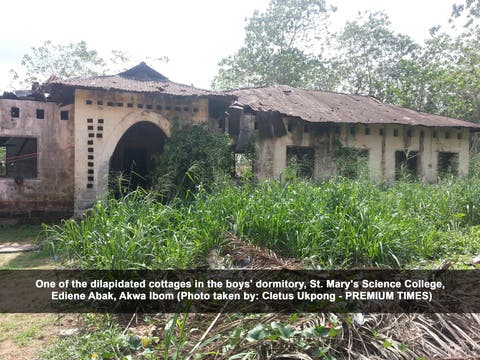
The four science colleges – St. Mary’s Science College, Ediene Abak, Abak; Qua Iboe Church Senior Science College, Ndon Eyo, Onna; Lutheran Senior Science School, Ibakachi, Ikono; and Methodist Senior Science School, Oron – are in shambles.
So also are the technical colleges in the state – like the Community Technical College, Ikot Akata, Mkpat Enin and the Government Technical College, Abak, which have become eyesores because of their many dilapidated school blocks.
The Government Technical College, Ikot Adaidem, Ibiono Local Government Area, built through the assistance of the World Bank, has been closed down and abandoned to rot for several years now.
Almost everyone – teachers, parents, government officials, unionists and development experts – who spoke with PREMIUM TIMES acknowledged that the education sector in Akwa Ibom is at a critical juncture, pointing at the rate parents are now abandoning public schools for private ones and the poor performances of pupils and students in public examinations.
The situation has led to an increase in the number of private schools in the state.
For instance, the number of private secondary schools in the state was 120 in 2007, up by 106.90 per cent from the previous year, according to the World Data Atlas. The number increased to 422 in 2017, says an official of the state ministry of education.
“It is surely higher than that if we include those ones that are operating without license from the government,” the official says, adding that the number of private nursery/primary schools in the state is 699, as at 2017.
It has just finished raining and it is cold this Tuesday morning in July 2017. This reporter is visiting the Annang Peoples Primary School, Ikot Iyire, Abak, in oil-rich Akwa Ibom State.
Three pupils between the ages of three and four lay fast asleep on bare floor inside a classroom. The doors and windows are wide open and the sleeping kids are not even covered with blanket, despite the cold wind.
It is such a pathetic sight. The kids are visibly shivering, teeth chattering, and bodies shaking. They coil themselves up ostensibly to conserve whatever heat remained in their bodies.
A few other kids sit idly on two desks. They aren’t looking cheerful at all. At a corner, in front of the classroom, sits a lonely woman – their teacher.
A teacher tells PREMIUM TIMES the pupils are part of the Early Education programme of the school. She says there is nothing teachers and the school authorities can do to help since the school lack even mats to spread on the floor for the poor kids.
Aside from this, the school has been in dire need of help, infrastructure wise. The two main classroom blocks are without roofs. The other remaining blocks are at various stages of decay, making them unsuitable and unsafe for pupils and their teachers.
Most pupils sit on bare floor to learn because of lack of chairs and desks. Inside the Primary Two classroom, for instance, 42 pupils are made to share only three desks.
The Early Education classroom has only two desks. There are no toys or learning materials for the kids.
The school, built around 1947 by the community before it was later handed over to the state government, has no staff room, so the teachers sit under a mango tree to hold meetings and prepare for the day’s lessons. They scamper into leaky classrooms when it rains.
Also, like most of the public primary schools in the state, it has no urinary, no toilet, and no source of drinking water.
“Whenever it rains, the pupils feel discouraged to come to school because the classrooms are flooded,” one of the teachers tells this reporter.
“We are suffering because we don’t have any godfather in government,” the Village Head of Ikot Iyire, James Akpan, says while showing this reporter round dilapidated buildings in the school.
“I have been a village head for more than 22 years now, we have not received any support for the school from any government official or any politician,” he says. “Sometimes I have to use my personal money to buy chalks for the school.”
Mr Akpan points at a minor concrete work in one of the classrooms, saying he used his personal funds to buy two bags of cement to execute the repairs.
“I have written several letters and forwarded several photos of the school to government, but there hasn’t been any response,” the village head says, adding that the school caters for the educational needs of more than seven villages around the area.
But as this PREMIUM TIMES reporter leaves the Ikot Uyire village head wondering why a government would allow its future leaders to learn in such a dehumanising situation, he soon happens on another school having what appeared a higher level of decay.
At Ediene II, about 20 minutes’ drive from Ikot Uyire, the only government primary school in the village is in ruins. One of the classroom blocks in the school is without roof, while tall weeds sprout from the broken parts of the cement floor inside the classroom.
At St. Ignatius Catholic Primary School, Ukana Iba, Essien Udim Local Government Area, it is a similar horrible sight – a pupil is seen sleeping on bare floor at the verandah of a classroom at 12:16 p.m. when he should be attending lessons. The main classroom block in the school is without roof, doors, and windows.
Our investigation, spanning more than one year and involving several schools in urban and rural communities, shows that only a handful of schools in this state can be considered reasonably conducive for learning. The rest are in terribly appalling situation. Some are not even good enough for raising animals, says Mbebe Albert, a lawyer based in the state.
Pupils in primary three, four, five, and six lumped in one classroom
At the Community Comprehensive Secondary School, Nto Osung, Ekpenyong Atai, Essien Udim, the teachers and principal do not worry much about their decaying infrastructure. They are more concerned about the regular invasion of the school premises by criminals.
The school is unfenced, allowing armed gangs to keep invading the school in broad daylight to rob teachers and students of their belongings.
For the school’s dilapidated structures, the school authorities say they had since forwarded videos and photos to the state’s ministry of education and Governor Udom Emmanuel’s aide on education monitoring. They are still awaiting response from government.
Several other schools visited in Essien Udim and in the neighbouring Obot Akara Local Government Area have similar challenges of decayed infrastructure, inadequate teachers and classrooms, and lack of functional laboratories and libraries.
One school in Essien Udim, Government Secondary School, Nto Nsek, was fortunate some years back to have an information technology laboratory built there, a rare facility in secondary schools in the state. But the laboratory has since become an eyesore. The small hall, with leaky roof and broken furniture, has now been neglected and abandoned for years. The school’s electrical laboratory has suffered a similar fate.
The school, which caters for more than nine villages in Essien Udim and the neighbouring local government area of Obot Akara and has a student population of 2,414, no longer hold science experiments due to lack of laboratories, this newspaper was told.
The school is grappling with the challenge of inadequate classrooms, having shut its main classroom block – a storey building – a year ago when the 55-year-old building showed cracks on its walls and vibrated whenever students climbed its stairs.
The ensuing accommodation crisis compelled the school to abolish its long-established boarding system. The hostels were then converted to classrooms, officials say.
Out of the three blocks at the Methodist Primary School, Nto Obio Ikang, Obot Akara Local Government Area, one is dilapidated and abandoned, while another is without roof.
Friday Idot, the Chairman, Nto Obio Ikang Village Council, appeals to the state government to urgently renovate and equip the school. He says the school, built since 1940, is the only school in the village.
Still within Obot Akara, the Community Secondary Commercial School at Nto Edino, requires complete overhaul of its aging classroom blocks, some of which have had their roofs torn off and their walls broken down.
St. Raphael Catholic Primary School, Ndon Eyo II, in Etinan Local Government Area, built around 1930 by the Catholic Church, has just one school block which houses classrooms and administrative offices.
To make the best of a bad situation, the school authorities divided the classroom along imaginary lines, lumping Primary one and two pupils together at one end. Those in Primary three, four, five, and six were also combined and cramped at the other end, with four chalkboards at the different corners. It is a chaotic spectacle as the cacophony of sounds from the different corners remains a constant distraction for the pupils.
The roof of the ageing building is depressed in the middle, indicating that it might cave in anytime, therefore putting the lives of the 459 pupils and their seven teachers at risk.
A teacher tells PREMIUM TIMES a decaying rafter once fell from the top and hit a pupil on the head. Luckily, the little boy only suffered a minor injury, the teacher says.
St. Raphael does not have a toilet or urinary. It does not also have any source of drinking water. Teachers and students rush into nearby bushes anytime they need to relieve themselves.
Within Etinan, there are several other schools with dilapidated structures like St. Louis Catholic Primary Sch, Mbiokporo 1, Community Secondary Commercial School, Ikot Nte, and even the once prestigious Etinan Institute.
When PREMIUM TIMES visited the community school in Ikot Nte, the students were writing examinations inside a dilapidated building with leaky roof.
“Whenever it rains, we packed the students into a corner in the hall,” one of the teachers says, adding that the student population has dropped to about 200 from 350 because of shortage of classrooms.
The situation forced the school to convert its staff quarters to makeshift classrooms.
More and more dilapidated schools
One classroom block at St. Theresa’s Catholic Primary School, Ikot Anam/Ikot Inyang, in Ekparakwa, Oruk Anam Local Government Area, is without roof, while another block is dilapidated.
All the three classroom blocks at Government Primary School, Mbon Mbere, still in Ekparakwa, appear new and in good condition, but pupils in the school sit on bare floor to learn because of lack of desks.
The roofs of two classroom blocks at Atakpo Community Secondary School, Mbiaya Uruan, Uruan Local Government Area, are decaying fast and showing signs they could collapse any moment soon.
One school in Uruan, Community Secondary Commercial School, Ifiayong Usuk, is currently bearing the brunt of corrupt practices by government officials; the concrete pillars and walls of its newest classroom block, built in 2010 through the state government inter-ministerial direct labour project, are already cracking due to substandard work by a contractor.
More than 200 students accommodated in the block have been moved to safety in other blocks, thereby leading to overcrowding in the classrooms, a teacher tells PREMIUM TIMES.
“A classroom that should have taken 50 students, now has like 150 inside it,” the teacher says, adding that the school has over 2,000 student population.
Also, the school, which serves about seven villages, can no longer organise science experiments for its students because of lack of laboratory equipment and chemicals, PREMIUM TIMES learns.
At Community Secondary Commercial School, Iffe Town, Ikot Ebak, in Mkpat Enin Local Government Area, one classroom block has collapsed, while the others have broken roofs, funneling rainwater into the classrooms whenever it rains.
Other schools in Mkpat Enin that require urgent intervention are Community High School, Ikot Esen Akpan Ntuen, Ibiaku Community Secondary School, Ikot Ebak, Government Primary School, Ikot Obio Nso, and QIC Primary School, Nya Odiong, Mkpat Enin. They are all at various stages of decay.
The following schools in Esit Eket Local Government Area are in deplorable state: Government Primary School, Etebi, Government Primary School, Akpautong, and St. Theresa’s Primary School, Ntak Inyang.
At Government Primary School, Ikot Ntuen Oku, located within the heart of Uyo, the state capital, renovation work on the main classroom block awarded by the Governor Emmanuel administration has been abandoned for about eight months, by the time this reporter visited there on April 18, 2018.
One classroom block in the school is dilapidated and roofless.
One classroom of the two blocks at Government Primary School, Udi-Ika, in Ika Local Government Area is without windows and ceilings. The broken cement floor in the classroom requires some work. The school is also clearly in need of more desks and more teachers.
At Asutan Ekpe Comprehensive Secondary School, Okop Ndua Eron, Ibesikpo-Asutan Local Government Area, eight uncompleted buildings which would have served as dormitory have been left to rot away after being abandoned for several years by the state government. An uncompleted classroom block – a storey building – have also been abandoned for several years.
Ironically, there are not enough classrooms in the school for the over 1,300 student population.
Teachers say they used their personal funds to renovate their quarters before they moved in.
Coastline oil-communities worst off….
It is quite a bizarre sight at Ntiat/Mbak 1 Comprehensive Secondary School, Itu Urban, where some female students are seen chatting freely inside a partially collapsed structure meant to be a classroom. The rafters and the remnants of the ceilings dangle menacingly above them, making the place a deathtrap.
The school’s staff quarters are dilapidated and abandoned. Same with one of its major classroom blocks.
The assembly hall had collapsed, while the library and the laboratory are in a terrible state and could go the way of other collapsed structures if not urgently rebuilt. “Yesterday, we had to spread out books, the school records and other materials in the field for them to get dry under the sun after being soaked by rainwater,” a teacher in the school says, as he points at the leaky roof in an empty library.
Moreso, the 37-year-old school, built through community effort, is threatened by gully erosion.
Bassey Ekanem, the Village Head of Ntiat Itam, says the community is working on relocating the school.
“Since 2007, we have been writing letters to the state government to come to our aid,” he sys. “We’ve not given up, we are still expecting that government will one day wake up to help us.”
Everywhere – from Uyo, the state capital, to the hinterlands of Etim Ekpo, Ikot Abasi, and Oron – the story is the same: roofless school buildings, collapsed classroom blocks, shortage of teachers, lack of basic learning materials, and the haunting sights of poor little children struggling to learn under the most dehumanising environment.
Coastline communities within the oil producing local government areas of Ibeno, Eastern Obolo, and Mbo seem worst off, as pupils have to cross rivers to get primary education elsewhere because of lack of schools in their own immediate communities.
Government Primary School, Isotoyo, in Eastern Obolo, for instance, with its wooden skeletal structure loosely covered with dried palm leaves, can easily pass for a shrine.
When PREMIUM TIMES visited the school in November 2016, there were only two teachers teaching Mathematics, English, Social Studies and other subjects to its 40 pupils.
“I sometimes feel like crying,” one of the teachers, who simply gave his name as Fingesi, said about the state of the rundown school. “But you know I can’t do that before the pupils.”
Fingesi had vowed never to abandon the school, despite its neglect by the state government and the local authorities.
“The community is my own,” he had told this reporter then. “If I abandon my job, it means that this school will be closed down.”
But he couldn’t hold on. Some few months after, Fingesi and the other teachers left the school, PREMIUM TIMES gathered, leaving the poor children stranded.
Meanwhile, the improvised school used to serve a group of villages – the Amazaba – with over 7,000 population.
The community, like most other communities in Eastern Obolo, is cut off by a river. Access is only by water, using canoes.
Eyo Abasi is an ill-fated water-locked community in Ibeno Local Government Area. Apart from being abandoned and severely underdeveloped like most other communities in the local government area, Eyo Abasi had its only school washed away by tidal waves of the Atlantic Ocean.
A model secondary school at Atabrikang, Ibeno, started by the state government during the administration of Governor Victor Attah, has been abandoned for years now. Mr. Attah left office in 2007.
The case of the Government Primary School, Okori-Itak, is shocking. While the six-classroom block, commissioned in 2011 by the immediate past administration of Godswill Akpabio, is furnished with school desks, no activity takes place in the school, as the classrooms and the and the administrative offices are locked.
Locals tell PREMIUM TIMES no single teacher has been posted to the school.
Ibaka, a commercial town in Mbo, where the state has plans to build a deep seaport, has no single public secondary school.
There are other riverine communities in the local government area without a primary or secondary school. The children have to cross rivers to attend schools elsewhere.
With only five public secondary schools, Mbo Local Government Area is clearly in need of new schools to cater for the educational needs of the growing population in the area.
Some say what is happening to education in Akwa Ibom is an unbelievable contradiction because the state, with abundance of oil and natural gas, is one of Nigeria’s richest.
“What we are seeing here negates the aspiration of the UN sustainable development goals which is targeting free, equitable and quality primary and secondary education for all girls and boys by 2030,” says one teacher who asked not to be named for fear he might be punished by government
The SDGs, launched by the UN in 2016, is a successor programme of the Millennium Development Goals, MDGs, which expired in 2015.
Several education monitors, supervisors, yet nothing to show
The state ministry of education has Area Education Officers (AEOs) spread across the state with the mandate to monitor education in local communities. There are also senior ministry officials whose job schedules include paying supervisory visits to schools and submitting reports on the condition of schools to higher authorities.
Governor Udom Emmanuel has four special assistants on education monitoring alone, with three of them covering each of the three senatorial districts and reporting directly to a Senior Special Assistant, Idongesit Etiebet.
Mrs Etiebet says she is well aware of how bad things have been.
“I do drive around Akwa Ibom and I know what we saw in 2015 and how much we have intervened,” she says in an interview with PREMIUM TIMES.
She however says the governor is ‘doing a lot’ to salvage the situation.
“They have done renovation and new constructions in almost 400 schools,” she says. “With the lean resources accruing to the state, you cannot expect that everything will be done immediately.” But Mrs Etiebet failed to provide names and photographs of the “renovated” schools.
Infographics produced by the state government and posted recently on Facebook by the state Commissioner for Information, Charles Udoh, claims the Governor Emmanuel administration has so far constructed and renovated 62 school blocks in the state, a number far less than that presented by the governor’s aide on education monitoring.
The infographics, titled ‘How Governor Udom Emmanuel spends your money’, did not, however, identify the schools where the “constructed and renovated” blocks of classrooms can be found.
 Education › Re: Inside The First-Class Schools Children Of Akwa Ibom Elite Attend by Blue3k2(op): 2:54pm On Jun 07, 2018