Education › Re: INVESTIGATION: Dehumanised And Demoralised, Unpaid Teachers Dying In Akwa Ibom by Blue3k2(op): 7:49pm On Jun 02, 2018 Education › Re: INVESTIGATION: Dehumanised And Demoralised, Unpaid Teachers Dying In Akwa Ibom by Blue3k2(op): 7:49pm On Jun 02, 2018 |
|
| Education › Re: Akwa Ibom Science College Where Students Are Raised In Squalour by Blue3k2(op): 7:41pm On Jun 02, 2018 |
|
| Education › Re: INVESTIGATION: Despite Shortage Of Schools In State, Akwa Ibom Abandons College by Blue3k2(op): 7:36pm On Jun 02, 2018 |
Rhea:
Abandoned technical college. One of many abandoned in the country. Now we understand why we cannot make ordinary toothpick or pencil. Technical colleges abound in Germany. They supply the brains behind VW, BMW, Audi, Meercedes and indeed the manpower that runs the largest economy in Europe. Ironicly the govermor is always running his mouth about industrialization. Dont worry they be building new engimeering college ti distract from fact tgey abandon these school. I have one more story to post today. |
|
| Education › Re: Akwa Ibom Science College Where Students Are Raised In Squalour by Blue3k2(op): 2:29pm On Jun 02, 2018*. Modified: 7:42pm On Jun 02, 2018 |
|
| Education › Akwa Ibom Science College Where Students Are Raised In Squalour by Blue3k2(op): 2:29pm On Jun 02, 2018 |
Almost everything – everything that makes a school a school — is in a state of decay at St. Mary’s Science College, Ediene Abak, in oil-rich Akwa Ibom State.
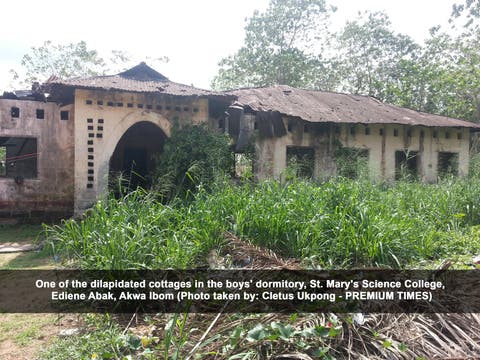
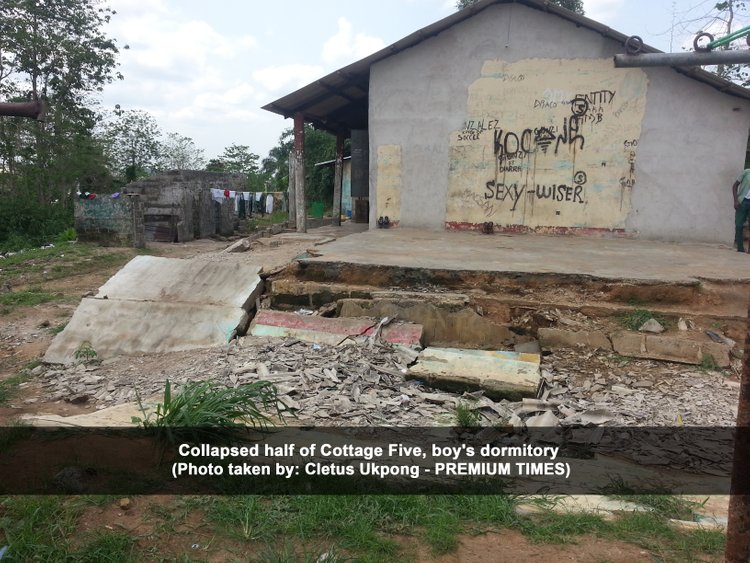
The ruins of the old cottages making up the boys’ dormitory can be seen a few meters away.
Blown-off roofs, partly-collapsed structures, dirty and abandoned buildings surrounded by tall grasses conjure a nauseating atmosphere around the dormitory.
Yet students live within these decrepit facilities, oblivious of the potential safety dangers.
When a PREMIUM TIMES reporter visited the school in April last year, some students were seen still living in one of the dormitories – Cottage Five. A section of the building had fallen down, and the debris were yet to be completely cleared away.
Nothing much has changed one year after, a follow-up visit this April shows.
The ceilings has fallen off in most of the cottages. For one or two that still have their ceilings partly intact, there are visible signs that they are caving in gradually. Yet the students have continued to live in that condition, endangering their lives.
The remnants of the ceilings are covered with graffiti. And the dormitory walls too. It looks like the walls have not been touched with fresh paints for decades.
Standing on the hill where the cottages are situated, this reporter can see some other buildings in the school down a valley, swallowed up by gully erosion which is threatening the school.
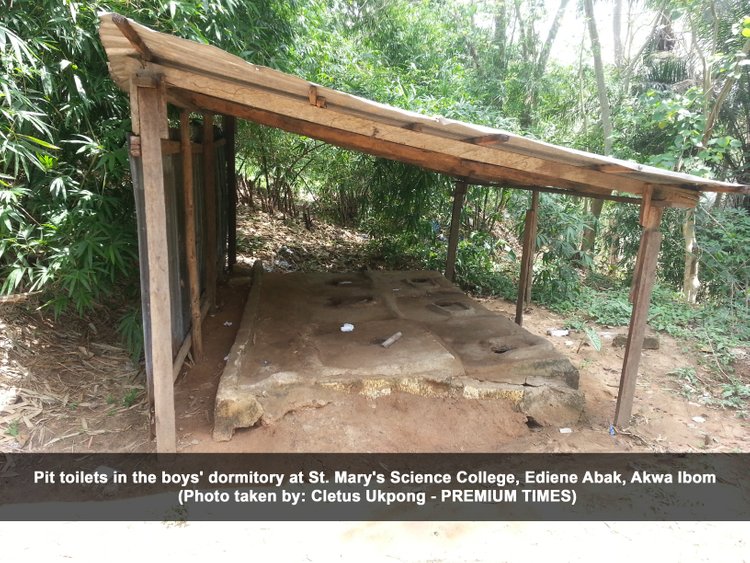
You can see the dormitory’s pit toilets and also perceive the stench oozing out from there.
Empty cans, dirty plates, and papers littered everywhere inside the cottages. The mattresses, as dirty and stinking as they are, have no bedcovers. The pillows too were terribly dirty and nauseating.
Garbage can be seen heaped carelessly at various locations near the dormitories.
“As you can see, the whole place is a mess,” says UbongAbasi Okon, an alumnus of the college guiding this reporter round the dilapidated structures in the school. “It looks more like a place where animals are kept.”
Mr Okon and other alumni of the college resorted to flooding Facebook with photos of the school, after making fruitless efforts to get the Akwa Ibom State government to renovate the dilapidated structures.
St. Mary’s Science College was built 65 years ago by Catholic missionaries. It was initially established for the training of Grade Two teachers before it was converted in 1986 to a senior science college by the government of the then Cross River State in line with the administration’s policy of promoting science education.
At the height of its glory, it was one of the most coveted schools in the old Cross River State. Parents from far and near scrambled to push their wards in. But today it is in ruins, and holds little or no attraction for parents, alumni say.
“This is disheartening,” Mr Okon, the alumnus who guided this reporter round the college, says with a sigh while standing atop the collapsed half of Cottage Five.
“This used to be my hostel,” he says.
Mr Okon, a web designer, graduated from the college 23 years ago.
He says with its present state of decay, he cannot recommend the school to any prospective student.
David Wilson, an expert in mental health, shakes his head in disbelief when this reporter shows him photos of the school’s dilapidated dormitory.
He advises the state government to close down the boarding facilities in the college to save the students from developing mental problems.
“It could lead to psychiatric disorder,” says Mr Wilson, a medical doctor and senior registrar, Department of Mental Health, University of Uyo Teaching Hospital. “It could also lead to conduct disorder.
“A school environment should be managed to support the child. If you are living in an environment that is emotionally unrewarding, you could be exposed to depressive illnesses.”
“It’s terrible,” he adds. “It’s degrading.”
Like hostels, like classrooms
The classrooms, library and the science laboratories in the college are also in appalling conditions.
The tables, shelves, and books in the library are all covered in dust, indicating that the place may have been out of use for sometime.
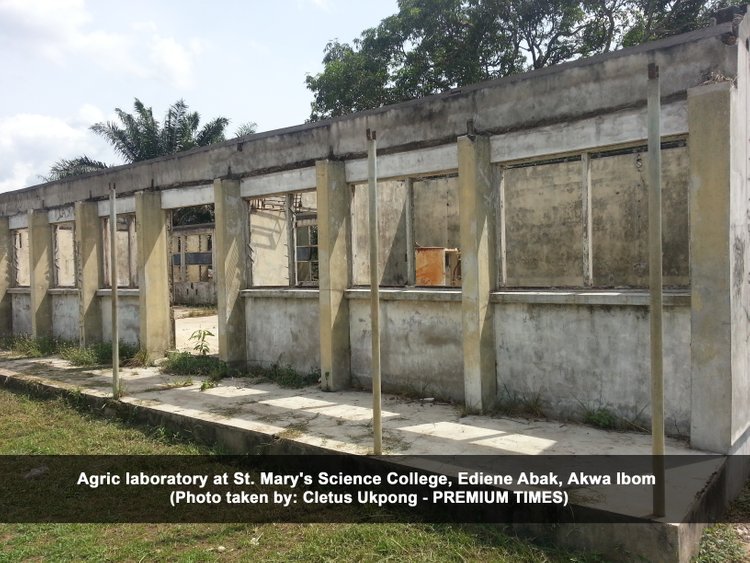
The small hall used as chemistry and biology laboratories are dusty, and without basic science equipment and chemical. And what is left of the Agric laboratory is a building in ruins, with no roof and windows.
The classrooms have only few desks. Graffiti adorns the walls while ceilings have fallen off in some of them. The louvers too are gone, leaving rainwater to splash inside the classrooms whenever it rains. The toilets are non-functional, soiled and smelly.[/color]
A boy and a girl are in one of the classrooms.
The girl, a 16-year old SS 3 student, says she ought to be in the laboratory for physics experiment at that time, but that she was barred because she could not provide the type of battery required for the practical session.
“I bought Tiger Head battery opposite the school gate, but the physics teacher rejected it because it wasn’t strong enough to power the ammeter and voltmeter in the laboratory,” she explains.
She does not have the money to buy the required battery, she says.
The boy, also 16 and in SS 3, had had his own time at the laboratory the previous day.
Both students have just two days to go before their West African Senior Secondary School Certificate Examination (WASSCE).
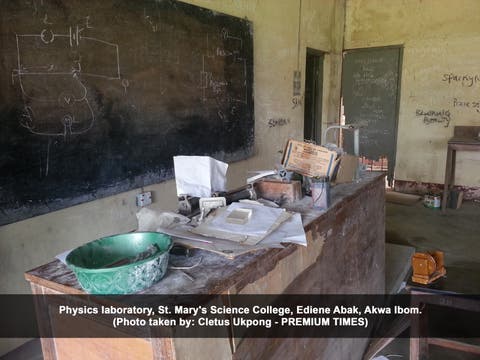
This reporter meets with the physics teacher, Iboro Dickson, in the physics laboratory as he was taking five students through the science experiment.
Mr Dickson, himself a former student of the college, explains that since the school cannot provide the materials needed for the experiment, students must be made to bear the burden.
The physics laboratory, like the other laboratories, is without learning apparatus and other materials. More so, it is dirty. The building has no ceilings and louvers.
Behind where the students are sitting, at one corner of the small hall, is a heap of computer scraps. And that is what the college calls a computer laboratory!
“When I was a student here in1996, the laboratory wasn’t like this,” the physics teacher, Mr Dickson says. “I cried the first day I came here as a teacher.”
Ambrose Useh, the Principal of the college says a government team came to inspect the school in March 2017 after he wrote to the education ministry.
The condition of the girls’ dormitory is not as bad as that of the boys’, says Mr. Useh who says he assumed duties in August 2016 as principal of the once prestigious college. This reporter, being male, is not allowed to inspect the female dormitories.
The parents-teachers association in the school has been inactive, alumni say.
Successive administrations in the state have consistently claimed that reforming the education sector remained a top priority.
In 2014 and 2015, the government specifically budgeted N500 million and N450 million respectively for the renovation and refurbishing of buildings, and provision of facilities in 124 primary and secondary schools in the state.
The government’s plan then, as documented in the budget, was to renovate four secondary schools and four primary schools in each of the 31 local government areas in the state.
Funds were also specifically allocated for the renovation of boarding facilities in secondary schools in the state — N100 million (in 2014) and N200 million (in 2015).
That was beside the N100 million and the N40 million earmarked in 2014 and 2015 respectively for the provision of 2,725 beds for 62 boarding schools and the N100 million and N55 million budgeted for in 2014 and 2015 respectively for the provision of 5,500 mattresses in secondary schools.
There was also provision for another N300 million, both in 2014 and 2015 budget, as subvention to 234 secondary schools.
It remains unclear whether these funds were released or whether the projects for which they were meant were executed. Pressed for months for explanations, education ministry officials consistently declined to comment.
What is however clear, is that a good number of schools across the state remain dilapidated and bereft of essential facilities.
Administration insiders, who asked not to be named for fear of being punished by the authorities, say St. Mary’s Science College, like most of the schools, is a victim of poor management of public funds and corruption among government officials.
Contracts for the renovation of public schools are awarded in most cases as a measure of political patronage to people who will in turn pocket the money, they say. And this, of course, happens in collusion with government officials.
[color=#006600]The state government, in a document circulated on Facebook by the state Commissioner for Information, Charles Udoh, claim Governor Udom Emmanuel administration has constructed and renovated 62 school blocks in the state so far.
The government is, however, yet to provide details of the locations of the projects. Several requests by this reporters are yet to be responded to.
Alumni, teacher to the rescue
A member of the Akwa Ibom State House of Assembly, Aniekan Bassey, who is an alumnus of the college, has stepped in to lobby the state government to save the school.
Mr Bassey, who represents Uruan State Constituency in the House, took some of the aides of Governor Emmanuel on a tour of the college.
He says he was later assured that a new dormitory and classroom blocks would be built during the next round of the state government’s Inter-Ministerial Direct Labour Projects.
The lawmaker says he became aware of the state of the school when a fellow House member, Friday Iwok (PDP/Abak State Constituency), raised the matter during a recent plenary.
Another lawmaker Otobong Akpan (PDP/Ukanafun State Constituency), also an alumnus of the college, says it was sad that the school was left to rot away.
“Why did the school authorities keep quiet for things to get to that state? What happened to the subventions given to the school by the government?” Mr Akpan asks.
Idongesit Reuben, a businessman and an alumnus of the school, tells PREMIUM TIMES his concern is more on the safety of the students.
“We don’t wish to have another tragedy in this state,” Mr Reuben says. “Let the government relocate the students out of the hostels immediately.”
A repeat visit to the school by this reporter on April 6, 2018, one year after, shows no significant improvement so far; saved for the replacement of the roof on three buildings, the hostels and the main classroom block are still in their decaying and squalour state.
There are signs of reconstruction work at the library building but the students on campus, who are writing their senior school certificate examination, tell PREMIUM TIMES the contractor abandoned site four weeks earlier.
This reporter had contacted several administration officials on the state of the college as he worked on this story. It is unclear if the government moved in to do some remedial work as a way of preempting this publication.
Patrick Akpabio, a Catholic priest and Chaplain of the college, believes it might be counterproductive waiting for government to tackle the infrastructural deficit in the school.
Mr Akpabio, who also teaches at the school, is, therefore, mobilising personal resources to build a new chapel for the school after the first one collapsed.
“This is the only pair of shoes I have,” the priest says, pointing to his thick black boots.
“If the white missionaries travelled such a long distance to this place to start this college, then I have every reason to do my best to rescue this school.” Source: https://www.premiumtimesng.com/news/headlines/269683-investigation-inside-the-akwa-ibom-top-science-college-where-students-are-raised-in-squalour-like-animals.html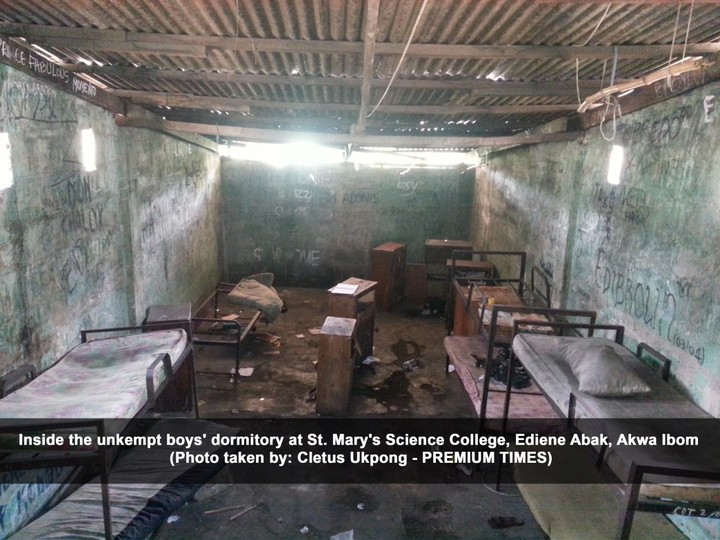
|
| Education › INVESTIGATION: Dehumanised And Demoralised, Unpaid Teachers Dying In Akwa Ibom by Blue3k2(op): 8:08am On Jun 02, 2018 |
The shortage of teachers in Akwa Ibom public secondary schools has reached a disastrous level.
Eunice Thomas, a former commissioner for education in the state, understood the enormity of the crisis at hand and made two attempts at tackling it.
As a commissioner then, she declared a state of emergency on education in the state when she came across the startling revelation that several public schools were without teachers in English Language, mathematics, and other subjects.
And yet students in the affected schools were taking part in external examinations like the West African Senior Secondary School Certificate Examination (WASSCE) and the Unified Tertiary Matriculation Examination (UTME).
A geology graduate, Mrs Thomas, while still doing her official job as a commissioner, volunteered and began teaching chemistry and biology lessons at a public school near her home at Etoi, Uyo, to prepare the students for their WASSCE examinations, she told PREMIUM TIMES.
Just when she began rallying ministry officials, policy experts, principals and teachers for the onerous task of turning things around, she was sacked by the then governor, Godswill Akpabio. She had stayed for only six months in office as education commissioner.
Three years after she left office, Mrs Thomas, still worried about the shortage of teachers in public schools in the state, launched a non-profit called Teachers’ Volunteers Scheme (TVS).
A shocking data released by TVS in 2016 showed that 616 teachers were teaching English Language to 400,603 students across 250 public secondary schools in the state, while 415 teachers were taking that same number of students mathematics.
The student-teacher ratios for English Language and mathematics in the state in 2016, according to TVS, were 1: 650 and 1: 965 respectively.
According to Mrs Thomas, 480 university graduates have so far volunteered for the TVS.
Unfortunately, the scheme was discontinued after three months because people erroneously thought she created it to mobilise support for a particular politician who was running for the governorship of the state, she said.
Mrs Thomas said she is working on a plan to revive and reform the scheme.
As at today, there are still several public secondary schools in the state without teachers in many subjects, according to an extensive PREMIUM TIMES investigation.
For instance, Ukpaubong Community Secondary School, Itam, in Itu Local Government Area, has no teacher in computer science, Christian religious studies, accounting, and insurance. Another school in Itu, Ntiat/Mbak Comprehensive Secondary School, Itu Urban, has no teacher in introductory technology, Christian religious studies, physical and health education, and Ibibio language.
Still in Itu, African Church Secondary Commercial School, Oku Iboku, has no teacher in physical and health education, Ibibio language, government, marketing, Christian religious studies, geography, and accounting.
Atakpo Comprehensive Secondary School, Mbiaya Uruan, Uruan Local Government Area, has no teacher in the following subjects: government, physics, geography, French, and Ibibio language.
The situation is worse in primary schools, this newspaper learnt.
“It’s a bad situation,” the state Chairman, Nigeria Union of Teachers (NUT), Etim Ukpong, who is also the state leader of the Nigeria Labour Congress (NLC) told PREMIUM TIMES.
During the 2016 May Day rally in Uyo, Mr Ukpong publicly told the state Governor, Udom Emmanuel, that the “classrooms in our schools are virtually without teachers”.
A retired permanent secretary, ministry of education, revealed to this newspaper that 17,300 new teachers were needed to fill the vacuum in public secondary schools in the state as at 2013.
For that year, he said, the state had only 6,000 to 7,000 teachers in all the 250 public secondary schools.
English Language, mathematics, geography, and economics are among the subjects that were critically in need of teachers, the retired permanent secretary said, adding that there were not up to 50 teachers teaching home economics in all the secondary schools in Akwa Ibom.
Botched effort at teachers recruitment
The Akwa Ibom government in 2012 took over six community secondary schools from their original owners and consequently offered direct employment to their teachers and the non-teaching staff. But the process of perfecting the employment contract came to an inconclusive and embarrassing end because of the action of corrupt state officials who wanted to use that avenue to smuggle people into the state civil service.
“You could imagine small community schools producing about 546 staff!” the NLC chairman, Mr Ukpong, told PREMIUM TIMES. “Naturally, the governor was not happy with it.
“The government set up a committee headed by the then Head of Civil Service, Cecilia Udosen, to look into the problem. The committee pruned the number down to 444. But the current administration rejected it, saying that to accept it would mean accepting illegality.
“That is where we are right now,” Mr Ukpong said.
But while the corrupt officials who caused the disruption walked away unpunished and are still in the state public service, the affected teachers have not received their salary for about four years now. Moreover, the government is yet to clearly define their status (even though they were given letters of employment by government).
Till date, the teachers have continued to teach in their respective schools, with the hope that someday the government will regularise their contract. Fifteen of them have died so far while waiting for that hope to be fulfilled, PREMIUM TIMES learnt.
In an attempt to call attention to their plight, one of the teachers in January 2016 threw himself into the front of a moving vehicle in Governor Emmanuel’s convoy near the entrance gate of the Government House, Uyo.
He got hit by the vehicle and was also beaten up by security officials attached to the governor, those who witnessed the incident said.
During the 2016 May Day rally at the Uyo Township Stadium, the teachers smuggled themselves into the NUT line during the march-past.
When they reached the spot where Governor Emmanuel was taking salute, they brought out their hidden placards and displayed them before the governor to tell of the injustice done to them.
The state chairman of NUT, Mr Ukpong, during the rally, pleaded with the governor on behalf of the teachers.
“For the free and compulsory education to be meaningful, many things have to be done. One of them, Sir, is to employ teachers,” Mr Ukpong told the governor.
“The set of teachers brought in through the State Secondary Education Board, and who have been working without salaries since January 2013 can help narrow the yawning gap. They are not many, we plead on their behalf,” he said.
One of the affected teachers, Uwem Bassey, told PREMIUM TIMES, “We’re going through terrible suffering. The way and manner we have been treated is enough proof that the people of this state have lost their humanity.”
Mr Bassey, 49, says his survival and that of his three children now depend on his wife who deals on fairly used shoes.
“I’m appealing to the governor to intervene for the sake of our lives,” he said with teary eyes. “Please let the government think about us.”
Also, the state government in 2015, during the last days of Godswill Akpabio administration, hurriedly recruited 5,000 teachers for public secondary schools.
But after the teachers received their employment letters and were waiting for posting to schools, Mr Akpabio’s successor, Governor Emmanuel, terminated their appointment on the ground that the recruitment process was tainted by fraud.
Since then the case has dragged on with some of the teachers suing the government for wrongful termination of employment.
Others resorted to prayers, with the hope that God would touch the heart of the governor to rescind his decision.
The recruitment is being done piecemeal after the government administered a new test to the 5,000 teachers in February 2017.
In August 2017, the government announced the employment of 1,500 teachers, out of the 5,000.
One of the newly recruited teachers told PREMIUM TIMES that she paid N500,000 bribe to a government official before she was finally employed.
Two of the recruited teachers also told this reporter that they know of people who didn’t write the February 2017 test but were able to get employment letters after paying between N300,000 to N500,000 bribe.
The government, this April, released additional 500 names of newly employed secondary school teachers from among the 5,000. The contract letter says their employment took effect from April 1, 2018, but they are yet to be called to assume duties or posted to schools as at the time of filing this report.
The 1,500 teachers employed in August 2017 haven’t been paid their September and October 2017 salary; the government started paying them from November, even when the contract paper says their employment took effect from September of that year, according to PREMIUM TIMES investigation.
“Teachers building beautiful houses from proceeds of examination malpractice.”
Apart from inadequate number of teachers, there is also the problem of poor teacher quality, low morale and widespread corruption within the teaching practice in the state.
Nicholas Luke, a retired secondary school teacher in the state told this reporter, “What has finally killed the education system in the state is examination malpractice masterminded by teachers.”
Mr Luke said the enrolment of students in the SS 3 in rural communities is usually high because of how teachers assist students in such communities to cheat in external examinations.
“The question is, why are teachers deeply involved in examination malpractice? And the answer is, because the teacher feels that the politician owns a four-storey building, while he doesn’t own even a bicycle.
“Today, teachers are now building beautiful houses from proceeds of examination malpractices. I know some of them. A teacher that is on level 10 has a two-storey building, courtesy of examination malpractice.
“It’s endemic,” he said.
Teachers’ salary, because of special salary structure, is slightly better than that of their counterparts in the Akwa Ibom state civil service.
A fresh university graduate employed as teacher in the state public school earns about N50,000 monthly salary, compared to a civil servant whose salary is about N45,000.
A school principal receives between N350, 000 and N400,000 as monthly salary.
But that doesn’t mean all is well financially with teachers in the state, according to experts in the education sector.
“As a principal of a school on level 17, for example, your counterpart in the ministry is a director and is entitled to an official car, and a few other things,” said a former teacher who retired as a director in the state’s education ministry.
“In fact, there are people who work in the ministry, they are not up to level 12, but at the end of the month what they take home is better than what the principal gets.
“Where a vehicle is not there, a director in the ministry is entitled to an imprest which allows him hire vehicle for official duties. A principal isn’t entitle to an official vehicle, he will have to find his way or pay from his salary,” he said.
Government officials and experts attribute the problem of education in the state basically to poor process of recruiting teachers and poor funding.
Eno Usoro, a professor of business education at the University of Uyo (Uniuyo), Akwa Ibom State, said many people who studied education at the university are outside the classrooms, while those who studied other courses are the ones recruited as teachers.
Antiaobong Ekong, a professor of agriculture education in Uniuyo and a former commissioner for education in the state, corroborated Mrs Usoro’s claims. “Those who didn’t study education are always the first to be employed as teachers by the government because of political connection,” he said.
“You can’t sow yam and then expect to harvest cocoyam,” the state chairman of NUT, Mr Ukpong, said of the poor qualities of teachers in the public schools. “If the teachers are of poor quality, it means the society itself is of poor quality.
“There was a time in this country when a teacher was the best gentleman around. Today, the society treats teachers poorly. The teachers are not given due respect. It is the societal factors that have made them not to be effective,” he said.
A retired official in the education ministry told this newspaper that things have degenerated to an incredible level where teachers in the state now feel ashamed to publicly introduce themselves as teachers.
“If you introduce yourself as a teacher, people usually think you are some kind of a misfit, economically,” said the retired official.
“There is a subtle stigma here – people think that teachers don’t have money and cannot be as rich as people in other professions.”
He said the discrimination against education as a discipline starts right in the university.
“A student scores 250 point in JAMB and go into the university to study medicine. Another student scores 250 and go in to study education. But if the state government wants to give bursary or scholarship, the guy studying medicine gets three times more than what the guy studying education gets.
“So, it would look as if teaching is not as important as other professions.
“That’s how teachers are generally treated,” he said.
He continues, “The present turnout from our schools, I am not sure will be competent to handle positions in the near future. Even in journalism profession, you would have come across a number of people who cannot write a good news report for people to read.
“These are happening as a throwback for the neglect of teachers who feel they are not sufficiently motivated to do their best.”
Emem Edoho, a former president of the National Association of Akwa Ibom State Students (NAAKISS), said the size of the population of graduates and school certificate holders who can’t write a good sentence is an indicator of the “extremely deplorable and degraded” standard of education in the state.
“I hired a lawyer to defend my town union recently in Eket High court over a civil claim. To my greatest surprise, the lawyer, could not move a motion in the open court. I had to debrief him and secure the services of a competent lawyer in Uyo,” Mr Edoho said.
“I am aware of a graduate in my workplace who cannot write a memo. I am also aware there are worse cases,” a lawyer in the state, Mbebe Albert, told this newspaper.
Blame the government, not teachers.”
Most people who spoke with PREMIUM TIMES said the state government should rather be blamed for the ineffectiveness and corruption among teachers in public schools.
They cited the delay in payment of salary, non-payment of promotion arrears, leave grants, and gratuities, as well as corruption among government officials and the political class as having far-reaching negative impact on the teaching profession in the state.
“When we talk about payment of promotion arrears, leave grants, and gratuities to the teachers in Akwa Ibom, the administration of Udom Emmanuel is the worst in the history of the state,” said a secondary teacher who didn’t want his name mentioned for fear of being victimized.
“The teachers in this state are suffering. They are angry with the governor,” he said.
During the 2016 May Day rally, the state Chairman of NUT, Mr Ukpong, took time to explain to Governor Emmanuel the issues around promotion arrears, the leave grants, and gratuities.
“An average public servant has only three occasions when he can mould blocks (to build his personal house),” Mr Ukpong told Governor Emmanuel.
“These are when he is paid leave grants, when he is paid promotion arrears, and at retirement when he is paid gratuity.
“If he is denied these, or any of the three, he is most likely not going to be able to mould blocks, talkless of being able to build a house for himself throughout his life.
“We humbly plead that you help us, Sir,” the NUT leader said.
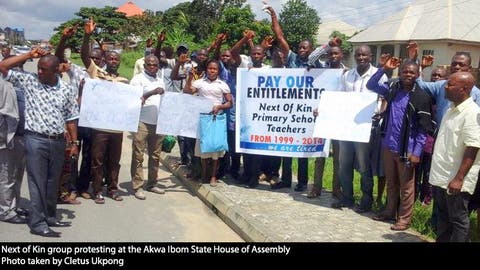
Next of kin put pressure on government over teachers’ gratuities
The government’s inability to pay gratuity to primary school teachers who died while serving the state has emboldened their relatives to come together to form a pressure group called Next of Kin of Late Primary School Teachers in Akwa Ibom State.
For several months now, the group has held regular protest march against the government.
That is besides writing protest letters to public officials, including Governor Emmanuel and the Speaker of the state House of Assembly, Onofiok Luke.
The police in January 2017 arrested three members of the group and charged them to court for protesting in front of the Government House gate. The court found them not guilty.
Some members of the group said the government has paid them part of their late parents’ entitlements. Others said they were still waiting for payment.
Benson Udo, one of the group leaders, told PREMIUM TIMES they were hopeful, despite their travails.
“Though wearied and tempted to lose faith because of not getting a response to the several letters we have sent to your office, we are still confident that this government isn’t just a listening one but also an active one,” the group told Governor Emmanuel in a 2016 letter.
“It is bad that our loved ones died in active service. Our inability to receive their entitlement many years after is like walking through the valley of death. Paying us the money will bring huge consolation.
“Ninety-nine per cent of us that voted for you could not have been wrong,” they told the governor.
The then commissioner for education in the state, Paul Udofia, declined comment for this report when he was contacted by PREMIUM TIMES before he was eventually sacked by Governor Emmanuel.
His successor, Victor Inoka, also declined comment, saying having just been appointed to office, he was still “studying the situation”.
The way forward.
A state of emergency should be declared for 10 years in the education sector in the state, says the former NAAKISS president, Mr Edoho, who sees primary education as the weakest link, where the rot is most severe.
“When the foundation is weak every other thing erected on it cannot stand. We need to redesign the curriculum for primary education, recruit qualified instructors and counsellors for each school.
“Teachers training colleges should be reintroduced at least one per senatorial district to retrain our teachers. Recruitment of teachers should be reformed and made transparent and devoid of all forms of favouritism. Educational supervisors should be deployed and strengthened across the state to monitor both the conduct of the teachers and students,” he said. Source: https://www.premiumtimesng.com/news/headlines/270176-investigation-dehumanised-and-demoralised-unpaid-teachers-dying-in-akwa-ibom.html


|
| Education › Re: INVESTIGATION: Despite Shortage Of Schools In State, Akwa Ibom Abandons College by Blue3k2(op): 7:44am On Jun 02, 2018 |
sykeng:
Tomorrow they will propose to build another one of same like just to loot our funds, where as the one already in place lacks maintenance. Gambia on my mind. You are correct. In collaboration with Exxon Exxon Mobil, we are building what would be the best Faculty of Engineering at the University of Uyo, alongside a Skills Development Centre in Ikot Akata, Mkpat Enin Local Government Area. This centre will train the needed manpower for the oil industry, and is affiliated with the Akwa Ibom State University, Ikot Akpaden.
Link utytill:
very correct writeup,udom is failing in education. industrialisation with no human capital development is backward ever. Lol this write up is part four in ongoing investigative report. Im glad he took pictures since 90% wont read past second paragraph. |
| Education › Re: INVESTIGATION: Despite Shortage Of Schools In State, Akwa Ibom Abandons College by Blue3k2(op): 7:31am On Jun 02, 2018 |
DogCynophile:
Too long didn't read Download text reader app if you don't have attention span to read. I reccomend @voice aloud if you have android device. If not let the pictures do the talking. Strikethem:
Seeing those kids made me cry. Our so called celebrities won't see these kind of people to help, but will be busy buying cars for those who don't need it. Celebrities can't and wouldn't need to save society if people held their elected representatives responsible. Politicians are spending tax money afterall. |
| Education › Re: INVESTIGATION: Despite Shortage Of Schools In State, Akwa Ibom Abandons College by Blue3k2(op): 6:06am On Jun 02, 2018*. Modified: 6:58am On Jun 02, 2018 |
|
| Education › INVESTIGATION: Despite Shortage Of Schools In State, Akwa Ibom Abandons College by Blue3k2(op): 6:02am On Jun 02, 2018 |
Apart from many of its schools being dilapidated, Akwa Ibom also has shortage of public schools.
This state of five million people has just 250 public secondary schools, a 2016 data shows. And a number of those schools, including the four science colleges and the seven technical colleges, are in ruins.
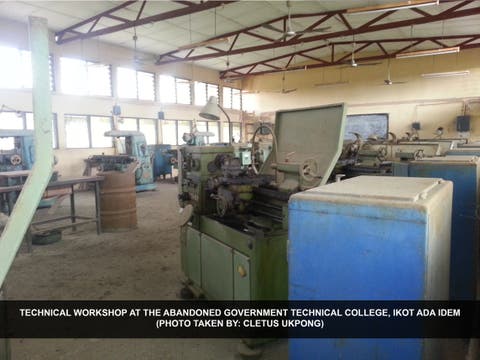
Among the neglected lots, the Government Technical College, Ikot Ada Idem, Ibiono Ibom Local Government Area, presents a shocking irony. It had state-of-the-art facilities, well-built classrooms and top quality teachers when poor planning by the state government led to its abandonment.
These facilities are now rotting away, a development that has infuriated not a few taxpayers.
Built more than 30 years ago, the school was shut down seven years ago when the government proposed converting it to a faculty of engineering of the state-owned polytechnic. In line with that plan, the college’s 2000 students were transferred to other schools in the state. It was then shut down, and left unused for years.
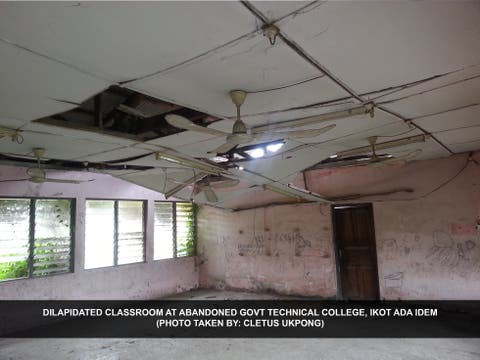
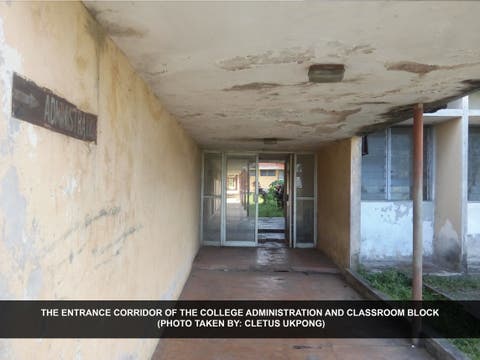
Because it has been abandoned for so long, the 14 classroom blocks, the administrative offices, the assembly hall, and the technical workshops in the school are now at various stages of decay.
The roofs of the buildings have collapsed, while weeds have grown tall inside them. Tall grasses overshadowed the staff quarters and other buildings when this reporter visited in early April.
Standing by the side of the staff quarters was a collapsed building which used to serve as the college refectory. Adjacent it was another collapsed building.
The technical equipment worth tens of millions of dollars were rotting away.
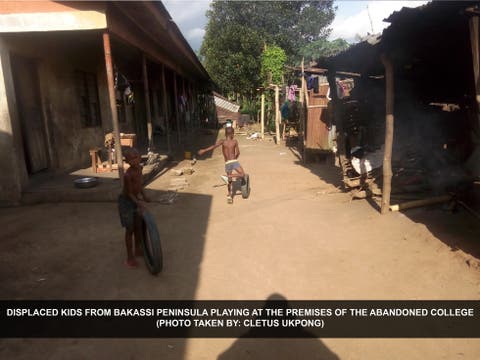
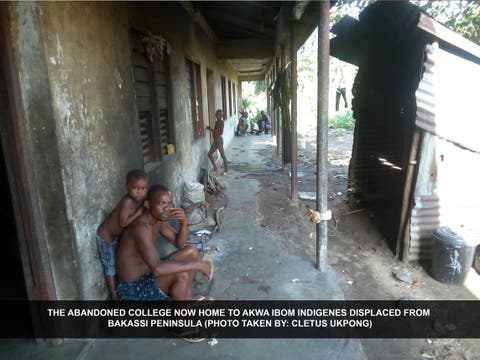
A section of the school facility was already taken over by herdsmen who resided there with their cattle, while another section was occupied by squatters said to be returnees from the contentious Bakassi Penisula.
Cow dungs littered everywhere.
Some of the Bakassi returnees were cooking in a classroom that had become their makeshift kitchen when this reporter visited the facility in October 2017. Malnourished kids ran around, naked.
A repeat visit to the abandoned college on April 14 showed that nothing had changed so far; the herdsmen and the Bakassi returnees were still occupying the premises. There were signs that the corridors connecting the various blocks in the school were now being used as makeshift kitchen as well.
The abandoned college, with its classic architectural design, sits on a large expanse of land by the Uyo-Ikot Ekpene-Aba Highway. It can be easily spotted as you drive through the highway, a few kilometers from Uyo.
The roads inside the college premises are asphalted and lined with street light (they aren’t working anymore, though). Down the hill, behind the college, is a local stream where students used to go swim and fetch water.
In its glorious days, the college was highly rated and very well respected, compared to other technical colleges in the state.
In those good old days, the students were taught refrigeration and air-conditioning repairs, mechanical, electrical, civil works, carpentry, and automobile, and other trades.
“When you come out from the school and you know the practical very well, companies would be looking for you to employ you,” Etim Udoh, an alumnus of the school, told PREMIUM TIMES.
Mr Udoh studied at the college mechanical department in the 80s. He now runs a popular fabrication yard in the capital, Uyo. He specialises in the design and fabrication of industrial machines like cassava and palm oil processing mill.
“We had good workshops then,” he says of his days in the technical college.
“There are people in today’s Akwa Ibom who would have been self-employed if the school were functional.
“After graduating from the college, there’s no way you would not have something useful to do with your hands,” he said.
One man who has hired Mr Udoh and could attest to his skill is Sunny Ayang, a former commissioner in charge of rural development in the state who now runs a toothpicks production plant.
“He is very good,” Mr Ayang says of Mr Udoh. “There’s nobody who runs a production factory in Uyo who doesn’t engage him.
“When the Taiwanese came to install my equipment, they shipped in a long sprocket, they machine was turning in the reverse. When Etim (Udoh) came and merely looked at the machine, he knew what the problem was before the Taiwanese could even explain,” he said.
Ibanga Asanga is another alumnus of the college. He studied refrigeration and air-conditioning technology and was employed immediately after graduation from college. He later left paid employment to set up his own business of maintenance and repairs of air-conditioners, in Uyo. Today, banks, government departments, and universities are among his clients.
“I can say that the Government Technical College, Ikot Ada Idem, helped me 100 per cent to be what I am today,” Mr Asanga told PREMIUM TIMES.
“In Akwa Ibom State today, it is only Government Technical College, Abak, that is doing refrigeration and air-conditioning, but they don’t have standard equipment like Ikot Ada Idem. The equipment at Abak is just ‘manageable’,” he said, while pleading with the state government to consider re-opening the school.
“We are still feeling the school,” says Okokon Akpan, another alumnus of the abandoned college.
“There were times we used to have a senior government official brought fabrication work for our department to do it for him. They used to pay us money for the time we spent in helping out with the fabrication. The head of the department then used to give us small money for what we were doing.
“There were days we were even asked to stay back in the college for some paid jobs during holidays,” said Mr Akpan who studied mechanical works in the 90s and now specialises in the installation of intercom and cable television for companies and private homes in the state.
The college apparently would have helped many youth become self-employed if it were still functional, alumni said.
Ironically, Akwa Ibom occupies an unenviable second position among states with the highest unemployment rate in Nigeria, according to a 2018 data released by the National Bureau of Statistics (NBS).
“If you call 50 university students now and ask them what they are studying in school, they would tell you banking and finance, marketing, management. What are they going to manage? What would they be financing? You want to set up a small factory and you are looking for a machinist, and you can’t find any,” said the former commissioner, Mr Ayang.
“Most people running factories today in the state are hard put to find skilled workers. I have that challenge. We need people who will operate, maintain and repair machines.
“Eighty per cent of the youth in the state should go through technical colleges where they can acquire skills to be self-employed,” Mr Ayang said, adding that foreigners from Togo are now the ones doing tiling and other auxiliary services in newly built houses in Uyo and its environs.
Traditional rulers and community leaders in the college’s host community have now begun to pressure government to reopen the school.
Twenty-four chiefs, under the aegis of the Southern Ibiono Ibom Council of Chiefs, wrote to the state Governor, Udom Emmanuel, three months after he was sworn-in in 2015, calling his attention to the negative effects of the continuous closure of the school.
The college served at least 24 villages when it was functional, the chiefs told Governor Emmanuel in their letter.
“Today, there is no government post-primary school in the 24 villages. All the euphoria about free education does not benefit our children,” the chiefs said, adding that several children from their communities were involved in “avoidable” road accidents because of traveling to the neighbouring local government areas of Itu and Ikono to attend secondary school.
The chiefs continued: “The Representatives of Ibiono Ibom in the State House of Assembly, Rt. Hon. Ime Okon undertook a facility tour of the school and his efforts resulted in including the school in the budgetary estimates of 2013/2014.
“The present Paramount Ruler of Ibiono, His Royal Majesty, Okuku Ime Udo Usoro Inyang, the Academicians of Ibiono Ibom, Ibiono Ibom Welfare and Development Union (IIWADU), Ibiono Ibom Traditional Rulers Council, and individuals have all requested the state government to reopen the school, but these fell on the deaf ears of the state government.”
Two years after their letter to Governor Emmanuel, the college is yet to be reopened. And there’s no sign that it would be reopened soon.
Gabriel Okoh, the Village Head of Ikot Ada Idem, is disturbed by the situation.
“What have we done wrong against the government that they have allowed this school to remain closed for this long,” he said with a forlorn look when PREMIUM TIMES met him in his palace.
The President of Ibiono Ibom Welfare and Development Union, Effiong Inyang, said the government was unfair to the people of Ibiono by allowing the college to remain closed for so long.
“If you go to the school, there are lots of unopened containers with equipment and instruments that have not been used. It doesn’t make sense that we in Akwa Ibom keep crying that we don’t have when we have so much.
“And then even when the government is saying that they have free education, we see children roaming the streets during school hours.
“With respect to whoever is at the helms of affairs in the state, it seems we have been over-blessed by God, and that is why we are abusing these things,” said Mr Inyang, who is a medical doctor.
When contacted, the Commissioner for Information in the state, Charles Udoh, told PREMIUM TIMES the government would announce its plans for the abandoned college “in due course”. Source: https://www.premiumtimesng.com/news/headlines/270417-investigation-despite-shortage-of-schools-in-state-akwa-ibom-abandons-top-multi-billion-naira-college.html


|
| Politics › Re: Abia Anti-open Grazing Law Ready Soon —speaker by Blue3k2(op): 4:09pm On Jun 01, 2018 |
markfemi1:
This is the first time you are posting something sensible. Lol nonsense my post are lit. Stick to your IPOB threads. Maybe you're still hurt your leader disapeared... markfemi1:
We enlightened yorubas will want to borrow nnamdi kanu to give us the leadership our bad leaders denied us. |
| Politics › Abia Anti-open Grazing Law Ready Soon —speaker by Blue3k2(op): 3:13pm On Jun 01, 2018 |
By Anayo Okoli
UMUAHIA—THE Speaker of the Abia State House of Assembly, Rt. Hon. Chikwendu Kalu has given the assurance that the anti-grazing bill currently before the House would soon be passed into law.
According to Kalu, work on the bill has been completed but the members were just doting the “is” and crossing the “ts” so as to get it right.
The Speaker who spoke Tuesday, at his Umuahia official lodge, explained that when passed into law, and security agencies adhere completely to its implementation, the lingering clashes between farmers and herdsmen would end.
The proposed law, he hinted, prohibits movement of cattle by road in the State, as cattle would be moved to the state by trucks or by rail.
“We are interested in getting the anti-grazing bill right. Work on the bill has been completed, it will soon be passed and it has a lot of advantages. The advantages are many.
“If Nigerians work within the ambit of the law, there would be no problem. I urge the security agencies to muster the courage to implement the law when passed, to the letter, to ensure the end of clashes between farmers and herdsmen. If they do it, the law would assure peace between herdsmen and farmers”, the Speaker said.
Giving more insight into the proposed anti-grazing law, Chikwendu said: “We must go the way of ranches. If you are bringing cattle into any part of Abia State, it must be through rail or trucks and they must be registered. Cattle will no longer move on the roads in the State.
“Movement of cattle within the state must be by truck not by road; there will be consequences for violators. With the law well implemented, both the farmers and the herders will be happy.” Read more at: https://www.vanguardngr.com/2018/06/abia-anti-open-grazing-law-ready-soon-speaker/Front Page: Lalasticlala |
| Politics › Re: N4bn Port Facilities Decay In Onitsha 5 Years After by Blue3k2(op): 2:25pm On Jun 01, 2018 |
Obi1kenobi:
Considering the huuuge budgets of Rivers and Akwa Ibom, I'm puzzled why they wouldn't want to take over the facilities. It's not surprising Ondo wouldn't want to take over theirs. States struggling to stay afloat tend to show little interest in decaying Federal infrastructure. Though a fishing terminal shouldn't be that expensive to manage. A lot of it is a lack of vision to be honest. There's no reason to be puzzled these states simply sont care or see potential. Ive post 3 different stories about Akwa Ibom fishing termimal nobody cares. It's not till someone else records sucess in it then will interest suddenly arise. Maybe it slipped their attention since they are focused on Ibom Deep seaport. Your excuse for Ondo doesnt make sense espevislly when state has been lobbying for its own deep seaport. They sucessfully had FTZs and getting bitumen miming licence approved last year. They just havent prioritized the fishing terminal. I dont know about Rivers states. mapet:
this to me is the pertinent question..........so that expectations can be properly managed. Amaechi said the 4 river ports would be ready by 2019. I say 2020 since government timelines are always off by 1 year or more. 
|
| Politics › Re: N4bn Port Facilities Decay In Onitsha 5 Years After by Blue3k2(op): 7:11am On Jun 01, 2018 |
Obi1kenobi:
Why your fuss about Onitsha river port? Why not fuss about Ondo utilizing its huge coasts for another sea port? But una go die ontop Lagos matter, as if Lagos is sole representative of the rest of the SW. When you asked about Ondo you should have mentioned the Igbokoda fishing terminal. Thats the only federal infrastructure the state could take over. I don't know if its bad shape like the one in Akwa Ibom though. It's relevant since it offers potential to tap in fish reserves and reduce dependance of fish imports. The fishing terminals in Rivers and Akwa Ibom are being concessioned. Neither state has shown interest in take over these projects. In Akwa Iboms case its been urged by certain people but nobody in general cares about fish unless they hear avout illegal fishing or high imoorts. |
| Politics › Re: N4bn Port Facilities Decay In Onitsha 5 Years After by Blue3k2(op): 11:21pm On May 31, 2018 |
Anyone have any guesses when the four river ports will be ready. I'll guess 2019-2020 for Onitsha along with ICD. I doubt world world bank would waste their time. They'll be featured together back to back.
Im not sure how gazetting process works but I would think you gazette port after you get consessionsire to manage it. Its weird port inaugurated 2012 with no consessionsire or no gazzetting done. Anyway I'll email the NSC, NIMAS and FMoT ask why. Maybe they'll have an answer.
Ps: these threads get stupid fast but they're entertaining. |
| Politics › Re: N4bn Port Facilities Decay In Onitsha 5 Years After by Blue3k2(op): 7:06pm On May 31, 2018*. Modified: 7:28pm On May 31, 2018 |
Meanwhile, the National Inland Waterways Authority (NIWA)’s General Manager, Corporate Affairs, Mr Tayo Fadile, told this newspaper that the authority has done its part and had handed over the port to the ministry.
He noted that it was not the responsibility of NIWA to concession the river port. The ICRC website says NIWA and FMoT approvals are required. In other news NSC is planning on building inland container Depot (dry port) in Onitsha. Onitsha River Port Concession
(Solicited Proposal): The FGN adopted PPP arrangements to develop four river ports in the Lower Niger, namely:
i. Onitsha
ii. Lokoja
iii. Baro and
iv. Oguta River Ports.
Onitsha River Port was selected as the pilot case. The World Bank is sponsoring the project development and procurement phases for the Inland Port Concession. Technical evaluation for concessionaire procurement concluded and awaiting approval of NIWA and FMoT.
Next Stage:
Financial Bid opening and Negotiation with preferred concessionaire. |
| Politics › N4bn Port Facilities Decay In Onitsha 5 Years After by Blue3k2(op): 4:59pm On May 31, 2018 |
Five years after it was commissioned, the N4 billion facilities at Onitsha River Port are rusting away due to lack of concessionaire to manage the port.
The river port was rehabilitated and handed over to the Infrastructure Concession Regulatory Commission (ICRC) for concession in order to save shippers about N100 billion annually from the costs incurred on cargo clearing at the Lagos seaports.
It is also aimed at preventing losses and risk in transporting the cargo by roads to the various cities in the eastern region.
Already, Expression of Interest (EoI) had received ministerial approval since 2017, but findings revealed that no tangible work has been done to commence the concession of the port.
Also, no concrete reason has been provided by the Federal Ministry of Transportation for delaying the concession.
Meanwhile, the National Inland Waterways Authority (NIWA)’s General Manager, Corporate Affairs, Mr Tayo Fadile, told this newspaper that the authority has done its part and had handed over the port to the ministry.
He noted that it was not the responsibility of NIWA to concession the river port.
Fadile said: “After rehabilitation, we handed over the port to the Federal Ministry of Transportation for concessioning. The concession is being handled by another agency.”
When contacted by telephone, the Director of Press at the Federal Ministry of Transportation, Mrs Yetunde Sonaike, did not respond to a message sent to her as at the time of filing the report.
However, it was learnt that importers were not willing to ferry their containers by barges from the main ports in Lagos, Onne, Rivers and Delta because of the topography of the lower River Niger.
But, according to the Managing Director of Oktopo Logistics Limited, Mr. Samuel Elem, the facilities at river port in the city were wasting due to lack of patronage.
He noted that cargoes expected to be discharged at the port are being freighted through the road. They include household items, machinery, textile materials, motor spare parts and accessories, motorcycle spares and accessories, electronics and electrical goods, building materials, pharmaceutical products, industrial machineries and others.
“When you estimate the costs, importers pay more on freight and, in some cases, they lose their cargoes to thieves and accidents on the highways,” he noted.
Also, Managing Director of Sceptre Consult, Mr Ayodele Jayeola, who said the port was strategic to Warri, Rivers and Onne ports, explained that importers were reluctant to move their cargo through the port because the river was not deep enough.
He said that Onitsha was one of the strategic commercial cities of Nigeria and the West African sub-region with high business activities taking place all year round.
However, he explained that insecurity along the river creeks and estuaries may have created fear in the minds of shippers.
According to him, “nobody would want to risk transporting his consignments where they would not be delivered safely. Everybody knows what has been happening in the Niger Delta areas. The means of conveying the cargoes to the port can be hijacked by thieves.”
He said that once the barge transporting the consignments from the main port is trapped, it would cost extra money to reload them.
It would be recalled that Minister of Transportation, Rotimi Amaechi, said in Lagos, at the 2017 National Inland Waterways Authority (NIWA) International Conference and Exhibition, that tremendous progress on the concessioning of Onitsha River Port had been made.
He said that the process of concessioning of the port would be completed before the end of 2017. Source: https://newtelegraphonline.com/2018/05/n4bn-port-facilities-decay-at-onitsha-5-years-after/ |
| Politics › Re: Falana To Governors: Don’t Expect Buhari To Police Your States by Blue3k2(op): 1:16am On May 31, 2018*. Modified: 1:43am On May 31, 2018 |
What exactly does the council control and how is the NPF not a federal police force? No. Under the constitution of 1999, Section 214, we don’t have a federal government police, we have the Nigerian Police Force which shall be controlled, organised and supervised by the Nigerian Police Council. 1999 Constitution Second Schedule Legislative Powers Part I Exclusive Legislative List
45. Police and other government security services established by law. “Who are the members of the Nigerian Police Council? The president as Chairman, Inspector General of Police, the Chairman of the Police Service Commission and the 36 state governors. So, we have a body where the governors constitute the largest number to determine the fate of the police. 1999 Constitution Third Schedule L. 28
The functions of the Nigeria Police Council shall include -
(a) the organisation and administration of the Nigeria Police Force and all other matters relating thereto (not being matters relating to the use and operational control of the Force or the appointment, disciplinary control and dismissal of members of the Force);
(b) the general supervision of the Nigeria Police Force; and
(c) advising the President on the appointment of the Inspector-General of Police. |
| Politics › Falana To Governors: Don’t Expect Buhari To Police Your States by Blue3k2(op): 1:08am On May 31, 2018*. Modified: 1:40am On May 31, 2018 |
Human rights lawyer and senior advocate of Nigeria, Mr. Femi Falana on Wednesday told governors of the 36 states of the federation not to expect President Muhammadu Buhari to help them maintain law and order in their states.
He said the governors have the power to control the police in their states.
Falana spoke at a Colloquium in honour of the Executive Editor, The News/PM News, Kunle Ajibade who turned 60 two days ago.
The event, under the theme, “A Brighter Future for Nigeria and how to get there.” was held at the Nigeria Institute of International Affairs, NIIA, Victoria Island, Lagos.
Noting the many killings in the land, Falana said unequivocally that it was not the duty of the Federal Government to maintain law and order in the states, as such duties belonged to the governors.
The celebrator, Ajibade and his wife Bumi , and Professor Wole Soyinka
“A governor cannot go to the television and be crying that his people are killed. No. Under the constitution of 1999, Section 214, we don’t have a federal government police, we have the Nigerian Police Force which shall be controlled, organised and supervised by the Nigerian Police Council.
“Who are the members of the Nigerian Police Council? The president as Chairman, Inspector General of Police, the Chairman of the Police Service Commission and the 36 state governors. So, we have a body where the governors constitute the largest number to determine the fate of the police.
“A governor cannot go to the television and be crying that his people are killed. No. Under the constitution of 1999, Section 214, we don’t have a federal government police, we have the Nigerian Police Force which shall be controlled, organised and supervised by the Nigerian Police Council.
“The president cannot appoint the IGP without seeking your consent or remove one. But what has happened since 1999? The governors have totally abdicated the responsibility of managing the Nigerian police force to the president. No governor is informed, they are only informed in a meeting and nobody will oppose it and that is the end of the matter. That is why we are in this mess.
“We are in a republic where the Supreme Court has held that the governor of a state is not for decoration, you have the power to give instruction to the police. The only time the commissioner of police can disapprove your instructions is when he says, please, I want to confirm from the president,” said.
Falana stated that under this dispensation, he has never heard of a situation where a governor ordered a Commissioner of Police to look for kidnappers who were causing problem in his state and the commissioner refused to do so.
“The only thing Abuja does for the police is the payment of their salary. The operational allowances, equipment and the rest have been abandoned to the states. Why then are the governors not taking control of the law and order in their states?”
Lamenting that people are still being killed in Kaduna, Zamfara, Benue and Taraba, the human rights activist added that robbery and kidnapping were also going on in other parts of the country.
“How did we get here? So, if we are gathered here to discuss the future of Nigeria, there has to be peace before we can plan ahead. Armed bandits have killed about 5,000 people in the last one-year in Zamfara State.
“Since the government has lost the monopoly of violence to criminals as it is happening now, it is high time we called on the National Assembly to enact a law to allow military training for Nigerian citizens. Pending the enactment of that law, I am calling on President Buhari to make facilities available in those states where lives have become totally endangered is in line with section 220 of the Nigerian constitution,” he said.
Osun State Governor, Rauf Aregbeola aligned with Falana’s position, while urging Nigerians not to be despaired.
“The success of any African country as said by former Ghanaian president will be nothing if it is not linked to the success of the people.
“My vision is for a Nigeria that will give leadership to other nations, particularly within the Lake region of Africa, where the wealth of our race is actually. Nigeria has the potential to rally the annexation of the resources in Central Africa namely Congo, Kenya and others. Only Nigeria has the means to lead the process of using the resources for the uplift of black race,” he said.
Former Governor of Ogun State, Chief Olusegun Osoba said former President Olusegun Obasanjo used the police to rig him and others out of power in 2003.
“ In my own case, I had Israel Ajao as Police Commissioner. Weeks before the poll, he was working effectively and furnished me with security reports.
“But the former President, Olusegun Obasanjo, transferred him to Abuja. I had to fight before he was redeployed to Ogun State and that tells you how the President could disrupt things in the states,” he said.
While recalling how former IGP, Musiliu Smith, was removed from office, Osoba lamented that these were some of the issues that had affected the country’s democracy.
Dignitaries at the event included the Publisher, Vanguard newspapers, Sam Amuka; former Civil Liberties Organisation President, Ayo Obe; Odia Ofeimum, lawyer Lai Babatunde, Amb. Tokunbo Awolowo-Dosunmu; Mike Awoyinfa, Prof. Chidi Odinkalu, Prof. Tunde Babawale, Tunde Rahman, Gbenga Adefaye, Alh. Sanni Kabir, Owei Lakemfa, Omoba Yemisi Shyllon, Senator Babafemi Ojudu, and others.
*Adapted from Source: https://www.vanguardngr.com/2018/05/falana-governors-dont-expect-buhari-police-states/ |
| Politics › Re: Buhari Backs Away From State Police by Blue3k2(op): 10:09pm On May 30, 2018 |
soldiers are deployed in about 32 states to carry out police duties; if he cannot understand the tragic implications of deploying more and more soldiers around the country with all the support infrastructure, including brigades and operational bases, Its noteworthy to see how different he is from rest of his party sometimes. Anyway I wouldnt think governors would be that dumb not pay police. Even despotic regimes make sure to pay for their soldiers. Lets not forget fact Nigerian police are inder funded which is why soldiers hace to step in condtsntly to do police work. IGP Idris has been lobbying for police trust fund. |
| Politics › Re: Buhari Backs Away From State Police by Blue3k2(op): 8:46pm On May 30, 2018*. Modified: 9:16pm On May 30, 2018 |
Its interesting I would live to see the amendment passed anyway. We still dont have an answer to a constutional question of necessity of presidential assent. Lets say he says no then what? I dint think his assent is necessary cinsidering fact 2/3 NASS has to pass bill. The 75% of total state houses of assemble have to pass same bill with 2/3 majority. Anyway decentralized policing is the answer. The also need to decentralize prisons because if you have police force you also need to have prisin under control. It woukd be silly constantly running to federal prisons. Before all that get rid of secruity vote. Just pass law and be ready to veto. It's much easier than this uphill task of getting constutional amendments. |
| Politics › Buhari Backs Away From State Police by Blue3k2(op): 8:22pm On May 30, 2018*. Modified: 8:53pm On May 30, 2018 |
AFTER many years of pussyfooting on the question of state police, the All Progressives Congress (APC) appears finally to have made up its mind. There will be no state police, says President Muhammadu Buhari in an interview with the Voice of America (VOA) during his trip to the United States. The president was never enamoured of state police, it must be admitted. As a matter of fact, he had always been generally and generously opposed to any constitutional amendment of such weight and substance as to qualify for the progressive label of rapid, if not radical, transformation.
Remarkably, for the significant issue of state police, the president anchored his conviction on the single but simple element of states’ financial solvency. Asked by his interviewer, Aliyu Mustapha, what his position on state police was, the president responded: “I want the Nigerian Constitution to be consulted first and see what it says. If it says they should be allowed, then they should be allowed. But don’t forget, how many times did we have to release money to states in the name of bailouts to enable them pay salaries? How many states are able to pay their workers in time? And you add the police to them? People should look at this matter very well.”
Apparently not satisfied with the president’s rhetorical statement and how he seemed so sparse in his answer, the interviewer pressed him further to know why he seemed unconvinced about state police. The president responded: “No, I am not convinced. We should have solved the current insecurity in the North-east and South-South by now. Can the states be able to shoulder the burden of the police? You cannot just give someone guns and ammunition, train him and refuse to pay him, you know what will eventually happen.”
It is not only the interviewer who was mystified by the president’s response. Everyone would be surprised that for a question that demanded his best philosophical response, complete with a discourse on federalism and examples from other polities, and a reasoned argument from him about why Nigeria should toe the line of the majority or be different, the president simply dismissed the grave constitutional conundrum with a terse and uninspiring reply. Worse, he seemed even unsure what the constitution says on the matter. No, he didn’t seem unsure; he actually did not know what the constitution says.
More and more, it is evident that there will be no serious effort to rework Nigeria. If the president cannot appreciate the significance of the insecurity problem overwhelming Nigeria, where soldiers are deployed in about 32 states to carry out police duties; if he cannot understand the tragic implications of deploying more and more soldiers around the country with all the support infrastructure, including brigades and operational bases, then clearly Nigeria will keep on mindlessly adopting the same jaded measures and expecting different outcomes. It is clear that, as his position on many grave national issues indicate, the president has made up his mind on state police without giving the matter any serious thought whatsoever.
With the president making up his mind so facilely, supported largely by confused commentators averse to fundamental structural and constitutional changes, the idea of state police may be dead for now. But it cannot be avoided in the long run, of course, and things are going to get far worse before Nigerian leaders recognise that they had been tilting at windmills. The president’s response also shows the hypocrisy of the APC and the disconnection between him and his party. In January, the APC ad hoc committee on true federalism indicated that a majority of respondents agreed with the quest for state police. It is not clear whether the president consulted with the recommendations made by the committee set up by the party he leads.
Importantly too, in February, perhaps flowing from the work of the party’s ad hoc committee, Vice President Yemi Osinbajo cautiously threw his weight behind state police. That same February, the Nigeria Governors’ Forum (NGF), pursuant to a national security summit they held in Abuja, all but accepted the inevitability of state police, but hedged it with the caveat that only states able to fund it should go for it. The governors did not make the argument about the possible misuse of the police, even though it is a genuine reason to dilly-dally.
Overall, the president is wrong to hinge his distaste for state police on the issue of funding. Not only is the federal government grossly underfunding the police, it is not also able to innovative in structuring and running it. If the states had not weighed in to provide financial succour for the police, the law enforcement agency would have since collapsed.
It is also frustrating that the president simply cannot make a connection between the increasing deployment of soldiers in states for police duties and the fact that the present structure, control, funding and operations of the police indicate both gross inadequacy in federal management of the organisation and the need to develop a new police and law enforcement paradigm in its entirety. But perhaps the president and his aides are still capable of presenting far more plausible and coherent arguments to sustain their needless and counterproductive opposition to state police. The public would like to hear those arguments. Source: http://thenationonlineng.net/buhari-backs-away-from-state-police/amp/Front Page: Lalasticlala 
|
| Politics › Understanding Security Votes by Blue3k2(op): 1:53pm On May 30, 2018 |
What is a ‘security vote’?
Security votes are budgeted funds provided to certain
federal, state, and local government officials to spend at
their discretion on—in theory—anything security-related.
They are budgeted separately from planned security
expenditures such as personnel salaries, allowances,
equipment, training and operational expenses. Security
votes also differ from extra-budgetary defence spending
that may be authorised by the President—often in secret—from opaque sources like the Federal Government Independent Revenue account. In practice, however, security votes have become opaque discretionary accounts (‘slush funds’) that serve several overlapping functions:
• Formal. Supplement army, police and other
security agencies’ expenditures, often because
their budgets have been embezzled or withheld;
• Informal. Mobilise and sustain non-state security
actors (e.g. vigilantes, youth volunteers, local militias);
• Political. Channel public funds into political
patronage networks, party coffers, or to cover
the cost of elections including campaigns, vote
buying, rigging, hiring thugs and post-election litigation;
• Personal. Personally enrich senior politicians,
officials and security officers.
The use of the word ‘vote’ to describe a budget item dates back to the British colonial era. Outside of Nigeria, the term continues to be used by officials in the UK, India, Uganda, Kenya and Australia. In India, the term ‘vote-on-account’ describes temporary funds released by Parliament to cover exigent government expenses until a formal budget is passed.7
Unusually for a country as legalistic as Nigeria, security
votes do not have a specific constitutional or statutory
basis8—yet neither are they explicitly prohibited. Security votes somewhat resemble the ‘Contingencies Fund’, a Nigerian constitutional mechanism that gives federal and state legislators the power to create a fund for the executive to draw upon when there exists an ‘urgent and unforeseen need for expenditure for which no other provision exists’.9 Unlike security votes, the executive must justify to legislators any withdrawal from this contingency fund.10 The ‘Service Wide Vote’—a massive source of extra-budgetary cash that Ministry Departments and Agencies (MDAs) can apply to draw upon—also resembles a security vote. Appropriated by legislators and controlled by the Ministry of Finance, this pot of money (over $532 million/N191.6 billion in the 2017 budget) resembles the Contingencies Fund insofar as it is meant to cover unforeseen expenses.
The nature of these ‘emergency’ expenses covered by
security votes, the Contingencies Fund, and the Service
Wide Vote vary widely—personnel costs, pension arrears, election commission expenses, entitlements paid to former presidents and even security expenses—according to a 2013 government audit report.11 This audit also showed several ad hoc outlays including $35 million (N12.6 billion) in payments to the Nigerian Army Quick Response Group and $425.4 million (N153.1 billion) for the Presidential Amnesty Programme for ex-militants in the Niger Delta.
Historical origins
The origins of the modern security vote likely date back
to the late 1960s, when head of state General Yakubu
Gowon granted state military administrators small slush
funds—labeled ‘security votes’—they could use to placate civilian elites rankled by these officers’ new-found dominance over state affairs. In the late 1970s, head of state General Olusegun Obasanjo strengthened Nigeria’s regime security apparatus following the assassination of his predecessor General Murtala Muhammed in February 1976, creating the National Security Organisation (NSO)—forerunner to today’s State Security Service (SSS). Created by military decree, all operational and administrative information about the NSO—including its budget and expenditures—remained closely held secrets.12
During the civilian-led Second Republic (1979-1983) under President Shehu Shagari, the use of secretive security votes continued and were used by corrupt politicians to siphon public funds. When General Muhammadu Buhari became head of state following the 1983 military coup, his government arrested scores of former officials for embezzling these funds. In 1984, former Kwara State governor Adamu Atta was jailed for embezzling $2.7 million (equal to $6.3 million today) in security vote.13
Following the overthrow of Buhari, the General Ibrahim Babangida (1985-1993) and General Sani Abacha (1993-1998) governments perfected and institutionalised the use of security votes as a tool for self-enrichment. Under Babangida, only the president and his inner circle enjoyed privileged access to security votes—even state military governors received only token sums.14 Abacha and his associates embezzled over $2 billion in cash withdrawn from the central bank—ostensibly as a security vote—according to US Department of Justice court filings.15
Following Nigeria’s 1999 return to civilian rule, soldiers turned-civilian officials such as President Obasanjo and National Security Adviser Aliyu Mohammed Gusau
allowed security votes to multiply and proliferate across
government and the security sector. Nigeria’s 36 civilian
governors also embraced this powerful source of political patronage, campaign finance, and personal enrichment. Within just a few years of taking office, Nigeria’s civilian leaders had embraced and revitalised the security vote despite it being an anachronistic and controversial symbol of military rule.
Security votes as a political tool
Today, security votes are budgetary black boxes that are
ripe for abuse by politicians seeking reelection or officials looking to run for political office. Fungible, unaudited, and transacted entirely in cash, security vote is an ideal mechanism for covering electoral expenses—including unsanctioned ones like hiring political thugs, bribing election officials, running post-election litigation and even praying for divine intervention. In the words of one veteran politician:
Why are we probing security votes now? You see, security votes to my understanding can be used for native doctors, it can be used to hire Alphas [sooth-sayers] and it can be used for churches to pray
for the country. It can be used for even sponsoring
things.
One former governor was even more candid about the
political utility of security votes as he explained how a
hypothetical first term governor might seek to use it to co-opt the top election official in his state:
When the Resident Electoral Commissioner (REC) comes before the elections are conducted...he pays a courtesy call on the governor. It’s usually a televised event you know, and of course he says all the right things: “Your Excellency, I am here to
ensure that we have free and fair elections and I
will require your support.”
After the courtesy call, the REC now moves in for a one-on-one with the governor and says, “Your Excellency, since I came, I’ve been staying in this hotel, there is no accommodation for me and even my vehicle is broken down and the last Commissioner didn’t leave the vehicle…” The Governor says [to his Chief of Staff]: “Please ensure that the REC is accommodated. Put him in the Presidential lodge, allot two cars to him...”
A few weeks to the elections, the REC sees the governor...and says, “we need to conduct a training programme for the [polling unit] presiding officers and headquarters hasn’t sent us any money yet, you know...” [The governor asks] “How much would
that cost?” The REC replies: “N25 million [$170,000
as of 2010] for the first batch, we may have about
three batches.” [Calling his Chief of Staff, the governor says] “Make sure that we arrange N25 million this week...and N75 million in all...put it under ‘Security Vote’.” In other words...cash in huge Ghana Must Go bags.
Politics may also shape the ever-shifting distribution of security votes at the federal level. Analysis of federal security vote recipients from 2014 to 2018 suggests that the list of second-tier security vote recipients (those receiving token amounts of $30,000 / N10 million or less) varies widely year-to-year. For example, under President Goodluck Jonathan, the Nigerian Embassy in Moscow received a sizeable $263,000 (N42.1 million) security vote in 2014, but has not received one since. Perhaps it was not a coincidence that in 2014, the then-Ambassador to Russia Assam Assam was contesting in the People’s Democratic Party governorship primary in Akwa Ibom State.
President Buhari’s final budget for 2018—ahead of the
2019 elections—reveals a huge expansion of the use of
security votes, with the total number of MDAs receiving
a security vote from about 30 in 2016 to over 190 in 2018. With the approach of the 2019 election, this abrupt increase should ring alarm bells for those overseeing Nigerian public spending. Source: http://ti-defence.org/publications/camouflaged-cash-how-security-votes-fuel-corruption-in-nigeria/ |
| Politics › 17 Boko Haram Members Surrender, Give Reasons by Blue3k2(op): 7:51pm On May 28, 2018*. Modified: 8:11pm On May 28, 2018 |
Seventeen suspected Boko Haram members on Monday said they surrendered to the Nigerian military due to the federal government’s pledge to offer them amnesty.
One of them, Ahmed Alhassan, disclosed this when Rogers Nicholas, a major-general, paraded the suspects at Theartre Commander of Operation Dole in Maiduguri.
He said they heard President Buhari’s appeal through the radio at their camp known as “Marcas of Nguma” at the shores of Lake Chad region.
“We have been contemplating to surrender ourselves after we realised that we were being recruited into false movement. What pulled us back was the fear of being caught and killed by either our members or the military.
“But after the announcement by President Muhammadu Buhari on granting amnesty to those who surrender, drop their arms and accept peace, we decided to defy all the fear and eventually came out.
“We also made up our minds to sacrifice our lives in a bid to secure freedom, knowing fully that God will forgive us for attempting to embrace peace and stop the killings,’’ he said.
The suspect said that he was forcefully initiated by the Mamman Nur’s faction after the insurgents stormed their town in Munguno four years ago.
“They gathered all of us and selected some of us, which they said we shall be working for the cause of God. Those who refused were eventually killed.
“Many have been conscripted and recruited, some have spent one and half, some two and some of us have spent four years,” he said.
He commended the military for treating them with respect and dignity, urging other members to embrace the Federal Government’s peace avenue to surrender.
“We eat the best of food and sleep in a conductive atmosphere. We are also allowed to interact with some our colleagues. They listen to us and share our pain,“ he said.
Mustapha Umar, another suspect, who claimed to be from Abubakar Shekau’s faction, said he had worked as a commanding officer for the group for about three years.
Mr Umar said he laid his arms because he was tired of the atrocities being committed under the guise of fighting for the religion of Islam
“We realised that the group was serving the course of the devil by committing all forms of atrocities. There was a lot of hardship in the camps. Many have been killed by one form of disease or the other.
“I am happy to be out here. The military have been treating us very humanly and I want to ask for forgiveness for all the pain I may have inflicted on the people while fighting for the baseless course,’’ he said.
In his remarks, Mr Nicholas, The Theartre Commander of Operation Lafiya Dole, said that the 17 suspects willingly surrendered themselves and renounced their membership to the fighting troops.
Mr Nicholas said that about 70 suspected Boko Haram surrendered in Munguno and 60 in Bama, adding that many others had continued to drop arms in different designated military centres.
“You can see that they are finding it easier to surrender. We have our designated centres where such persons can come out and surrender and it is yielding result,” he said. source: https://www.premiumtimesng.com/news/headlines/270089-17-boko-haram-members-surrender-give-reasons.html |
| Politics › Nigerian Govt Restates Commitment To Float National Carrier By December by Blue3k2(op): 8:25pm On May 27, 2018 |
The federal government on Tuesday restated it’s commitment to float a new national carrier by December 2018.
Chidi Izuwah, the acting Director-General of the Infrastructure Concession Regulatory Commission (ICRC) gave the assurance in an interview with the News Agency of Nigeria (NAN) in Abuja.
He said that President Muhammadu Buhari has given the National carrier Committee a timeline which must be met stating that a task force was created which would work intensively for the next six months.
Mr Izuwah, who is also a member of the Ministerial Committee on the Establishment of a National Carrier said that it would be private sector driven leading to the concession of the airports. He said ICRC would look at the business case.
“The committee has met and set up a plan. What the plan is, is to make sure that there is a business plan, which is the first thing if you want the private sector to participate.
“You must let them know that if they invest in this business, they will make profit, our plan is to attract investors and request for qualification process, which is part of the ICRC guidelines for procurement.
“Where we identify pre-qualified bidders, who can now bid, which will be a very competitive process all around the world, It’s a very pressurised timeline I must say, but the committee is committed to be able to do that.
“Because the National carrier is very crucial for our economy and in addition the entire aviation infrastructure, what we are doing is that, we just certified the Aviation Leasing Company, it will make access to aircraft easier for our airlines.”
He said that the national carrier would create huge jobs, noting that the aviation sector has been creating jobs for other countries instead of Nigerians stating that the carrier is a pride of every nation.
Mr Izuwah, however, said that government is willing to partner with the private sector to drive the economy.
(NAN) Source: https://www.premiumtimesng.com/business/business-news/269352-nigerian-govt-restates-commitment-to-float-national-carrier-by-december.html |
| Politics › Governor Ikpeazu Seeks Federal Government’s Support For Cross River Superhighway by Blue3k2(op): 7:18pm On May 27, 2018 |
Gov. Okezie Ikpeazu, of Abia has called on the Federal Government to support Cross River Government to execute its multi-billion dollar 274 kilometer superhighway and Bakassi deep seaport projects.
Ikpeazu made the call on Monday in Calabar during a courtesy visit to his Cross River colleague, Ben Ayade.
He said that the projects were of huge economic benefits to the state, the North-East and the entire country because they would allow the region easy access to the sea.
The Abia governor said: “it is only a man of courage and vision that can embark on such monumental projects.
“The potentials of the deep sea port and the super highway projects will add value to other states in Nigeria.
“If we are serious about diversification, the best thing to do is to encourage the realisation of these signature projects.
“So, we are appealing to the good reasons and logic of our leaders everywhere to lend their voice and support to the projects,” he said.
Ikpeazu said that Abia which shares borders with Cross River would be privileged to benefit from the abundant natural endowment in the state.
“The time for us to tap the full potentials of the seaport in Cross River is now.
“It is not proper to restrict the entrepreneurial spirit and energy of our people to just one or two seaports in the midst of many opportunities around us,” he added.
He described Ayade as a visionary leader who was opening vistas of economic growth through exploiting natural endowments and marketing of the country.
Responding, Ayade thanked the Abia governor for soliciting federal government’s support for the projects.
According to him, the state still felt the pains of the loss of its land and 76 oil wells to the neighbouring Akwa Ibom.
Ayade said it was time the federal government wiped the tears of the people by supporting the projects.“One of the ways to do that is by giving institutional support for the realisation of the deep seaport and superhighway projects,’’ he stated. Source: https://nationalaccordnewspaper.com/fw-work-on-cross-river-super-high-way-begins-may15/ |
| Business › Court Declared Me Wanted To Embarrass Me – Innoson Boss, Innocent Chukwuma by Blue3k2(op): 5:06pm On May 24, 2018 |
The Nigerian businessman, Innocent Chukwuma, has described his declaration as a wanted person by a Lagos State Special Offences Court as targeted to humiliate him.
Mr Chukwuma was dragged to the court in January by the Economic and Financial Crimes Commission (EFCC) on allegations of fraud and forgery of shipping documents.
On Thursday, the court presided by Mojisola Dada, declared Mr Chukwuma wanted following protracted attempt to arraign him to face the charges.
The businessman has objected to his trial, saying it was an abuse of court processes as a similar matter is pending before another court.
He also challenged the jurisdiction of the court to try him, as he also petitioned the National Jucidial Council over alleged bias by the judge.
Read Mr Chukwuma’s full statement below:
I have been briefed by my lawyers that Justice Mojisola Dada of Lagos State High Court Ikeja granted the oral plea of counsel to the Economic and Financial Crimes Commission to declare me wanted because of my failure to appear before the court today. I have expressly stated before that I am not afraid of arraignment but must be arraigned through due process of the law.
It must be noted that I, through my legal counsel, challenged the jurisdiction of the Lagos State High Court to hear the forgery charge filed against me by the Economic and Financial Crimes Commission on ground of, inter alia, the charge being an abuse of process. I filed an application before the court that this present charge is an abuse of process because a similar charge on the same subject matter, transactions and issues is ongoing at the Federal High Court Lagos Division between the same parties, in charge no FHC/l/565c/2015. The last hearing of the charge at the Federal High Court was this week, May 22nd 2018.
Furthermore, my legal counsel had at the last court hearing on April 25th 2018 notified the court that I had challenged the Jurisdiction of the court to hear the suit at the Court of Appeal, Lagos Division and that the prosecuting counsels which are the EFCC has equally filed their brief at the Appellate Court. The judge subsequently adjourned the hearing to today, May 24th 2018.
At the court hearing today, my defense team, also, notified the judge that both parties have filed and exchanged their briefs at the Court of Appeal and a date has been fixed for hearing of the substantive appeal and prayed the Honourable Judge to defer to the Court of Appeal to decide the appeal which is on the jurisdiction of the court to hear the suit. Again, my legal team notified the trial court that I had appealed against the order of bench warrant of 9th February 2018 to the Court of Appeal and as well filed a motion for stay of execution of the order of bench warrant.
However, the judge failed to grant the prayers of my legal counsel and quickly granted the plea of the prosecuting counsel to declare me wanted without recourse to due process of the law or listen to the submissions of my counsel on why an order declaring me wanted should not be made.
Declaring me wanted was done in bad faith and is simply to embarrass my personality, defame me and malign my character aimed to distract me from my daily activities in ensuring that Innoson Vehicles continues to produce durable made in Nigeria vehicles.
Recall also that the same Judge had issued a bench warrant against me, while I had challenged the jurisdiction of her court to hear the suit and I also wrote a petition to the National Judicial Council to investigate the circumstance leading to issuing a bench warrant against me and ordering my arrest. In the course of this case, I had filed a motion that the judge recuse or disqualify herself from further conduct of the proceedings which she failed to hear and insisted I must be brought to court against laid down judicial authorities.
Finally I want to expressly state that I am not afraid of arraignment but must be arraigned through the due process of the law. This Trumped Up Charge against me is being instigated by Guaranty Trust Bank, who as at today is indebted to me above N22 Billion Naira, but I know Justice will prevail at the end of the day. Meanwhile, I have also appealed against the order declaring me wanted and as well filed a motion for the stay of its execution.
Cornel Osigwe
Head, Corporate Communications
Innoson Group Source: https://www.premiumtimesng.com/news/top-news/269640-court-declared-me-wanted-to-embarrass-me-innoson-boss-innocent-chukwuma.html |
| Politics › Re: FG Redesigns 2nd Niger Bridge From 2km To 7.9km—ngige by Blue3k2(op): 7:30pm On May 23, 2018 |
Lol this sounds like fake news. The weird thing is vanguard is only major site carrying this story. Why are the suddenly making bridge longer and when did this change get approved? I'll wait for Fashola to confirm this. |
| Politics › FG Redesigns 2nd Niger Bridge From 2km To 7.9km—ngige by Blue3k2(op): 7:22pm On May 23, 2018 |
By Emeka Mamah
ENUGU—FEDERAL Government has said it has redesigned 2nd Niger Bridge from two kilometers to 7.9 kilometers.
The Minister of Labour and Employment, Senator Chris Ngige and his counterpart in the Ministry of Science and Technology, Chief Ogbonnaya Onu, made this known in Enugu yesterday, during the South East zonal stakeholders meeting of the All Progressives Congress, APC.
The meeting was called to discuss the forthcoming congresses and convention of the party in the south east zone.
They said that the government was executing one major project in each of the six geopolitical zones including the second Niger Bridge in the South East, the Abuja- Kaduna road, the Mambilla Power Project and the Lagos- Ibadan road which were all estimated at over $1 billion.
In his speech, Ngige asked the Igbo to support the APC by voting for President Muhammadu Buhari in the 2019 general elections, which he said Buhari would win.
“I am over 67 years and getting to 68. I cannot deceive myself at this age. President Buhari will win the 2019 election. There is no doubt about it.
“Those saying that the north will not vote for Buhari because they are dying of hunger because of him are deceiving themselves.
“Northerners are happy and most of them are into farming because the President has revolutionised agriculture. There is money in agriculture.
“There are no northern labourers or Okada (commercial motorcyclists) in Abuja now.
“Our people should vote for Buhari so that we can produce the Nigerian president of Igbo extraction in 2023.”
Chief Ogbonnaya Onu also spoke in the same vein, adding that the Enugu- Onitsha road and the Enugu- Port Harcourt roads were among the major roads rehabilitated in the country since the advent of this administration, adding that the Federal Medical Centre, Umuahia, Abia State had been given a facelift even as the runway of the Akanu Ibiam International Airport, Enugu , would be extended.
Earlier, the zonal chairman of the party, Chief Emma Eneukwu, had commended the leaders of the party in the zone for their support which led to the peace being witnessed in the states.
Those who attended the meeting included the former governor of old Anambra State, Chief Jim Nwobodo, the former governor of Ebonyi State, Chief Martin Elechi, Chief Gbazuagu Nweke Gbazuagu, Senators Andy Uba, Osita Izunaso, Ifeanyi Ararume among others. Source: https://www.vanguardngr.com/2018/04/fg-redesigns-2nd-niger-bridge-2km-7-9km-ngige/Front Page: Lalasticlala |
| Health › Canadian Firm Takes Over Management Of Ibom Specialist Hospital by Blue3k2(op): 5:05pm On May 02, 2018 |
Canadian Firm Takes Over management Of Ibom Specialist Hospital …..signs pact with Akwa Ibom State Govt
A Memorandum of Understanding has been signed between the Akwa Ibom State Government and Clinotech Group from Canada for the management of the Ibom Specialist Hospital by the Company.
Clinotech Group, Canada is the only solution partner to the Federal Ministry of Health with the mandate to build hospitals of international standards in each of the geo-political zones and manage them.
Speaking during the event at Government House Uyo, Governor Udom Emmanuel congratulated the Company for emerging successful in the bidding process noting that serious criteria were put in place by Government to ascertain the best among the bidders.
The Governor who was represented by the Secretary to the State Government, Dr Emmanuel Ekuwem explained that, “technical capacity, hospital management experience and competencies as well as financial implications were considered when the Commissioner for Health, Dr Dominic Ukpong and his team assessed the entries and capacity of bidders.”
Governor Emmanuel reminded the Clinotech Group that they did not arrive at the position of the new managers of Ibom Specialist Hospital out of sentiment or skewed process and encouraged them to be ready to work and meet the objectives of the huge medical facility.
The Governor explained that he pays a great deal of attention to health care delivery because all his drives in the area of Industrialization, Agriculture, Education, Political and economic inclusion, infrastructural development, poverty alleviation, wealth creation and job creation will not yield the desired dividends without a healthy population of Akwa Ibomites.
He stated that the state needed healthy men and women to put their hands, as patriotic citizens, on the plough to move the frontiers of economic development and public goodwill forward.
Canadian Firm Takes Over Management Of Ibom Specialist Hospital .....signs pact with Akwa Ibom State Govt
Canadian Firm Takes Over Management Of Ibom Specialist Hospital
The Commissioner for health, Dr Dominic Ukpong described the signing of the Memorandum of Understanding between the state government and Clinotech Group of Canada as a red letter day for the Ministry of Health noting that the build up to the formal signing of the agreement was very painstaking.
The Commissioner congratulated the Canadian Consortium for taking over the management of Ibom Specialist Hospital and reminded the new team that the state expects a lot from them bearing in mind that to whom much is given, much is expected.
In the words of Dr Ukpong who earlier recalled the unpleasant experience with the last managers, “the agreement has ensured that we will be together to make it succeed. We do not have any reason to fail.”
The Commissioner went down memory lane and told the investors that the foundation of the hospital was laid in September 25, 2007 to commemorate the 20th Anniversary of the state creation while the inauguration was in May 2015.
He explained that the objective was to offer highly specialized medical services to members of the public, reduce morbidity and mortality through prevention and treatment of cases that are beyond the capabilities of secondary and tertiary health care systems.
Dr Ukpong noted that Nigerians spend billions of dollars on medical treatment outside the country and asserted that Clinotech Group has the capacity to use the well equipped Ibom Specialist Hospital to reverse the trend.
He highlighted potentials in other sectors of the state economy especially in medical tourism and encouraged the new team to take advantage and secure meaningful return on investment.
In his remark, the President and Chief Executive Officer, Clinotech Group, Harrison Ofiyai said they were attracted to Akwa Ibom State to work especially on professional basis and promised to manage the facility professionally and profitably.
He pledged to collaborate with the engineering team, contractors and others to bring about speed and other desired results.
According to Dr Ofiyai, “we will do all our very best within the shortest possible time. We had also thought that we will resume work given short time frame to deal with certain segments of the hospital, moving forward.
He stated the need to fix power as the facilities in the hospital cannot run twenty-four-seven without having constant power supply.
The investors appreciated the state for the peace being witnessed, and hoped that it would continue in that manner as law and order is important for them in their efforts to uphold best practices.
Canadian Firm Takes Over Management Of Ibom Specialist Hospital .....signs pact with Akwa Ibom State Govt
The Signing of the agreement was witnessed by a representative of the Health Minister, Dr Rosemary Bola Olowu, Akwa Ibom State Commissioner for finance, Mr Linus Nkan, Senior Special Assistant to the Governor on Due Process and Technical Matters, Mr Ufot Ebong, Chairman, State Technical Committee on Foreign Direct Investments, Mr Gabriel Ukpe, Chief Medical Director of Turkish hospital, Abuja, Dr Mustafa Ahen, Chief Medical Director, University of Uyo Teaching hospital, Dr Isaac Assam Duo, Banks’ executives and other Investors. source: https://akwaibomstate.gov.ng/2018/05/01/canadian-firm-takes-over-mgt-of-ibom-specialist-hospital/ |
| Politics › Boko Haram: Nigeria Did Not Get Required Support From Obama – Presidency by Blue3k2(op): 4:12am On Apr 30, 2018 |
The presidency on Sunday said Nigeria did not receive required support from the former President of the United States of America, Barrack Obama, in the fight against terrorism.
The assertion was made Sunday in Washington DC by the Senior Special Assistant to President Muhammadu Buhari on Media and Publicity, Garba Shehu, in an interview with journalists.
Mr. Buhari, who arrived the U.S. Sunday afternoon is billed to meet with his host, President Donald Trump, on Monday at the White House.
Mr Shehu said the discussion between the two leaders will centre on insecurity, especially the fight against terrorism.
He said the relationship between Nigeria and the U.S. has improved since the coming into office of Mr Trump.
Mr Shehu said Mr Buhari is the first leader from sub-Saharan Africa to hold talks with the U.S. President in the White House, describing the visit as “a pointer to two important things. One is, no matter how Nigerians take our own country, this is hugely an important country and this recognition is being manifested in this visit.
“And for the President personally, it is equally important that of all the heads of state we have in the continent; that he among all of them has come forward to meet President Donald Trump.
“But it is important to know that beyond the symbolism of the visit, there are important matters affecting both countries that will be placed on the table when the two Presidents meet.
“We have the understanding that the two delegations have their agenda clearly spelt out and there will be interest and focus on the matter of security and safety, focus on trade and investment and focus on democratic development in our country.
“It is important (to note) that cooperation between the two countries has manifestly increased under the Trump presidency. If you recall sometime back, the president had reason to openly complain that we are not receiving as much as we thought we deserve in terms of support and cooperation especially in our fight against terrorism back then during the Obama period.
“And it will seem that quite dramatically and interestingly, a lot of the obstacles are being removed under the Trump presidency and doors are being opened and we are receiving far more support than most people had expected,” Mr Shehu said.
Nigeria is battling with the Boko Haram insurgency which has caused about 100,000 deaths since 2009, according to figures by the Borno State Government.
Although the terror group has been largely decimated by the Buhari administration, it is still able to carry out attacks on civilian and military targets.
Discussion on how to end the Boko Haram insurgency is one of the major issues to be discussed between Messrs Buhari and Trump.
Also, a group of pro-Buhari supporters also on Sunday arrived Blair House where Mr Buhari is staying to show their solidarity with him.
They carried placards in support of Mr Buhari’s fight against corruption and his re-election.
On the solidarity rally by some Nigerians in the Diaspora, Mr Shehu said, “It is a very pleasant development and this tells you that America is a totally different clime, there is a deep appreciation for the work the President is doing for our country.”
The leader of the group, Wale Adewoye, in an interview said, “We are here to support the president.
“We realised that there is a lot of damage done to the county and when Buhari came into power, he tried at least to stop corruption in Nigeria. He is still working on it, it is not easy.
“So we just felt that we should support him in our little way, to encourage the government that we are behind him to support him. On our own way too, when we go back home, we make sure that we don’t influence things negatively, we work on our ways of life to live right,” he said. Source: https://www.premiumtimesng.com/news/headlines/266616-boko-haram-nigeria-did-not-get-required-support-from-obama-presidency.html |