Buchoalfa's Posts
Nairaland Forum › Buchoalfa's Profile › Buchoalfa's Posts
1 2 (of 2 pages)
 Politics › Re: For Those Keen On The Numbers And Geopolitical Voting Patterns by Buchoalfa: 12:18pm On Mar 17, 2020 Politics › Re: For Those Keen On The Numbers And Geopolitical Voting Patterns by Buchoalfa: 12:18pm On Mar 17, 2020 |
The total votes from the south is only more than that of North West with 929,952. Southerners need to learn how to turn up for voting. Watching TV, playing football, surfing the internet on election day will do us no good. Can't we just sacrifice a few hours in a day for four years. |
| Politics › Re: Sanusi Lamido 2023 Campaign Vehicle By Northern Youth Group by Buchoalfa: 12:04pm On Mar 17, 2020 |
johnmartus:So life is only experienced in Lagos? 1 Like 1 Share |
| Politics › Foreign Reserves Sheds $2.97b In Seven Months by Buchoalfa(op): 10:20am On Aug 10, 2016 |
The foreign exchange reserves have lost $2.97 billion since this year from combined challenges of low earnings and interventions in defense of the local currency. However, it has recorded a relative stability at $26 billion market since May 2016, more than at other months of the year, with marginal gains and losses, as a result of policy options, improved earnings and demand pressure on the other hand. Starting from January, the reserves lost $810 million from $28.97 billion; $340 million to $27.82 in February; and gained $40 million in March. In April, it resumed the sliding profile, losing $780 million; $700 million in May, to $26.38 billion; $20 million in June; and $160 million in July. From June to date, reserves’ depletion has moderated due to the introduction of the flexible exchange rate policy, which reduced speculations and volume of spot dollar-purchase, through the foreign exchange forwards market. Similarly, the local currency sustained its loss at the parallel market, exchanging for between N400 to N410 per dollar as at Monday. On the official interbank market, the naira ended weaker at N318.91 per dollar, after trades worth $12.63 million The naira dropped continuously at unofficial market last week after opening at 381 on Monday, riding on the back of assessed dollar demand from individuals travelling abroad for their summer holidays. Already, the Central Bank of Nigeria (CBN) has directed international money transfer operators to pay dollar proceeds from transfers into local commercial banks in naira, while selling the dollars themselves to bureaux de change outlets. The bank hopes the move will help narrow the gulf between the official and black market rates and boost dollar liquidity, traders say. Some past suppliers of dollars, including oil firms, are now selling some of their hard currency directly to petrol importers under an arrangement with the government, draining supply at the market and pressing the reserves. Besides, they noted that banks, which act as agents of some international money transfer operators are yet to comply with the directive from the Central Bank of Nigeria, that instructed them to sell foreign currency remittances to licensed bureau de change operators. Meanwhile, cumulative monetary policy actions of CBN worth N415.5 billion, last week, kept money supply in check, as interbank lending rates remained trended higher. The treasury bills auction, which was conducted twice, had withdrawn N170.3 billion earlier in the week, while the second auction sterilized another N245.2 billion. Consequently, interbank lending rates- Open Buy Back and Overnight, which started the week at less than 12 per cent, ended higher at 19.5 and 20.6 per cent respectively, through steady progression in all the trading days. The first auctioned instruments were the 353-day and 185-day bills at marginal rates of 18.5 per cent and 18 per cent. The second auctioned instruments were the 91-day, 182-day and 364-day securities at stop rates of 15.4 per cent, 18.1 per cent and 18.5 per cent, which were also twice oversubscribed. http://independentnig.com/2016/08/10/foreign-reserves-shed-2-97bn-in-seven-months/ |
| Career › Survival Strategy For Abuja Civil Servants by Buchoalfa(op): 9:41am On Aug 10, 2016 |
It is not unusual for people to operate “kabukabu”, Nigeria’s parlance for unregistered cabs. What is, however, news is that it has gradually become a way of life especially in Abuja, the Federal Capital Territory (FCT), for most civil servants. Residents of the nation’s capital have come to accept it as a part of the city’s transport system. Daily Sun findings indicate that there are two types of kabukabu operators; namely, those who do it for livelihood because of unemployment and others who are duly employed but make out time to use their vehicles as “kabukabu.” The latter are mostly public servants who use their vehicles to comb the city to pick up commuters or passengers especially while coming to work in the morning and returning home after work. Some others still operate during work hours. They include civil servants who may have less to do in the office, policemen, soldiers, and personnel of other paramilitary agencies like the Nigerian Security and Civil Defence Corps (NSCDC) and Federal Road Safety Corps (FRSC). Investigations reveal that personnel of the prisons and immigration services also indulge in “kabukabu” business and their preferred route is the Airport Road, ostensibly because their offices are located along the road. This trade is no longer exclusive for men. Some women also traverse the city with their vehicles engaging in “drop and pick.” The few women involved either ply routes outskirts of the city centre like Lugbe and Nyanya-Mararaba, while those who cover the city centre are usually seen on the Berger-Area 1 and Federal Secretariat-Area 10-Area 1 routes. Why people operate “kabukabu” The origin of “kabukabu” is not really known but it started becoming popular about 12 years ago when the former FCT, Malam Nasir el-rufai’s bulldozers demolished settlements including people’s means of livelihood. The lure in the construction industry in Abuja has also not helped matters. Though people run “kabukabu” for various reasons but operators agreed that they do it to augment their income. Due to the recent hike in the pump price of fuel coupled with the attendant hardship induced by the economic downturn, many people do not want to waste money on fuel driving to work and returning home after work alone in their vehicles. So, each time they are coming out or going home, they pick up passengers. In addition, some persons leaving their offices to other parts of the city may also pick up passengers in order to make more money. A Gwarimpa resident, Mr. Samuel Ademola, did not see anything wrong in the “kabukabu” business: “I do not think that any day would pass by without my carrying passengers in my car. Everything is becoming expensive, even to buy noodles for my daughter; the price has gone up. By carrying passengers every morning and evening, it gives me a little more income.” Another civil servant at the Old Secretariat, Area 1, who gave his name as Mr. Gabriel Eze heaped the blame on the doorstep of the recent fuel hike. He resides at EFAB Estate Lokogoma: “I don’t have a choice, the price of fuel is so alarming. Each time I leave my house, I make sure I carry passengers regardless of where I am heading to.” Like Eze, Mr. Kelechi Utah, a resident of Nyanya said he would not leave his area without carrying four passengers. But James Atah, another “kabukabu” operator gave an idea of how much a civil servant could make weekly from the operation: “The APC change has really changed me. I have no choice but to look for extra means of making income. I go to work everyday so I make at least N4,000 a week by carrying passengers, which is manageable. We will always find a way to survive in this country.” Investigation showed that some persons who devote more time to it, especially after work sometimes make up to N5,000 daily after refilling their tanks. An FRSC officer who operates “kabukabu” with his car bus but pleaded not to be named said there was nothing to be ashamed of. He reasoned that many Nigerians even with big degrees do much more menial jobs abroad: “So, why should I not pull off my uniform and make money, or do you want me to steal?” The hardship in the land notwithstanding, a staffer of one of the security agencies who gave his name as Inah commended President Muhammadu Buhari for blocking areas where public servants pilfered money. Inah, who operates mainly from Bolingo Hotel to the airport when not on duty stated that the present government has made Nigerians to be more creative and hardworking, noting that only lazy persons are really complaining. Challenges Operating “kabukabu” is not all rosy. Operators bemoaned the recent hike in fuel pump price, which they said has seriously affected their operations because people do not have money. So, it has been difficult for them to increase their charges too. While at the same time, they lamented that an operator may run round the city, wasting fuel without getting a passenger in the afternoon, especially now that the schools are on holiday. Besides, they complained about the unwholesome activities of criminals known as “one chance”, who use their cars and pretend to be “kabukabu” operators. These criminals in most case dispossess unsuspecting passengers of their valuables and sometimes harm them. The fear of “one chance” is one factor militating against “kabukabu” operation in the FCT. In fact, this same reason made the Abuja Environmental Protection Board (AEPB), to always clamp down on “kabukabu” operators. It also makes an operator a ready prey for overzealous security agents on the road. But Mustapha Ahman, a civil servant in one of the agencies of the FCT Authority insisted that “kabukabu” has come to stay, noting that any attempt to outlaw it would be anti-people. Rather, he urged the transport department of FCTA to fashion a way of integrating them into the transport policy: “Since the urge for survival forced people into it, the government should find a way of regulating it by registering and taking details of those who operate “kabukabu” in Abuja. Once you register the vehicle, it would be difficult for the user to indulge in criminal ventures.” http://sunnewsonline.com/survival-strategy-for-abuja-civil-servants/ |
| Politics › Education Ministers At War by Buchoalfa(op): 9:15am On Aug 10, 2016 |
The raging cold war between the Minister of Education, Malam Adamu Adamu, and the Minister of State for Education, Prof. Anthony Anwukah, came to the limelight again on Tuesday as the two ministers bickered over the recent hike in the fees of Unity Colleges. Adamu accused Anwukah of unilaterally increasing the fees of Federal Government Colleges (Unity Schools) – in addition to several other alleged infractions. Indeed, Adamu and Anwukah have not seen eye to eye since the appointment of the heads of 17 agencies in the Federal Ministry of Education. In a chat with journalists in Abuja on the sidelines of the National Education Quality Assurance Handbook’s launch, Adamu said the news of the increment of fees from N20,000 to N75,000 was strange to him. He said: “I am not aware that the Unity Schools’ fees have been increased. As the Minister of Education I am not aware but I will try and find out.” Responding to the alleged feud between him and Anwukah over the recent appointment of the new heads of 17 agencies in the ministry, in which the Minister of State was allegedly side-lined, Adamu feigned ignorance of the development. However, he admitted to have mistakenly failed to acknowledge the presence of Anwukah’s representative during the launch of the handbooks yesterday. “I am not also aware that he has been side-lined but you can go and find out from the source that told you,” Adamu stated. Speaking on the Unity Schools’ fees, the Ministry’s Permanent Secretary, Dr Folasade Yemi-Esan, admitted that the Federal Government had hiked the fees. She said that the increment, which was focused on boarding fees, was to cover the cost of running the schools. Yemi-Esan said: “The school fees of the Federal Government Colleges have been increased but not up to the 300 percent as being claimed. You must be aware of the reality in the country. “It is important for the Federal Government Colleges to maintain the students that are there and you must also be aware that these schools are tuition-free. What has been increased is the boarding fees but is not up to N75,000,” she added. But she denied knowledge of any feud between the two education ministers. The AUTHORITY recalls that Prof. Anwukah has been shunning events that attract the presence of Adamu, which a source blamed on the way he was side-lined on the recommendation to President Muhammadu Buhari on the appointment of heads of the education agencies. Apparently to show his grievances, Anwukah allegedly shunned the inauguration of the new chief executives. He was also absent during the flag-off of the 2016 Teachers’ Professional Development in Abuja last week. http://www.authorityngr.com/2016/08/Education-ministers-at-war-over-appointments-fees-hike |
| Politics › The Power Behind The Throne by Buchoalfa(op): 9:02am On Aug 10, 2016 |
The Presidency has taken a drastic action to check the overwhelming influence in Aso Rock, the seat of power, of Alhaji Mamman Daura, a nephew of President Muhammadu Buhari. Mamman Daura is reputed to be the main “power behind the throne” in the Presidency. Without any publicly announced portfolio or appointment, Daura’s only qualification for the power and influence he wields in the government is that he is the President’s nephew. Among the steps taken by the Presidential Villa to cut Daura to size was the immediate withdrawal of all his official vehicles and the stoppage of the supply of refreshments to his office. The AUTHORITY learnt that the Presidency’s action was prompted by the increasing outcry against what an insider described as the “overarching powers and influence” of Mamman Daura in the affairs of the Aso Villa. Daura is reportedly older than Buhari by four years and is alleged to have influenced most of the appointments made so far by the President. The President’s nephew, who is different from the Director-General of the Department of State Security (DSS), sources said, moved his office to one of the guest houses in the Villa, popularly referred to as the Glass House, and parades a large retinue of staff on the payroll of the Presidency. Recently, he was said to have commandeered a fleet of official vehicles from Aso Rock for his personal use while also ordering that breakfast and lunch be provided daily for him and his clan of hangers-on from the Aso Villa kitchen. However, in what sources described as “a decisive move by the First Family to properly define everyone’s roles in the Presidency,” The AUTHORITY gathered that both the official vehicles and the supply of refreshments to his supposed office were withdrawn last week. The move, it was gathered, has the tacit support of members of the President’s immediate family, who consider as embarrassing some of the actions attributed to the President but which, in reality, were masterminded by Daura. Indeed, in a widely circulated interview he granted two national newspapers recently, radical Kano politician, Dr. Junaid Mohammed, who accused Buhari’s government of nepotism, going by the way and manner in which the administration has made appointments, confirmed the fears already expressed in some quarters about the “incestuous” powers of the President’s nephew. Mohammed had described Daura as the most influential person in the Presidency. He said: “First, the most influential person in the Presidency today is one Mamman Daura whom as you know, is a nephew of the President. His father was Buhari’s elder brother. In addition, Mamman Daura was the one who singlehandedly brought up Abba Kyari, the current Chief of Staff to the President.” Mohammed, a Second Republic member of the House of Representatives, added: “Next, the Personal Assistant to Buhari himself is the son of Mamman Daura; next is what they call SCOP, the State Chief of Protocol, and he is also a son-in-law to Mamman Daura because he is married to Mamman Daura’s daughter. “Next, the minister they unilaterally chose against the interests of the party and against the wishes of the Sokoto people, happens to be the daughter of the younger sister of Mamman Daura’s wife. Both of them are daughters of Sultan Dasuki, who was sacked by the late head of state, Gen. Sani Abacha. We have the Aide De Camp to Buhari himself, Colonel Abubakar. He is married to the granddaughter of one of Buhari’s elder sisters. Next, we have the woman who represents Kaduna in the Federal Executive Council (FEC), she is a cousin to Kaduna State Governor, Nasir el-Rufai. “It is well known that el-Rufai is one of the closest governors to Muhammadu Buhari. Next, we have the Minister of the Federal Capital Territory. The Minister of the FCT is the man called Musa Bello, who used to be the Managing Director of the Northern Nigeria Development Corporation, which used to be the biggest holding company that belonged to all the northern states. His only qualification to be FCT Minister is the fact that his father has been Buhari’s friend over the years. Now, there is a young man called Sabiu Yusuf, nicknamed Tunde - probably because of the late General Tunde Idiagbon. He is another PA to President Buhari. He is also a grandson of another sister of Buhari.” While the Presidency has pooh-poohed Junaid Mohammed’s revelations as “sour grapes”, sources close to the First Family said they are actually worried about the bad image “some of Daura’s rather untidy activities have created for the President and may have decided to put an end to it.” To that end, sources equally disclosed, “the aspect of his influencing future appointments in this regime can no longer stand if the current development is anything to go by.” http://www.authorityngr.com/2016/08/Presidency-curbs-Daura-s-influence-in-Aso-Rock |
| Jobs/Vacancies › Re: Aso Villa Demo: 30 Nigerians Shortlisted (List) by Buchoalfa: 2:47pm On Aug 04, 2016 |
Why would the selection be restricted to two Nigerian cities of LAGOS and PORT HARCOURT. So what happens to people in other Geo Political zones. FCT is the Nation's capital. 1 Like 1 Share |
| Politics › Re: Hausa Community And Traders Clash In Asaba by Buchoalfa: 12:47pm On Jul 08, 2016 |
I blame BUhari |
| Politics › Re: Nigerians Rate Buhari High On Economy And Governance - Leadership Newspaper by Buchoalfa: 10:05am On Jun 29, 2016 |
Progressive01:You dont need to tell the world that your head isn't booting well |
| Jobs/Vacancies › Re: Unemployed First Class Graduate From UNIBEN Laments For Job. PIC by Buchoalfa: 2:39pm On Jun 27, 2016 |
He just finished NYSC last month. |
| Jobs/Vacancies › Re: Civil Service Commission Hires 4,916 Illegally by Buchoalfa: 2:04pm On May 09, 2016 |
How is this different from the CBN and FIRS recruitment under this government? |
| Politics › Re: 55 People Stole N1.34tr – Lai Mohammed by Buchoalfa: 1:23pm On Apr 26, 2016 |
Liar |
| Politics › Re: Fuel Loading Resumes Aba Depot After 16 Years by Buchoalfa: 10:37am On Apr 26, 2016 |
Caseless:zombie spotted. Is Tonimas NNPC depot. |
| Politics › Fulani Don't Carry Guns To Kill, But As A Lifestyle by Buchoalfa(op): 9:46am On Apr 26, 2016 |
Buhari lacks political will to address Fulani/farmers challenge –Junaid Mohammed — 26th April 2016 …Says President’s appointments not inspiring By Iheanacho Nwosu Dr Mohammed Junaid in this interview, blamed the recurring Fulani herdsmen, farmers clashes on government’s inability to muster political will to address the matter. On the issue of governance , he picked holes in the style of President Muhamnadu Buhari, insisting that the appointments made so far by the President were not such that could inspire hope among Nigerians. Excerpts: What do you make of the blame game going on over herdsmen/ farmers clashes? Thank you very much for describing the situation as nothing but political blame game. As far as I am concerned, if a government has the political will to solve a problem, and that will and attitude towards any political problem is perhaps a reflection of the attitude of the elite themselves, that problem can be solved. The central issue here is having the political will. Secondly, people believe that the so called herdsmen problem is indeed a problem which should engage our attention the way it has been made to do or the way it has been presented. I am now in my 67th year and I know that this problem is not purely Fulanis vs the rest of the public or Fulanis vs the South. In my days as a teenager, I remember several cases of clashes between Fulani herdsmen and farmers all over the country. The problem is still there. The difference now is that, first, there is the effect of global warming, the land being with little or no grass all over the country . Many people who are owners of livestock have been forced to move farther and farther in order to find grazing land for their livestock. The issue is presented in a very skewed, one- sided manner. People are saying that the Fulanis are troublesome, they are killing people etc. Those who have an interest in presenting the message the way it is being couched have their own interest. They are doing so to present the Fulanis in bad light because they have imaginary enemies who may be Hausa or Hausa Fulani. Unfortunately for the Fulanis, they do not have a radio station, television or newspapers. Could that explain what you mean by government not having the political will to handle the problem? Government does not have the will. I can say it any day. Are you talking about the past and present government? When I talk about the government, I am talking about the Nigerian State; so whichever is the government is guilty of not having the political will to solve the problem. What exactly would you have loved government to do on the matter? First, has government bordered to examine all the sides to the problem? Have they found out the implication of any policy which they have identified and which they want to carry out, what it will lead to? There are 54 African countries today, the 54th one is South Sudan but in 33 out of those 54 countries, there are identified Fulani settlements. How do you pick up a quarrel and say these people are all at fault? Does that issue have to do with only Nigerian Fulani? What is it that Fulani do wrong in Nigeria that enable the Fulani to be presented as constituting a national security problem? I have heard discussion with people especially those from the South who say why should the Fulani be carrying arms? Fulanis don’t carry arms in order to go and kill anybody. It is a life style. Where the political elite, the authorities are not alive to their responsibility, we always have this kind of problem. It is not different from the challenge we have in the North East, that is the issue of Boko Haram, the problem we have in the South South which is leading to destruction of government installations by militants. The Nigerian state is not credible, nobody should make mistake about that. Every life is valuable and should be treated as such. If you have to take life, you have to do that in accordance with the law. Do you agree with claims in some circles that several people who disguise as herdsmen are Boko Haram members? Those who say these Fulanis are Boko Haram elements should please tell us what they know. I am interested in knowing the truth. Secondly, there have been this problem before the advent of Boko Haram. If you say these are Boko Haram, how about those who have been rustling their cattle? Boko Haram members were reported to be going about attacking Fulani herdsmen and taking their cattle into the bush especially Sambisa and slaughtering them for food. You cannot be a Boko Haram and at the same time be a victim of Boko Haram activity. There is also claim that government has submitted a bill on grazing to the Senate and the Senate is about going into discussion on it. As far as I know, there has been no such bill emanating from the executive. In fact, the executive is so much in disarray; I can’t see them sitting down to articulate a draft bill and send to the senate or National Assembly for the purpose of creating the so called grazing reserve. Wouldn’t they have confronted the Fulanis themselves and ask them if they would want to have a grazing reserve or how best to handle the situation. The issue has been elevated into a national problem; it has to be solved nationally. If you decide before investigating the issue that ABC are guilty or anytime somebody dies you say it must be the handwork of ABC, then we are in a very serious trouble. We are not thinking rationally. The Nigerian elite are not prepared to do anything, they are only interested in shouting. The problem we have here, we have the same in Ghana. The difference is that it is not being politicized in Ghana. Something is being done, it is being discussed openly there. The police is taking a very irresponsible stand. The force said the Fulanis must be disarmed. They have been living all their life wielding reasonable arms but they don’t carry arms. Are you saying they should not carry arms for their own protection or protection of their cattle which rustlers take from them and sell or slaughter. Nigerian State cannot guarantee the safety of me living in Kano or anybody in the country. Are you okay with the state of affairs in the country especially the controversy over the 2016 budget? Let me start with the budget. As far as I am concerned, the issue of the budget is a non issue. How do you mean? It is like a red herring, it is a non issue. It is being created by both the executive and the National Assembly for the purpose of taking away attention on the real issue Nigerians should have focused their attention on. Nigerians should have been more interested in whether the budget is suitable and can address our problems. Secondly, sections 33 and 34 of the constitution do not give the National Assembly the power to originate budget. If they have any problem with the interpretation of the constitution, they should approach the Supreme Court for interpretation. It is clear from my own understanding that the National Assembly is determined to confront and if possible humiliate Buhari and his government. What is between them I don’t know. Both Houses are controlled by APC and they ought to work harmoniously with the executive. I want to make this clear; Nigerians are concerned about their own security and economic welfare. They are not interested in all this politics or disagreement between the President and lawmakers. The sooner this is realized by everybody, the better for this country. There are things happening in government that we should all be worried about. I am aware that for nearly a year now, the government has no compliment of full appointees. Now, if in a four year term you spent one year before getting the government on the move in terms of appointments, you can see that we have a very serious problem. Whether they like our constitution or not, the fact is that this a political government. Anybody who feels otherwise is a bloody idiot, the person does not know his left from his right. Telling us that this thing we have is the best Nigeria can offer, I think that is an insult. Nigeria deserves a better deal. I have no doubt in my mind that the interest of the country was not paramount in some of the appointments made so far. It was given to friends, in-laws or what have you. As far as I am concerned, that is very unfortunate. The taste of any food or pudding is in the eating. So far, we have had almost 11 months of this government, tell me what have been the benefits to Nigerians. I know there is a problem with the economy. I know we have had to contend with Boko Haram war. Yet I have no doubt in my mind that this is a government that would have done better if it had appointed the right people. I have no doubt in my mind that something is being achieved in the insurgency fight and on the EFCC front but we deserve more from the government. I commend the EFCC more than the government itself. As it is today, 80 to 90 percent of Nigerians would tell you that they are not satisfied with the state of affairs in the country. Are you saying that the government is not focused? As far as I am concerned, these things go together. If you employ the best minds, best brains, they will achieve the best results. You cannot have a government in which almost everybody is complaining about. There must be something it is not doing right. The fight against corruption is a good one but people do not want it to affect development and good governance. It is not wrong for Nigerians to demand that. My reading of our current situation is that Nigerians want food on their table even though they support war on corruption. They want improvement in our educational standard. They want a sense of belonging for every Nigerian. Nobody can take a government pursuing a single agenda in a country of over 180 million people. Government must pursue poverty, unemployment, etc. Appointees who have failed to deliver must be asked to go. Nobody should force corrupt and incompetent people on us because of one excuse or the other. http://sunnewsonline.com/buhari-lacks-political-will-to-address-fulanifarmers-challenge-junaid-mohammed/ |
| Politics › China: Where Cheap Products Are Not Always Cheap by Buchoalfa(op): 3:28pm On Apr 20, 2016 |
I have a problem with the Chinese. You rent an apartment to one man and his wife and before you know it, there are dozens of little men and women swarming all over the place. And because they all look the same, you can’t even tell which one of them you collected rent from. And as if that’s not enough, they would bring in everything they need from China – from kitchen utensils to beddings and flip-flops. Even the call girls that ‘service’ them are all from China. That’s bad business for our runs-girls and pimps. And to make matters worse, they’re always saving, saving and saving. No clubbing, no ‘dashing’ anybody anything. If you see them shopping, it’s likely to be at the grocery section. For he would wear the same set of clothes for his entire stay in the country. In fact, I suspect it’s the too much ‘sense’ in their heads that prevents most of them from growing tall. But that’s not the reason I was not thrilled by President Muhammadu Buhari’s visit to China. If nothing else, the visit would have afforded members of the president’s team the opportunity of seeing many beautiful and tall Chinese people. But, on a more serious note, I’m one of those who believe that, in diplomacy, there are no do-gooders anywhere in the world. Everyone out there is looking for what would best serve the interest of his country. No free lunch anywhere! In fact, put more bluntly, every country is out there looking for what other country to scam. But every scam is packaged as a win-win deal that would have everyone happy. Yes, both parties are happy, but one of them is only happy because he’s too daft to know he has been scammed. Nothing better captures the scam we call foreign aid and bilateral agreements than the fact that the UK and US are already kicking against Nigeria’s Chinese romance – albeit covertly. The same US and UK that had been singing the praise of President Buhari since last year are suddenly seeing so many things wrong with his administration. They’re suddenly talking about human rights (the same human rights issues they raised when Jonathan opted to look in the direction of China for arms to fight Boko Haram). But I see only one problem: Buhari has elected to be scammed by China, instead of continuing to live with the scam of UK and US. That is not to say I’m enamoured by any of the partners. Far from it! My position has always been that no foreigner would build this country for us. Rather than worry our heads with foreign investors, we should first harness our local capacities. I would even prefer that we grant amnesty to all those who have looted our economy amnesty – on the condition that they would repatriate their loots to the country and invest them here, instead of hiding them in British Virgin Islands, Cayman Island, Monaco, Switzerland, Dubai, Panama, etc. But that’s debate for another day. So, with just one visit, Buhari just solved our importort-dependence problem of many years as well as the perennial foreign exchange crisis. And the solution? Instead of importing from Europe and America, we’ll start importing from China. Instead of running after the dollar, like we took a naked oath with greenbacks, we should be chasing after the Yuan. Oh yes! And the Yuan is never going to get scarce as the dollar currently is! In fact, until Buhari and his team opened my eyes, I never knew that our problem was that we were importing from the wrong places. I foolishly thought that the problem with our economy was that we were not manufacturing enough at home, and that we were importing just about everything – from toothpick to vegetables. No doubt, we would need a lot of foreign capital to give our comatose economy a shot in the arm, but I don’t see any foreign government handing us the money. Rather, I see that foreign capital coming in the form of a Dangote, for instance, going to negotiate financing from foreign banks and coming to build a refinery in Nigeria. That way, we take their loan, pay the clearly spelt out interests, build our refinery, give jobs to our people and add value to our crude oil. But this Chinese arrangement of taking a loan that the Chinese would warehouse and manage, help us purchase Chinese products (at prices they would fix), pay Chinese consultants from the loan, send their engineers and technicians to come do the work (and also get paid from the loan) is very dizzying. This is even more so when we consider that we still have to pay back the loan. And since the details of the deal are yet to be translated from their Mandarin versions, we wouldn’t even know if there was also a build-operate-and-transfer clause hidden somewhere between the lines. Now, that is not cheap! http://sunnewsonline.com/china-where-cheap-products-are-not-always-cheap/ |
| Politics › Re: EFCC Disowns Ekweremadu As Anti-corruption Ambassador by Buchoalfa: 12:33pm On Apr 20, 2016 |
I blame Buhari. He has called the EFCC boss . 1 Like 1 Share |
| Politics › Whither The South East/south-south In The China Goodies Bag? by Buchoalfa(op): 3:27pm On Apr 18, 2016 |
President Muhammadu Buhari has just concluded a week-long working visit to the Peoples’ Republic of China, during which he, among other things, wrapped up an agreement for China to grant Nigeria a whopping US $6b loan to finance a part of the deficit budget in the ambitious 2016 budget. The loan would also be channelled into many infrastructural facilities and development projects in the different zones of the country except the South East and the South South. Last week, the Presidency issued a statement detailing the projects to which the loan facilities would be channelled. Accordingly, the loans would be applied to key sectors of the Nigerian economy including power, solid minerals, agriculture, housing and rail transportation in different parts of the country. An agreement was signed with North South Power Company Limited and Sinohydro Corporation Limited, valued at $478,657,941.28, for the construction of a 300 Mega Watts solar power facility in Shiroro, Niger State. In the same vein, Granite and Marble Nigeria Limited and Shanghai Shibang also initialled an agreement valued at $55 million for the construction and equipping of granite mining plant in Nigeria. A total of $1 billion is to be invested in the development of a green-field expressway for Abuja-Ibadan-Lagos, under an agreement reached by the Infrastructure Bank and Sinohydro Corporation Limited. In the housing sector, both companies also sealed a $250 million deal to develop an ultra-modern 27-storey high rise complex and a $2.5 billion agreement for the development of the Lagos Metro Rail Transit Red Line project. Other agreements announced and signed during the visit include a $1 billion for the establishment of a Hi-tech industrial park in Ogun-Guangdong Free Trade Zone in Igbesa, Ogun State. Furthermore, the Ogun-Guangdong Free Trade Zone and CNG (Nigeria) Investment Limited also signed an agreement valued at $200 million for the construction of two 500MT/day float gas facilities. A loan of $363 million for the establishment of a comprehensive farm and downstream industrial park in Kogi State was also announced at the Nigeria-China business forum, just as there are on-going negotiations for a $500 million project for the provision of television broadcast equipment and a $25 million facility for production of pre-paid smart meters between Mojec International Limited and Microstar Company Limited. Many observers have continued to hail the visit as a very rewarding one, in that many loan agreements were successfully concluded and signed, an indication of the level of confidence which the Chinese government reposes both in Nigeria and its current leadership. Many who hail the visit and its outcome also do so in support of the need for Nigeria to prove to the West, and particularly the United States of America, that it can count on such big partners as China, in the face of the cold shoulder which Nigeria has continued to receive from its traditional ally, the US in recent times. There is no doubt that the US has taken Nigeria for granted for too long. It should be recalled that the United States, which used to be the main buyer of Nigeria’s petroleum products has since scaled down its demands, thereby tilting the balance of trade position in Nigeria’s disfavour. Again, the United States has treated Nigeria very shabbily in our military relationships, by denying it of crucial military equipment it needed at its hours of need. The deepest cut of all seemed to have been the strident refusal of the United States and other Western nations in tow, to sell to Nigeria, the armament and spare parts it needed to oil its military machinery in the fight against Boko Haram, making it possible for the terrorists to gain an undue and almost irreversible advantage against Nigeria. It was not until Nigeria was able to scrape and scavenge for weapons from diverse sources that it was able to redeem an already bad situation. Not even after the much orchestrated visit of President Buhari to the US last July did the situation improve, as the US still turned its back on Nigeria, citing the so-called Leahy law, which, as they claimed, precludes nations they accuse – gratuitously – of human rights violations. Faced with such odds, it was a matter of common sense and pride for Nigeria, to turn to willing friends and partners, like China. While Nigerians see nothing wrong in jumbo loans, provided they are channelled to gainful ventures that would generate or catalyse development, it is hoped that the conditionality’s are not those that would ruin the intentions for the loans in the first instance. For instance, judging from the situation in such countries as Angola, Zambia and Tanzania that have enjoyed huge Chinese development facilities, it is hoped that China would not use the application of those loans as an opportunity to offload its mammoth workforce in Nigeria, at the detriment of the unemployed Nigerians. Finally, The AUTHORITY would have wished that the projects for which the loans were sourced should have been spread more evenly across the different zones of the country. For, unless the details have not become fully available, it is noticeable that none of the projects is sited in the South East and South-South zones of the country, yet, it is from those zones that the preponderant portion of natural resources from where the loans would be repaid is sourced. It is our considered view that the zones that have been left out in this and other considerations of the present government have many reasons to complain. For, there is no way you can beat a child and prevent it from crying out. http://www.authorityngr.com/2016/04/Whither-the-South-East-South-South-in-the-China-goodies-bag-/ |
| Business › Re: Fire Incident At Ogbo Mmanu Nnobi Anambra - Photos by Buchoalfa: 2:47pm On Apr 18, 2016 |
BUHARI |
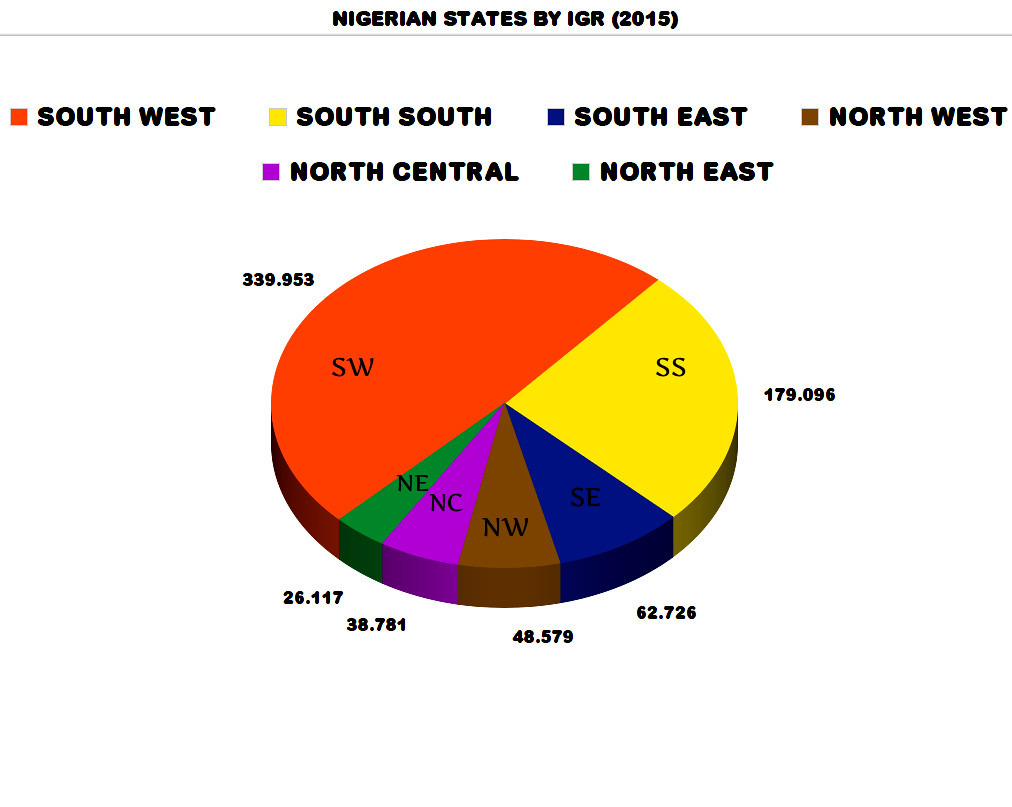
| Politics › Re: Nigerian States By Internally Generated Revenue (IGR) - 2015 by Buchoalfa: 12:37pm On Apr 15, 2016 |
scholes0:South West excluding Lagos 71,728,635,492 11 Likes 5 Shares |
| Politics › Us Releases Gory Report On Nigeria by Buchoalfa(op): 3:40pm On Apr 14, 2016 |
The United States has released yet another gory and nauseating detailed report on Nigeria, accusing the government at all levels of injustice, brutality and inflicting pain on poor Nigerians. The report, which was released by the United States Department of States, accused the Nigerian police, DSS and the military of gross abuse of power which include citizens brutality, arbitrary detention,bribery among other scandals. It also revealed that 69 percent of persons in prison across the country are awaiting trial – blaming the situation on lack of judicial capacity and corruption. While explaining that the insurgency in the Northeast has rendered many hopeless, US accused the Boko haram militants of committing pogrom in which more than 20,000 people have been killed and maimed with permanent injury. “The most serious human rights abuses included those committed by Boko Haram, which conducted numerous attacks on government and civilian targets that resulted in thousands of deaths and injuries, widespread destruction, the internal displacement of an estimated 1.8 million persons, and the external displacement of 220,000 Nigerian refugees to neighboring countries”, the report said. It pointed out that in response to Boko Haram violent attacks, and at times to crime and insecurity in general, “security services perpetrated extrajudicial killings, and engaged in torture, rape, arbitrary detention, mistreatment of detainees, and destruction of property”. “The country also suffered from widespread societal unrest, including ethnic, regional, and religious violence. Other serious human rights problems included vigilante killings; prolonged pretrial detention, often in facilities with poor conditions; denial of fair public trial; executive influence on the judiciary; infringement on citizens’ privacy rights; and restrictions on freedoms of speech, press, assembly, and movement. There were reports during the year of official corruption; violence against women and children, including female genital mutilation/cutting; infanticide; sexual exploitation of children; trafficking in persons; early and forced marriages; discrimination based on sexual orientation and gender identity; discrimination based on ethnicity, regional origin, religion, and disability; forced and bonded labor; and child labour”. The report pointed out that impunity remained widespread at all levels of government; saying “although President Buhari’s administration began initial steps to curb corruption, authorities did not investigate or punish the majority of cases of police or military abuse”. “Boko Haram perpetrated numerous attacks, often directly targeting civilians. The group, which recruited and forcefully conscripted child soldiers, carried out bombings–including suicide bombings–and attacks on population centers in Adamawa, Bauchi, Borno, Gombe, Kano, Plateau, and Yobe States. In some cases, the group employed women and children as suicide bombers. The government investigated these attacks but prosecuted only a few members of Boko Haram”. http://www.thisdaylive.com/index.php/2016/04/14/us-releases-gory-report-on-nigeria/?utm_source=twitterfeed&utm_medium=twitter |
| Politics › Re: Pictures From #MAFO Mega Protest In Makurdi, Benue State Today by Buchoalfa: 1:44pm On Apr 13, 2016 |
They are IPOB youths |
| Politics › Re: FG Borrows N600bn Annually To Augment Staff Salaries, Says SGF by Buchoalfa: 10:40am On Apr 13, 2016 |
BUBU |
| Health › Re: Millions At Risk As Nigeria Runs Into Vaccine Debt by Buchoalfa: 9:28am On Apr 13, 2016 |
 I BLAME BUHARI I BLAME BUHARI |
| Politics › Re: Edo 2016: Anenih Breaks Silence, by Buchoalfa: 12:55pm On Apr 12, 2016 |
GudluckIBB:I think Lai Mohammed must be ur father 1 Like |
| Politics › Re: Rivers Rerun: Violence, Killings Barbaric, Unacceptable – PMB by Buchoalfa: 11:02am On Mar 24, 2016 |
Worst President Nigeria ever had |
| Politics › Re: Osun State Allocation For February Is N6M by Buchoalfa: 4:12pm On Mar 18, 2016 |
bettercreature:Who told U it has to do with what is generated in Osun? Osun is heavily indebted, there is what is called a STANDING ORDER and means interest and principal on the said loan as the order refers to the loan is deducted before transferring to Osun. |
| Jobs/Vacancies › Re: Immigration Recruits 500 Despite Embargo by Buchoalfa: 5:11pm On Mar 16, 2016 |
APC is a scam |
| Politics › Rising Inflation by Buchoalfa(op): 3:14pm On Feb 16, 2016 |
Rising Nigeria Inflation Risks Thwarting Buhari’s Naira Defense Bloomberg Inflation pressures are rising in Nigeria despite the central bank pegging the currency for almost a year in the face of plunging oil prices. Governor Godwin Emefiele has opposed devaluing the naira, imposing restrictions on imports and curbing foreign-currency supply instead to cope with a more than 45 percent slump in oil prices since the beginning of last year. Rather than protecting consumers — the justification used by President Muhammadu Buhari in rejecting calls for a weaker currency — the policy threatens to stoke inflation as it boosts import costs and pushes the naira to a record low on the black market. The central bank’s correlation between the naira and inflation “has already broken down,” Nema Ramkhelawan-Bhana, an economist at Rand Merchant Bank in Johannesburg, said in an interview on Tuesday. “Inflation will average in double digits this year,” above the central bank’s target of 6 percent to 9 percent. Rising food costs, which make up about half of the consumer price index, have pushed inflation to 9.6 percent in January, the same rate as the previous month and the highest level in three years. Calls to Central Bank of Nigeria spokesman Ibrahim Mu’azu’s mobile and office phones didn’t connect and he didn’t immediately respond to a text message seeking comment. Ten of the 12 categories of consumer prices surveyed by Standard Chartered Plc in its Consumer Price Tracker showed increases in January from the previous month, according to Razia Khan, chief Africa economist at the London-based lender. That shows “prices are rising, despite attempts to keep the official Nigerian naira exchange rate unchanged,” she said in an e-mailed note to clients. The central bank in Africa’s largest economy has effectively pegged the naira at 197-199 per dollar since March by restricting foreign-currency supply, hurting businesses. That’s forced them to seek currency on the parallel market, where the naira reached a low of 337 against the dollar on Friday. “The average consumer is already facing a de facto devaluation, and this has driven up prices,” Alan Cameron, an economist at Exotix Partners LLP in London, said in an e-mailed responses to questions. While food prices have risen higher than the main rate, pressure in the last few months has come from core inflation, which excludes food costs, he said. Economic growth, which is estimated to have slowed to 3 percent last year, the lowest since 1999, is set to remain subdued. “Given the drag on economic growth from the foreign-exchange restrictions in place in order to keep the naira steady, there is a big economic cost to avoiding devaluation,” said William Jackson, the London-based senior emerging markets economist at Capital Economics. |
| Politics › Obasanjo Boycotted Due Process In Awarding Railway Project by Buchoalfa(op): 3:07pm On Feb 16, 2016 |
Obasanjo Boycotted Due Process In Awarding $841.6m Rail Project Contract – Chinese Firm By Tony Ademiluyi, Lagos The project manager of a Chinese construction firm, Etim Abak gave a shocking revelation when he testified before the Senate Committee on the Federal Capital Territory that former President Olusegun Obasanjo threw due process to the wind when he awarded the Abuja rail project in 2007 without any memorandum of understanding. The Governor of Kaduna State and the erstwhile FCT Minister, Mallam Nasir El-Rufai put his signature to paper when he allegedly signed the over $800 million contract based on a vaguely calculated estimate. The manager told the committee that the contract was inflated by $10 million per kilometer and the length was later reduced to 45km without of the cost of the 15.67km that was removed from the project. Dino Melaye, who chaired the Senate investigative committee inspected the project as part of its oversight duty and demanded a refund of $195,878,296.74. Abak said, “The contract was awarded based on conceptual design and estimates were not properly done. There was no formal design submitted and rail bridges and crossover bridges were not captured in the contract.” Melaye said his findings revealed that the rail project was inflated by over $10m per km and wondered why such an act was perpetrated by the handlers of the project. The senator added that the contract sum was $841.645,898m and that the project completion period was 48 months while the scope of work was 60.67km standard gauge, with double railway tracks and associated permanent way within the FCT. He wondered why the 60.67km project was later reduced to 45. 245km without reduction in its cost. He said, “Now, you have reduced the length of the standard gauge from 60.67km to 45.245km, meanwhile, there is no concomitant reduction if you juxtapose the length in kilometres and the reduction in terms of the cost. He raised a pertinent question as to the rationale behind the decision of the Federal Government to want to borrow $500 million from the Bank of China when the money pumped in was enough to finance the entire project. http://dailyindependentnig.com/2016/02/obasanjo-boycotted-due-process-awarding-841-6m-rail-project-contract-chinese-firm/ |
| Romance › Re: Ladies What's The Best Gift To Get For My Gf by Buchoalfa: 1:51pm On Feb 09, 2016 |
Buy her a house in Ikoyi,banana island, asokoro or maitama  |


1 2 (of 2 pages)