 Politics › Nigerian Mdas Paid Over N159bn Into Private Accounts In Six Years by ogododo(op): 6:57am On Feb 06, 2024 Politics › Nigerian Mdas Paid Over N159bn Into Private Accounts In Six Years by ogododo(op): 6:57am On Feb 06, 2024 |
Last month, the Minister of Humanitarian Affairs, Betta Edu, was suspended from office by President Bola Tinubu following public outrage over the disclosure that she authorised the payment of N585.2 million public funds into a private account in violation of financial transparency laws.
However, PREMIUM TIMES’ findings show that the “crime” she is accused of is prevalent across several ministries, departments and agencies (MDAs). At least N159.6 billion (N159,626,619,959) was paid into private accounts by MDAs in six years, a review of data published by Govspend, a platform tracking government spending, show.
The findings do not exonerate Ms Edu but show that the problem is not peculiar to her and is widespread within the Nigerian government.
The Office of the Special Adviser to the President on Niger Delta tops the list of MDAs making such controversial payments with a total payment of N8.3 billion in 130 transactions to Ebikabowei Victor-Ben, an ex-Niger Delta militant.
The Nigerian office of the New Partnership for African Development, a pan-African poverty-eradication programme funded by member states, comes next having paid N1.5 billion in 111 tranches to one Afangekung Mfon Okon.
Other MDAs that made multiple transactions into private accounts include the Ministry of Information and Culture, Ministry of Communications and Digital Economy, Ministry of Power, Ministry of Women Affairs, Economic and Financial Crimes Commission (EFCC), Office of the Accountant General of the Federation and Secretary to the Government of the Federation (SGF).
Over N13bn public funds paid into private accounts in 2023
Last year, more than N13.6 billion was paid into private accounts in violation of the country’s Financial Regulations 2009.
The violators include the Office of the SGF, Ministry of Women Affairs, Ministry of Finance, Budget and National Planning and many parastatals.
Findings showed that the Office of the Special Adviser to the President on Niger Delta paid N4.72 billion into individual accounts of some camp leaders in the Niger Delta where the struggle for oil wealth and agitation against environmental hazards have propelled ethnic militias to pick arms against the state.
For instance, in a total of 10 transactions, Mr Victor-Ben, the ex-militant also known as Boyloaf, received N564.7 million from the office between July and November 2023. According to the transactions’ descriptions, the money was meant for “delegates of Boyloaf camp.”
His counterparts also benefited, having received N3.5 billion collectively.
Despite its oversight functions, the SGF office was also caught in the web. It paid public funds amounting to N3.1 billion into 15 private accounts between March and December 2023.
The scandal-ravaged Ministry of Humanitarian Affairs, Disaster Management and Social Development paid at least N918.5 million public funds into private accounts. This is in addition to other scandalous payments in the ministry as seen in the cases of the pioneer minister, Sadiya Umar Farouq and her successor, Betta Edu.
The Ministry of Finance, Budget and National Planning paid N1.5 billion in tranches to 16 individuals for various projects and services between February and December last year.
In other suspicious transactions, the Ministry of Women Affairs paid N1.6 billion into the accounts of vaguely identified individuals for travel purposes, palliative for widows, and monitoring and evaluation of capital projects among others.
Between March and September, NEPAD paid N1.67 billion into the accounts of two individuals, Bello Nagwaggo and Afangekung Mfon Okon.
EFCC, Police, Human Rights Commission, AGF office, others complicit
While five parastatals paid billions into private accounts, 12 others paid in millions with the lowest being N17.6 million.
The MDAs that paid millions into individual accounts include, the EFCC, Police Formations and Commands, Nigeria Police Academy Wudil, Kano, National Directorate of Employment, National Commission for Refugees, Auditor General for the Federation, National Commission for Persons with Disability, Ministry of Communications and Digital Economy, Federal Character Commission, Ministry of Aviation and Aerospace Development, Ministry of Petroleum Resources, Budget Office of the Federation and National Human Rights Commission.
Others are the National Agency for Science and Engineering Infrastructure (NASENI), the National Commission for Mass Literacy, Adult & Non-formal Education, the Nigeria Extractive Industries Transparency Initiative (NEITI) and the Ministry of Niger Delta.
The EFCC in two transactions between May and October last year, paid a total of N211.7 million into two private accounts; one for Aliyu Naibi (N154,974,745.00) and the other for Abdullahi Mohammed (N56,767,056.83).
In total, the police (police formations and commands and Nigeria Police Academy Wudil, Kano) paid N173.8 million into five individual accounts.
Prominent Nigerians as beneficiaries
Some of the payments made into individual accounts could be explained. For example, former President Muhammadu Buhari, former Vice President Yemi Osinbajo, former SGF Boss Mustapha and many ministers and aides who served in the Buhari administration were paid their severance allowances.
One notable controversial payment made to a known public official was the N89.8 million that the police paid to the then-police spokesperson, Frank Mba, in 2019. The official records show that the payment was for issues such as the production of presidential portraits to be used by the police and the cost of “airing” a police programme on TV; payments the police could have made to the service providers directly.
What the law says
Chapter Seven, Section 713 of Nigeria’s Financial Regulations 2009 states that “Personal money shall in no circumstances be paid into a government bank account, nor shall any public money be paid into a private account.”
It also added that: “Any officer who pays public money into a private account is deemed to have done so with fraudulent intention.”
Commenting on our findings, Joe Abah, a former Director-General of the Bureau of Public Service Reforms, said: “Things like that should not be paid into personal accounts but should be transparently procured.”
He added that the financial regulations condemn “paying project activity money into private bank accounts, like was alleged to be done in the Betta Edu case.”
However, the Deputy Director of Fiscal Accounts in the office of the Accountant General of the Federation, James Abalaka, said that the Financial Regulations 2009 recognises circumstances in which public money can be paid into private accounts.
Chapter 10, Section 1001 of the regulations sheds light on what it described as ‘imprest’, which is “applicable to all sums advanced to a public officer to meet expenditure under current estimates, for which vouchers cannot immediately be presented to a Sub- Accounting Officer for payment.”
“Imprests are issued by the Accountant-General of the Federation and the Accounting Officers of Self-Accounting ministries/extra-ministerial offices and other arms of government,” section 1002 explains further. “The authority for issuing Imprests is conveyed in the Annual General Imprest Warrant issued by the ‘Minister of Finance to the Accountant-General.”
According to the financial regulation, there are two types of imprest namely: standing imprest and special imprests. The latter which is granted for a particular purpose “must be retired in full when the purpose has been achieved.”
The former “may be replenished from time to time during a financial year by the submission of paid vouchers to Sub-Accounting Officers for reimbursement.”
Mr Abalaka noted that MDAs are responsible for money paid into private accounts. According to him, the accountant general’s office through the Government Integrated Financial and Management Information System (GIFMIS) only facilitates payments of vouchers raised by MDAs.
Mr Abalaka told PREMIUM TIMES that there are three layers — initiator, reviewer and final approval — of payments in every MDA.
“The initiator is someone who initiates payment after a permanent secretary’s approval,” he explained. “The reviewer then reviews it and checks whether there are adjustments to be made before passing it for final approval where the Central Bank of Nigeria (CBN) makes the payments.”
The accountant general’s office, he explained, only makes the government’s daily expenditures open through the open treasury portal and is not responsible for any payment made “except the one made within the AGF office.”
He, however, declined comment on the N11.5 million paid to one Lanre Gbajabiamila by the accountant-general’s office.
On 25 September 2023, N5.7 million was paid to Mr Gbajabiamila as “Payment of furniture allowance to 19 political office holders.” The same amount was in 2018 paid into his account for a similar purpose. https://www.premiumtimesng.com/investigationspecial-reports/665683-nigerian-mdas-paid-over-n159bn-into-private-accounts-in-six-years.html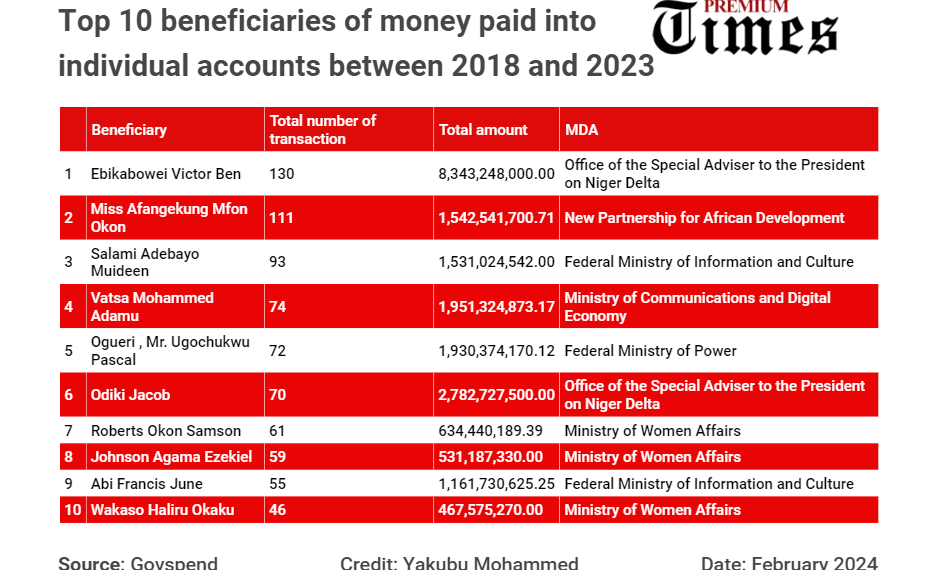


|
| Politics › Re: James Kingsley: Soldiers Gun Down Colleague Who Killed OC Ukachuckwu In Sokoto by ogododo: 12:19pm On Feb 05, 2024 |
|
| Politics › Re: Nigerian Cost Of Living Lowest In Africa, Says Presidency by ogododo(op): 12:18pm On Feb 05, 2024 |
Dis people no rate us. |
| Politics › Re: Nigerian Cost Of Living Lowest In Africa, Says Presidency by ogododo(op): 11:14am On Feb 05, 2024 |
Dem don wail for Niger. |
| Politics › Re: Vandalism, responsible for Recent Grid Collapse by ogododo: 9:20am On Feb 05, 2024 |
|
| Politics › Nigerian Cost Of Living Lowest In Africa, Says Presidency by ogododo(op): 7:47am On Feb 05, 2024 |
Amid the soaring rate of inflation, the Presidency on Sunday claimed that Nigerians are enjoying the lowest living costs in Africa. It also said the administration of President Bola Tinubu was focused on “solving our economic and security challenges,” and while admitting that his reforms would cause “immediate pains, but will usher in an era of prosperity in the medium and long terms.” The Special Adviser to the President on Information and Strategy, Mr Bayo Onanuga, made these assertions in a statement he signed titled ‘Atiku Abubakar and his new hobby.’ Onanuga’s response followed accusations from the Peoples Democratic Party 2023 presidential candidate, Atiku Abubakar, who said Tinubu’s economic policies were dashing hopes, creating pain, and causing despair among Nigerians. In a statement he signed on Sunday, Atiku, argued that President Tinubu’s poor response to the nation’s challenges was setting the stage for a prolonged and deeper economic crisis. Atiku said, “The economy’s performance has, in recent weeks and months, been a subject of intense discourse among Nigerian citizens at home and abroad. Nigerians are gravely concerned, and rightly so, that Tinubu’s poor response to Nigeria’s economic challenges is setting the stage for a prolonged and deeper domestic economic crisis. “His economic policies, drawn from a so-called Renewed Hope Agenda, are ironically dashing hopes, creating pain and causing despair. The private sector is shrinking by the day as small businesses are emasculated and as Multinational Companies, confused and weary of the economy, leave Nigeria in droves. The intense cost of living pressures has created more misery for the poor in towns and villages. There is hunger in the land as basic commodities, including BREAD, are becoming out of reach for average Nigerians. “BAT has shown no capacity to deal with the adverse and disastrous impact of the new subsidy regime on the people and businesses and the new foreign exchange policy, which provides for a free-floating exchange rate. His initiatives are uninformed, arbitrary, and chaotic. BAT’s palliatives are too mean, pitiable, and contemptuous of the poor. He seems genuinely lost, bewildered, and overwhelmed.” But the Presidency faulted Atiku’s assertions about the rising cost of living saying, “His claim that the government’s policies have created intense cost of living pressures are also not grounded on facts as recent comparative cost of living indices show that Nigerians still enjoy the lowest cost of living in Africa.” “Atiku’s claims that the private sector is shrinking and that multinational companies are leaving our companies in ‘droves’ are not grounded on facts,” it added. Onanuga said the former Vice President “should be honest enough to admit that President Tinubu inherited a weak economy,” which, to all intents and purposes…needs a complete overhaul. “Nigerians can easily see through the hypocrisy of Alhaji Atiku, who in accusing President Tinubu of poor response to the nation’s challenges and causing pains and despair, didn’t offer any better policy options in his run for the Presidency different from the economic reform agenda being pursued by President Tinubu,” the statement further read. It added that reputable local and international agencies who understand the situation the Tinubu administration found itself have commended the administration, having seen a policy trajectory that is clearly positive, realistic and sustainable. The Presidency noted that the administration has also embarked on comprehensive fiscal and tax policy reform that will drive speedy recovery and spur economic growth and therefore its detractors “cannot stop the serious work of nation-building already set in motion by President Tinubu.” Meanwhile, ex-lawmaker representing Obokun State Constituency in Osun State House of Assembly, Mr Olatunbosun Oyintiloye, has urged opposition parties in the country to stop criticising Tinubu over rise in violent crimes across the country. Oyintiloye, a Chieftain of the All Progressives Congress in Osun, who spoke in Osogbo on Sunday, said instead of criticism that could cause distraction, Tinubu should be supported as he sought solution to the challenge. He said, “No one is happy with the recent killing, banditry, terrorism, kidnapping other criminalities across the country. But negative criticism and names calling by the leaders of the opposition parties is not the way forward. “What we need at the critical period is for us, as stakeholders to come together, irrespective of our political affiliation, religious or tribe and give the present administration needed boost and encouragement. “Security is a collective responsibility of everyone and that is why I am appealing to leaders of the opposition parties to stop playing cheap politics with security issues and narratives that can divide the country,” he said. https://punchng.com/nigerian-cost-of-living-lowest-in-africa-says-presidency/ |
| Agriculture › Egg Price Rises As Many Poultry Farms Shut Down In Kano by ogododo(op): 4:04pm On Feb 04, 2024 |
The recent hike in the prices of eggs and other poultry products in Kano State has generated a serious public concern, especially when the Muslim fasting period is fast approaching. Eggs are usually in high demand during the fasting period.
It was gathered that one egg new sells at N130 while a crate is N3,100. It was also revealed that despite the increase, eggs are gradually becoming scarce in the state metropolis, and that has raised a serious concern from the public as other poultry products are getting out of the reach of the common citizen.
According to a resident, Abubakar Abdulsamad, egg scarcity is a perennial issue that usually occurs in periods like this when Ramadan fasting is setting in. He explained that the hike in price and scarcity of poultry products is connected to heavy hoarding by merchants. He added that the little eggs being produced by the few poultry farmers in the state are now hoarded by some merchants bent on making huge profits during the Ramadan.
“That has been the norm in periods like this, but what made this one different is that there are few poultry farms operating now due to the current economic situation across the globe, and Ramadan fasting is fast approaching. My fears are that poultry products would soon be out of circulation or too expensive to be afforded,” he said.
A poultry farmer in the state, Alhaji Isa Abba, said he could no longer afford to continue with the poultry business because the cost of production had gradually become unbearable. According to him many farmers have abandoned their farms due to several factors that have made the business very difficult.
However, the Kano State chairman of the Poultry Association of Nigeria (PAN), Dr Usman Gwarzo, attributed the scarcity and hike to several factors that range from poultry feeds raw materials, chicks, vaccines, transportation, among others.
He explained that a tonne of maize, which serves as the major raw material for poultry feed making, which was sold at N320,000 in November last year, is now N550,000. He added that soya mill, which constitutes 25 per cent of raw materials needed to produce feed, had also gone up drastically.
“Ironically, these two raw materials are usually sourced within the country, not imported. What we only bring outside the country is amino-acid. However, transportation increased due to subsidy removal and insecurity that prevented many farmers from going to farms, among other factors, which cumulatively added to bring the rise in the cost of poultry farming in not only Kano State but the country in general,” he said.
He added that the state lacked capable hatchers that could meet the demand of chicks by farmers, a situation that is causing a day-old chick to be sold at N800, which has forced over 85 per cent of poultry farmers out of business.
“I bet you, if you add up all these factors I mentioned you would find out that the price of eggs is cheap. But as it is with poultry production, the more expensive poultry products are, the less profit poultry farmers get. That is why most of our members have closed down their farms. About 85 per cent left the business in the last six months, which is a bad omen,” he said.
Gwarzo said the association had been advocating improved security, increase in production through effective engagement of real farmers, as well as introduction of credible loans to farmers that are realistic, not formulary. https://dailytrust.com/egg-price-rises-as-many-poultry-farms-shut-down-in-kano/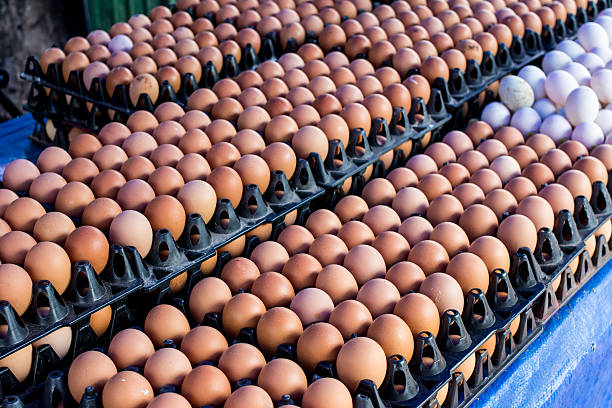
|
| European Football (EPL, UEFA, La Liga) › Manchester United Vs Liverpool (2 - 2) On 7th April 2024 by ogododo(op): 11:52am On Feb 04, 2024 |
Manchester United Vs Liverpool 07/04/2024 3:30pm |
| Politics › Re: Tinubu, Nigeria Is Sinking And Streets Are Full Of Tears- Kperogi by ogododo(op): 12:33pm On Feb 03, 2024 |
|
| Politics › Re: Terrorism/kidnapping: Influential Northern Senator Under Watch by ogododo: 12:32pm On Feb 03, 2024 |
|
| Politics › Re: Tinubu, Nigeria Is Sinking And Streets Are Full Of Tears- Kperogi by ogododo(op): 12:27pm On Feb 03, 2024 |
abhosts:
Imagine a country whose monthly minimum wage is N30,000($21) feeling cool when their president removed fuel subsidy. The major problem we have in Nigeria is the fake and complicit intellectual class that deceive the poorly educated masses. If you see how some monkeys attacked me when I advocated for subsidy to remain, you would understand why the Nigerian masses do not deserve any pity. No be lie. |
| Politics › Tinubu, Nigeria Is Sinking And Streets Are Full Of Tears- Kperogi by ogododo(op): 9:07am On Feb 03, 2024 |
The searing torment that everyday folks are going through in Nigeria right now is so dire, so unbearably extreme, and so unexampled in its rawness that even diasporan Nigerians like me who live tens of thousands of miles away from home can feel it not just vicariously but also experientially.
The unending streams of requests for help to meet the most basic obligations of life that we get from previously proud, resourceful, and self-sufficient family members, friends, acquaintances, and even strangers are the conduits through which we have experiential encounters with the ongoing cost-of-living turmoil in the country.
The lower classes are sinking deeper into soul-depressing depths of poverty, despair, and hopelessness, and the middle class is so hobbled by the economic crunch that it is disappearing faster than soap bubbles. The lower and the middle classes are now united by a common sensation of emptiness, agony, and anxiety for the future.
Every day is worse, less hopeful, and more precarious than the previous day for most Nigerians. Even hope, which French philosopher François de La Rochefoucauld assured us is the last thing that dies in humans, is desperately going into a death spiral. That’s an ominous signal President Bola Ahmed Tinubu would do well to not take lightly.
Nigeria is famous for its superabundant supply of self-regenerating hope even in the midst of the most nerve-racking existential strain. You know you’re dealing with a potentially explosive social rupture when hope is grasping for breath among people who are famed for feasting on hope.
The current state of affairs isn’t unavoidable. It’s the predictable consequence of the pigheaded pursuit of a ruinous policy of subsidy removal from petrol, the lifeblood of Nigeria. I sounded an early warning about this a month before Tinubu was inaugurated.
In my April 29, 2023 column titled “Six Agenda Items for Tinubu’s Success,” I specifically warned Tinubu to resist the neoliberal anti-subsidy seduction of Western financial institutions, which they have successfully brainwashed Nigerian economists and civil society members into not just accepting but also aggressively evangelizing.
I wrote: “I know that there is now an artfully manufactured consent, particularly among the gilded classes in Nigeria, about the undesirability of ‘fuel subsidy.’ I don’t care what it’s called, but any policy (call it deregulation, subsidy removal, appropriate pricing, etc.) that results in an arbitrary and unbearable hike in the price of petrol without a corresponding increase in the salaries of workers and an improvement in the living conditions of everyday people will sink Tinubu.”
I concluded: “I can assure Tinubu that if petrol price hikes deepen people’s misery, he’ll have a tough time governing.”
The dramatic spikes we have seen in abductions for ransom all over the country are attributable to the rising tide of unheard-of deprivation that the removal of petrol subsidies has activated. And that’s just one auxiliary after-effect of the removal of petrol subsidies without a cushion or an alternative.
Other after-effects are the total collapse of the informal sector and what remained of Nigeria’s manufacturing sector. It also instigated the unprecedentedly hyper-inflationary pressures that are being exerted on the economy. Prices of basic goods and services and even of medications for common illnesses are now beyond the reach of people. That’s an unsustainable magnitude of agony.
But it was always obvious to anyone with even a halfway functioning brain that removing petrol subsidies in a weak, oil-producing economy that is organically petrol dependent, that has no well-developed public transportation system, that has weak infrastructures, and that is the poverty capital of the world would trigger infernal anguish on the vast majority of the people and tank the economy to the ground.
These are not birth pangs. They are not the pains before the gains. There is no light at the end of the tunnel. The tunnel is condemned to unrelieved darkness. The blight Nigerians are contending with now is the certain and inevitable result of a conscienceless implementation of disconnected and irrelevant economic policies inspired from outside Nigeria.
I came of age during General Ibrahim Babangida’s regime. IBB started the so-called structural adjustment programs (removal of subsidies, devaluation of the naira, mass retrenchment, etc.), which inaugurated Nigeria’s descent into the abyss. I heard the exact same things the current government is spouting during IBB’s time: that it would get worse before it got better, that after the birth pangs a big bouncing baby would be born, that there was delayed gratification awaiting us if only we could be a little more patient.
None of the promises materialized. Instead, suffering was elevated to crushing heights. Advanced fee fraud (also called 419) blossomed. Corruption was fertilized. Brain drain to the West got wings. This period also unleashed the naira’s irrecoverable slide into the deep hole of worthlessness.
Decades after, the same SAP about which hundreds of books and articles have been written and whose irreversible damage we continually lament, has been artfully repackaged, disguised, deodorized, and huckstered by a well-oiled gang of soulless apes who deployed all manner of clever rhetorical trickery to coax Nigerians into consenting to their own self-incineration.
The idea that petrol subsidies had to go because they were riddled with corruption and that they consumed a disproportionate share of our national budget is a mere propagandistic cop-out. If petrol subsidy administration is rid of corruption (that is perpetrated in cahoots with the government, which explains why no “subsidy thief” has ever been apprehended much less brought to justice), it would consume no greater share of our national budget than any governmental obligation.
It certainly won’t be anywhere near the colossal venality that is perpetuated at the Federal Ministry of Humanitarian Affairs, Disaster Management and Social Development under the guise of giving money to the poor.
The truth is that we have no original, independent thinkers among people who make or influence economic policies in Nigeria. They are all hopelessly mindless parrots of ill-comprehended economic prescriptions of the Bretton Woods institutions. They do not have the cognitive and intellectual sophistication to transcend what I call derivative or regurgitative knowledge.
There is not a single example of a country in the world that has developed on the basis of the prescriptions of the World Bank and the IMF. On the contrary, the only countries that have achieved inclusive growth and development outside the West are precisely the countries that have bucked the World Bank and the IMF. And every country that uncritically adopts the recommendations of these institutions has been wracked by utter devastation.
Unfortunately, if either Atiku Abubakar or Peter Obi were president today, Nigeria would experience exactly what it is going through now. Like Tinubu, Atiku and Obi said they would remove petrol subsidies “on day one.” When you remove petrol subsidies “on day one” in a desperately poor, inordinately petrol-supported economy with no public transportation, you get what Nigerians are going through now. It’s not rocket science.
Similarly, both Atiku and Obi said they would float the naira and let its fate be determined by the vagaries of demand and supply. When you do that in an import-dependent economy, you can’t escape what the naira is going through now.
Atiku tweeted in March 2021—and in several policy documents—that “Nigeria must move towards a single exchange rate to be determined by market forces.”
On April 9, 2022, Obi also tweeted: “The truth is that for long market forces have not determined the exchange rate of the Naira…. It has to end. Let the exchange rate be determined by the forces of demand and supply. It’s that simple.”
In other words, Tinubu is doing exactly what Atiku and Obi had proposed they would do, and the results would have been the same. The hyperinflation and hurt Nigerians are going through now won’t have been evaded because it is Atiku or Obi who removed petrol subsidies “from day one.” The naira’s glide to the bottom wouldn’t have been avoided because Atiku or Obi “floated” the naira.
That is why Atiku- or Obi-supporting critics of Tinubu come across as ignorant partisans who have drunk the Kool-Aid of their cult leaders. Atiku and Obi supporters should be grateful that their idols are not president today. They would have been bearing the reputational brunt of the boneheaded, discredited rightwing economic policies they also advocated, which have thrown Nigeria into the current mess.
Interestingly, in response to Obi’s 2022 tweet rhapsodizing over the imperative of subjecting the naira to the “forces of demand and supply,” a supporter of his by the name of Abel (with the handle @governance9ja) wrote a riposte, which has turned out to be prescient. He wrote: “So @PeterObi will float the currency for a country where most factor inputs into local manufacturing is imported? We already have cost push inflation reducing real income of many Nigerians. Floating naira will ruin many households. @PeterObi and @OfficialABAT are two of a kind.”
Obi supporters who have wet dreams of a Nirvana if Obi were president should wake up. His economic policies are exactly like Tinubu’s. Personalities aren’t the issue; policies are.
Tinubu and his team need to face the reality confronting them and change course. I know that Nigeria has been so polluted by neoliberal propaganda that even news that the government was paying subsidies through the backdoor to stop petrol prices from getting to N1,000 per liter was seized upon by the opposition to poohpooh the government, which compelled the government to deny paying any subsidies.
I’ve never seen this level of self-crushing inanity in my life. Assistance to the needy (which is what subsidy literally means) is now a dirty word that everyone avoids like the plague.
But the government should know that even hope is dying in Nigeria. When a usually hopeful nation spawns armies of hopeless and angry people through thoughtless economic policies dictated by outsiders, it sows and nurtures the seeds of its self-destruction. https://www.farooqkperogi.com/2024/02/tinubu-nigeria-is-sinking-and-streets.html
|
| Politics › Re: Gunmen Abduct 30 Women Escorting Newlywed Bride In Katsina by ogododo(op): 2:36am On Feb 03, 2024 |
|
| Politics › Gunmen Abduct 30 Women Escorting Newlywed Bride In Katsina by ogododo(op): 10:13pm On Feb 02, 2024 |
A convoy transporting a newlywed bride and her companions faced terror along Gamji Road in Dandume Local Government Area of Katsina State Thursday night.
According to a reliable source, the bride accompanied by approximately 30 women, was en route to her husband’s residence in Ungwan Murjiya in Dandume LGA between 8:30-9pm when the convoy fell prey to the hoodlums.
The assailants, believed to be armed bandits, intercepted the truck and abducted the women.
DAILY POST learnt that during the attack, the source revealed that the truck conductor was shot, and he is currently receiving medical treatment at Damari Hospital.
In a separate incident around the same time, gunmen reportedly from Siddi forest infiltrated Tashar Nadaya, near the Gazari district border in Sabuwa LGA.
The criminals killed a commercial motorcycle rider, seizing his bike.
They also opened fire on a group of four individuals, confiscating their motorcycles.
Chairman of Dandume Local Government Council, Alhaji Basiru Musa, confirmed the report.
While some unconfirmed reports suggest that a few kidnapped women managed to escape, the chairman promised to verify and provide updates.
He clarified that although the women were from Dandume, the criminals intercepted them on their way from Sabuwa Local Government Area at about 9pm.
Sabuwa and Dandume are among the local government areas being heavily tormented by bandits in Katsina State.
Despite the relentless efforts of the Katsina Security Watch Corps and other security forces, a day hardly goes by without a report of their nefarious activities. https://dailypost.ng/2024/02/02/gunmen-abduct-30-women-escorting-newlywed-bride-in-katsina/
|
| Education › Re: Nigerian Students Abroad Groan Over Naira Free Fall by ogododo: 8:34pm On Feb 02, 2024 |
|
| Politics › PUNCH Celebrates 50th Anniversary With Weeklong Activities by ogododo(op): 8:25am On Feb 02, 2024 |
: Nigeria’s foremost print and digital media group, PUNCH Nigeria Limited, is set to roll out the drums to mark its 50th anniversary with an array of epoch-making ceremonies in Lagos. PUNCH, the publisher of the nation’s leading newspaper titles, The PUNCH, Saturday PUNCH, Sunday PUNCH, and PUNCH Online, clocked 50 on March 18, 2023. However, its board of directors moved the 50th-anniversary celebration to this year because the anniversary month fell within an election month and year. According to a statement on Thursday by the company’s General Manager, Corporate Services, Mrs Olufolakemi Gbemuotor, the 50th anniversary will be marked with the 40th anniversary of the passing of the founding Chairman, the late Chief James Olubunmi Aboderin, who died on February 28, 1984, at the age of 50. The weeklong celebration will start on Saturday, February 24 with a novelty match between Team PUNCH and the Nigeria Media XI, a team made up of journalists from other newspaper houses in the country. The novelty match will take place at the Mobolaji Johnson Arena (formerly Onikan Stadium), Onikan, Lagos Island. Both teams will be coached by two former Super Eagles players, Victor Agali and Brown Ideye. THE ROUNDTABLE: KIDNAPPING/INSECURITY EPIDEMIC - WHAT IS THE WAY FORWARD: (THE ABUJA, LAGOS, KANO…0.00 / 0.00 Beginning on Wednesday, February 28, PUNCH will hold a three-day photo exhibition at the Alliance Francaise de Lagos/Mike Adenuga Centre, Osborne Road, Ikoyi, Lagos, to afford its readers and other Nigerians opportunities to view the best photographs from its extensive pictorial archive of the biggest news events in the nation’s history. The high point of the anniversary is a distinguished public lecture to be held on Thursday, February 29 at the Civic Centre, Ozumba Mbadiwe Road, Victoria Island, Lagos. The lecture is expected to play host to leaders from the public and private sectors. The weeklong activities will continue on Saturday, March 2, 2024, at Eko Hotels and Suites in Lagos, where PUNCH will host a black-tie dinner to acknowledge the contributions of its stakeholders to the success of our organisation. The Chairman of the company’s Board of Directors, Mrs Angela Emuwa, described the anniversary and her father’s 40th remembrance as an opportunity to celebrate twin milestones. Emuwa said, “For over five decades, PUNCH has made a tremendous impact in Nigeria. At a time when we are equally remembering the passing of our founding chairman, it is fitting to look back at those landmark events that have shaped the course of history in our national polity and appreciate those who have stood by us not only in good times but when it was uncomfortable for them to do so.” The Managing Director/Editor-In-Chief of PUNCH Nigeria Limited, Mr Adeyeye Joseph, described PUNCH as a national treasure that had stood with Nigeria through thick and thin. According to him, the newspaper’s anniversary will be for all Nigerians who believe in the values that PUNCH has consistently espoused over five decades. “PUNCH has outgrown its humble beginnings to emerge as a national institution. The celebration of our 50th anniversary is not just an opportunity to wine and dine but a chance to celebrate our excellent heritage and fierce editorial independence,” Joseph said. The anniversary’s grand finale is a staff party on March 9 at which current and former staff will be feted for their contributions to PUNCH’s successes. A special commemorative anniversary publication to mark the golden jubilee anniversary of the newspaper will also be distributed at some of the events. https://punchng.com/punch-celebrates-50th-anniversary-with-weeklong-activities/ |
| Politics › 81% Of Working Nigerians Don’t Add Value To The Economy – Taiwo Oyedele by ogododo(op): 7:22pm On Feb 01, 2024 |
About 81% of Nigerians in the employment pool are not in any productive sector of the economy, the Chairman of the Presidential Fiscal Policy and Tax Reform Committee, Taiwo Oyedele, has said.
Oyedele said while the unemployment rate in Nigeria is relatively low at 4.2%, most employed Nigerians do not add any meaningful value to the economy.
Speaking Thursday at the Africa Trade and Investment Summit, he said Nigeria has the same unemployment rate as the United Kingdom.
He said: “About 81% of people in employment in Nigeria are engaged in a non-productive sector of the economy. They are doing things that do not add value in the real sense of the world.
“That is the reason our unemployment rate even though is just 4.2%, similar to that of the UK. Our poverty rate is still one of the highest in the world. We have over 113 million people living in poverty as of 2022 and it is most likely to have increased because that was before subsidy removal and naira floatation.
“So how is it that you have a high employment rate and you also have one of the highest poverty rates? That is the only explanation. We are working poor. We need to create decent jobs. Our job is just beginning.”
According to him, while Nigeria cannot control the global economic climate, a change in policy direction can help manage the economic situation of the country.
“While we cannot control what Russia and Ukraine are doing. We cannot control what happens in Gaza. Just making it easy for small businesses to earn a meaningful living, it is easier for manufacturers to produce,” he said. https://dailytrust.com/81-of-working-nigerians-dont-add-value-to-the-economy-presidential-team/
|
| Crime › Bandits Demand Cough Syrup, Rice, N290m To Release Seven Hostages by ogododo(op): 12:30pm On Feb 01, 2024 |
Bandits who abducted seven residents of Kuduru community in Bwari Area Council of the Federal Capital Territory FCT on December 28 have demanded N290 million ransom, drugs and foodstuffs to release the hostages.
The victims, including a pregnant woman, three children and four adults, have now spent one month and four days in captivity
A leader in the community (names withheld) said the bandits had threatened to kill two of the victims if their demands were not met on time.
He said the abductors also demanded food items, drugs, bed sheets and cardigans.
“They have reached out to us to bring N290 million to secure their release or that they will kill two of them. We have a pregnant woman and three children among them.
“They asked us to bring bags of rice, packs of Indomie, cough syrups, antibiotics, bedsheets and cardigans for the bandits’ use.
“They insist that the N290 million ransom must be complete for them to let our people go”, he stated.
The community leader therefore begged the Inspector General of Police IGP, Kayode Egbetokun and the Chief of Army Staff, Taoreed Lagbaja,, to come to the rescue of the hostages.
“We know that they are trying their best but we plead with them to rescue our families like they did to the six sisters and the Ariyos.
“We understand that these people are already falling sick in captivity because of the harsh weather and the treatment there”, he said. https://www.vanguardngr.com/2024/02/bandits-demand-cough-syrup-rice-n290m-to-release-seven-hostages/amp/
|
| Business › Naira Appreciates Against US Dollar Amid CBN Intervention by ogododo(op): 9:20am On Feb 01, 2024 |
The Naira slightly appreciated against the US dollar in the official foreign exchange market at the end of January 2024 amid the Central Bank of Nigeria’s recent intervention to curb its free fall. Data from FMDQ on Wednesday showed that the Naira marginally appreciated N1,455.59 per US dollar from N1,482.57 on Tuesday. On a day-to-day level, the Naira appreciated by N26.98 gain or a 1.85 per cent increase, to close at N1,455.59 from N1,482.57 per Dollar on Tuesday. Meanwhile, the black market remained unchanged at N1,470 per US Dollar at the close of Wednesday. However, with Naira ending at N1,455.59 per US dollar, the nation’s currency recorded a 37.6 per cent depreciation in January 2024. This comes as the Association of Bureau De Change operators said it will close its offices for business on Thursday over dollar scarcity. Recall that the Central Bank of Nigeria issued a fresh guideline to curb foreign currency hoarding and speculation on Wednesday. Earlier, the apex bank announced that it released over 500 million dollars in the forex market to clear the FX backlog. DAILY POST recalls that the Senate summoned the Governor of CBN, Olayemi Cardoso, to appear before it next week over the forex crisis. https://dailypost.ng/2024/02/01/naira-appreciates-against-us-dollar-amid-cbn-intervention/ |
| European Football (EPL, UEFA, La Liga) › Re: Liverpool Vs Chelsea (4 - 1) On 31st January 2024 by ogododo(op): 3:27pm On Jan 31, 2024 |
Selsea to win. |
| Business › Re: Naira Continues Free Fall On Official Window, Trades N1482.57/$ by ogododo(op): 7:27am On Jan 31, 2024 |
Na N30 self, black market take better, black market na N1450. Nawa. |
| Business › Re: Naira Continues Free Fall On Official Window, Trades N1482.57/$ by ogododo(op): 12:12am On Jan 31, 2024 |
Nlfpmod, de matta tire Mathias. |
| Business › Naira Continues Free Fall On Official Window, Trades N1482.57/$ by ogododo(op): 10:32pm On Jan 30, 2024 |
The naira continued its free fall on the official Investor and Exporter window of the foreign exchange market, closing at N1482.57/$ on Tuesday.
This is a 9.93 per cent decline from its N1348.63/$ Monday rate according to data from the FMDQ Securities Exchange.
On the parallel market, it remained stable at N1,450/$, and on the cryptocurrency peer-to-peer market, the naira was trading for N1,439.5/$ on Binance’s P2P platform as of the time of filing this report.
The naira has now fallen to a new all-time low on the official market and this can be linked to the technical devaluation of the national currency.
On Monday, FMDQ Securities Exchange, which calculates the exchange rate, revised the methodology used to set the rate. According to some experts, this is a technical devaluation of the national currency.
In a market notice, FMDQ stated, “This revision aims to address recent fluctuations and challenges encountered in the Nigerian Foreign Exchange (‘FX’) Market.”
It highlighted that its new measures will ensure that NAFEX and NAFEM rates accurately reflect market conditions. It explained, “These revisions are focused on enhancing the accuracy and reliability of the NAFEX and NAFEM rates determination process, with a focus on data availability and integrity involving a rigorous data validation process, including tolerance checks which shall be applied by FMDQ Exchange, subject to internal policies and procedures.”
Also on Monday, the Central Bank of Nigeria released a circular to authorised dealers on financial market price transparency. The bank said its attention had been drawn to the practice of some dealers and their customers in reporting inaccurate and misleading information on transitions in the financial market.
It stated that the behaviour is not compliant with ethical standards… “and deliberate attempts to create price distortions by reporting false transaction details amounts to market manipulation which will not be tolerated and henceforth face sanctions.”
This continued depreciation of the naira against the dollar is despite efforts by the Central Bank of Nigeria and the Federal Government to boost liquidity in the foreign exchange market.
The national currency is now close to trading at N1,500/$ as recently predicted by the Group Managing Director of Cowry Asset Management Limited, Johnson Chukwu.
In a recent The PUNCH report, he said, “The worst-case scenario is that the naira could worsen to N1,500 against the dollar.”
The fall of the naira is set to lead to further price hikes, the president of the Manufacturers Association of Nigeria, Francis Meshioye, recently noted to The PUNCH.
He said, “It is not possible to remain profitable with this exchange rate. The first challenge is breaking even. It means the prices of things will be higher, and the income is not there for people to buy things as they should buy as things become more expensive.”
However, the International Monetary Fund believes the naira has not discovered its fair value against the dollar yet.
Nigeria’s Country Representative, International Monetary Fund, Dr. Christian Ebeke, recently stated, “There is also uncertainty in the market. I am not sure that the parallel rate is the ultimate rate. At some point, we may think about a fair naira rate that is probably between what we see in the parallel market and the official market.
“But it is very difficult while you are still in the transition phase to talk about what is a fair value and what we are seeing.” https://punchng.com/naira-continues-free-fall-on-official-window-trades-n1482-57/
|
| Politics › Re: Tinubu Is Playing Fiddle While Nigeria Is Drowning - Atiku by ogododo(op): 12:32pm On Jan 30, 2024 |
Nlfpmod. |
| Politics › Tinubu Is Playing Fiddle While Nigeria Is Drowning - Atiku by ogododo(op): 11:42am On Jan 30, 2024 |
Tinubu is playing fiddle while Nigeria is drowning in the ocean of insecurity. To imagine that the Commander-in-Chief is on a so-called private visit while kidnappers kill a nursing mother and grandmother in Abuja for failing to pay N90m ransom and two monarchs in Ekiti, among other regular tragedies besetting Nigerians. If the shoes are too big for Emilokan, he should step aside. Nigeria does not need another Tourist-in-Chief. The country needs 24/7 leadership to confront the pervasive insecurity and collapsing economy. -AA Atiku Abubakar 
|
| Health › Denying Children Eggs May Cause Poor Brain Development by ogododo(op): 9:26am On Jan 30, 2024 |
Eggs have become increasingly expensive in Nigeria in recent months, and this trend has the potential to negatively impact the mental and physical development of under-five children, medical experts have warned. The experts lamented that with the high cost of eggs, it may become difficult for families to provide their children with enough nutrition to support healthy growth and development. According to them, eggs are an essential source of nutrition for young children. They provide protein, vitamins, and minerals that are vital for growth and development. The Feed Industry Practitioner Association of Nigeria had warned that scarcity of eggs, chicken, and other livestock is imminent owing to the rise in the cost of maize and soya beans, which are important for livestock feed production. How My Chinese Boyfriend Abandoned Me With His Child - Ogun Woman | Punch FIPAN said Nigerians might begin to depend on eggs, chicken, and other livestock imported at outrageous cost if the Federal Government failed to intervene and release grains from the nation’s reserve to alleviate their plights. The President, FIPAN, Raymond Isiadinso, at a media briefing, added that the high cost of eggs, chicken, fish, and other poultry products is a result of scarcity of maize and soya beans. Reacting, a nutritionist and a paediatrician lamented that this could have a serious nutritional impact on the health and well-being of under-five children in the country. Speaking exclusively with PUNCH Healthwise, the experts stated that eggs are a highly nutritious food that can provide under-five children with essential nutrients for healthy growth and development. They warned that substituting less healthy foods for eggs may lead to even higher rates of obesity and its associated health risks, including type 2 diabetes, cardiovascular disease, and liver disease. They added that the rising cost of eggs in Nigeria is a cause for concern, as it may lead to nutritional deficiencies in children who depend on this food source. According to the United Nations International Children’s Emergency Fund, in Nigeria, 37 per cent of children, or 6 million children, are stunted (chronically malnourished or low height for age), more than half of them severely. UNICEF notes that 18 per cent of children suffer from low weight for height, while 29 per cent of the children are underweight (both acutely and chronically malnourished and low weight for age). A Professor of Paediatrics at the University of Ilorin, Kwara State, Omotayo Adesiyun, said eggs contain proteins, vitamins, and macronutrients which are all important for eye health, brain development, immune system development, bone health, and muscle health. Adesiyun, who is a Consultant Paediatrician at the University of Ilorin Teaching Hospital, noted that since eggs are the cheapest and are getting harder to acquire, it would be challenging for parents to give their children protein-containing foods. She added, “Eggs are very important to the nutrition of under-five children not because the nutrients in them are not found in other foods but because they are all found together instead of trying to get them from various sources. “Eggs contain proteins, vitamins, and macronutrients. They are important for eye health, brain development, immune system development, bone health, and muscle health. “Like I said earlier, there are other sources of nutrients. Protein and minerals can be found in meat, fish, and milk. The vitamins can be found in fruits and vegetables. But the advantage of eggs is that they are all together “The problem with the cost of eggs is that virtually all protein-containing foods are very expensive. Eggs are still cheaper than meat and fish. “We used to advise mothers who can keep chickens to do so so that they could feed their children eggs but the cost of chicken feed is so high now that it might not be practicable.” The paediatrician, however, said, “If children don’t eat eggs but eat meat, fish and drink milk and eat vegetables and fruits, they will not have a nutritional burden.” On his part, a registered dietician, Joshua Adetona said denying children eggs may harm their mental and physical growth. According to him, eggs are a valuable source of protein and nutrients like choline, vitamin D, and omega-3 fatty acids, which are essential for brain development. “In addition to the nutritional benefits of eggs, they are also a relatively affordable food option for many families in Nigeria. If the cost of eggs continues to rise, it may place a strain on family budgets and lead to children not getting the nutrition they need. “Children under five years old are particularly vulnerable to the effects of a lack of proper nutrition. In the first few years of life, a child’s brain develops rapidly and requires adequate nutrition to support this development. “During the first 1000 days of life, children have a critical window of opportunity for development. They need adequate nutrition during this period to achieve their full potential. “Without the nutrients provided by eggs, children under five may not reach their full cognitive and physical potential,” he noted. The nutritionist, however, recommends interventions such as growth monitoring and vitamin supplementation to address any shortfalls in nutrition. He stressed, “The effects of inadequate nutrition go beyond just physical health. They also have implications for children’s educational attainment and economic productivity in adulthood.” https://punchng.com/denying-children-eggs-may-cause-poor-brain-development/ |
| Politics › Re: Tinubu’s Monetary Policy Devalued Naira By 98 Per Cent: Pwc by ogododo(op): 8:02am On Jan 30, 2024 |
Na 120%. |
| Politics › Re: Naira Hits Record Low Of N1,348.63 /$1 At The Official Market by ogododo(op): 9:58pm On Jan 29, 2024 |
Nawo oo. Bring back Goodluck era. |
| Politics › Re: Tinubu’s Monetary Policy Devalued Naira By 98 Per Cent: Pwc by ogododo(op): 9:49pm On Jan 29, 2024 |
DMerciful:
Tinubu is a monumental failure No be lie. |
| Politics › Naira Hits Record Low Of N1,348.63 /$1 At The Official Market by ogododo(op): 9:47pm On Jan 29, 2024 |
Naira on Monday fell to a record low of N1,348.63 per dollar following strong demand on the official market, also known as NAFEM market. This is despite the news of additional release of 500 million dollars to various sectors in its determination to address the backlog of verified foreign exchange transactions by the Central Bank of Nigeria (CBN). This represents 33.87% or N456.73 weaker than N891.90 recorded at the close of trading on Friday. The observed depreciation is unparalleled and stands as the lowest point in the historical performance of the Naira, reflecting the severity of the current economic challenges. Sixth time Naira crossed the N1,000/$ threshold This latest depreciation marks the sixth time the Naira has breached the N1,000/$ threshold, highlighting a persistent trend of weakness. The first instance occurred on Friday, December 8th, 2023, when the currency reached a historical low of N1,099.05 per dollar. This was followed by a brief reprieve before a second depreciation on Thursday, December 28th, 2023, closing at N1,043.09 per dollar. These developments represent a significant turning point for the Naira. Despite recent efforts by the Central Bank of Nigeria (CBN) to bolster the foreign exchange market through interventions, the currency’s downward trend persists, prompting concerns about its potential impact on the broader economy. This development is likely to aggravate existing inflationary pressures and further strain household budgets, particularly for those reliant on imported goods. The implications for businesses, both large and small, are also significant, with potential increases in production costs and challenges in maintaining profitability. The domestic currency depreciated by 33.87% to close at N1,348.63 to a dollar at the close of business, data from the NAFEM where forex is officially traded, showed. This represents an N456.73 loss or a 33.87% decline in the local currency compared to the N891.90 it closed on Friday. The intraday high recorded was N1414.94/$1, while the intraday low was N701/$1, representing a wide spread of N713.94/$1. According to data obtained from the official NAFEM window, forex turnover at the close of the trading was $64.29 million, representing a 36.33% increase compared to the previous day. However, the naira depreciated at the parallel forex market where forex is sold unofficially, the exchange rate depreciated by 2.76%, quoted at N1,450/$1, while peer-to-peer traders quoted around N1,466.20/$1. What you should know Nairametrics reported that the Central Bank of Nigeria (CBN) said that it has released 500 million dollars to various sectors in its determination to address the backlog of verified foreign exchange transactions. Mrs. Hakama Sidi-Ali, CBN’s Acting Director of the Corporate Communications Department, said this in a statement on Monday in Abuja. According to the News Agency of Nigeria (NAN), Sidi-Ali said this comes barely a week after the apex bank paid approximately 2.0 billion dollars to settle outstanding commitments across manufacturing, aviation, and petroleum sectors. She said that the management of the CBN was committed to settling all legitimate foreign exchange backlogs within a short time frame. A comprehensive strategy to improve liquidity She said the CBN had begun implementing a comprehensive strategy to improve liquidity in the Nigerian foreign exchange markets in the short, medium, and long terms. “As the Governor said, the CBN’s focus is on addressing fundamental issues that have hindered the effective operation of the Nigerian FX markets over the years,” she said. Sidi-Ali said that the forex market reforms were designed to streamline and unify multiple exchange rates, foster transparency, and reduce arbitrage opportunities. She expressed confidence that a stable exchange rate would boost investor confidence and attract foreign investment. She urged all participants in the market to play by the rules, adding that transparency in the market would enable the fair determination of exchange rates. https://nairametrics.com/2024/01/29/naira-hits-record-low-of-n1348-63-1-at-the-official-market/ |
| Politics › Re: Tinubu’s Monetary Policy Devalued Naira By 98 Per Cent: Pwc by ogododo(op): 8:40pm On Jan 29, 2024 |
Nlfpmod. |
| Crime › Re: Bandits Kill 2 Ekiti Monarchs, Elesun Of Esun & Olumojo Of Imojo by ogododo: 8:39pm On Jan 29, 2024 |
nlfpmod:
Source: Deji Adesogan African gas no dey again. |


