PhysicsMHD's Posts
Nairaland Forum › PhysicsMHD's Profile › PhysicsMHD's Posts
1 2 3 4 5 6 7 8 9 10 11 12 13 14 15 (of 67 pages)
 Nairaland General › Re: NL Men/boys Borrow Me Ya 2 Minutes Abeg! by PhysicsMHD(m): 10:56pm On May 18, 2011 Nairaland General › Re: NL Men/boys Borrow Me Ya 2 Minutes Abeg! by PhysicsMHD(m): 10:56pm On May 18, 2011 |
nvmd |
| Foreign Affairs › China Reaches Turning Point As Inflation Overtakes Labor by PhysicsMHD(op): 12:25pm On May 17, 2011 |
This is old, but interesting. . . By Bloomberg News - Jun 11, 2010 12:33 AM CT Shenzhen Jufeng Handicraft Co. was so eager to ensure employees returned to work after February’s Lunar New Year holiday that it threw them a party, handed out gifts and bused workers to homes 1,000 kilometers away. “We needed to do more to make them stay,” said Sunny Jia, sales manager of the Shenzhen-based company, which makes linen, leather bags and cabinets for such customers as Oscar Collections Ltd. in the U.K. “All our customers wanted orders shipped within a month.” China, once an abundant provider of low-cost workers, is heading for the so-called Lewis turning point, when surplus labor evaporates, pushing up wages, consumption and inflation, said Huang Yiping, former chief Asia economist at Citigroup Inc. The result may prompt manufacturers to switch to cheaper countries such as India and Vietnam. “If the first decade of the 21st century saw China rapidly rising as a global manufacturing center, the post-Lewis turning point could see the opposite,” said Huang, an economics professor at Peking University in Beijing. “Global manufacturing activities concentrated in China today may find their way elsewhere.” Shenzhen Jufeng’s efforts to retain workers, strikes at Honda Motor Co. factories and a 100 percent wage rise at Hon Hai Precision Industry Co.’s Shenzhen plants are signs of the watershed, named after the late Nobel Prize-winning economist W. Arthur Lewis. The point marks where manufacturing competitiveness and the pace of growth begin to turn down as labor costs rise. Restrained Growth China’s potential annual economic growth rate may slide to 9 percent by the middle of this year, from 11 percent, as the impact of a shrinking young labor force bites, said Lu Ting, an economist with Bank of America-Merrill Lynch in Hong Kong. As growth soaks up cheap labor and wages rise, China is losing the competitive advantages it had previously, said Robert L. Tignor, a professor of modern and contemporary history at Princeton University in New Jersey and author of the book “W. Arthur Lewis and the Birth of Development Economics.” “Arthur would have been really pleased to see that his theories have proven to be pretty valid when it comes to countries like China,” he said in a telephone interview. Countries with lower wage costs such as India and Vietnam stand to benefit in attracting manufacturing. Minimum wages in Shanghai are $141 a month, compared with $77 in Mumbai and $74 in Hanoi, according to Morgan Stanley calculations based on Japan External Trade Organization data. Vietnam Competition “In lower-end export industries there’s already a case for China having lost competitiveness against places like Vietnam,” said Jim Walker, Asianomics Ltd.’s chief economist in Hong Kong. Regional labor shortages begin when the ratio of job openings to job seekers rises above 0.96, according to Ha Jiming, Hong Kong-based chief economist at China International Capital Corp. In eastern China in May the ratio reached 1.01, while in the Pearl River Delta region bordering Hong Kong it hit 1.26 and in Fujian province 1.14, according to Beijing-based CICC. The surplus of rural workers suitable for labor-intensive work has fallen to about 25 million from about 120 million in 2007, squeezing job markets in eastern provinces, said Ha, a former International Monetary Fund economist. “I don’t know exactly when there won’t be enough workers,” said Wang Gang Qiang, president of Ningbo-based Ningbo Ocean Textiles (Group) Co. Ltd. “I do know shortages will get worse.” Far to Go China’s wages are still far below those in developed competitors such as Japan, and income gains will boost consumer spending, helping put a floor under the nation’s growth, said Qu Hongbin, chief China economist at HSBC Holdings Plc in Hong Kong. Companies serving “the bottom of the food chain” are those poised to benefit, said Russell Hoss, who manages the EPH China Fund from Newport Beach, California. Menswear retailer China Lilang Ltd. and restaurant chain Ajisen (China) Holdings Ltd., both based in Hong Kong, are stocks the EPH China Fund owns that Hoss says are likely to benefit. “The future trajectory is that China is not only an export country,” said Johnny Yu, foreign trade manager at China Crown Textile Co. in Shanghai. “With rising wages consumption will rise.” Local governments have announced increases in minimum wages this year ranging from 5 percent in Hunan province to 27 percent in Ningxia, according to Morgan Stanley. Worker Strife Hon Hai’s Foxconn Technology unit said it will raise salaries at Shenzhen factories to 2,000 yuan a month in October from 900 yuan in May, after a spate of worker suicides. The increase prompted Macquarie Group Ltd. and Daiwa Securities Group Inc. to cut their investment ratings on Hon Hai. Honda, based in Tokyo, raised pay by 24 percent at a parts- making factory in Foshan, Guangdong province, last month after a strike crippled its production in China. Two more facilities were hit by strikes this week. Wages in privately owned companies will rise as much as 17 percent annually over the next three years, said Jun Ma, an economist at Deutsche Bank AG in Hong Kong. China’s inflation accelerated in May to 3.1 percent, the quickest pace in 19 months, and producer prices rose the most in 20 months, the statistics bureau said in Beijing today. A construction boom fueled by 4 trillion yuan ($586 billion) of stimulus and record bank lending has boosted job opportunities in western and central China. Manufacturers including Ningbo-based Dejin Textile Co., Shanghai-based China Crown Textile and Shenzhen Jufeng say that’s made it harder for them to attract migrants to coastal factories. Children and Wives “Workers don’t want to leave their children and wives” now that more jobs are available near home, said Shenzhen Jufeng’s Jia. “The inland regions are booming because the government is spending so much.” Ningbo Ocean Textiles’s Wang cites the city of Chongqing, 2,400 kilometers (1,492 miles) up the Yangtze river from Shanghai, as an example of the difficulties he faces recruiting. Chongqing’s economy expanded 14.9 percent last year. “Chongqing workers used to go to the east coast to work,” he said. “Now their home is a booming city, and lots of companies have moved there. Why do people there need to leave?” China’s export recovery is also tightening labor markets. Shipments abroad surged 48.5 percent from a year earlier in May, the most in more than six years after excluding distortions caused by the Lunar New Year holiday. The number of people hired last year in eastern China’s provinces, the backbone of the country’s three-decade economic growth, fell by 8.8 million because job seekers had been lured to inland areas by rising wages, according to the National Bureau of Statistics in Beijing. The pay gap between the eastern region and inland China is now 5 percent, down from 15 percent five years ago, according to Ha at CICC. “Wages in the eastern areas aren’t attractive enough,” statistics bureau spokesman Sheng Laiyun said. “Younger peasant workers are demanding better work conditions and welfare.” --Kevin Hamlin. With assistance from Rich Miller in Washington. Editors: Adam Majendie, Anne Swardson To contact the Bloomberg News staff on this story: Kevin Hamlin in Beijing on khamlin@bloomberg.net |
| Politics › [history] Albert Lutuli - The first African to win The Nobel Peace Prize. . . by PhysicsMHD(op): 12:12pm On May 17, 2011 |
Does anybody know about him? I was surprised that he was so obscure. |
| Politics › Hundreds Of Pictures Of Nigeria In The 1950s And 60s by PhysicsMHD(op): 10:02am On May 17, 2011 |
http://siris-archives.si.edu/ipac20/ipac.jsp?npp=50&ipp=20&spp=20&profile=allimg&aspect=subtab164&term=Nigeria&index=.SI&uindex=&oper=&ri=1&session=I1F223694S041.38&menu=search&aspect=subtab164&npp=50&ipp=20&spp=20&profile=allimg&ri=1&source=~!siarchives&sort=3100016&limit=LO01+%3D+eepa&go_sort_limit.x=10&go_sort_limit.y=10 |
| Politics › Re: The New Republic Of Nok by PhysicsMHD(m): 8:23am On May 17, 2011 |
Thor:lol |
| Politics › Re: Strauss-kahn Arrest: Imf Head Detained At NOTORIOUS RIKERS Island by PhysicsMHD(m): 7:33am On May 17, 2011 |
[flash=200,200] https://www.youtube.com/watch?v=eovCScmD1FM[/flash] |
| Politics › Re: Strauss-kahn Arrest: Imf Head Detained At NOTORIOUS RIKERS Island by PhysicsMHD(m): 7:00am On May 17, 2011 |
Holy sh1t. Didn't see that coming. |
| Culture › Re: Benin Art And Architecture by PhysicsMHD(m): 6:20am On May 17, 2011 |
https://collectibleartonline.com/images/DSC03073.jpg During the 15th and 16th centuries, the Oba of Benin's power was at its peak and different monarchs of the dynasty controlled significant stretches of land in what is now West Africa. During this era, exquisite naturalistic bronze art was created to enhance and embody the power of the Oba. The art often depicted the ancestors in order to establish legitimacy. |
| Culture › Re: Benin Art And Architecture by PhysicsMHD(m): 6:05am On May 17, 2011 |
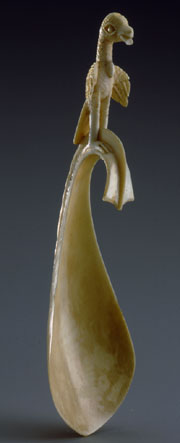
[img]http://africa.si.edu/exhibits/art/birdspn.jpg[/img] The exhibition's third section, which relates to foreign influences, contains a rare, 16th-century carved ivory spoon topped by a stylized bird. The 4-inch-high spoon is an outstanding example of the kinds of objects made for export, destined for the curiosity cabinets of Renaissance-era collectors. Spoon 16th-17th century Benin-Portugese style Edo peoples, Benin Kingdom, Nigeria Ivory 16.5 cm (6 1/2 in.) 69-20-4, bequest of Mrs. Robert Woods Bliss |
| Culture › Re: Benin Art And Architecture by PhysicsMHD(m): 6:05am On May 17, 2011 |
[img]http://africa.si.edu/exhibits/art/oba.jpg[/img] The first section of the installation comprises commemorative heads and figures dating from the 15th through the 19th centuries. One of the most striking works on view, a 16-inch-high statue of an oba from the 17th century, is depicted in the elaborate regalia of the royal court and carries a staff nearly equal to his height. Figure of a King (Oba), 19th century, Edo peoples, Benin Kingdom, Nigeria Copper alloy 41 cm (16 1/8 in.) 85-19-12, gift of Joseph H. Hirshhorn to the Smithsonian Institution in 1966 Photograph by Kathy Corday |
| Foreign Affairs › Re: Worst Country To Be A Woman by PhysicsMHD(m): 4:20am On May 17, 2011 |
Very interesting thread. Didn't know a lot of what eddy1977 mentioned. As for the original post, I don't believe the figures. |
| Politics › Re: Nigeria Denies Ex-US Envoy, Campbell, Visa by PhysicsMHD(m): 3:57am On May 17, 2011 |
An unfortunate decision. |