PhysicsQED's Posts
Nairaland Forum › PhysicsQED's Profile › PhysicsQED's Posts
1 2 3 4 5 6 7 8 ... 105 106 107 108 109 110 111 112 113 (of 154 pages)
 Culture › Re: Abstract Or Stylized African Art In Pictures by PhysicsQED(op): 12:56am On Apr 14, 2012 Culture › Re: Abstract Or Stylized African Art In Pictures by PhysicsQED(op): 12:56am On Apr 14, 2012 |
https://www.barakatgallery.com/Auction/ItemImgs/ACF5D6.jpg Unusual Urhobo Mask Origin: Niger River Delta Circa: 20 th Century AD Dimensions: 8.5" (21.6cm) high x 7.25" (18.4cm) wide Collection: African Art Medium: Wood and Reeds |
| Culture › Re: Abstract Or Stylized African Art In Pictures by PhysicsQED(op): 12:53am On Apr 14, 2012 |
https://www.africatoyou.com/photos/EG0911.jpg Urhobo Mask " Omotokpokpa " Type of Object: Face Mask Ethnic Group: Urhobo - Isoko Country of Origin: Nigeria Materials: Wood and Pigment Approximate Age: Second half 20th Century Dimensions: 20.5 inches x 8.5 inches Additional Information: A well used face mask with large hairstyle coming from the Urhobo peoples of the Niger Delta region of Nigeria that is a crossroads of shared cultural practices and artistic interactions. The downcast half-opened eyes, pointed nose, and a close mouth showing carved teeth, are hallmarks of this style of mask carving executed in. There are motifs in relief on the the temples. These markings represent scarification patterns which were prominent among the Urhobo in the 19th century. The worn off patina on this piece indicates the mask was extensively used and repainted several times. This offered mask painted in white represents a beautiful young female water spirit known as Omotokpokpa, and shows her as a bride wearing a specific crown ended with a carved head. Recommended Reading: Wittmer, M. & W. Arnett. Three Rivers of Nigeria. 1978 Anderson. M. and P. Peek, Ways of the Rivers, Art and Environment of the Niger Delta. 2002 Perkins Foss (editor), Where Gods and Mortals Meet. Continuity and Renewal. Urhobo Art. Museum of African Art, New York. Snoeck Publishers, Ghent. 2004 |
| Culture › Re: Abstract Or Stylized African Art In Pictures by PhysicsQED(op): 12:39am On Apr 14, 2012 |
[img]http://www.laportedogon.fr/thumb.ashx?ImageID=10238[/img] [img]http://www.laportedogon.fr/thumb.ashx?ImageID=10240[/img] [img]http://www.laportedogon.fr/thumb.ashx?ImageID=10239[/img] Idoma mask |
| Culture › Re: Abstract Or Stylized African Art In Pictures by PhysicsQED(op): 12:27am On Apr 14, 2012*. Modified: 12:52am On Apr 14, 2012 |
Negro_Ntns: . . . physics nice work showcasing the diversities of African art and their significance in the history and culture of our people. Do you know who wrote this narrative attributing the mask to representation of Northern muslim? That association is wrrong in several ways.Thanks. And yeah, now that you've pointed it out I see that that caption is probably off in some way. The author was one Dana Rush: http://www.kam.illinois.edu/collection/africa/BeninMask.html The individual depicted in the mask is clearly Yoruba and if she meant a Yoruba Muslim she should have said so more explicitly because "Muslim man from northern Nigeria" isn't exactly the same thing. Also, you said it was wrong in several ways. Is the claim about the significance of the seven amulets and their connection to Islam also wrong? |
| Culture › Re: Abstract Or Stylized African Art In Pictures by PhysicsQED(op): 12:23am On Apr 14, 2012 |
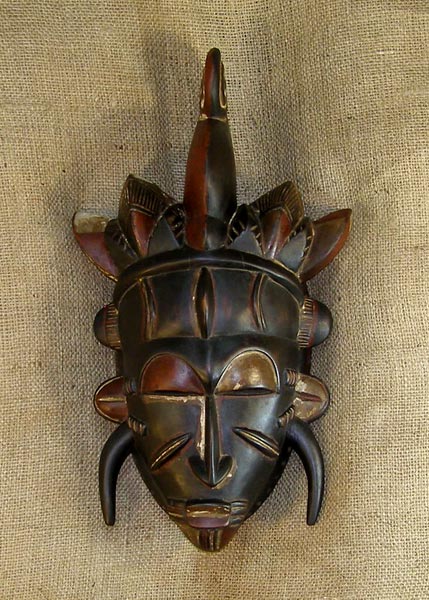
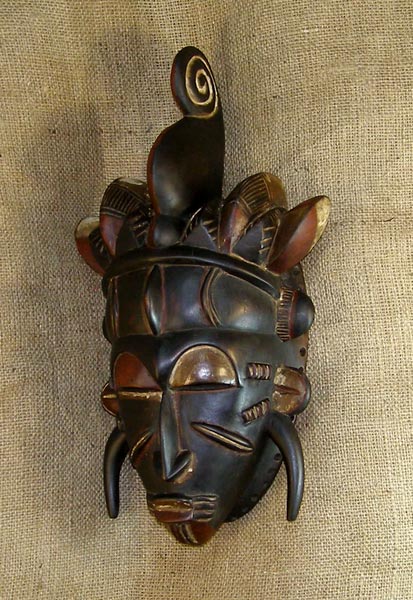
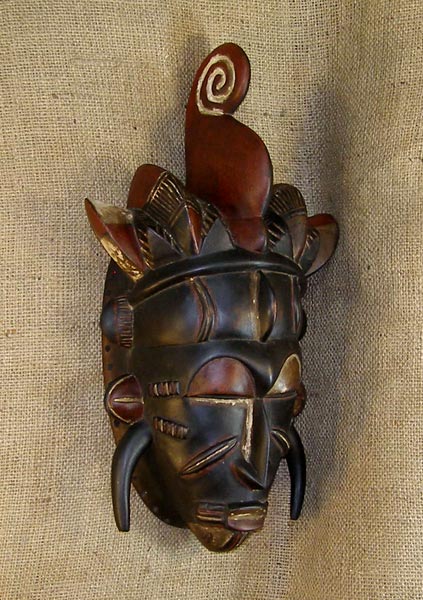
https://www.genuineafrica.com/images/Senufo/African_Masks/African-Masks-Senufo-Mask-32-Front.jpg https://www.genuineafrica.com/images/Senufo/African_Masks/African-Masks-Senufo-Mask-32-LeftA.jpg https://www.genuineafrica.com/images/Senufo/African_Masks/African-Masks-Senufo-Mask-32-RightA.jpg\ Senufo Mask, Ivory Coast |
| Culture › Re: Abstract Or Stylized African Art In Pictures by PhysicsQED(op): 12:19am On Apr 14, 2012 |
https://www.flysfo.com/web/export/sites/default/sfo_museum/images/exhibitions/previous_exhibitions/2010/helmetmasks/helmetmasks-07.jpg Mask 1950–67 Gola or Vai Liberia gumwood, stain Birds are common embellishments found on Sande masks. Noninga ta kulo lolo is a Mende saying that means "birds see far." In Mende mythology, birds have the ability to see into the future and often act as intermediaries between the human and spirit realm. Maintaining Silence and Secrecy Members of the Sande society take great pains to ensure that the masker's true identity stays hidden. For instance, "on occasions when the zooba [in Vai] is to perform, seven or eight women will enter the zoo house (where Sande masks and paraphernalia are kept), but only three or four exit, leaving some doubt as to which one is the dancer." The Sande spirit must be completely covered by the mask, clothing, and raffia so that no part of her is visible to the audience while dancing or at rest. This would tarnish the masker's embodiment of the ngafa or mystical spirit. One of the defining characteristics of the sowei mask is its silence, for it neither speaks nor is spoken to directly by the audience to emphasize its spiritual, otherworldly being. It does not communicate with ordinary mortals, nor do masked performers appear to speak to one another when there is more than one dancing. If conversation does occur, it is from the masker's attendant. Her attendant calls out the masker's presence to introduce her to the crowd so that all are aware of her presence. The dancer may carry a cane or a twig to communicate with musicians or her attendant. The gourd rattle is the traditional musical accompaniment to the masker's performance, but today, male musicians may also play instruments such as drums or slit-gongs (hollowed, log drums). |
| Culture › Re: Abstract Or Stylized African Art In Pictures by PhysicsQED(op): 12:17am On Apr 14, 2012*. Modified: 8:48am On Apr 15, 2012 |
https://www.suagacollection.com/images/large/senufo_kponyugu_1.jpg [img]http://t0.gstatic.com/images?q=tbn:ANd9GcQSB1Zl8v2rDDf0hgyzHGP-WO_TsOmqBWBUkuyTIcPo7bAankuqXPRYolWKnA[/img] The task of the Kponyugu mask is to detect and destroy negative forces and harmful spirits who in the shape of monsters or wild animals threaten people in times of crisis or vulnerability, for example during burial ceremonies. The Senufo are a farming people who live in the northern and central regions of the Ivory Coast and the southern regions of Mali and Burkino Faso. They have a vital masquerading tradition associated with various male societies including Poro. Zoomorphic masks are active among the southern Senufo in the densely populated area around the city of Korhogo. The threatening appearance of the Kponyugu befits its purpose of battling evil. Powerful jaws and sharp teeth (recalling a crocodile or hyena' snout) and tusks like those of a warthog underscore its aggressive nature. On occasions they have been said to emit swarms of wild bees or blasts of fire - after dark tinder is held in a cleft stick in front of the mouth. The mask recalls the chaos before the world was set in order. Between the horns is a hornbill and a chameleon, two of the primordal animals. The chameleon' slow and careful walk is due to the fact that he was the first creature to walk on the newly formed surface of the earth. Due to the dangerous forces they embody, masks and costumes are treated with extreme caution and kept in an isolated shelter or secret grove away from the village. The most dangerous mask is kept within the grove and the more innocuous mask on the outside or edges of it. The mask derived its power from the magical and/or medicinal substances (wah) placed in the small cup in the crown held by the two chameleons. The mask was supplemented by a costume of cotton fabric (wao, wabele) and danced to music in the context of the ceremony. Recycled glass beads are attached to the “wah†cup and cowries are attached to the ears - the holes are rounded with wear. |
| Culture › Re: Abstract Or Stylized African Art In Pictures by PhysicsQED(op): 12:12am On Apr 14, 2012 |
https://www.flysfo.com/web/export/sites/default/sfo_museum/images/exhibitions/previous_exhibitions/2010/helmetmasks/helmetmasks-01.jpg Mask 1950–67 Gola Liberia gumwood, stain Hair and the Sowei Mask Few works of African sculpture are more focused on the depiction of hairstyles than are the sowei masks of the Sande women's initiation society. The representation of hairstyles on masks from this region is among the most detailed and realistic in Africa. The hairstyle of the mask, a carefully carved representation of braided, plaited, knotted, and decorated strands of hair, takes up between one-third to one-half of the total height of the carving. Hair is a preeminent symbol of feminine beauty among members of the Sande society. An attractive head of hair is one that is thick, lush, and abundant, like "the rice in a well-tended field." Women spend hours styling each other's hair, and the process also serves as an act of social bonding. Ironically, women throughout this region commonly wear a head tie, which covers a carefully and beautifully coiffed hairstyle. The use of head ties may be due to Islamic influence; however, it is more of a social, rather than a religious convention. There are no restrictions against women showing their hair in publi |
| Culture › Re: Abstract Or Stylized African Art In Pictures by PhysicsQED(op): 12:08am On Apr 14, 2012 |
| Culture › Re: Abstract Or Stylized African Art In Pictures by PhysicsQED(op): 12:06am On Apr 14, 2012 |
| Culture › Re: Abstract Or Stylized African Art In Pictures by PhysicsQED(op): 12:04am On Apr 14, 2012 |
https://www.remnantsofritual.com/photos/024_MskSnfo.jpg Mask, Senufo; Ivory Coast Wood; H. 13 1/8" Masks such as this example were used in funerary contexts within the Poro society among the Senufo. Referred to as Kpellie or Kpeliyehe, masks of this type are danced during the Poyoro masquerade and represent beautiful women. Originally, this mask would have been part of a larger costume, with a hooded cloth cape and a red skirt made of raffia. The dancers, imitating women's delicate and graceful gestures, would dance with iron staves topped by three small bells. Though certain uniformity exists within this masking tradition, there are subtle and often graceful variations that can accent the basic structure. This example has down-turned horns and simplified, heavy volumes on its side panels. Crowned by a narrow crest, this mask harmoniously integrates the usual shapes of the standard form into a seemingly simple combination that is deceivingly complex in its balance. |
| Culture › Re: Abstract Or Stylized African Art In Pictures by PhysicsQED(op): 11:56pm On Apr 13, 2012 |
https://artenegro.com/wp-content/uploads/2009/05/dsc_4292.jpg https://artenegro.com/wp-content/uploads/2009/05/7.jpg Songye Bronze Kpelie Poro Society Mask |
| Culture › Re: Abstract Or Stylized African Art In Pictures by PhysicsQED(op): 11:43pm On Apr 13, 2012 |
https://0.tqn.com/d/cleveland/1/0/L/o/-/-/bowlbearerluba.jpg Bowl bearer. Luba, D.R.C. Wood, brass tacks, iron, beads h. 39 cm. |
| Culture › Re: Abstract Or Stylized African Art In Pictures by PhysicsQED(op): 11:19pm On Apr 13, 2012 |
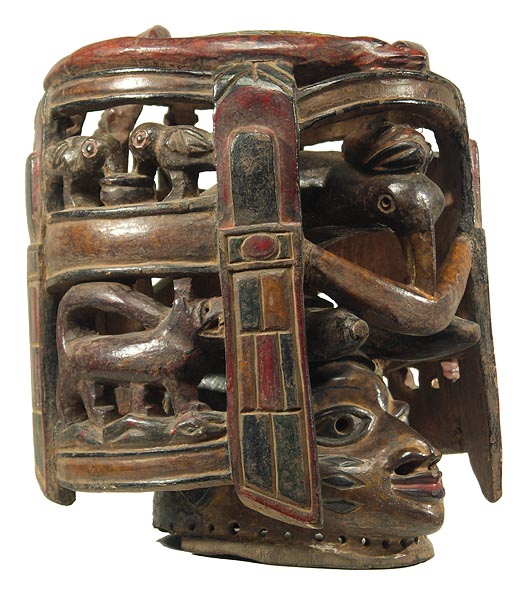
https://www.randafricanart.com/images/Yoruba_gelede_mask_snakes2.jpg "Masks like this are worn by men in elaborate masquerade performances known as "Gelede." This ritual takes place each year between March and May, at the beginning of a new agricultural season. The purpose of the performance is to pay tribute to the special power of women, both elders and ancestors, who are known affectionately as "our mothers." Women can use a spiritual life force, ase, which can be creative or destructive. When these powers are used destructively, women are called aje (witch), and, if angered, are believed to have the capacity to destroy individuals or entire communities. The masquerade provides an opportunity for "our mothers" to be placated or pampered so that they do not use their destructive powers against the Yoruba people; instead they encourage rain and fertile soil. The masks are worn at an angle on the top of the head, with pairs of men wearing similar masks. The masquerade has an elaborate and bulky costume, emphasizing the breasts and buttocks of the woman it represents, showing the desired fatness of a beautiful and graceful woman. The identity of the wearer is not secret; he can be seen through the transparent cloth worn over the face, and he can unmask in public. The name of the dancer may be given in the song which accompanies his act, making him the subject of praise or criticism, depending on the skill and rhythm of his performance. Drumming and singing, essential features of the performance, accompany the strictly choreographed dance. The harmony and balance demonstrated by good dancers shape a metaphor for social perfection, where people help one another, share their wealth and talents, and enjoy the life they have been given. The Gelede headdress often consists of two parts, a lower mask and an upper superstructure. The lower mask depicts a woman's face, its composure expressing the qualities of calmness, patience, and "coolness" desired in women. The static expression and simplicity of this portion of the headdress contrasts with vitality and diversity of the superstructure. The design of the superstructure is intended to placate the mothers by displaying their inner powers for all to see, thus pleasing them and ensuring the well-being of the community." http://www.randafricanart.com/Yoruba_gelede_mask_snake_and_birds.html |
| Culture › Re: Abstract Or Stylized African Art In Pictures by PhysicsQED(op): 11:17pm On Apr 13, 2012 |
[img]http://www.kam.illinois.edu/collection/images/african/BeninMask.jpg[/img] Mask depicting warrior hunter (Oro Efe), early 20th century Republic of Benin, Ketu-Ohori (Yoruba) Wood, pigment 15 x 13 inches An Efe-Gelede celebration is generally a two-day event in which masks are divided into those that make their appearance at night (Efe), and those that appear on the following day (Gelede). The nighttime Efe performance takes place in the market area, which is generally regarded as the economic and social realm of women. Efe-Gelede ceremonies recognize and honor the formidable powers of Yoruba female elders, referred to collectively as "our mothers." This celebration involves masqueraders, dancers, singers, and orators who impart social commentary, legend, and history through performance. A wide variety of masks are worn in Efe-Gelede performances, all of which touch on aspects of Yoruba life. Snakes, birds, tortoises, and lizards, as well as historical public figures, fashion trends, and foreigners, are frequently depicted. This Efe mask is unusual in its representation of a bearded Muslim man from northern Nigeria, distinguished by seven carved amulets (three across his forehead and four flanking his beard). These amulets signify evil-averting devices containing verses from the Qur'an, which empower the mask. There has been a strong Muslim presence in Yorubaland since the seventeenth century, and aspects of Islam have been incorporated into local religious traditions. The white color of this mask tells us that it would be danced at the nighttime Efe ceremony in order to educate and entertain the community on both secular and spiritual matters, while both placating and honoring Yoruba women. An Efe-Gelede performance exemplifies the Yoruba tradition of synthesizing the arts of mythology, poetry, sculpture, dance, and music through masquerade. Efe-Gelede is performed in times of celebration and of calamity to honor and appease the mothers. If admired and respected, the women will protect and bless the community. If neglected, they may use their supernatural powers to wreak havoc on society. Known for their beauty and athletic display, Efe-Gelede festivals honor and celebrate all women, especially mothers, a significant phenomenon in a patriarchal society. |
| Culture › Re: Abstract Or Stylized African Art In Pictures by PhysicsQED(op): 11:12pm On Apr 13, 2012 |
https://www.hurstgallery.com/exhibit/current/Yoruba/Hurst_African_9209-060t.jpg Gelede mask Yoruba, Nigeria, Kete area Wood with red paint First half 20th century Height 16 inches, Width: 10.5 inches |
| Culture › Re: Abstract Or Stylized African Art In Pictures by PhysicsQED(op): 11:10pm On Apr 13, 2012 |
| Culture › Re: Abstract Or Stylized African Art In Pictures by PhysicsQED(op): 11:07pm On Apr 13, 2012 |
emöfine2: Does it matter what era of work is posted or are you after work only from a particular period?It doesn't matter what era of work is posted. Any art from the past to the present that is abstract/stylized, African, and which you feel is beautiful in some way or another, feel free to post. |
| Culture › Re: Abstract Or Stylized African Art In Pictures by PhysicsQED(op): 11:00pm On Apr 13, 2012 |
| Culture › Re: Abstract Or Stylized African Art In Pictures by PhysicsQED(op): 10:57pm On Apr 13, 2012 |
emöfine2: ExquisiteYeah. It's beautiful. All of this art is really creative and beautiful and there's really nothing quite like it in the world. Yet we don't often see or hear about this kind of art whenever really creative art traditions are mentioned. |
| Culture › Re: Abstract Or Stylized African Art In Pictures by PhysicsQED(op): 10:55pm On Apr 13, 2012 |
https://www.malooffoundation.org/Images/DSC_3870.gif CEREMONIAL CONTAINER, “Ark of the World” Wood, pigment Africa, Mali, Dogon tribe 19th Century Among the Dogon peoples, the “ceremonial container of the ancestors” also called “ark of the world”, is kept in the lineage’s family house. It represents the ark in which the first “Nomo”, the mythical progenitor of mankind, descended to earth, along with his “sons” — four pairs of male and female twins — and everything made in heaven by Amma, the creator. This sculpted wooden container was made to be offered to the wife of the “hogon”, the religious head of the region and high priest of the cult of the Lebe. |
| Culture › Re: Abstract Or Stylized African Art In Pictures by PhysicsQED(op): 10:53pm On Apr 13, 2012 |
https://www.malooffoundation.org/Images/DSC_3910.gif ANTELOPE SCULPTURE, Tyi Wara Wood Africa, Mali, Bamana (Bambara) 19th-20th Century Closely linked to the Chi Wara, shown elsewhere in the exhibit, this sculpture is often carried or featured in the dances and ceremonies related to Ganay, god of agriculture. Today, the Bambara people have personified their reverence for the agricultural deity by referring to a good hardworking farmer as Tyi Wara. |
| Culture › Re: Abstract Or Stylized African Art In Pictures by PhysicsQED(op): 10:50pm On Apr 13, 2012 |
https://www.brooklynmuseum.org/opencollection/images/objects/size3/51.3_threequarter_SL1.jpg Reliquary Guardian Figure (Eyema-o-Byeri) Fang The Fang preserve the skulls, femurs, and vertebrae of revered ancestors in bark boxes that are protected in shrine houses. Figurative images are carved to sit on the lids of these containers to serve as guardians of the bones. These figures symbolically evoke the ancestor as well as serving as protectors of the relics. This figure's elongated torso and bulbous arms and legs, and especially the elaborate coiffure with three triangular elements that sweep back from the nape of the neck, are characteristic of a Fang master carver who lived in the Ntem River valley in the latter part of the eighteenth century and the early nineteenth. |
| Culture › Re: Abstract Or Stylized African Art In Pictures by PhysicsQED(op): 10:49pm On Apr 13, 2012 |
https://www.brooklynmuseum.org/opencollection/images/objects/size3/22.225_SL1_edited_version.jpg Mask for the Okuyi Society (Mukudj) Punu Okuyi masks are made by people throughout the Ngounie River basin of southern Gabon. They are danced in masquerades during funeral celebrations. The mask's white coloring symbolizes peace, the afterlife, and the spirits of the dead. Scarification patterns arranged into lozenges on the forehead and at each temple are known as "fish scales." Though the features of these masks are relatively naturalistic, a supernatural effect is created by bulky costumes and stilts worn by the dancer. |
| Culture › Re: Abstract Or Stylized African Art In Pictures by PhysicsQED(op): 10:48pm On Apr 13, 2012 |
https://www.brooklynmuseum.org/opencollection/images/objects/size3/77.245.1_SL1.jpg Dance Headdress (Ci-wara Kun) Bamana |
| Culture › Re: Abstract Or Stylized African Art In Pictures by PhysicsQED(op): 10:47pm On Apr 13, 2012 |
https://www.brooklynmuseum.org/opencollection/images/objects/size3/69.39.2_SL1.jpg Helmet Mask (ndoli jowei) for Sande Society Mende The ceremonies of the Sande society are the only occasions in Africa in which women customarily wear wooden masks. Masks like this one represent the society's guardian spirit at public events such as funerals or the installations of chiefs.The features of the mask illustrate the group's ideal of feminine beauty, with a broad, high forehead, small narrow eyes, and an elaborate coiffure. The elegant hairstyles also symbolize the importance of social cooperation, since a woman needs the help of her friends to dress her hair.In Sierra Leone and western Liberia, each town has a Sande society that includes all of the women in the community. It represents them and binds them together as a powerful social and political force. The Sande society is one of the most influential patrons of the visual arts in West Africa. |
| Culture › Re: Abstract Or Stylized African Art In Pictures by PhysicsQED(op): 10:45pm On Apr 13, 2012 |
https://www.brooklynmuseum.org/opencollection/images/objects/size3/77.245.2_SL1.jpg Dance Headdress (Ci-wara Kun) Bamana These headdresses, called chi wara, represent antelopes, important animals in Bamana philosophy. The antelope's power is a metaphor for the successful farmer who tirelessly tills his fields. Worn on the heads of male dancers, these headdresses are always danced in pairs, one male and one female, to symbolize the fertility of both land and animals. The headdresses are danced during agricultural festivals by each town's champion farmer, who wears them with raffia or cloth costumes. |
| Culture › Re: Abstract Or Stylized African Art In Pictures by PhysicsQED(op): 10:44pm On Apr 13, 2012 |
https://www.brooklynmuseum.org/opencollection/images/objects/size3/22.1345_SL1_edited_version.jpg Bow Stand (Nsakakabemba) Luba The great mythical hero of Luba kingship was a famous hunter whose most cherished possession was his bow. Bow stands, therefore, symbolize chiefly authority and are connected to elaborate rituals and taboos. They are never displayed in public and are guarded by a female dignitary who provides prayers and sacrifices. The female figure on this bow stand holds her hands to her chest, a gesture that refers both to the Luba idea that women guard the secrets of royalty within their breasts and to the idea of devotion to the spirit world |
| Culture › Re: Abstract Or Stylized African Art In Pictures by PhysicsQED(op): 10:42pm On Apr 13, 2012 |
https://www.brooklynmuseum.org/opencollection/images/objects/size3/1998.80.4_SL1.jpg Feast Ladle (Wunkermian) Dan Hospitality is an important virtue in African societies. Among the Dan, the woman with the greatest reputation for hospitality is known as a wunkirle. On public occasions, she carries as a staff of office a spoon known as a wunkirmian. The large bowl of the spoon suggests the ample quantities of rice she has given away. The ram's head commonly denotes power among the Dan, but it may also refer to the use of rams as sacrifices at the feasts over which a wunkirle presides. |
| Culture › Re: Abstract Or Stylized African Art In Pictures by PhysicsQED(op): 10:40pm On Apr 13, 2012 |
| Culture › Re: Abstract Or Stylized African Art In Pictures by PhysicsQED(op): 10:38pm On Apr 13, 2012 |
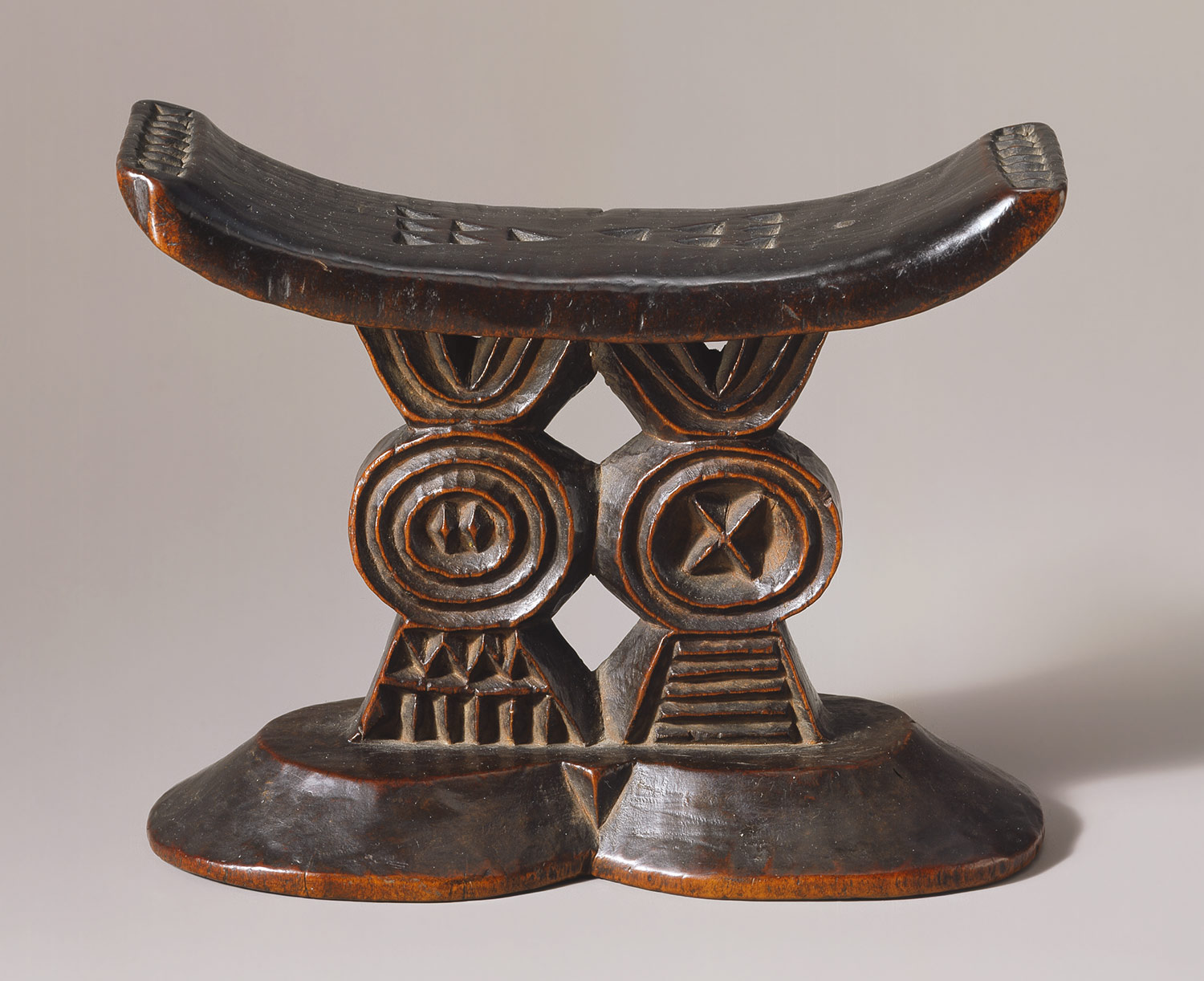
https://www.metmuseum.org/toah/images/h2/h2_2001.759.2.jpg Headrest, 19th–20th century Zimbabwe; Shona people Wood |
| Culture › Re: Abstract Or Stylized African Art In Pictures by PhysicsQED(op): 10:37pm On Apr 13, 2012 |









1 2 3 4 5 6 7 8 ... 105 106 107 108 109 110 111 112 113 (of 154 pages)