PhysicsQED's Posts
Nairaland Forum › PhysicsQED's Profile › PhysicsQED's Posts
1 2 3 4 5 6 7 8 ... 125 126 127 128 129 130 131 132 133 (of 154 pages)
 Foreign Affairs › Re: Rick Perry's Nigger-head Hunting Ground by PhysicsQED(m): 9:56am On Oct 04, 2011 Foreign Affairs › Re: Rick Perry's Nigger-head Hunting Ground by PhysicsQED(m): 9:56am On Oct 04, 2011 |
| Politics › Re: Tallest Buildings In Nigeria by PhysicsQED(m): 9:36am On Oct 04, 2011 |
^^^^ None of the buildings you listed was 520 ft. high. Furthermore, two buildings that are going to be built in Nigeria over the next few years are going to be higher than 520 ft. Maybe you should elaborate on what you meant in your post. |
| Politics › Re: Nigerians Killed Around Gaddafi’s Hometown by PhysicsQED(m): 9:33am On Oct 04, 2011 |
@ 9ja voice, I did not say that he could not have been Edo. He could possibly be from Edo north, where it seems that a few people there mix up names like that occasionally. I just said that there is no actual evidence that he is Edo. For all I know, the man could be an Igala. |
| Politics › Re: Delta State Renovates 10 Schools With N933.5m by PhysicsQED(m): 9:16am On Oct 04, 2011 |
blink182:Thanks for clearing that up. @ oritsejafordollars John Odigie Oyegun's mother was Urhobo: http://www.waado.org/organizations/uhs/debates/edowa/ekeh_edowa.html Does that mean an Urhobo man and a Deltan was governing Edo state at some point? Of course not. We don't determine ethnicity by mothers. |
| Politics › Re: Amanda Knox Freed At Last by PhysicsQED(m): 9:11am On Oct 04, 2011 |
This is fu[i]c[/i]king ridiculous. An accomplice to murder and she gets off free just by bitching and lying enough. |
| Politics › Re: Nigerians Killed Around Gaddafi’s Hometown by PhysicsQED(m): 9:02am On Oct 04, 2011 |
Spain-based Hamada Radio International monitored in Kaduna on Monday listed the three Nigerians killed as 33-year-old Ugochukwu Okafor; Emeka Aloysius Mohammed, 33; and Braimoh Robinson Garba, 30. |
| Politics › Re: Nigerians Killed Around Gaddafi’s Hometown by PhysicsQED(m): 9:01am On Oct 04, 2011 |
South-East:How do you know Braimoh Robinson Garba is Edo? Braimoh, Robinson, and Garba are not Edo names. |
| Politics › Re: Amanda Knox Freed At Last by PhysicsQED(m): 4:00am On Oct 04, 2011 |
Nonsense. |
| Politics › Re: Delta State Renovates 10 Schools With N933.5m by PhysicsQED(m): 1:37am On Oct 04, 2011 |
How on earth is Uduaghan from Esan? How was the filthy, stinking, shameless thief James Ibori set up? Inquiring minds want to know. |
| Politics › Re: Edo State Is Changing(pics). Kodus To Comrade Adams by PhysicsQED(m): 5:59pm On Oct 03, 2011 |
PhysicsQED: And why is it that whenever I come across attempts at heavy criticism of Oshiomhole, they are either illogical, unreasonable, or just downright nonfactual?I really don't understand it.  |
| Politics › Re: Genocide: The Consequence Of Ethnic Bigotry? (Hotel Rwanda) by PhysicsQED(m): 5:57pm On Oct 03, 2011 |
arsenefc = fstranger Half of what he says is purely for shock value. The other half is probably real bigotry though. |
| Culture › Re: The Art And Architecture Of Yorubaland! by PhysicsQED(m): 8:15pm On Oct 02, 2011 |
Another agere ifa figure. This one is really cool looking and also reveals what the attire of the horsemen looked like: https://catalogue.gazette-drouot.com/images/perso/full/VENTE/38/2948/cavalier_agere_ifa.jpg Estimation : 20 000 - 24 000 € Lot n°181 Yoruba, Nigeria. Coupe Agere Ifa. Cette coupe en ivoire est destinée à recevoir les noix de palmes utilisées dans les rituels de divination du culte Ifa. Le réceptacle, au bord dentelé, est disposé au sommet du crâne dÕun cavalier. Celui-ci à lÕallure guerrière est richement habillé, costume et harnachement sont sculptés avec détails. Le cavalier assis sur une selle au haut dossier protecteur, porte en main droite un bâton, la main gauche absente devait tenir la bride du cheval. Cette représentation équestre évoque les valeurs de Mesi Shango, guerrier mythique, libérateur du peuple yoruba, divinisé par la suite comme Dieu du tonnerre. LÕensemble équestre repose sur un plateau circulaire aux bords décorés dÕune ligne brisée. LÕivoire présente une patine brun rouge très foncé par endroits, et particulièrement luisante en croupe. Des gerces anciennes, expliquent les brides en cuivre qui ont été fixées à la base et en intérieur de la coupe afin dÕen limiter les effets dÕécartements. On note au dos du biceps droit un manque parallèle à la gerce principale. Ce type de coupe apparaît au début du XIX siècle évoquant et commémorant les guerriers chasseurs du XVIII siècle des seize royaumes. Région d'Owo. Dimensions : 24,5 cm de hauteur le diamètre à la base au plus fort est égale au diamètre de la partie supérieure de la coupe soit 12,5 cm cm ^^^ Don't know what any of that means, but it seems to be from the 19th century (siècle) according to the Roman numerals used. Does anyone who knows French know what it's saying above about the baton or Shango? http://www.enghien-svv.com/html/fiche.jsp?id=673074&np=1&lng=fr&npp=20&ordre=1&aff=1&r=agere+ifa |
| Culture › Re: The Art And Architecture Of Yorubaland! by PhysicsQED(m): 8:06pm On Oct 02, 2011 |
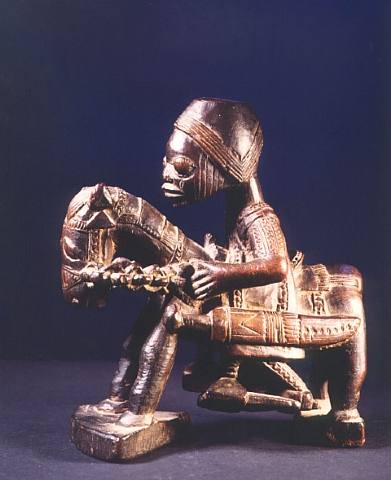
I found an interesting image of another agere ifa sculpture: [img]http://academics.smcvt.edu/africanart/Arianne%20Pictures/agere%20vessel.jpg[/img] Ifa Divination Vessel: Equestrian Warrior (Agere Ifa) Yoruba, Nigeria Wood; H. 29.5 cm (11 5/8 in.) 19th century Museum für Völkerkunde zu Leipzig Maf22514 In Yoruba culture, women and men each have their own characteristics that make them powerful. Metaphorically, women and men can be compared to containers and what needs containing. Women are vessels in more than one sense. They carry babies, and they also receive men during intimate intercourse. In this way, women have a power that men need. This is an essential concept of female power that is brought out through the art. (4) Vessels and receptacles are traditionally associated with women for two purposes: they are symbolic and actual containers, and they are reliable and productive. According to a legend, a woman named Agere was a divination deity’s wife who protected him by hiding him in her belly and also helped him by working with him. Agere containers, which are divination vessels that hold a young male initiate’s palm nuts (contain) and that are also used to ground medicines (productive), became known as such due to this woman. (4) Although associated with women, instead of images of females, the agere containers are usually carved in the form of men on horseback, like this one pictured here. (4) (4) Drewal, Margaret Thompson. Yoruba Ritual: Performers, Play, Agency. Bloomington and Indianapolis: Indiana University Press, 1992. |
| Culture › Re: The Art And Architecture Of Yorubaland! by PhysicsQED(m): 8:01pm On Oct 02, 2011 |
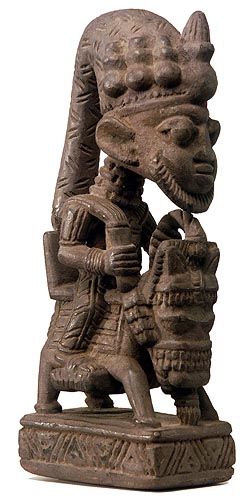
https://images.artnet.com/artwork_images/928/121507.jpg TITLE: Yoruba Horseman, (Section of an Ifa divination cup) SIZE: h: 8.2 in / h: 20.8 cm REGION: African TRIBE: Yoruba PRICE*: Contact Gallery for Price GALLERY: 310-820-9448 Send Email DESCRIPTION: Although they are objects firmly associated with ritual, Ifa divination cups, agere Ifa, have few proscriptions regarding subject matter and manner of execution. As a result they vary widely in form and representation, and have provided Yoruba carvers with a versatile sculptural type with which to test their skill and imagination. The equestrian figure, embodying as it does notions of power, of sacrifice and self-discipline, was often the subject of the agere Ifa, especially among the central and northern Yoruba carvers, where the mounted warrior was better known. The figures are said to personate Obatala (The King who is great), "The Deputy Olodumare" (or Olorun, The High God), "The Maker", "The One who deals in choice clay". Obatala is the heavenly rider, represented as a horseman or a mounted figure holding a lance or carrying a sword and scabbard. In addition, the actual process of carving, the skill and imagination of the master carver, serves as a hymn of praise to the deity. The curve of the horse's neck, the line of the rider's jaw and the bend of the foot in the stirrup give evidence of the carver's sense of figural form. The harness, reins and scabbard are finely detailed. But these skills of eye and hand are subordinated to an awareness of the unity of the work as a whole. ONLINE CATALOGUE(S): African & Asian Art LITERATURE: Drewal, Pemberton and Abiodun, Yoruba - Nine Centuries of African Art and Thought, the Centre for African Art in association with Harry N Abrams, New York, 1989. |
| Culture › Re: The Art And Architecture Of Yorubaland! by PhysicsQED(m): 7:59pm On Oct 02, 2011 |
https://www.icollector.com/images/1067/12661/12661_1595768_1_lg.jpg An impressive, beautifully rendered Agere Ifa Sculpture of a Horse and Rider Divination Cup. Mid 20th Century. Camwood and Indigo (or Rekitts Blue) coloring. Height: 15.5 inches (39.5cm), Length: 12.5 (31.5cm), Width: 5 inches (12.5cm). There are a few stable cracks, otherwise in good condition. |
| Culture › Re: The Art And Architecture Of Yorubaland! by PhysicsQED(m): 7:56pm On Oct 02, 2011 |
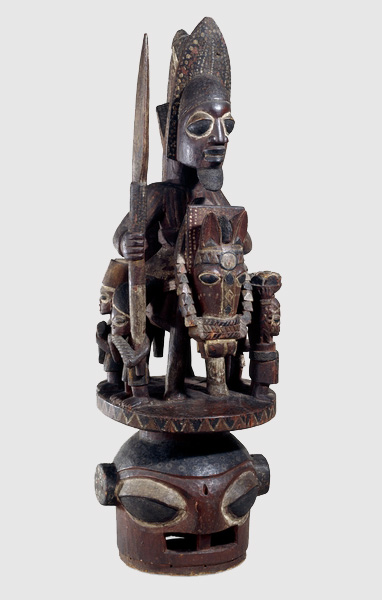
[img]http://scma.smith.edu/artmuseum/var/scma/storage/images/artists/yoruba-peoples-unknown-artist/agere-ifa/2073-1-eng-US/Agere-Ifa_large.jpg[/img] Unknown artist. Yoruba peoples, Nigerian Agere Ifa, 19th-20th century Curator‘s Comments An agere Ifa is one of the essential ritual artifacts used by divination priests. When an individual or group consults an Ifa priest with a problem, the diviner uses sixteen sacred palm nuts to “cast Ifa” and produce images for the client. This agere Ifa was carved by a master carver, and has an intricate grouping of seven figures and a horse. In the faces of the equestrian figure and the mother with child, the carver has reflected the desires of the people consulting the priest, and has provided visual expressions of hope and expectation. |
| Culture › Re: The Art And Architecture Of Yorubaland! by PhysicsQED(m): 7:49pm On Oct 02, 2011 |
https://farm3.static.flickr.com/2562/3744046465_0ca3e38b62_o.jpg Nigeria - Yoruba Epa Headdress (British Museum) Nigeria Yoruba people Probably late 19th century Possibly carved by Bamgose of Osi-Ilorin The Epa masquerade of the Yoruba peoples promotes the health and well-being of communities. Processions of masqueraders perform energetic dances which suggest higher powers of existence and the strengthening of the body. The performers jump to the top of a mound, the result of which is an omen for the community. In Opin such masks were known as aguru and were used in the post-burial rites of titled men whose status was based on personal achievement rather than lineage. The image of the mounted warrior appears regularly on Epa masks. In addition to being an image of energy and authority, it embodies memories of at least three centuries of cavalry warfare in north-central Yoruba. H.M. Cole (ed.), I am not myself: the art of ma, Los Angeles monograph series, no. 26 (Museum of Cultural History, University of California, 1985) T. Phillips (ed.), Africa, the art of a continent (London, Royal Academy, 1995) |
| Culture › Re: The Art And Architecture Of Yorubaland! by PhysicsQED(m): 7:47pm On Oct 02, 2011 |
https://www.hamillgallery.com/YORUBA/YorubaHorsemen/YorubaHorseman05s.jpg YORUBA, HORSEMAN 5, 11" Nigeria Figures were placed on altars in shrines or displayed at special ceremonies. Leaders and ancestors were often displayed on horseback to support their status as great warriors or leaders. several are depicted in colonial wear. Despite its patina, this figure shows no evidence of age or use and was probably made to be sold. |
| Culture › Re: The Art And Architecture Of Yorubaland! by PhysicsQED(m): 7:44pm On Oct 02, 2011 |
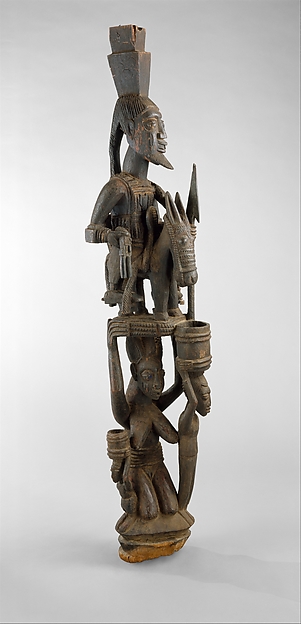
https://images.metmuseum.org/CRDImages/ao/web-large/DT4113.jpg Veranda Post: Equestrian Figure and Female Caryatid Olowe of Ise (Nigerian, born Ise, about 1873–1938) Date: before 1938 Geography: Nigeria, Yorubaland, Efon-Alaiye region Culture: Yoruba peoples, Ekiti group Medium: Wood, pigment Dimensions: H. 71 x W. 11 1/4 x D. 14 in. (180.3 x 28.6 x 35.6 cm) Classification: Wood-Architectural Credit Line: Purchase, Lila Acheson Wallace Gift, 1996 Accession Number: 1996.558 This monumental work was one of a series of carved architectural supports designed for the exterior courtyard of a Yoruba palace. It was commissioned by a king from the most renowned master sculptor in the history of Yoruba art, Olowe of Ise. The two-tiered composition embodies a formal dynamism that established Olowe's exceptional artistic reputation. Its principal personage, an equestrian warior, is depicted frontally above a female caryatid with arms raised in three-quarter view. Through this contrast in their alignment, the figures at once reflect distinct attitudes while relating to each other fluidly. The compressed style of the upper half also contrasts with the greater degree of openness below. At the base two smaller figures radiate outward at oblique angles. In addition to the inventive dynamism of their overall design, works by Olowe are noted for the attention given to surface detail. The mounted warrior holds a spear and pistol in either hand, and his vest, saddle, and horse's headgear are articulated through deeply carved linear motifs. While innovative in its formal interpretation, the subject of this work is a classic emblem of regional leadership. In Yoruba art such equestrian figures identify their patrons with martial conquest achieved through physical might. |
| Politics › Re: Delta State Renovates 10 Schools With N933.5m by PhysicsQED(m): 7:20pm On Oct 02, 2011 |
$5,911,220. For 10 primary schools and computers for these 10 schools? I think there is some huge typo in the original article or reporting. Nigerian journalism is sometimes sloppy or inaccurate. There is no country anywhere where the equivalent of 6 million U.S. dollars are needed to renovate and upgrade 10 primary schools. I don't think the Delta state government is insane, even if it might be corrupt. |
| Politics › Re: Edo State Is Changing(pics). Kodus To Comrade Adams by PhysicsQED(m): 7:10pm On Oct 02, 2011 |
asha 80:Average compared to who? And what criteria did you use to conclude that he was an average governor? Take into account the money he's working with, and how the state was when he entered it, and it'll dawn on you that in Nigeria, he's definitely one of the better governors. I think the real problem is that people don't swamp this forum posting all the projects he undertakes in his state like they do for some other states, so the extent of his effort stays under the radar despite deserving more accolades than some governors that are hyped up for no real reason. Oshiomhole is better than all but a few governors in Nigeria, so he can't be average. You don't need wikileaks or the [url=http://www.thenationonlineng.net/2011/index.php/newsextra/21303-edo-and-the-world-bank%E2%80%99s-endorsement.html]world bank[/url] to figure that out, although they paint the same picture - that he's one of the better performing governors in Nigeria. |
| Culture › Re: The Art And Architecture Of Yorubaland! by PhysicsQED(m): 6:46pm On Oct 02, 2011 |
Ah, actually I remember seeing that second horseman before. So I guess I had seen at least one Oyo horseman, actually. But that first horseman in the Owo sculpture is still just great, as far as giving us a good glance at what the military outfit of Oyo cavalrymen was like. That image should be a lot less obscure or hard to find than it is, considering how important it is. |
| Culture › Re: The Art And Architecture Of Yorubaland! by PhysicsQED(m): 6:36pm On Oct 02, 2011*. Modified: 5:45am On Nov 25, 2012 |
lakal:Yeah, I thought it represented the Attah of Idah earlier. J. Nevadomsky made a pretty convincing (to me) argument for it in his article on the horseman being the ruler of Idah, but I read another article (a 1993 article) from him published after that original article in which he corrects and changes his earlier theory and argues instead that there is strong evidence that the bronze horseman represents Oba Esigie of Benin. There are multiple horsemen figures, and not all are identical however, so it's still possible that it represents someone else. I really am kind of ecstatic to see that image you posted earlier though, because this whole time I had had to imagine what the Oyo horsemen looked like while reading about Oyo, and it was like a big, gaping hole in my knowledge that was just bothering me the whole time. A picture really is worth a thousand words. |
| Culture › Re: The Art And Architecture Of Yorubaland! by PhysicsQED(m): 5:44pm On Oct 02, 2011 |
@ lakal, I agree with you that thatch, when done well, is better than corrugated iron in appearance. I strongly dislike the look of corrugated iron on the roofs of some buildings in Nigeria. When I go back home and I see how the roofs of some of the traditional palaces of the different title holders look, I'm disappointed because I frequently see ugly corrugated iron. Of course, if the shape of the roof on a building is done creatively/artistically and the roof is painted well, like that Akaba Idena building in Ketu, then corrugated iron can still look good. |
| Culture › Re: The Art And Architecture Of Yorubaland! by PhysicsQED(m): 5:33pm On Oct 02, 2011 |
lakal:  This is awesome! Have you found any other art representing Oyo cavalry? I had been looking for some and couldn't find any. |
| Politics › Re: Edo State Is Changing(pics). Kodus To Comrade Adams by PhysicsQED(m): 5:00pm On Oct 02, 2011 |
Oshiomhole has not been there for more than three years. I don't know why that would be hard to figure out. Oshiomhole became governor in November of 2008 and by November of this year he will have been there for 3 years. Maybe the person who said he's been there for more than 3 years is living in an alternate reality. And why is it that whenever I come across attempts at heavy criticism of Oshiomhole, they are either illogical, unreasonable, or just downright nonfactual? |
| Culture › Re: The Art And Architecture Of Yorubaland! by PhysicsQED(m): 2:38pm On Oct 02, 2011 |
tpia@:  Calm down. Nobody could possibly claim Benin took precedence in Nigeria lost wax casting without evidence, and I have seen other Ife art that actually was radiocarbon dated, so that's not even the point. There's a Benin thread and I'm not interested in diluting this thread with material or information that I've already seen. I was just pointing out that that particular piece hadn't been dated to a specific time, so seeing something as specific as "12th century" as it's label doesn't make sense and is almost arbitrary. I only even mentioned Benin to admit that the same was true of many of the Benin pieces, which are also undated, other wise I wouldn't have mentioned Benin. The basis of the assigned dates for most of them both was basically Frank Willett and William Fagg's ideas about the artistic progression of certain styles over centuries; there were few radiocarbon dates. Calm down. Nobody could possibly claim Benin took precedence in Nigeria lost wax casting without evidence, and I have seen other Ife art that actually was radiocarbon dated, so that's not even the point. There's a Benin thread and I'm not interested in diluting this thread with material or information that I've already seen. I was just pointing out that that particular piece hadn't been dated to a specific time, so seeing something as specific as "12th century" as it's label doesn't make sense and is almost arbitrary. I only even mentioned Benin to admit that the same was true of many of the Benin pieces, which are also undated, other wise I wouldn't have mentioned Benin. The basis of the assigned dates for most of them both was basically Frank Willett and William Fagg's ideas about the artistic progression of certain styles over centuries; there were few radiocarbon dates. |
| Politics › Re: Delta State Renovates 10 Schools With N933.5m by PhysicsQED(m): 10:49am On Oct 02, 2011 |
wtf |
| Politics › Re: Edo State Is Changing(pics). Kodus To Comrade Adams by PhysicsQED(m): 10:39am On Oct 02, 2011 |
I don't know where people got the story that all Oshiomhole was working on was Benin city, but those people are completely deluded. |





1 2 3 4 5 6 7 8 ... 125 126 127 128 129 130 131 132 133 (of 154 pages)